
Unlock
Dutch IBAN
Rent, salary, direct debits
Netherlands · Money · Setup
Ordered money ops for your first 30 and 90 days: Dutch account, insurance, budget, tax orientation and buffers — a money-only setup checklist, not a full moving logistics list.
General orientation only — not financial, tax, insurance or legal advice. Product rules, deadlines and eligibility differ by person, employer and municipality. Verify with banks, insurers, Belastingdienst and qualified advisers before you act.

Quick answer
Once you choose a place (or while you wait for keys), money setup has an order. This guide is the money-only checklist for expats in the Netherlands: open and use a Dutch account, arrange insurance, write a budget, get tax orientation, and build buffers across the first 30 and 90 days.
It is not a full moving logistics checklist and not a documents pack list — use Moving checklist and Moving documents checklist for those. Hidden costs sizes surprise lines; Cheap cities compares place stacks; Monthly budget peers help structure the month.

Money ops file — keep these together
Examples
| Situation | How it works here | First step |
|---|---|---|
| Employed starter with salary in two weeks | Prioritise IBAN and insurance before lifestyle subscriptions | Start or complete bank onboarding with your ID pack |
| Couple sharing first Dutch bills | Agree who owns each money op on a shared calendar | Pick one shared checklist owner for week one |
| Someone mid-move with packing stress | Keep logistics on Moving checklist; keep money ops here | Separate a money tab from the packing list today |
Snapshot
Six cards cover money setup order for the first months. Deeper sections expand each op without filing your taxes for you.
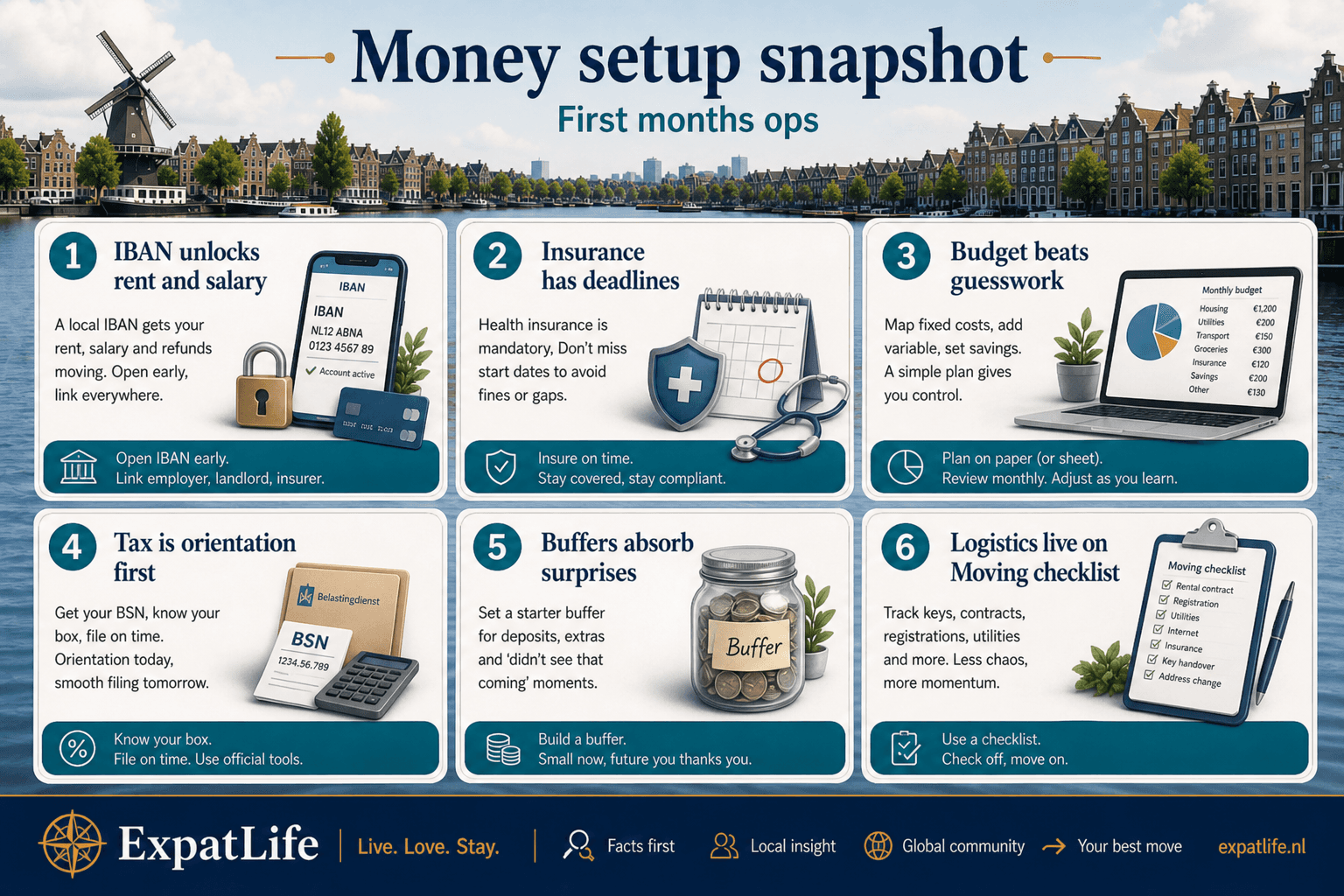
Unlock
Dutch IBAN
Rent, salary, direct debits
Protect
Insurance timing
Premium + deductible note
Plan
Written budget
Include surprise lines
Steady
Buffers
30 / 90 day calm
Ordered money setup for account, insurance, budget, tax orientation and buffers across 30 and 90 days.
Not a moving logistics list, not a documents checklist, not a tax filing portal.
Rent and salary need an IBAN; insurance has timing; budgets fail without surprise lines.
Size deposits, eigen risico and municipal lines on Hidden costs, then tick setup here.
If you are still comparing places, run stacks on Cheap cities — then return for setup order.
Monthly budget and Saving money peers help after the checklist is underway.
Definition
This is a money-ops checklist for newcomers: the sequence of banking, insurance, budgeting, tax orientation and buffers. Moving checklists cover logistics; documents checklists cover paperwork packs. Tax guides explain systems — this page only orients you to open the right bookmarks at the right time.
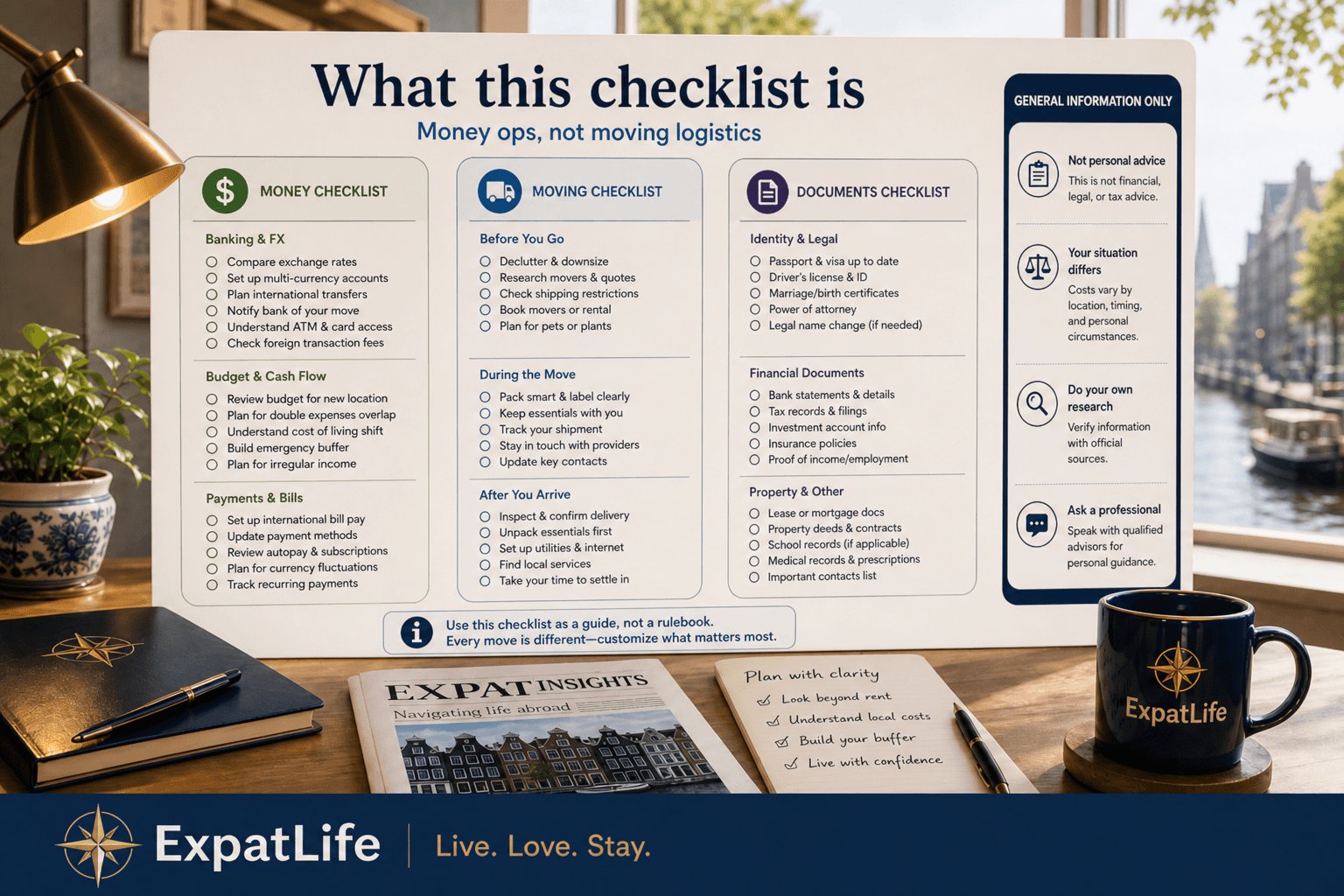
Boundary habits
If the task is boxes, keys or municipality appointments, use Moving checklist. If the task is IBAN, premium or buffer, stay here.
We sequence common money jobs. Your employer, bank and insurer set the real rules.
Documents checklist owns IDs and forms packs. Mixing it into money ops creates noise.
Cheap cities → place math. Hidden costs → surprise lines. This page → setup order.
First 30 days
Week-by-week, keep money jobs small and sequenced. Exact calendar dates depend on your arrival and employment start — use this as a priority order.
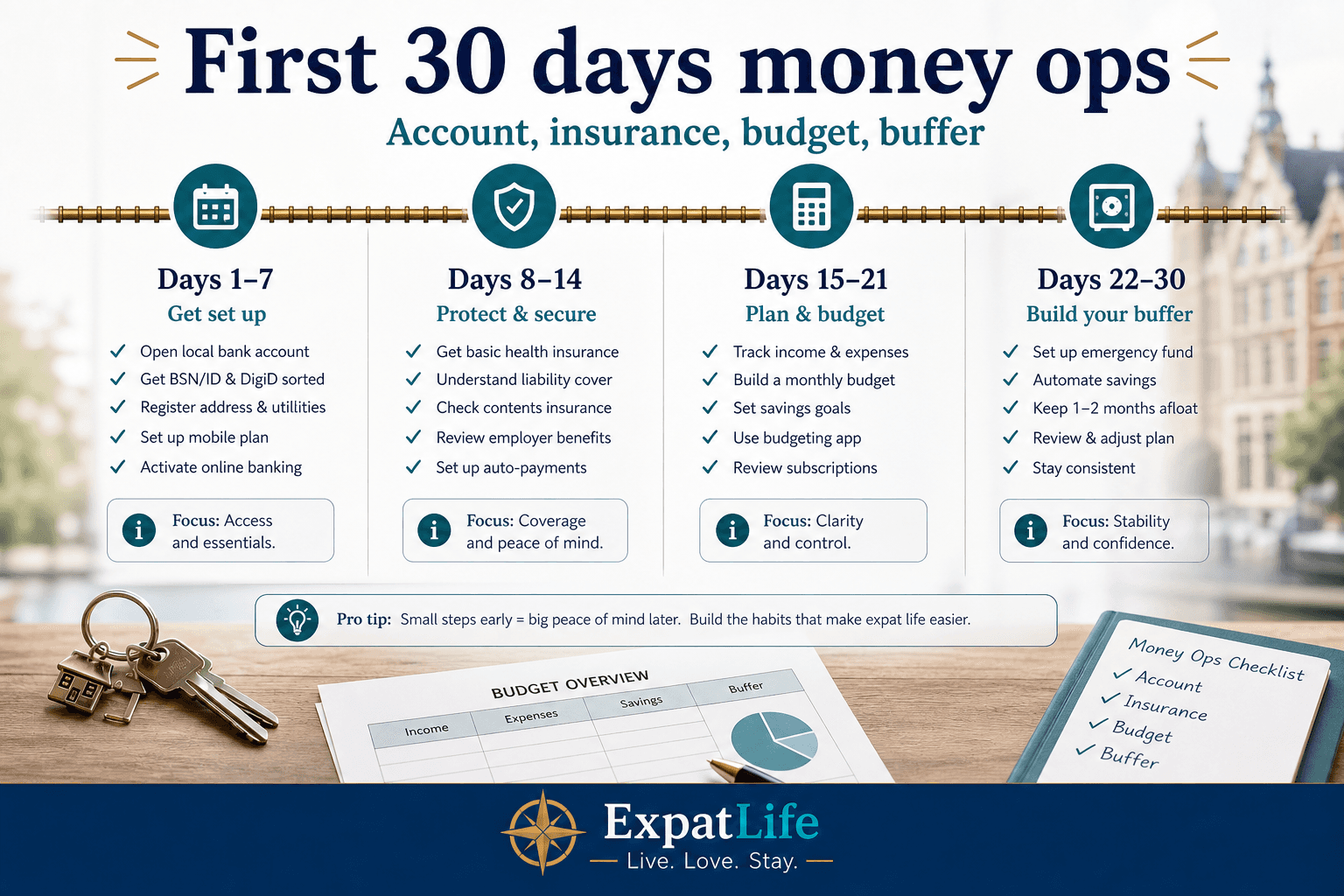
30-day priorities
| Window | Focus | Practical tip |
|---|---|---|
| Days 1–7 | Account access + cash control | IBAN for landlord and employer; app security on |
| Days 8–14 | Insurance timing | Premium + eigen risico note on one sheet |
| Days 15–21 | Budget v1 | Income, fixed bills, everyday, surprises, buffer |
| Days 22–30 | Buffers + letters | Municipal folder; starter buffer parked |
A rough budget with a buffer beats waiting until every invoice arrives.
If first salary is weeks away, size cash from Hidden costs move-in totals first.
In couples, assign a checklist owner so tasks do not bounce.
Keep municipality appointments on Moving checklist so money ops stay visible.
Days 31–90
After the scramble, improve the system: salary rhythm, budget categories, tax bookmarks, and habits for FX and saving.

90-day priorities
| Window | Focus | Practical tip |
|---|---|---|
| Days 31–45 | Salary + direct debit review | Check names, amounts and dates match your plan |
| Days 46–60 | Budget v2 | Adjust categories using real Dutch weeks |
| Days 61–75 | Tax orientation | Bookmark tax guide / residency / return pages |
| Days 76–90 | Habits | FX route + saving money peer habits |
Update the same budget sheet — do not throw it away each month.
Know payroll vs return concepts before you chase every detail.
Use Saving money peers once fixed bills and buffers are visible.
If a move is still open, re-run Cheap cities stacks with real Dutch numbers.
Banking
A Dutch IBAN is the unlock for rent, salary and most direct debits. Onboarding rules depend on residency status, BSN timing and the bank’s product — verify on the bank’s site and Banking hub guides.
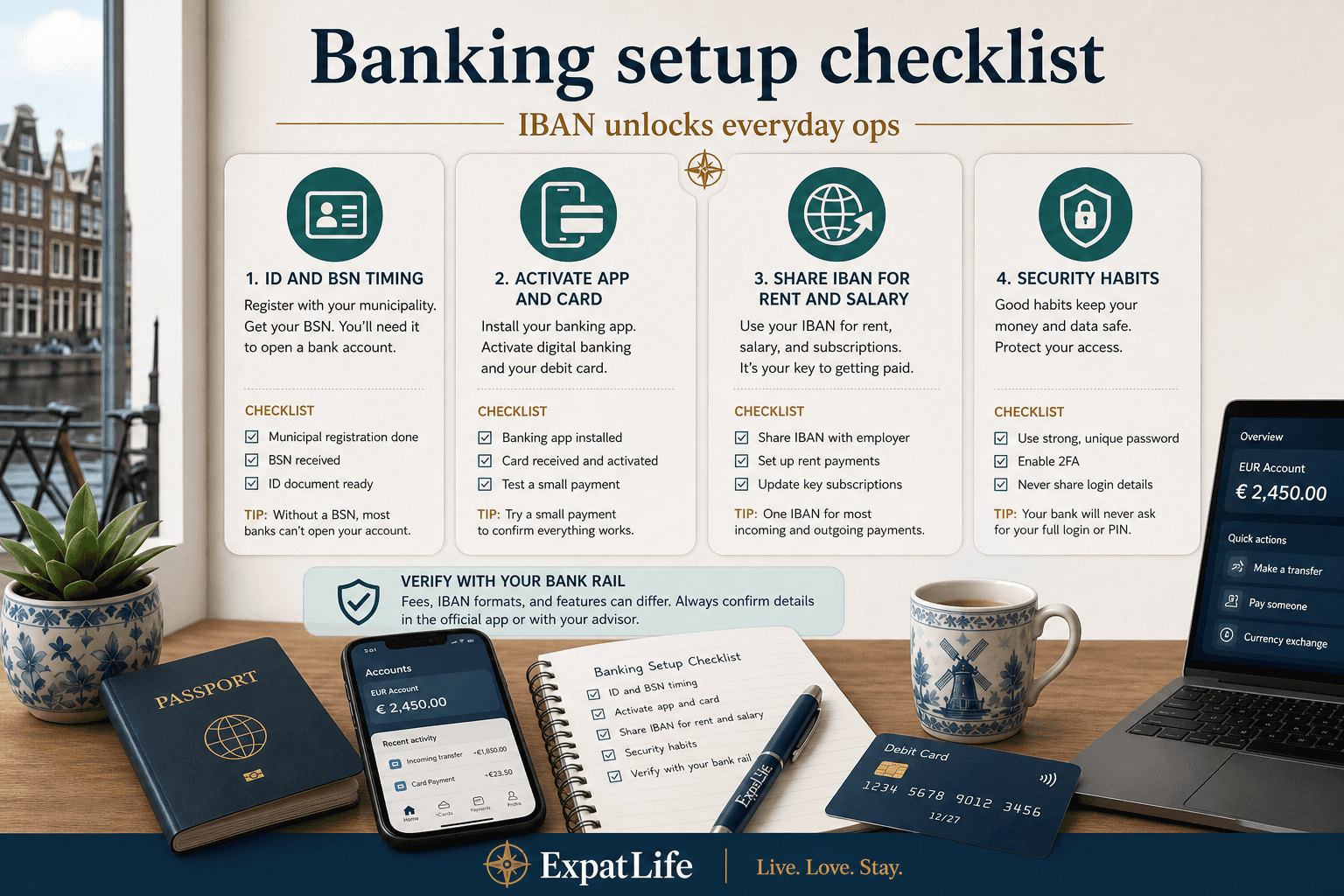
Banking setup habits
Many landlords and employers expect a Dutch account. Delaying creates payment friction.
A working everyday account beats endless fee comparisons in week one — refine later via Banking guides.
If relevant, open the specialist banking guides after the primary IBAN works.
Use Open bank account and Banking hub for how-to depth — this section stays on checklist order.
Insurance
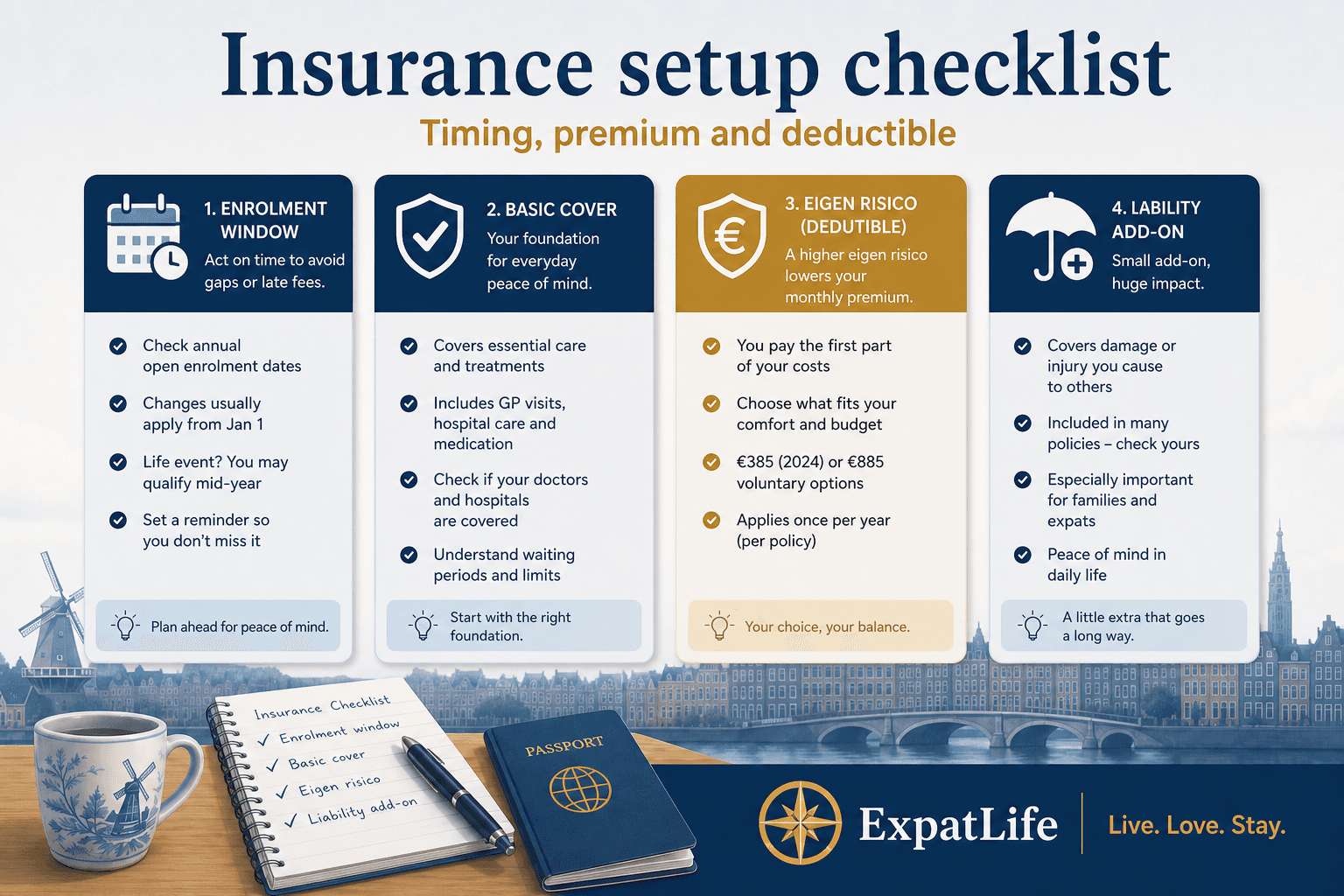
Health insurance timing is one of the highest-stakes money ops after arrival. Add deductible awareness and consider liability cover. Confirm current enrolment rules — they are not static forever.
Insurance setup habits
Missing insurance timing can create stress and back-dated premiums — treat it as a dated checklist item.
Keep eigen risico on the same sheet — Hidden costs explains the surprise framing.
Liability is a small monthly line that prevents large personal claim shocks.
Health insurance guide owns system explanation — this section owns setup order.
Budget
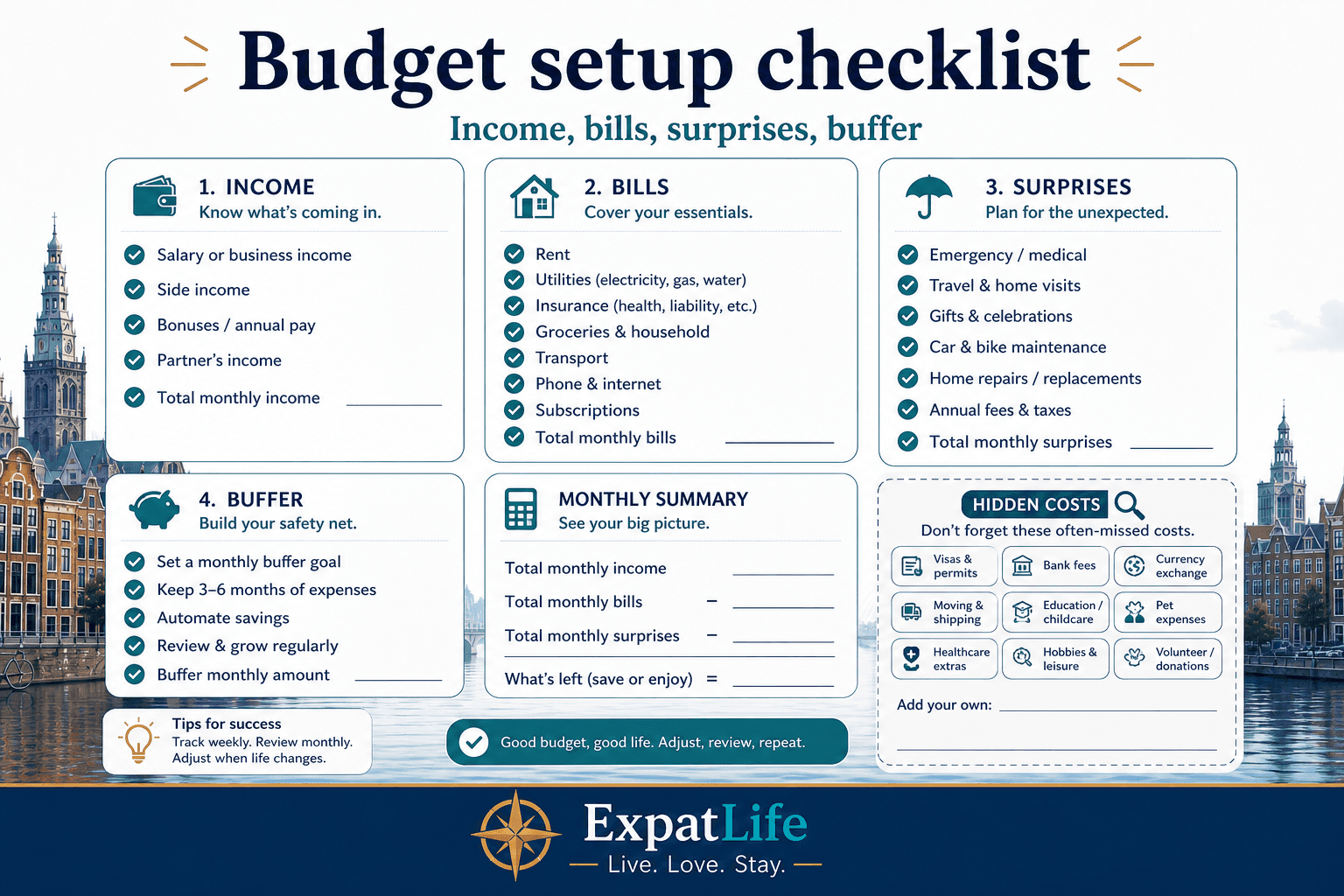
Write income, fixed bills, everyday spend, Hidden costs surprise lines and a buffer. Tools help — a sheet you reopen weekly matters more than a perfect template on day one.
Budget setup habits
First 30 days: rough and complete. Days 31–90: refine with real receipts.
Keep one living document — do not scatter budgets across chats.
Monthly budget peers help structure categories; Saving money peers help after clarity.
Cost of living calculator is useful when household assumptions are still settling.
Tax orientation
In the first 90 days, most expats need a map: payroll withholding vs annual return, where to read about residency and common allowances, and when complexity suggests an adviser. This is orientation — not a filing checklist you complete on this page.

Tax orientation habits
Know the difference between payroll and the annual return before you chase every form name.
Tax and allowance letters are money ops — open, translate, diary.
We will not calculate your return here. Use tax guides and official tools.
Many return tasks sit later in the year — orientation in days 61–90 still prevents surprises.
Buffers
Buffers are planned cash for known unknowns: leftover move-in friction, eigen risico, municipal letters, and uneven first months. Separate them from lifestyle spend so they survive payday temptation.

Buffer habits
Even a modest amount reduces panic when an unexpected Dutch invoice arrives.
Label sub-buffers (insurance, municipal, travel FX) if that helps you not raid them.
Use Hidden costs bands to size what “modest” means for your household.
True savings goals sit on top of buffers — Saving money peers help once ops are stable.
Situations
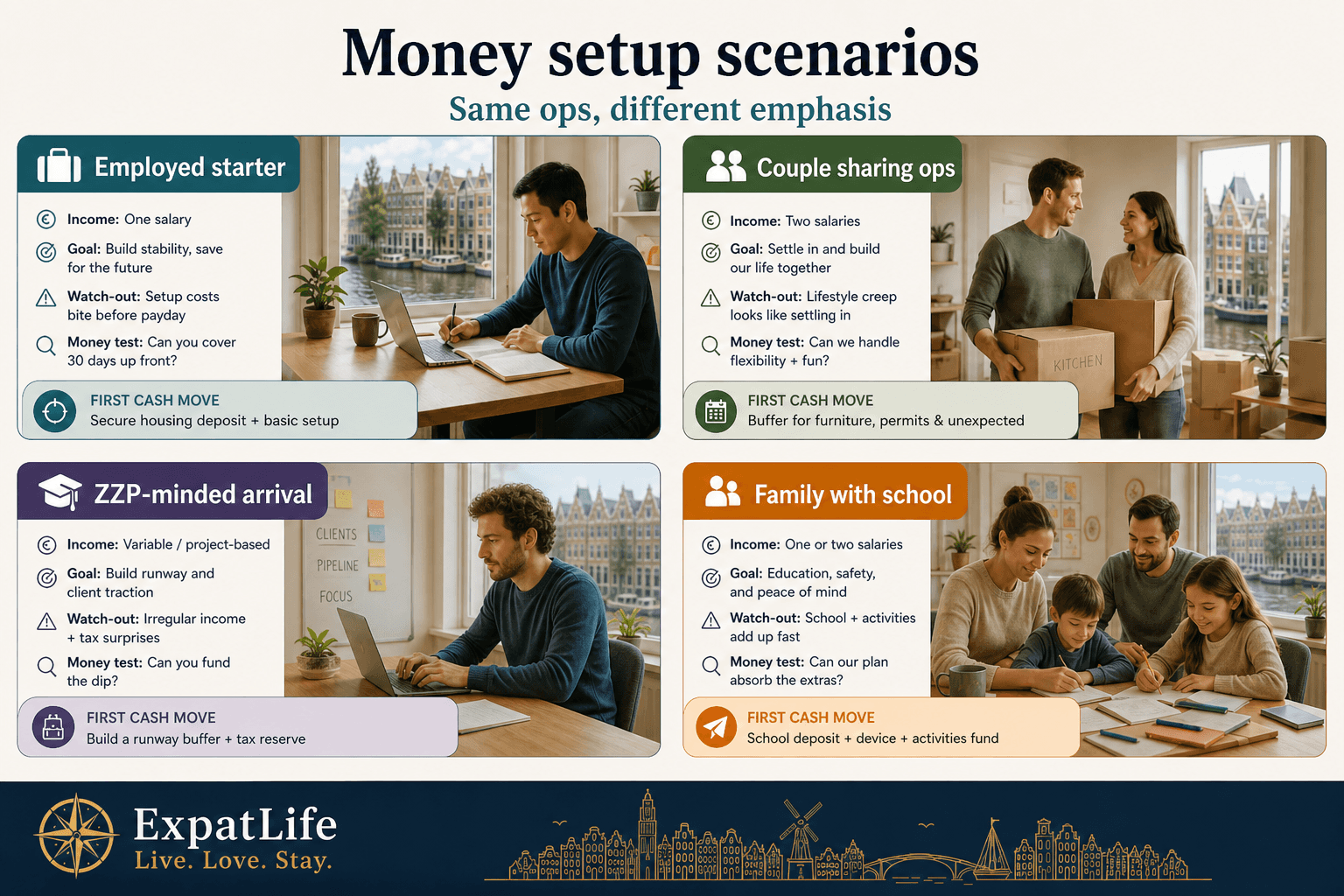
Same ops, different order emphasis. Pick the closest story, then complete the full checklist.
Examples
| Situation | How it works here | First step |
|---|---|---|
| Employed starter | IBAN and insurance before subscriptions | Finish bank onboarding with ID pack |
| Couple sharing ops | One shared calendar with clear owners | Assign banking vs insurance owners for week one |
| ZZP-minded arrival | Personal IBAN first; business money later | Stabilise personal account and insurance before entity setup |
| Family with school | Budget extras early; buffers include family drift | Add school/childcare extras line to budget v1 |
Avoid
These patterns delay stability. Each has a calmer fix — orientation only.
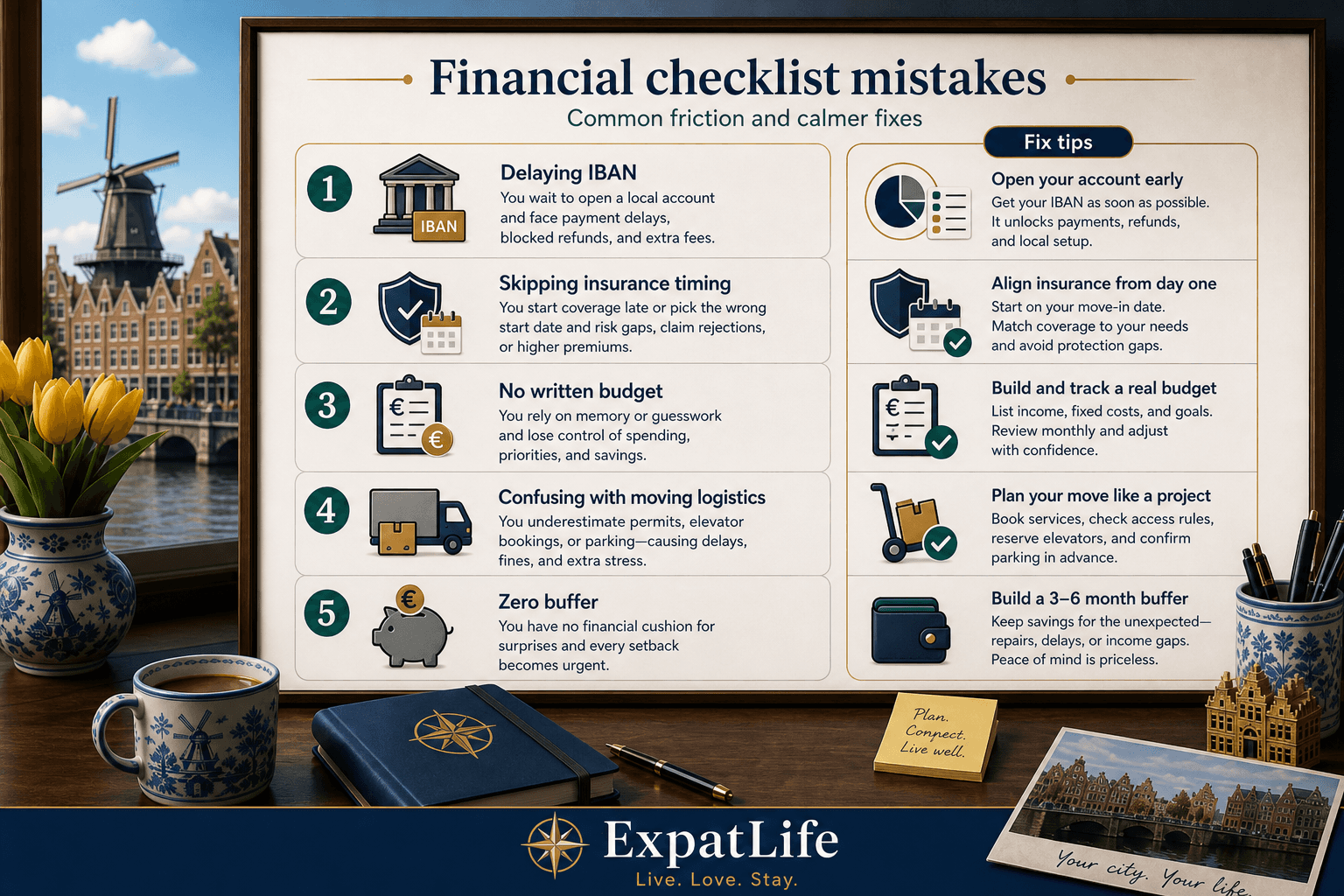
Rent and salary friction stacks quickly without a Dutch account.
Fix: Prioritise onboarding in the first week you can.
Deadlines and back-dated premiums create avoidable stress.
Fix: Put enrolment on a dated checklist item immediately.
Mental maths fails when Dutch invoices arrive in clusters.
Fix: Write v1 in week three even if numbers are rough.
Packing lists bury money ops until something bounces.
Fix: Keep a separate money checklist tab.
First municipal or care invoice becomes an emergency.
Fix: Park a starter buffer after move-in cash.
Full list
Use this as your money ops board for the first 90 days. Tick in order where you can — parallel tracks are fine when owners differ.

Financial checklist board
How-to
Follow these orientation steps to sequence money ops — then verify bank, insurer and tax rules with official sources.
Step 1
Keep Moving checklist for appointments and packing; keep this list for money.
Step 2
Complete onboarding and share IBAN for rent and salary as appropriate.
Step 3
Enrol or diary enrolment; note premium and deductible together.
Step 4
Pull categories from Cost of living and Hidden costs; add a buffer.
Step 5
Bookmark tax guides, fund buffers, then refine budget and habits in days 31–90.
Tools
Use tools while assumptions settle — then verify live banking, insurance and budget numbers.
FAQ
Short answers for the searches expats ask most often about money setup in the first 30 and 90 days.
Typically: Dutch account access, insurance enrolment with deductible awareness, a written budget including surprise lines, tax orientation bookmarks, and starter buffers across the first 30/90 days.
No. Moving checklist covers logistics. Moving documents checklist covers paperwork packs. This page is money-only setup order.
Prioritise IBAN access, insurance timing, a simple budget, and a starter buffer. Exact dates depend on your arrival and job start.
Payroll happens via your employer when employed. Use the first 90 days to build orientation and bookmarks; annual return tasks often sit later. This page does not file a return.
Hidden costs sizes surprise lines (deposits, eigen risico, municipal taxes, FX, family extras). This checklist sequences the money ops that absorb those lines.
No. Write a complete rough v1, then refine with real Dutch weeks by day 90.
No. General orientation only. Verify banking, insurance and tax steps with official sources and qualified help when needed.
Related
Cluster siblings, banking/tax guides, and moving boundary peers stay linkable without comingSoon labels.
Hub
Return to the Money hub or jump to Cheap cities, Hidden costs, Banking and Tax guides.
Explore next
Size surprise lines, compare place stacks, or deepen banking and insurance next.
Trust
Confirm banking, insurance and tax steps with current official sources — this page is orientation only.
Some links on this page may be affiliate or referral links. If you use them, we may earn a commission at no extra cost to you. Affiliate status never changes banking, insurance or tax rules.