
Housing
Usually #1 driver
City premium swings totals most
Netherlands · Money · Cost of living
What actually drives Dutch living costs in 2026 — housing, insurance, groceries, transport and childcare — with indicative lifestyle and city bands, and a clear way to use the figures without treating them as quotes.
General orientation only — not personal financial advice. Euro figures on this page are indicative 2026 planning ranges for newcomers, not quotes, guarantees or offers. Your rent, household size, city and lifestyle can move totals a lot. Confirm live prices with landlords, insurers, providers and your own budget.

Quick answer
Cost of living in the Netherlands is driven less by coffee prices and more by housing, mandatory health insurance, and how you get around. Expats who plan only on “average monthly spend” lists often miss deposit cash, eigen risico, or the jump from a shared flat to a family home.
This guide is the orientation layer: what typically moves the total, how city and lifestyle bands differ, and how to read indicative 2026 euro figures without treating them as quotes. For interactive estimates, use the cost-of-living calculator. For a month-by-month template, use the monthly budget sibling. For cutting spend later, use the saving-money sibling.

Cost-of-living planning file — keep these together
Examples
| Situation | How it works here | First step |
|---|---|---|
| Offer in hand, undecided city | Model rent first for two cities, then insurance and transport — keep lifestyle constant so the comparison is fair. | Open the calculator with the same household size in both cities. |
| Couple moving to a Randstad core | Expect housing to lead; decide early whether one salary must cover rent alone for a buffer month. | Write a housing stack: rent + utilities + deposit cash. |
| Family with daycare needs | Treat childcare as a primary driver beside rent — not a footnote after groceries. | Sketch weekly care hours, then read the childcare allowance orientation guide. |
Snapshot
Six cards summarise what usually moves a Dutch monthly total. Deeper sections expand each driver with indicative 2026 planning bands.

Housing
Usually #1 driver
City premium swings totals most
Health insurance
Fixed monthly line
Premium + deductible buffer
2026 figures
Planning ranges
Not quotes or guarantees
Next step
Calculator + net pay
Stress-test before you sign
Rent, utilities and move-in cash usually decide whether an offer feels workable — more than coffee or phone plans.
Most residents need basic health insurance. Budget the premium and keep a deductible buffer separate from optional extras.
Dining out, travel and subscriptions turn a modest band into a comfortable one quickly — especially in city centres.
The same household can look very different in Amsterdam versus a secondary city once rent is honest.
Dual-working parents often find daycare or BSO hours reshape the whole monthly picture.
This page frames drivers; the calculator estimates; the budget sibling templates a month; saving covers levers.
Drivers
Think in stacks, not a single “average cost of living” number. Housing sits at the centre; insurance and groceries are steadier; transport, childcare and lifestyle stretch the edges.

Driver stack
Rent and insurance behave like fixed lines once chosen. Groceries and dining are flexible — but habits stick.
Deposits, agency fees and first furniture buys are cash events. Do not fold them into a “monthly average” without labelling them.
Job offers are often discussed in gross. Your rent is paid from net. Stress-test with the net salary tools.
A single studio total is not half a family total. Always match household size when you compare bands.
Housing
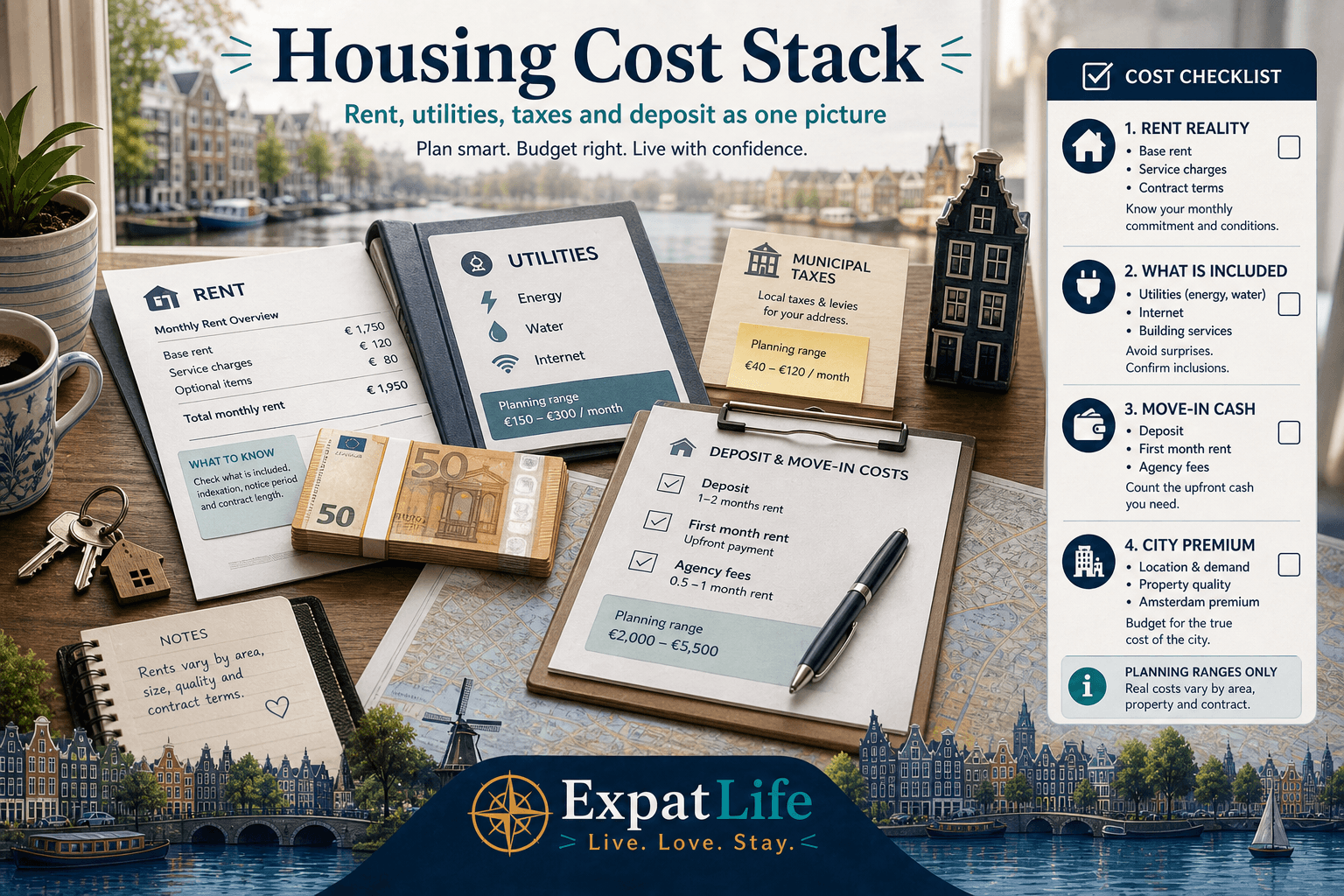
For most newcomers, housing decides the monthly story. Treat rent, utilities and move-in cash as one stack. City choice and housing type (studio, shared, family flat) matter more than small grocery savings.
Housing habits
If the rent line already consumes most of net pay, lifestyle cuts rarely fix the plan — revisit city, household or offer.
“All-in” marketing can still exclude internet, municipal taxes or final energy settlements.
Deposit plus first month can equal two or three rents before you buy a mattress. Label it as cash, not monthly burn.
| Cost line | Indicative 2026 band | Practical tip |
|---|---|---|
| Shared room / student-style (secondary city) | Often roughly €450–€800 / month rent (planning) | Availability and contracts vary widely — verify listings. |
| Studio / 1-bed (many cities outside Amsterdam core) | Often roughly €950–€1,600 / month rent (planning) | Furniture, energy and service costs may sit on top. |
| 1–2 bed in Amsterdam / prime Randstad | Often roughly €1,600–€2,800+ / month rent (planning) | Competition is high; buffer for viewings and deposits. |
| Utilities + internet (typical household) | Often roughly €150–€280 / month combined (planning) | Energy contracts and insulation swing this hard. |
Insurance
Most residents need basic Dutch health insurance. Budget the monthly premium and keep a separate buffer for the mandatory deductible (eigen risico). Optional dental, physio extras, liability and household cover sit on top.

Insurance habits
A slightly cheaper premium with the same deductible still leaves you exposed to care costs — plan both lines.
Some households may qualify for healthcare allowance (zorgtoeslag) — that is a separate tax/benefit pathway, not a reason to skip insurance.
This guide does not recommend insurers. Use the health insurance guides and official sources to compare.
| Cost line | Indicative 2026 band | Practical tip |
|---|---|---|
| Basic health insurance premium (adult) | Often roughly €140–€170 / month (2026 planning) | Compare policies on official comparison routes — not rankings on this page. |
| Eigen risico buffer | Up to the annual mandatory deductible (commonly discussed around €385) | Treat as a cash buffer, not a monthly average unless you spread it deliberately. |
| Optional extras + liability (light) | Often roughly €15–€50+ / month depending on cover | Extras are personal — dental and physio needs vary. |
Groceries
Dutch supermarket costs are usually manageable compared with rent. What stretches the food line is dining out, specialty imports and convenience habits — not whether you occasionally buy coffee.

Food & shopping habits
A solid supermarket basket is predictable. Weekend brunch culture is a lifestyle choice — label it that way in your plan.
Favourite home-country brands and specialty shops can quietly add tens of euros a week.
| Cost line | Indicative 2026 band | Practical tip |
|---|---|---|
| Single — mostly home cooking | Often roughly €200–€320 / month (planning) | Alcohol, specialty diets and waste habits move this. |
| Couple — mixed home cooking | Often roughly €350–€550 / month (planning) | Shared bulk buys help; dining out is separate. |
| Dining out / cafés uplift | Easily +€100–€400+ / month depending on habit | Track two weeks of receipts before you set a lifestyle band. |
Transport
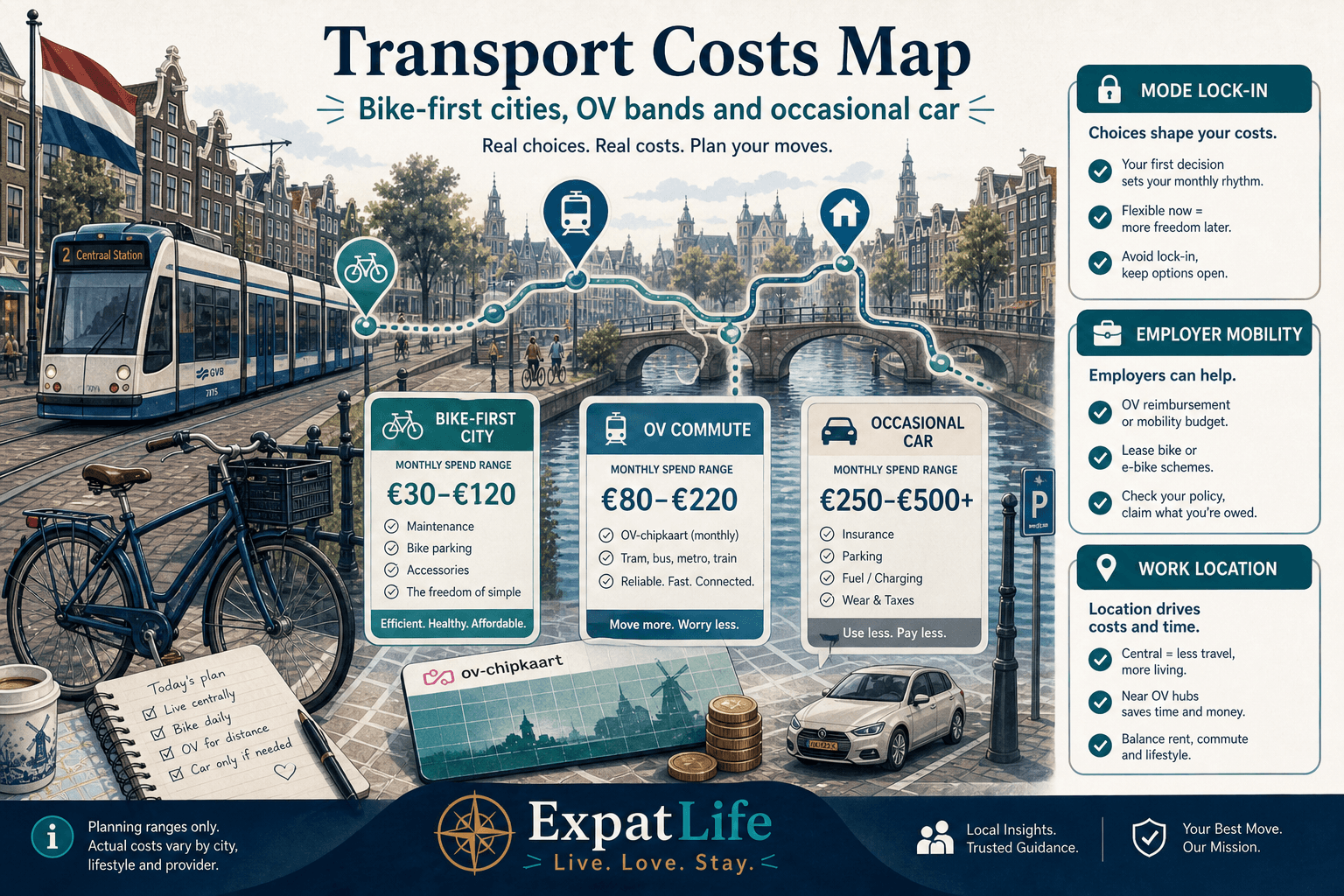
Many expats in Dutch cities live bike-first with occasional trains and buses. That keeps monthly transport modest. Owning a car (insurance, parking, fuel, maintenance) is a different cost-of-living tier.
Getting-around habits
Once you choose car-based living, renting farther out can look cheaper until parking and time costs appear.
A hybrid office pattern can cut OV dramatically — remodel when your schedule is clear.
| Cost line | Indicative 2026 band | Practical tip |
|---|---|---|
| Bike-first + occasional OV (city) | Often roughly €30–€120 / month (planning) | Plus a one-off decent bike if you do not have one. |
| Regular OV commute (no car) | Often roughly €80–€220 / month (planning) | Season tickets and employer cards change this. |
| Car ownership (city-adjacent) | Often roughly €250–€500+ / month all-in (planning) | Insurance, parking, fuel, maintenance, tax — verify locally. |
Childcare
If you need daycare or after-school care (BSO), treat it as a primary driver. Hourly rates and weekly hours can push family totals near or above the rent line — especially before any allowance is applied.

Family cost habits
Dual careers often make childcare non-optional. Put it beside rent in your first draft, not under “misc”.
Kinderopvangtoeslag has rules. This page flags the cost driver; the tax guide covers the benefit pathway.
| Cost line | Indicative 2026 band | Practical tip |
|---|---|---|
| Part-time daycare (illustrative) | Can run hundreds of euros per month before allowance | Get a written hours quote from a registered provider. |
| Full-time daycare for one child (illustrative) | Can approach or exceed a modest rent line before allowance | Model with and without expected allowance — never assume approval. |
Banking
Rent, insurance and childcare direct debits need a workable euro account. Soft CTAs only — confirm fees, onboarding and eligibility on each bank’s site.
City bands
These bands are planning frames for newcomers — not quotes. They assume rent is the main swing factor. “Modest” means careful dining and bike/OV; “comfortable” allows more eating out and flexibility. Always re-check with live listings and the calculator.

City framing habits
The gap is mostly dining, travel and housing quality — not whether you buy store-brand pasta.
Add a clear childcare and larger-home line before you reuse a couple band for a family plan.
A national “Netherlands average” hides both Amsterdam studios and quieter provincial rents.
| City frame | Single · modest (planning) | Couple · comfortable (planning) | Note |
|---|---|---|---|
| Amsterdam | Often roughly €2,200–€3,000+ / mo | Often roughly €3,800–€5,500+ / mo | Rent-led premium; verify listings neighbourhood by neighbourhood. |
| Rotterdam / The Hague | Often roughly €1,900–€2,700 / mo | Often roughly €3,300–€4,800 / mo | Still housing-sensitive; pockets vary widely. |
| Utrecht | Often roughly €2,000–€2,800 / mo | Often roughly €3,500–€5,000 / mo | Tight market; commute trade-offs vs Amsterdam common. |
| Eindhoven & many secondary cities | Often roughly €1,700–€2,400 / mo | Often roughly €2,900–€4,200 / mo | Housing often softer; confirm tech-hub demand locally. |
How to read
Indicative bands help you plan relocation and offers. They fail when you treat them as invoices, mix gross with net, or compare unlike households. Use the rules below before you make a lease or salary decision.

Reading rules
A band like “often roughly €X–€Y” is for orientation. It is not a landlord quote or insurer offer.
If rent + insurance + basics already exceed a safe share of net pay, lifestyle optimism will not rescue the plan.
Deposits, flights, furniture and agency fees belong on a separate arrival cash list.
Monthly budget owns the category template; saving money owns levers; the calculator owns interactive estimates.
Step 1
City, adults, children, work pattern, transport mode.
Step 2
Rent from real listings + utilities + deposit cash.
Step 3
Health insurance premium, deductible buffer, transport.
Step 4
Modest vs comfortable dining and subscriptions — be honest.
Step 5
Compare to net pay and run the cost-of-living calculator.
Calculator
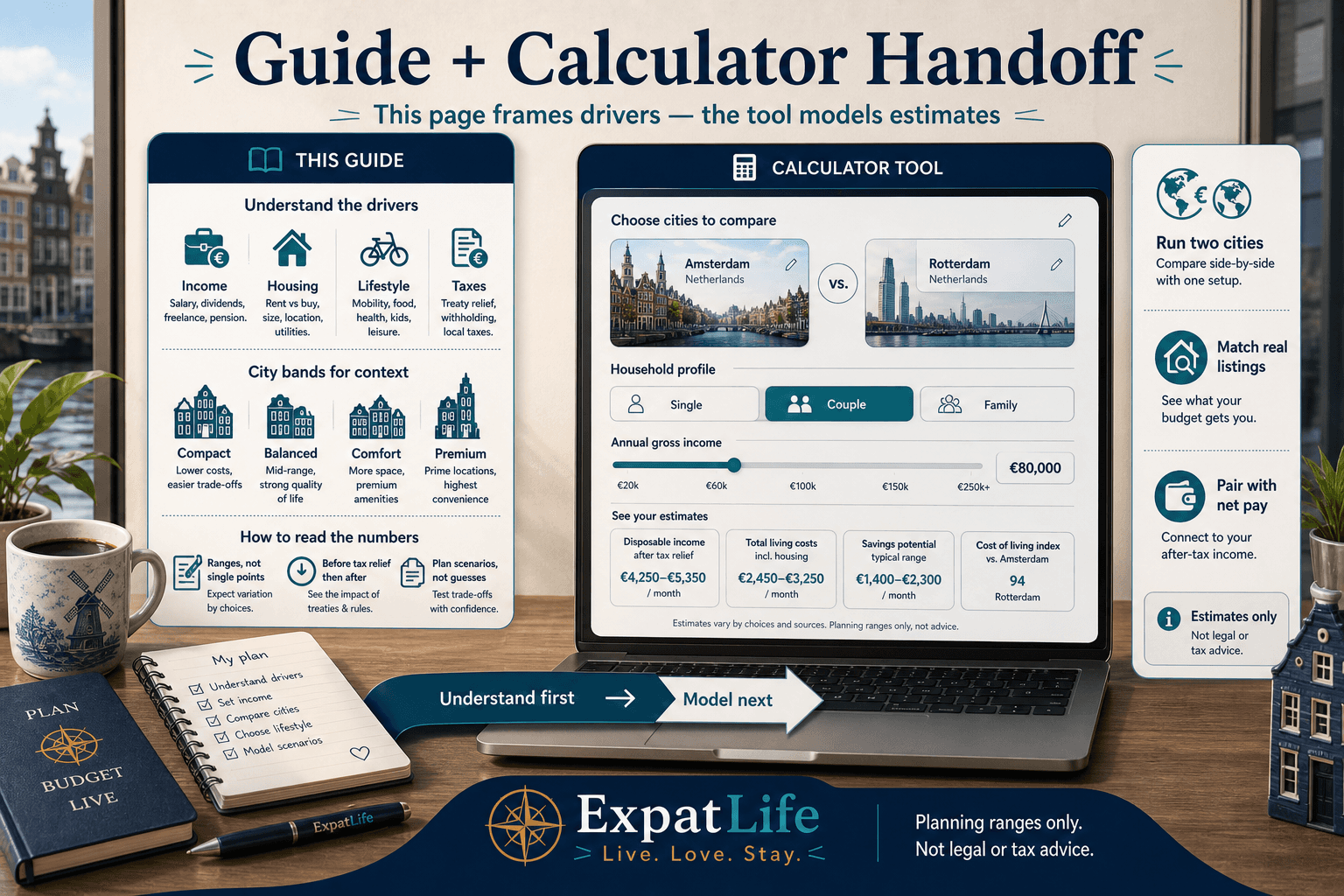
This cornerstone explains drivers and how to read numbers. The interactive calculator is where you model city, household and category estimates. Cross-link heavily — do not treat either page as a substitute for the other.
Calculator habits
Guide = meaning and framing. Tool = interactive estimates. Budget sibling = monthly template. Saving sibling = levers.
Bring a calculator scenario and a rent listing printout — more persuasive than a vague “Amsterdam is expensive”.
Primary tool handoff
Open the interactive cost-of-living calculator with the same city and household assumptions you used on this page.
Open cost of living calculatorSituations
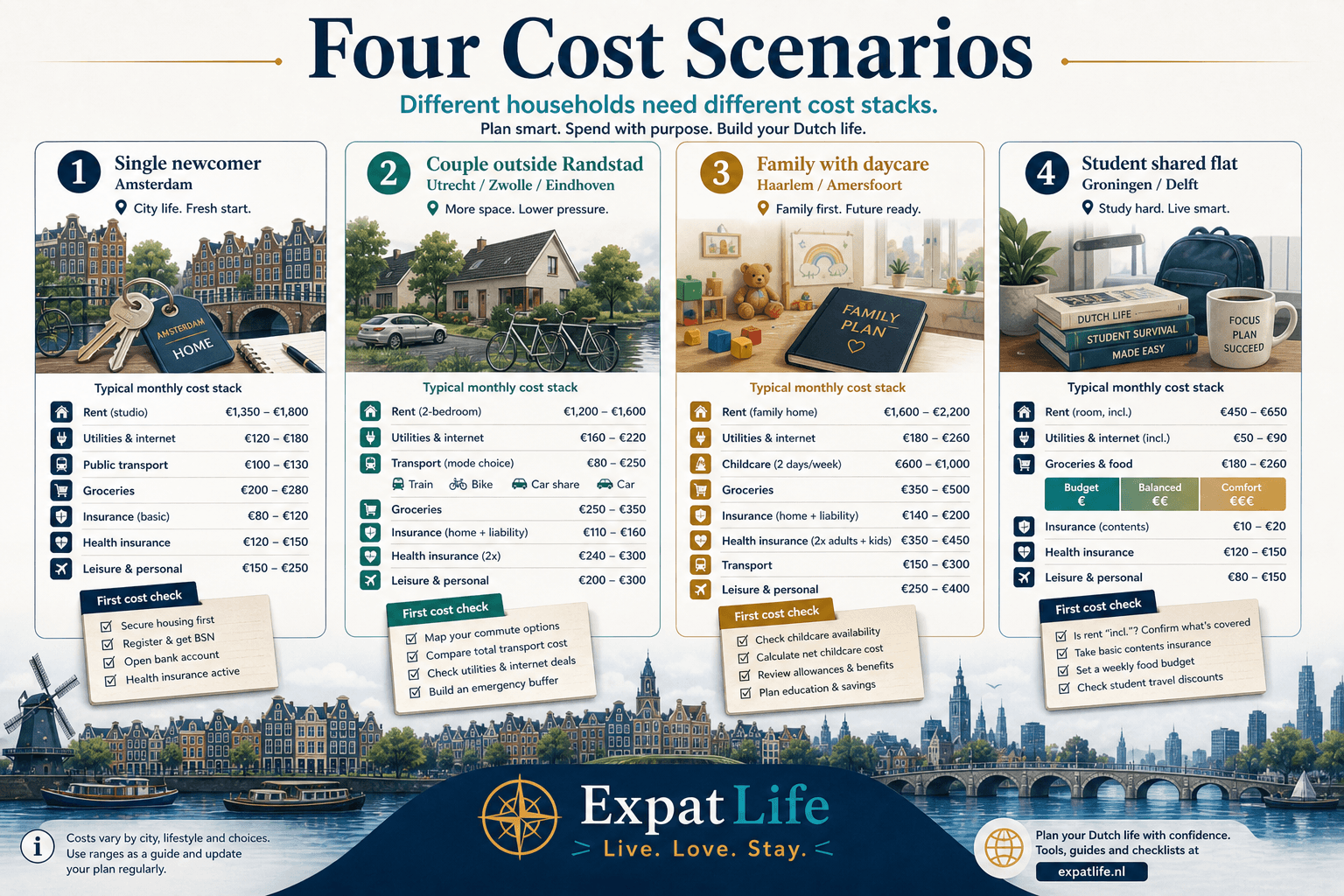
These stories show how drivers combine — not personalised advice. Replace the numbers with your listings and calculator output.
Examples
| Situation | How it works here | First step |
|---|---|---|
| Single professional, Amsterdam offer | Rent leads; keep lifestyle modest until the lease is signed and a buffer month exists. | Shortlist three realistic listings and run the calculator on that rent. |
| Couple, Eindhoven or secondary city | Housing may soften; watch whether a car sneaks into the plan and rebuild transport honestly. | Compare bike/OV vs car all-in before choosing a neighbourhood. |
| Family, dual careers, daycare | Put childcare beside rent in draft one; check allowance pathways separately. | Get a hours quote from registered care, then open the childcare allowance guide. |
| Student / shared housing | Lower rent can still surprise you with insurance and OV — do not skip structural lines. | Confirm what the huis includes, then add health insurance and a basic food band. |
Avoid
These patterns create avoidable planning friction — calm housing-led checks beat optimistic listicle averages.
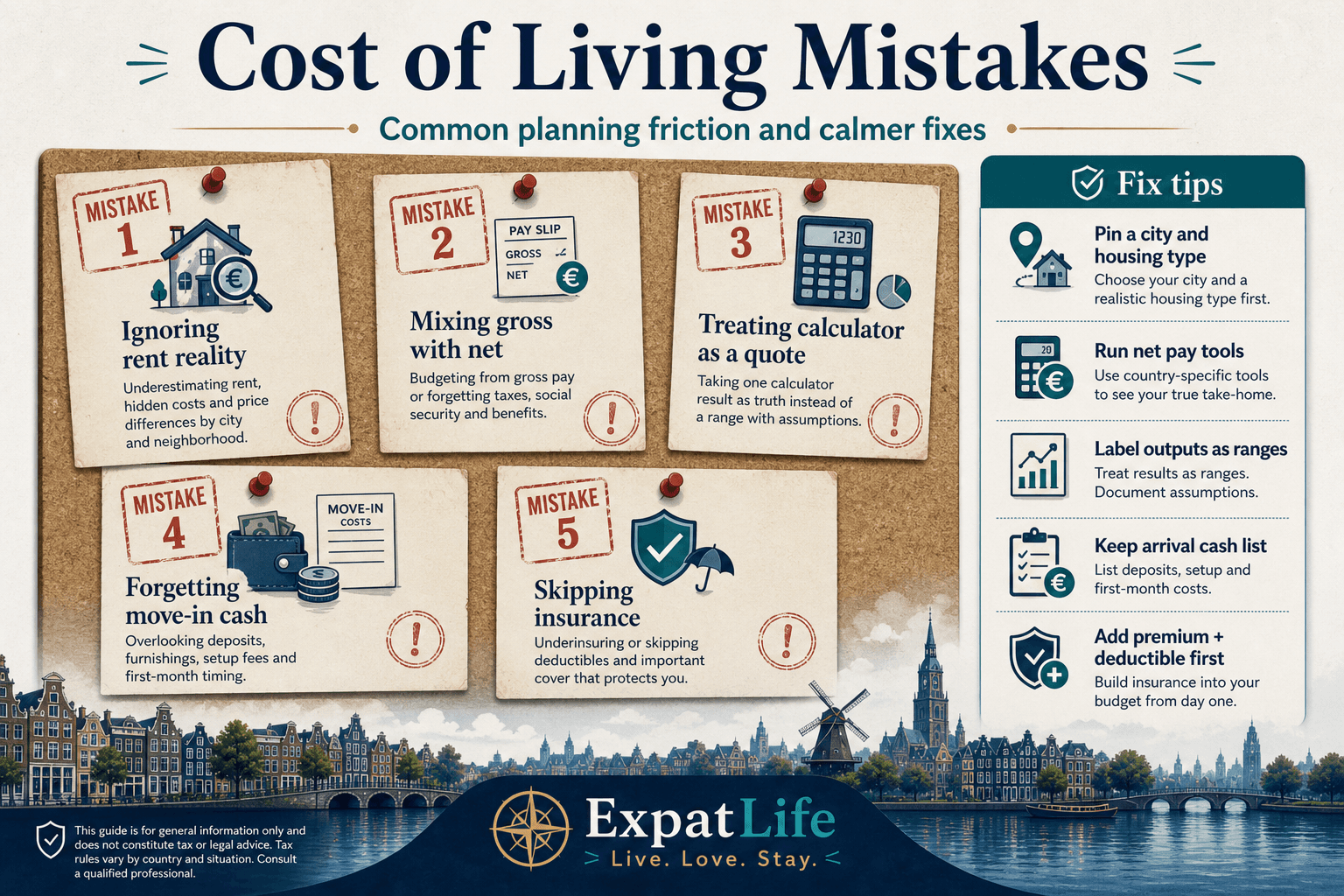
Netherlands-wide averages hide Amsterdam rents and quieter provincial markets.
Fix: Always pin a city and housing type before you quote a total.
Rent is paid from net. Gross-looking offers can still feel tight after payroll.
Fix: Run net salary tools beside the cost calculator.
Tools estimate. Landlords and insurers set real prices.
Fix: Label outputs as planning ranges and verify live sources.
Deposit and first month can stall a move even when monthly burn looks fine.
Fix: Keep a separate arrival cash checklist.
Health insurance is structural for most residents — not a nice-to-have.
Fix: Add premium + deductible buffer before lifestyle spend.
This guide owns drivers and framing. Templates and levers live on siblings.
Fix: Use monthly budget for the template; saving money for cut levers.
Ready to plan
Use this before you sign a lease or accept an offer. Then verify live numbers with listings, insurers and the calculator.

Cost-of-living readiness checklist
How-to
A calm sequence beats downloading five unrelated listicles. Follow these steps, then refine with real quotes.
Step 1
Write city, number of adults and children, and whether you need parking or daycare.
Step 2
Pick three realistic listings and note rent, what is included, and deposit cash required.
Step 3
Health insurance premium, deductible buffer, utilities/internet, and transport mode costs.
Step 4
Be honest about dining out, travel and subscriptions — label modest vs comfortable.
Step 5
Compare the total to net pay and run the cost-of-living calculator with the same assumptions.
Step 6
Use the monthly budget guide for a category template; use saving money when you are ready to cut.
FAQ
Short answers for the searches expats ask most often about Dutch living costs, city bands and how to use planning figures.
There is no single number. For many expats the total is led by housing, then health insurance, groceries, transport and — when relevant — childcare. Indicative city and lifestyle bands on this page are 2026 planning ranges, not quotes. Use the calculator for interactive estimates.
Often yes on rent, which usually dominates the monthly stack. Other costs (insurance, groceries) differ less than housing. Always compare like-for-like household sizes and real listings.
Treat them as planning ranges. Match city, household and housing type, separate move-in cash from monthly burn, and stress-test against net pay. Verify live prices with landlords and providers.
No. This page owns drivers, lifestyle/city framing and how to read numbers. The calculator owns interactive estimates. Use both.
Monthly budget for expats owns the category template and example month. Saving money in the Netherlands owns levers and habits. This page stays on drivers and framing.
Most residents need basic health insurance. Budget the monthly premium and a deductible (eigen risico) buffer. See the health insurance guides for how cover works — this page only places insurance in the cost stack.
Daycare or BSO hours can rival rent for dual-working parents. Get a hours quote, then read the childcare allowance guide for benefit pathways. Do not assume allowance approval in your first draft.
Plan outgoings against net. Use the net salary Netherlands tools to estimate take-home, then compare to your housing-led stack.
No. This is general orientation for newcomers. Figures are indicative planning ranges. Confirm details with providers and seek qualified advice when your situation is complex.
Related
Cluster siblings, the calculator, housing, insurance and banking plumbing that sit beside cost-of-living planning.
Banking
You will need a Dutch payment setup for rent and bills. These guides sit beside cost-of-living planning — they do not replace it.
Hub
Return to the Money hub or jump to the calculator, budget sibling, saving sibling and banking hub.
Explore next
Model estimates in the calculator, template a month, find saving levers, check net pay, or ground your housing stack.
Trust
Confirm live prices and rules with landlords, insurers and official sources — bands on this page are planning orientation only.
Some links on this page may be affiliate or referral links. If you use them, we may earn a commission at no extra cost to you. Affiliate status never changes prices, eligibility or your personal budget reality. All euro bands are indicative planning ranges for 2026 orientation only.