
Biggest lever
Housing habits
When you can still choose
Netherlands · Money · Saving
Practical levers for expats who already know their cost drivers and budget lines — housing habits, groceries, transport, subscriptions, fees and a first buffer. Indicative 2026 euro impacts for planning only — not investment advice.
General orientation only — not personal financial advice. Euro figures on this page are indicative 2026 planning ranges for newcomers, not quotes, guarantees or offers. Your rent, city, household and habits can move results a lot. Confirm live prices with landlords, providers and your own records. This is not a ranking of savings products.
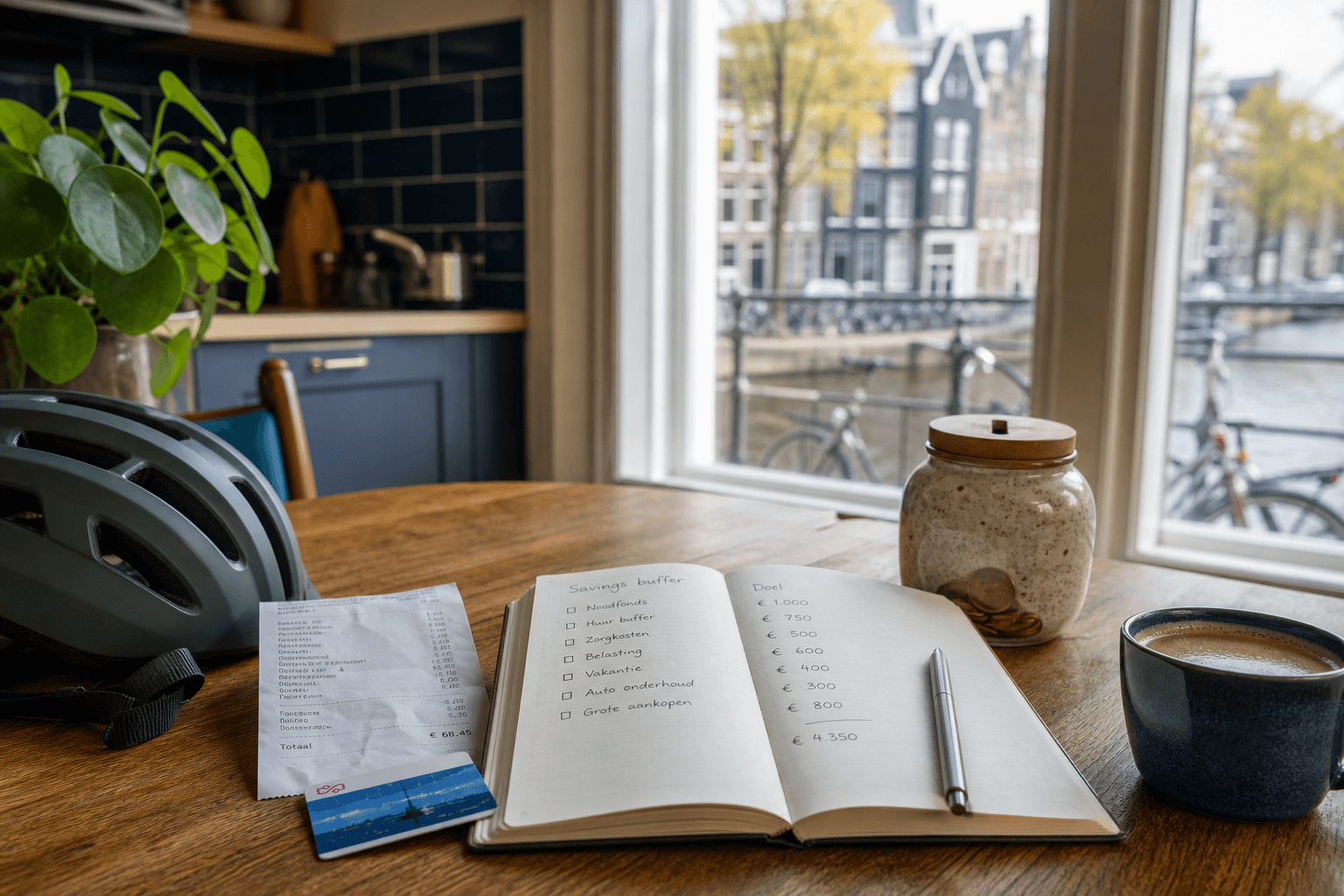
Quick answer
Saving money in the Netherlands usually means changing a few big habits — not downloading a viral “Amsterdam is expensive” listicle. Expats who cut coffee while ignoring rent location, dining rhythm or forgotten subscriptions often feel busy and still cash-tight.
This guide owns the levers: housing habits, groceries, transport, subscriptions, banking fees, energy and dining — plus a first emergency buffer and calm spaarrekening orientation. Cost of living owns drivers and city framing. Monthly budget owns the category template and workflow. Banking siblings own account types and fees — this page does not rank savings products.
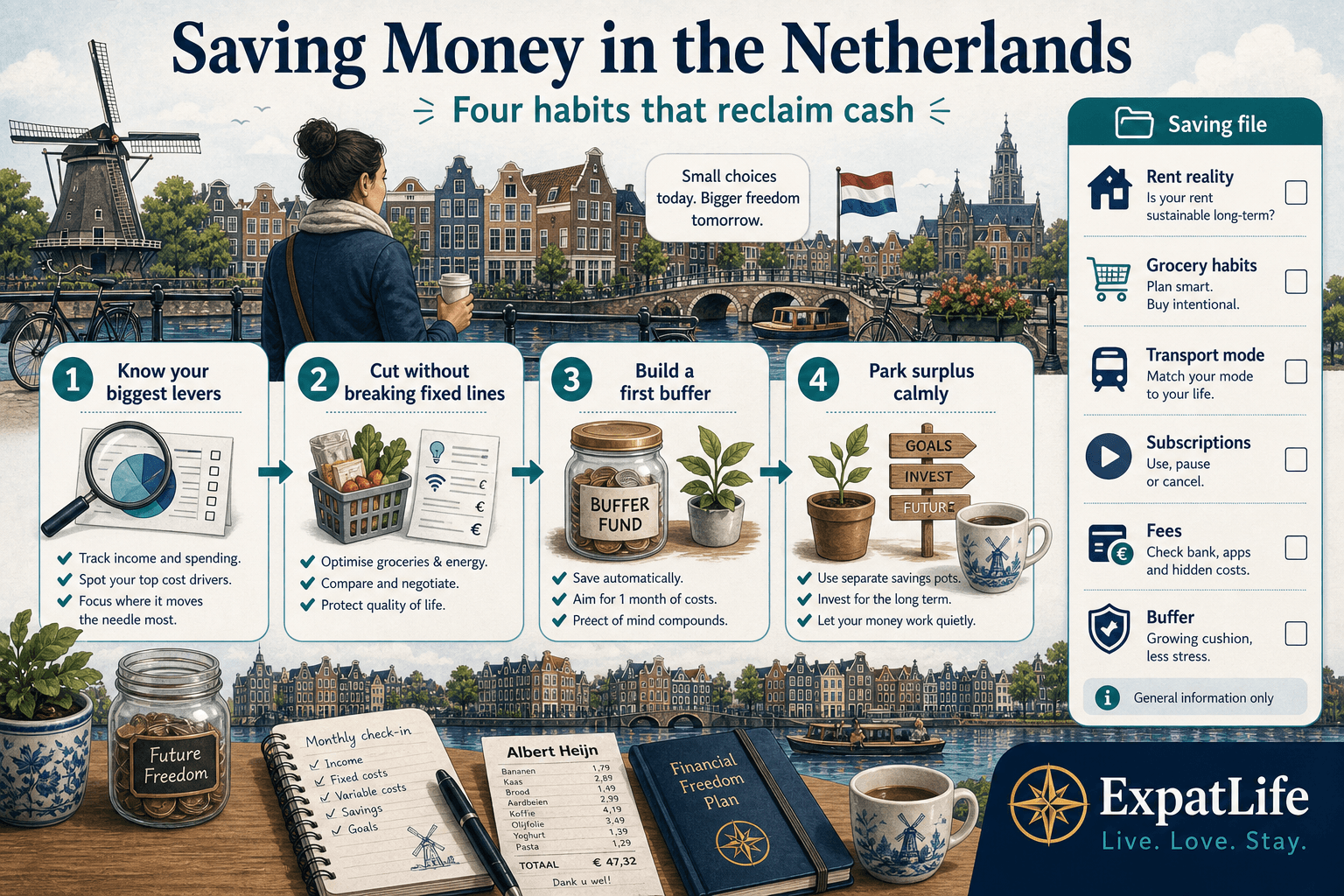
Saving planning file — keep these together
Examples
| Situation | How it works here | First step |
|---|---|---|
| New in the Randstad, rent already signed | You cannot rewind the lease overnight — reclaim cash from dining, groceries, subscriptions and transport first. | Track two weeks of food + subscriptions, then cancel unused stacks. |
| Still searching for housing | Housing is the largest lever — compare commute, inclusions and shared options before lifestyle cuts. | Write a max rent band against net pay using the monthly budget sibling. |
| Couple with overlapping streaming and gyms | Audit shared vs solo subscriptions; keep one social dining budget you both agree on. | Export recurring charges and mark duplicates. |
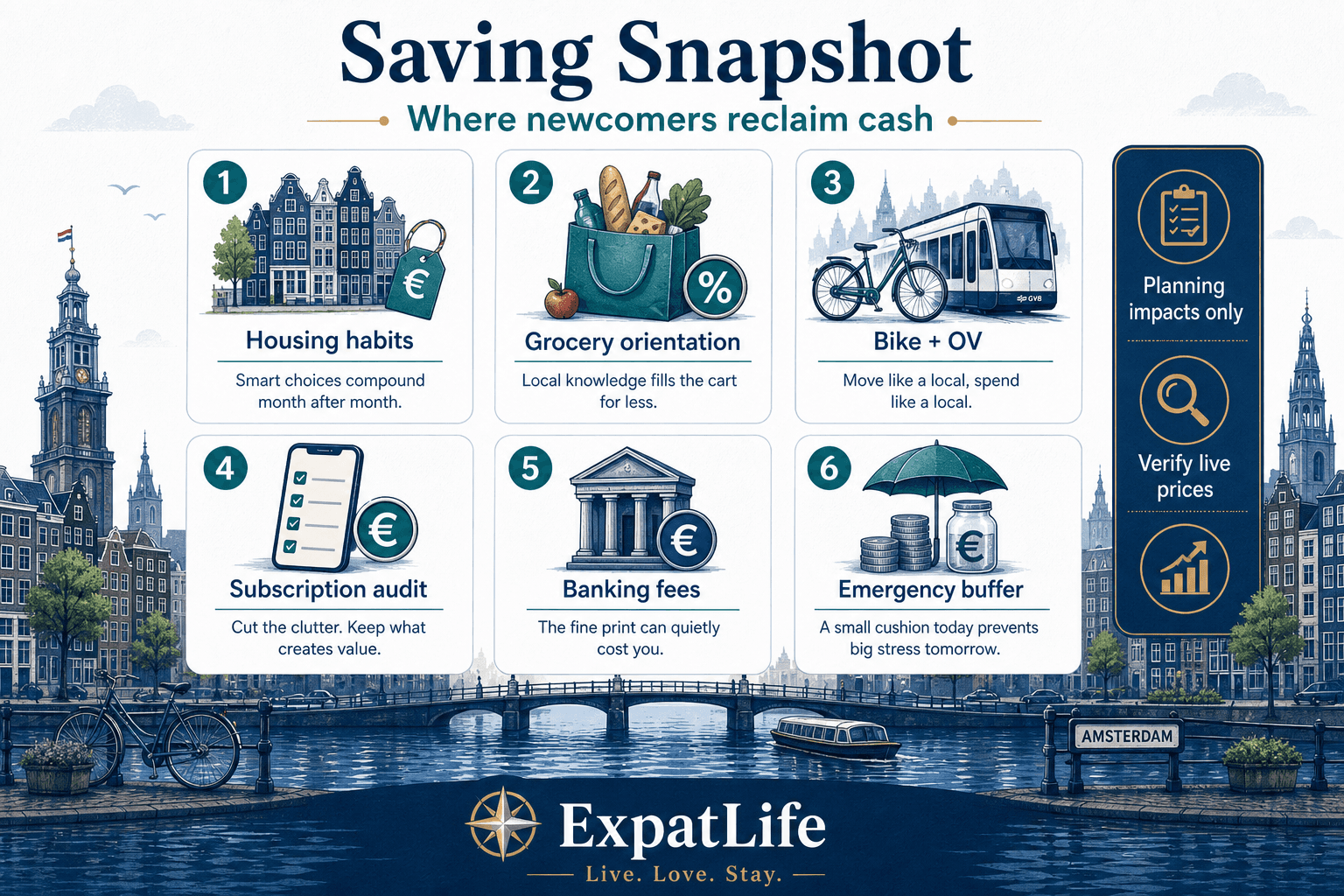
Snapshot
Six cards summarise the levers: housing habits, food and dining, bike + OV, subscriptions, fees and a first buffer. Deeper sections expand each with indicative 2026 planning impacts.
Biggest lever
Housing habits
When you can still choose
Everyday
Food + dining
Habit-led reclaim
Transport
Bike + OV
Car changes everything
Next step
Buffer first
Then spaarrekening calm
Location, inclusions and shared housing move totals more than most lifestyle tips. If the lease is signed, shift to everyday levers.
Store orientation and cook-at-home rhythm usually beat obscure coupons. Dining out sits under leisure — track it honestly.
Many expats keep transport lean without a car. Occasional taxis are fine; monthly car costs are a different world.
Streaming, software, gyms and trials stack quietly. A quarterly audit often frees a calm monthly band.
Bank packages and FX habits rarely rival rent — still worth a tidy review once big levers are stable.
A named emergency pot beats rate shopping with zero cash cushion. Spaarrekening orientation links to banking siblings.
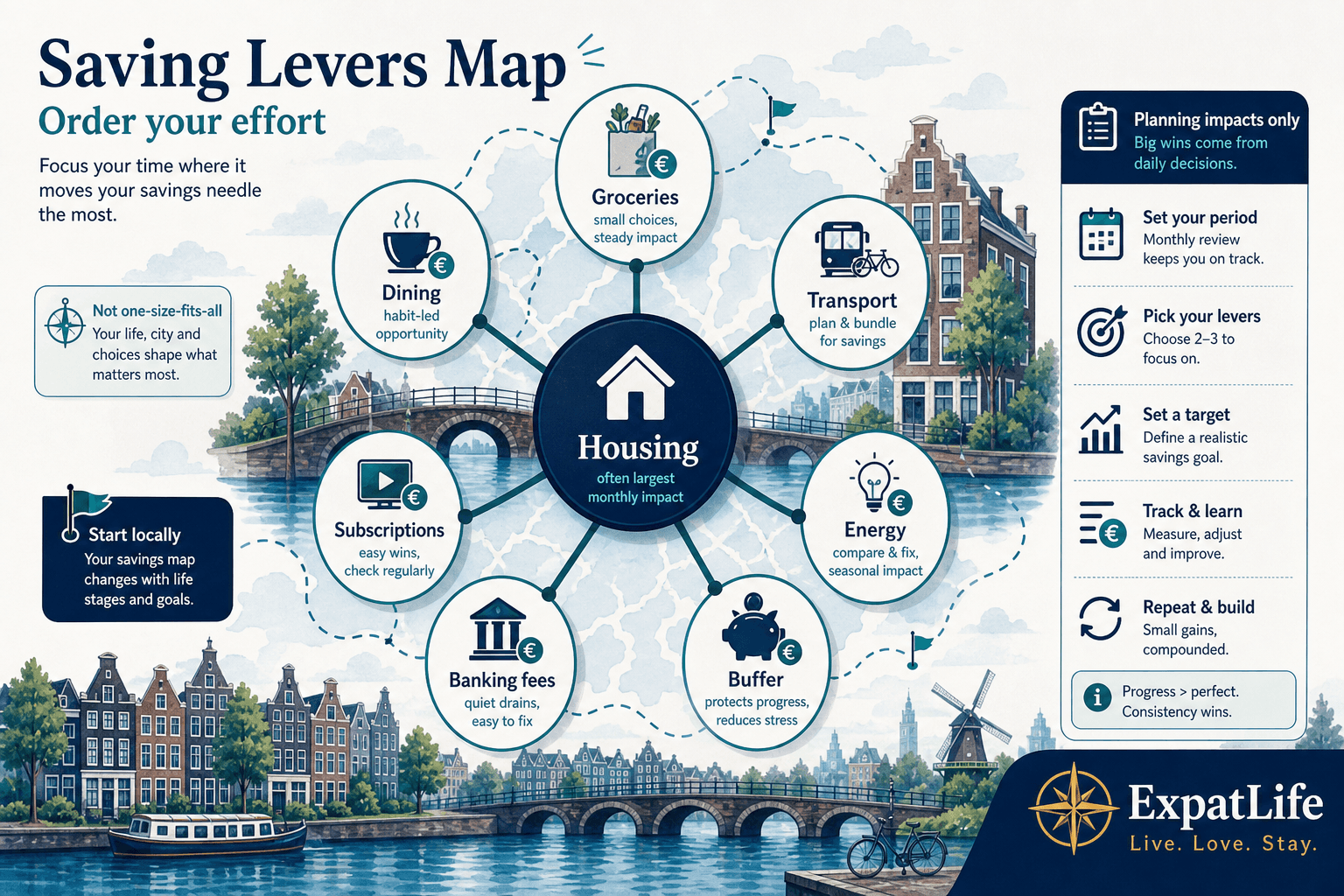
Map
Order your effort. Tiny habits feel productive; large levers change the month. Use this map after your budget template exists — COL explains drivers; this page owns cuts and habits.
Lever list
| Lever | Indicative 2026 impact | Practical tip |
|---|---|---|
| Housing / location choice | Often hundreds of € / month vs city-core premium (planning) | Compare commute time honestly — see renting + cheap cities. |
| Shared vs solo housing | Can free a large rent share — with privacy trade-offs | Price the trade-off, not only the euro line. |
| Groceries + cook rhythm | Often roughly €30–€120 / month reclaim (planning) | Track a month before guessing. |
| Dining out / coffee | Often roughly €50–€200+ / month if frequent (planning) | Protect social nights; cut autopilot. |
| Transport mode | Bike + OV often far below car ownership stack | Delay a car until you truly need one. |
| Subscriptions audit | Often roughly €10–€60+ / month (planning) | Export recurring charges from your bank app. |
| Banking fees / FX | Usually smaller than rent — still tidy | See fees + cheapest accounts guides. |
Two weeks of bank-app tracking beats guessing. Then cut the largest soft lines first.
Do not “save” by skipping mandatory health insurance or underfunding rent. Protect structural lines.
Cutting spend without naming a buffer just relocates lifestyle spend. Park the reclaim.
COL for drivers, monthly budget for the template, calculator for estimates, banking for products.
Housing
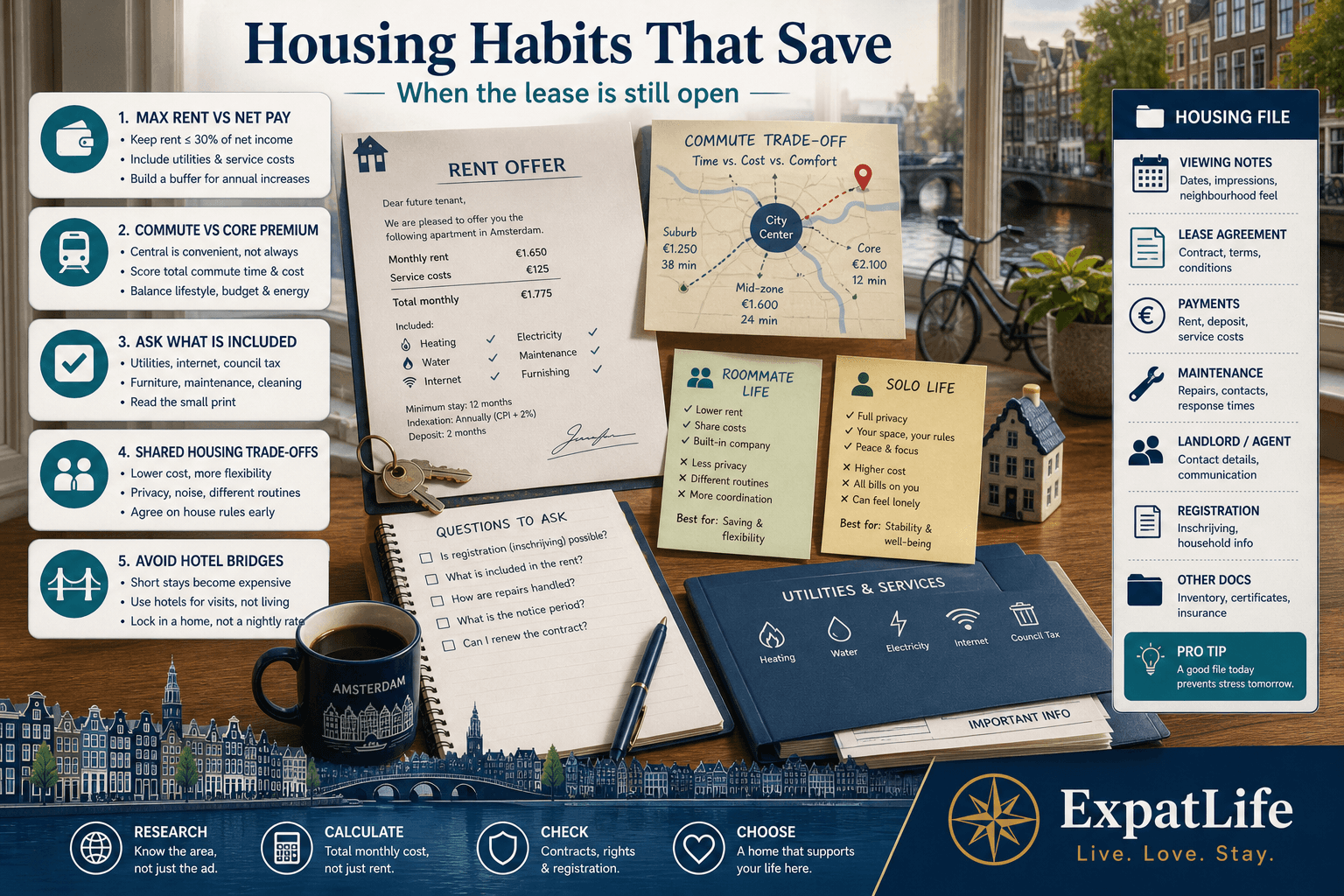
When the lease is still open, housing is usually the highest-impact lever. When it is signed, use everyday levers below and revisit at renewal. This is not a city ranking — cheap cities and renting guides own search detail.
Housing habits
| Habit | Rough monthly (planning) | Note |
|---|---|---|
| Core vs outer neighbourhood (same city) | Often a meaningful rent gap (city-led) | Trade commute and vibe |
| Utilities included vs separate | Often roughly €100–€250+ difference in visibility | Inclusions still cost — just bundled |
| Shared room / flatshare | Can free a large rent share | Privacy and contract risk trade-offs |
A cheaper flat with a brutal commute can erase savings in time, OV tickets and stress. Price both.
Service costs, energy advances and internet can surprise you after signing. Confirm in writing.
If you already live somewhere pricey, set a calendar reminder to reassess at renewal — not every weekend.
Groceries
Dutch grocery spend is habit-led. Store types differ in price feel and assortment — use orientation, not fake rankings. Pair this section with the shopping & groceries sibling for everyday detail.

Grocery habits
| Habit | Rough monthly (planning) | Note |
|---|---|---|
| Cook-most-nights vs frequent takeaway | Often roughly €50–€150+ difference (planning) | Household size swings hard |
| Discount-led vs premium-led basket | Often roughly €20–€80+ (planning) | Orientation only — not a store ranking |
| Impulse snacks and specialty imports | Quiet uplift many newcomers miss | Visible only after tracking |
Full-service and discount formats sit on the same street in many cities. Choose by basket needs and location — this page does not rank winners.
One main shop plus a midweek top-up beats daily convenience runs for many households.
Restaurant nights and café culture belong in dining/leisure — mixing them into “groceries” hides the lever.
Transport
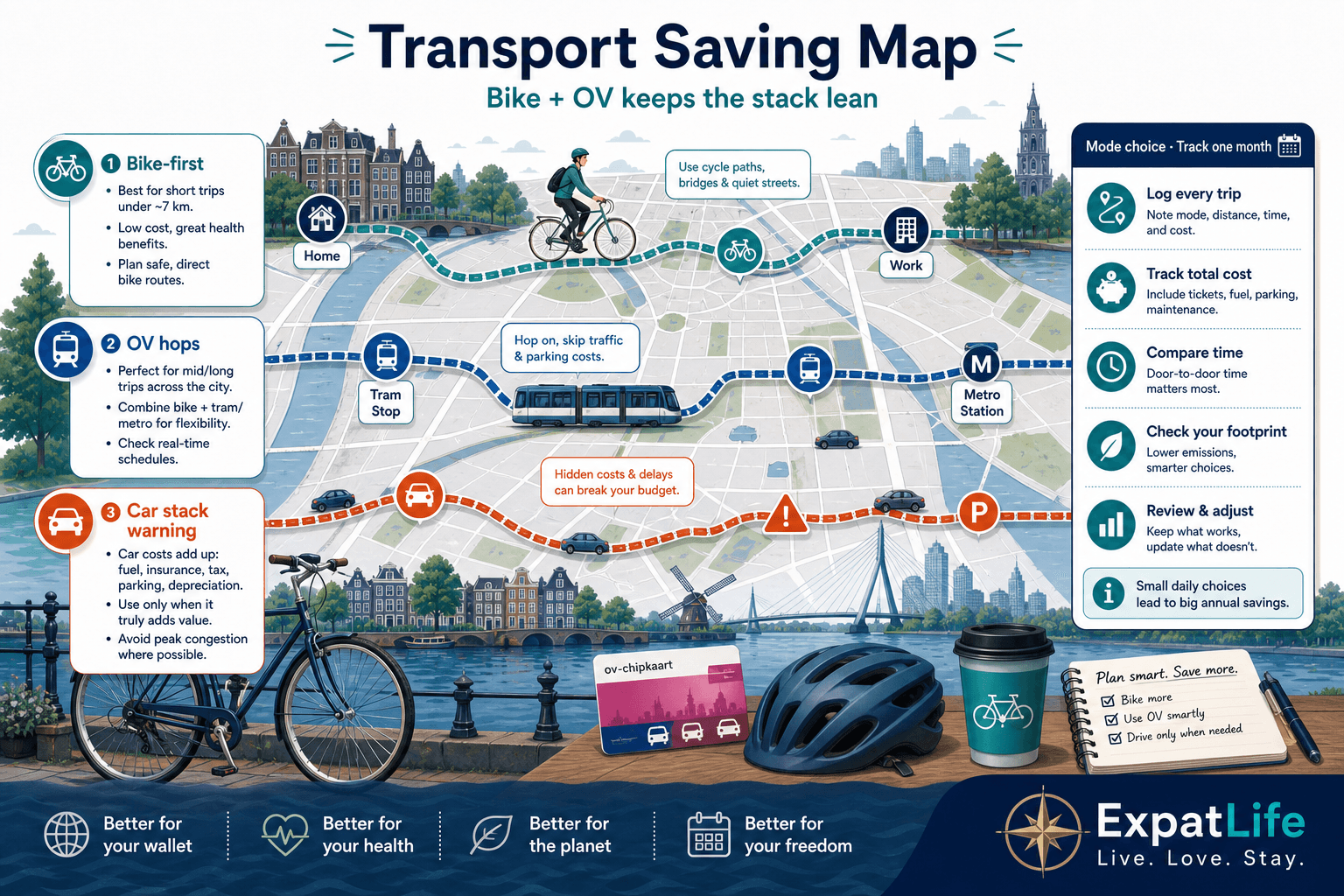
Many Dutch cities reward bike-first living. OV covers longer hops. A car can be essential for some roles or suburbs — but it is a different monthly stack. Track honestly for one month before changing mode.
Transport habits
| Habit | Rough monthly (planning) | Note |
|---|---|---|
| Bike + occasional OV | Often roughly €40–€150 without a car (planning) | City and commute dependent |
| Heavy daily OV | Can sit higher — track your passes | Still often below full car stack |
| Car ownership stack | Parking + insurance + fuel + tax can dwarf bike/OV | Only if you truly need it |
A solid lock and lights matter. Theft risk is real — insure or choose parking carefully.
Check-in/check-out mistakes create surprise charges. Learn your routes once.
If work requires it, budget the full stack. If not, treat car as a lifestyle upgrade, not a default.
Subscriptions
Streaming, software, gyms, cloud storage, mobile extras and “free trials” stack quietly. A quarterly audit is one of the cleanest reclaim habits because it rarely touches rent or insurance.

Audit steps
| Habit | Rough monthly (planning) | Note |
|---|---|---|
| Unused streaming / trials | Often roughly €10–€40 (planning) | Easy wins |
| Duplicate gyms / memberships | Often roughly €20–€60+ (planning) | Couples often overlap |
| Software and cloud stacks | Quiet €5–€30 bands add up | Annual plans hide the pain |
Block 45 minutes. Highlight keep / share / cancel. Cancel the same evening.
Calendar the renewal dates. Annual charges feel small monthly until three hit the same week.
New tool? Cancel the old one the same day — or keep both on purpose with a written reason.
Banking
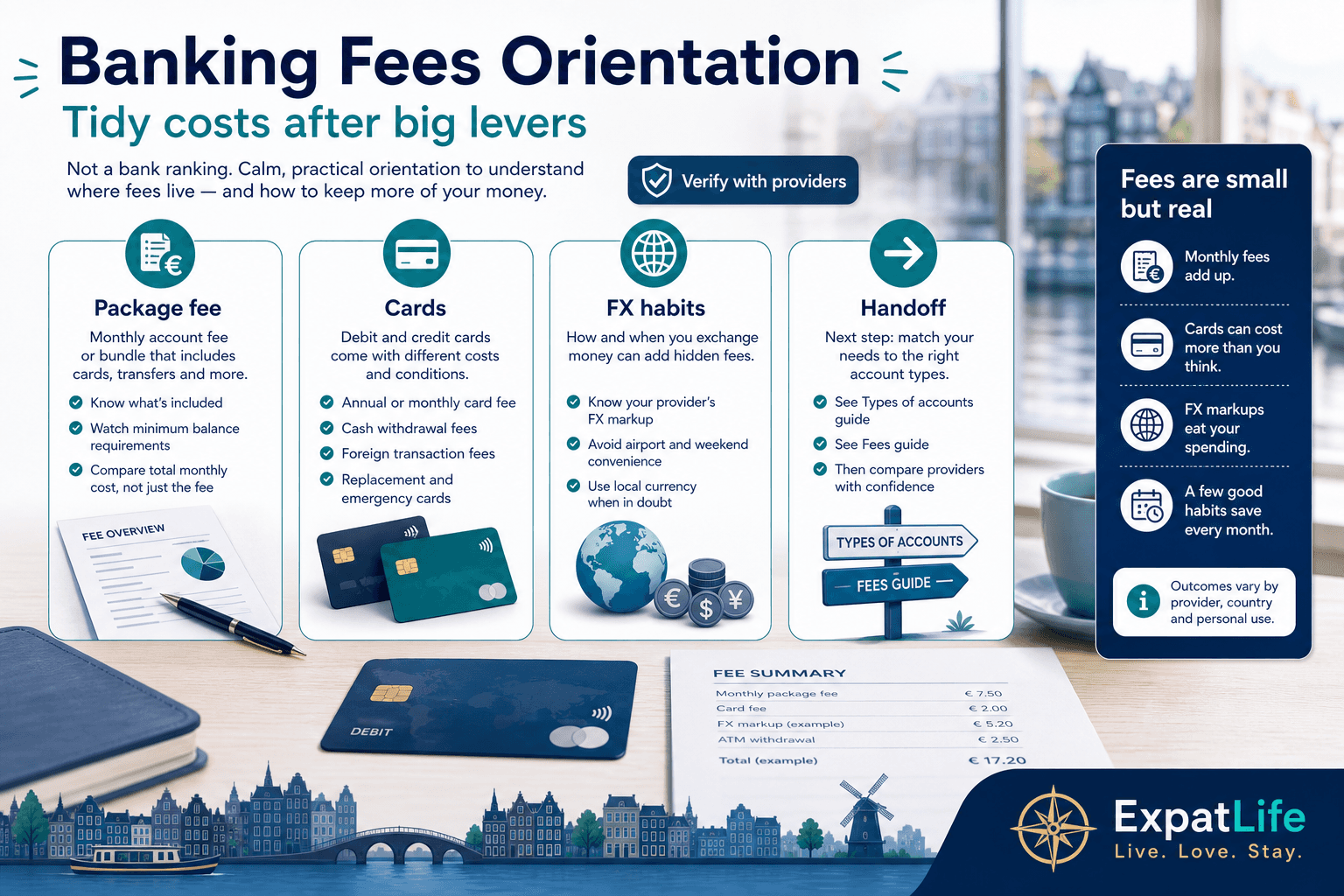
Package fees and card costs rarely rival rent — but they are easy to tidy once. FX mark-ups on foreign cards and ATM habits can sting during travel months. This section is orientation — product deep-dives live on banking siblings.
Fee habits
The cheapest package is not always the best fit if you need branches, joint access or specific payment tools.
Paying in euros when abroad is not always the win — learn your card’s FX behaviour once.
Parking surplus belongs after the buffer goal. Types of accounts explains product shapes — not rankings here.
Energy
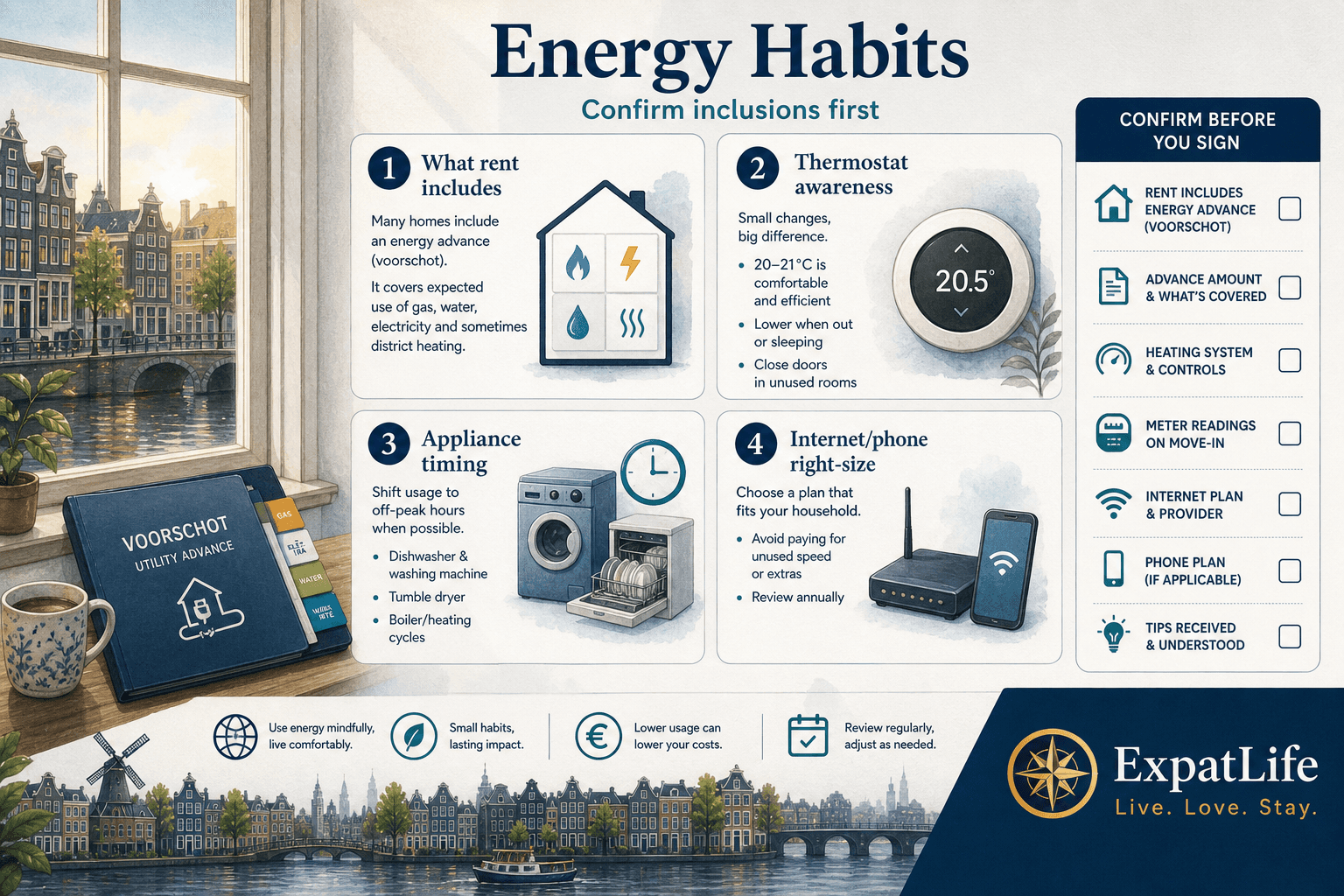
Confirm what rent includes before chasing thermostat tips. Advances (voorschot) and annual reconciliations can surprise newcomers. Pair habits with the utilities sibling for setup.
Energy habits
| Habit | Rough monthly (planning) | Note |
|---|---|---|
| Inclusions clarified at signing | Prevents surprise €100+ visibility gaps | Process win more than a tip |
| Heating / thermostat awareness | Seasonal — often noticeable in winter | Household and insulation dependent |
| Right-size internet/phone | Often roughly €5–€25 reclaim (planning) | After comparing real needs |
Monthly advances are estimates. Keep a small buffer for year-end reconciliation.
Once contracts exist, small habits help — but they will not fix an oversized rent line.
Dining
Café culture and restaurant nights are part of Dutch city life — the saving move is choosing them on purpose. Autopilot lunches and delivery apps often free more cash than another supermarket coupon.

Dining habits
| Habit | Rough monthly (planning) | Note |
|---|---|---|
| Daily café lunch → packed lunch | Often roughly €60–€150+ (planning) | City prices vary |
| 3 restaurant nights → 1 planned night | Often roughly €80–€200+ for a couple (planning) | Keep joy, cut autopilot |
| Delivery app default | Fees + tips add a quiet uplift | Cap or remove the app icon |
A written dining budget beats guilt. Spend it proudly — then stop when it is gone.
Batch one dinner ingredient into next-day lunch. Small rhythm, real reclaim.
One month of honest tags in your bank app beats an arbitrary “no restaurants” rule that fails week two.
Buffer
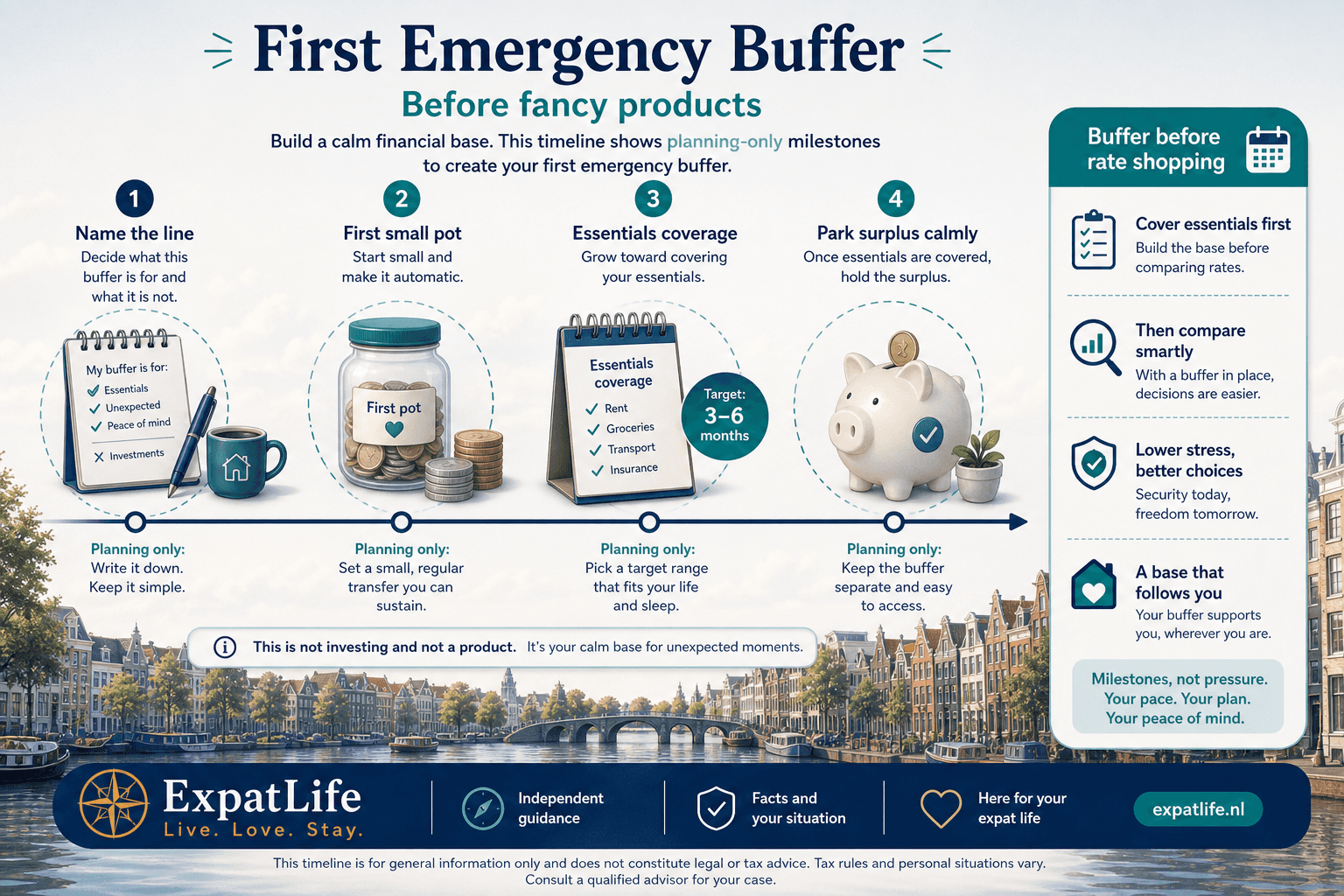
Cutting spend without parking the reclaim usually returns as lifestyle creep. Name a buffer line on your monthly budget template, fund a first emergency pot, then grow toward essentials coverage. Product shopping comes after.
Buffer principles
Step 1
Add buffer / savings on your monthly budget template with a real euro amount — even small.
Step 2
Move the amount toward a separate pot on payday when cashflow allows.
Step 3
Pick a first target you can reach in 1–3 months (examples vary — choose yours).
Step 4
Grow toward short disruption cover for rent, insurance and food — not a perfect number from a blog.
Step 5
When the buffer feels real, use Types of accounts + fees guides for spaarrekening orientation.
Emergency cash needs to stay reachable. Investment products are a different conversation.
A labelled savings space reduces “accidentally spending the buffer” on décor.
Move-in months and travel can empty the pot — schedule a rebuild, do not abandon the line.
Need the category template first?
Name the buffer line on the monthly budget sibling, then return here for cut levers and buffer milestones.
Open monthly budget guideSpaarrekening
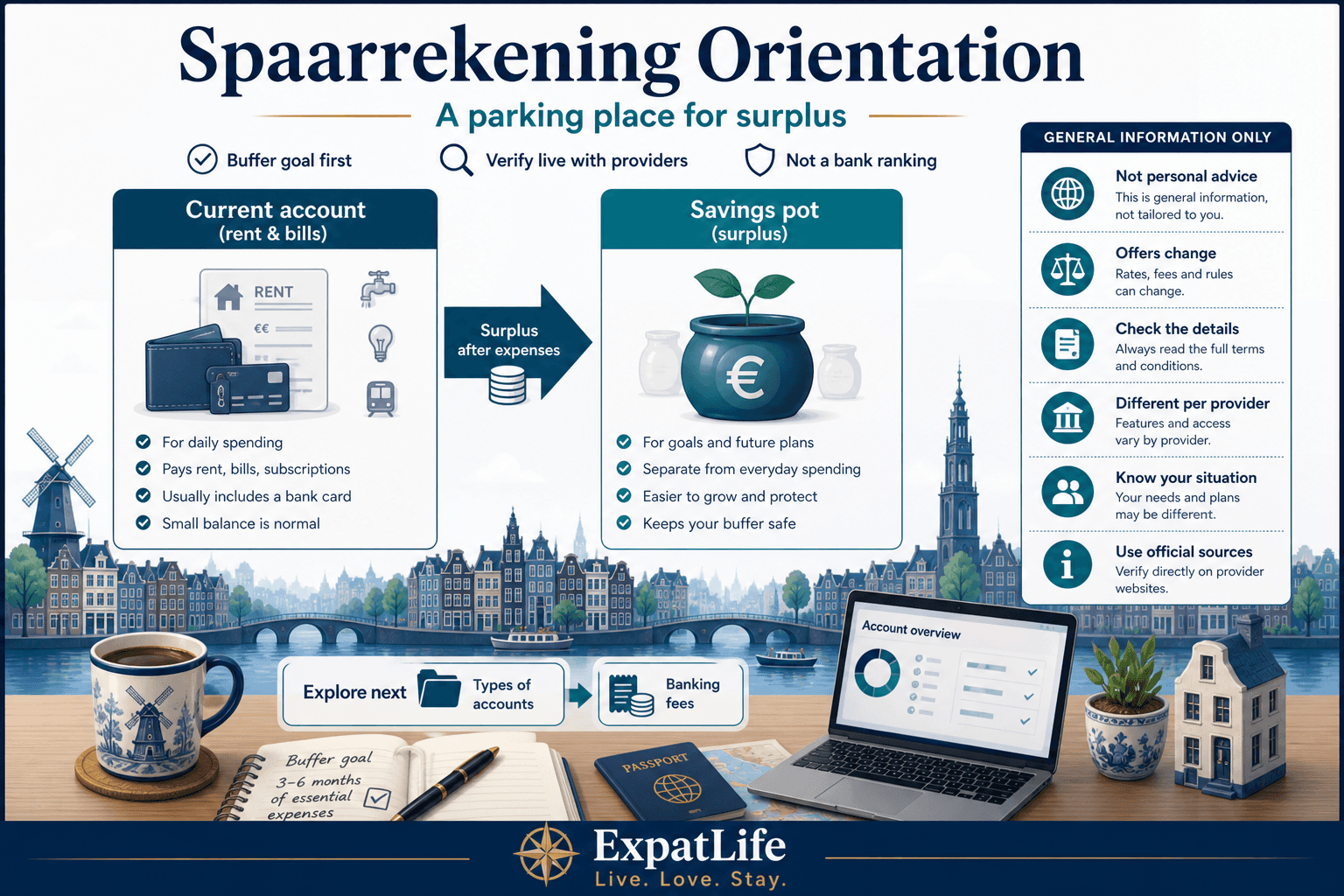
A spaarrekening (savings account) is typically a place to park surplus separately from your current account. This page does not rank banks, rates or products. Use Types of bank accounts for product shapes and banking fees / cheapest accounts for cost orientation.
Orientation points
Any “best spaarrekening” list ages instantly. Learn the product shape, then compare live offers yourself.
Some products trade easier access for conditions. Match the pot to emergency vs medium-term goals.
Package costs on the current account and any savings-related fees belong in your review — see the fees guide.
Situations
Same lever map, different first moves. Pick the story that matches your constraints.

Examples
| Situation | How it works here | First step |
|---|---|---|
| Single newcomer — lease already signed | Reclaim from dining, groceries, subscriptions and transport; fund a small buffer weekly. | Export recurring charges and tag two weeks of food spend. |
| Couple sharing rent | Agree shared vs solo leisure; kill duplicate subscriptions; one joint buffer rule. | List overlapping streaming/gym charges tonight. |
| Family with daycare squeeze | Protect care and insurance lines; cut soft leisure and subscriptions before “optimising” care hours unsafely. | Re-run the monthly budget template with care hours locked. |
| Student / shared housing | Lower rent helps — still watch insurance, OV and food; build a tiny buffer for admin surprises. | Confirm huis inclusions, then set a € amount buffer auto-transfer. |
Avoid
These patterns create avoidable friction — big levers and a named buffer beat random tip lists.

Tiny habits feel productive while the housing line still breaks the plan.
Fix: When the lease is open, fix housing first. When signed, still track big soft spend.
Shopping spaarrekening rates before an emergency pot exists reshuffles anxiety, not safety.
Fix: Name and fund a buffer line first — then park surplus calmly.
Fake “best supermarket” rankings age badly and miss your basket.
Fix: Use orientation + your tracked month — not influencer scorecards.
Mandatory health insurance is structural for most residents.
Fix: Trim leisure and subscriptions — keep structural cover.
Reclaimed euros drift back into dining and apps.
Fix: Auto-transfer the reclaim to the buffer pot on payday.
This guide owns levers and habits. Drivers and templates live on siblings.
Fix: Use COL for framing; monthly budget for the template; this page for cuts.
Ready to save
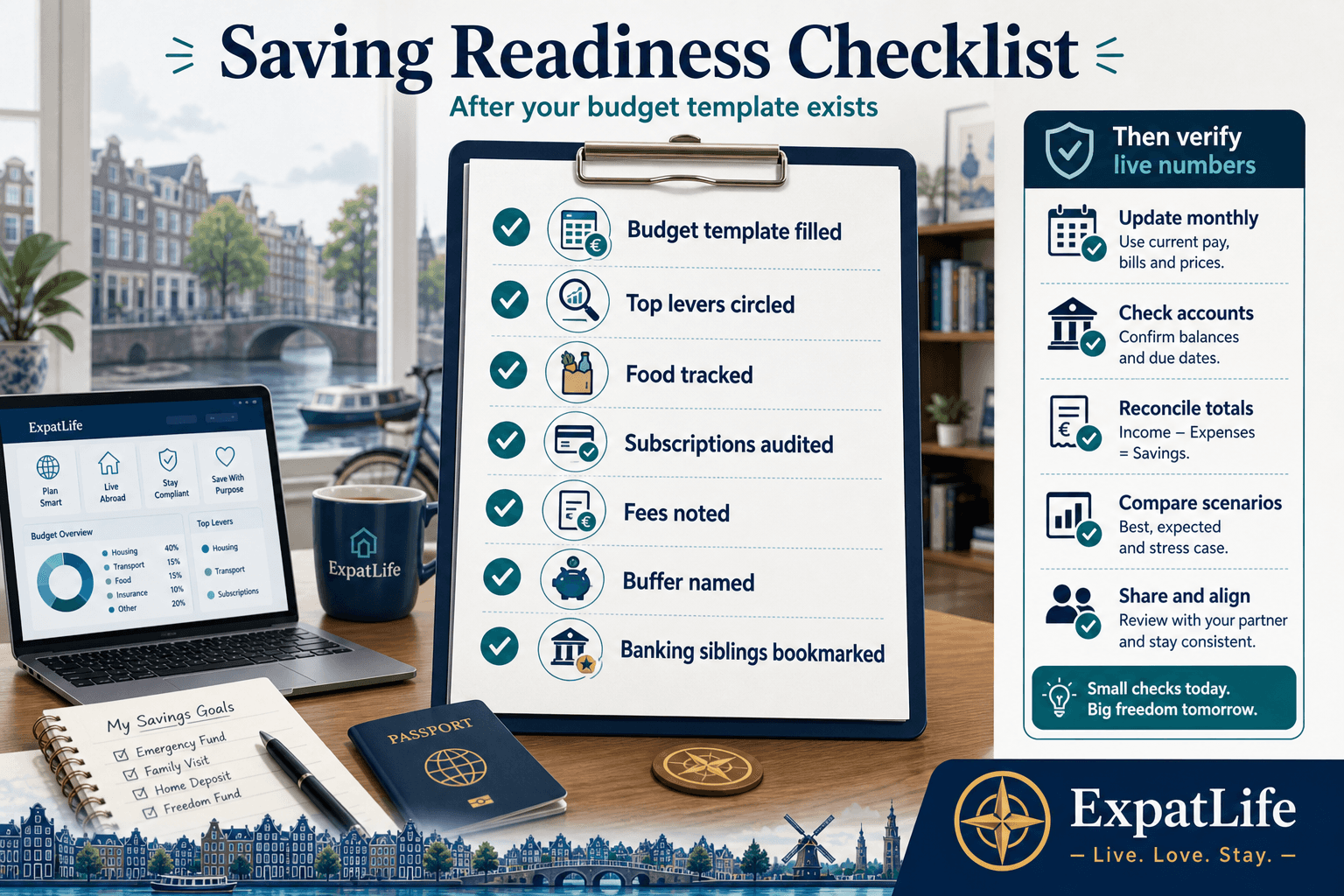
Use this after your monthly budget template exists. Then verify live prices and provider terms.
Saving readiness checklist
How-to
A calm sequence beats random tips. Follow these steps, then refine with live prices.
Step 1
Use the monthly budget sibling so categories and net pay are visible before you cut.
Step 2
Housing (if open), food/dining, transport, subscriptions — ignore tiny tips until these are clear.
Step 3
Tag groceries, dining, coffee and recurring charges in your bank app.
Step 4
Either adjust the housing decision if you still can, or cancel unused subscriptions and set a dining cap.
Step 5
Put a euro amount on the template and automate a transfer when cashflow allows.
Step 6
When the buffer feels real, read Types of accounts and fees guides for spaarrekening orientation — no product ranking here.
FAQ
Short answers for the searches expats ask most often about saving money, buffers and spaarrekening orientation in the Netherlands.
Focus on controllable levers after rent and net pay are clear: housing habits when the lease is open, groceries and dining rhythm, bike + OV transport, a subscription audit, tidy banking fees, and a named emergency buffer. Indicative 2026 impacts on this page are planning ranges only.
Monthly budget owns the category template, first-month vs steady-state, and the planning workflow. This page owns cut levers and habits once the template exists. Use both.
Cost of living owns drivers, lifestyle/city framing and how to read numbers. This page owns practical ways to reduce spend and build a buffer.
This guide does not rank stores. Discount and full-service formats coexist — track your basket for a few weeks and use the shopping & groceries sibling for everyday orientation.
A separate savings pot helps once you have surplus to park. Fund a first emergency buffer goal first, then read Types of bank accounts and fees guides — this page does not rank products.
No. Basic health insurance is structural for most residents. Trim leisure and subscriptions instead — see the health insurance orientation guide.
There is no single number. Many newcomers start with a reachable first target, then grow toward short essentials coverage. Pick a figure that fits your fixed lines and risk — this is orientation, not advice.
No. This is general orientation for newcomers. Figures are indicative planning ranges. Confirm details with providers and seek qualified advice when your situation is complex.
Related
Cluster siblings, the calculator, housing, groceries and banking plumbing that sit beside saving levers.
Banking
Saving habits sit beside Dutch payment setup. These guides help with accounts and fees — they do not replace buffer discipline.
Hub
Return to the Money hub or jump to cost of living, monthly budget, the calculator and banking guides.
Explore next
Lock the budget template, read cost drivers, model estimates, or park surplus calmly later.
Trust
Confirm live prices and rules with landlords, providers and official sources — bands on this page are planning orientation only.
Some links on this page may be affiliate or referral links. If you use them, we may earn a commission at no extra cost to you. Affiliate status never changes prices, eligibility or your personal budget reality. All euro bands are indicative planning ranges for 2026 orientation only. This page does not rank savings products or provide personal financial advice.