
Template
10 category lines
Same list every month
Netherlands · Money · Monthly budget
A practical category template for newcomers: housing, insurance, groceries, transport and a buffer line — plus first-month vs steady-state cash and example 2026 planning bands. Not investment advice.
General orientation only — not personal financial advice. Euro figures on this page are indicative 2026 planning ranges for newcomers, not quotes, guarantees or offers. Your rent, household size, city and lifestyle can move totals a lot. Confirm live prices with landlords, insurers, providers and your own records.
Quick answer
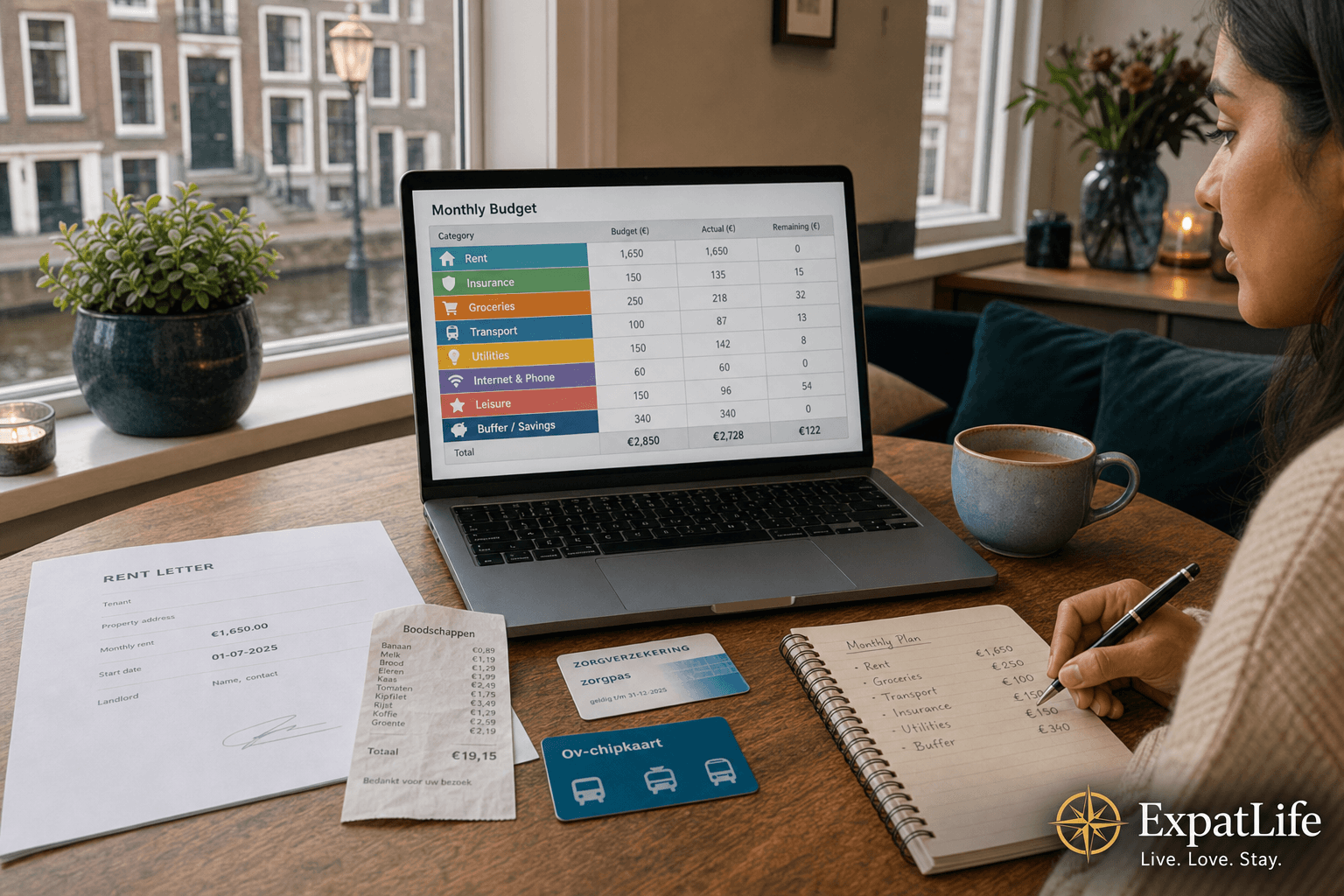
A monthly budget in the Netherlands works best as a reusable category template — not a single “average cost of living” number copied from a listicle. Expats who skip housing deposits, eigen risico or a named buffer often feel fine on paper and stressed in month one.
This guide owns the planning workflow: categories, first-month vs steady-state, example household months with indicative 2026 euro bands, and a calm sequence from net pay to buffer. For what drives totals and city framing, use the cost-of-living sibling. For interactive estimates, use the calculator. For cutting spend later, use the saving-money sibling.

Monthly budget planning file — keep these together
Examples
| Situation | How it works here | First step |
|---|---|---|
| Offer in hand, first Dutch lease ahead | Build the template from net pay and rent first — then insurance — before lifestyle lines. | Write net pay, target rent band and deposit cash on one page. |
| Couple sharing a Randstad flat | Agree which lines are joint (rent, utilities) vs personal (subscriptions, leisure). | Split the category list into shared and solo columns. |
| Family with daycare starting soon | Add childcare as a primary fixed/variable hybrid — not a footnote after coffee. | Sketch weekly care hours, then keep allowance pathways separate from the draft budget. |
Snapshot
Six cards summarise the template: categories, first-month cash, workflow order and tool handoffs. Deeper sections expand each with indicative 2026 planning bands.

Template
10 category lines
Same list every month
Phases
First vs steady
Deposit cash stays separate
Workflow
Net → fixed → buffer
Order reduces surprises
Next step
Calculator + COL
Estimate, then refine
A reusable list beats a single total. Housing, insurance, groceries, transport, phone/internet, childcare if needed, subscriptions, leisure and a buffer cover most newcomer months.
Deposits, double rent and setup fees can stall a move even when steady burn looks fine. Keep a separate cash checklist.
Job offers are often discussed in gross. Your rent is paid from net — start the workflow there.
Leftover hope is not a plan. Name a buffer / savings line even if it starts small.
Indicative 2026 bands show shape, not your quote. Swap city rent and household size before you commit.
This page templates the month; COL frames drivers; the calculator estimates; saving covers levers.
Template
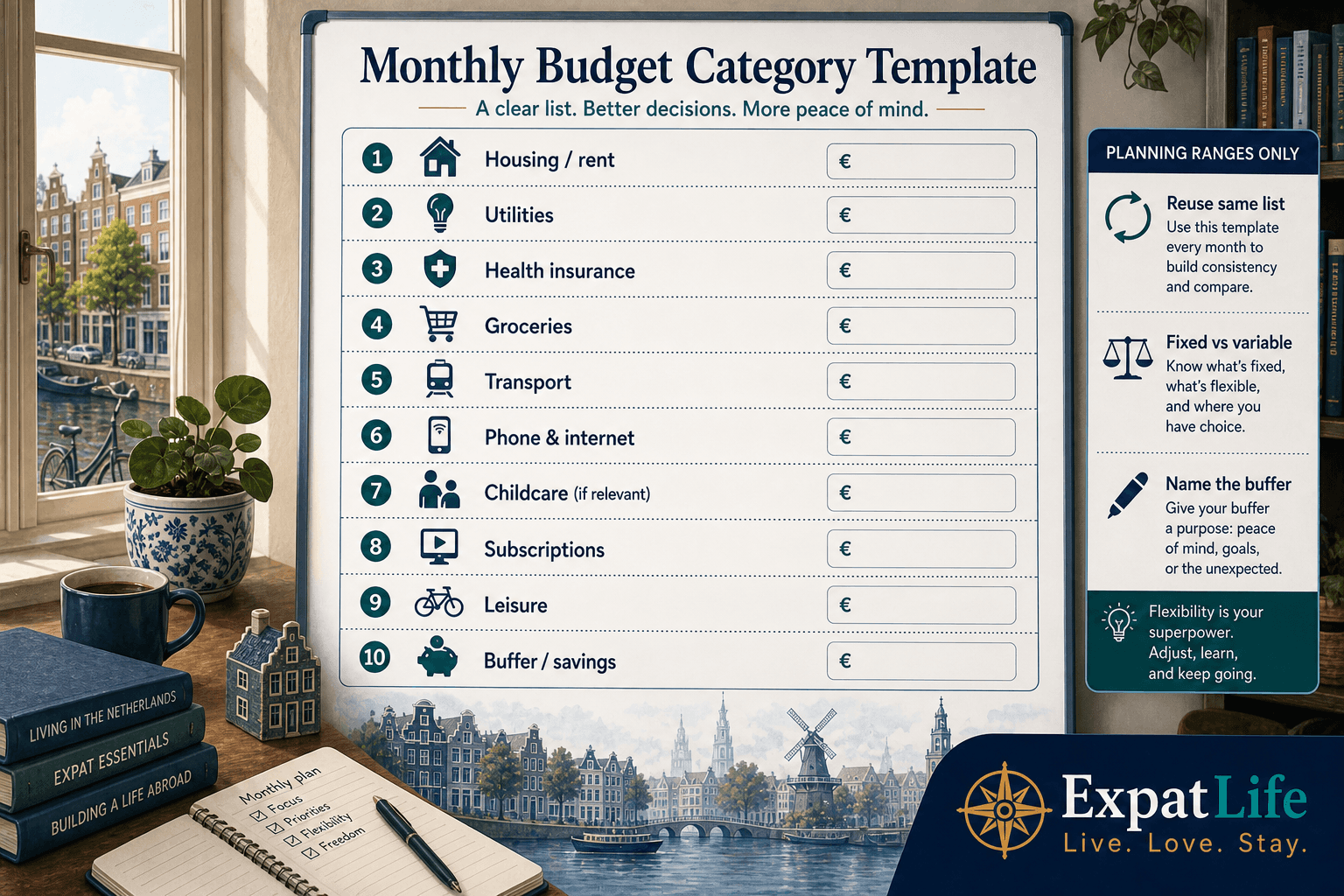
Keep one category list and reuse it. That makes first-month spikes visible and keeps steady-state months comparable. Deep cost drivers and city framing live on the cost-of-living sibling — this section owns the template lines.
Category lines
| Category line | Indicative 2026 band | Practical tip |
|---|---|---|
| Housing / rent | Often the #1 share of net pay (city-led) | Pull from real listings — see renting guide. |
| Utilities + internet | Often roughly €150–€280 / month combined (planning) | Confirm what rent includes. |
| Health insurance (adult) | Often roughly €140–€170 / month premium (2026 planning) | Keep eigen risico as cash buffer, not only a monthly average. |
| Groceries (single → couple) | Often roughly €200–€550 / month (planning) | Dining out sits under leisure, not groceries. |
| Transport (bike + OV) | Often roughly €40–€150 / month without a car (planning) | Car ownership changes the stack completely. |
| Phone + subscriptions + leisure | Wide band — habits stretch this fast | Cap leisure after fixed lines are locked. |
| Buffer / savings line | Aim to name an amount — even €50–€200+ to start | Saving levers deepen on the saving sibling. |
Rent, insurance and phone behave like fixed lines once chosen. Groceries and leisure are flexible — but habits stick.
Skip the line if you have no care hours. If you do, treat it as a primary driver beside rent.
Account packages and cards rarely dominate — still add a small banking line if useful. See fees and cheapest accounts guides.
Use the same categories for first-month cash planning and for steady months — only the amounts and one-off flags change.
Phases
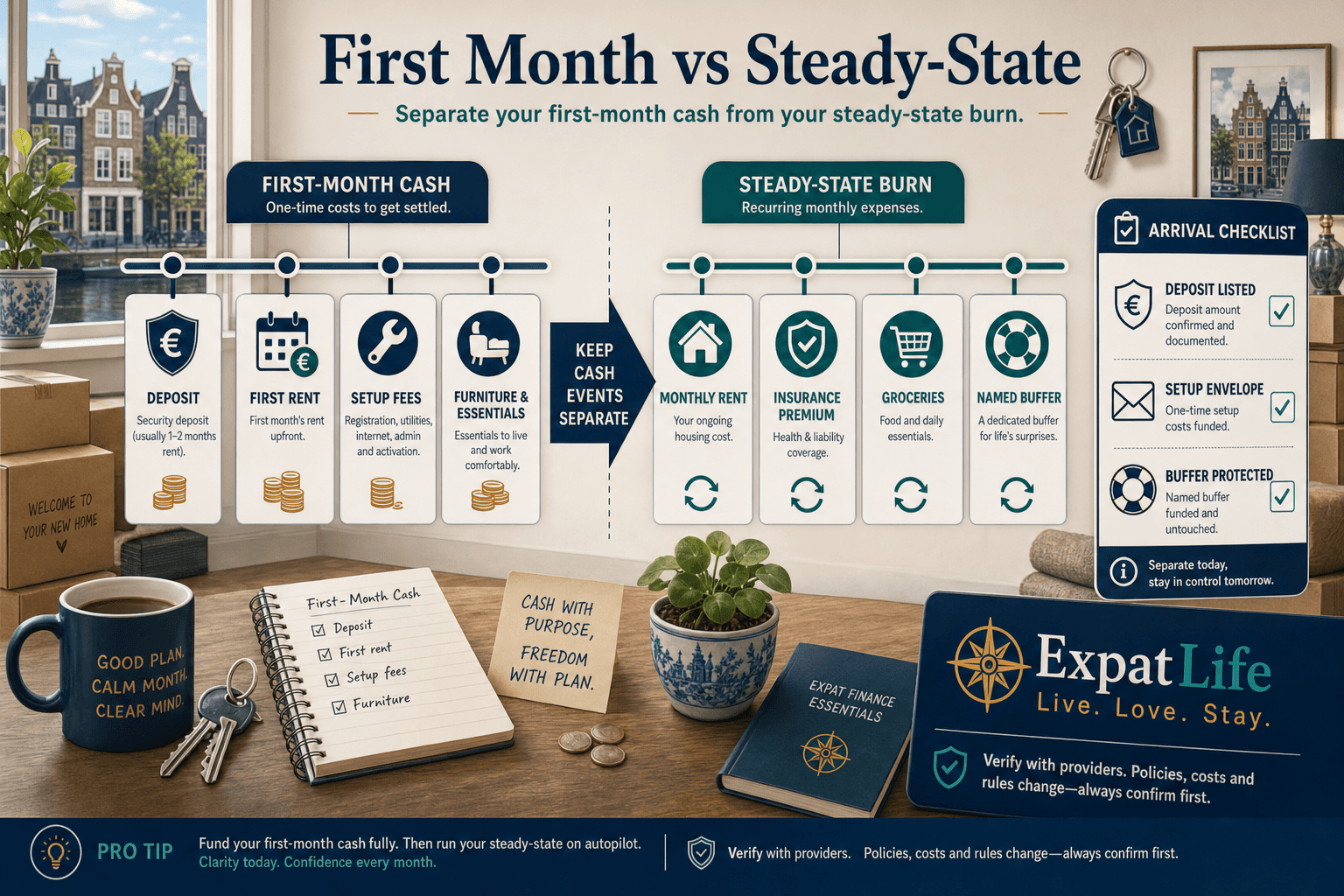
Month one often looks nothing like month three. Deposits, setup fees and furniture are cash events. Steady-state is the recurring template once housing and insurance are in place. Mixing the two creates false “monthly averages”.
First-month awareness
| Line | First month | Steady-state | Tip |
|---|---|---|---|
| Housing cash | Deposit + first rent (often 2–3× rent as cash) | Monthly rent only | Keep deposit off the steady burn line. |
| Utilities / internet | Setup, deposits, possible overlap with previous housing | Recurring energy + internet | Ask what is included in rent. |
| Health insurance | Policy start + deductible awareness | Monthly premium | Eigen risico is a cash buffer, not only a monthly slice. |
| Setup & stuff | Furniture, bike, SIM, travel to viewings | Near zero (replace as needed) | Give setup its own cash envelope. |
| Buffer | Protect arrival cash — do not spend the buffer on décor first | Named monthly buffer / savings line | Rebuild buffer after move-in spikes. |
Cash is what leaves your account in week one. Burn is what repeats. Label both or your template lies.
Leaving a previous lease early, hotel bridges or overlapping months can create a silent second rent line.
Once setup is done, re-run the template with only recurring lines and compare to net pay again.
Workflow
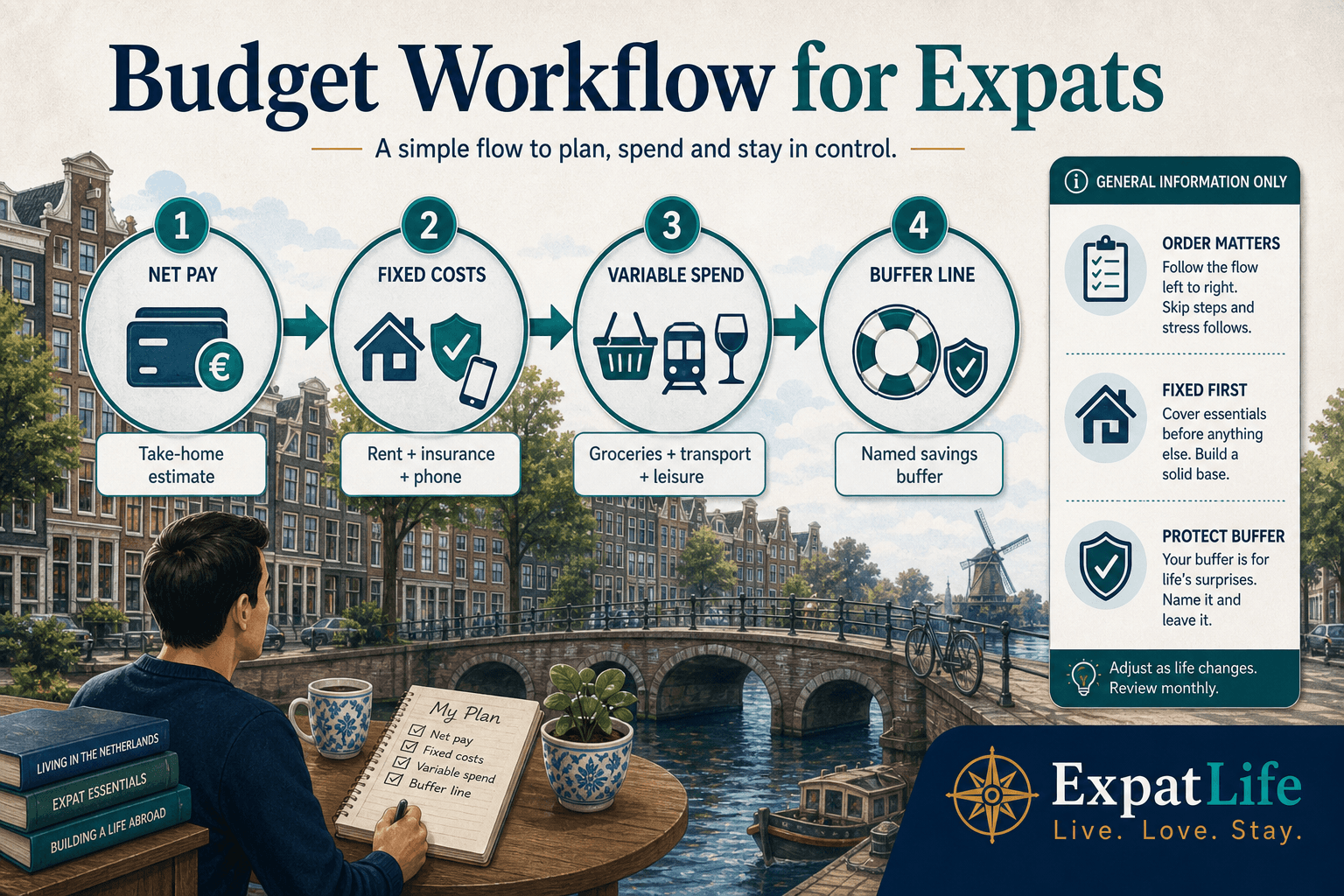
Order matters. Starting from lifestyle spend and “hoping rent fits” is how newcomers get stuck. Follow this sequence, then refine with the calculator and COL guide.
Step 1
Use net salary tools for your contract type. Write the monthly take-home you will actually receive.
Step 2
Rent (or housing), utilities assumption, health insurance premium, phone/internet — and childcare if it is committed.
Step 3
Groceries, transport, subscriptions and leisure. Be honest about dining and travel habits.
Step 4
Name an amount for surprises and savings goals. If nothing is left, revisit rent or lifestyle — do not delete the line.
Step 5
Compare total to net pay, list first-month cash separately, run the cost-of-living calculator with the same assumptions.
If fixed lines already consume most of net pay, variable cuts rarely save the plan — revisit housing or offer.
Cutting coffee before naming a buffer usually fails. Protect a small line, then use the saving sibling for levers.
After month two, compare actuals to the template. Adjust bands; keep categories stable.
Examples
These sketches show shape — not quotes. Swap in your city rent and household size. Amsterdam-led housing sits higher; secondary cities often soften the rent line first. Figures are planning ranges for 2026 orientation only.
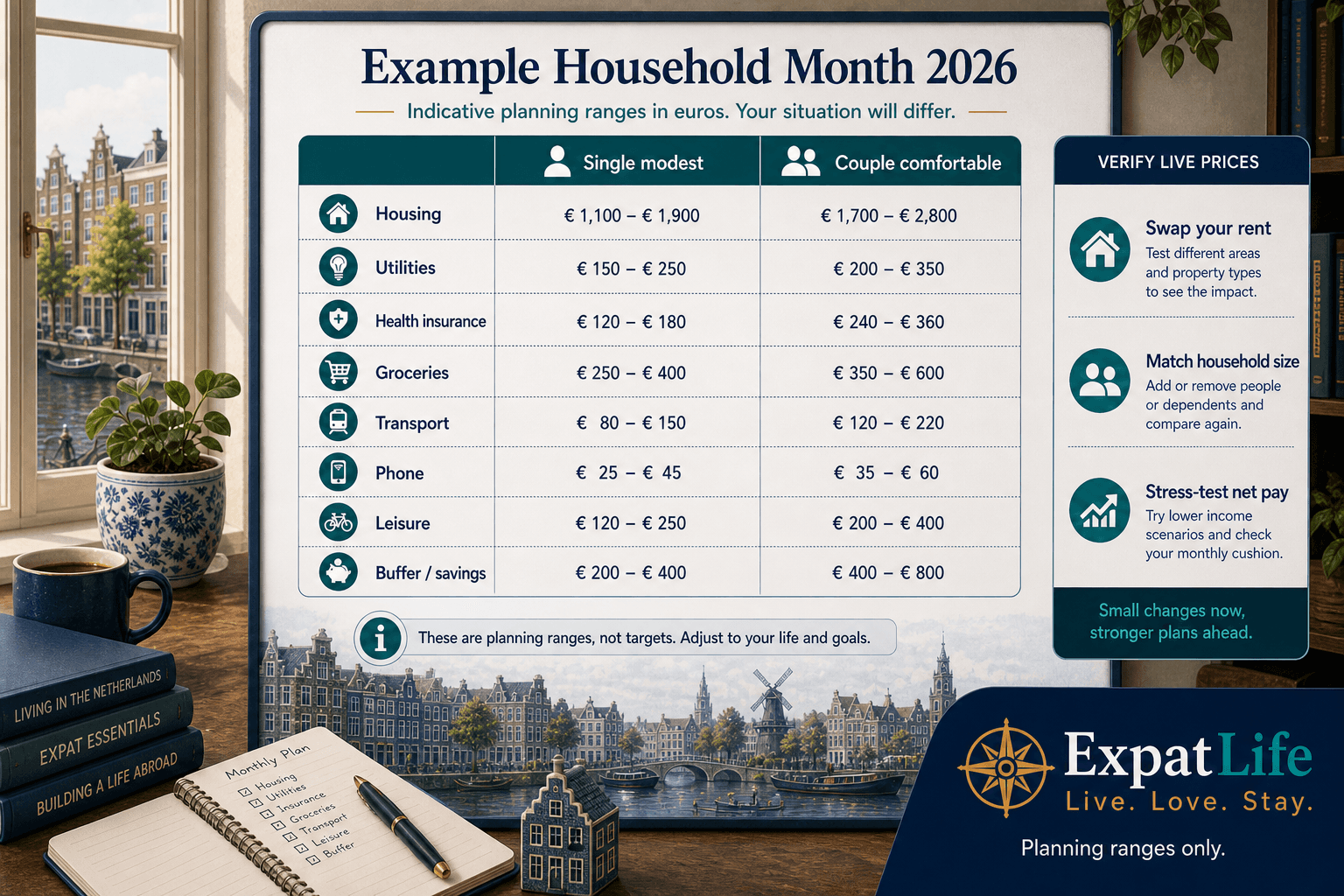
| Category | Single · modest (planning) | Couple · comfortable (planning) | Note |
|---|---|---|---|
| Housing / rent | €1,100–€1,900 (modest city mix) | €1,500–€2,600 (comfortable Randstad mix) | Biggest swing — verify listings |
| Utilities + internet | €140–€240 | €170–€280 | Depends on inclusions |
| Health insurance | €140–€170 / adult | €280–€340 / two adults | Plus deductible buffer awareness |
| Groceries | €200–€320 | €350–€550 | Home cooking assumption |
| Transport | €40–€120 (bike + OV) | €80–€200 (bike + OV) | Car ownership excluded |
| Phone + subscriptions | €40–€90 | €60–€140 | Habits stretch this |
| Leisure | €80–€250 | €150–€400 | Dining and travel move this hard |
| Buffer / savings | €50–€200+ | €100–€400+ | Name it even if small |
Outside the tightest Amsterdam cores, many singles see housing + insurance + food dominate. Leisure is the first stretch line.
Two incomes help — but Randstad rent and two insurance premiums still lead. Agree shared vs solo lines early.
Daycare hours can rival rent. Do not paste a family total onto a couple without care needs.
If your listing is €2,400 rent in central Amsterdam, use that — not the midpoint of a national sketch.
Tools
This page owns the category template and planning workflow. The cost-of-living guide owns drivers and city framing. The calculator owns interactive estimates. Saving money owns levers and habits.

Who owns what
Ready for interactive estimates?
Structure the month here, then model city and household totals in the cost-of-living calculator — keep assumptions matched.
Open cost of living calculatorSituations
Same template, different weights. Use the story that matches your household, then swap real rent.

Examples
| Situation | How it works here | First step |
|---|---|---|
| Single newcomer — first Dutch month | Prioritise arrival cash + rent + insurance; keep leisure thin until steady-state. | List deposit cash beside the monthly template on day one. |
| Couple sharing rent | Joint lines for housing and utilities; personal lines for subscriptions and leisure. | Agree who pays which IBAN and how the buffer is funded. |
| Family with daycare | Treat care hours as a primary line beside rent; do not assume allowance in the first draft. | Get a hours quote, then read the childcare allowance orientation guide. |
| Student / shared housing | Lower rent can still surprise you with insurance and OV — keep structural lines. | Confirm what the huis includes, then add health insurance and a food band. |
Avoid
These patterns create avoidable planning friction — a calm net-pay template beats optimistic listicle averages.

Rent is paid from net. Gross-looking offers can still feel tight after payroll.
Fix: Start the workflow with a net salary estimate.
Averaging move-in cash across twelve months hides the cash crunch in week one.
Fix: Keep a separate first-month cash checklist.
If every euro is assigned to lifestyle, the first bill spike breaks the plan.
Fix: Name a buffer even if it starts small — then grow it.
Sketches show shape. Your listing and insurer set prices.
Fix: Swap real rent and verify premiums before you commit.
Health insurance is structural for most residents — not a lifestyle optional.
Fix: Add premium + deductible awareness before leisure.
This guide owns the template workflow. Drivers and cut levers live on siblings.
Fix: Use COL for framing; saving for levers; calculator for estimates.
Ready to plan
Use this before you sign a lease or accept an offer. Then verify live numbers with listings, insurers and the calculator.
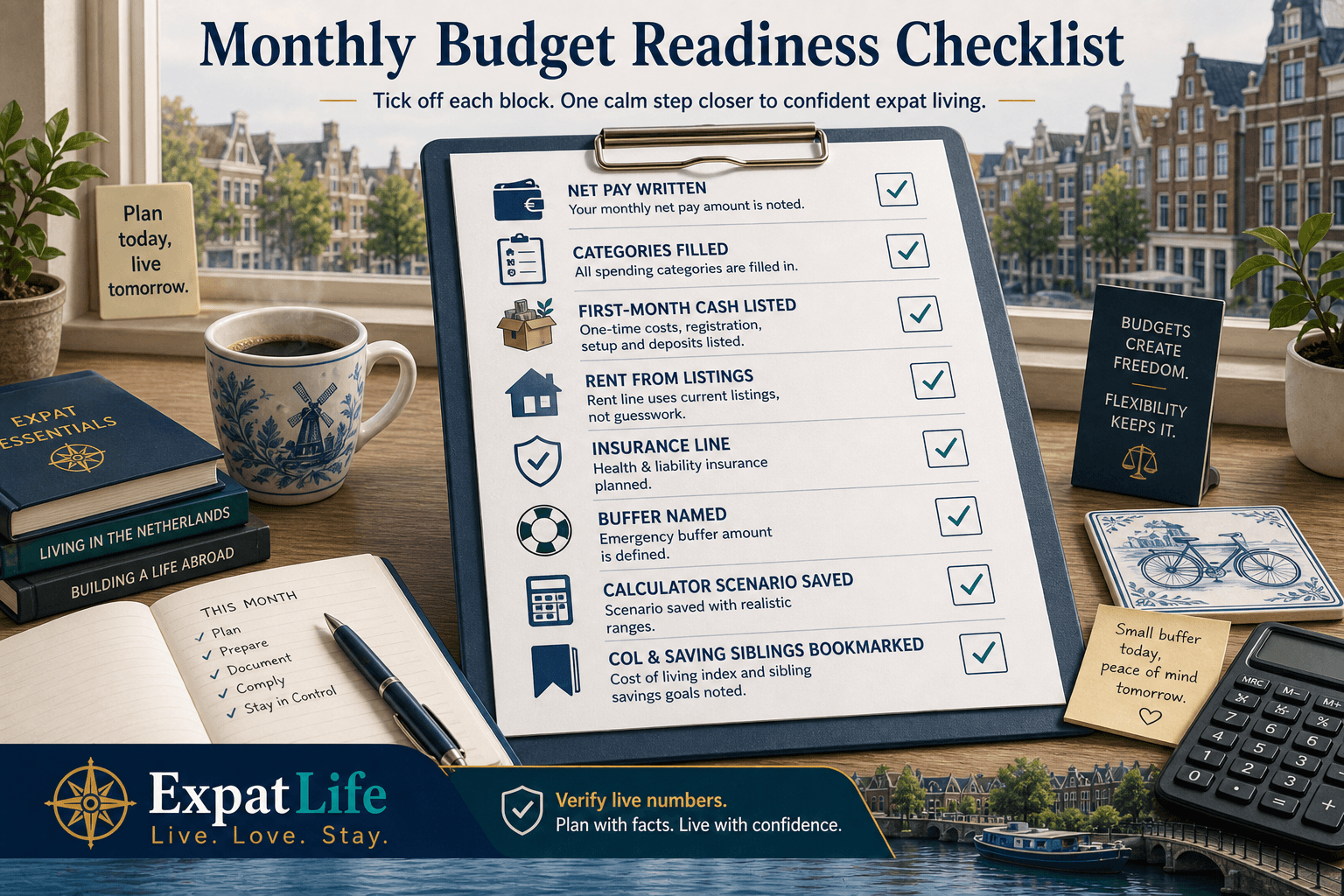
Monthly budget readiness checklist
How-to
A calm sequence beats downloading five unrelated listicles. Follow these steps, then refine with real quotes.
Step 1
City, adults, children, and whether you need parking or daycare.
Step 2
Housing, utilities, insurance, groceries, transport, phone/internet, childcare if relevant, subscriptions, leisure, buffer.
Step 3
Deposit, first rent, setup fees, furniture and travel — keep it beside the steady template.
Step 4
Fixed lines first, then variable bands, then protect the buffer — do not delete the buffer to force a fit.
Step 5
Compare totals to net pay and run the cost-of-living calculator with the same assumptions.
Step 6
Use COL for drivers and city framing; use saving money when you want cut levers.
FAQ
Short answers for the searches expats ask most often about Dutch monthly budgets, first-month cash and how to use planning figures.
There is no single number. Build a category template from net pay, led by housing and health insurance, then set groceries, transport, leisure and a buffer. Indicative 2026 bands on this page are planning ranges — swap real rent and verify premiums.
Cost of living owns drivers, lifestyle/city framing and how to read numbers. This page owns the category template, first-month vs steady-state, and the planning workflow. Use both.
Deposits, setup fees and furniture are cash events. Folding them into a monthly average hides the week-one crunch. Keep a separate arrival cash list beside the steady template.
Start from net. Use the net salary Netherlands tools, then lock fixed costs before lifestyle lines.
After you know your categories and assumptions. This page structures the month; the calculator models interactive city and household estimates.
Name a small line anyway — even a modest amount beats zero. If fixed costs leave nothing, revisit rent or lifestyle before deleting the buffer. Deeper cut levers live on the saving-money sibling.
Only if you have care hours. When both adults work, daycare or BSO can rival rent — get a hours quote and keep allowance pathways separate from the first draft.
No. This is general orientation for newcomers. Figures are indicative planning ranges. Confirm details with providers and seek qualified advice when your situation is complex.
Related
Cluster siblings, the calculator, housing, insurance and banking plumbing that sit beside monthly budget planning.
Banking
You will need a Dutch payment setup for rent and bills. These guides sit beside budget planning — they do not replace the template.
Hub
Return to the Money hub or jump to cost of living, saving, the calculator and banking hub.
Explore next
Model estimates in the calculator, read cost drivers, find saving levers, check net pay, or ground your housing line.
Trust
Confirm live prices and rules with landlords, insurers and official sources — bands on this page are planning orientation only.
Some links on this page may be affiliate or referral links. If you use them, we may earn a commission at no extra cost to you. Affiliate status never changes prices, eligibility or your personal budget reality. All euro bands are indicative planning ranges for 2026 orientation only.