
Family-friendly infrastructure
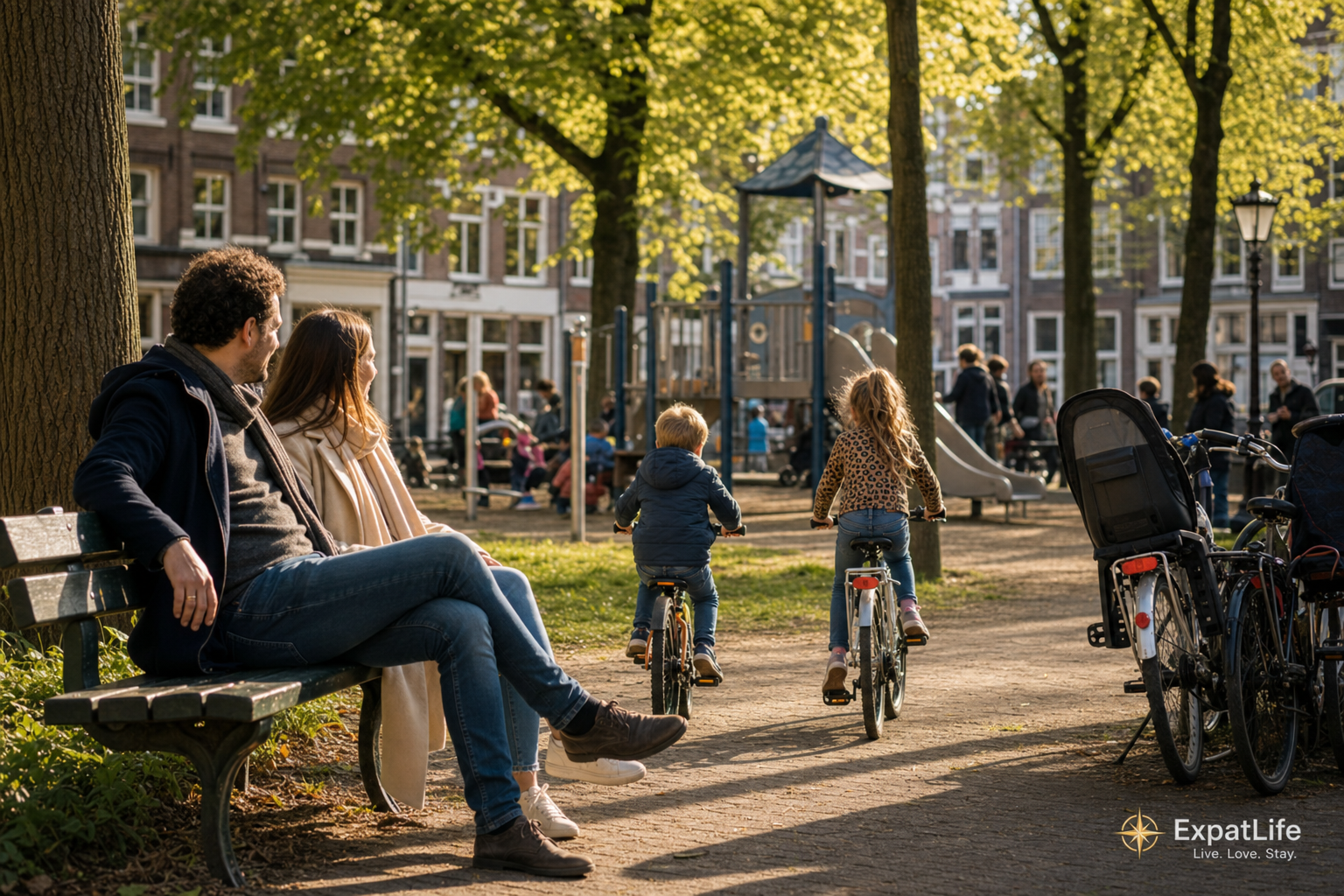
Parks, playgrounds, cycling paths and youth sport clubs are widely available — outdoor life is part of daily childhood for many families.
Netherlands · Family · Parenting
Everything parents need to know about raising children in the Netherlands, from childcare and schools to healthcare, outdoor life and Dutch parenting culture.
Practical orientation only — not medical, legal or parenting advice. Confirm healthcare, school and childcare details with official providers and your municipality.
Quick answer
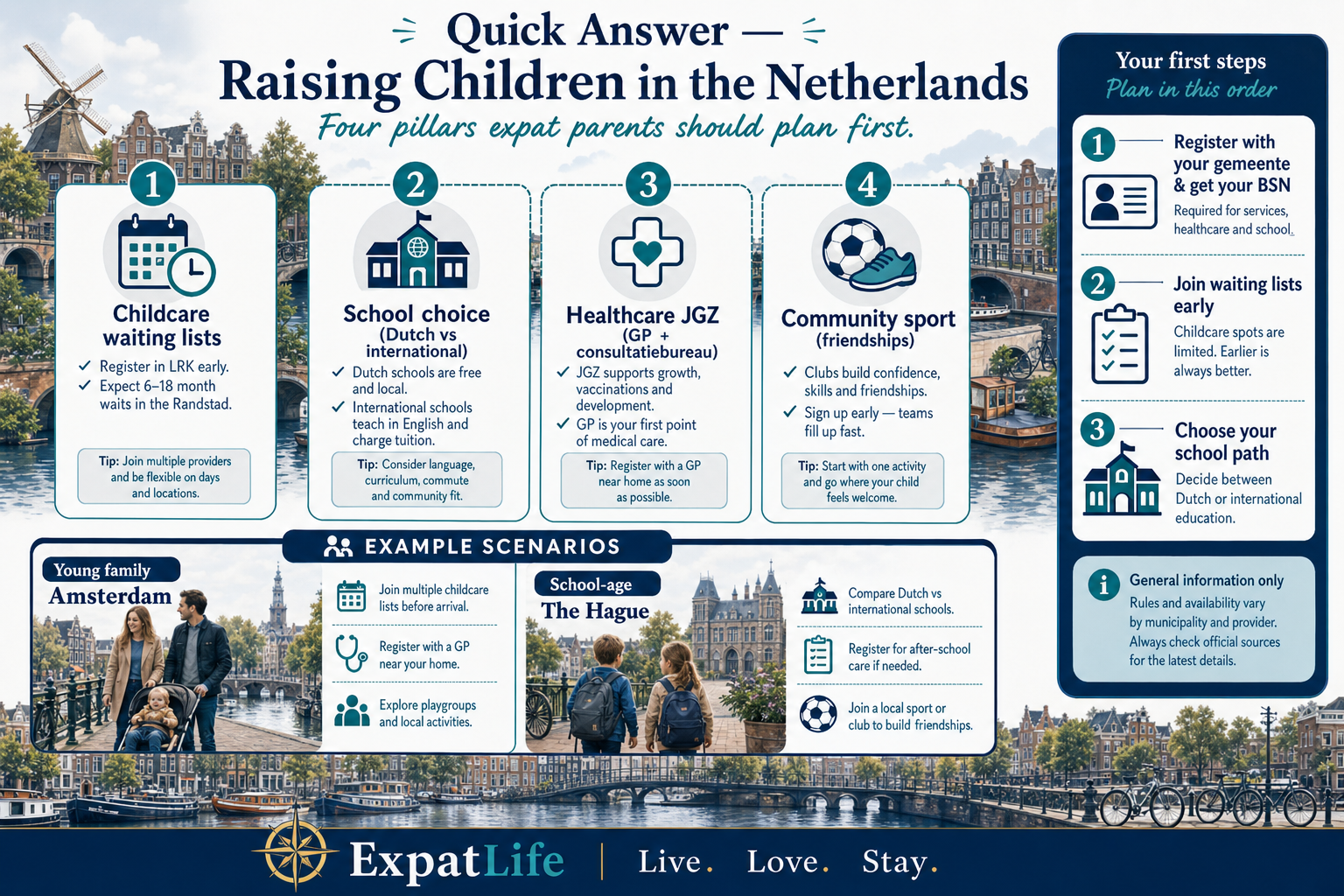
The Netherlands is often recognised for being family-friendly, with strong public services, quality education, safe neighbourhoods and an emphasis on children's independence. Every family's experience is different — city, income, language and school choice all shape daily life — but many parents appreciate the cycling culture, outdoor play, accessible healthcare, community sports and relatively good work-life balance.
Dutch parenting culture tends to emphasise practicality, routine and letting children develop self-reliance within clear boundaries. That can feel different from more protective or academically intense approaches in other countries. Neither approach is inherently better — understanding local norms helps you navigate schools, neighbours and community expectations without judging your own style.
For expat families, the practical pillars are usually childcare (often with waiting lists), school choice (Dutch vs international), youth healthcare registration (JGZ), and building a social network through sport, school and neighbourhood activities. This guide orients you across those areas — use official sources and local providers for decisions that affect your children directly.
Parks, playgrounds, cycling paths and youth sport clubs are widely available — outdoor life is part of daily childhood for many families.
Education, preventive youth healthcare (JGZ) and municipality family services provide a structured safety net — registration unlocks access.
Independence, direct communication and outdoor play are common themes — observe locally rather than assuming universal Dutch parenting.
Childcare waiting lists, school enrolment and healthcare registration reward advance planning — especially when relocating with young children.
Examples
| Profile | Scenario | What to check |
|---|---|---|
| Young family — Amsterdam | Two children ages 1 and 4; both parents working; arriving from Singapore | Join daycare waiting lists before arrival; compare Dutch basisschool vs international; register GP and JGZ within first month. |
| School-age — The Hague | Children ages 7 and 10; diplomatic posting; mid-year arrival | International vs Dutch school mid-year policy; BSO for Wednesday afternoons; enrol in hockey or football club for friendships. |
| Single parent — Utrecht | One child age 3; part-time work; limited Dutch | Gastouder or peuterspeelzaal for flexible hours; taalhuis or library programmes; municipality newcomer orientation. |
| Teen relocation — Eindhoven | Child age 14; tech-sector HSM; English at home | Secondary track placement (VMBO/HAVO/VWO); international school waitlists; maintain home language while building Dutch social network. |
At a glance
Key pillars of family life for expat parents — from public services to outdoor culture and work-life balance.
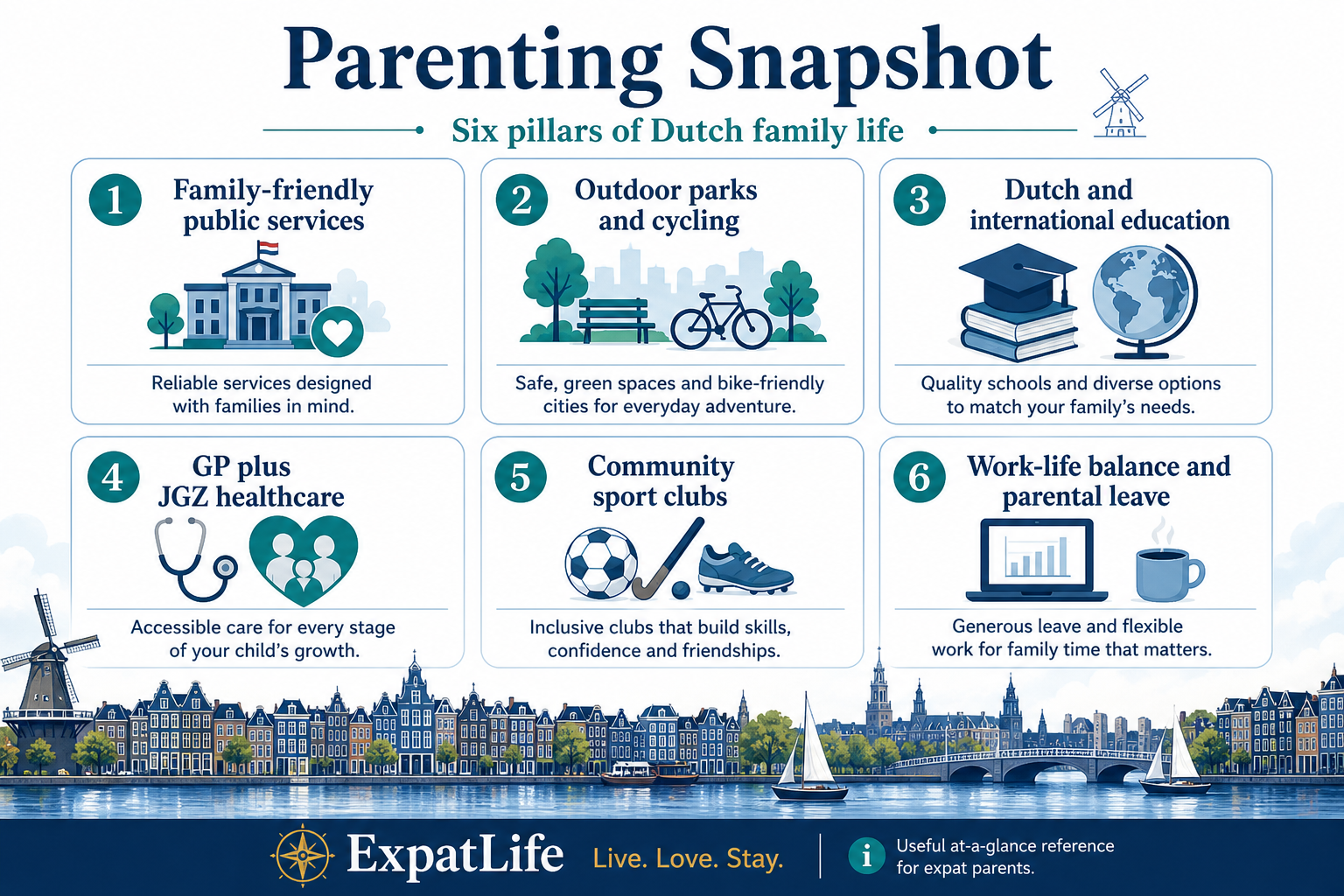
Family-friendly
Strong public services
Education, healthcare and municipality support for families with children.
Outdoor lifestyle
Parks & cycling
Playgrounds, nature and bike infrastructure support active childhoods.
Strong education
Dutch & international
Free Dutch basisschool plus international and bilingual options in major cities.
Healthcare support
GP + JGZ
Preventive youth healthcare from birth through age 18 via consultatiebureau.
Sports clubs
Community sport
Football, swimming, hockey and more — major social routes for children.
Work-life balance
Flexible norms
Part-time work and parental leave are widely accepted in Dutch workplaces.
Culture
Dutch parenting is often described as practical, egalitarian and focused on raising capable, independent children within a safe community context. Research and popular commentary highlight themes like 'free-range' outdoor play, less hovering supervision and early cycling independence — but these are tendencies, not rules every Dutch family follows.
For expat parents, the useful frame is observation, not comparison. Your neighbours, colleagues and school community may parent differently from stereotypes in media or from your home country. Schools and sport clubs often reinforce local norms — for example, expecting children to cycle, attend Wednesday sport or participate in group activities.
Understanding Dutch parenting culture helps you interpret school communication, playground behaviour and community expectations. It does not require adopting every local habit — many international families blend Dutch integration with home-country traditions successfully.
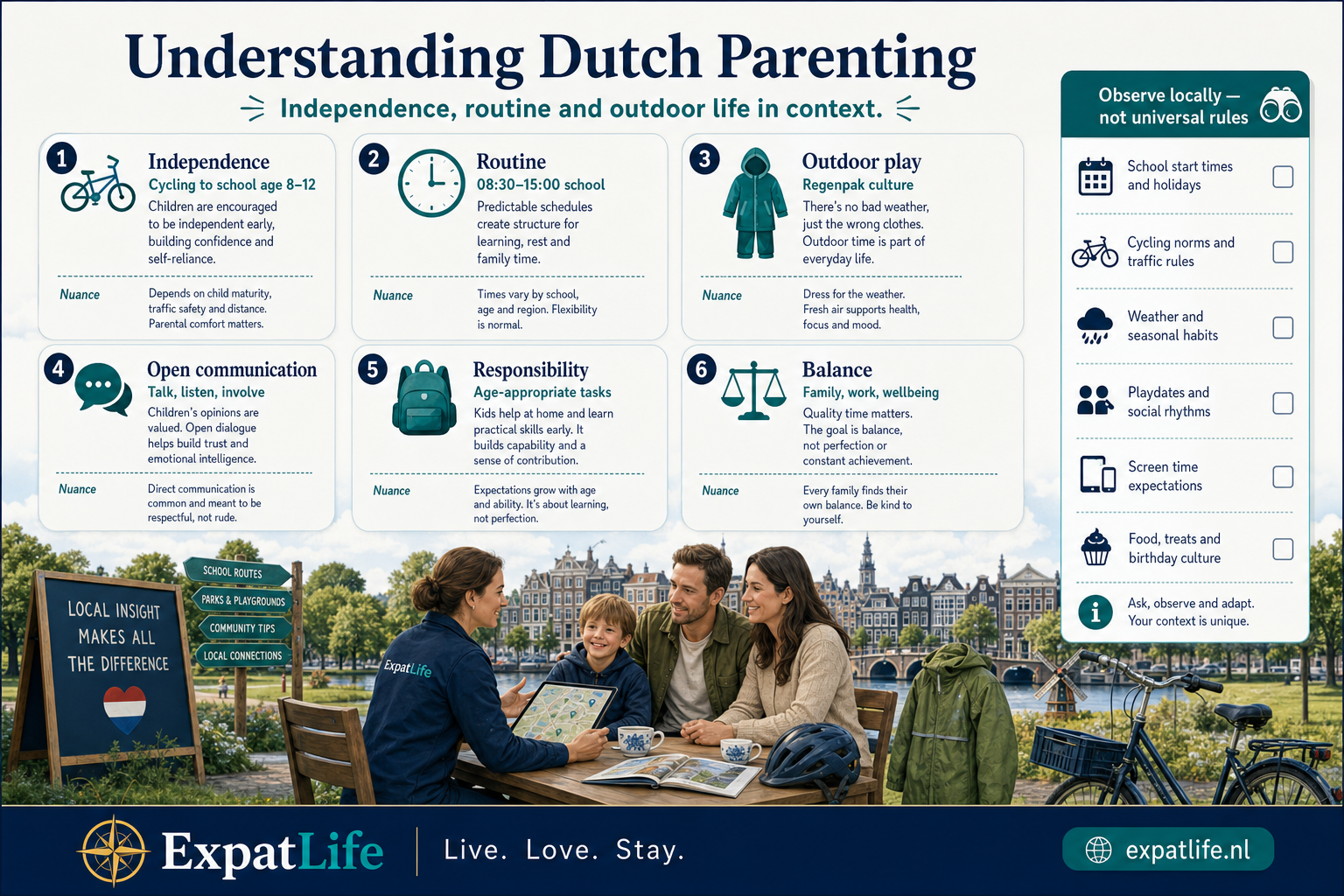
Many Dutch parents encourage children to do things themselves — cycling to school, packing bags, resolving minor playground disputes — earlier than in some other cultures.
Nuance: This reflects trust in safe infrastructure and community norms, not neglect. Families vary widely; expat parents often adapt gradually.
Predictable schedules — school hours, Wednesday sport afternoons, fixed mealtimes — help children and working parents coordinate daily life.
Nuance: Routine supports work-life balance but can feel rigid if you are used to more flexible family rhythms.
Rain or shine, children spend significant time outside — playgrounds, parks, sport clubs and cycling are normal daily activities.
Nuance: Weather-appropriate clothing (regenpak) is part of the culture — staying indoors is less default than in some countries.
Direct, calm conversation with children about feelings, rules and consequences is common in schools and many households.
Nuance: Directness can feel blunt to newcomers — it often aims at clarity rather than criticism.
Children may take on age-appropriate tasks — helping at home, managing belongings, participating in club obligations.
Nuance: Expectations rise gradually; schools and sport clubs reinforce shared responsibility.
Academic pressure exists but is often balanced with sport, play and downtime — especially in early primary years.
Nuance: International schools and selective secondary tracks can feel more intensive — compare school cultures before enrolling.
Daily life
Typical Dutch family weeks revolve around school hours (roughly 08:30–15:00 for primary), Wednesday afternoon sport or free time, and weekend club matches or family activities. Many parents work part-time — often one partner four days and another three — to align with school schedules.
Family meals remain important, though busy sport evenings may shift timing. Supermarkets, neighbourhood shops and weekly markets make cooking at home accessible. Libraries (bibliotheek) offer free children's programmes, and municipalities run school holiday activities (voorjaarsvakantie, zomervakantie, etc.).
Cycling connects daily life — school runs, grocery trips and visiting friends. Parks and playgrounds are social hubs where children play while parents chat. Building friendships often happens through school, sport and neighbourhood proximity rather than formal playdates alone.
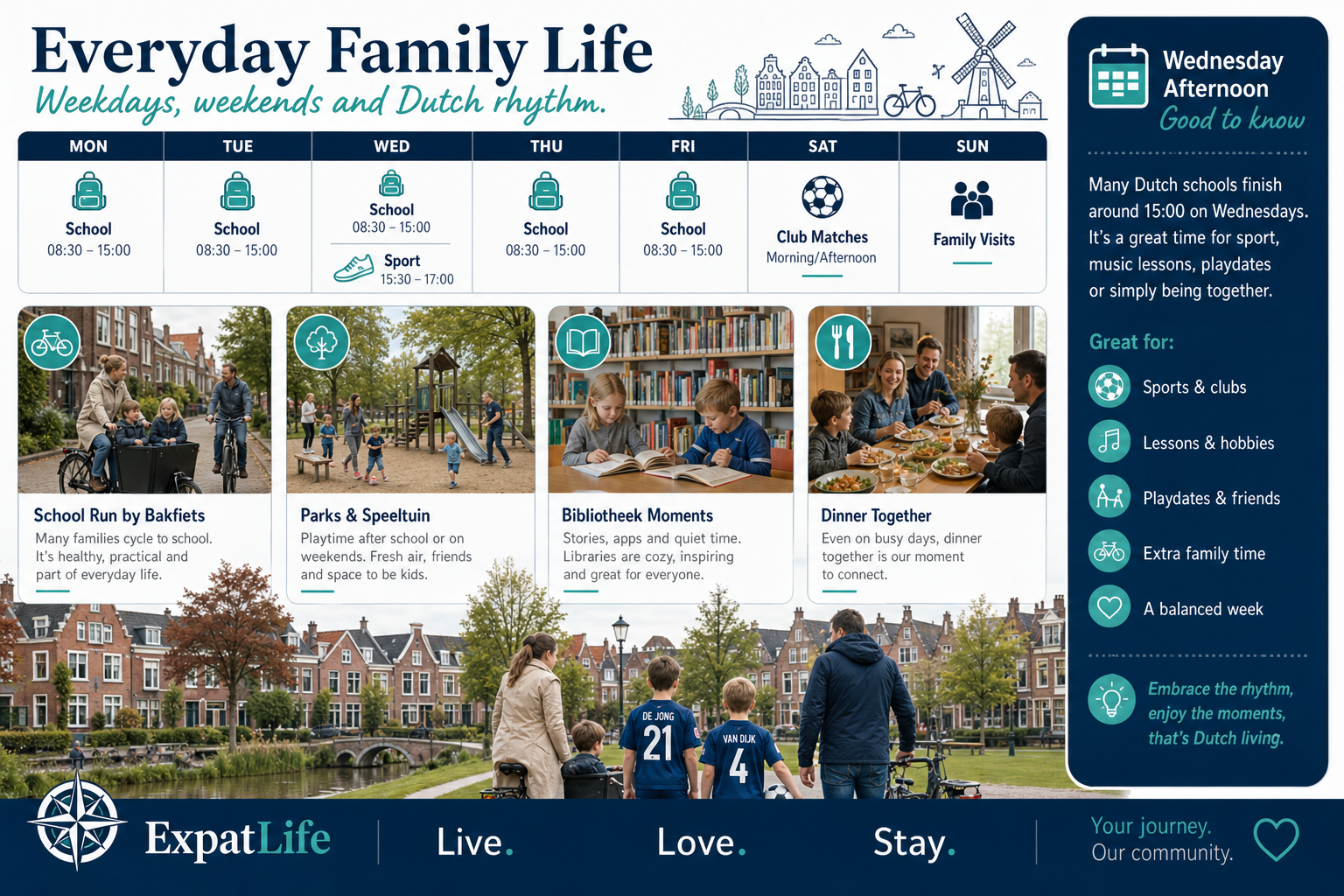
School morning, work or childcare, pickup, homework (increasing with age), dinner and early bedtime on school nights.
Saturday club matches and training; Sunday often reserved for family visits, cycling trips or rest.
Shared dinner is common; children often eat similar food to adults — separate 'kids menus' are less typical at home.
Cargo bikes (bakfiets) for young children; independent cycling increases with age and route safety.
Free outdoor play spaces in every neighbourhood — social meeting points for families.
Free membership, Dutch and sometimes English children's books, holiday activities and reading programmes.
Childcare
Dutch childcare options include daycare centres (kinderdagverblijf), host parents (gastouder), preschool programmes (peuterspeelzaal / voorschool) and after-school care (buitenschoolse opvang, BSO). Most formal care requires LRK registration for allowance eligibility.
Waiting lists are common — especially for infants in Amsterdam, Utrecht and The Hague. Many expat families register before arrival or within weeks of knowing their neighbourhood. Childcare allowance (kinderopvangtoeslag) can reduce costs for eligible working parents.
For full detail on provider types, costs, waiting lists and expat scenarios, see our dedicated daycare guide.
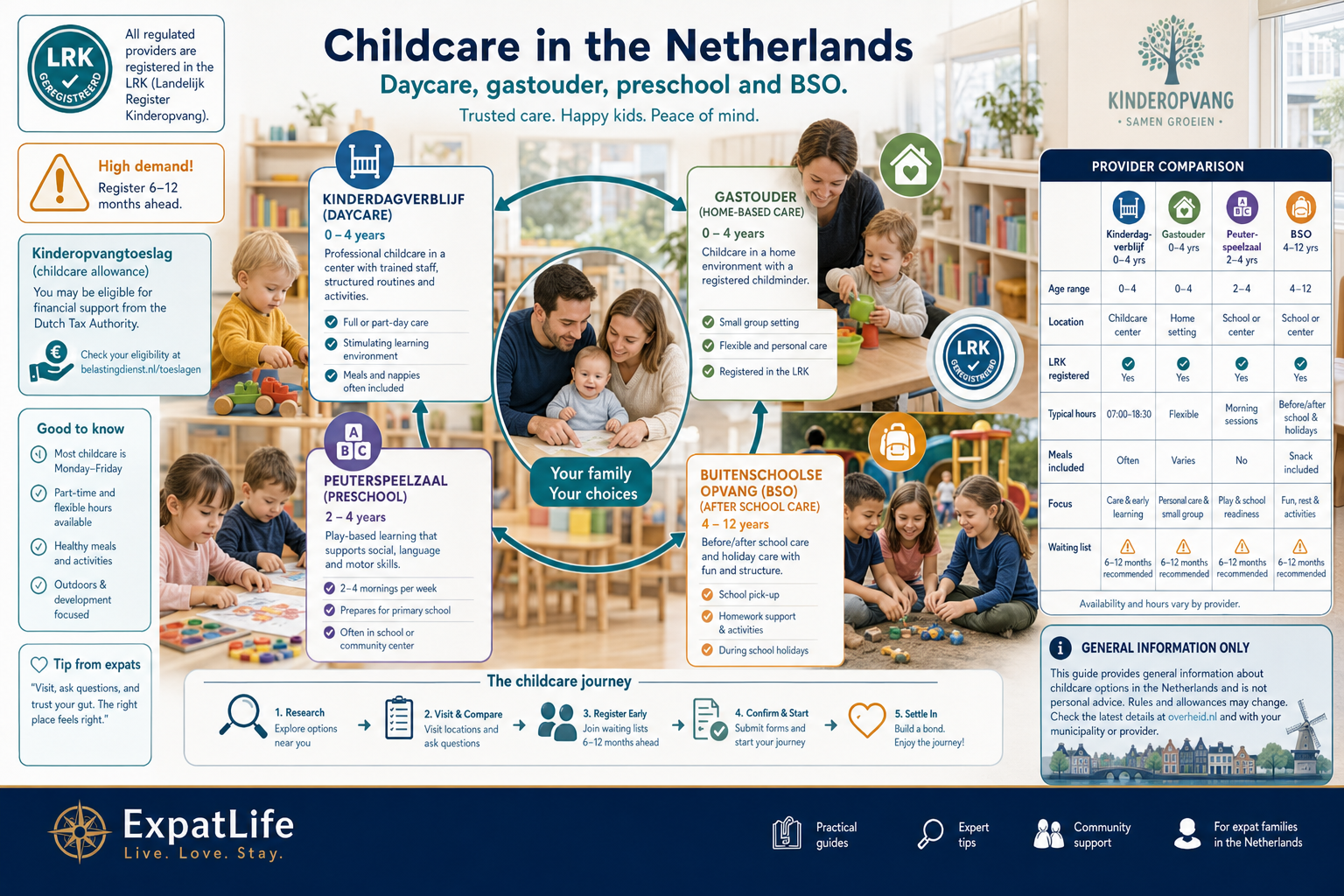
Centre-based care from roughly 0–4 years; structured groups, often 08:00–18:00; LRK registered. Randstad waiting lists often 6–18 months for infants.
Host-parent care in a home setting; smaller groups; flexible hours; also LRK registered. Often shorter waits than large centres.
Part-time play-based programme for ages 2–4; often linked to primary schools; municipal subsidies may apply. Good bridge before basisschool.
Supervised care before/after school for primary-age children; covers Wednesday afternoons and school holidays when parents work.
Schools
Dutch primary education (basisschool) is free and begins at age 4 (compulsory from age 5). Most children attend local Dutch-medium schools; international and bilingual options exist in major cities. Secondary education (voortgezet onderwijs) begins around age 12 with tracked pathways (VMBO, HAVO, VWO).
Language is the key decision for expat families: Dutch-medium schools accelerate integration; international schools maintain English or other home-country curricula at higher cost. Homework loads increase with age; parent communication happens via apps (e.g. Parro, Magister), newsletters and parent evenings.
School choice interacts with housing — catchment areas and commute matter. Visit schools, talk to other parents and read our dedicated school guides before committing.
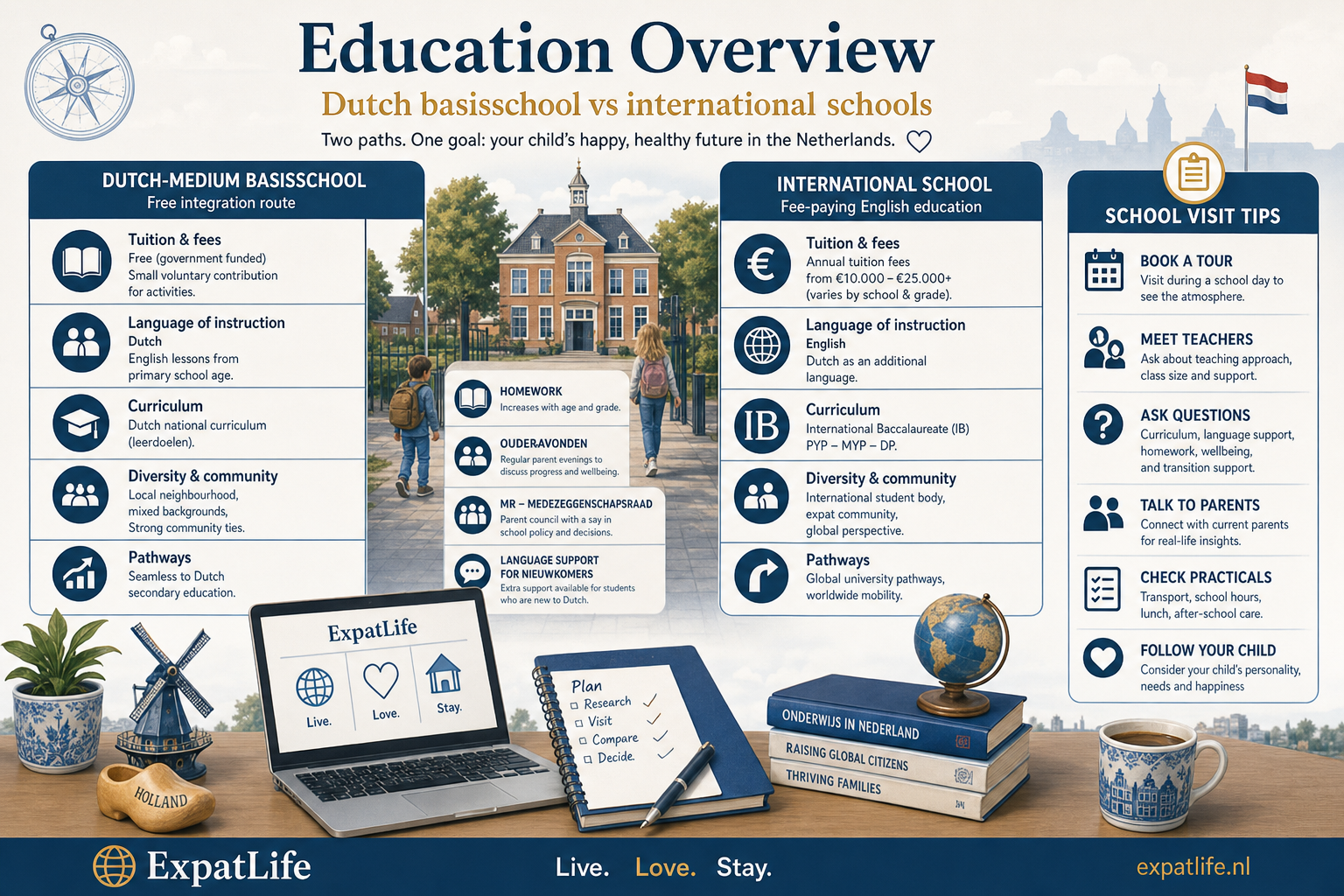
| School path | Best for | Trade-off |
|---|---|---|
| Dutch basisschool | Long-term stay, integration, local friendships | Dutch language learning curve; fewer English-speaking staff |
| International school | Short assignments, English continuity, global curricula | Fees €10k–€25k+/year; smaller Dutch social network |
| Bilingual track | Dual-language families in major cities | Limited places; often still competitive admission |
Health
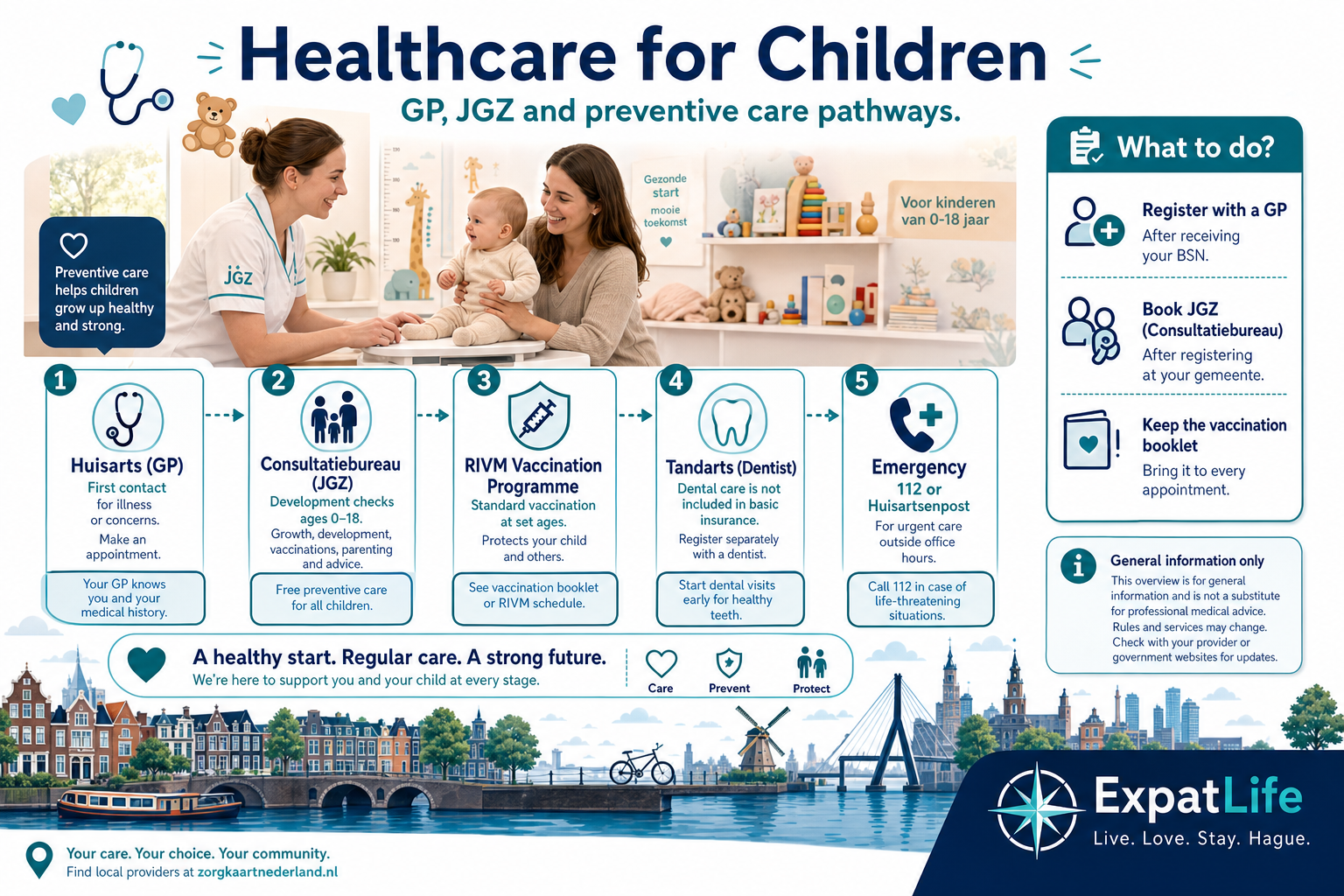
Children in the Netherlands access healthcare through a GP (huisarts) for illness and a preventive youth healthcare service (JGZ — jeugdgezondheidszorg) via the consultatiebureau for development checks, vaccinations and parenting guidance. Dental care is separate — register with a dentist (tandarts) early.
The national vaccination programme (Rijksvaccinatieprogramma) is offered free through JGZ. Development monitoring at standard ages helps identify support needs early. For emergencies, call 112; for urgent non-emergency care, contact your GP or local huisartsenpost.
Register your children with a GP after obtaining BSN and health insurance. JGZ contact usually follows gemeente registration — your municipality or consultatiebureau website explains local appointment booking.
Activities
Sport and extracurricular activities are central to Dutch childhood social life. Most activities run through local clubs (verenigingen) rather than school-only programmes — football (soccer), swimming, gymnastics, hockey, scouting, martial arts, dance and music are widely available.
Enrolment often follows the August–September season; waiting lists exist for popular clubs. Wednesday afternoons (when many primary schools finish early) are prime sport time. Costs vary — club membership, equipment and travel add up; some municipalities subsidise low-income families.
Sport is one of the fastest routes to friendships for expat children — teammates and parents form natural community networks regardless of language level at first.
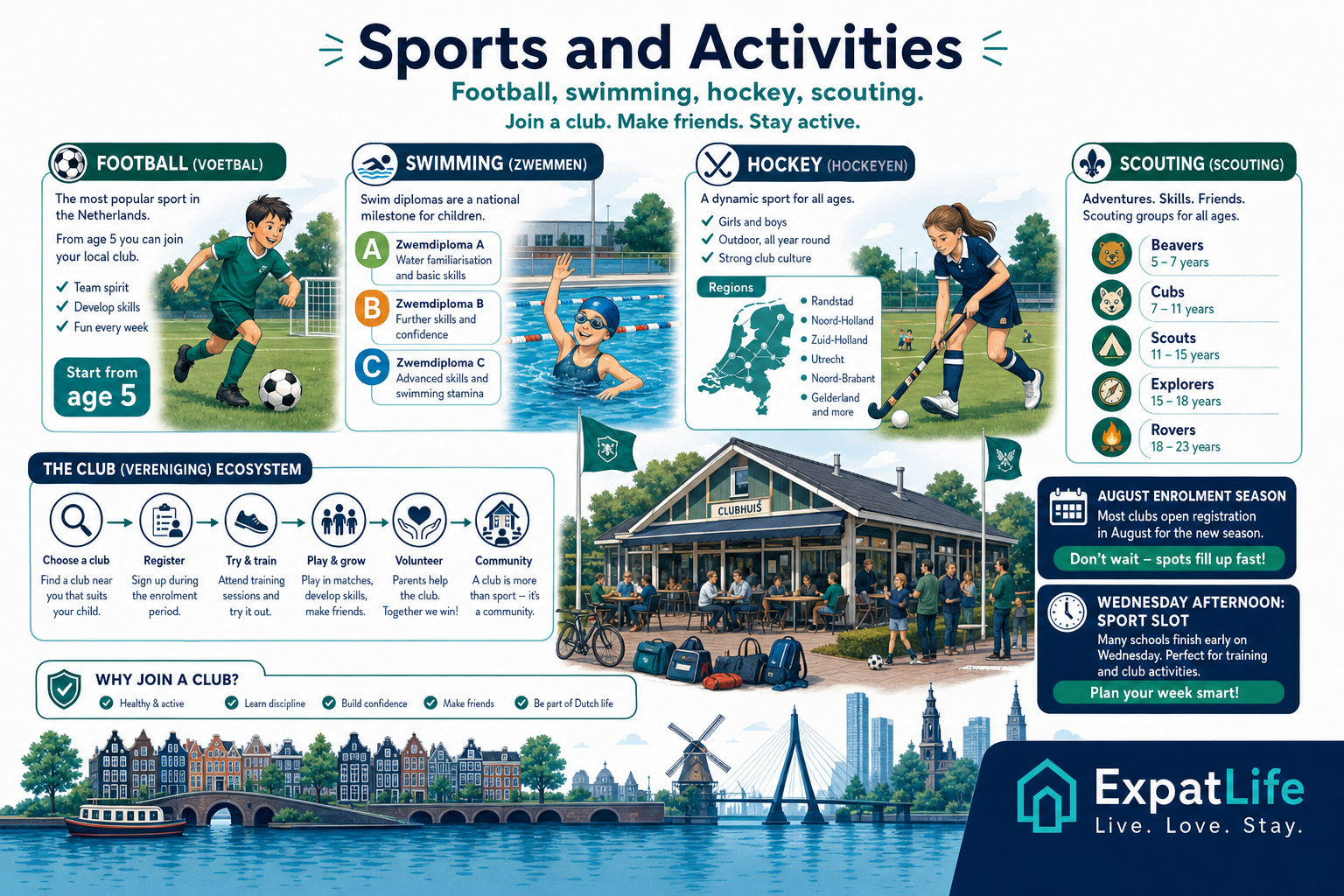
Largest youth sport; clubs in every municipality; season starts August–September; typical cost €150–€300/season.
Zwemdiploma A/B/C is a cultural milestone; lessons at municipal pools or clubs; plan 1–2 years for diploma A.
Strong in Randstad and The Hague corridor; higher equipment costs; excellent social network for expat families.
Scouting Nederland groups nationwide; affordable; strong community and outdoor skills focus.
Outdoor
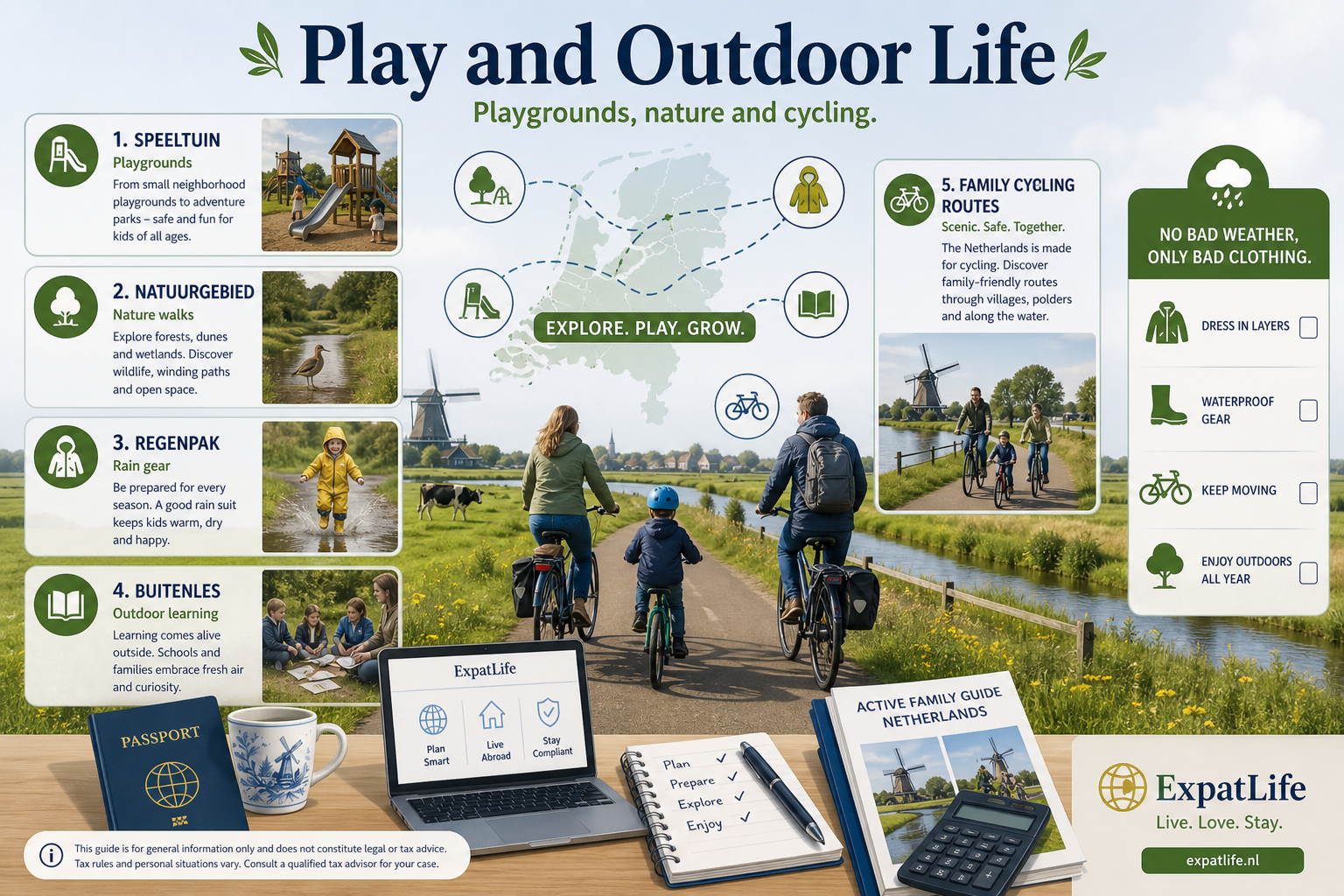
Outdoor play is deeply embedded in Dutch family culture. Playgrounds (speeltuinen) are free and plentiful; nature areas (natuurgebieden), beaches and forests are accessible by bike or public transport. The phrase 'There is no bad weather, only bad clothing' reflects how normal outside time is, even in rain.
Schools often incorporate outdoor learning (buitenles). Family walks, cycling trips and playground visits are default weekend activities. This emphasis supports physical activity, social skills and independence — but requires weather-ready gear and acceptance of messy, active play.
For expat families from climates or cultures with more indoor default, adjusting wardrobes and expectations early helps children participate fully in local social life.
Language
Many expat families raise bilingual or multilingual children — home language plus Dutch acquired through school and community. Research generally supports maintaining home languages while children learn Dutch; abandoning home language is not necessary for integration.
Dutch schools expect increasing Dutch proficiency over time; newcomer support may be available. International schools may offer dual-language tracks. Community resources include libraries, taalhuis (language house) programmes and heritage language schools in major cities.
Language development varies — some children code-switch early, others have a silent period. Patience, consistent home-language use and exposure through sport and play accelerate confidence.
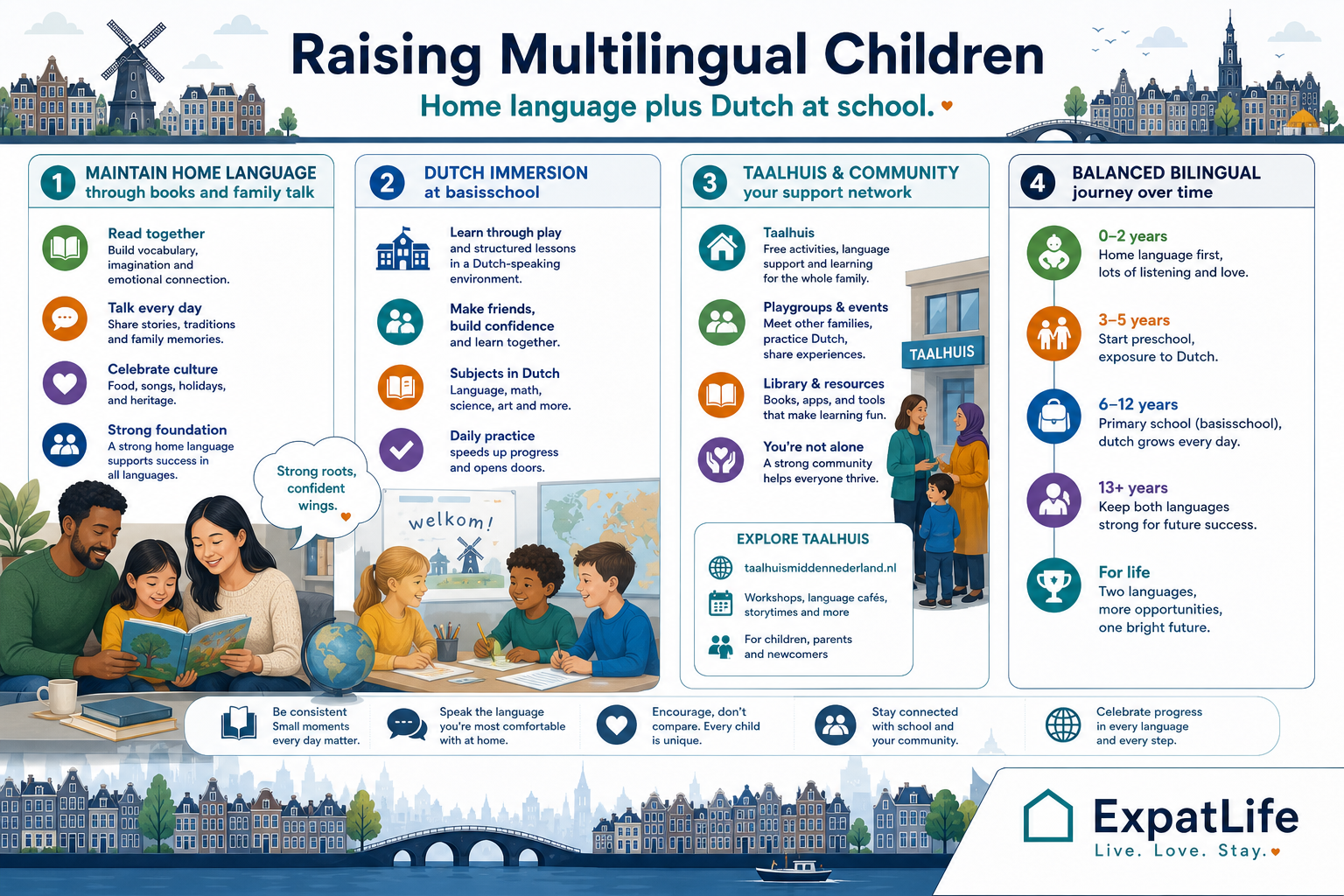
Free membership; Dutch and English children's books; taalcafé sessions in many cities.
Municipal language house programmes — orientation for adults and sometimes family sessions.
Weekend schools in major cities for Arabic, Chinese, Spanish and other home languages.
Nieuwkomers or extra Dutch (NT2) groups — ask basisschool or gemeente after enrolment.
Relocate
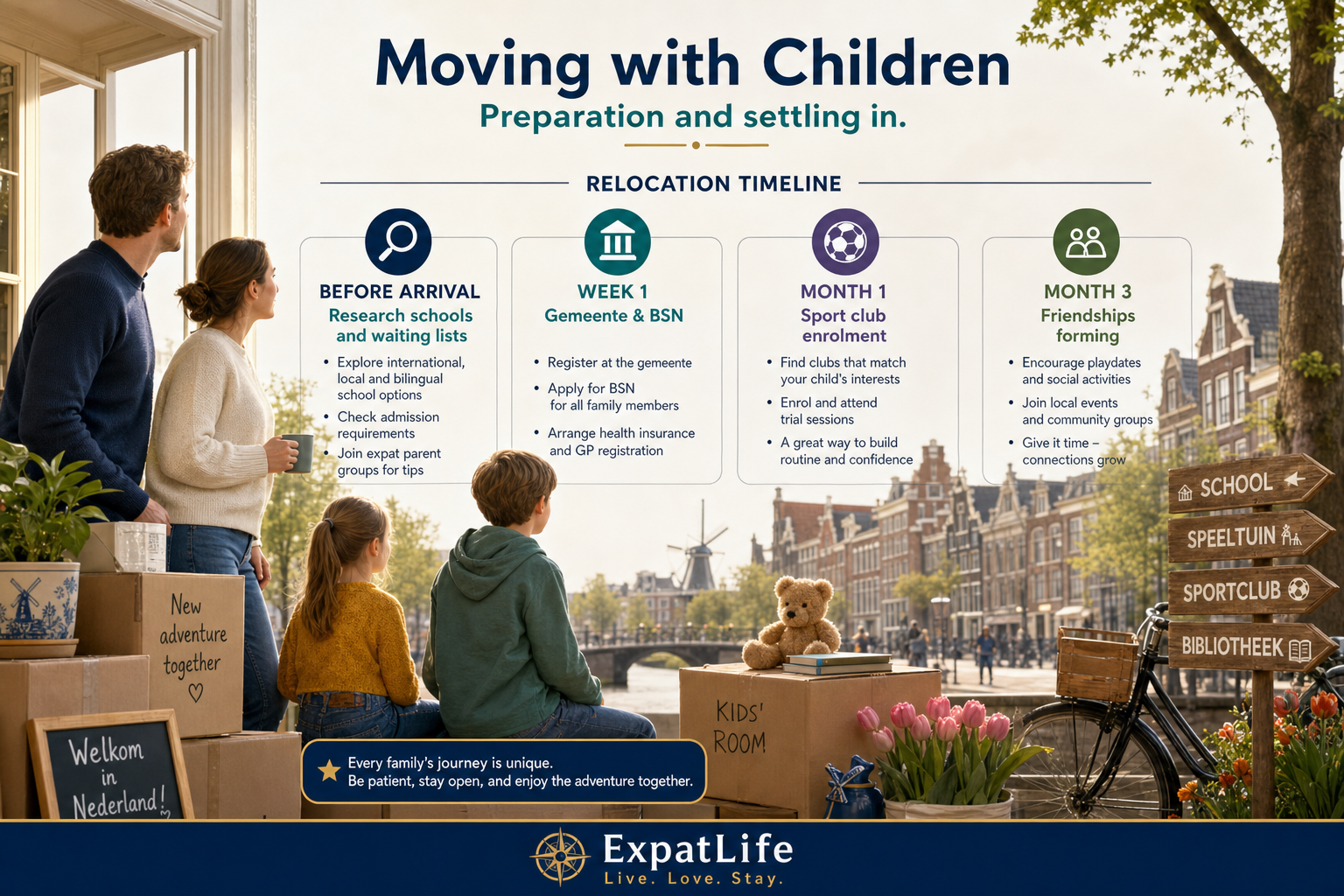
Relocating with children adds layers to an already complex move — schools, childcare, healthcare, friendships and emotional adjustment all need parallel planning. Preparation before arrival (researching neighbourhoods, joining waiting lists, discussing the move age-appropriately) reduces stress in the first months.
Settling in takes time — six to twelve months for new routines and friendships is common. Help children maintain connections to their previous home while building local anchors through school, sport and neighbourhood play.
School transitions mid-year are possible but easier at natural break points. Temporary childcare or gastouder care can bridge gaps while you secure permanent arrangements.
Moving with children checklist
Balance
The Netherlands is known for part-time work culture — many parents (especially mothers, increasingly fathers too) work 24–32 hours to align with school schedules. Parental leave (geboorteverlof, aanvullend geboorteverlof, kraamverlof) provides paid and unpaid options around birth; employers often offer additional leave.
School hours (08:30–15:00, with Wednesday afternoons often free from age 6+) shape logistics. BSO covers gaps for working parents. Flexible working (hybrid, adjusted hours) is common in knowledge-sector and international employers.
Expat parents on demanding full-time contracts may feel tension with local norms — discuss flexibility early with employers and plan BSO or informal care for Wednesday afternoons and holidays.
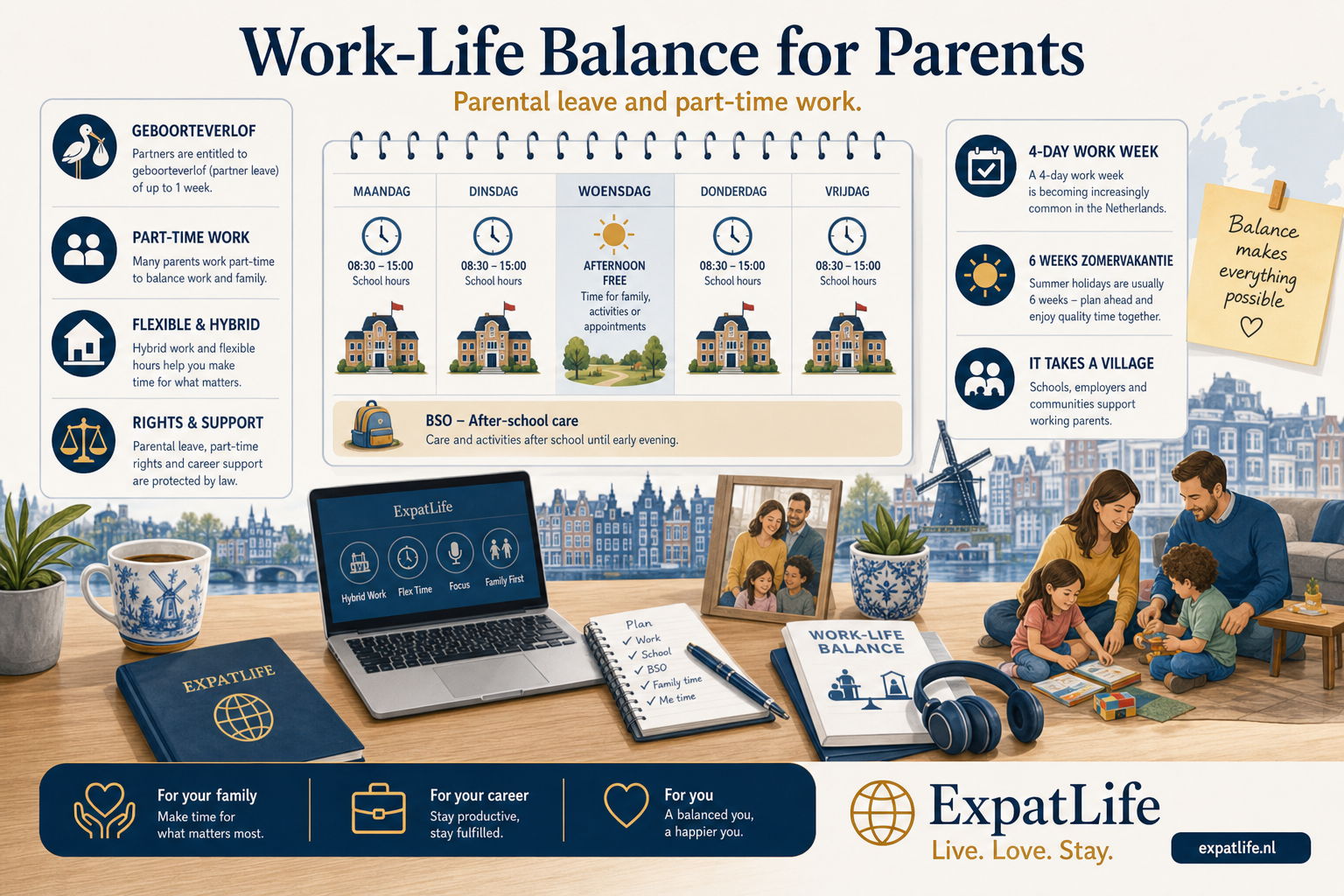
| Leave type | What to know |
|---|---|
| Maternity leave (zwangerschapsverlof) | 16 weeks total — typically 4–6 weeks before due date; paid via UWV at daily rate cap. |
| Partner birth leave (geboorteverlof) | 1 week paid at 100% of daily wage — taken within 4 weeks of birth. |
| Supplementary partner leave | Up to 5 weeks at 70% via UWV in first 6 months — check current UWV rules. |
| Unpaid parental leave (ouderschapsverlof) | Up to 26× weekly working hours per parent per child until age 8 — job protected. |
Community
You do not need to navigate Dutch family life alone. Municipality websites list family services; consultatiebureau nurses offer parenting guidance; libraries run free programmes; and parent groups (via school, expat networks or neighbourhood) provide peer support.
Community centres (buurtcentra) host playgroups and language cafés. International parent groups in major cities offer familiar formats during early adjustment. Youth healthcare professionals can signpost to support for development, sleep or behaviour concerns.
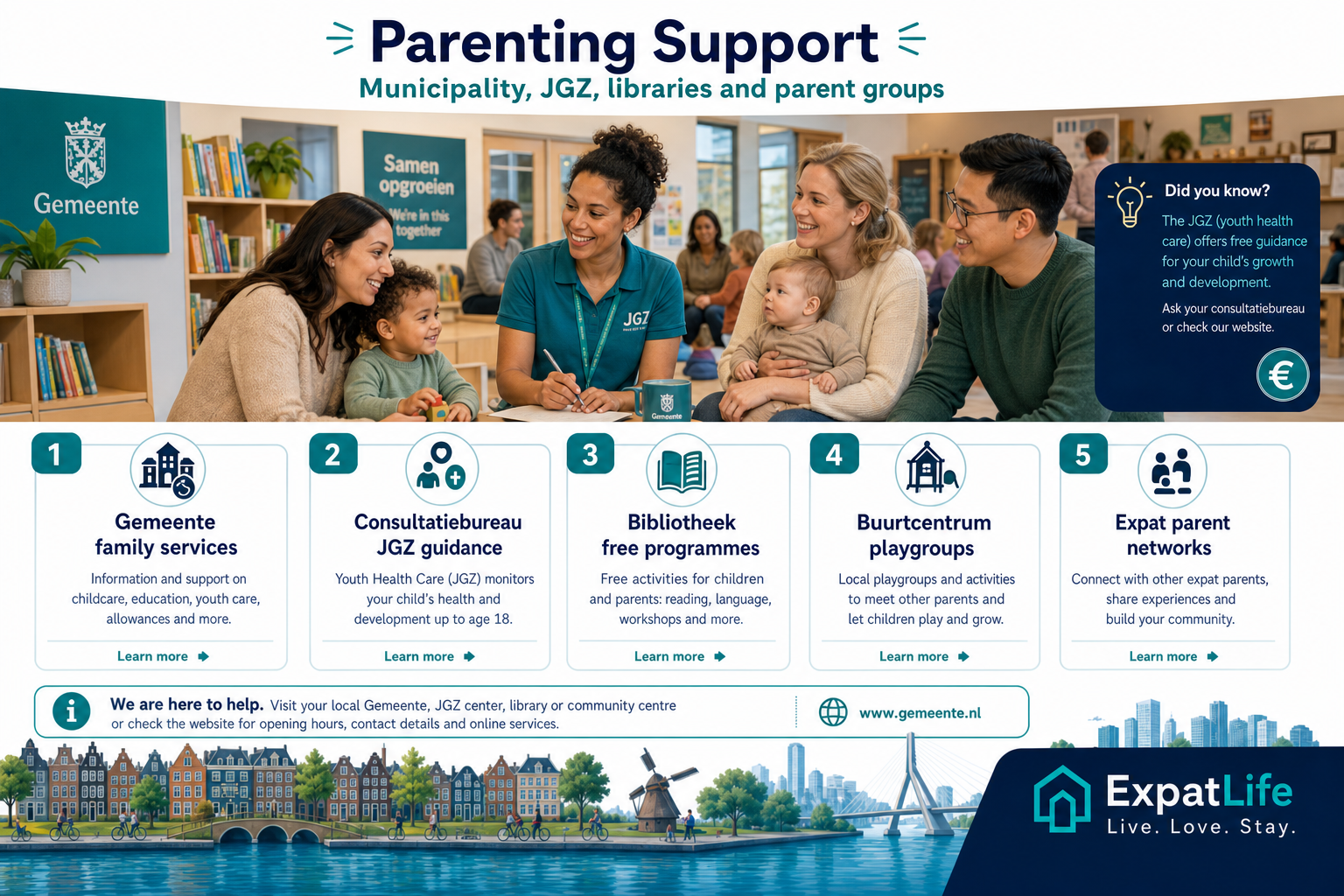
Local family services, childcare lists, newcomer orientation and sometimes integration programmes.
Preventive healthcare plus parenting guidance at standard check appointments.
School oudercommissies, expat parent networks and neighbourhood playgroups.
Free children's activities, language support and community events.
Playgroups, language cafés and low-cost family activities.
International clubs and online groups for peer advice and social connection.
First month — build your support network
Compare
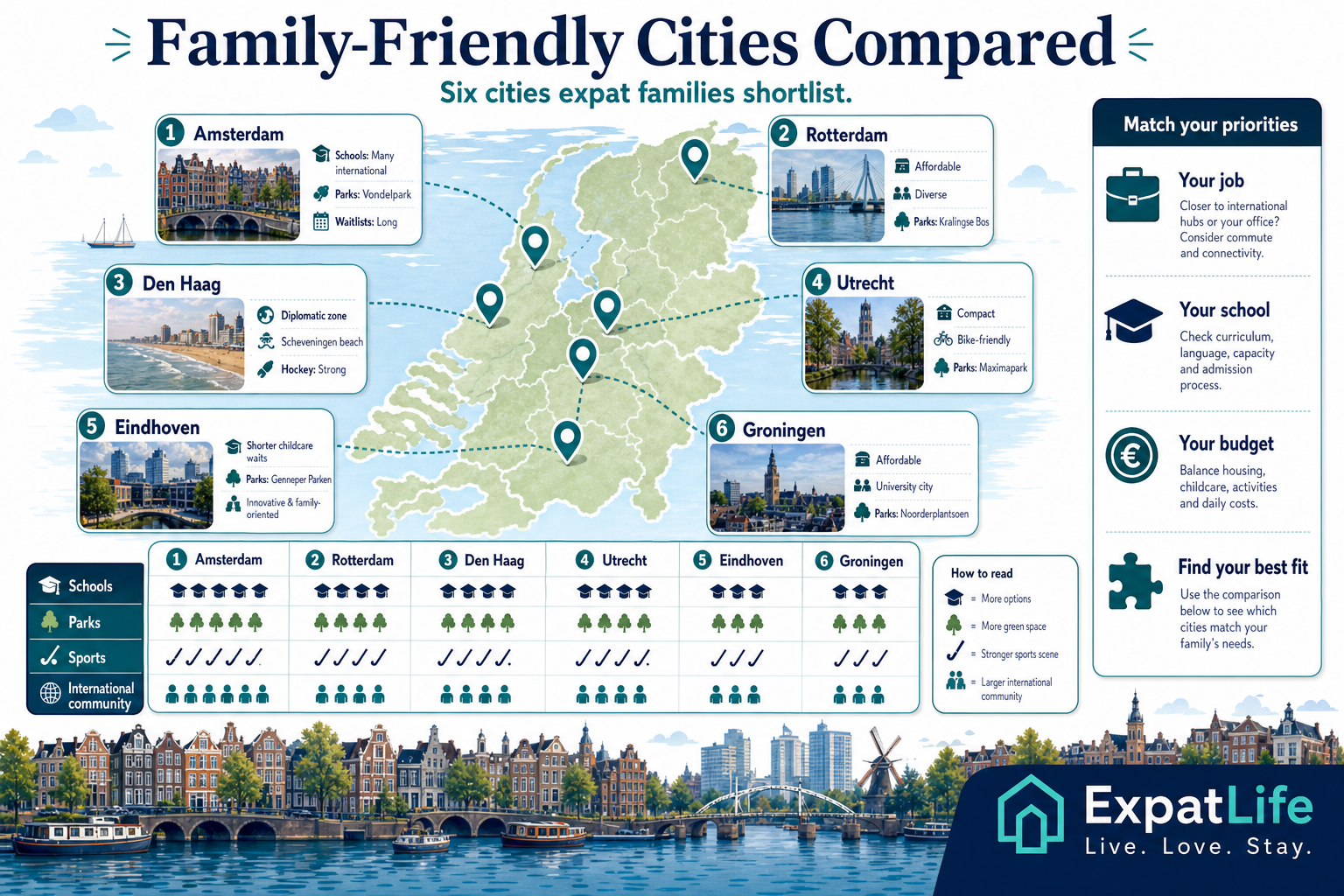
City choice shapes schools, childcare waiting lists, outdoor lifestyle and international community — compare before you commit.
Budget
Raising children in the Netherlands involves predictable public costs (health insurance, often low basisschool fees) and variable private costs (childcare, international school fees, sport, housing). Child benefits (Kinderbijslag) and childcare allowance can offset part of the load for eligible families.
Budget holistically: housing sized for family, commute, childcare days, sport memberships and holiday care. Randstad cities carry premium housing costs; smaller cities often trade lower rent for fewer international school options.
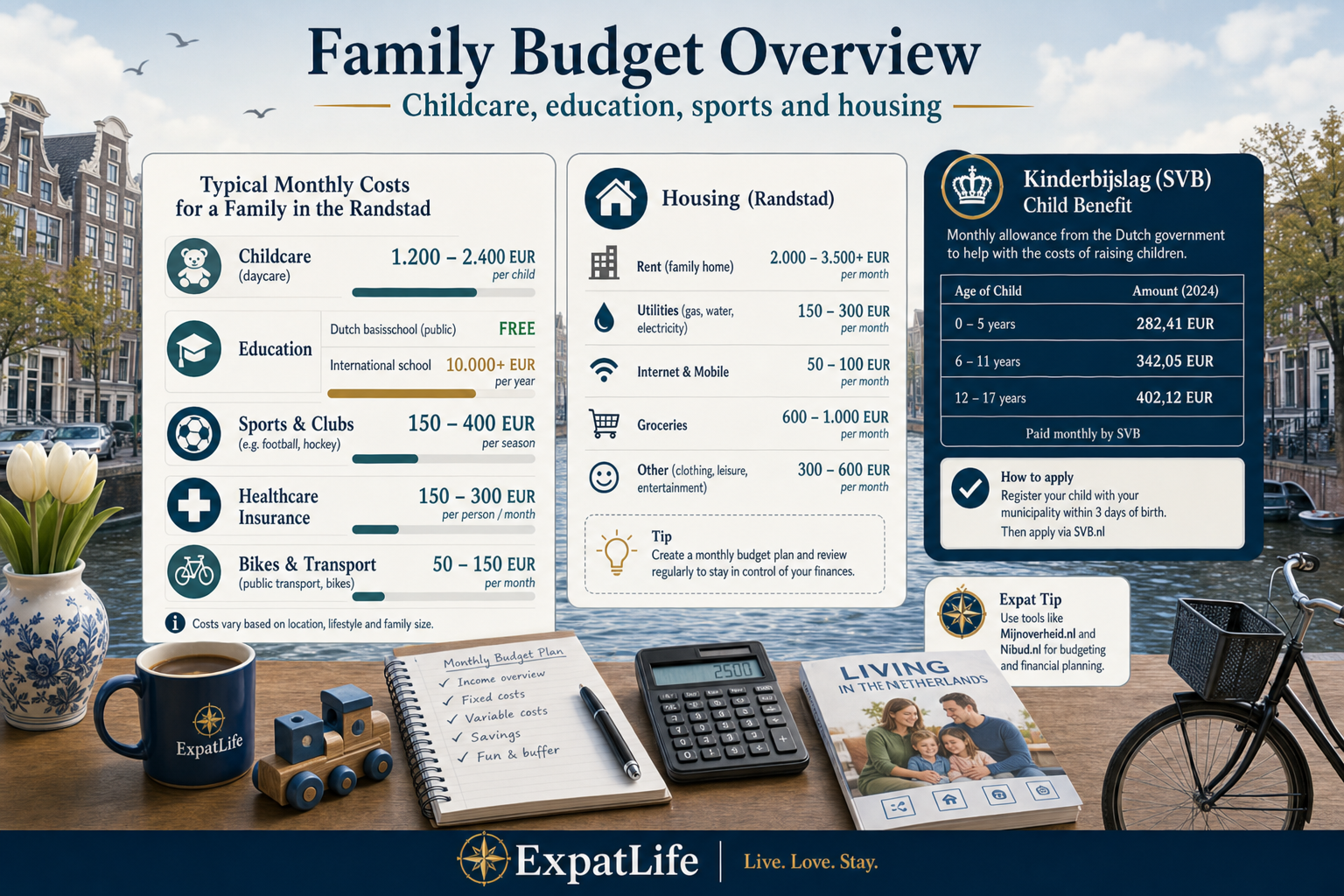
Often the largest early-years cost — €1,200–€2,400/month full-time before allowance in Randstad cities.
Dutch basisschool free; international schools €10,000–€25,000+/year; ouderbijdrage voluntary contributions at Dutch schools.
Club fees €150–€400/season plus equipment; music lessons additional.
Mandatory insurance for adults; children covered under parent's policy until 18.
Bikes primary; OV-chipkaart for older children; car optional in cities.
Museum passes, holiday camps, family trips — plan for school vacation periods.
Expat life
These challenges are predictable — address them early with local resources, schools and community networks.
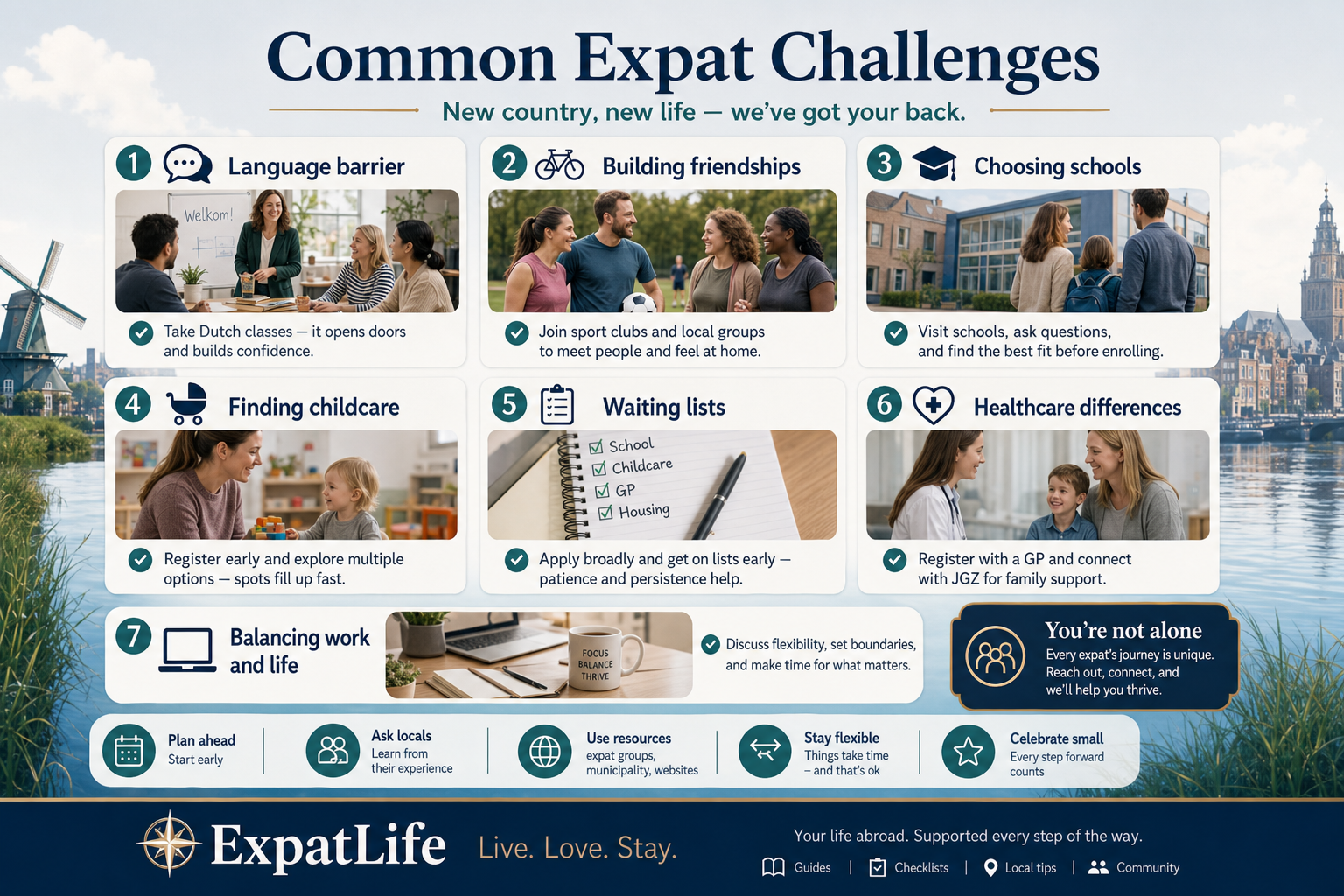
Children often pick up Dutch faster than parents — school communication and playground interactions may feel isolating at first.
Tip: Take beginner Dutch classes; use school apps with translation; join expat parent groups for parallel support.
Local friendships form through sport and school — expat children may need time to find their social footing.
Tip: Enrol in a club early; accept playdates; attend school parent events even when language is imperfect.
Dutch vs international is a major fork — each path has trade-offs for language, cost and community.
Tip: Visit schools, talk to parents and read our school guides before deciding.
Waiting lists in major cities can exceed 12 months for infant places.
Tip: Register multiple providers before arrival; consider gastouder as flexible bridge care.
Childcare and popular sport clubs both use queues — late planning creates gaps.
Tip: Treat waiting-list registration as step one of relocation planning.
JGZ and GP-first systems differ from paediatrician-led models in some countries.
Tip: Register GP and attend JGZ appointments — ask nurses for orientation.
Dutch school hours and Wednesday afternoons conflict with full-time expectations from some employers.
Tip: Discuss flexibility early; plan BSO and holiday care; explore part-time options.
Checklist
Work through this checklist in your first months after arrival.
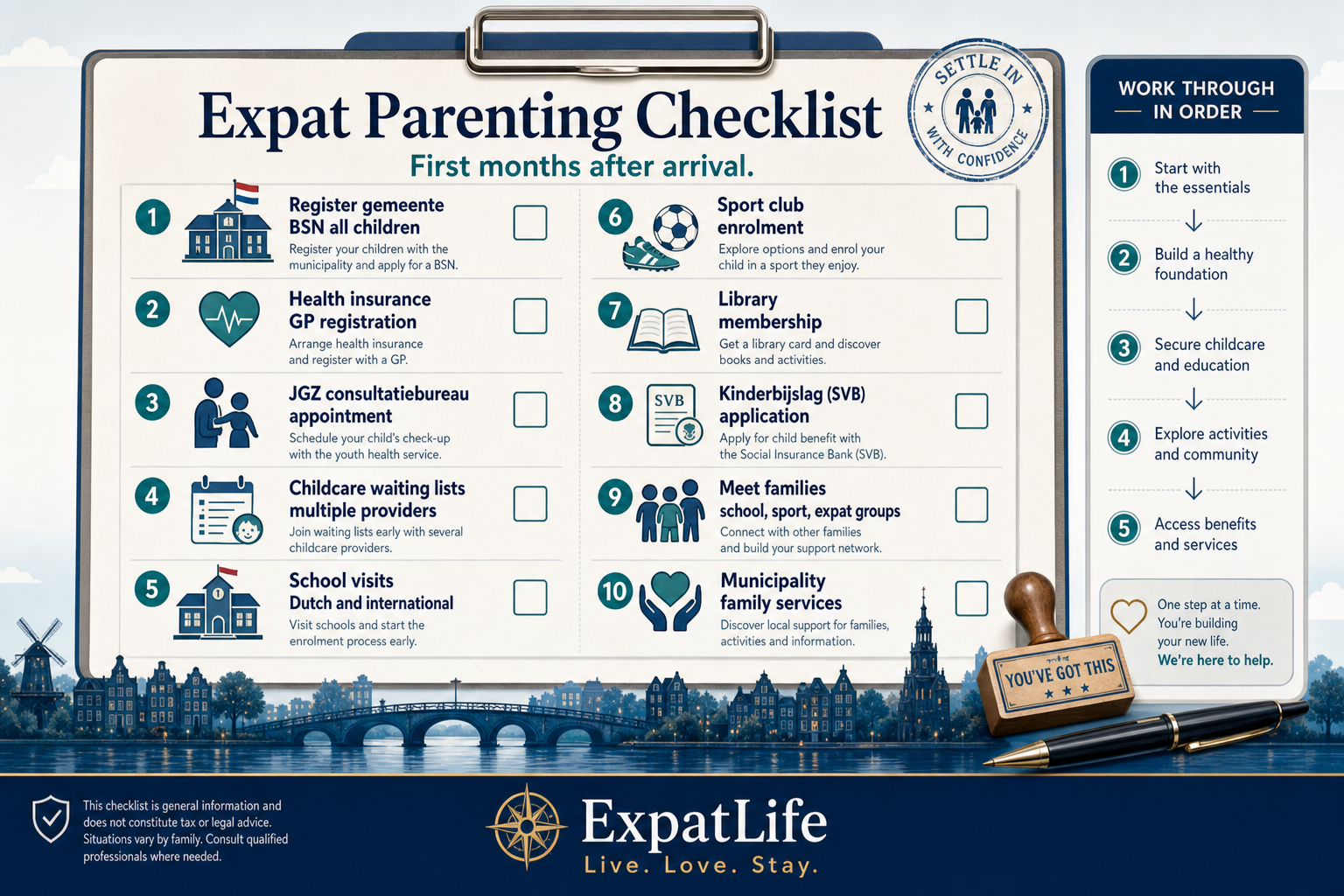
First-year parenting checklist
Avoid
These patterns slow integration — plan around them from the start.
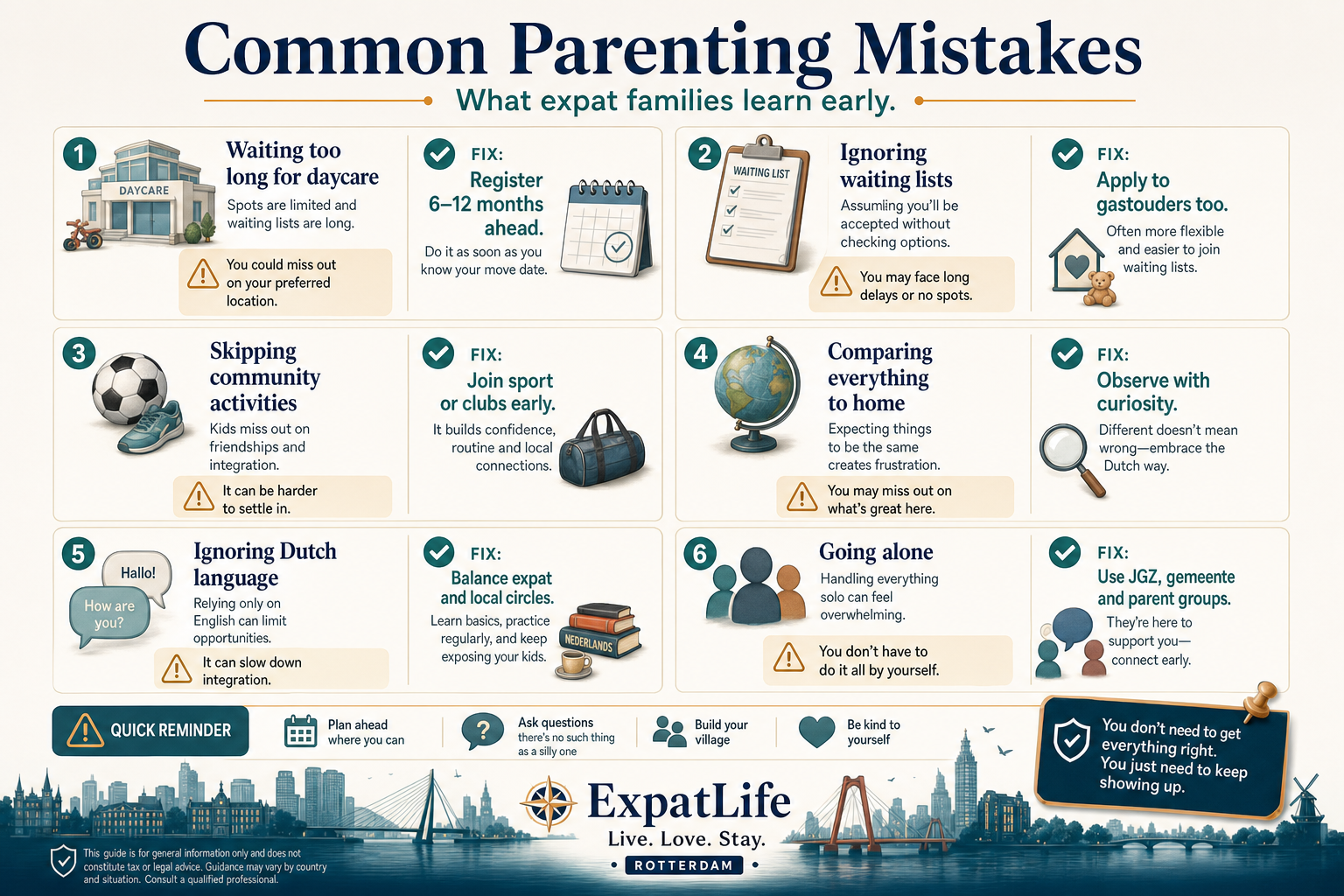
Example: assuming a place will appear once you arrive in Amsterdam with a 6-month-old.
Fix: Join waiting lists 6–12 months ahead; register with multiple LRK providers.
Example: applying to one popular centre and stopping when waitlisted.
Fix: Register broadly — gastouders and less central locations often have shorter waits.
Example: waiting until Dutch is fluent before enrolling in sport.
Fix: Children integrate through play — clubs accept beginners and parents help translate.
Example: frustration that school hours, food culture or communication style differ.
Fix: Observe local norms with curiosity — adapt what works, keep what matters from home.
Example: choosing only expat circles and delaying Dutch exposure.
Fix: Balance international community with Dutch school, sport or neighbourhood play.
Example: not asking school, JGZ or neighbours for guidance.
Fix: Use consultatiebureau, parent groups and municipality services — asking is normal.
FAQ
Orientation answers — confirm provider-specific details for your municipality and family situation.
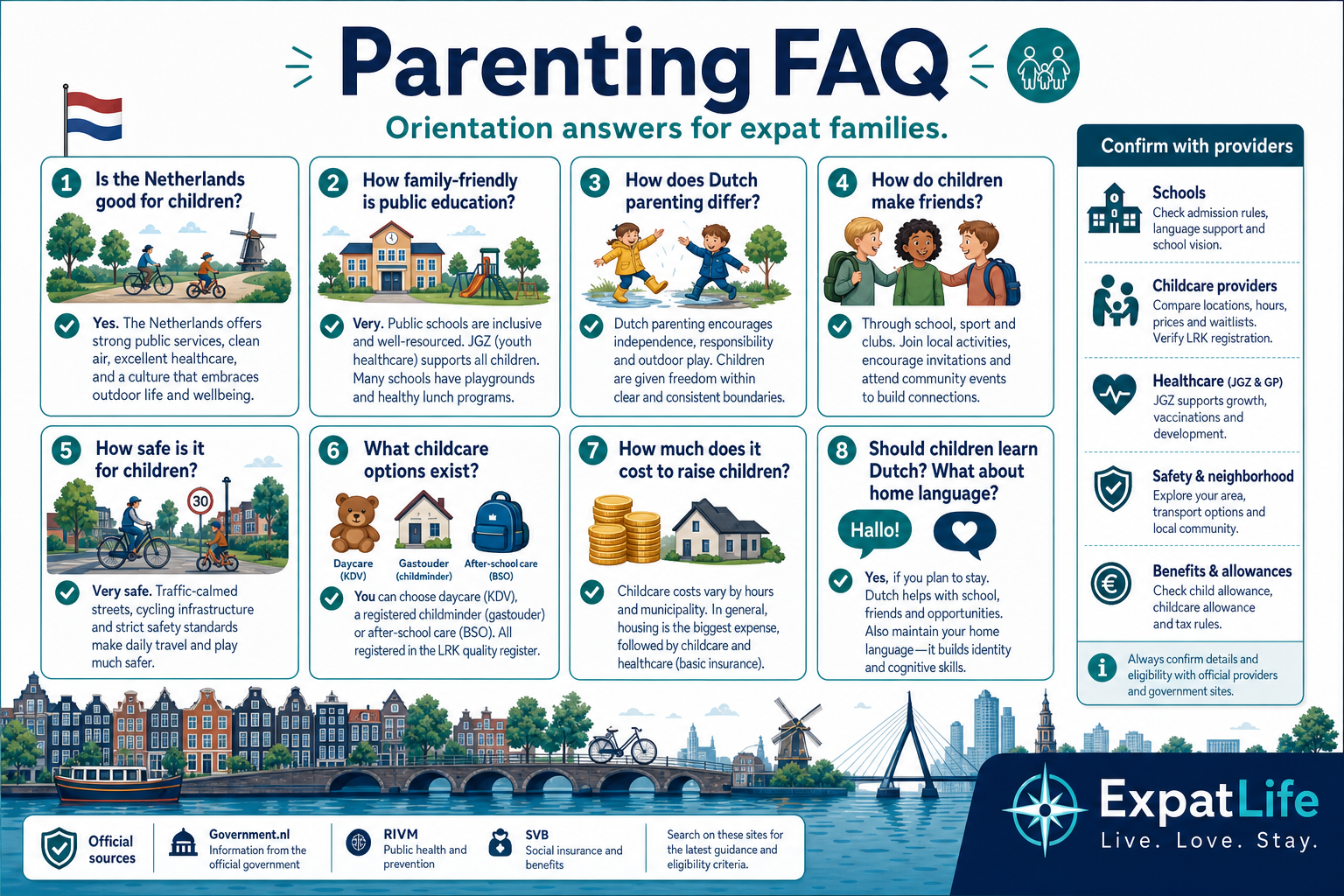
Many families find the Netherlands family-friendly thanks to safe neighbourhoods, quality education, preventive healthcare, outdoor infrastructure and work-life balance norms. Experience varies by city, income and support network — this guide helps you evaluate fit for your family.
Public services for families are strong — free primary education, JGZ preventive healthcare, childcare allowance for eligible parents and extensive sport and playground infrastructure. Housing cost and childcare availability in Randstad cities are common challenges.
Dutch parenting often emphasises independence, outdoor play, routine and direct communication — children may cycle to school and spend more unsupervised play time than in some cultures. These are tendencies, not universal rules; families blend local and home-country approaches.
Primarily through school, sport clubs and neighbourhood play. Enrolling in a local club (voetbal, swimming, scouting) is one of the fastest friendship routes — especially for expat children arriving mid-year.
The Netherlands ranks among safer countries globally with traffic-calmed residential streets, cycling infrastructure and low violent crime. Normal urban precautions apply — water safety near canals and bike proficiency matter.
Daycare centres, gastouders (host parents), preschool programmes and after-school care (BSO). Most formal care is LRK registered. See our daycare guide for costs, waiting lists and allowance rules.
Costs vary widely — childcare and housing dominate early years in cities; Dutch basisschool is free; international schools charge fees. Child benefits and childcare allowance offset part of the load for eligible families.
If staying beyond a short assignment, Dutch helps social integration and future education options. Many families maintain home language while children learn Dutch through school and activities — both are valuable.
Family guides
Connect parenting with childcare, schools, benefits and relocation content.
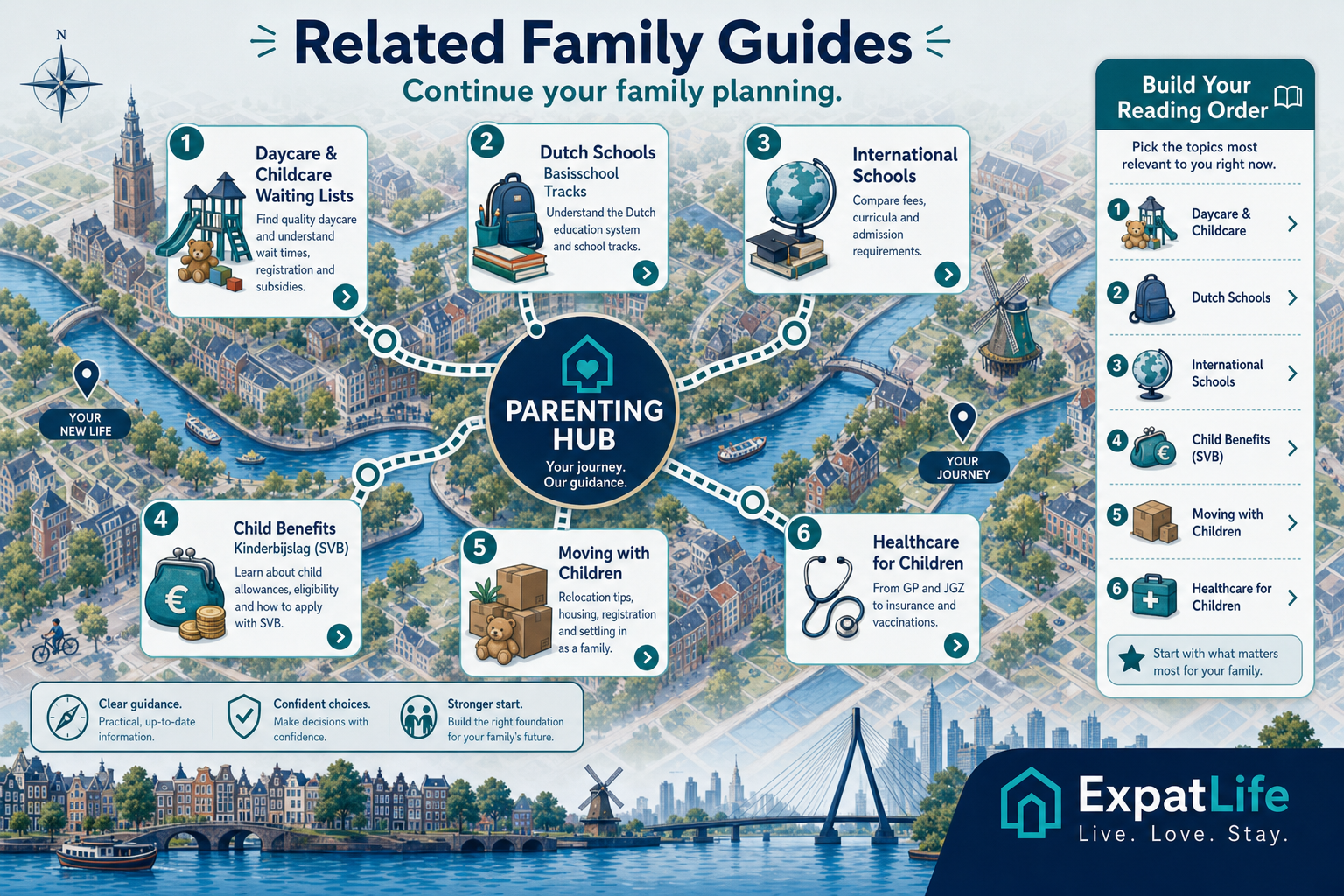
Family hub
This page is the parenting cornerstone — explore the full family cluster next.
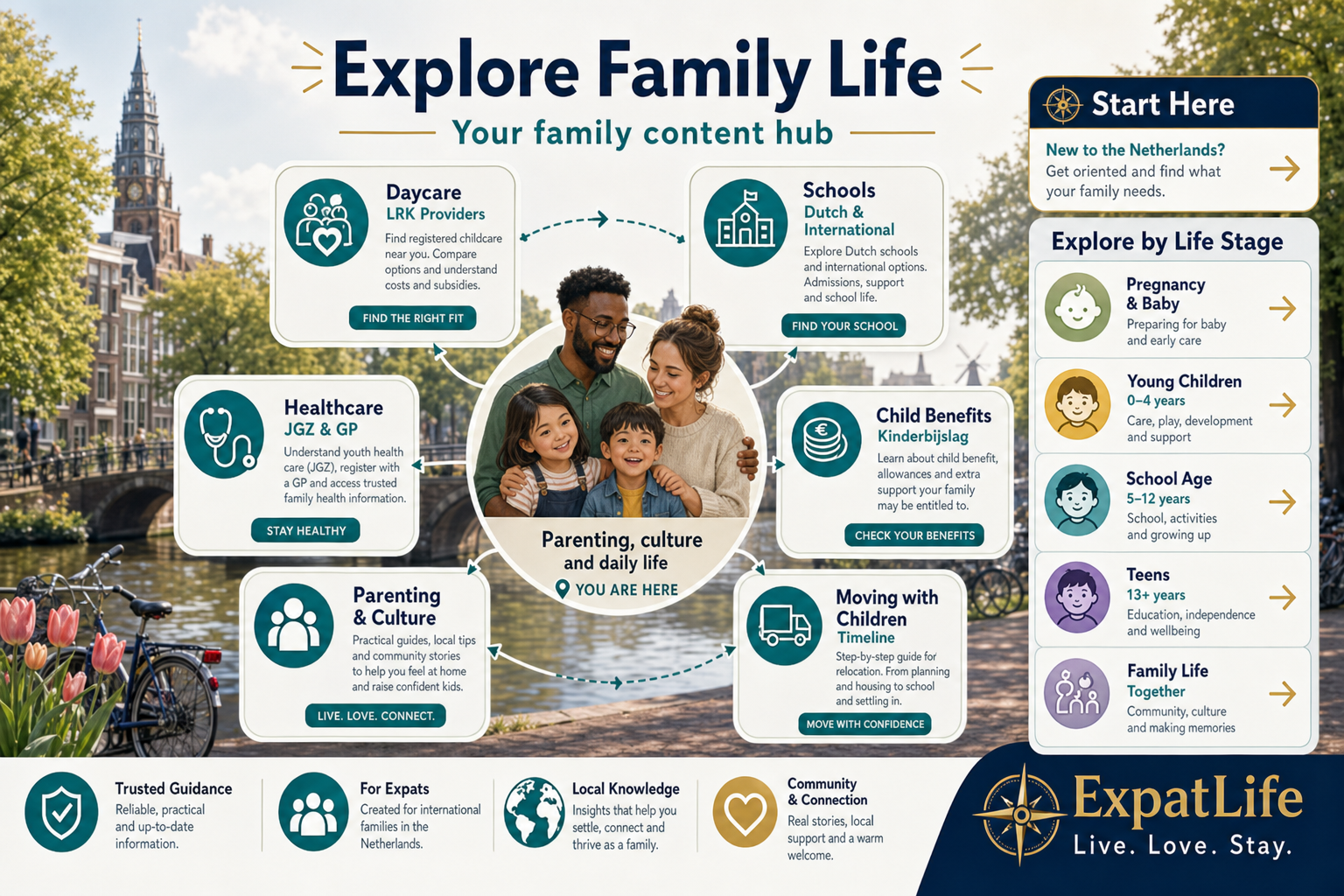
Explore next
Continue with daycare, schools, child benefits and relocation guides.

Trust
General information only — not medical, legal or parenting advice. Confirm details with your municipality, school, GP and consultatiebureau.