
Cost for children
No premium, no deductible
Under-18s are insured free on a parent's policy — registration is still required.
Netherlands · Family · Children's Healthcare
Everything parents need to know about children's healthcare, from newborn check-ups and vaccinations to GPs, hospitals, specialists and emergency care.
General orientation only — not medical advice. For individual concerns, contact a GP, JGZ or emergency services. Always verify coverage with your insurer and current RIVM/JGZ guidance.
Quick answer
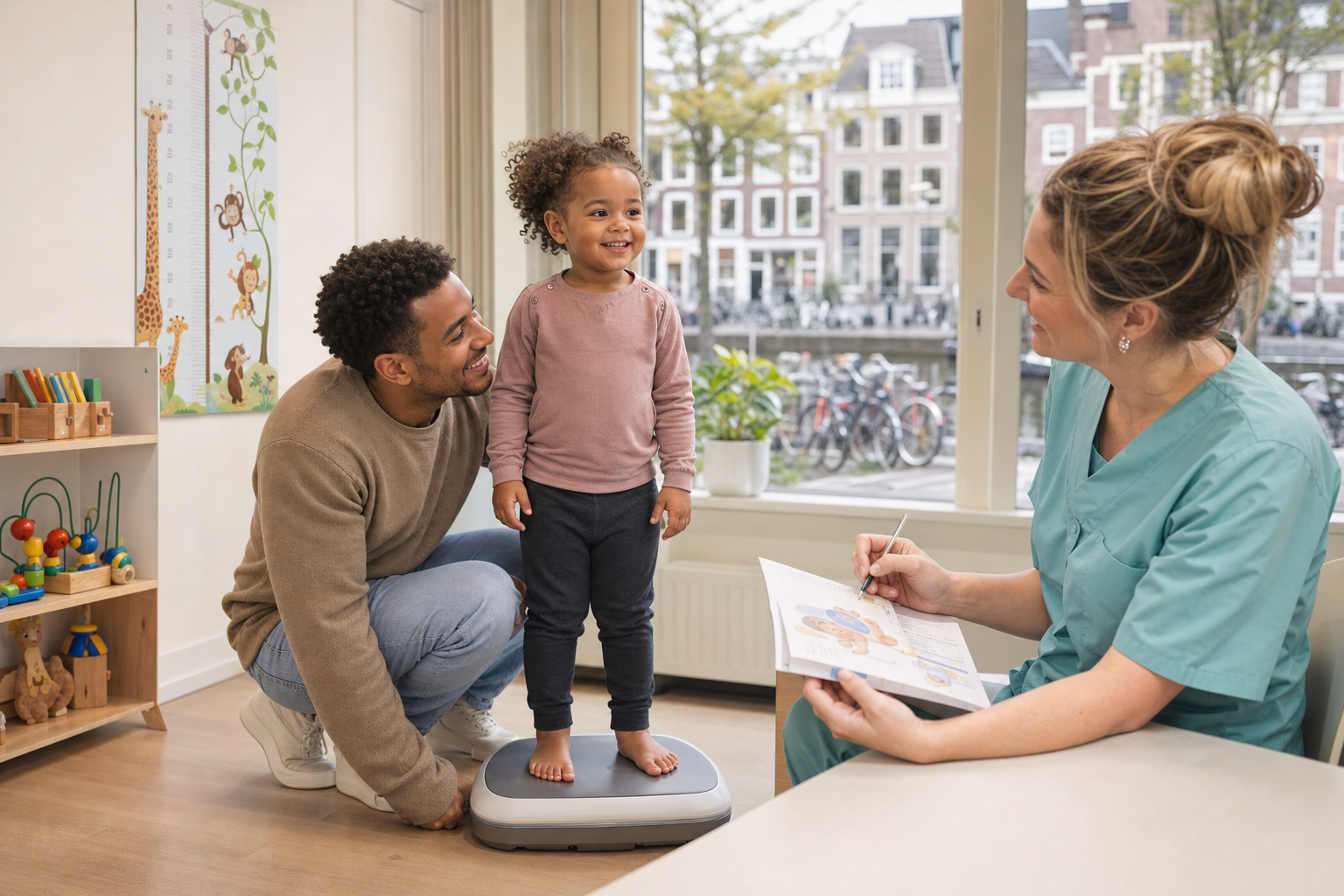
Children's healthcare in the Netherlands is built on two parallel tracks. Illness and injury go through your family GP (huisarts), who treats what can be treated in the practice and writes referrals for hospitals and paediatric specialists. Prevention — growth, development, vision, hearing, vaccinations and parenting questions — runs through Youth Healthcare (jeugdgezondheidszorg, JGZ), delivered by the consultation bureau for under-fours and by school-based youth health teams afterwards.
Financially, children are treated generously: under-18s are insured without paying a premium and without the annual deductible (eigen risico) that applies to adults, and JGZ preventive care is funded through your municipality rather than billed to you. What surprises many newcomers is not the cost but the structure — you cannot usually book a paediatrician directly, appointments are short and phone-triaged, and out-of-hours care starts with a call to the huisartsenpost rather than a walk-in at the hospital.
This guide walks through each part of the system in the order you will meet it: insurance and registration, the GP, JGZ and consultation bureaus, vaccinations, hospitals and specialists, emergencies, dental care, mental health support, everyday illness, medicines, and the practical checklists for relocating families. It is orientation, not medical advice — for anything about your own child, speak to a GP, a JGZ professional or, in an emergency, call 112.
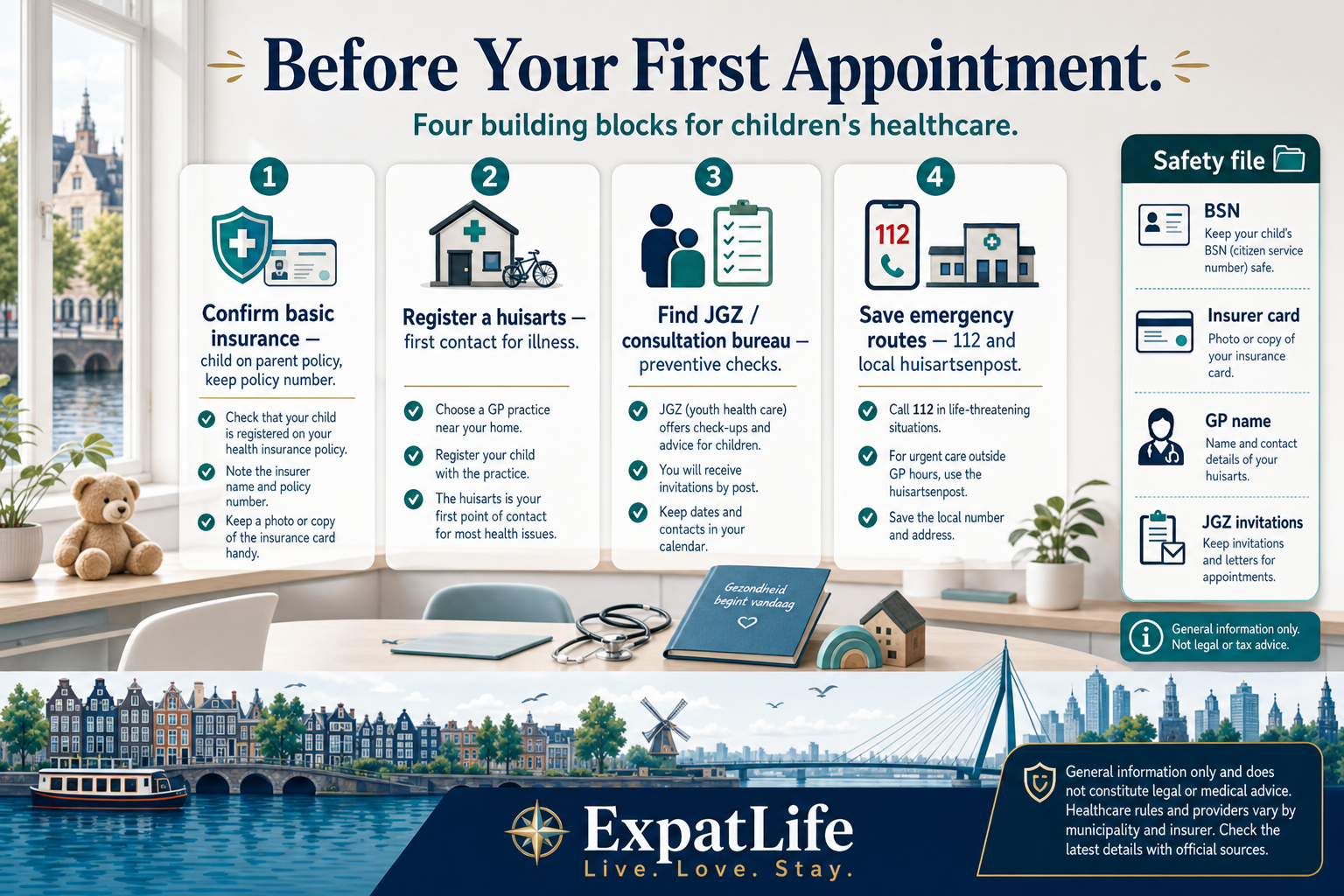
Safety file — keep these together
Examples
| Situation | How it works here | First step |
|---|---|---|
| Baby born in the Netherlands | Midwife and maternity care (kraamzorg) handle the first days; JGZ takes over preventive care from around two weeks. | Declare the birth at the gemeente, then contact your insurer to add the baby to your policy. |
| Arriving with a toddler | Register the family, arrange insurance, then contact the local JGZ organisation so check-ups and vaccinations continue. | Bring the original vaccination record and ask JGZ to assess what is still needed. |
| Arriving with a school-age child | Preventive care shifts to school-based youth healthcare; illness care runs through your new GP. | Register a GP and dentist in the first weeks, and tell the school about health needs. |
| Child with a chronic condition | Continuity depends on a good handover — the Dutch GP needs a written summary before they can refer effectively. | Ask the previous specialist for an English medical summary and current prescriptions with generic drug names. |
Snapshot
Almost every question expat parents ask fits into one of these six blocks. Read them once now, then use the detailed sections below when you need the specifics.
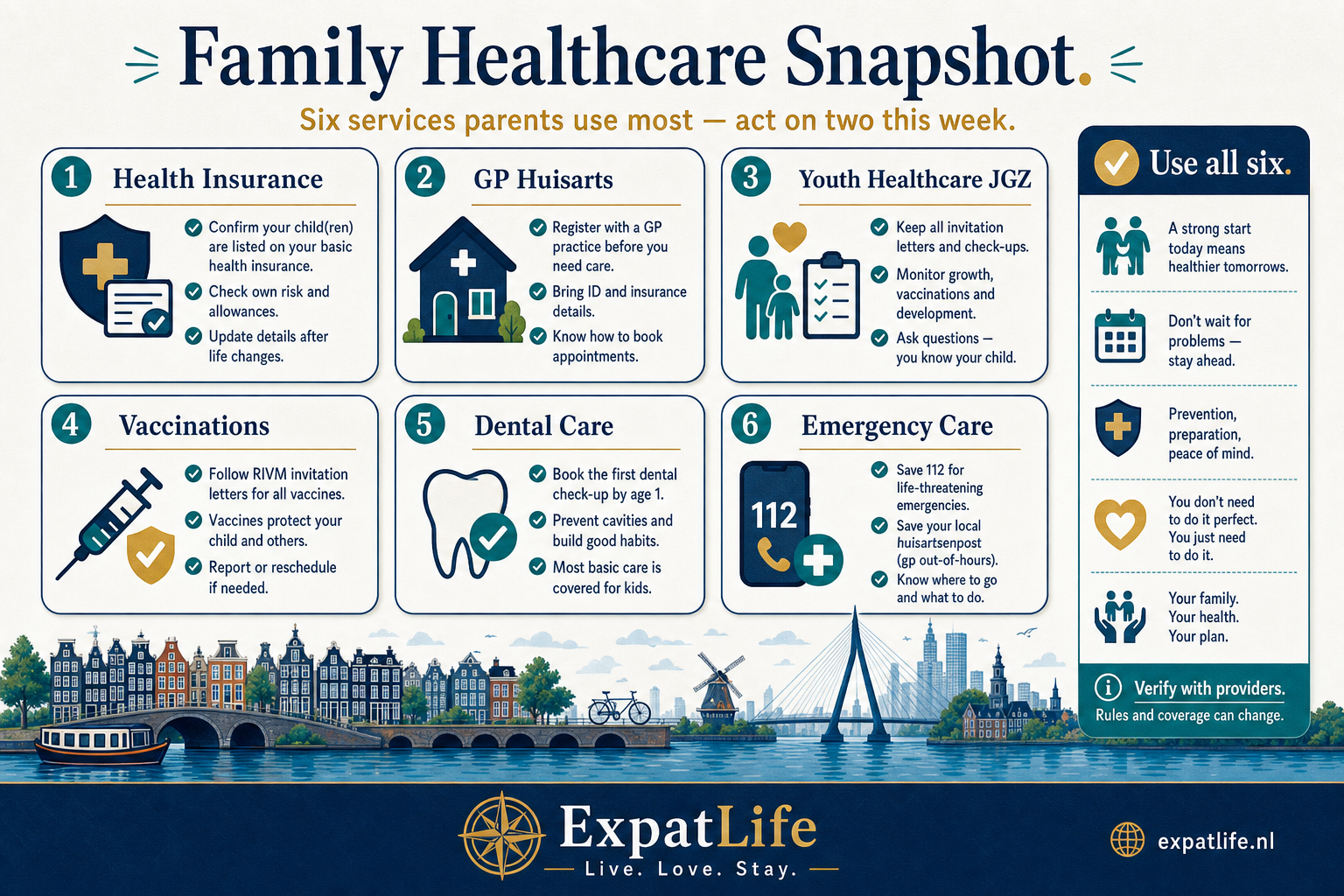
Cost for children
No premium, no deductible
Under-18s are insured free on a parent's policy — registration is still required.
First contact
Huisarts (GP)
Illness, prescriptions and referrals all start at the family practice.
Preventive care
JGZ, free
Consultation bureau to age 4, then school-based youth health teams.
Out of hours
112 or huisartsenpost
112 for life-threatening emergencies; the GP post for urgent evening and weekend care.
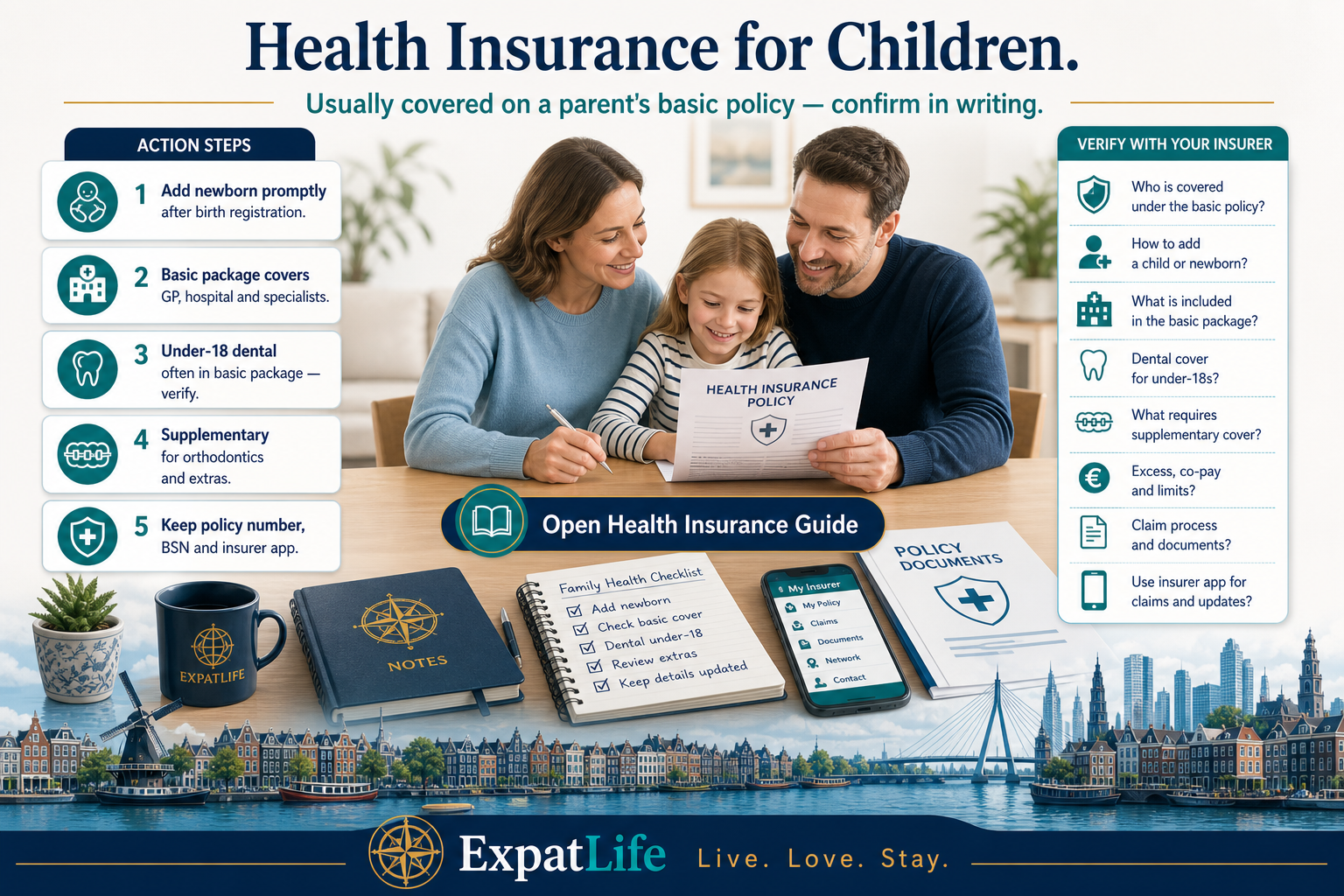
Children under 18 are covered on a parent's Dutch basic insurance without a premium and without the annual deductible. You must still register them with an insurer — for newborns, normally within four months of birth, with cover backdated to birth.
Your family doctor is the first contact for illness, injury, prescriptions and worries about development. The GP treats what can be treated in the practice and writes the referral letter that unlocks hospital and specialist care.
Free preventive care from birth to 18: growth and development monitoring, vision and hearing screening, vaccinations and parenting guidance — via the consultatiebureau for under-fours and school health teams afterwards.
The national immunisation programme (Rijksvaccinatieprogramma) is offered free through JGZ. It is voluntary, not mandatory. Children arriving from abroad can usually join a catch-up route after their existing record is assessed.
Routine dental care for under-18s is covered by the basic insurance, typically including check-ups, fillings and extractions. Orthodontics usually needs supplementary cover. You choose and register with a practice yourself.
Call 112 for life-threatening emergencies. For urgent problems outside practice hours, call your regional huisartsenpost first — hospital emergency departments generally expect a referral rather than a walk-in.
How it works
The Dutch system separates prevention from treatment. Preventive care for children is a public service delivered by Youth Healthcare (JGZ) organisations on behalf of your municipality: check-ups, screening and vaccinations, free of charge and invited automatically once your child is registered in the municipal records. Treatment of illness and injury sits in the insured system, where your GP is the first contact and the gatekeeper for everything beyond the practice.
That gatekeeper role is the biggest structural difference for families used to booking paediatricians directly. In the Netherlands the huisarts assesses first, treats what can be treated in general practice, and refers to a hospital paediatrician (kinderarts) when specialist assessment or diagnostics are needed. It keeps costs and over-treatment down, and it means the quality of your GP relationship matters more than in many other systems.
The sequence below is the order most families experience it, whether the journey starts with a birth in a Dutch hospital or with a plane landing at Schiphol. Registration comes first because a BSN unlocks insurance, insurance unlocks insured care, and municipal registration triggers the JGZ invitation.
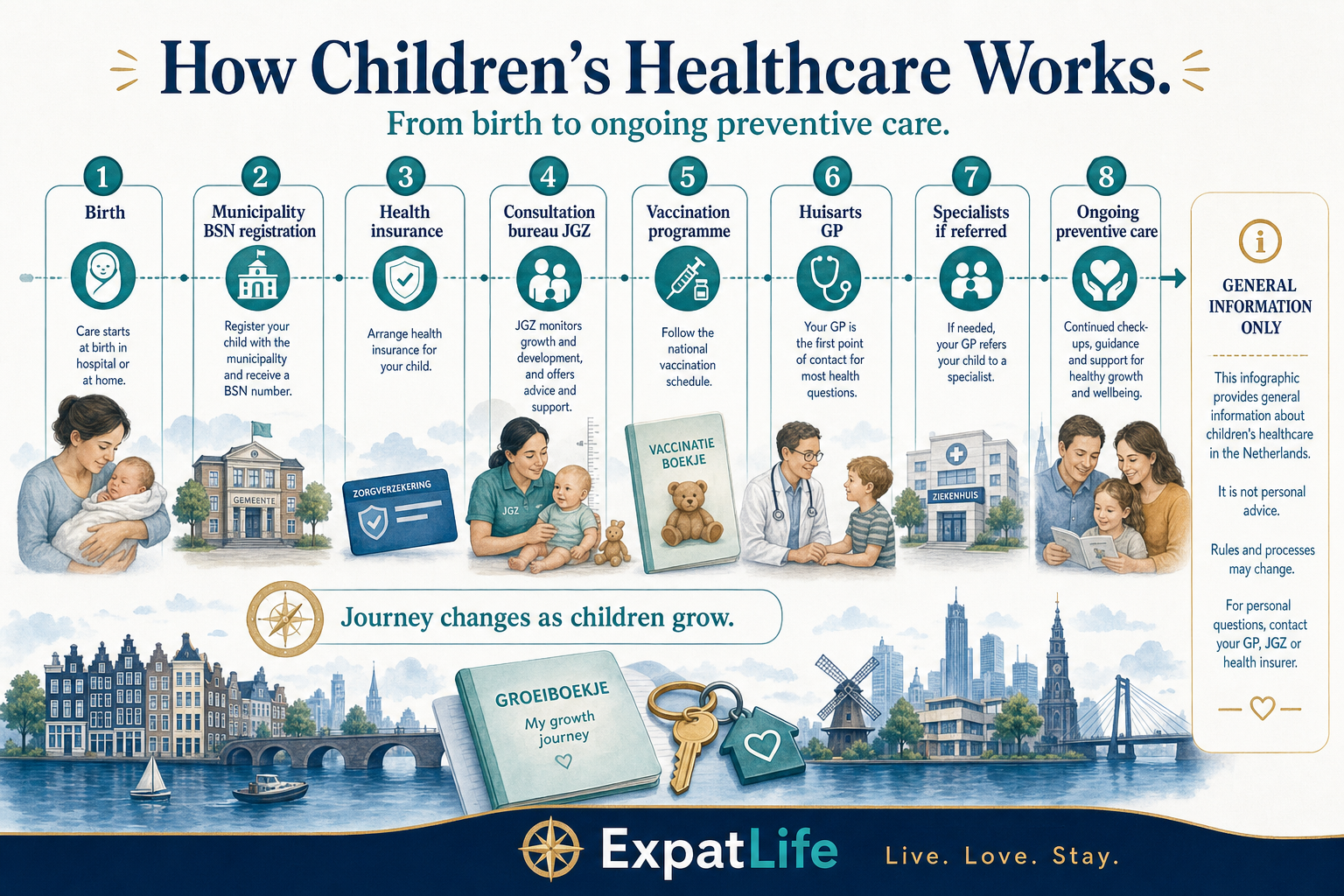
Step 1
Babies born here are supported by a midwife (verloskundige) and maternity care (kraamzorg) in the first days at home. Families arriving from abroad start with their own existing records and prescriptions.
Step 2
A birth is declared at the gemeente within a few working days; arriving families register the whole household. Each child receives a BSN (citizen service number) — the key to insurance, insured care and school enrolment.
Step 3
Add the child to a Dutch basic health insurance policy. For a newborn this is normally done within four months of birth, with cover backdated to the birth date. Newcomers arrange insurance shortly after registration; verify the deadline for your situation.
Step 4
In the first week after a Dutch birth, families are offered the newborn blood spot screening (hielprik) and a hearing screening, organised through the national programme and youth healthcare. Both are voluntary and free.
Step 5
Once registered, you are invited to the local consultatiebureau. Appointments are frequent in the first year and then spread out — height, weight, development, feeding, sleep and any questions you bring.
Step 6
The national immunisation programme is offered free through JGZ, starting in the first months. Participation is voluntary. Children arriving from abroad have their existing record assessed for a catch-up plan.
Step 7
Register the family with a huisarts practice near home. This is your first contact for illness, injury, prescriptions and referrals — and for a child, ideally arranged before the first bout of fever rather than during it.
Step 8
When needed, the GP (or youth healthcare doctor) writes a referral to a hospital paediatrician or another specialist. The referral letter is what the hospital uses to book and to bill your insurer.
Step 9
From age four, preventive care shifts to school-based youth healthcare: screening moments at set ages, vaccinations, and access to a youth health nurse or doctor for growth, wellbeing and school-related concerns.
Who does what
Newcomers most often lose time by contacting the wrong service. This table shows which service handles which question, and how you reach it.
| Service | What it does | When to use it | Access & cost |
|---|---|---|---|
| Huisarts (GP) | Illness, injury, prescriptions, ongoing conditions, first assessment of any worry | Fever with warning signs, persistent symptoms, rashes, injuries, medication questions, referral requests | Register once, then book by phone or online. Covered by insurance; no deductible for under-18s. |
| JGZ / consultatiebureau | Preventive care — growth, development, hearing, vision, vaccinations, parenting and sleep guidance | Scheduled check moments, vaccination appointments, questions about development, feeding, sleep or behaviour | Invited automatically after municipal registration; you can also contact them yourself. Free — funded by the municipality. |
| Kinderarts (paediatrician) | Hospital-based paediatric assessment, diagnostics and treatment of more complex conditions | When the GP or JGZ doctor concludes that specialist assessment or hospital diagnostics are needed | By referral (verwijzing) from the GP or youth healthcare doctor. Covered by basic insurance for under-18s. |
| Huisartsenpost (out-of-hours GP post) | Urgent GP-level care in evenings, at night, at weekends and on public holidays | Urgent but not life-threatening problems that cannot wait for the next working day | Call the regional number first — you will be triaged by phone and given an appointment or advice. |
| Tandarts (dentist) | Routine dental check-ups, fillings, extractions and preventive dental advice | Twice-yearly check-ups, toothache, dental injuries, questions about brushing and fluoride | You register with a practice yourself. Routine care for under-18s is covered by the basic insurance. |
| Apotheek (pharmacy) | Dispensing prescriptions, repeat medication, interaction checks and dosing advice | Collecting prescribed medicines, repeat requests, questions about children's dosing | Register with one pharmacy near home so your family's medication record stays in one place. |
Contact details differ by municipality and region. If you are unsure which service to call, call your own GP practice during opening hours — the assistant will redirect you.
If you believe your child needs specialist assessment, say so explicitly at the GP appointment and ask what would need to be true for a referral. Asking directly is normal and expected here — it is not considered rude.
Insurance
Every resident of the Netherlands needs Dutch basic health insurance (basisverzekering), but children are treated differently from adults: under-18s are insured without paying a premium and are exempt from the annual deductible (eigen risico). What parents pay is their own premium and their own deductible — not a second bill for the children.
That does not make cover automatic. Children must be actively registered with an insurer, normally on a parent's policy. For a baby born in the Netherlands, registration is usually required within four months of birth, and cover is backdated to the date of birth. Families arriving from abroad take out insurance shortly after becoming insurable; the exact deadline depends on your situation, so confirm it with the insurer or Government.nl rather than guessing.
The basic package is defined nationally, so the covered care is the same at every insurer: GP care, hospital and specialist treatment, prescribed medicines, and routine dental care for under-18s. What differs between insurers is service, the network of contracted providers, and the supplementary packages (aanvullende verzekering) that cover extras such as orthodontics. If you use a provider your insurer has no contract with, reimbursement can be partial — worth checking before a first specialist appointment.
| Care type | Cover for under-18s | Note |
|---|---|---|
| GP care (huisarts) | Covered by the basic insurance; no deductible for under-18s | Includes consultations, phone consults and out-of-hours GP post care. |
| Hospital and paediatric specialist care | Covered by the basic insurance with a valid referral | Check whether the hospital is contracted by your insurer to avoid partial reimbursement. |
| Prescribed medicines | Largely covered under the national medicine reimbursement system | Some medicines carry a personal contribution; the pharmacy can tell you before dispensing. |
| Routine dental care under 18 | Covered by the basic insurance | Typically check-ups, fillings and extractions — confirm specifics with your insurer. |
| Orthodontics (braces) | Usually not in the basic package for children | Often requires supplementary dental cover; compare limits and waiting conditions before you need it. |
| Speech therapy and physiotherapy | Cover for children is broader than for adults, within conditions | Usually needs a referral or indication; verify the number of covered sessions with your insurer. |
| Youth healthcare (JGZ) checks and vaccinations | Not billed to your insurance — funded publicly | Consultation bureau visits, screening and national programme vaccinations are free. |
| Care received abroad | Limited and conditional | Ask your insurer about holiday cover and whether you need extra travel health cover. |
Insurance setup checklist
Insurance rules, package content and deadlines change. Verify your own situation directly with your insurer or on Government.nl before making decisions.
First contact
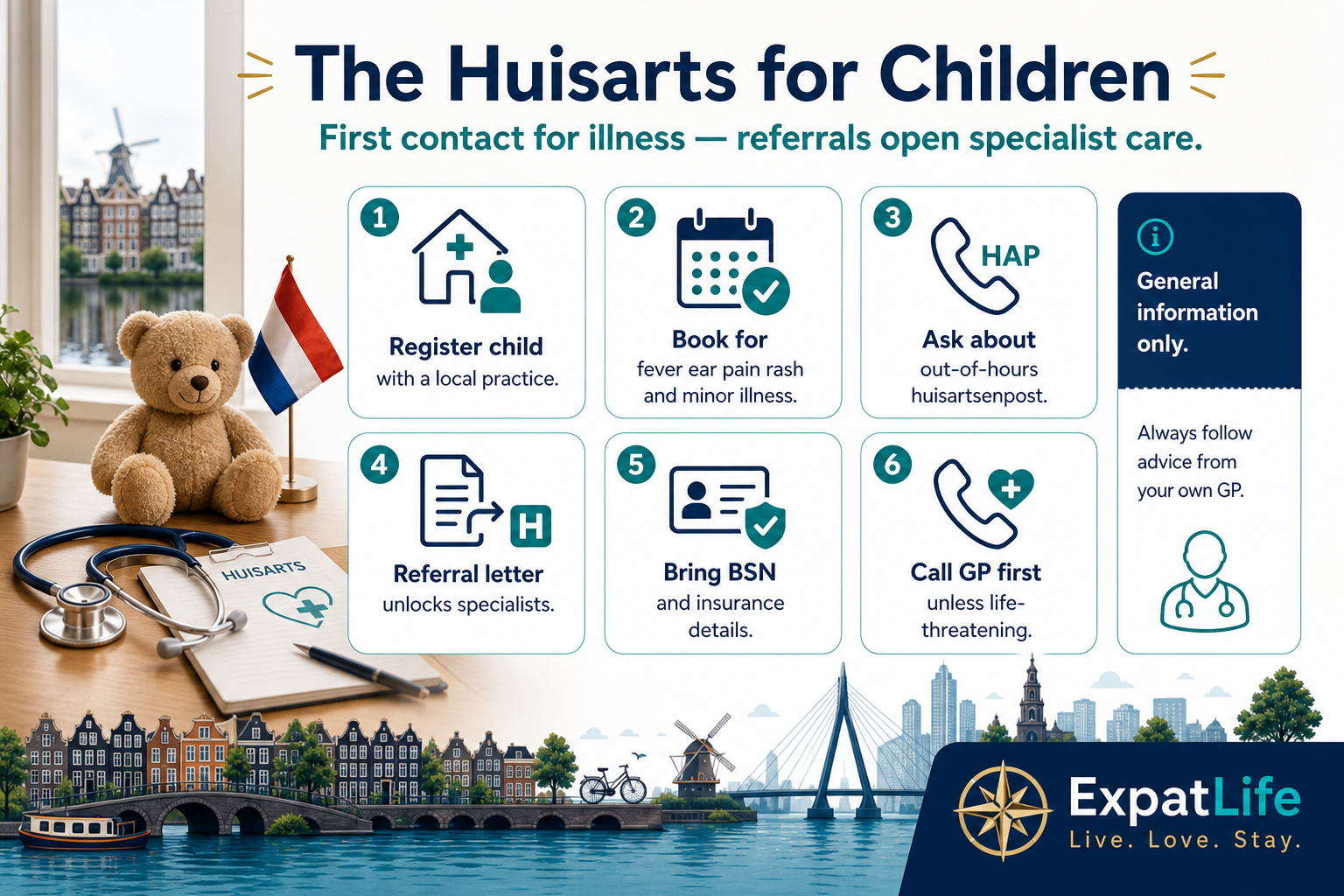
The huisarts is the centre of gravity in Dutch healthcare. For children, the practice handles fevers, infections, rashes, injuries, growth concerns, medication and chronic condition follow-up — and decides when hospital assessment is needed. Practices are local by design: most only accept patients living within their catchment area, so the search starts with your postcode.
Appointments are usually ten minutes and are triaged by a trained practice assistant (doktersassistent) who asks what the problem is. That question is not gatekeeping for its own sake — it decides whether you get a same-day slot, a phone consult, an e-consult or advice to wait and watch. Being specific and factual helps: say the age, the symptom, how long it has lasted, what you have already tried and what specifically worries you.
Register the whole family at once, ideally in your first weeks. Practices in popular city neighbourhoods sometimes close their lists, and being registered somewhere is far better than searching while a child is ill. If your first choice is full, ask which nearby practices are accepting patients — assistants usually know.
How to register your child with a GP — step by step
Have this ready when you call the practice
Examples
| Situation | How it works here | First step |
|---|---|---|
| Practice list is closed in your neighbourhood | Ask the practice which nearby practices are still open, and check whether a new practice is starting in the area. | Register anywhere reasonable that accepts you now; you can switch later once your first choice reopens. |
| You want a paediatrician, the GP wants to wait | Ask what the GP is watching for, what would change the plan, and agree a review moment in writing. | Book the follow-up before you leave and ask directly what the threshold for referral would be. |
| Your child has an ongoing condition from abroad | Continuity depends on documents — Dutch prescriptions and referrals are written from the GP's own file. | Send the medical summary and medication list to the practice before the intake appointment. |
| Consultations feel too short | Structure beats speed: one clear main question, plus a written list of the rest. | Request a longer appointment when booking and say it concerns more than one issue. |
Preventive care
Jeugdgezondheidszorg — youth healthcare, usually shortened to JGZ — is one of the most valuable and most misunderstood parts of Dutch family life. It is a free public service, commissioned by your municipality and delivered by local organisations (often a GGD or a regional youth healthcare provider), that follows every child from birth to around age 18 with preventive check-ups, screening, vaccinations and parenting support.
JGZ is not a doctor's practice and does not treat illness. Its job is to notice things early: growth that flattens, hearing or vision that needs checking, motor or speech development that lags, or a parent who is exhausted and needs practical help. Appointments are scheduled at fixed ages rather than when something is wrong, which is exactly why they catch what busy families miss.
For under-fours, contact happens at the consultatiebureau (consultation bureau). From age four, the same service continues through school: youth health nurses and doctors run screening moments at set ages, deliver programme vaccinations, and are available for conversations about growth, wellbeing, sleep, bullying or school stress. Parents can also request contact themselves — you do not need to wait for an invitation or a referral.
For expat families, JGZ is often the single best orientation resource in the first year. The staff know local childcare, schools, activities and support services, they are used to multilingual families, and the conversation is free and unhurried compared with a ten-minute GP slot. If you only accept one appointment in your first month, make it this one.
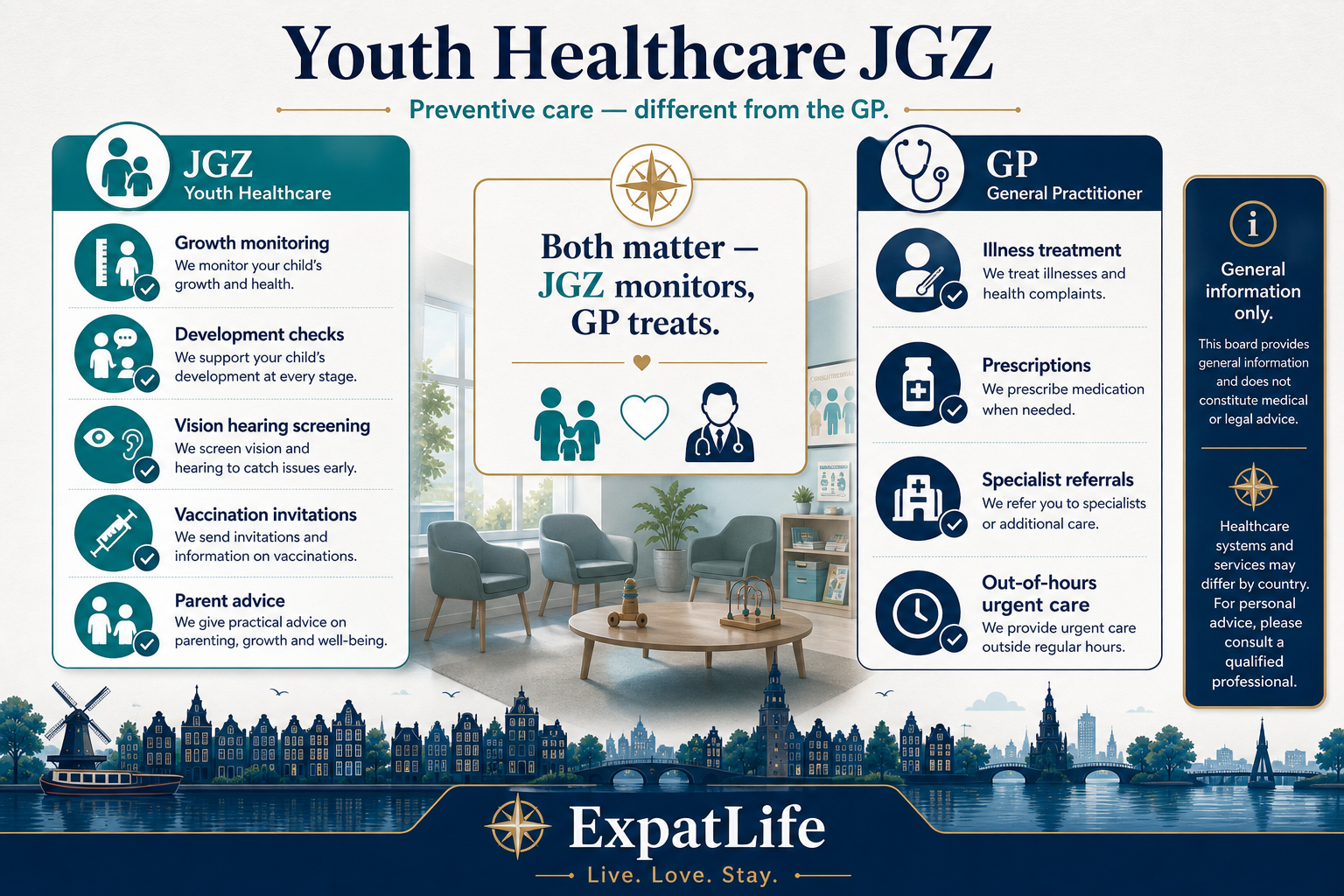
Height, weight and head circumference are plotted on Dutch growth curves, alongside motor, speech and social development milestones — trends over time matter more than single measurements.
Screening at set ages picks up hearing loss and vision problems early, including a newborn hearing screening and later school-age eye checks, with referral to a specialist when something needs follow-up.
The national immunisation programme is delivered through JGZ, free of charge, with invitations sent at the relevant ages and a record kept of what your child has received.
Feeding, sleep, screen time, toilet training, tantrums, sibling rivalry and adolescence — JGZ nurses give practical, non-judgemental advice and know when something needs more than advice.
From primary school onwards, youth health teams work with schools on wellbeing, absence, bullying and stress, and can involve the school support team or municipal youth services.
JGZ is a hub: they refer to speech therapy, dietetics, physiotherapy, youth mental health, family support and municipal services, and can write referrals in their own right.
Contact moments
| Moment | Focus | Parent note |
|---|---|---|
| First weeks after birth | Home visit or first bureau contact — feeding, weight, newborn screening follow-up, parental wellbeing | Ask everything at this stage; nothing is considered a silly question. |
| First year | Frequent check-ups combining growth, development and the infant vaccination series | Appointment frequency is highest here; bring your questions written down. |
| Toddler and preschool years | Development, speech, motor skills, vision, behaviour and boosters | A good moment to discuss daycare, language exposure and bilingual development. |
| Around school entry | Handover to school-based youth healthcare; screening of growth, vision, hearing and school readiness | You will meet a new team — check how to contact them directly. |
| Primary school years | Screening moments at set ages, programme vaccinations and wellbeing conversations | Consent forms come via school; read them rather than signing on autopilot. |
| Adolescence | Growth, mental wellbeing, lifestyle, adolescent vaccinations and confidential conversations | Teenagers can speak to the youth health nurse without a parent present. |
JGZ organisation names and contact routes differ by municipality — search for 'jeugdgezondheidszorg' or 'consultatiebureau' with your city name, or ask your municipality. You can request contact yourself at any time; you do not need a referral.
Ages 0–4
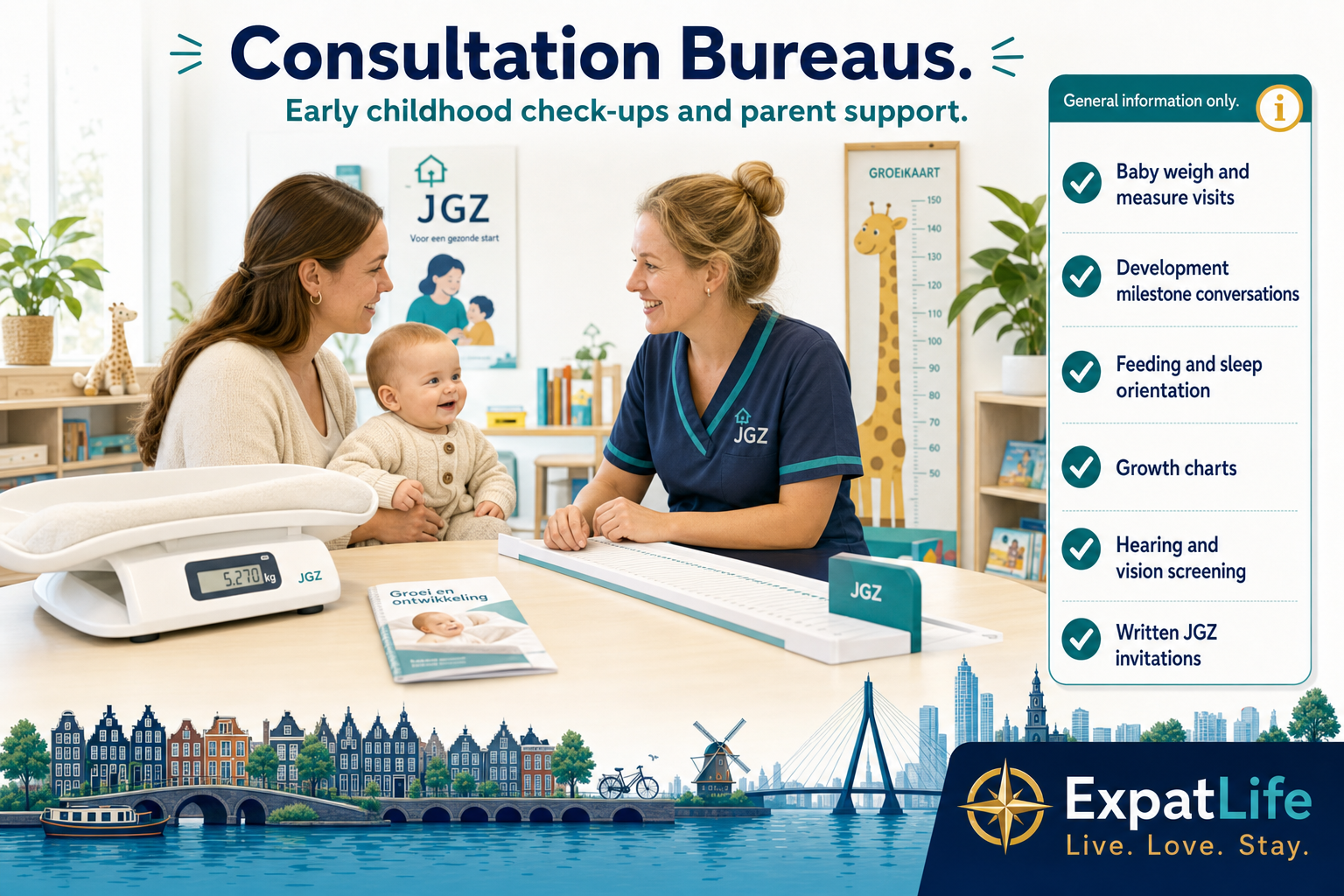
The consultatiebureau is where JGZ meets families with children under four. It is usually a small, calm local centre — a weighing room, a measuring board, growth charts on the wall — and it is where most Dutch parents get their questions answered in the first years. Visits are free, invited automatically after municipal registration, and follow a schedule that is dense in the first year and then spreads out.
A typical appointment takes twenty to thirty minutes. Your child is weighed and measured, development is checked against milestones, and the nurse or doctor asks about feeding, sleep, mood and family life. Vaccinations from the national programme are often given at the same visit. The tone is advisory: you will be given information and options rather than instructions, which some newcomers initially read as vagueness and later come to appreciate.
The team is multidisciplinary. A doktersassistent handles measurements and administration, a jeugdverpleegkundige (youth health nurse) does most consultations and advice, and a jeugdarts (youth healthcare doctor) sees children at key moments and where something needs medical judgement. Many bureaus also have access to a pedagogical adviser for behaviour and parenting questions.
Your main contact for most visits — measurements, development, feeding, sleep and everyday parenting questions, plus home visits in the newborn period in many regions.
Sees children at key check moments and whenever medical assessment is needed. Can refer to specialists directly and liaises with your GP.
Handles weighing, measuring, vaccination administration and appointment logistics — and is usually the person who answers the phone.
Available in many regions for behaviour, routine and parenting support — often through the family centre (Centrum voor Jeugd en Gezin) linked to the bureau.
What to bring
If you miss or cannot attend an appointment, call to rebook rather than waiting for the next invitation — the schedule is built around specific ages, and catching up early keeps screening on track.
Vaccinations
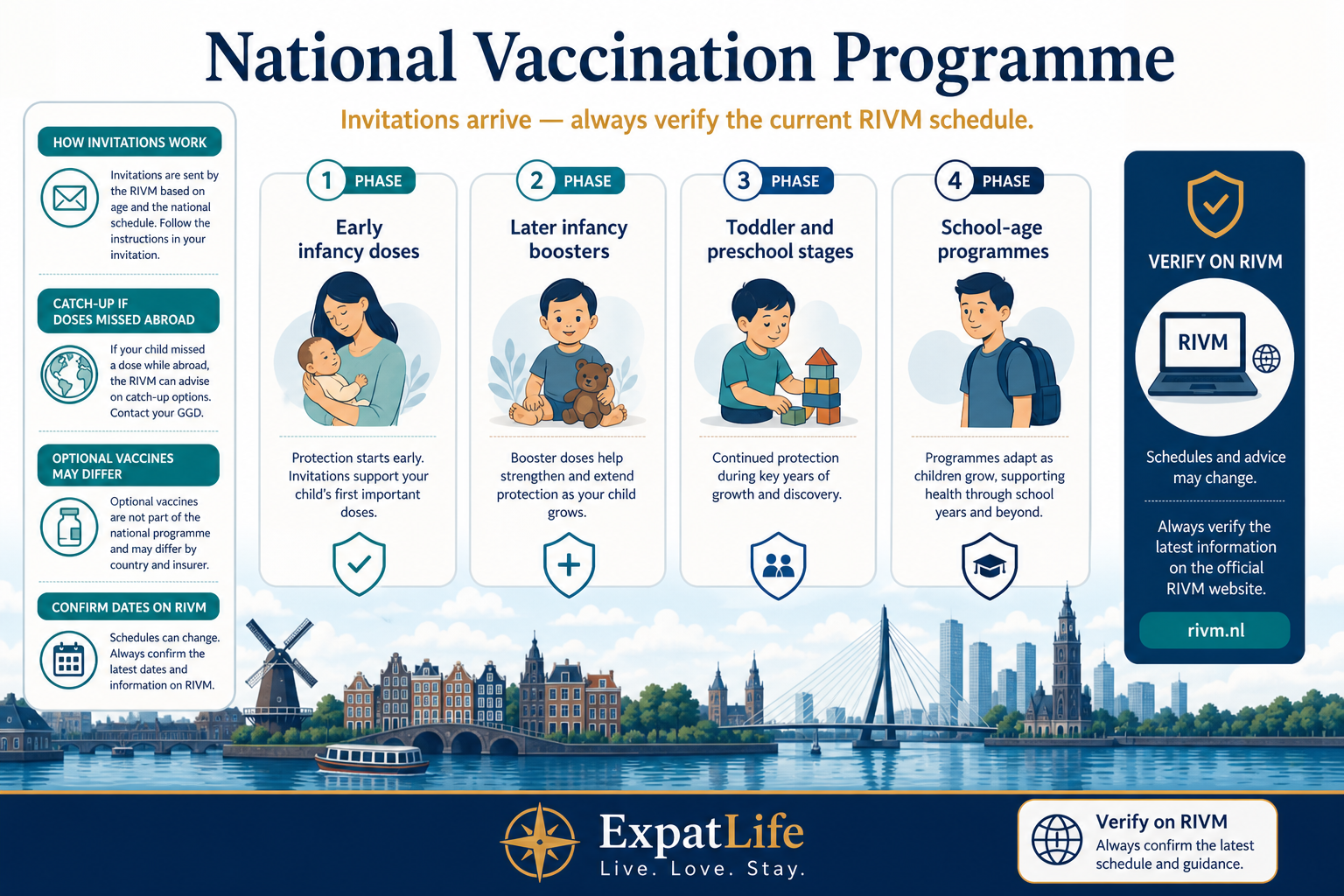
The Netherlands runs a national immunisation programme (Rijksvaccinatieprogramma, RVP), coordinated by RIVM and delivered free of charge through JGZ. Children are invited at set ages, parents are given information about each vaccination, and participation is voluntary — there is no legal obligation to vaccinate. Uptake is high, and the programme is one of the reasons JGZ contact moments are scheduled the way they are.
Vaccinations are grouped into broad phases: a series in the first year of life, boosters in the toddler and early school years, and further vaccinations offered in the school-age and adolescent years. Because the exact composition and timing of the programme is reviewed and updated periodically, this guide deliberately does not reproduce a detailed schedule — check the current one on the RIVM website or with your JGZ team.
Children arriving from abroad are not expected to start over. Bring the original vaccination record, ideally with an English or Dutch translation, and JGZ will assess what your child has already received and propose a catch-up plan (inhaalprogramma) to align with the Dutch programme. If records are missing or unclear, the team will discuss options with you rather than guessing.
Daycare centres, schools and some employers may ask about vaccination status for information or outbreak management. That is not the same as a requirement, and policies differ by provider — ask each organisation directly what they ask for and why.
| Phase | Typically offered | What you do |
|---|---|---|
| First year of life | The infant series, given across several appointments alongside growth and development checks | Attend the invited bureau appointments; ask for the information leaflet for each vaccination. |
| Toddler years | Booster doses completing the early childhood series | Keep the record updated and note the dates yourself, not only in the JGZ system. |
| Primary school years | Booster vaccinations offered through school-based youth healthcare | Watch for consent forms sent via school and return them on time. |
| Adolescence | Additional vaccinations offered in the pre-teen and teenage years | Discuss the invitation with your child; teenagers are involved in the decision. |
| Arriving from abroad | An individual catch-up plan after assessment of existing records | Bring the original record plus a translation, and book a JGZ assessment appointment early. |
Specialist care
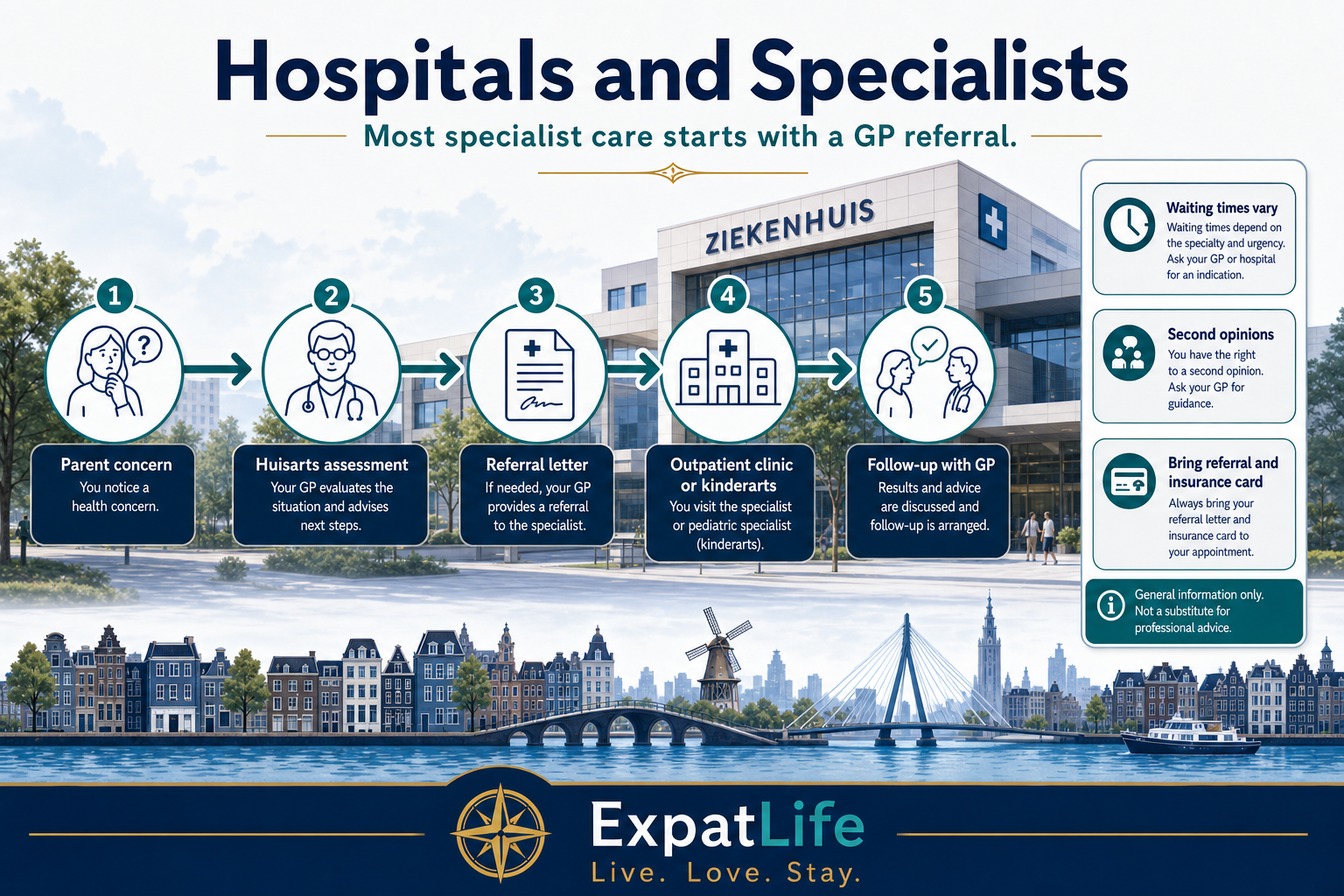
Paediatric specialist care in the Netherlands is hospital-based and referral-led. When your GP or youth healthcare doctor concludes that specialist assessment is needed, they write a referral (verwijzing) to a kinderarts — a hospital paediatrician — or to another relevant specialist. The referral letter is both a clinical handover and the administrative key your insurer needs.
Most children are seen at a regional hospital paediatric outpatient clinic, which handles the large majority of paediatric problems. More complex conditions are referred onwards to a university medical centre (UMC) with a dedicated children's hospital, or to a national specialised centre for a specific field. This tiering is deliberate: care stays close to home where possible and concentrates where specialised expertise matters.
Waiting times vary considerably by specialty, region and urgency. If you are worried about a wait, call the hospital's planning desk and ask about earlier slots or another location of the same hospital group; you can also ask your GP whether a different hospital has shorter waits. Second opinions are a normal part of the system — ask your GP how to arrange one rather than assuming it will cause offence.
| Setting | What it covers | How you get there |
|---|---|---|
| Regional hospital paediatric clinic | General paediatrics — infections, growth, asthma, allergies, abdominal complaints, follow-up after admission | GP or youth healthcare referral; appointment booked by the hospital or by you with the referral number. |
| University medical centre (UMC) children's hospital | Complex, rare and multidisciplinary paediatric care, including specialised diagnostics and surgery | Onward referral from a regional hospital paediatrician, or directly for specific conditions. |
| Specialised national centre | Concentrated expertise for specific fields such as paediatric oncology | Referral from a treating specialist as part of a national care network. |
| Day treatment and diagnostics | Blood tests, imaging, minor procedures and day-case treatment without overnight admission | Requested by the referring doctor or specialist; often bookable at several locations. |
| Hospital emergency department (SEH) | Acute assessment of serious injury and illness | Via 112, ambulance, or referral from your GP or the out-of-hours GP post — walk-ins are generally redirected. |
What to take to a hospital appointment
If a wait feels clinically risky, say so — call the hospital and your GP and explain what has changed. Deterioration is a reason to be reassessed sooner, and both the GP practice and the hospital can escalate.
Emergencies
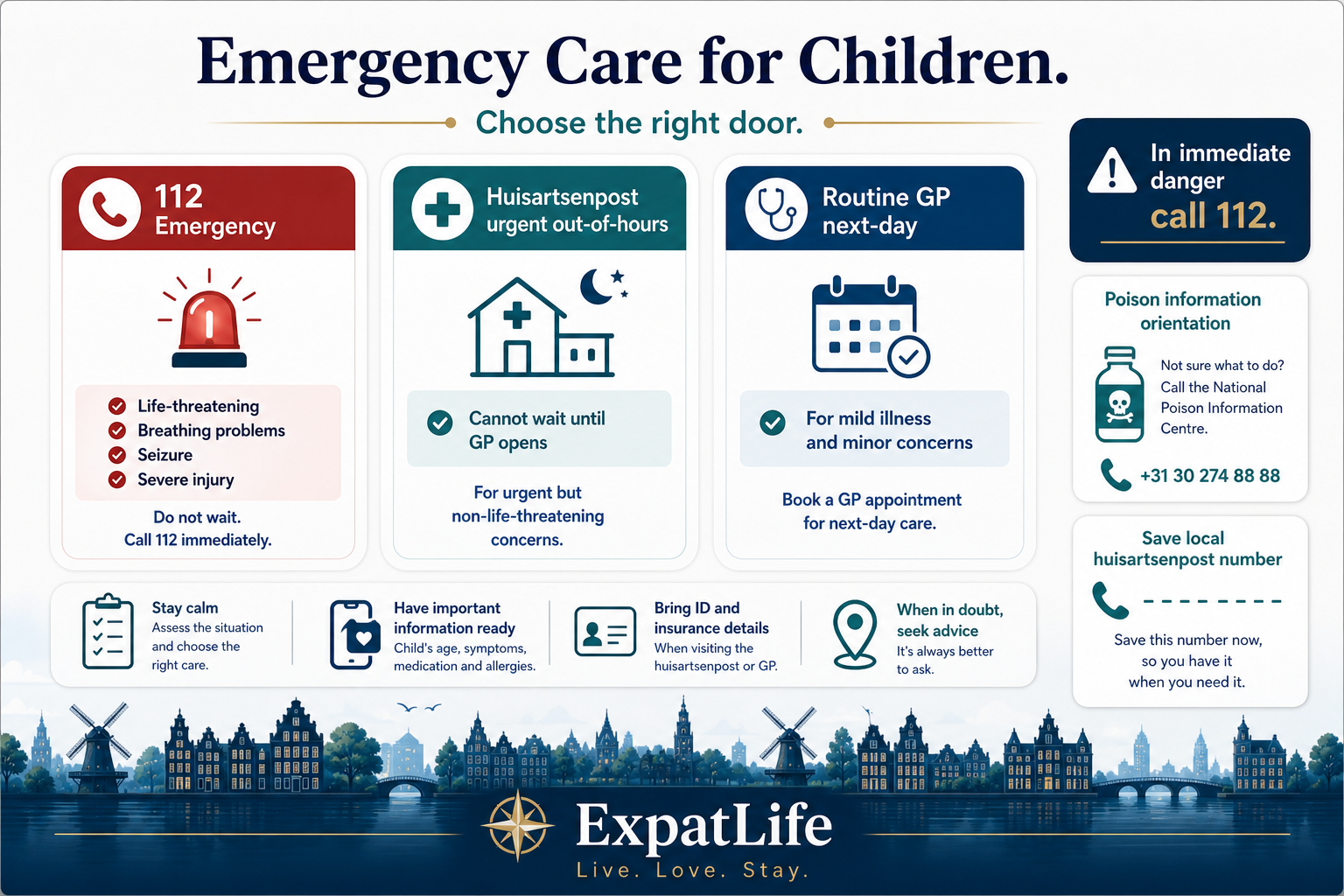
Two numbers cover almost every urgent situation with a child. 112 is the national emergency number for life-threatening situations — it reaches ambulance, fire and police, and operators speak English. For urgent problems that are not life-threatening but cannot wait until the practice reopens, you call your regional huisartsenpost (out-of-hours GP post), where a triage nurse assesses by phone and either gives advice, books you in, or escalates.
The important cultural difference: you do not usually walk into a hospital emergency department (spoedeisende hulp, SEH) with a child. Emergency departments in the Netherlands expect patients to arrive by ambulance or with a referral from a GP or the GP post, and self-referrals are commonly redirected to the huisartsenpost. Calling first is not a delay — it is the fastest route to the right place.
Find your regional huisartsenpost number now, while nothing is wrong, and save it next to 112 in every parent's phone. Also note the address, because posts are often attached to a hospital but with a separate entrance, and the location may not be your nearest hospital.
Call 112 now
Child is unresponsive, not breathing normally, or turning blue
Call 112 immediately and follow the operator's instructions.
Severe allergic reaction — swelling of face or throat, breathing difficulty
Call 112 immediately; use prescribed emergency medication if you have it and have been trained.
A seizure that does not stop, or a first-ever seizure
Call 112 immediately.
Serious injury — heavy bleeding, suspected fracture with deformity, head injury with drowsiness or vomiting
Call 112 for severe injuries; for less severe injuries call the huisartsenpost for triage.
Suspected poisoning, or swallowing medication, batteries or chemicals
Call 112 immediately if the child is unwell; otherwise call the National Poison Information Centre (+31 30 274 88 88) and have the packaging to hand.
Immediate risk of self-harm or a mental health crisis
Call 112 if there is immediate danger; otherwise contact your GP or the huisartsenpost urgently.
Same day
Baby under three months with a fever
Contact your GP the same day, or the huisartsenpost outside practice hours.
Fever with a stiff neck, a rash that does not fade, or unusual drowsiness
Contact the huisartsenpost immediately; call 112 if your child deteriorates quickly.
Repeated vomiting, refusing all fluids, or far fewer wet nappies than usual
Call your GP or the huisartsenpost for assessment the same day.
Worsening breathing, persistent wheeze, or asthma medication not helping as usual
Call the GP or huisartsenpost; call 112 if breathing becomes severely difficult.
Next working day
Earache, sore throat, mild fever or a rash without warning signs
Book a normal GP appointment on the next working day; use Thuisarts.nl for interim orientation.
Ongoing concerns about growth, sleep, feeding or development
Contact your GP or your JGZ team for a scheduled appointment.
Life-threatening situations only. Reaches ambulance, fire and police; operators speak English. Give the location first, then what has happened.
First contact during opening hours, including for urgent same-day problems. Save the number and the practice's urgent line if it has one.
Evenings, nights, weekends and public holidays. Call before travelling — you will be triaged by phone and given advice or an appointment.
Orientation number +31 30 274 88 88 when a child may have swallowed medication, batteries, chemicals or plants — and call 112 immediately if they are unwell.
For urgent prescriptions outside normal pharmacy hours. The GP post will tell you which one serves your area.
What to say when you call
Prepare before you need it
Dental
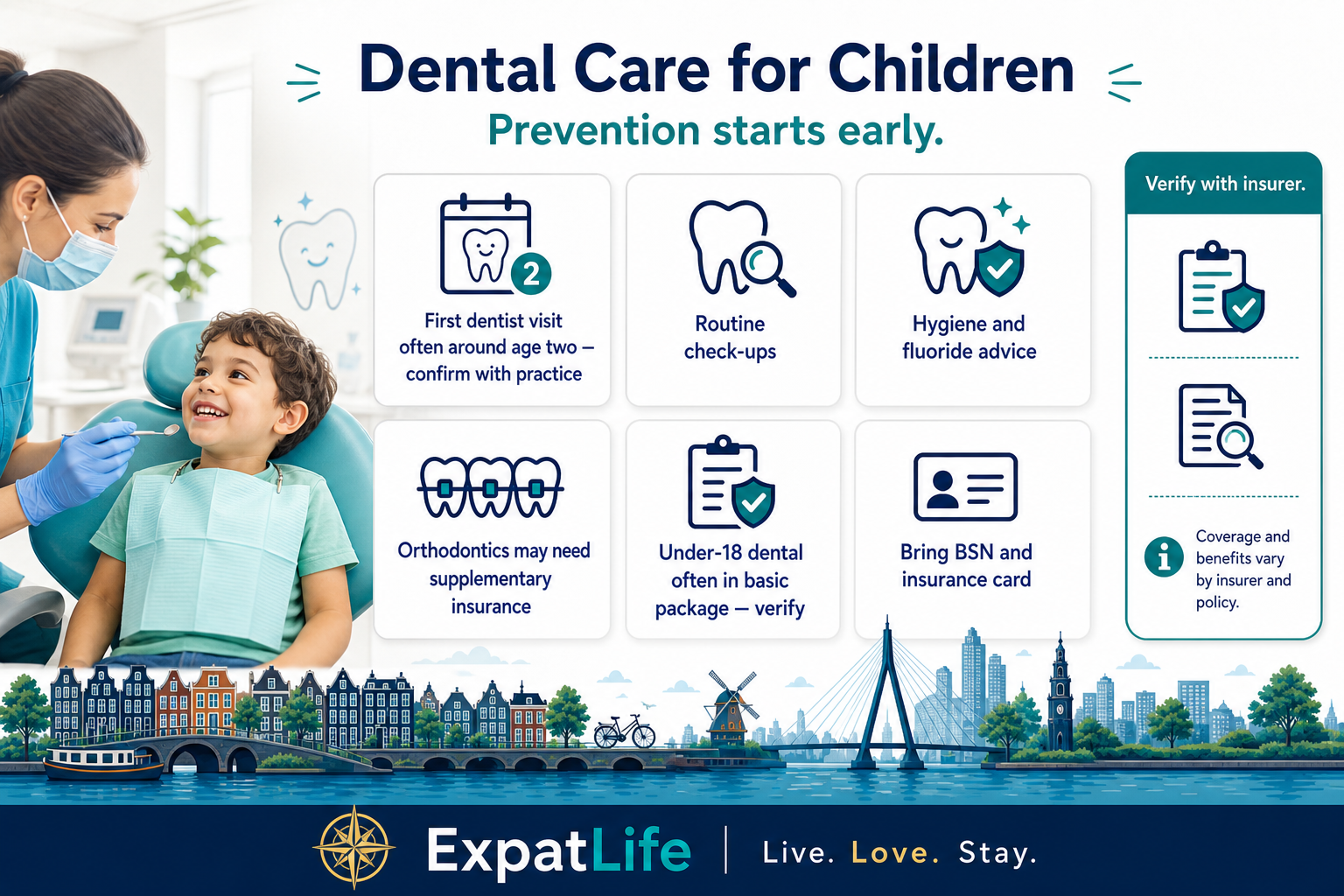
Routine dental care for children under 18 is covered by the Dutch basic health insurance — typically periodic check-ups, fillings, extractions and preventive advice. That makes dental care one of the least expensive parts of raising children here. What it does not do is arrange itself: there is no automatic school dentist, and no one will register your child for you.
Register with a dental practice (tandartspraktijk) in your first weeks. In busy cities practices sometimes have closed lists or waiting periods, and being registered matters more than which practice you chose. Once registered, most practices invite children for check-ups roughly twice a year and will tell you when they want to see your child more or less often.
Orthodontics — braces and related treatment — usually sits outside the basic package for children and is a common reason families take supplementary dental cover. If braces are likely in your family, compare supplementary packages early: waiting periods and annual limits mean cover taken after treatment is proposed is often too late to help.
| Care type | Cover for under-18s | Note |
|---|---|---|
| Periodic check-up | Covered for under-18s under the basic insurance | Typically offered around twice a year; the practice advises the interval. |
| Fillings and extractions | Generally covered for under-18s | Confirm specifics with your insurer, especially for less common treatments. |
| Preventive treatment and advice | Generally covered for under-18s | Includes cleaning and instruction; sealants may have conditions. |
| Orthodontics (braces) | Usually not covered for children by the basic insurance | Commonly requires supplementary cover with annual limits and waiting periods. |
| Crowns and specialist restorative work | Conditional — depends on the treatment and indication | Ask for a written cost estimate (begroting) before treatment starts. |
| Urgent dental care outside opening hours | Available through regional dental emergency services | Your practice's answering message usually names the on-call service. |
Registering with a dental practice
Dental coverage details and supplementary packages differ by insurer and change annually. Verify what your policy covers before treatment and ask the practice for a written estimate for anything beyond routine care.
Wellbeing
Children's mental health support in the Netherlands is spread across several doors that all lead into the same system. Your GP can assess and refer to youth mental health care (jeugd-GGZ). Municipalities are responsible for youth support under the Youth Act (Jeugdwet) and run local teams, often through a family centre (Centrum voor Jeugd en Gezin) or neighbourhood team. Schools have internal support coordinators and work with youth health nurses and doctors from JGZ.
For expat families, relocation itself is a common reason to seek support. Homesickness, language stress, losing a friendship group, or a parent's own adjustment strain all show up in children as changed sleep, appetite, behaviour or school performance. Most of it is normal adjustment that settles within six to twelve months — but it is not something you have to manage alone or wait out silently.
Practically, the fastest routes are usually your GP (for referral into specialist care) and the school or JGZ (for support around school, wellbeing and family life). Waiting times for specialist youth mental health care can be long in some regions, so ask what interim support is available while you wait, and ask the municipality what it offers directly.
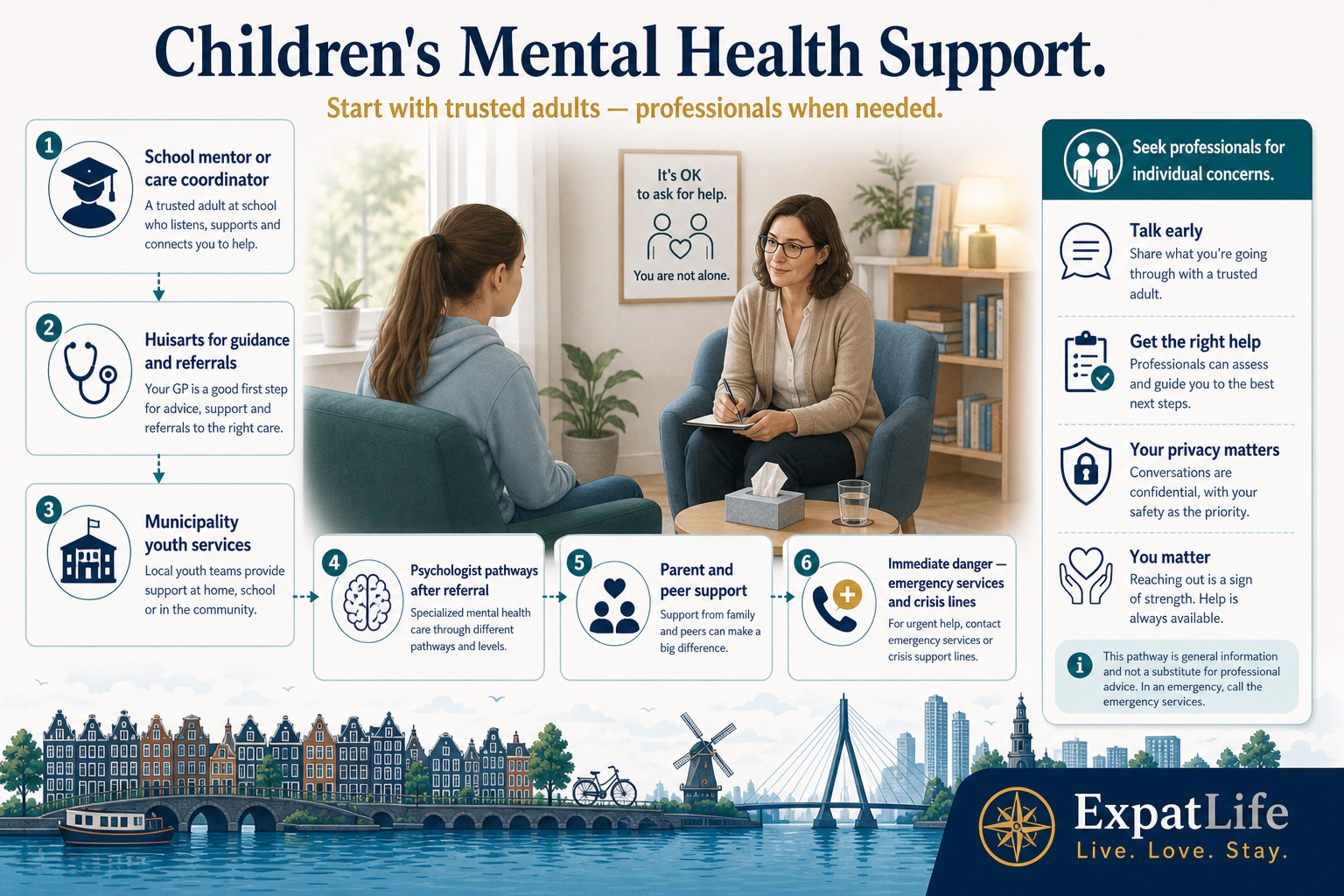
Assesses what is happening, offers first-line support in the practice — often with a practice-based mental health worker — and refers into youth mental health care when specialist assessment is needed.
Internal support coordinators, mentors and the school social worker can adjust school expectations, arrange in-school support and involve external help.
Available from primary school onwards for wellbeing conversations, and can refer independently. Teenagers can talk to them confidentially without a parent present.
Your municipality is responsible for youth support. Local teams and family centres offer parenting support, family coaching and access to funded youth care.
De Kindertelefoon (0800 0432) is a free, anonymous helpline where children can talk about anything. For suicidal thoughts, 113 Suicide Prevention is reachable on 0800 0113.
If there is immediate danger to your child, call 112. Outside practice hours, the huisartsenpost can arrange urgent assessment and involve crisis services.
This section is orientation, not a diagnostic tool. Any concern about your child's mental health belongs with a professional — start with your GP, the school or your JGZ team, and call 112 if there is immediate danger.
Everyday illness
Dutch general practice is deliberately conservative. For common childhood illness the standard approach is assessment, an explanation, clear instructions about what to watch for, and a review moment if things do not improve — rather than immediate medication. Antibiotics are prescribed when there is a clear indication, not as reassurance, and 'uitzieken' (letting an illness run its course, with monitoring) is a normal and evidence-based part of the conversation.
That approach surprises many newcomers, and the mismatch is usually about communication rather than clinical care. The fix is to ask two specific questions at every appointment: what should make me come back, and by when should I expect improvement? A good GP answers both readily, and the answers give you a concrete plan instead of a vague wait.
For reliable, non-commercial self-help information, Dutch households use Thuisarts.nl, written by the professional body for GPs. It explains symptoms, what usually happens and when to contact a doctor. It is mostly in Dutch, but browser translation handles it well and it is far more trustworthy than general internet searching.
This guide deliberately gives no treatment guidance and no symptom-by-symptom instructions. What follows is about how the system responds and how to work with it — the clinical judgement belongs to your GP, the huisartsenpost or 112.
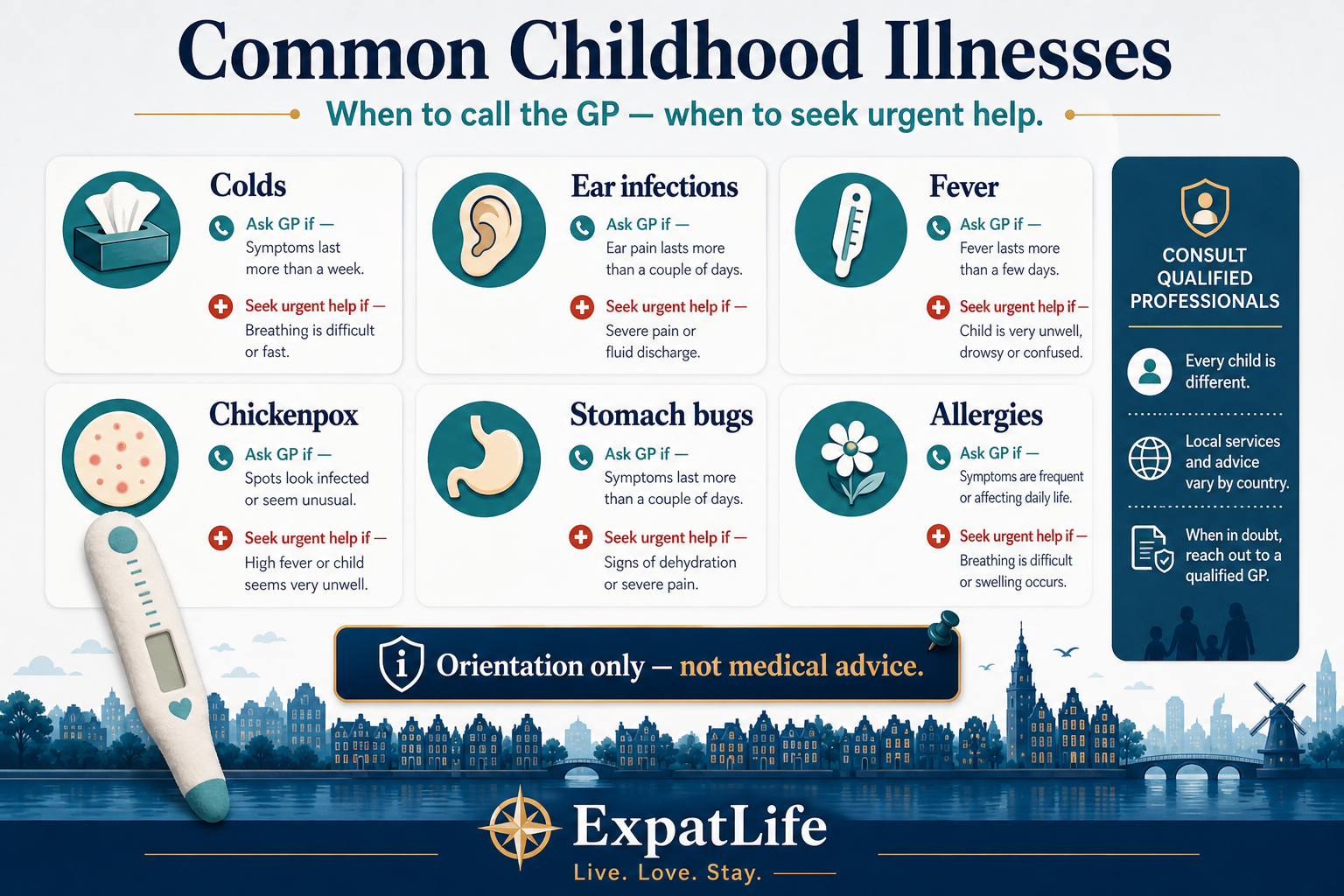
| What you notice | First contact | Note |
|---|---|---|
| Fever without warning signs in an otherwise well child | Thuisarts.nl for orientation, then your GP if it persists or you are worried | Age matters: babies under three months with fever are assessed the same day. |
| Cough, cold or sore throat | Normally managed at home with monitoring; GP if symptoms worsen or persist | Expect an explanation and warning signs rather than automatic medication. |
| Vomiting or diarrhoea | GP or huisartsenpost if fluid intake drops, or if there are signs of dehydration | Ask specifically about hydration signs to watch for at home. |
| Rash | GP appointment; urgent contact if the rash does not fade under pressure or comes with fever and drowsiness | Photograph the rash when you see it — rashes change fast. |
| Earache | GP appointment; urgent contact if severe pain, high fever or discharge | Watchful waiting is common for ear infections in older children. |
| Recurring or unexplained complaints | GP appointment with a written symptom timeline; JGZ if it concerns growth or development | Patterns over weeks are more useful to a doctor than single episodes. |
| Infectious illness affecting daycare or school | Inform the childcare provider or school; they follow national public health guidance | Exclusion rules come from public health guidance, not from the provider's preference. |
Medicines
Prescription medicines come from a pharmacy (apotheek), not from your GP practice. Prescriptions are sent digitally, so once you register with one pharmacy near home the process is quick: the GP prescribes, the pharmacy prepares, you collect. Registering with a single pharmacy also means your family's medication record sits in one place, which is how interaction and dosing checks work.
A drogist (drugstore such as Etos or Kruidvat) sells over-the-counter products including children's paracetamol, saline drops and plasters. An apotheek dispenses prescriptions and gives medication advice, including on dosing for children by weight. For urgent prescriptions outside opening hours there is a regional out-of-hours pharmacy (dienstapotheek) — the huisartsenpost will tell you which one serves your area.
Families arriving from abroad should plan medication continuity carefully. A Dutch GP prescribes from their own file, so bring a medication list with generic names (not only brand names), current dosages and the reason for use. Some brands and formulations available elsewhere are not marketed here, so an equivalent may be prescribed instead. Bring enough supply to bridge the first weeks while registration and appointments are arranged.
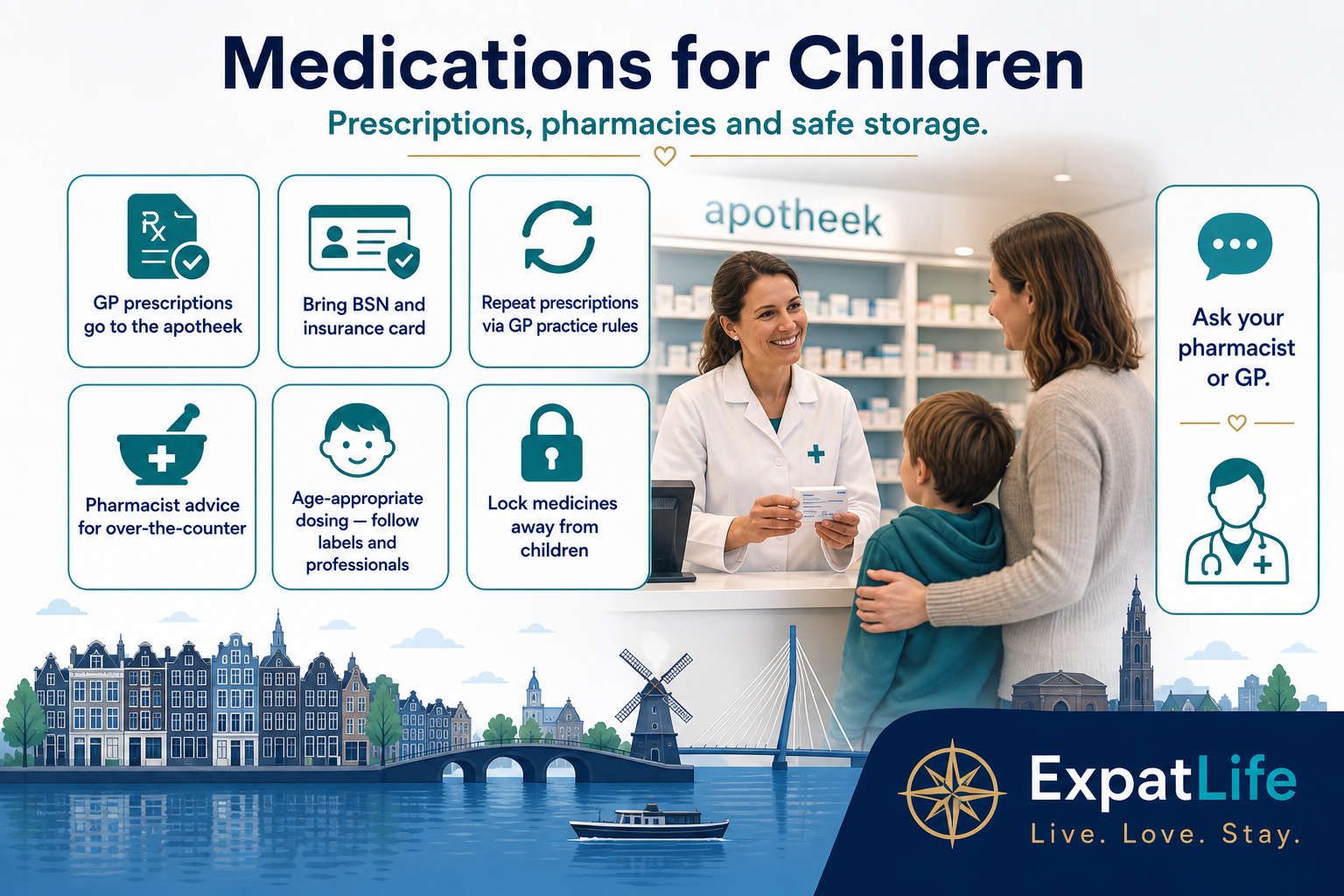
Medication continuity when you move
Never adjust a prescribed dose based on general information. Dosing for children depends on weight and age — ask your pharmacy or GP.
Relocating
The healthcare part of a family relocation is mostly paperwork done in the right order — and the paperwork is much easier to gather before you leave than after. Records travel badly: previous clinics may be slow to respond, may not send documents internationally, and may charge for copies. Collect and translate what you need while you are still a local patient.
After arrival, the sequence is municipal registration (which gives each child a BSN and triggers the JGZ invitation), insurance, then the practical registrations: GP, dentist and pharmacy. Most families complete this within a month. The first JGZ appointment is worth prioritising — it also gives you a local guide to childcare, schools and support services.
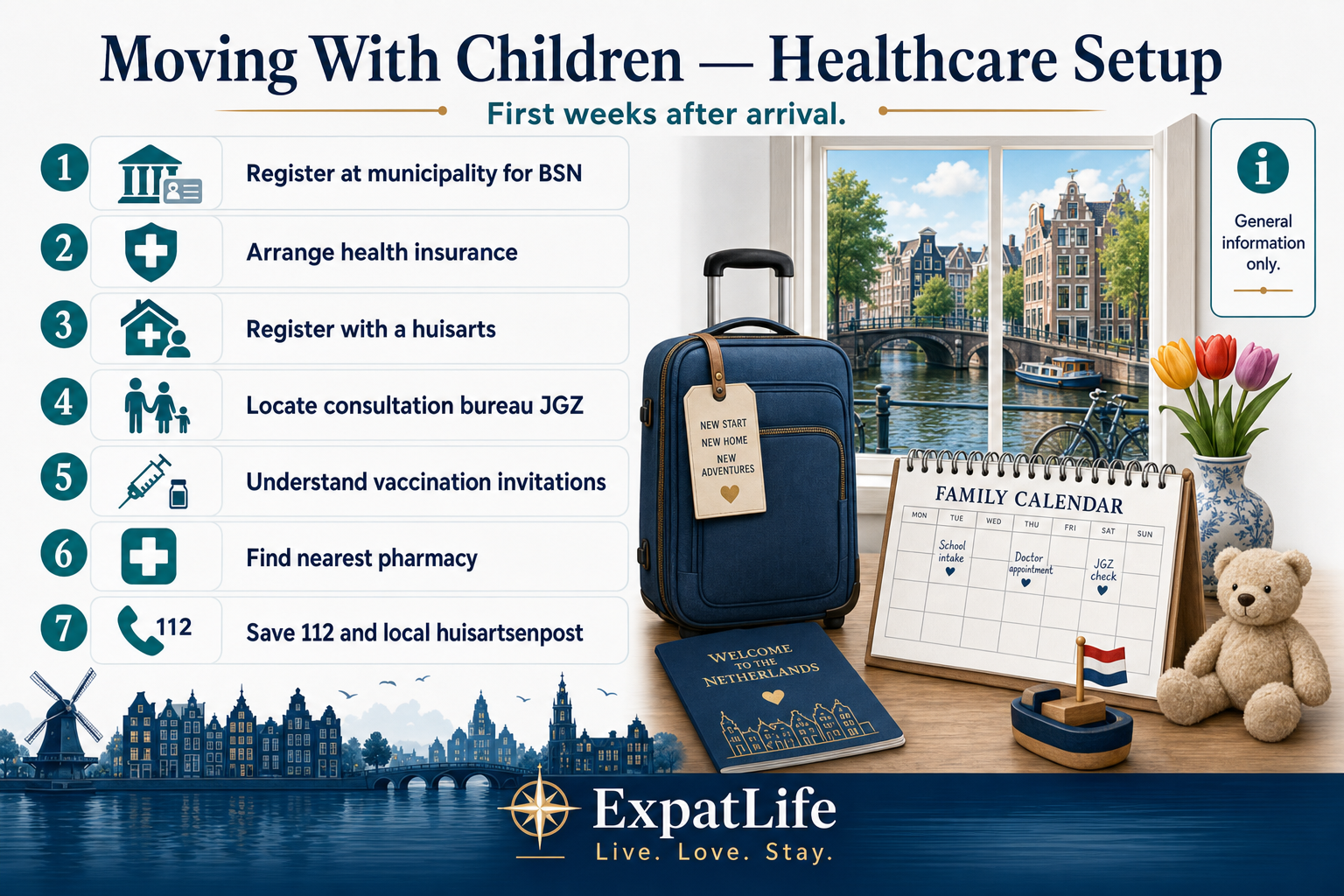
Before you leave — collect and translate
Week 1 after arrival
First month after arrival
Examples
| Situation | How it works here | First step |
|---|---|---|
| Newborn arriving or born shortly after the move | Insurance registration and JGZ contact are the priorities; the bureau schedule is dense in the first year. | Declare the birth or register the baby, then add them to the insurance policy immediately. |
| Child with asthma, allergies or another chronic condition | Continuity needs a written handover plus a GP who can re-prescribe and refer quickly. | Book a GP intake appointment specifically to hand over the file, before medication runs low. |
| Teenager arriving mid-school-year | School-based youth healthcare replaces the consultation bureau; wellbeing support runs partly through school. | Register the GP, then ask the school who the youth health nurse and support coordinator are. |
| Non-EU family with a pending residence procedure | Insurance eligibility and timing depend on your residence and work situation. | Check your insurance obligation and deadline as soon as you register, and keep proof of the start date. |
Checklist
Work through these four blocks in order. Most families finish the essentials in their first month, and the annual review keeps everything current as children grow.
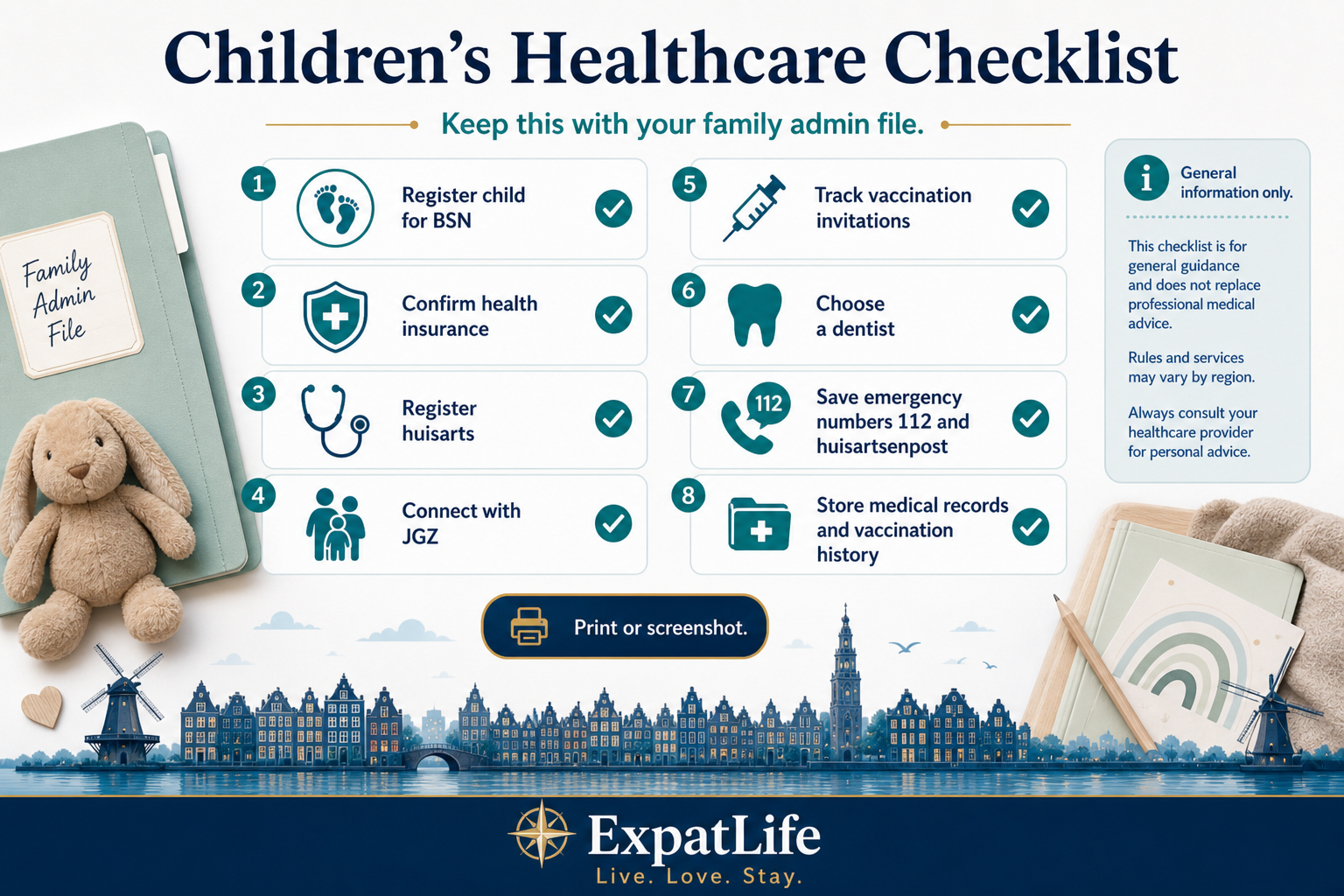
Block 1 — essentials
Block 2 — routine setup
Block 3 — ongoing and annual
Block 4 — records to keep in one place
Surprises
None of these are problems once you expect them. Each card explains the surprise and the practical fix that experienced expat families use.
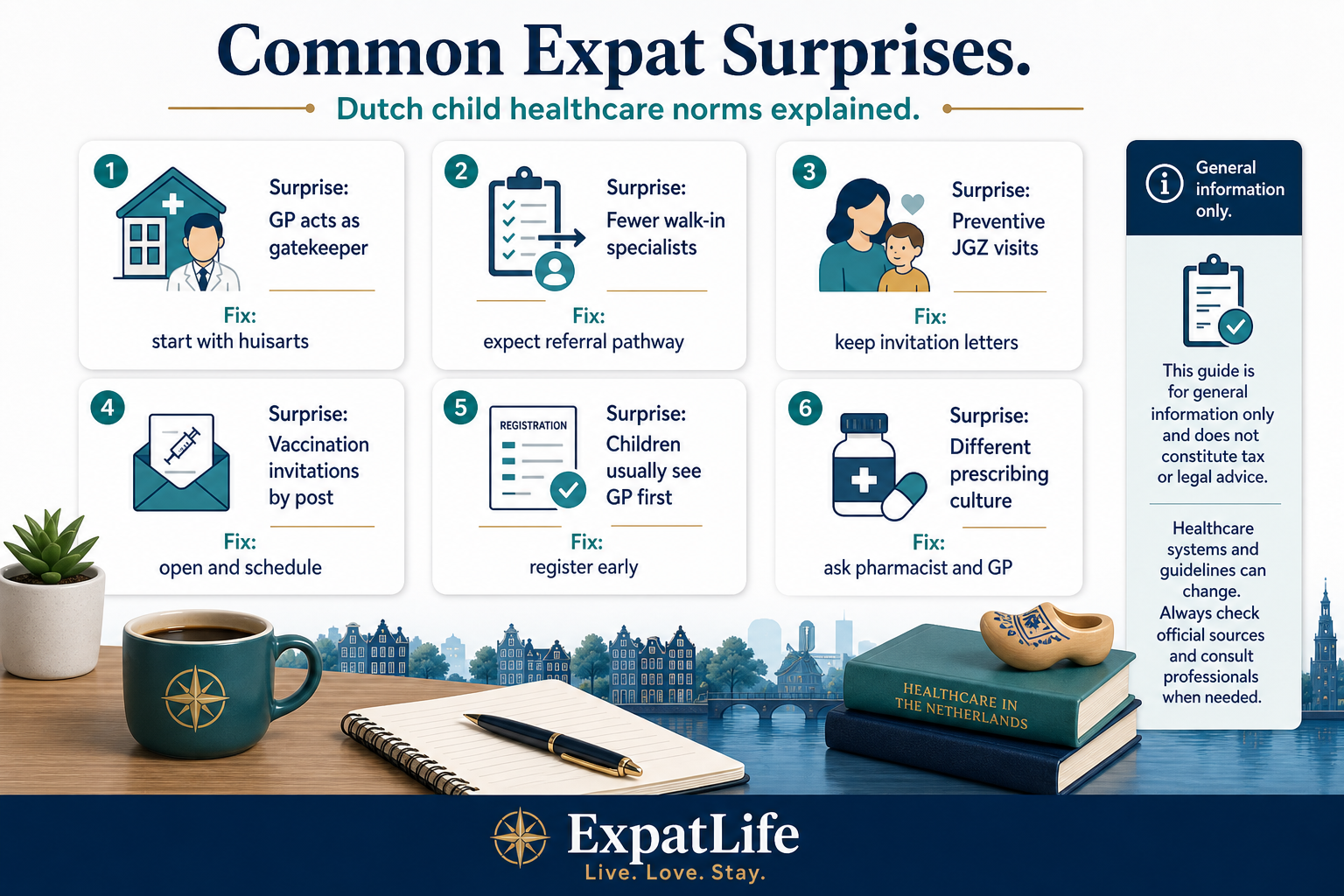
You usually cannot book a paediatrician directly. Every route to hospital paediatric care runs through a referral from your GP or a youth healthcare doctor, which feels slow if you are used to choosing specialists yourself.
Fix: Register a GP early and build the relationship before you need it. If you think specialist assessment is needed, say so explicitly and ask what would justify a referral.
Dutch practice favours assessment, explanation and monitoring over immediate medication, and antibiotics are reserved for clear indications. Parents used to leaving with a prescription can read this as being brushed off.
Fix: Ask two questions every time: what should make me come back, and by when should I see improvement? You leave with a plan instead of a prescription.
Growth, development, screening and vaccinations happen at JGZ, not at your GP. Families who only register a GP end up missing the entire preventive track — and vice versa.
Fix: Set up both. Treat the JGZ invitation as a real appointment, and tell each service what the other has advised.
A standard consult is around ten minutes and an assistant asks what the problem is before you get a slot. Without preparation, that is not much time for a worried parent with two children.
Fix: Prepare three sentences, lead with your main worry, and ask for a longer or double appointment when booking if you have several issues.
Routine dental care is covered until 18, yet nobody enrols your child — and practices in popular city areas sometimes have closed lists or waiting periods.
Fix: Register with a dental practice in your first weeks, even if you are still unsure whether you will stay in that neighbourhood.
Emergency departments expect an ambulance or a referral, so walking in with a feverish child usually means being redirected to the out-of-hours GP post instead.
Fix: Save the regional huisartsenpost number now and call it first outside practice hours — and call 112 straight away for anything life-threatening.
FAQ
Orientation answers for the questions expat parents ask most. Confirm your own situation with your insurer, your GP and your local JGZ team — and call 112 in an emergency.
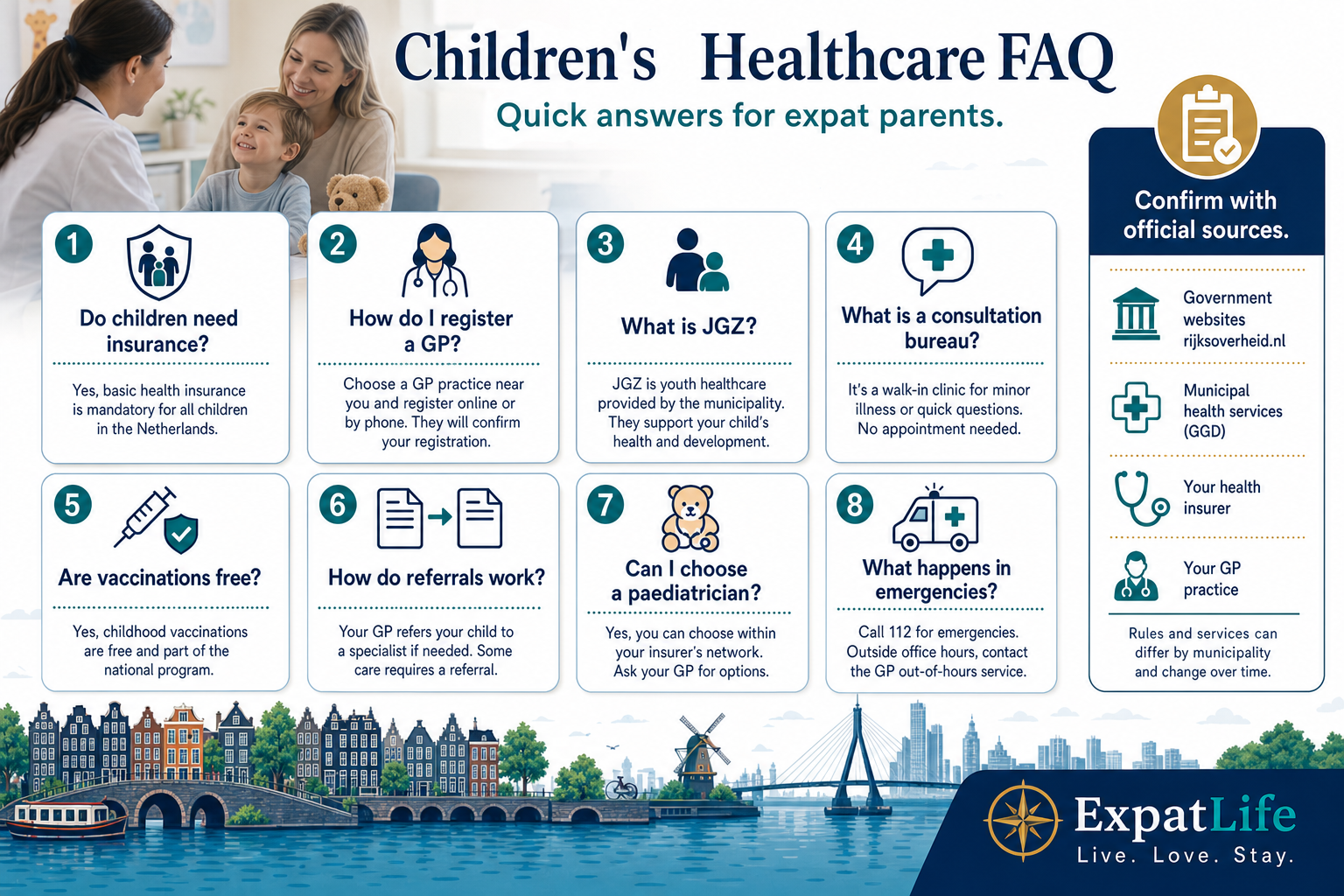
Largely, yes. Children under 18 are covered by Dutch basic health insurance without paying a premium and without the annual deductible (eigen risico) that applies to adults, and preventive youth healthcare (JGZ) — including check-ups, screening and national programme vaccinations — is publicly funded rather than billed to you. Parents still pay their own premium and deductible, and some things sit outside the basic package for children, most commonly orthodontics. Verify the details of your own policy with your insurer.
Children need to be insured, but not with a separate premium-paying policy. They are registered on a parent's Dutch basic insurance and covered free of charge until they turn 18. Registration is not automatic: for a baby born in the Netherlands you normally have four months from birth to arrange it, with cover backdated to the birth date, and families arriving from abroad arrange insurance shortly after becoming insurable. Confirm the exact deadline for your situation with your insurer or on Government.nl.
Search for practices near your home that accept new patients — most serve a defined catchment area — and complete the practice registration form for every family member using each child's BSN and your insurance details. Ask your previous doctor for a medical summary and vaccination record so allergies, conditions and past treatment are on file, and book an introduction appointment if the practice offers one. Do this in your first weeks rather than during a child's first illness.
The consultatiebureau is the local Youth Healthcare (JGZ) centre for children under four, and it is not a GP. It provides free preventive care — growth and development monitoring, vision and hearing screening, national programme vaccinations and parenting guidance — at scheduled ages rather than when your child is ill. From age four the same service continues through school-based youth health teams. You need both: JGZ for prevention and your GP for illness, injury and referrals.
No. The national immunisation programme (Rijksvaccinatieprogramma), coordinated by RIVM and delivered free through JGZ, is voluntary. You are invited at set ages, given information about each vaccination and asked to decide. Some childcare providers and schools ask about vaccination status for information or outbreak management, which is not the same as a legal requirement — ask each organisation what they ask for and why. For the current schedule, check RIVM rather than any summary.
Through a referral. Your GP — or a youth healthcare doctor — assesses first and writes a referral letter (verwijzing) to a hospital paediatric clinic when specialist assessment or diagnostics are needed. Most children are seen at a regional hospital; more complex care is referred onwards to a university medical centre or a specialised national centre. Keep a copy of the referral, check that the hospital is contracted by your insurer, and ask that letters are copied back to your GP.
Call 112 immediately for anything life-threatening — unresponsiveness, serious breathing difficulty, a severe allergic reaction, a seizure that does not stop, heavy bleeding or suspected poisoning. Operators speak English. For urgent problems that are not life-threatening but cannot wait for your GP practice to reopen, call your regional huisartsenpost (out-of-hours GP post) first; they triage by phone and give advice or an appointment. Hospital emergency departments generally expect an ambulance or a referral rather than a walk-in.
Routine dental care for under-18s — periodic check-ups, fillings, extractions and preventive advice — is covered by the basic insurance, but you must register with a dental practice yourself, as there is no automatic school dentist. Orthodontics such as braces usually falls outside the basic package for children and is a common reason families take supplementary dental cover. Compare supplementary packages early, since waiting periods and annual limits mean late cover often does not help.
Related
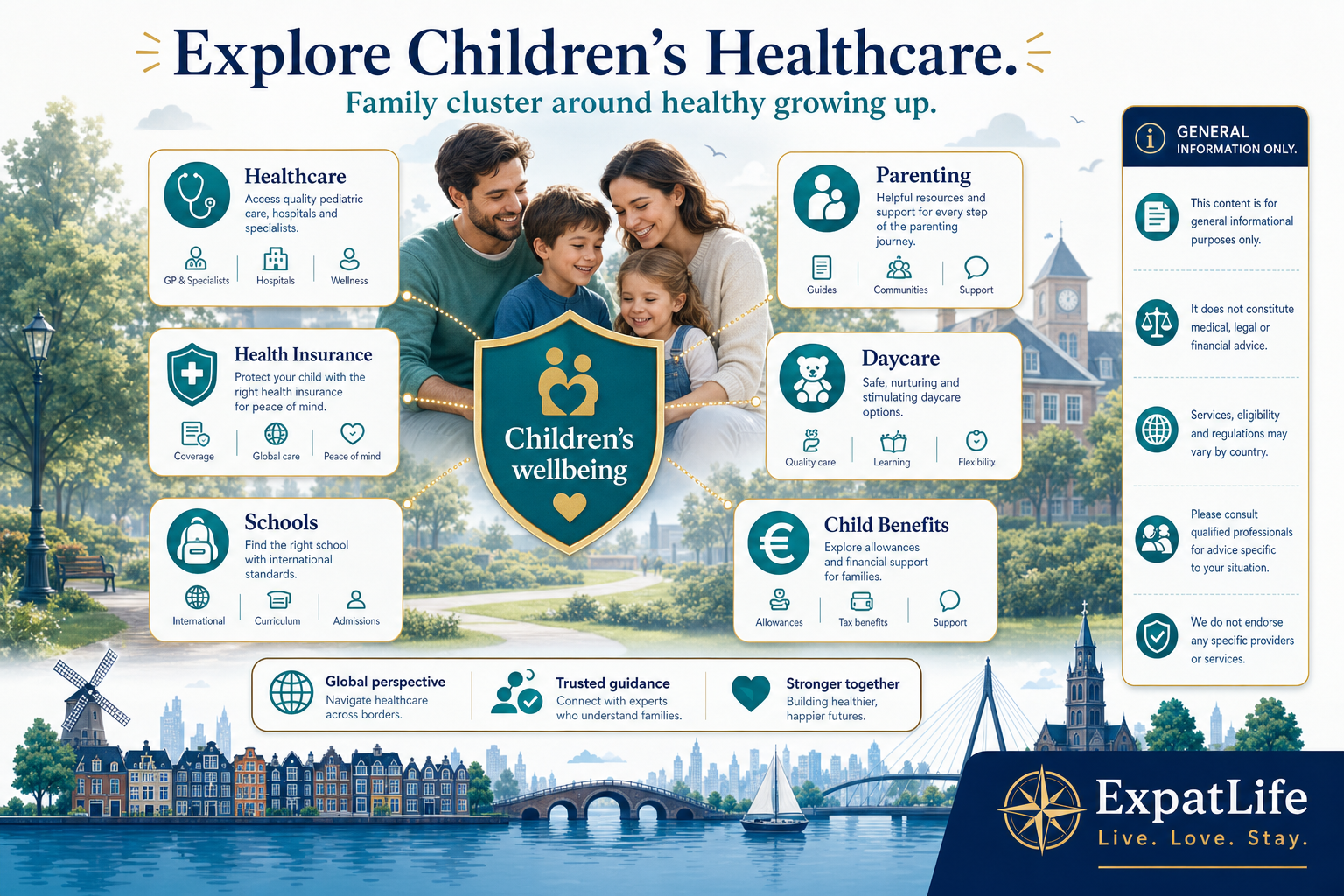
Healthcare decisions rarely stand alone — insurance, childcare, schools and relocation planning all connect to what is on this page.
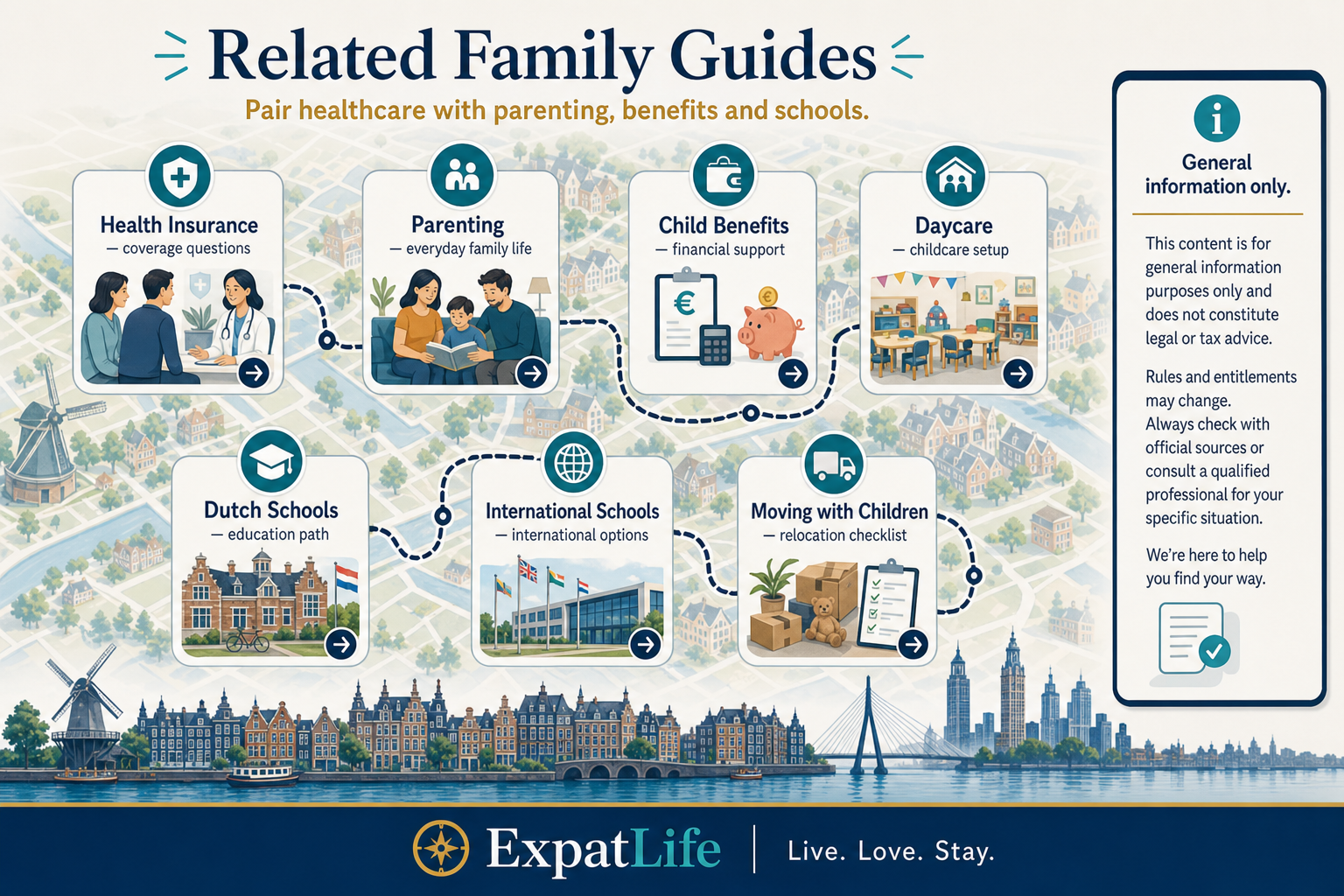
Family hub
This page is the children's healthcare cornerstone. Use the family cluster to sequence childcare, schools, benefits and relocation around it.
Explore next
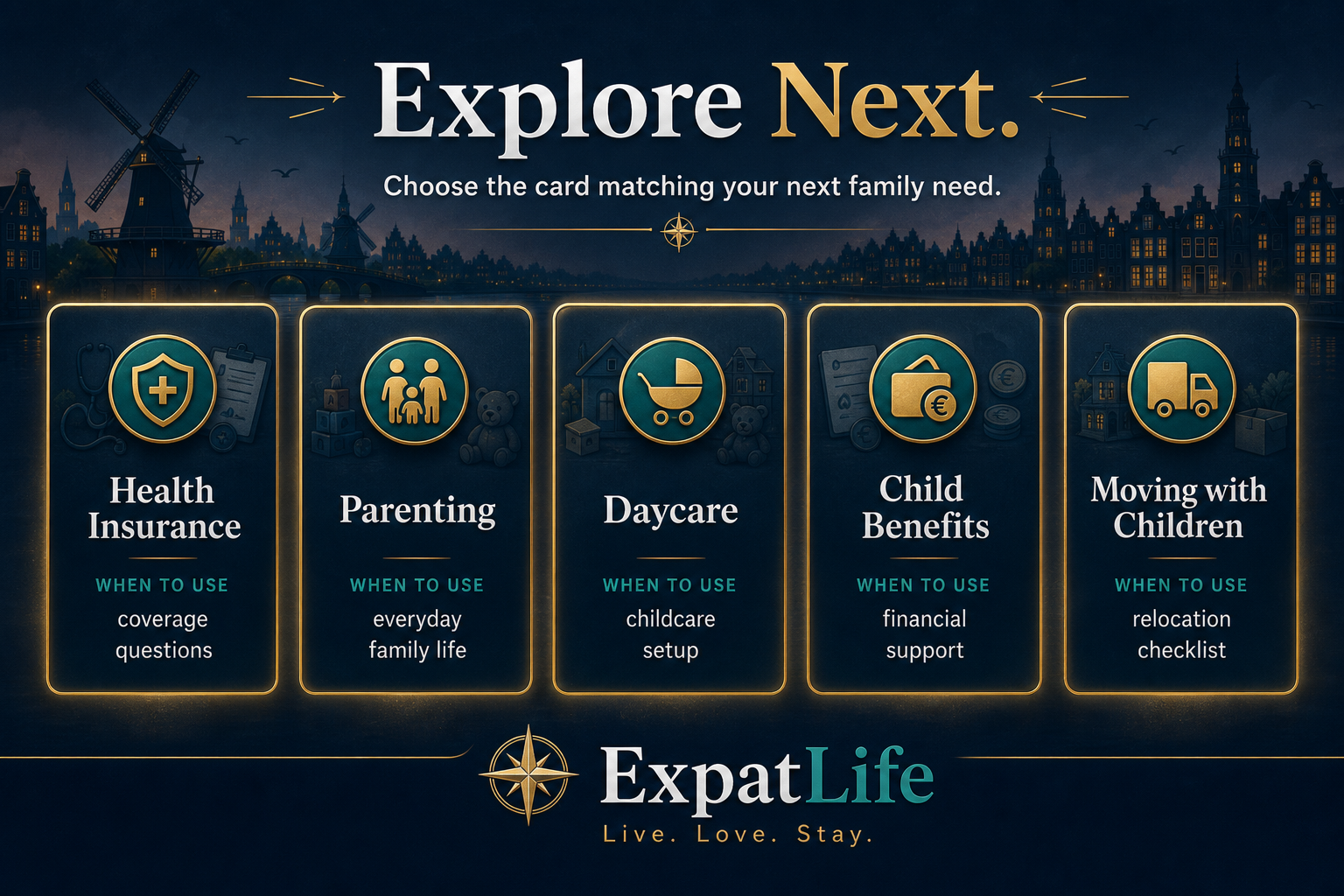
Pick the card that matches what is still open — insurance, childcare, benefits or the wider relocation checklist — and verify specifics on the official sources below.
Trust
General information only — not medical advice. Coverage, schedules and local arrangements change, so verify your own situation with your insurer's portal, your municipality's JGZ organisation and your GP. In an emergency, call 112.