
City drives availability
Example: The Hague offers 10+ international options including American and European Schools; Groningen has one main IB school — verify before accepting a regional role.
Netherlands · Education · International schools
Everything expat families need to know about international schools, curricula, admissions, tuition fees and choosing the right school.
Practical orientation only — not admissions advice. Fees, waiting lists and placement depend on each school. We do not rank schools subjectively.

Quick answer
The Netherlands has one of Europe's strongest international school networks. Families relocating for work, diplomacy or entrepreneurship can choose from International Baccalaureate (IB), British, American, European, bilingual and other international programmes depending on city and age group.
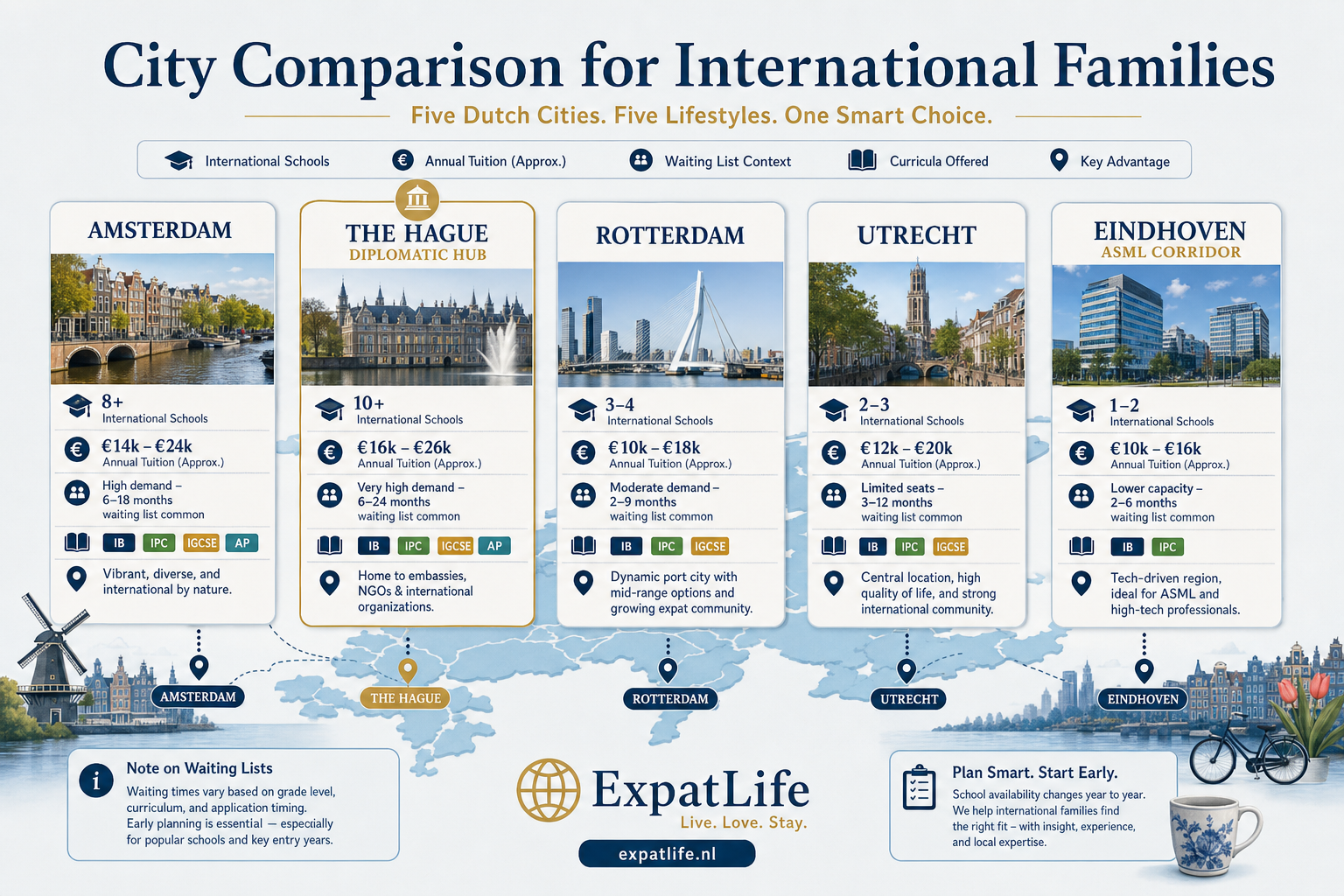
Availability varies significantly by city. Amsterdam, The Hague and Rotterdam have the largest selection, while smaller cities may offer one or two international options plus strong Dutch public alternatives. Waiting lists are common at popular schools — planning 6–18 months ahead is realistic in major hubs.
This guide helps you compare real schools, understand admissions and fees, and connect school choice with housing, commute and family relocation planning. It does not rank schools subjectively or guarantee placement.
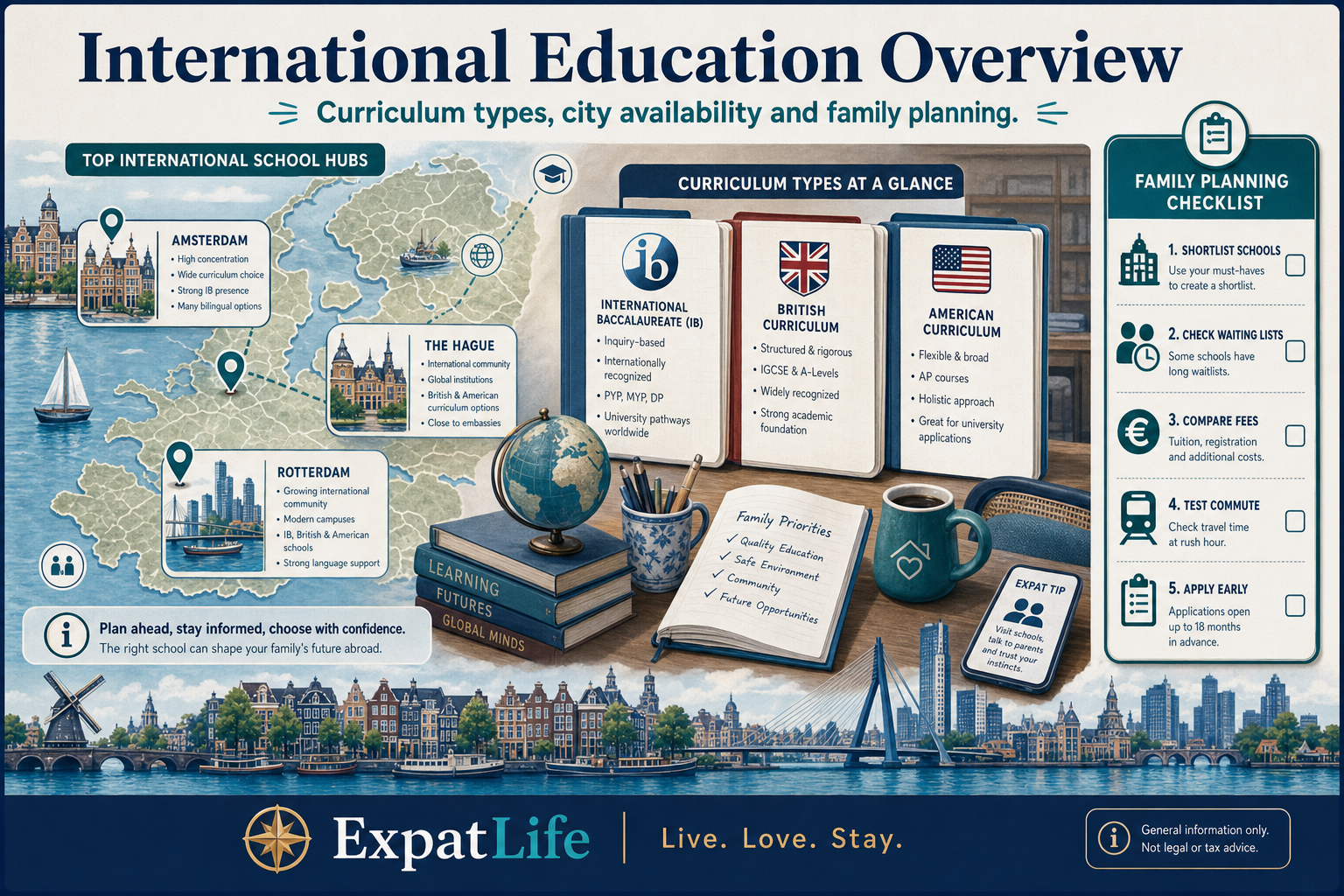
Key points
Example: The Hague offers 10+ international options including American and European Schools; Groningen has one main IB school — verify before accepting a regional role.
Example: primary tuition often €12,000–€22,000/year at many schools, plus registration, bus and trip extras — not covered by Dutch public education funding.
Example: reception and IB Diploma entry at ASH or AICS can fill early — apply to multiple schools and keep Dutch public alternatives open.
Example: British family on IGCSE path may prefer BSN or British School Amsterdam over switching to IB mid-secondary without credit mapping.
Three orientation moves before you shortlist schools
Examples
| Profile | Scenario | What to check |
|---|---|---|
| Diplomatic family — The Hague | Two children ages 5 and 12; posting confirmed for August; housing in Wassenaar corridor | Apply to BSN, ASH and European Schools early; compare bus routes and year-group waiting lists in writing. |
| Amsterdam tech hire — two kids | HSM contract; lease in Amsterdam Zuid; children ages 6 and 10 | Shortlist AICS, ISA and British School; test commute from lease address before signing. |
| Eindhoven ASML transfer | Mid-year move January; one child age 14 on IB MYP | Contact ISE with 2–3 years of reports; mid-year MYP places vary by cohort. |
| Long-term NL residency | Family planning 8+ years; wants English instruction plus Dutch integration | Compare bilingual tracks (e.g. Optimist) with Dutch public plus after-school Dutch — ask hours of Dutch per week. |
At a glance
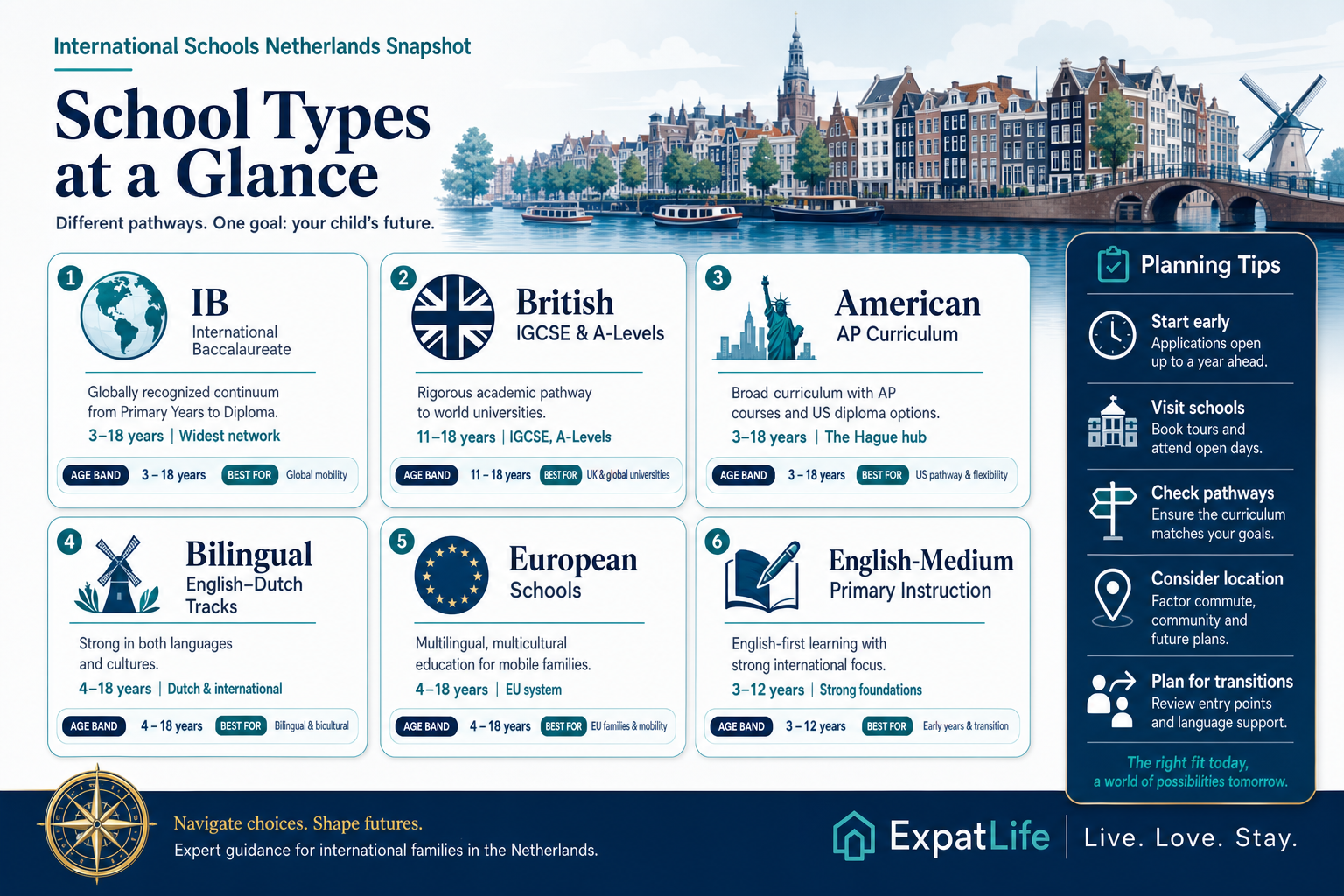
Compare school types before diving into the directory — availability and fees vary by city.
IB schools
Widest network
Primary through diploma programmes in most major cities.
British schools
Strong presence
Popular with UK and Commonwealth families; IGCSE and A-Level pathways.
American schools
The Hague hub
American School of The Hague is the flagship US-curriculum option.
Bilingual schools
Growing options
English–Dutch tracks in select cities — verify language balance per school.
English education
Primary medium
Most international schools teach in English with Dutch as a subject.
International communities
City-linked
School clusters follow diplomatic, corporate and university hubs.
School system comparison
Many expat families compare international schools with Dutch public (basisschool and voortgezet onderwijs) options. This table orients you on structural differences — municipal rules and school policies still govern exact placement.
| Factor | How it differs | Planning note |
|---|---|---|
| Funding | Private tuition at international schools; Dutch public schools are free at point of use | Budget €15k–€25k+ per child all-in at many international schools |
| Language | English-medium at most international schools; Dutch-medium at public schools | Dutch public viable if children are young or you plan long-term integration |
| Admissions | Direct application per school; municipal placement for many public schools | Public lottery and priority rules differ by gemeente — start early |
| Curriculum | IB, British, American etc. vs Dutch core curriculum | University recognition differs — match to future plans |
| Waiting lists | Common at flagship international schools in Randstad hubs | Apply 12+ months ahead for popular year groups |
| Commute | Suburban campuses common; cycling culture for Dutch public | Test door-to-door time from shortlisted housing areas |
Examples
| Profile | Scenario | What to check |
|---|---|---|
| UK family — British curriculum | Children on National Curriculum; target UK universities; relocating to Amsterdam | British School Amsterdam vs IB schools — compare IGCSE/A-Level continuity and commute. |
| US State Department — The Hague | Standard US curriculum expected; children ages 8 and 15 | American School of The Hague vs IB alternatives; verify AP availability and waiting lists. |
| Single-school city — Groningen | University post; one IB school in region | Confirm places before lease; Dutch public or bilingual backup if waitlisted. |
| Budget-conscious family | Two children; employer education allowance capped at €12k/child | Compare total cost including extras; explore Dutch public plus language support. |
Three moves after reading this snapshot
Basics
International schools in the Netherlands are privately funded and operate outside the standard Dutch public school system. They typically teach in English (or another international language) and follow a non-Dutch curriculum such as IB, British or American programmes.
Who attends? Diplomatic families, highly skilled migrants, international professionals, entrepreneurs and Dutch families seeking an international education path. Admission is through the school directly — not through municipal lottery systems used for many Dutch public schools.
Accreditation varies by curriculum body (IBO, Cambridge, Cognia and others). Verify accreditation status on each school's website and with the relevant curriculum organisation.
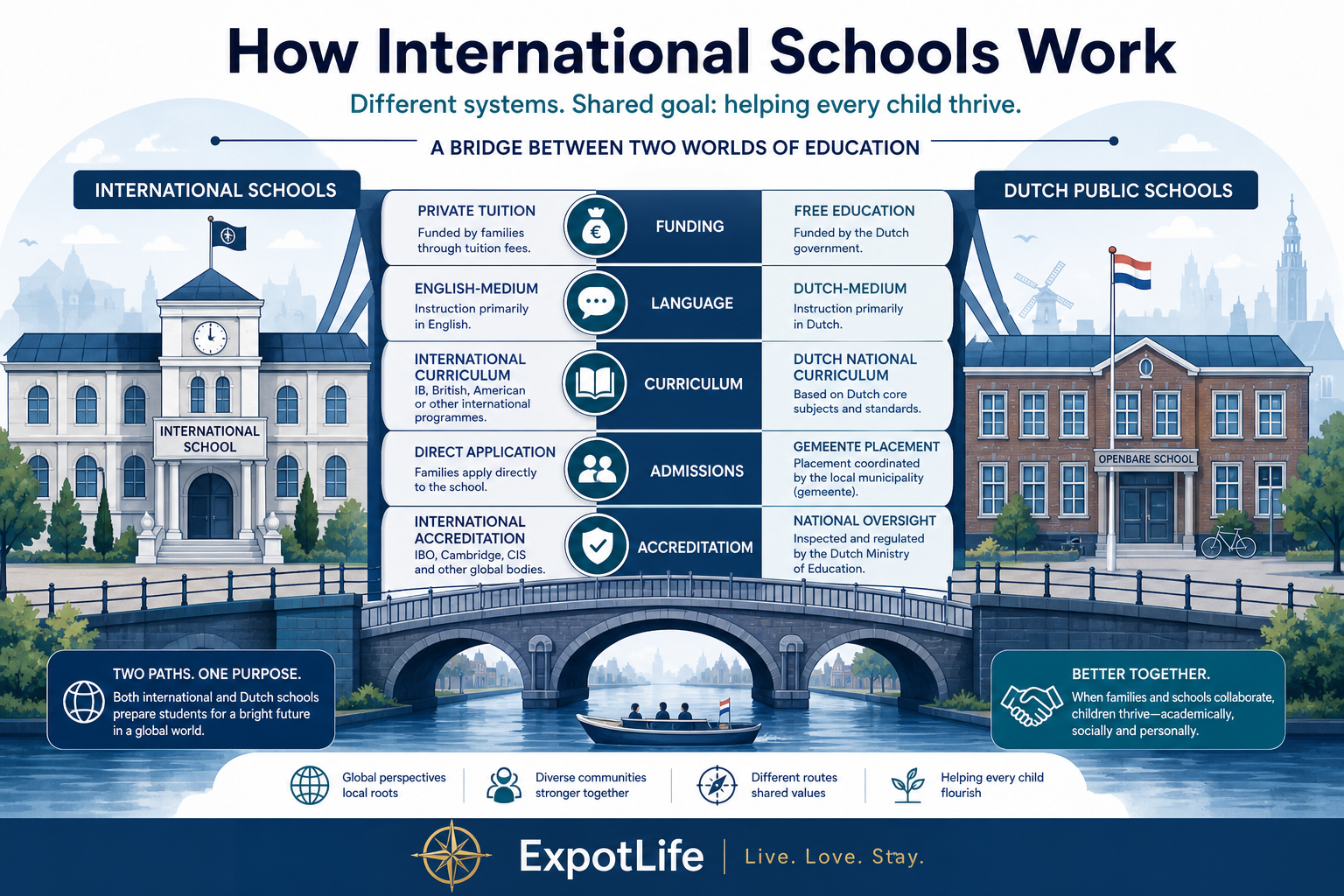
| Factor | International schools | Planning note |
|---|---|---|
| Funding | Private tuition fees — not free like Dutch public schools | Budget for tuition plus registration, trips and transport extras |
| Language | English-medium instruction is standard; Dutch taught as subject in many schools | Ask about Dutch integration if you plan long-term residency |
| Curriculum | IB, British, American, European or bilingual — not Dutch core curriculum | Match curriculum to home-country continuity or university plans |
| Admissions | Direct application to each school with own timeline and criteria | Apply to multiple schools; waiting lists are common in major cities |
| School years | Often aligned to international age bands; may differ from Dutch group system | Bring report cards and ask about year-group placement assessments |
| Accreditation | IBO, Cambridge, Cognia or European Schools frameworks | Verify on school site — important for university recognition |
Curricula
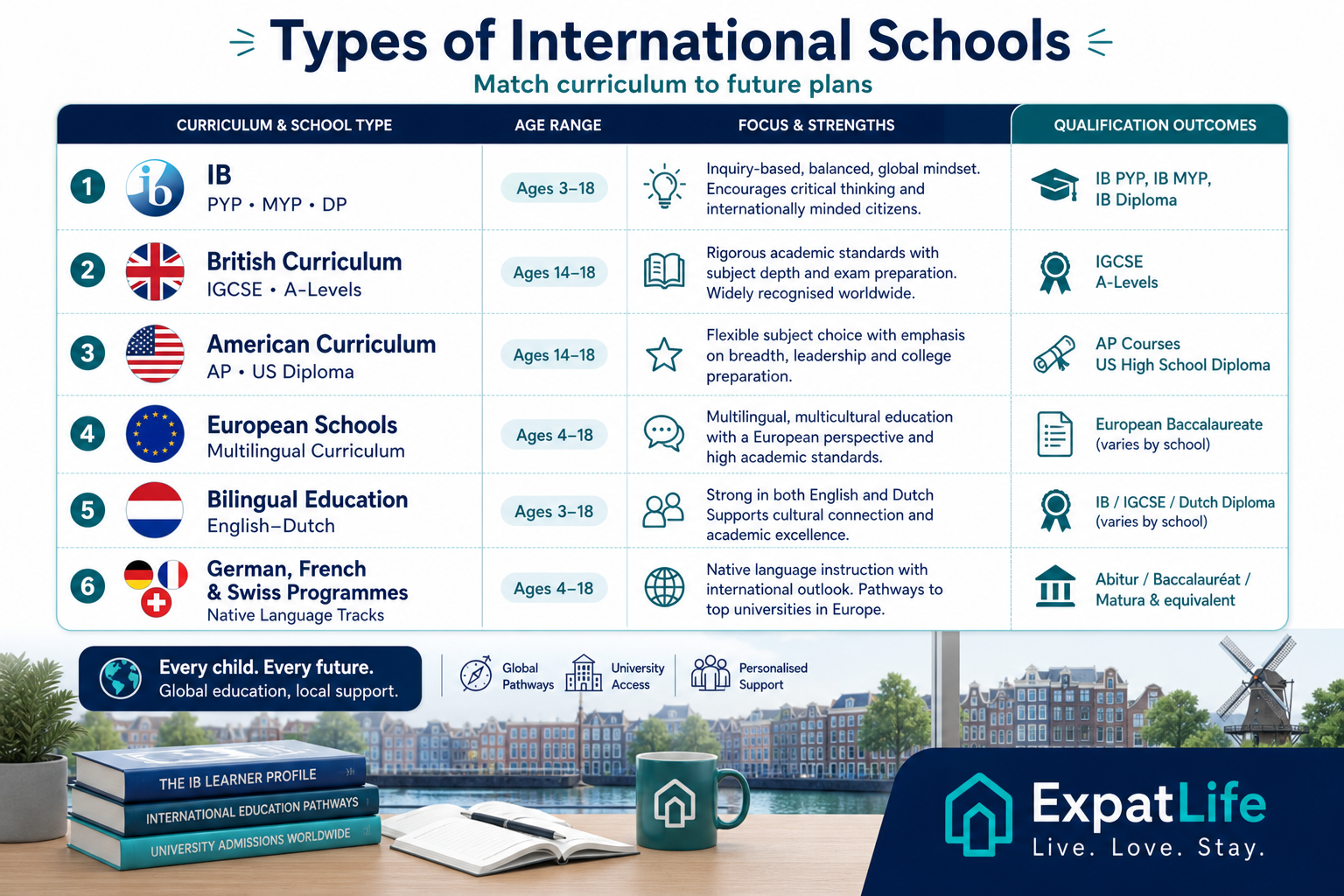
Each curriculum suits different relocation patterns and university plans — compare fit, not rankings.
Directory
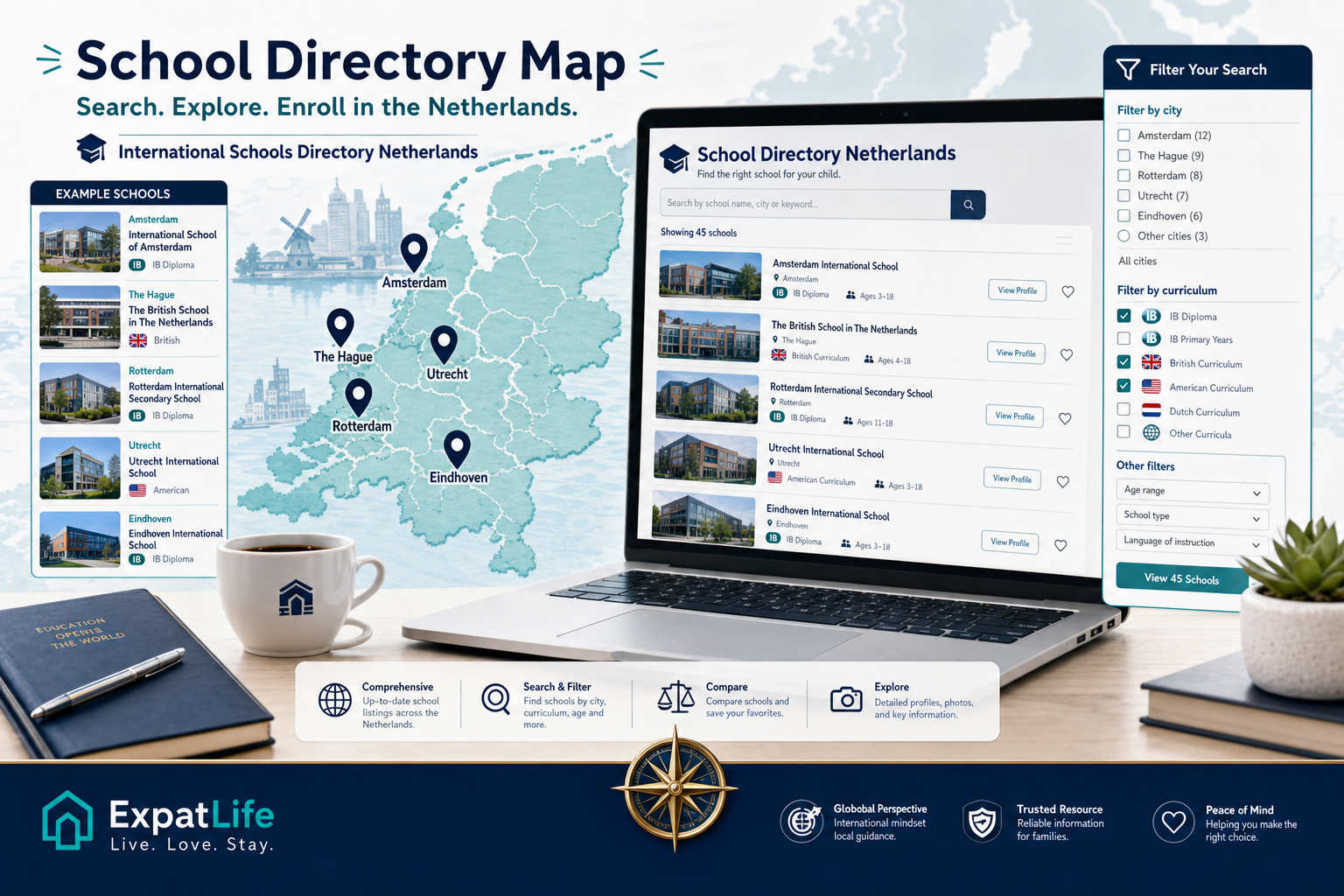
Search and filter recognised international and bilingual schools across the Netherlands. Always confirm current admissions and fees on each school website.
Directory data
Recognised international and bilingual schools in the Netherlands
40 schools · Last checked: December 2025
Verify admissions, fees and availability on each school's website — listings are orientation only.
Showing 40 schools
| School | City | Curriculum | Ages | Language | Website |
|---|---|---|---|---|---|
| AICS South / Satellite campusesMultiple AICS sites — confirm campus assignment during admissions. | Amsterdam | IB | 4–18 | English | Visit |
| American School of The Hague (ASH)Serves The Hague international community; strong AP programme. | Wassenaar | American | 3–18 | English | Visit |
| Amsterdam International Community School (AICS)Multiple Amsterdam campuses; popular with diplomatic and corporate families. | Amsterdam | IB | 4–18 | English | Visit |
| British School in the Netherlands (BSN)Multiple campuses including Jan van Hoof and Leidschenveen locations. | The Hague | British | 3–18 | English | Visit |
| European School Bergen | Bergen | European | 4–18 | English, Dutch, French, German, Other EU languages | Visit |
| European School The HagueEuropean Schools system; language sections and EU staff eligibility rules apply. | The Hague | European | 4–18 | English, Dutch, French, German, Other EU languages | Visit |
| German International School The Hague (DISDH) | The Hague | German | 3–18 | German, English | Visit |
| International Primary School Almere (IPSA)Primary programme under the International School Almere foundation. | Almere | IB | 4–12 | English | Visit |
| International Primary School Twente | Enschede | IB | 4–12 | English | Visit |
| International School Almere | Almere | IB | 3–18 | English | Visit |
| International School Amersfoort | Amersfoort | IB | 4–12 | English | Visit |
| International School Amsterdam (ISA)Long-established IB school serving the Amsterdam metropolitan area. | Amstelveen | IB | 2–18 | English | Visit |
Page 1 of 4
Cities
School choice and city choice are linked — compare options before signing a lease or accepting a role.
Budget
International school fees vary significantly by school, age group, curriculum and included services. The ranges below are illustrative planning bands based on publicly listed fee schedules — always confirm current amounts directly with each school.
Additional costs often include registration fees, technology levies, lunch programmes, school trips, exam fees and transport. Do not treat these ranges as quotes or guarantees.
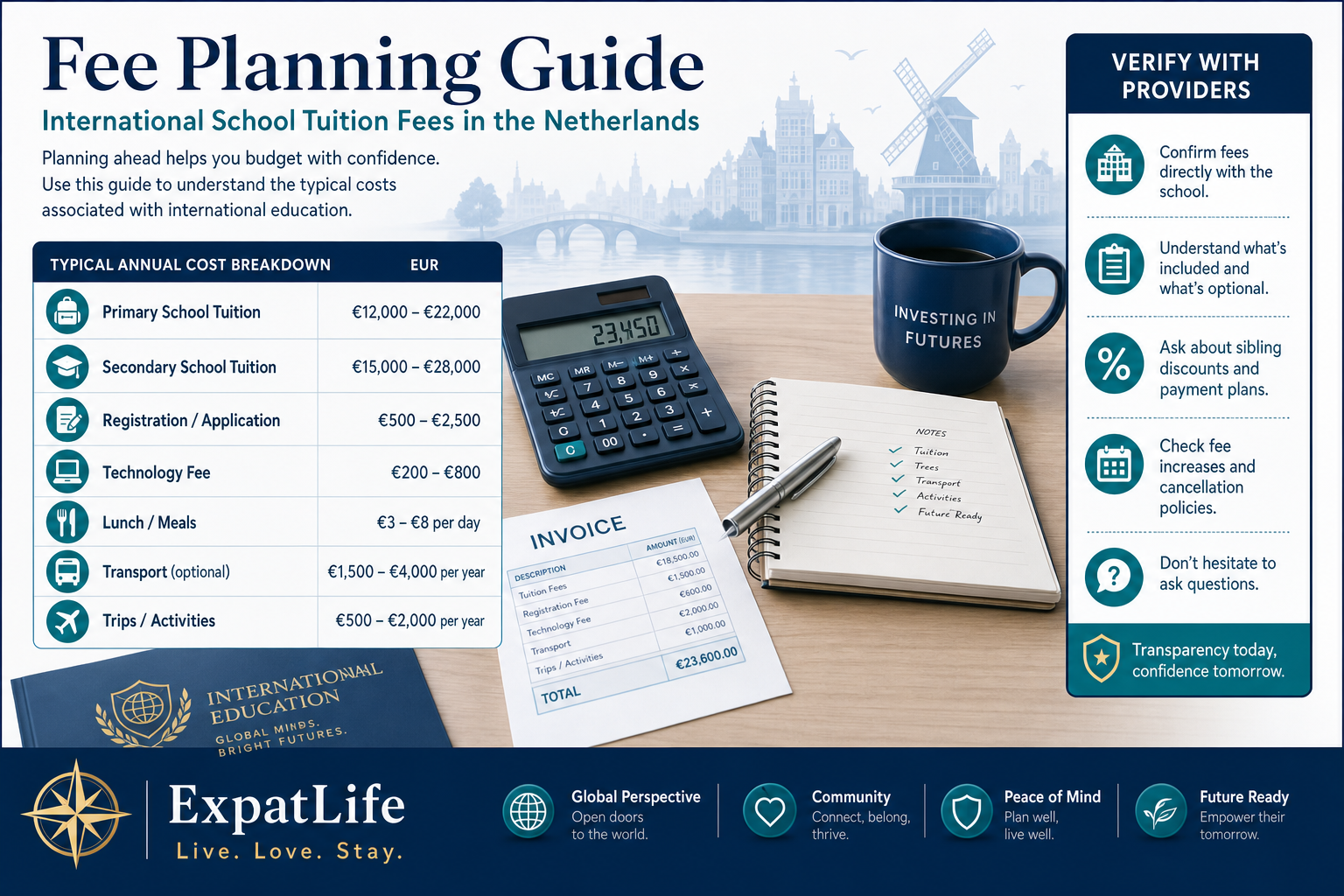
| Cost category | Primary / one-off | Secondary / annual | Notes |
|---|---|---|---|
| Annual tuition — primary | €12,000 – €22,000 | — | Lower in smaller cities; higher at flagship Randstad schools |
| Annual tuition — secondary | — | €15,000 – €28,000 | IB Diploma and A-Level years often at upper end |
| Registration / enrolment fee | €500 – €2,500 | One-time or annual | Sometimes non-refundable — check contract terms |
| Technology fee | €200 – €800 / year | Varies by device policy | Laptop or tablet programmes common from mid-primary |
| Lunch programme | €3 – €8 / day | Optional at many schools | Some schools require hot lunch; others are bring-your-own |
| School transport | €1,500 – €4,000 / year | Route-dependent | Bus services common around The Hague and Amsterdam |
| Trips & activities | €500 – €2,000 / year | Increases in secondary | Model UN, sports tours and IB CAS trips add cost |
Fees change annually. Use school websites and admissions offices for current pricing — this guide provides orientation ranges only.
Examples
| Profile | Scenario | What to check |
|---|---|---|
| Two children — Amsterdam IB | Ages 7 and 11 at mid-range IB schools; bus required from Haarlem | Budget ~€45k–€50k tuition plus ~€6k transport and €2k activities — confirm employer allowance caps. |
| Single child — The Hague American | Age 14 entering Grade 9; ASH flagship fees | Secondary often €22k–€28k plus registration €1k+ and laptop levy — request itemised schedule. |
| Primary-only — Rotterdam | One child age 5; bilingual interest | Compare €12k–€18k primary bands; bilingual tracks may have separate application fees. |
| Employer allowance €15k cap | Two children; allowance does not cover full tuition | Model out-of-pocket gap including registration and trips before accepting role. |
Apply
Each international school manages its own admissions. While steps are similar across schools, deadlines and assessment requirements differ. Starting early — especially in The Hague and Amsterdam — reduces stress when relocation dates are fixed.
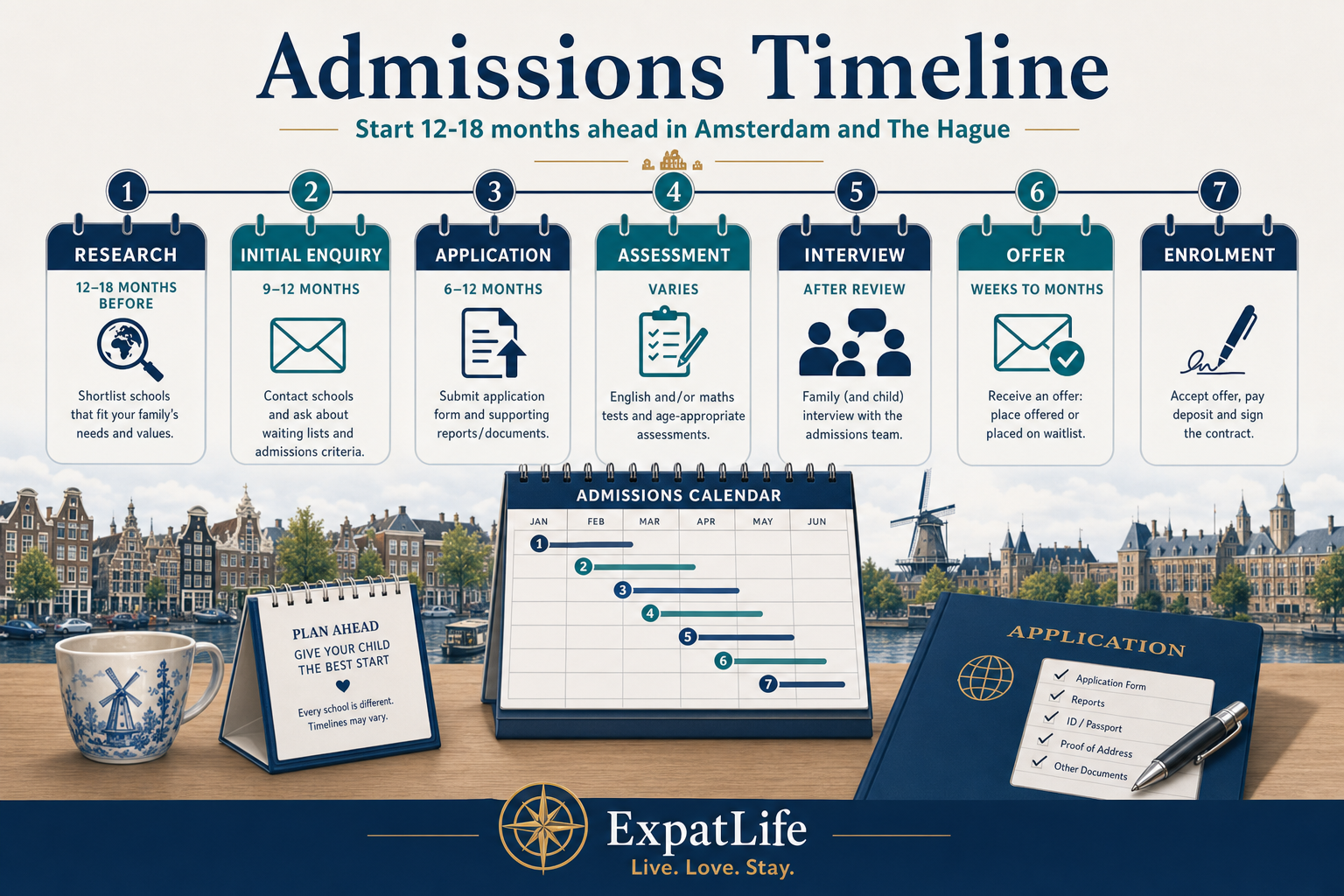
| Stage | Typical timing | What to do |
|---|---|---|
| Research | 12–18 months before start | Shortlist schools by city, curriculum and commute; read fee schedules online. |
| Initial enquiry | 9–12 months before | Contact admissions; ask about waiting lists and year-group availability. |
| Application | 6–12 months before | Submit forms, previous school reports and passport copies. |
| Assessment | Varies | Some schools test English, maths or general readiness — especially mid-year. |
| Interview | After application review | Family or student meeting — more common in secondary entry. |
| Offer | Weeks to months after review | Place offer or waiting list position — respond by deadline. |
| Acceptance & enrolment | Before start date | Pay deposit, sign contract and complete medical or visa documentation. |
Documents schools commonly request
Examples
| Profile | Scenario | What to check |
|---|---|---|
| August start — organised family | Relocation confirmed January; children ages 8 and 13 | Research Jan–Feb, apply Mar–Apr, assessments May–Jun — standard Randstad timeline. |
| Late application — Amsterdam | Job offer May; school start September | Contact 3+ schools immediately; ask which year groups still have places vs waitlist only. |
| Secondary with IEP | Child with documented learning support plan entering Year 10 | Share IEP at enquiry stage; ask about learning support staffing before formal application. |
| Corporate relocation package | Employer names one school; family prefers another curriculum | Verify placement yourself — employer suggestion does not guarantee year-group availability. |
Planning
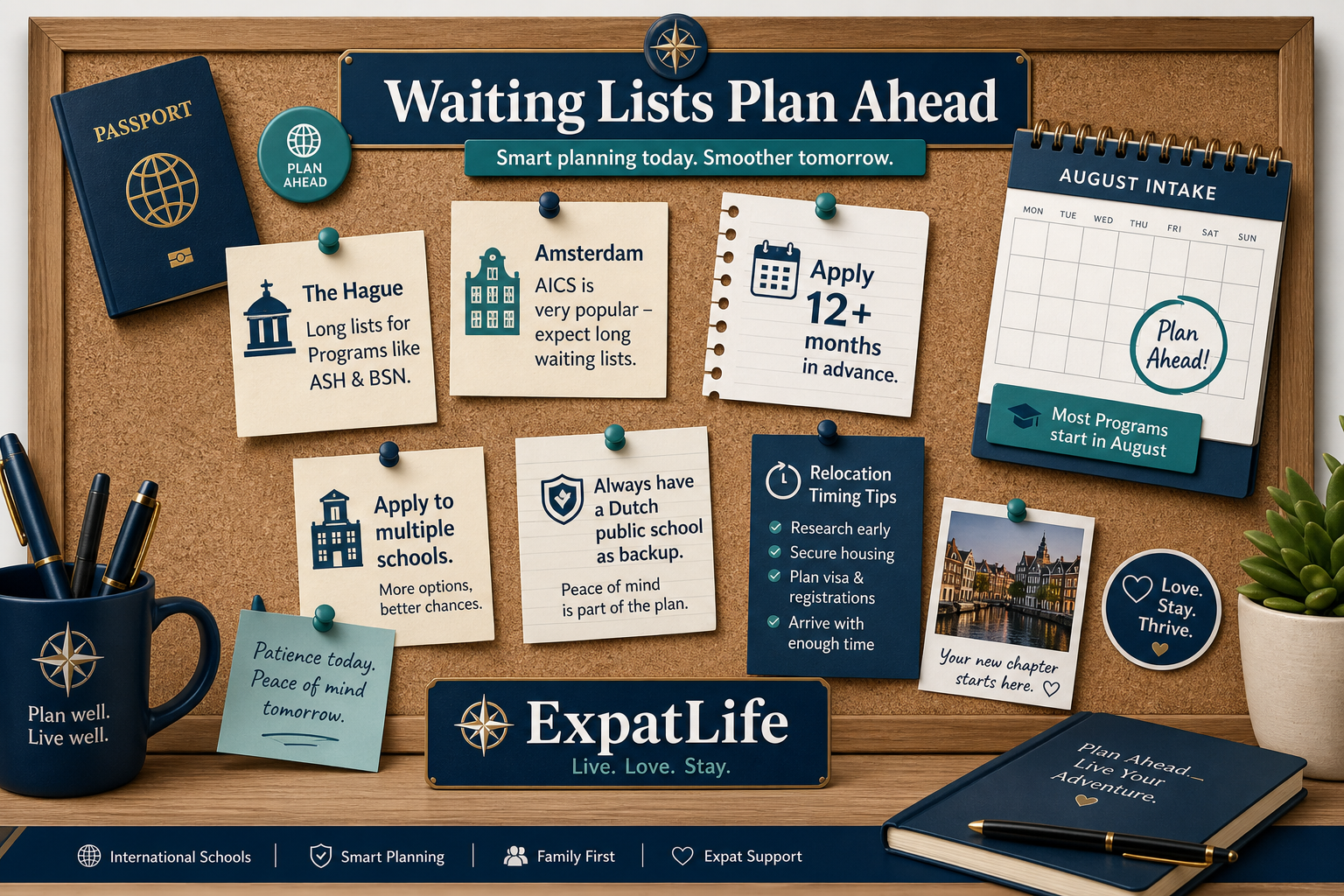
Popular international schools — especially in The Hague, Amsterdam and parts of Rotterdam — maintain waiting lists for certain year groups. Lists are often age-specific: reception and IB Diploma entry years tend to be most competitive.
Planning ahead, applying to multiple schools and keeping Dutch public or bilingual alternatives on your shortlist reduces relocation risk if your first choice is full.
| Profile | Scenario | What to check |
|---|---|---|
| HSM family — The Hague | Target ASH or BSN; relocation confirmed for August | Apply immediately on confirmation — both schools often have year-group waiting lists. |
| Amsterdam tech hire | Two children ages 6 and 10; lease signed in Zuid | Apply to AICS, ISA and British School; compare commute from lease address. |
| Mid-year Eindhoven | ASML transfer in January; one child age 14 | Contact ISE directly with reports — mid-year IB MYP places vary by cohort. |
| Backup planning | First-choice school waitlisted | Keep Dutch public option open via municipality; consider temporary placement. |
Languages
English is the primary language of instruction at most international schools in the Netherlands. Dutch is commonly taught as a subject — useful for integration but not equivalent to full Dutch-medium education.
Bilingual programmes, European Schools language sections and ELL (English Language Learner) support vary by school. Ask admissions about class composition and support hours if your child is not a native English speaker.
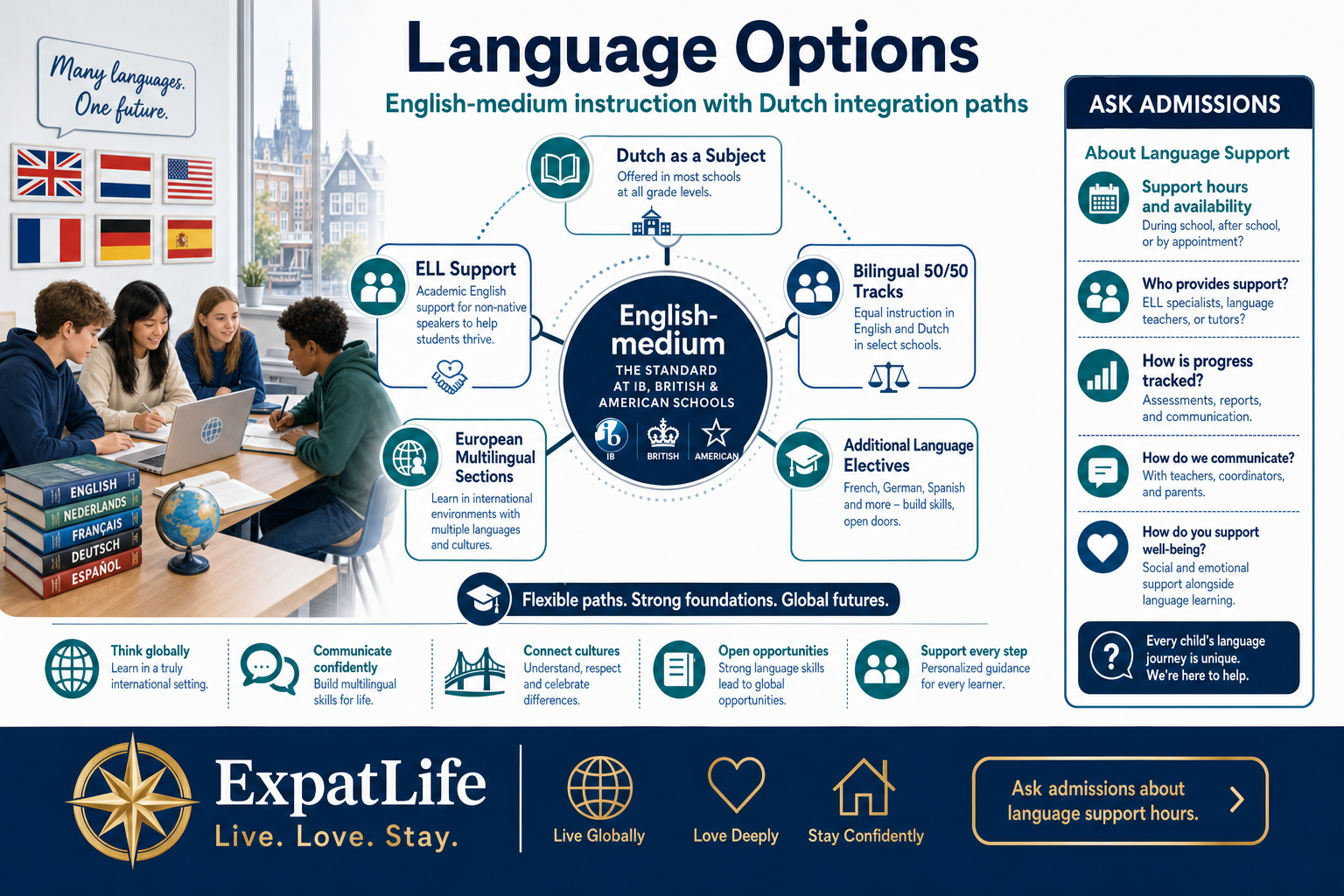
Standard at IB, British and American schools — verify ELL support if needed.
Dutch taught as subject; some bilingual tracks offer 50/50 models in select schools.
English–Dutch or English–German tracks — fewer places; verify language split per year.
French, German and Spanish common as electives; European Schools offer multilingual sections.
ELL and learning support teams vary — ask for policy documents during admissions.
| Language option | Typical setup | Planning note |
|---|---|---|
| English instruction | Full curriculum in English at most international schools | Ask about ELL pull-out hours if child is not fluent |
| Dutch as subject | Typically 2–5 lessons per week from primary | Useful for integration; not equivalent to Dutch-medium schooling |
| Bilingual 50/50 | Select schools e.g. Optimist, some Haarlem/Rotterdam tracks | Verify which subjects are in Dutch each year |
| European Schools | Language sections (EN, FR, DE, etc.) with multilingual curriculum | Eligibility rules apply — not open to all families |
| Home language | Some schools support mother-tongue clubs or IB language A | Ask about exam language options at secondary level |
Commute
Dutch families commonly cycle to school from age 8–10 with proper training. International schools in suburban locations often run bus services; urban schools may rely on public transport and parent drop-off.
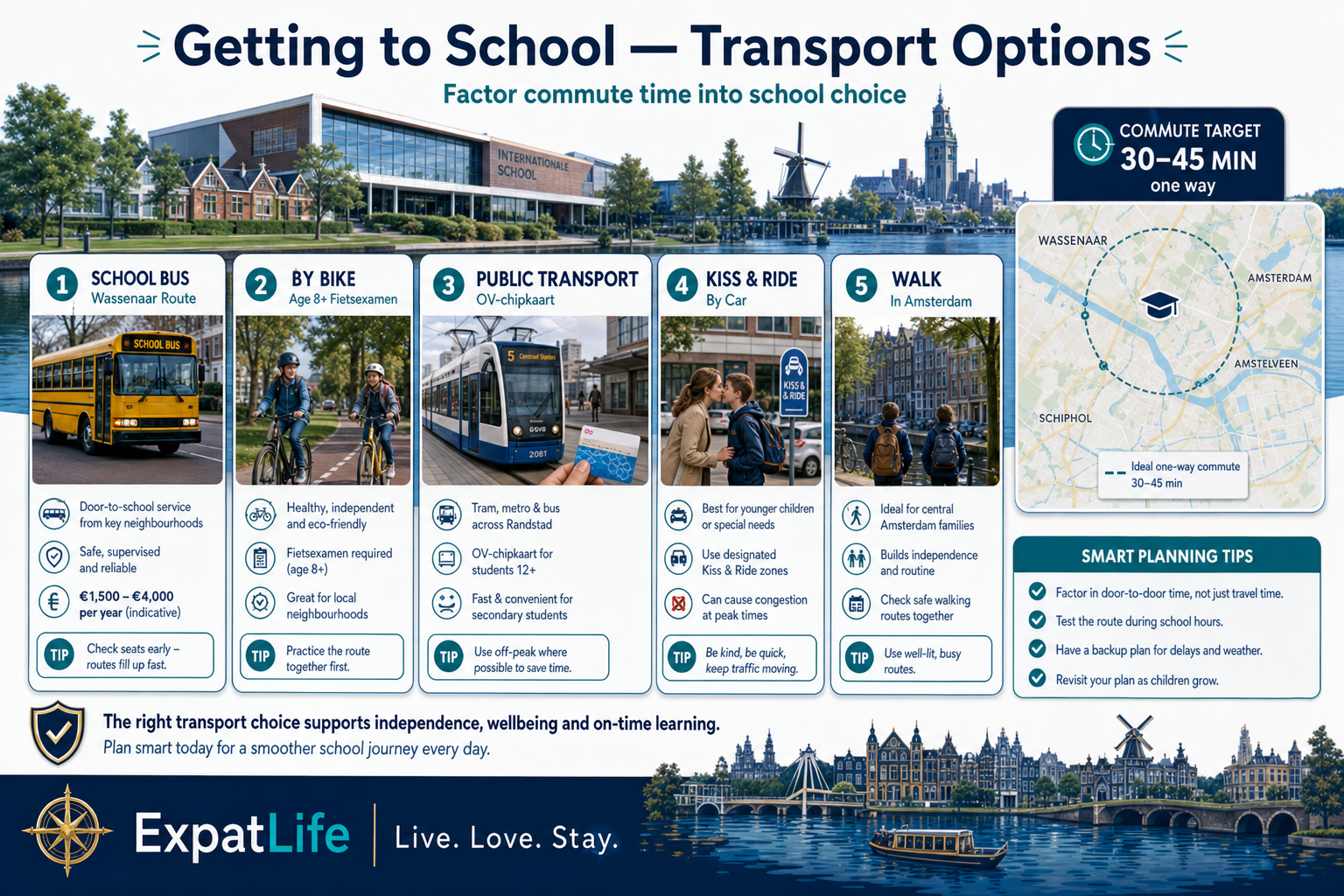
Contracted routes in The Hague, Wassenaar and Amsterdam corridors — fees separate from tuition.
Very common once children pass fietsexamen — factor safe routes from your housing search.
OV-chipkaart from age 4+ with begeleider; many secondary students travel independently.
Peak congestion at suburban campuses — check parking and kiss-and-ride rules.
Feasible in urban locations — still verify safe pedestrian routes.
| Commute pattern | Typical time / mode | Planning note |
|---|---|---|
| Wassenaar school + Amsterdam lease | 40–60 min by car in peak; bus 50–70 min | Many families relocate closer or accept long commute — test before signing |
| Amstelveen ISA + Amsterdam Zuid | 15–25 min by tram/metro or bike | Popular combination — verify OV route with child age in mind |
| Rotterdam suburban campus | School bus hubs in Kralingen or Hillegersberg | Bus fees €1,500–€3,500/year typical — confirm stops near home |
| Eindhoven ISE + Waalre/Veldhoven | 10–20 min by bike or car for ASML corridor families | Shorter commutes common — still check after-school activity timing |
| Age 6 on public transport | Requires adult begeleider on OV until independent travel age | Factor parent time if not using bus or drop-off |
Decide
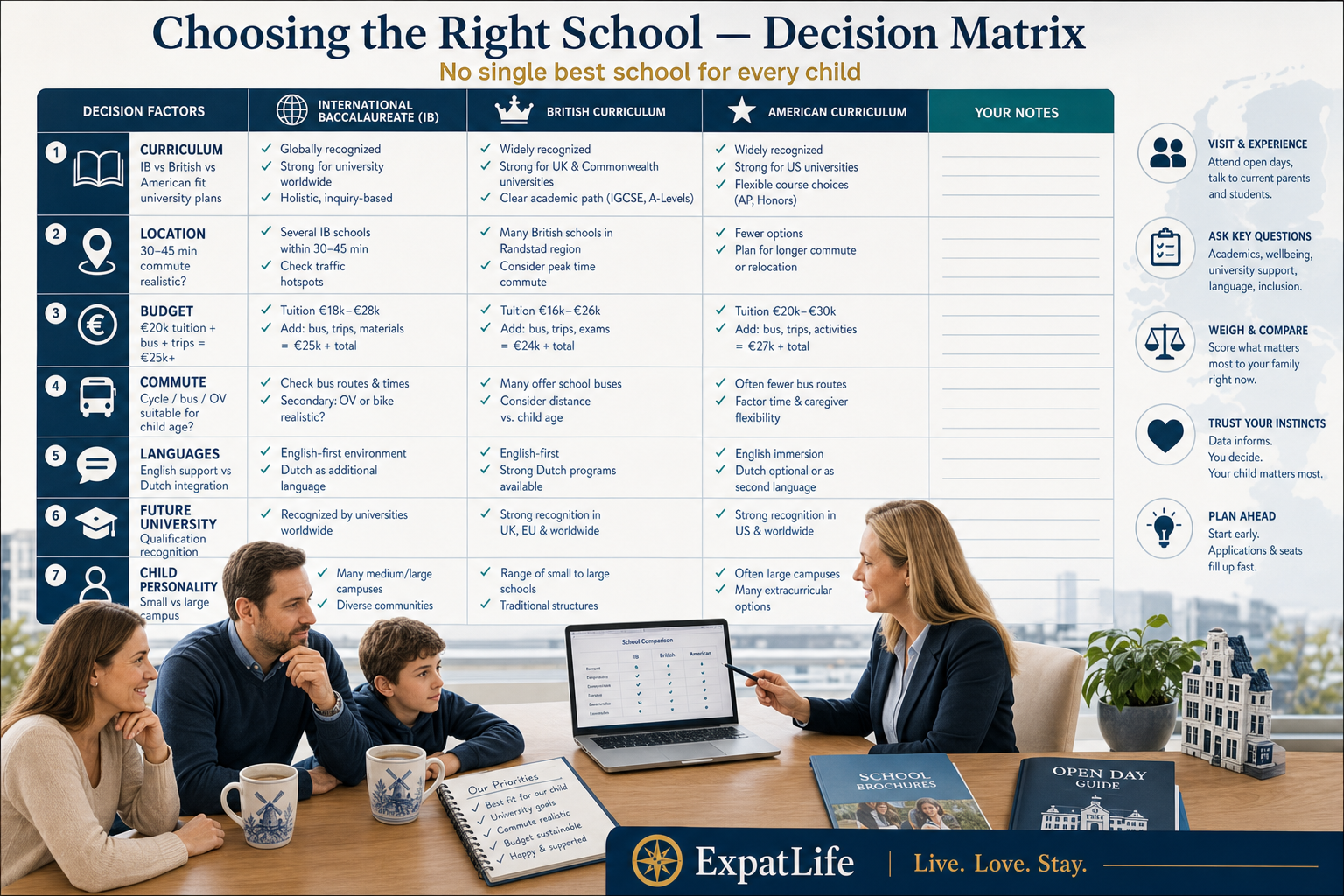
There is no universal best international school — the right fit depends on curriculum continuity, location, budget, languages, commute and your child's learning style. Use the matrix below as a conversation tool with your family and admissions offices.
| Factor | Ask yourself | Example |
|---|---|---|
| Curriculum | Does IB, British or American fit university plans? | UK university plans → British A-Levels may feel more direct than IB. |
| Location | Can you live within 30–45 minutes commute? | The Hague school + Amsterdam lease = daily strain — reconsider housing. |
| Budget | Total cost including extras, not tuition alone? | €20k tuition + bus + trips can exceed €25k per child. |
| Commute | Cycle, bus or OV realistic for your child's age? | Age 6 on a 45-minute bus — tiring long term. |
| Languages | English support or Dutch integration priority? | Long-term NL residency → ask about Dutch hours per week. |
| Future university | Recognition of qualifications in target countries? | IB widely recognised — still verify subject choices for medicine or engineering. |
| Child's personality | Small school vs large campus; sports vs arts? | Visit schools and observe break times if possible. |
Transfers
Mid-year admissions happen but are less predictable than August or January intake cycles. Schools assess whether a year group has capacity and whether your child's previous curriculum aligns with their programme.
Prepare digital copies of report cards, curriculum guides and any IEP or support plans. Integration support varies — ask about buddy programmes and counsellor availability.
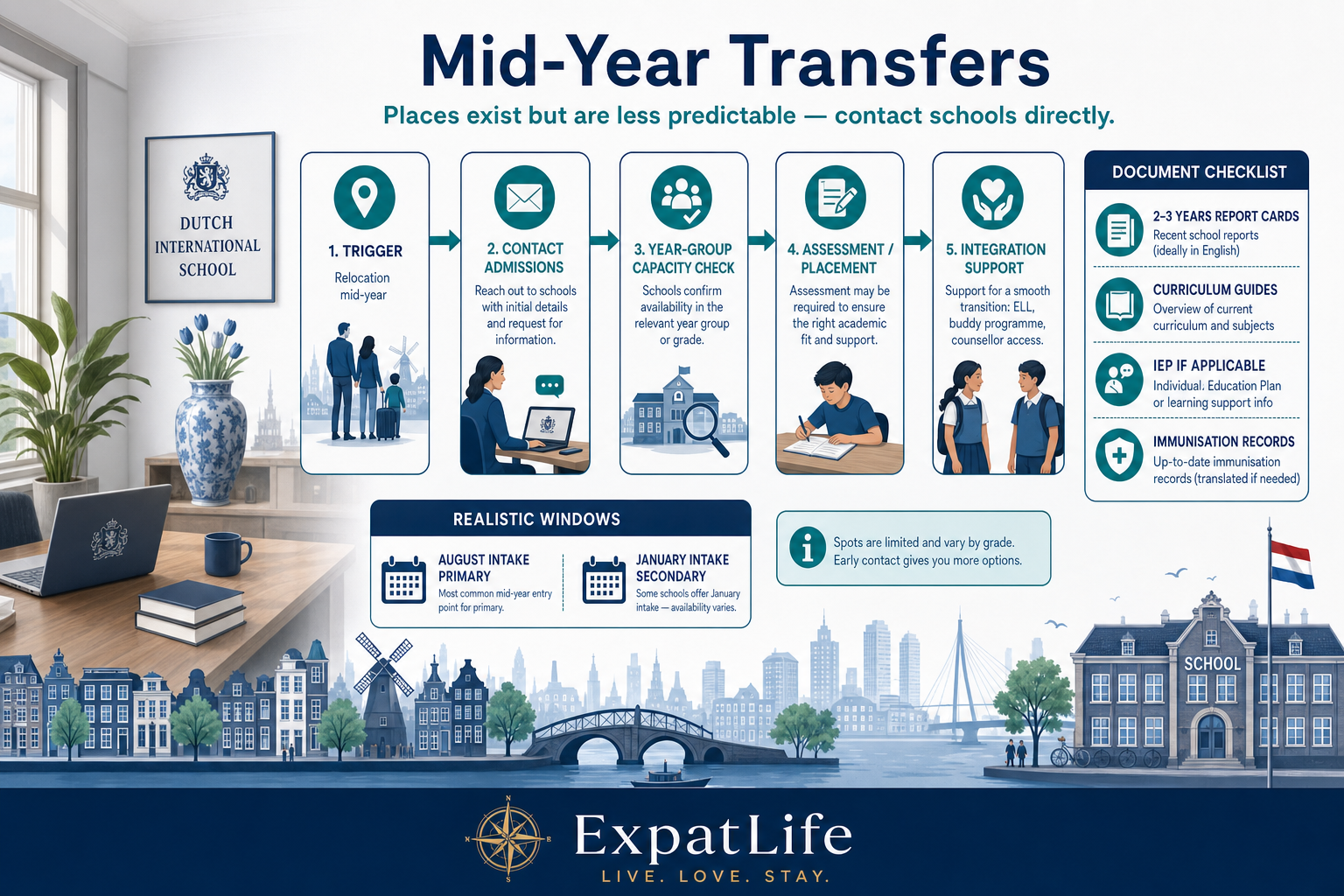
Before contacting admissions for mid-year entry
Examples
| Profile | Scenario | What to check |
|---|---|---|
| January start — corporate transfer | Family arrives mid-January; child age 9 in British Year 4 equivalent | Ask schools about spring intake; British School may map year group differently from Dutch group. |
| February — IB Diploma | Age 16 transferring into IB DP Year 1 in March | Subject availability and CAS continuity — DP mid-year entry is often most constrained. |
| Military/diplomatic surge | Sudden posting; 3 weeks to start date | Contact admissions daily; prepare interim online schooling; explore temporary Dutch public. |
| Same curriculum transfer | IB student moving from Singapore to Amsterdam | Request IB continuity letter from current school; transfer within IB is usually smoother. |
Support
Support for special educational needs (SEN) varies significantly between international schools. Some employ dedicated learning support teams; others have limited capacity for moderate or complex needs.
If your child has an existing support plan, share documentation early in admissions and ask specific questions about staffing, classroom accommodations and external therapist access. Lighthouse Special Education in The Hague is a specialist option for significant needs.

Questions to ask admissions about learning support
Examples
| Profile | Scenario | What to check |
|---|---|---|
| Mild dyslexia support | Child age 10 with existing support plan; needs reading accommodations | Ask about in-class support hours and exam access arrangements at each shortlisted school. |
| Moderate autism — mainstream | Family seeks inclusive IB primary with structured transitions | Visit learning support team; ask about class size, sensory spaces and buddy systems. |
| Significant needs | Complex support requirements beyond typical mainstream capacity | Lighthouse Special Education The Hague or specialist referral — verify early. |
| Undisclosed needs | Family waits until after offer to mention IEP | Risk of place withdrawal or inadequate support — disclose at enquiry stage. |
Checklist
Work through this list 6–12 months before your target start date where possible.
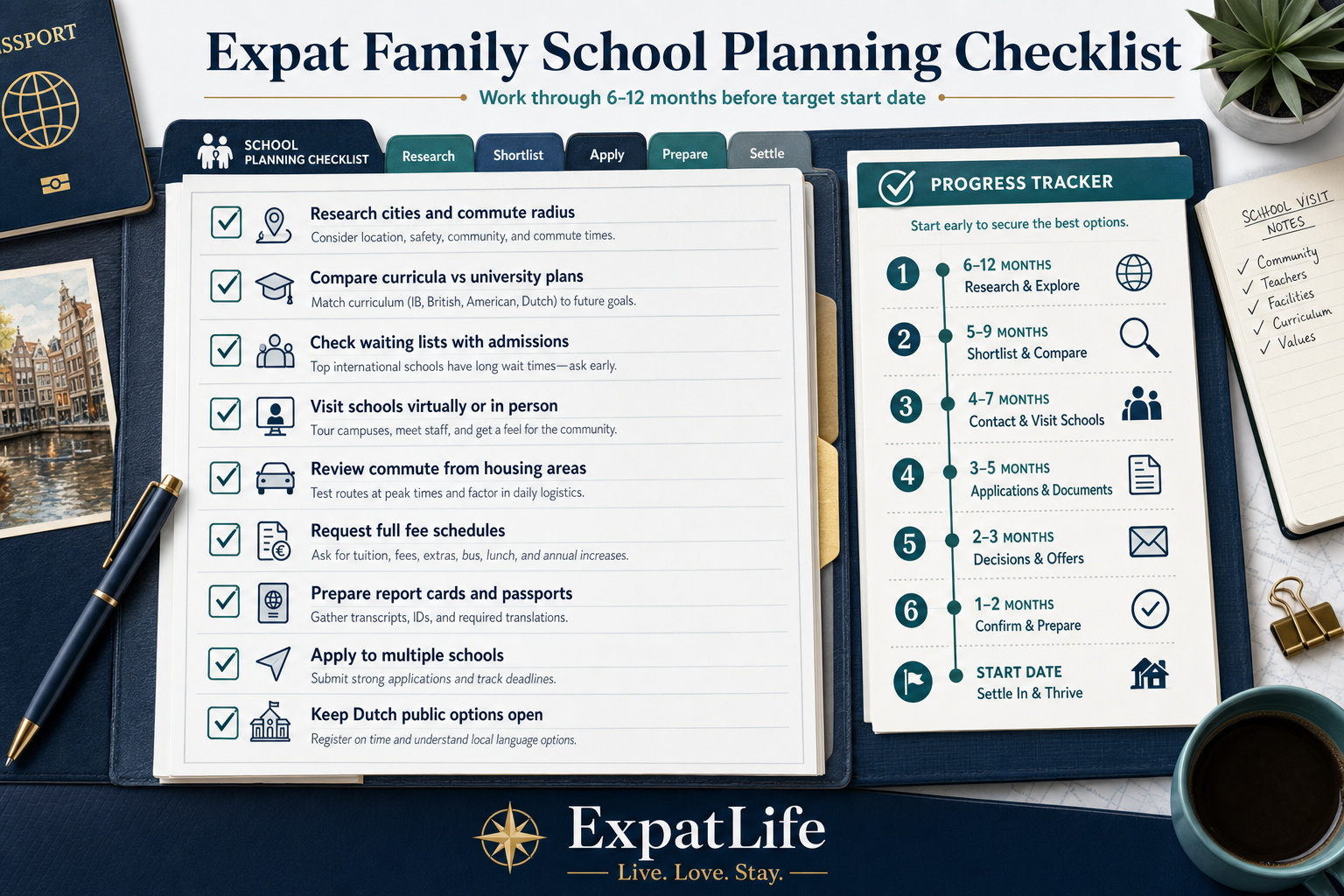
6–12 months out: research phase
Application phase
Pre-move phase
Full planning checklist
Avoid
These patterns cause stress for relocating families — plan around them early.
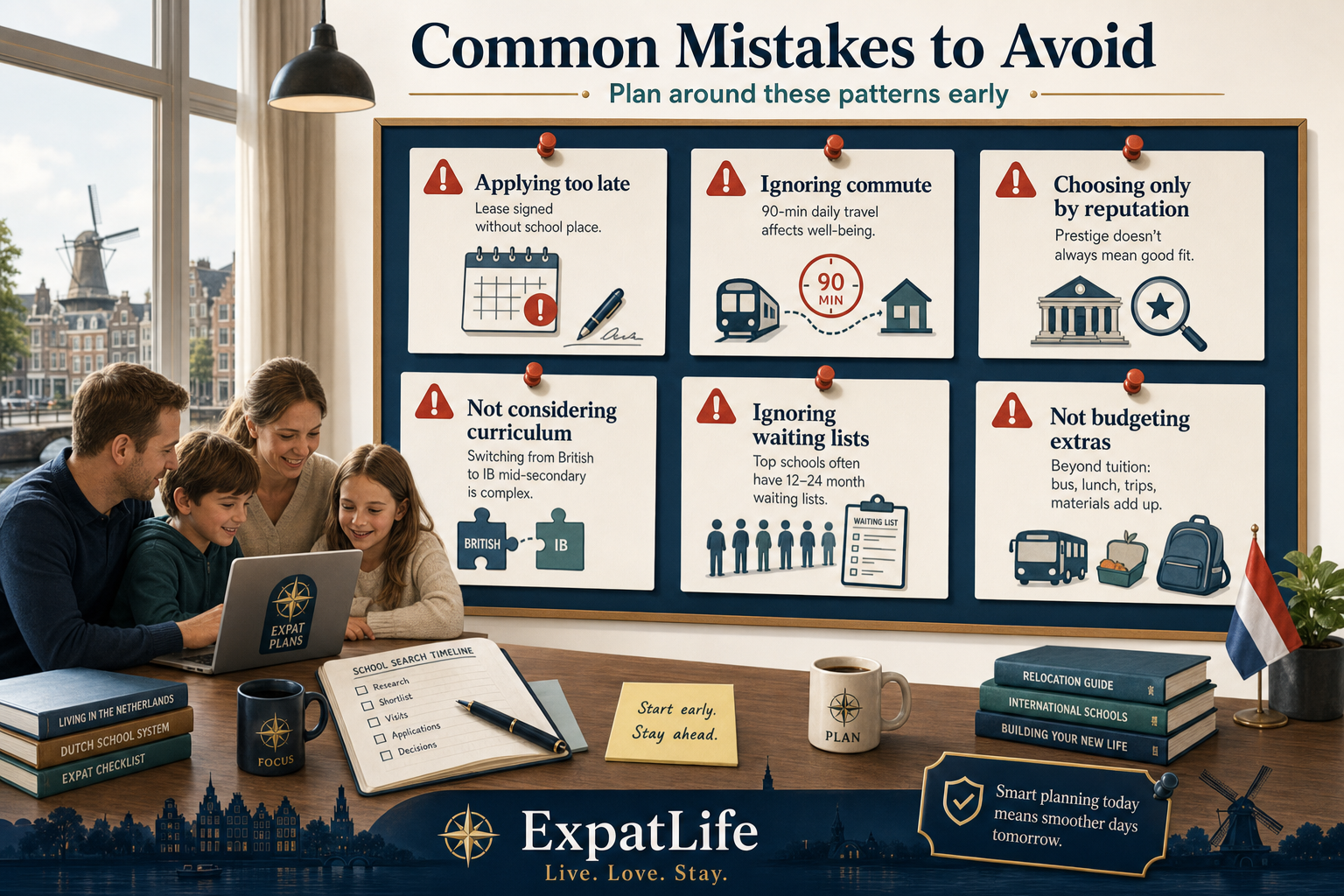
Example: signing a lease in August for September start without confirming school places — apply before housing where possible.
Example: choosing a Wassenaar school while living in central Rotterdam — 90-minute daily travel exhausts children.
Example: selecting a flagship school that does not fit your child's learning style — visit and ask about support.
Example: switching from British to IB mid-secondary without credit mapping — ask admissions about transition.
Example: assuming a place exists because the company mentions the school — verify year-group availability in writing.
Example: tuition quoted without bus, lunch, trips and exam fees — request full cost breakdown.
FAQ
Orientation answers — confirm school-specific details with admissions offices.
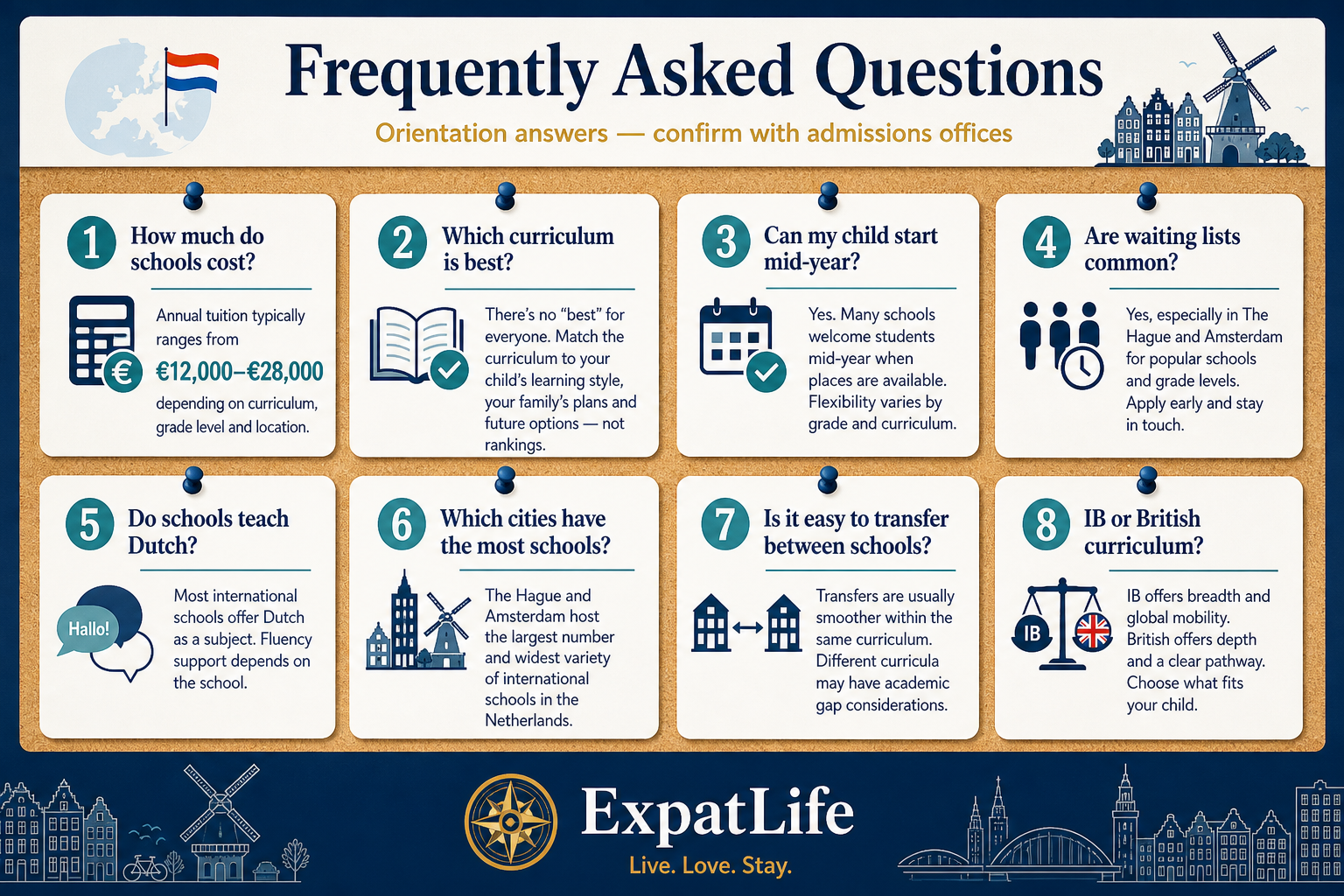
Annual tuition commonly ranges from roughly €12,000–€22,000 for primary and €15,000–€28,000 for secondary at many schools, plus registration, transport and activity fees. Amounts vary widely — confirm current fees on each school's website.
There is no single best curriculum. IB offers global portability; British A-Levels suit UK university paths; American AP suits US routes. Match curriculum to your child's needs and future plans rather than rankings.
Yes, when places exist. Mid-year entry depends on year-group capacity and assessment. Contact admissions with report cards as early as possible — placement is less predictable than August intake.
Yes, at popular schools in The Hague and Amsterdam especially. Waiting lists are often year-group specific. Apply early and keep alternatives including Dutch public schools on your shortlist.
Most international schools teach Dutch as a subject. Full bilingual English–Dutch programmes exist at select schools. Dutch public schools remain the main route for Dutch-medium education.
The Hague and Amsterdam have the largest selection, followed by Rotterdam and Utrecht. Smaller cities may have one IB school — verify before accepting a job in a regional location.
Transfers within the same curriculum (e.g. IB to IB) are usually smoother. Curriculum changes may require credit mapping and assessments. Bring full transcripts and course descriptions.
IB emphasises breadth and global recognition; British A-Levels allow deeper specialisation earlier. Consider your child's strengths, relocation plans and target universities — visit schools before deciding.
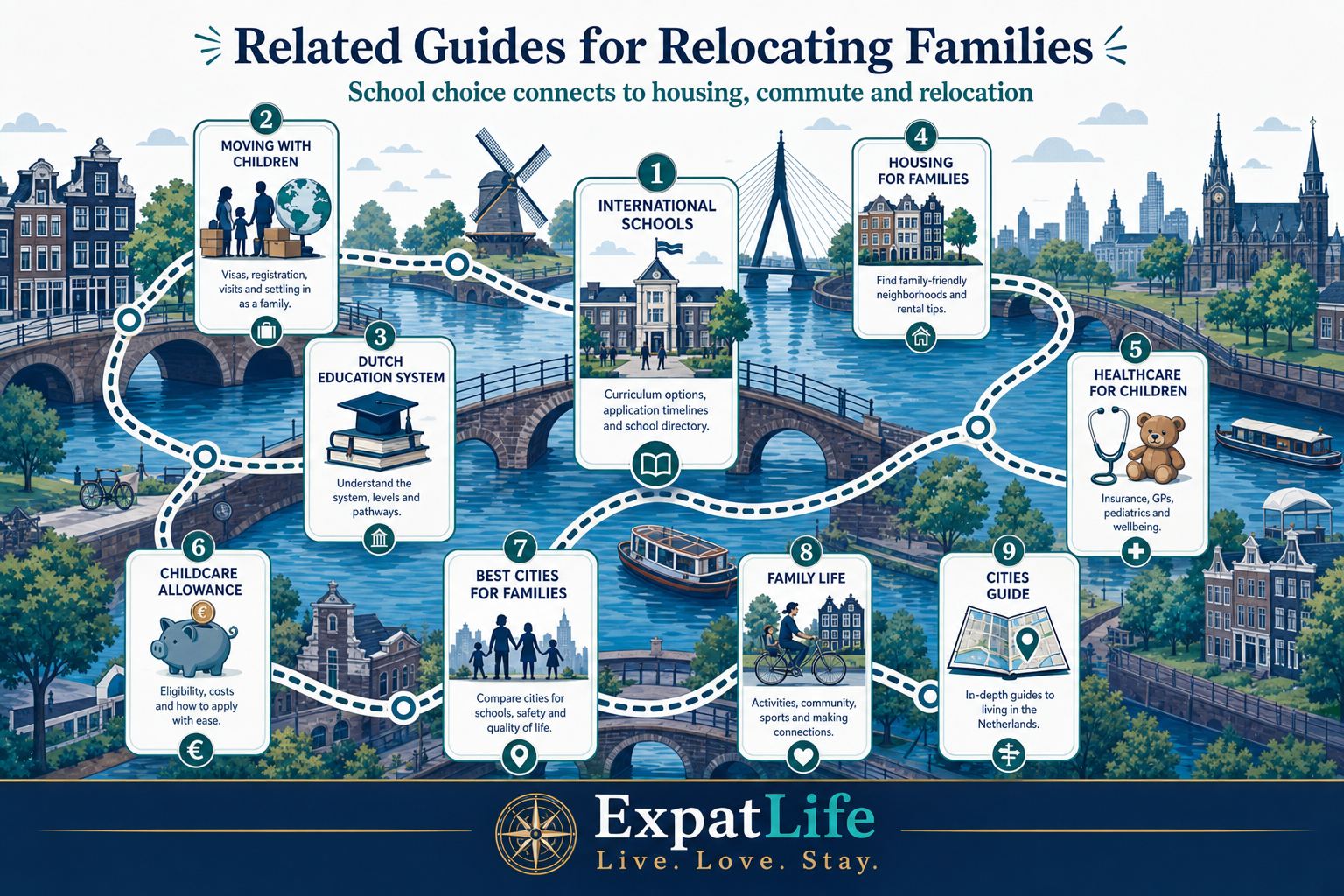
Family guides
Connect school choice with moving, housing, cities and Dutch education content.
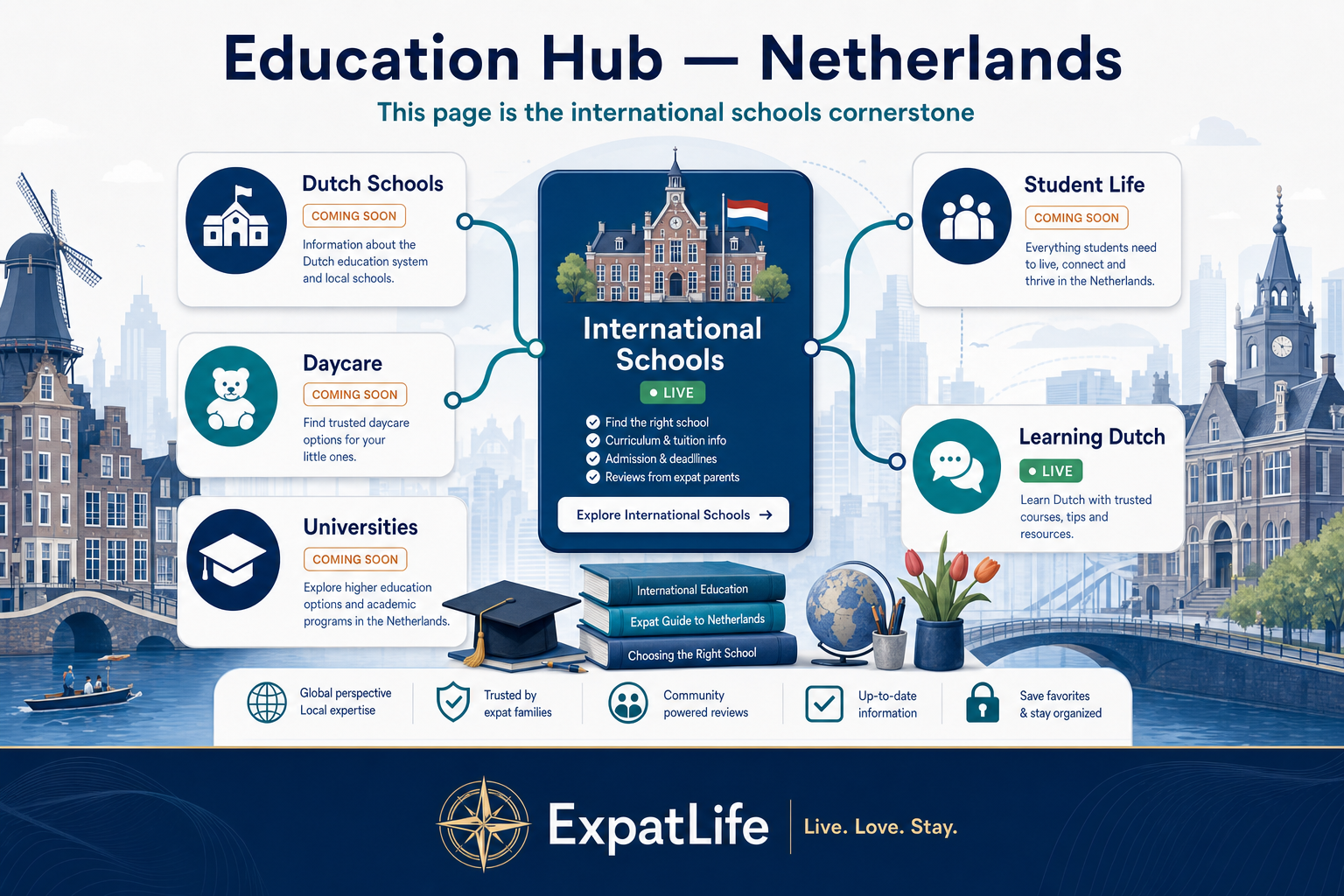
Education hub
This page is the flagship international schools guide — explore related education topics next.
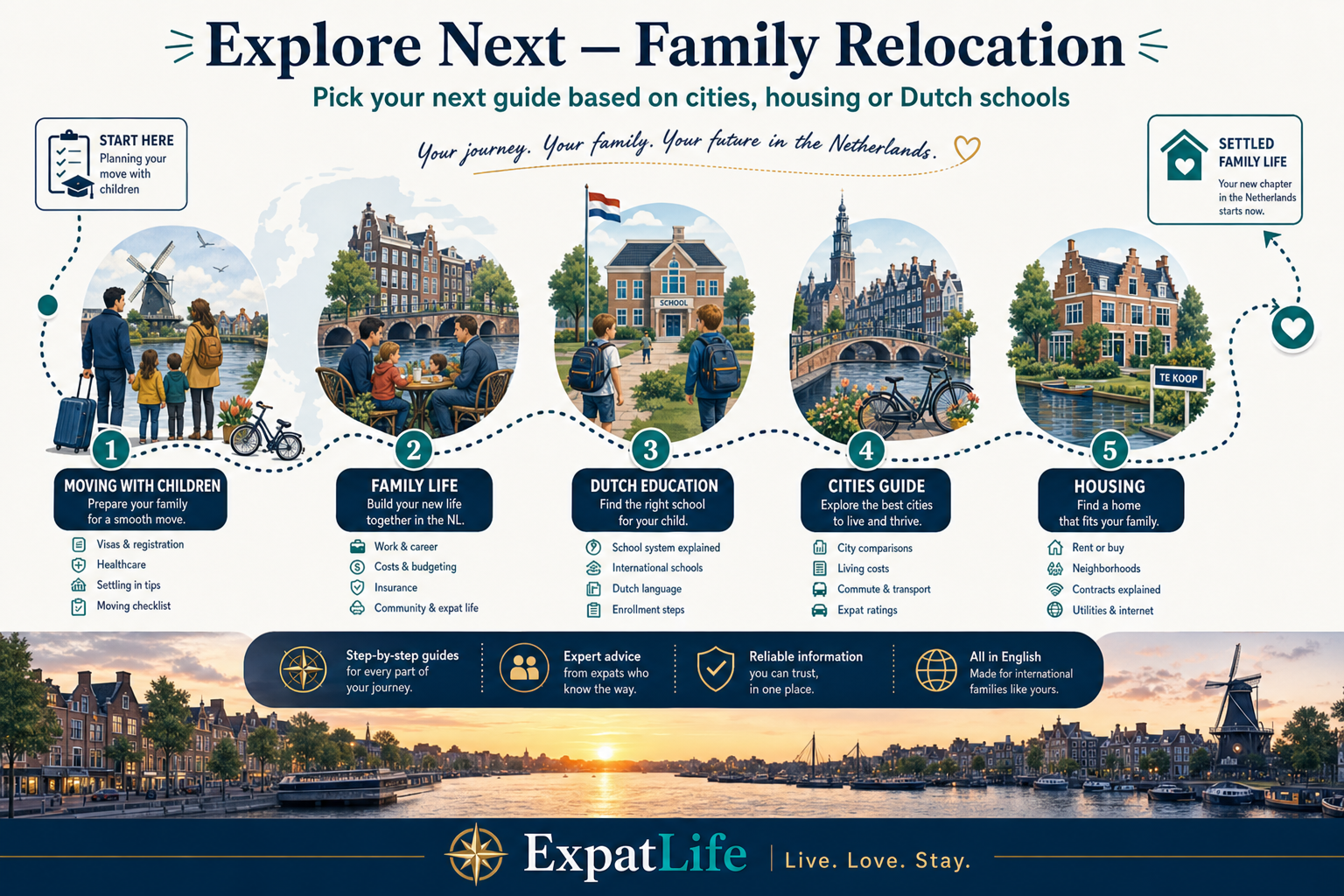
Explore next
Continue planning your family relocation with housing, cities and family life guides.
Trust
School admissions, fees and availability change frequently. Always verify current information on official school websites and government sources — this guide is orientation only, not admissions advice.