
Free at public schools
Example: no tuition at openbare basisschool — budget for lunch, trips, materials and optional bijdrage at some bijzonder schools.
Netherlands · Education · Dutch schools
A practical guide for expat families to Dutch public and special schools — pathways, enrolment, language support, costs and how Dutch schools compare with international options.
Practical orientation only — not enrolment advice. Gemeente rules, NT2 capacity and placement vary. We do not rank schools subjectively.

Quick answer
Dutch schools (basisschool and voortgezet onderwijs) are the default route for children living in the Netherlands. Public (openbare) and special (bijzonder) schools are largely government-funded and free at the point of use, with instruction in Dutch.
Expat families often enrol through the municipality (gemeente) after BSN and address registration. Non-Dutch-speaking children may enter NT2 or newcomer programmes before or alongside regular classes — availability varies by city and age.
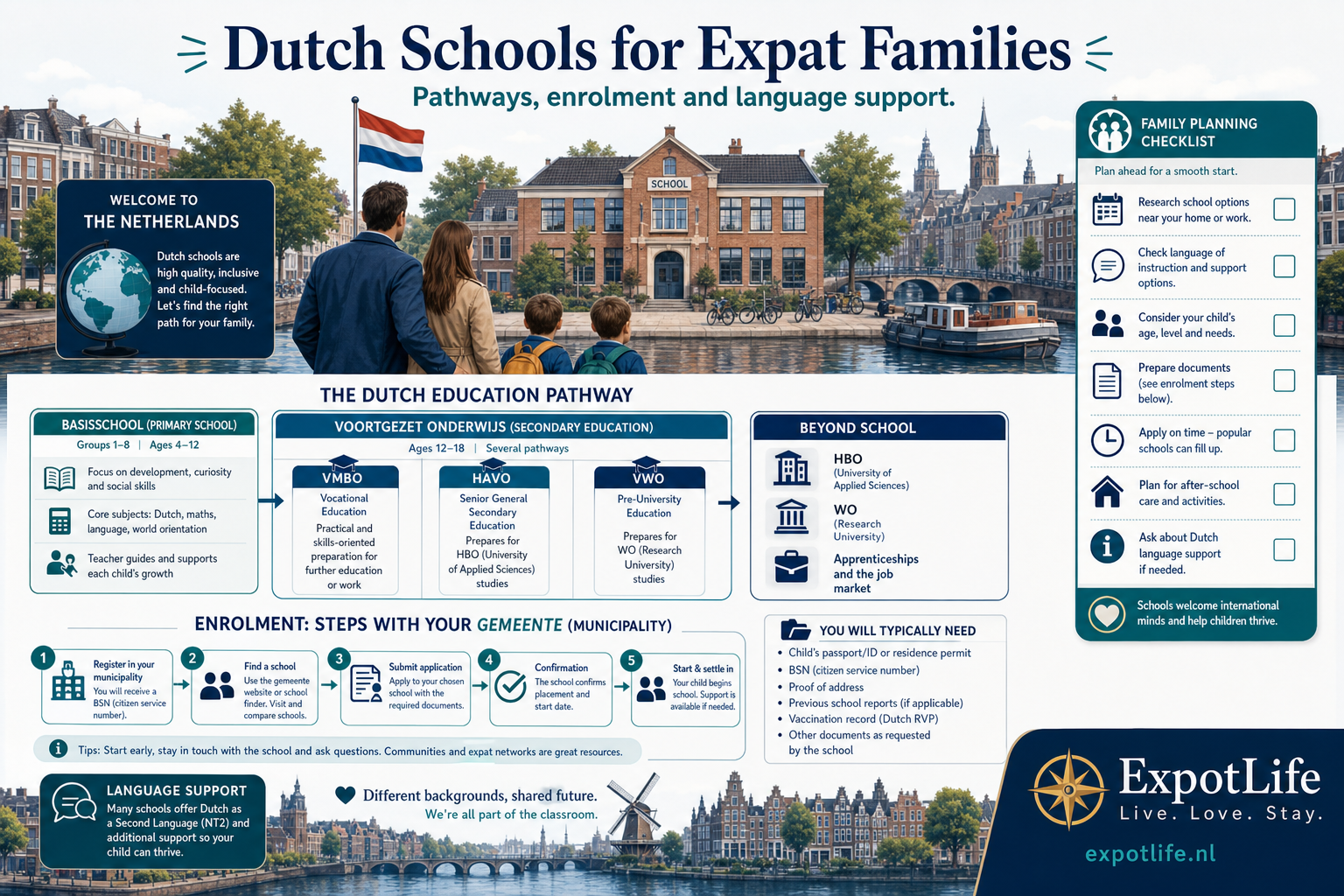
This guide explains pathways from age 4 through VMBO, HAVO and VWO, how enrolment works, language support, costs and how Dutch schools compare with international options. It does not rank schools or guarantee placement.
Key points
Example: no tuition at openbare basisschool — budget for lunch, trips, materials and optional bijdrage at some bijzonder schools.
Example: a 7-year-old from the UK may start in NT2 klas before joining groep 3/4 — gemeente coordinates intake.
Example: basisschool advies often guides VMBO (4 years), HAVO (5 years) or VWO (6 years) — ask about brugklas if advice feels wrong.
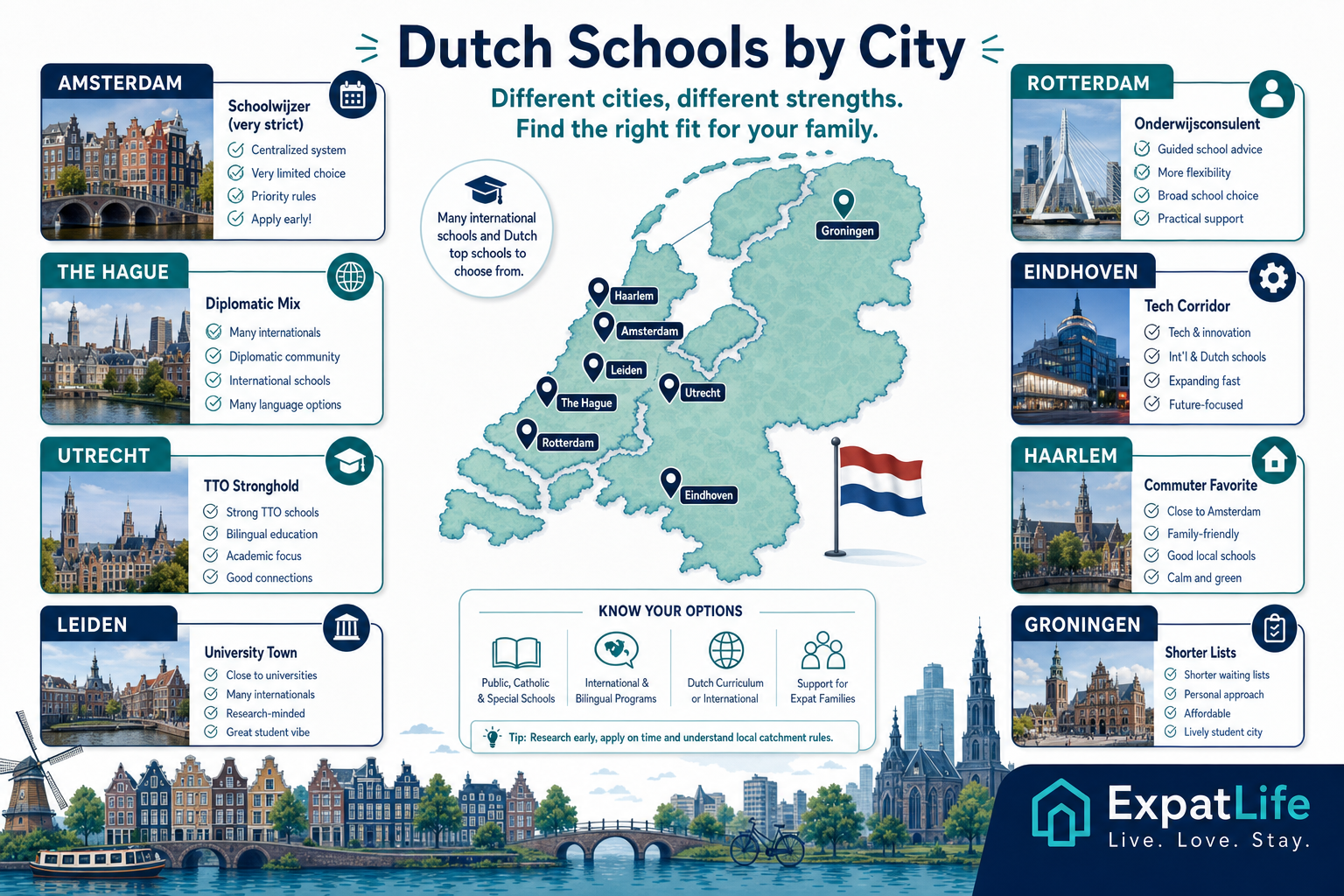
Example: Amsterdam and Utrecht have different priority and lottery rules — register early after address registration.
Three orientation moves before gemeente registration
Examples
| Profile | Scenario | What to check |
|---|---|---|
| Young family — long-term NL | Two children ages 5 and 8; planning 10+ years in Utrecht | Register gemeente; ask about NT2 intake; visit 2–3 basisscholen near lease area. |
| HSM hire — Amsterdam | One child age 10; limited Dutch; 3-year contract | Compare NT2 support timeline vs international school; test commute from shortlisted housing. |
| Mid-year arrival — The Hague | Child age 12 entering groep 7 equivalent in February | Contact gemeente immediately; bring report cards; ask about taalschool placement. |
| Bilingual interest | Parents want English plus Dutch integration in Rotterdam | Verify bilingual track availability by year group — full 50/50 models are limited. |
At a glance
Compare school types before contacting your gemeente — placement rules and NT2 capacity vary by city.
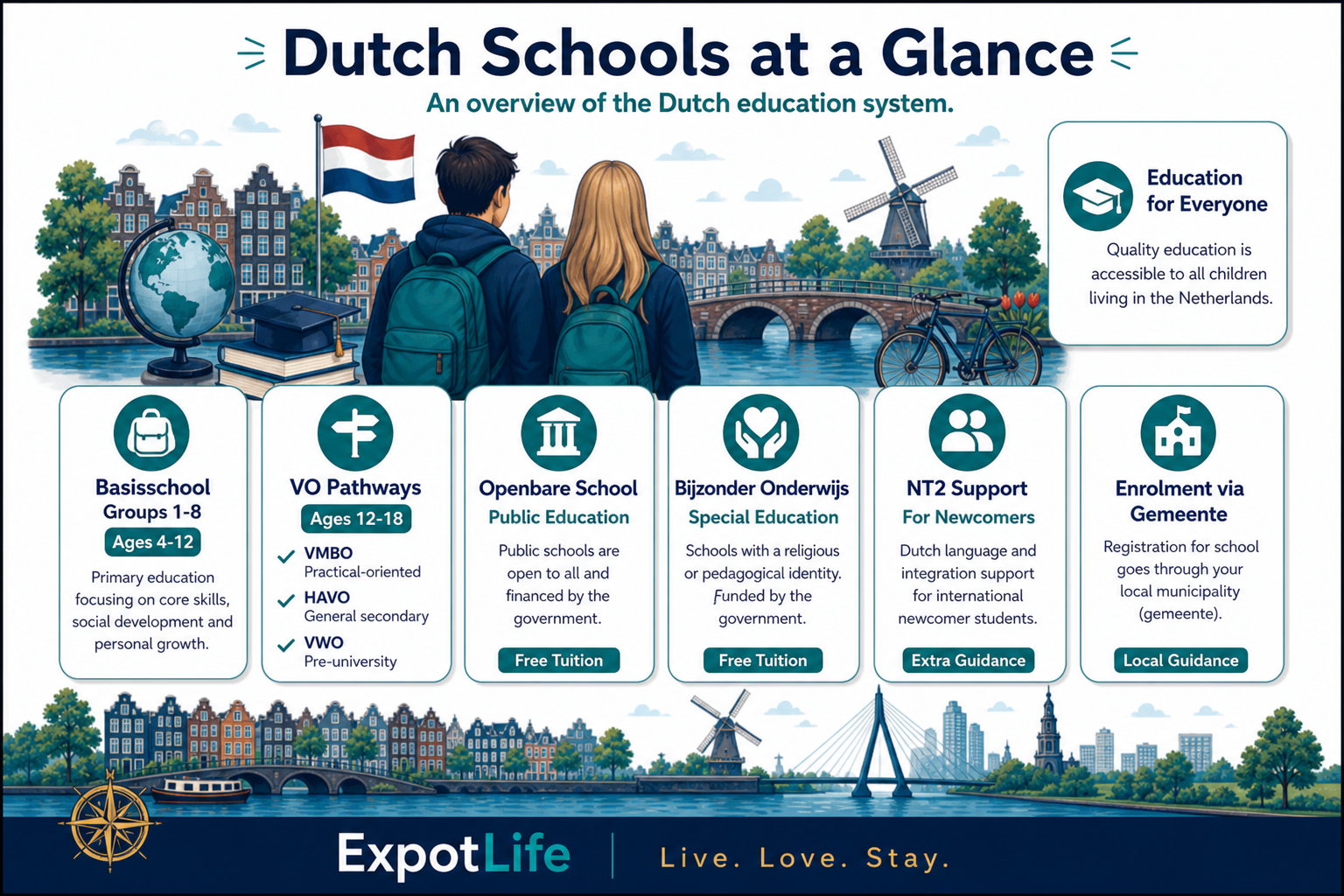
Basisschool
Groups 1–8
Ages roughly 4–12; Cito group 8 assessment common.
VO pathways
VMBO · HAVO · VWO
Secondary split guides diploma type and university access.
Public schools
Openbaar
Municipal or neutral ethos; free tuition.
Special schools
Bijzonder
Religious or pedagogical profile; may request small contribution.
Language support
NT2 / newcomer
For non-Dutch speakers — gemeente-coordinated in many cities.
Enrolment
Via gemeente
Rules and deadlines differ by municipality.
School system comparison
Many expat families compare Dutch public education with international schools. This table orients you on structural differences — neither path is universally better; municipal rules and family timeline still govern the decision.
| Factor | How it differs | Planning note |
|---|---|---|
| Tuition | Free at openbare/bijzonder schools vs private international fees | Budget ouderbijdrage and opvang — not €15k+ tuition |
| Language | Dutch-medium instruction vs English-medium at most international schools | NT2 support exists; full English tracks are limited in Dutch system |
| Admissions | Gemeente placement/lottery vs direct school application | Different deadlines — register early after address registration |
| Integration | Local peers and Dutch fluency vs expat community | Long stays often benefit from Dutch route; short postings may favour continuity |
| Secondary path | VMBO/HAVO/VWO vs IB/British/American diplomas | University recognition depends on chosen diploma track |
| Waiting pressure | Placement capacity and NT2 queues vs international waiting lists | Keep both options open until placement is confirmed in writing |
Examples
| Profile | Scenario | What to check |
|---|---|---|
| Long-term family — Utrecht | Children ages 4 and 9; planning 8+ years in NL | Register gemeente; NT2 for older child; visit openbare and Montessori bijzonder schools nearby. |
| 3-year HSM posting — Amsterdam | One child age 11; limited Dutch on arrival | Compare NT2 timeline with international school continuity — parallel applications reduce risk. |
| Teen arrival — Rotterdam | Age 14 from UK National Curriculum in March | Ask gemeente about ISK; credit mapping for VO placement after language year. |
| Dual-track planning | Employer covers partial international fees only | Model Dutch route costs (near zero tuition) vs out-of-pocket international gap. |
Three moves after reading this snapshot
Pathway
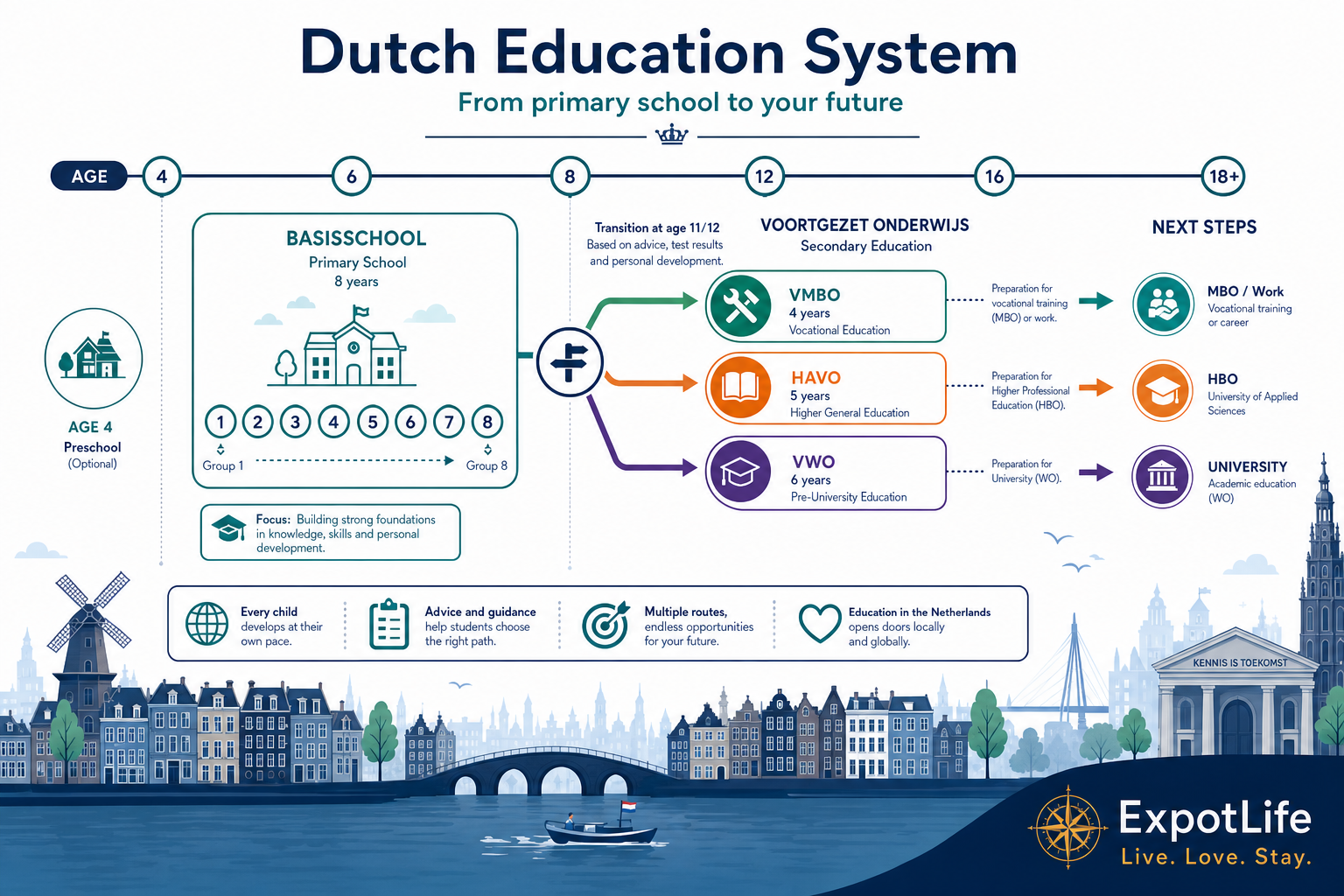
Children typically start basisschool at age 4 in group 1 and progress through group 8 by age 12. Instruction is in Dutch. At the end of primary, schools give secondary advice (advies) that guides placement into VMBO, HAVO or VWO — though final routes can include brugklas or adjustments.
Voortgezet onderwijs (secondary) lasts four to six years depending on track. VMBO leads to vocational pathways (MBO); HAVO and VWO lead to HBO and university respectively. Understanding this split early helps expat families plan language support and length of stay.
Primary
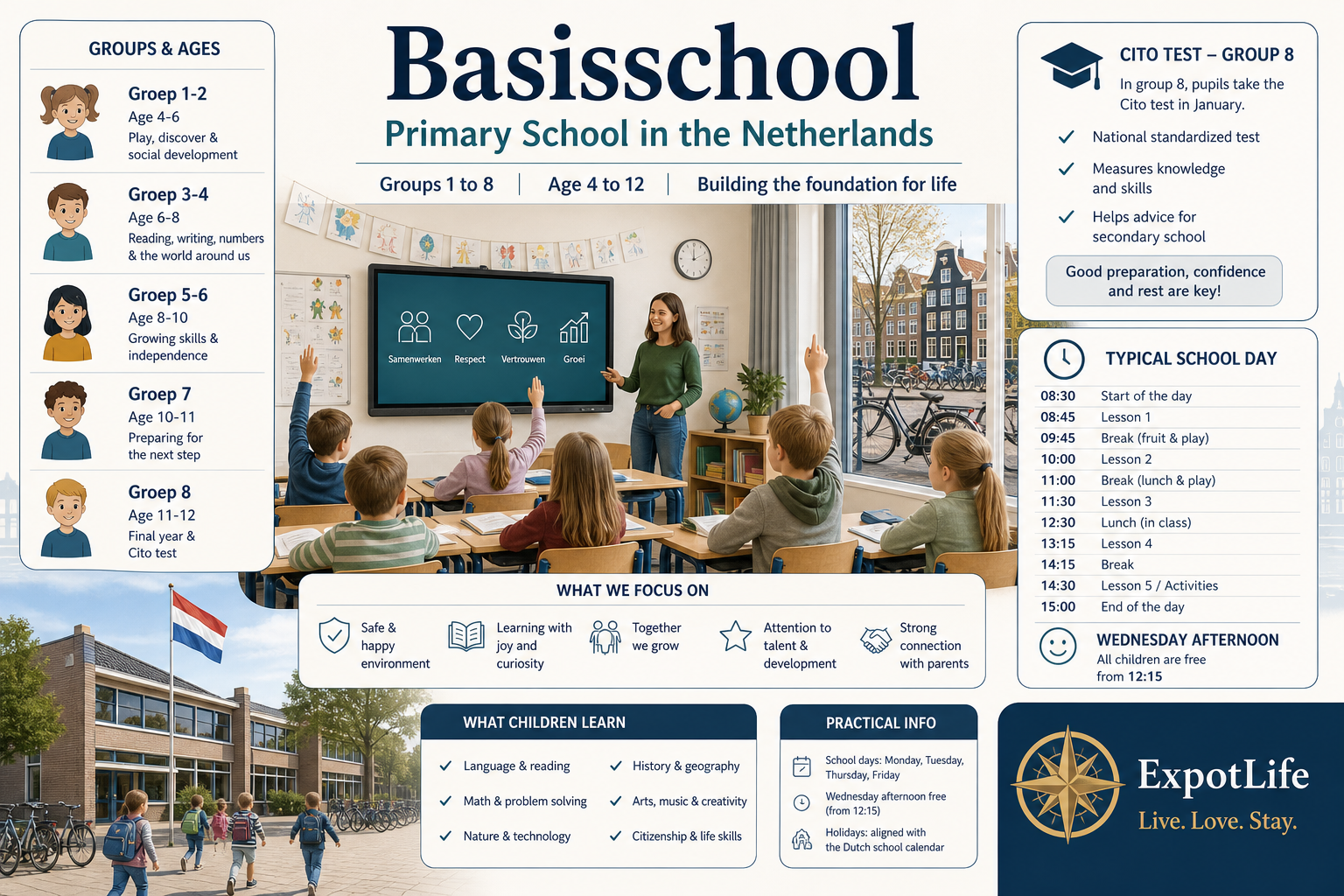
Basisschool covers groups 1 through 8. Schools combine academic subjects, social development and activities such as gym, music and swimming. The school day often ends around 15:00, with optional buitenschoolse opvang (after-school care) available separately.
For expat children, age and prior schooling determine group placement. Non-Dutch speakers may spend time in NT2 or newcomer classes before joining a regular group. Ask schools how they support homework and parent communication in languages other than Dutch.
| Topic | Typical setup | Planning note |
|---|---|---|
| Age entry | Most start group 1 at age 4; compulsory from 5 | Newcomers may be placed by age and language level — not home-country grade alone |
| Groups | Groups 1–8, multi-year classes common in smaller schools | Ask which group your child will join after language assessment |
| School day | Often 08:30–15:00; Wednesday afternoon free at many schools | Plan opvang if both parents work full-time |
| Group 8 | Cito or alternative tests; secondary advies issued | Expat families should understand advies meetings — ask for translation support |
| Parent involvement | Parent evenings, committees (MR), volunteering culture | Schools expect participation — phrasebooks or buddy parents help |
Secondary
From age 12, students enter VMBO, HAVO or VWO — sometimes via a combined brugklas year. Tracks determine diploma type and post-secondary options. Expat teenagers arriving mid-stream need careful placement; gemeente and schools assess language and prior credits.
International families staying long-term should understand how HAVO/VWO subject choices affect Dutch and English-taught university pathways later.
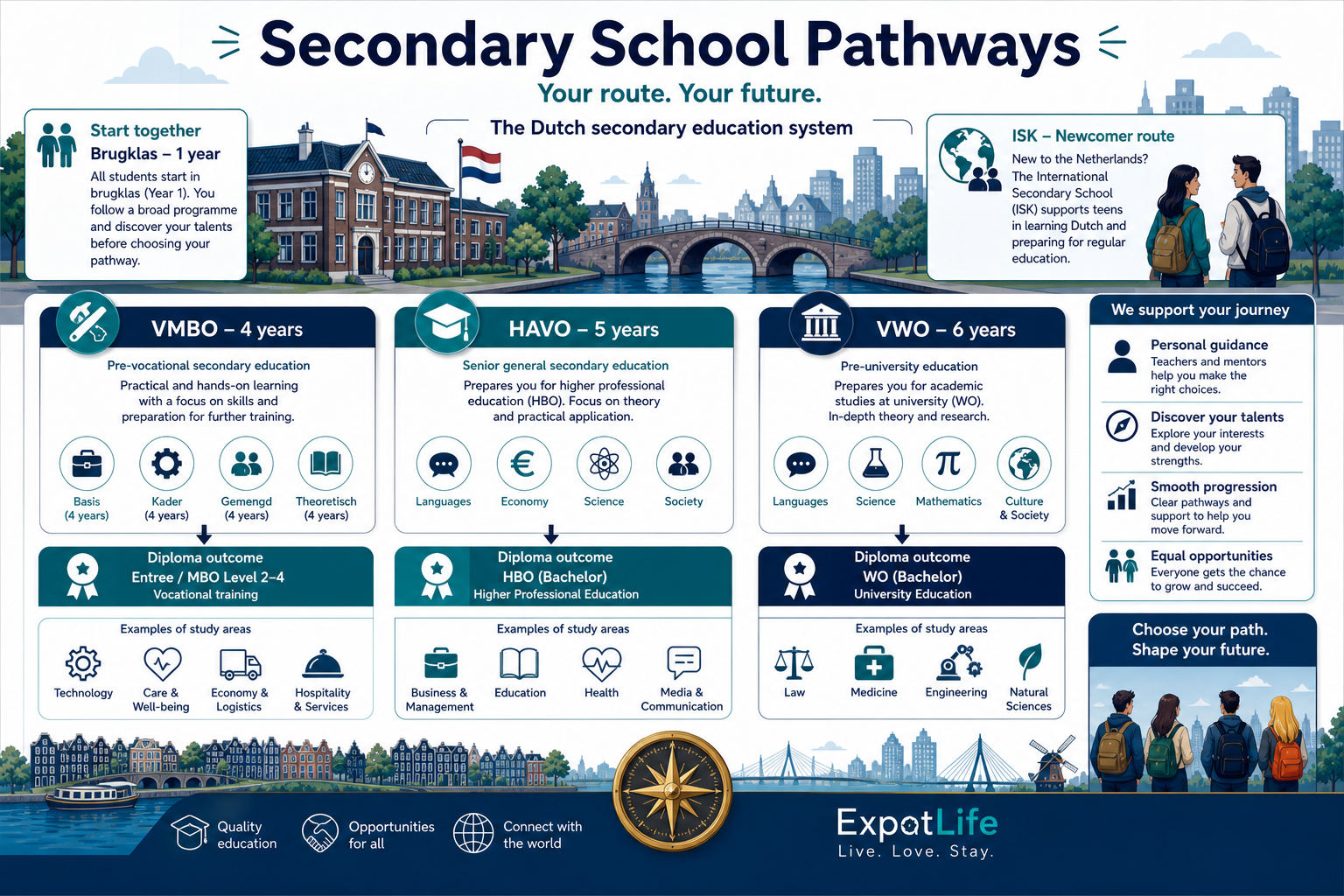
| Track | Overview | Planning note |
|---|---|---|
| VMBO | 4-year vocational-oriented track; multiple levels (basis, kader, gemengd, theoretisch) | Leads to MBO — strong for practical careers |
| HAVO | 5-year middle academic track | HBO (applied sciences) entry — good balance for many students |
| VWO | 6-year pre-university track (Atheneum/Gymnasium) | University (WO) entry — highest academic pace |
| Advies | Basisschool recommendation in group 8 | Parents can discuss; brugklas allows reassessment |
| Newcomers | Internationale schakelklas (ISK) or NT2 routes for teens | Ask gemeente about ISK if arriving age 12+ with limited Dutch |
School types
Openbare (public) schools are neutral in religious or ideological terms. Bijzonder (special) schools follow a specific religious (Catholic, Protestant, Islamic etc.) or pedagogical (Montessori, Dalton, Jenaplan) approach. Both receive government funding; parents do not pay tuition in the same way as international schools.
Some bijzonder schools request a voluntary or statutory parental contribution (ouderbijdrage). Admission rules differ: public schools often follow gemeente placement; special schools may have affiliation or waiting lists.
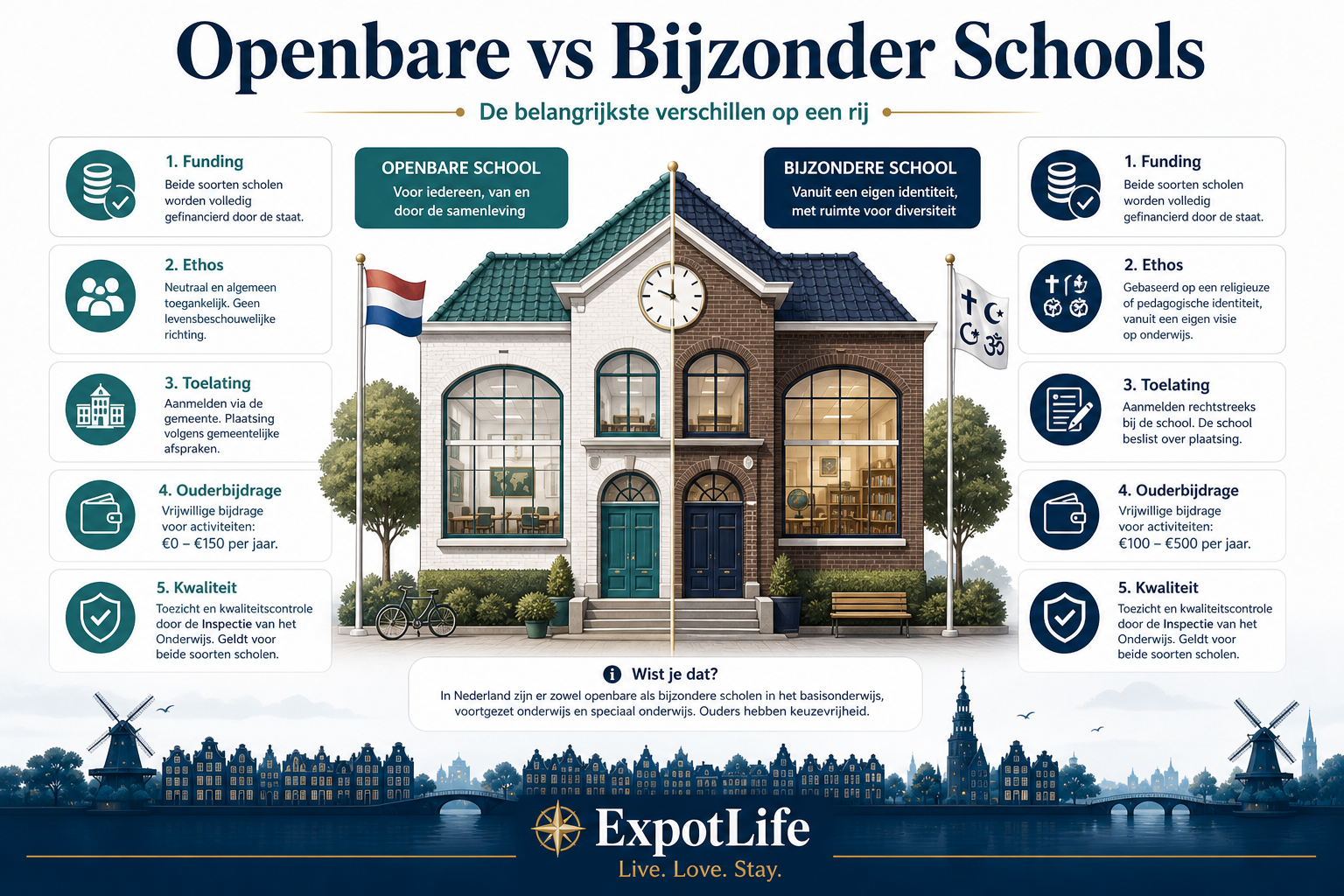
| Factor | Openbaar vs bijzonder | Planning note |
|---|---|---|
| Funding | Both largely state-funded; no international-style tuition | Budget extras only — not €15k+ tuition |
| Ethos | Public = neutral; special = religious or pedagogical | Visit to see if ethos fits your family values |
| Admissions | Gemeente placement vs school application depending on type | Confirm rules before assuming automatic place |
| Contribution | Optional ouderbijdrage at many bijzonder schools | Typical €100–€500/year — verify per school |
| Quality | Inspectie reports apply to both types equally | Check Schoolwijzer.nl for official data |
Languages
True bilingual basisscholen (roughly 50% English/Dutch) are limited compared with international schools. Some VO schools offer bilingual departments (tweetalig onderwijs) in select subjects. Taal routes and municipal programmes remain the main path for most expat children in Dutch schools.
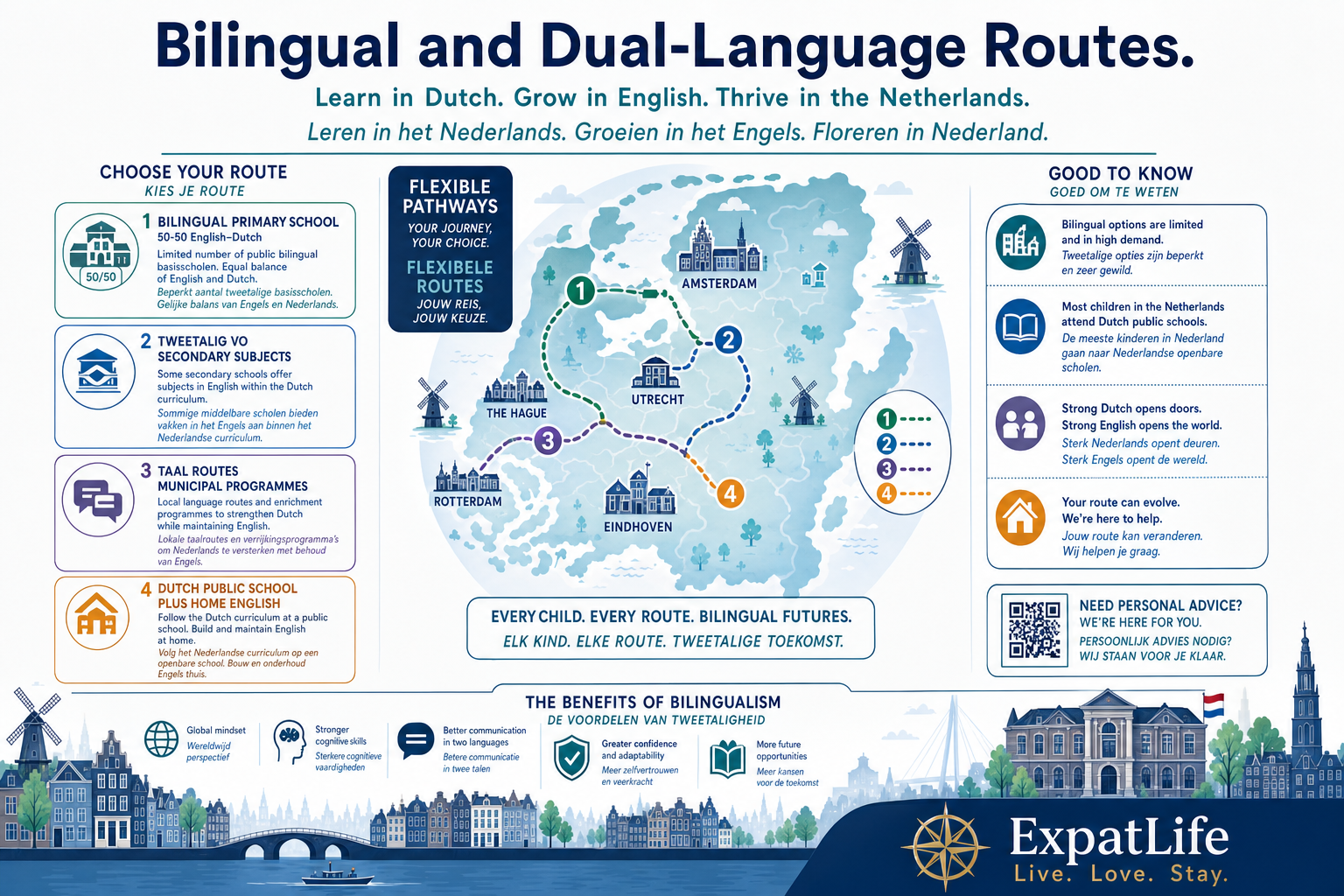
Small number of schools offer extended English — verify which subjects and year groups.
Secondary schools with bilingual streams in subjects such as history or geography — not full English-medium.
Municipal language pathways preparing children for Dutch-medium classes.
Many families combine Dutch school with English at home and international friendships.
Children with strong Dutch after basisschool can access broader VO options.
NT2
The Netherlands provides NT2 (Dutch as second language) and newcomer (nieuwkomers) programmes for children who need Dutch before joining regular classes. Intake is often coordinated by the gemeente or a regional samenwerkingsverband.
Support intensity depends on age: younger children often integrate faster; teenagers may attend Internationale Schakelklas (ISK) before entering VO.
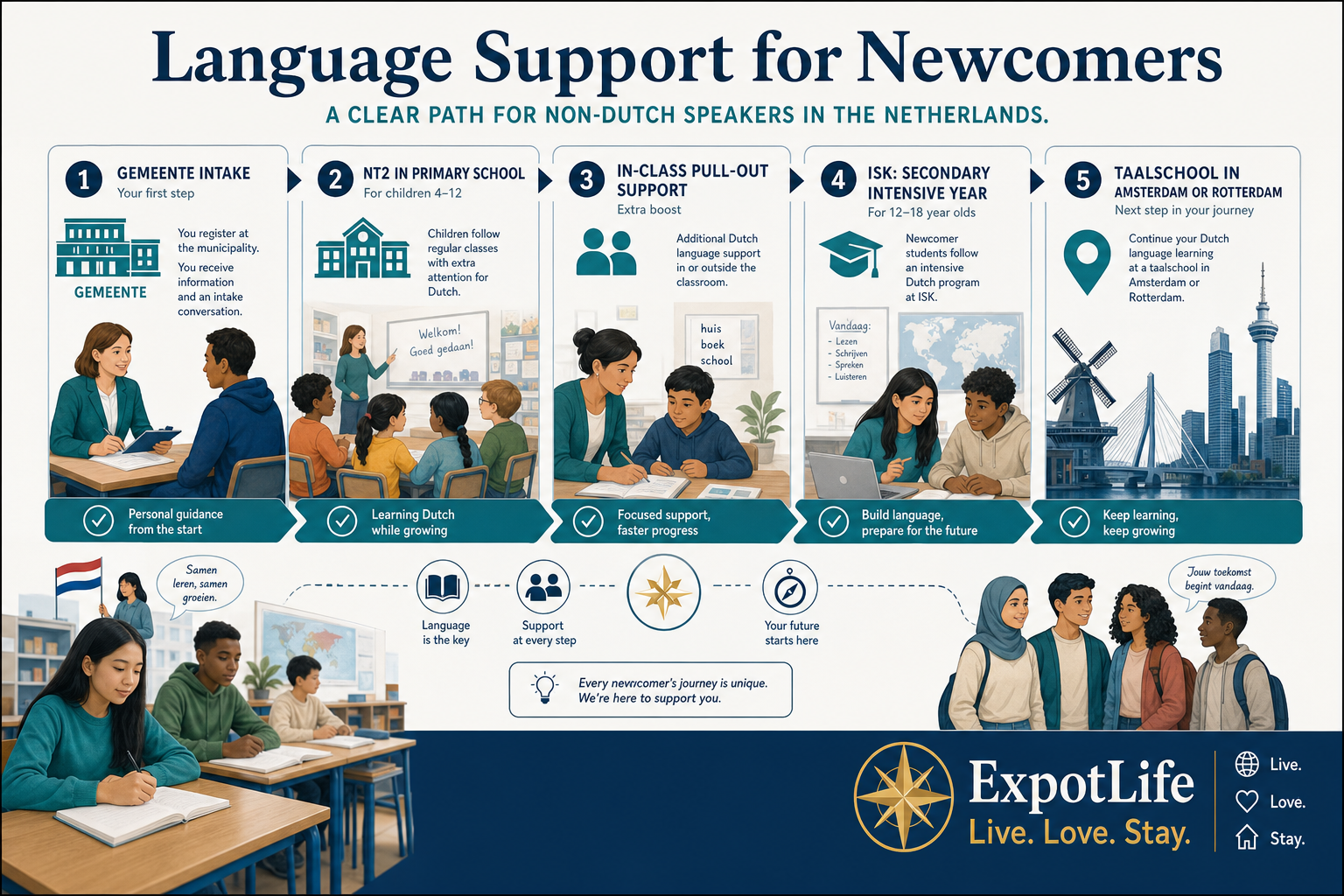
Dedicated language classes for primary-age newcomers — duration varies by proficiency.
Some schools pull out for Dutch lessons while keeping partial mainstream contact.
Intensive Dutch year for ages roughly 12–18 before HAVO/VWO/VMBO placement.
Municipal language school route in cities such as Amsterdam and Rotterdam.
Ask about newsletters in translation, tutors and buddy systems for families.
| Age band | Typical support | Planning note |
|---|---|---|
| Younger children | Often 6–12 months NT2 before mainstream | Immersion at home accelerates progress |
| Age 10+ | May need longer support before group placement | Plan homework help in early months |
| Teenagers | ISK common before VO | Credit transfer from home system needs school assessment |
| Gemeente role | Coordinates intake in many municipalities | Start within weeks of address registration |
Register
After registering your address and obtaining BSN, contact your gemeente for school placement procedures. Some municipalities assign schools; others allow ranked preferences or lottery systems. Special schools may require separate application.
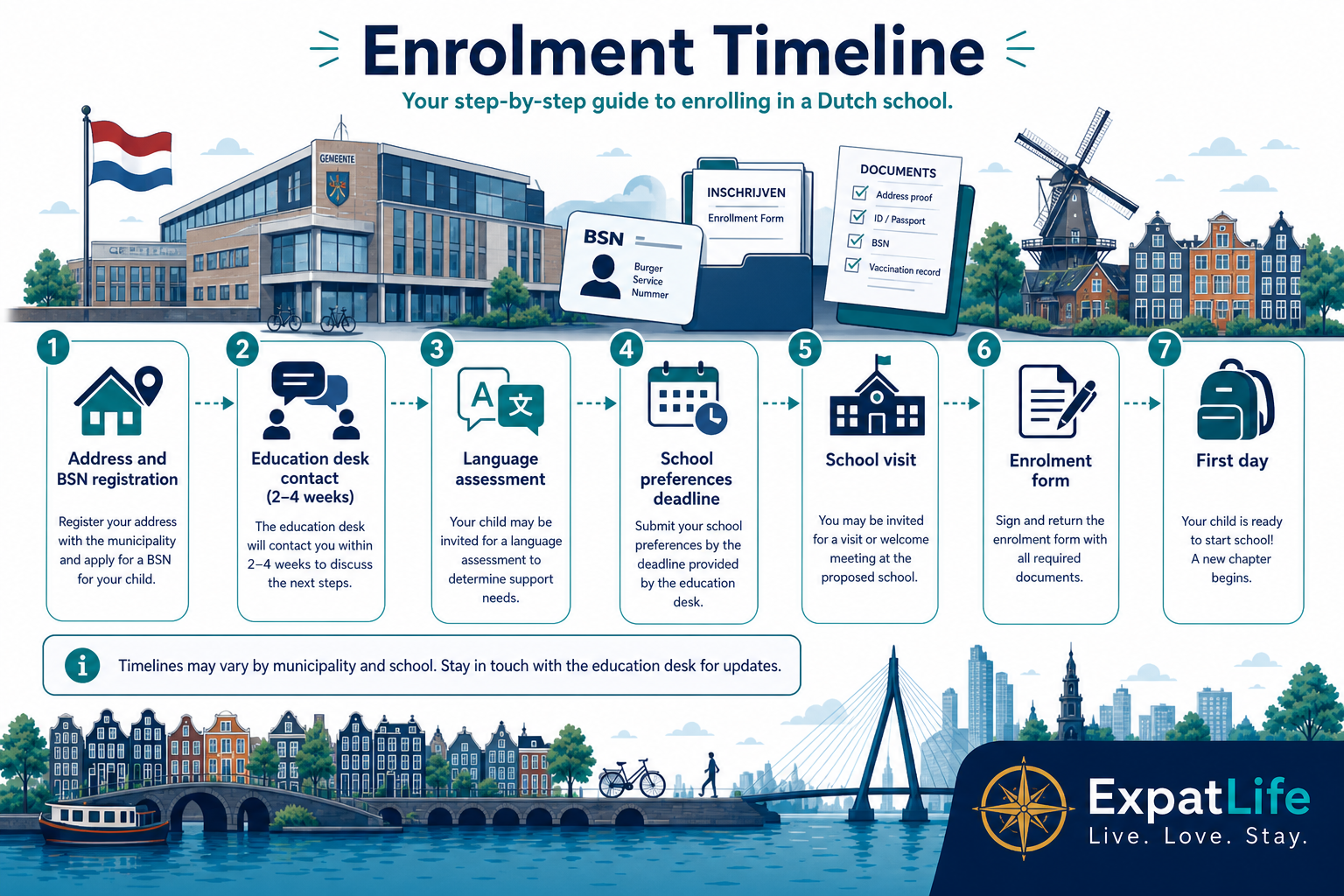
| Stage | Typical timing | What to do |
|---|---|---|
| Address & BSN | As soon as you arrive | Register at gemeente; obtain BSN for each child. |
| Education desk | Within 2–4 weeks | Contact onderwijs/loket for newcomer procedures and forms. |
| Language assessment | Varies | Gemeente or school assesses Dutch level for placement. |
| School preferences | Per gemeente deadline | Submit ranked choices or accept assigned school. |
| School visit | Before acceptance | Meet leerkracht/direction; ask about NT2 and opvang. |
| Enrolment form | Before start | Complete inschrijving; provide vaccination and prior reports. |
| First day | Start date agreed | Confirm opvang, lunch and pickup arrangements. |
Documents gemeente and schools commonly request
Examples
| Profile | Scenario | What to check |
|---|---|---|
| August start — organised family | Relocation confirmed March; children ages 5 and 10 in Utrecht | Register April; NT2 assessment May–June; school preferences before gemeente deadline. |
| Late registration — Amsterdam | Lease signed September; school start same month | Contact onderwijsconsulent immediately — NT2 queue may delay mainstream placement. |
| Bijzonder school preference | Catholic basisschool chosen; public assignment offered elsewhere | Confirm separate application rules and waiting list — not always via same lottery. |
| VO transfer with reports | Teen age 13 with 2 years of English-medium reports | Bring course descriptions; gemeente may route to ISK before HAVO/VWO placement. |
Budget
Public and special Dutch schools do not charge international-style tuition. Families budget for optional ouderbijdrage, school lunches, trips, materials, gym clothes and after-school opvang. Secondary students may have laptop requirements.
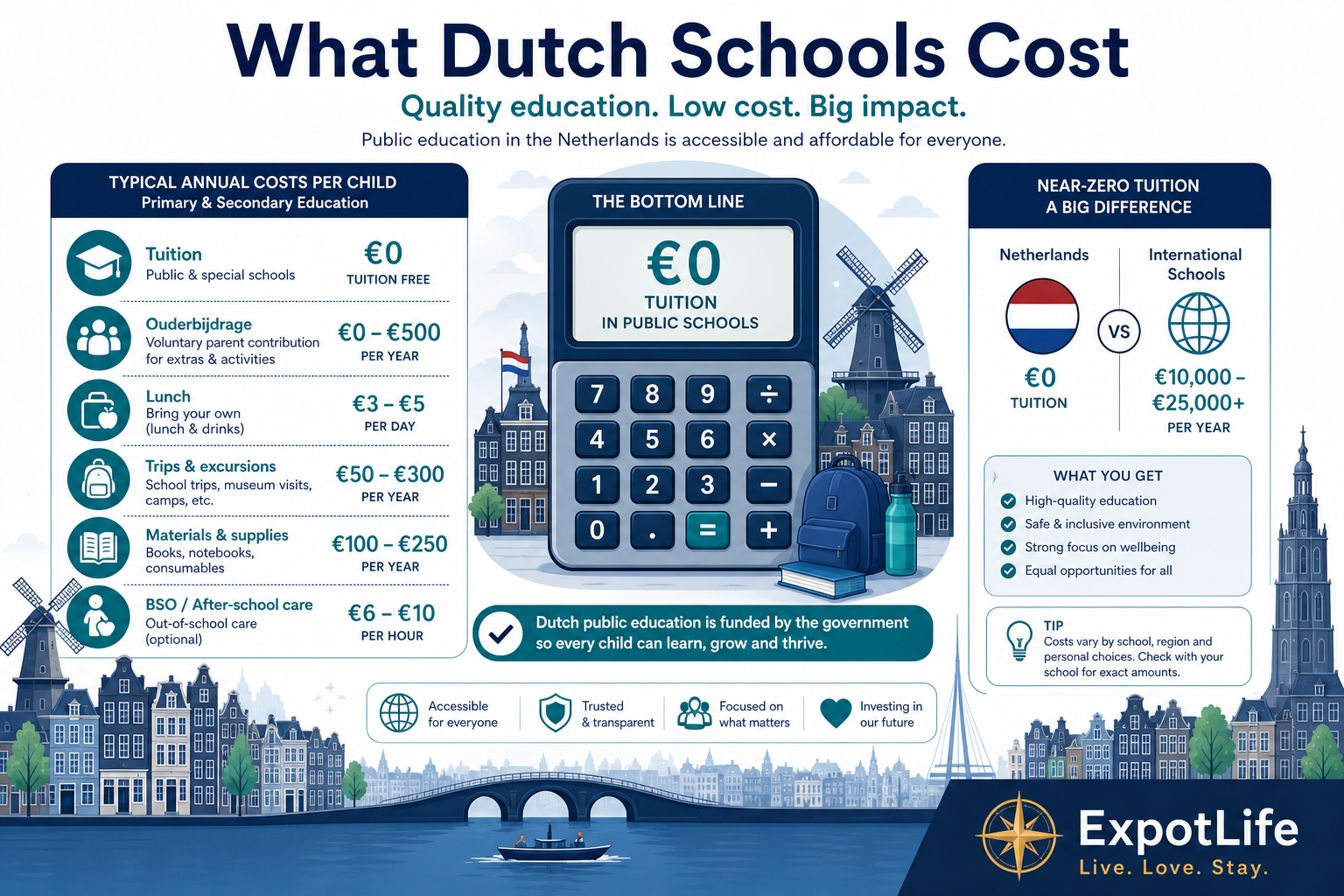
| Cost category | Openbare school | Bijzonder school | Notes |
|---|---|---|---|
| Tuition | Free | Free (state-funded) | Unlike international schools charging €12k–€28k/year |
| Ouderbijdrage | Often €0–€150 | Often €100–€500 | Voluntary or statutory — school-specific |
| Lunch | Bring own or ~€3–€5/day | Same | Hot lunch uncommon at basisschool |
| School trips | €50–€300/year | Similar | Camp weeks increase cost in group 7–8 |
| Materials & gym | €100–€250/year | Similar | Laptop common from VO |
| Buitenschoolse opvang | €6–€10/hour | Same | Separate from school; toeslag may apply — see childcare allowance guide |
Amounts vary by school and city. This guide provides planning ranges only — not quotes.
Examples
| Profile | Scenario | What to check |
|---|---|---|
| Two children — openbare basisschool | Ages 6 and 9 in Rotterdam; no ouderbijdrage | Budget ~€800–€1,200/year extras plus opvang ~€7/hour for Wed afternoons. |
| Bijzonder Montessori | Ouderbijdrage €350/year; group 7 camp week | Add camp €200–€400 and materials — still far below international tuition. |
| VO laptop requirement | HAVO year 2 student; school specifies €600 device | One-off cost — ask about subsidy or second-hand programmes. |
| Opvang + toeslag | Full-time parents; BSO 5 days after school | Childcare allowance may offset part of opvang — see childcare allowance guide. |
Decide
The right Dutch school depends on length of stay, language readiness, location, ethos and secondary ambitions. Use this matrix with gemeente guidance and school visits — not league tables.
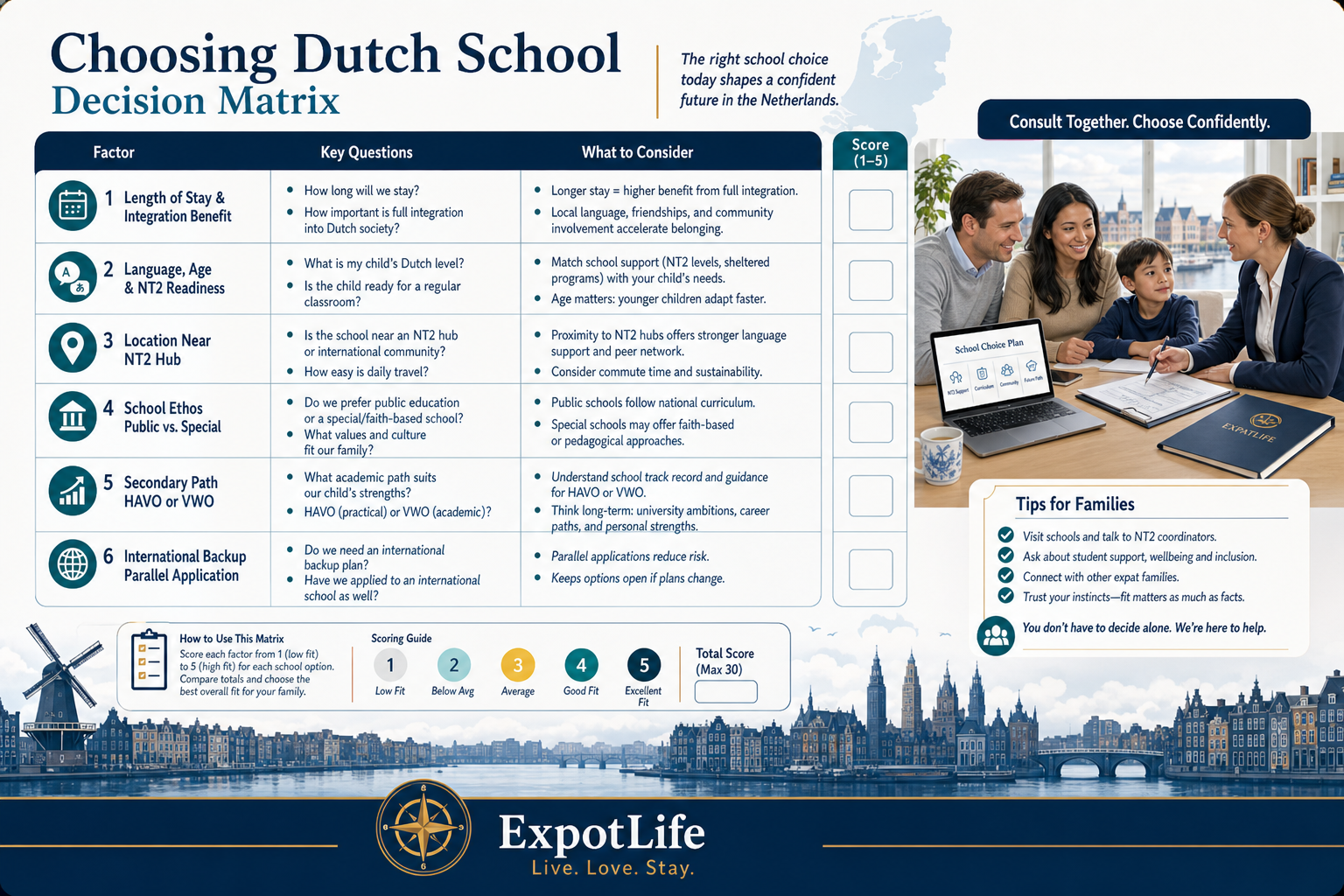
| Factor | Ask yourself | Example |
|---|---|---|
| Length of stay | Will your child benefit from full Dutch integration? | 3+ years → Dutch school often worthwhile if support exists. |
| Language age | Is your child's age favourable for NT2? | Under 10 usually adapts faster than mid-secondary arrival. |
| Location | Can you live near the school or NT2 centre? | Amsterdam NT2 hubs may not match your commute from Haarlem. |
| Ethos | Public neutral vs religious/pedagogical special? | Montessori special school vs openbare — visit both. |
| Secondary path | Are you planning HAVO/VWO or vocational routes? | Long-term academic plans → ask about school advies patterns honestly. |
| International backup | Should you keep international options open? | Short posting → parallel application may reduce risk. |
How to choose a Dutch school — step by step
Examples
| Profile | Scenario | What to check |
|---|---|---|
| Undecided — 2-year contract | Child age 8; employer relocation to Eindhoven | Apply international and register gemeente — compare NT2 pace vs English continuity. |
| Strong Dutch partner | One Dutch-speaking parent; child age 6 | Home language support accelerates NT2 — openbare near home may suffice. |
| Montessori preference | Pedagogical fit over proximity | Bijzonder waiting lists differ from gemeente lottery — apply early. |
| University-bound teen | Age 15 arrival; target Dutch WO pathway | ISK then VWO/HAVO placement — realistic timeline 12–24 months for Dutch proficiency. |
Inspectie
The Dutch Inspectorate of Education (Onderwijsinspectie) publishes reports on all schools. Schoolwijzer.nl aggregates official data including leerlingenkenmerken (student progress indicators). Use these sources rather than informal expat forum rankings.
Schools follow national behaviour and safety frameworks. Minor discipline (such as nablijven — staying after class — or structured homework tasks sometimes referred to in parent guides as taakstraf-style assignments) is handled internally; serious concerns fall under inspectorate oversight and school complaints procedures.
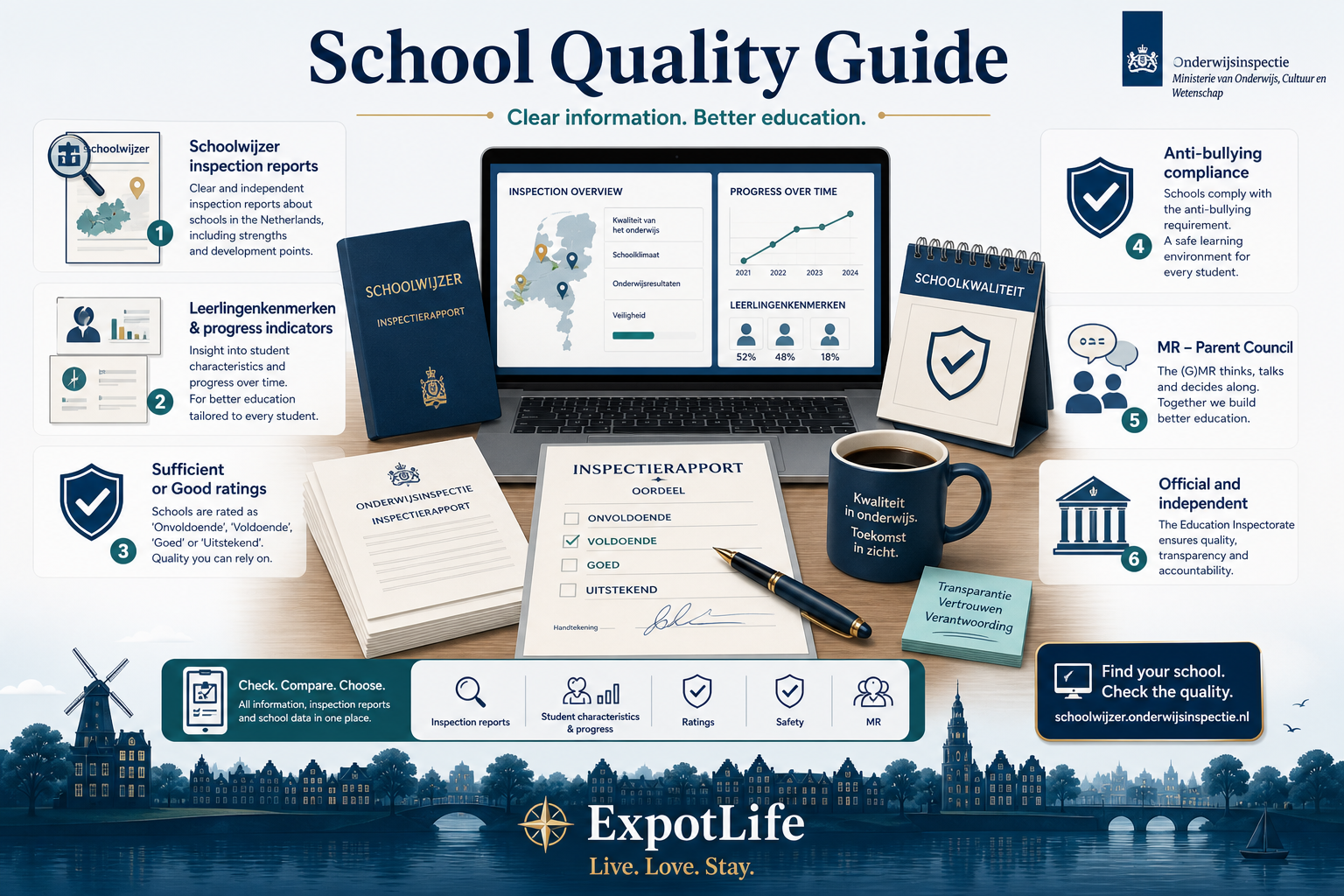
Questions to ask on school visits
Examples
| Profile | Scenario | What to check |
|---|---|---|
| Comparing two basisscholen | Both 'voldoende' on Schoolwijzer; one closer to home | Visit both; ask NT2 coordinator about newcomer numbers — proximity may matter more than small score differences. |
| Concern about bullying | Child reports exclusion in groep 6 | Request school anti-bullying protocol; escalate via MR if unresolved — inspectie tracks serious patterns. |
| Advies dispute | Group 8 advies HAVO; parents expect VWO | Discuss with leerkracht and directeur; brugklas or Cito herkansing may be options — not forum anecdotes. |
| Inspectie report jargon | Report mentions 'kwaliteitszorg' and 'veiligheid' | Use Schoolwijzer plain-language summary; ask school for parent-friendly explanation at open day. |
Cities
NT2 capacity and placement rules differ by gemeente — compare before signing a lease.
Compare
Expat families often weigh Dutch public education against international schools. Dutch schools offer integration and no tuition; international schools offer English-medium continuity and familiar curricula at significant cost. Many families apply to both until placement clarity emerges.
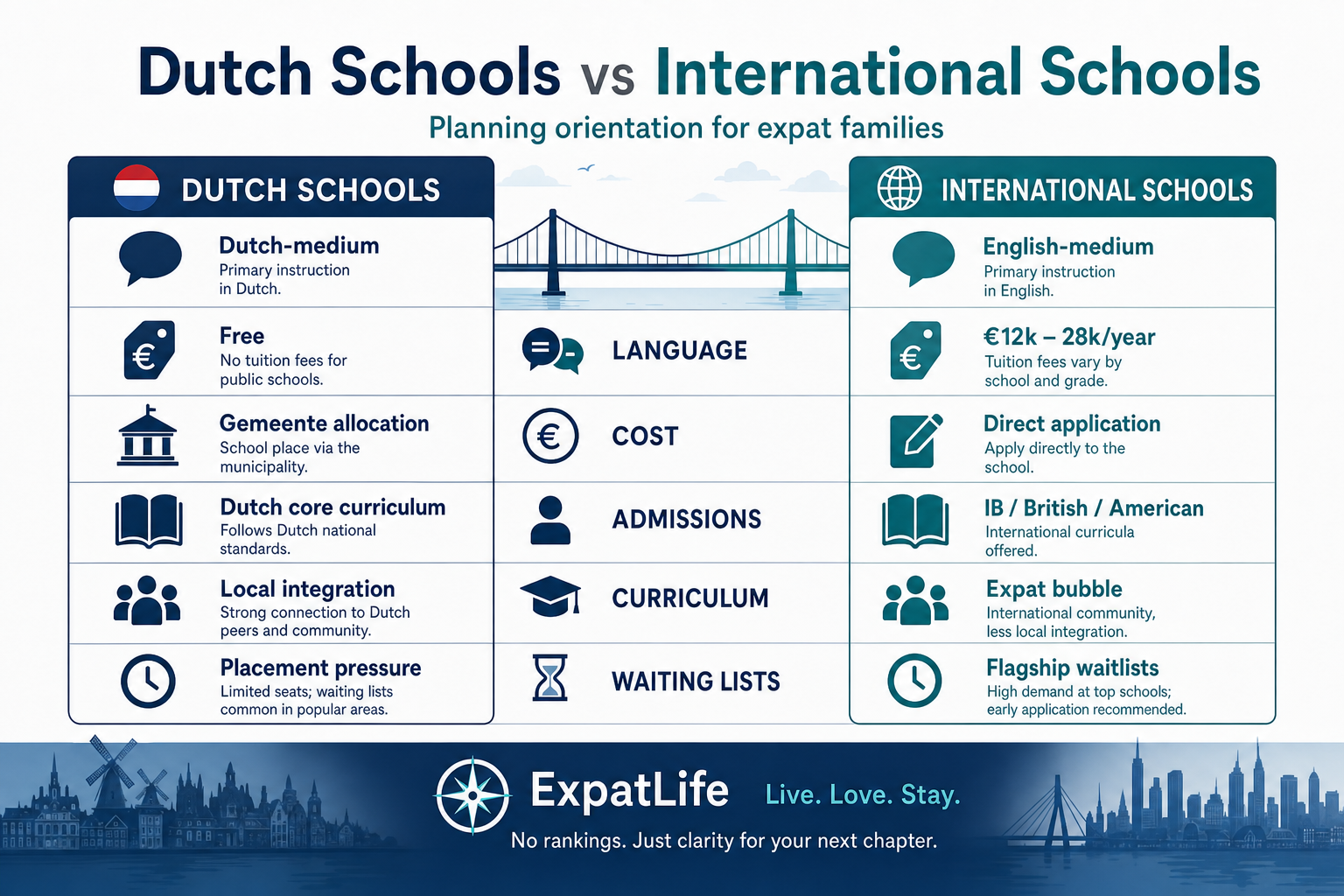
| Factor | Dutch vs international | Planning note |
|---|---|---|
| Language | Dutch-medium vs English-medium instruction | Young children adapt; teens need explicit support planning |
| Cost | Free tuition vs €12k–€28k/year typical international | Employer allowances may not cover Dutch extras |
| Admissions | Gemeente/school vs direct international application | Different timelines — do not conflate deadlines |
| Curriculum | Dutch core vs IB/British/American | University recognition depends on diploma path |
| Integration | Local friends and Dutch fluency vs expat bubble | Long-stay families often value Dutch route |
| Waiting lists | Usually placement pressure not €20k waitlists | International flagship schools still competitive |
Transfers
Arriving outside August is common for expat families. Gemeente and schools place children when capacity and language support exist. Mid-year is less predictable than the standard August intake — contact the education desk immediately.
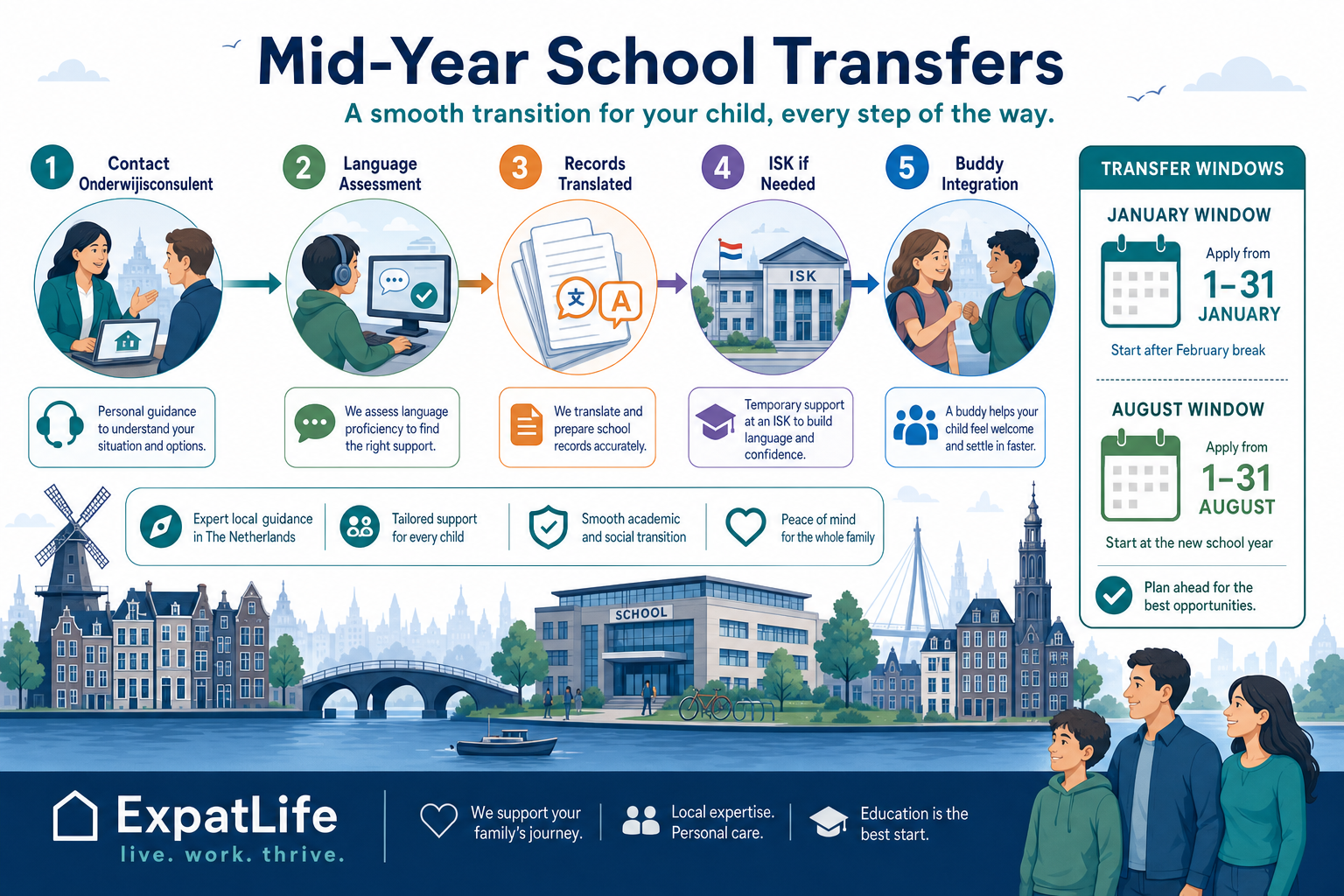
Before contacting gemeente for mid-year entry
Examples
| Profile | Scenario | What to check |
|---|---|---|
| January start — corporate transfer | Family arrives mid-January; child age 9 in Year 4 equivalent | Gemeente may place in NT2 within weeks; mainstream groep 5 after assessment — less predictable than August. |
| February — age 12 | Entering groep 7 equivalent; limited Dutch | Taalschool or intensive NT2 before group 7 — ask if brugklas timing shifts. |
| Summer arrival | July move; school starts August | Register June if possible; many gemeenten process August cohort in spring. |
| International backup active | Dutch NT2 queue 8 weeks; international offer pending | Keep both until Dutch start date confirmed — do not decline international until gemeente letter received. |
Support
Dutch schools operate under passend onderwijs — appropriate education for every child. Support is organised through regional samenwerkingsverbanden (collaborative bodies). Levels range from extra support in mainstream to specialised schools (speciaal onderwijs).
Disclose needs early during gemeente intake. Bring existing IEPs, diagnoses and therapist reports — translated summaries help.
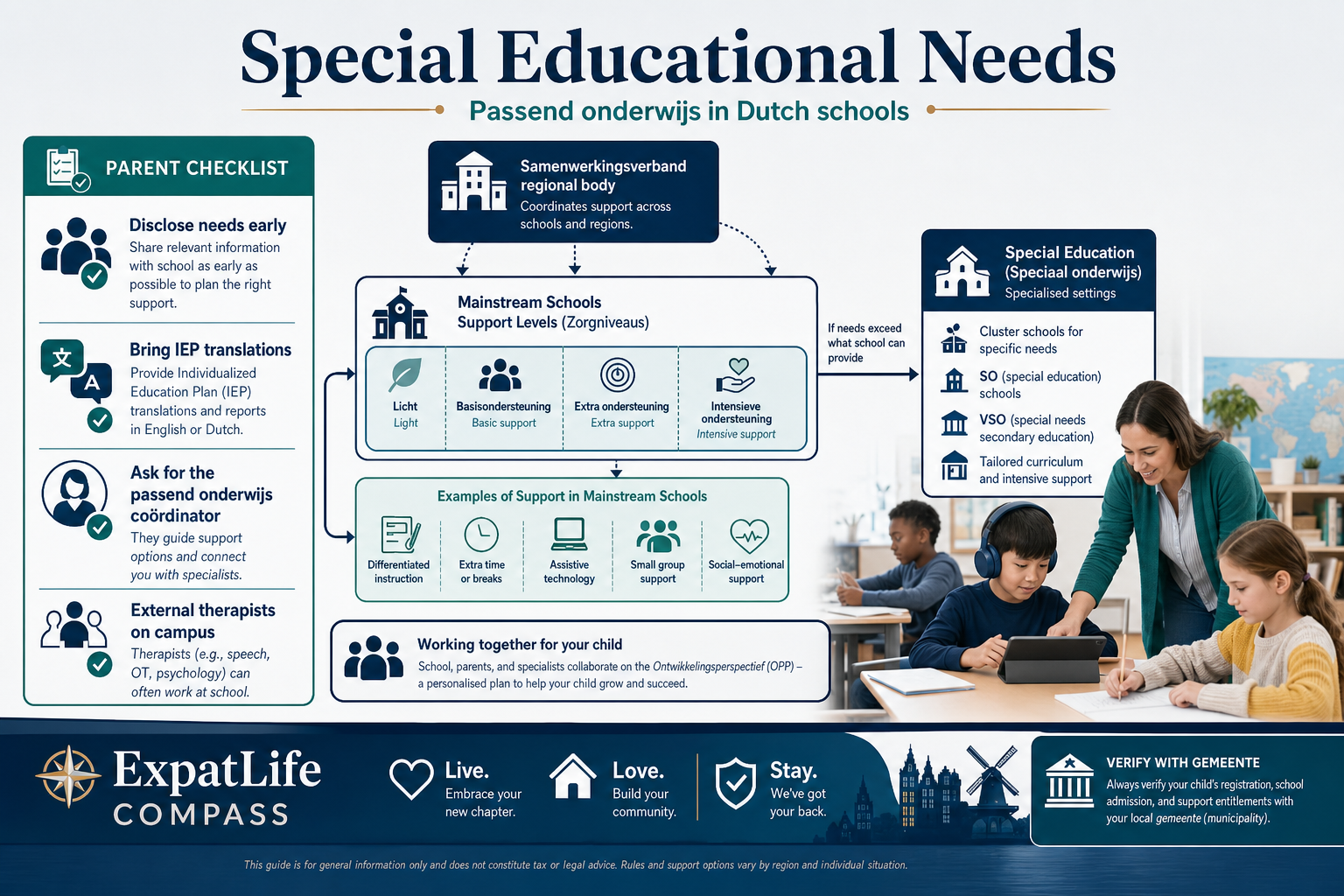
Questions to ask about special educational needs support
Examples
| Profile | Scenario | What to check |
|---|---|---|
| Mild dyslexia — basisschool | Child age 8 with existing support plan; needs reading accommodations | Ask passend onderwijs coordinator about in-class support hours and Cito adjustments. |
| ADHD — mainstream VO | Teen entering HAVO; needs structured breaks | Samenwerkingsverband may fund extra guidance — disclose at gemeente intake. |
| Autism — special vs mainstream | Primary-age child; sensory needs in busy classroom | Visit both mainstream with support and speciaal onderwijs options — regional capacity varies. |
| Undisclosed IEP | Family waits until after placement to share diagnosis | Risk of inadequate support — bring translated IEP summary at first gemeente meeting. |
Checklist
Work through this list as soon as your address and BSN are confirmed.
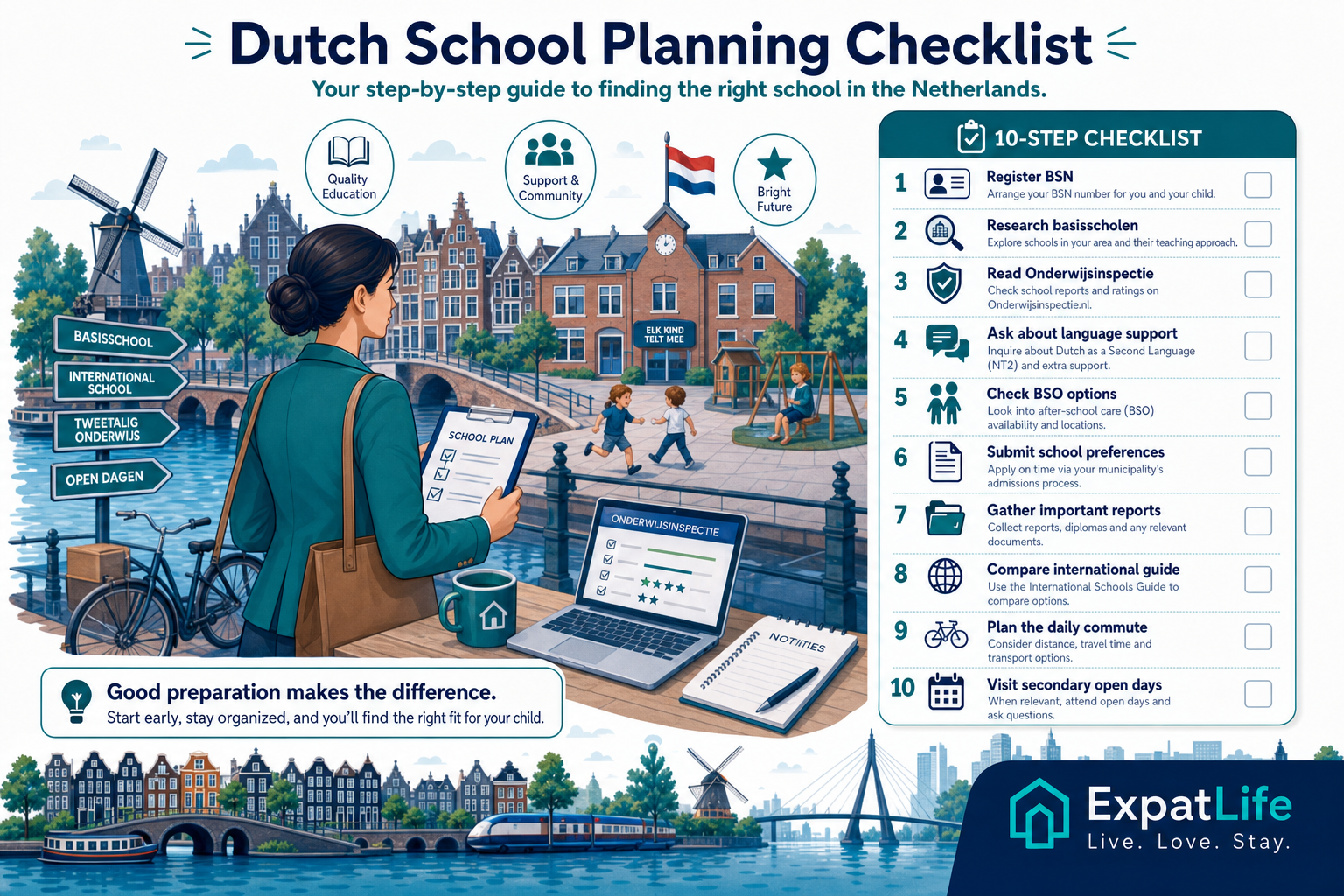
Early research phase
Registration and application phase
Pre-move phase
Full planning checklist
Avoid
These patterns cause stress for relocating families — plan around them early.

Example: signing a lease in September without registering children — NT2 queues may delay start by months.
Example: expecting Dutch basisschool to teach in English — only limited bilingual tracks exist.
Example: not attending group 8 meetings because reports are in Dutch — ask for translation support.
Example: living in a village while child attends taalschool 45 minutes away — exhaustion follows.
Example: single-track Dutch application on a 2-year contract — no plan B if placement slips.
Example: missing MR meetings and WhatsApp groups — integration slows for the whole family.
Examples
| Profile | Scenario | What to check |
|---|---|---|
| Forum ranking obsession | Choosing school solely from expat Facebook 'best school' threads | Use Schoolwijzer inspectie data and visit NT2 support in person — no official rankings exist. |
| Grade number mismatch | Insisting child joins 'Year 5' when gemeente places in groep 6 | Dutch groups differ from UK/US grades — trust language assessment outcome. |
| Single deadline mindset | Misses bijzonder application while waiting for gemeente lottery | Track separate deadlines on a shared calendar. |
| No Dutch at home | Parents speak only English; expect school to fully substitute | Plan family Dutch learning — children integrate faster with home exposure. |
FAQ
Orientation answers — confirm gemeente and school-specific rules directly.
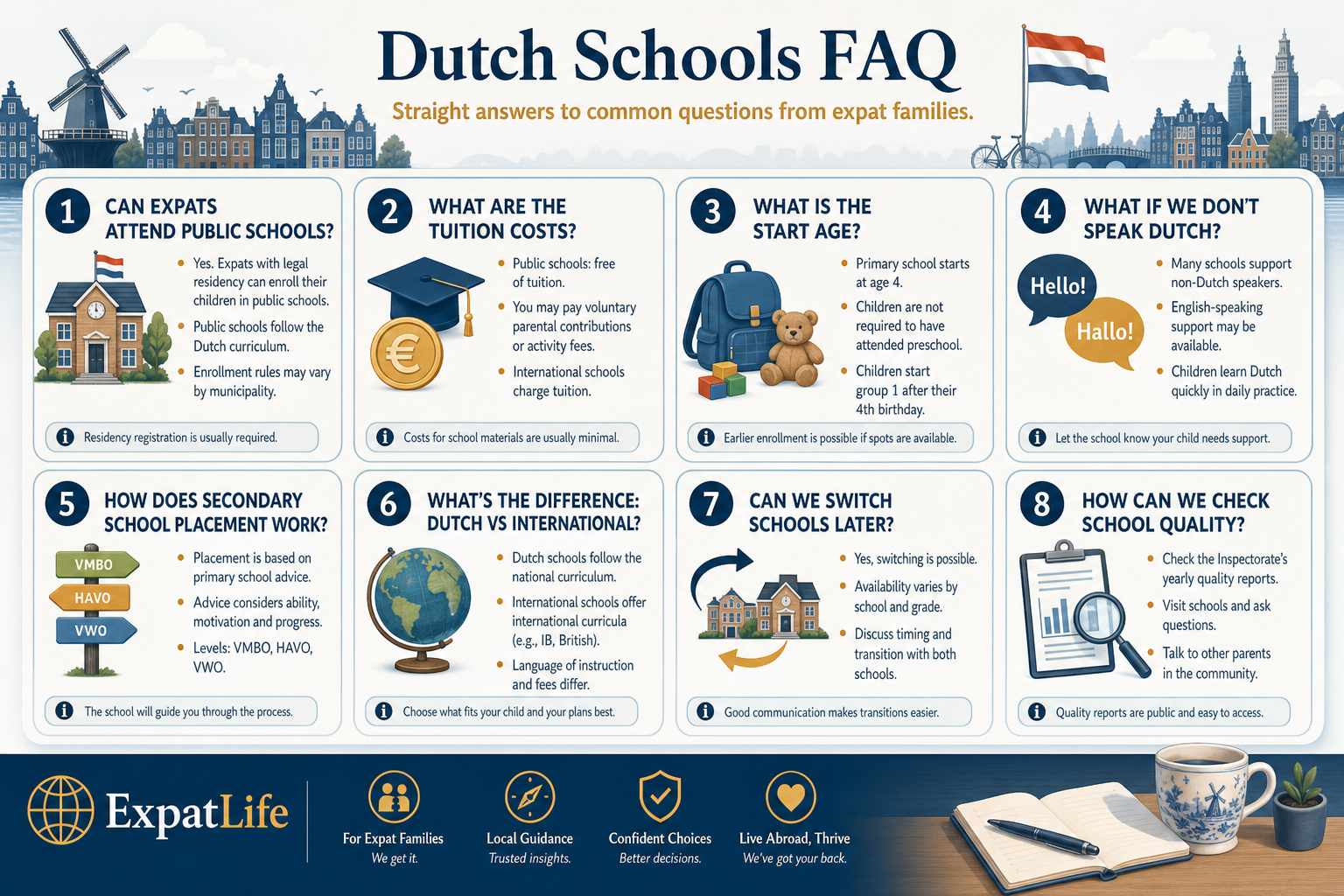
Yes — openbare and most bijzonder schools are state-funded with no tuition fees. Budget for ouderbijdrage, materials, trips and opvang instead.
Not to enrol, but instruction is in Dutch. Non-speakers enter NT2 or newcomer programmes first — duration depends on age and support.
Register your address, obtain BSN and contact your gemeente education desk. Procedures vary by municipality for preferences, lottery or assignment.
Groups 1–8 correspond roughly to ages 4–12. Newcomers are placed by age and language assessment — not always equal to home-country grade.
Secondary tracks after basisschool: VMBO (vocational, 4 years), HAVO (5 years, HBO entry), VWO (6 years, university entry).
Yes — bijzonder schools include Catholic, Protestant, Islamic and other profiles. Admission rules vary; some require affiliation.
Dutch schools suit integration and long stays without tuition. International schools suit English continuity and short postings at higher cost. Many families compare both.
Contact gemeente immediately. Mid-year placement depends on capacity and NT2 availability — less predictable than August intake.
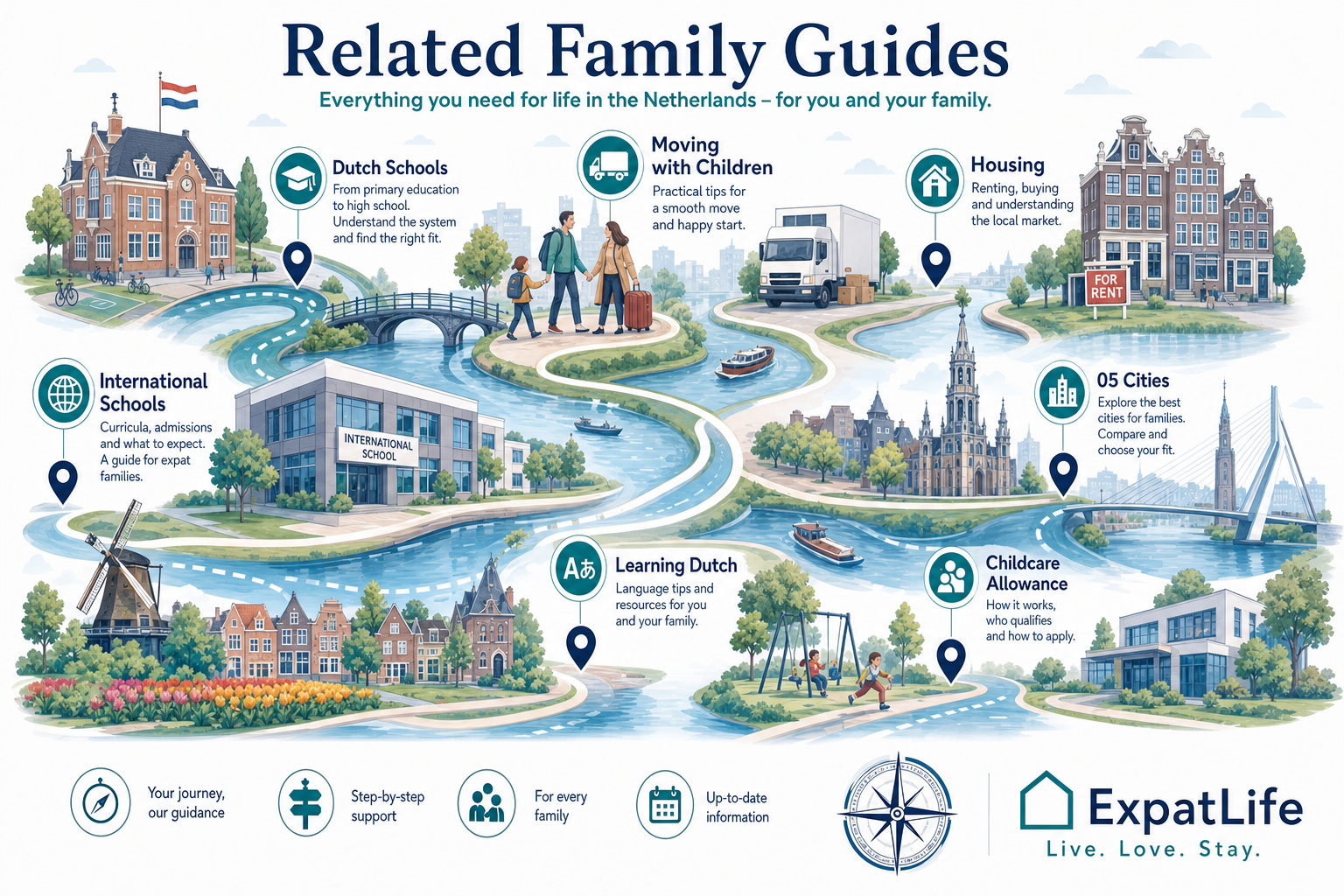
Family guides
Connect Dutch school choice with moving, housing, language and international education content.
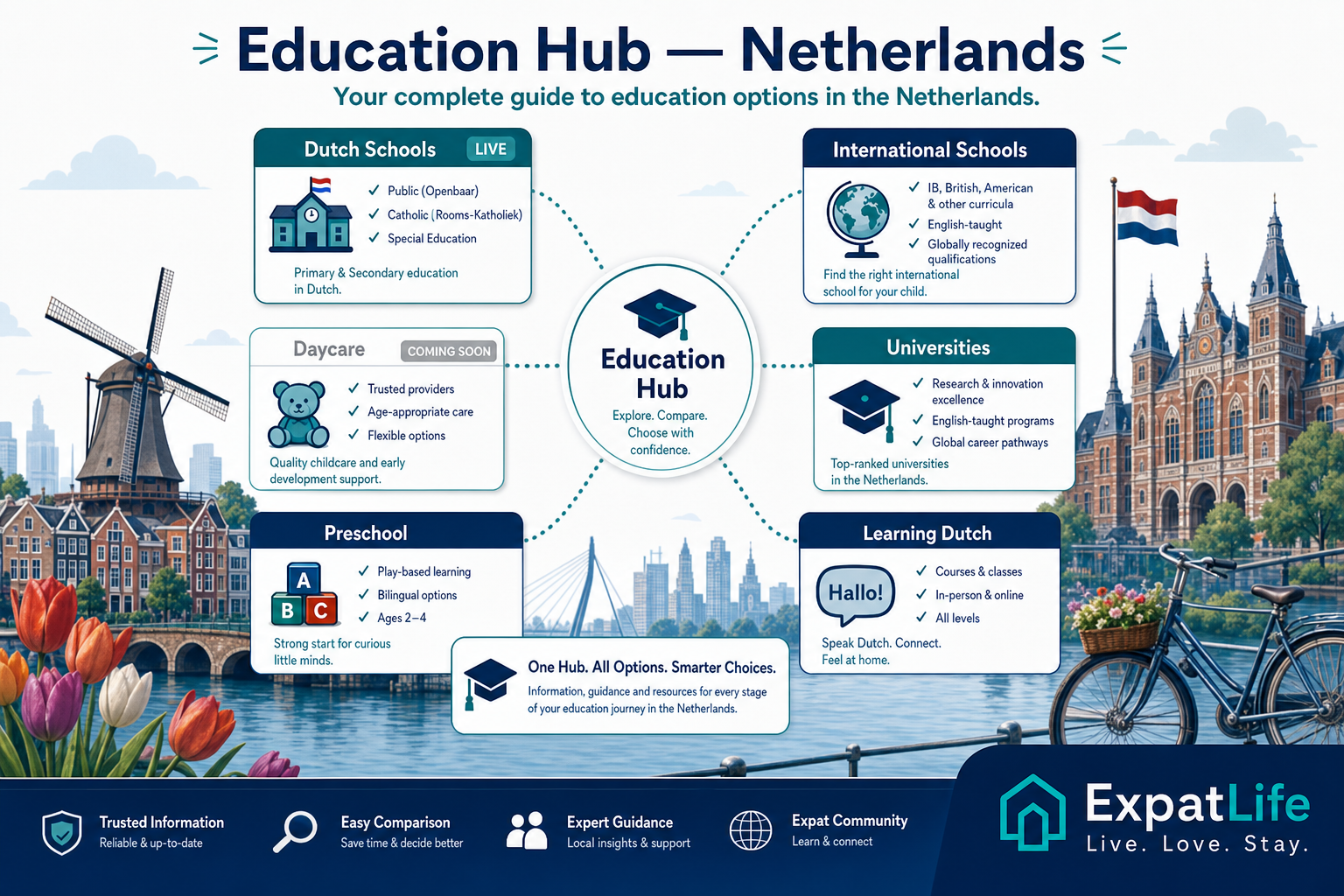
Education hub
This page is the Dutch schools cornerstone — explore related education topics next.
Next steps
Continue planning your family relocation with housing, cities and language guides.

Trust
Gemeente rules, NT2 capacity and school placement change frequently. Verify current procedures with your municipality and schools — this guide is orientation only, not enrolment advice.