
LRK registration matters
Example: only LRK-registered childcare qualifies for kinderopvangtoeslag — verify on lrk.net before signing.
Netherlands · Education · Childcare · Daycare
Everything expat families need to know about Dutch childcare — kinderopvang options, costs, waiting lists, childcare allowance and choosing the right provider.
Practical orientation only — not childcare advice. Availability, fees and allowance rules vary. We do not rank providers subjectively.
Quick answer
Dutch childcare (kinderopvang) covers registered daycare centres (kinderdagverblijf), home-based care (gastouder), preschool (peuterspeelzaal) and after-school care (buitenschoolse opvang / BSO). Most expat families use registered LRK providers so they can apply for childcare allowance (kinderopvangtoeslag) through the Belastingdienst.
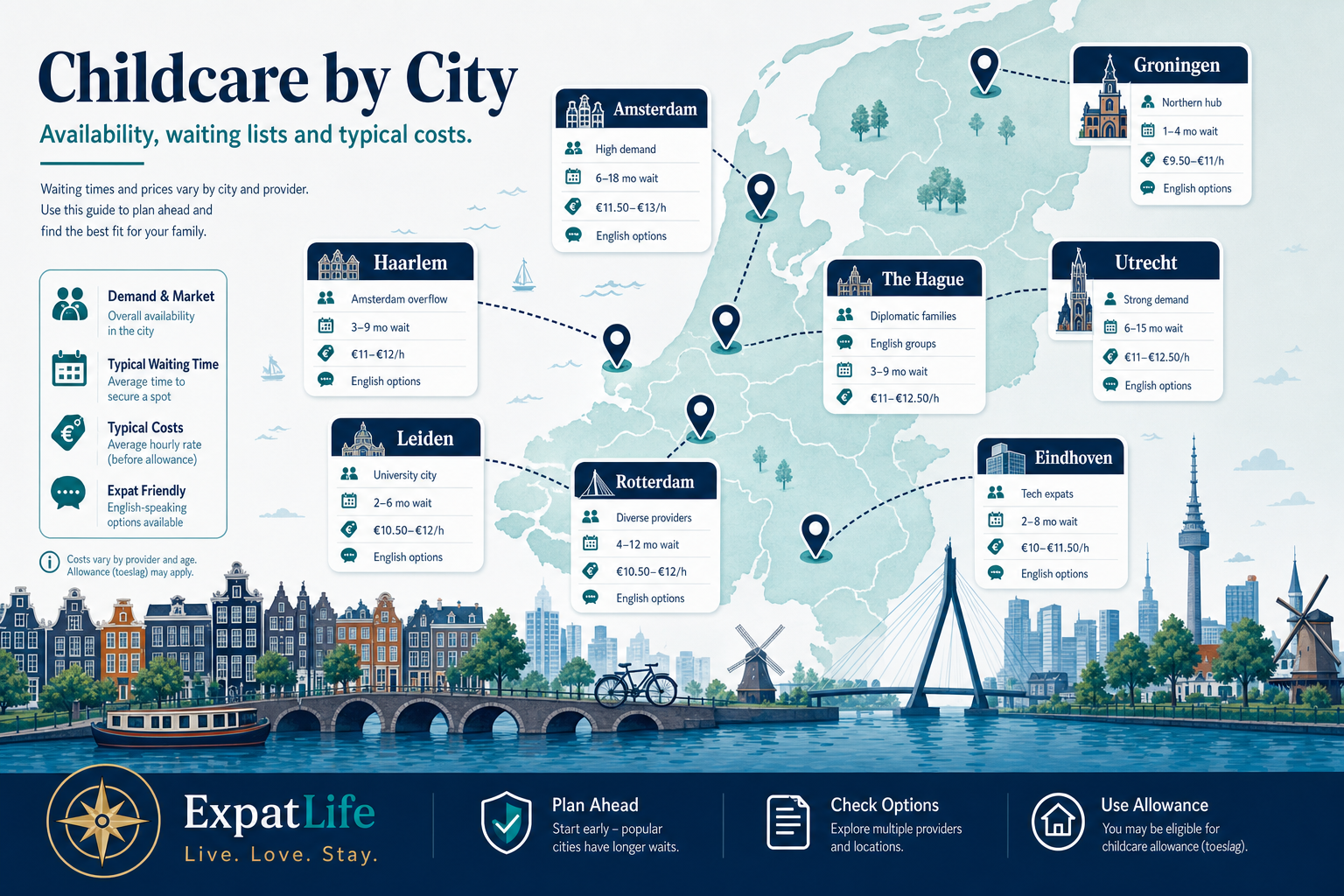
Availability and waiting lists vary significantly by city. Amsterdam, The Hague and parts of Utrecht see the longest lists for popular locations — registering before or shortly after confirming pregnancy is common practice. Costs depend on hours, location and provider type; allowance can reduce your net payment but does not cap provider fees.
This guide helps you compare real providers, understand costs and allowance orientation, and connect childcare choice with housing, commute and school planning. It does not rank providers subjectively or guarantee placement.
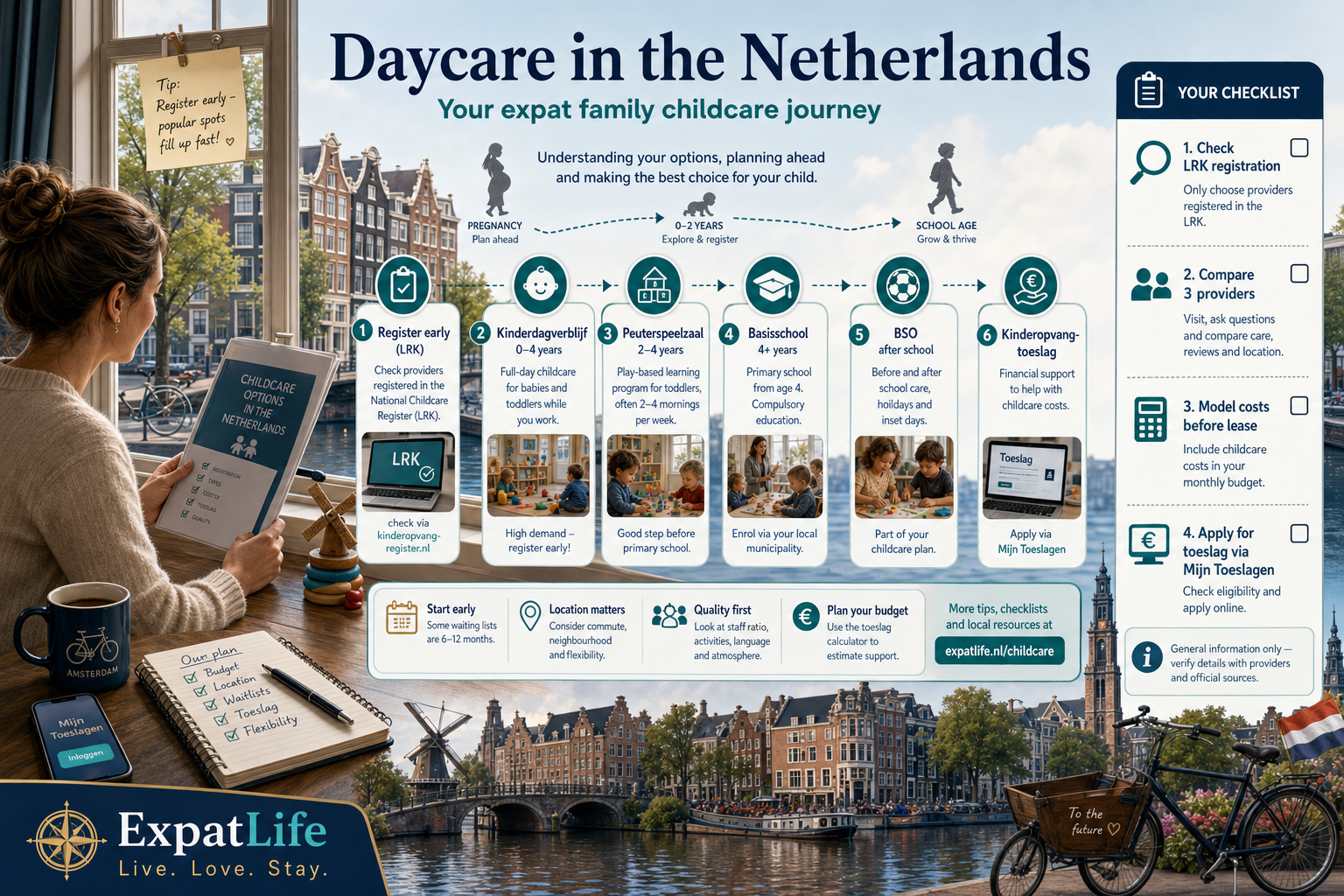
Example: only LRK-registered childcare qualifies for kinderopvangtoeslag — verify on lrk.net before signing.
Example: Amsterdam Zuid and The Hague international corridors often have 6–12 month waits at popular locations.
Example: three days per week vs full-time changes both monthly invoice and allowance calculation — model both.
Example: a kinderdagverblijf place does not automatically continue as BSO when your child starts basisschool.
Three orientation moves before registering
Examples
| Profile | Scenario | What to check |
|---|---|---|
| Dual-income HSM — Amsterdam | Baby due in September; both parents return to work January; lease in Amsterdam Oud-Zuid | Register with 3+ providers now; confirm LRK status; model allowance with planned work hours. |
| Trailing spouse — The Hague | One parent works part-time; toddler age 2; diplomatic zone housing | Compare Zein, Ludens and gastouder options; ask about English support hours per location. |
| Rotterdam port hire | Two children ages 1 and 5; need daycare plus BSO from August | KindeRdam and municipal portal; separate BSO registration for basisschool child. |
| Pre-arrival planning | Relocating from Singapore in six months; child age 3 | Email providers before arrival; join waiting lists remotely where accepted; plan temporary gastouder if needed. |
At a glance
Compare childcare types before contacting providers — waiting lists and fees vary significantly by city.
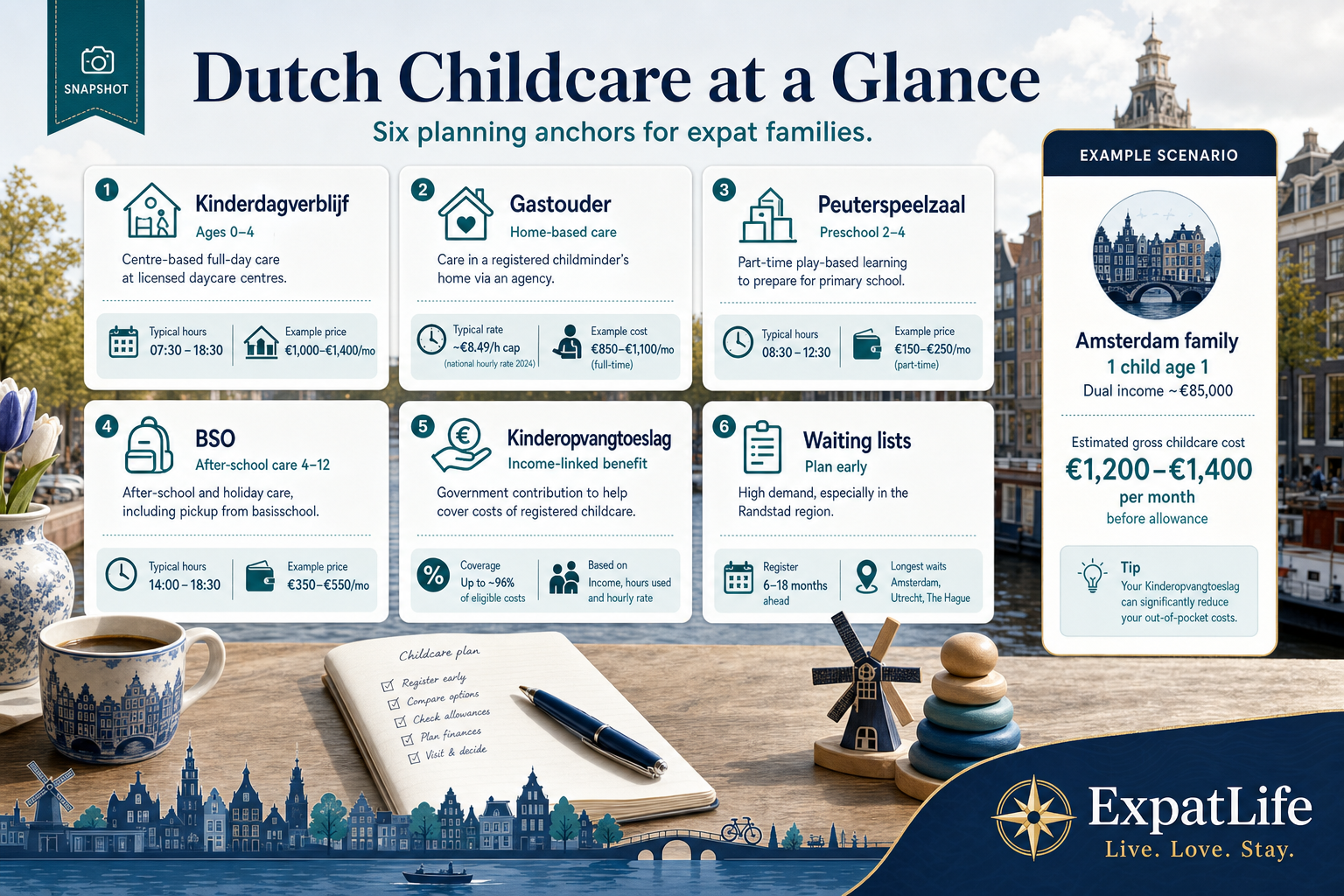
Daycare centres
Kinderdagverblijf
Group care for babies and toddlers — most common full-day option.
Home-based
Gastouder
Small groups in a registered carer's home — flexible for younger children.
Preschools
Peuterspeelzaal
Play-based care for ages 2–4 preparing for basisschool.
After-school
BSO
Wraparound care for primary school children until parents finish work.
Allowance
Kinderopvangtoeslag
Income-dependent subsidy for registered childcare — apply via Belastingdienst.
Waiting lists
Plan early
Randstad hubs often need months of lead time — register before you need a place.
System
The Dutch childcare system is built around registered providers listed in the Landelijk Register Kinderopvang (LRK). Parents choose a provider that fits their schedule; the government provides childcare allowance (kinderopvangtoeslag) to eligible working parents using registered care — it does not run daycare centres directly.
Most children enter kinderdagverblijf from age 3 months to 4 years while parents work or study. From age 4, children move to basisschool; working parents often add BSO for after-school hours. Peuterspeelzaal bridges toddler years with part-day, play-focused care.
Quality is overseen by the GGD (municipal health service) through regular inspections. Always verify LRK registration and read inspection reports before committing — links are on lrk.net and many municipality websites.
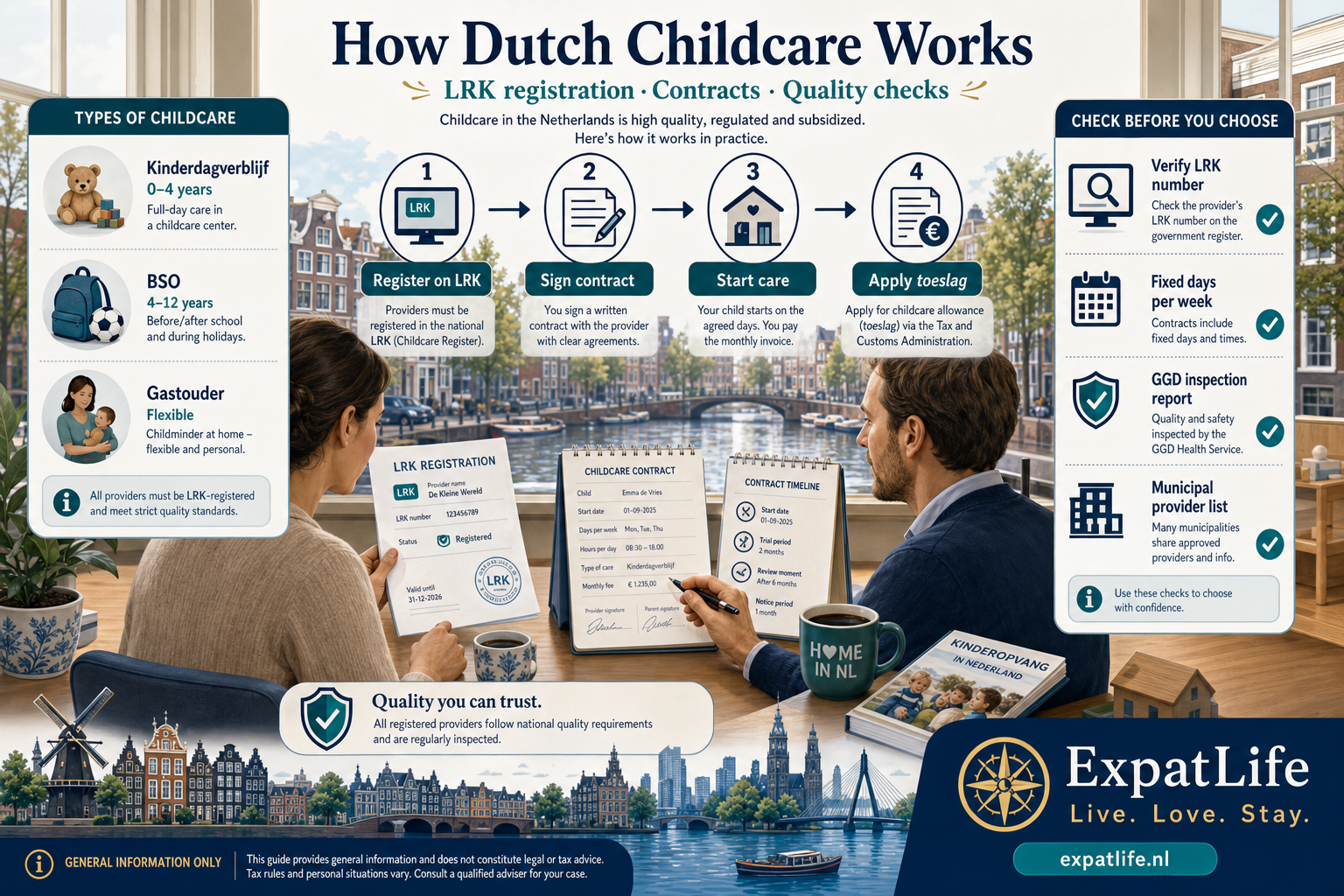
| Factor | How it works | Planning note |
|---|---|---|
| Registration | Direct with LRK provider — no municipal lottery like some school systems | Apply to multiple providers; lists are location-specific |
| Funding model | Parent pays provider; allowance reduces net cost if eligible | Allowance varies — do not assume a fixed subsidy amount |
| Quality oversight | GGD inspections published; LRK registration required | Read inspection reports on lrk.net before signing |
| Language | Most care is Dutch-medium; English options limited | Ask each location about language policy and integration support |
| School transition | Daycare ends at 4; BSO is separate registration | Register BSO when basisschool place confirmed |
| Flexibility | Fixed days contract common; gastouder often more flexible | Match contract days to your actual work pattern to optimise allowance |
Options
Each type serves different ages and schedules — match the type to your work pattern and child's age.
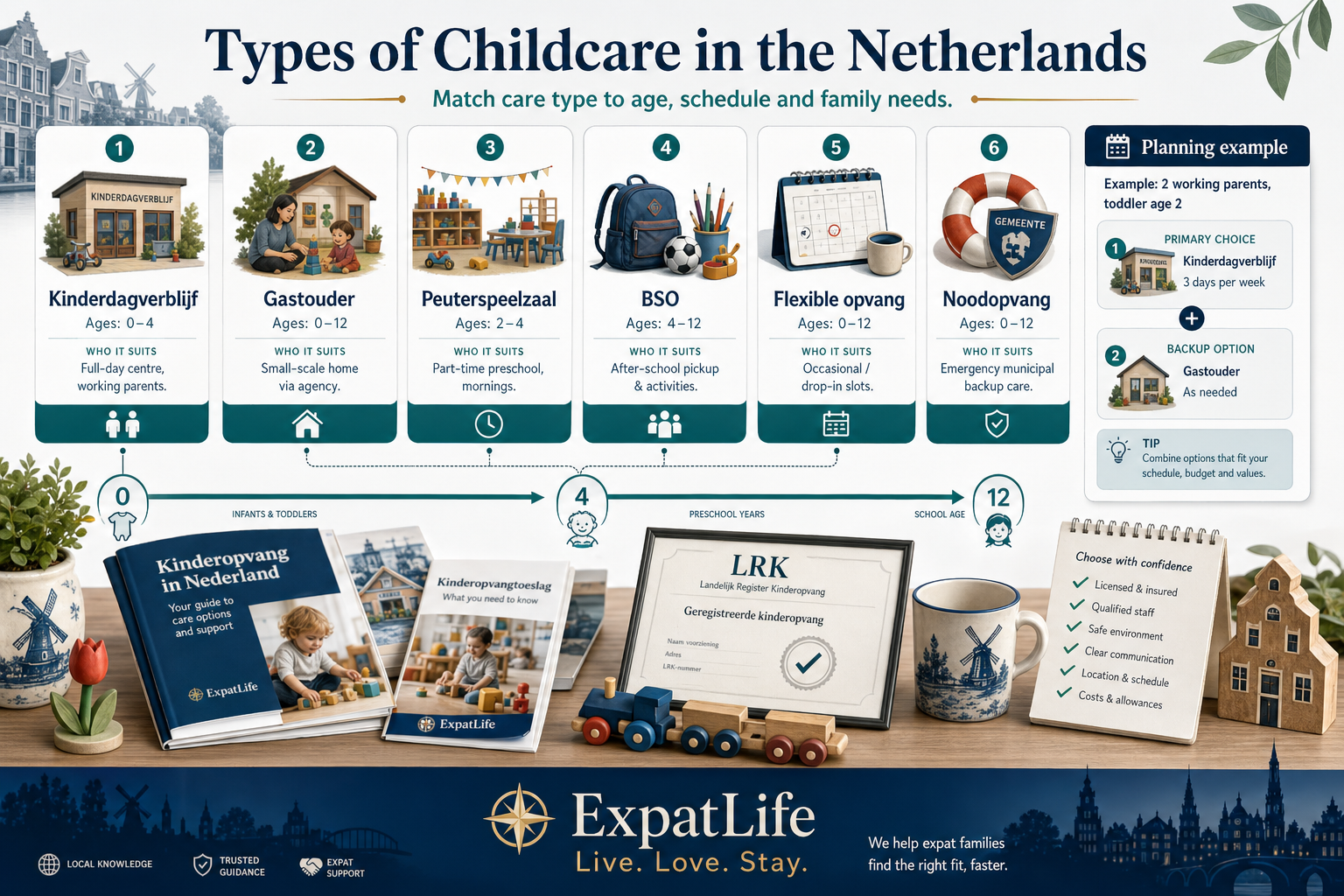
Kinderdagverblijf
Gastouder (via gastouderbureau)
Peuterspeelzaal
Buitenschoolse opvang (BSO)
Flexibele opvang
Spoedopvang
Providers
National and regional providers for orientation — always confirm availability, LRK registration and fees directly.
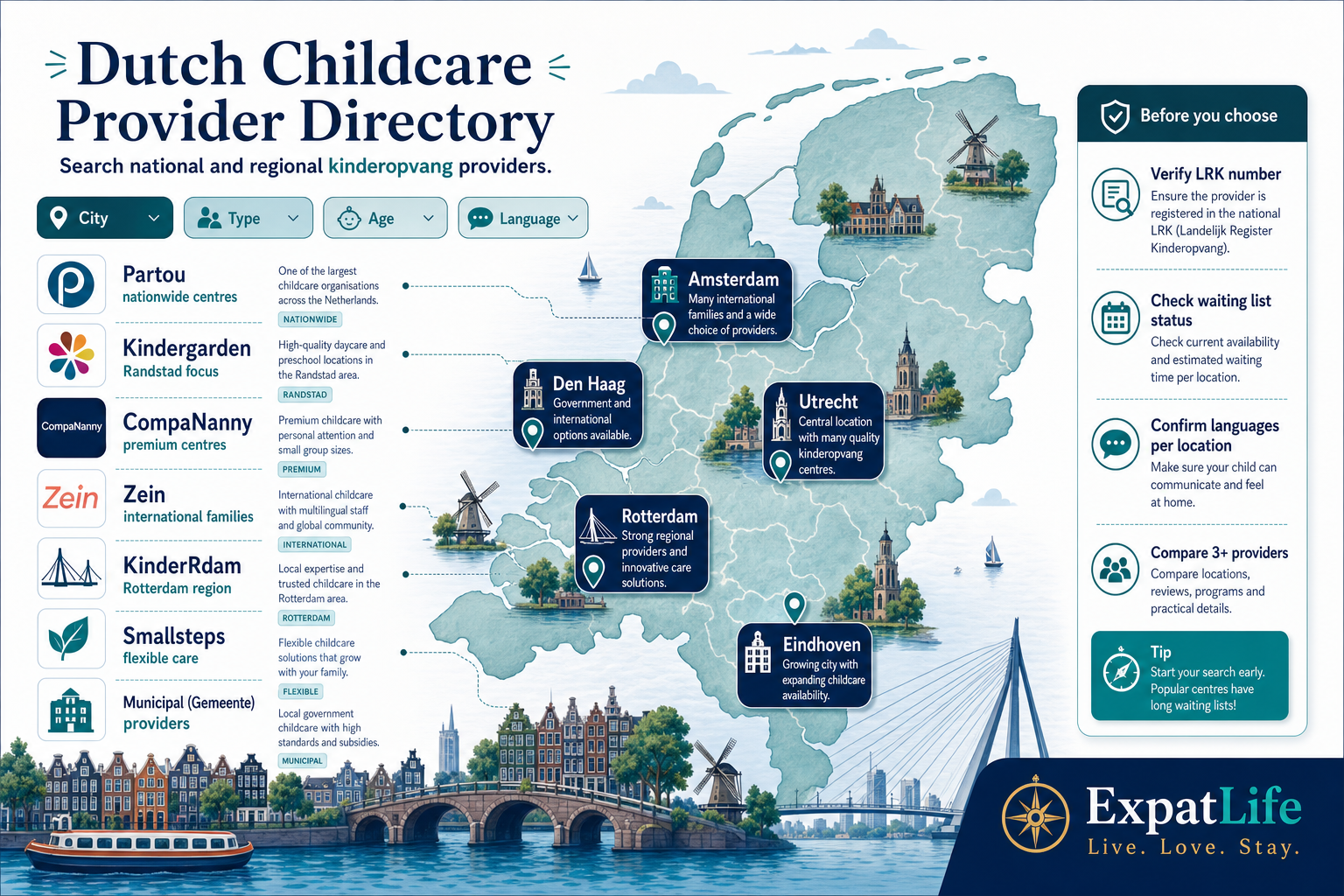
Directory data
National provider orientation list — verify LRK registration per location
14 providers · Last checked: June 2026
Verify availability, fees and LRK registration on each provider's website — listings are orientation only. We do not rank providers.
Showing 14 providers
| Provider | Cities | Type | Age groups | Languages | Website | Notes |
|---|---|---|---|---|---|---|
| CompaNanny | Amsterdam, Rotterdam, The Hague, Utrecht, Haarlem | Daycare, BSO | 0–12 | Dutch; English at select sites | Visit | Corporate and expat-heavy locations; confirm contract hours for toeslag eligibility. |
| Gastouderbureau (childminder agencies) | Nationwide | Childminder (gastouder) | 0–12 | Varies by host family | Visit | Flexible hours; lower statutory cap (€8.49/h 2026) — agency must be LRK-registered. |
| Humankind | Nationwide (non-profit) | Daycare, BSO, gastouder, preschool | 0–12 | Dutch | Visit | Non-profit umbrella; municipality partnerships — often shorter lists in smaller cities. |
| Impuls | Rotterdam, The Hague region | Daycare, BSO | 0–12 | Dutch | Visit | Regional provider; compare with KindeRdam and municipal options in Rotterdam. |
| Junis | Groningen, northern Netherlands | Daycare, BSO, preschool | 0–12 | Dutch | Visit | Main regional option in Groningen; generally shorter waits than Randstad hubs. |
| KidsFoundation | Amsterdam, Haarlem, Almere corridor | Daycare, BSO | 0–12 | Dutch; English at select locations | Visit | Multiple brands under one foundation; check individual location LRK numbers. |
| KindeRdam | Rotterdam, surrounding region | Daycare, BSO, preschool | 0–12 | Dutch; English at some locations | Visit | Rotterdam-focused; check port-area and suburban availability separately. |
| Kindergarden | Amsterdam, Rotterdam, The Hague, Utrecht, Eindhoven | Daycare, BSO | 0–12 | Dutch; English at many locations | Visit | Premium positioning; popular with expat families in Randstad — waiting lists common. |
| Ludens | Utrecht, Amersfoort region | Daycare, BSO, preschool | 0–12 | Dutch | Visit | Central Netherlands focus; university-city demand can tighten infant places. |
| Municipal childcare (gemeente) | All municipalities | Daycare, BSO, preschool (varies) | 0–12 | Dutch | Visit | Each gemeente lists local providers and sometimes priority rules — start at your municipality site. |
| Partou | Nationwide (100+ locations) | Daycare, BSO, preschool | 0–12 | Dutch; English at select locations | Visit | Large national chain; verify English-medium groups per location on LRK listing. |
| Peuterspeelzaal / preschool | All municipalities | Preschool | 2–4 | Dutch | Visit | Often 2–3 half-days per week; separate from full daycare — municipal lists show local options. |
Page 1 of 2
Budget
Childcare fees in the Netherlands vary by city, provider, age of child and number of hours contracted. Randstad cities typically sit at the higher end; regional cities may be lower but waiting lists still apply at popular locations.
Fees usually cover core care hours. Extras may include meals, diapers, late pickup, inset days and holiday programmes. Childcare allowance reduces your net payment if you qualify — it does not limit what providers charge. Always request a written quote for your exact days and hours.
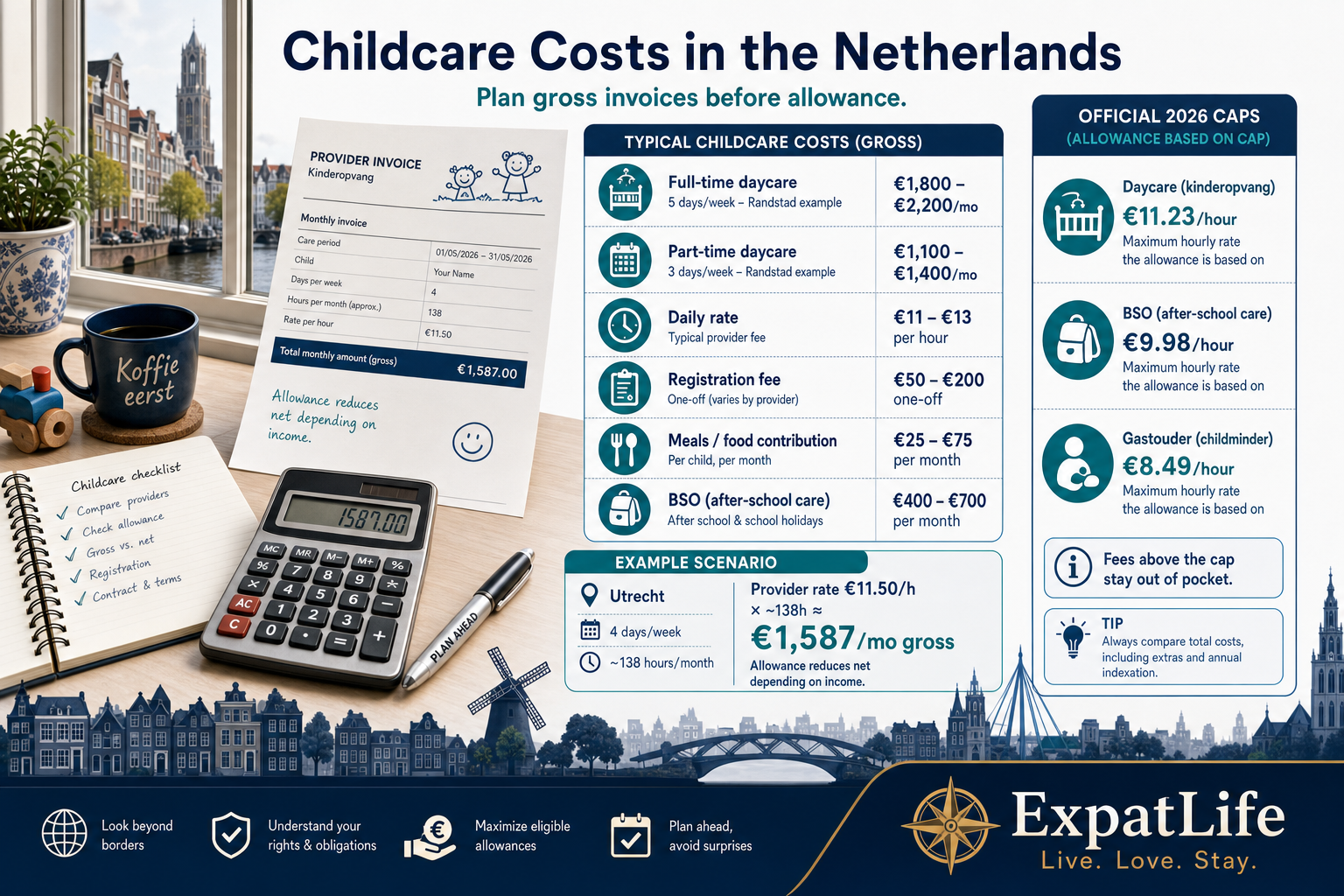
| Cost type | Full-time / one-time | Part-time / other | Notes |
|---|---|---|---|
| Full-time (4–5 days) | €1,400 – €2,400 / month | — | Randstad hubs often at upper range — verify per location |
| Part-time (2–3 days) | — | €700 – €1,500 / month | Pro-rata from full-time rate; minimum days may apply |
| Daily rate (indicative) | €70 – €110 / day | Varies by age | Babies often cost more than toddlers at same provider |
| Registration fee | €50 – €250 | One-time | Sometimes non-refundable — check contract |
| Meals & supplies | €3 – €8 / day | Optional at some providers | Hot lunch common at centres; gastouder may differ |
| BSO (after-school) | €400 – €900 / month | Per day ~€15 – €30 | Depends on school partnership and hours |
Fees change annually. Use provider quotes and Belastingdienst allowance estimates for your situation — this guide provides orientation ranges only.
Examples
| Profile | Scenario | What to check |
|---|---|---|
| Full-time baby — Amsterdam | 5 days kinderdagverblijf; both parents working full-time | Budget €1,800–€2,300 gross monthly before allowance — model net with toeslagen tool. |
| Part-time toddler — Utrecht | 3 days peuterspeelzaal; one parent part-time | Compare €800–€1,200 monthly; allowance depends on declared work hours. |
| Two children — The Hague | Daycare plus BSO for sibling | Separate contracts; sibling discount varies — ask each provider. |
| Gastouder — Haarlem | 4 days home-based care for age 1 | Often slightly lower daily rate but fewer English options — verify LRK via agency. |
Benefits
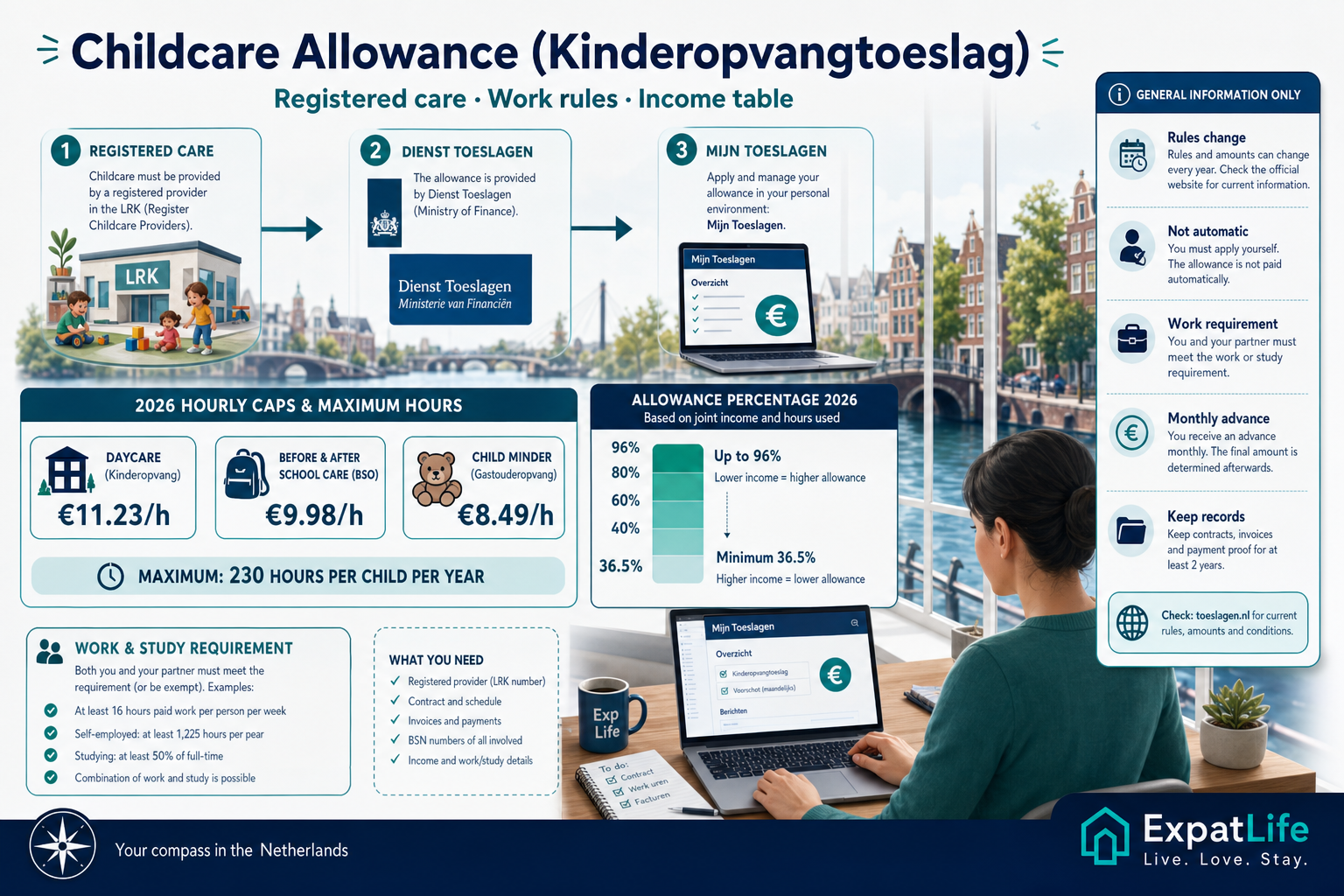
Childcare allowance helps eligible parents pay for registered LRK childcare. It depends on your household income, number of childcare hours used and hours you work or study. It is not a fixed amount — the Belastingdienst calculates your entitlement annually and can adjust during the year.
Both parents (or the single working parent) must meet work-hour requirements unless exceptions apply. You apply through the Belastingdienst after choosing registered childcare. Keep your hours and income updated — changes affect your allowance.
Timing
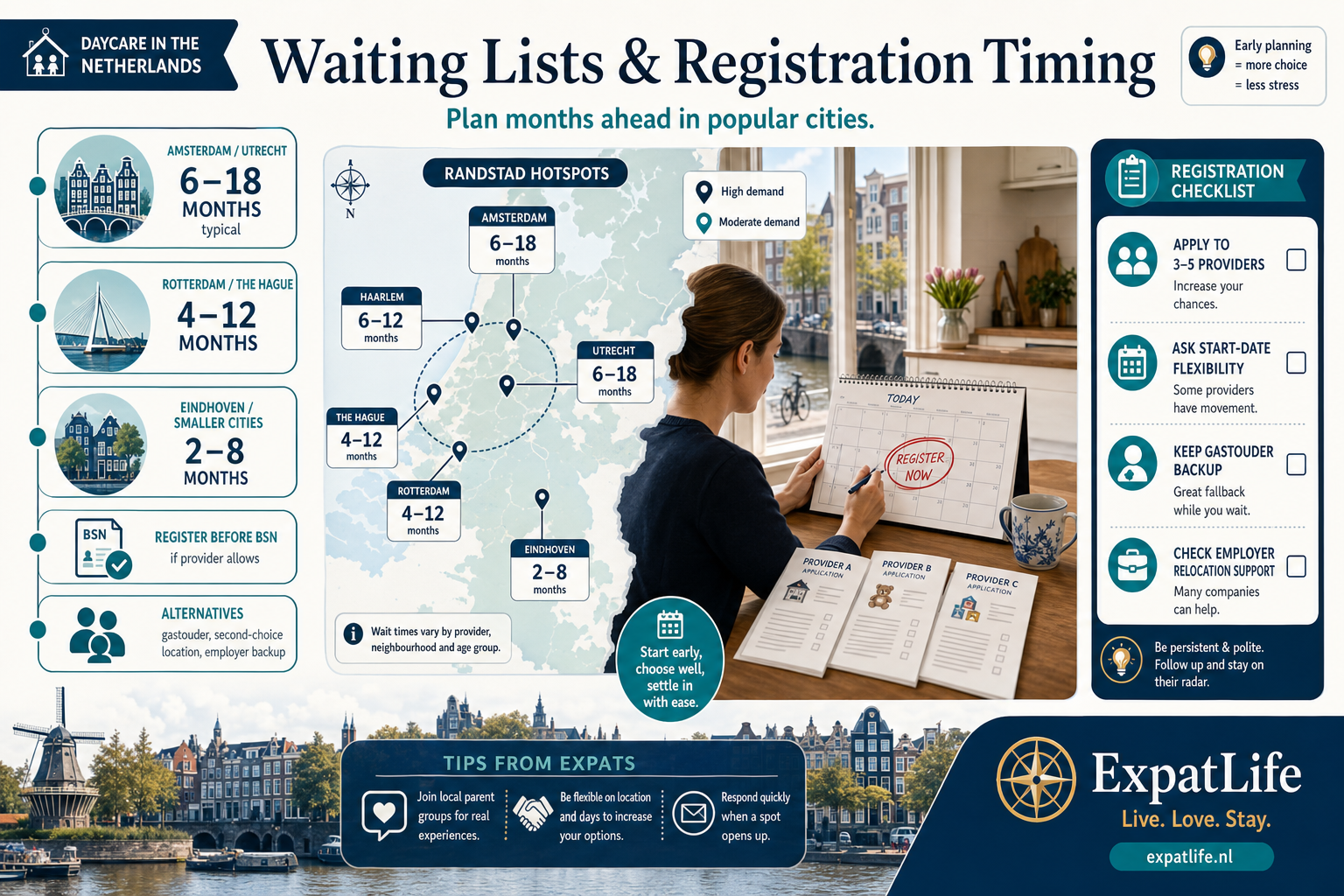
Waiting lists are standard in popular Dutch cities — especially for infant places in Amsterdam, The Hague, Utrecht and parts of Rotterdam. Lists are usually per location, not per chain: registering with Partou location A does not guarantee Partou location B.
Register as early as possible — many families join lists during pregnancy. Keep multiple active registrations and confirm your position in writing. If relocation timing is fixed, explore gastouder, temporary care or employer relocation support while you wait.
Examples
| Profile | Scenario | What to check |
|---|---|---|
| Pregnant — Amsterdam Zuid | Due date March; return to work September | Register 3–5 locations now; ask typical wait for infant start September. |
| Relocating in 8 weeks | Child age 2; job in Rotterdam | Email KindeRdam and municipal portal; accept temporary gastouder if needed. |
| Mid-year school start | Child turns 4 in April; needs BSO from September | Register BSO linked to basisschool early — separate from daycare list. |
| Waitlist only | First choice 6 months out | Keep second and third registrations active; confirm you won't lose place if you defer. |
Languages
Most registered childcare operates in Dutch — this supports integration and matches the language of basisschool. Some providers in international corridors (The Hague, Amsterdam, parts of Rotterdam) offer English-speaking staff or bilingual groups, but these are limited and often have longer waiting lists.
Children typically adapt quickly at young ages. Many expat families combine Dutch childcare with English at home. Ask providers about daily language use, how they support non-Dutch speakers and whether they track language development.
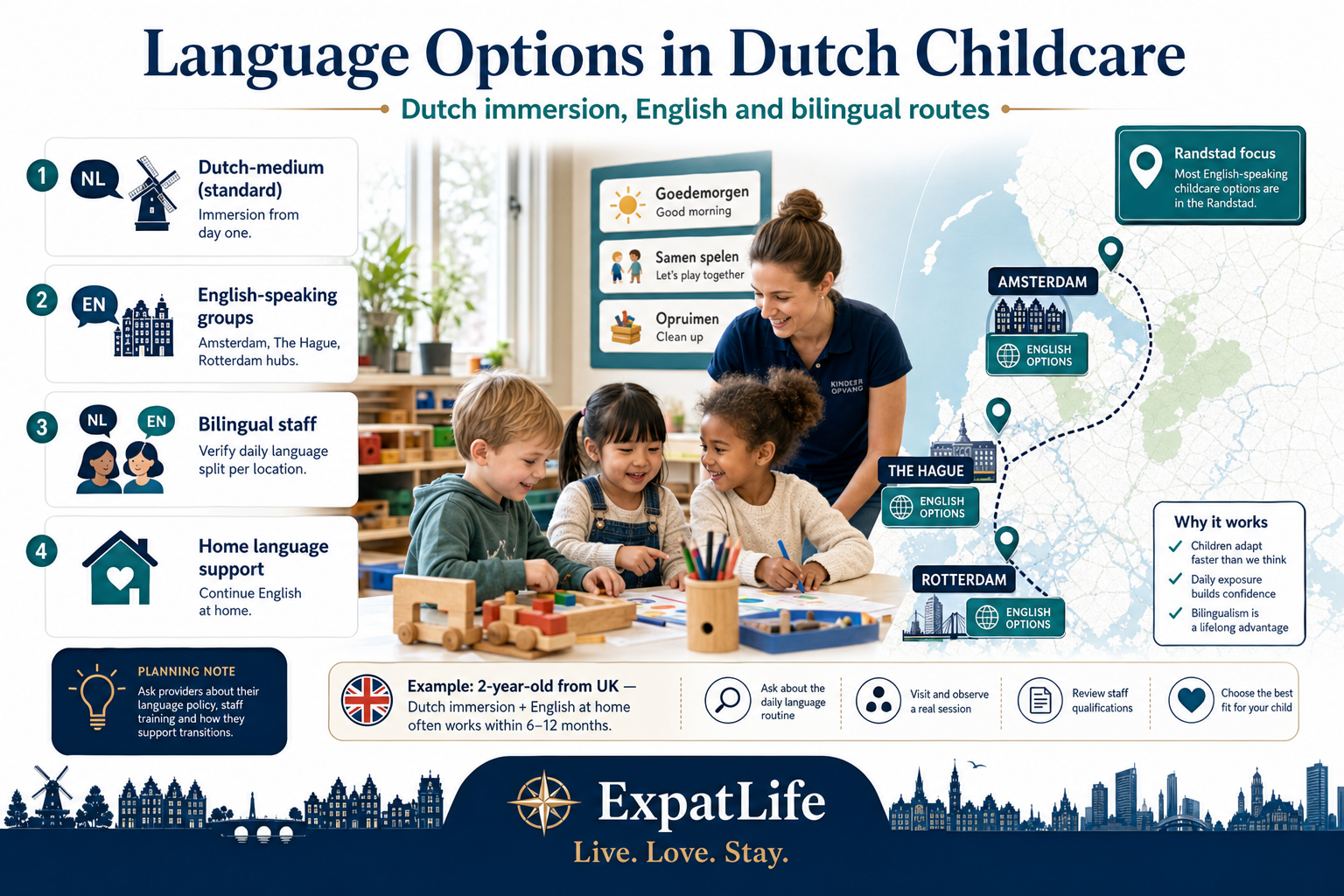
Standard at most LRK locations — full immersion from daily routines and peer interaction.
Available at select providers (e.g. Zein, some Kindergarden/CompaNanny locations) — verify per site.
Some centres use both languages in routines — ask how staff switch and what ratio applies.
The Hague and Amsterdam have the widest orientation — still expect Dutch in most daily activities.
GGD and pedagogical policy focus on Dutch progress — useful preparation for basisschool.
Safety
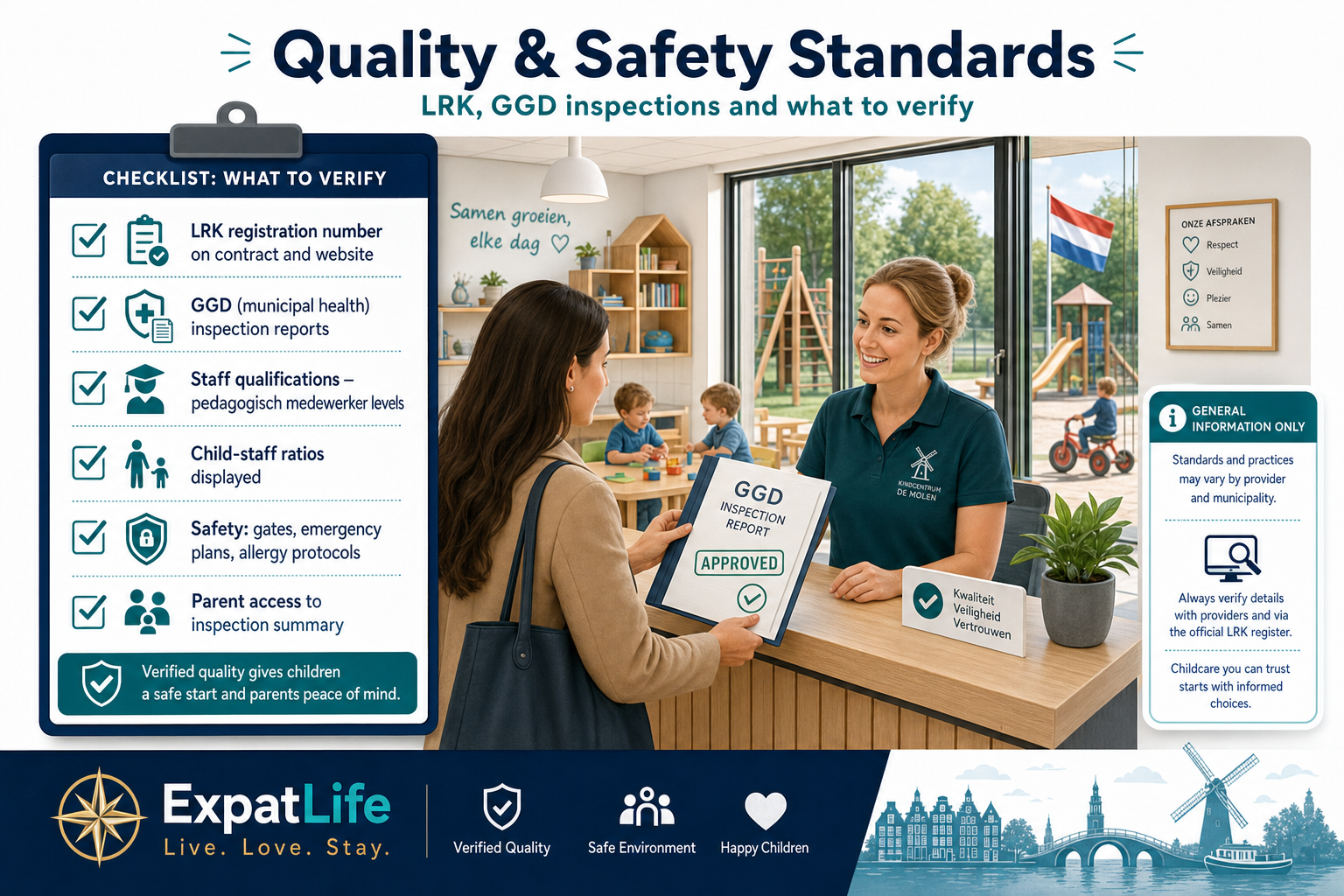
All LRK-registered childcare must meet Dutch quality standards. The GGD inspects locations regularly and publishes reports. Staff qualifications, child-staff ratios and safety procedures are legally defined.
Before signing, verify LRK registration on lrk.net, read the latest GGD inspection report and ask about staff turnover, emergency procedures and outdoor play policy during visits.
Quality verification checklist
Questions to ask providers
Decide
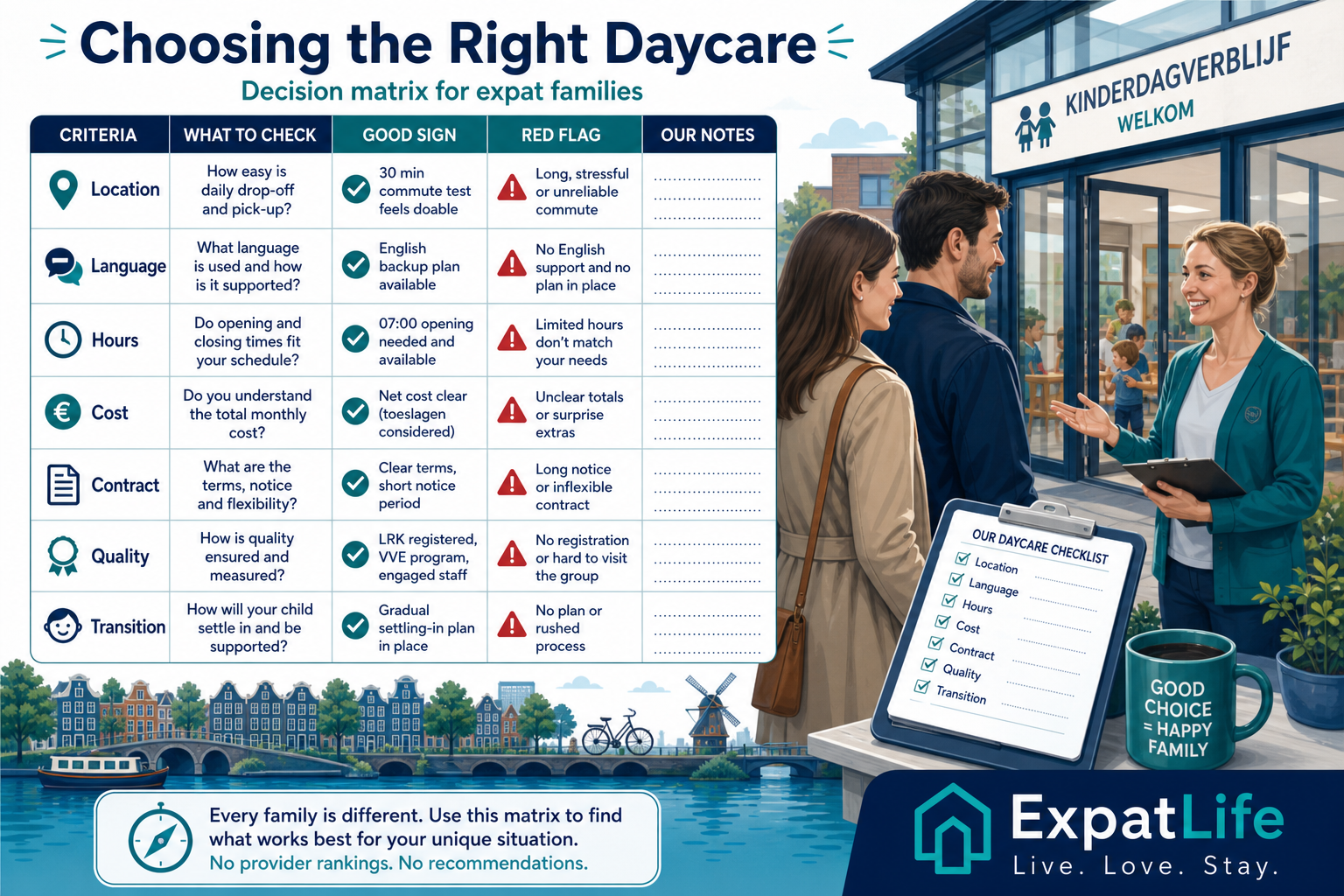
There is no universal best childcare provider — the right fit depends on location, hours, language, cost, outdoor space, meals, pedagogical philosophy and waiting list timing. Use the matrix below as a conversation tool during visits and provider calls.
| Factor | Ask yourself | Example |
|---|---|---|
| Location | Is pickup realistic on your commute home? | Amsterdam centre job + Haarlem daycare = tight evening pickup window. |
| Hours | Do opening times cover your work pattern? | 18:30 close with 18:15 meetings — check late fees. |
| Languages | Dutch immersion vs English support priority? | Long-term NL stay → Dutch care helps basisschool transition. |
| Cost | Total monthly cost after allowance, not gross fee? | €2,000 invoice minus variable allowance — model both scenarios. |
| Outdoor play | Daily outdoor time and garden quality? | Canal-centre locations may have smaller outdoor areas. |
| Meals | Hot lunch included? Allergy policy? | Nut-free policy varies — critical for allergic children. |
| Philosophy | Montessori, VVE, nature-based or standard model? | VVE locations offer extra early-years support — ask gemeente. |
| Waiting lists | Realistic start date vs your return-to-work date? | Backup gastouder if primary list is 4 months out. |
How to choose a daycare — step by step
After school
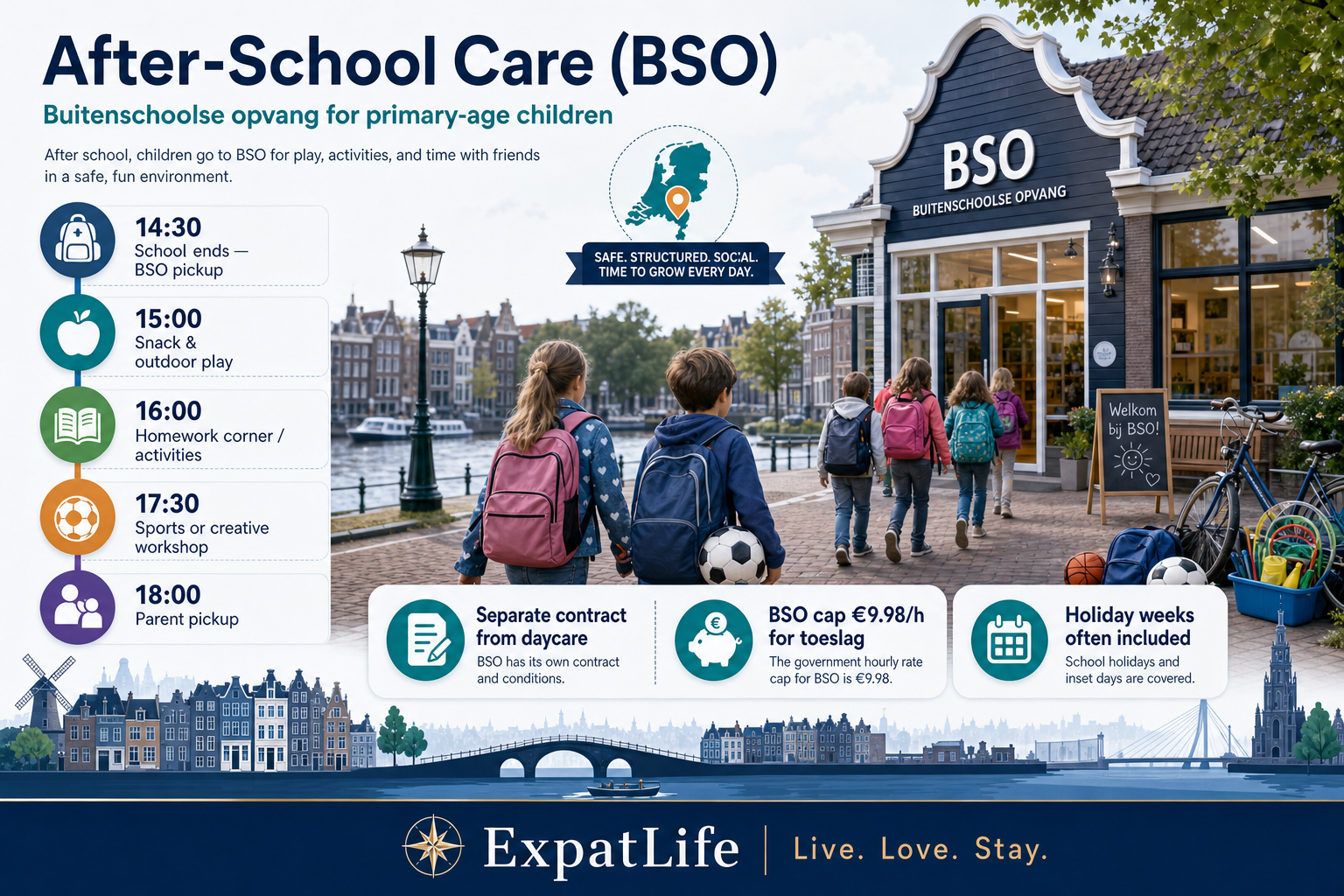
Buitenschoolse opvang (BSO) provides care after basisschool until parents finish work — typically until 18:00. Many providers run BSO at or near primary schools; activities include sports, crafts, outdoor play and homework support.
BSO requires separate registration from kinderdagverblijf. Register when your basisschool place is confirmed — popular school-linked BSO fills quickly in cities.
Preschool
Peuterspeelzaal offers play-based care for children roughly aged 2–4, preparing them socially and linguistically for basisschool. Sessions may be half-day or full-day depending on provider and municipality.
Many expat families use peuterspeelzaal as a gentler step before full kinderdagverblijf or alongside part-time work. VVE (early childhood education) programmes at some locations provide extra support for language development.

Cities
Waiting lists and fees differ by city — compare before finalising housing.
Relocate
Relocating with babies or toddlers adds urgency to childcare planning. Start researching providers before arrival if possible — many accept pre-arrival waiting list registration with expected address and start date.
Temporary options include gastouder care, employer relocation packages with childcare support and short-term spoedopvang while you secure a permanent place. Register with your gemeente after address registration for local orientation resources.
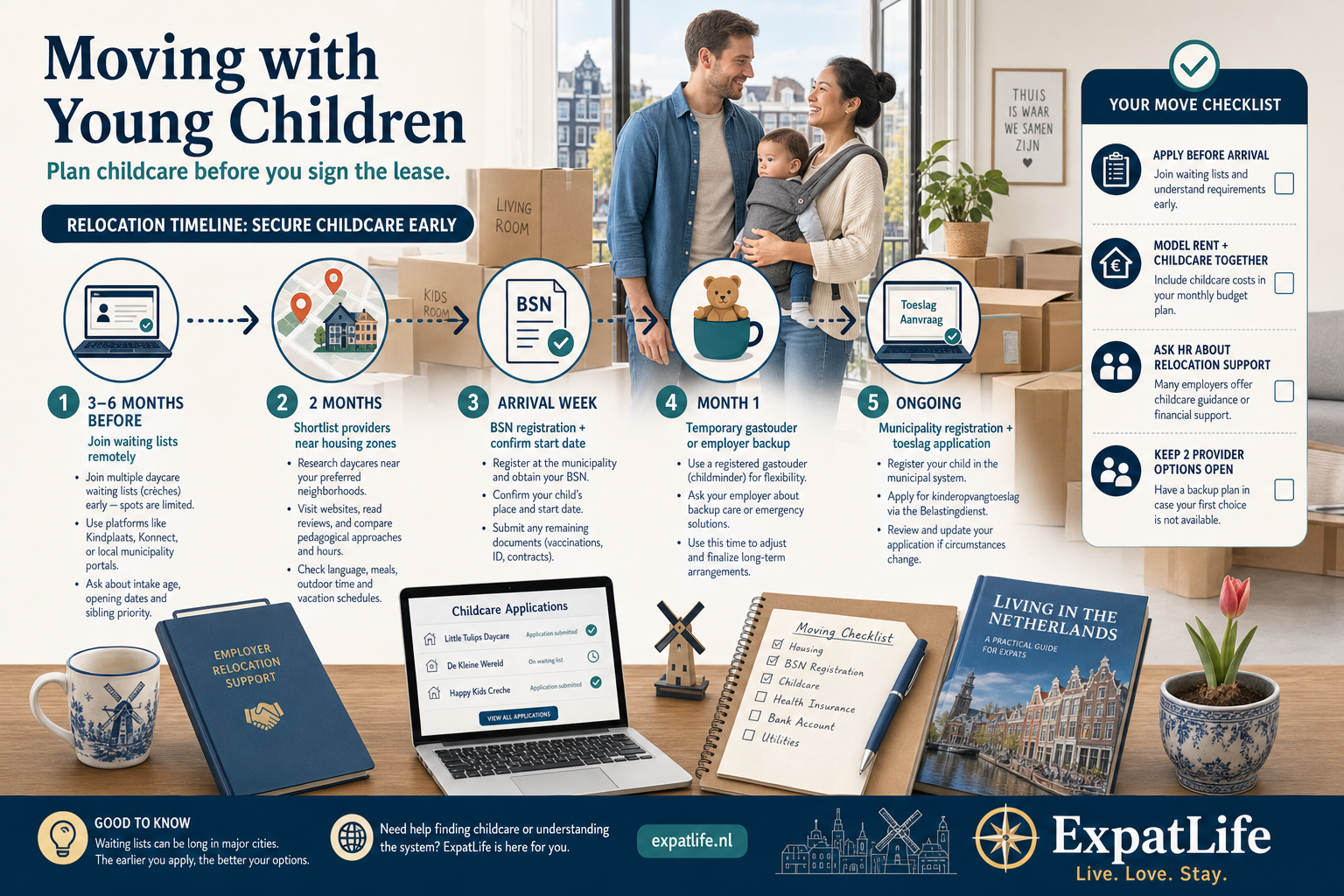
Pre-arrival childcare checklist
Checklist
Work through this list as soon as your move dates and work contracts are confirmed.
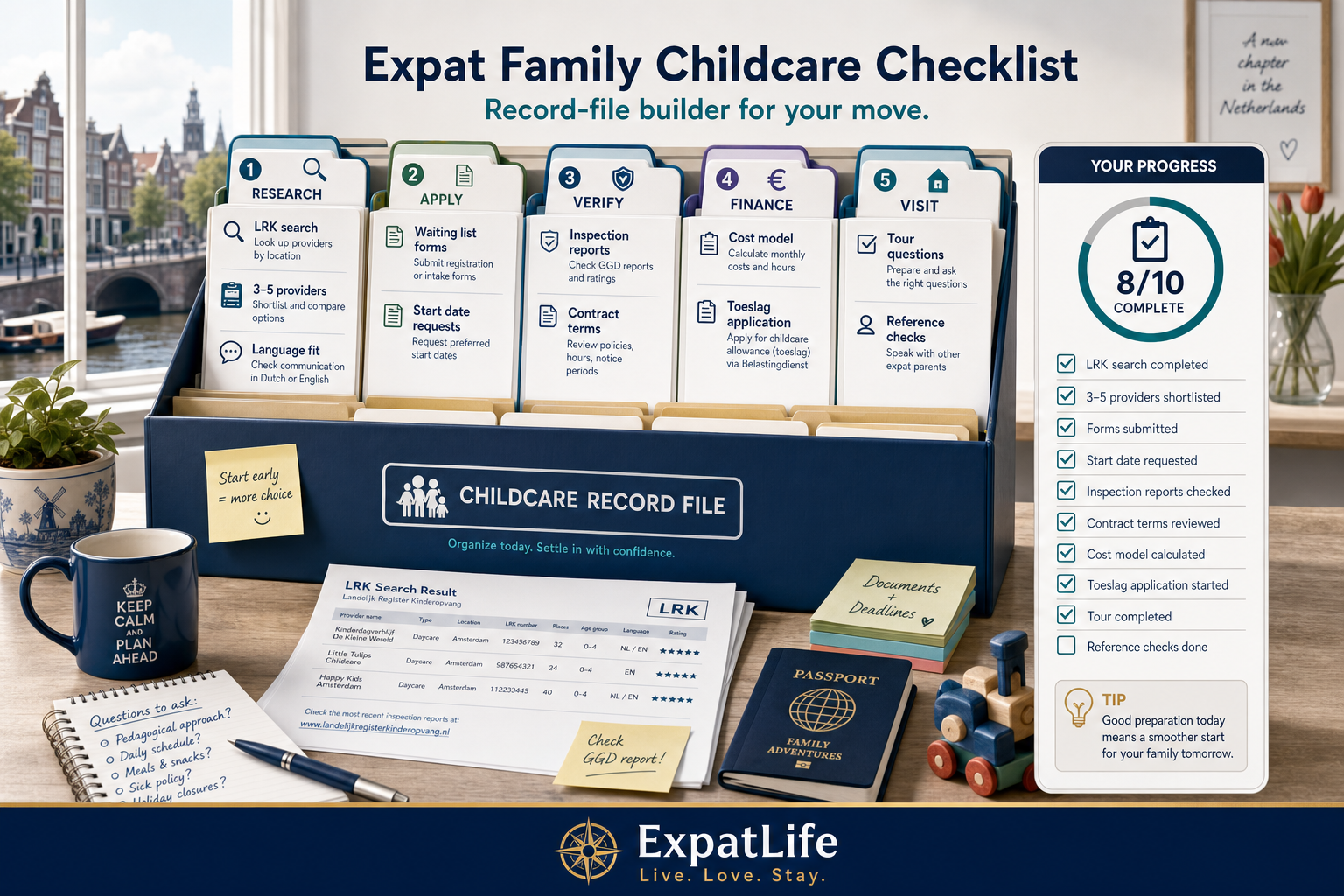
6–12 months out: research phase
Registration phase
Pre-start phase
Full planning checklist
Avoid
These patterns cause stress for relocating families — plan around them early.
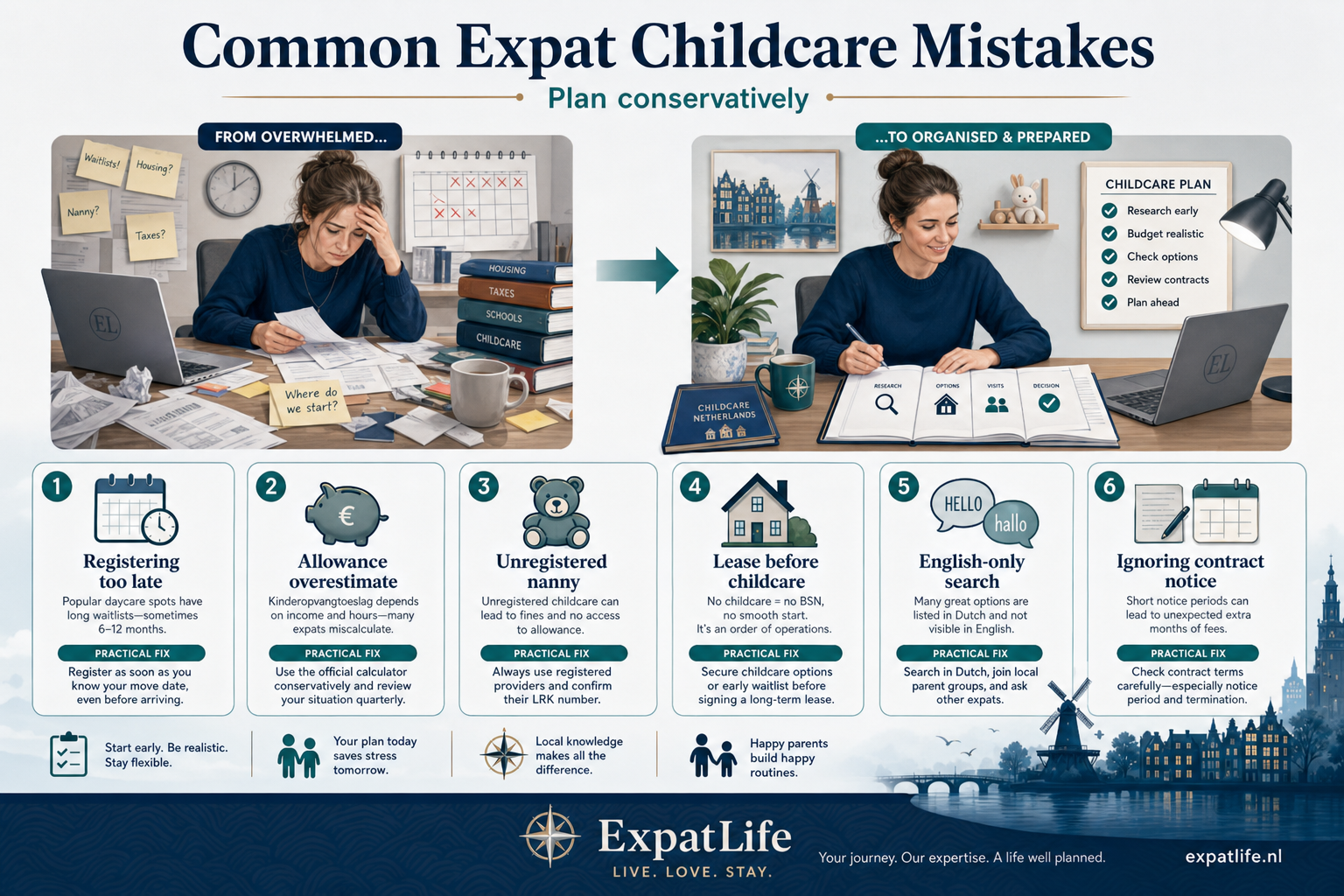
Example: joining lists two months before return-to-work in Amsterdam — infant places often need 6+ months lead time.
Example: relying on a single location without backup — lists are per site; keep multiple active registrations.
Example: choosing a provider 45 minutes from work — late pickup fees and stress add hidden cost.
Example: skipping GGD report review — corrective actions may affect quality or safety.
Example: assuming a fixed €500 subsidy — allowance is income and hour dependent via Belastingdienst.
Example: cheapest provider far from home with poor outdoor space — fit and logistics matter more.
Example: expecting full English care without verifying — most locations are Dutch-medium daily.
FAQ
Orientation answers — confirm provider-specific rules and allowance entitlement on official sources.
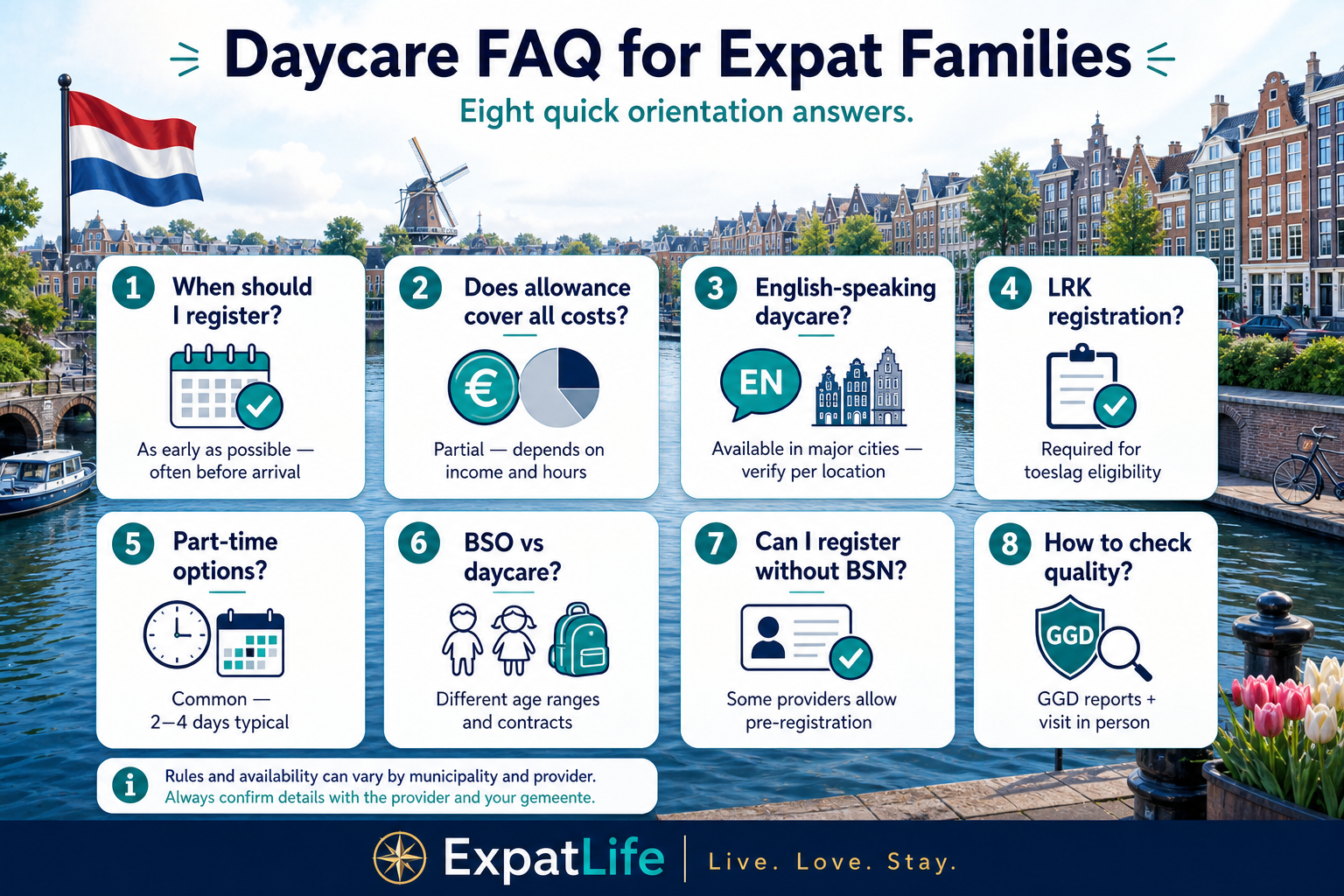
Kinderopvang is the umbrella term for registered childcare — including kinderdagverblijf (daycare), gastouder (home-based), peuterspeelzaal (preschool) and BSO (after-school care). Providers must be LRK-registered for allowance eligibility.
Full-time daycare commonly ranges from roughly €1,400–€2,400 per month depending on city and age, before allowance. Part-time and daily rates vary — request a written quote from each provider for your exact schedule.
Each location maintains its own waiting list. Popular cities often require months of lead time for infant places. Register early at multiple providers and confirm your position in writing.
Yes, if you meet Belastingdienst rules — including registered LRK childcare, income thresholds and work-hour requirements. Apply via the toeslagen portal with DigiD once your contract starts.
Kinderdagverblijf is centre-based group care with fixed hours and larger teams. Gastouder is home-based care in small groups, often via a gastouderbureau agency — usually more flexible but fewer English options.
As early as possible — many families register during pregnancy for Randstad cities. Do not wait until your parental leave ends; align registration with your housing and work timeline.
Some providers in The Hague, Amsterdam and Rotterdam offer English-speaking staff or groups, but most care is Dutch-medium. Verify language policy at each specific location — it is not standard nationwide.
BSO is after-school care for primary school children, typically until around 18:00. It is registered separately from daycare — register when your basisschool place is confirmed.
Family guides
Connect childcare planning with schools, benefits and relocation content.
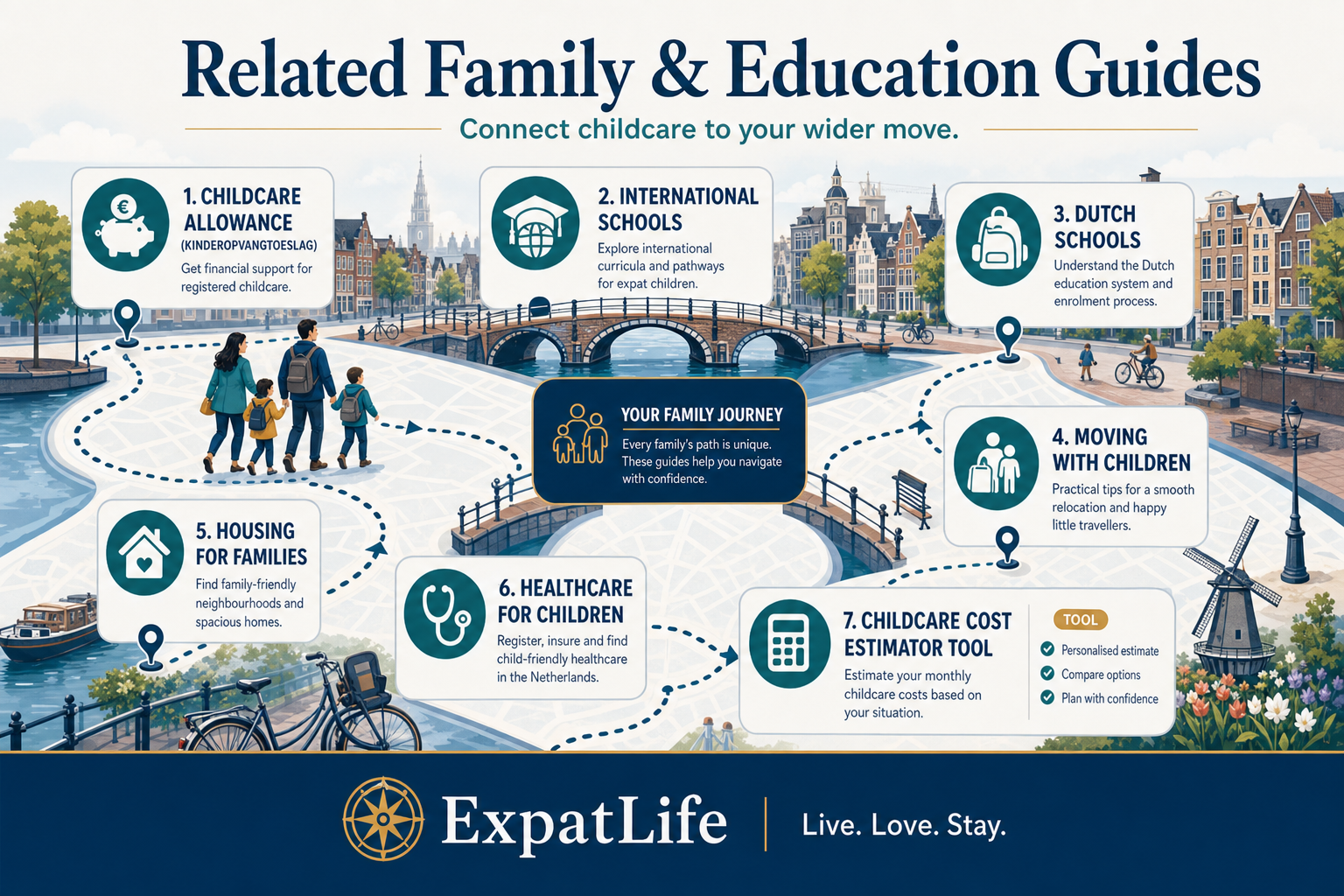
Education hub
This page is the childcare cornerstone — explore related education topics next.

Explore next
Continue planning with allowance, schools and family relocation guides.

Trust
Childcare fees, availability and allowance rules change. Always verify current information on official provider websites, lrk.net and Belastingdienst sources — this guide is orientation only, not financial or placement advice.