
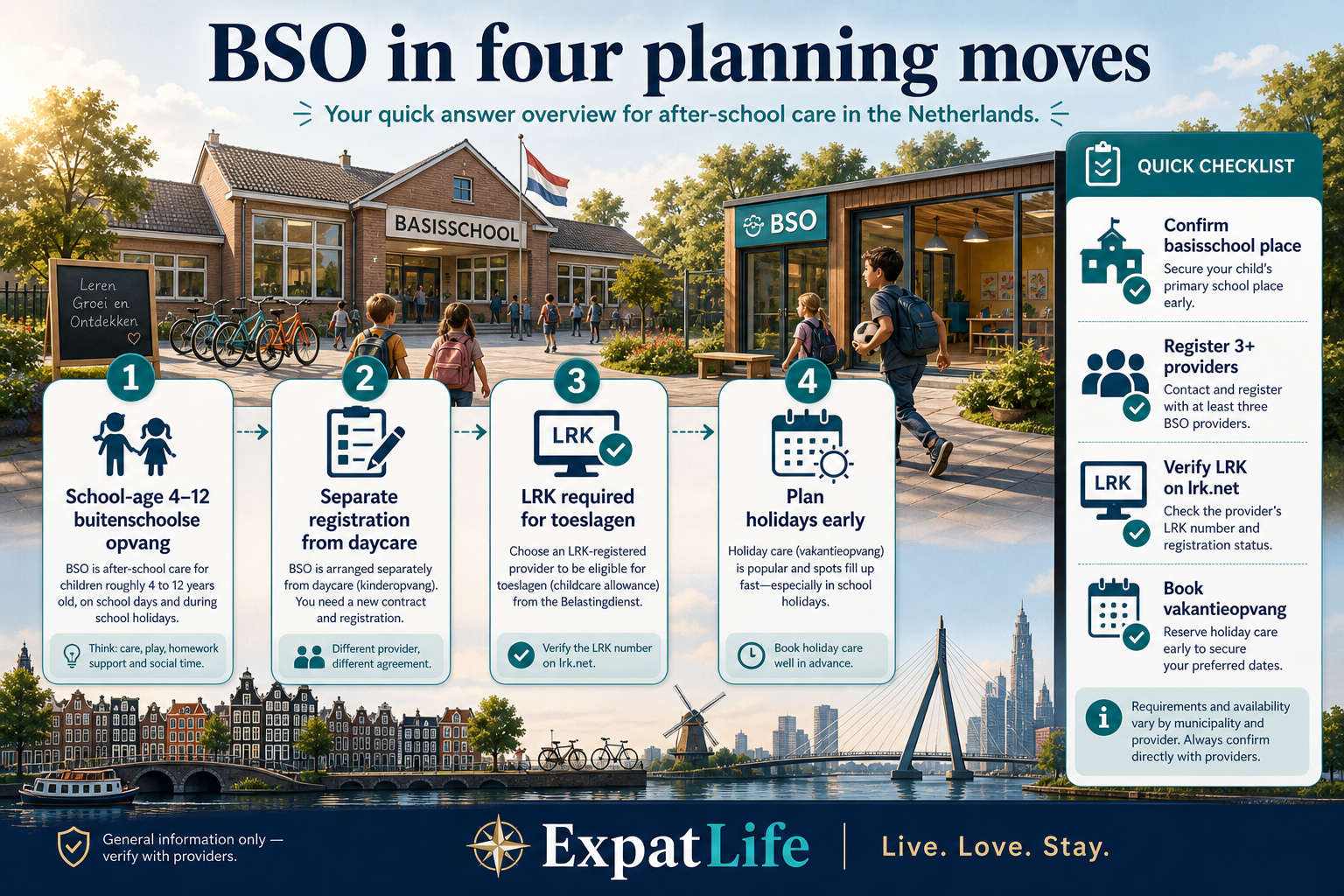
Separate from daycare
Example: a kinderdagverblijf contract does not automatically continue as BSO when your child starts group 2 at basisschool.
Netherlands · Education · Childcare · BSO
Everything parents need to know about BSO, including before-school care, after-school care, holiday programmes, childcare allowance and choosing the right provider.
Practical orientation only — not childcare advice. Availability, fees and allowance rules vary. We do not rank providers subjectively.

Quick answer
Buitenschoolse opvang (BSO) is registered after-school childcare for primary school children, typically ages 4–12. Working parents use BSO to cover hours before school (VSO), after school until roughly 18:00, and often during school holidays and study days when basisschool is closed.
BSO is separate from kinderdagverblijf (daycare). You register with an LRK-registered BSO provider — often linked to your child's school or a nearby location. Childcare allowance (kinderopvangtoeslag) can reduce net costs if you meet Belastingdienst work-hour and income rules.
Waiting lists are common in Amsterdam, The Hague and other Randstad cities, especially for school-linked locations with English support. Register as soon as your basisschool place is confirmed and keep multiple applications active. This guide helps you compare real providers, plan holidays and connect BSO with school and commute choices — it does not rank providers or guarantee placement.
Example: a kinderdagverblijf contract does not automatically continue as BSO when your child starts group 2 at basisschool.
Example: many BSO locations collect children from partner schools — verify your school is on the pickup list.
Example: summer weeks may need separate holiday camp booking — capacity is limited and lists open early.
Example: only LRK-registered BSO qualifies for kinderopvangtoeslag — verify on lrk.net before signing.
Examples
| Profile | Scenario | What to check |
|---|---|---|
| Dual-income — Amsterdam | Child in Dutch basisschool group 3; both parents work until 18:00 | Register BSO at 2–3 providers near school; confirm pickup from your basisschool; model allowance with work hours. |
| International school — The Hague | English-medium primary; parents need holiday cover | Compare Zein and Kindergarden; ask about ISH pickup routes; book holiday weeks in spring for summer. |
| Part-time parent — Utrecht | BSO 3 afternoons per week; one parent works flex | Match contract days to allowance work-hour rules; ask about flexible drop-off on non-BSO days. |
| Pre-arrival planning | Relocating July; child starts basisschool September | Email providers before arrival; join waiting lists remotely where accepted; plan gastouder backup. |
At a glance
Compare care types before contacting providers — waiting lists and fees vary significantly by city and school partnership.
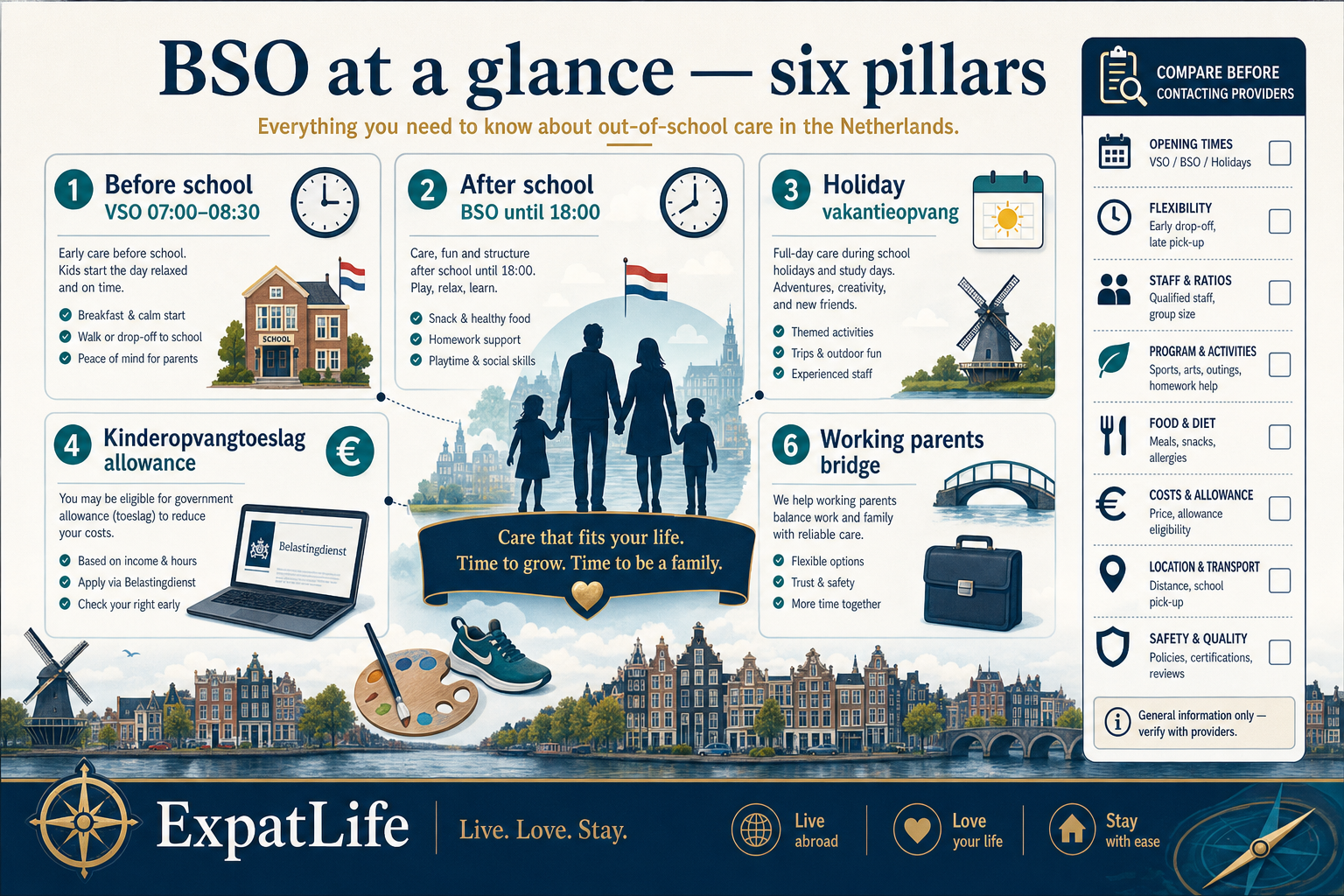
Before school
VSO / early care
Morning cover from ~07:00 until school starts — not every location offers it.
After school
BSO core hours
Collection from school through ~18:00 — the main working-parent solution.
Holiday care
School breaks
Summer, Christmas and spring programmes — often separate booking and fees.
Allowance
Kinderopvangtoeslag
Income-dependent subsidy for LRK-registered care — apply via Belastingdienst.
Sports & activities
Clubs & play
Football, crafts, outdoor play and homework corners vary by provider.
Working parents
Bridge school gap
BSO aligns childcare with Dutch school hours and employer schedules.
Basics
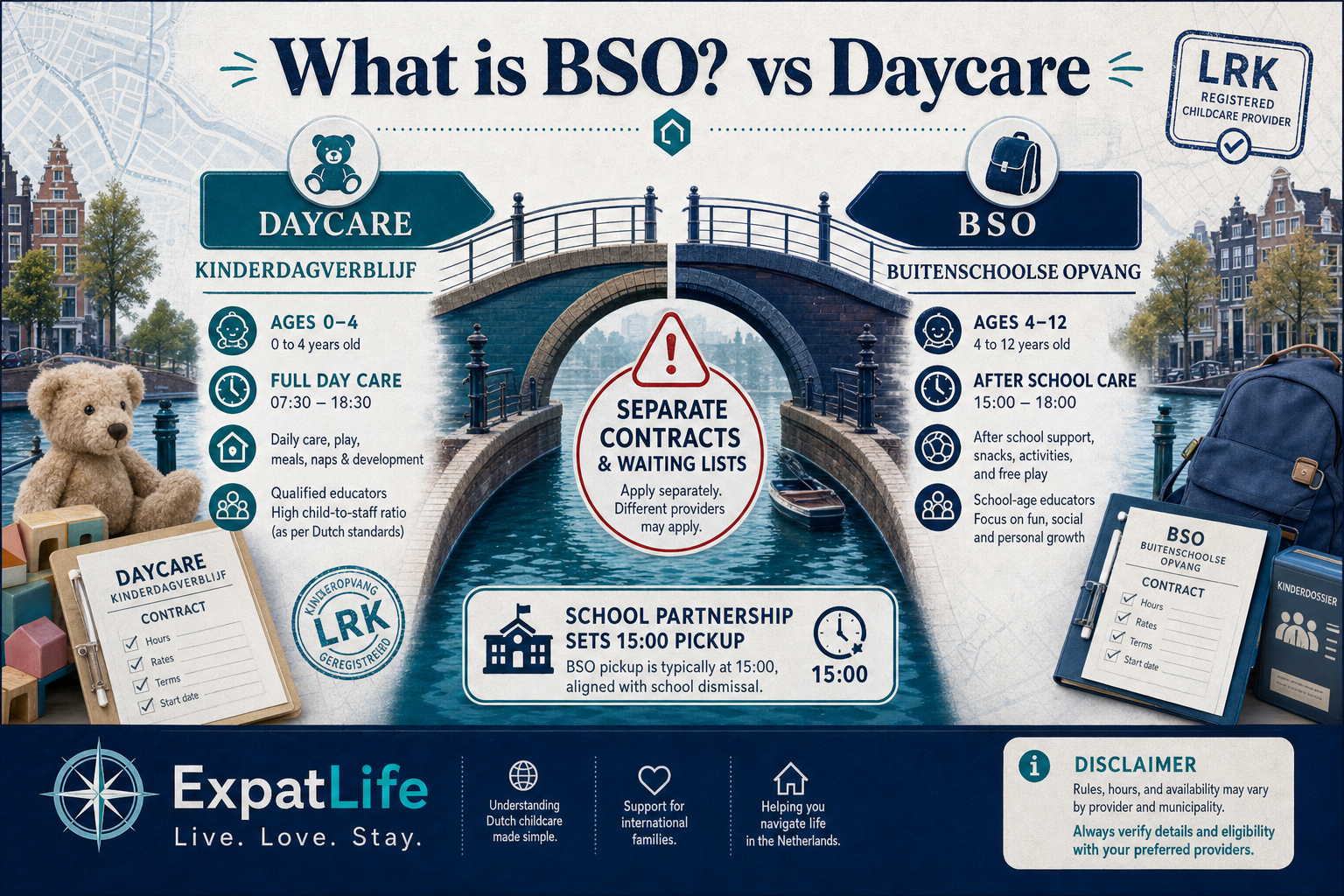
BSO is licensed out-of-school care for children who attend primary school (basisschool). It fills the gap between school hours and typical working hours, and can extend to mornings, holidays and study days depending on the provider and your contract.
Most BSO locations operate in or near schools, community centres or dedicated childcare buildings. Staff collect children from partner schools or receive them at a central pickup point. Programmes mix supervised play, activities, outdoor time and quiet homework periods.
Unlike kinderdagverblijf for babies and toddlers, BSO assumes children can follow school routines, eat independently and participate in group activities. Ages typically span 4–12 until the end of basisschool (group 8), though exact age limits vary by provider.
| Factor | BSO vs daycare | Planning note |
|---|---|---|
| Age focus | BSO: 4–12 school-age · Daycare: 0–4 early years | Plan BSO registration when basisschool place confirmed |
| Hours | BSO: after school ~15:00–18:00 · Daycare: full day ~07:30–18:30 | Match contract to actual pickup window |
| Registration | Separate contracts and waiting lists per care type | Do not assume automatic transfer from daycare |
| School link | BSO often tied to school pickup routes | Housing and school choice affect BSO options |
| Holiday care | BSO may offer camps; daycare offers different holiday model | Book holiday weeks early in Randstad cities |
Options
Match care type to your work pattern, school calendar and child's age — not every location offers every option.
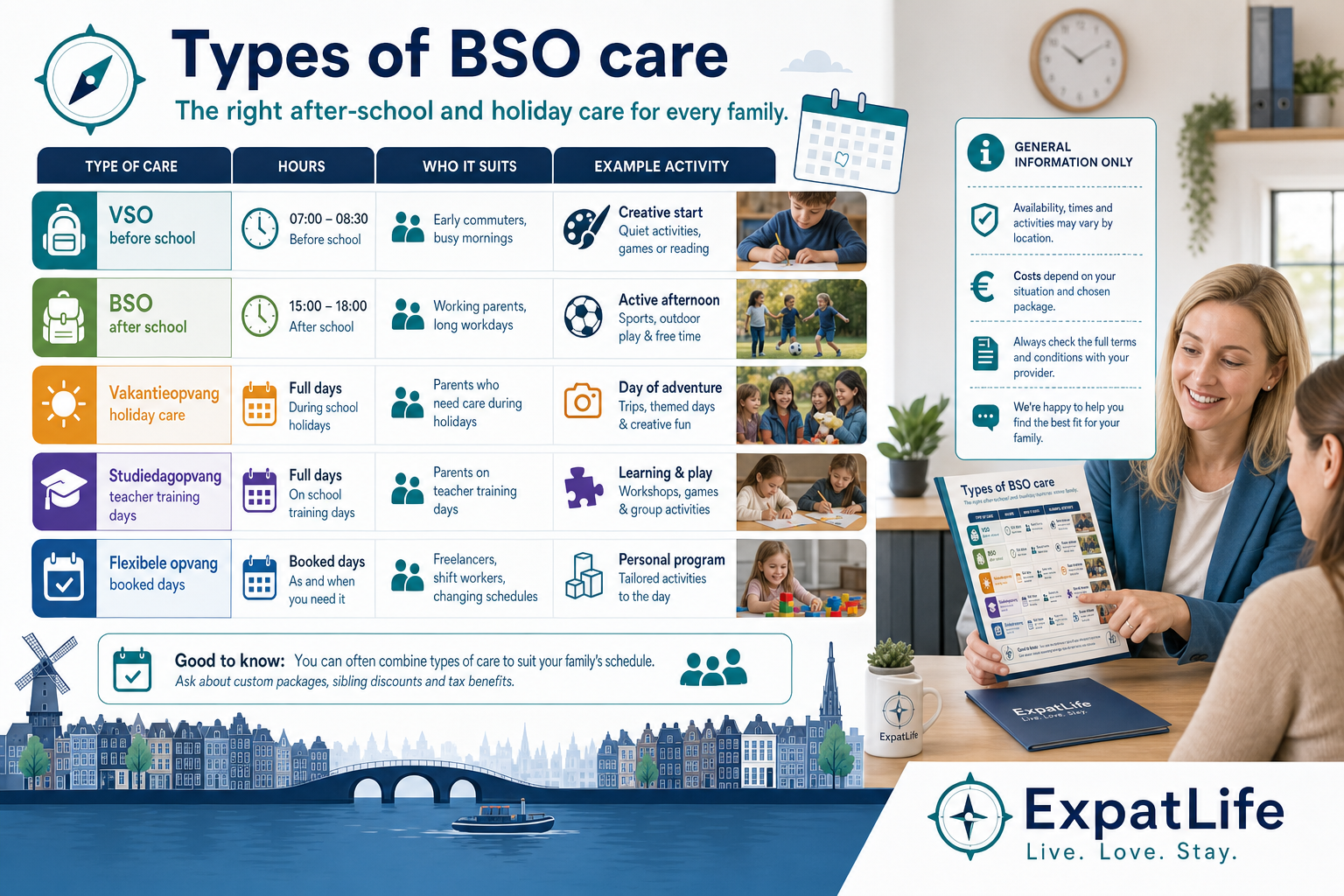
VSO (voorschoolse opvang)
BSO (buitenschoolse opvang)
Vakantieopvang
Studiedagopvang
Flexibele opvang
Examples
| Profile | Scenario | What to check |
|---|---|---|
| Both parents 09:00–17:30 | Dutch basisschool; need cover every weekday | 5-afternoon BSO with school pickup; model allowance with combined work hours. |
| One early shift | Parent starts at 07:00 twice a week | VSO + BSO combo at same provider or two locations — not all chains offer both. |
| Part-time worker | BSO needed Tue/Thu only | Flexible contract days; allowance still requires minimum work-hour rules. |
| Grandparents in summer | Term-time BSO only; 3 summer weeks uncovered | Book vakantieopvang weeks separately — capacity is limited in August. |
Routine
Routines differ by provider, season and age group — use this timeline as a visit checklist, not a guarantee.
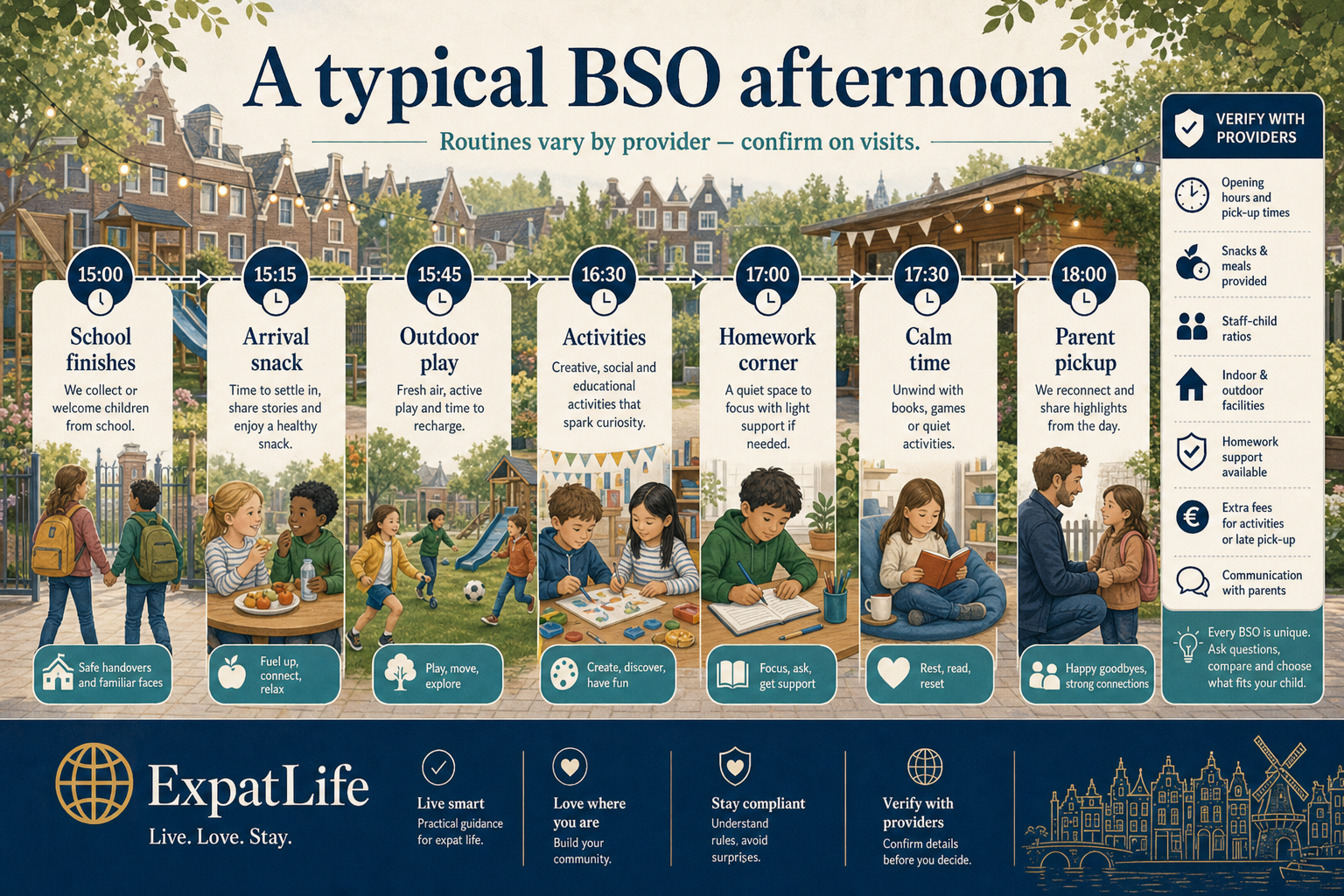
15:00
BSO staff collect children from playground or designated pickup point at partner school.
15:15
Children register, change shoes, wash hands and settle into the group space.
15:30
Fruit, bread or provider-provided snack — allergy policies vary; share medical info at intake.
15:45
Garden, playground or nearby park — Dutch providers often prioritise daily outdoor play.
16:30
Sports, crafts, music or themed projects led by pedagogical staff.
17:00
Quiet tables for reading and school tasks — especially for older groups.
17:30
Board games, drawing or relaxed play as pickup window approaches.
18:00
Authorised adults collect children — late pickup fees may apply after closing time.
What to check on a BSO visit
Play & learn
Programmes vary by provider, season and age group — ask about daily outdoor time and activity rotation during visits.
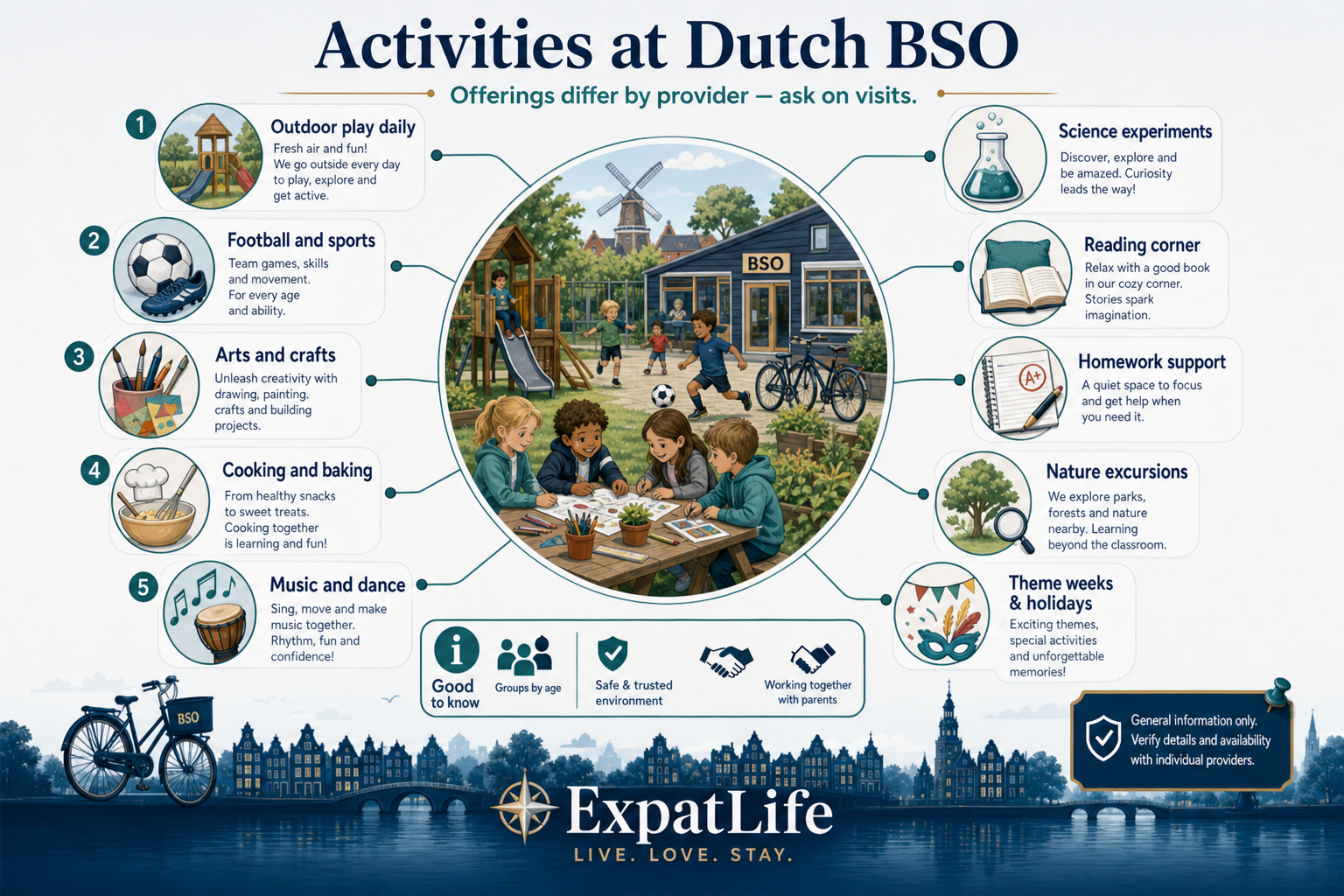
Daily garden or park time — weather-permitting outdoor culture is central to Dutch childcare.
Football, dodgeball, cycling skills and team games in the BSO garden or gym hall.
Painting, building, seasonal projects and creative workshops with recycled materials.
Simple recipes, fruit prep and occasional baking sessions — good for motor skills and teamwork.
Singing, rhythm games and movement sessions — some locations link to external music teachers.
Hands-on experiments, nature observation and STEM-themed activity weeks.
Quiet corners with Dutch and sometimes English books — supports language development.
Supervised tables for school tasks — staff encourage independence, not tutoring.
Local walks, forest days and museum trips during holiday programmes.
Holiday camps around sports, art or adventure themes — popular in summer programmes.
Providers
National and regional providers for orientation — always confirm availability, LRK registration and school pickup lists directly.
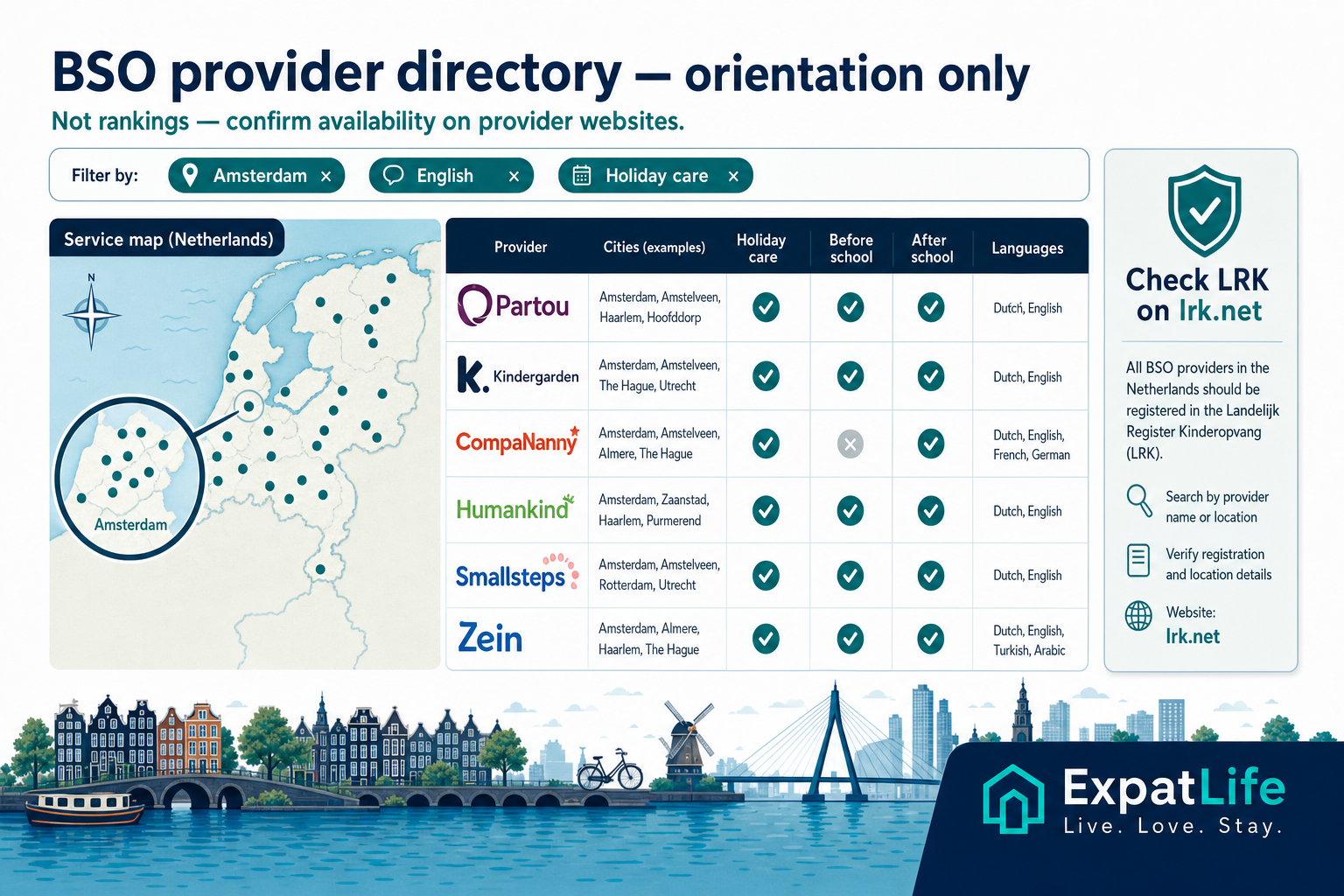
Showing 11 providers
| Provider | Cities | Holiday care | Before school | After school | Languages | Website |
|---|---|---|---|---|---|---|
| CompaNanny | Amsterdam, Rotterdam, The Hague, Utrecht, Haarlem | Yes | Limited locations | Yes | Dutch; English at select sites | Visit |
| Humankind | Nationwide (non-profit) | Yes — varies by location | Select locations | Yes | Dutch | Visit |
| Impuls Kinderopvang | Rotterdam, The Hague region | Yes | Select locations | Yes | Dutch | Visit |
| Junis | Groningen, northern Netherlands | Yes | Select locations | Yes | Dutch | Visit |
| KidsFoundation | Amsterdam, Haarlem, Almere corridor | Yes | Limited | Yes | Dutch; English at select locations | Visit |
| KindeRdam | Rotterdam, surrounding region | Yes | Select locations | Yes | Dutch; English at some locations | Visit |
| Kindergarden | Amsterdam, Rotterdam, The Hague, Utrecht, Eindhoven | Yes — holiday programmes | Select locations | Yes — popular with expat families | Dutch; English at many locations | Visit |
| Ludens | Utrecht, Amersfoort region | Yes | Select locations | Yes | Dutch | Visit |
| Partou | Nationwide (100+ locations) | Yes — vakantieopvang at many sites | Select locations (VSO) | Yes — widespread BSO network | Dutch; English at select locations | Visit |
| Smallsteps | Amsterdam, Haarlem, Utrecht, Leiden | Yes | Limited | Yes | Dutch | Visit |
| Zein Childcare | The Hague, Amsterdam, Leiden | Yes — international holiday camps | Select locations | Yes | English, Dutch | Visit |
Orientation only — not rankings. Confirm availability, LRK registration and fees on each provider's website.
Budget
BSO fees depend on city, provider, number of afternoons per week, and whether you book morning or holiday care. Randstad locations typically sit at the higher end. Fees are usually quoted per hour or per booked afternoon — always request a written quote for your exact pattern.
Childcare allowance can reduce your net payment for LRK-registered BSO if you qualify. Allowance does not cap provider fees. Holiday programmes and excursions may carry separate charges beyond regular BSO contracts.
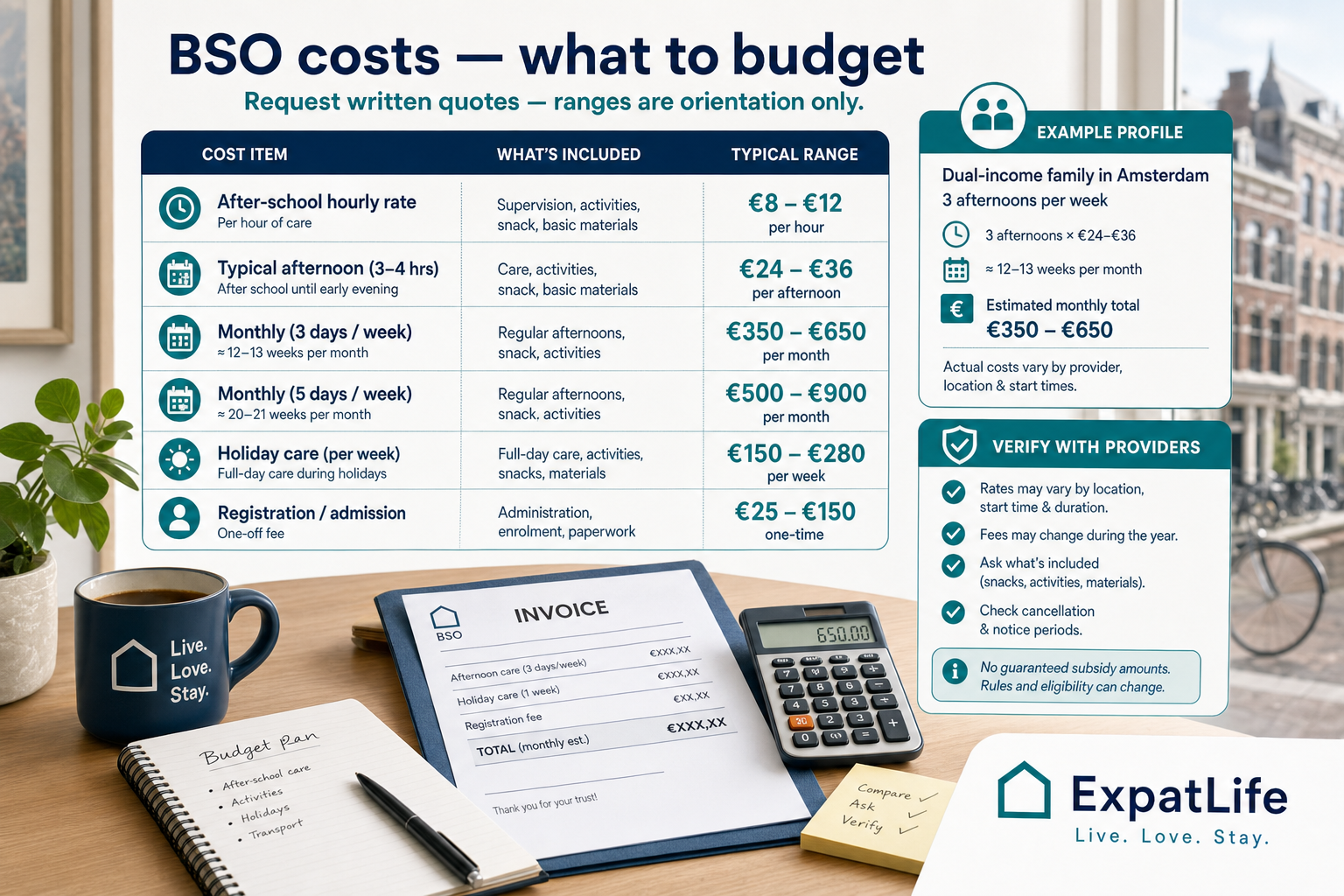
| Cost type | Indicative range | Notes |
|---|---|---|
| After-school hourly rate | €8 – €12 / hour | Indicative — varies by city and provider tier |
| Typical afternoon (3 hrs) | €24 – €36 / day | Often billed per booked afternoon, not always hourly |
| Monthly (3 afternoons) | €350 – €650 / month | Before allowance — Randstad often higher |
| Monthly (5 afternoons) | €500 – €900 / month | Full week after-school cover orientation range |
| Holiday week (full day) | €150 – €280 / week | Theme camps and excursions may add extras |
| Registration fee | €25 – €150 | One-time — sometimes non-refundable |
| Meals & snacks | €2 – €5 / day | Often included or optional per provider |
| Excursion / trip fees | €5 – €25 / trip | Holiday programmes and special outings |
Fees change annually. Use provider quotes and Belastingdienst allowance estimates for your situation — ranges here are orientation only, not quotes or subsidy guarantees.
Examples
| Profile | Scenario | What to check |
|---|---|---|
| 3 afternoons — Amsterdam | Dutch basisschool; both parents working | Budget €450–€700 gross monthly before allowance — model net with toeslagen tool. |
| Full week BSO — The Hague | International school corridor; 5 afternoons | Compare Zein vs Kindergarden quotes; holiday weeks add €150–€250 per week. |
| Holiday-only gap | Grandparents cover term-time; need 2 summer weeks | Book vakantieopvang early — per-week fees separate from term contract. |
| VSO + BSO combo | Early shift start plus late finish | Not all locations offer both — confirm combined monthly package. |
Benefits
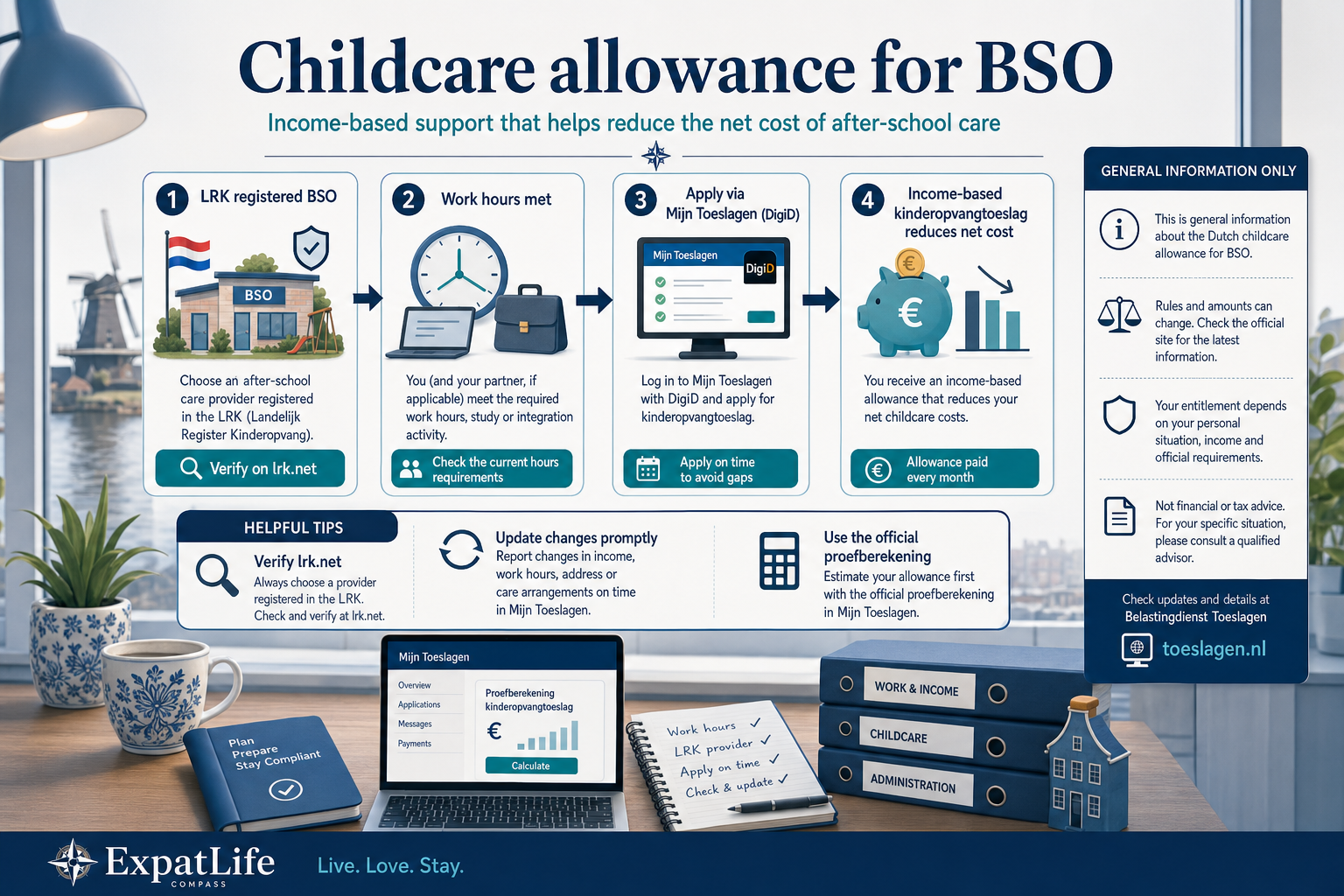
Childcare allowance helps eligible parents pay for registered LRK BSO. The Belastingdienst calculates entitlement based on household income, childcare hours used and parents' work or study hours. It is not a fixed subsidy amount.
BSO must be LRK-registered. Verify registration on lrk.net and read GGD inspection reports before signing. Apply through Mijn Toeslagen (DigiD) after your BSO contract starts, and update changes promptly to avoid repayments.
Timing
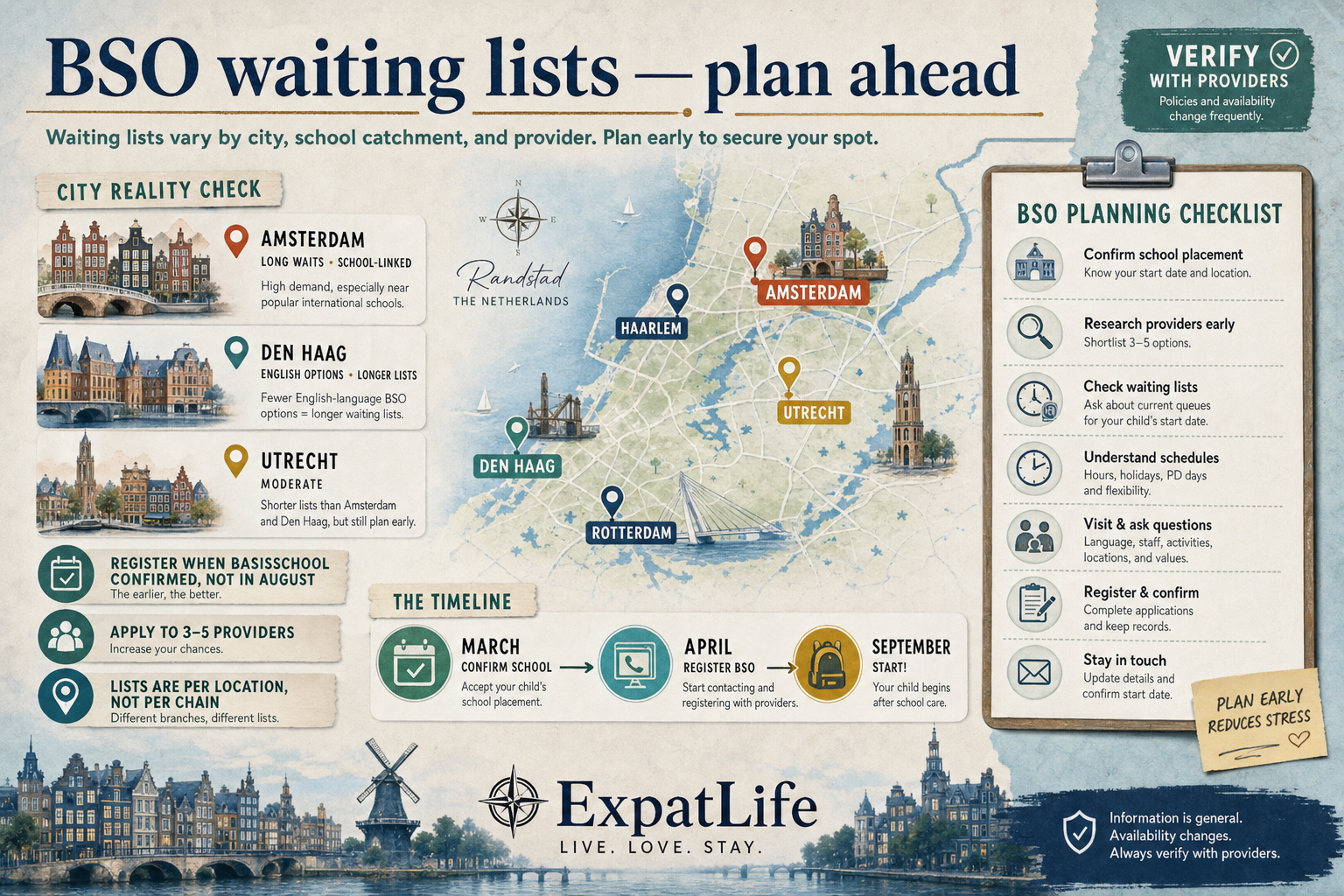
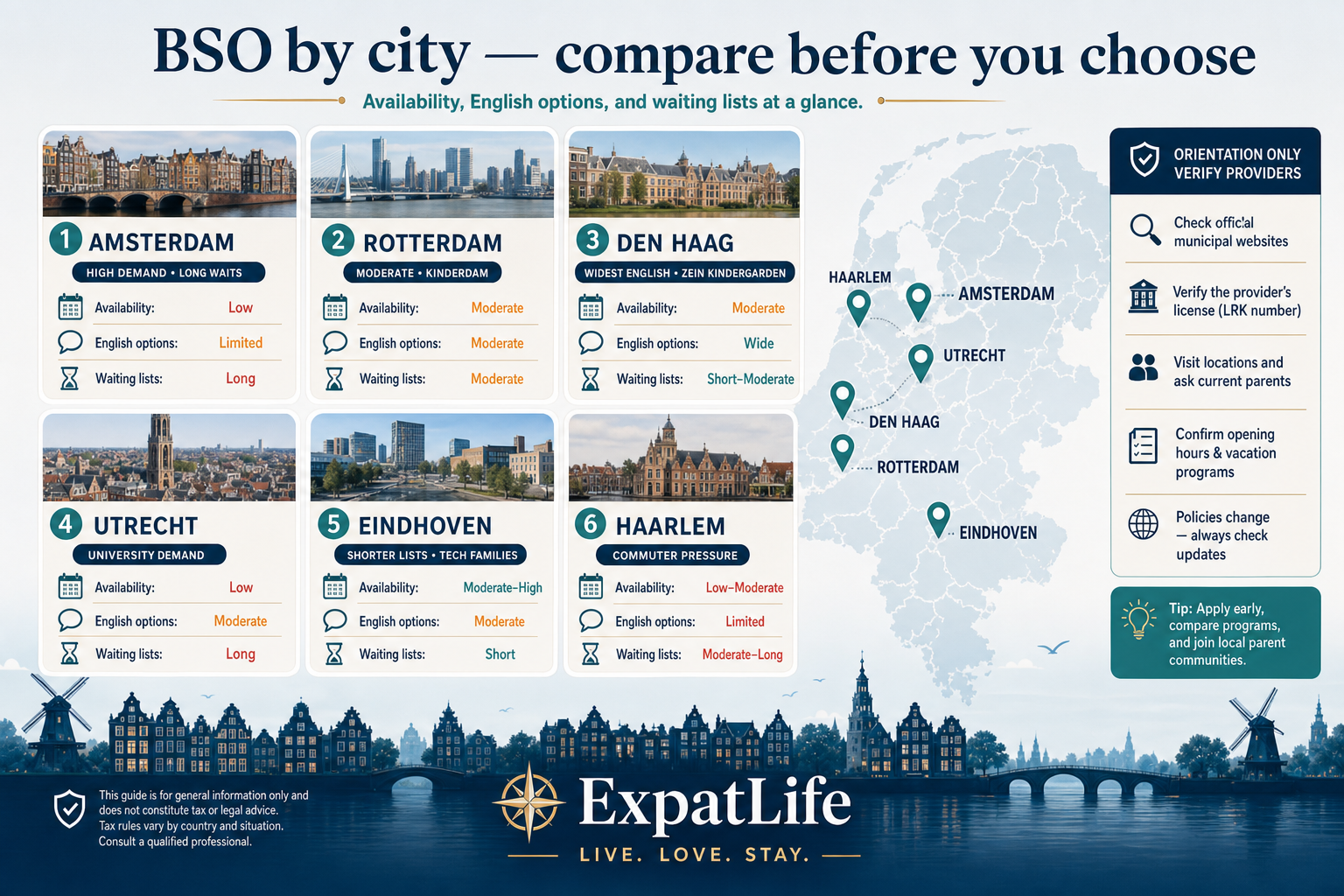
Waiting lists for popular BSO locations are common in Amsterdam, The Hague, Utrecht and parts of Rotterdam — especially school-linked sites with English support. Lists are usually per location: registering with Partou at one address does not place you on lists at other addresses.
Register when your basisschool place is confirmed — ideally months before the school year starts. Keep multiple active applications, confirm positions in writing and maintain a backup option such as gastouder or a second-choice BSO.
Examples
| Profile | Scenario | What to check |
|---|---|---|
| September start — Amsterdam | Basisschool confirmed in March; need BSO from September | Register 3+ BSO by April; ask expected wait for your school pickup route. |
| Mid-year move | Relocating January; child joins group 4 mid-year | Email providers immediately; accept temporary gastouder if lists are full. |
| International school | ISH The Hague; need English-friendly BSO | Zein and select Kindergarden sites — lists often longer; apply early. |
| Sibling priority | Older child already at BSO; baby starting basisschool | Ask about sibling policy — not guaranteed at all chains. |
School breaks
Dutch basisschool children have substantial holiday time — roughly six weeks in summer plus Christmas, spring and autumn breaks, plus occasional study days (studiedagen). BSO providers often run vakantieopvang with full-day programmes, theme weeks and excursions.
Holiday care is frequently booked separately from regular afternoon contracts. Capacity is limited in cities — register interest when providers open summer booking, often in spring. Study day cover may be included in some packages or billed per day.
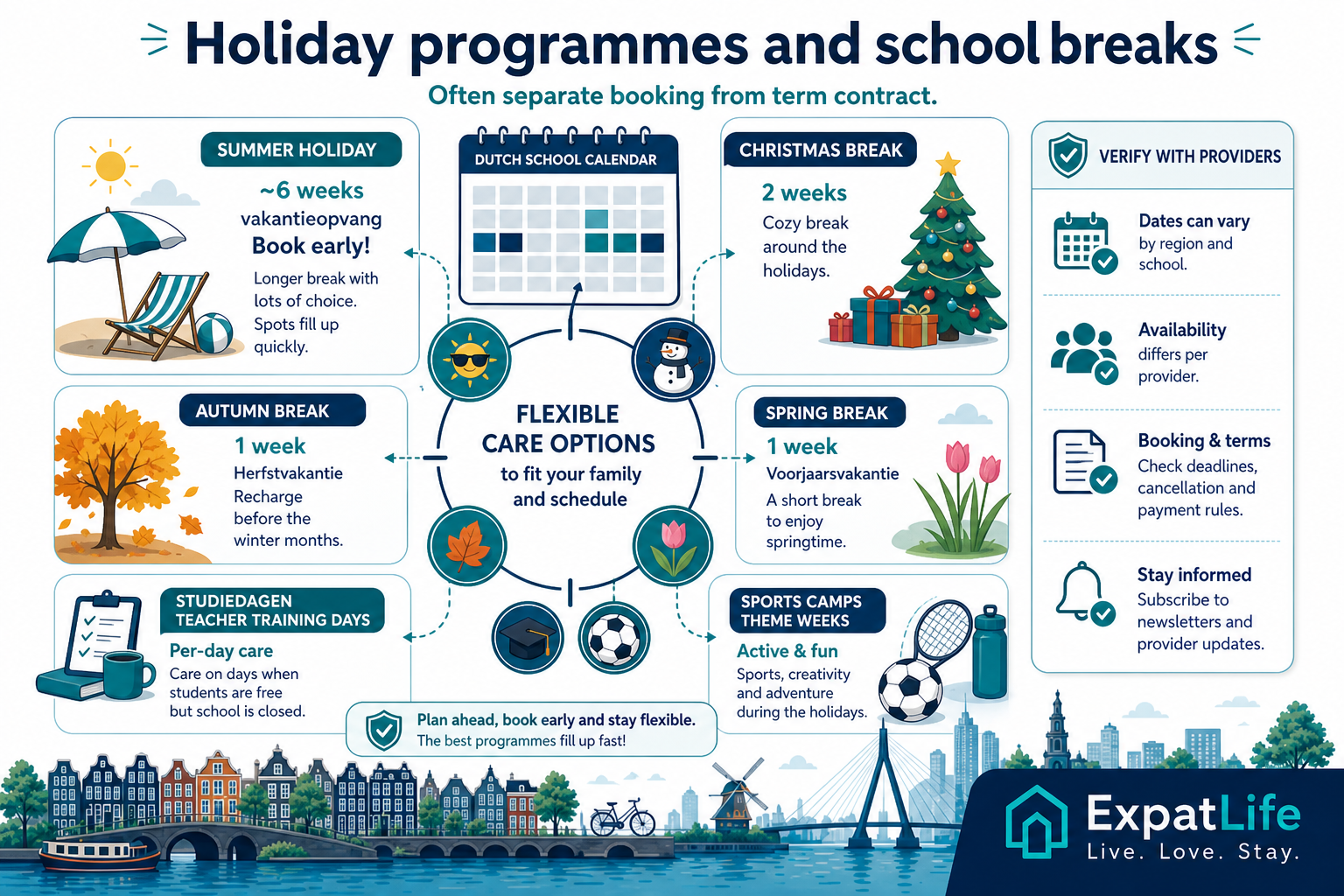
Six-week window — sports camps, adventure weeks and full-day care; book early in Randstad.
Two-week period — festive activities; fewer providers open every day — confirm schedule.
One week (voorjaarsvakantie) — theme programmes and outdoor excursions.
One week (herfstvakantie) — nature and craft-focused camps common.
Teacher training days — studiedagopvang when basisschool closes mid-week.
Football, swimming and multi-sport weeks during summer at select providers.
Art, science or adventure themes — popular at Kindergarden, Zein and national chains.
Examples
| Profile | Scenario | What to check |
|---|---|---|
| Dual-income — Randstad | Both parents work full-time; no family nearby | Book full summer weeks at 2 providers; keep backup gastouder for gap weeks. |
| One parent part-time | Cover Wednesdays and school holidays informally | BSO 4 afternoons + vakantieopvang only for summer peak weeks. |
| International school calendar | Different break dates from Dutch basisschool | Confirm Zein/Kindergarden camps align with your school's holiday schedule. |
| Pre-arrival July move | Child starts basisschool September; summer uncovered | Email providers in June for August vakantieopvang — lists may still have slots outside peak weeks. |
Decide
The right BSO depends on pickup logistics, languages, activities, outdoor space, holiday cover and cost after allowance — not a single national ranking. Use the matrix during visits and provider calls.
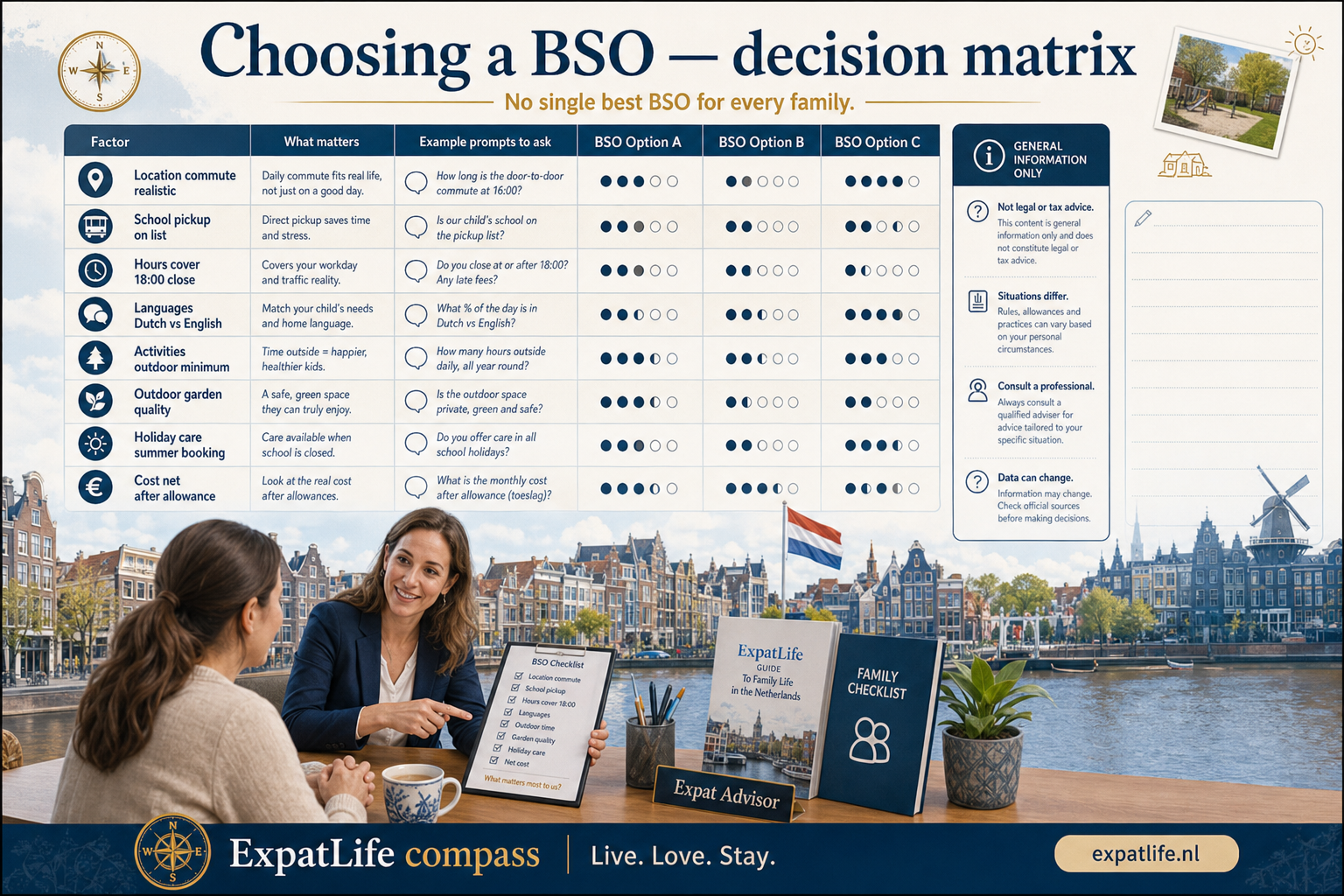
| Factor | Ask yourself | Example |
|---|---|---|
| Location | Is pickup realistic from your school and commute? | Basisschool in Amsterdam Noord with BSO in Zuid — verify staff pickup list. |
| School pickup | Does the BSO collect from your specific school? | International schools may need provider with dedicated bus or parent drop-off. |
| Hours | Do opening times cover your work pattern? | 18:00 close with 18:15 meetings — check late pickup policy. |
| Languages | Dutch immersion vs English support? | Long-term NL stay → Dutch BSO helps peer integration. |
| Activities | Sports, arts and outdoor time match your child? | Active child → ask about daily outdoor minimum. |
| Outdoor space | Garden quality and daily outdoor policy? | Canal-centre locations may have smaller outdoor areas. |
| Holiday care | Summer and study day availability? | Book holiday weeks in spring — capacity fills in cities. |
| Cost | Net cost after allowance, not gross invoice? | Model both full-week and 3-day patterns. |
How to choose BSO — step by step
Logistics
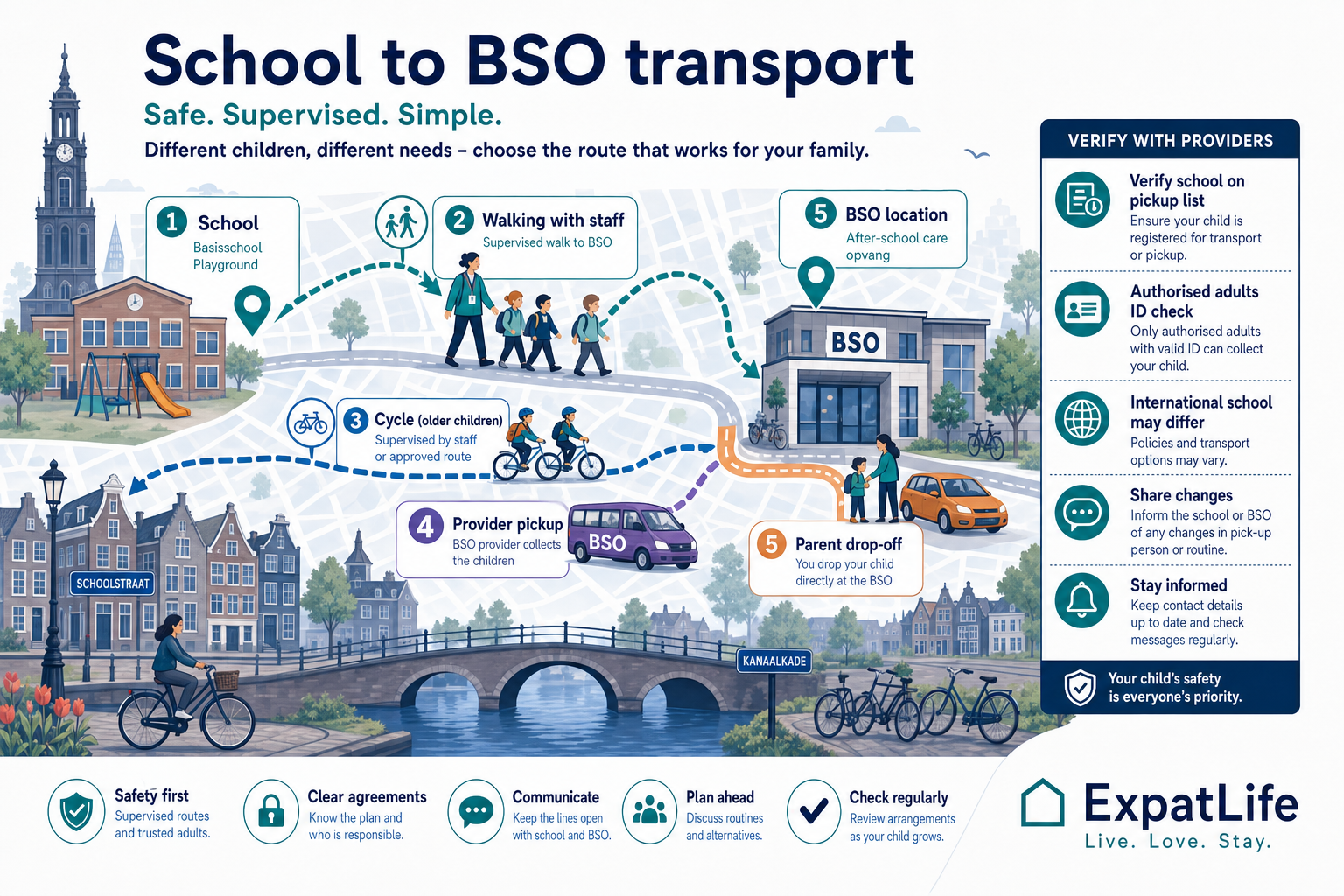
Transport logistics are central to BSO choice. Many providers collect children from partner school playgrounds; others require parents to drop off at a central BSO location. Older children in some neighbourhoods walk or cycle in supervised groups.
Confirm authorised pickup adults, ID requirements and what happens if you are late. International school families should verify whether BSO staff collect from their school or only from Dutch basisschool partners.
Cities
Waiting lists, English options and international communities differ by city — compare before finalising housing and school choice.
Checklist
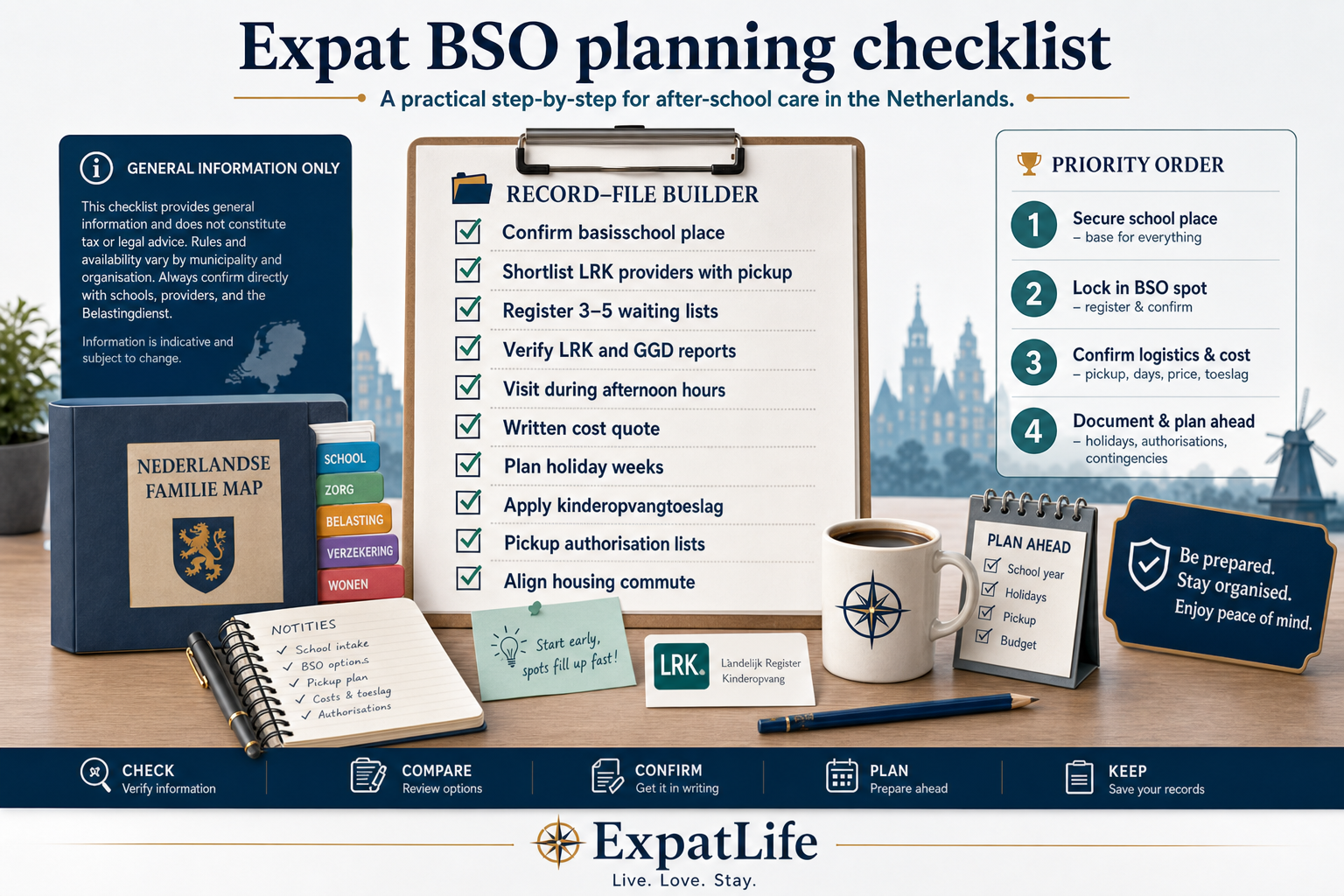
Work through this list once your basisschool place and work hours are confirmed.
Phase 1 — research (when school place confirmed)
Phase 2 — registration and visits
Phase 3 — before the first BSO day
Full BSO planning checklist
Avoid
These patterns cause stress when school starts — plan around them before September.
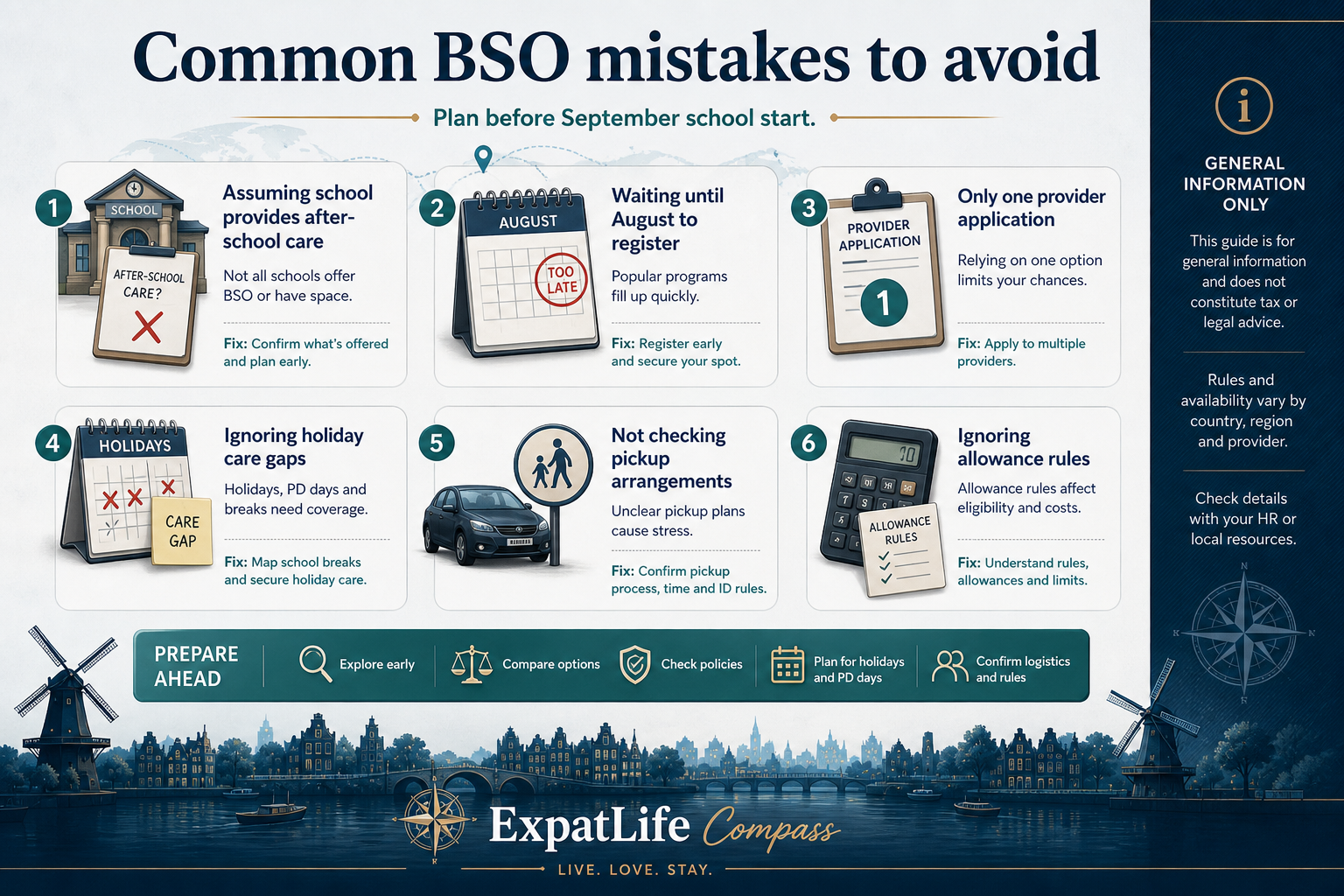
Example: expecting basisschool to supervise children until 18:00 — Dutch primary schools finish around 15:00 with no built-in extended care.
Fix: Register LRK BSO separately — schools coordinate pickup lists but do not run afternoon childcare.
Example: joining BSO waiting lists in August for September start in Amsterdam — popular school-linked sites are often full.
Fix: Apply 3–6 months ahead in Randstad cities when basisschool place is confirmed.
Example: relying on a single school-linked BSO without backup — waiting lists are per location, not per chain.
Fix: Keep 2–3 active applications until a contract is signed.
Example: budgeting only for term-time afternoons — six summer weeks need separate vakantieopvang booking and fees.
Fix: Map the school holiday calendar and book holiday care in spring where possible.
Example: registering with a BSO that does not collect from your basisschool or international school.
Fix: Confirm school partnership and pickup route in writing before paying registration fees.
Example: assuming a fixed monthly subsidy — allowance is income and work-hour dependent via Belastingdienst.
Fix: Verify LRK registration and use official proefberekening plus our allowance guide for estimates.
FAQ
Orientation answers — confirm provider-specific rules and allowance entitlement on official sources.
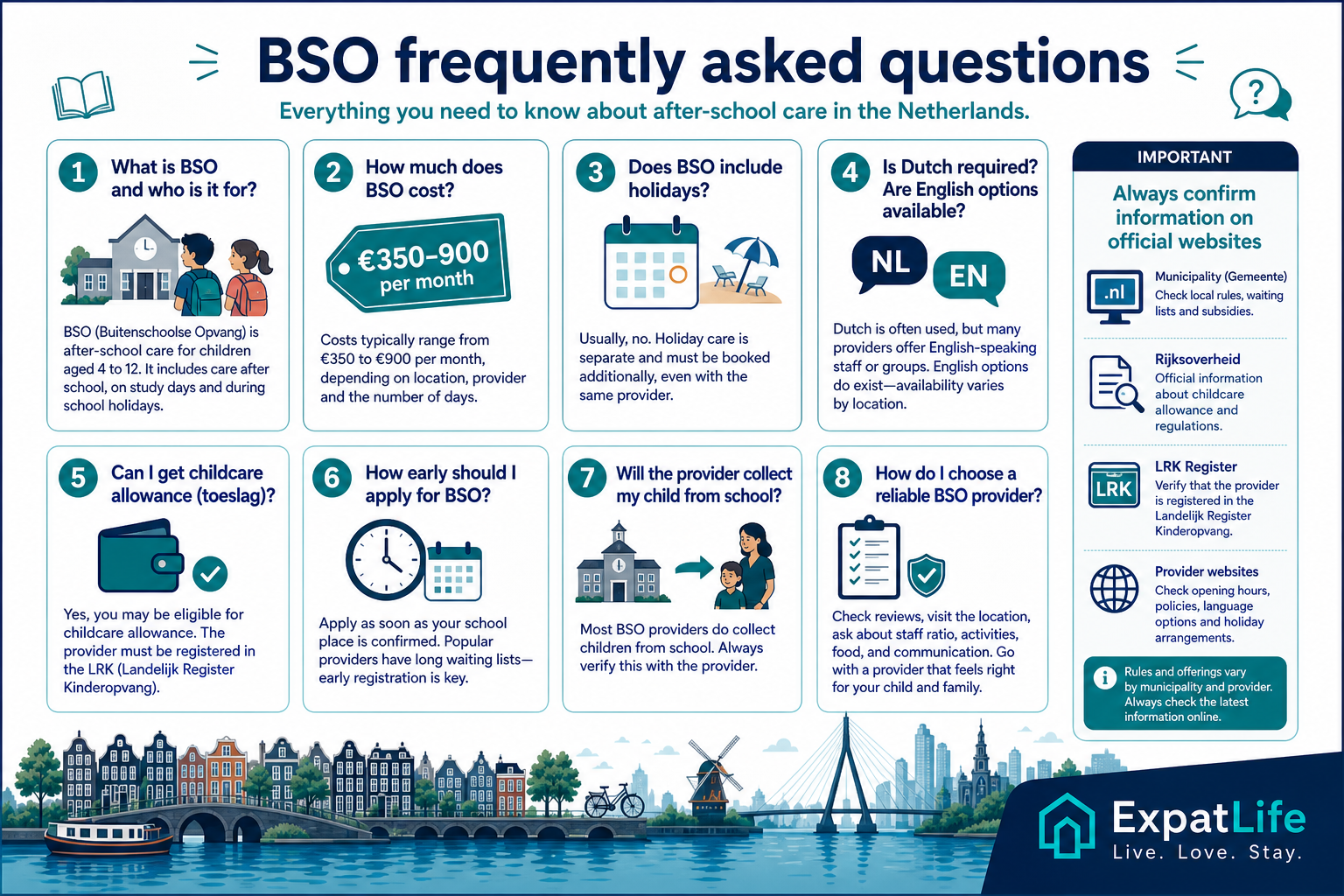
BSO (buitenschoolse opvang) is registered after-school childcare for primary school children, typically ages 4–12. It covers hours before and after school, and often school holidays and study days, depending on your contract and provider.
Most BSO serves children from about age 4 (when they start basisschool) through 12 (end of group 8). Exact age limits vary by provider — confirm minimum and maximum ages at intake.
Costs commonly range from roughly €350–€900 per month for regular after-school cover, depending on city, days per week and provider. Holiday weeks often cost €150–€280 per week separately. Request written quotes — allowance can reduce net cost if you qualify.
Regular BSO contracts cover school-day afternoons. School holidays usually require separate vakantieopvang booking with different fees. Study days (studiedagen) may be included or billed per day — check your contract.
Yes — children often learn through play and peer interaction. Most BSO is Dutch-medium daily; English-speaking staff or groups exist at select providers in The Hague, Amsterdam and Rotterdam (e.g. Zein, some Kindergarden locations).
Yes, if you meet Belastingdienst rules — including LRK-registered BSO, income thresholds and work-hour requirements. Apply via the toeslagen portal with DigiD after your contract starts.
As soon as your basisschool place is confirmed — ideally months before the school year starts. Popular locations in Amsterdam and The Hague often have waiting lists.
Many BSO providers collect from partner schools at the end of the school day. Verify your basisschool or international school is on the provider's pickup list before registering.
Family guides
Connect BSO planning with daycare, schools, benefits and relocation content.
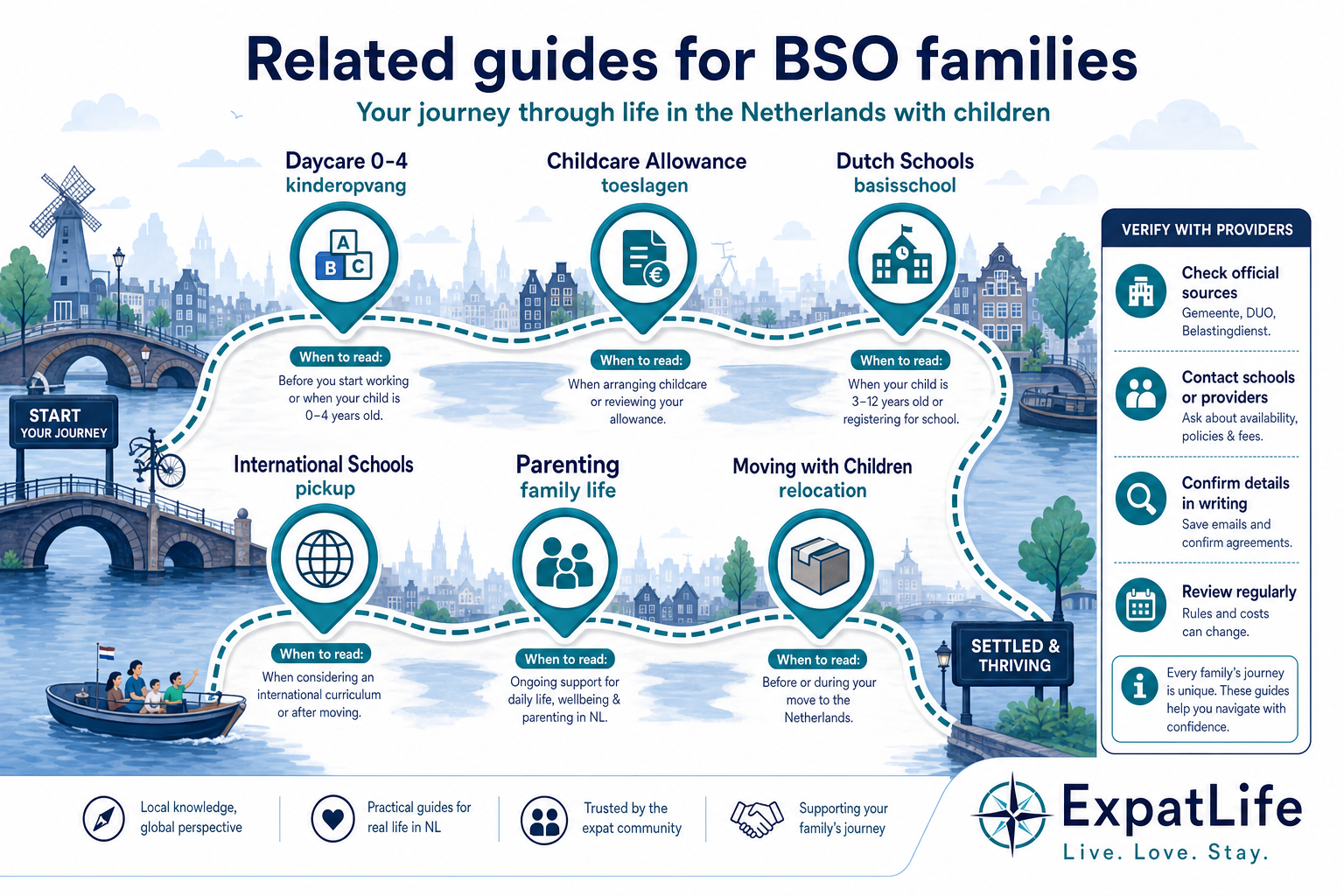
Education hub
This page is the BSO cornerstone — explore related education topics next.
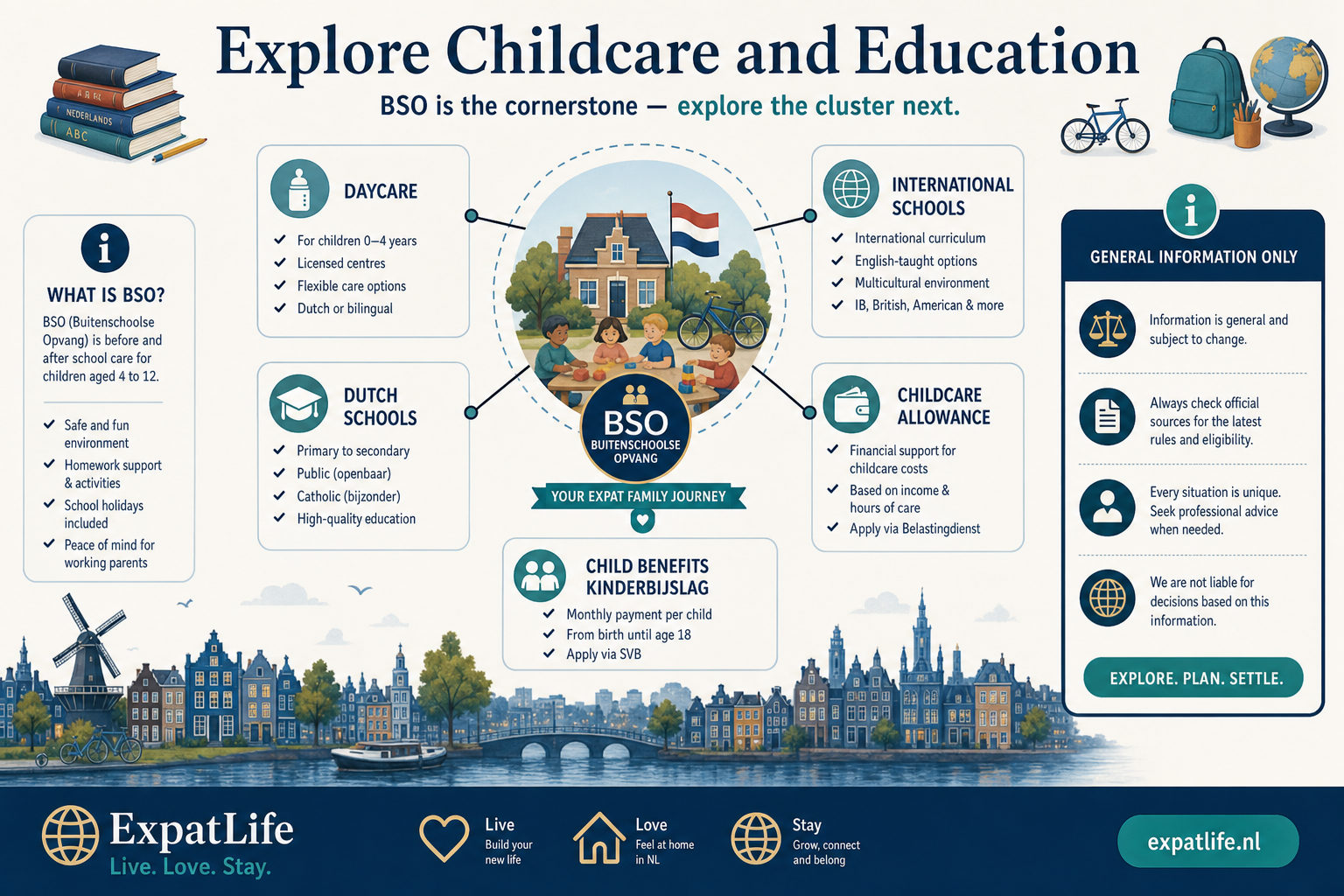
Explore next
Continue planning with allowance, schools and family relocation guides.
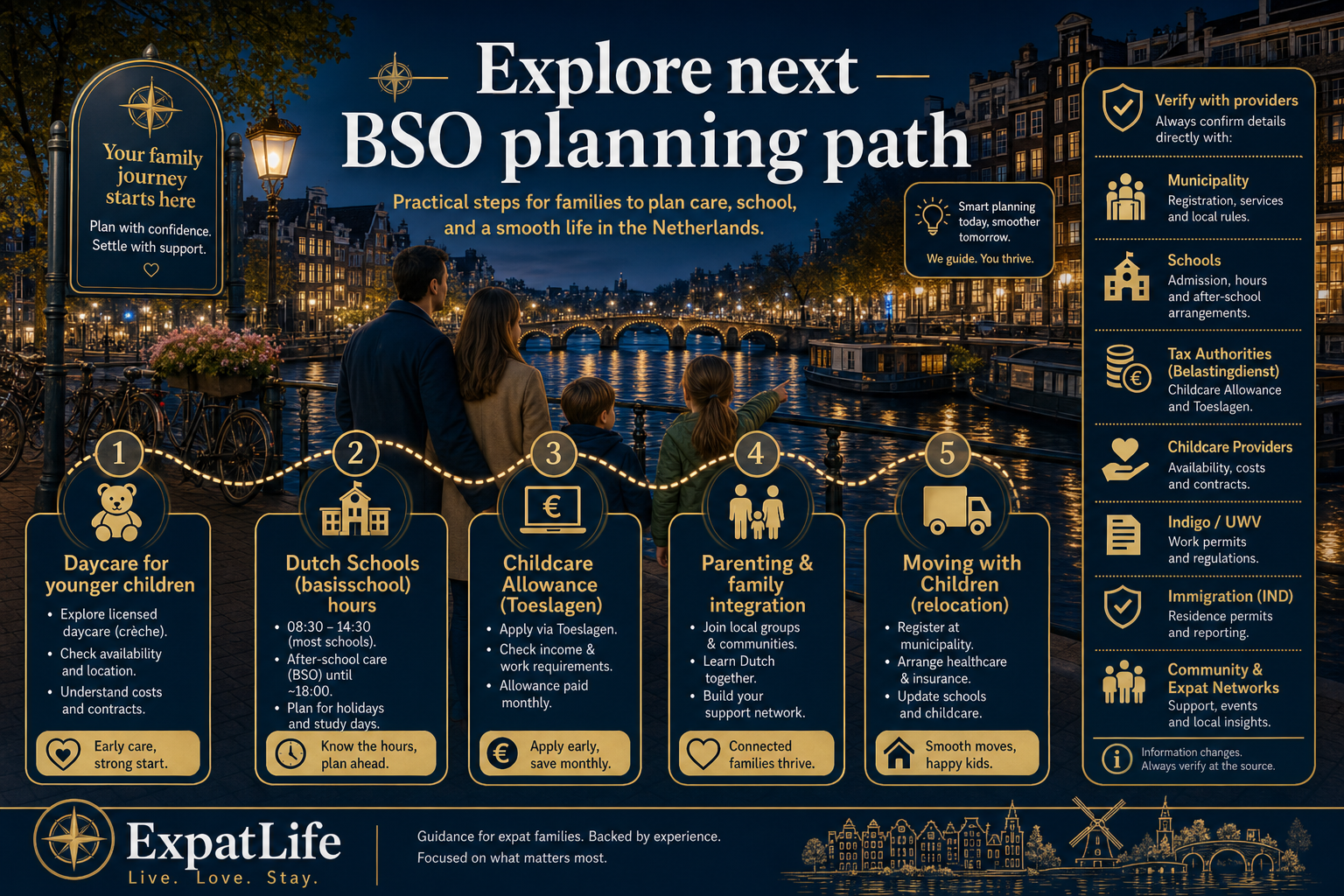
Trust
BSO fees, availability and allowance rules change. Always verify current information on official provider websites, lrk.net and Belastingdienst sources — this guide is orientation only, not financial or placement advice.