
Electricity provider can often be chosen
Residents often compare electricity suppliers by contract type, green energy mix, fixed or variable rates and customer service.
Relocation setup guide
Learn how electricity, gas, water, internet, waste collection and other utilities work in the Netherlands and how to set them up after moving.

First-week setup
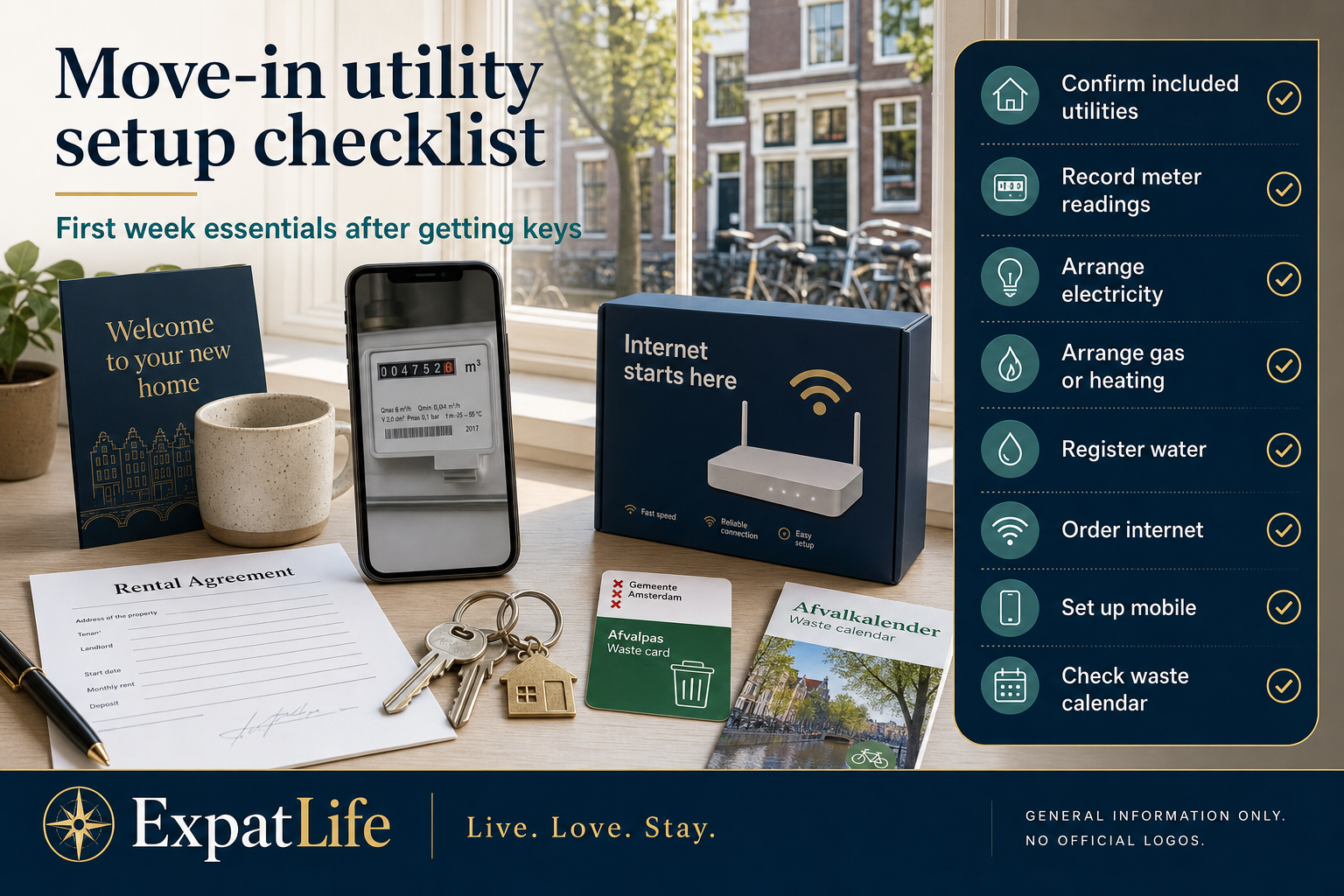
After moving to the Netherlands, most residents need to arrange electricity, gas or district heating, water, internet, television, mobile services and local waste collection.
Some utilities may be included in rent, especially in temporary housing, furnished rentals or all-in contracts. Others require separate contracts in your own name. Always confirm this before signing a lease or immediately after receiving keys.
The most important practical difference is who controls the service: energy and internet are usually chosen by the resident, water is regional, and waste collection is handled by the municipality.
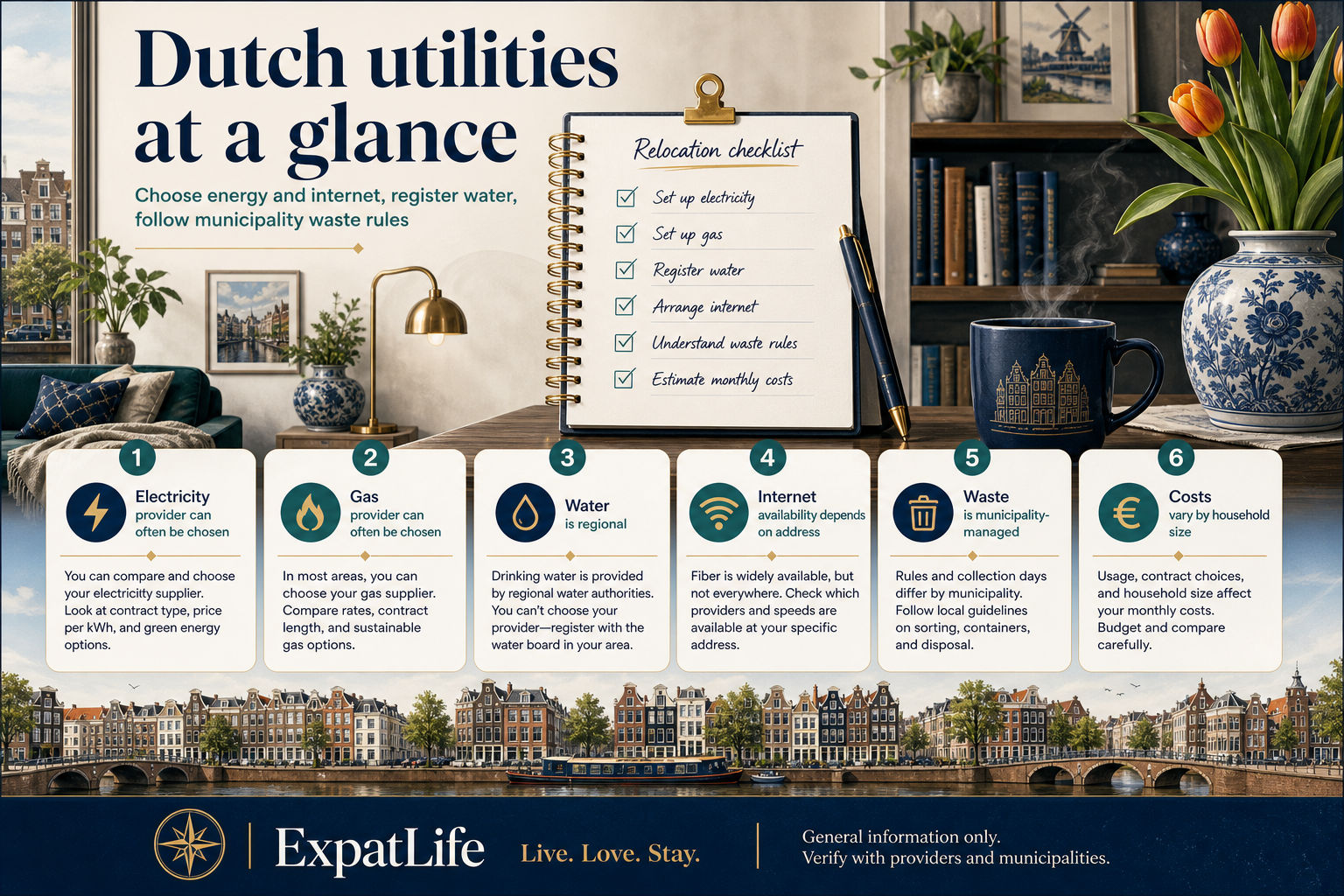
Start here if you need a quick split between services you choose, services tied to your address and municipality-managed tasks.
Residents often compare electricity suppliers by contract type, green energy mix, fixed or variable rates and customer service.
Gas may be bundled with electricity, but some homes use district heating or are gas-free.
You usually register with the water company assigned to your address rather than choosing from a market.
KPN, Ziggo, Odido, Delta and others may be available, but technology depends on postcode and building.
Rules for paper, glass, organic waste, residual waste and collection days differ by city and neighborhood.
A studio, family townhouse and poorly insulated detached home can have very different monthly bills.
Use this list to separate essential services from optional subscriptions and municipality-managed tasks.
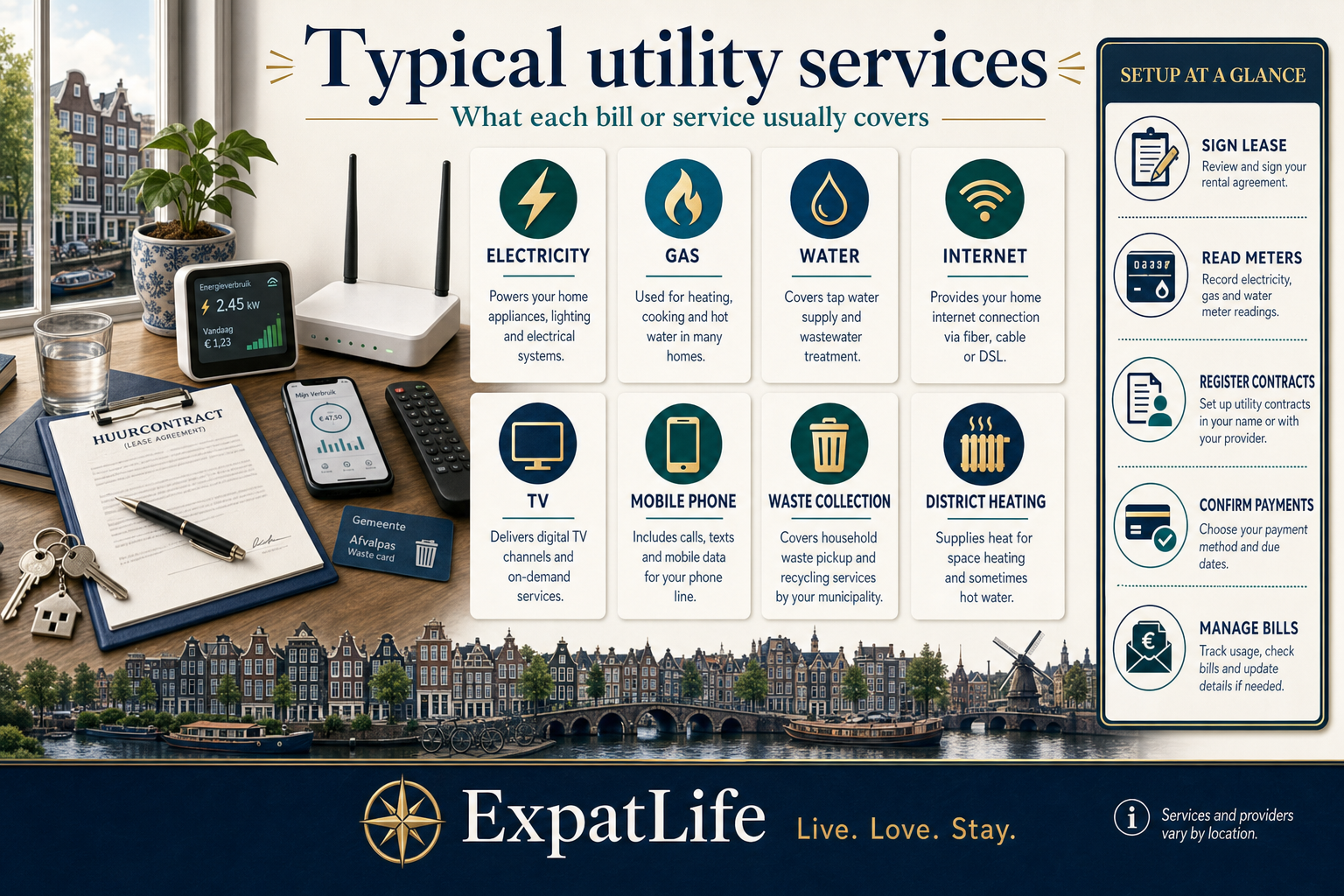
Powers lighting, appliances, cooking in electric homes, home-office equipment and increasingly heat pumps or induction cooking.
Still used in many homes for heating, hot water and cooking, although the Netherlands is transitioning toward lower-gas housing.
Covers drinking water and household water use, billed by a regional water company or sometimes advanced by a landlord.
Home broadband may be fibre, cable or DSL depending on the address; installation can take longer than newcomers expect.
Traditional TV is often bundled with internet, but many households now use streaming services instead.
Mobile plans range from prepaid SIM cards to one- or two-year contracts with data, EU roaming and international calling add-ons.
Municipalities manage household waste, recycling containers, collection passes, bulky waste and local waste taxes.
Some apartments and new developments use stadsverwarming instead of individual gas contracts.
Residents generally choose electricity suppliers unless electricity is included in rent or temporary accommodation. Energy comparison usually starts with address, expected usage, contract length and whether you want fixed or variable rates.
Fixed contracts give price certainty for a period, while variable contracts can change with market conditions. Dynamic contracts may follow hourly or market-linked prices and are better suited to people who actively manage usage.
Green energy options are common, but check whether a provider's product uses Dutch renewable generation, certificates or broader European sourcing if that matters to you.
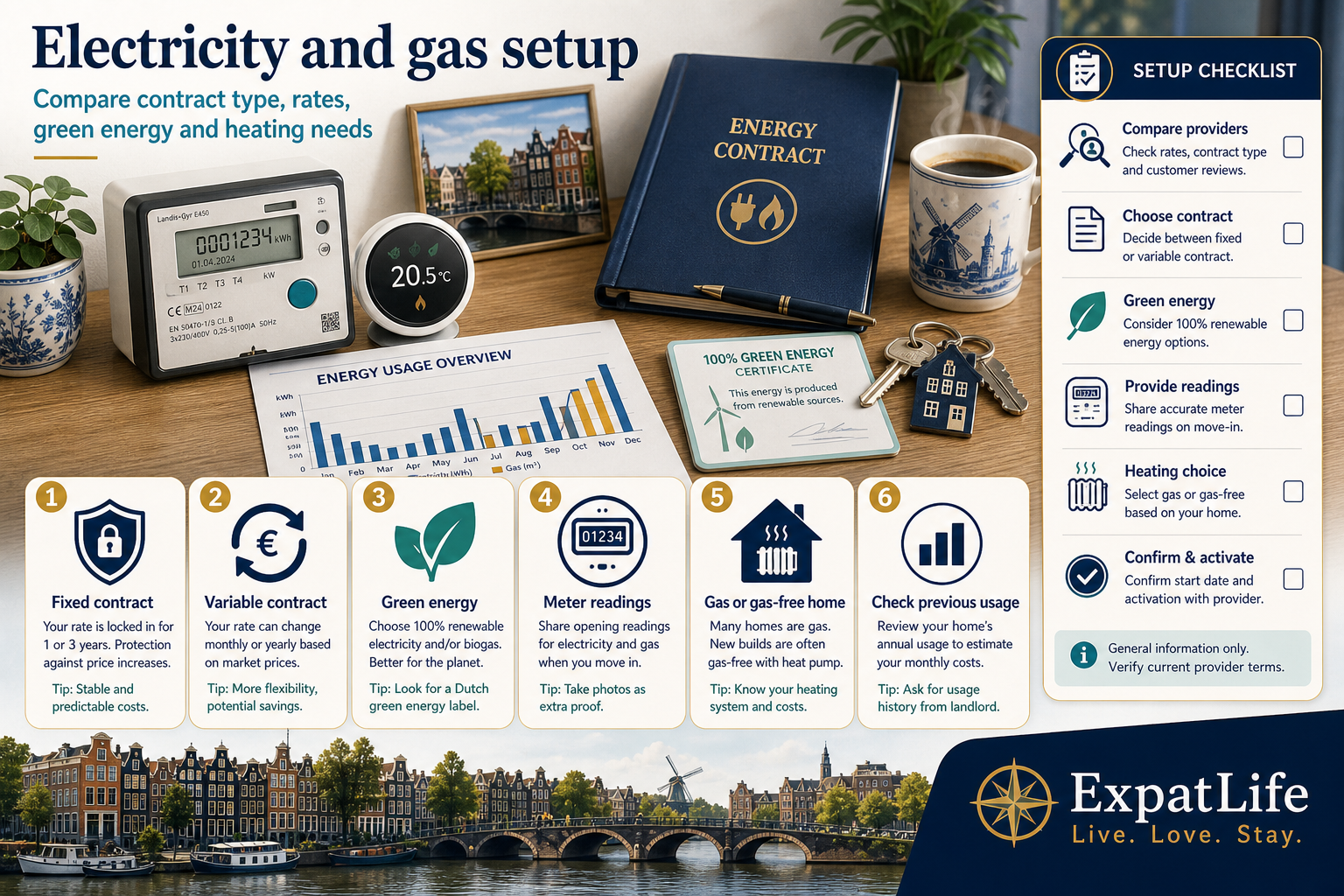
Many Dutch homes still use gas for central heating, hot water or cooking. If your property has a gas meter, gas is often arranged together with electricity through one energy supplier.
Gas usage can be the largest variable utility cost in older or less insulated homes. Ask about insulation, heating system, energy label and previous usage before estimating monthly bills.
The Netherlands is moving toward sustainability and lower-gas housing, so newer apartments may use district heating, heat pumps or all-electric systems instead of a gas connection.
Some apartments, urban developments and newer housing projects use district heating instead of an individual gas contract. Heat is supplied through a local network and billed separately from electricity.
District heating is common in parts of cities and apartment complexes where collective heating networks are used. Availability depends on the building, not personal preference.
Billing can feel different from gas because you may have fewer provider choices and separate charges for heat delivery, usage and sometimes fixed network costs. Ask the landlord, seller or property manager before moving in.
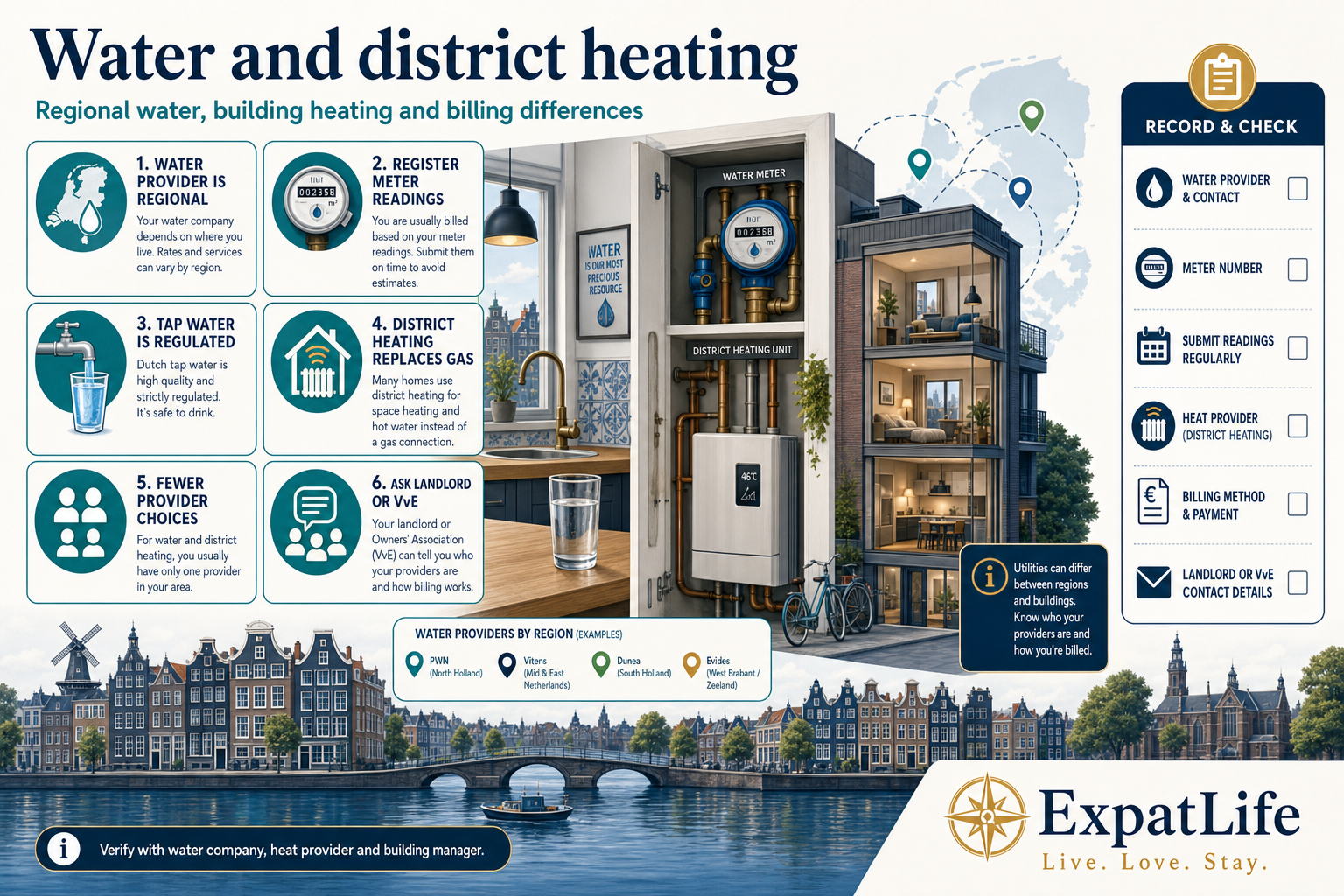
Water is generally supplied by regional water companies. Residents usually cannot choose their water provider because service areas are assigned geographically.
Dutch tap water is high quality and drinking water standards are strict. You may receive bills directly from the water company, through a landlord or via settlement if you are in serviced accommodation.
When moving in, check whether you need to register the address, provide meter readings and set up payment. Water tax and municipal water-related charges may appear separately depending on location.
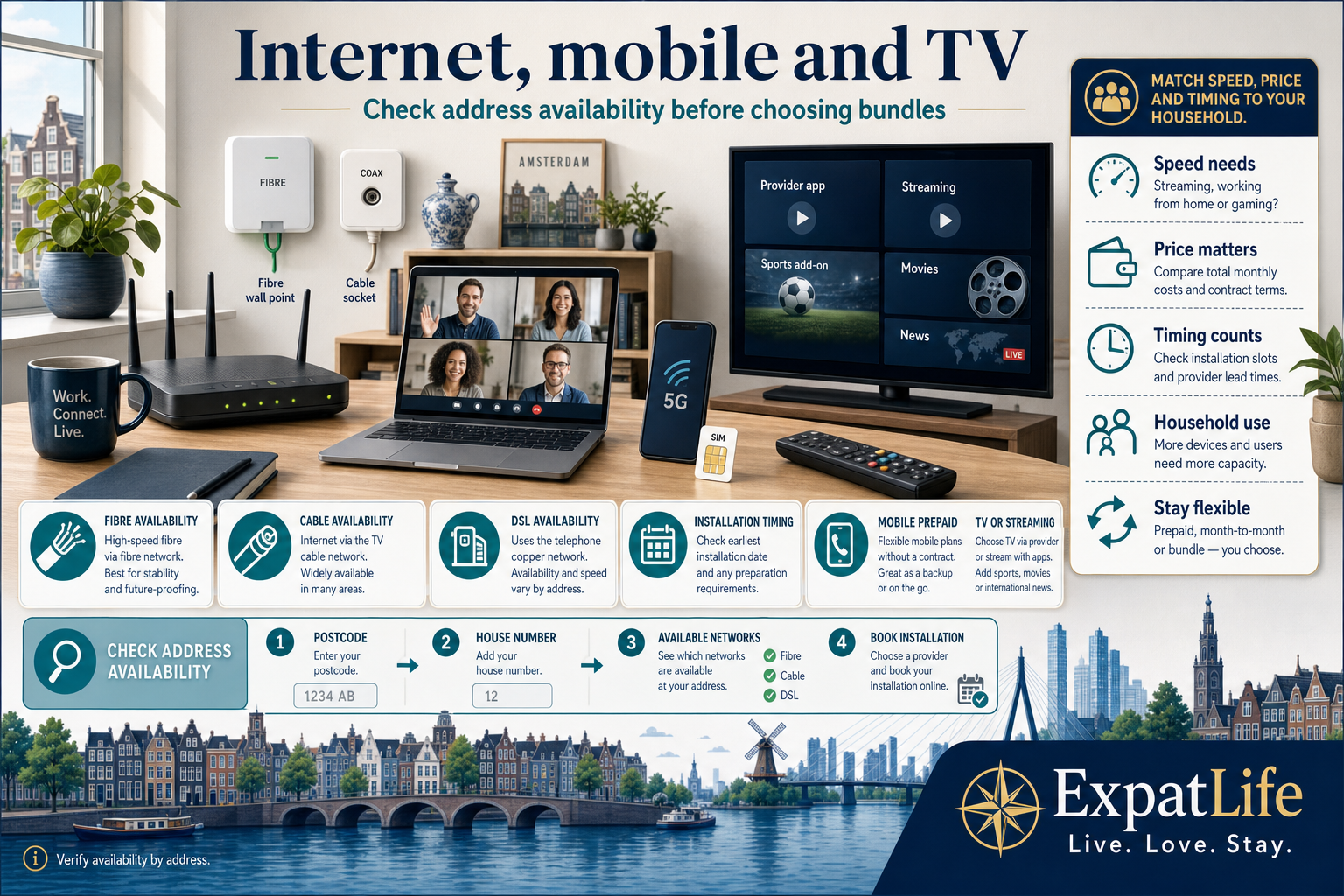
Internet availability depends on your exact address. Fibre can offer high speeds, cable is common through Ziggo, DSL may remain available in some places, and installation lead times vary.
If you work remotely, order internet as soon as your move-in date is clear and keep a mobile hotspot or temporary SIM option as a fallback. Some buildings require an installer appointment or access to a meter cupboard.
| Provider | Technology | Typical speed range | TV bundles | Business services |
|---|---|---|---|---|
| KPN | Fibre / DSL | 50 Mbps to 4 Gbps where fibre is available | Often available | Yes |
| Ziggo | Cable | 100 Mbps to 1 Gbps depending on package | Often available | Yes |
| Odido | Fibre / mobile / fixed internet | 100 Mbps to 8 Gbps in selected fibre areas | Often available | Yes |
| Delta | Fibre / cable in selected regions | 150 Mbps to multi-gigabit where available | Often available | Yes |
| Freedom Internet | Fibre / DSL via available networks | Depends on local network and address | Not usually bundled | Yes |
Open the complete connectivity guide for fibre, mobile providers, SIM-only, eSIM, costs, setup and coverage.
Open complete guideMobile setup is often one of the easiest first-week tasks. Newcomers can start with a prepaid SIM, then switch to a contract after registration, bank setup or BSN timing is clearer.
Compare data allowance, EU roaming, international calling, contract length, number portability and whether a Dutch bank account is required. Families and frequent travelers should check shared bundles and international add-ons.
Traditional TV is often sold as an internet bundle, especially by cable and fibre providers. This can be convenient if you want Dutch channels, sports packages or a set-top box.
Many expats skip traditional TV and use streaming services instead. Before bundling TV, check whether the channels, language options and cancellation terms are worth the added monthly cost.
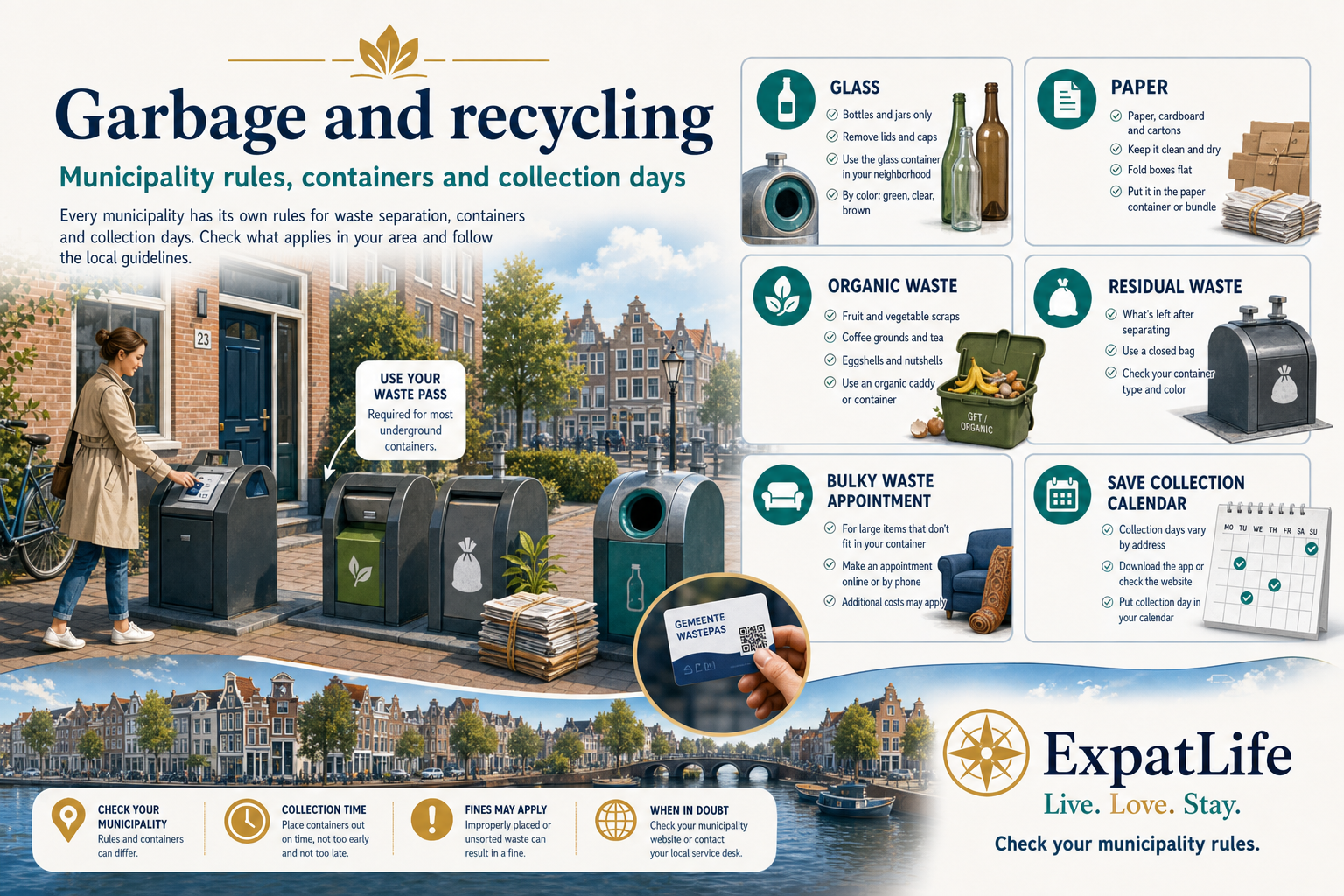
Waste collection is typically managed by municipalities. Local rules decide how you dispose of glass, paper, plastic, organic waste, residual waste and bulky items.
Many cities use underground containers, waste passes, scheduled pickup days or separate neighborhood recycling points. Check your municipality website after registering your address and save the waste calendar.
These are realistic example ranges only. They are not quotes, guarantees or provider recommendations.
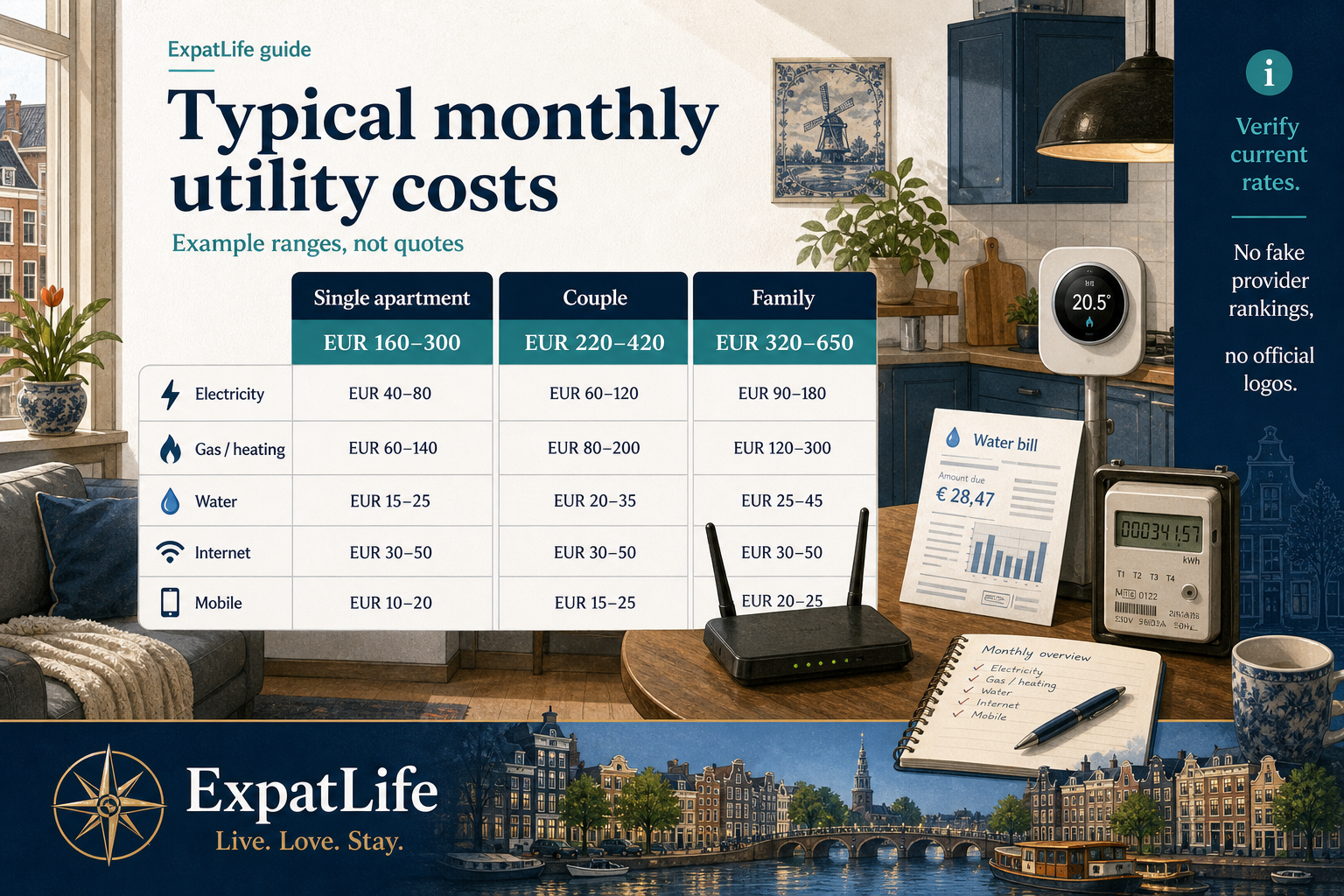
Single apartment
Couple
Family
Home type changes the utility setup because heating system, insulation, floor area and included service costs can all differ.
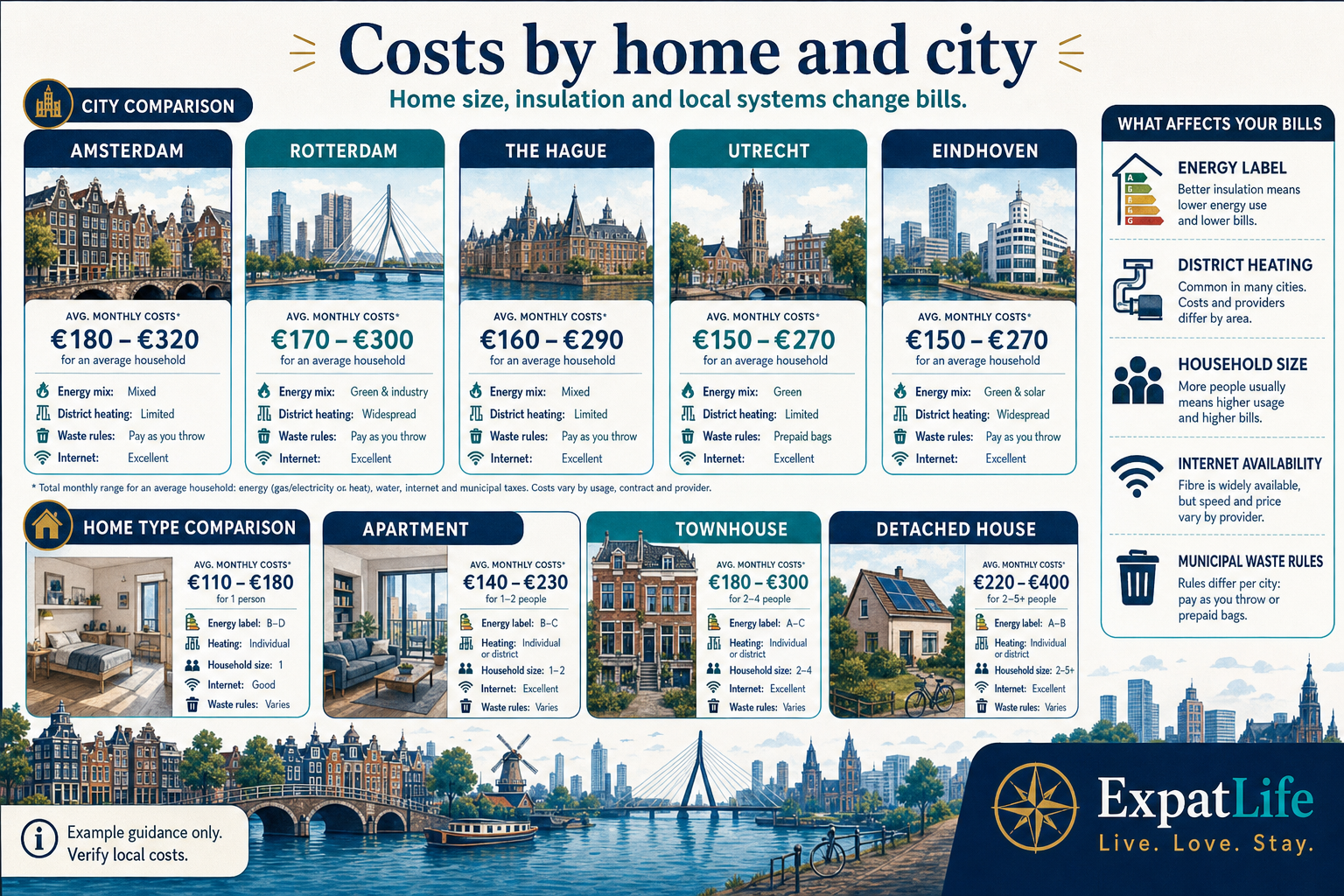
Usually lower energy and water usage; internet may be the biggest fixed utility if heating is included.
Check whether heating is individual gas, district heating or included through service costs.
Expect higher heating and electricity usage, especially with families or older insulation.
Usage can be much higher due to space, garden, heating loss and possible maintenance-related systems.
City differences usually come from housing type, building age, insulation, district heating, rent structure and municipality rules.
Higher rents and many apartments; district heating and VvE arrangements can affect what is included.
Varied housing stock from modern apartments to family homes; check heating system and insulation carefully.
Apartments, townhouses and international households mean costs vary widely by neighborhood and home size.
Competitive housing market with many apartments and family homes; internet availability is usually address-specific.
Modern developments may use fibre and newer heating systems, while older homes can have higher gas usage.

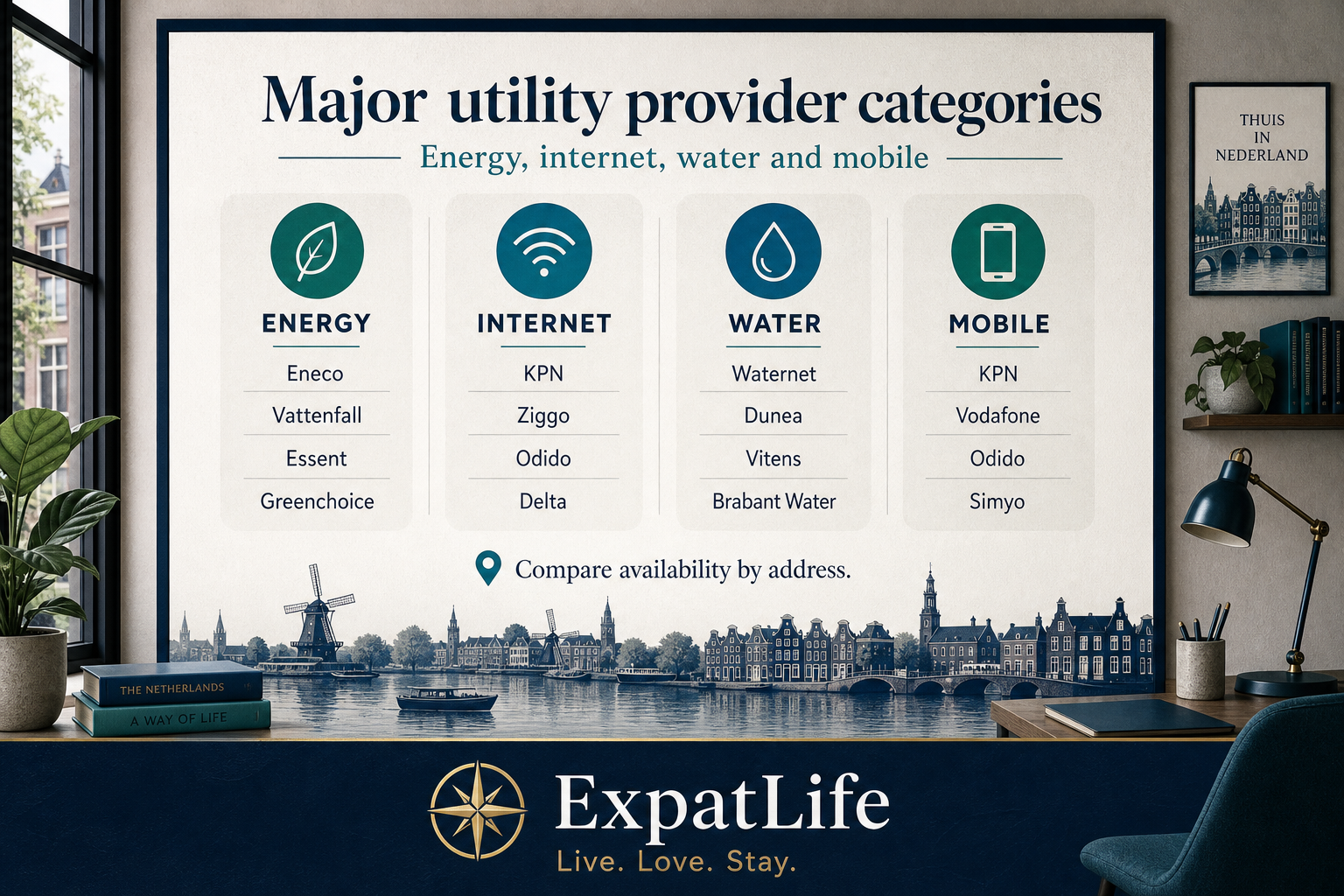
These are real provider examples grouped by utility type. Example prices are orientation ranges only — not quotes, guarantees or recommendations. Always verify current tariffs, contract terms and address availability directly with providers.
Energy
Major Dutch energy supplier for electricity, gas and selected heat products, often compared for fixed, variable and green-energy contracts.
Example costs and prices
Example orientation: electricity supply tariffs often sit around EUR 0.28–0.32 per kWh incl. VAT before standing charges; a typical two-person home may pay roughly EUR 120–220 per month for electricity and gas combined depending on usage, contract type and season.
Features
Pros
Watch-outs
Service regions: National electricity and gas supply; district heating in selected areas.
Visit websiteEnergy
Large national energy supplier offering electricity, gas, green energy and selected local heat networks.
Example costs and prices
Example orientation: public comparison ranges often show electricity from roughly EUR 0.29 per kWh incl. VAT; combined electricity and gas for an average apartment may land around EUR 100–180 per month in moderate usage months and higher in winter.
Features
Pros
Watch-outs
Service regions: National energy supply; heat networks in selected cities and developments.
Visit websiteEnergy
Major Dutch electricity and gas supplier often compared on price, contract length and online switching.
Example costs and prices
Example orientation: comparison sites often list Essent electricity from roughly EUR 0.28–0.30 per kWh incl. VAT; a couple in a one-bedroom home might budget roughly EUR 110–200 per month for energy in shoulder months, more with gas heating in winter.
Features
Pros
Watch-outs
Service regions: National electricity and gas supply.
Visit websiteEnergy
Price-focused energy brand often bundled with telecom products under the Budget Thuis group.
Example costs and prices
Example orientation: comparison listings sometimes show lower headline electricity rates from about EUR 0.27–0.29 per kWh incl. VAT; monthly totals still depend on standing charges, grid fees, taxes and gas usage.
Features
Pros
Watch-outs
Service regions: National electricity and gas supply.
Visit websiteEnergy
Sustainability-focused energy supplier associated with green electricity and Dutch renewable sourcing.
Example costs and prices
Example orientation: green electricity offers often sit slightly above the lowest market rates, around EUR 0.30–0.32 per kWh incl. VAT in public comparisons; expect roughly EUR 120–230 per month for combined electricity and gas in a typical apartment depending on usage.
Features
Pros
Watch-outs
Service regions: National electricity and gas supply.
Visit websiteEnergy
Consumer collective offering energy contracts alongside other household services through membership-style propositions.
Example costs and prices
Example orientation: collective offers can show competitive monthly estimates, but final pricing depends on membership terms, contract type and annual consumption; verify the all-in monthly figure rather than a headline discount alone.
Features
Pros
Watch-outs
Service regions: National availability subject to address, product and membership terms.
Visit websiteInternet
Major Dutch telecom provider offering fibre, DSL, TV, mobile and business connectivity with strong national coverage.
Example costs and prices
Example orientation: home fibre packages often cost about EUR 40–65 per month depending on speed, TV add-ons and promotions; installation or activation fees may apply on first signup.
Features
Pros
Watch-outs
Service regions: National telecom provider; fibre and DSL availability depends on address.
Visit websiteInternet
Cable internet and TV provider with high-speed packages on the Ziggo coax network in many urban addresses.
Example costs and prices
Example orientation: cable internet often ranges from about EUR 35–65 per month depending on speed tier, Wi-Fi extras and TV bundles; setup or activation costs can apply.
Features
Pros
Watch-outs
Service regions: Cable network availability depends on address, especially in larger cities.
Visit websiteInternet
Telecom provider offering mobile, fibre internet, TV and converged home connectivity after the T-Mobile rebrand.
Example costs and prices
Example orientation: home internet packages often start around EUR 30–55 per month depending on speed and bundle; combined mobile plus internet deals can change the total materially.
Features
Pros
Watch-outs
Service regions: National mobile; fixed internet depends on address and network access.
Visit websiteInternet
Regional provider offering fibre and cable internet in selected Dutch networks, especially in parts of the south and west.
Example costs and prices
Example orientation: where available, home internet often costs roughly EUR 32–55 per month depending on speed and TV options; not every Dutch address can order Delta.
Features
Pros
Watch-outs
Service regions: Selected regional fibre and cable availability; postcode check required.
Visit websiteInternet
Internet provider reselling access over available Dutch networks with a privacy-focused positioning.
Example costs and prices
Example orientation: reseller pricing often lands around EUR 30–50 per month depending on underlying network, speed and modem choice; verify whether a network switch or technician visit is needed.
Features
Pros
Watch-outs
Service regions: Availability depends on address and underlying network access.
Visit websiteWater
Regional water organization supplying drinking water and managing water-related services in Amsterdam and surrounding areas.
Example costs and prices
Example orientation: drinking water for a one- to two-person household often costs roughly EUR 13–20 per month, while larger households may pay around EUR 20–28 depending on usage and local tariffs.
Features
Pros
Watch-outs
Service regions: Amsterdam and selected surrounding municipalities.
Visit websiteWater
Regional drinking water company serving parts of South Holland, including The Hague area.
Example costs and prices
Example orientation: many households in the region pay roughly EUR 14–22 per month for drinking water, with higher usage or larger homes toward the upper end of that range.
Features
Pros
Watch-outs
Service regions: The Hague region and parts of South Holland.
Visit websiteWater
Large Dutch drinking water company serving multiple provinces across the central, eastern and northern Netherlands.
Example costs and prices
Example orientation: drinking water commonly costs about EUR 12–25 per month for many households, depending on occupants, garden use and local tariff structure.
Features
Pros
Watch-outs
Service regions: Large parts of central, eastern and northern Netherlands.
Visit websiteWater
Regional drinking water company for Noord-Brabant.
Example costs and prices
Example orientation: typical household drinking-water bills often fall around EUR 13–24 per month depending on household size and usage.
Features
Pros
Watch-outs
Service regions: North Brabant.
Visit websiteWater
Waterleiding Maatschappij Limburg supplies drinking water across Limburg.
Example costs and prices
Example orientation: drinking water in Limburg often costs roughly EUR 12–22 per month for standard household use, with higher consumption increasing the total.
Features
Pros
Watch-outs
Service regions: Limburg.
Visit websiteMobile
Major mobile network operator offering postpaid, SIM-only, prepaid and business mobile plans.
Example costs and prices
Example orientation: SIM-only plans often range from about EUR 10–35 per month depending on data bundle, 5G access and contract length; phone-inclusive plans cost more.
Features
Pros
Watch-outs
Service regions: National mobile network coverage.
Visit websiteMobile
Budget-friendly SIM-only and prepaid brand operating on the KPN network.
Example costs and prices
Example orientation: SIM-only plans often start around EUR 6–18 per month for smaller data bundles and can reach EUR 20–30 for larger data packages; verify current bundle sizes before ordering.
Features
Pros
Watch-outs
Service regions: National mobile coverage via KPN network.
Visit websiteMobile
Mobile provider focused on SIM-only and simple phone plans with online-first service.
Example costs and prices
Example orientation: SIM-only pricing often falls around EUR 8–25 per month depending on data, minutes and whether a phone is included in the contract.
Features
Pros
Watch-outs
Service regions: National mobile coverage.
Visit websiteMobile
Mobile provider often used by internationals for prepaid, SIM-only and international calling options.
Example costs and prices
Example orientation: prepaid and SIM-only plans often start from about EUR 5–15 per month for light usage, with larger data or international bundles moving toward EUR 15–30.
Features
Pros
Watch-outs
Service regions: National mobile coverage.
Visit websiteUse these quick answers for orientation before checking your lease, provider terms or municipality instructions.

Most households need electricity, water, internet, mobile service and waste collection. Gas or district heating depends on the home. TV is optional and often bundled with internet.
Sometimes, especially in temporary or all-in rentals, but many residents register with the regional water company or settle usage through the landlord. Always check the contract.
Usually yes, unless electricity is included in rent or controlled by a special housing arrangement. You can normally compare suppliers by contract type, rate, green energy option and customer service.
A single apartment may pay roughly EUR 160-300 per month across energy, water, internet and mobile, while couples and families often pay more. Actual costs depend on home size, insulation, contract and usage.
There is no universal best provider. The right choice depends on address availability, fibre or cable access, speed needs, installation timing, TV bundles and business requirements.
District heating, or stadsverwarming, supplies heat through a local network instead of an individual gas boiler. It is common in some apartments and modern developments, and billing differs from gas.
Municipalities manage waste collection. Check your local municipality for recycling rules, container access, collection days, bulky waste appointments and waste taxes.
First confirm what is included in rent, record meter readings, arrange energy or heating, register water if needed and order internet early. Then handle mobile, TV and waste-calendar details.
Utility providers, prices and contract options change regularly. Always verify current information directly with providers, regulators and your municipality.
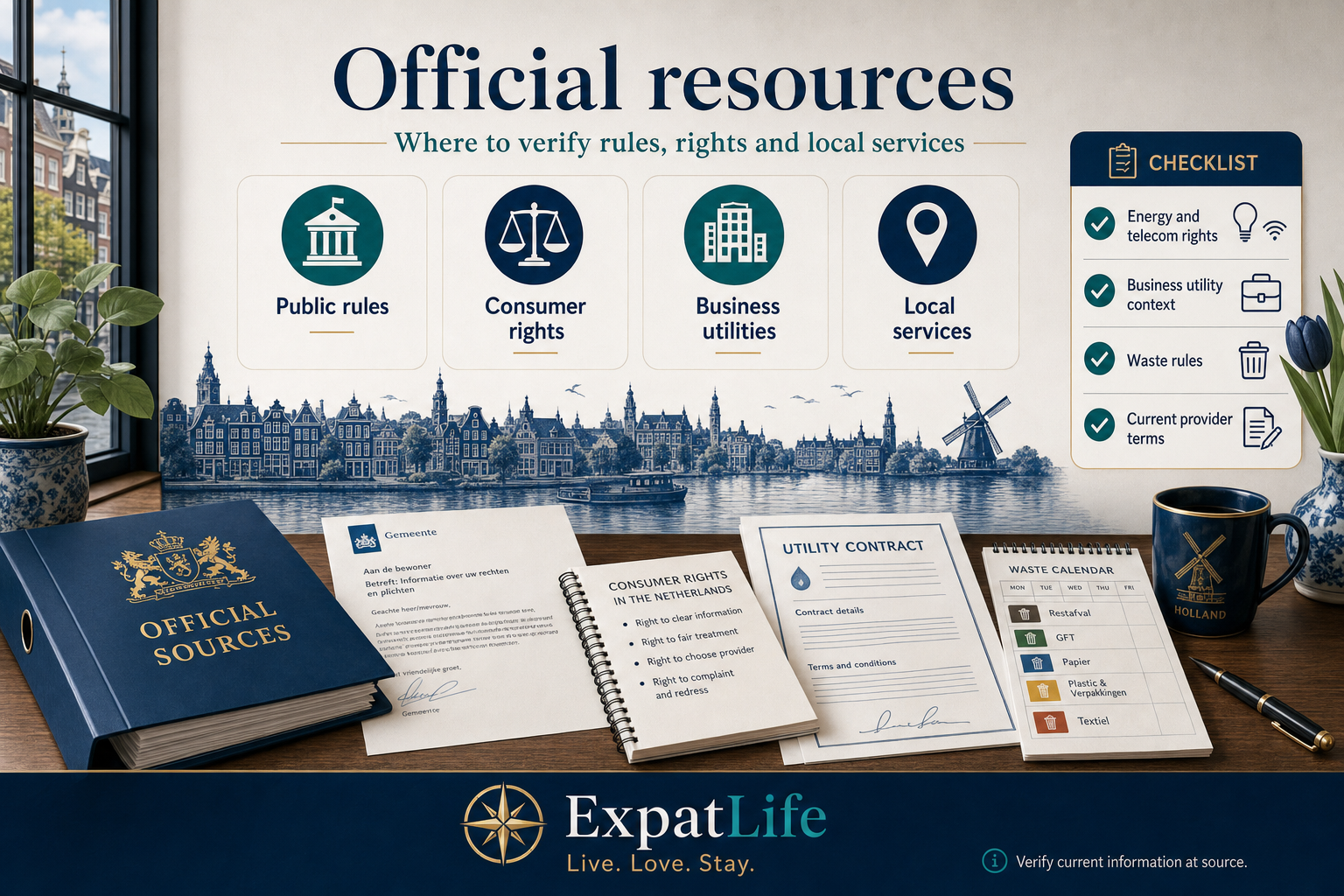
General Dutch government information for residents and public services.
Open official sourceConsumer and market authority context for energy, telecom and consumer rights.
Open official sourceBusiness utility and regulatory context for entrepreneurs and companies.
Open official sourceMunicipality routes for waste collection, local taxes and neighborhood rules.
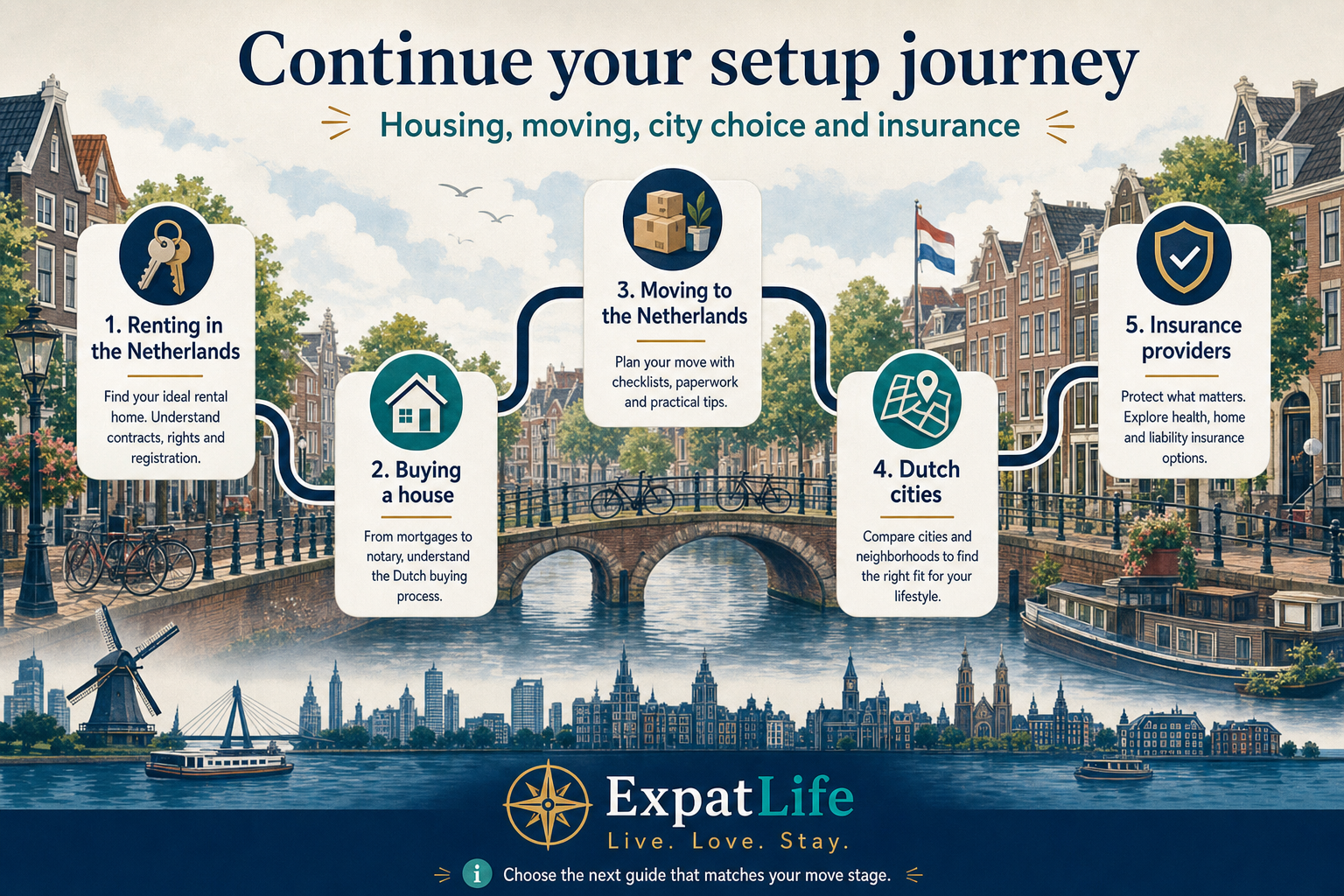
Open official sourceContinue from utilities into housing, moving, city choice and practical insurance setup.
Explore next
Move from utilities into housing contracts, ownership costs, city choices, insurance and your broader relocation checklist.