
Electricity providers can usually be chosen
Compare suppliers by contract type, tariff structure, green options and online service.
Energy and water guide
Understand how electricity, gas, district heating and water services work in the Netherlands, including providers, costs and setup after moving.

Utility services
Most households in the Netherlands use a combination of electricity, gas or district heating, and water. Together these services cover lighting and appliances, heating and hot water, and everyday drinking and household water use.
Residents often choose electricity and gas suppliers, compare contract types and manage usage online. Water is different: drinking water is supplied by a regional company assigned to your address, so you usually register rather than shop between providers.
For expats, the practical split is simple. Energy setup is about contracts, meter readings and annual settlements. Water setup is about confirming your regional provider, registration and how billing works in your rental or owned home.
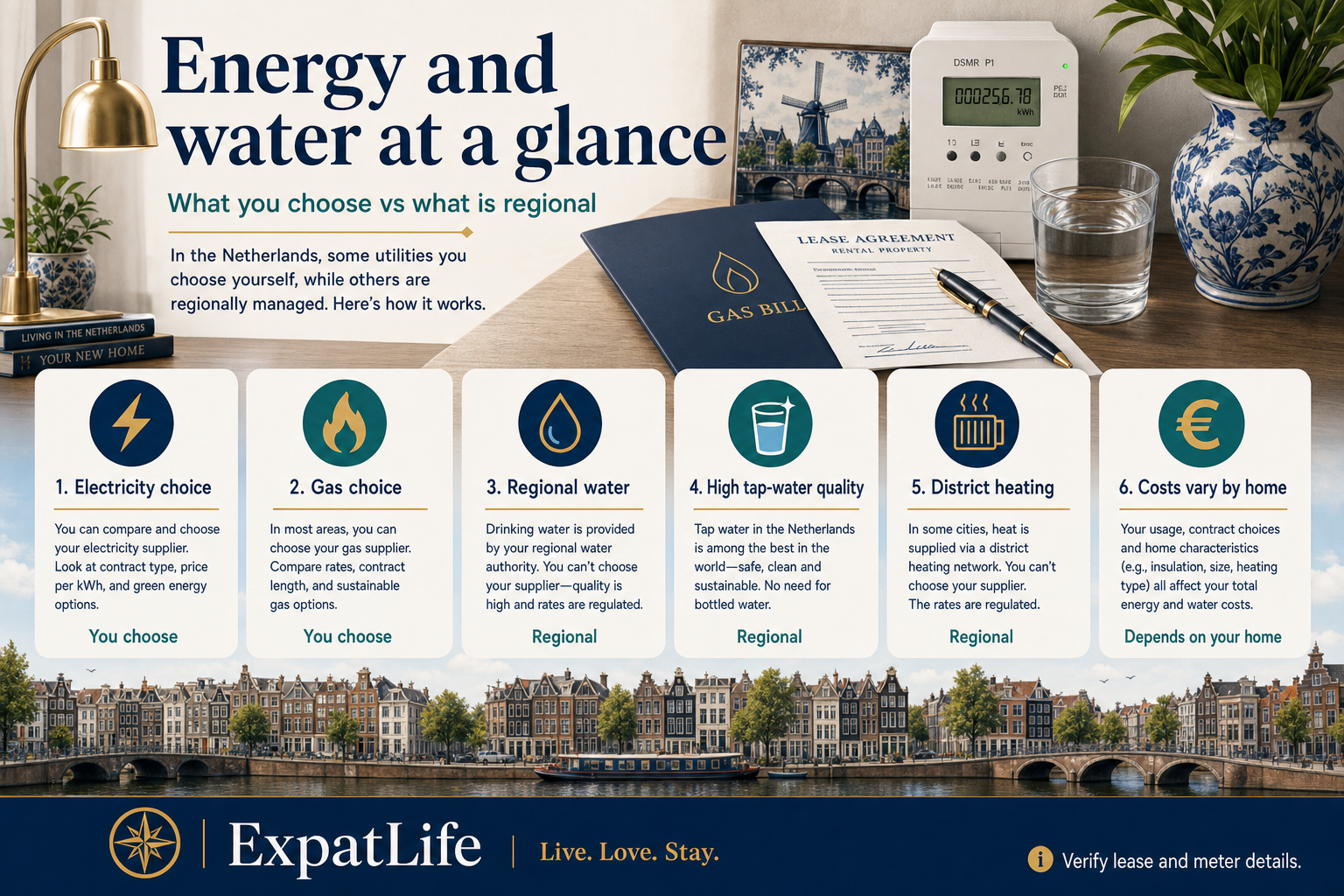
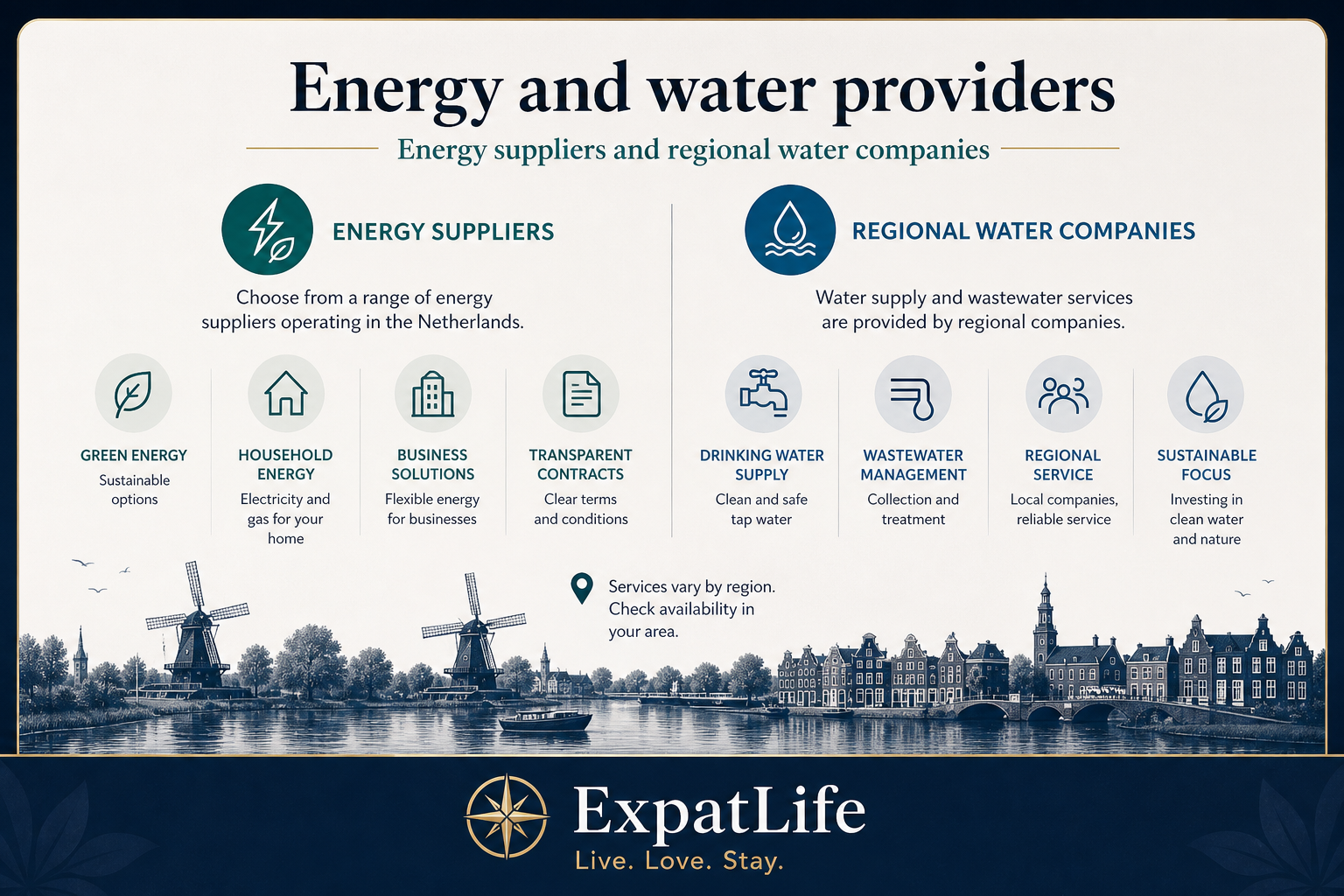
Compare suppliers by contract type, tariff structure, green options and online service.
Gas may be bundled with electricity unless the home uses district heating or is gas-free.
Your address determines whether you register with Waternet, Vitens, Dunea or another regional company.
Drinking water is regulated and generally safe to use directly from the tap.
Apartments and newer developments may receive heat through a local network instead of gas.
Home size, insulation, heating system and usage habits change monthly totals significantly.
Dutch energy bills commonly include electricity usage, gas usage, network charges and taxes or levies. The supplier sends your usage-based charges, while grid and tax components are part of the overall bill structure.
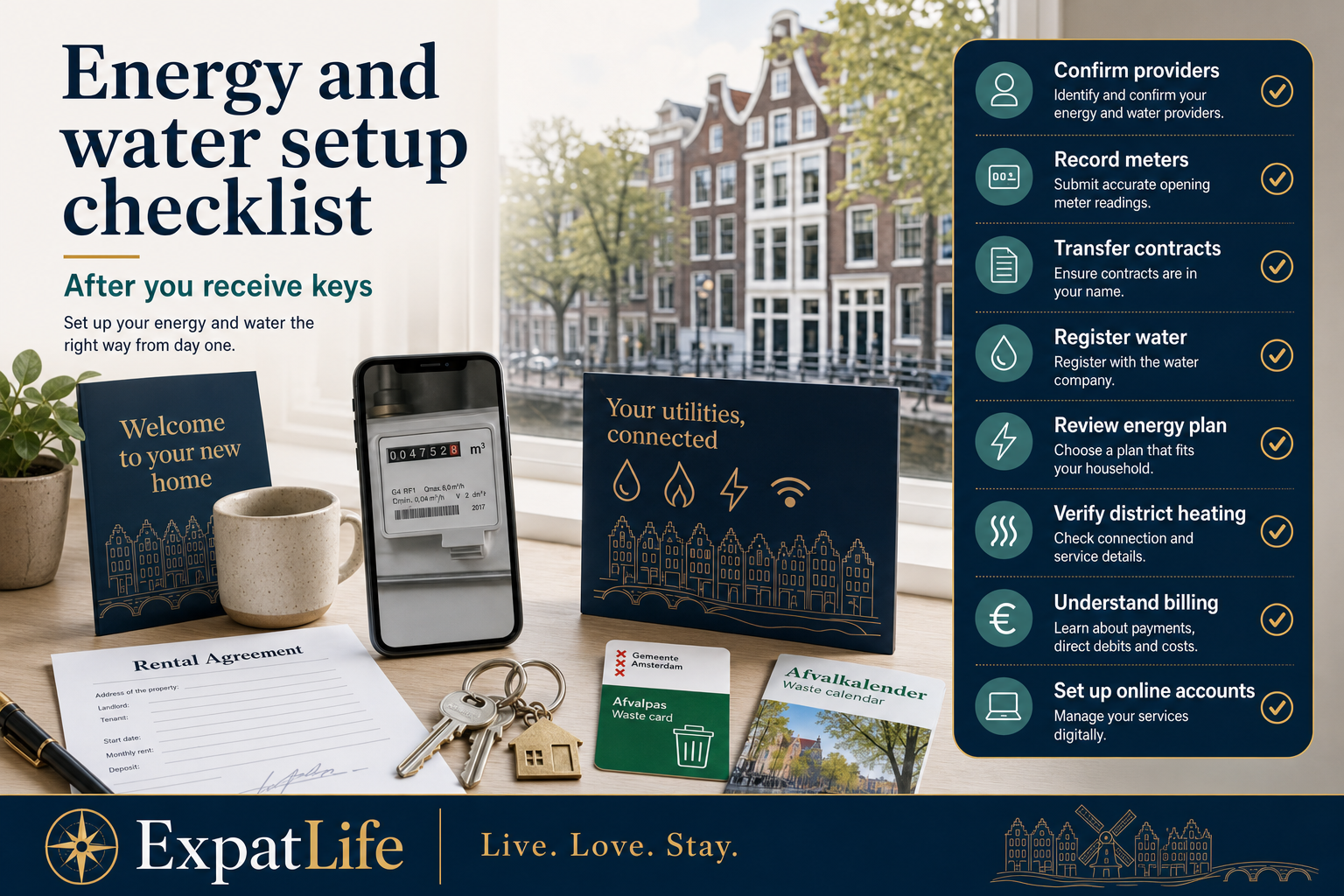
Most homes now have smart meters that measure consumption and support more frequent insight into usage. On move-in day, record electricity and gas meter readings with photos and share them when starting or transferring a contract.
Many contracts use monthly advance payments followed by an annual settlement. That means your monthly bill is an estimate and the year-end calculation may result in an extra payment or refund depending on actual usage.
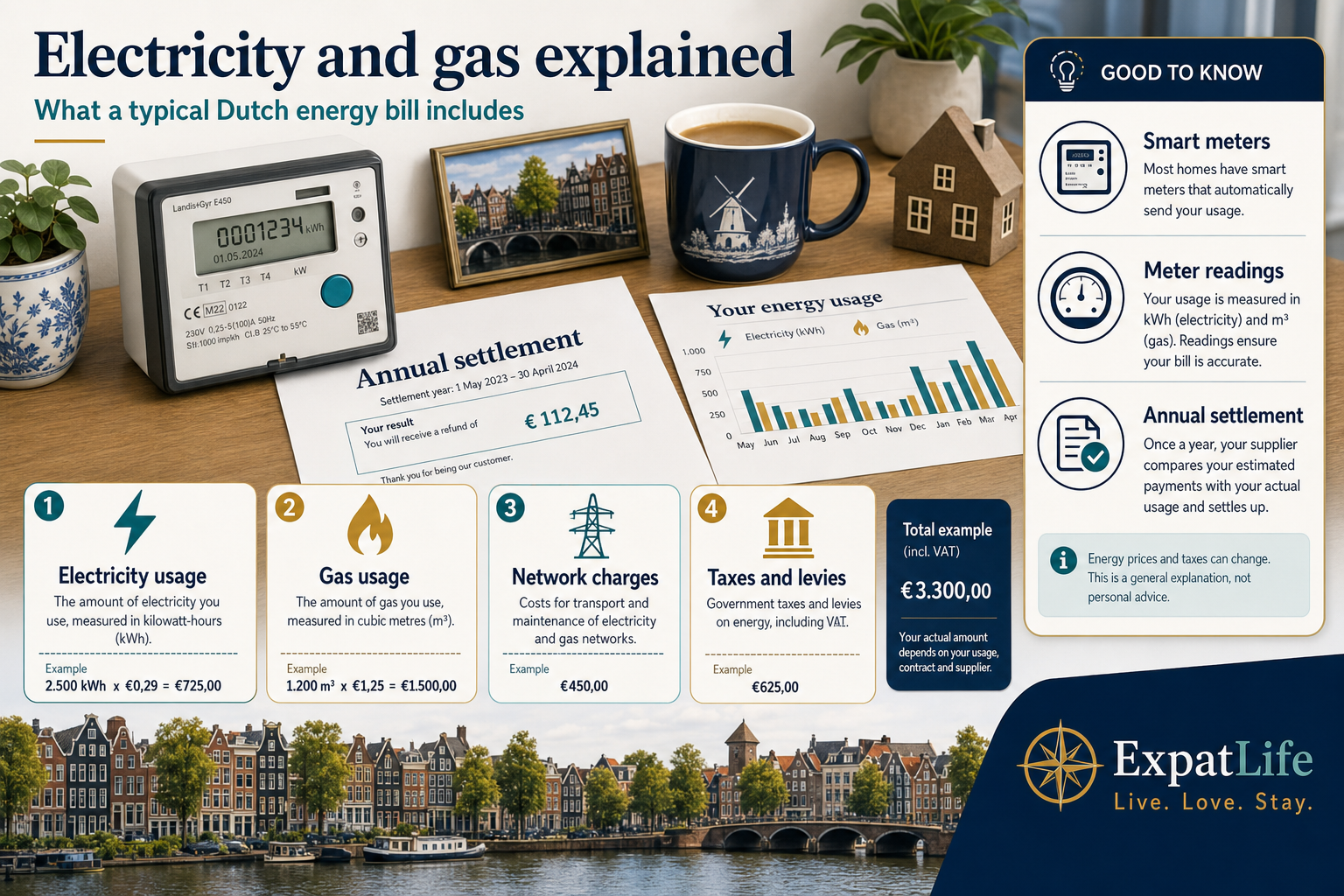
Electricity and gas consumption priced by your chosen supplier under fixed, variable or dynamic contract rules.
Charges for transporting energy to your home, set by the grid operator rather than your supplier brand.
Government components included in the overall bill structure alongside usage and network fees.
Fixed monthly or daily fees that apply even when usage is low — check these when comparing headline kWh rates.
You pay an estimated amount each month based on expected usage and your contract type.
Actual consumption is tracked digitally, reducing reliance on manual readings in most homes.
The supplier compares advances paid with actual usage and issues a refund or requests a top-up.
After settlement, monthly advances are often recalculated — review whether the new amount fits your budget.
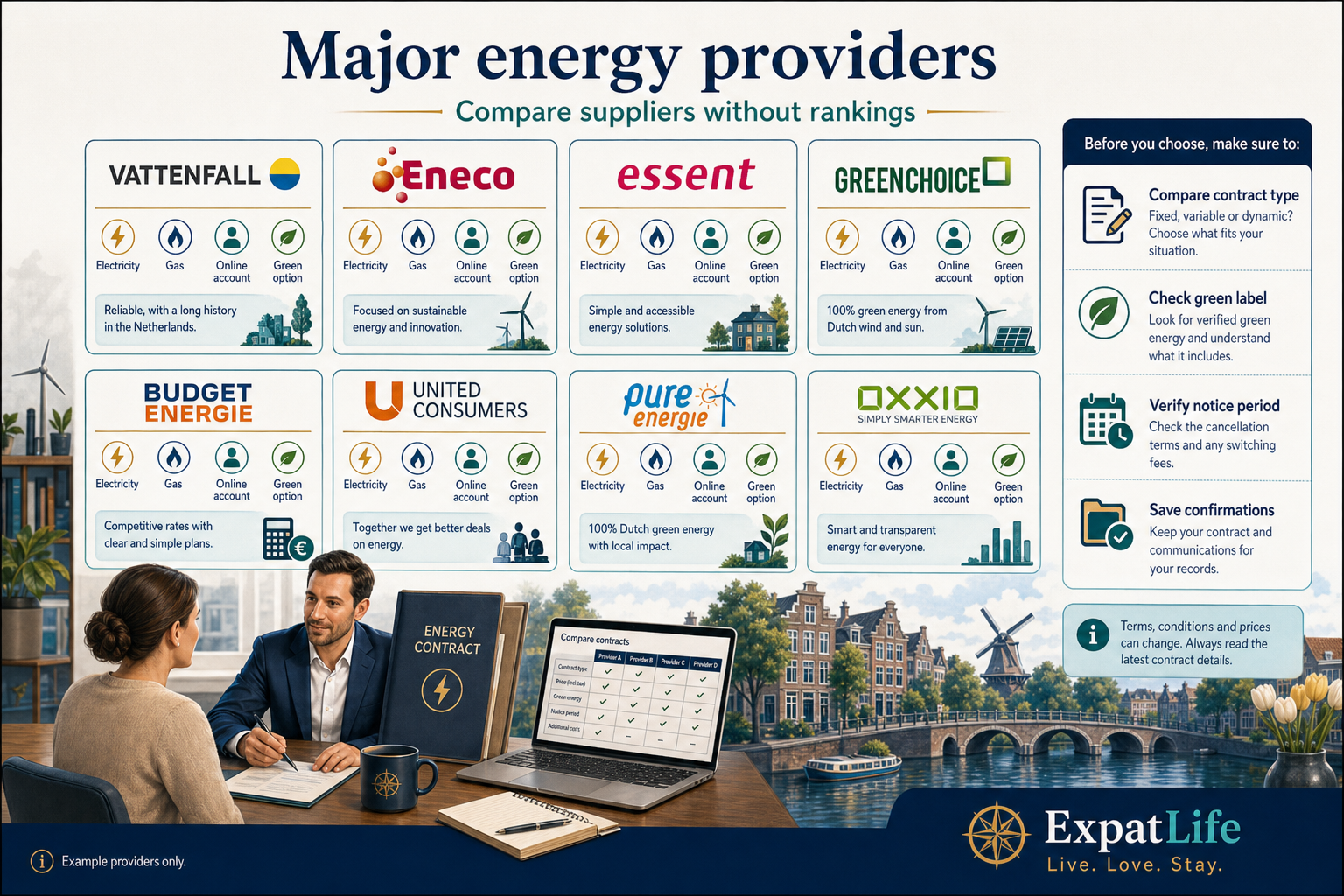
These are real provider examples for orientation only. Inclusion does not rank or recommend any supplier.
Large national supplier for electricity, gas and selected heat products.
Sustainability: Green electricity and renewable product options.
Online: Yes
Visit websiteMajor Dutch energy supplier with sustainability-oriented products.
Sustainability: Green energy, solar and comfort-related products.
Online: Yes
Visit websiteLarge supplier often compared on price and contract length.
Sustainability: Standard and green tariff options.
Online: Yes
Visit websiteSupplier associated with green electricity and Dutch renewable sourcing.
Sustainability: Renewable electricity positioning.
Online: Yes
Visit websitePrice-focused brand within the Budget Thuis group.
Sustainability: Cost-focused comparison positioning.
Online: Yes
Visit websiteCollective offering energy contracts and household services.
Sustainability: Collective and membership-based offers.
Online: Yes
Visit websiteSupplier marketing Dutch wind and renewable electricity products.
Sustainability: Wind and renewable electricity emphasis.
Online: Yes
Visit websiteOnline-first energy brand with straightforward digital signup.
Sustainability: Green electricity options on selected products.
Online: Yes
Visit websiteCompare contract types by stability, flexibility, risk and budget predictability. No single option suits every household.
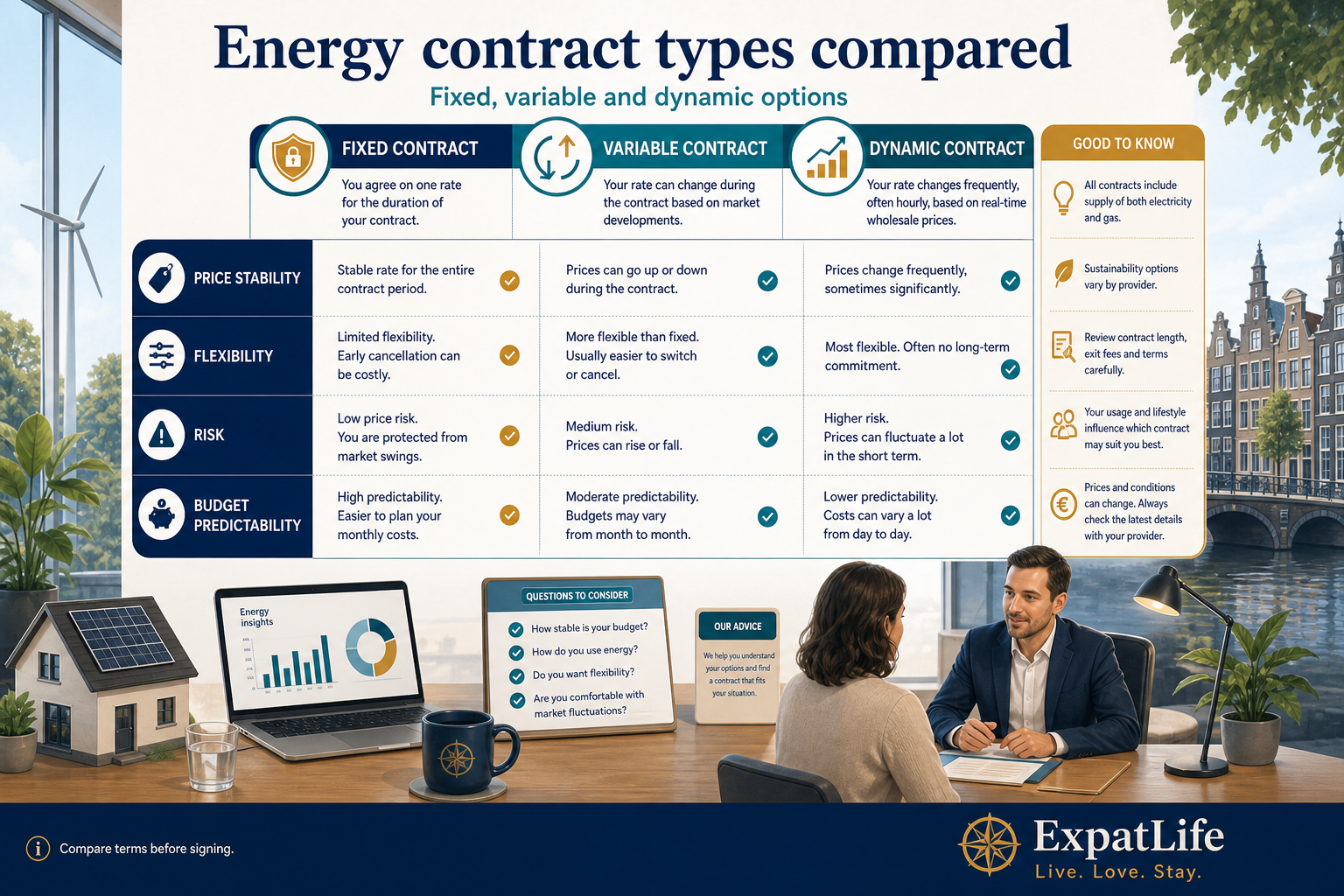
| Contract type | Price stability | Flexibility | Risk | Budget predictability |
|---|---|---|---|---|
| Fixed contract | High during contract term | Lower while locked in | Lower short-term price movement | Strongest for monthly planning |
| Variable contract | Changes with market updates | Higher between renewal points | Moderate market exposure | Moderate; bills can shift over time |
| Dynamic contract | Low; follows short-term prices | High but needs active monitoring | Highest price volatility | Weakest unless usage is very predictable |
Best for
Households that want predictable monthly costs and are willing to commit for a set period.
Best for
Users comfortable with tariff changes who may benefit when market prices fall.
Best for
Active users who can shift usage to cheaper hours and monitor prices regularly.
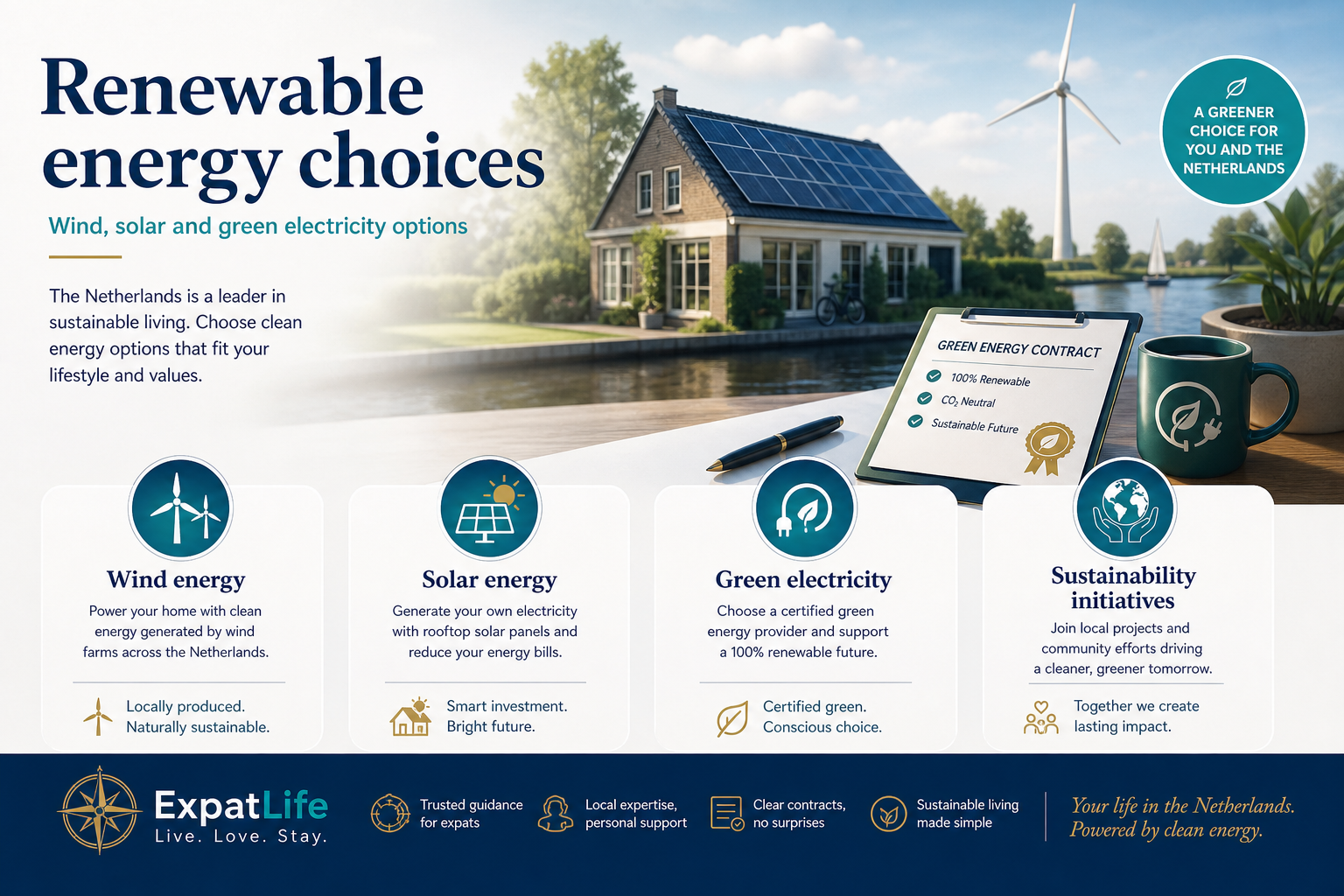
Many Dutch energy suppliers offer green electricity products based on renewable sourcing, certificates or supplier-specific sustainability claims. Wind and solar are the most common themes in consumer marketing.
Homeowners or long-term residents may also consider solar panels, heat pumps or efficiency upgrades, but rental and building rules can limit what is possible. Always verify what a provider means by green energy before paying a premium.
Renewable choices can support lower-carbon living, but the best option depends on contract terms, home suitability and whether you prioritize price stability or sustainability features.
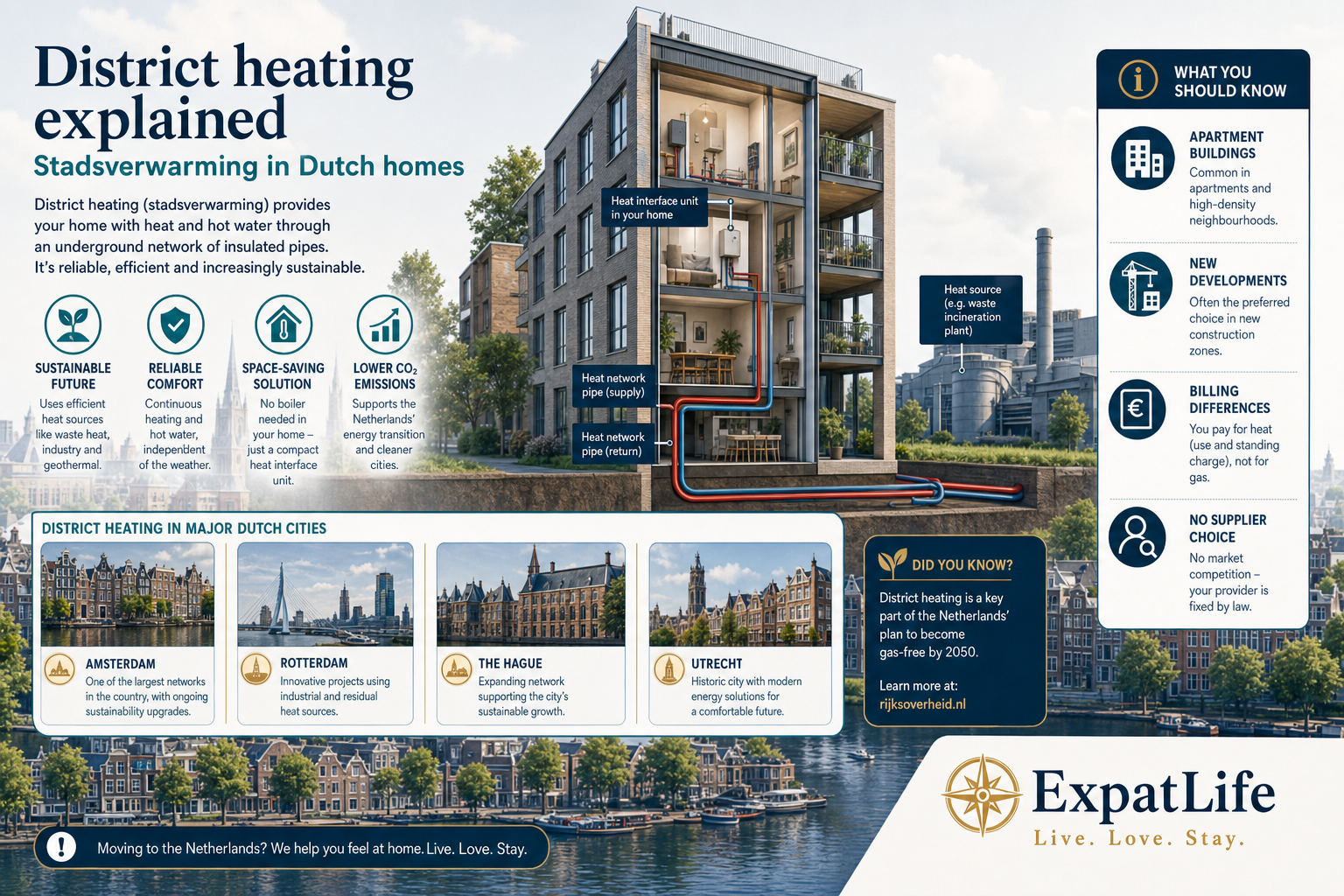
Some homes receive heat through district heating networks rather than an individual gas boiler. This is common in apartment buildings and newer urban developments in cities such as Amsterdam, Rotterdam, The Hague and Utrecht.
Billing can differ from a normal gas contract because heat may be charged through fixed and usage-based components linked to the building network. Ask the landlord, VvE or building manager which heat provider serves the property.
If your home uses district heating, you usually cannot choose another heat supplier in the same way you can choose electricity or gas on the open market.
| Topic | Individual gas heating | District heating |
|---|---|---|
| Provider choice | You can usually choose an electricity and gas supplier on the open market. | Heat is supplied through the building network — switching supplier is usually not possible. |
| Typical homes | Older houses, townhouses and many detached homes with their own boiler. | Apartments and newer developments in Amsterdam, Rotterdam, The Hague and Utrecht. |
| Billing structure | Gas usage on your energy bill plus electricity from your supplier. | Heat charges via the network operator, sometimes separate from your electricity contract. |
| Move-in action | Record gas meter readings and start or transfer a gas contract. | Confirm with landlord or VvE how heat is billed and whether registration is needed. |
Drinking water in the Netherlands is supplied by regional water companies. Examples include Waternet in the Amsterdam area, Vitens across large parts of the country, Dunea in parts of South Holland, Brabant Water in Noord-Brabant, WML in Limburg and PWN in parts of North Holland.
Residents usually cannot choose a different drinking-water provider for the same address. After moving, confirm whether you need to register directly, whether water is included in rent, and how meter readings or billing will work.
Water charges are regulated and separate from energy supplier choice, although both may appear in your overall household budget planning.
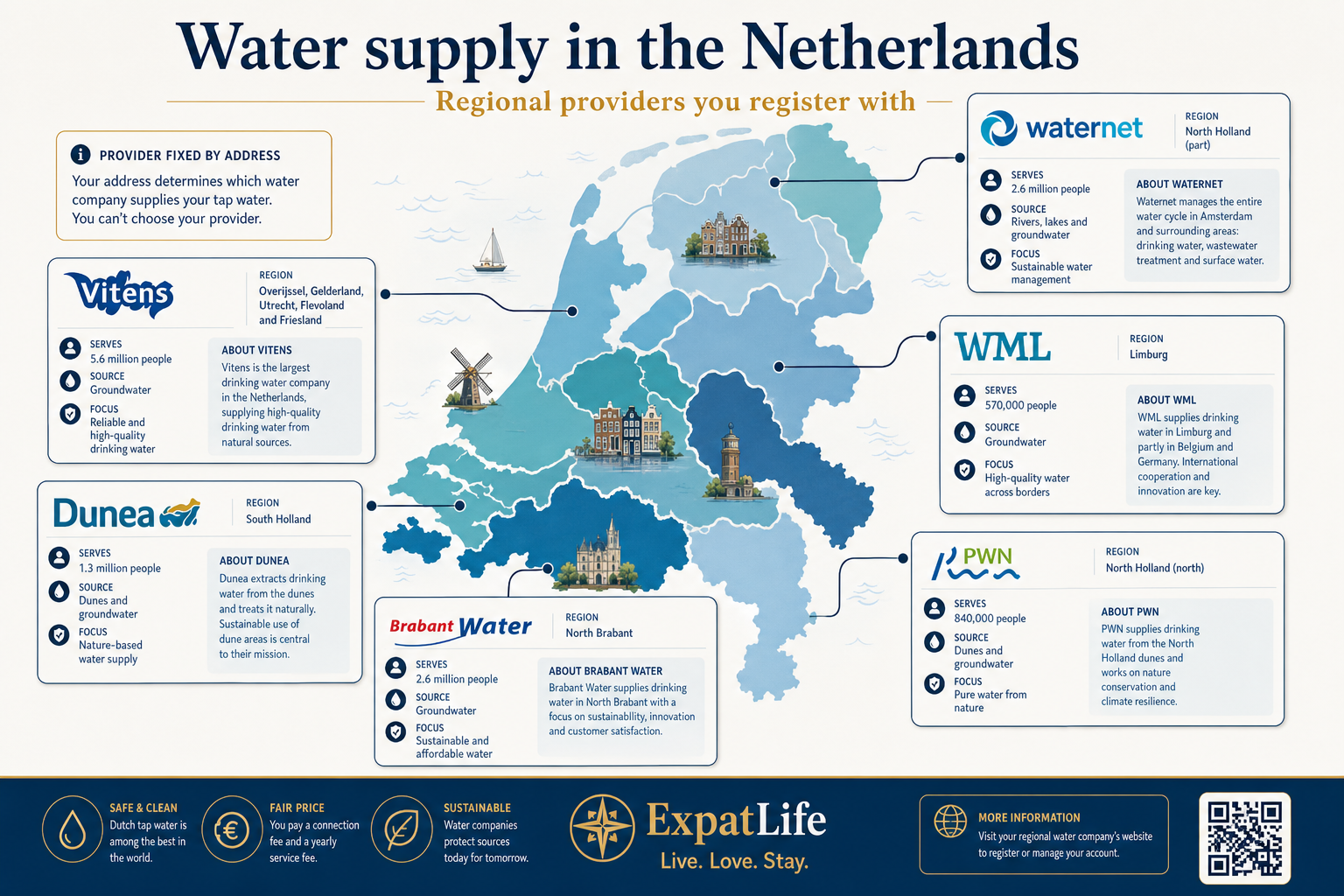
Regional provider
Amsterdam and surrounding municipalities
Common for expats moving to Amsterdam — register after confirming billing with your landlord.
Regional provider
Large parts of central, eastern and northern Netherlands
Covers many addresses outside the Randstad core cities.
Regional provider
The Hague area and parts of South Holland
Typical provider for The Hague newcomers.
Regional provider
Noord-Brabant including Eindhoven
Check move-in registration steps on the company website.
Regional provider
Limburg
Regional monopoly — billing may still run through the landlord in some rentals.
Regional provider
Parts of North Holland
Serves areas outside central Amsterdam where Waternet does not apply.
The Netherlands is known for high-quality drinking water that meets strict standards. In most homes, tap water is suitable for drinking, cooking and everyday household use without buying bottled water.
Using tap water can also reduce plastic waste and household cost compared with bottled alternatives. Regional water companies publish quality information and customer guidance online.
If you are unsure how billing works in your rental, check the lease and landlord instructions even though the water itself is generally safe.
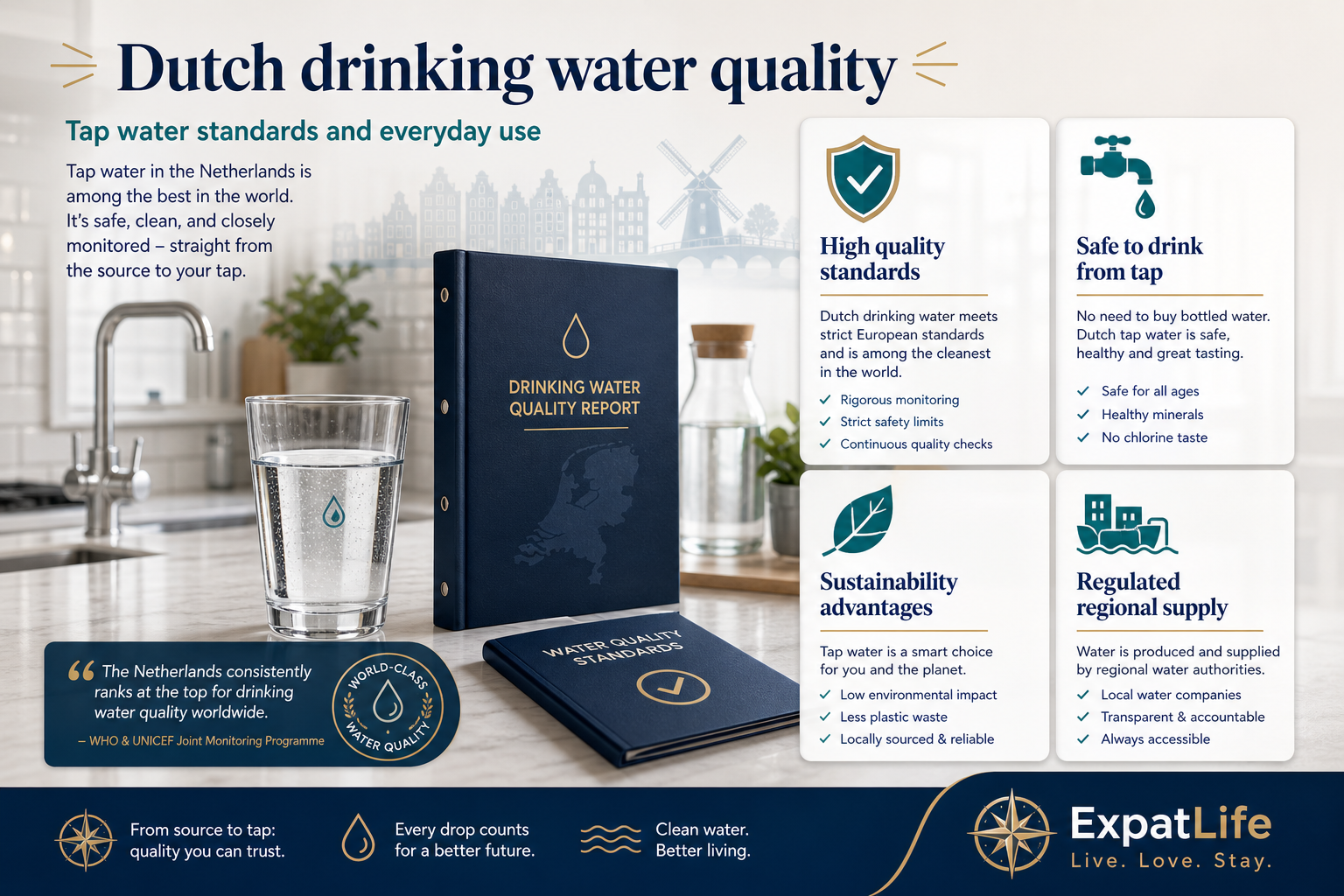
Dutch tap water is regulated for drinking quality — bottled water is optional, not required for safety.
Filters can change taste but are not usually necessary for safety in standard Dutch homes.
Older internal plumbing or temporary works can occasionally affect a specific building — follow landlord guidance.
Your assigned water company publishes annual quality data for your supply area online.
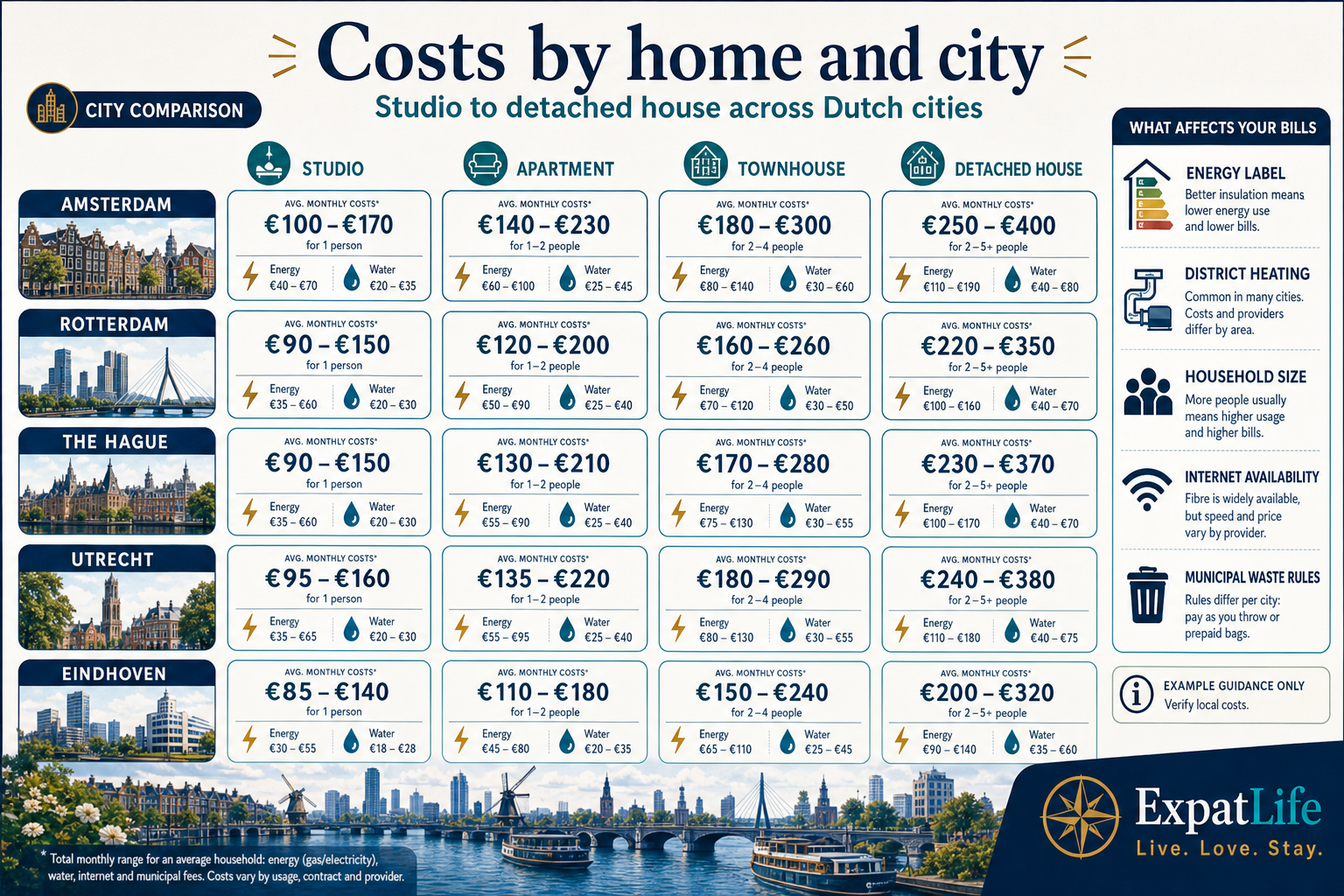
These are realistic example ranges only. They are not quotes, guarantees or provider recommendations.
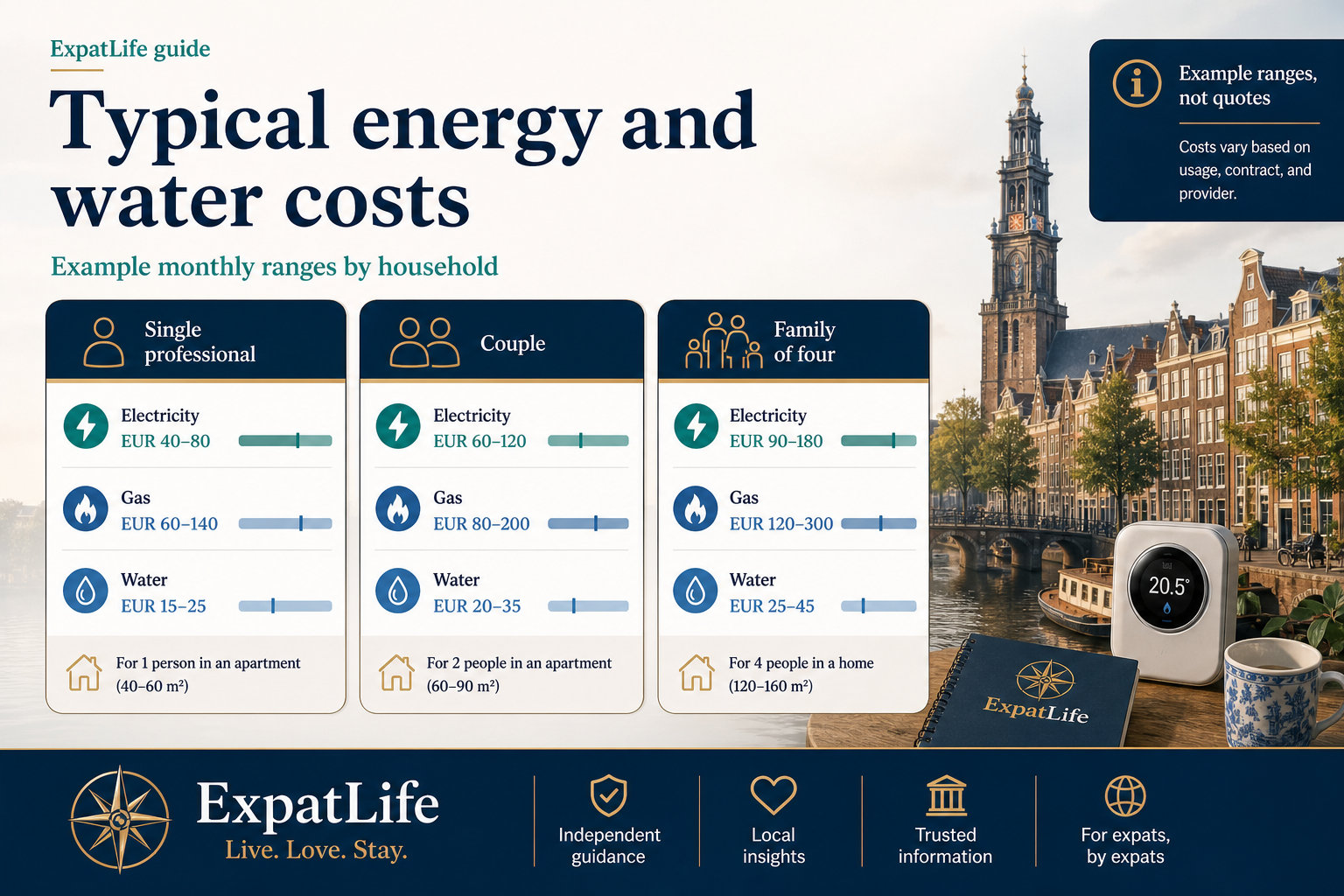
Home type, insulation and city housing stock often matter more than city name alone.
Smaller floor area and lower occupancy often reduce heating and electricity usage, especially when heating is partly included.
District heating is more common; insulation and exposure direction can still change bills materially.
More rooms and hot-water demand usually increase gas or heat usage compared with compact apartments.
Larger surface area and garden water use can push energy and water totals higher without strong insulation.
Higher share of apartments, district heating and older building stock can change heating patterns.
Mix of modern developments and older homes affects insulation and heat-system prevalence.
Regional water via Dunea and varied housing types create different typical bill profiles.
Growing apartment stock and district heating networks appear in many central neighborhoods.
Often more space per home than dense Randstad cores, which can increase usage.
Use this checklist after confirming your lease, meter access and move-in date.
Small usage changes and better contract choices can reduce bills without changing your address.
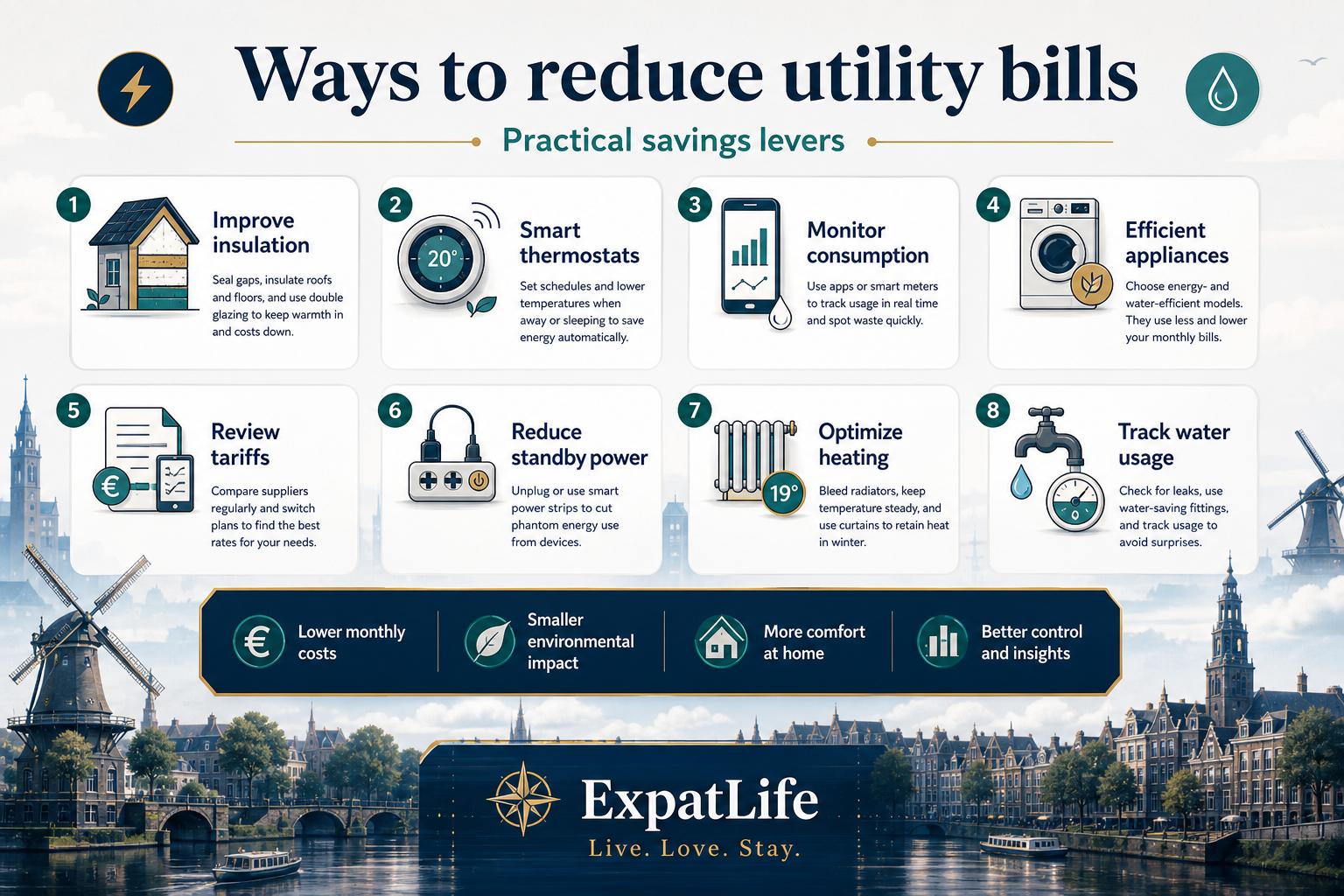
Draught-proofing windows and doors can reduce heating waste in older Dutch homes, especially in winter.
Lower temperatures overnight or when away — small schedule changes can reduce gas and heat use materially.
Check supplier apps or smart meter portals monthly to catch unusual spikes before annual settlement.
Replace old fridges, washers or dryers with higher efficiency models when upgrading.
Compare contract type and all-in monthly cost before auto-renewing — headline kWh rates can mislead.
Switch off devices and chargers that draw power when not in use, especially in home offices.
Heat living areas when occupied rather than keeping the whole home at peak temperature all day.
Fix leaks quickly and avoid long showers — water is regulated but still billed by usage in many homes.
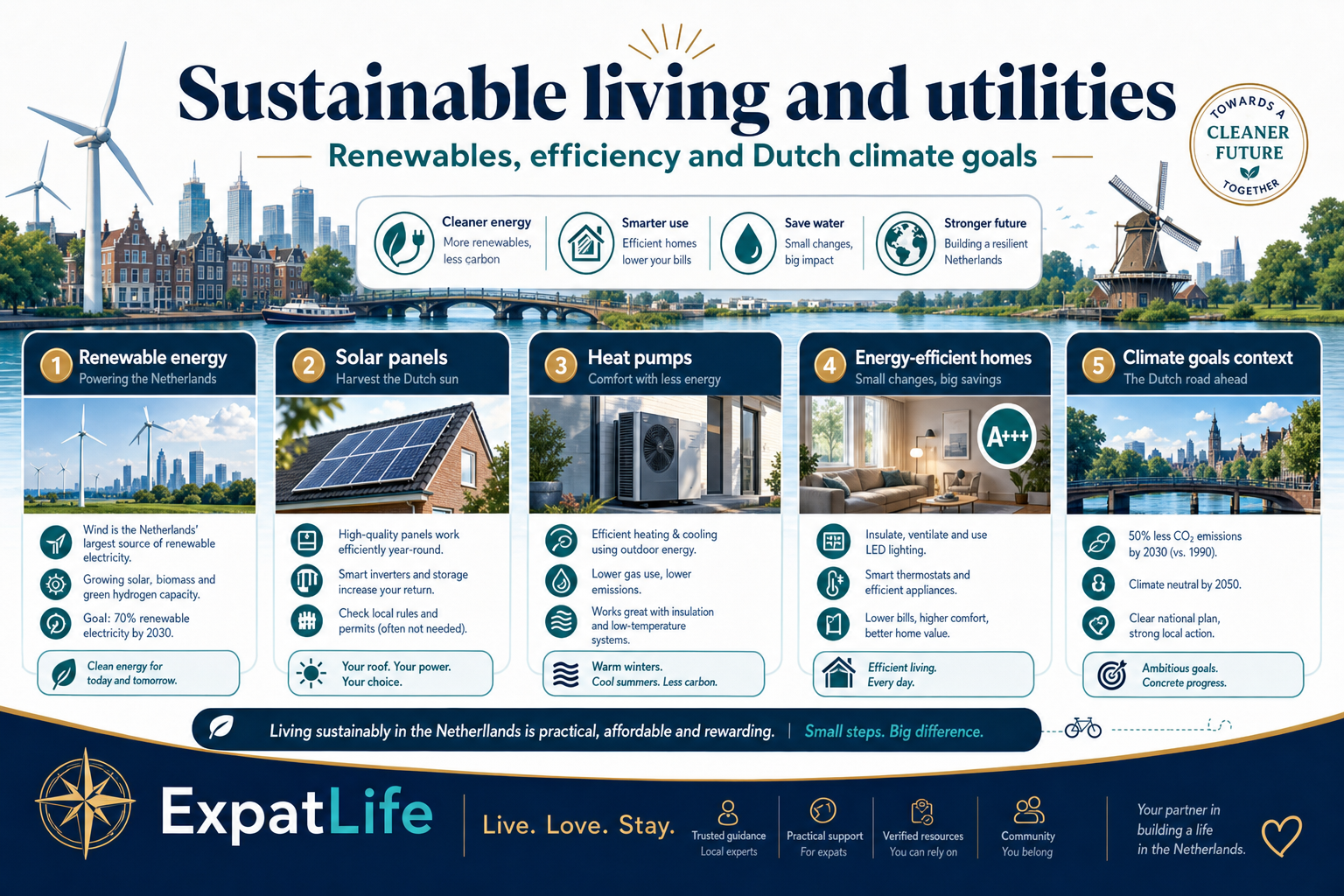
Dutch utility policy and housing trends increasingly emphasize energy efficiency, lower gas use and more renewable electricity. That shows up in green tariffs, heat pumps, solar panels and better-insulated new builds.
For renters, sustainability options may be limited by the landlord or building, but green electricity contracts and efficient usage habits can still help. Owners may have more scope for solar, heat pumps and retrofit insulation where permitted.
Future guides on solar panels, heat pumps and sustainable living can go deeper, but the starting point is understanding your current heating system, contract and home constraints.
These are the setup errors expats most often make with energy contracts, water registration and meter readings.
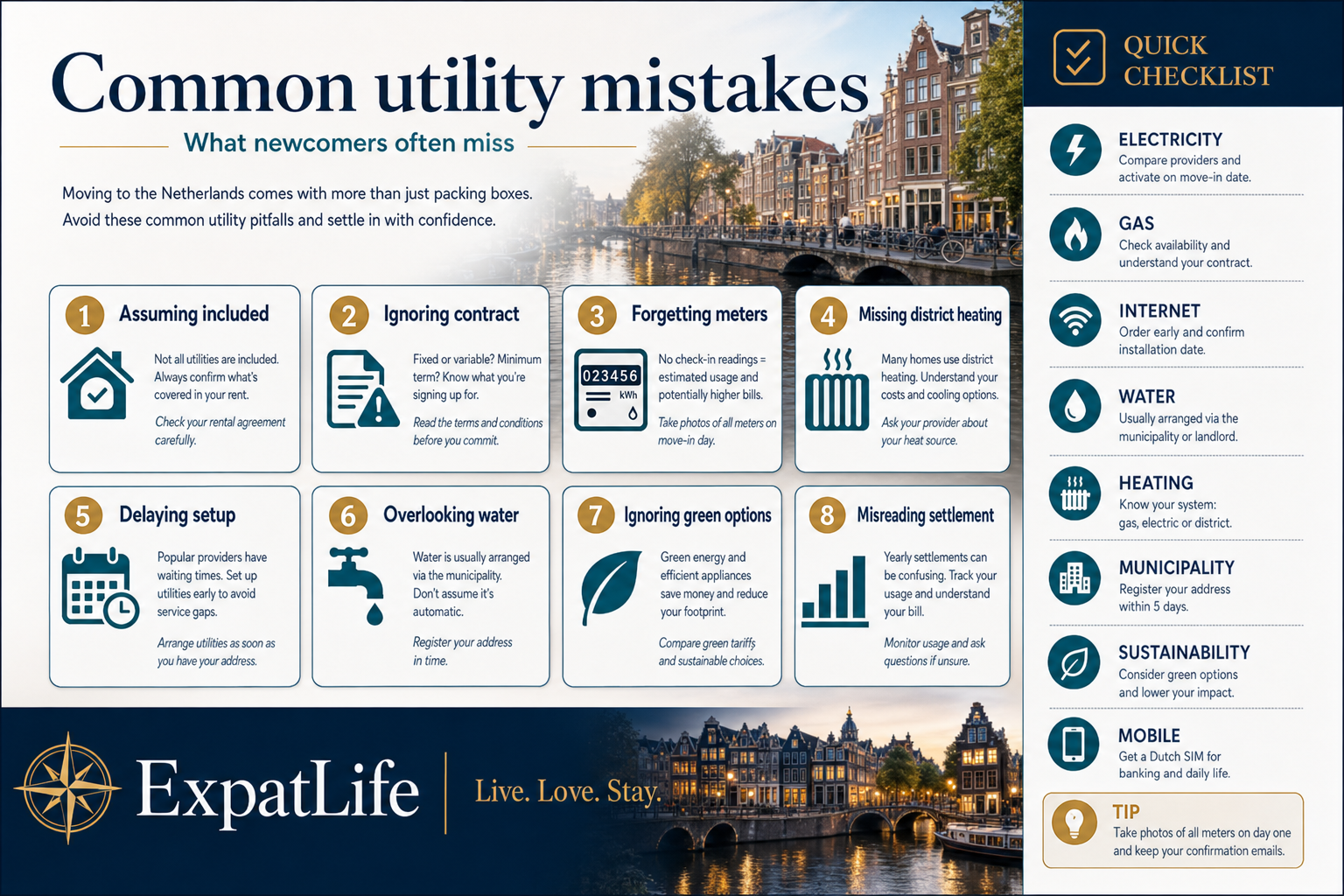
Many rentals bill energy separately or via service costs — confirm the lease before move-in.
Fixed, variable and dynamic contracts behave very differently when prices move or you want to switch.
Date-stamped photos protect you from paying for the previous tenant's usage.
Heat-network homes may not need a standard gas contract — ask how stadsverwarming is charged.
Late registration can create billing gaps, estimated charges or disputes with landlords.
Even though you cannot choose a water company, you may still need to register or confirm billing.
Green tariffs, smart thermostats and insulation can help when they match your housing situation.
A low monthly advance can feel cheap until a large top-up arrives after the jaarafrekening.
Example prices are orientation ranges only. Verify current tariffs, contract terms and regional availability directly with providers.
Energy
Large national electricity and gas supplier with green and heat-network products.
Example costs and prices
Example orientation: combined electricity and gas often EUR 100–220 per month for a typical apartment in moderate usage months.
Features
Pros
Watch-outs
Service regions: National energy supply; heat networks in selected areas.
Visit websiteEnergy
Major supplier with sustainability-focused electricity, gas and comfort products.
Example costs and prices
Example orientation: electricity tariffs often around EUR 0.28–0.32 per kWh incl. VAT before standing charges and gas use.
Features
Pros
Watch-outs
Service regions: National energy supply; heat in selected areas.
Visit websiteEnergy
Large supplier often compared on contract price and online switching.
Example costs and prices
Example orientation: couple in a one-bedroom home might budget EUR 130–220 per month for energy in shoulder seasons.
Features
Pros
Watch-outs
Service regions: National electricity and gas supply.
Visit websiteEnergy
Green-energy-focused supplier for electricity and gas.
Example costs and prices
Example orientation: green electricity often slightly above lowest market rates; budget roughly EUR 120–230 per month combined for moderate apartment use.
Features
Pros
Watch-outs
Service regions: National energy supply.
Visit websiteEnergy
Price-focused energy brand in the Budget Thuis group.
Example costs and prices
Example orientation: headline rates sometimes from about EUR 0.27–0.29 per kWh incl. VAT; verify all-in monthly cost.
Features
Pros
Watch-outs
Service regions: National energy supply.
Visit websiteEnergy
Collective supplier model with membership-style energy offers.
Example costs and prices
Example orientation: verify all-in monthly estimate including membership or bundle terms before comparing.
Features
Pros
Watch-outs
Service regions: National subject to product and membership terms.
Visit websiteEnergy
Supplier emphasizing Dutch wind and renewable electricity.
Example costs and prices
Example orientation: renewable products often EUR 0.30+ per kWh incl. VAT in public comparisons before gas and fixed charges.
Features
Pros
Watch-outs
Service regions: National energy supply.
Visit websiteEnergy
Online-first electricity and gas brand with digital contract management.
Example costs and prices
Example orientation: apartment households may see roughly EUR 100–200 per month combined in moderate usage depending on contract and gas use.
Features
Pros
Watch-outs
Service regions: National energy supply.
Visit websiteWater
Regional drinking water and water-system organization for Amsterdam and surroundings.
Example costs and prices
Example orientation: drinking water often EUR 13–20 per month for one to two people.
Features
Pros
Watch-outs
Service regions: Amsterdam region and selected surrounding municipalities.
Visit websiteWater
Large drinking water company serving central, eastern and northern Netherlands.
Example costs and prices
Example orientation: many households pay roughly EUR 12–25 per month depending on occupants and usage.
Features
Pros
Watch-outs
Service regions: Large parts of central, eastern and northern Netherlands.
Visit websiteWater
Drinking water company for parts of South Holland including The Hague area.
Example costs and prices
Example orientation: typical household drinking-water bills often EUR 14–22 per month.
Features
Pros
Watch-outs
Service regions: The Hague region and parts of South Holland.
Visit websiteWater
Regional drinking water company for Noord-Brabant.
Example costs and prices
Example orientation: roughly EUR 13–24 per month for typical household drinking-water use.
Features
Pros
Watch-outs
Service regions: North Brabant.
Visit websiteWater
Drinking water supplier for Limburg.
Example costs and prices
Example orientation: about EUR 12–22 per month for standard household water use.
Features
Pros
Watch-outs
Service regions: Limburg.
Visit websiteWater
Drinking water company serving parts of North Holland.
Example costs and prices
Example orientation: drinking water commonly EUR 13–23 per month for average household use.
Features
Pros
Watch-outs
Service regions: Parts of North Holland.
Visit websiteUse these quick answers for orientation before checking your lease, provider terms or municipality instructions.
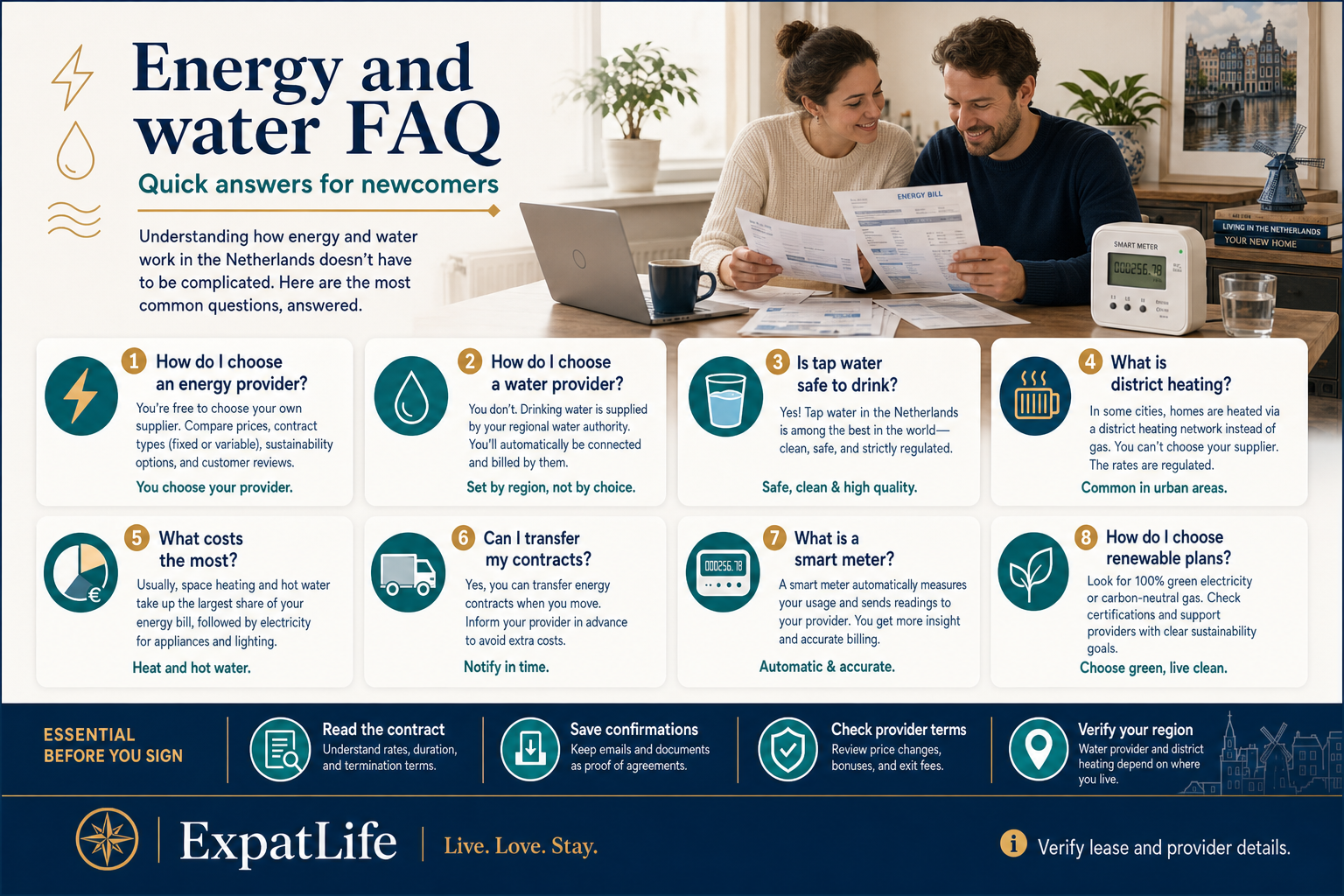
Usually yes for electricity and gas unless utilities are included in rent or your home uses a special heat arrangement. Compare contract type, tariff, notice period and green options before signing.
No. Drinking water is supplied by the regional company assigned to your address. You register and manage billing rather than switching between water companies.
Yes. Dutch drinking water is regulated and generally high quality, making tap water suitable for drinking and cooking in most homes.
District heating, or stadsverwarming, delivers heat through a local network instead of an individual gas boiler. It is common in apartments and some modern developments.
A single professional may pay roughly EUR 90–180 per month for energy and water combined, while couples and families often pay more. Actual costs depend on home size, heating system, insulation and usage.
After confirming meter readings, contact the energy supplier to start or transfer a contract in your name. For water, register with the regional company if required and save all confirmations.
A smart meter measures electricity and often gas consumption digitally. It supports usage insight and the annual settlement process used by many Dutch suppliers.
Yes. Many suppliers offer green electricity products based on renewable sourcing or certificates. Verify what each product means before choosing it.
Energy markets, utility prices and regulations change over time. Always verify current information through providers and official sources.
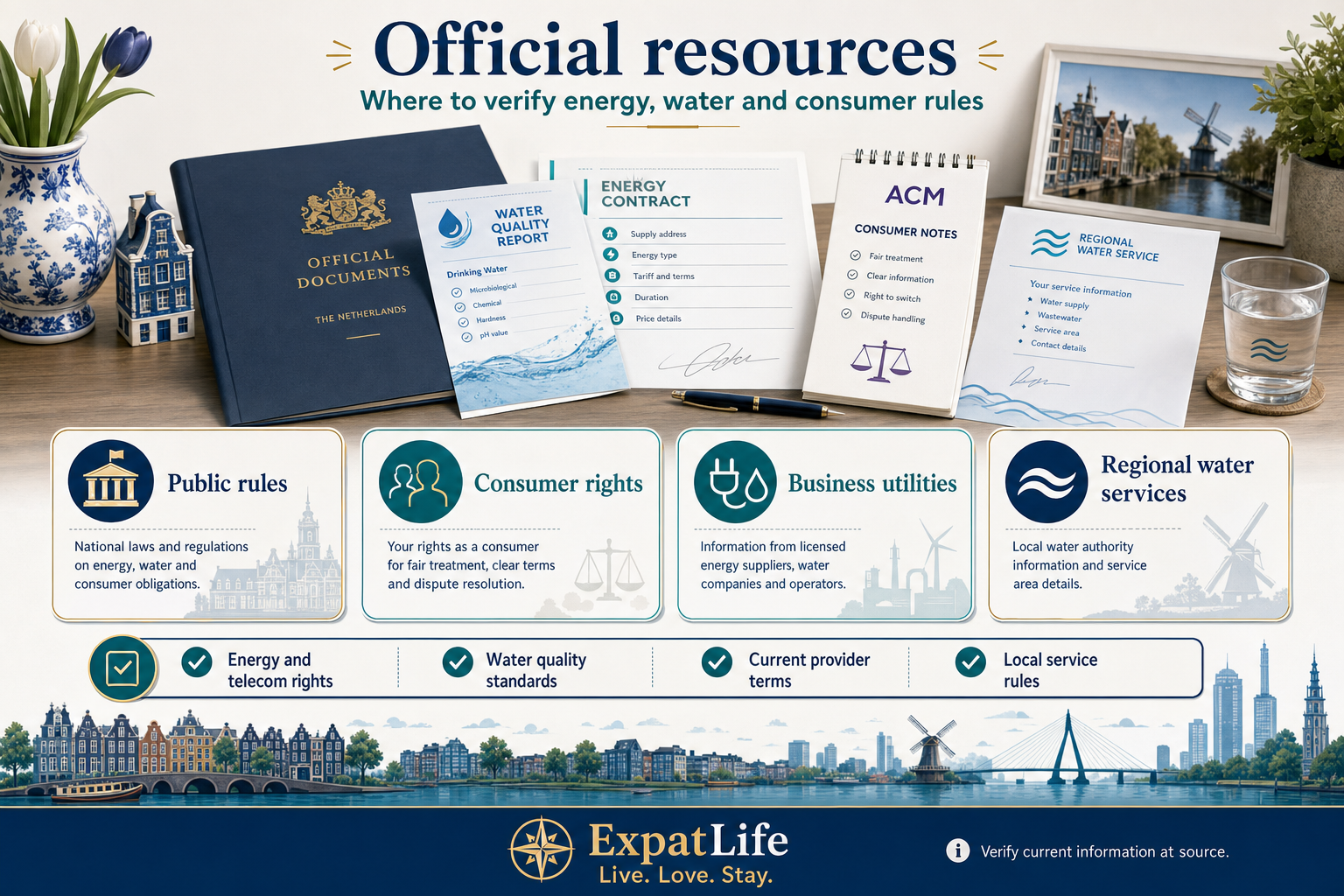
General Dutch government information for residents and public services.
Open official sourceConsumer and market authority context for energy markets and consumer rights.
Open official sourceBusiness utility and regulatory context for entrepreneurs and companies.
Open official sourceDutch central government information on public rules and resident topics.
Open official sourceUmbrella organization linking regional water authority and water-sector context.
Open official sourceContinue from energy and water into the wider utilities, housing and city guides.
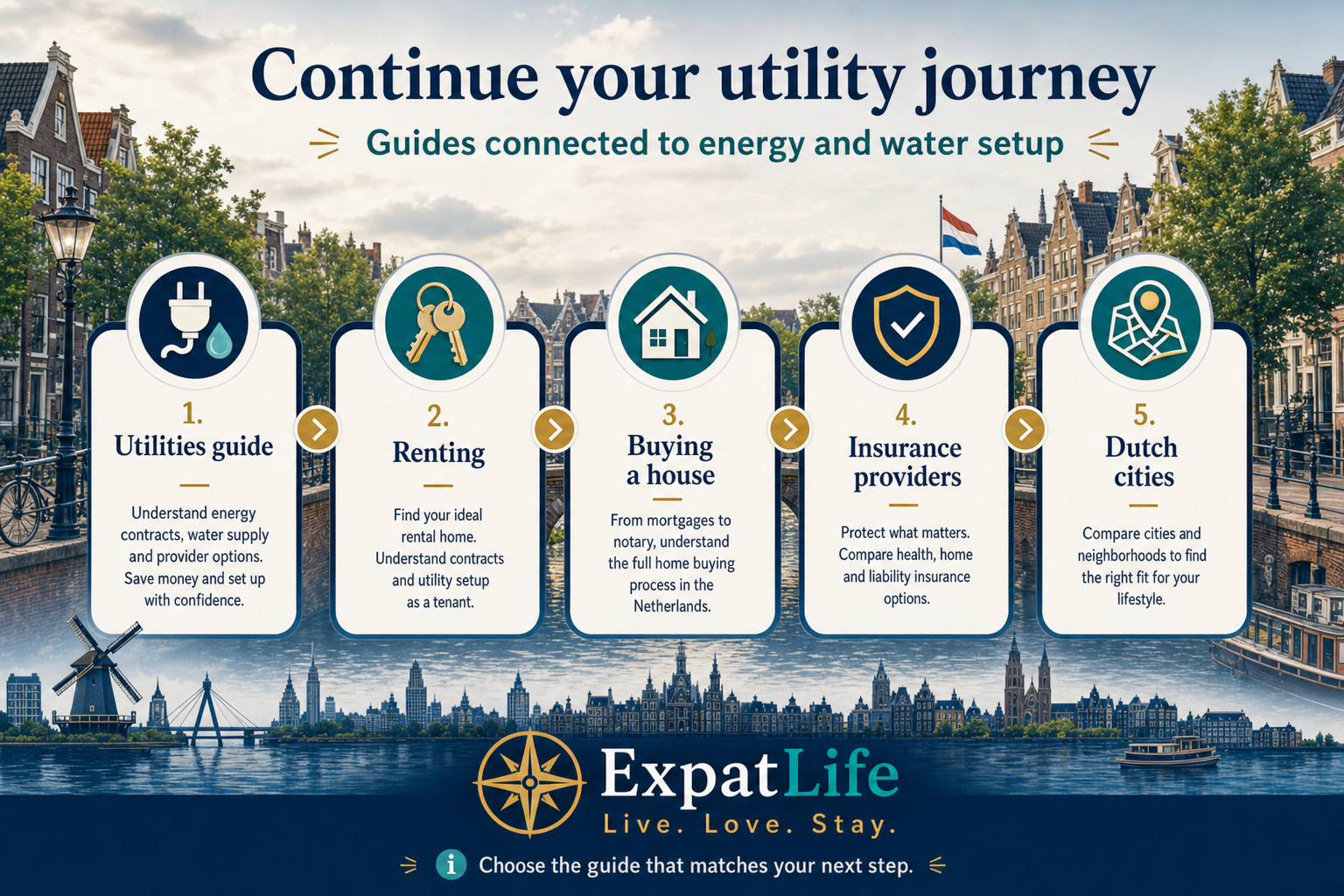
Explore next
Move from energy and water into the full utilities guide, housing setup, insurance and your broader relocation checklist.