Municipalities manage waste systems
Your gemeente sets sorting rules, collection schedules, container locations and recycling center access.
Practical life guide
Learn how Dutch waste collection and recycling systems work, including household waste, recycling categories, collection schedules and sustainability practices.
Quick answer
Waste collection and recycling in the Netherlands are primarily managed by your municipality (gemeente). Rules for sorting, containers, collection days and recycling centers depend on your address — not on one national system.
Most newcomers quickly learn that Dutch households separate waste into several streams: general rubbish, paper, glass, plastic packaging and often organic waste (GFT). Urban areas frequently use underground containers; suburban areas may use curbside bins or bags.
This guide explains everyday waste systems in practical terms for expats, students and families. Always verify current rules on your gemeente website — local requirements can change and differ significantly between cities.
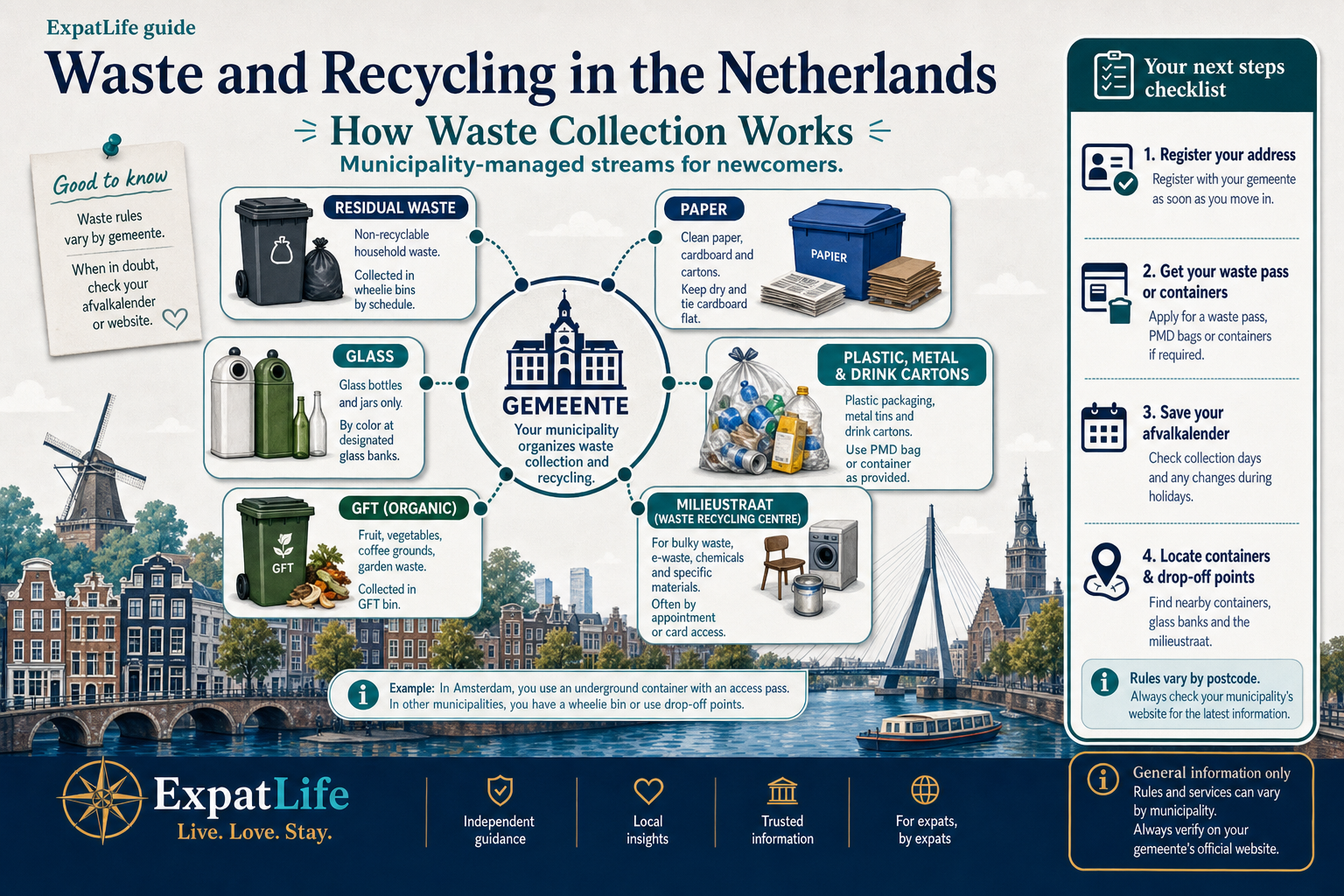
Your gemeente sets sorting rules, collection schedules, container locations and recycling center access.
Separating paper, glass, plastic and organic waste is normal in Dutch daily life.
Amsterdam, Rotterdam and smaller gemeenten use different container types and calendars.
Many neighborhoods use below-street bins accessed with a pass or card.
Milieustraat locations accept furniture, appliances and renovation waste.
Save your afvalkalender or use apps like Afvalwijzer after move-in.
Connect waste and recycling rules to broader gemeente services including taxes, parking and registration.
Open municipality guidePlace waste setup in your wider relocation timeline alongside housing, registration and first-month household tasks.
Open moving guideComplete household setup with energy, water and internet after you understand local waste systems.
Open utilities guideAddress registration unlocks waste passes, calendars and gemeente waste portals at your postcode.
Open address registration guideLearn building-specific waste rules for apartments, VvE shared containers and new move-ins.
Open housing hubAt a glance
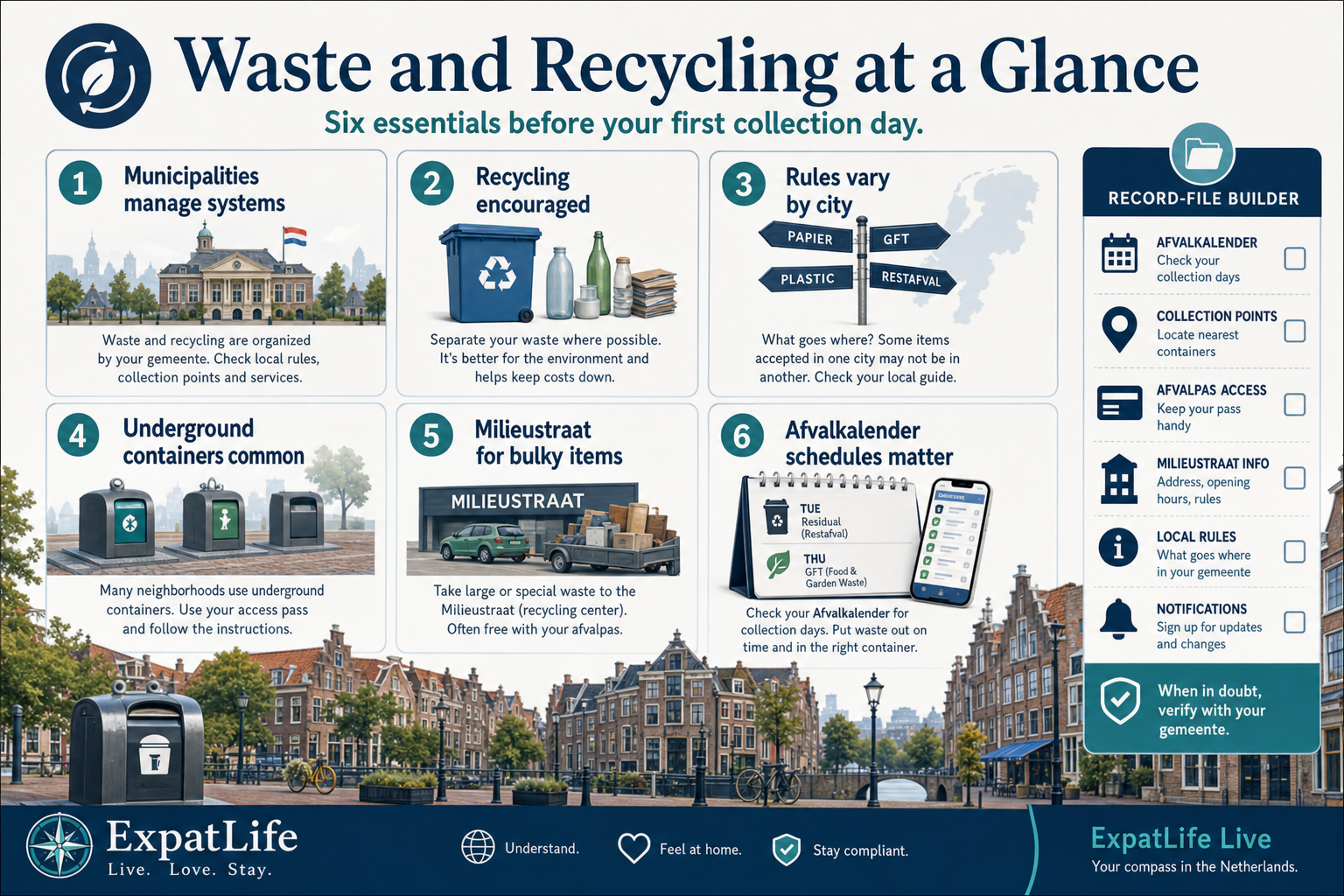
Use these essentials to orient yourself in the first week after moving. Then open your municipality waste page for the authoritative rules at your postcode.
| Resource | What it helps with |
|---|---|
| Afvalwijzer | Postcode-based collection reminders used by many Dutch municipalities. |
| Gemeente waste portal | Authoritative sorting guides, container maps and milieustraat hours. |
| Supermarket statiegeld machines | Return deposit bottles and cans — separate from household recycling bins. |
| Municipality apps | Amsterdam, Rotterdam and other cities offer container reporting and calendars in-app. |
Dutch municipalities typically organize household waste collection, recycling infrastructure, recycling centers (milieustraat) and occasional special collections for items like Christmas trees or hazardous waste.
Urban areas often rely on underground containers and waste passes to limit street clutter. Suburban and rural areas may use wheelie bins, collection bags or neighborhood container hubs with fixed pickup days.
Your registered address determines which rules apply. After address registration, look up your waste calendar and learn whether your building uses shared containers, individual bins or a pay-as-you-throw system.
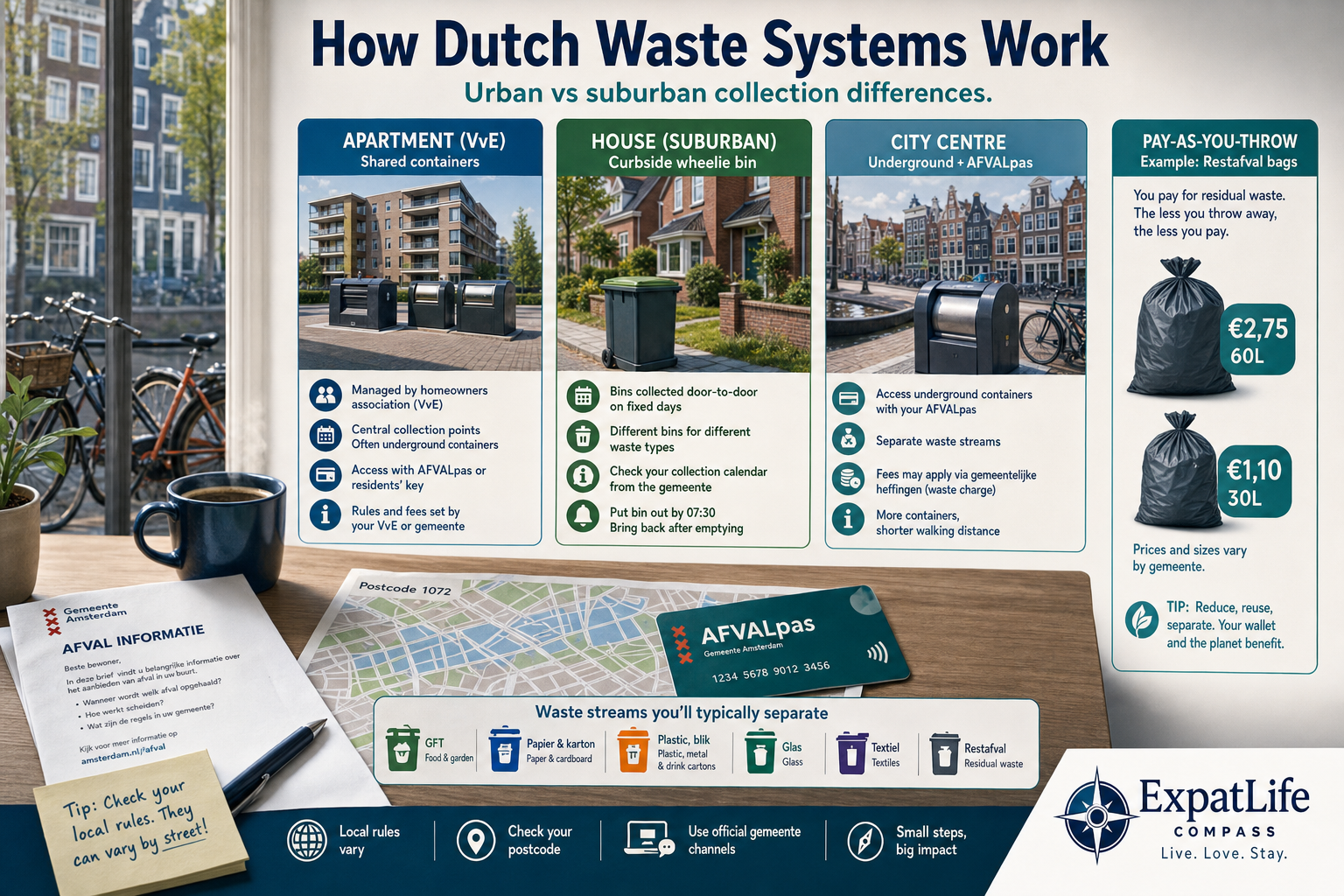
| Area | Containers | Schedule | Expat tip |
|---|---|---|---|
| Dense urban (Amsterdam, Rotterdam) | Underground hubs with waste pass | Often no curbside residual pickup | Find your nearest container map on day one. |
| Suburban neighborhoods | Wheelie bins or above-ground hubs | Fixed curbside days on afvalkalender | Confirm evening-before vs morning set-out rules. |
| Apartment buildings | Shared chutes or basement rooms | Building rules may override street containers | Ask landlord or VvE for sorting instructions at handover. |
| Pay-as-you-throw gemeenten | Official bags or weight-based residual | Recycling often free; residual costs per bag/kg | Separating GFT and recyclables can lower your bill. |
Separate household waste into the streams your municipality collects. Rules for plastic, textiles and organic waste vary by gemeente — verify your local sorting guide.
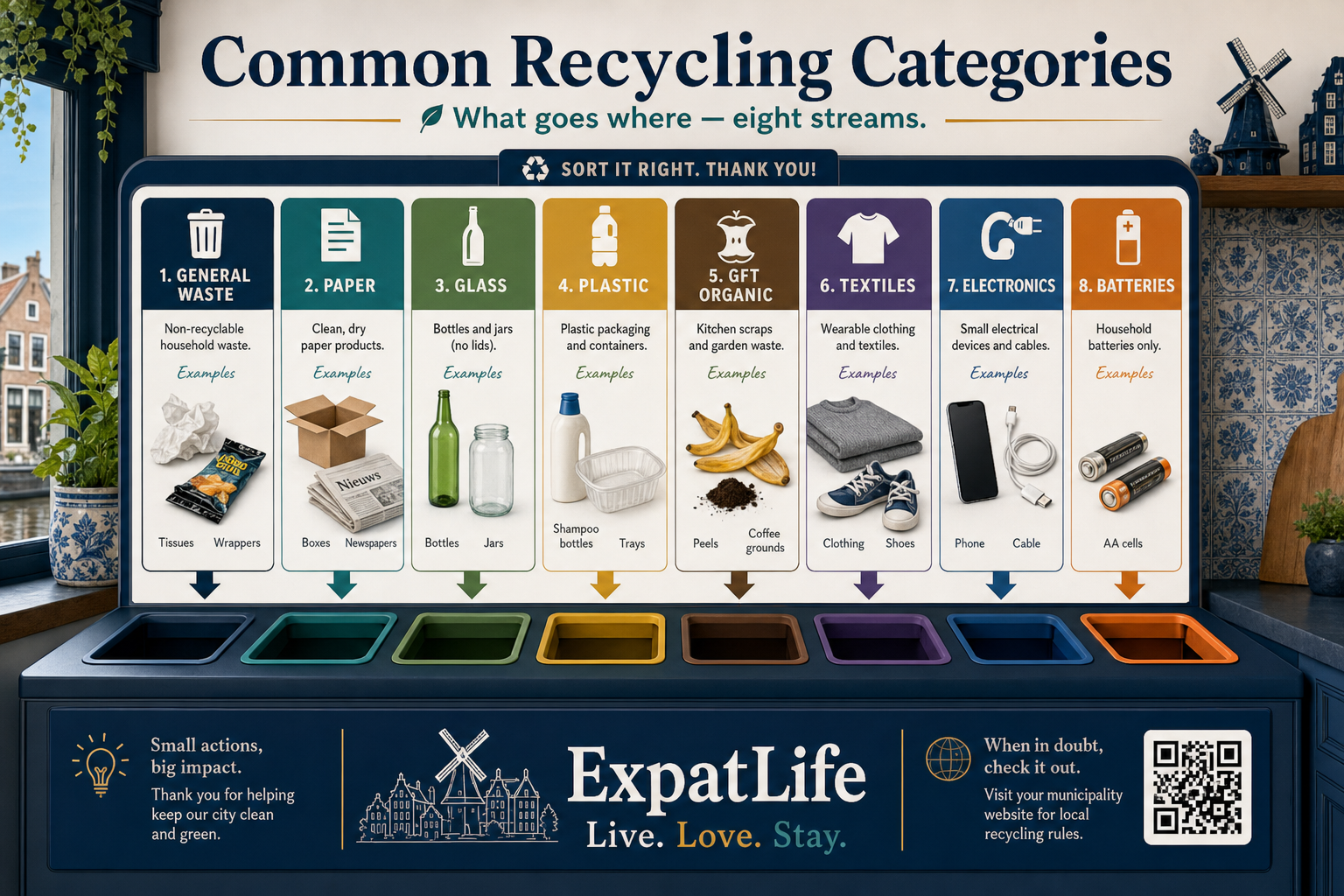
Non-recyclable household rubbish that cannot go in other streams.
Examples
Avoid: Do not put recyclables, electronics or hazardous items in general waste.
Clean, dry paper and cardboard for separate collection or drop-off.
Examples
Avoid: Greasy pizza boxes, wax-coated paper and wet cardboard belong elsewhere.
Bottles and jars — often sorted by color at neighborhood bottle banks.
Examples
Avoid: No window glass, mirrors, light bulbs or ceramics in glass containers.
Plastic packaging — rules vary; some cities use bags, others use containers.
Examples
Avoid: Hard plastics, toys and non-packaging items may need milieustraat drop-off.
Food and garden waste collected for composting where municipalities offer GFT.
Examples
Avoid: No plastic bags (unless certified compostable locally), pet waste or cooking oil in GFT.
Clothing and fabrics via dedicated containers or charity collection points.
Examples
Avoid: Wet, heavily soiled or non-textile items do not belong in textile bins.
E-waste via retailers, gemeente points or recycling centers — never in household bins.
Examples
Avoid: Do not discard electronics in general waste or mixed recycling streams.
Separate collection at supermarkets, retailers and gemeente drop-off points.
Examples
Avoid: Never put batteries in general waste — fire risk and environmental harm.
Many Dutch cities use underground waste containers to keep streets clean and reduce odor. Residents access them with a waste pass, RFID card or building key depending on the municipality.
Containers are usually shared by a street or block. Each container is dedicated to a specific stream — mixing waste in the wrong underground slot can block collection or trigger fines.
Check your gemeente map for container locations near your home and learn which pass opens which bin.
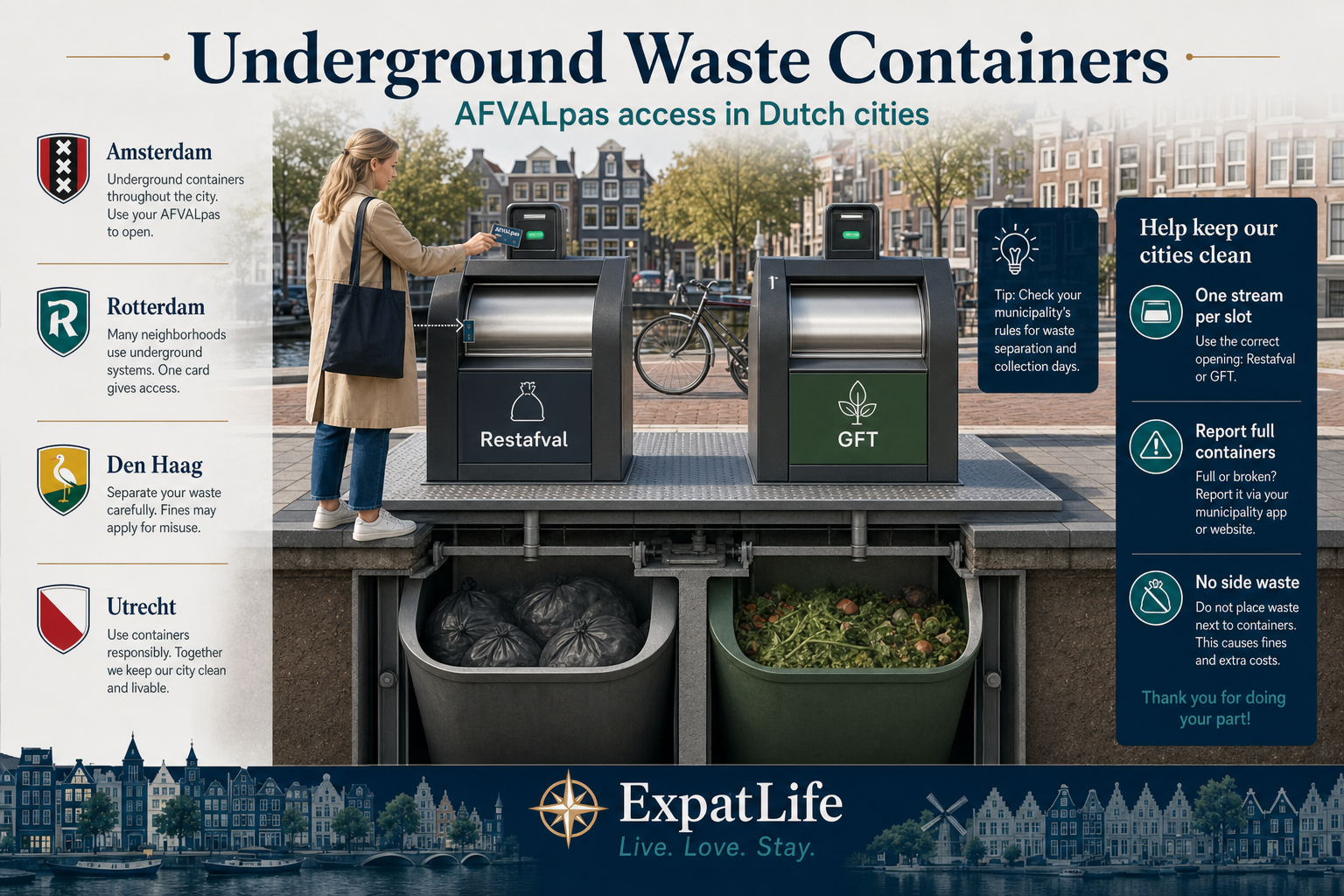
Widespread underground systems with AFVALpas; dense neighborhoods use color-coded container hubs.
Mix of underground and above-ground containers; check rotterdam.nl/afval for local maps.
Underground containers in many districts; collection rules tied to address registration.
Underground residual and organic systems common; verify container access after move-in.
Waste passes and underground container access often activate after address registration at your gemeente.
Open address registration guideResidual household waste is what remains after you separate recyclables and organic material. How it is collected depends on your municipality: curbside wheelie bins, underground containers, collection bags or pay-as-you-throw systems.
Collection frequency varies — some areas pick up weekly, others every two weeks. Missing your collection window often means storing waste longer or finding an alternative drop-off point.
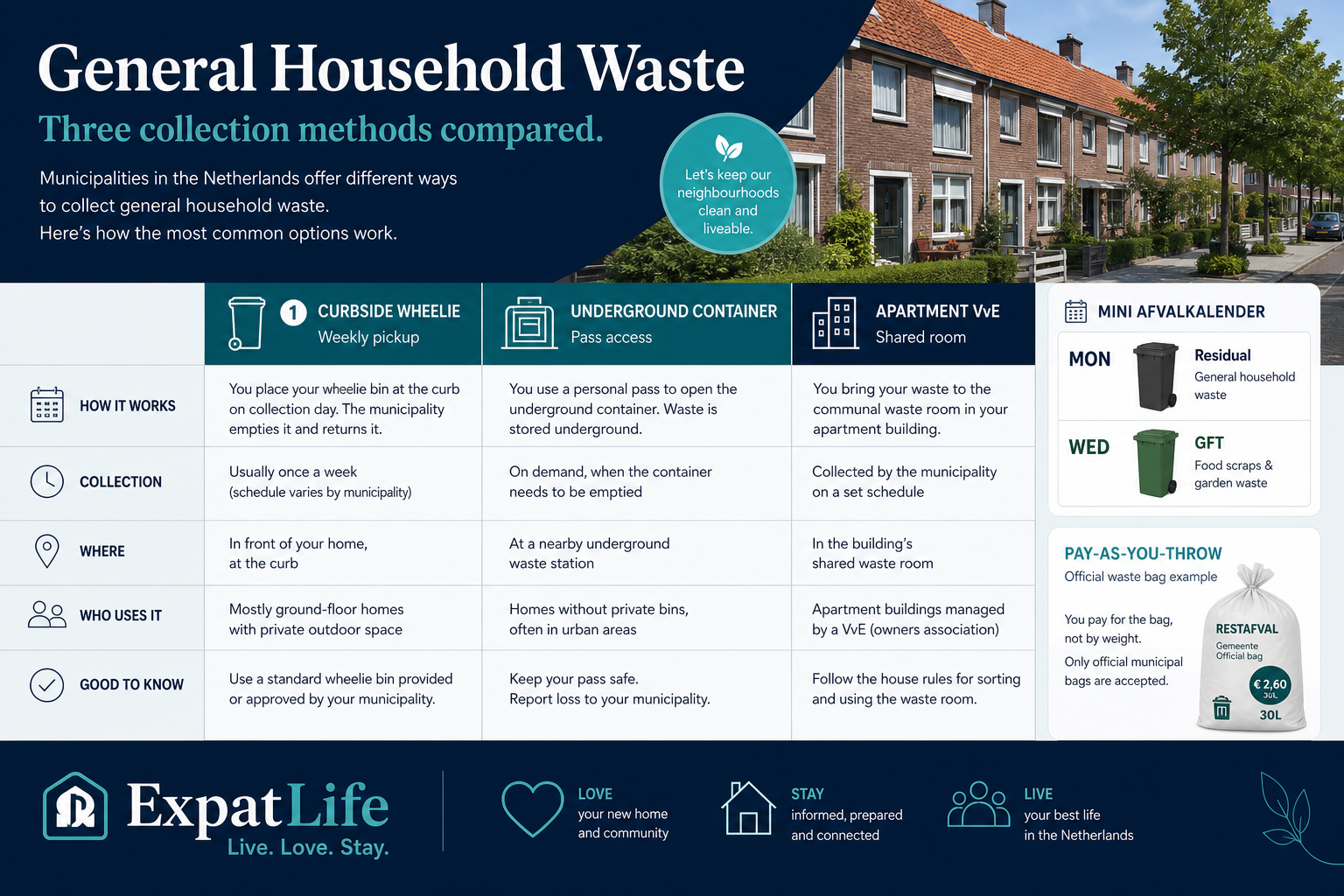
| Method | Detail |
|---|---|
| Curbside collection | Place approved bin or bag at the curb on scheduled days — times vary by street. |
| Underground systems | Use your pass at neighborhood containers; no curbside pickup for residual waste. |
| Apartment systems | Shared chutes or container rooms managed by VvE — ask your landlord for rules. |
| Pay-as-you-throw | Some gemeenten sell official bags or charge by weight to encourage recycling. |
Glass recycling in the Netherlands usually happens at neighborhood bottle banks (glasbak). Many locations ask you to separate clear, green and brown glass; others use a single mixed glass container.
Rinse bottles and jars lightly and remove lids where required. Bottle banks fill quickly in dense areas — plan drop-offs regularly rather than storing large amounts at home.
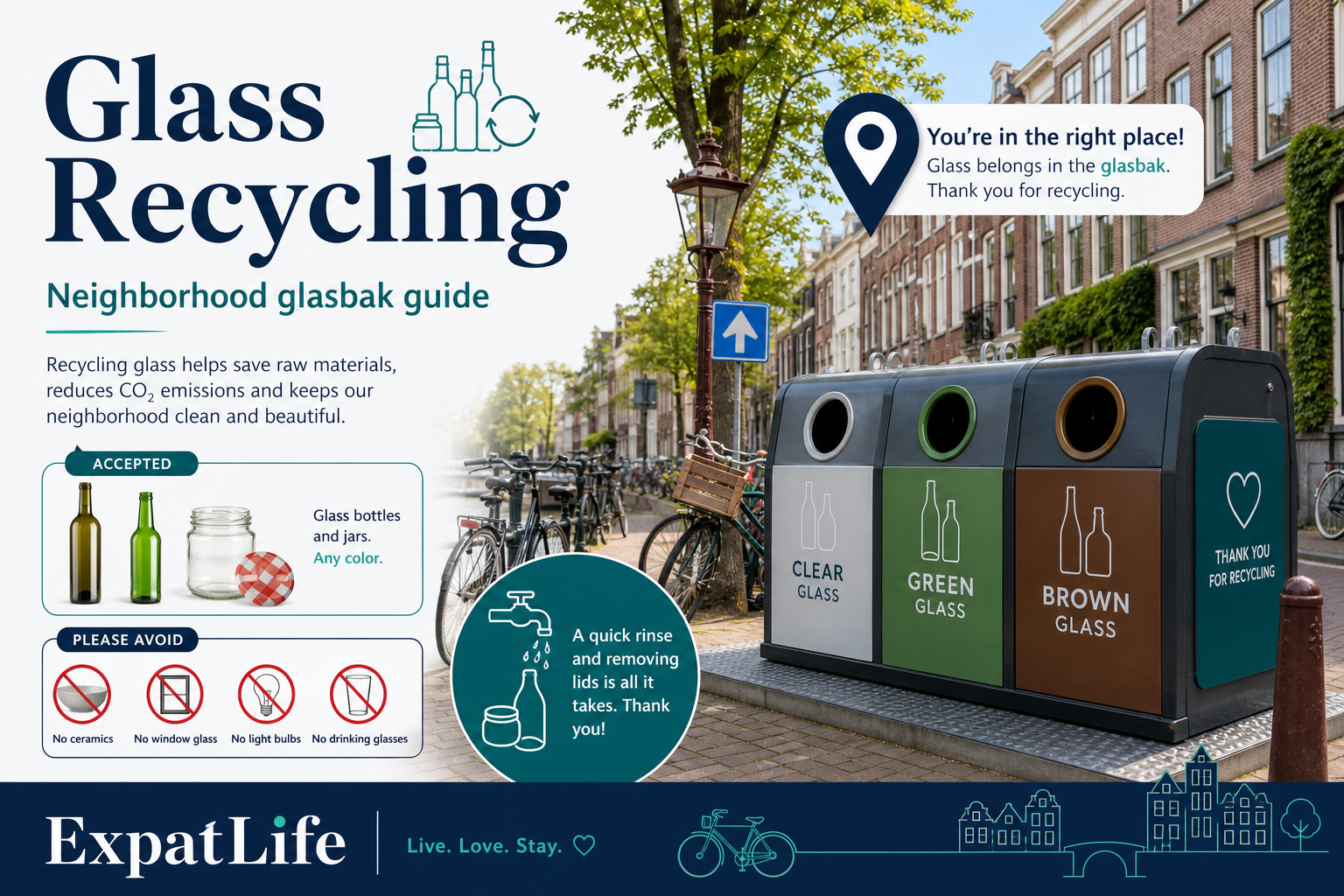
Do not put in glass banks: Drinking glasses, mirrors, window panes, light bulbs, ceramics and Pyrex do not belong in glasbak containers.
Paper and cardboard are among the easiest streams for newcomers to adopt. Flatten boxes, remove plastic tape and keep material dry before placing it in paper containers or tying bundles for collection.
Large volumes from moving — especially delivery boxes — should be broken down promptly to avoid clutter in shared hallways or container areas.
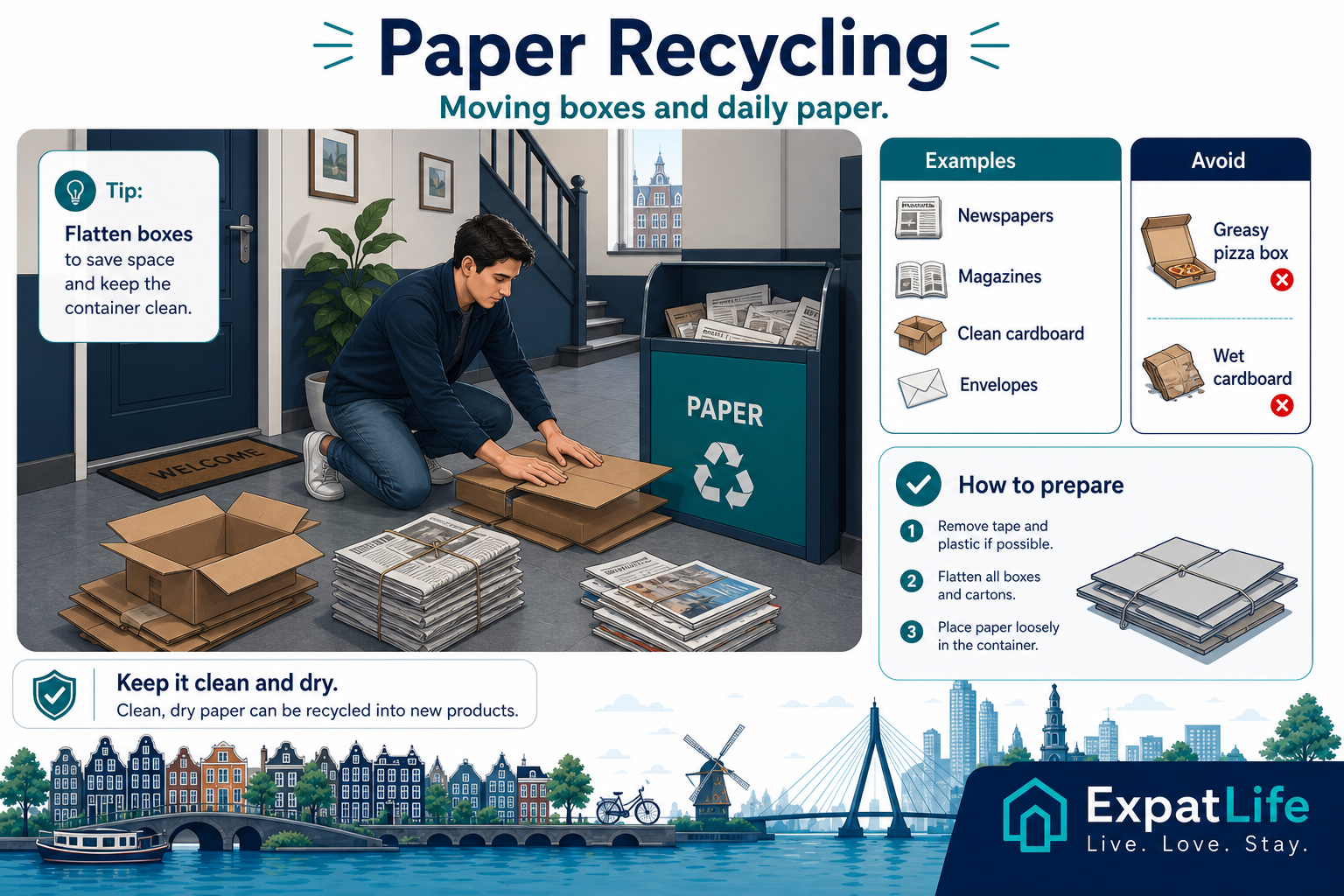
Keep out of paper stream: Greasy pizza boxes, wax-coated paper, wet cardboard and plastic-lined cartons belong in general waste or plastic streams per local rules.
Plastic packaging collection varies significantly by municipality. Some areas use dedicated plastic containers or bags; others collect plastic together with other packaging materials (PMD-style streams).
Check whether your gemeente accepts all plastic packaging or only specific types. When in doubt, use the milieustraat or consult your waste calendar rather than contaminating a recycling stream.
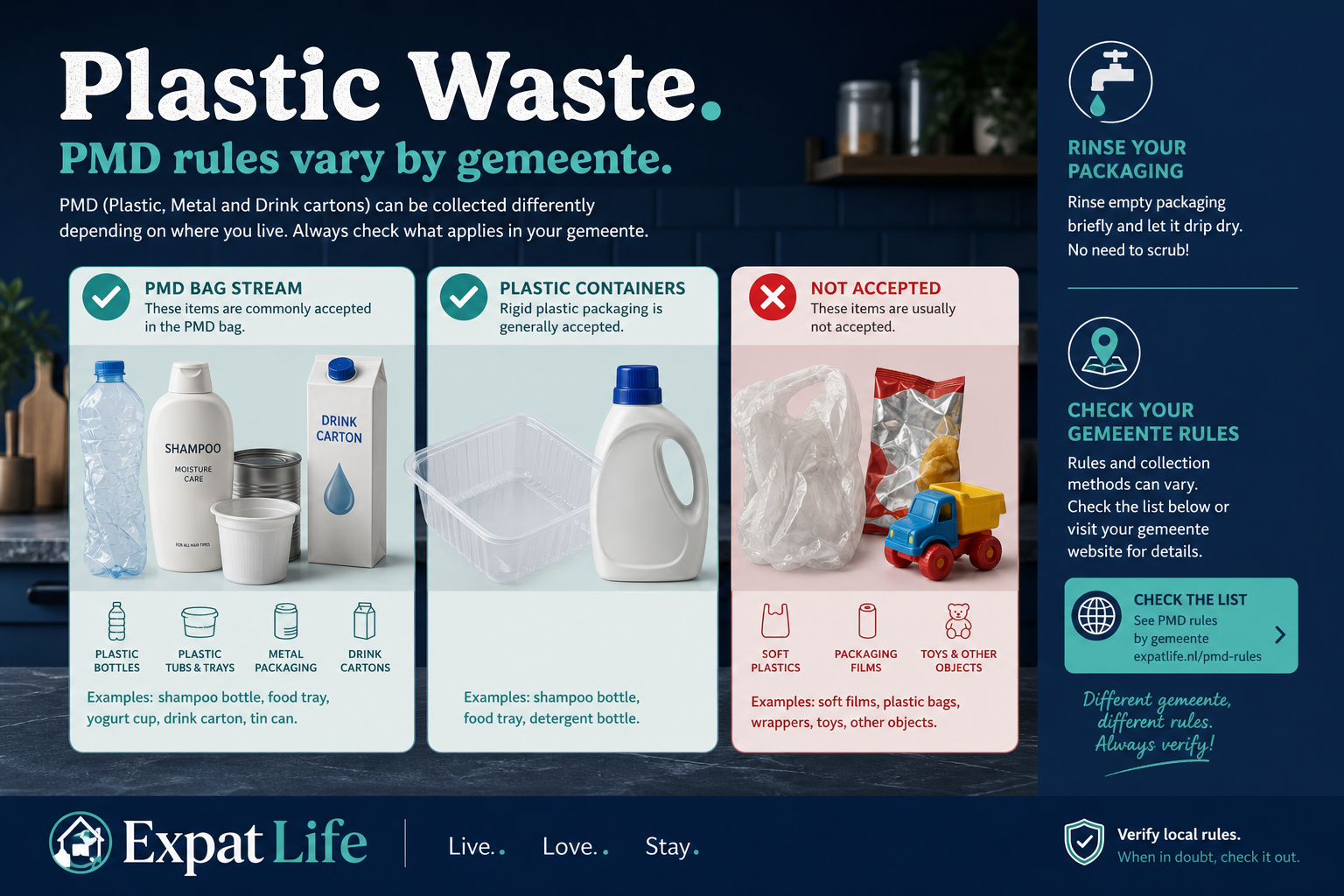
| Stream | Usually accepted | Usually not accepted |
|---|---|---|
| Separate plastic container | Hard packaging, bottles, trays where listed locally | Soft films, toys, garden plastics unless specified |
| PMD combined packaging | Plastic, metal and drink cartons in one stream | Glass, organic waste and residual rubbish |
| Plastic bag collection | Designated bags from gemeente or supermarket | Loose plastic without approved bag in bag-based systems |
Many municipalities collect organic waste (GFT — groente-, fruit- en tuinafval) for composting or anaerobic digestion. Separate bins or underground containers are common in houses; apartments may have limited GFT access.
Separating food waste reduces residual rubbish volume and supports Dutch sustainability targets. Garden waste may follow the same stream or have seasonal collection rules.
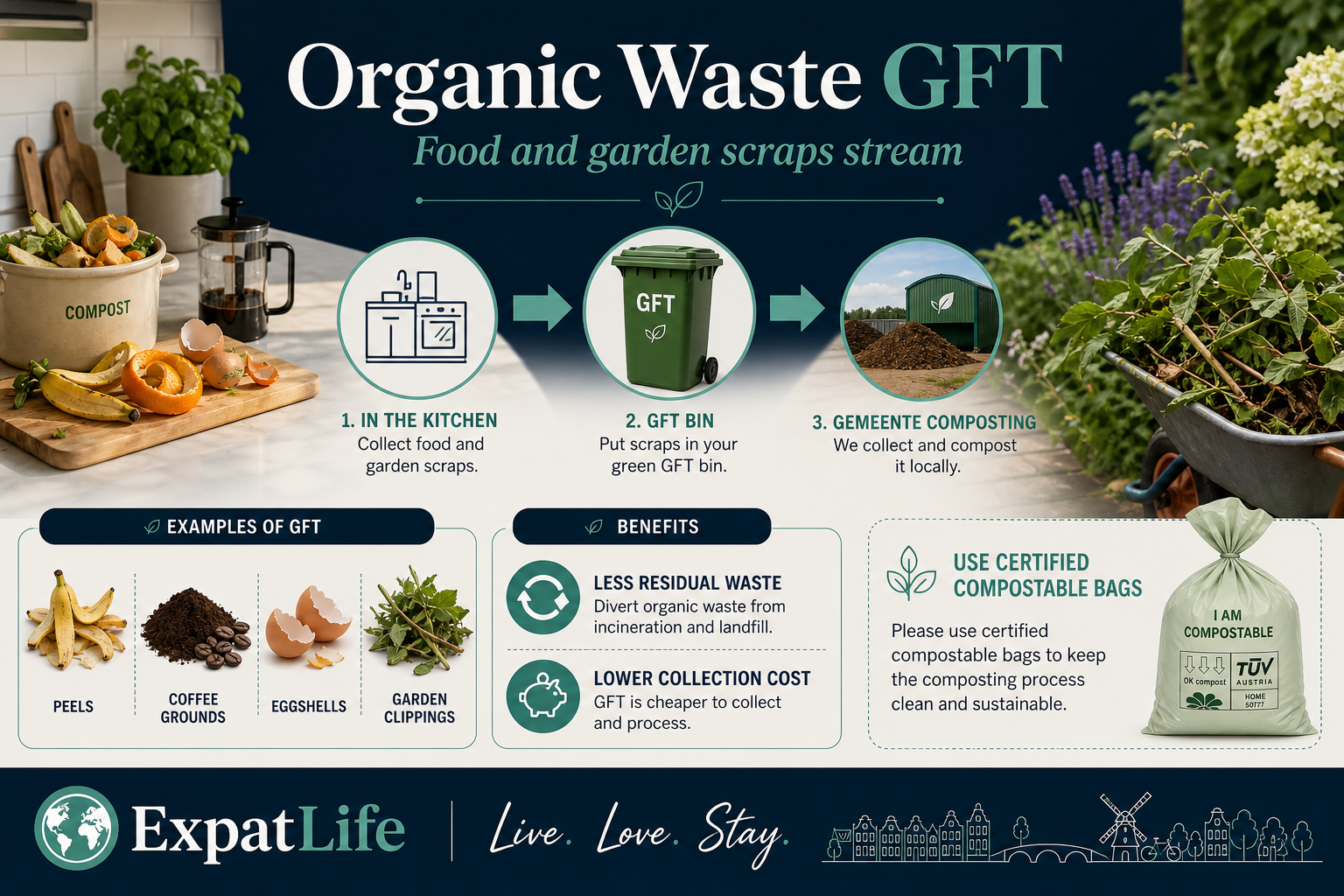
Keep out of GFT: Plastic bags (unless certified compostable locally), pet waste, cooking oil, diapers and non-organic packaging.
Lowers general waste volume and can reduce pay-as-you-throw costs.
Supports municipal composting and energy recovery programs.
Encourages mindful food planning and less household waste overall.
Recycling centers (milieustraat) are gemeente facilities where residents drop off items too large or specialized for curbside collection: furniture, mattresses, appliances, garden waste, construction debris and hazardous materials.
Access usually requires proof of residence in the municipality. Some centers require online booking or charge fees for certain waste types such as renovation debris or asbestos-related materials.
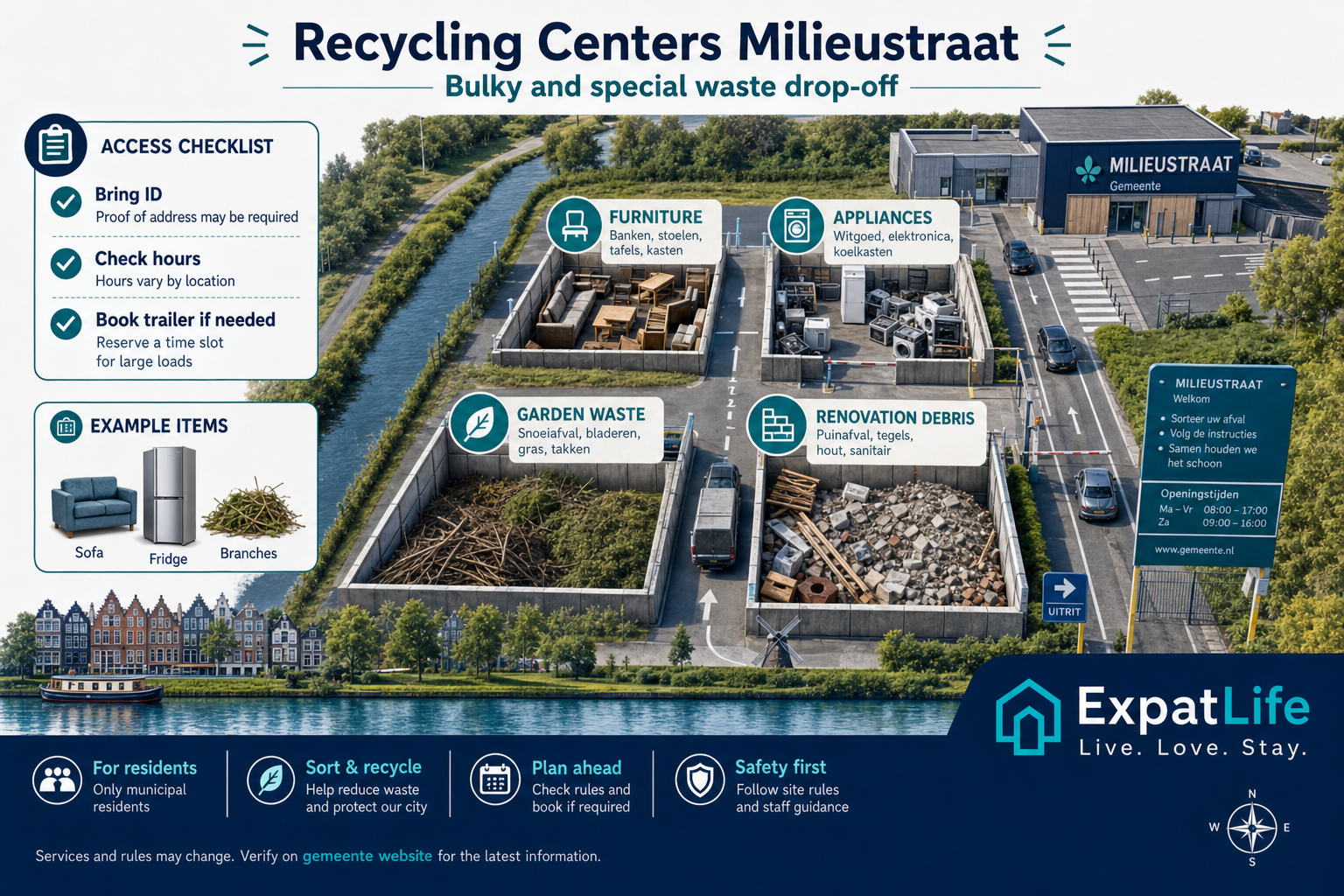
Sofas, tables, chairs and beds — often free drop-off for residents.
Washers, fridges and ovens — may need separate electrical waste handling.
Rubble, tiles and wood — fees and booking rules vary by gemeente.
Branches and green waste — seasonal hours at many locations.
Find milieustraat locations, bulky waste booking and gemeente waste portals for your address.
Open municipality guideElectronic waste (e-waste) must not go in household bins. Dutch law requires retailers to accept old devices when you buy replacements, and municipalities provide drop-off points for small and large electronics.
Batteries are collected separately at supermarkets, hardware stores and gemeente locations due to fire and environmental risks.
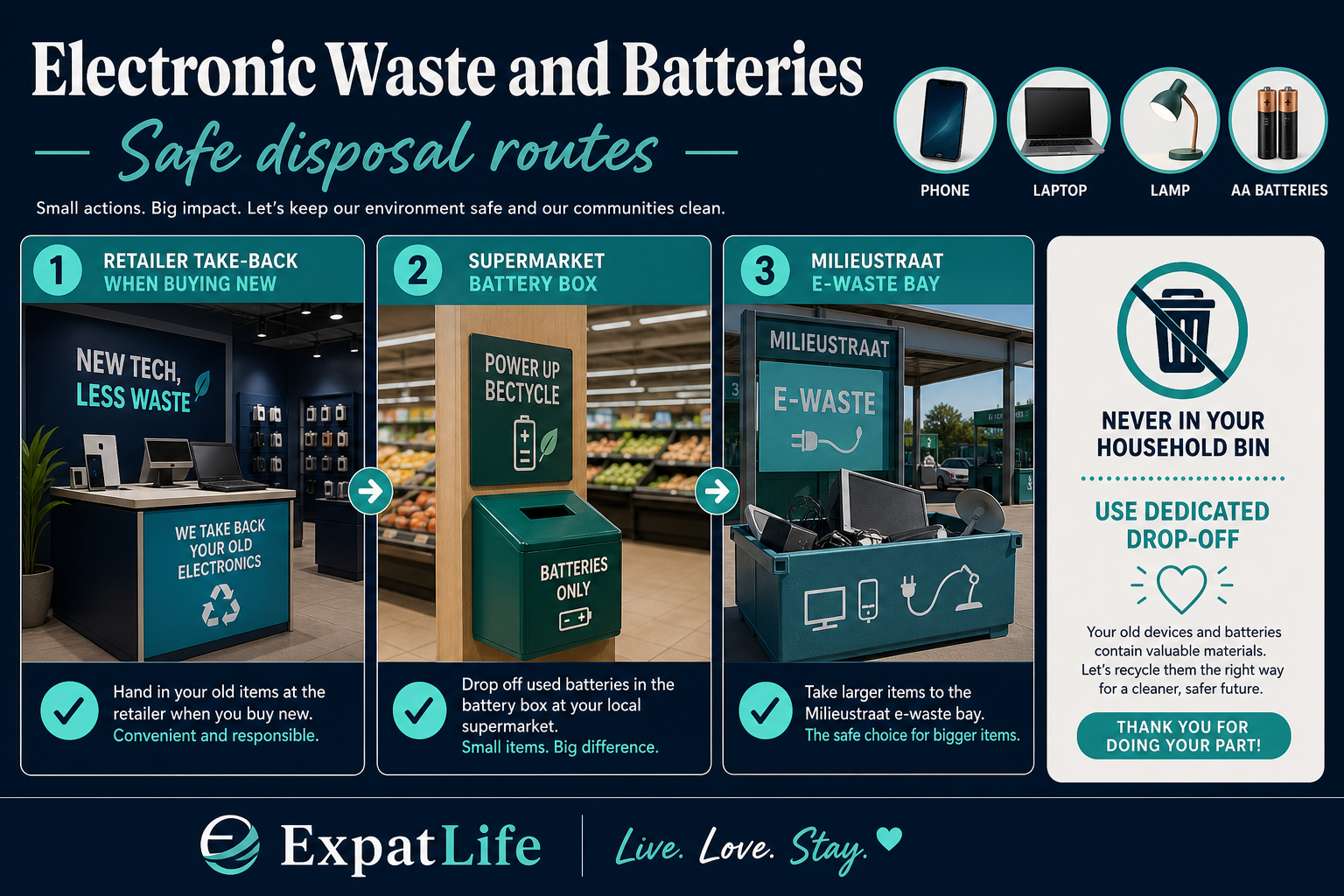
Shops often accept old appliances when purchasing replacements.
Small electronics bins at recycling centers and some neighborhood hubs.
Supermarkets and electronics stores often have battery collection boxes.
Larger items like TVs, fridges and computers go to recycling centers.
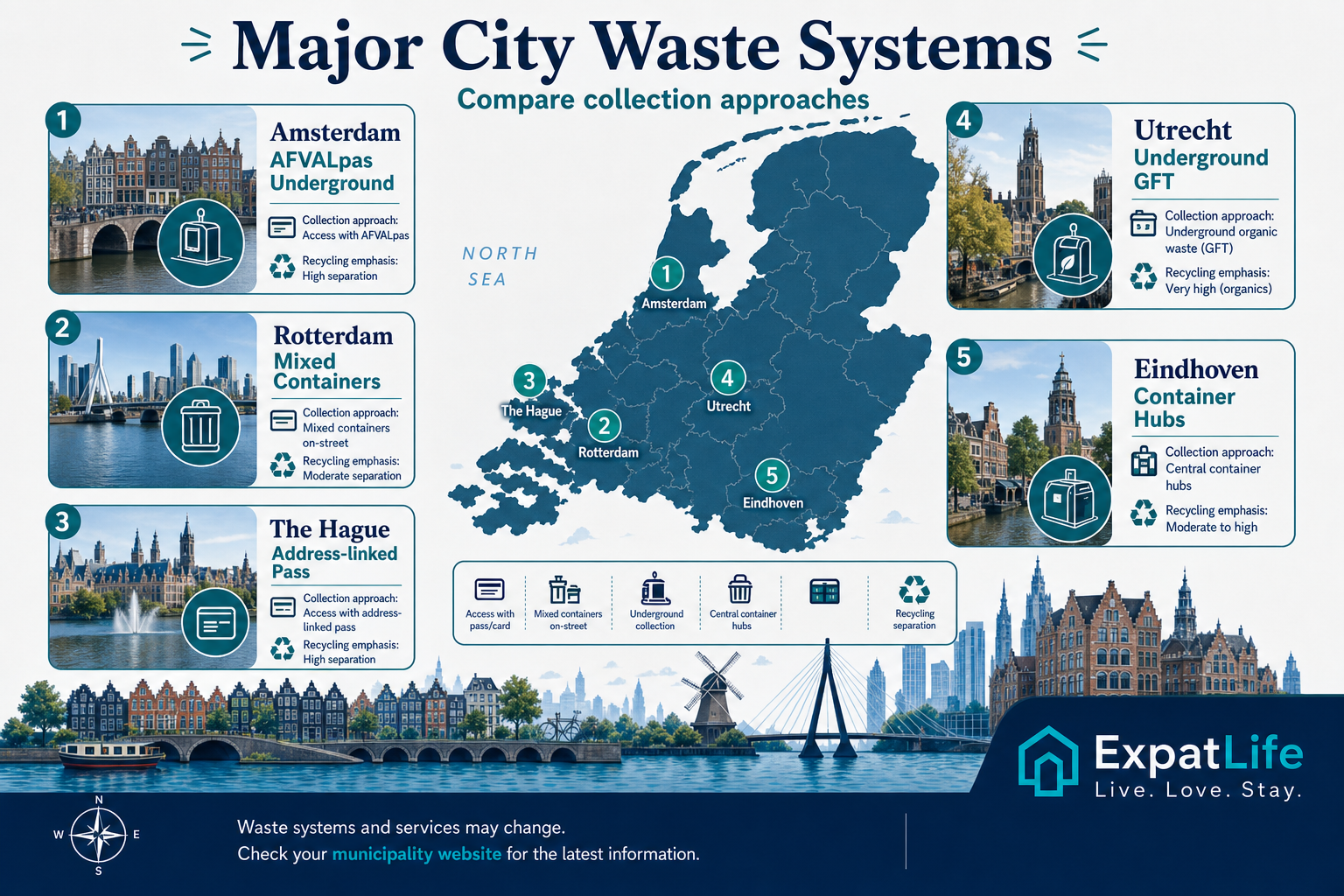
Collection approaches and recycling emphasis differ between Amsterdam, Rotterdam, The Hague, Utrecht and Eindhoven. Open your city guide alongside your gemeente waste portal.
| City | Container type | Organic (GFT) | Official resource |
|---|---|---|---|
| Amsterdam | Underground AFVALpas hubs | Separate underground GFT in many districts | amsterdam.nl/afval — container map and calendar |
| Rotterdam | Mix of underground and above-ground | District-specific GFT rules | rotterdam.nl/afval-en-grondstoffen |
| The Hague | Underground with address-linked pass | GFT containers in many neighborhoods | denhaag.nl/afval — English summaries available |
| Utrecht | Underground residual and organic | Strong GFT separation in many areas | utrecht.nl/wonen-leven/afval |
| Eindhoven | Container hubs and curbside mix | Check district for GFT availability | eindhoven.nl/afval |
~920,000
Underground containers and AFVALpas system across most districts.
Recycling emphasis: Strong separation culture; check amsterdam.nl for container maps and calendars.
~670,000
Mix of underground and above-ground containers by neighborhood.
Recycling emphasis: Rotterdam.nl waste portal with postcode-specific collection information.
~560,000
Underground systems common; address-linked waste pass after registration.
Recycling emphasis: Denhaag.nl provides sorting guides and collection schedules in English.
~370,000
Underground residual and organic containers in many areas.
Recycling emphasis: Utrecht.nl waste pages with neighborhood container locations.
~250,000
Container hubs and curbside systems depending on district.
Recycling emphasis: Eindhoven.nl afval section for local sorting and milieustraat access.
The Netherlands has a strong culture of waste separation and environmental awareness. Recycling is part of everyday life — neighbors notice when bins are used incorrectly, and municipalities invest in circular economy programs.
Many households reduce waste through reusable shopping bags, bottle deposit (statiegeld) returns, second-hand markets and repair cafes. Understanding local systems helps you participate rather than stand out for the wrong reasons.
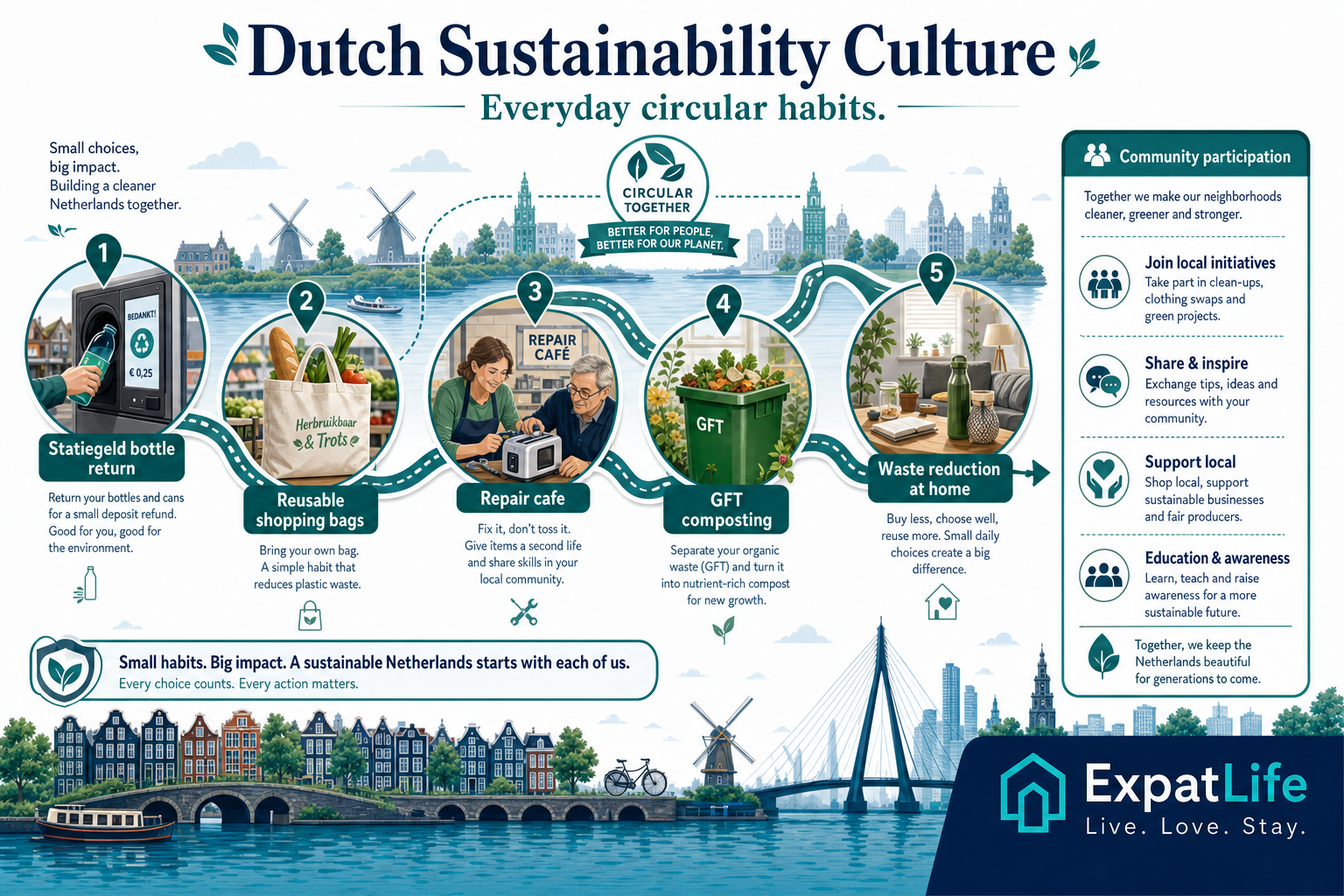
Separating streams at home is expected, not optional, in most neighborhoods.
Schools, workplaces and media reinforce waste reduction and sorting norms.
Deposit schemes, repair initiatives and material recovery are widely promoted.
Buying less packaging and composting organic waste lowers household volume.
These are the waste and recycling errors expats most often make after arriving in the Netherlands.
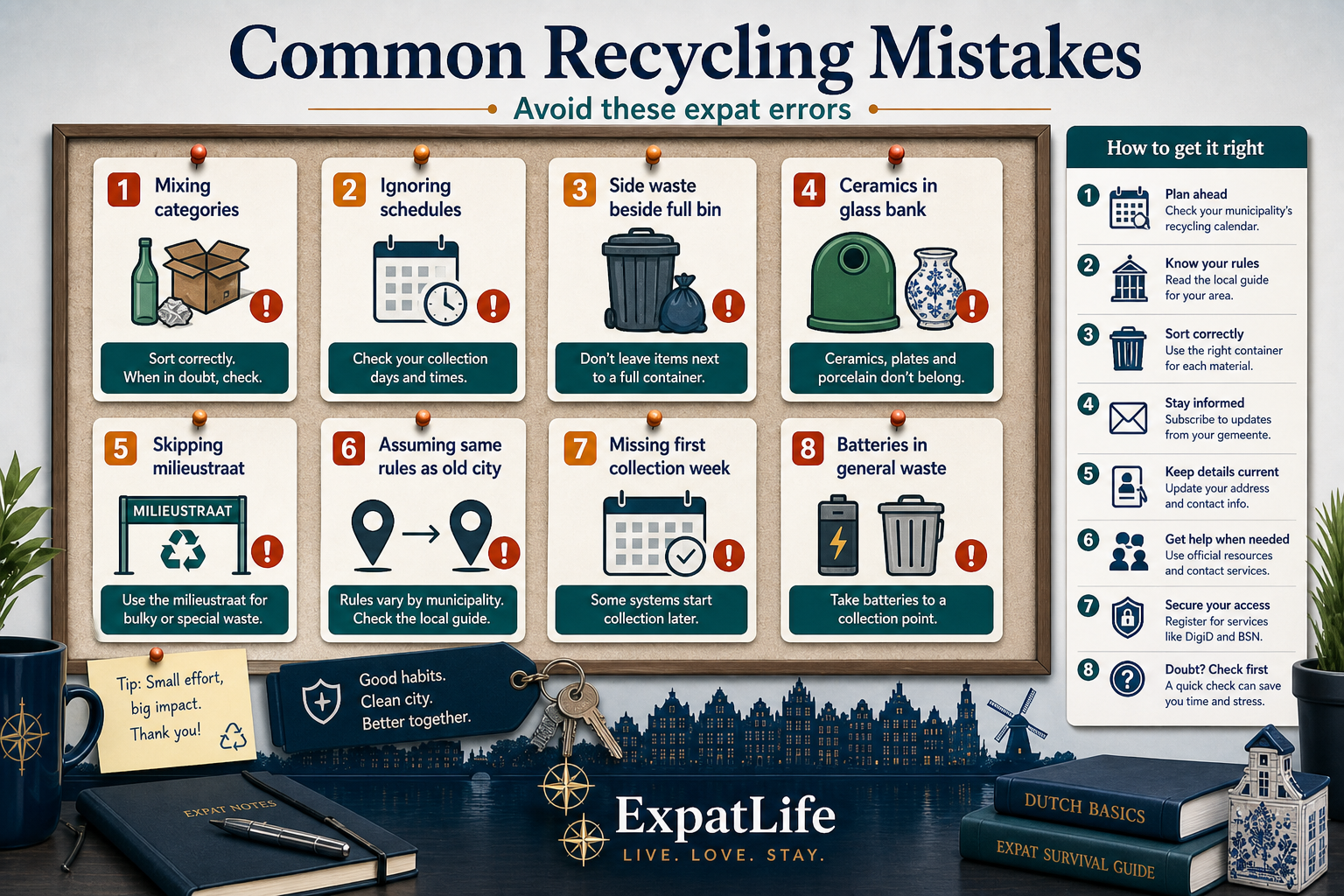
Contaminated streams can cause entire loads to be rejected.
Missed collection days leave waste stored at home or on the street.
Side waste is often fined and creates neighborhood complaints.
Ceramics and window glass break sorting equipment — use milieustraat.
Large items left on the street instead of milieustraat drop-off.
Assuming your previous city’s system applies in your new gemeente.
First weeks are busy — set calendar reminders immediately.
E-waste and batteries require dedicated drop-off — never general bins.
Double-check sorting rules, collection calendars and container access before your first pickup week.
Open municipality guideUse this checklist after registering your address and locating your containers.
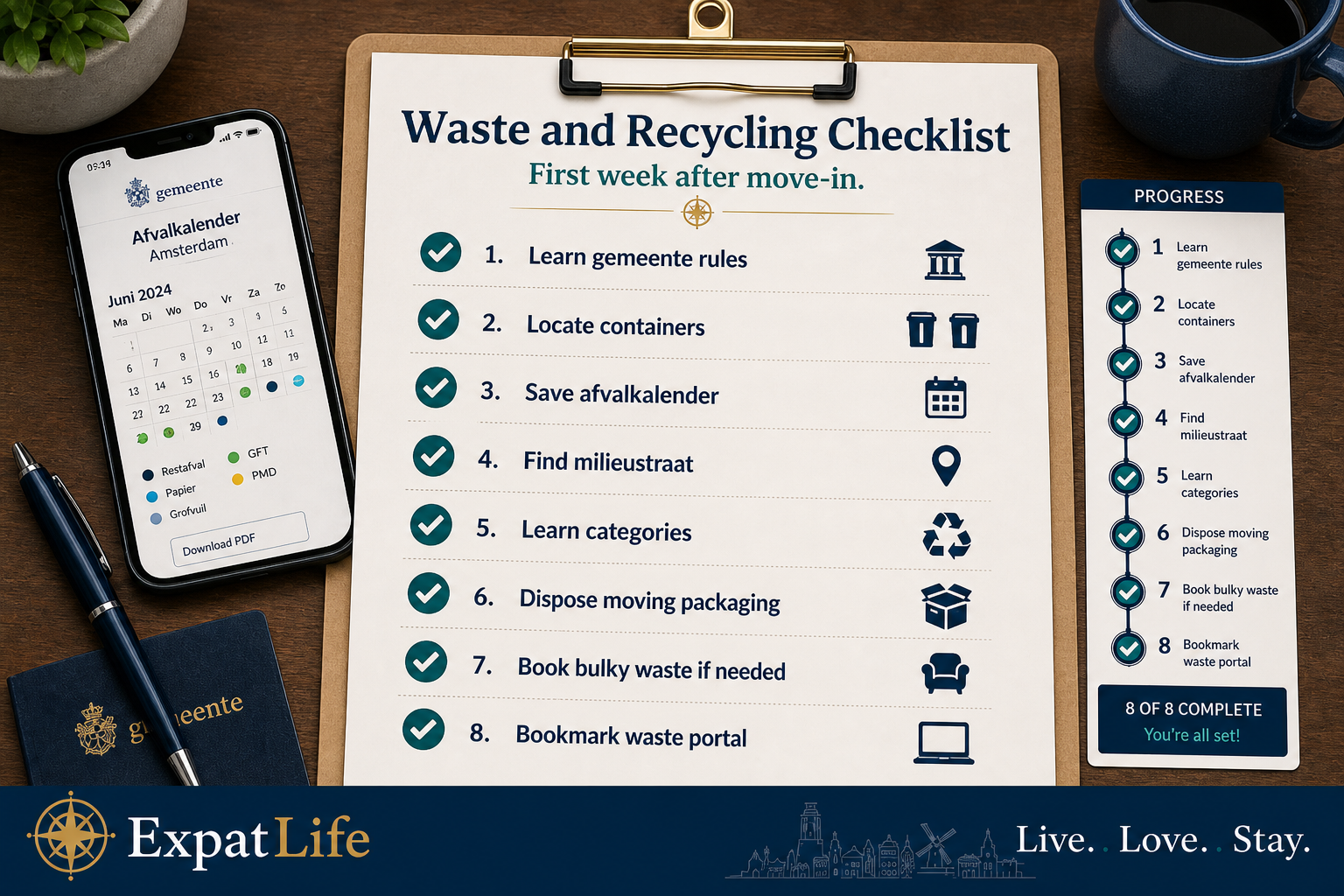
Complete address registration first — waste passes, calendars and gemeente portals usually require a registered postcode.
Open address registration guideOfficial waste information portals for major Dutch cities. Always verify postcode-specific rules on your gemeente website.
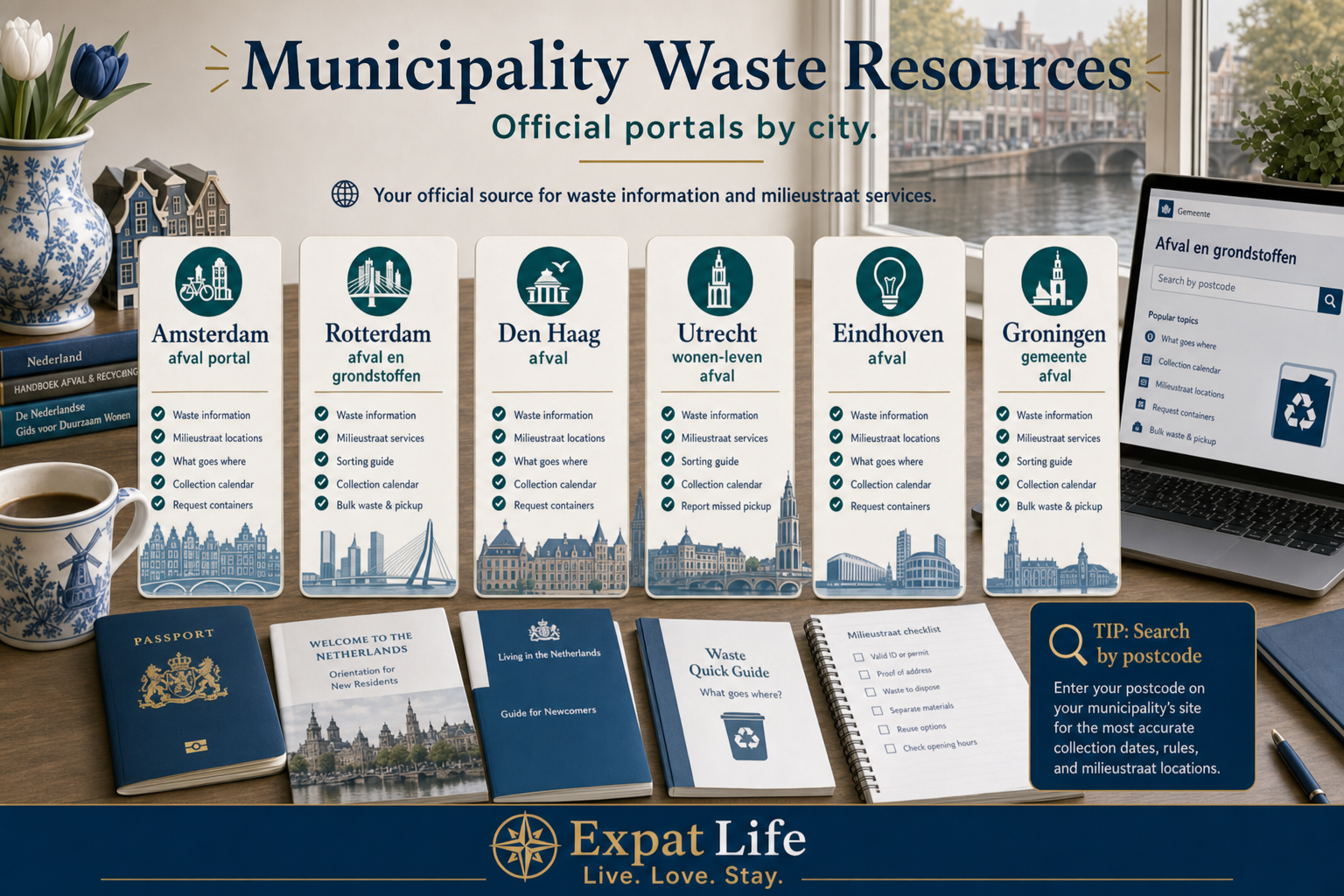
Waste information: AFVALpas, underground containers and postcode calendars
Recycling services: Milieustraat locations and bulky waste booking
Waste information: Afval en grondstoffen portal with sorting guides
Recycling services: Recycling centers and container maps by district
Waste information: Address-linked waste pass and collection calendar
Recycling services: Milieustraat and bulky waste collection
Waste information: Waste and recycling pages with container finder
Recycling services: Milieustraat access for residents
Waste information: Local afval sorting rules and collection schedule
Recycling services: Recycling center and container hub network
Waste information: Gemeente waste calendar and sorting guidance
Recycling services: Milieustraat for bulky and special waste
Quick answers for orientation — always confirm details on your gemeente website.
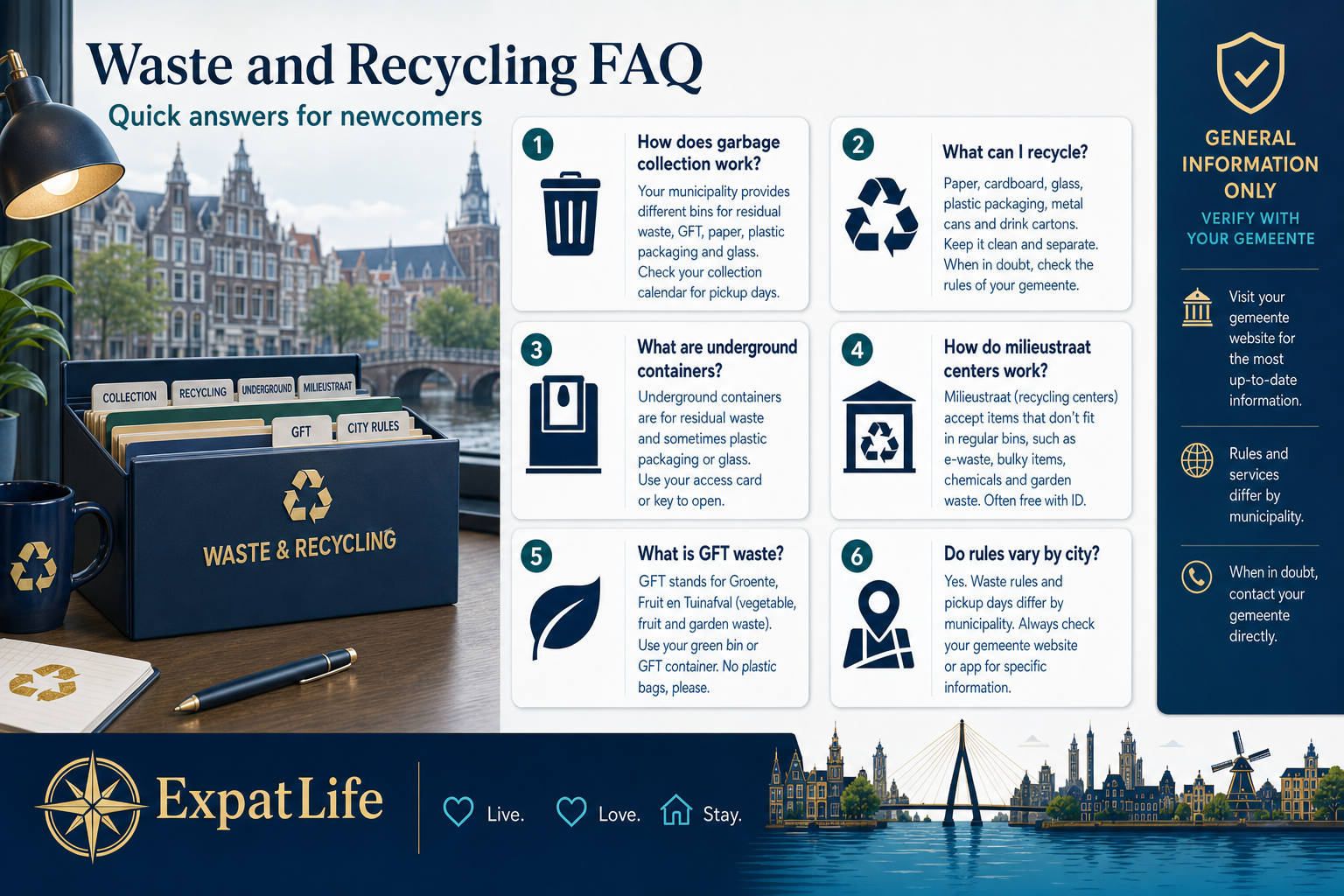
Your municipality sets collection methods — underground containers, curbside bins or bag systems. After registering your address, look up your waste calendar on the gemeente website for collection days and sorting rules.
Common streams include paper, glass, plastic packaging and organic waste (GFT). Exact categories depend on your municipality. General waste is for items that cannot be recycled locally.
Below-street waste bins accessed with a pass or card, common in Dutch cities. Each container accepts a specific waste stream — use the correct slot for residual, organic or other types.
Milieustraat facilities accept furniture, appliances, garden waste and other large items. Residents usually need proof of address. Some materials require booking or fees.
Yes — via retailers, gemeente drop-off points and milieustraat locations. Never put electronics or batteries in household waste bins.
GFT (groente-, fruit- en tuinafval) is organic waste — food scraps and garden clippings collected separately for composting where your municipality offers it.
Yes — container types, collection days and sorting rules differ by gemeente and often by neighborhood. Always check your local waste portal.
Large items like sofas and mattresses usually require a gemeente pickup appointment or drop-off at a milieustraat. Leaving bulky waste on the street without booking can result in fines.
Waste collection systems and recycling rules vary by municipality. Always verify local requirements through your municipality.
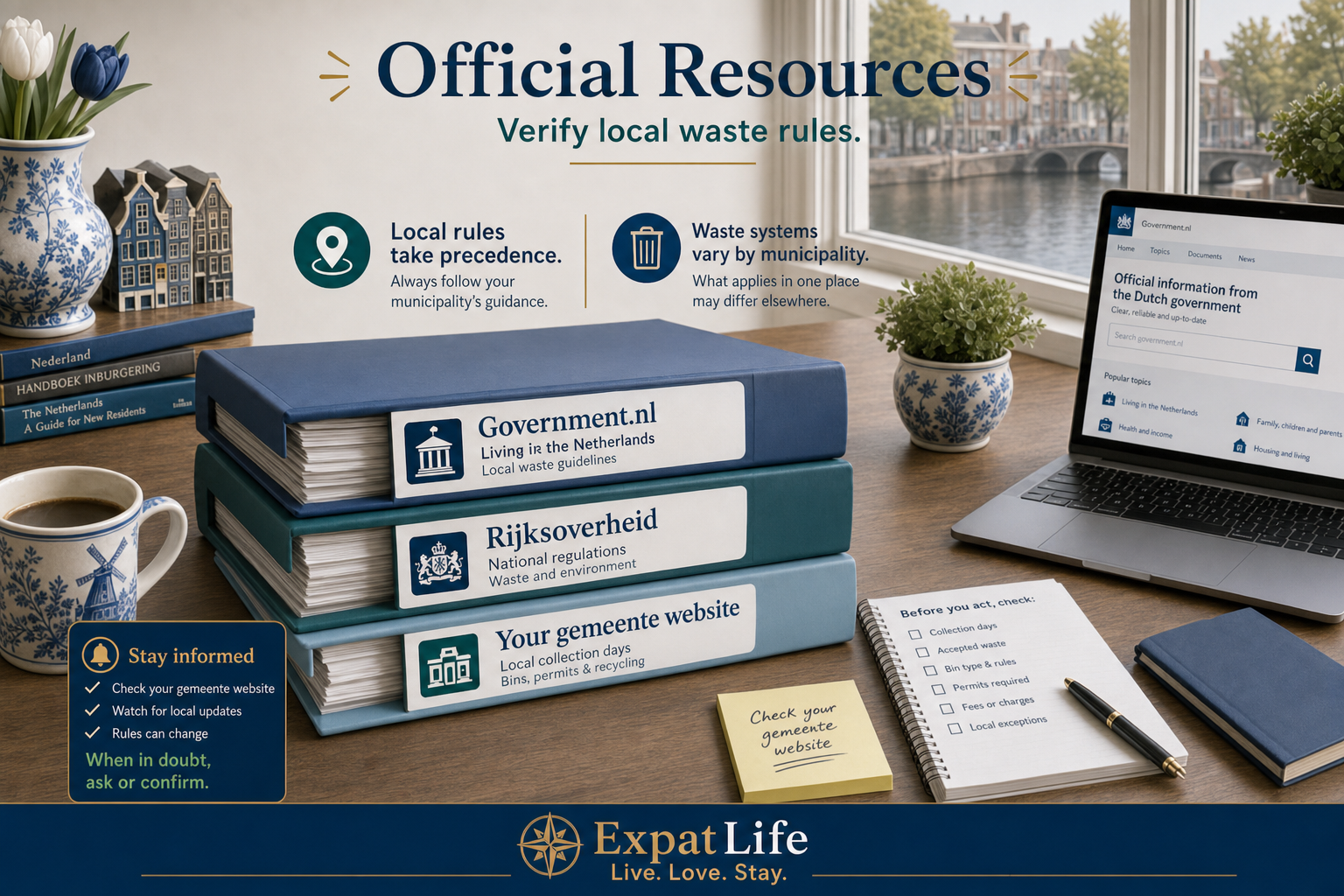
National government portal with environmental and living-in-the-Netherlands context.
Open official sourceCentral government information on waste policy and sustainability programs.
Open official sourceAuthoritative source for collection schedules, sorting rules and milieustraat access.
Open official sourceContinue from waste orientation into municipality services, utilities, housing and relocation guides.

Explore next
Move from waste and recycling into municipality services, utilities, housing and your broader relocation checklist.