Resident permits are common
Many neighborhoods require a gemeente parking permit to park on the street overnight.
Practical life guide
Understand parking permits, visitor permits, paid parking zones and municipality-issued permits commonly used by residents and expats.
Quick answer
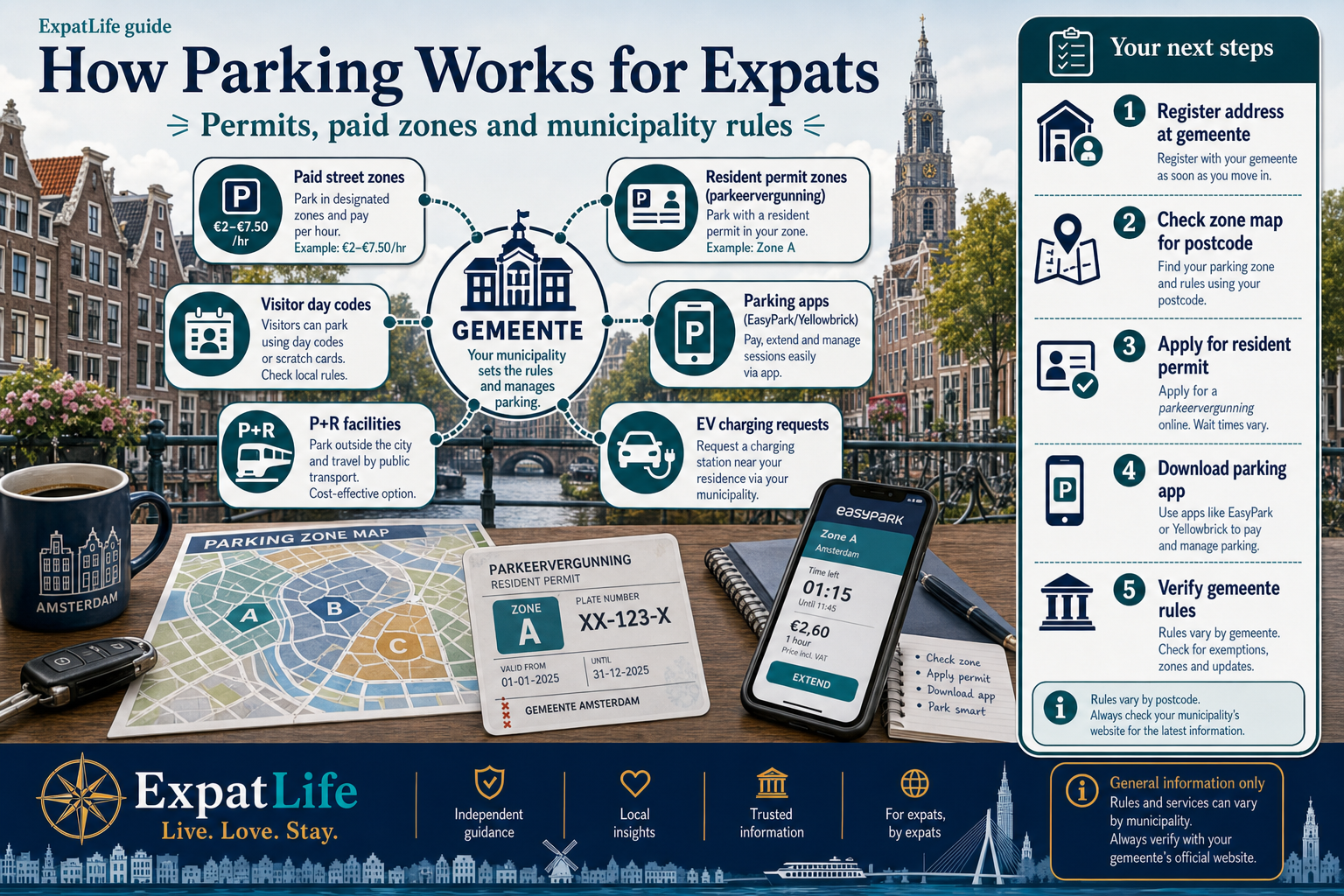
Parking in the Netherlands is managed locally. Your municipality sets paid parking zones, resident permit rules, visitor systems and enforcement — not one national parking authority.
Many expats arrive expecting free street parking or a single national permit. In practice, dense cities use permit zones with waiting lists, paid parking in centres and digital payment through apps.
This guide explains parking systems and common municipality permits in practical terms. Always verify current rules, fees and availability on your gemeente website — requirements change and differ significantly between cities.
Many neighborhoods require a gemeente parking permit to park on the street overnight.
High-demand areas in Amsterdam, Utrecht and other cities often have permit waiting lists.
Day codes, guest passes and visitor zones help when family or friends visit by car.
EasyPark, Yellowbrick and similar apps pay for on-street parking in many cities.
Public chargers and residential charging requests follow municipality processes.
Zone maps, fees and eligibility differ — never assume your previous city’s rules apply.
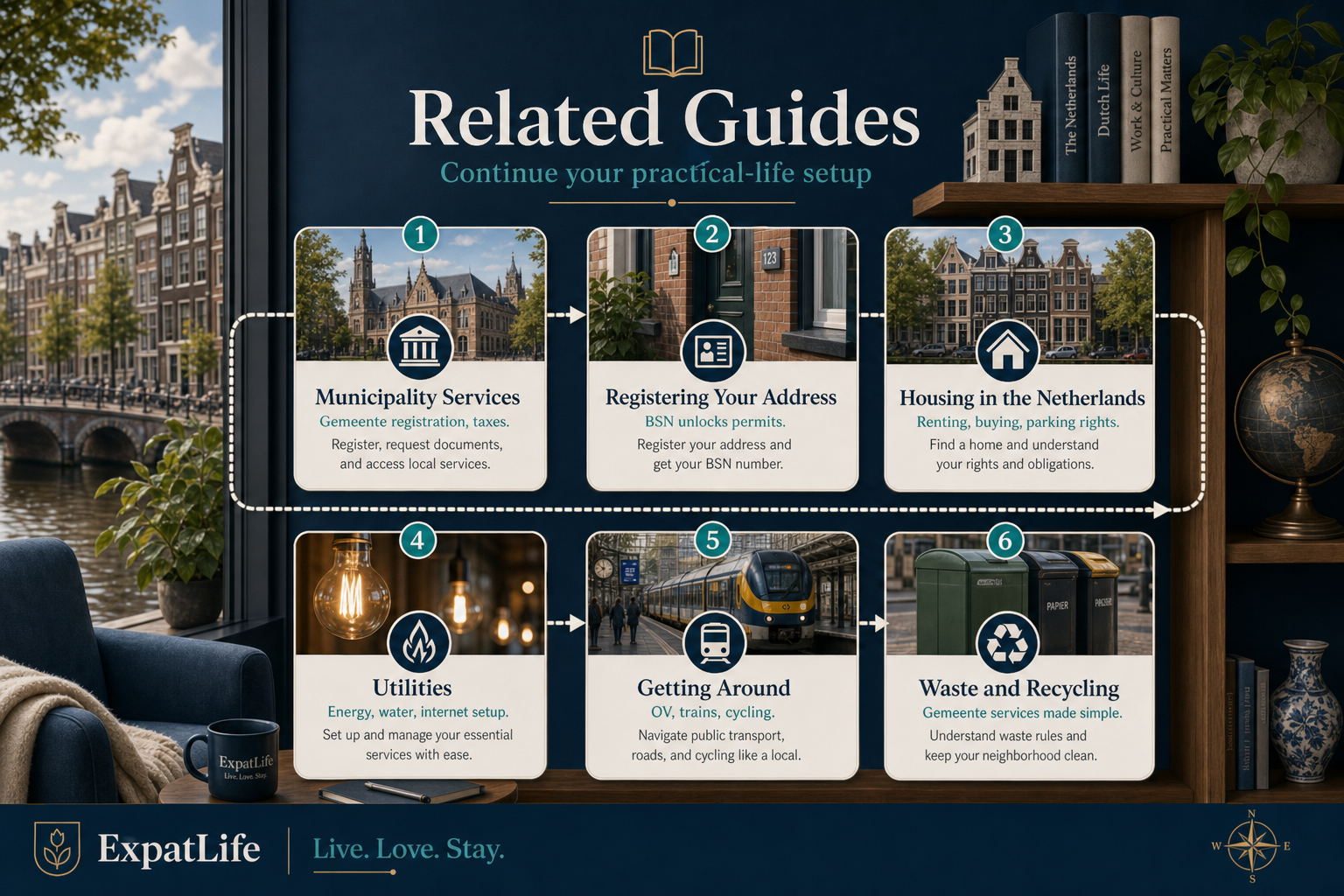
Connect parking permits and local gemeente rules to broader registration, taxes and municipal services.
Open municipality guidePlace parking setup in your wider relocation timeline alongside housing, registration and first-month household tasks.
Open moving guideAddress registration unlocks resident parking permits and postcode-specific zone maps at your gemeente.
Open address registration guideComplete household setup with energy, water and internet after you understand local parking rules.
Open utilities guideLearn garage access, VvE parking rules and building-specific parking before relying on street permits.
Open housing hubAnother core gemeente service — sorting, schedules and local rules that vary by municipality like parking.
Open waste and recycling guideCompare public transport, cycling and driving options before committing to car ownership and parking costs.
Open getting around guideAt a glance
Use these essentials to orient yourself in the first weeks after moving. Then open your municipality parking page for zone maps, fees and permit applications at your postcode.
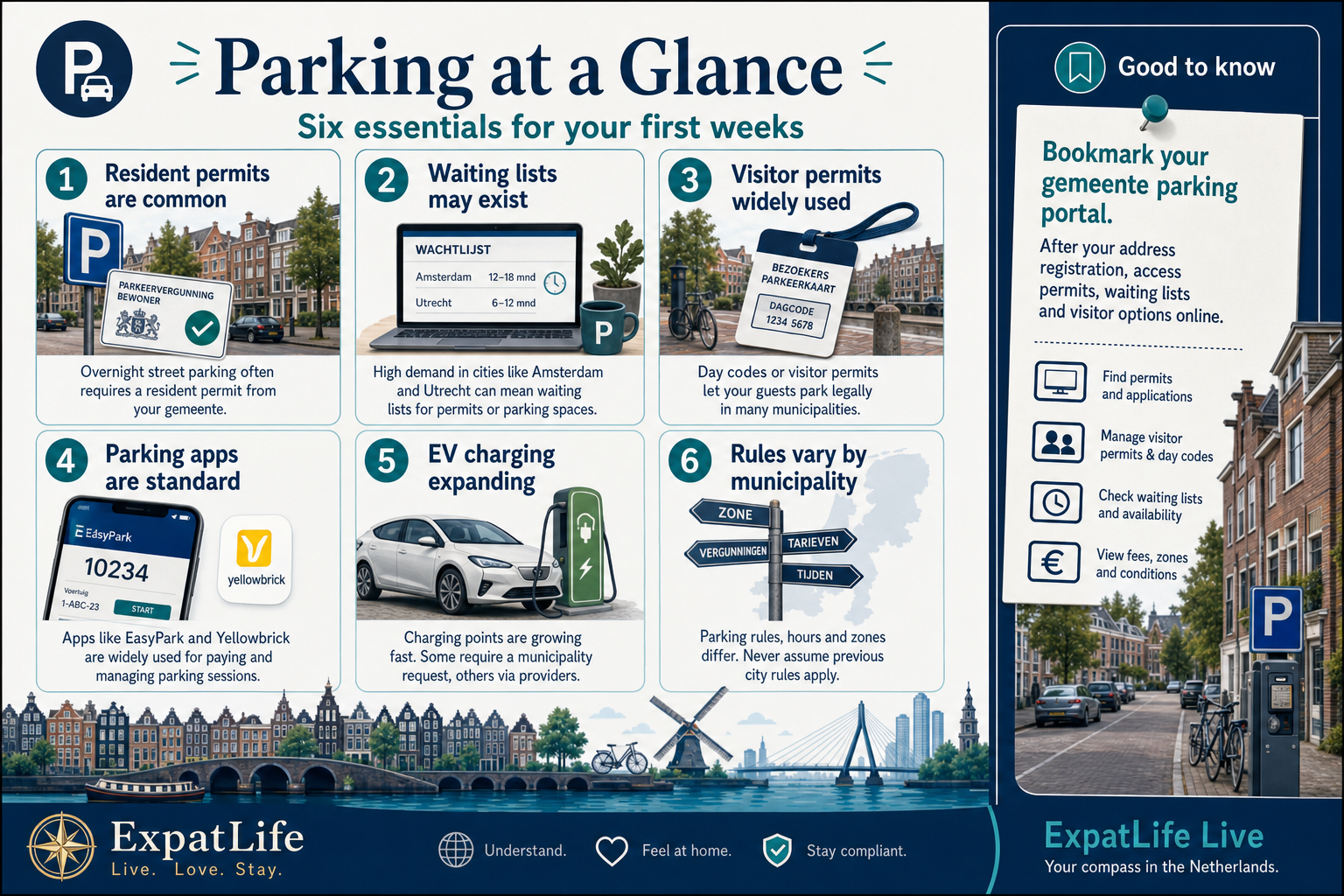
Many neighborhoods require a gemeente parking permit to park on the street overnight.
High-demand areas in Amsterdam, Utrecht and other cities often have permit waiting lists.
Day codes, guest passes and visitor zones help when family or friends visit by car.
EasyPark, Yellowbrick and similar apps pay for on-street parking in many cities.
Public chargers and residential charging requests follow municipality processes.
Zone maps, fees and eligibility differ — never assume your previous city’s rules apply.
| Sign | What it means |
|---|---|
| Blue P with zone code | Paid parking — check hours on the sign and pay via app or meter. |
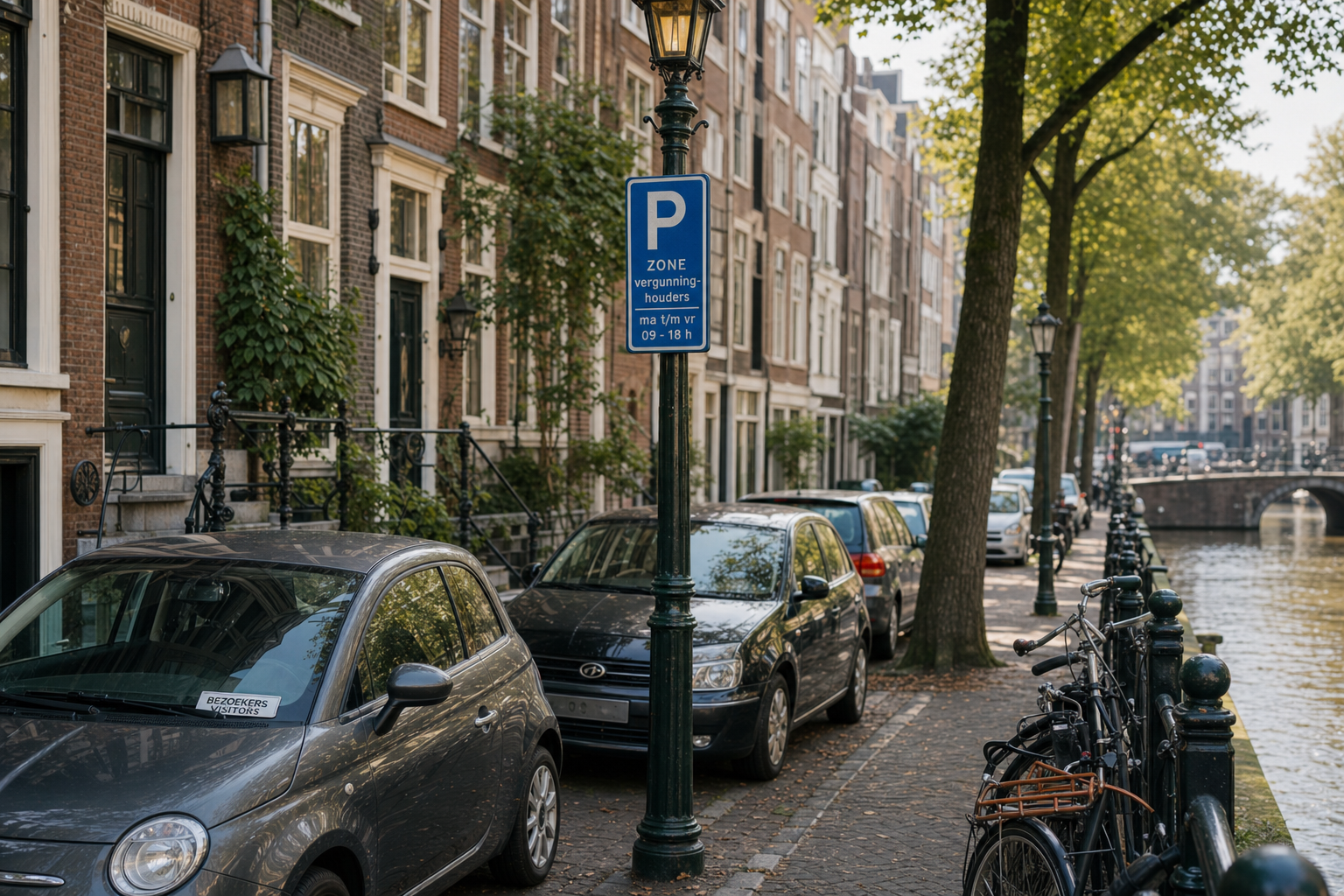
| Permit holders only (vergunninghouders) | Resident permit required during stated hours — visitors need a separate code. |
| Maximum stay limit | Payment or permit may not extend beyond the posted time — move the car when required. |
| Loading / disabled bay | Separate rules apply — do not assume general paid parking covers these spaces. |
| Resource | What it helps with |
|---|---|
| Gemeente parking portal | Zone maps, permit applications and visitor systems for your address. |
| RDW | Vehicle registration, import rules and official vehicle records in the Netherlands. |
| EasyPark / Yellowbrick | Widely used mobile parking payment in many Dutch cities. |
| Government.nl | National context on living, transport and municipality services. |
Dutch cities combine several parking systems: paid street parking in commercial and residential zones, permit-only areas for residents, private garages, and park-and-ride facilities on city edges.
Urban centres typically restrict on-street parking to manage congestion. Suburban and rural areas may have fewer restrictions but still use paid zones near train stations and town centres.
Your registered address determines which permit zone and waiting list apply. After address registration, look up your postcode on the gemeente parking map before buying or importing a car.
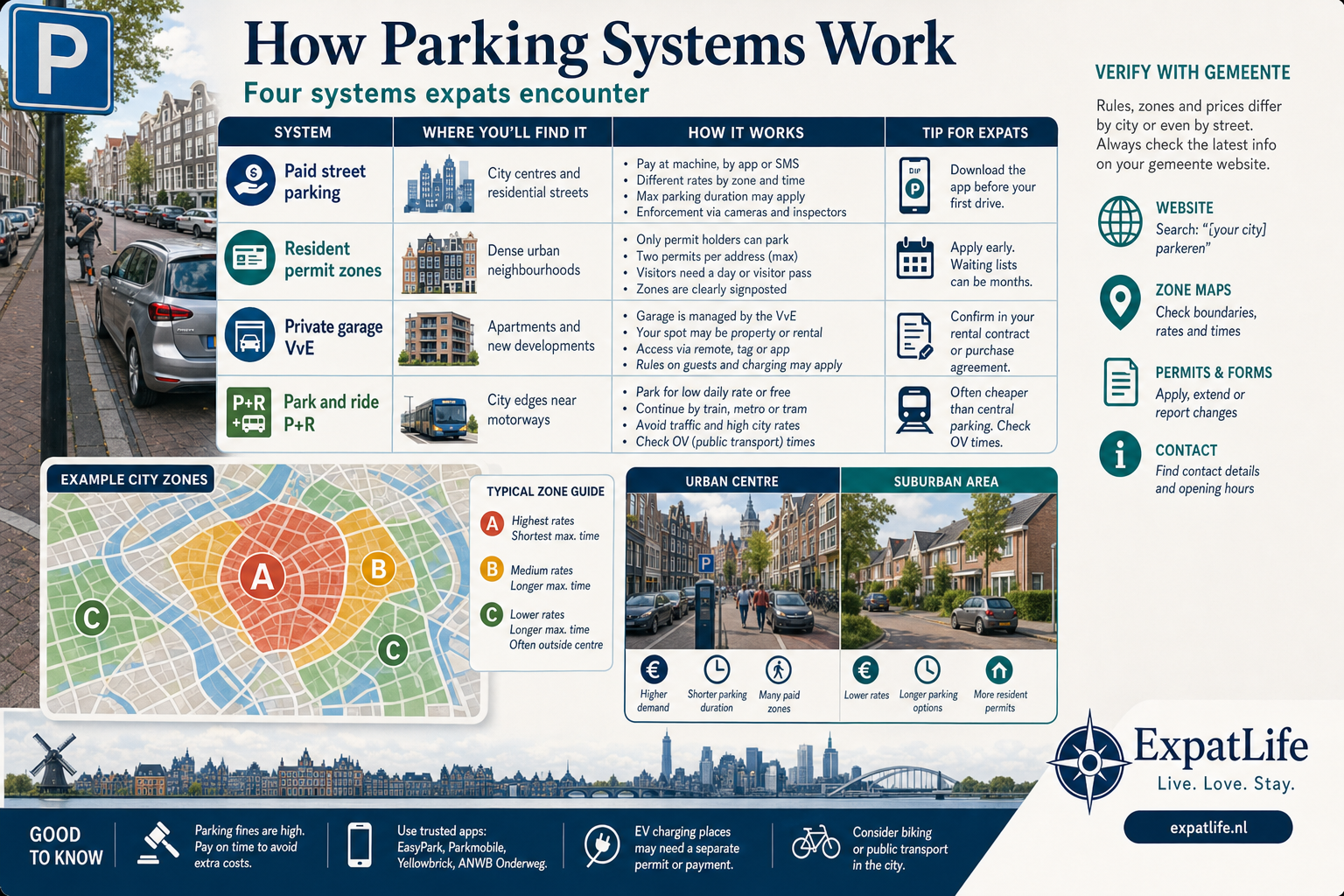
| System | Where | Expat tip |
|---|---|---|
| Paid street parking | City centres and many residential streets | Download a parking app before your first drive into town. |
| Resident permit zones | Dense urban neighborhoods | Apply early — waiting lists can be months in popular areas. |
| Private garage / VvE | Apartments and new developments | Confirm parking rights in your rental or purchase contract. |
| Park and ride (P+R) | City edges near motorways and rail | Often cheaper than central parking — check OV connection times. |
Many residents apply for a parkeervergunning (parking permit) through their municipality. The permit allows overnight or long-stay parking in designated resident zones where street space is limited.
Eligibility usually requires that you live at the address, have registered with the gemeente and sometimes that your vehicle is registered in your name. Some cities limit permits per household or per address.
Availability varies by city and neighborhood. High-demand districts may have waiting lists, priority rules or no new permits until space becomes available.
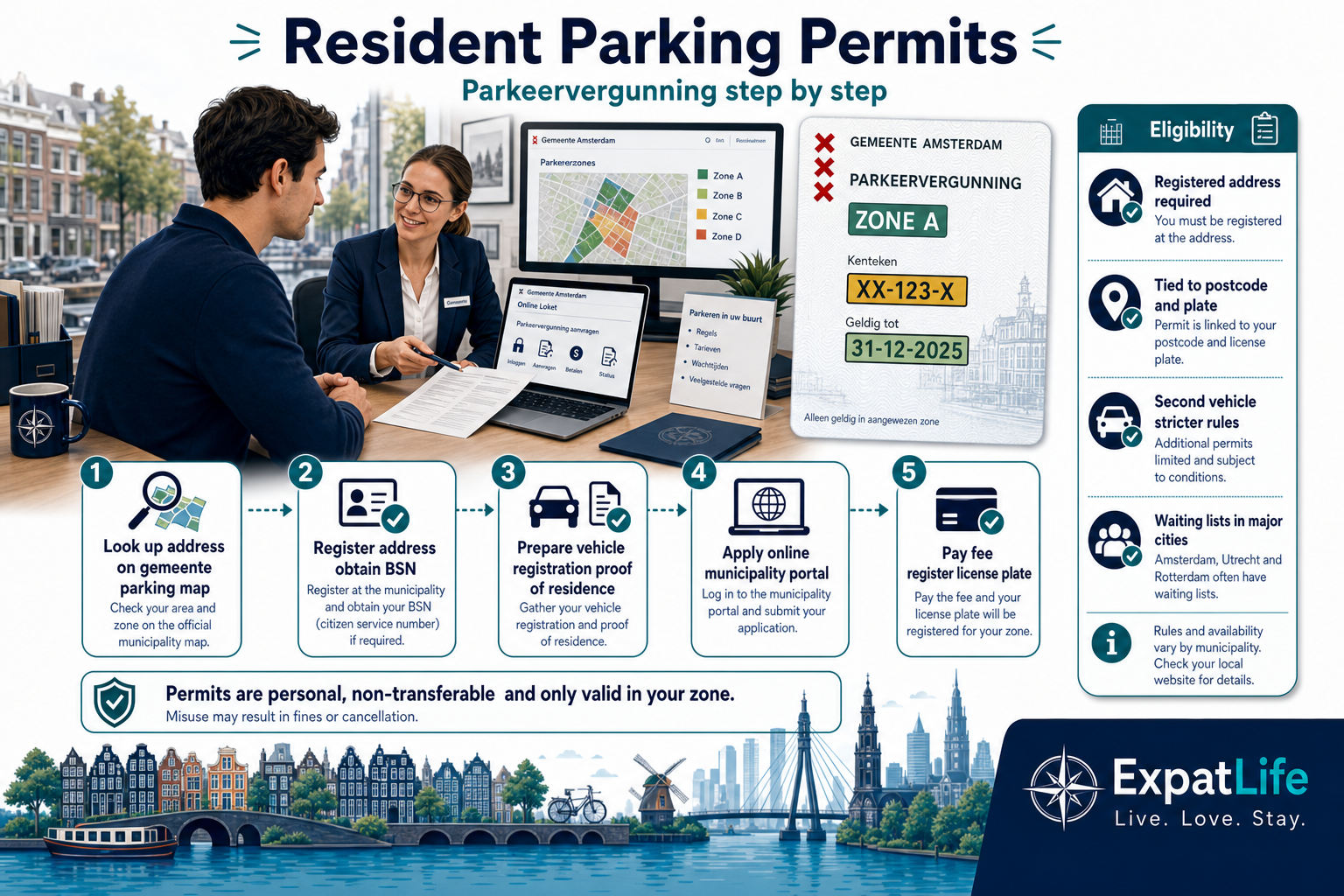
Check your zone map
Look up your address on the gemeente parking map to confirm you are in a permit zone.
Register your address
Complete address registration and obtain BSN if you have not already done so.
Prepare documents
Gather vehicle registration details and proof of residence if required.
Apply online
Submit your application through the municipality parking portal.
Pay and register plate
Pay the annual or quarterly fee and register your license plate digitally or display any required sticker.
| Document | Why it matters |
|---|---|
| Proof of address registration | BSN and registered postcode at your gemeente. |
| Vehicle registration (kentekenbewijs) | License plate must match the permit application. |
| ID or passport | Identity verification for online or in-person applications. |
| Lease or ownership proof | Some cities ask for housing contract if address recently registered. |
Resident permits usually require a registered postcode — complete address registration before applying.
Open address registration guideMany municipalities offer visitor parking systems so residents can host guests without sharing their own permit. Models differ by city — day codes, guest passes, hourly bundles or separate visitor zones.
Visitor systems are useful for family visits, contractors, moving vans and short-stay guests. Some cities sell day passes online; others require the resident to activate a code through the gemeente portal.
Always check whether visitor parking covers your guest’s license plate for the full visit — overstaying or wrong-zone parking can still lead to fines.
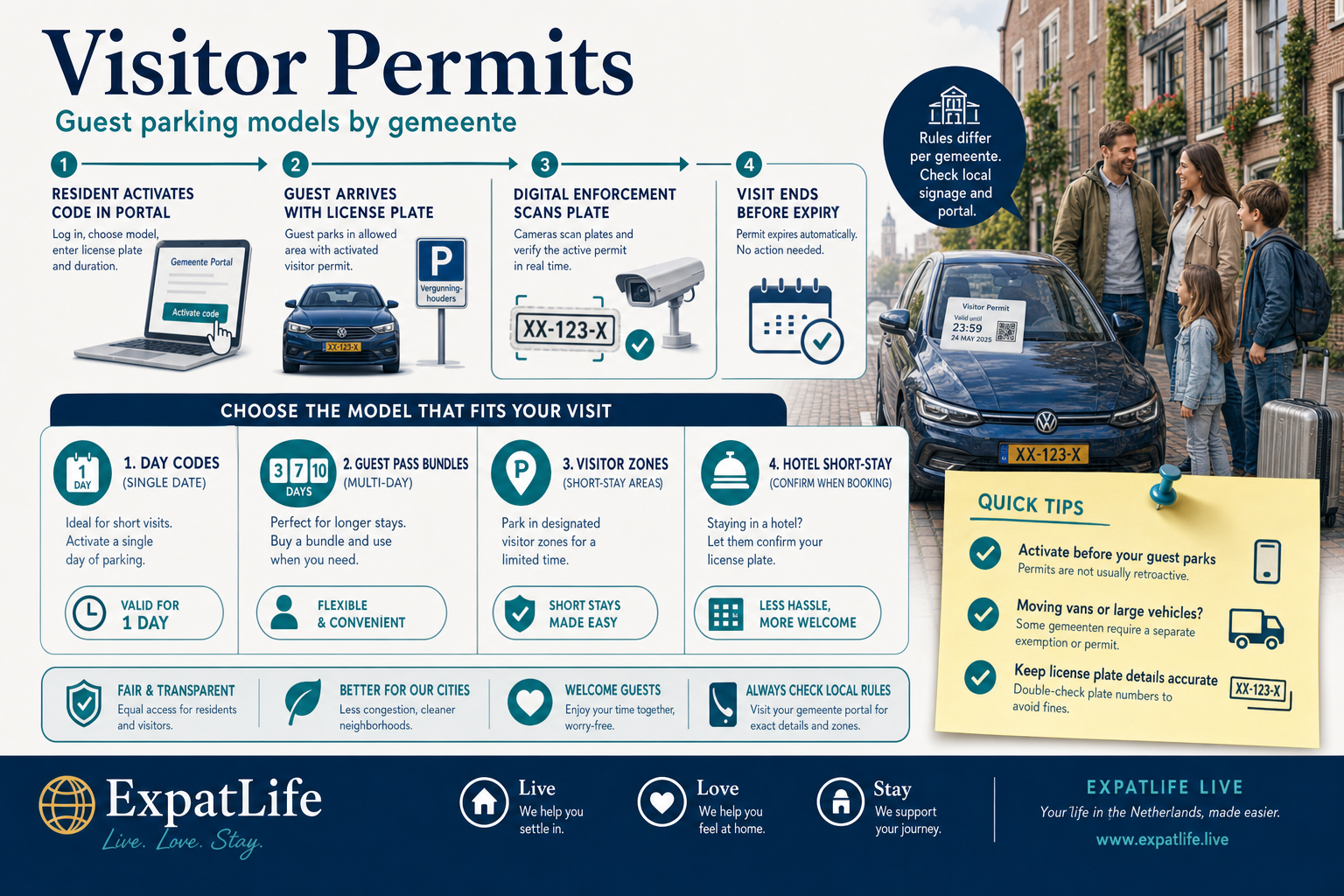
| Model | When to use | Expat tip |
|---|---|---|
| Day code | One-off guest for a single day | Buy or activate before the guest parks. |
| Guest pass bundle | Family staying several days or recurring visitors | Check hourly vs daily bundle pricing on your gemeente site. |
| Visitor zone | Short shopping or station visits outside your permit area | Rates and hours differ from resident permit zones. |
| Moving exemption | Moving van at your new address | Apply separately — a normal visitor code may not cover large vans. |
Single-day visitor codes purchased or activated by the resident for a specific date.
Multi-day or hourly bundles for recurring visitors in permit zones.
Separate short-stay areas near shopping or train stations with their own rates.
Hotels and serviced apartments may include parking — confirm before booking.
Important: Visitor permits usually cover permit zones only — they do not replace paid parking in commercial areas or exempt you from maximum stay limits.
Paid parking is common in urban centres, shopping districts and many residential streets during daytime hours. Rates, hours and zone codes are set by the municipality.
Payment options include parking meters, pay-and-display machines and mobile apps. Enforcement uses license plate recognition in many cities — no paper ticket on your dashboard is needed if you paid digitally.
Zone boundaries and time limits matter. Parking outside your paid window or in the wrong zone can result in fines even if you paid elsewhere in the city.
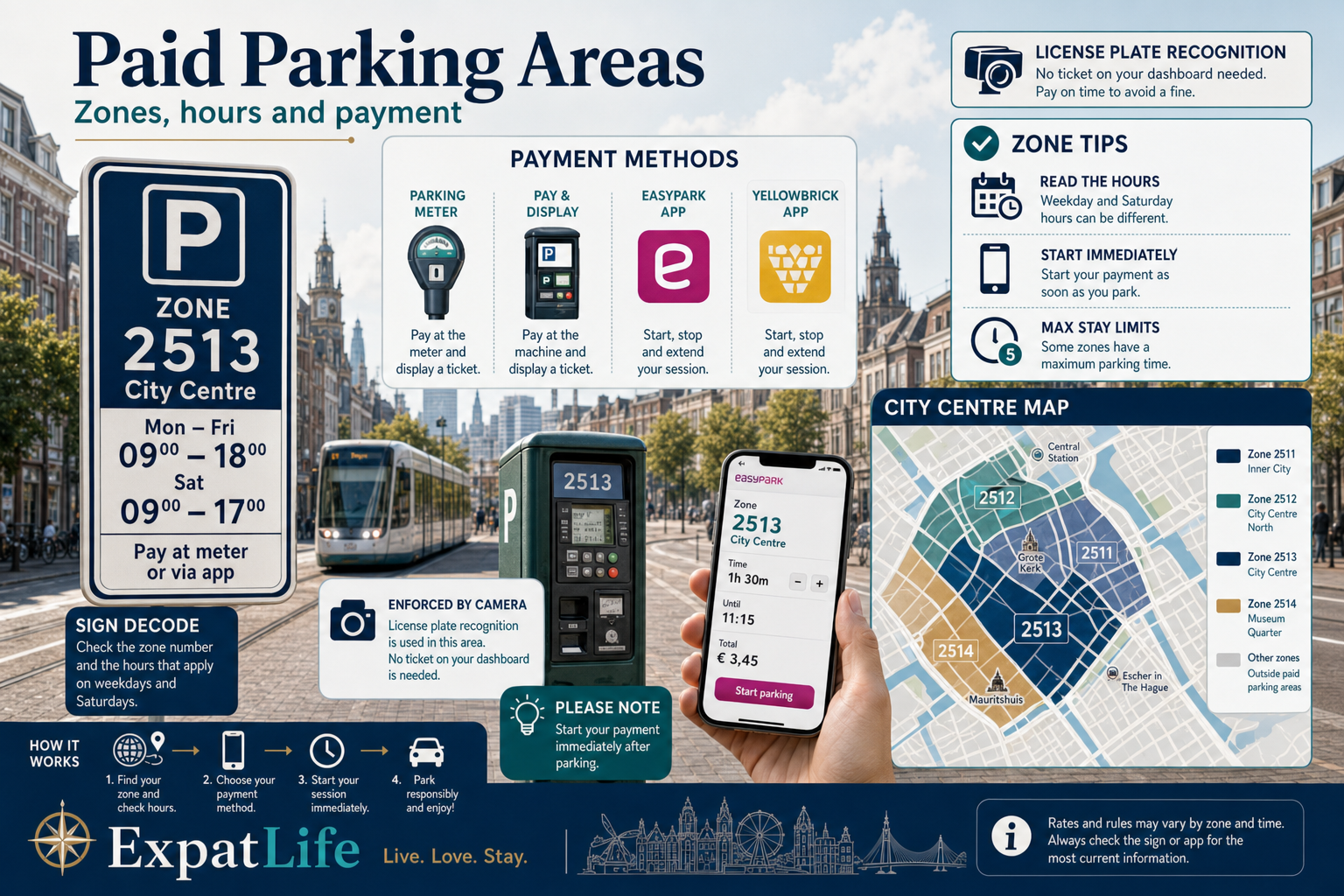
| Method | How it works | Best for |
|---|---|---|
| Mobile parking app | Pay by zone code — extend session remotely | Daily city-centre parking |
| Parking meter / pay-and-display | Card or coin at machine on street | Backup when apps are unavailable |
| Resident permit (digital plate) | Registered license plate scanned automatically | Overnight parking in permit zones |
| Visitor day code | Resident activates guest plate for set period | Guests in permit-only neighborhoods |
Mobile parking apps are widely used across Dutch cities. They let you pay for on-street parking, extend sessions remotely and sometimes find garages — coverage varies by municipality contract.
This is an overview of commonly used services, not a ranking. Check which apps work in your city on the gemeente parking page before relying on one provider.
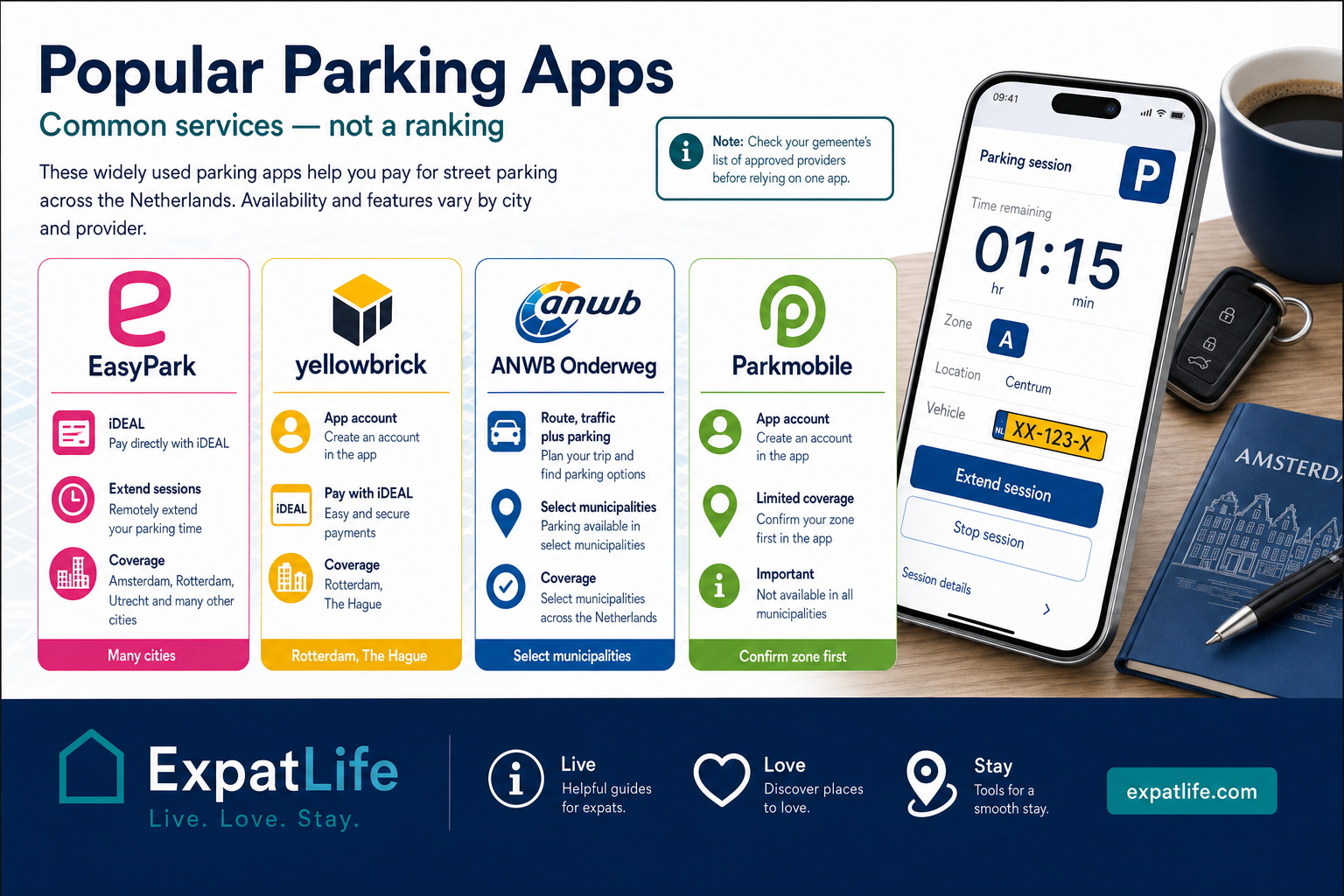
Widely available mobile parking payment in many Dutch municipalities and private car parks.
Payment: Credit card, iDEAL and in-app payment; extend sessions remotely.
Coverage: Many cities including Amsterdam, Rotterdam, Utrecht and smaller gemeenten — verify locally.
Long-established parking app used by several municipalities for on-street zones.
Payment: App account, iDEAL and card payment options.
Coverage: Rotterdam, The Hague and other cities — check gemeente list for active zones.
ANWB travel app with parking payment features alongside route and traffic information.
Payment: Linked payment methods through ANWB account.
Coverage: Select municipalities and ANWB partner locations — useful for combined travel planning.
Parking payment app active in some Dutch cities and private locations.
Payment: App-based payment with account registration.
Coverage: Limited compared to EasyPark — confirm zone support before parking.
Park-and-ride (P+R) facilities let drivers park on city outskirts and continue by train, metro or bus. They reduce central congestion and are often cheaper than inner-city parking.
Many P+R locations require an OV chip card or combined ticket for the transit portion. Some offer discounted parking when you travel onward by public transport within a set time window.
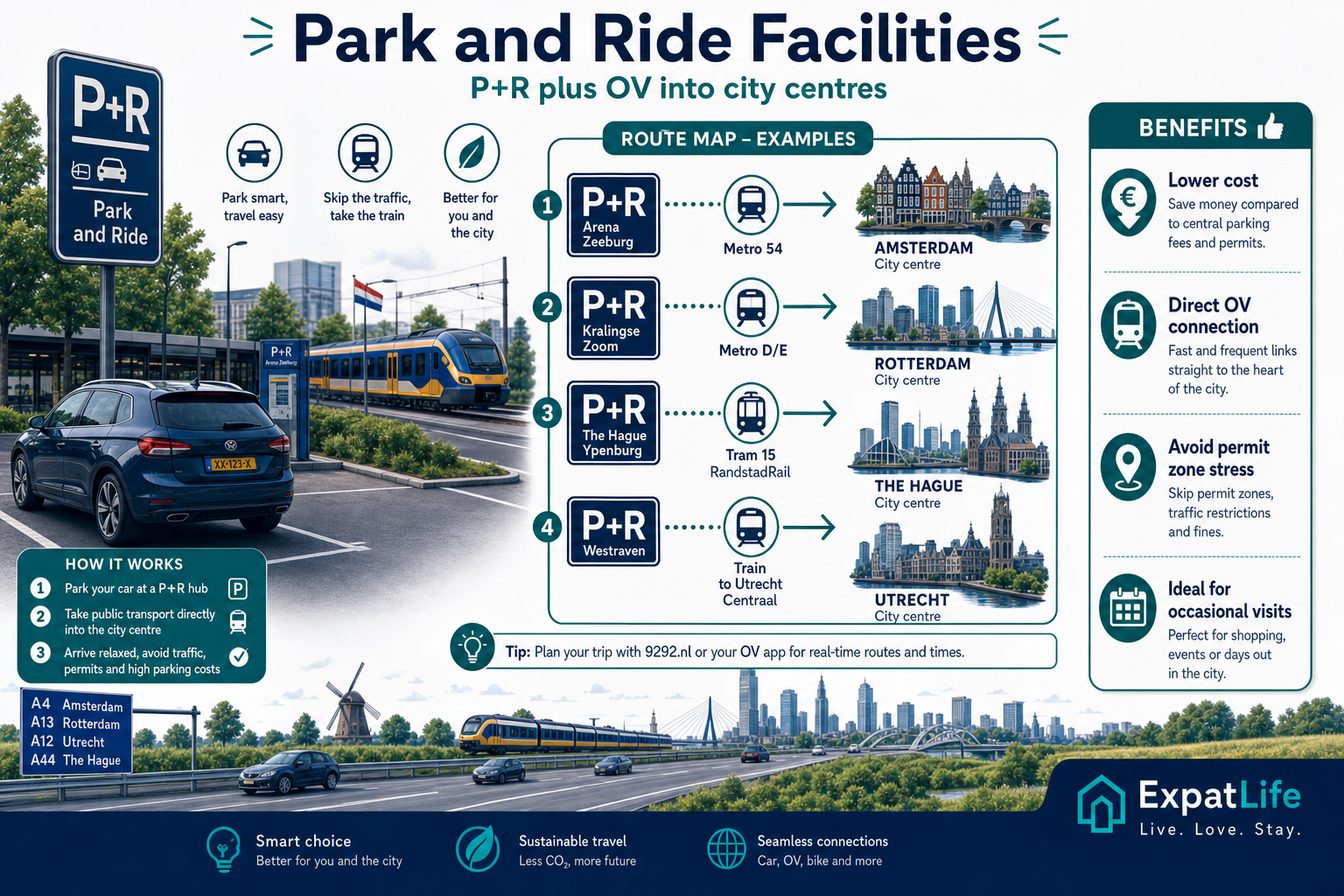
| City | Location | Transit | Note |
|---|---|---|---|
| Amsterdam | P+R Arena, Zeeburg | Metro / train to centre | Check OV travel requirement for discounted rate. |
| Rotterdam | P+R Kralingse Zoom | Metro connection | Useful for events and waterfront visits. |
| The Hague | Edge P+R sites | Tram / Randstad rail | Compare Scheveningen vs centre access needs. |
| Utrecht | P+R Westraven | Direct train to Utrecht Centraal | Popular on weekdays — arrive early. |
P+R locations at city edges (e.g. Arena, Zeeburg) with OV connection — check current rates and time rules.
P+R near Kralingse Zoom and other hubs linked to metro and bus networks.
P+R options connecting to tram and Randstad rail services.
P+R Westraven and other sites with direct train access to the centre.
Electric vehicle charging in the Netherlands combines public charge points, semi-public locations and residential charging requests. Parking rules for EVs vary — a charging spot is not always a free parking spot.
Residents without private driveways can often request a public charger near their home through the municipality or a regional operator. Waiting times and eligibility rules apply.
Always check signage — some EV bays are for active charging only with time limits.
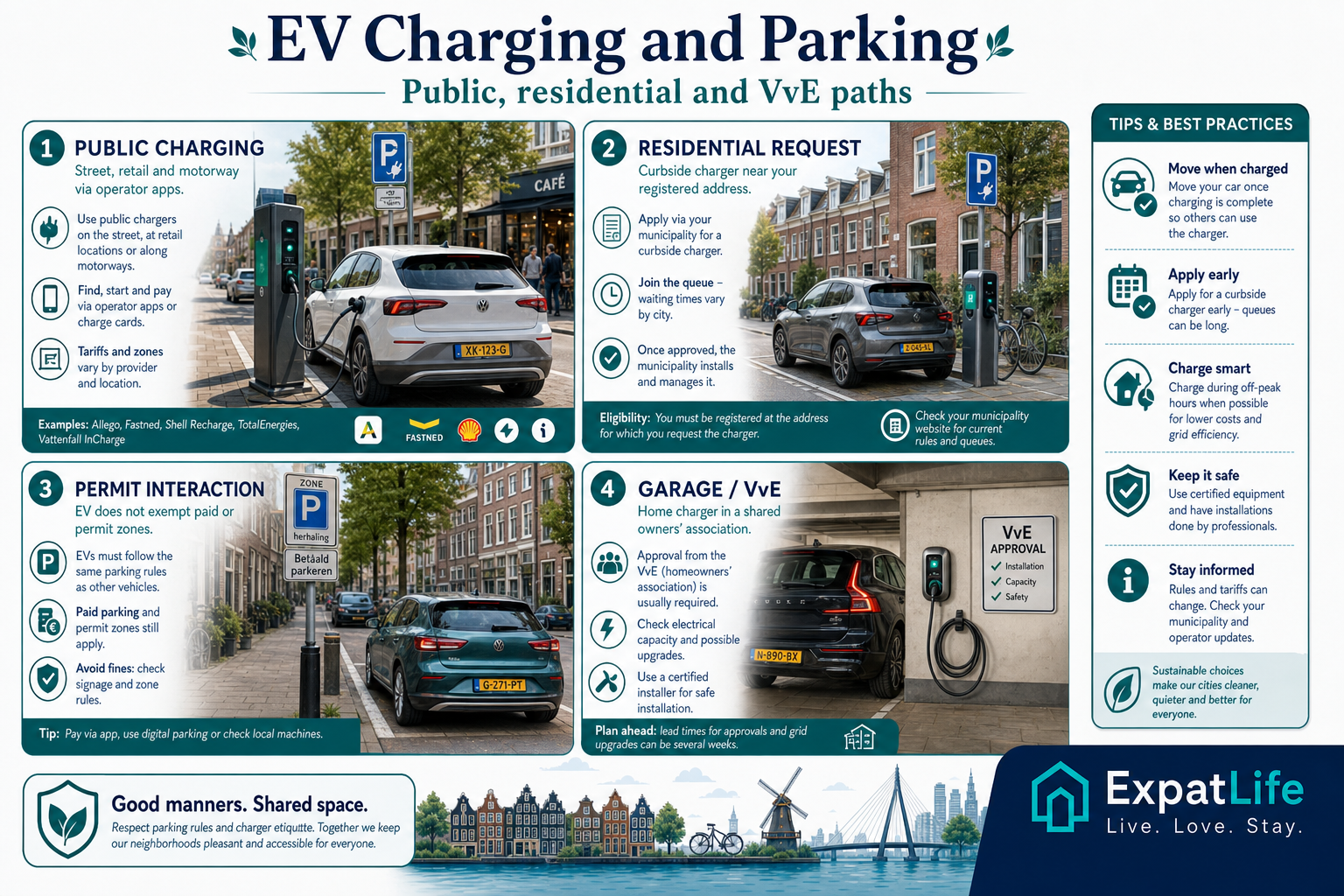
| Path | How to set up | Parking rule |
|---|---|---|
| Public street charger | Use operator app or charge card | Often active-charging-only with time limit |
| Residential request | Apply via municipality or regional operator | Does not automatically grant a resident parking permit |
| Garage / driveway | VvE or owner approval plus electrician | Private — separate from street permit rules |
| Workplace / retail | Employer or location provider access | Check whether parking while charging is included |
Charge points at street, retail and motorway locations via operator apps and cards.
Municipality-led programs to install curbside chargers near registered addresses.
EV status does not automatically exempt you from paid or permit zone rules.
Apartment charging often needs VvE approval and electrical capacity assessment.
Permit demand, visitor systems and P+R options differ between Amsterdam, Rotterdam, The Hague, Utrecht and Eindhoven. Open your city guide alongside your gemeente parking portal.
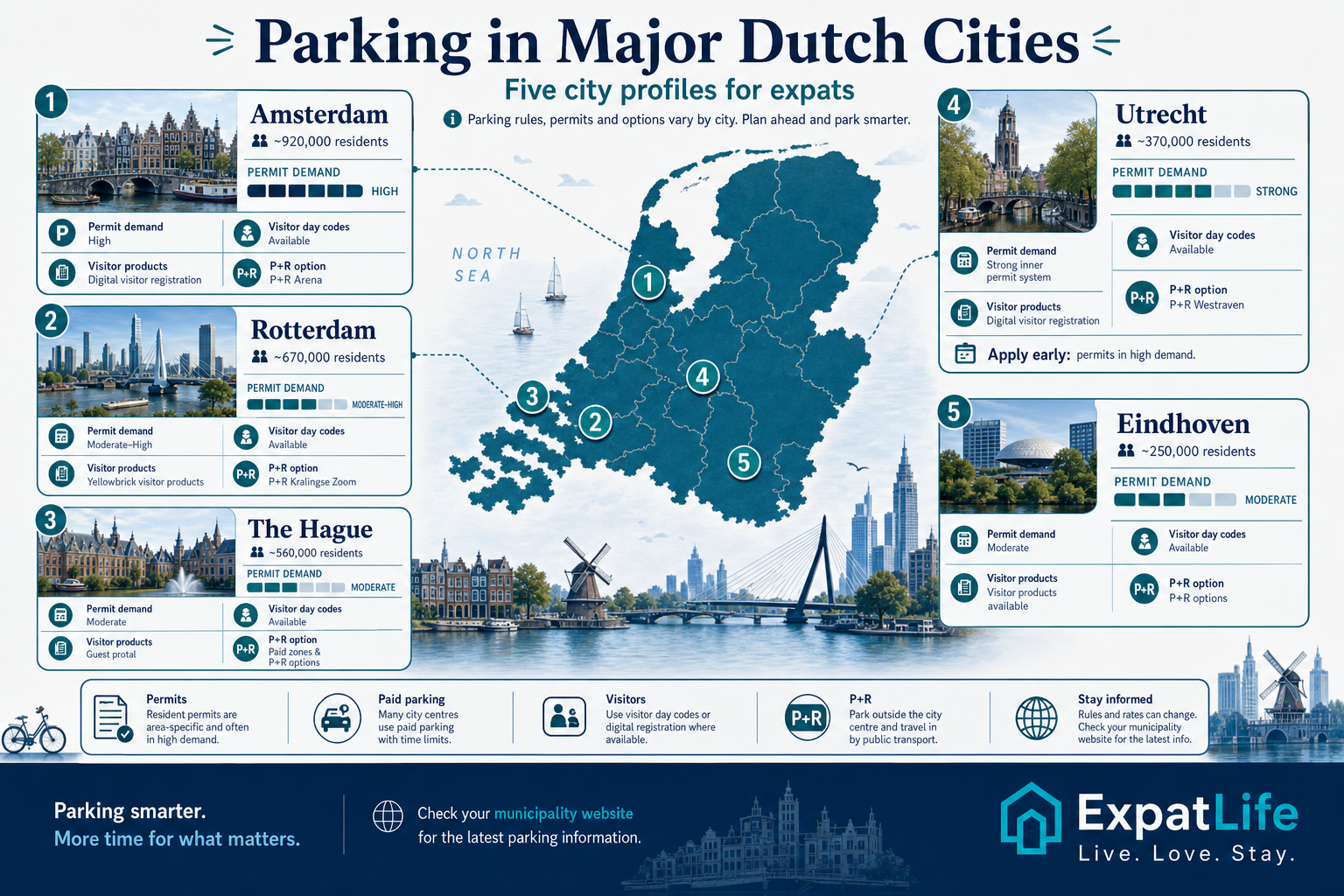
| City | Permit demand | Paid parking | Visitor system | P+R |
|---|---|---|---|---|
| Amsterdam | Very high | Extensive zones | Online day codes | Arena, Zeeburg |
| Rotterdam | Moderate–high | District-based zones | Guest products online | Kralingse Zoom |
| The Hague | Varies by district | Centre + Scheveningen | Guest portal products | Tram-linked sites |
| Utrecht | High inner city | Strong centre zones | Visitor passes online | Westraven train link |
| Eindhoven | Moderate | Centre focus | Online visitor products | Limited vs Randstad |
~920,000
Extensive paid zones and permit areas across most districts; strict enforcement.
Permit demand: High — waiting lists common in Centrum and popular neighborhoods.
Visitor system: Online visitor day codes and guest products via Amsterdam parking portal.
Park and ride: P+R Arena, Zeeburg and other edge locations with OV links.
~670,000
Mix of paid zones, permit areas and garage parking by district.
Permit demand: Moderate to high in central and waterfront neighborhoods.
Visitor system: Visitor products and day passes via rotterdam.nl parking section.
Park and ride: P+R Kralingse Zoom and metro-linked sites.
~560,000
Paid zones in centre and Scheveningen; permit zones in residential areas.
Permit demand: Varies by district — coastal and central areas tighter.
Visitor system: Guest parking options through denhaag.nl portal.
Park and ride: P+R locations connecting to tram and Randstad rail.
~370,000
Strong permit system in inner districts; paid parking in centre.
Permit demand: High in popular inner-city neighborhoods — apply early.
Visitor system: Visitor passes and day products via Utrecht parking pages.
Park and ride: P+R Westraven and other train-linked facilities.
~250,000
Paid zones in centre; permit areas in surrounding neighborhoods.
Permit demand: Moderate — less extreme than Randstad cores but still zone-dependent.
Visitor system: Visitor parking products on eindhoven.nl.
Park and ride: Limited compared to Amsterdam — check current P+R map.
Municipalities handle many permits beyond parking. Requirements, fees and processing times vary by gemeente and project type.
Always use official municipality portals for applications. Third-party services may assist but cannot guarantee approval or waiting times.
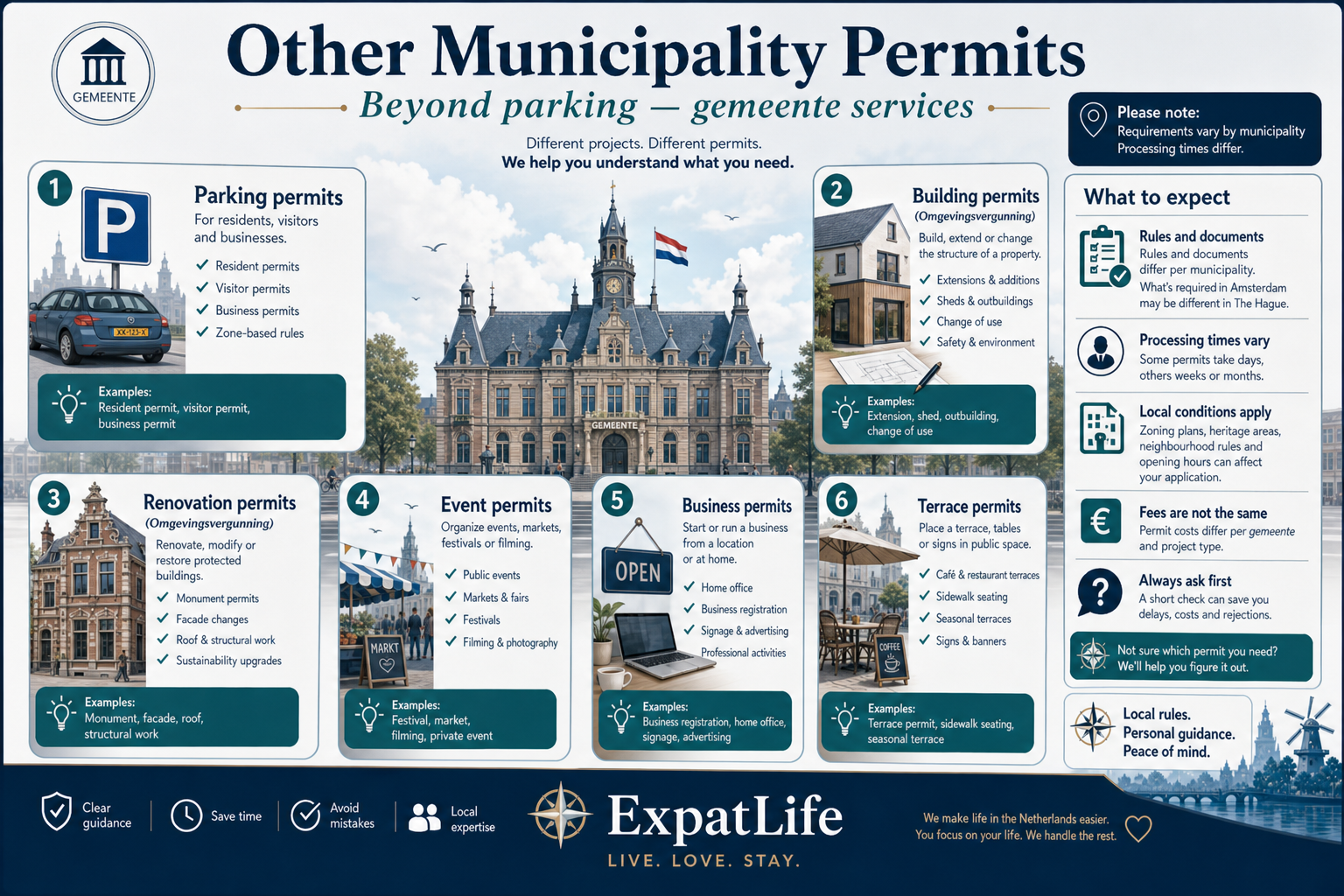
Resident, visitor and business parking authorizations for on-street zones.
Examples
Note: Tied to address and license plate — rules vary by zone.
Omgevingsvergunning for construction, extension or structural changes.
Examples
Note: Processing times vary — check gemeente planning portal.
May be required for facades, monuments or changes in conservation areas.
Examples
Note: Extra rules apply in historic districts.
Temporary use of public space for markets, festivals or street events.
Examples
Note: Apply well in advance of the event date.
Including hospitality, retail and home-business rules where applicable.
Examples
Note: Cross-check with KVK registration and zoning rules.
Seasonal or permanent permission for outdoor seating on public space.
Examples
Note: Fees and seasonal rules set locally.
See how parking permits fit into broader gemeente registration, taxes and local admin.
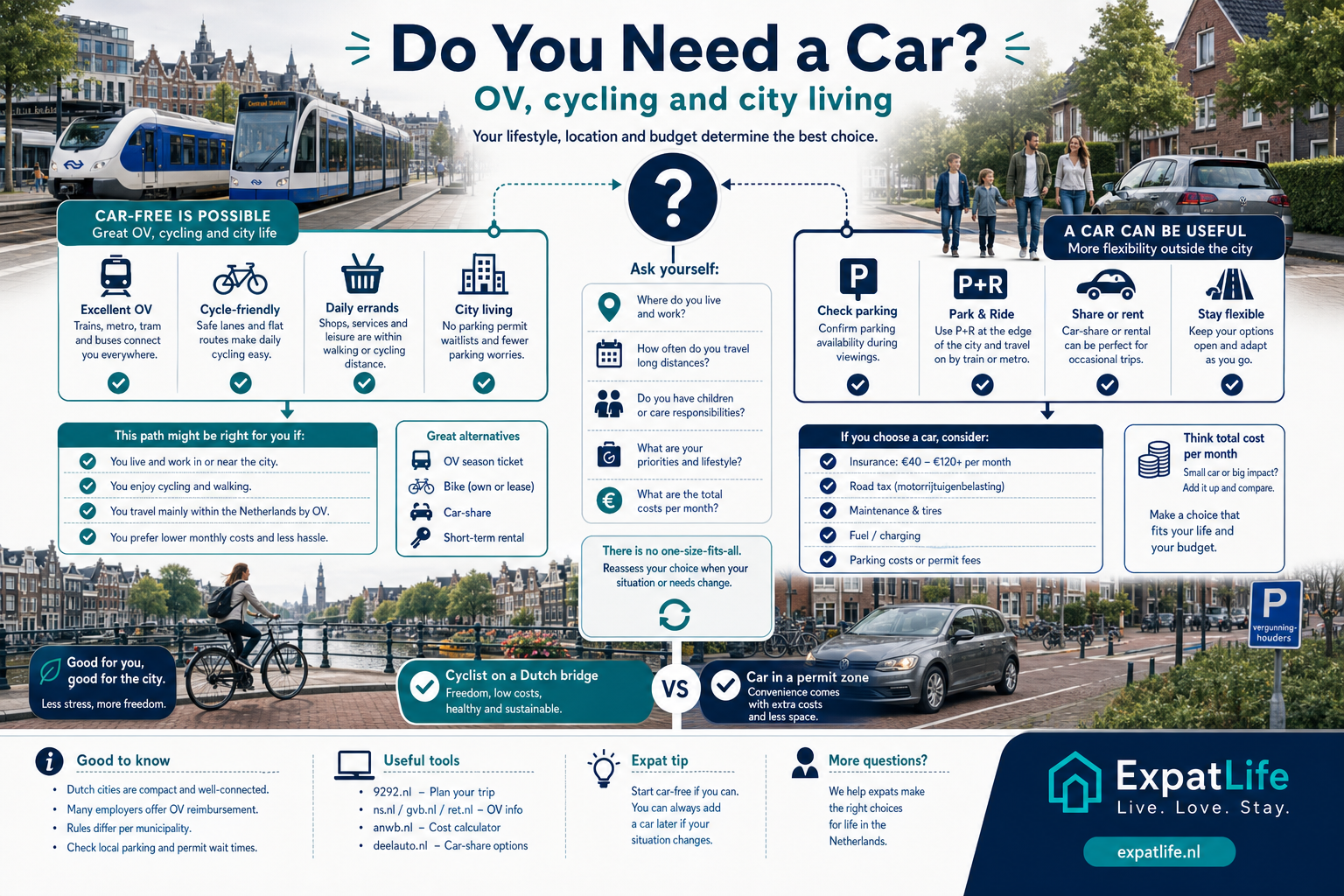
Open municipality guideMany expats in the Netherlands live comfortably without a car, especially in cities with strong cycling infrastructure and public transport. Car ownership adds parking costs, insurance, road tax and maintenance.
Suburban and rural areas may make a car more practical. Weigh P+R, car-sharing and occasional rental against full ownership before committing to permit zones and garage costs.
| Option | Typical costs | Best for |
|---|---|---|
| OV + bike | NS subscription or OVpay + bike ownership | City-centre expats, daily commutes under 30 km |
| P+R + OV | Daily P+R fee plus transit ticket | Occasional city visits without a resident permit |
| Car ownership | Permit + insurance + road tax + fuel + maintenance | Suburban families, regular regional travel |
| Car-sharing / rental | Pay per trip or short rental | Infrequent trips, avoiding permit waiting lists |
NS trains, metro, tram and bus networks cover most Randstad and city regions well.
Daily errands, school runs and commutes often work by bike in Dutch cities.
Permit waiting lists and paid parking make car-free life attractive in dense areas.
Families and edge-of-city homes may need a car — confirm parking at viewing stage.
Weigh public transport, cycling and occasional car use before buying or importing a vehicle.
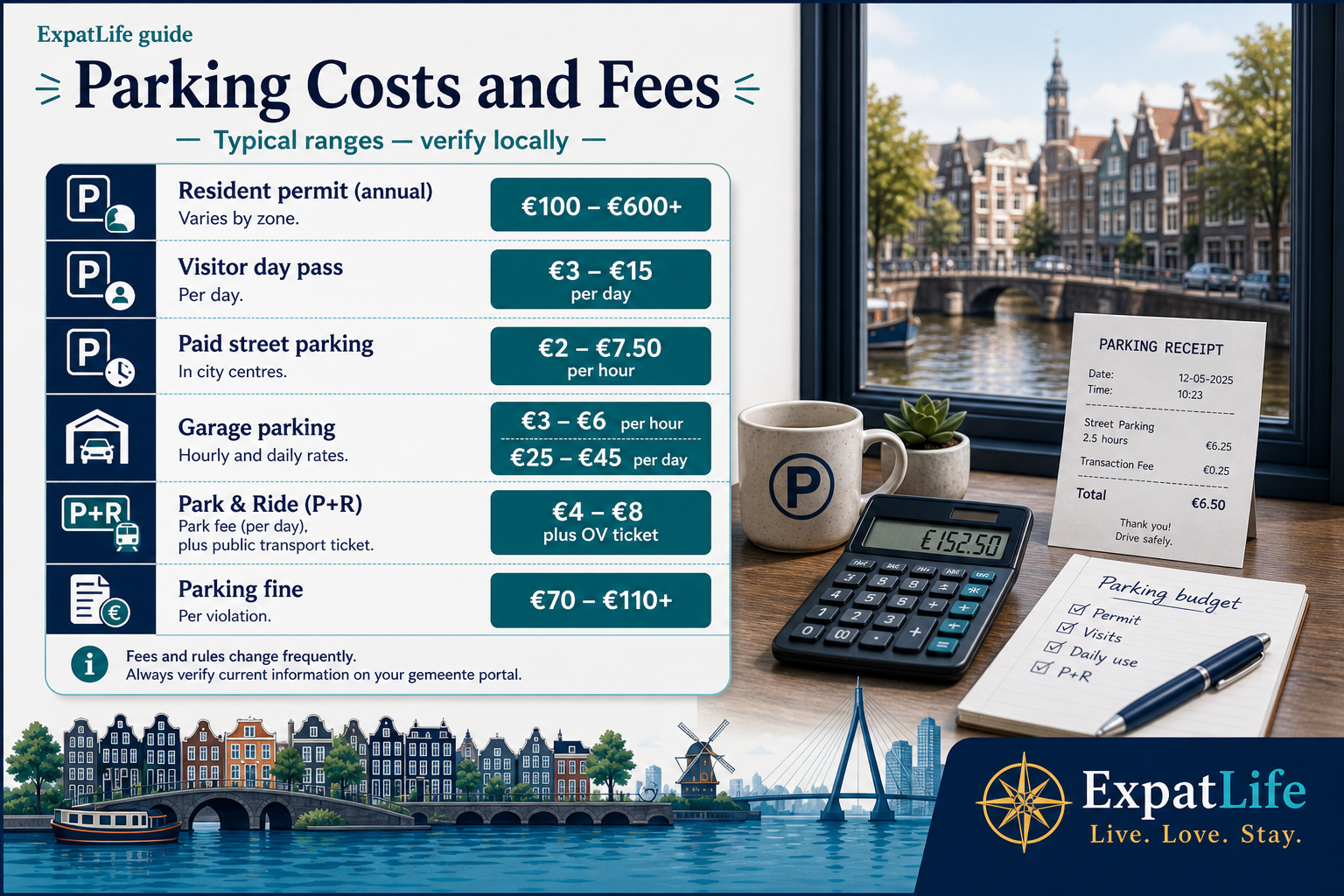
Open getting around guideParking costs include permit fees, visitor passes, paid zone rates and garage parking. Amounts vary by city, zone and vehicle type — treat ranges as orientation only.
Always confirm current fees on your gemeente website before budgeting. This guide does not guarantee prices or availability.
| Item | Range | Note |
|---|---|---|
| Resident permit (annual) | Roughly €100–€600+ per year | Varies by city, zone and second-vehicle rules. |
| Visitor day code | Often €3–€15 per day | Depends on city and product type. |
| Paid street parking | Roughly €2–€7.50 per hour in centres | Zone and time dependent. |
| Garage parking | Roughly €3–€6 per hour or €25–€45 daily | Central garages cost more. |
| P+R daily | Often €4–€8 plus OV ticket | Discounts may apply with transit use. |
| Parking fine | Typically €70–€110+ per violation | Set by municipality — pay or appeal via official channels. |
Important: Fees and fines change frequently. Verify current amounts on your gemeente parking portal and RDW — this guide provides orientation only, not a price guarantee.
Use this checklist after registering your address and before relying on street parking.
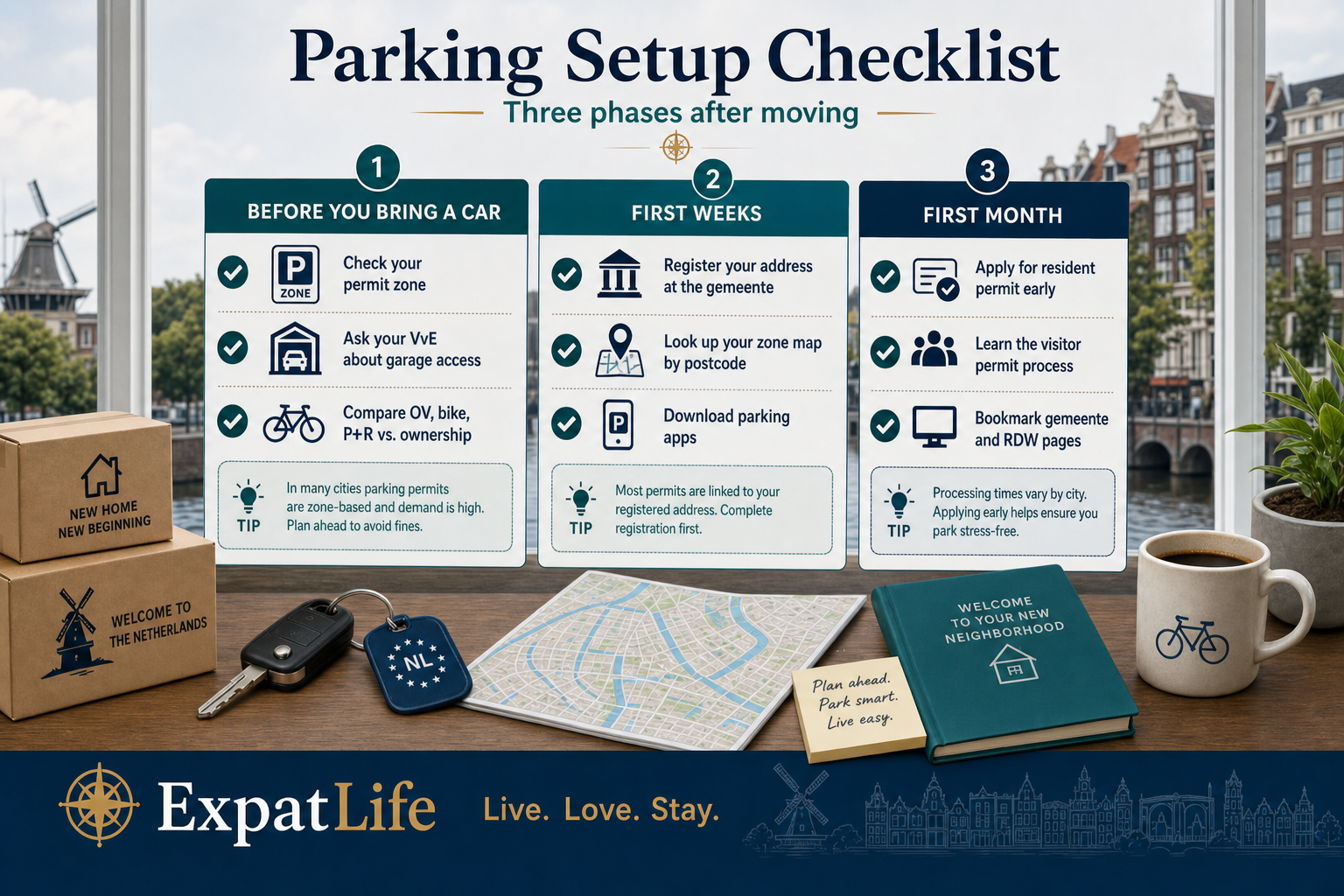
Complete address registration first — resident permits and zone maps usually require a registered postcode.
Open address registration guideThese are the parking and permit errors expats most often make after arriving in the Netherlands.
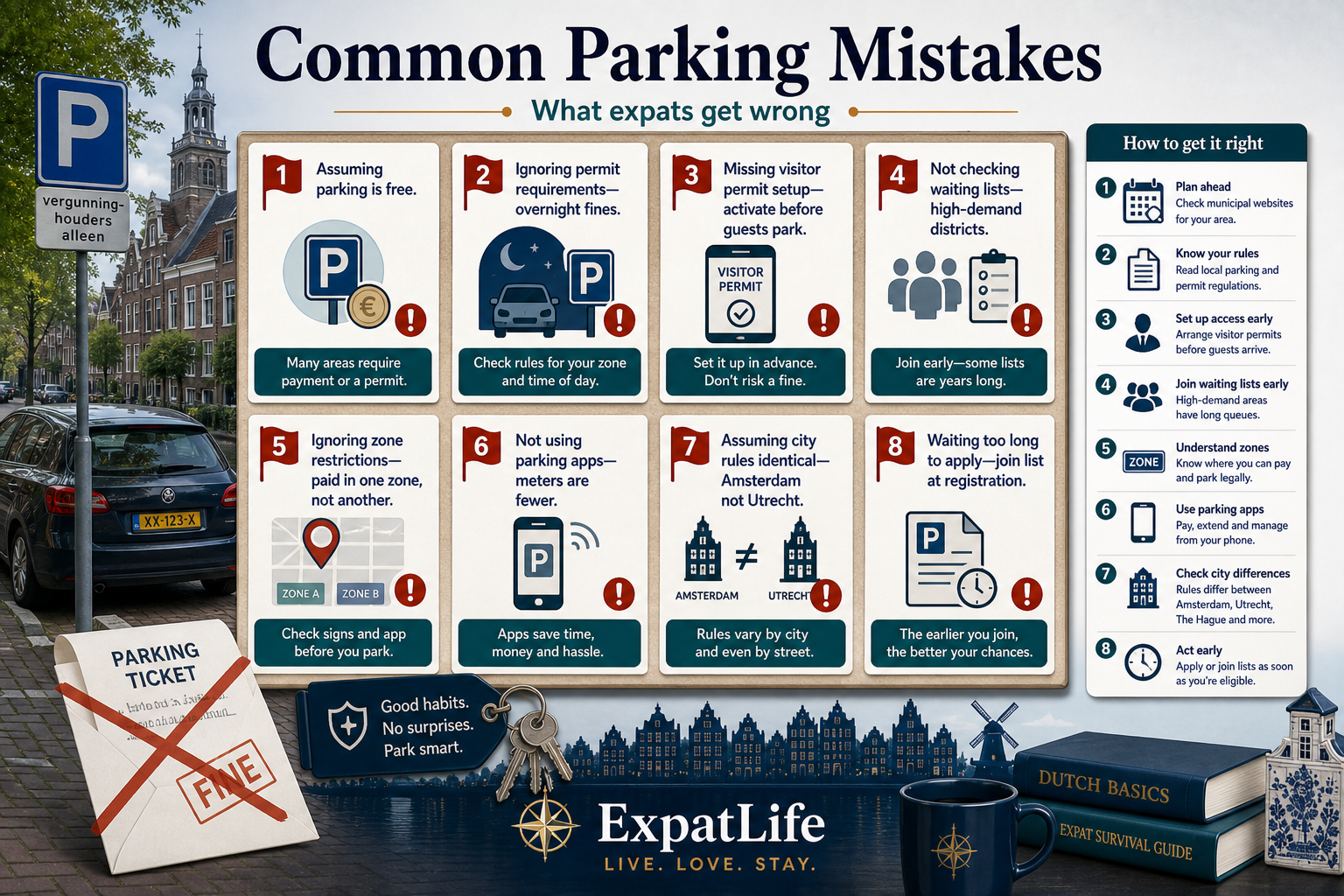
Many streets require payment or a permit even in residential areas.
Overnight parking in permit zones without authorization leads to fines.
Guests need activated codes before parking — not after enforcement.
Assuming a permit is available immediately in high-demand districts.
Paid in one zone does not cover another — check signs and apps.
Meters are fewer — mobile payment is standard in many cities.
Amsterdam rules do not apply in Utrecht or Eindhoven.
Join waiting lists as soon as you register your address.
When in doubt: If you are unsure whether a street requires payment, a permit or both, check the gemeente zone map for your postcode before parking overnight — fines often exceed the cost of a visitor pass.
Official parking information portals for major Dutch cities. Always verify postcode-specific rules and current fees on your gemeente website.
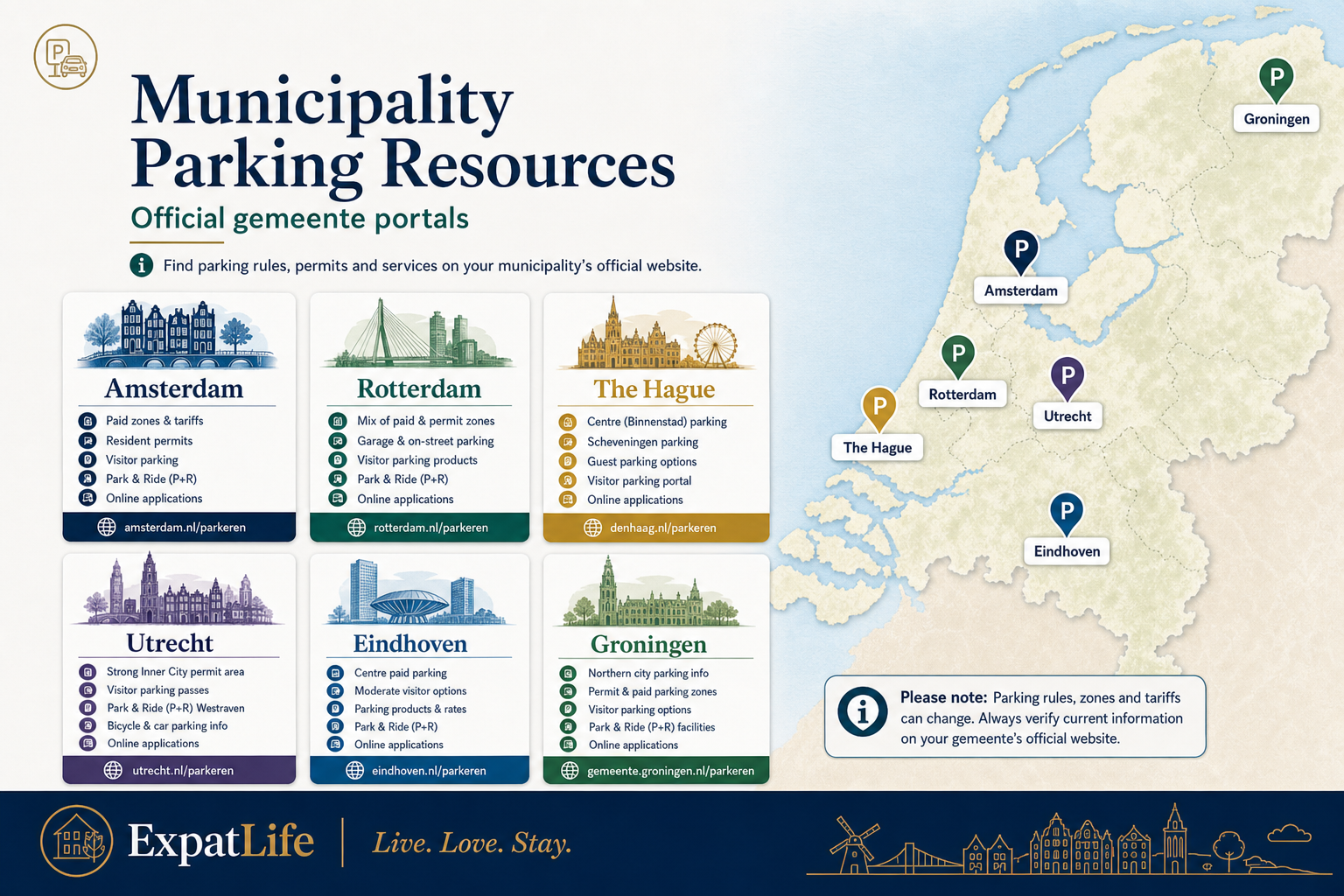
Parking services: Paid zones, resident permits, visitor products and P+R
Permit information: Online applications linked to registered address
Parking services: Zone parking, permits and garage maps
Permit information: Resident and visitor products via rotterdam.nl
Parking services: Paid parking, permits and Scheveningen zones
Permit information: Address-linked permit applications
Parking services: Permit zones, paid parking and P+R links
Permit information: Utrecht parking portal with postcode lookup
Parking services: Centre paid zones and neighborhood permits
Permit information: Online permit and visitor products
Parking services: City centre paid zones and permit areas
Permit information: Gemeente Groningen parking section
Quick answers for orientation — always confirm details on your gemeente website.
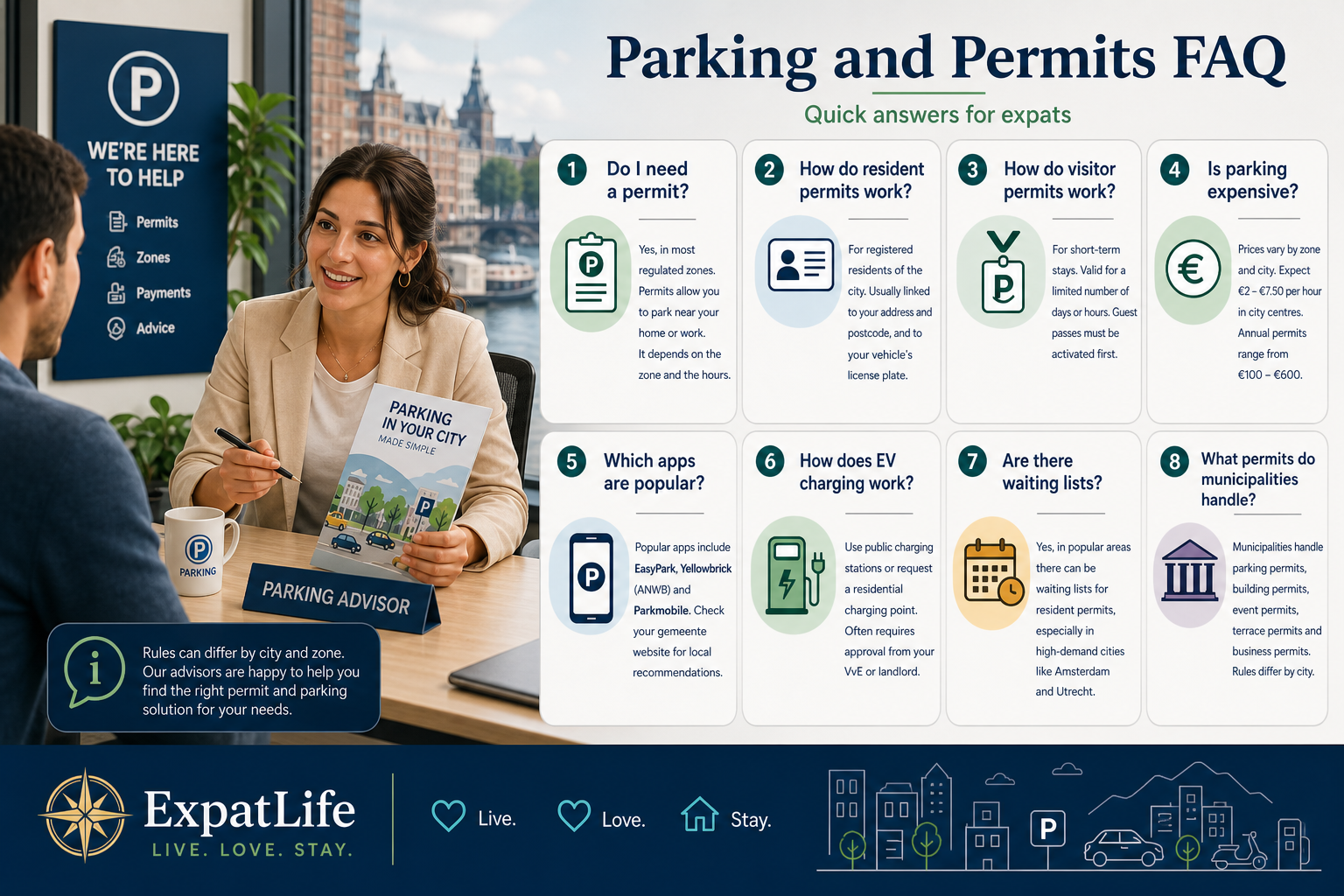
If you live in a permit zone and want to park on the street long-term, you usually need a resident permit. Check your postcode on the gemeente parking map — many city centres and dense neighborhoods require permits or paid parking.
You apply through your municipality, typically after registering your address. The permit links to your license plate and allows parking in designated resident zones. Waiting lists and fees vary by neighborhood.
Many cities sell day codes or guest passes that residents activate for visitors. The guest’s license plate must be registered for the valid period. Products and prices differ by gemeente.
Central paid parking can cost several euros per hour. Resident permits have annual fees that vary by city. P+R and cycling often cost less for occasional city access.
EasyPark and Yellowbrick are widely used in Dutch cities. ANWB Onderweg and Parkmobile also operate in selected areas. Check your gemeente list for supported apps.
Public chargers use operator apps or cards. Residents can often request curbside chargers near home through municipality programs. Charging bays may have separate time limits from parking rules.
Yes — high-demand neighborhoods in Amsterdam, Utrecht and other cities may have waiting lists for resident permits. Apply as soon as you are eligible and registered.
Besides parking, gemeenten handle building and renovation permits, event use of public space, terrace permits and various local business authorizations. Processes vary by municipality.
Parking regulations, permit systems and fees vary by municipality and can change over time. Always verify current requirements through official sources.
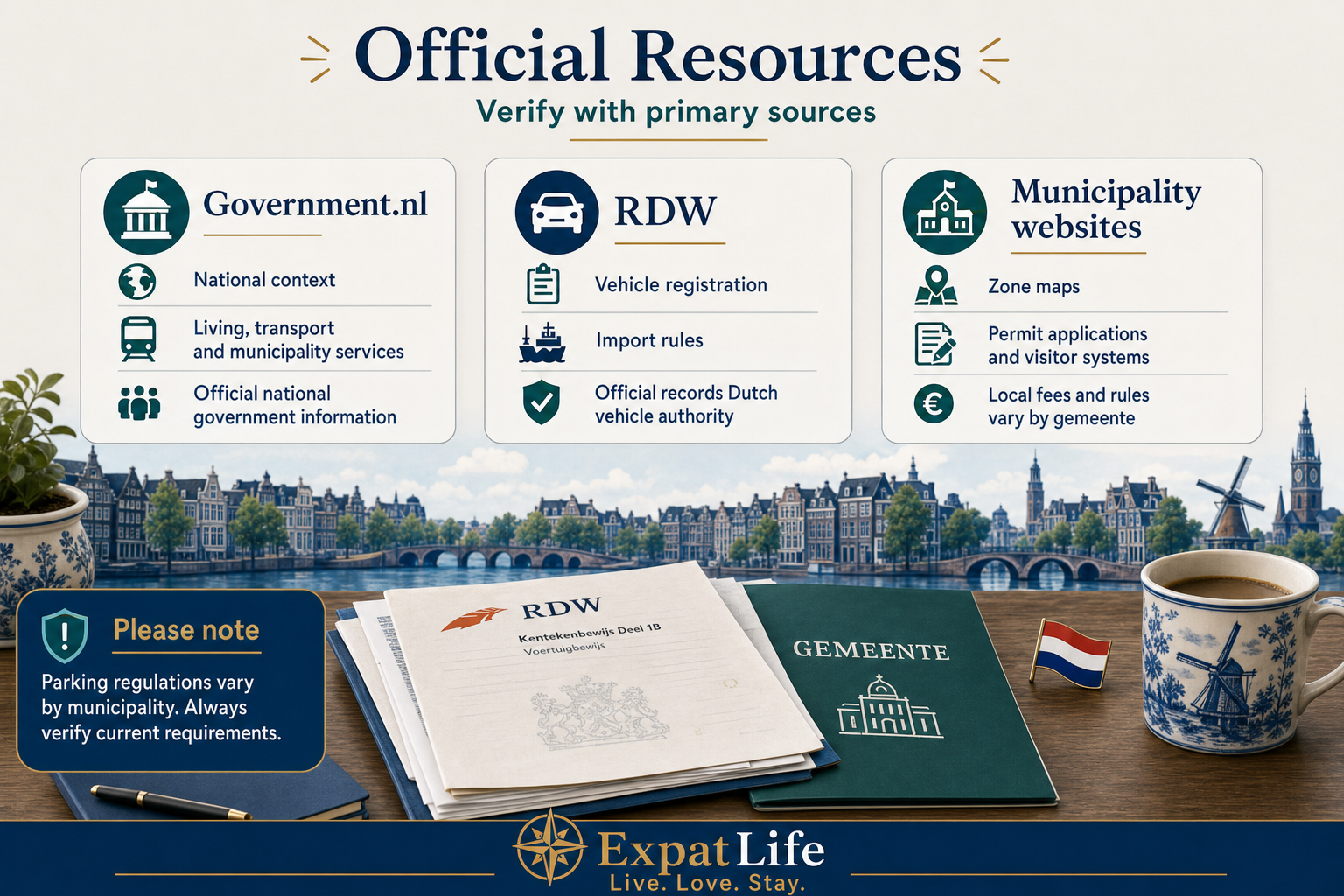
National government portal with living, transport and municipality context.
Open official sourceVehicle registration, import and official vehicle records in the Netherlands.
Open official sourceAuthoritative source for parking zones, permits, fees and local rules.
Open official sourceContinue from parking orientation into municipality services, housing, utilities and transport guides.
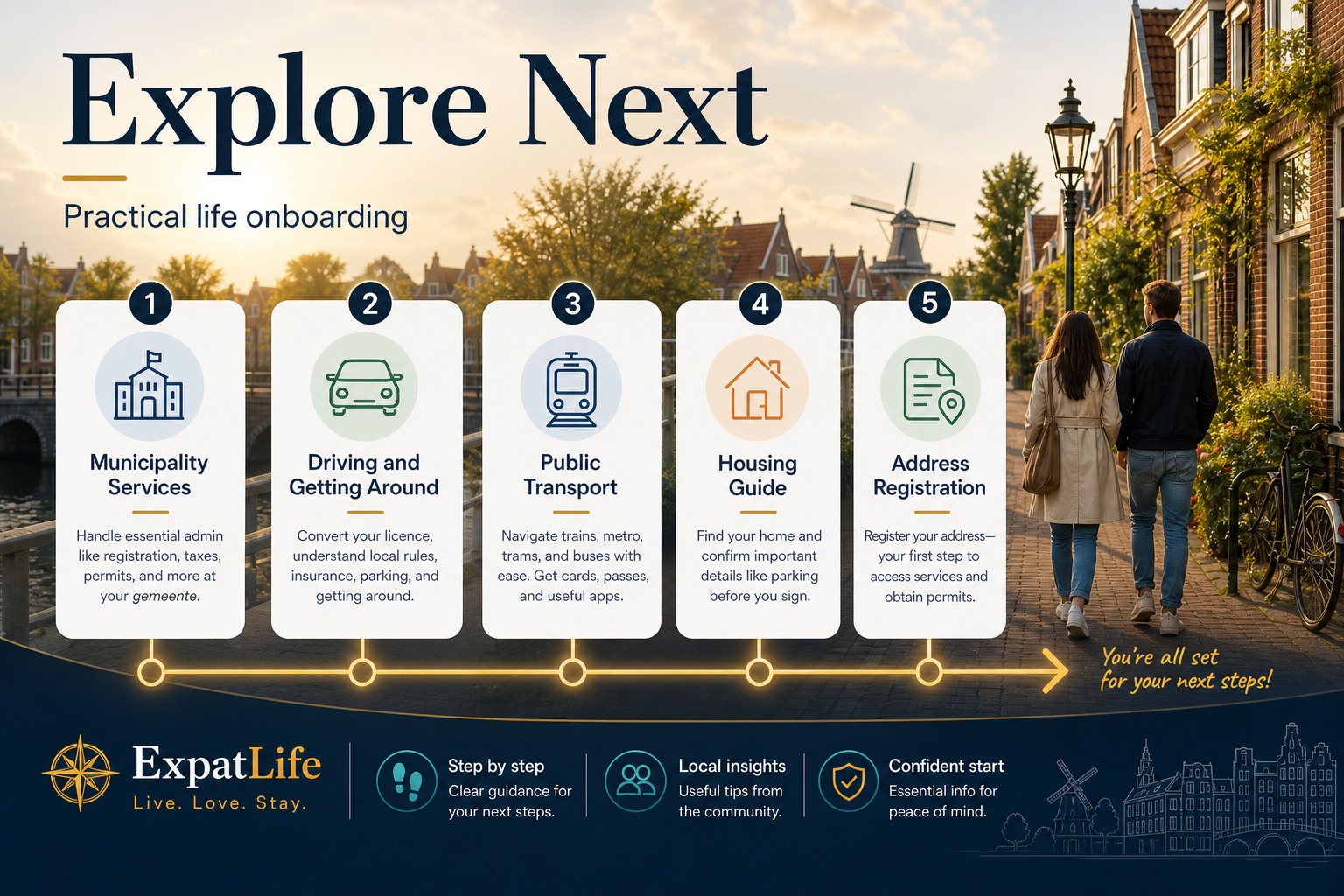
Explore next
Move from parking and permits into municipality services, getting around, housing and address registration.