
Address registration
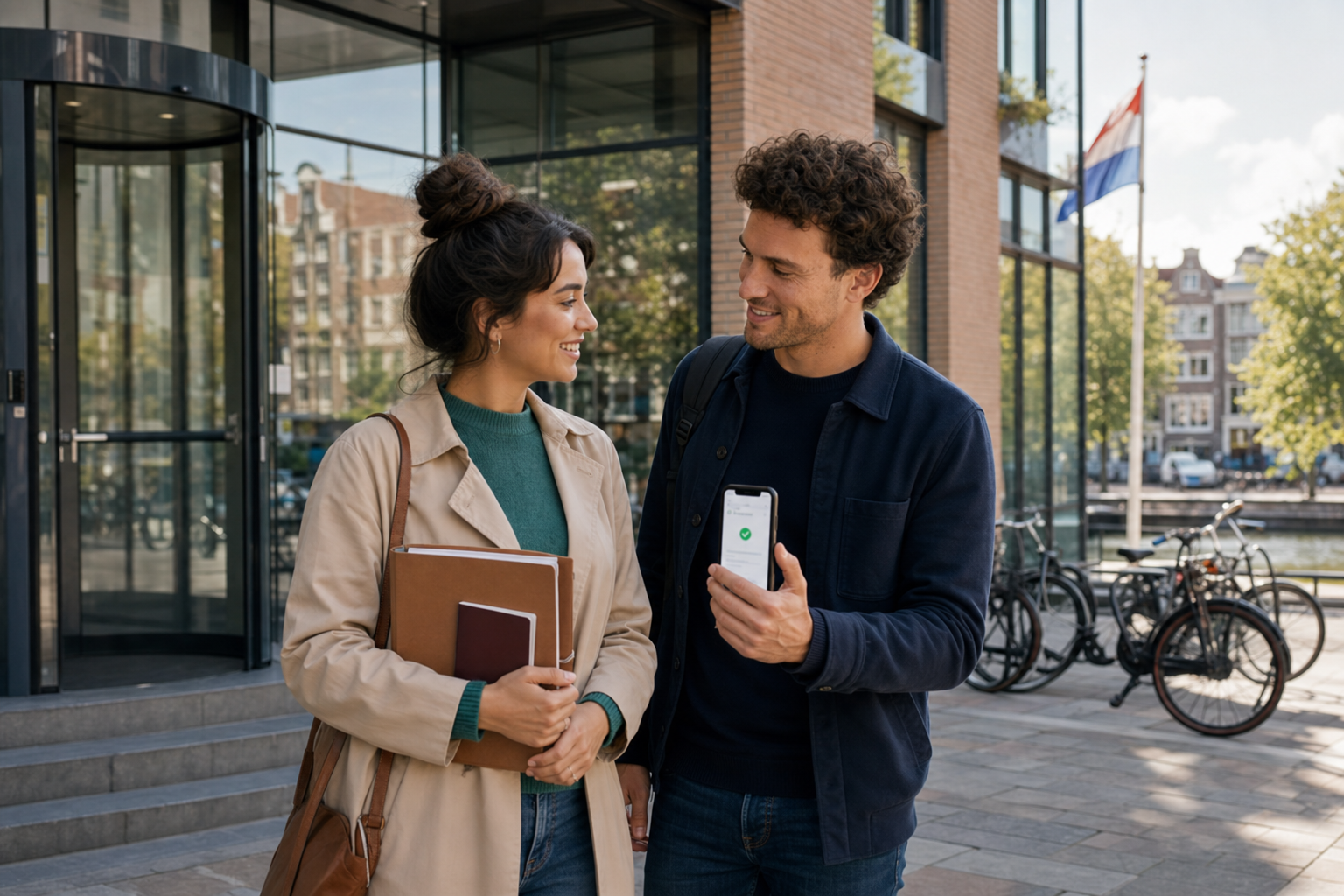
Most newcomers register their home address at the gemeente where they live, usually by appointment with supporting documents.
Practical life guide
Learn how Dutch municipalities work, what services they provide and what expats need to arrange after moving to the Netherlands.
Practical life
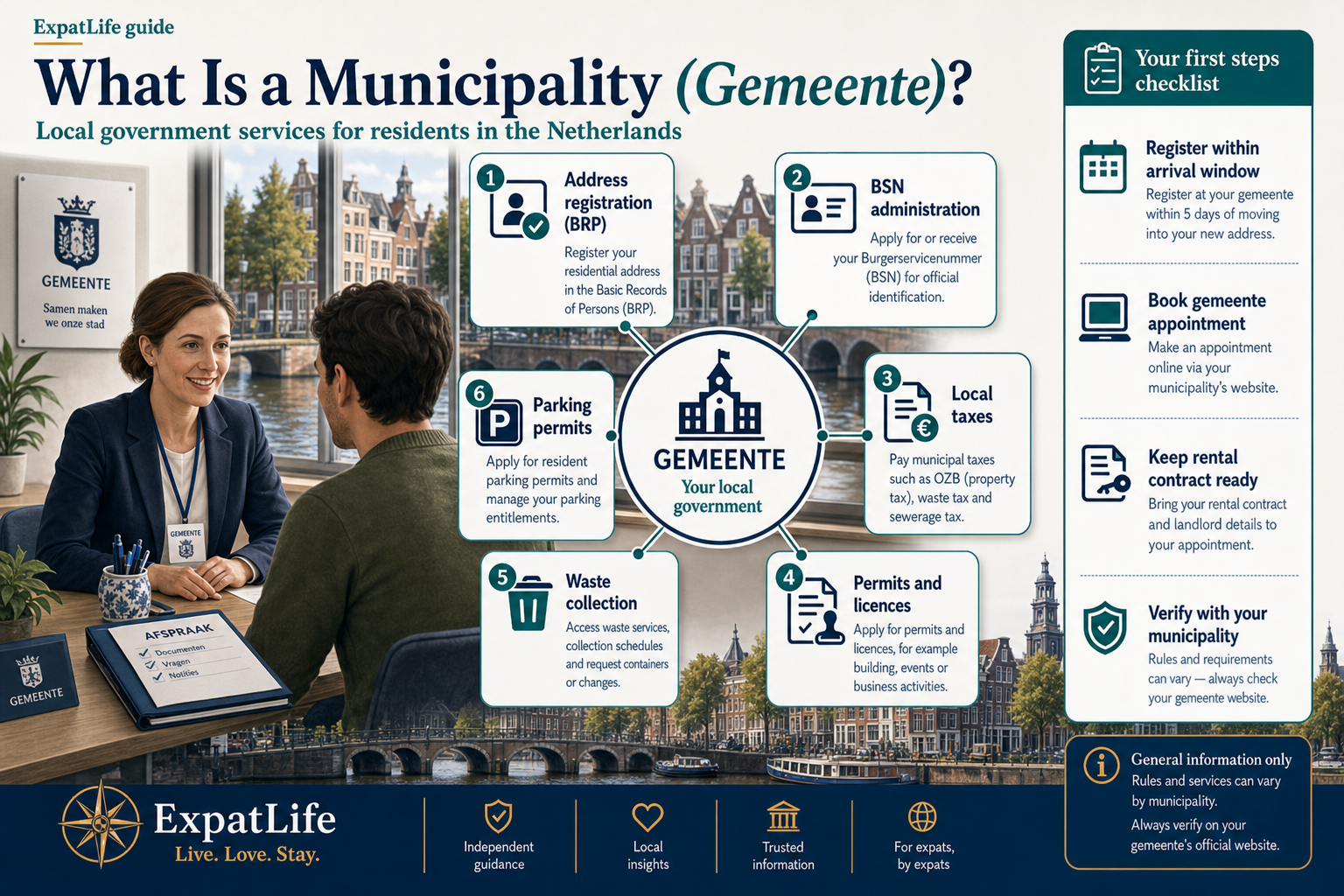
Municipalities are local government authorities responsible for many day-to-day services residents use. In Dutch, the municipality is called the gemeente. Whether you live in Amsterdam, a regional city or a smaller town, your gemeente is usually the first local institution you interact with after moving.
Examples of gemeente responsibilities include address registration, BSN administration, local taxes, permits, waste collection, parking permits and social services. National rules often set the framework, but appointments, local charges and service delivery are handled locally.
For expats, the practical takeaway is simple: every resident interacts with their municipality. Understanding what the gemeente does — and what to arrange first — reduces relocation stress and helps you connect registration with banking, healthcare, taxes and housing setup.
Most newcomers register their home address at the gemeente where they live, usually by appointment with supporting documents.
The citizen service number is often issued through municipality registration and is needed for work, tax, healthcare and banking.
Municipal charges such as waste tax, sewage levies and property-related fees may arrive after registration.
Many cities use resident parking zones, waiting lists and visitor permits that depend on your registered address.
Recycling rules, container types and collection days are set locally — check your gemeente calendar after moving in.
Childcare information, schools, youth services and family programs are often coordinated or signposted by the municipality.
Continue into the complete moving hub for relocation timeline, first-week setup and wider practical-life guides.
Open moving guideMost newcomers register their address with the municipality after arrival. Registration records where you live in the Dutch population register (BRP) and is a gateway to BSN access, official post and many other services.
The process usually requires booking an appointment online or by phone, bringing valid identification and proof of address, and attending in person unless your municipality offers a specific remote route. Required documents can vary by nationality, permit type and household situation.
Register as soon as you have a valid address and your route allows it. Appointment availability differs widely between cities, and delaying registration can slow down employment onboarding, banking and DigiD setup.
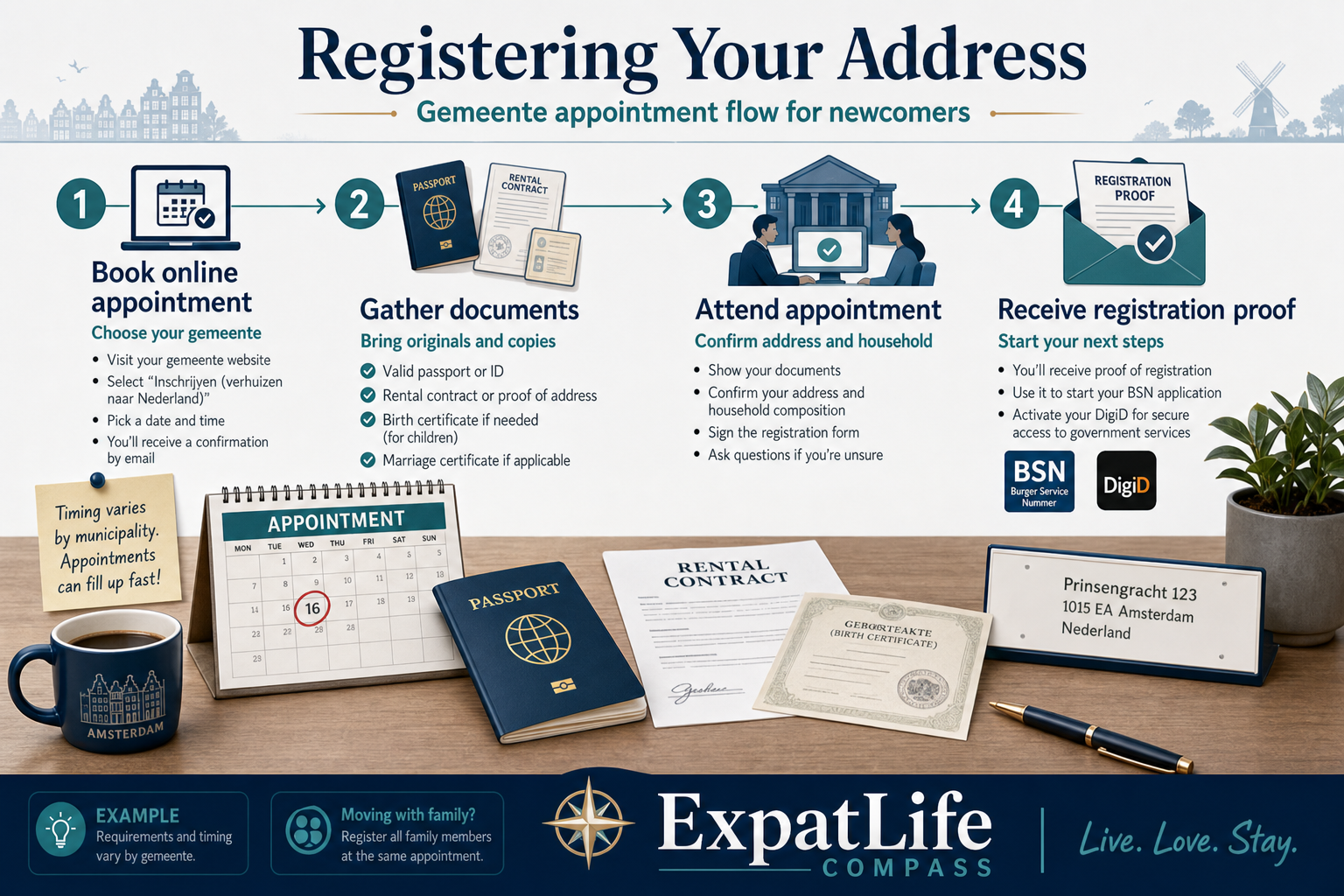
Secure a valid Dutch address
Confirm your rental or ownership situation allows registration and that the address matches where you will live.
Check municipality requirements
Read your gemeente website for appointment booking, document lists and any expat-specific registration route.
Book an appointment
Slots can fill quickly in larger cities — book as early as possible once your move date is firm.
Gather documents
Typical items include passport or ID, proof of address and route-specific papers such as employment or permit documents.
Attend registration
Bring originals and copies if requested; ask what proof you will receive for BSN and employer onboarding.
Store registration proof
Keep confirmation safe for banks, insurers, payroll and future address-change updates.
The BSN (burgerservicenummer) is a personal identification number used across Dutch administration. Employers, the tax authority, health insurers, banks and many government services rely on it.
Many newcomers receive a BSN through municipality registration rather than through a separate standalone application. The exact timing and format can depend on your nationality, permit route and whether you register in the standard BRP process.
Treat the BSN as a core relocation milestone. Without it, payroll setup, basic health insurance enrollment and many account openings become much harder. Use our dedicated BSN guides for deeper document and timing detail.
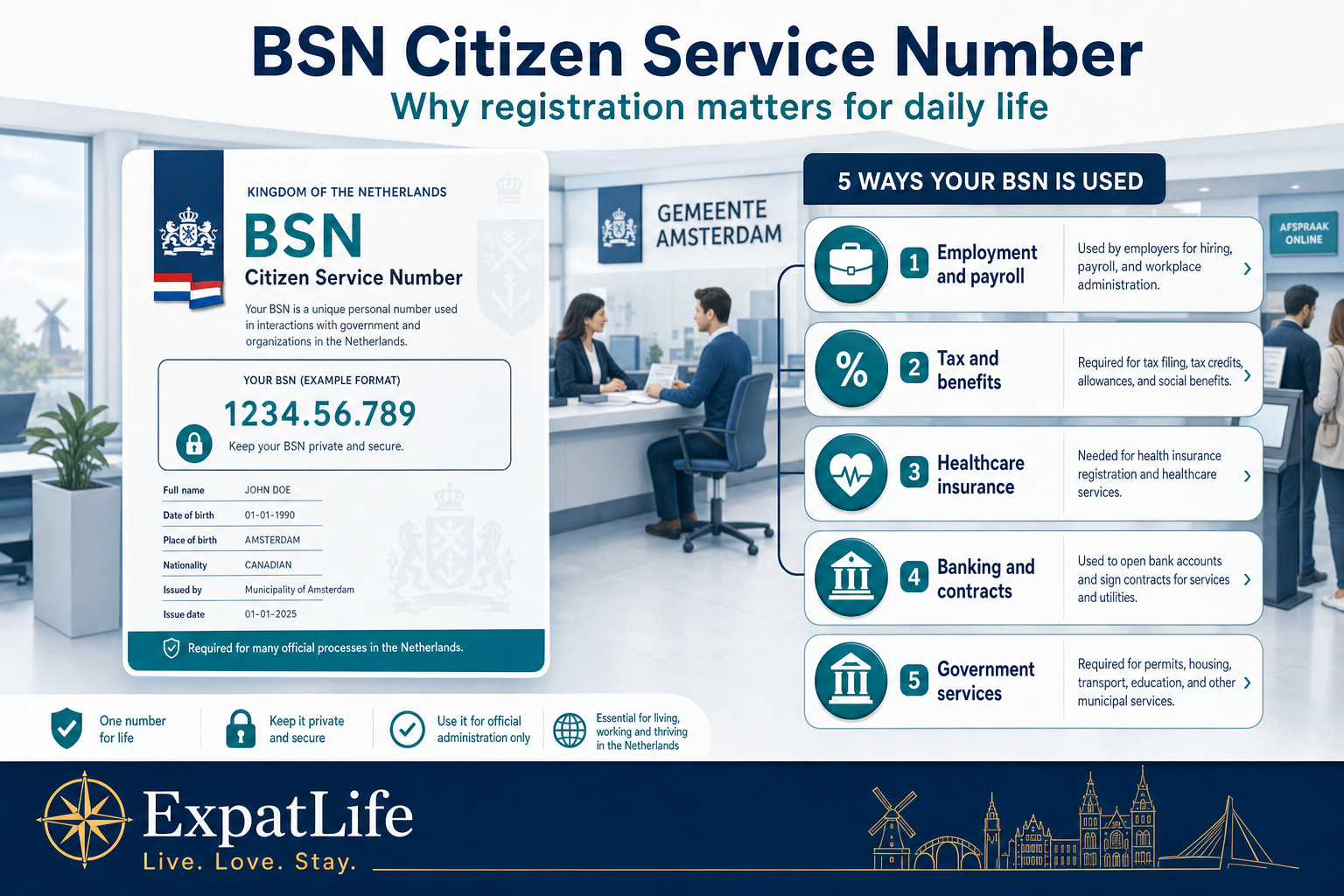
Employers need your BSN for contracts, salary payments and payroll tax processing.
Belastingdienst correspondence and tax filings are tied to your BSN identity.
Basic health insurance registration and many healthcare portals use your BSN.
Most Dutch banks request a BSN for account opening and ongoing compliance checks.
Benefits, DigiD, MijnOverheid and many municipality forms rely on BSN-linked records.
Residents increasingly use digital systems for government services, tax matters, healthcare administration and municipality interactions. Once you have a BSN and registered address, online access becomes an important practical step.
DigiD is the standard Dutch government login. You apply online, receive an activation letter at your registered home address and complete setup within the stated activation window. Many expats only realise later how often DigiD is needed, so applying early is worthwhile.
Municipality portals, Belastingdienst, MijnOverheid, health insurers and some employers all use DigiD or related identity tools. Pair digital setup with your registration timeline rather than leaving it for month two or three.
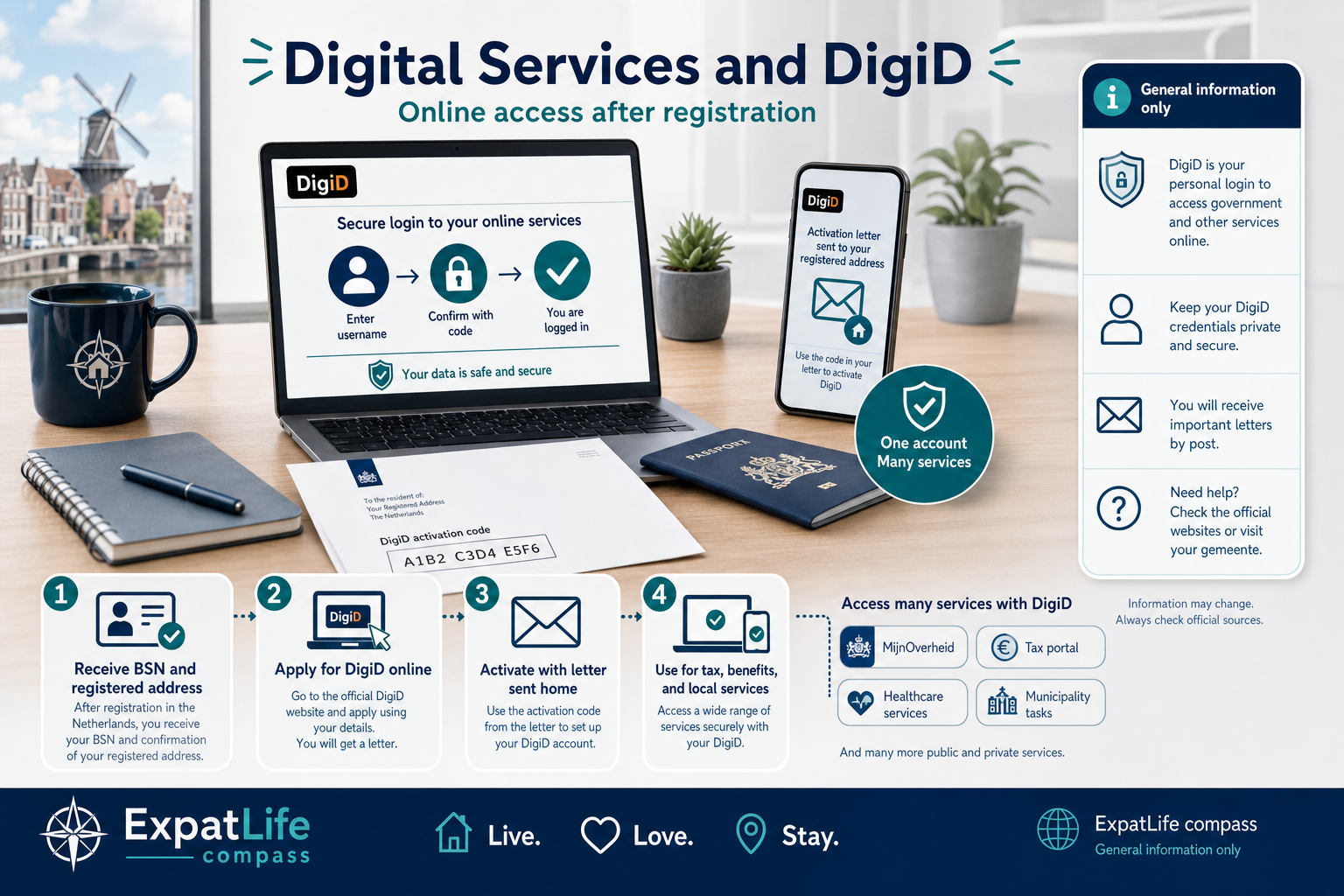
Central government message box for official correspondence and personal record checks.
Tax assessments, benefits applications and annual filing access for residents.
Appointments, permits, waste information, parking and local tax queries.
Insurer and care-provider admin often requires DigiD after basic insurance setup.
Mobile approval can simplify login once your account is activated.
Municipal taxes are separate from national income tax and often arrive as gemeente letters after you register. Common examples include waste tax, sewage charges, property-related levies and parking-related fees.
Billing terminology is often Dutch and amounts vary by municipality, housing type and household situation. Owners and renters can receive different charges depending on local rules and how costs are passed through leases.
This section explains concepts only. It is not tax advice. Use official municipality sources, the taxes hub and property-tax guides to understand what may apply to your address and how to respond to letters you receive.
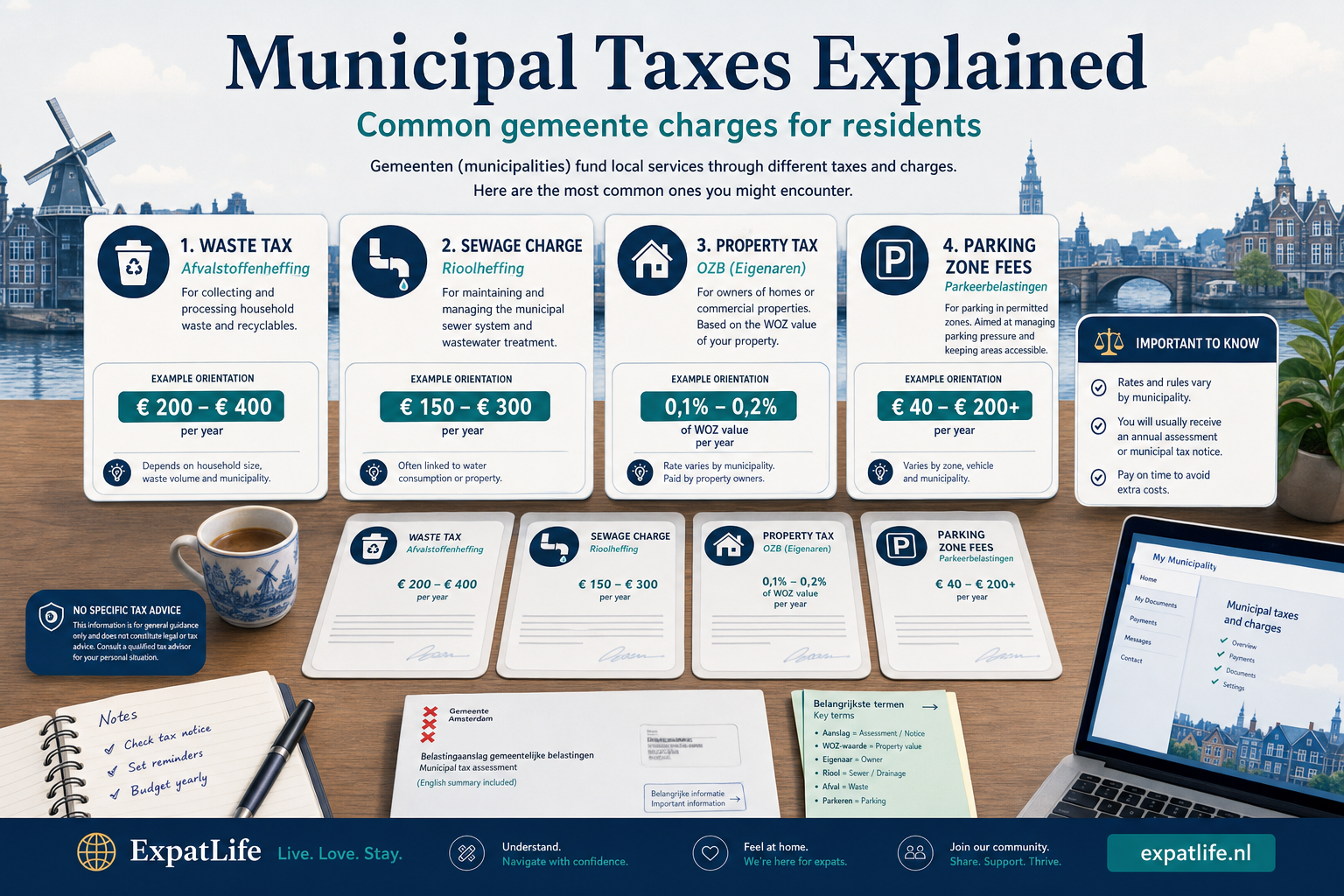
A common household charge funding local waste collection and processing.
Municipal levy linked to wastewater infrastructure — often billed annually.
Owner-occupiers and sometimes landlords face property-related municipal levies — see property tax guide.
Resident permits, visitor permits and zone parking charges in many cities.
Some municipalities apply visitor or accommodation-related charges in specific contexts.
These are orientation ranges only — not quotes, guarantees or tax advice. Verify current amounts on your gemeente website.
Single renter, city apartment
Couple or family, suburban home
Owner-occupier
Many Dutch cities use paid parking zones where residents can apply for permits linked to their registered address. Rules cover eligibility, zone boundaries, waiting lists, visitor permits and second vehicles.
Permit costs and waiting times vary sharply by neighborhood. Dense areas in Amsterdam, Rotterdam, The Hague and Utrecht often have long waiting lists, so checking rules soon after registration is practical even if you do not own a car yet.
Visitor permits, temporary exemptions and electric-vehicle rules differ by gemeente. Always verify current zone maps and fees on your municipality website rather than relying on informal neighborhood advice.
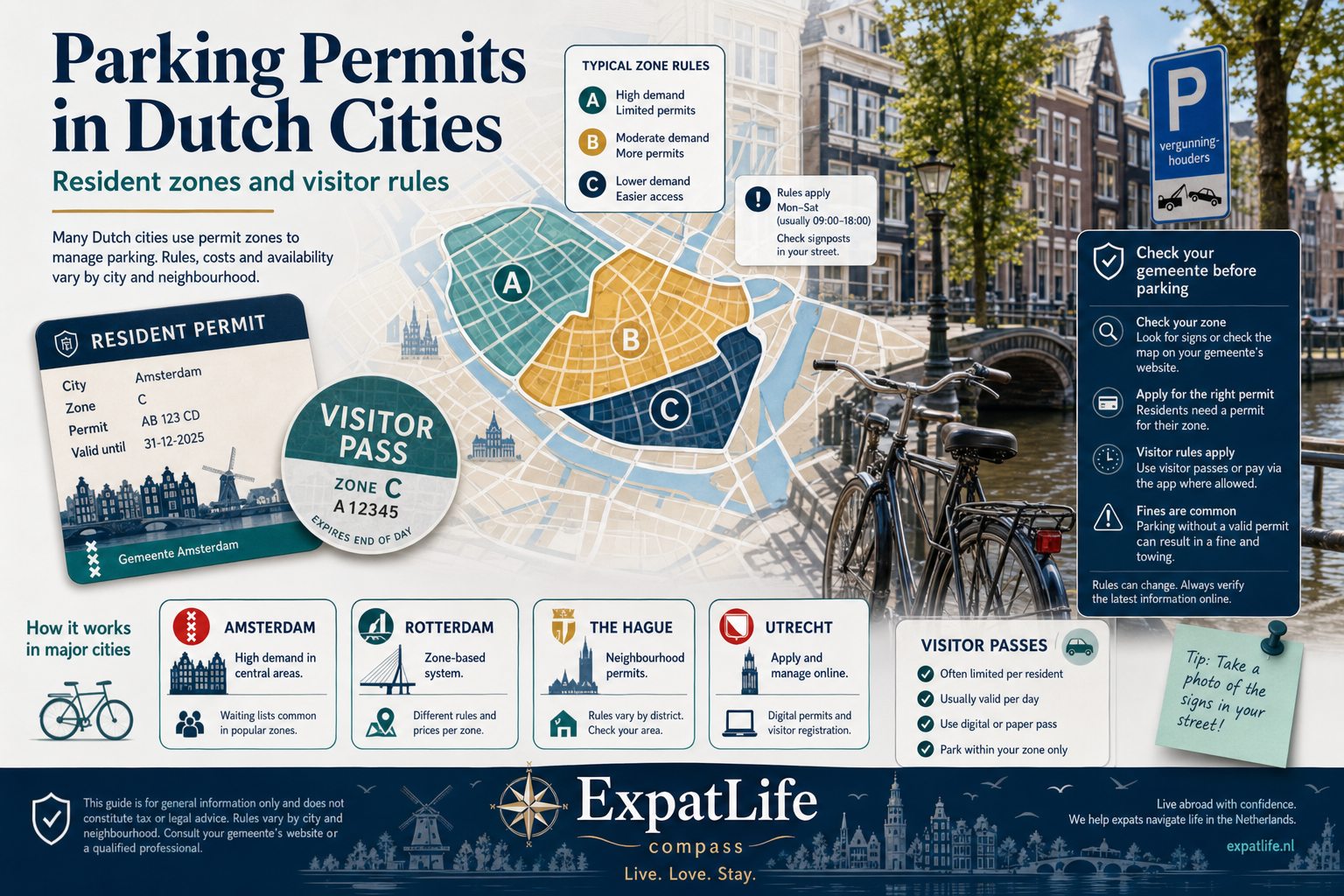
Multiple permit zones with waiting lists in popular neighborhoods; check amsterdam.nl parking maps.
Example orientation: resident permits often EUR 30–60+ per month depending on zone — verify live tariffs.
Waiting lists are common in central districts; apply promptly after address registration if you need parking.
Zone-based resident permits with separate rules for visitor and business parking.
Example orientation: monthly resident permit fees often EUR 20–50 depending on area — confirm on rotterdam.nl.
Some zones use quota systems; online applications typically require DigiD.
Paid parking areas across the city with resident permits tied to registered address zones.
Example orientation: permit pricing often EUR 25–55 per month by zone — check denhaag.nl.
Waiting periods vary by street segment; visitor permits available on selected products.
Resident permits organized by neighborhood zones with digital application routes.
Example orientation: resident permits often EUR 20–45 per month — verify current rates locally.
Central neighborhoods may have queues; check eligibility before purchasing a car.
Waste collection and recycling are municipality-managed services. Rules for household waste, glass, paper, plastic packaging, organic waste and bulky items depend on your address and local policy.
After registering, find your waste calendar, learn container locations or underground pass systems and understand sorting requirements. Mistakes such as wrong collection days or incorrect sorting can lead to missed pickups or fines in some areas.
Waste is closely connected to utilities setup. Use the utilities guide for the wider first-week household picture and your gemeente site for authoritative local rules.
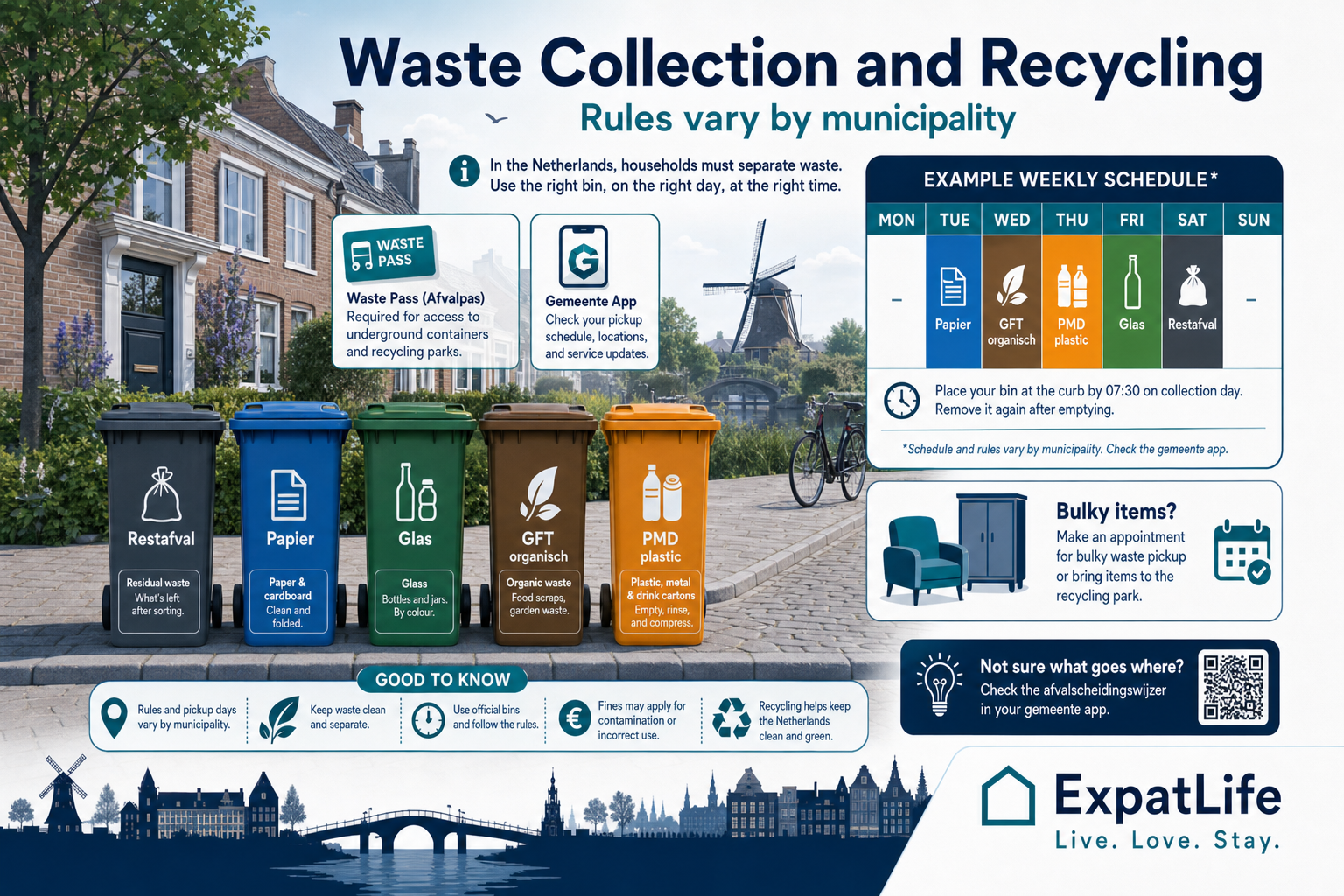
General household rubbish — often limited by container size, collection frequency or pay-as-you-throw systems.
Separate collection points or containers; flatten boxes and keep material dry.
Bottle banks by color in many neighborhoods; no lids or ceramics in glass streams.
Often collected separately or via dedicated bags depending on municipality.
Food and garden waste bins where offered; rules vary for high-rise buildings.
Sofas, mattresses and large items usually need a gemeente appointment or drop-off slot.
Municipalities often support families through childcare information, school enrollment guidance, youth services and local family programs. The exact mix depends on city size and local policy priorities.
Registering children, understanding school choice and exploring childcare allowance involve both national rules and local signposting. Larger cities may publish English-language family pages or welcome-centre referrals.
Use gemeente resources for local program discovery and national portals for allowance and school-system detail. This section orients you to touchpoints rather than replacing school or childcare specialists.
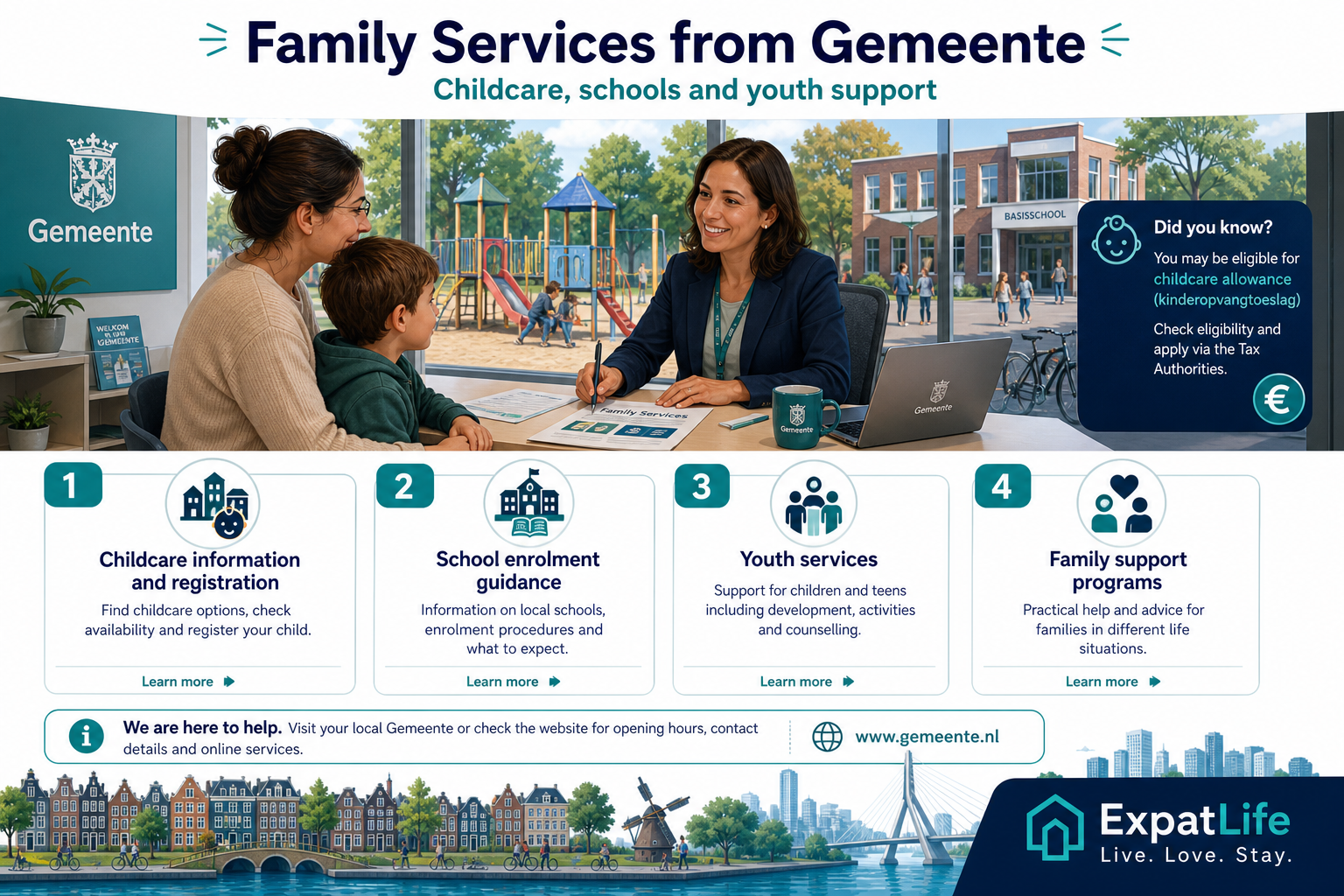
Municipal websites often list childcare options, subsidies context and local registration steps.
Primary and secondary school routes vary; gemeente pages explain local processes and deadlines.
Support programs, activities and referrals for children and teenagers.
Playgroups, language activities and newcomer family support in selected cities.
Registering newborns or relocating children may require a gemeente appointment with documents.
Housing and municipality services overlap at address registration, occupancy rules, housing permits and local regulations. Your registered address should reflect where you actually live for most official processes.
Renters should confirm landlord permission for registration and understand how service costs and local charges appear in the lease. Owners may encounter property-related municipal taxes and permit requirements for renovation or rental use.
Report address changes promptly when moving within or between municipalities. Delays can affect post, DigiD letters, tax correspondence and permit eligibility.
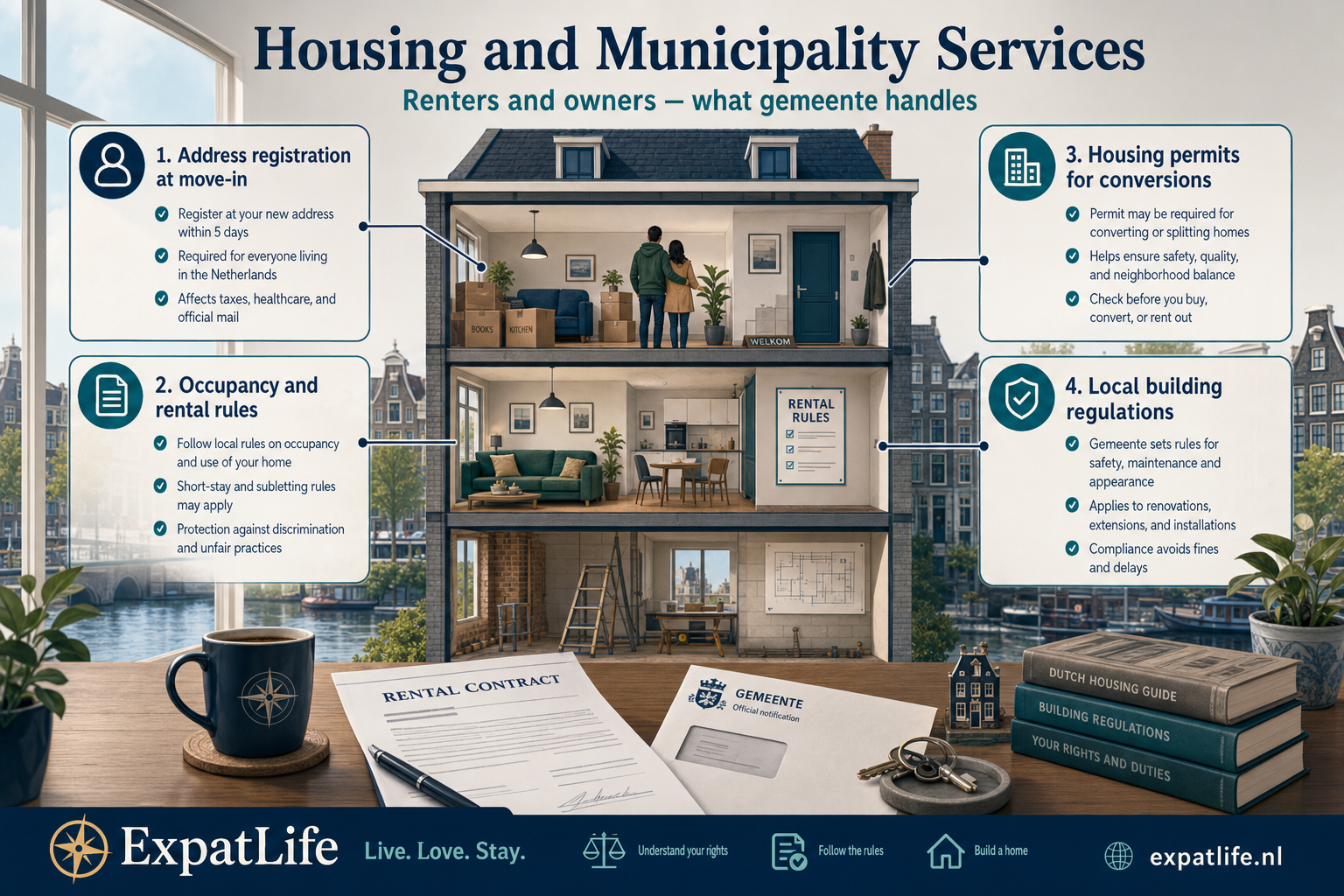
Core housing-municipality link — required for BSN, post and many permits.
Subletting, short stays and registration permission should match your contract.
Some conversions or shared housing setups need gemeente approval depending on local policy.
Noise, renovation, monument rules and neighborhood notifications can be municipal.
Update gemeente records when moving to avoid breaking official correspondence chains.
Business owners and freelancers may interact with municipalities for permits, zoning, local regulations and business support programs. Requirements depend on activity type, premises and whether you work from home or commercial space.
KVK registration is a separate national step, but gemeente rules still matter for hospitality, retail, signage, events and certain home-office setups. ZZP freelancers should check whether their address and activity trigger local notifications.
Use municipality business desks and online portals early when planning premises, renovations or customer-facing operations.
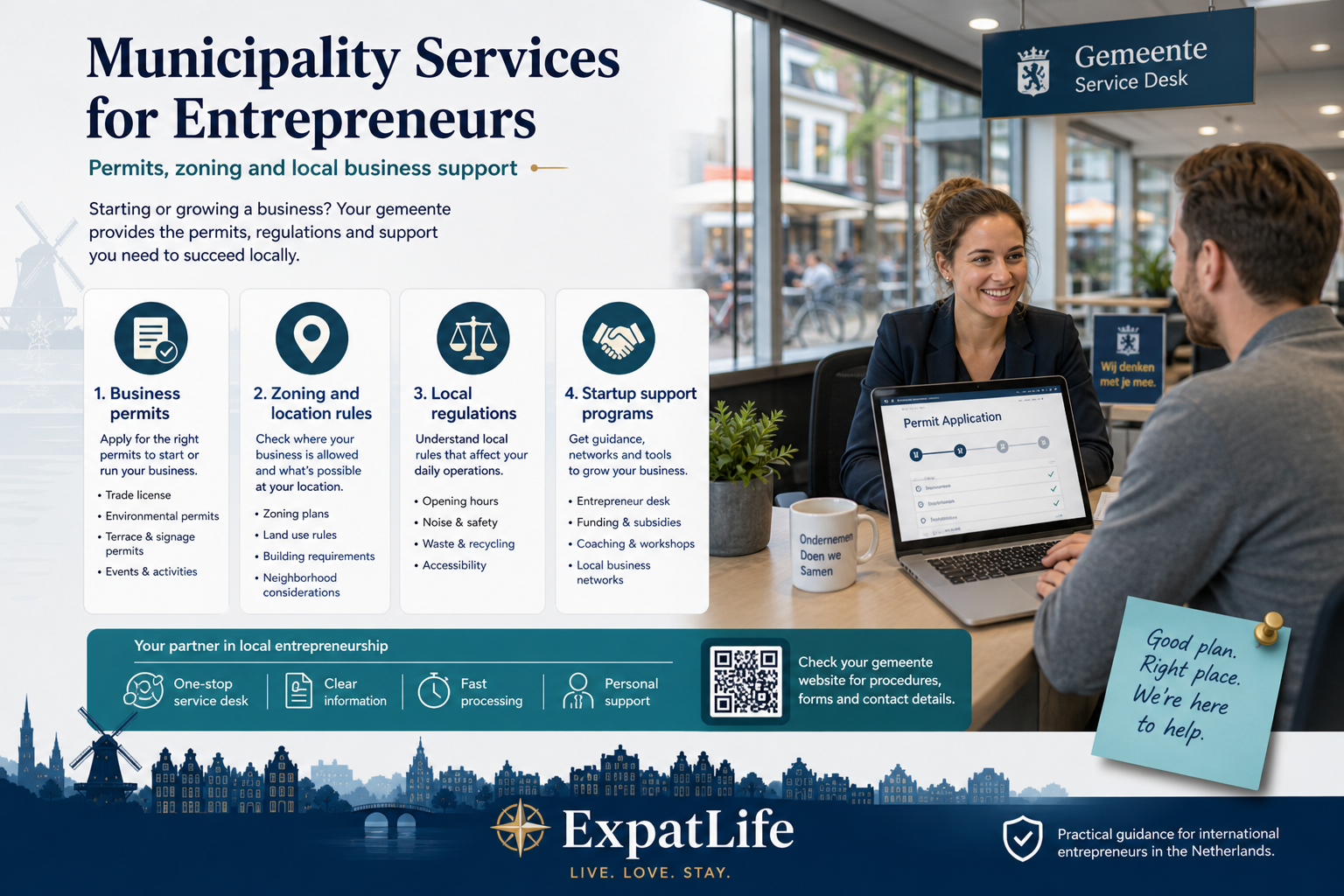
Hospitality, retail, events and regulated activities often need gemeente permission.
Check whether your address allows the intended commercial activity.
Some municipalities require notification for work-from-home businesses.
Subsidies, advice desks and startup programs vary by city.
Physical customer-facing changes usually need local approval.
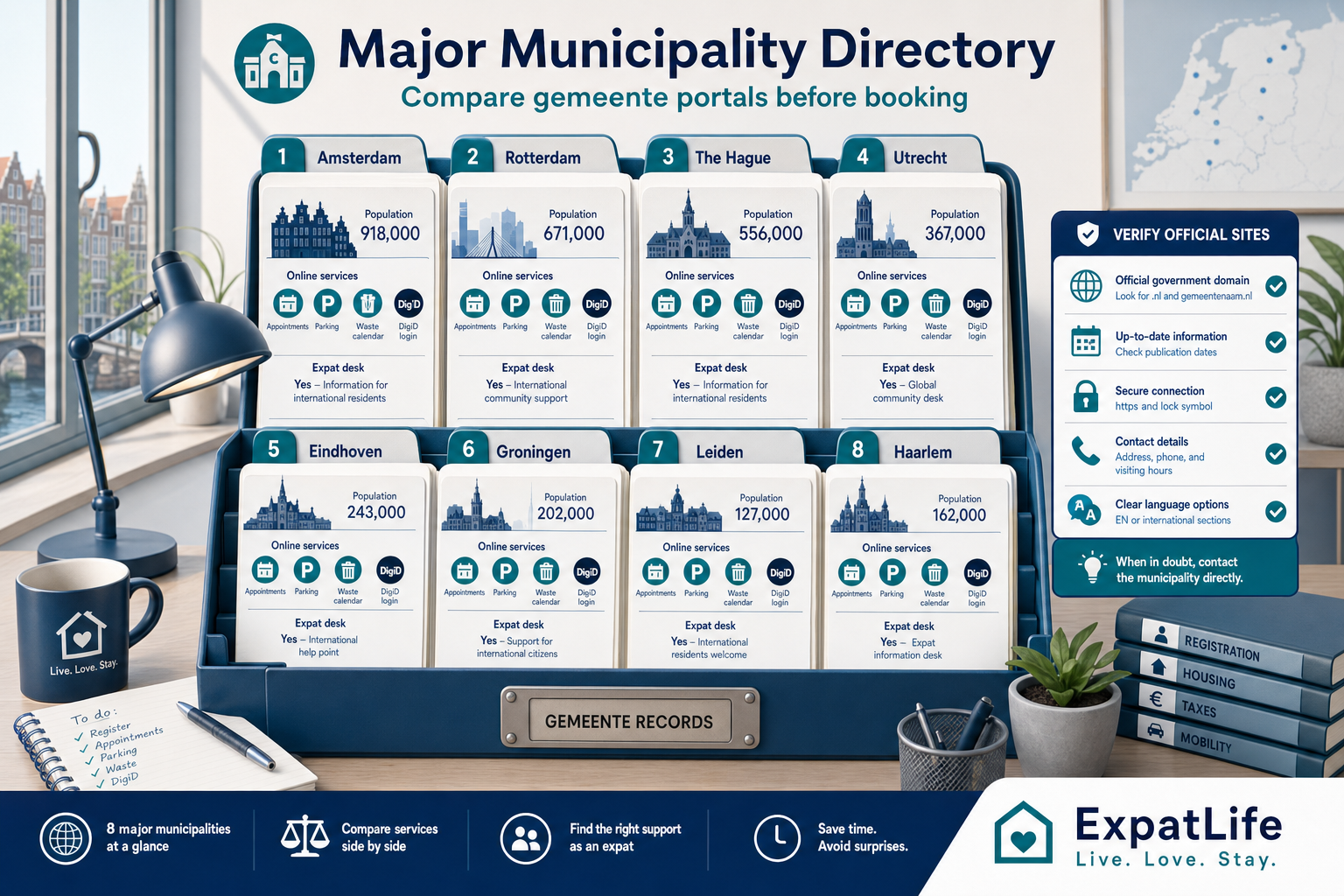
Compare appointment access, expat desks and online tools across popular relocation cities.
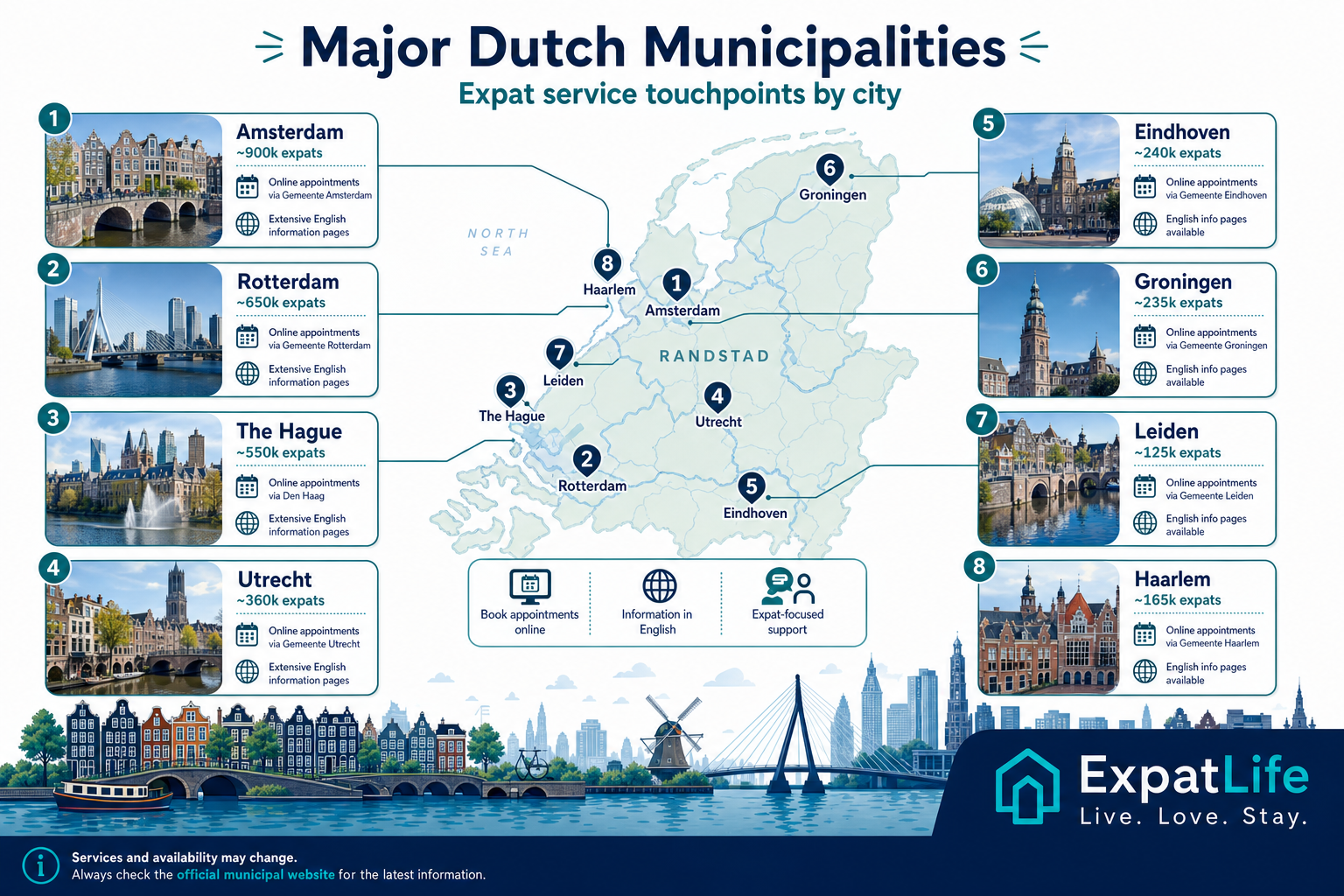
~872,000
IN Amsterdam and English newcomer pages support many international registrations.
~655,000
Rotterdam International Center and multilingual newcomer information.
~552,000
The Hague International Centre and extensive English municipal pages.
~361,000
International Welcome Centre Utrecht Region and strong digital service portal.
~248,000
International talent and newcomer pages for tech and international workers.
~235,000
Student-friendly municipality with English information for newcomers.
~128,000
Compact municipality with international student and researcher community support.
~165,000
Randstad commuter city with digital appointment and permit services.
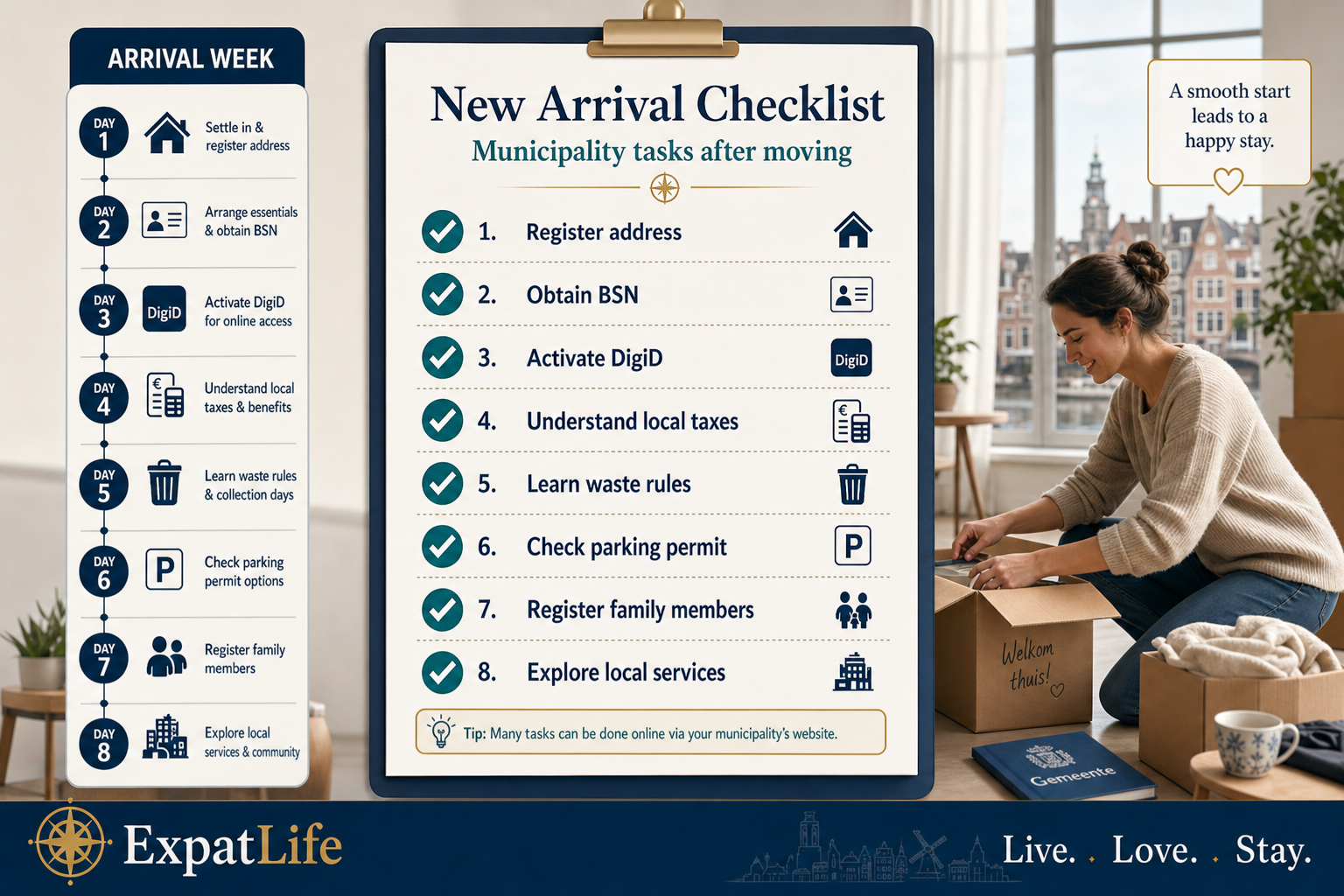
Use this sequence after confirming your address and move-in date.
Before arrival
Arrival week
After registration
These are the gemeente setup errors expats most often make after arriving in the Netherlands.
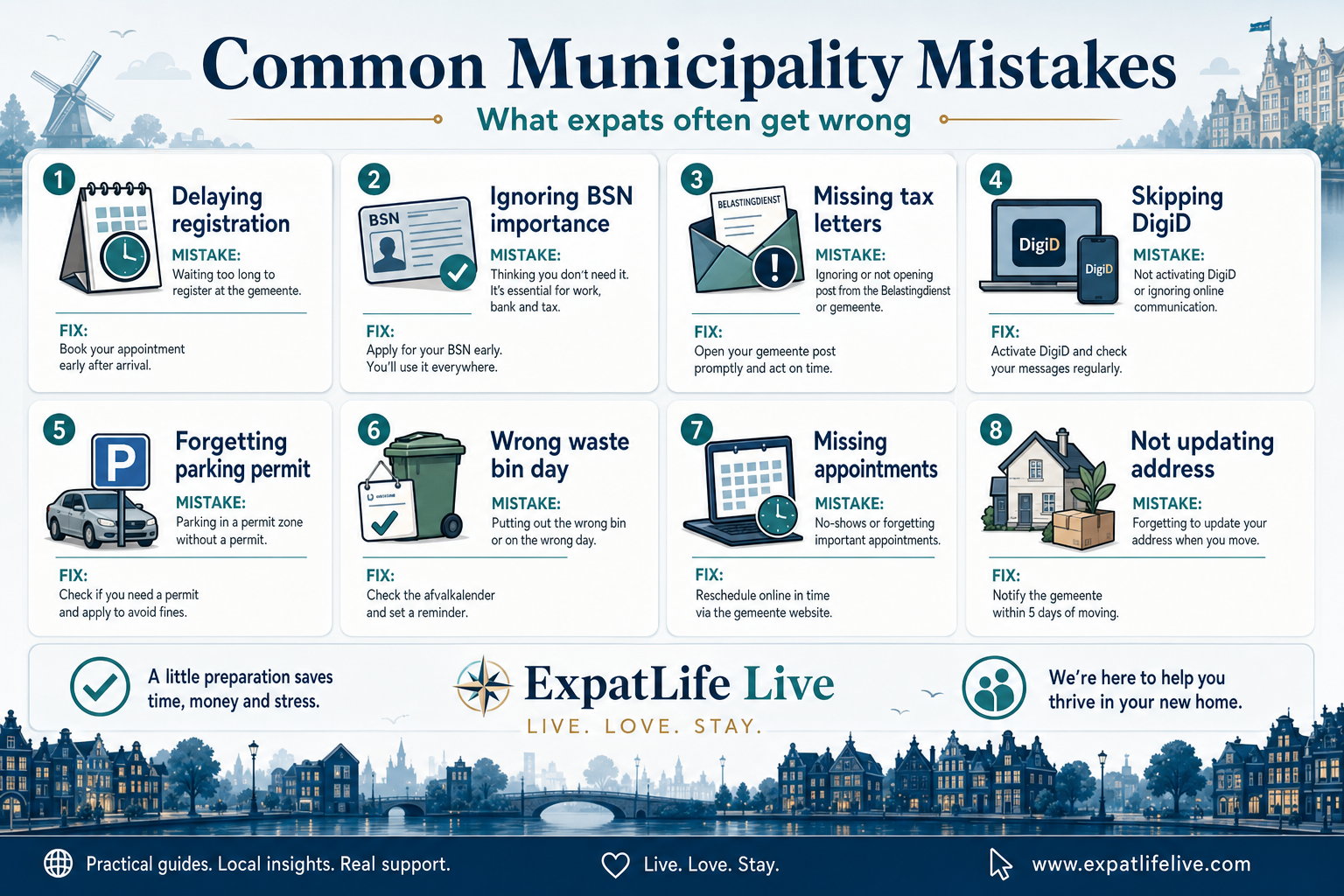
Waiting weeks to register can delay BSN access, payroll, banking and official post delivery.
Treating BSN as optional blocks employment, insurance and many government interactions.
Dutch gemeente post can look unfamiliar — open and verify deadlines rather than setting it aside.
Without DigiD, online tax, benefits and municipality tasks become much harder to complete on time.
Assuming free street parking in paid zones leads to fines or long permit waiting-list surprises.
Wrong collection days or sorting can mean missed pickups or neighborhood complaints.
Arriving without required documents or missing slots pushes registration back by weeks in busy cities.
Failing to report a move breaks DigiD delivery, tax post and permit eligibility at your new home.
Population figures are orientation only. Verify current services, fees and appointment processes on each gemeente website.
Gemeente
Largest Dutch municipality with dedicated expat services and high appointment demand.
Expat services: IN Amsterdam supports many international newcomers alongside standard gemeente registration.
Services offered
Gemeente
Major port city with international newcomer centre and zone-based parking system.
Expat services: Rotterdam International Center helps international residents with relocation orientation.
Services offered
Gemeente
International city with strong expat infrastructure and English municipal information.
Expat services: The Hague International Centre supports diplomats, professionals and families.
Services offered
Gemeente
Central city with welcome centre and busy housing market affecting registration timing.
Expat services: International Welcome Centre Utrecht Region supports regional newcomers.
Services offered
Gemeente
Technology hub with international worker focus and practical digital gemeente tools.
Expat services: Expat-facing pages support international talent moving for work.
Services offered
Gemeente
Northern student city with accessible municipality services and English pages.
Expat services: Popular with students and researchers; gemeente publishes newcomer guidance in English.
Services offered
Gemeente
University city with compact gemeente services and international research community.
Expat services: Smaller municipality with student and researcher registration demand at key intake periods.
Services offered
Gemeente
Historic Randstad municipality with digital services for commuters and families.
Expat services: Commuter-friendly city with online permit and registration tools.
Services offered
Planned expansion
These focused child guides are planned as the practical-life cluster expands. Use this page for the full overview until they ship.
Use these quick answers for orientation before checking your gemeente website and official sources.
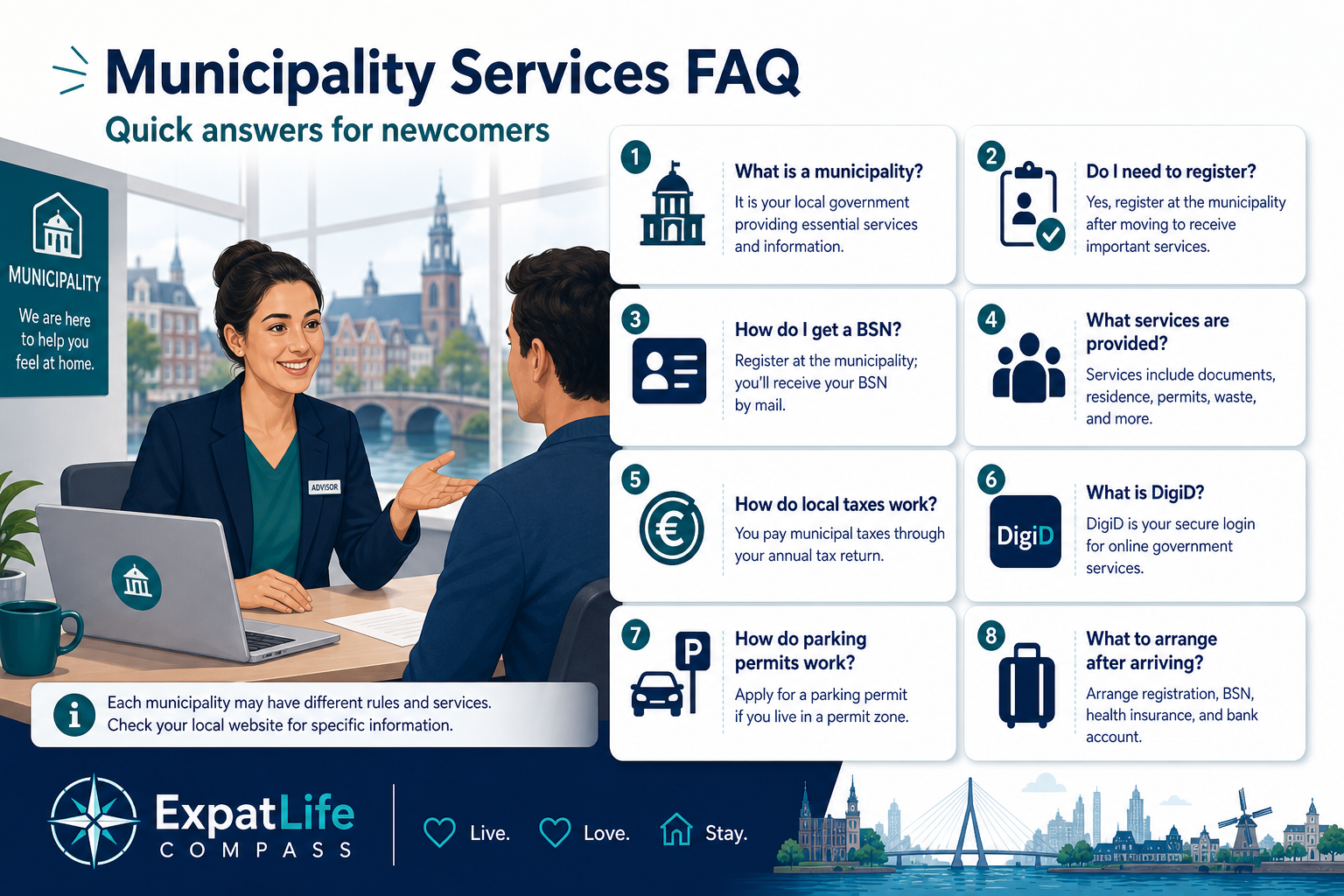
A municipality (gemeente) is your local government authority. It handles address registration, BSN administration, local taxes, permits, waste collection, parking and many resident services. Every address in the Netherlands belongs to one gemeente.
Most residents staying in the Netherlands for more than a few months register their address with the municipality where they live. Requirements vary by nationality, permit route and length of stay — verify with your gemeente and official sources.
Many newcomers receive a BSN through municipality registration. Book a gemeente appointment, bring required documents and ask what proof you will receive. Some routes, such as short stays or specific cross-border situations, follow different processes.
Common services include address registration, BSN administration, local taxes, waste collection, parking permits, family information, business permits and social support referrals. Exact services and online tools differ by city.
Municipalities may charge waste tax, sewage levies, property-related taxes and parking fees. Letters often arrive after registration and use Dutch terminology. Amounts vary by gemeente and housing situation — verify each letter on your municipality website.
DigiD is the Dutch government login used for tax, benefits, MijnOverheid and many municipality portals. You usually apply after receiving a BSN and registered address, then activate using a letter sent to your home.
Many cities use resident parking zones tied to your registered address. You apply through the gemeente, often online with DigiD. Zones, costs and waiting lists vary — check your city parking pages before assuming street parking is unrestricted.
A practical sequence is: register your address, secure your BSN, apply for DigiD, learn local tax and waste rules, check parking if needed, register family members and explore housing, utilities and tax guides for the wider setup path.
Municipality services, registration requirements and local regulations change over time. Always verify current information with official sources.
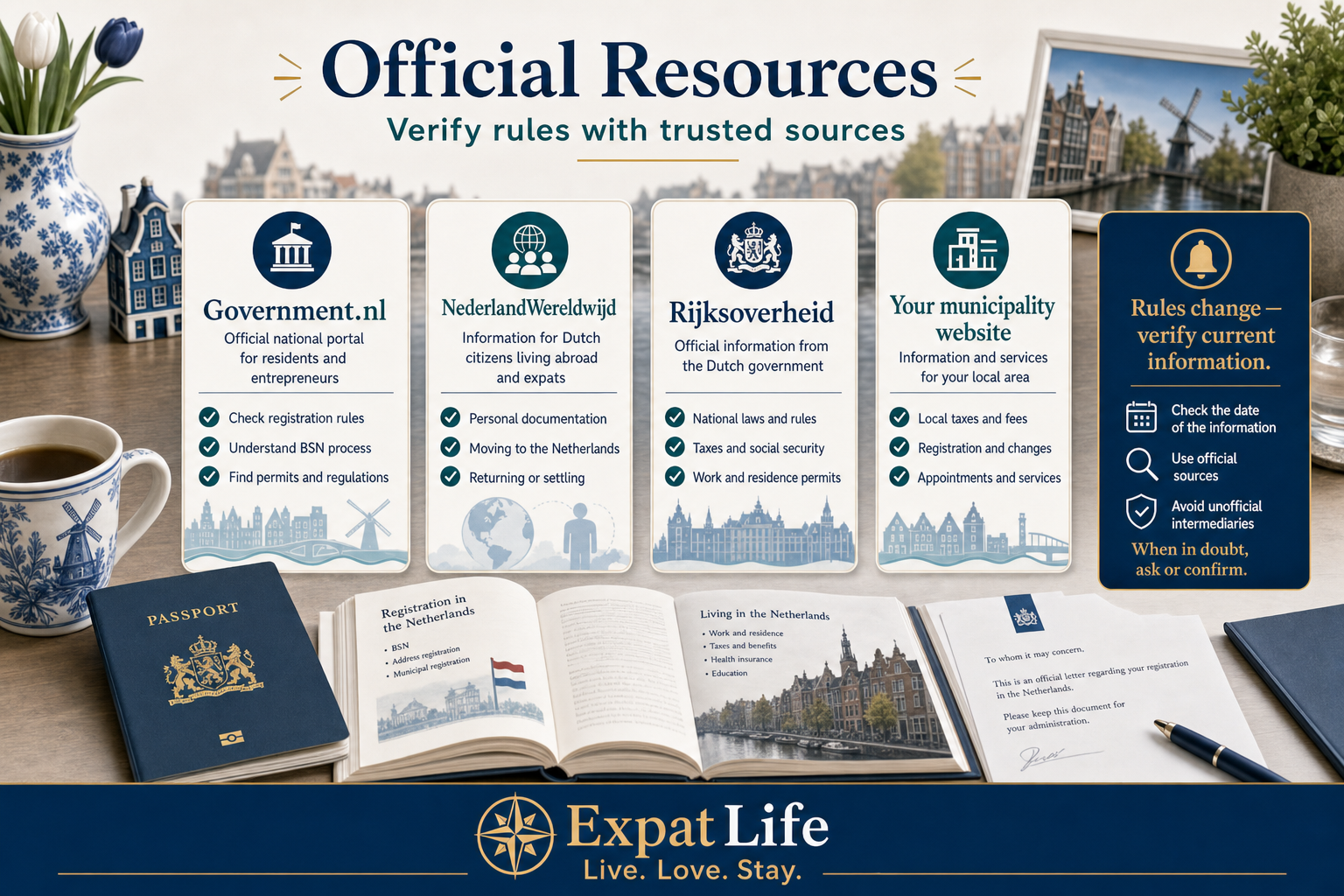
Official Dutch government information on living, working and public services in the Netherlands.
Open official sourceGovernment portal with practical information for Dutch nationals abroad and newcomer orientation resources.
Open official sourceCentral government site for policy context, resident topics and links to municipal responsibilities.
Open official sourceYour gemeente website is authoritative for appointments, local taxes, permits, waste rules and parking. Examples include Amsterdam, Rotterdam, The Hague, Utrecht and Eindhoven.
Open official sourceContinue from municipality services into BSN, DigiD, housing, taxes and relocation guides.
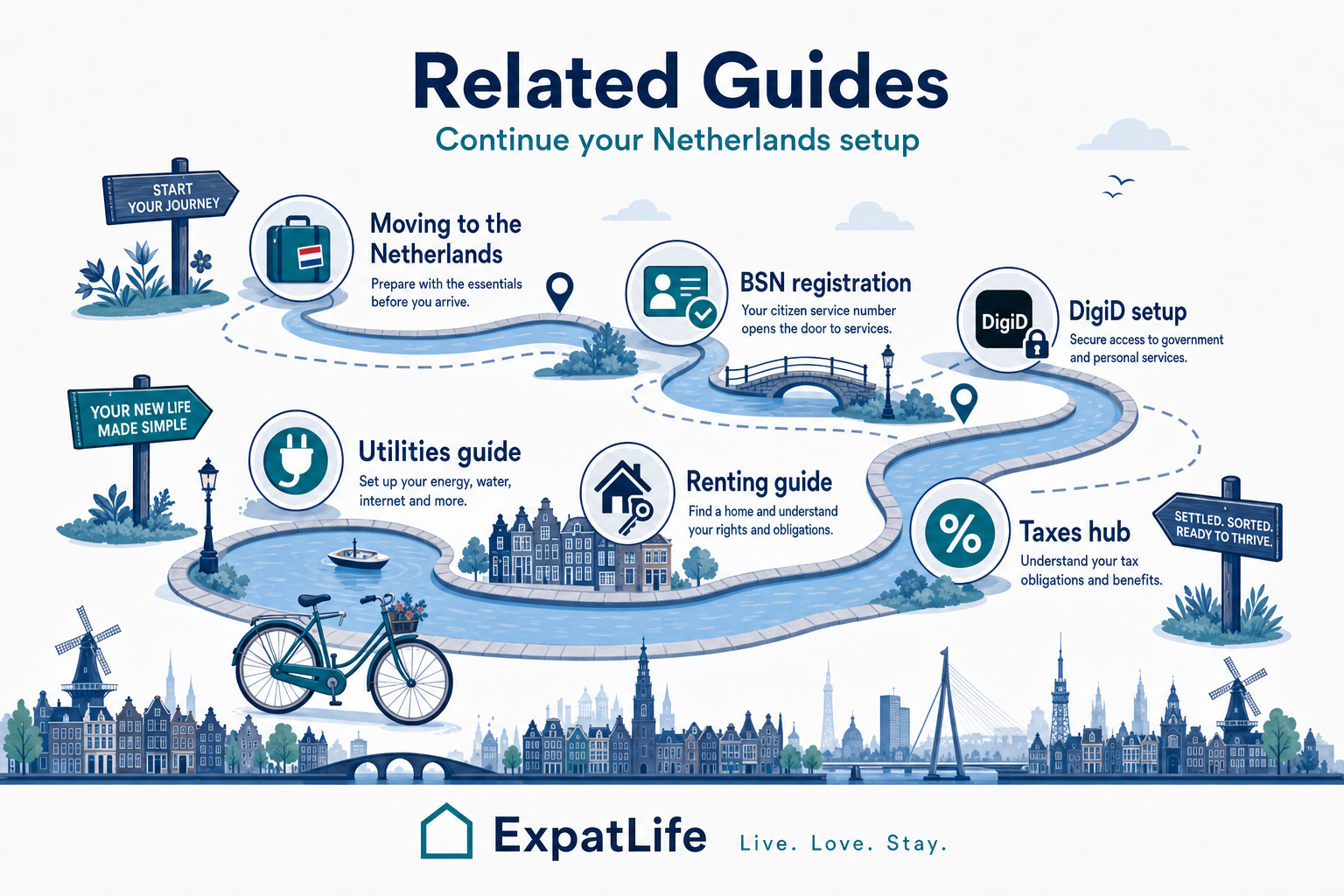
Explore next
Move from municipality services into BSN and DigiD setup, utilities, housing and your broader relocation checklist.
Community and Social Support
Beyond registration and permits, municipalities provide community information, social support referrals, integration resources and public service access points. Libraries, neighborhood teams and welcome centres often complement official gemeente channels.
Eligibility for social support depends on personal circumstances and is not covered as legal advice here. The practical goal is knowing where to ask locally when you need orientation, language programs or community activities.
Explore your municipality website for newcomer pages, social support directories and local event listings once your core registration steps are underway.
Public information desks
Front-door orientation for gemeente services, forms and referrals.
Integration resources
Language, civic integration and newcomer programs vary by municipality.
Community activities
Local events, volunteer networks and neighborhood initiatives.
Social support referrals
Municipal gateways to welfare, debt or family support where eligible.
Library and civic spaces
Often host newcomer information, language cafés and practical workshops.