Competitive rental market
Major cities see strong demand for apartments and family homes — speed and preparation matter.
Housing hub
Everything you need to know about renting, buying and finding accommodation in the Netherlands as an expat.

Housing hub
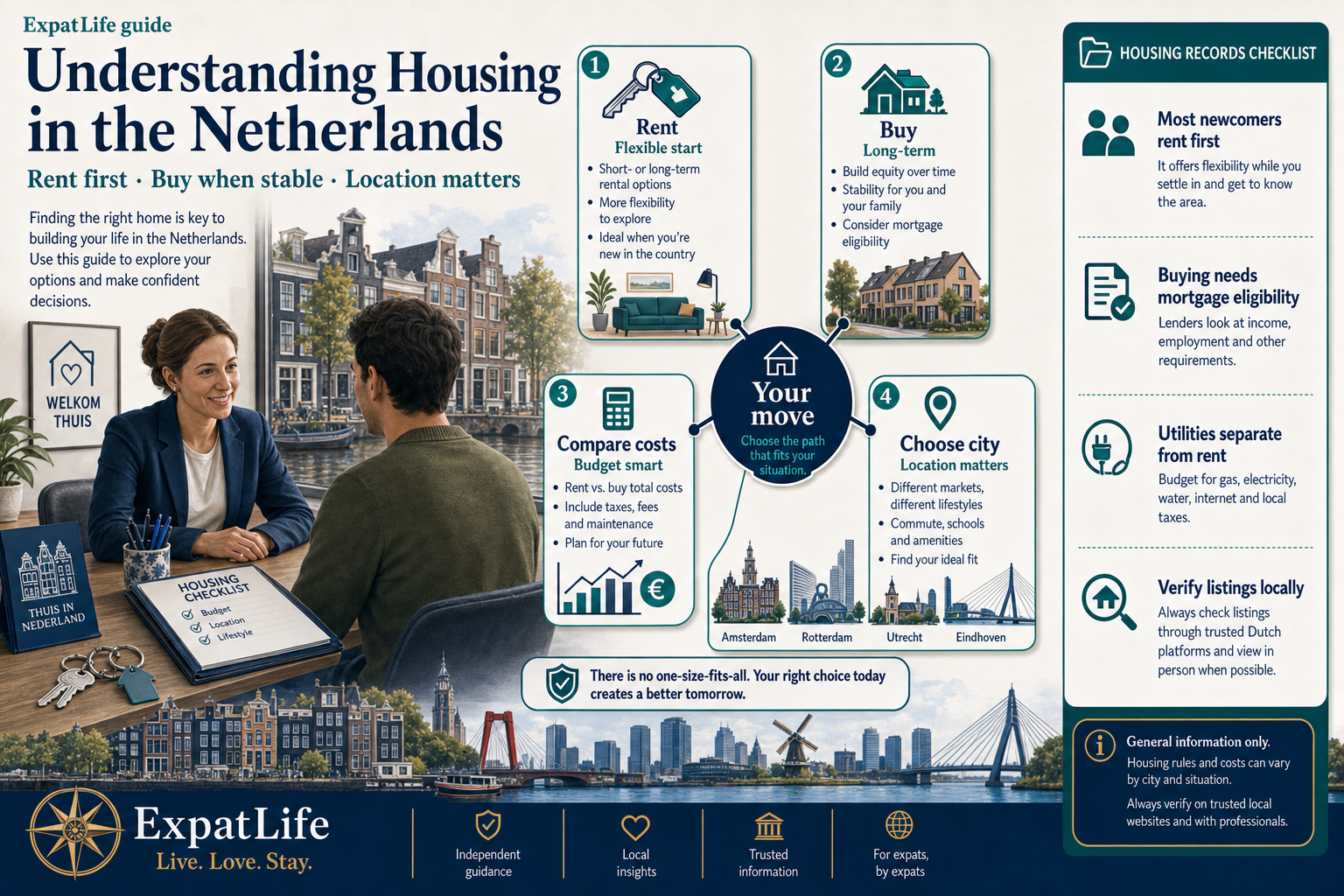
Finding housing is one of the biggest practical decisions when moving to the Netherlands. Whether you plan to rent an apartment in Amsterdam, buy a family home near Utrecht or secure temporary accommodation before your first viewing week, the market works differently from many countries newcomers know.
Most expats start by renting while they learn city neighbourhoods, commute patterns and Dutch rental norms. Buying becomes attractive when stay plans stabilise, income supports a mortgage and you understand transaction costs and owner responsibilities.
This hub explains how the Dutch housing market works, what costs to expect, how cities differ and which deeper guides to use next. It is practical orientation only — not legal, mortgage or financial advice.
Major cities see strong demand for apartments and family homes — speed and preparation matter.
Many Dutch households own property; expats may buy when stay plans and financing align.
Stable employment, contract type and advisor support shape eligibility and borrowing capacity.
Amsterdam and Utrecht sit at the top of rent ranges; regional cities often offer more space per euro.
Electricity, gas, water, internet and waste are typically arranged separately from the lease.
Commute, schools, international community and listing volume differ sharply by city and neighbourhood.
Connect housing decisions to your wider relocation timeline, documents and first-month setup.
Open moving guideExplore city guides to compare housing profiles, affordability and international appeal across the Netherlands.
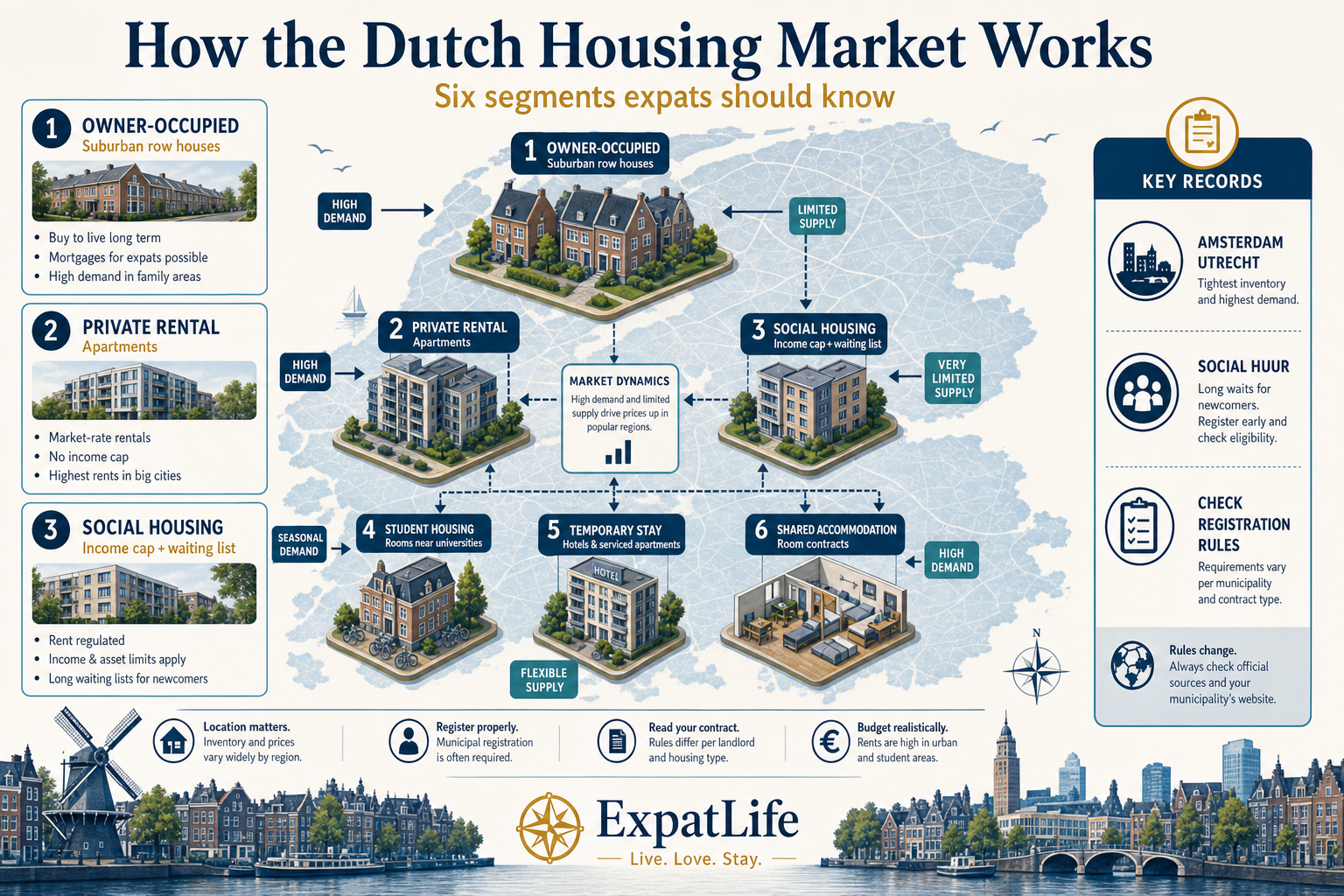
Open cities hubThe Dutch housing market combines owner-occupied homes, private rentals, social housing, student products and temporary accommodation. Supply and demand vary by region — dense cities face tight rental inventory while some commuter towns offer more family homes.
Owner-occupied housing dominates many suburban areas. Private rentals include studios, apartments and houses listed on platforms, agencies and social networks. Social housing (sociale huur) has income ceilings and long waiting lists, making it less accessible for many newcomers on arrival.
Student housing, short-stay apartments and shared accommodation fill specific niches. Understanding which segment you target helps set realistic timelines and documentation expectations before you arrive.
Freehold and apartment ownership with VvE rules in many buildings.
Market-rate apartments and houses with landlord contracts and deposits.
Income-capped rentals with municipal or housing corporation allocation — long waits.
Rooms and studios linked to universities and academic calendars.
Hotels, serviced apartments and short stays for arrival windows.
Rooms in shared houses — check contract and registration rules carefully.
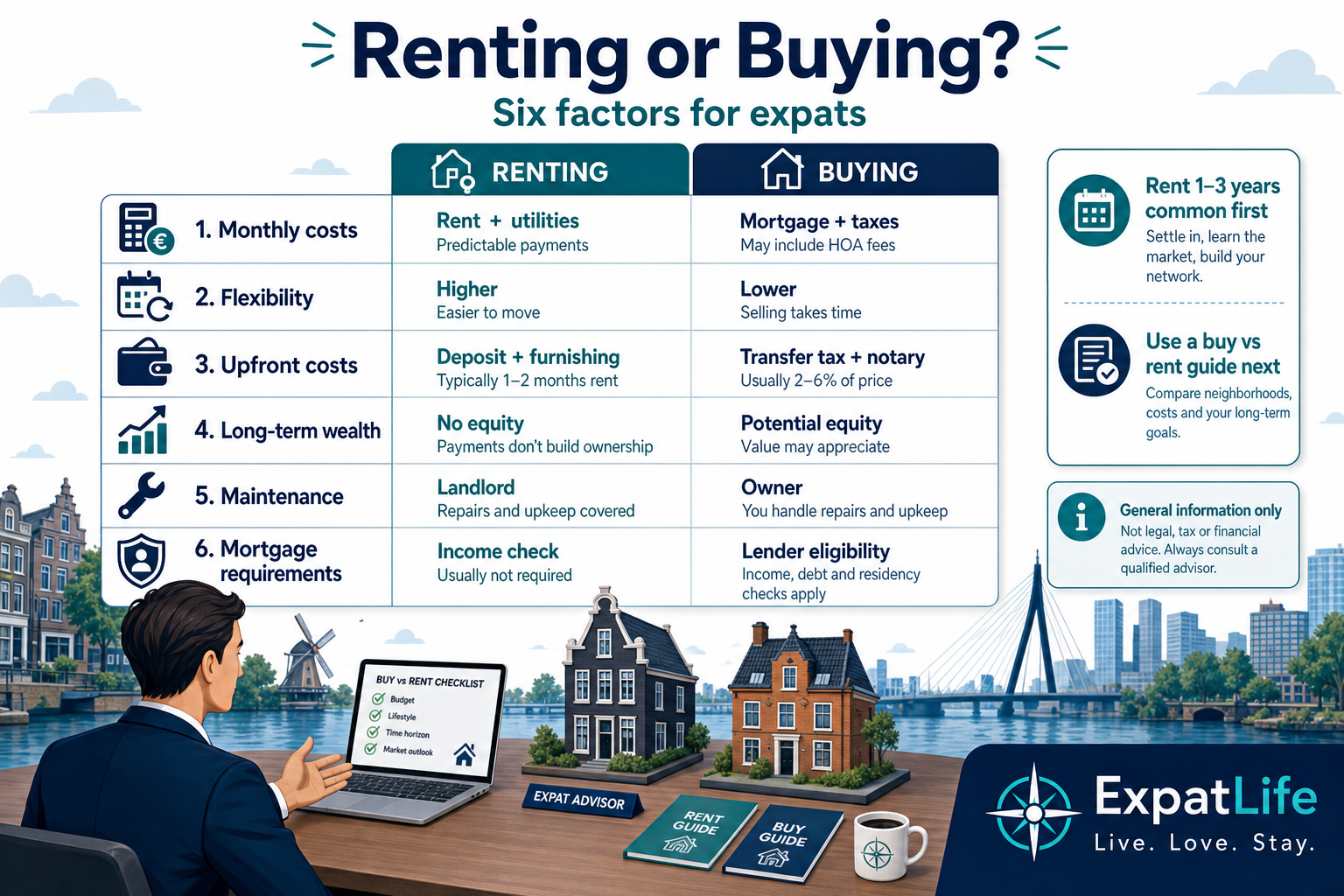
There is no universal answer for every expat. Renting preserves flexibility while you learn the market; buying can suit longer stays when mortgage eligibility, savings and stability align. Compare monthly cash flow, upfront costs, maintenance responsibility and exit flexibility before deciding.
Many international professionals rent for the first one to three years, then reassess once employment, family plans and city preference are clearer. Use the buy vs rent guide for a deeper financial comparison.
| Factor | Renting | Buying |
|---|---|---|
| Monthly costs | Rent plus utilities and insurance; no mortgage interest | Mortgage, taxes, insurance, maintenance and VvE charges |
| Flexibility | Higher — easier to relocate for work or family changes | Lower — selling takes time and transaction costs |
| Upfront costs | Deposit, agency fees sometimes, furnishing | Transfer tax, notary, advisor, inspection and moving costs |
| Long-term wealth | No property equity; may suit short or uncertain stays | Potential equity build; tied to market and hold period |
| Maintenance | Landlord responsible for major repairs in most cases | Owner responsible for upkeep, VvE and major replacements |
| Mortgage requirements | Income checks for lease approval | Lender eligibility, valuation, NHG rules and documentation |
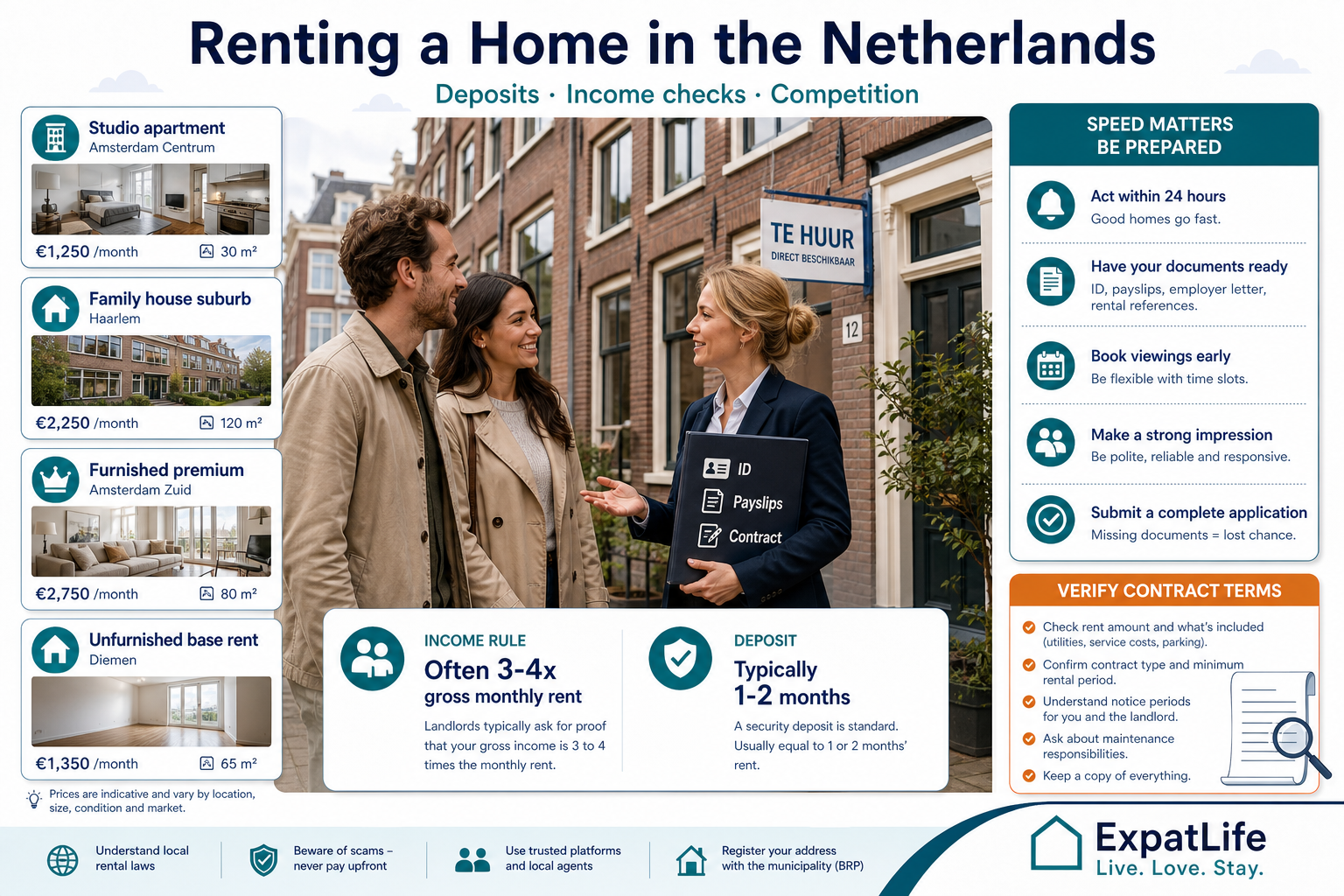
Renting is the most common starting point for expats. Listings include studios, apartments and houses in both furnished and unfurnished condition. Furnished options reduce setup time but often cost more monthly.
Landlords and agencies frequently require proof of income, employment contracts and sometimes guarantors. Deposits typically equal one to two months' rent depending on contract terms. Competition is intense in Amsterdam, Utrecht and parts of The Hague — respond quickly and prepare documents in advance.
Read rental contracts carefully for service costs, notice periods, maintenance duties and permission to register your address at the gemeente.
Common in cities — check VvE costs, energy label and storage access.
More common in suburbs; verify garden, parking and landlord maintenance scope.
Higher monthly cost but faster move-in for short or uncertain stays.
Lower rent but requires furniture, utilities setup and time to equip.
Often three to four times monthly rent in gross income — verify listing rules.
Estimate a realistic monthly rent range from your income before you start searching.
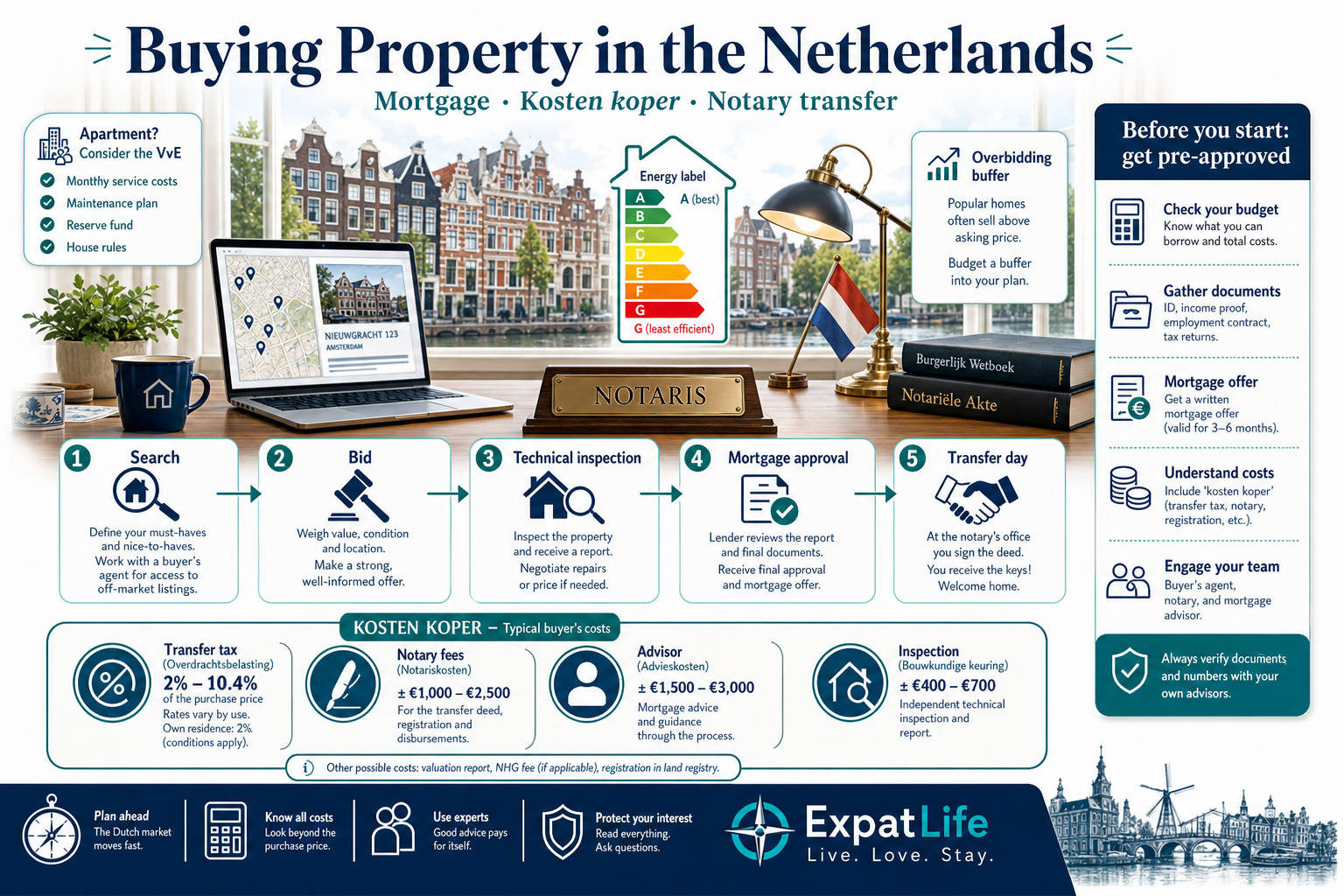
Run calculatorBuying a home in the Netherlands involves mortgage preparation, property search, bidding strategy, technical inspection and notarial transfer. Transaction costs (kosten koper) add materially to the purchase price for buyers.
Expats should understand energy labels, apartment VvE documents and regional overbidding norms before making offers. Long-term planning includes property tax, insurance and maintenance reserves after the keys handover.
Expat eligibility depends on income stability, contract type and lender policy.
Savings for transaction costs and any gap between offer and valuation.
Transfer tax, notary, advisor and inspection fees add to upfront cash needs.
Budget owner insurance, maintenance, VvE and municipal charges after purchase.
Competitive markets may require quick decisions — pre-approval helps.
Housing costs depend on property type, city, energy label and whether utilities are included in the lease. The examples below are orientation ranges only — not quotes, guarantees or market predictions. Always verify current listings for your target cities and neighbourhoods.
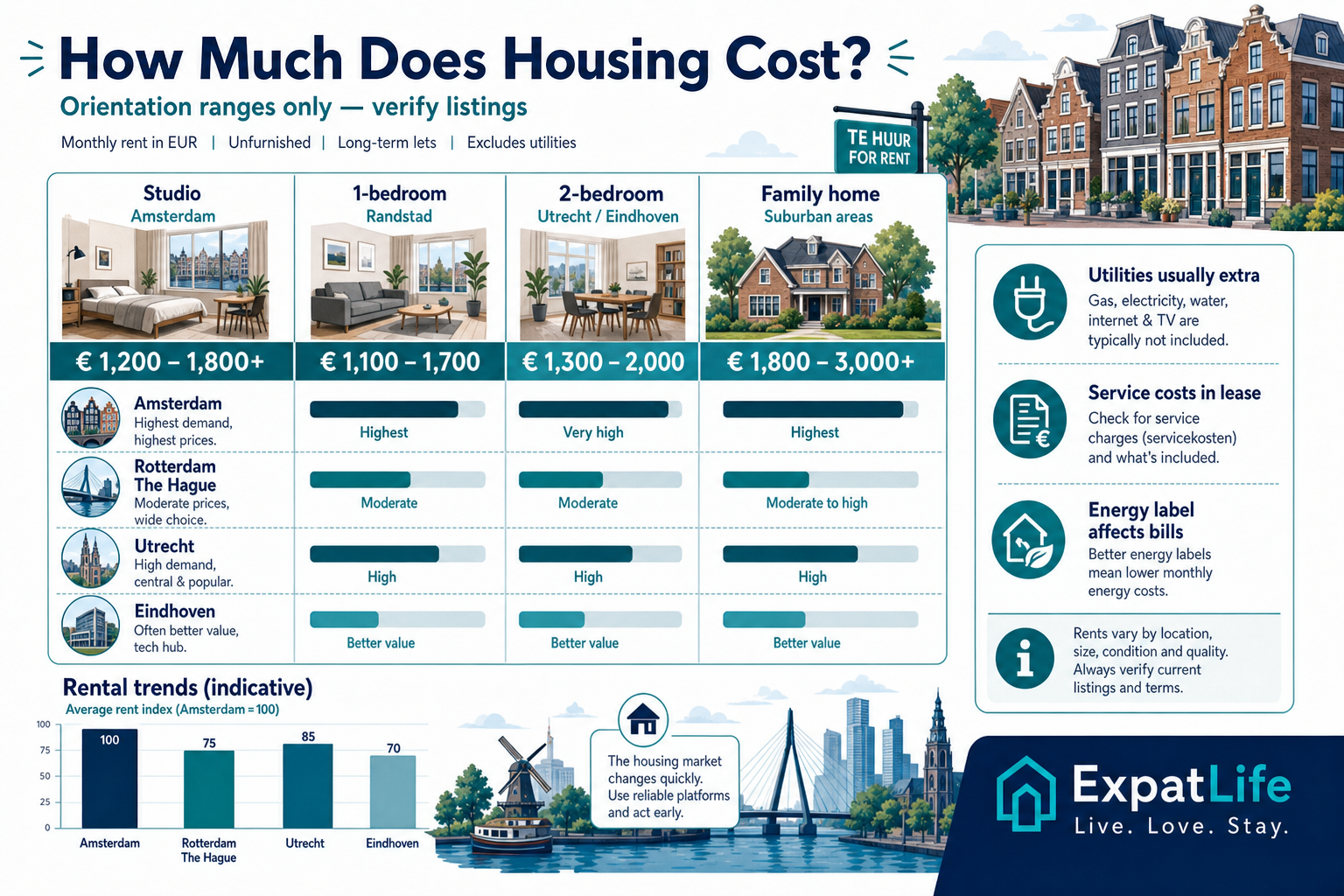
Studio — Amsterdam (orientation)
1-bedroom apartment — Randstad (orientation)
2-bedroom apartment — Utrecht / Eindhoven (orientation)
Family home — suburban (orientation)
| City | Studio | 1 bedroom | 2 bedroom | Family home |
|---|---|---|---|---|
| Amsterdam | EUR 1,200–1,800+ | EUR 1,500–2,200+ | EUR 1,900–2,800+ | EUR 2,500–4,000+ |
| Rotterdam | EUR 900–1,400 | EUR 1,100–1,700 | EUR 1,400–2,100 | EUR 1,800–3,000 |
| The Hague | EUR 950–1,450 | EUR 1,200–1,750 | EUR 1,500–2,200 | EUR 1,900–3,100 |
| Utrecht | EUR 1,000–1,550 | EUR 1,300–1,900 | EUR 1,600–2,400 | EUR 2,000–3,200 |
| Eindhoven | EUR 850–1,300 | EUR 1,000–1,550 | EUR 1,300–1,900 | EUR 1,700–2,800 |
Example monthly rent ranges for orientation only — not quotes or guarantees. Verify current listings locally.
Use the rent affordability calculator to stress-test listings before applying in competitive cities.
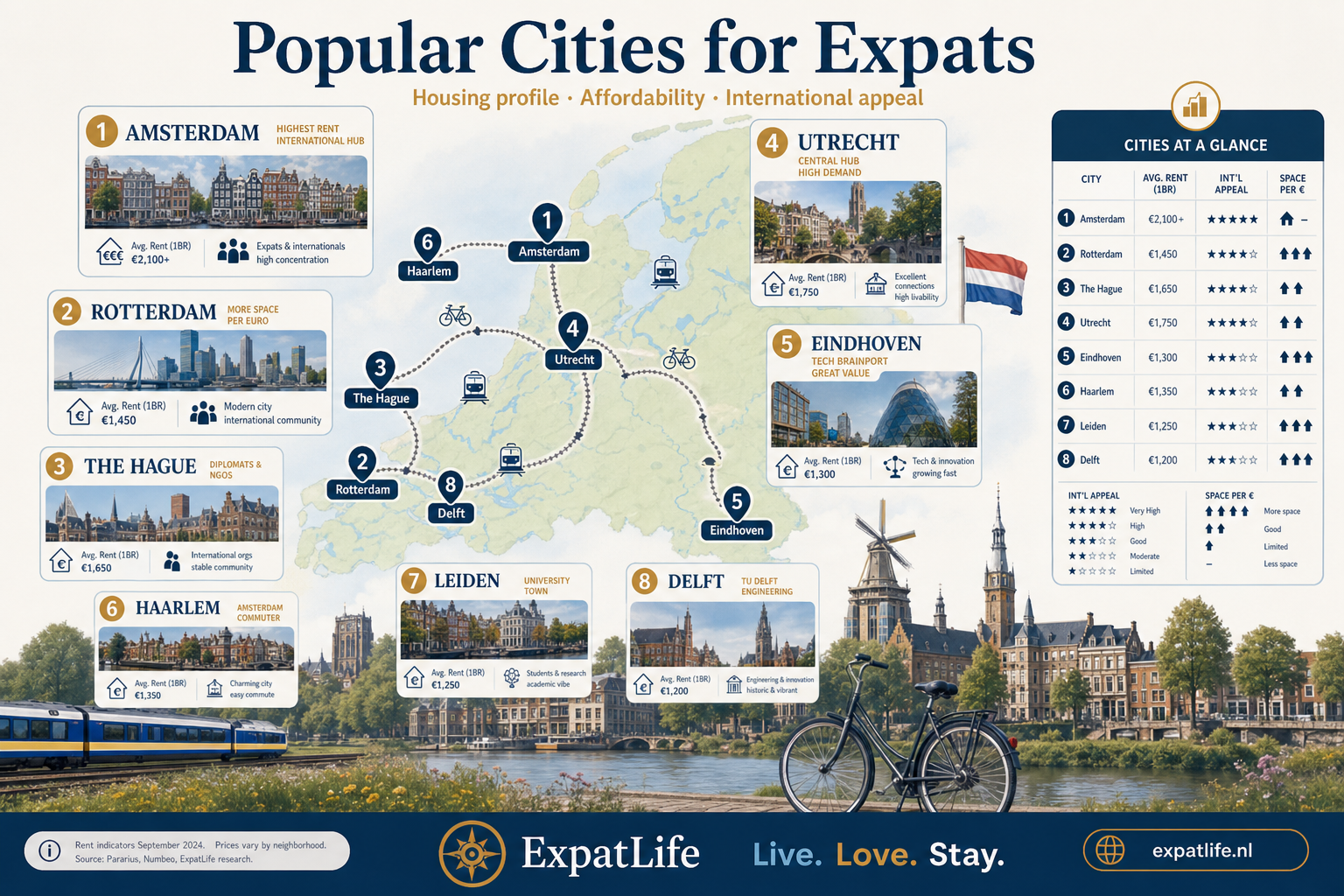
Open rent calculatorCity choice shapes rent pressure, commute time, school options and how quickly you can find a home. Amsterdam and Utrecht are among the tightest markets; Rotterdam, The Hague and Eindhoven often offer more space per euro with strong international communities.
Haarlem, Leiden and Delft suit commuters and university profiles. Compare city guides alongside this hub before narrowing your search area.
~872,000
Dense rental market, canals and apartments dominate central districts.
Affordability: Highest rents; strong competition for studios and family homes.
International appeal: Largest international job market and expat infrastructure.
~655,000
Modern apartments and port-city neighbourhoods with more space per euro.
Affordability: Generally lower than Amsterdam with varied waterfront districts.
International appeal: Growing international community and logistics hub careers.
~552,000
Embassy city mix of apartments, townhouses and coastal suburbs.
Affordability: Moderate to high; Scheveningen and central zones premium.
International appeal: Diplomats, NGOs, legal sector and international organisations.
~361,000
Central hub with strong rental demand near station and canals.
Affordability: High competition; popular with commuters and families.
International appeal: University city with tech and professional roles.
~248,000
Tech-oriented city with apartments and suburban family homes.
Affordability: Often better value than Randstad core cities.
International appeal: International talent and Brainport employers.
~165,000
Historic centre with commuter appeal to Amsterdam.
Affordability: Premium vs national average; family homes in surrounding areas.
International appeal: Randstad lifestyle with smaller-city feel.
~128,000
University town with canals, bikes and compact rental stock.
Affordability: Student demand affects rental pressure; family homes in outskirts.
International appeal: Researchers, students and Amsterdam commuters.
~104,000
Student and tech profile with historic centre apartments.
Affordability: Moderate; competition near TU Delft and station.
International appeal: Engineering, university and The Hague commute links.
Compare Amsterdam, Rotterdam, The Hague, Utrecht, Eindhoven and regional cities in one place.
Compare all citiesTemporary accommodation bridges the gap between landing and signing a long-term lease or completing a purchase. Hotels suit very short stays; serviced apartments and corporate housing help when employment or viewings start before your permanent address is ready.
Short-term rentals are useful but verify registration rules, deposit terms and maximum stay lengths. Book early during peak relocation seasons in August–September and January.

Best for a few nights while arranging viewings and bank setup.
Furnished mid-stay option with housekeeping and flexible terms.
Employer-arranged stays for relocation packages and assignees.
Platforms and agencies — confirm registration and contract limits.
After securing housing, arrange electricity, gas, water, internet and mobile services. Dutch utilities are usually billed separately from rent unless your contract explicitly includes specific services.
Check meter access, postcode internet availability and waste rules for your address soon after move-in. The utilities guide covers the complete first-week household setup path.

Choose supplier and contract type; note meter type and green tariff options.
May be separate or absent in newer all-electric homes.
Regional water company billed by household — usually fixed plus usage.
Postcode-specific fibre, cable or DSL — order before move-in when possible.
Local number helps with banking OTPs, appointments and two-factor login.
Renters typically need contents insurance and often liability cover. Owners add building insurance and may face lender requirements as part of mortgage approval. Compare providers and policy scope — this section is orientation only, not insurance advice.
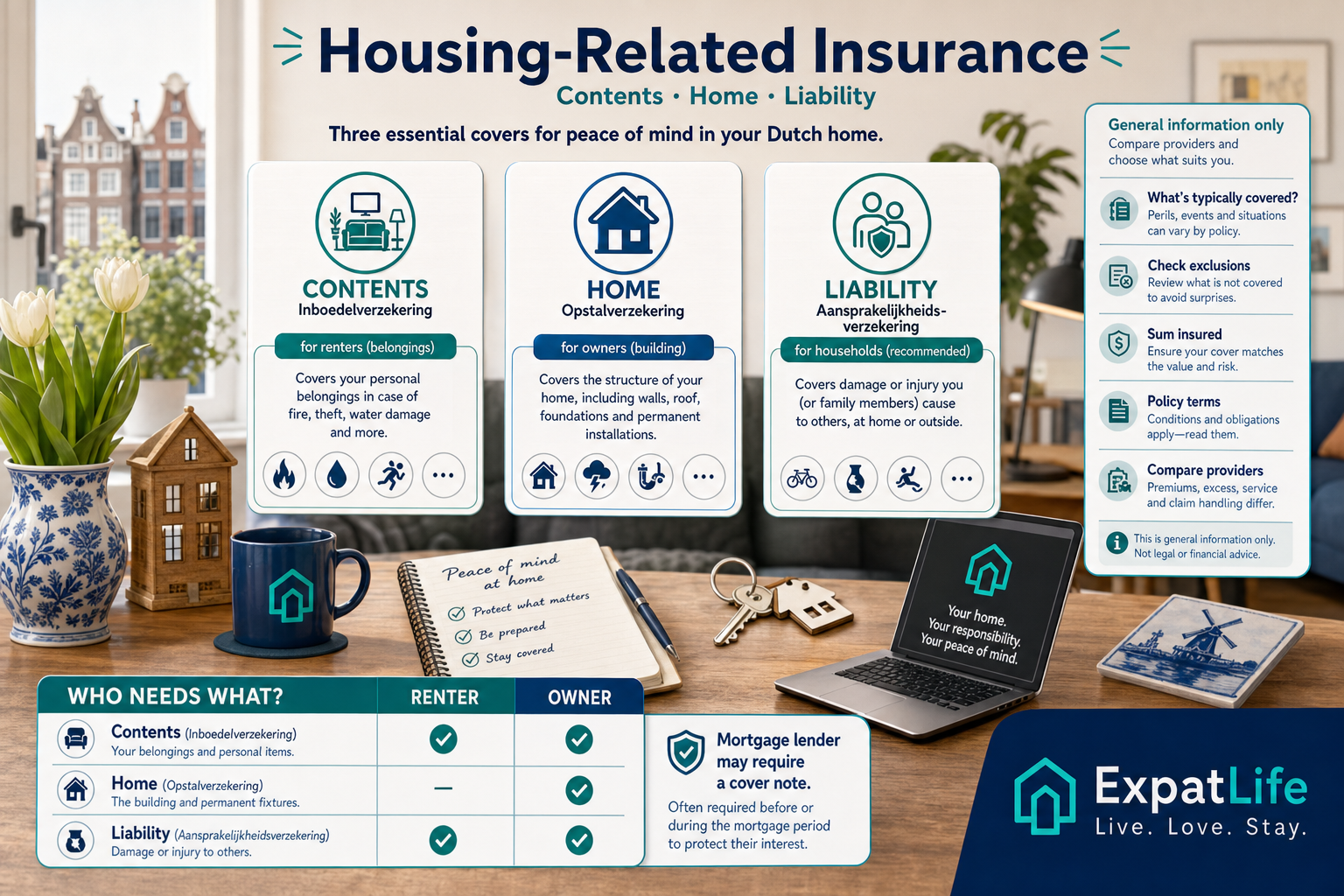
Covers belongings against theft, fire and some water damage.
Building cover relevant for owners and some mortgage products.
Widely recommended for accidental damage to others or rented property.
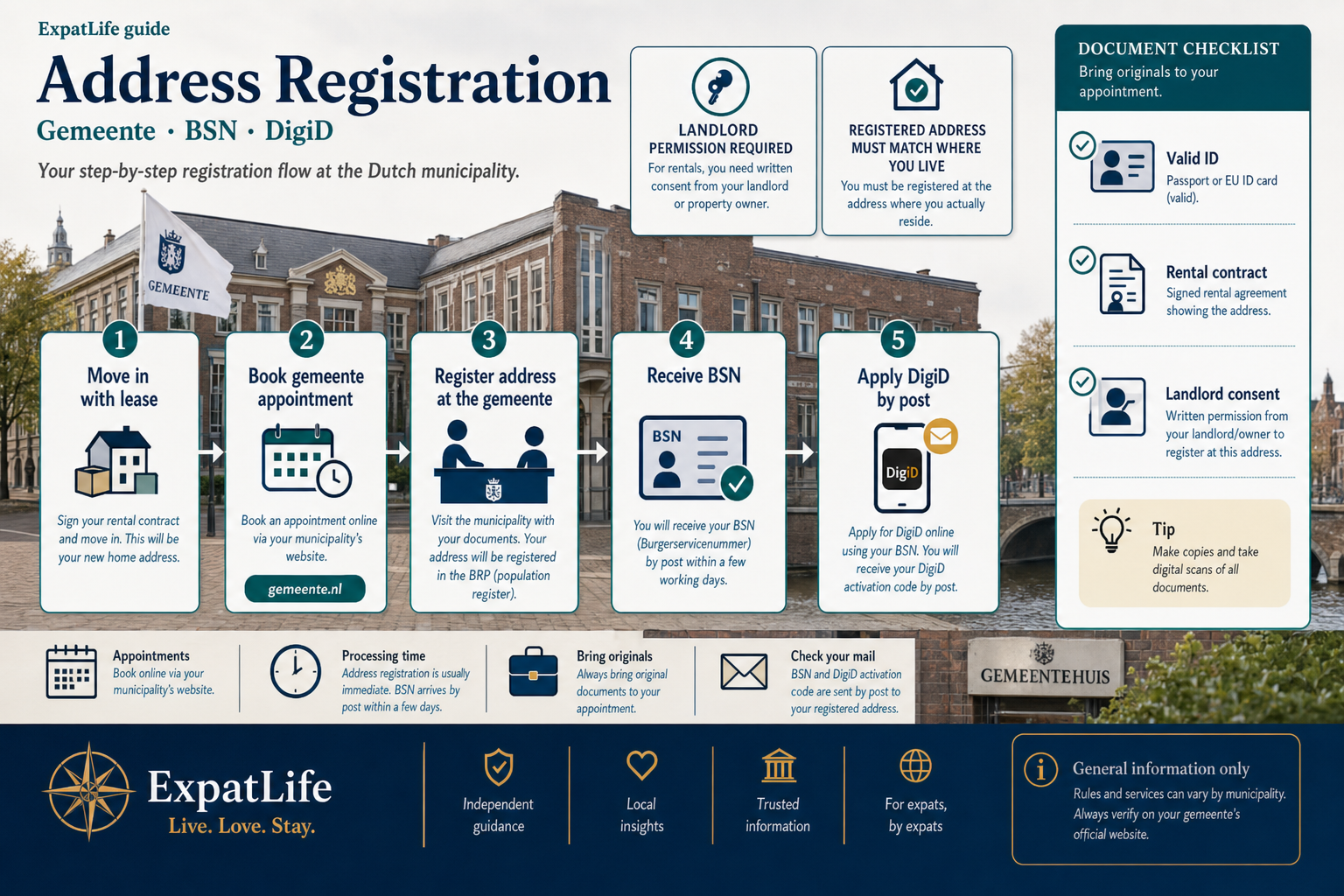
Your registered address must match where you live for BSN issuance, official post and many government services. Renters need landlord permission to register in most cases. After registration, apply for DigiD once post can reach your home address.
Expats may access Dutch mortgages with stable employment, acceptable contract types and sufficient documentation. Lenders assess income, residency, nationality and property valuation. Mortgage advisors help navigate NHG limits, interest products and offer strategy.
Pre-approval strengthens buying timelines in competitive markets. This section is not mortgage advice — verify terms with licensed advisors and lenders.
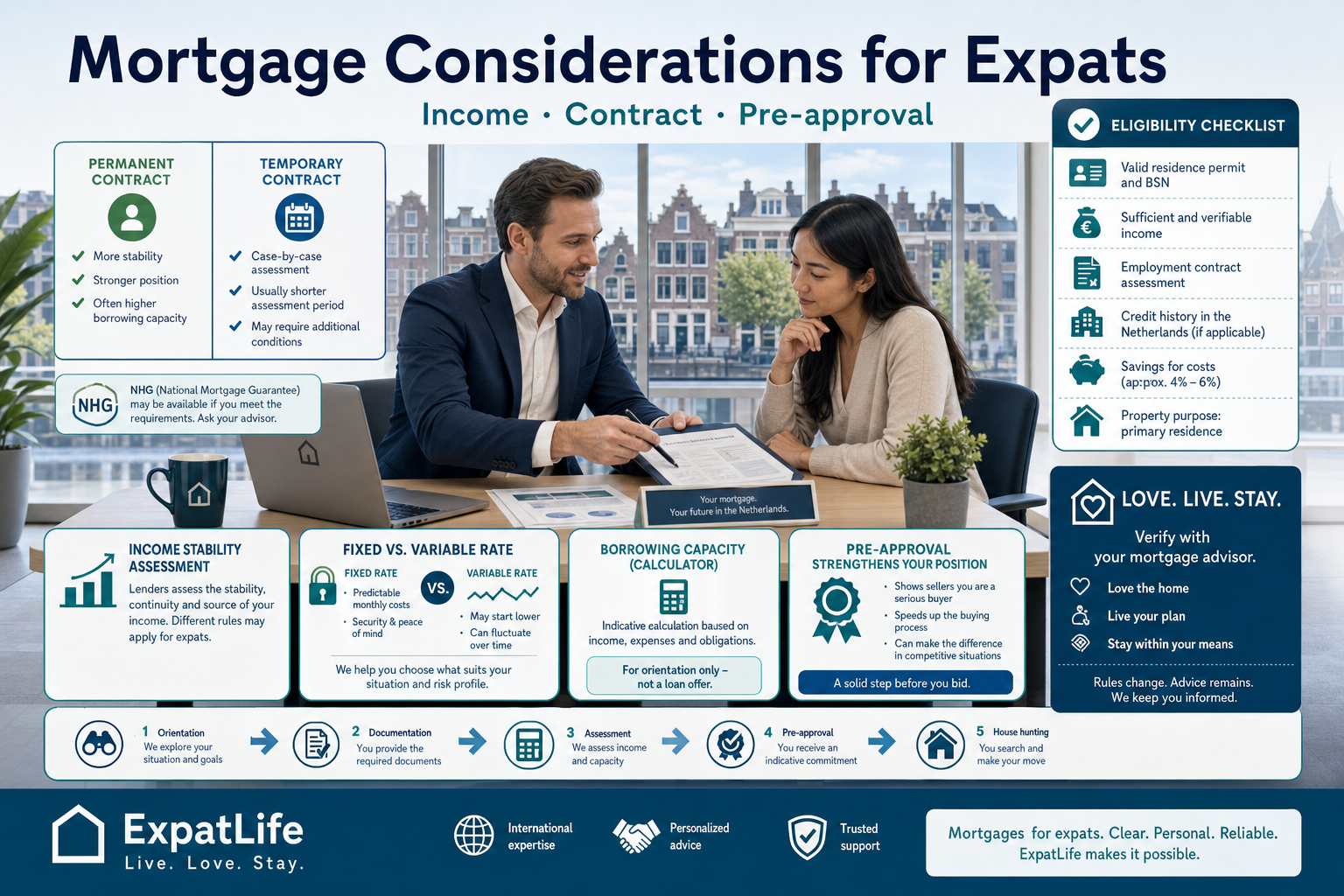
Permanent or long-term contracts strengthen applications; variable income needs extra review.
Employees, contractors and entrepreneurs face different lender policies.
Fixed vs variable interest affects monthly predictability and risk.
Specialist advisors explain documentation, NHG and cross-border income.
Students, young professionals, families, entrepreneurs, retirees and digital nomads often need different housing types, contract lengths and registration setups. Match your stay horizon and budget before choosing a property type or city.
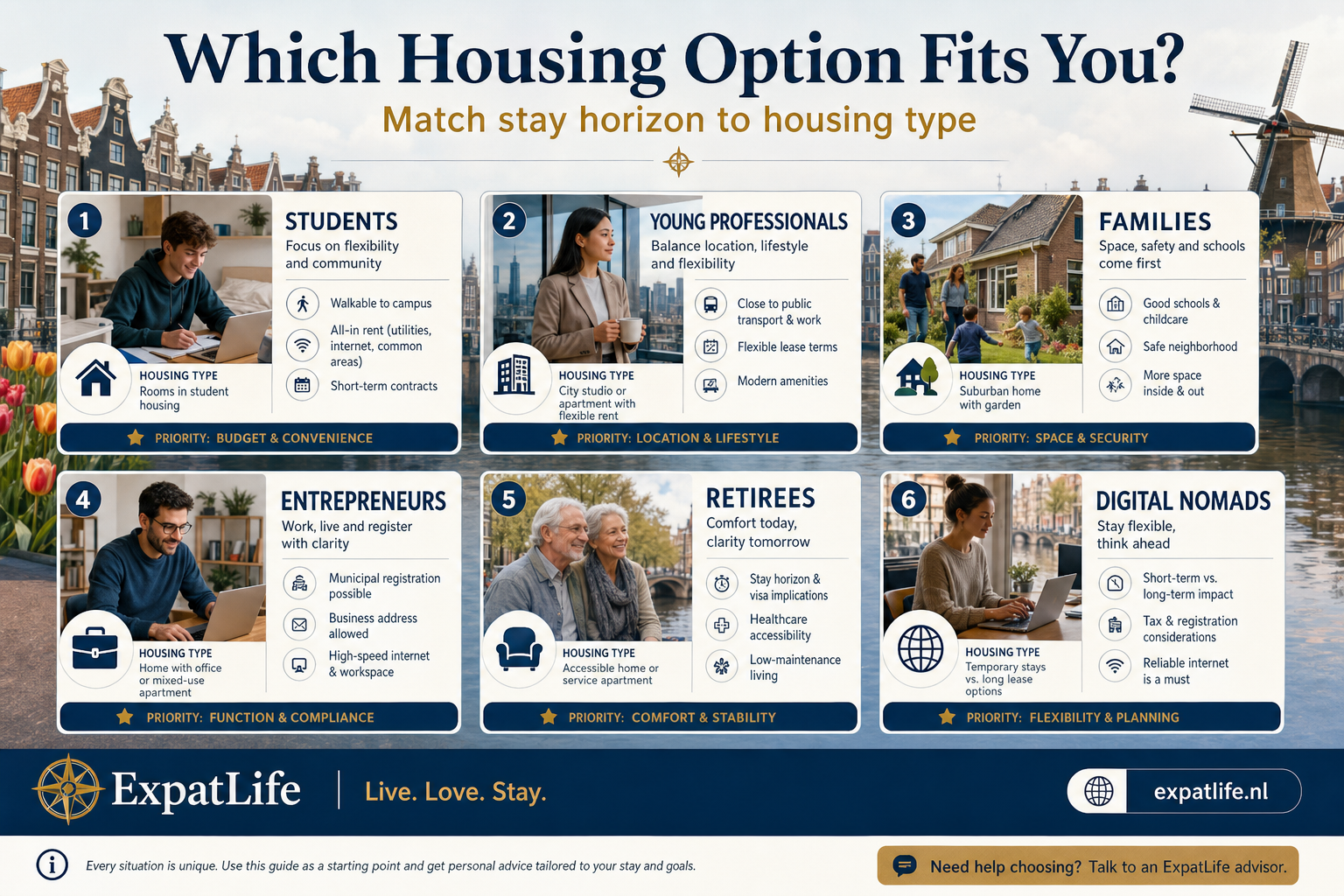
Rooms, studios and student housing near universities — book early for intake periods.
City apartments and flexible rentals; prioritise commute and social life.
Space, schools, gardens and dual commutes drive suburban choices.
Home-office rules, registration and address suitability for business admin.
Accessibility, healthcare proximity and stay-horizon planning matter.
Short stays, registration limits and visa rules need careful checks.
Use this sequence to prepare budget, city choice, documentation and temporary accommodation before arrival. The phases below mirror how most expats actually search, sign and settle in.
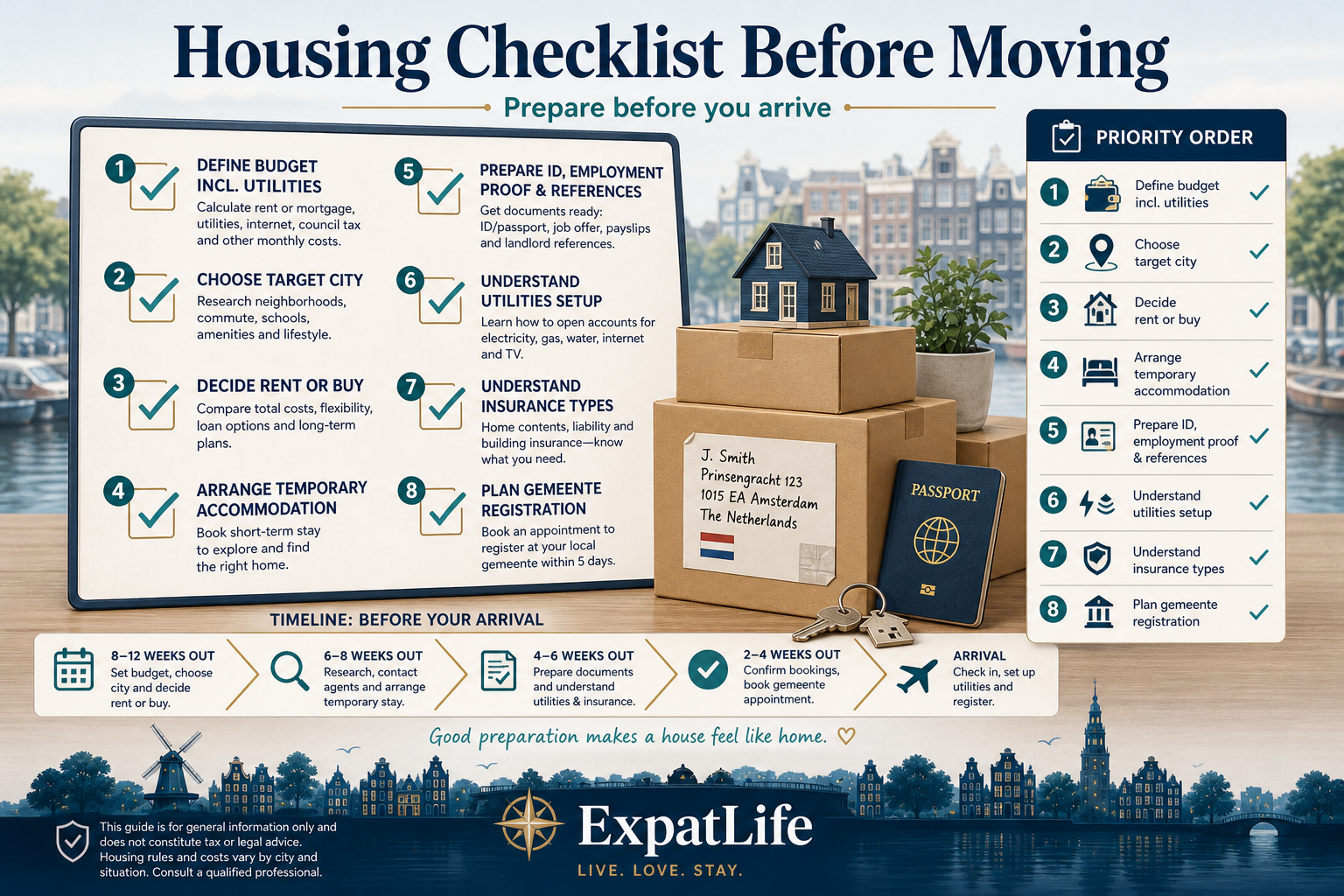
Before you move
First weeks
After move-in
These are the housing errors expats most often make when searching, signing and settling in the Netherlands. Avoiding them saves time, money and registration delays.
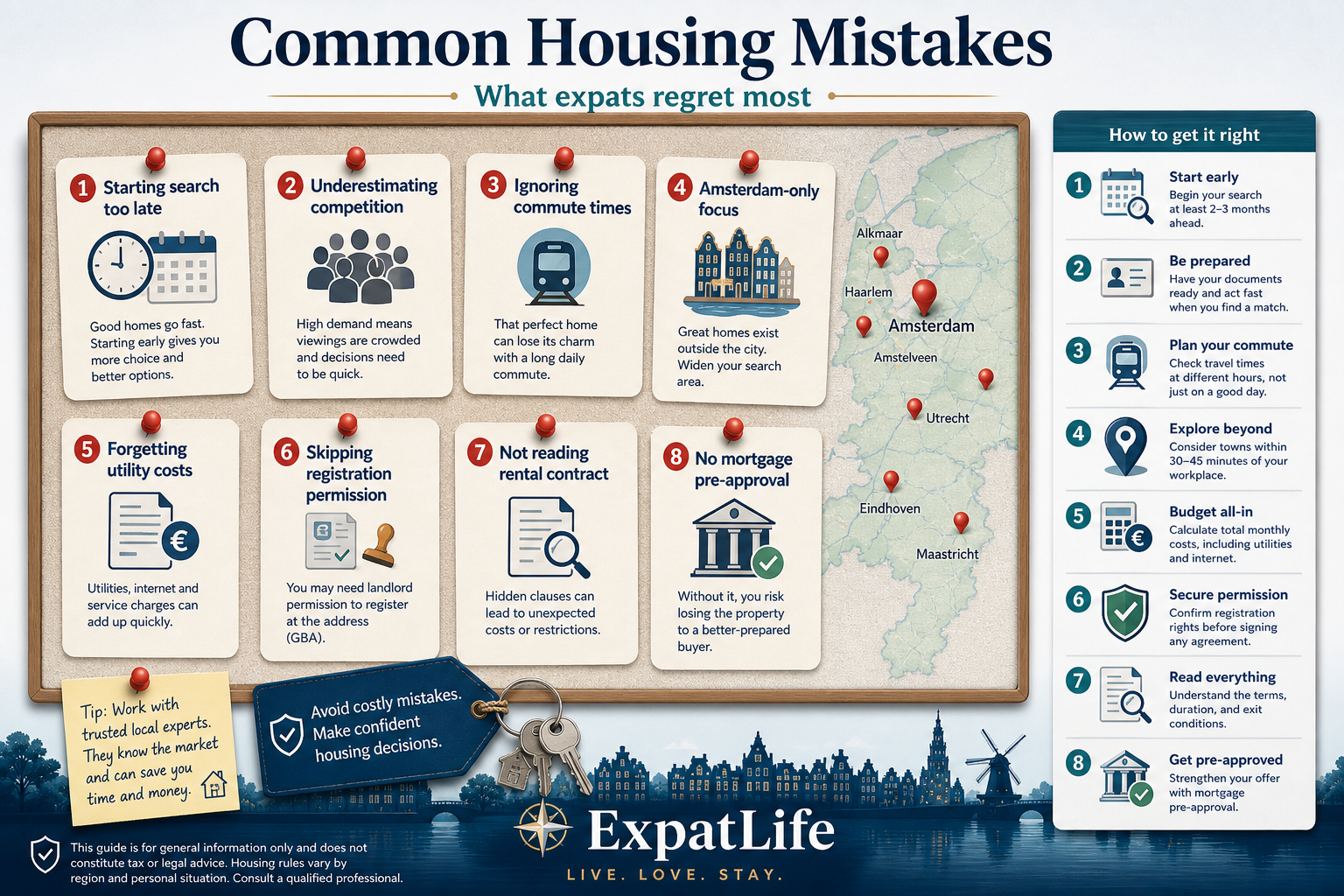
Peak seasons fill quickly — begin before arrival when possible.
Strong listings receive many applications within hours in major cities.
A cheaper rent far from work may cost time and transport fees.
Rotterdam, The Hague, Utrecht and Eindhoven offer strong alternatives.
Energy labels and separate bills materially affect monthly totals.
Without registration, BSN, post and DigiD setup stall.
Service costs, notice periods and maintenance duties vary.
Buyers lose time in competitive markets without financing clarity.
If you are unsure whether to rent or buy, use the structured comparison guide before committing.
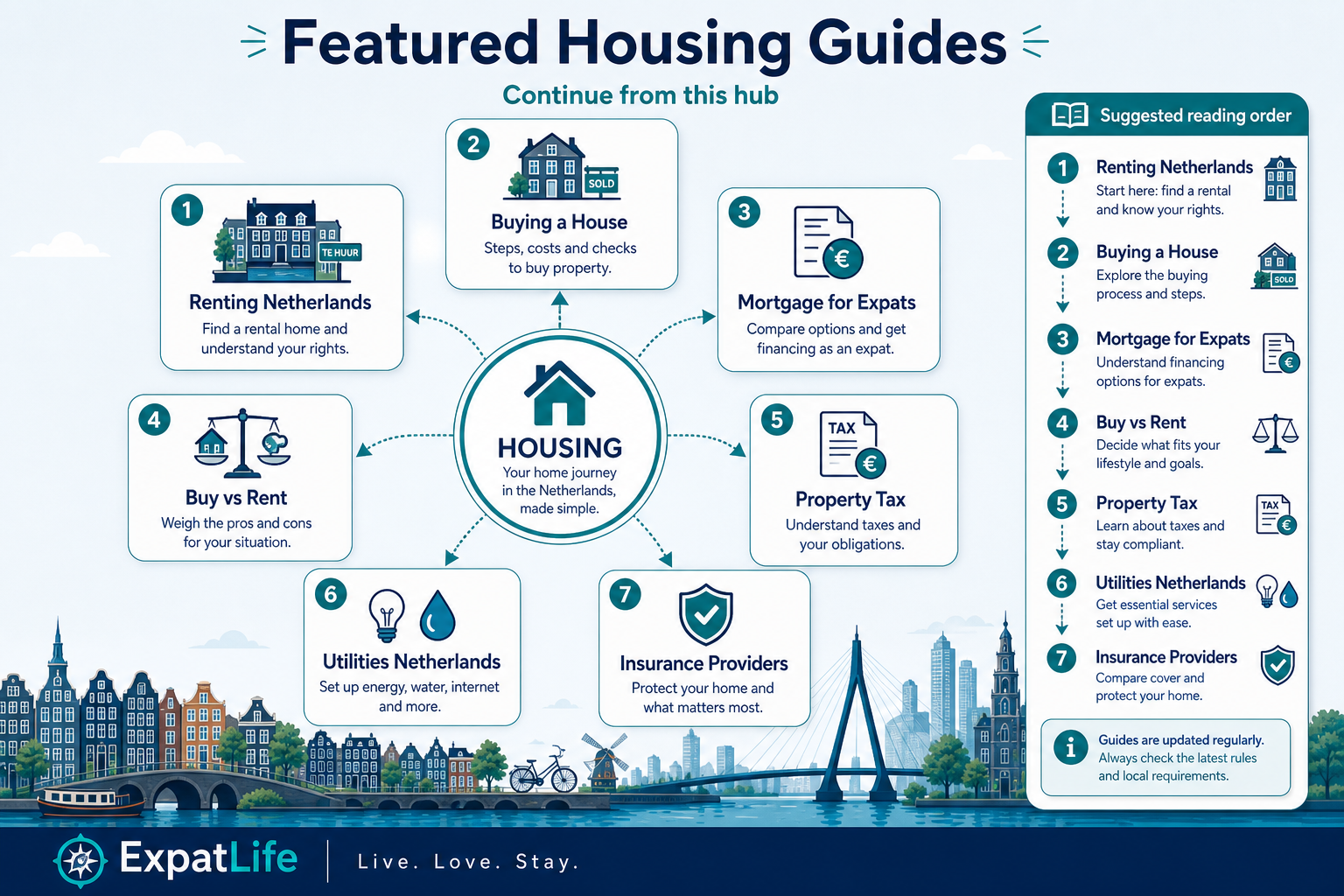
Compare rent vs buyContinue into deeper guides for renting, buying, mortgages, property tax, utilities and insurance. Each guide expands one part of the housing journey introduced on this page.
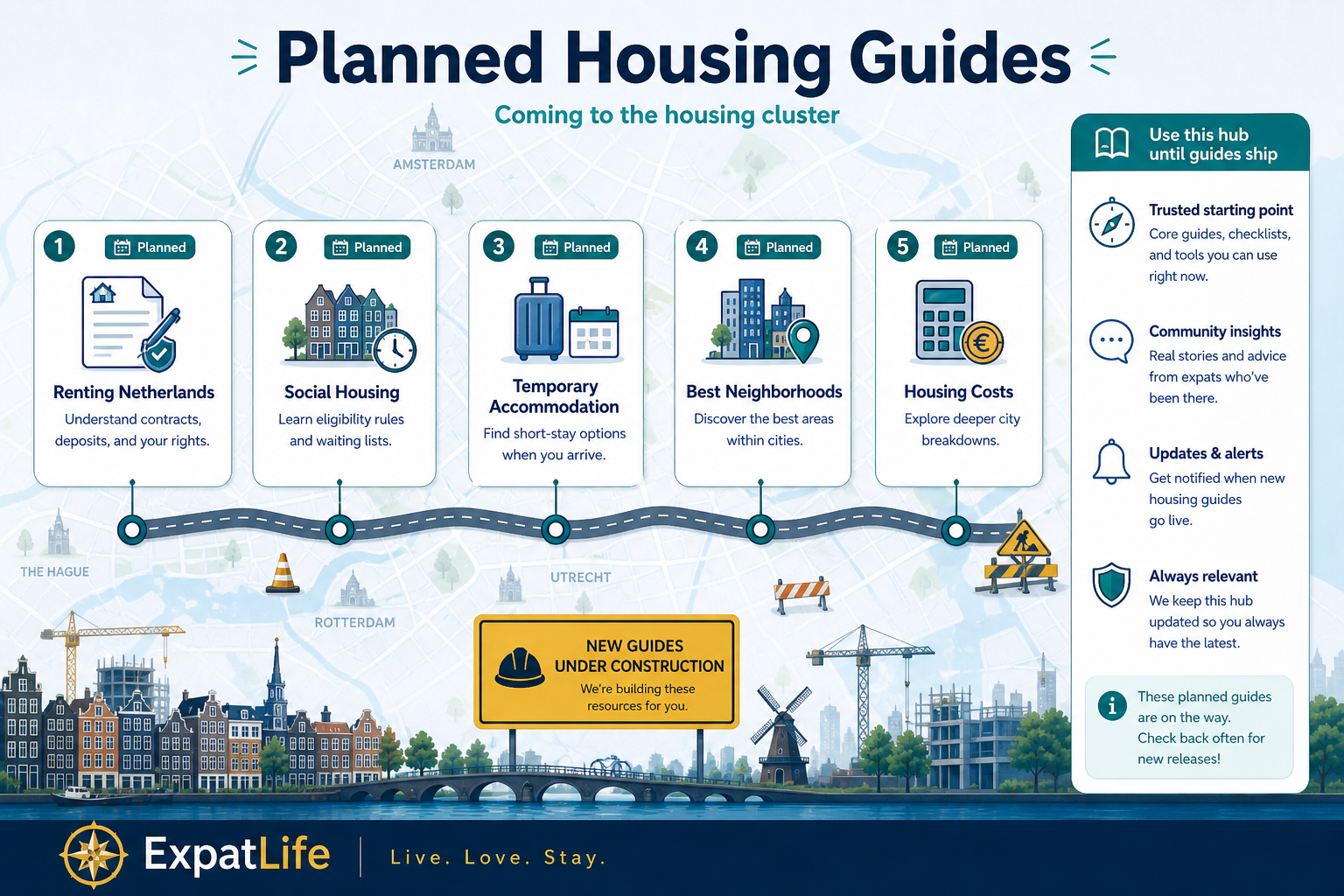
Planned expansion
These focused child guides are planned as the housing cluster expands. Use this hub for the full overview until they ship — each planned guide will go deeper on one housing topic.
Use these quick answers for orientation before checking listings, contracts and official sources. Open the linked guides when a topic needs more detail.
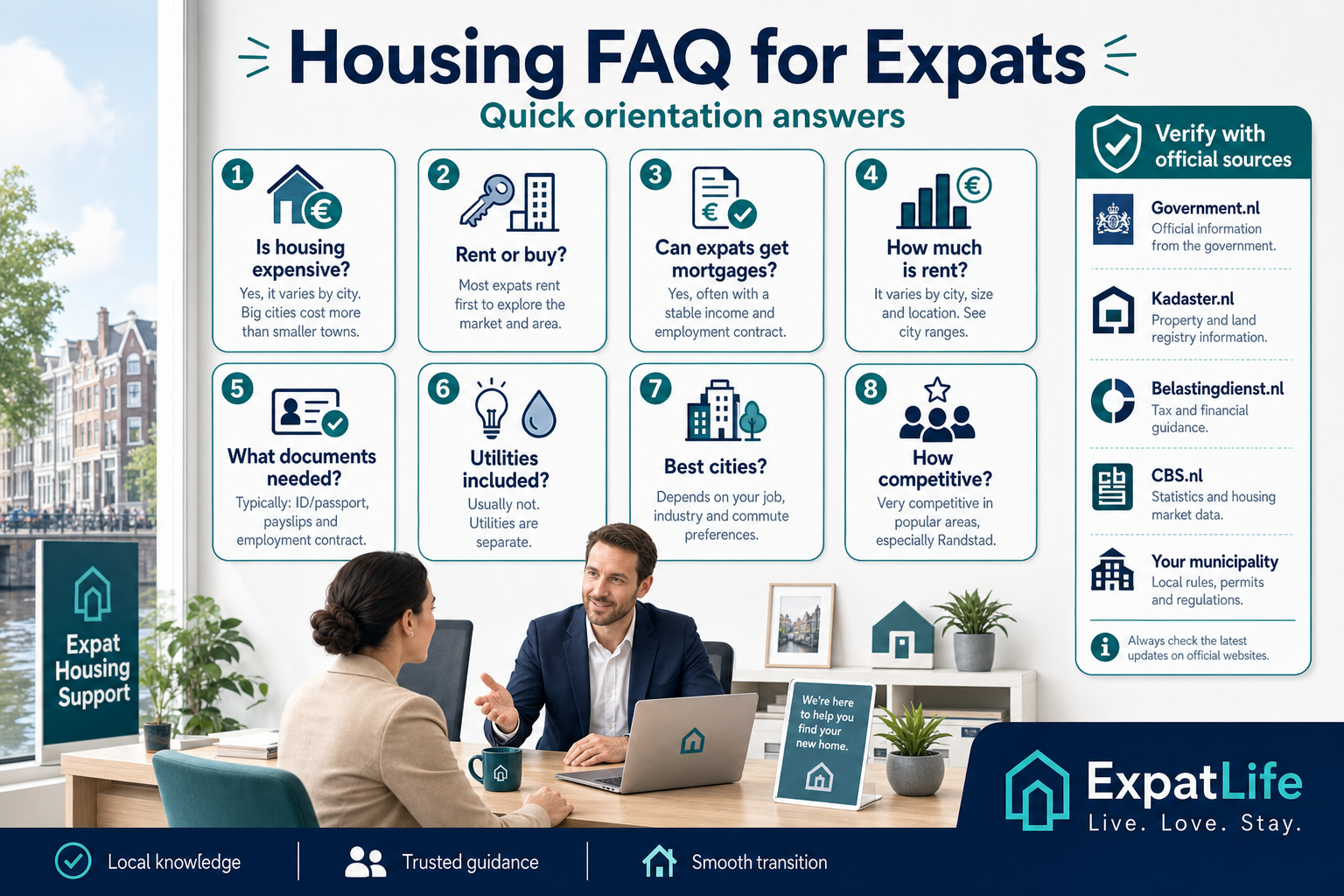
Housing costs are high in Amsterdam, Utrecht and parts of the Randstad compared with many European cities. Smaller cities and suburban areas often offer lower rents and more space. Costs depend on property type, energy label and whether utilities are included — verify current listings rather than relying on averages alone.
Most newcomers rent first while learning the market and confirming long-term plans. Buying can suit stable long-term stays when mortgage eligibility, savings for transaction costs and employment continuity align. Use the buy vs rent guide for a structured comparison.
Many expats qualify for Dutch mortgages with stable income, acceptable employment contracts and sufficient documentation. Lenders vary in policy for nationality, contract type and self-employment. Speak with a mortgage advisor to assess your situation — this hub does not provide mortgage advice.
Rent varies sharply by city and property size. Studios in Amsterdam may exceed EUR 1,200–1,800 per month as orientation ranges, while smaller cities can be lower. Always check live listings and include utilities, service costs and insurance in your budget.
Rentals often require ID, employment contract, payslips and sometimes bank statements or guarantor details. Buying requires mortgage documentation, proof of funds for transaction costs and notary-ready identification. Requirements vary by landlord, agency and lender.
Usually not fully. Many leases list rent separately from gas, electricity, water, internet and municipal waste charges. Check the contract for service costs (servicekosten) and what they cover before comparing listings.
Amsterdam, Rotterdam, The Hague, Utrecht and Eindhoven attract the largest international communities for work and study. Haarlem, Leiden and Delft suit commuters and university profiles. The best city depends on job location, budget, schools and lifestyle preference.
Major cities are competitive for rentals and popular purchase locations. Speed, prepared documents and flexible neighbourhood choice improve outcomes. Starting early and considering adjacent cities or suburbs often helps.
Housing regulations, mortgage rules and local requirements can change over time. Always verify current information with official sources before signing contracts or making offers.
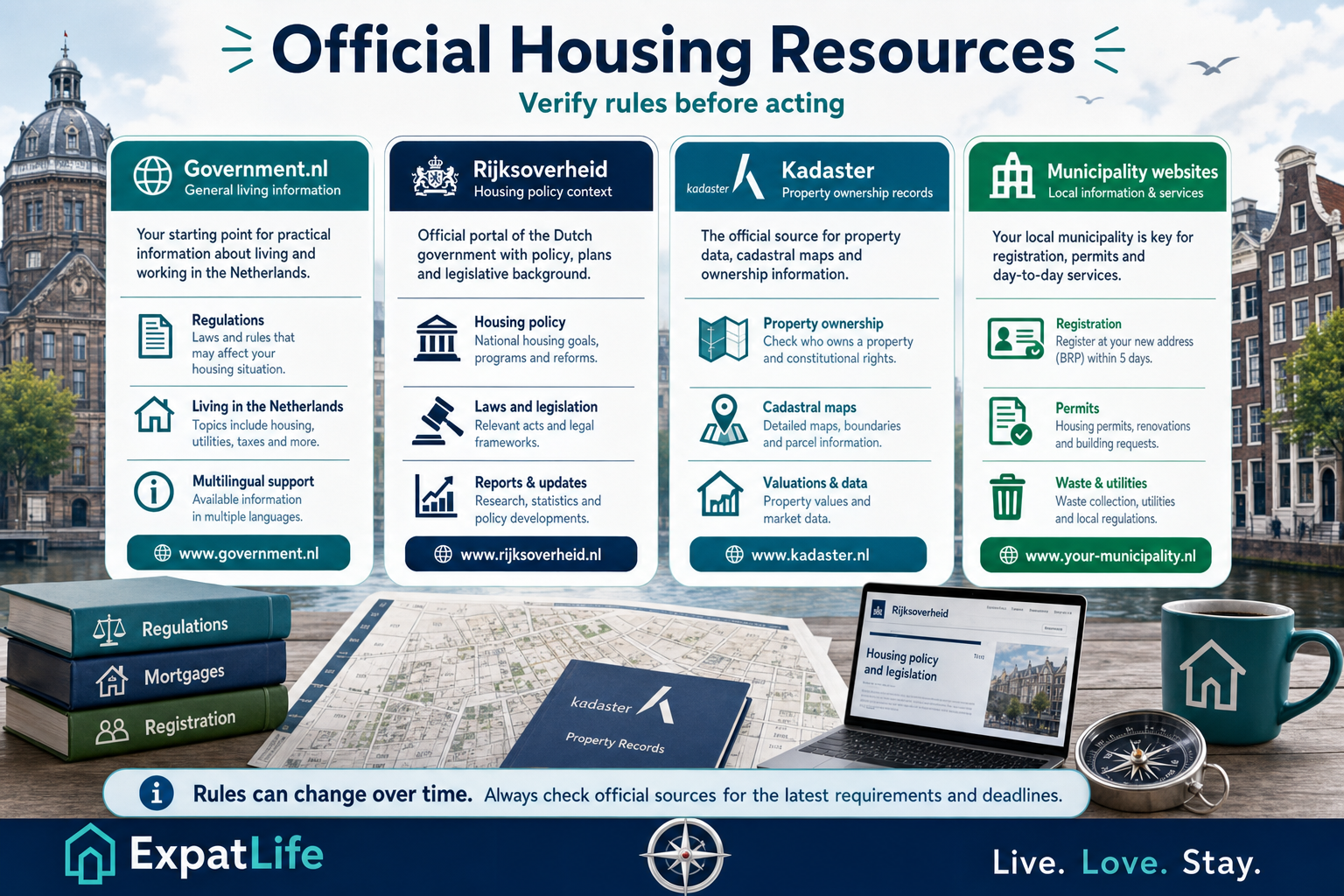
Official Dutch government information on living, working and housing in the Netherlands.
Open official sourceCentral government site for policy context on housing and resident topics.
Open official sourceLand registry and property information for ownership research in the Netherlands.
Open official sourceYour gemeente website covers registration, local housing rules and permits. Examples include Amsterdam, Rotterdam, The Hague and Utrecht.
Open official sourceHousing connects to your wider relocation plan — moving timeline, city choice, utilities setup, municipality registration and tax topics often move together.
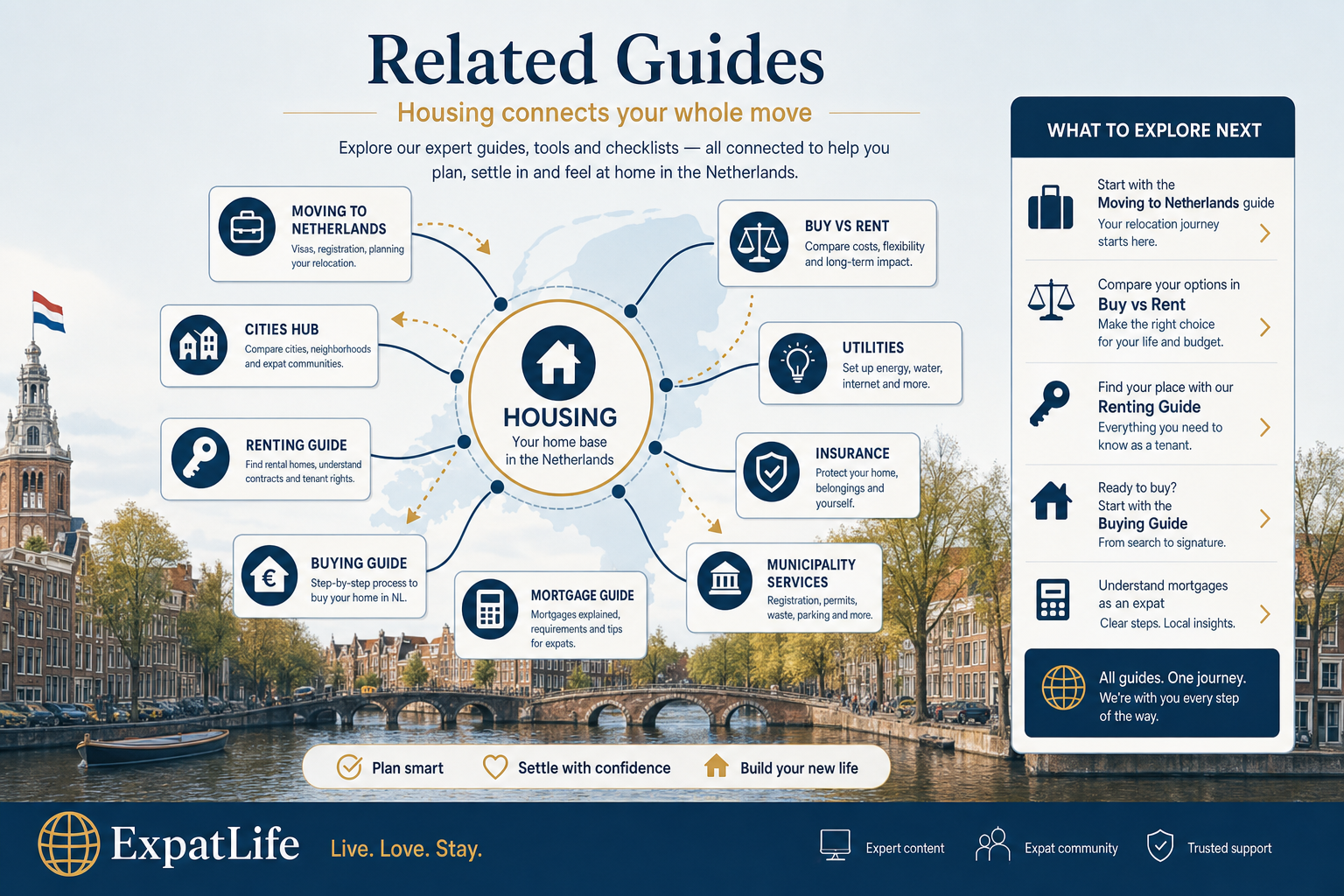
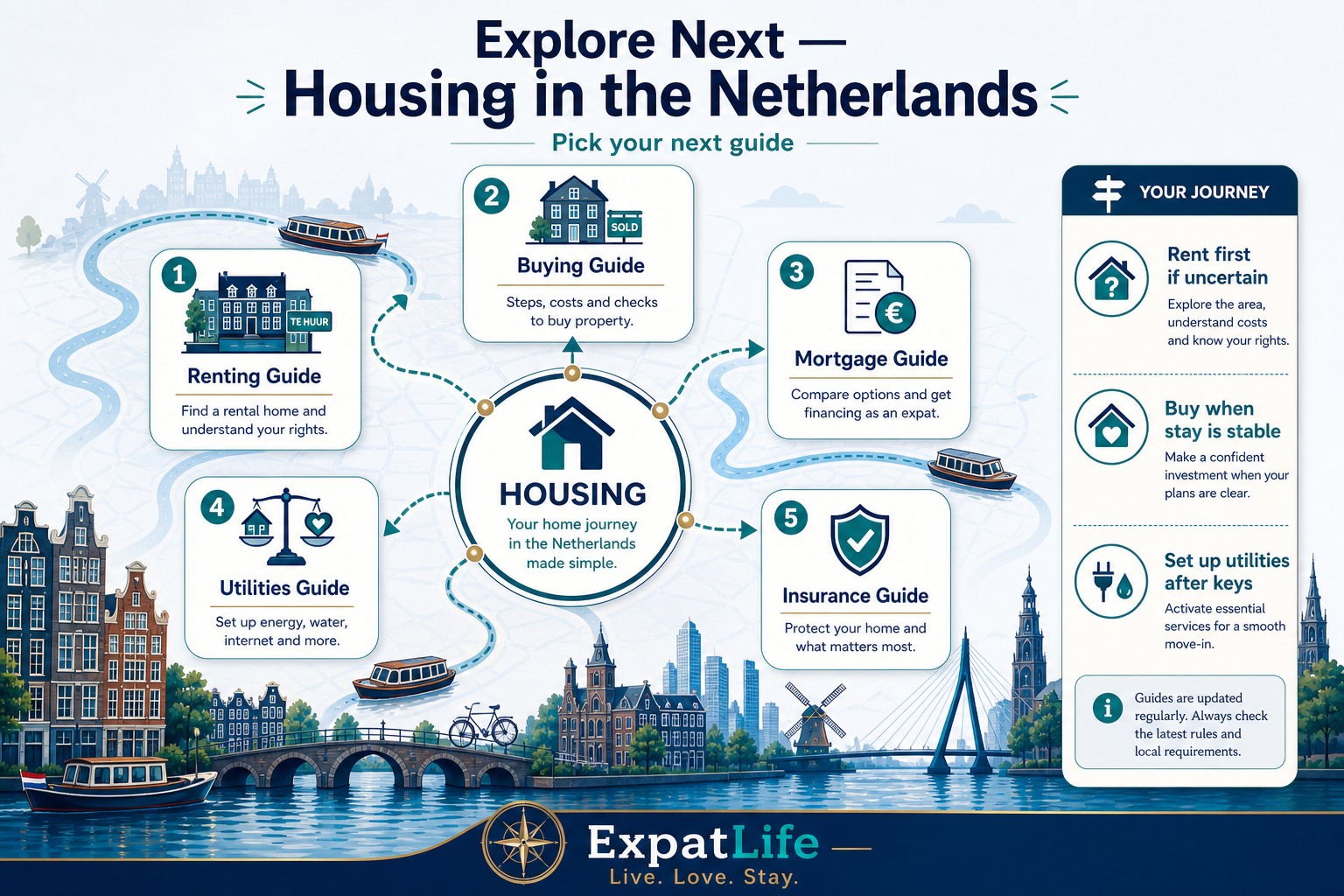
Explore next
Move from this housing overview into renting, buying, mortgage, utilities and insurance guides.