
Common
You're not alone
Many newcomers feel this in months 1–6
Life in the Netherlands · Community & Wellbeing
Feeling lonely after moving abroad is more common than many people expect. Here's how to understand it, rebuild your social life and feel more at home in the Netherlands.
Practical wellbeing orientation only — not medical, psychiatric or counselling advice. If loneliness persists or affects daily life, speak with a GP or qualified professional. In immediate danger, contact emergency services.

Quick answer
Moving to the Netherlands can feel exciting and disorienting at the same time. You may love the bikes, the cafés and the career opportunity — and still feel a quiet emptiness in the evenings. That gap between a functioning daily life and a felt sense of belonging is what many expats mean by loneliness.
This guide treats loneliness as a normal relocation experience, not a personal flaw. You will find why it happens, how friendship culture works here, where to meet people, daily habits that help, a 30-day social reset and when to seek extra support. It is practical wellbeing orientation — not a diagnosis or treatment plan.
Snapshot
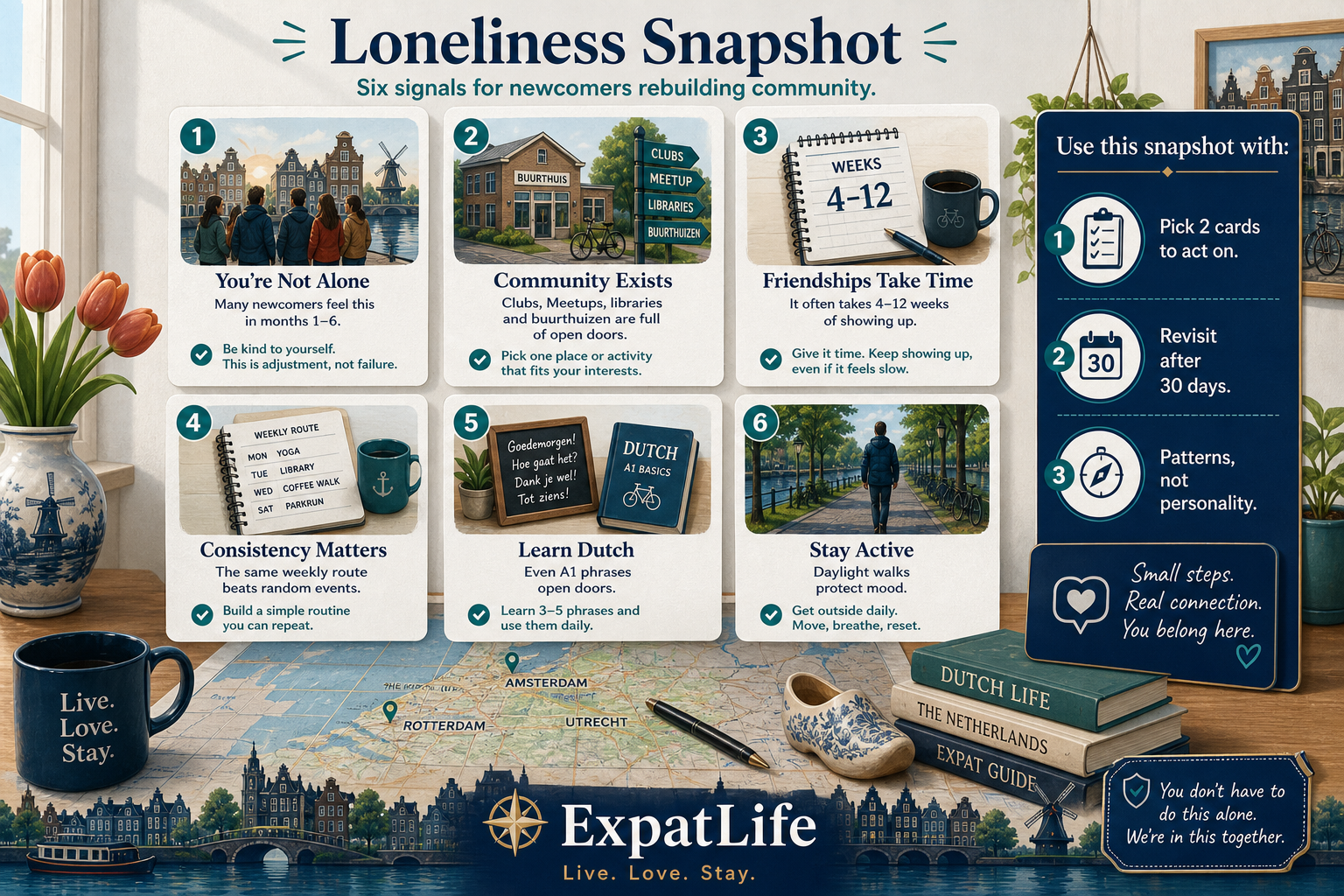
Scan these signals before blaming yourself — loneliness here is often structural, not personal failure.
Common
You're not alone
Many newcomers feel this in months 1–6
Pace
Friendships take time
Depth often grows months 3–6
Method
Activity-first
Clubs beat one-off parties
Habit
Consistency
Weekly rhythm rebuilds belonging
Feeling lonely after moving is extremely common — even among people who look settled on social media. Naming it is the first step.
Sports clubs, Meetups, language cafés, buurthuizen and volunteer teams welcome newcomers who show up regularly.
Dutch circles often form through months of shared routines. Activity partners come first; deeper friendship follows.
Six visits to one group beat six different events. Familiar faces are the foundation of belonging.
English works in many cities — Dutch effort still opens neighbourhood life and signals long-term intent.
Movement, daylight and recurring clubs reduce isolation even before you have close friends.
Causes
Loneliness abroad rarely has a single cause. You leave the people who knew your history, start from zero in a new city, and meet a culture where friendships grow through planned activities rather than spontaneous hanging out. Add remote work, language friction, municipal admin stress and a grey winter — and evenings can feel long even when life looks fine on paper.
Understanding the drivers helps you respond with strategy instead of self-blame. You do not need to fix everything at once. Match one cause to one habit this month.
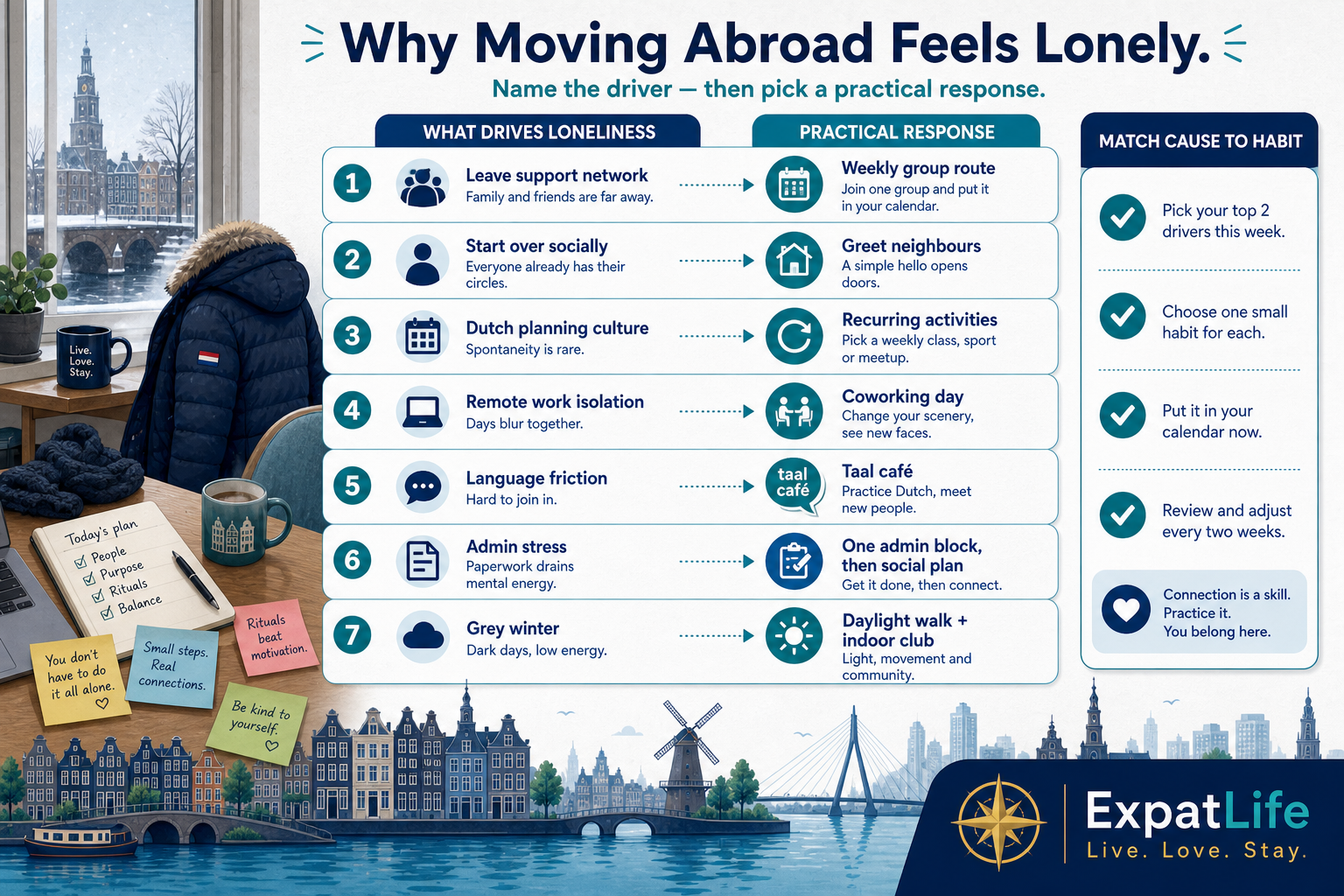
Your old friends, family and colleagues are still elsewhere. Video calls help — they do not replace local face-to-face rhythm.
Nobody nearby shares your inside jokes yet. Shared activities create new common ground faster than forced small talk.
Calendars fill early and circles can seem closed at first. Recurring clubs are the usual entry point — not random bar nights.
Working from a quiet apartment removes the incidental chats of an office. Design out-of-home contact on purpose.
English gets you far in cities — deeper local groups may still feel harder until Dutch confidence grows.
BSN, housing, insurance and school logistics drain energy that would otherwise go to social plans.
Short daylight and rain reduce terrace life. Indoor clubs, libraries and daytime walks matter more from November to March.
Examples
| Situation | Approach | First step |
|---|---|---|
| New arrival, WFH every day | Design three out-of-home contact points before friendships feel deep | Book two coworking days and one evening Meetup this week |
| Months in, still no invitations | Assume calendars are full — initiate with concrete plans | Join one recurring club and send one coffee invite with day and time |
| Homesick after festive season | Keep home calls and plant one local winter ritual | Add an indoor walking group or library programme for January |
| Admin overwhelm blocking social plans | Separate settling tasks from belonging habits | Finish one registration task, then attend your weekly group anyway |
Emotional arc
Many newcomers recognise a rough emotional sequence after moving. It is a pattern, not a medical model — and people skip stages, revisit them or move at different speeds.
If you are in frustration while a colleague seems confident, that often reflects timing, not character. Keep one weekly social habit through the harder weeks.
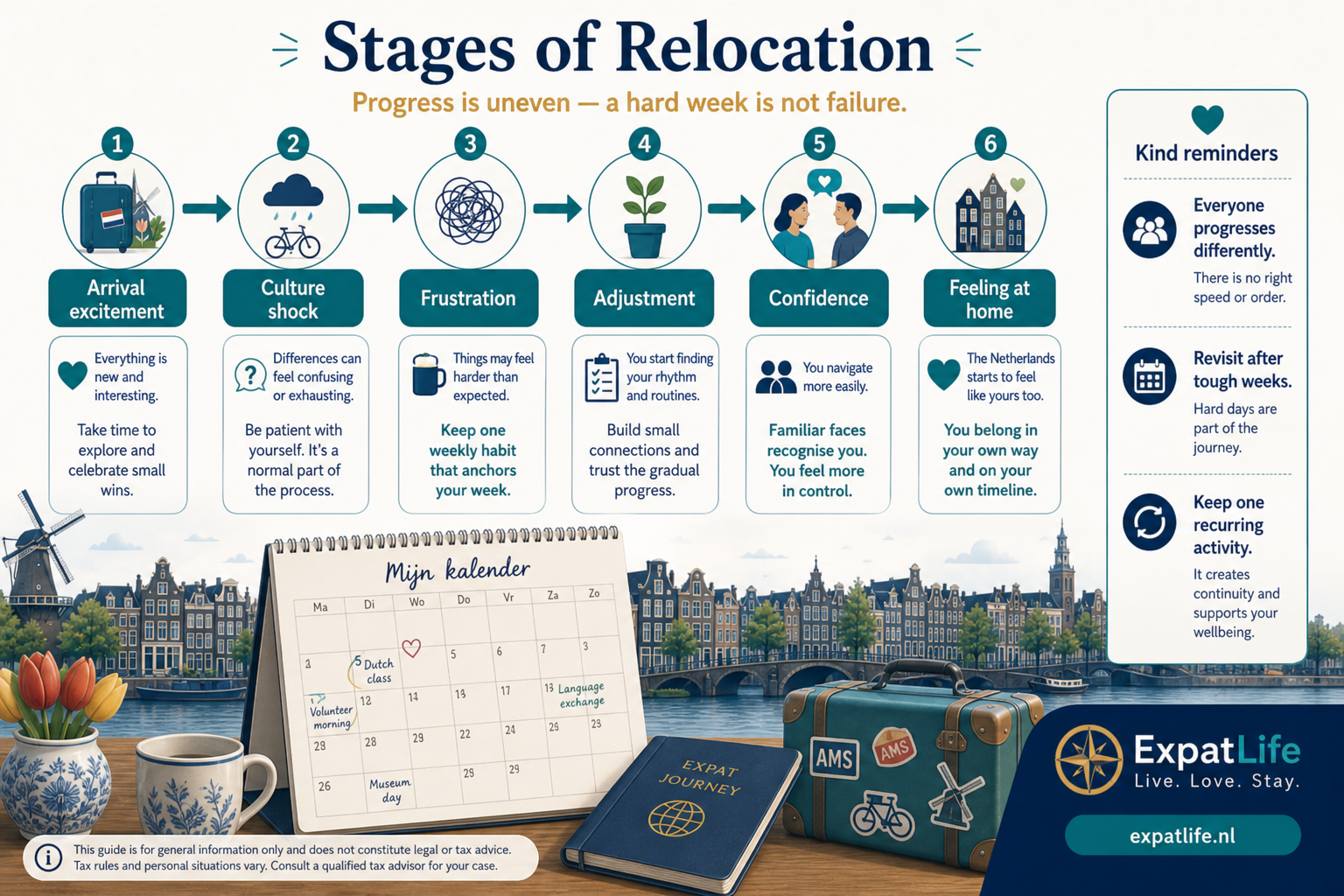
Novelty, exploration and adrenaline. Everything feels possible — including underestimating how long belonging takes.
Small differences in communication, humour and planning start to feel tiring. Homesickness may spike.
Admin, weather or slow friendships can feel personal. This stage is common — and often temporary with support and routine.
You recognise faces at your club, café or street. Practical life gets easier; social life starts to have a rhythm.
You initiate plans, navigate Dutch directness more calmly and feel less like a perpetual guest.
Belonging becomes quieter and more secure — not perfect, but rooted. Many people need a year or more to reach this.
Everyone progresses differently. A hard month does not erase progress — return to your weekly habit and ask for help if distress stays intense.
Friendship culture
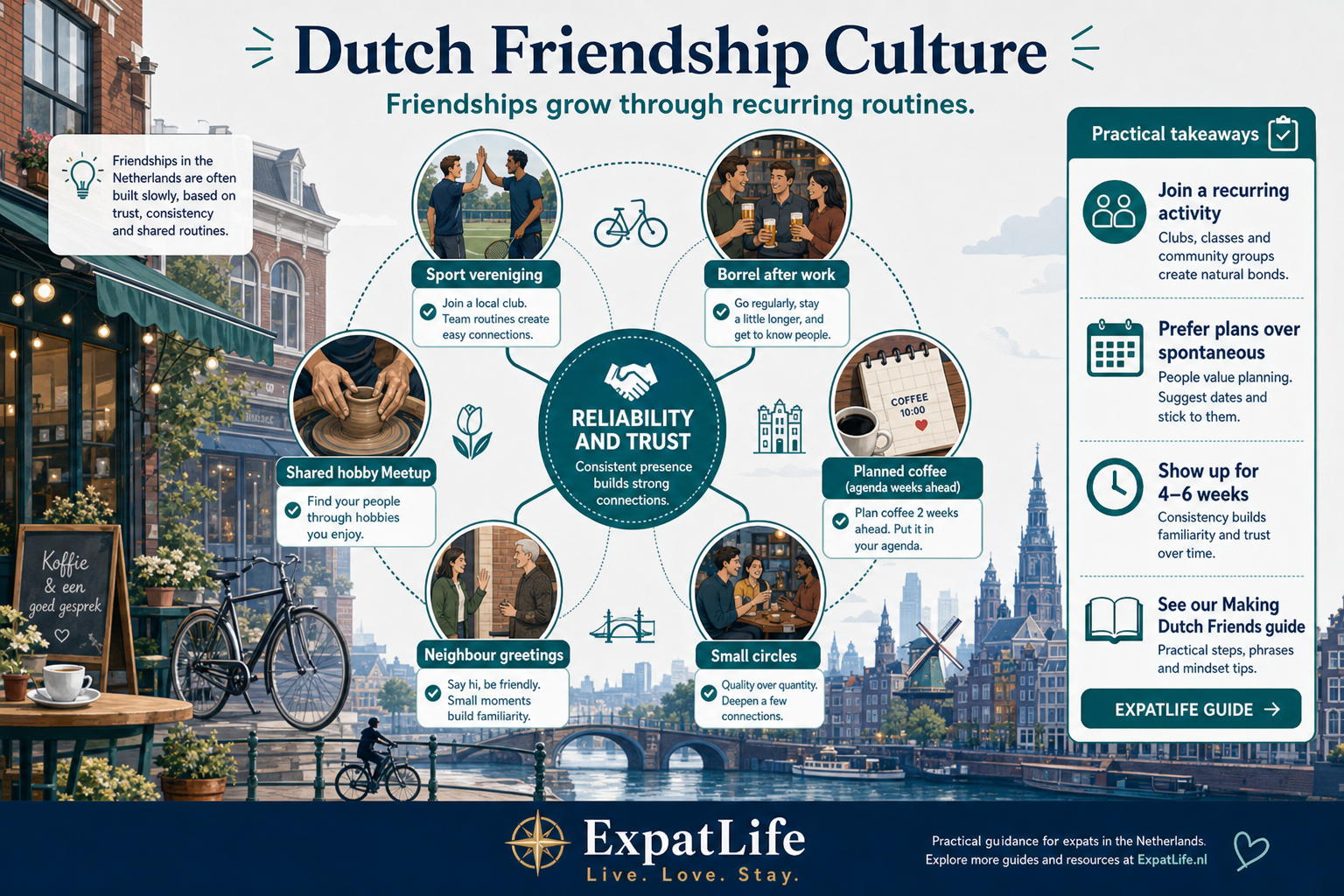
Dutch adult friendships often grow through sports clubs, hobby associations, volunteer shifts, parent networks and planned borrels — not through endless spontaneous evenings. People may be warm and helpful while still protecting full calendars.
That structure can feel cold if you expect instant intimacy. It can also be hopeful: once you join a recurring group, the path to familiarity is clear. Reliability matters more than being the most outgoing person in the room.
Remote work
Remote and hybrid work are common for internationals in the Netherlands — and they remove the accidental social contact of an office. Without a deliberate plan, weekdays can become silent loops between laptop and kitchen.
You do not need to become an extrovert. You need designed contact points: coworking days, café work blocks, professional Meetups and one non-work weekly activity so belonging is not only transactional.

Finish work at a set time and leave the apartment for a short walk — even 20 minutes breaks isolation loops.
Book two fixed coworking days. Community lunches and Friday borrels often matter more than the desk.
Become a regular at one neighbourhood café. Brief greetings with staff and regulars build light belonging.
Industry Meetups and alumni events create conversation starters — follow up with one coffee within 48 hours.
Add one hobby Meetup so all human contact is not career-shaped. Introverts often prefer activity-first groups.
Weekly contact plan for remote workers
Examples
| Situation | Approach | First step |
|---|---|---|
| Fully remote with no local colleagues | Treat social contact like meetings you schedule | Block two out-of-home work days and one hobby Meetup |
| Hybrid office but lonely evenings | Office chats help — evenings still need a non-work route | Join one sport or language café after work |
| Networking feels forced | Prefer activity-first groups over mixer nights | Pick board games, photography or running over large mixers |
Connection methods
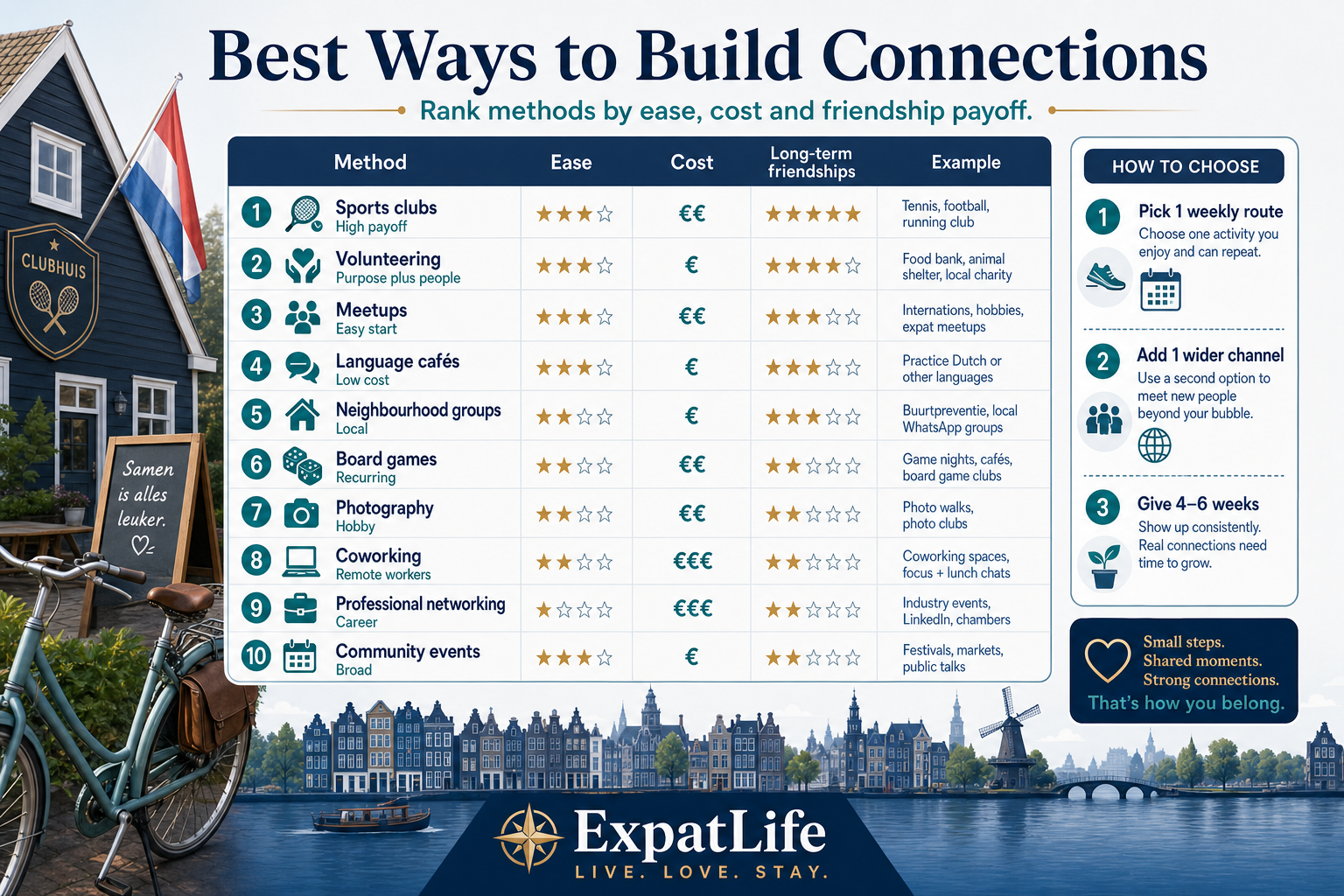
Compare methods by ease, cost and long-term friendship potential. Loneliness improves most when at least one route repeats weekly.
| Method | Ease | Cost | Long-term friendships | Examples |
|---|---|---|---|---|
| Sports clubs | Medium | Medium | High | Football, padel, running, hockey, rowing — ask about proefles trials |
| Volunteering | Medium | Free | High | Food banks, libraries, animal shelters, festival crews with weekly shifts |
| Meetups | High | Low | Medium | Hiking, board games, language exchange, photography walks |
| Language cafés | High | Free–low | Medium–high | Library TaalCafés, tandem evenings, municipal language tables |
| Neighbourhood groups | Medium | Free | Medium | Building WhatsApp, buurt BBQ, community gardens, street events |
| Board games | High | Low | Medium–high | Board-game cafés and weekly open-table Meetups |
| Photography | Medium | Low | Medium | City photo walks — shared focus reduces awkward small talk |
| Coworking | Medium | Medium | Medium | Community desks, member lunches, after-work drinks |
| Professional networking | Medium | Low–medium | Medium | Industry Meetups, alumni chapters, LinkedIn local events |
| Community events | High | Free–low | Low–medium | Markets, King's Day streets, library talks — best paired with a weekly club |
Communities
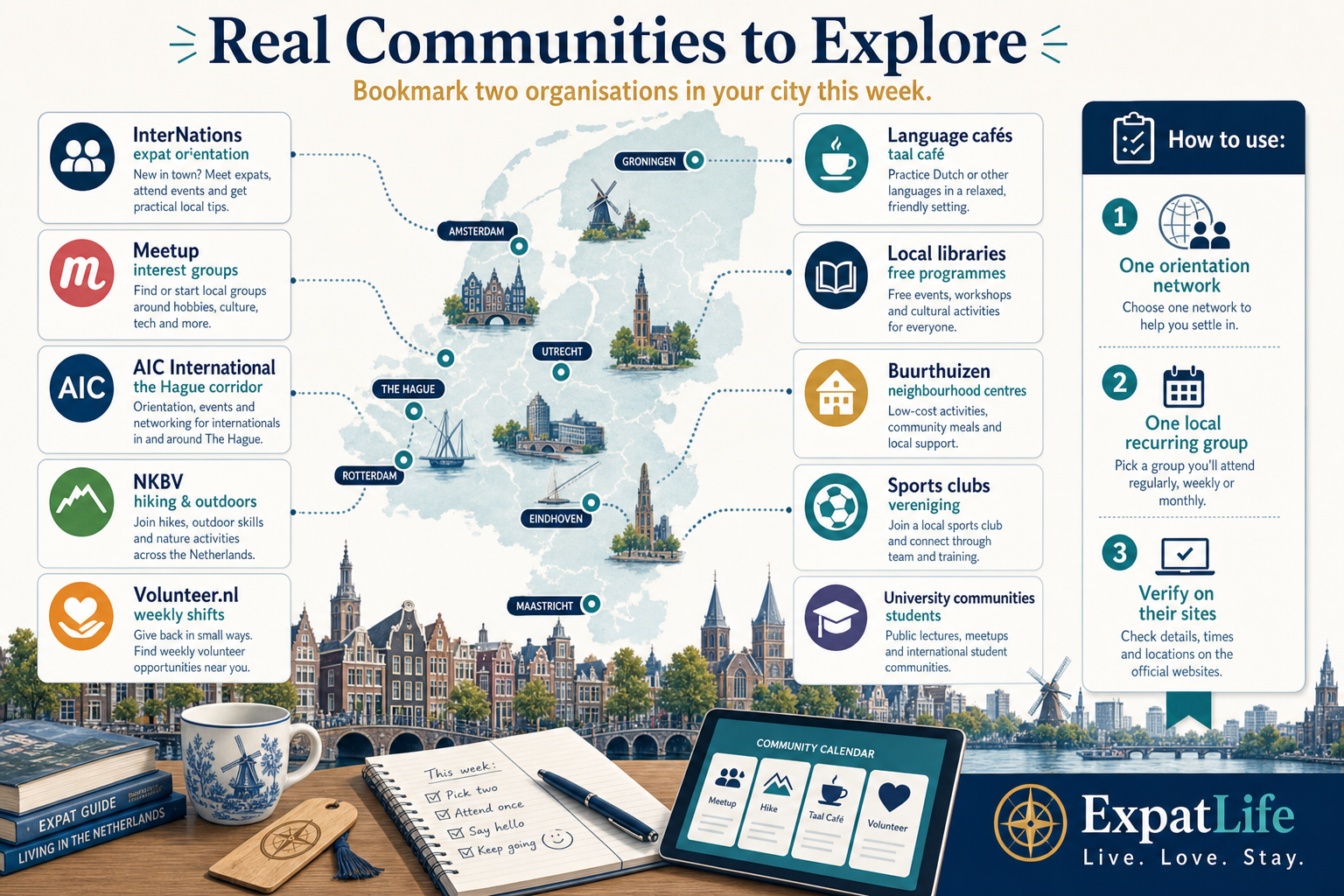
These are real, publicly known routes many internationals use. Always verify current events, fees and language on the organisation’s own site.
Expat network
International professionals
Large welcome events and interest groups — strong for orientation; pair with a local weekly activity.
Visit siteInterest groups
Anyone by city and hobby
Fast way to sample hiking, language, tech and social groups — repeat the same group for depth.
Visit siteInternational centre
Amsterdam-area newcomers
Practical settling support and community programming for internationals.
Visit siteOutdoor association
Hikers and outdoor enthusiasts
Sections nationwide — training, walks and trips create recurring outdoor company.
Visit siteVolunteer portal
Anyone seeking weekly shifts
Search by city and cause — weekly roles build familiar faces faster than one-off days.
Visit siteLanguage practice
Learners and locals
Library and Meetup taal cafés offer structured conversation with built-in return dates.
Visit sitePublic community hub
Residents of all ages
Quiet work space, talks, children's hours and language programmes — low-pressure belonging.
Visit siteMunicipal / local
Neighbourhood residents
Affordable courses, coffee mornings and parent groups — check your gemeente listings.
Visit siteVerenigingen
Adults and families
Ask about proefles trial sessions — post-training borrels are social glue.
Visit siteCampus & alumni
Students and young professionals
Associations, sports intros and international student desks create structured entry points.
Visit siteDaily habits
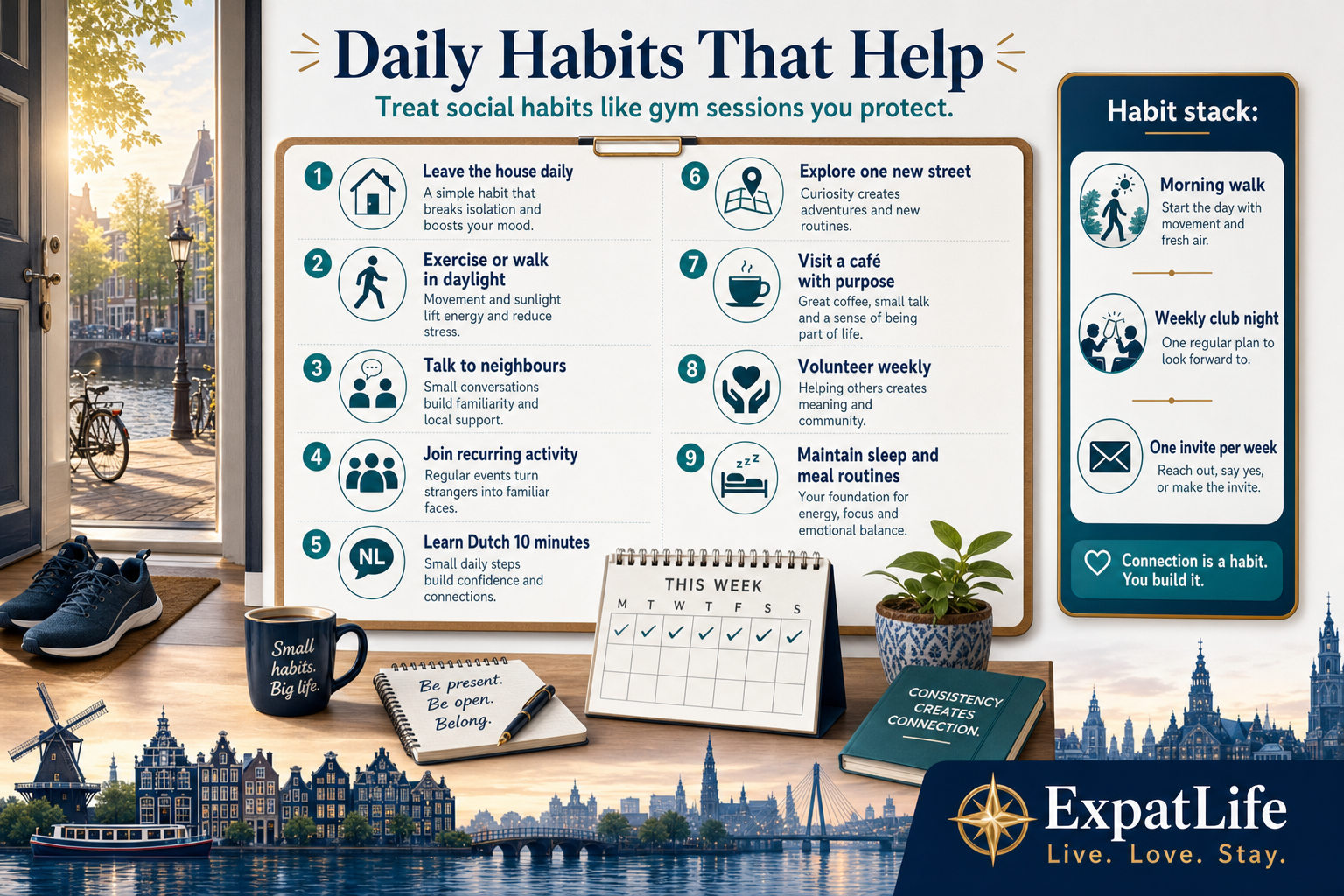
Belonging is rebuilt in small repetitions. Protect a few habits rather than overhauling your entire personality.
Belonging habits checklist
Friends & dating
When you feel lonely, dating can look like the fastest fix. A caring partner helps — but putting all belonging pressure on romance often backfires. Friendships, colleagues-turned-mates and neighbourhood ties spread emotional support across more than one relationship.
Keep a friendship route active even while dating. Activity-first groups also tend to create healthier dating opportunities than isolation plus apps alone.
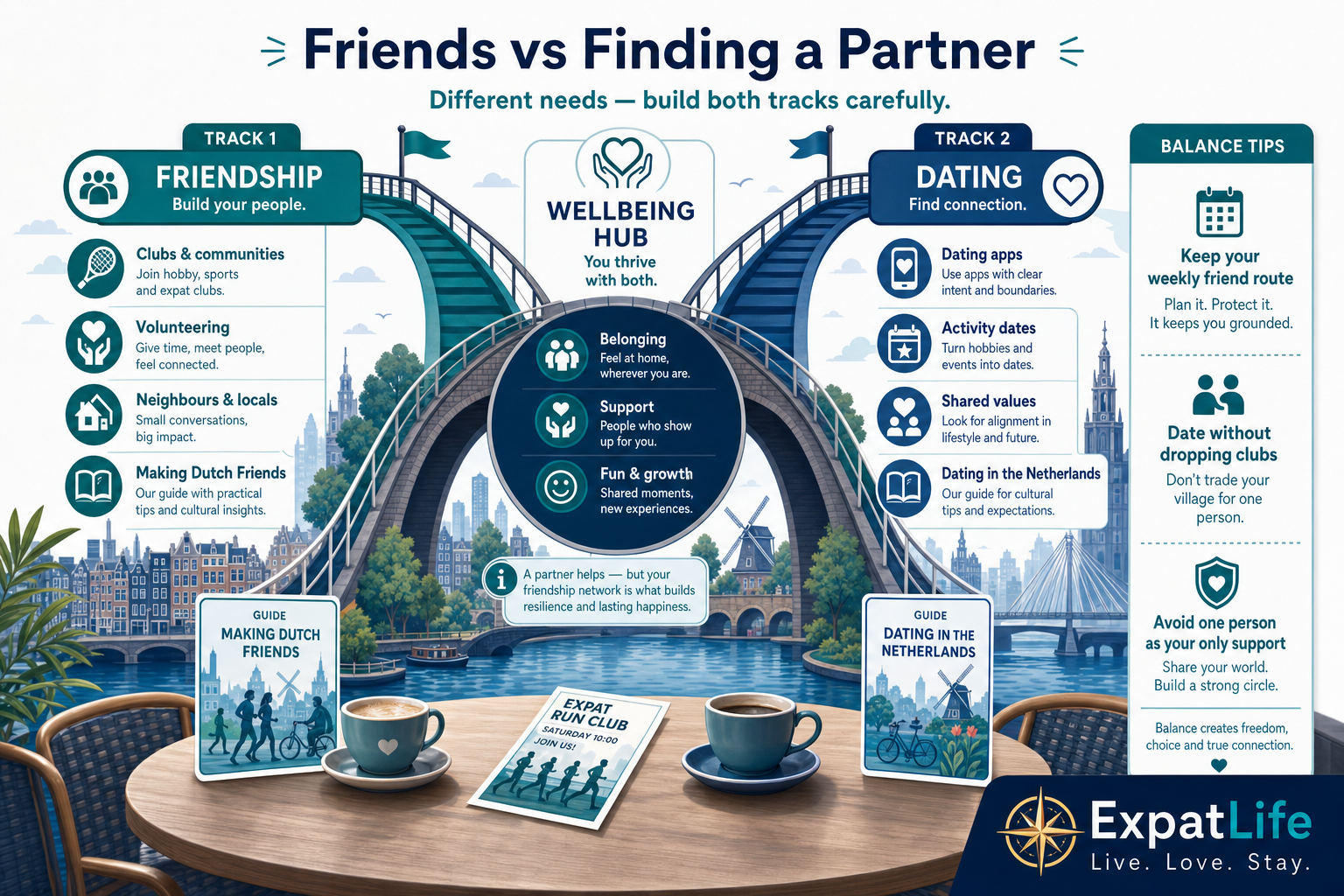
| Situation | Approach | First step |
|---|---|---|
| New in town and only using dating apps | Add one weekly non-dating activity so belonging is not app-dependent | Join a language café or sport intro this week |
| In a new relationship and dropping all friends plans | Protect one friendship habit — clubs, volunteering or a standing coffee | Put the weekly group back on both calendars |
| Want friends first, romance later | Focus on hobby and volunteer routes; let dating emerge from shared context | Pick one high-repeat method from the best-ways table |
Homesickness
Homesickness is longing for familiar people, places, food, humour and identity — not proof you chose wrong. It often spikes after the novelty fades, during holidays or in dark winter months.
The helpful pattern is both/and: stay connected to home and plant local rituals that make the Netherlands feel more like yours. Isolation plus endless comparison usually makes homesickness louder.
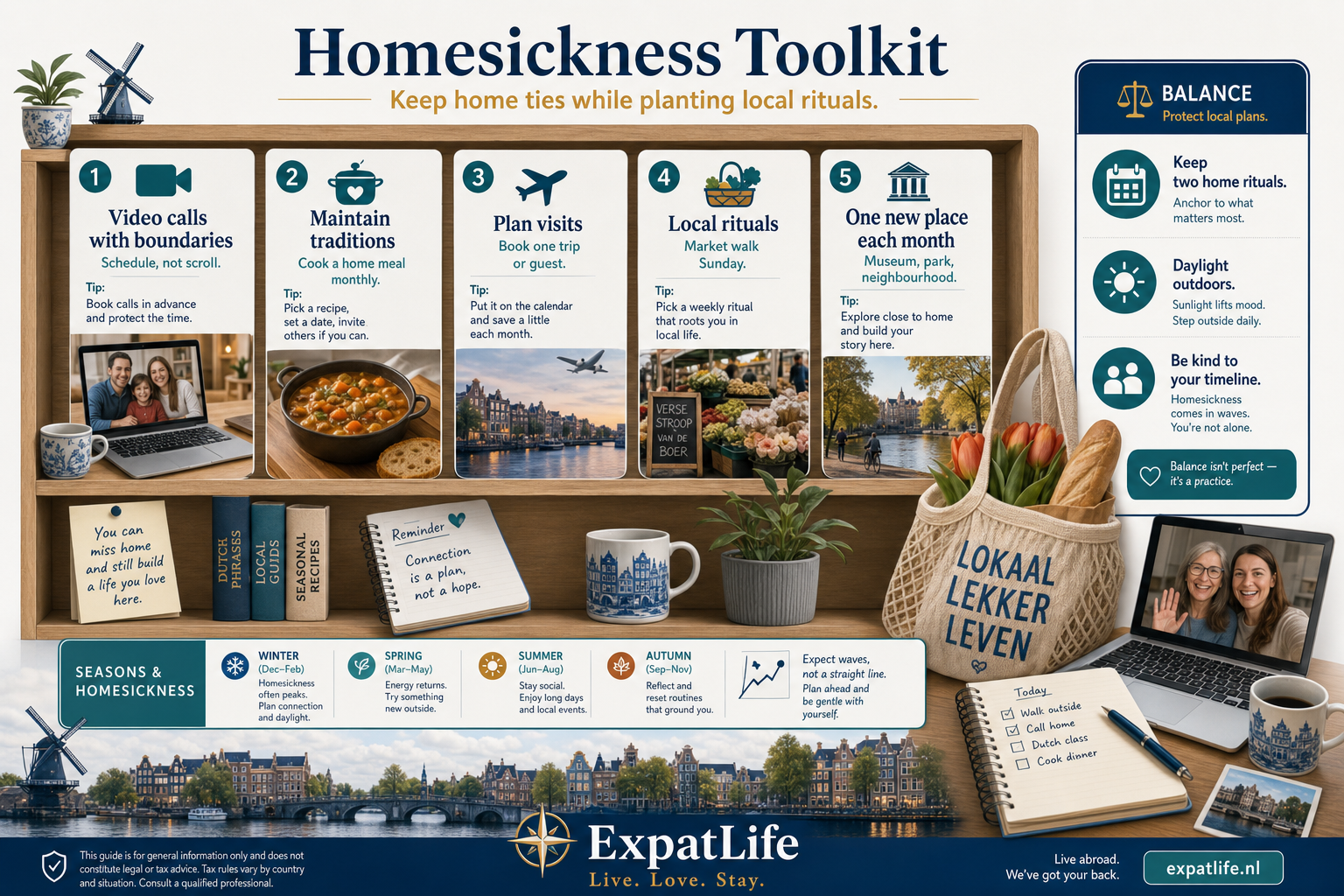
Homesickness tips
Life stages
Your best antidotes depend on schedule, energy and who you live with. Use the tip that matches your stage instead of copying a strategy built for someone else's week.
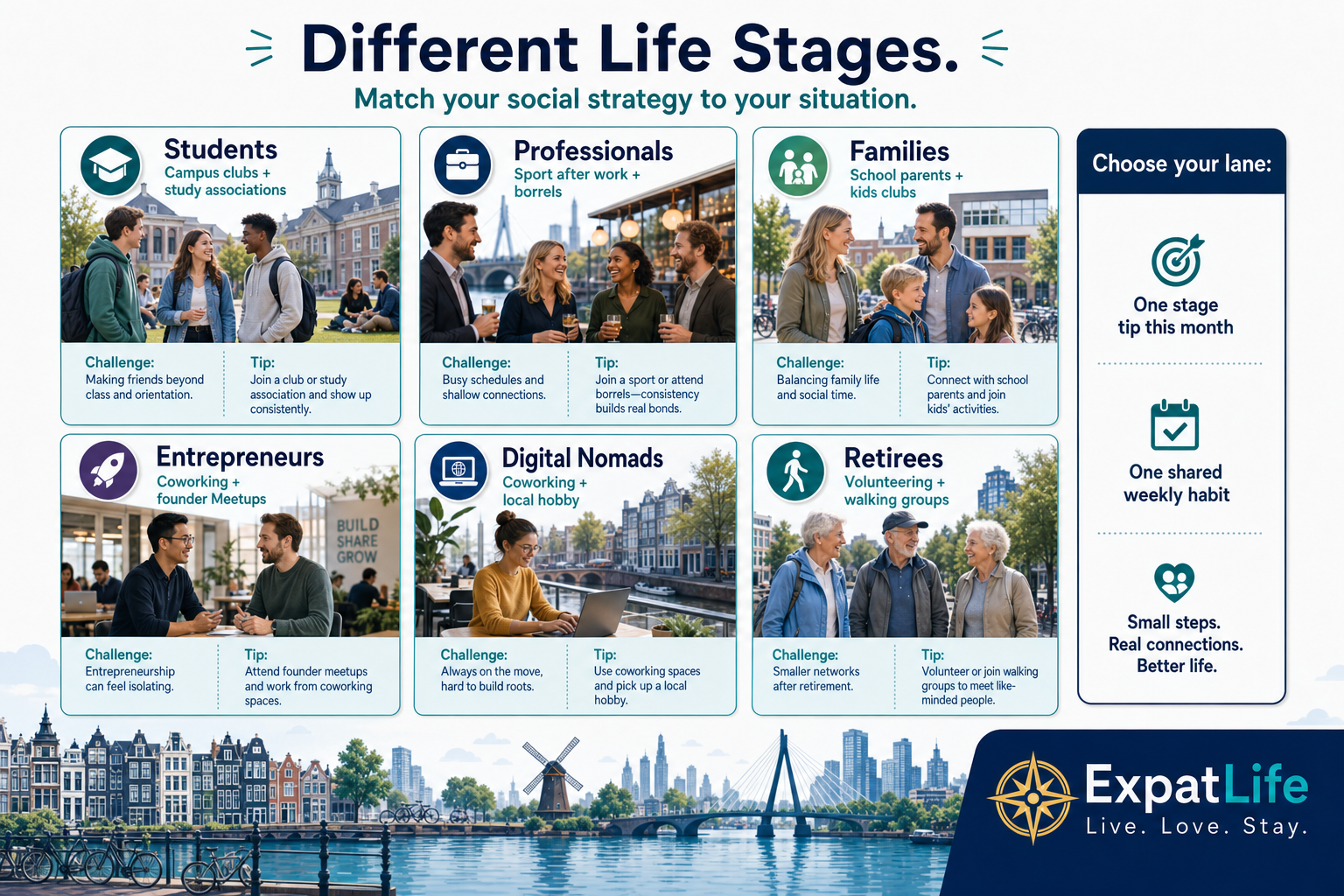
Transient classmates, tight budgets, intense comparison during intro weeks
Tip: Join one association or campus sport for the full semester — not only orientation week.
Long work weeks, international turnover, work-only social contact
Tip: Schedule one non-work weekly club the way you schedule gym sessions.
Little evening energy, partner as only adult company, school language barriers
Tip: Use school gates and kids' sport sidelines — stay for coffee after drop-off or matches.
Irregular hours, financial stress, networking that feels transactional
Tip: Pair founder Meetups with a hobby or sport that has nothing to do with pitching.
Short stays, shallow contacts, café-hopping without recurrence
Tip: Even on a three-month visa, repeat the same Meetup or coworking community weekly.
Fewer workplace contacts, quieter evenings, smaller digital-first networks
Tip: Daytime walking clubs, library groups and volunteer desks often fit better than late Meetups.
Support
Community habits help many people feel less lonely. Sometimes loneliness sits alongside ongoing low mood, anxiety, grief or exhaustion that needs more than Meetup attendance. Seeking help is a practical step — not a failure of integration.
Start with your huisarts (GP) if loneliness or low mood affects sleep, work, appetite or daily function. Municipal pages may list local wellbeing programmes. Trusted friends and peer groups can walk beside you while professionals provide care.
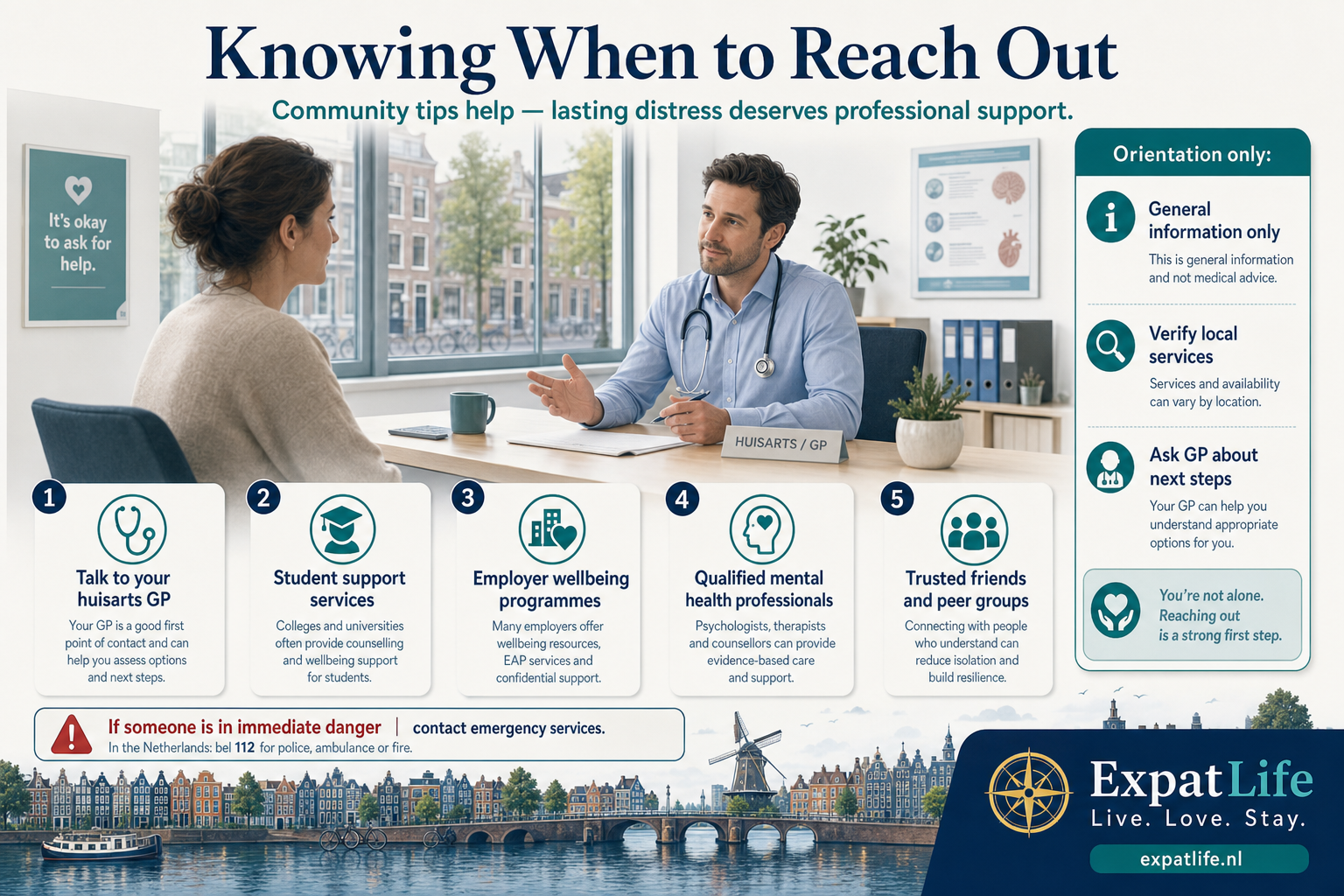
Support routes
Stories
These fictional examples are realistic composites — not guarantees. Most share weekly consistency for several months before loneliness eased.
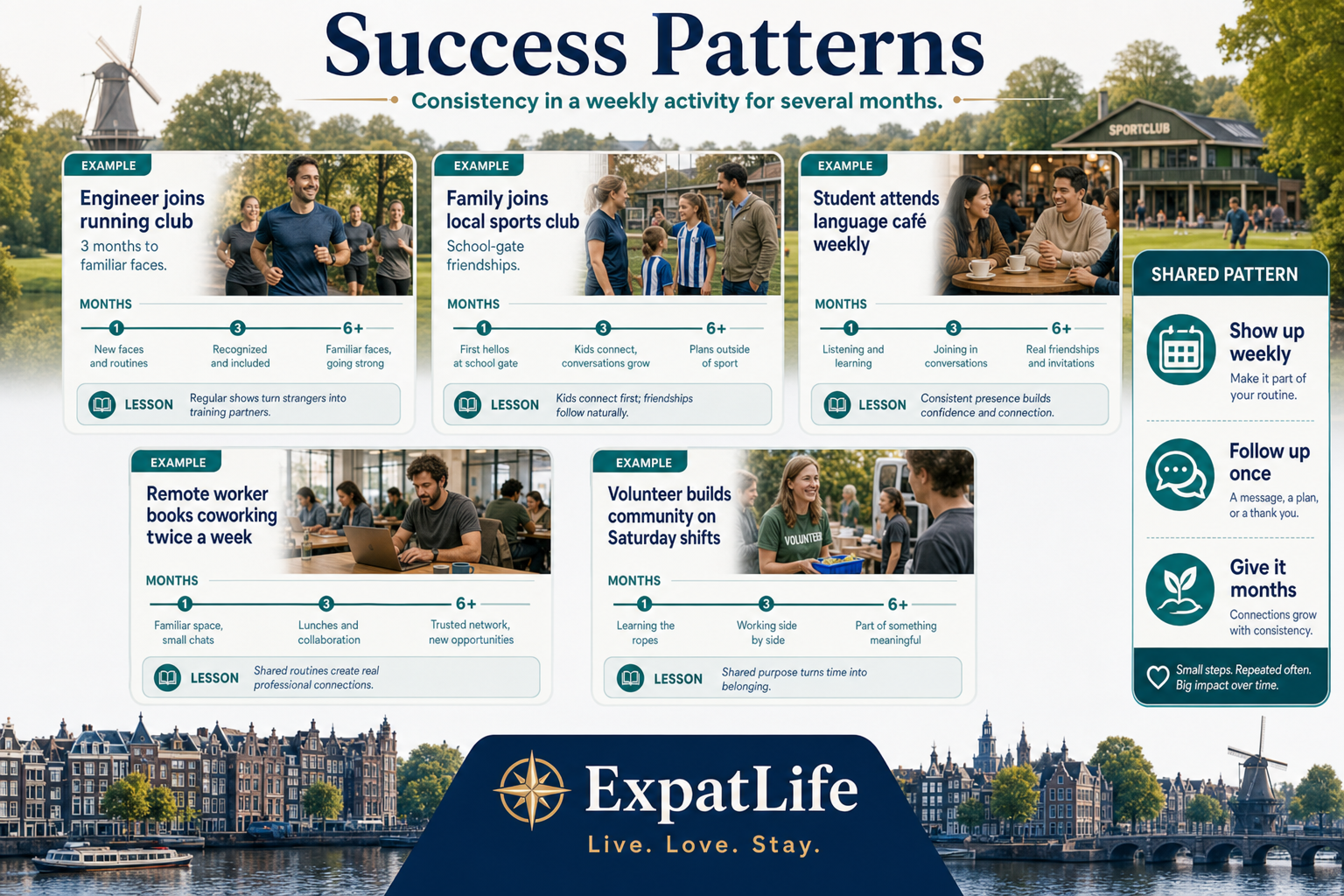
Amsterdam
Lesson: Remote Mondays felt heavy until fixed sport and coworking days created rhythm.
Utrecht
Lesson: Evening Meetups failed — daytime family-adjacent contact worked.
Rotterdam
Lesson: Volunteering created deeper bonds than large expat mixers alone.
Groningen
Lesson: Campus sport intros beat waiting for classmates to initiate.
Haarlem
Lesson: Daytime local groups suited energy better than late-night networking.
Mistakes
Most loneliness friction is strategy — adjust channels before concluding you will never belong here.

People often assume newcomers are busy or temporary. Passive waiting extends isolation.
Fix: Send one concrete coffee or walk invite each week.
Romance can help — it rarely replaces a broader friendship network on its own.
Fix: Keep one non-dating weekly activity on the calendar.
Familiarity usually starts after several repeats. Early awkwardness is normal.
Fix: Commit to six sessions of the same group before switching.
International friends are valuable for orientation — exclusive bubbles can slow local roots.
Fix: Add one local club, volunteer shift or language café.
Social media hides how long belonging took for others.
Fix: Track your own attendance streak, not other people's highlight reels.
Grey months reduce spontaneous socialising — without indoor plans, isolation deepens.
Fix: Pre-book indoor clubs and daylight walks from November onward.
Resources
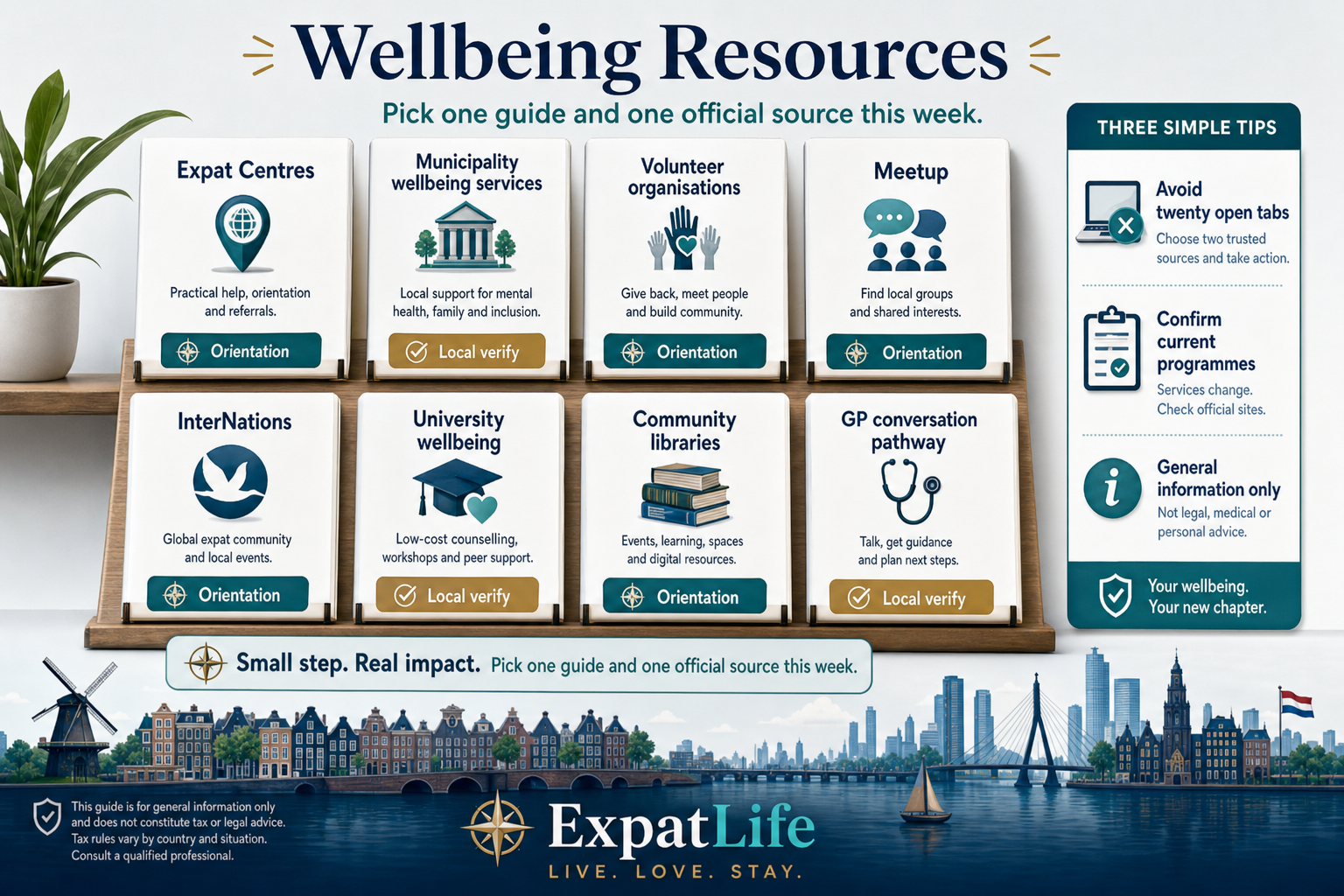
Pick one internal guide and one official source — avoid drowning in twenty tabs this week.
FAQ
Confirm local group and support details — offerings and wait times change by city and season.
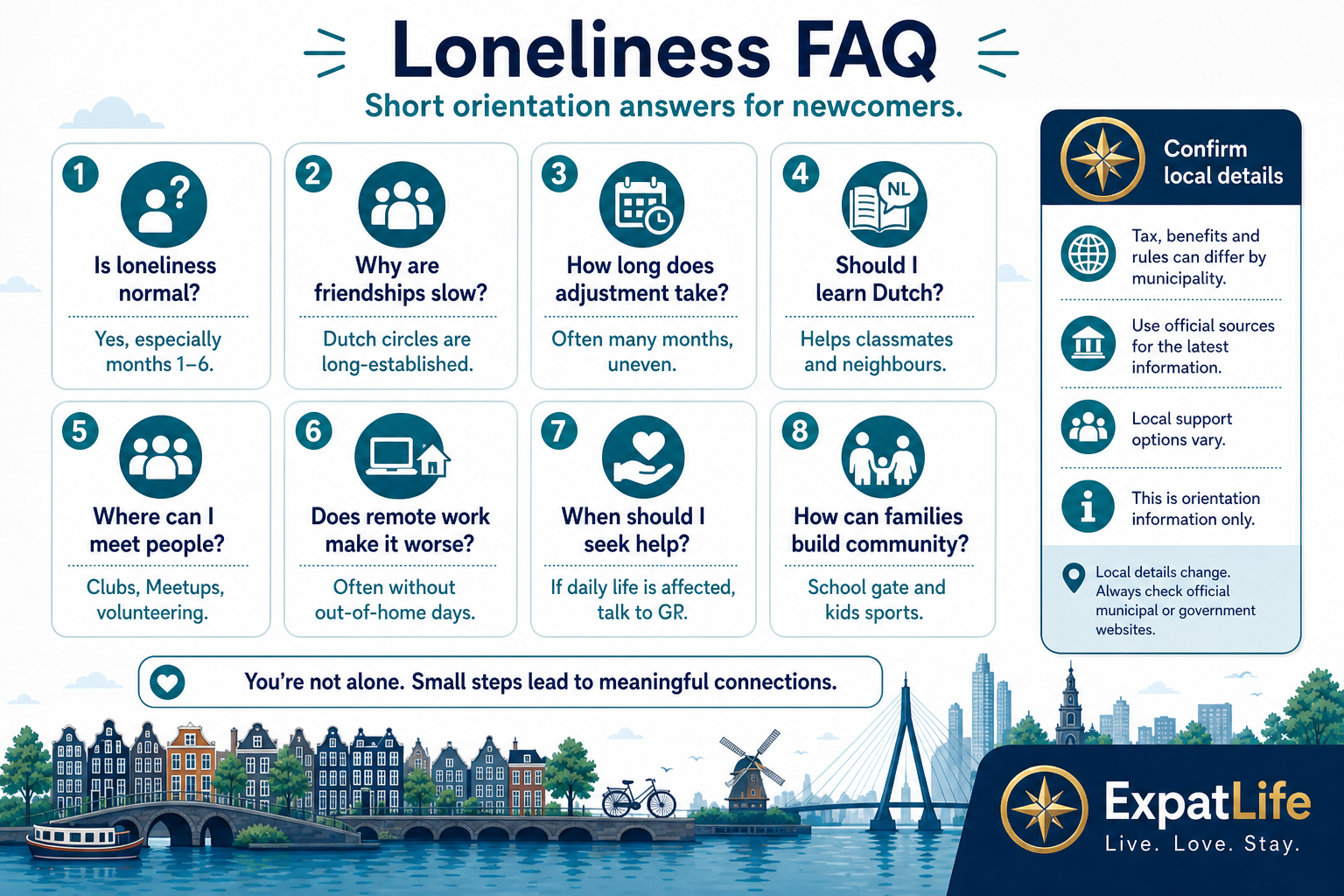
Yes. Many expats feel lonely in the first months even when work and housing are fine. Leaving networks behind and rebuilding through slower, activity-based friendships is a common relocation pattern — not a personal failure.
It varies widely. Activity partners often appear within weeks; a stronger sense of belonging commonly grows between months three and twelve. Progress is uneven — winter, remote work and life stage all affect timing.
A recurring weekly activity (sport, volunteering, language café or hobby group), small daily contact habits and one concrete follow-up invite tend to help more than one-off networking nights.
Many adults already have established circles, calendars fill early and friendships often grow through clubs rather than spontaneous plans. Choosing recurring groups matches how social life often works locally.
Expat groups are excellent for orientation and practical tips. For longer-term belonging, pair them with at least one local club, volunteer shift, neighbourhood ritual or language café.
English is enough to start in many cities. Dutch effort still opens neighbourhood life, local-only groups and signals you are investing in staying — which often deepens friendships over time.
Design out-of-home contact: coworking days, café work blocks, professional Meetups and one non-work weekly activity so all human contact is not limited to screens.
If loneliness or low mood persists, worsens, or affects sleep, work, appetite or daily function, talk to your huisarts (GP) or a qualified professional. In immediate danger, contact emergency services; for suicide prevention support in the Netherlands, see 113.nl.
Related
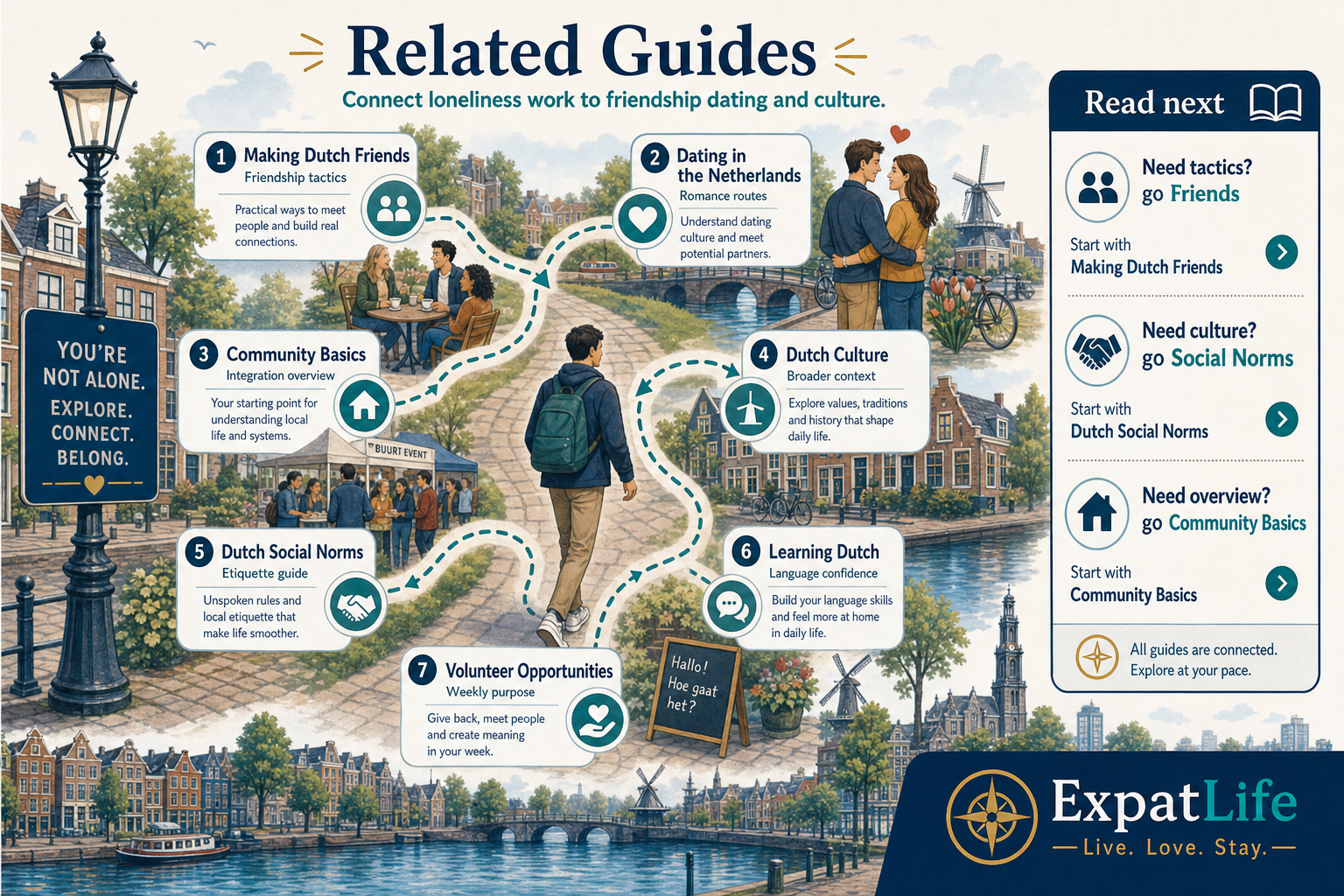
Loneliness work sits inside wider community building — friendship and culture guides reinforce each other.
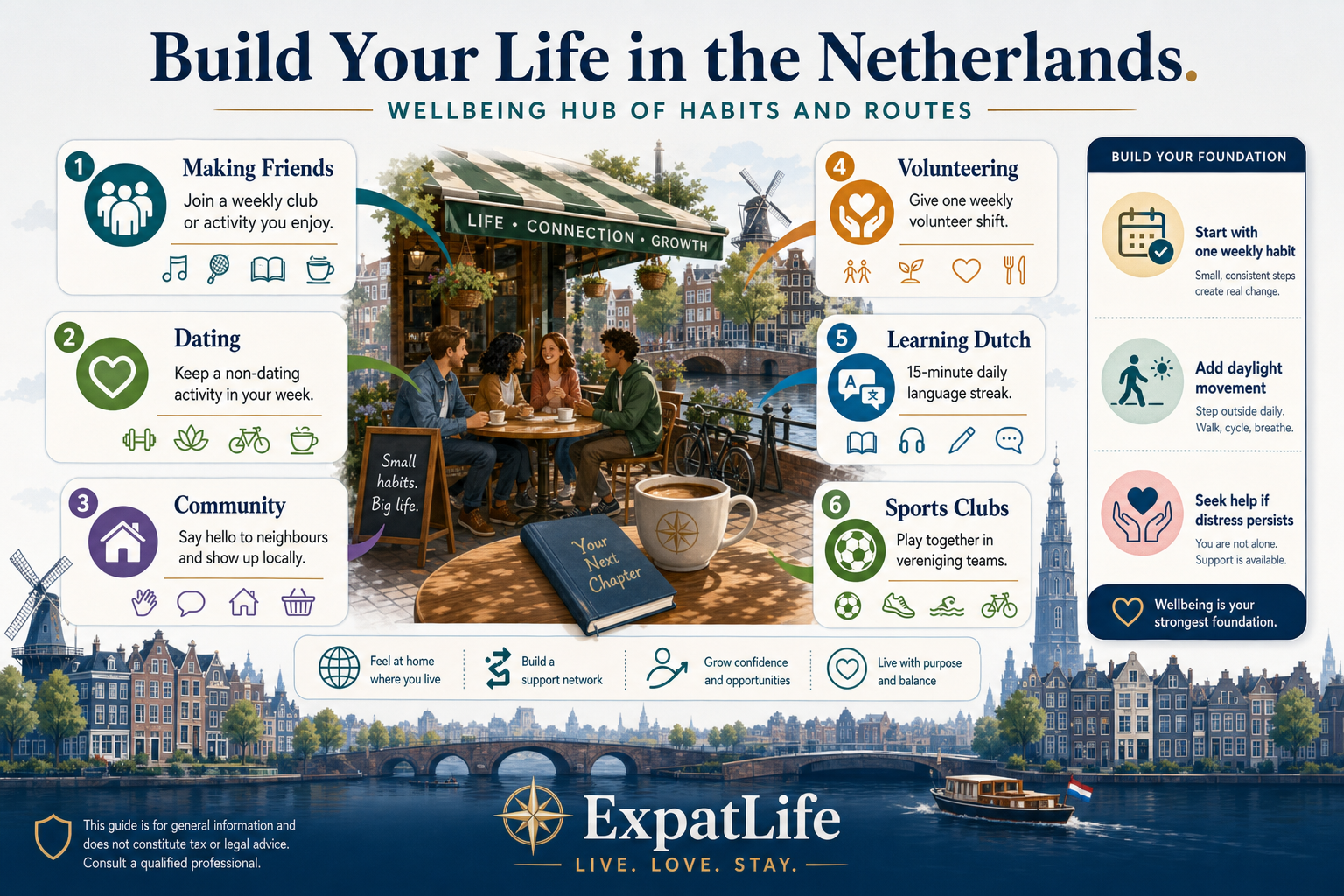
Wellbeing hub
Treat wellbeing as a hub of habits — social contact, movement, language and help-seeking when needed.
Explore next
Pick the card matching whether you need friendship tactics, culture context or city comparison first.

Trust
Official links are for orientation. Group schedules, municipal programmes and support services change — verify details on the source site. This guide is not medical advice and does not replace GP or specialist care.
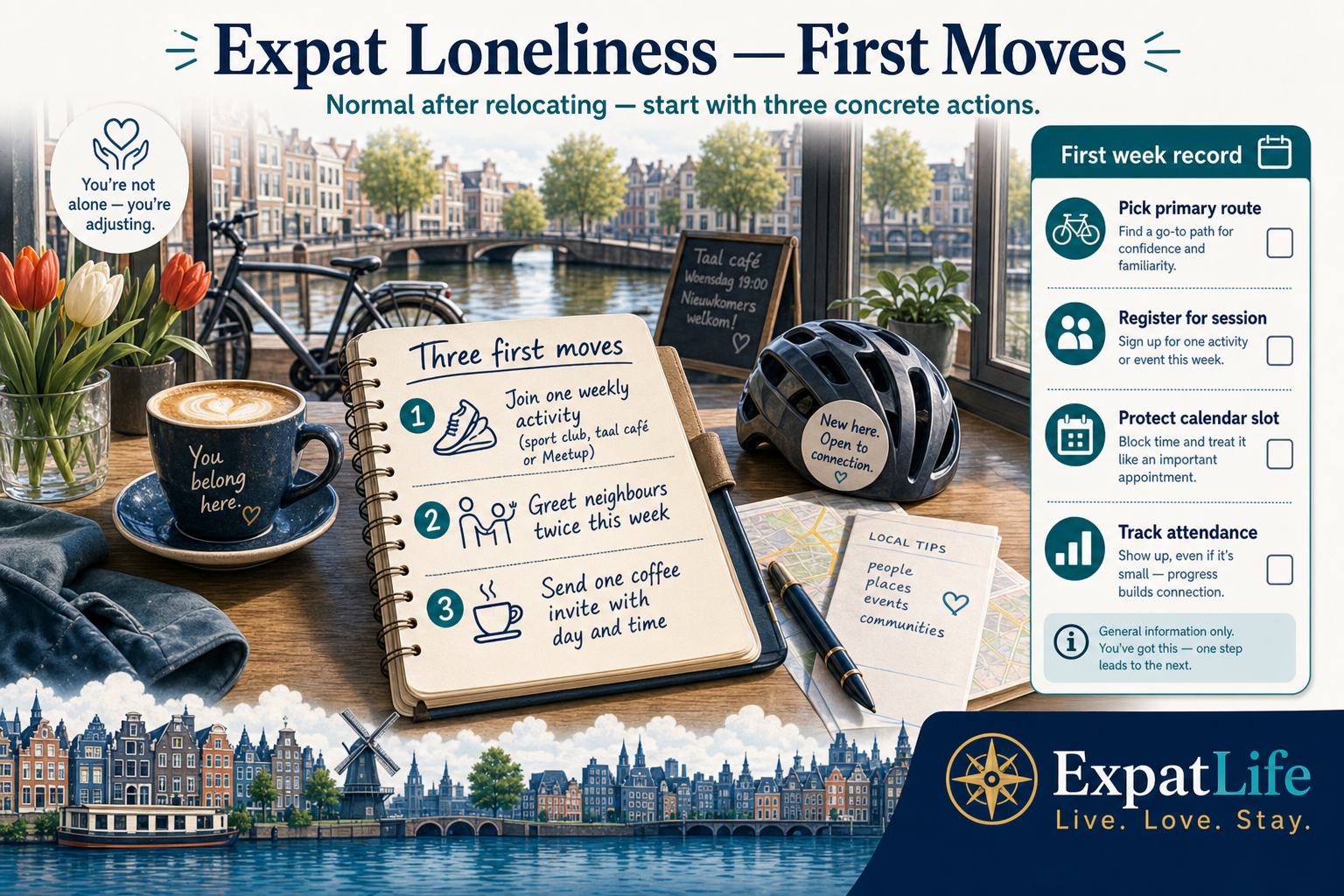
30-day reset
30-Day Social Reset
Use four weeks as a structured experiment. The goal is rhythm and follow-up — not instant best friends.
Week 1 — Orient
Choose routes and clear friction
Week 2 — Show up
Attendance and first introductions
Week 3 — Follow up
Turn familiarity into a plan
Week 4 — Review rhythm
Keep what is sustainable
Reset checklist — track attendance