
Should I bring a gift?
Often appreciated, rarely required — flowers, wine or dessert are safe. Ask the host if unsure.
Life in the Netherlands · Culture
Understand the everyday customs, etiquette and unwritten rules that help newcomers feel more comfortable living in the Netherlands.
Orientation only — social customs vary by person, region, age and household. Observe locally and ask politely rather than assuming one national style fits everyone.
Quick answer
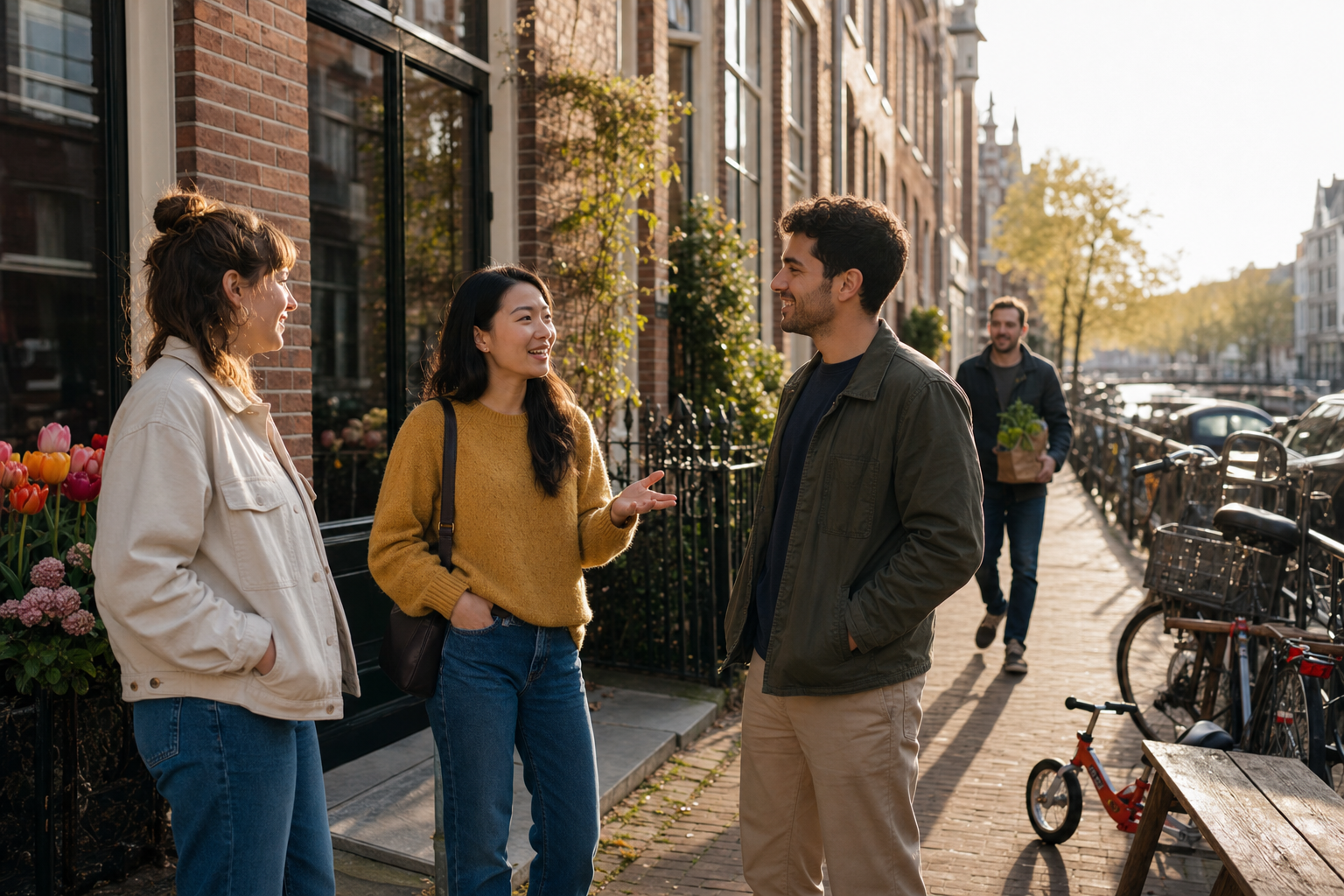
Moving to the Netherlands brings practical tasks — housing, registration, banking — and a quieter layer of social learning. Everyday greetings, birthday customs, bill splitting and neighbour etiquette can surprise newcomers even when Dutch colleagues speak excellent English.
This guide explains common social norms in balanced, practical language. It focuses on everyday life outside the office: how people greet each other, plan visits, celebrate birthdays and share public space. For workplace communication, see our dedicated workplace culture guides.
Often appreciated, rarely required — flowers, wine or dessert are safe. Ask the host if unsure.
Common among friends — follow the other person's lead; a handshake is fine if unsure.
Usually issue-focused — ask what practical outcome is needed before reacting.
Repeated contact through clubs, language class or neighbours — see Community Basics.
At a glance
Six orientation signals — then verify with your neighbourhood and colleagues.

Greetings
Handshake or cheek kisses
Follow the other person's lead
Punctuality
5–10 min early
Especially for appointments
Visiting
RSVP + small gift
Ask about shoes
Paying together
Split or Tikkie
Confirm before ordering
Arriving on time shows respect — confirm expectations for casual plans.
Direct questions and answers are common — ask for context if tone surprises you.
Unplanned visits and personal questions may feel intrusive — plan ahead.
Calendars fill early — RSVP and arrive at agreed times.
Informal titles and flat hierarchies appear in many social settings.
Simple, efficient solutions beat elaborate fuss in daily interactions.
How to use this snapshot
Greetings set the tone for Dutch social life. In professional settings, a firm handshake and eye contact are standard for introductions. Among friends and family, cheek kisses (often three) may appear — follow the other person's lead if you are unsure.
In shops, offices and neighbourhoods, time-of-day greetings (goedemorgen, goedemiddag, goedenavond) are widely used. Casual doei or tot ziens work among peers. When meeting someone new, stating your name clearly and asking theirs is a safe default.

| Situation | Dutch phrase | English | Note |
|---|---|---|---|
| Morning — shop or neighbour | Goedemorgen | Good morning | Widely expected before noon. |
| Afternoon — office or café | Goedemiddag | Good afternoon | Polite default until early evening. |
| Evening — restaurant | Goedenavond | Good evening | Use from late afternoon onward. |
| Casual goodbye | Doei / Tot ziens | Bye / See you | Fine among peers and neighbours. |
| Birthday | Gefeliciteerd! | Congratulations! | Add the person's name. |
| First introduction | Aangenaam, ik ben… | Nice to meet you, I'm… | Handshake + eye contact in professional settings. |
| Setting | Hello | Goodbye | Note |
|---|---|---|---|
| Office — first meeting | Handshake + 'Aangenaam, ik ben…' | 'Fijne dag' / 'Tot morgen' | Use first names once invited. |
| Friends — birthday borrel | Cheek kisses + 'Gefeliciteerd!' | 'Doei, tot snel' | Congratulate the birthday person and sometimes their relatives. |
| Neighbour — hallway | 'Hallo' / 'Goedemorgen' | Nod or brief 'Doei' | Short and friendly is enough. |
| Shop or café | 'Goedemiddag' to staff | 'Dank u wel, tot ziens' | Politeness is noticed even in quick transactions. |
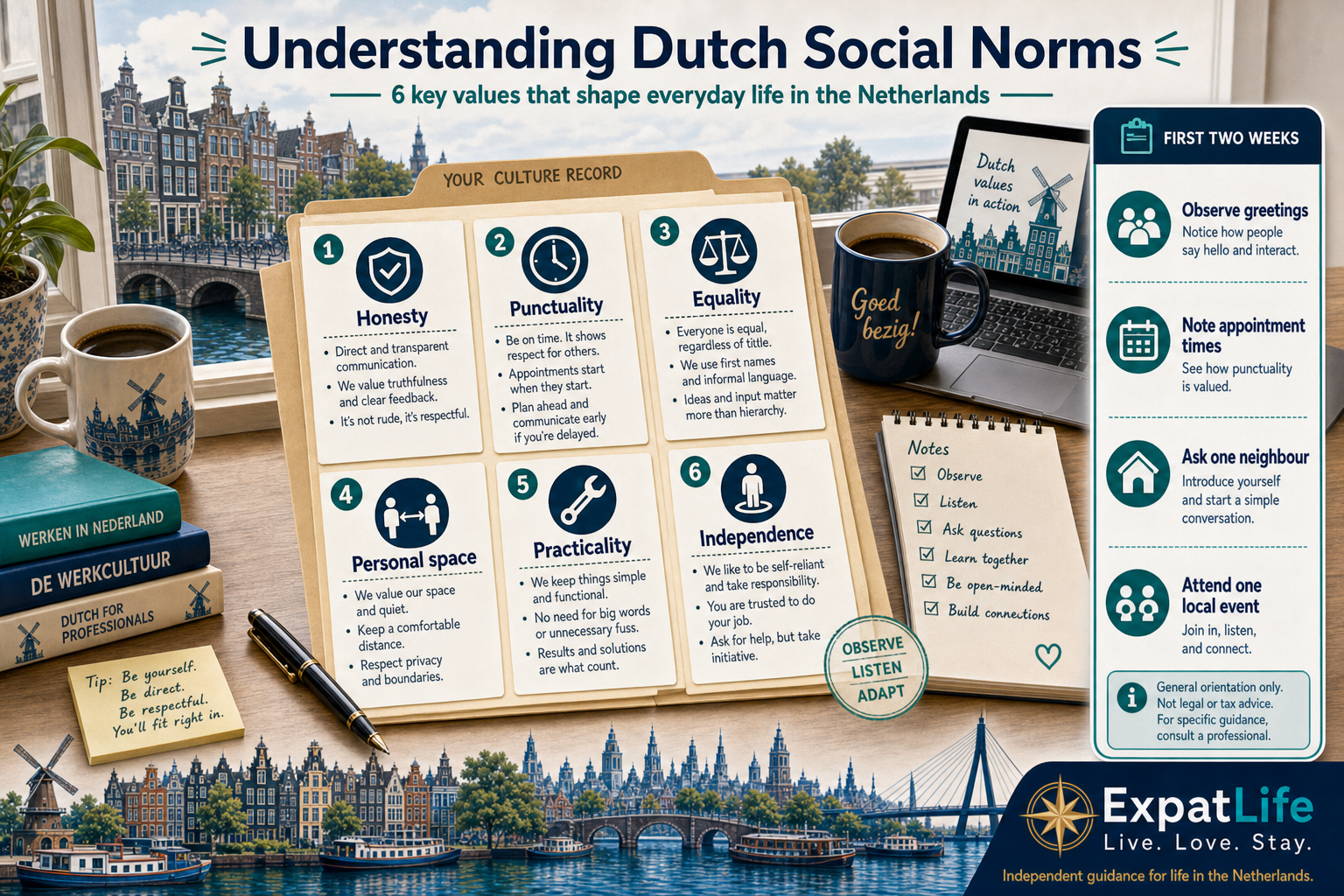
Punctuality is one of the most cited Dutch social expectations. Appointments for doctors, gemeente visits and work meetings generally start on time. Arriving five to ten minutes early is often safer than arriving late.
Social plans vary: dinner at someone's home usually means the agreed time is the arrival time. Casual drinks may allow a little flexibility — message the group if you are delayed.

| Situation | Expectation | Tip |
|---|---|---|
| Dinner invitation | Arrive at the agreed time — not significantly early or late. | Ask whether to bring something. |
| Medical appointment | Check in before the scheduled time. | Bring ID and insurance details. |
| Business meeting | Start on time; join quietly if unavoidably late. | Message ahead when possible. |
| King's Day street party | Flexible — crowds and transport affect timing. | Plan transport early. |
Punctuality quick check
Invitations are usually planned in advance. Spontaneous drop-ins are less common than in some cultures. When invited, confirm time, location and whether partners or children are welcome.
A small gift — flowers, wine, dessert or something for the children — is often appreciated but not mandatory. Some households ask guests to remove shoes; others do not. When in doubt, ask or follow the host's example.

| Step | What to do |
|---|---|
| Before you go | Confirm time, address, parking and whether partners or children are welcome. |
| What to bring | Small gift optional — flowers, wine, dessert or something for children. |
| Arrival | Ring the bell at the agreed time; wait to be invited in. |
| Shoes | Follow the host — ask 'Schoenen uit?' if you see a shoe rack or others remove theirs. |
| During the visit | Offer to help once; accept 'no' gracefully; keep voice moderate. |
| Afterward | Send a brief thank-you message — 'Bedankt voor de gezellige avond' works well. |
Odd numbers for some occasions — ask the florist if unsure.
Match the meal if you know it; non-alcoholic options are fine.
Appreciated when the host is cooking.
Book or small toy if kids are invited.
Birthdays are celebrated in structured, social ways. Office 'circle' gatherings with coffee and cake are common. At some parties, guests congratulate not only the birthday person but also their partner, parents or children — a custom that surprises many expats the first time.
Seating in a circle for home parties keeps everyone included. Treats are often brought to the office rather than the office organising a large event. Ask colleagues how your team handles birthdays before your first one.

| Situation | Dutch phrase | English | Note |
|---|---|---|---|
| Birthday person | Gefeliciteerd met je verjaardag! | Happy birthday! | Use their name. |
| Partner or parent (some circles) | Gefeliciteerd met [name]! | Congratulations on [name]'s birthday | Common at home parties — follow others. |
| Office circle | Proost / Op jou! | Cheers / To you | After coffee and cake. |
| Declining late stay | Ik moet gaan, bedankt! | I have to go, thanks! | End times are often stated upfront. |
Office birthday checklist
Splitting costs fairly is everyday practice. Restaurants may ask whether you want one bill or separate tabs. Friends commonly use Tikkie to request exact shares after shared meals, groceries or tickets.
Practices vary: some groups rotate who pays; others split immediately. Follow the established habit of the group or ask before ordering.

| Context | Common practice | Note |
|---|---|---|
| Restaurant with friends | Split by item or equally — confirm before paying. | Card and mobile payment widely accepted. |
| Shared household | Apps track rent, utilities and groceries. | Write agreements down for clarity. |
| Office lunch | Individual payment common. | Avoid assuming one person treats the team. |
| Birthday gift pool | Tikkie link in group chat. | Participation is optional but appreciated. |
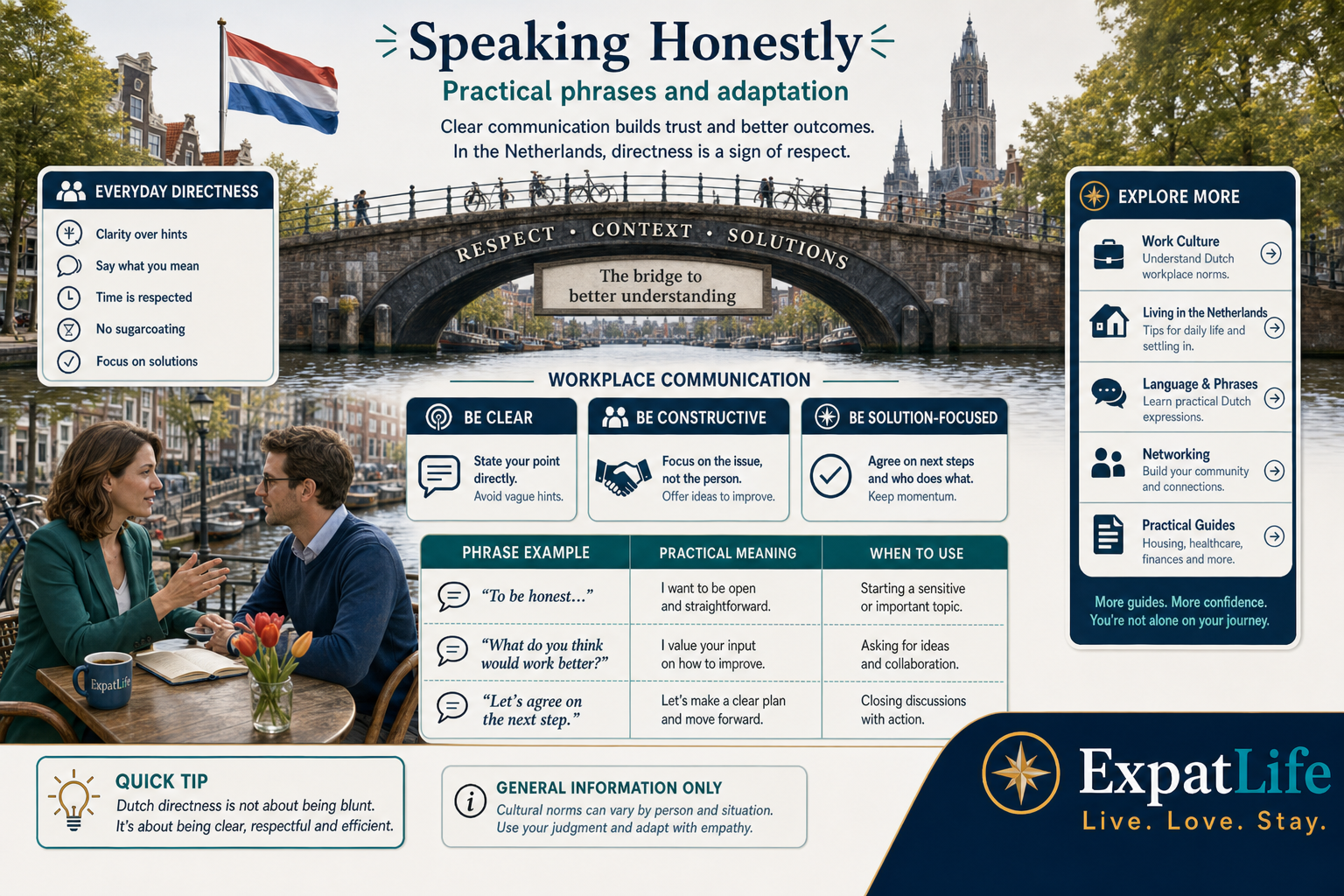
Direct communication appears in everyday life as well as at work. Short answers, clear requests and open disagreement in group settings are common. The goal is usually efficiency and shared understanding — not personal criticism.
If tone feels sharp, ask what practical outcome is needed. For workplace-specific feedback, meeting debate and manager 1:1s, use our dedicated workplace guides linked below.
| What you might hear | Often means | Try responding |
|---|---|---|
| 'Nee, dat werkt niet.' | That approach won't work — let's try another. | Ask: 'Wat zou wel werken?' (What would work?) |
| 'Ik ben eerlijk: …' | Prefacing direct feedback — not an attack. | Listen for the practical point, not the blunt wrapper. |
| 'We moeten efficiënt zijn.' | Keep the meeting or chat focused. | Summarise next steps out loud. |
| Short 'Ja' / 'Nee' in shops | Normal efficiency — not rudeness. | Mirror brevity; add 'Dank u wel' at checkout. |
| 'Dat is niet handig.' | That timing or method causes problems. | Ask for a preferred alternative. |
Personal space and privacy are widely respected. Unplanned visits, lengthy personal questions or loud behaviour in shared spaces can cause friction. Many people protect evenings and weekends with calendar planning.
Questions about salary, rent, weight or relationships may feel normal in some home cultures but intrusive here. Polite deflection — 'I'd rather not say' — is acceptable.

| Sensitive question | Polite response | Note |
|---|---|---|
| How much do you earn? | 'Daar praat ik liever niet over.' / 'I'd rather not say.' | Polite deflection is widely accepted. |
| Why aren't you married yet? | 'Daar ben ik nog niet aan toe.' / 'That's private, thanks.' | Change topic after declining. |
| Can I drop by tonight? | 'Vanavond lukt niet — zullen we een moment plannen?' | Offer to schedule instead of refusing bluntly. |
| Can I borrow money? | 'Ik leen liever geen geld aan vrienden.' | Financial boundaries are normal. |
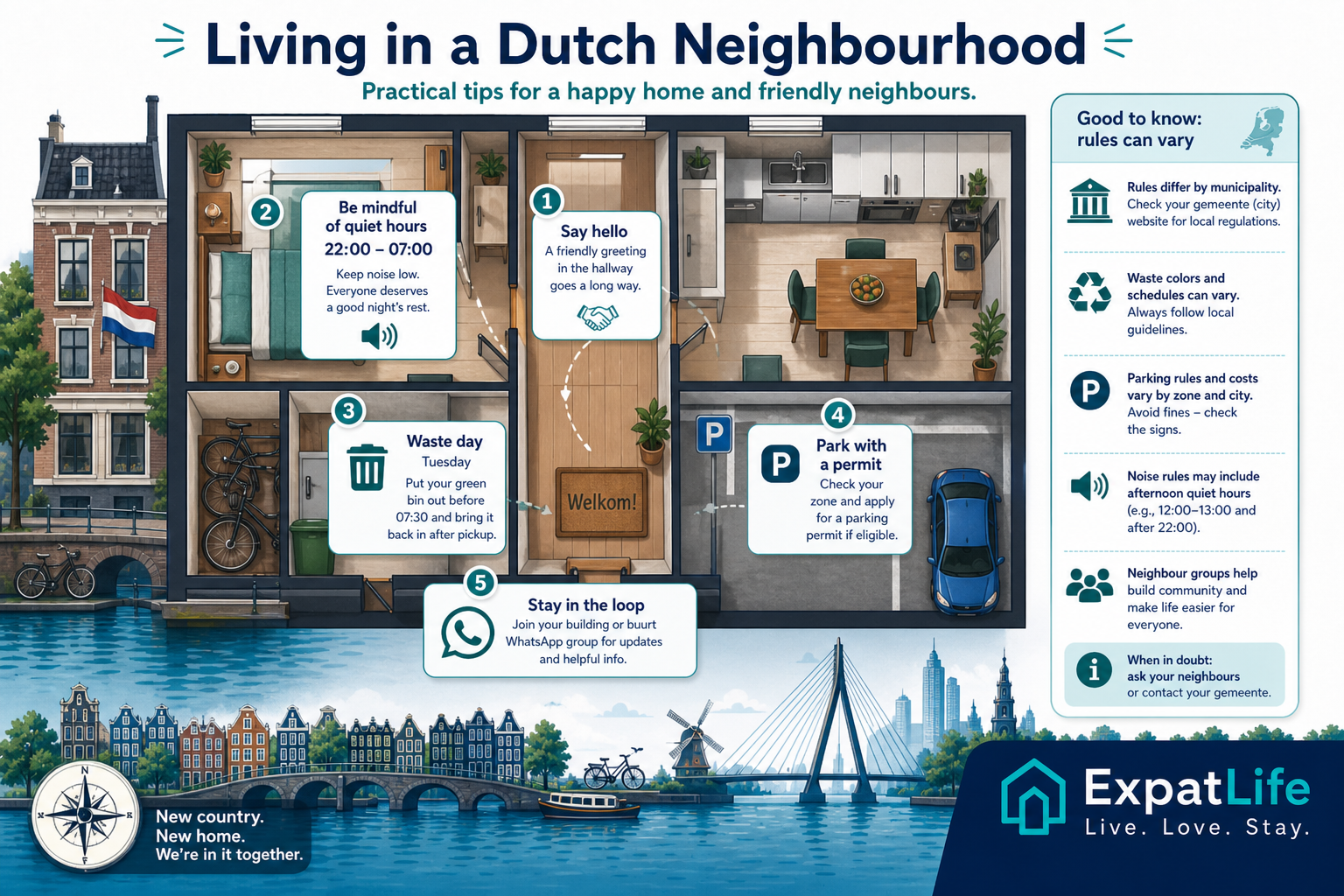
Neighbour relations are often friendly and practical. Brief hallway greetings, quiet-hour awareness and correct waste sorting go a long way. Buurt WhatsApp groups share package deliveries, lost keys and local notices.
Parking, shared gardens and bicycle storage can become friction points — address issues calmly and early. Municipal rules on waste and parking vary by city.
| Situation | Helpful action | Note |
|---|---|---|
| Moving in | Introduce yourself briefly — name and floor. | A short note in the hallway group helps. |
| Noise after 22:00 | Lower volume; message neighbours if hosting. | Rules vary — check building or gemeente guidance. |
| Wrong bin day | Ask a neighbour or check gemeente calendar. | Sorting errors can lead to fines. |
| Package for neighbour | Accept if asked; leave a note on their door. | Buurt WhatsApp groups coordinate this often. |
Cycling is everyday transport for many residents — not only a tourist activity. Bike lanes, hand signals, lights and considerate parking matter for safety and neighbour relations.
Pedestrians, trams and cars interact closely in cities. Ring your bell early, pass with space and never block wheelchair ramps or doorways with parked bikes.
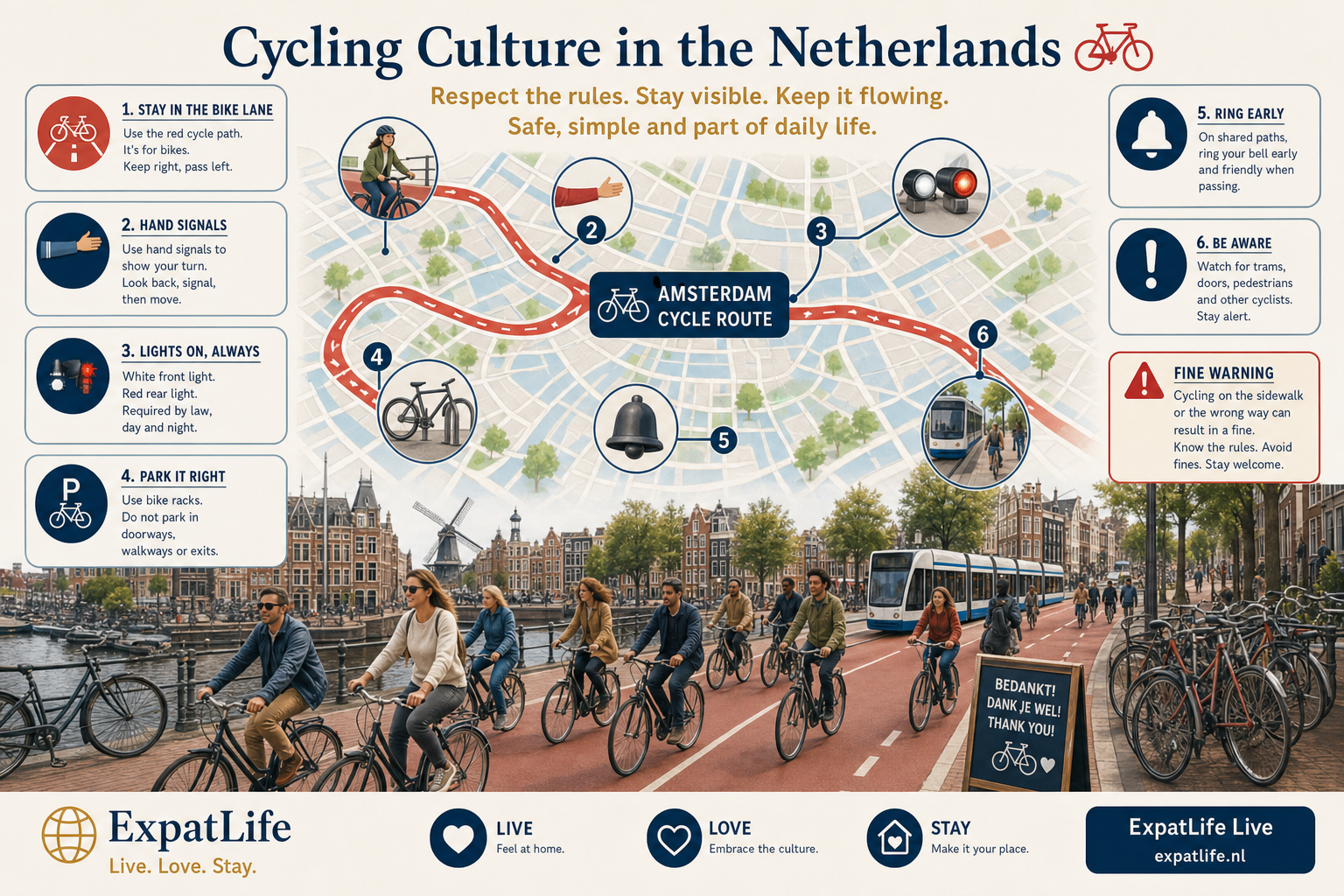
| Situation | Rule / courtesy | Note |
|---|---|---|
| Bike lane blocked | Ring bell early; pass with space. | Apologise if you startled someone. |
| Turning at junction | Hand signal + check mirrors and trams. | Trams often have priority. |
| Parking at home | Use rack or designated area — not doorways. | Blocked paths frustrate neighbours. |
| Shared path with pedestrians | Pedestrians first; slow down. | Ring bell before overtaking. |
| After dark | White front + red rear lights required. | Fines apply without lights. |
Public transport (OV) expects quiet, orderly behaviour. Check in and out with OV-chipkaart, contactless or app. Quiet zones prohibit phone calls; priority seats are for those who need them.
During rush hour, remove backpacks from seats and let passengers exit before boarding. Staff and inspectors check tickets — fines apply for travelling without valid fare.
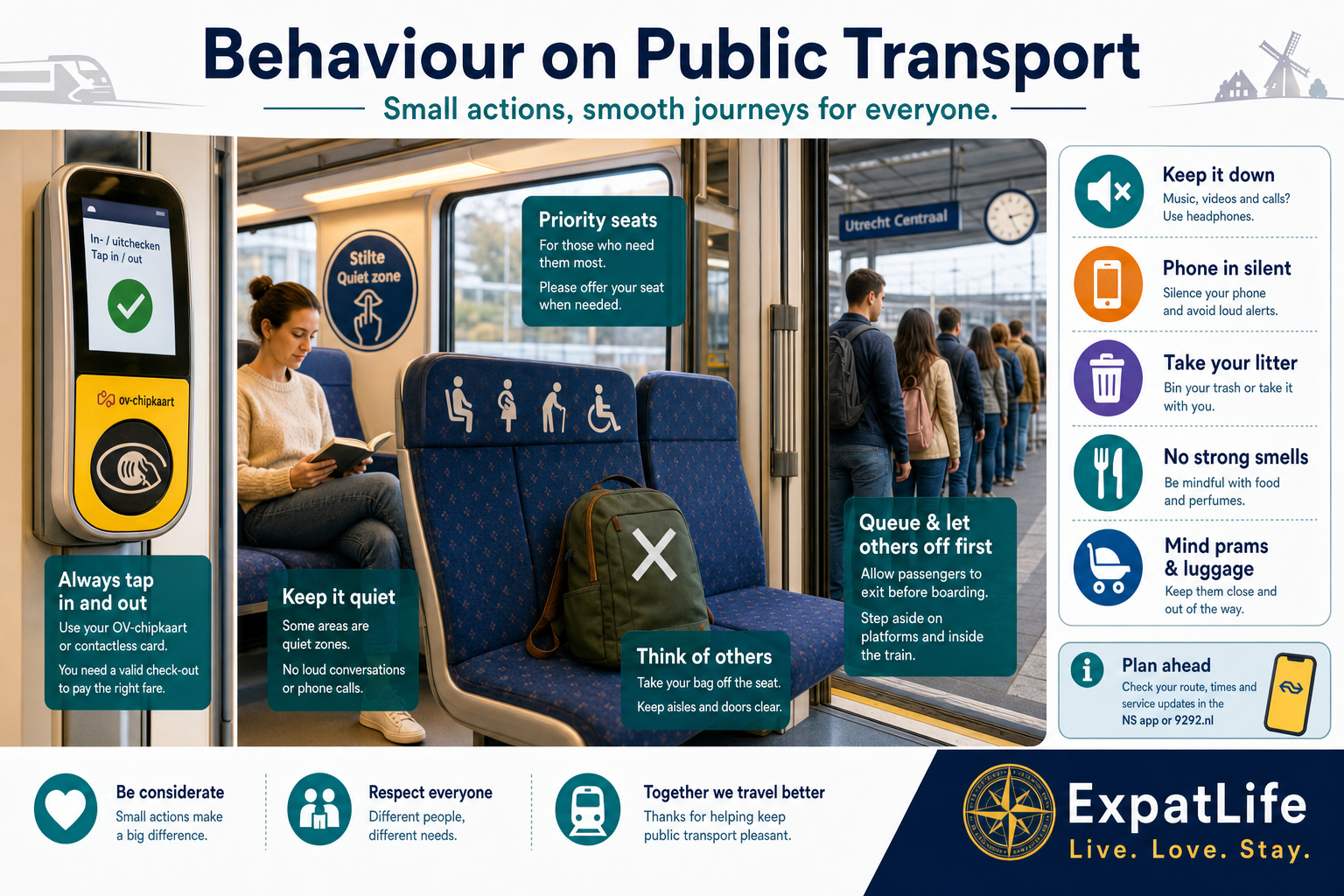
| Scenario | Expected behaviour | Note |
|---|---|---|
| Boarding rush hour | Let passengers exit first; move inside. | Hold backpack in front or at feet. |
| Quiet zone (stilte) | No calls; whisper if needed. | Signs mark quiet compartments. |
| Ticket check | Have OV-chipkaard or app ready. | Fines for travelling without valid fare. |
| Priority seat offered | Stand if elderly, pregnant or disabled need it. | Badge not always visible — offer anyway. |
| Bike on train | Check peak-hour rules; use designated areas. | NS rules vary by time and train type. |
The same person may communicate differently at work, at a friend's home, in the neighbourhood and on public transport. Formality, punctuality and directness all shift by setting.
Use the comparison table below as an orientation grid — confirm with your own circles rather than treating any row as fixed.
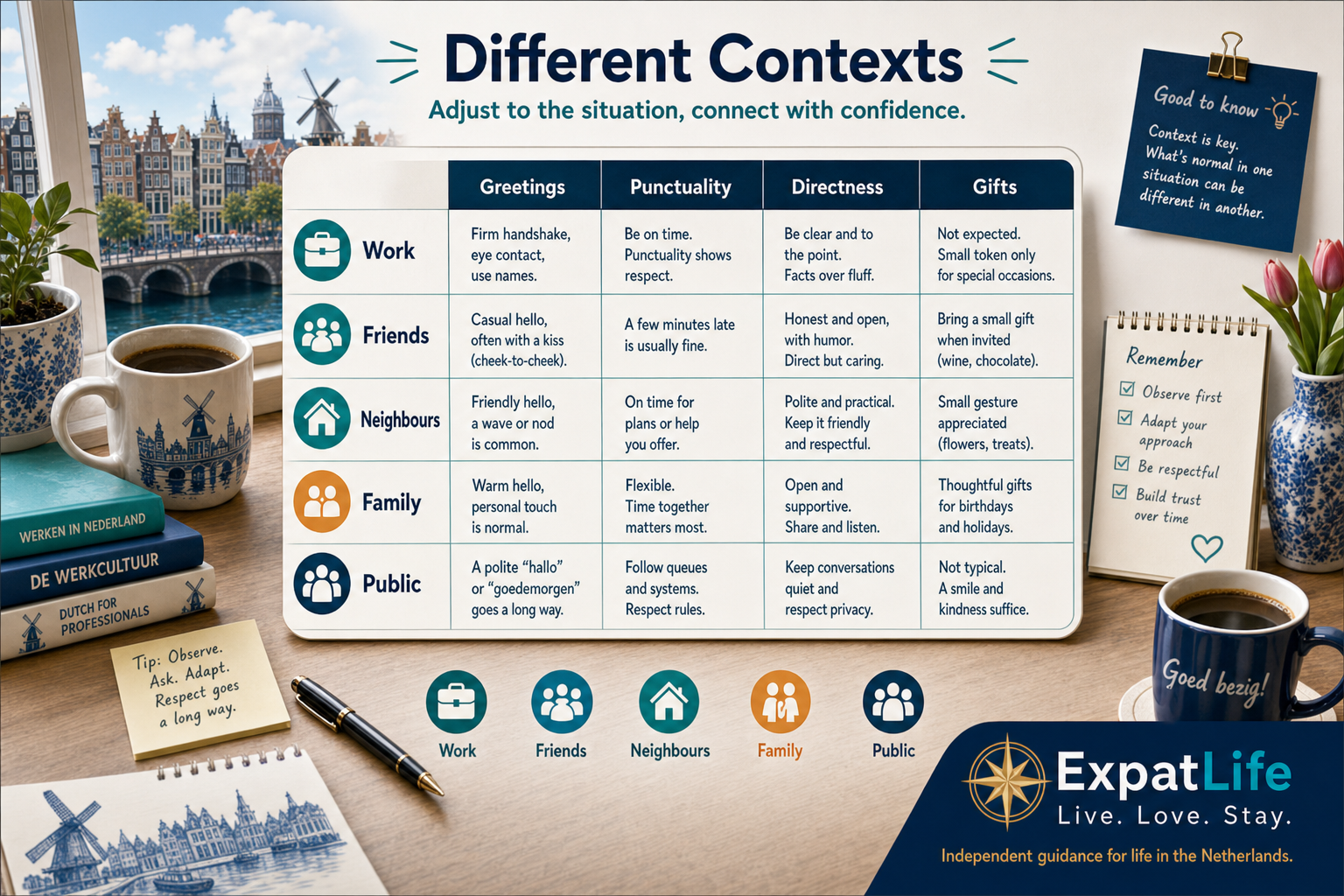
| Context | Greetings | Punctuality | Directness | Gifts |
|---|---|---|---|---|
| Work | Handshake / first-name once invited | Strict | Task-focused feedback common | Team occasions only |
| Friends | Informal, cheek kisses possible | Planned; some flexibility | Blunt jokes possible among close friends | Birthdays, housewarming |
| Neighbours | Brief hallway hello | Noise and waste schedules matter | Practical notes about bins or parking | Optional when visiting |
| Family | Warm but often planned visits | Meals on time | Varies widely by family | Birthdays and holidays |
| Public | Minimal | Queues and OV etiquette | Quiet correction if rules broken | N/A |
Mirror the setting
Practical advice for everyday settings — observe locally before assuming intent.

Handshake or cheek kisses by context; state your name clearly.
Follow their lead on formality.
Staff may not rush table turnover — ask for the bill when ready.
Confirm split before ordering.
Bag your groceries; bring your own bag.
Greet at checkout.
Check in/out; quiet zones matter.
Backpack off seat when busy.
Sort waste correctly; greet in hallways.
Note collection days.
Birthday circles and Friday drinks (borrel) are common.
Ask about team customs.
Parents often plan playdates in advance.
Learn basic Dutch phrases.
Team culture and post-training drinks.
Try a proefles first.
Common adaptation gaps — not permanent mismatches.
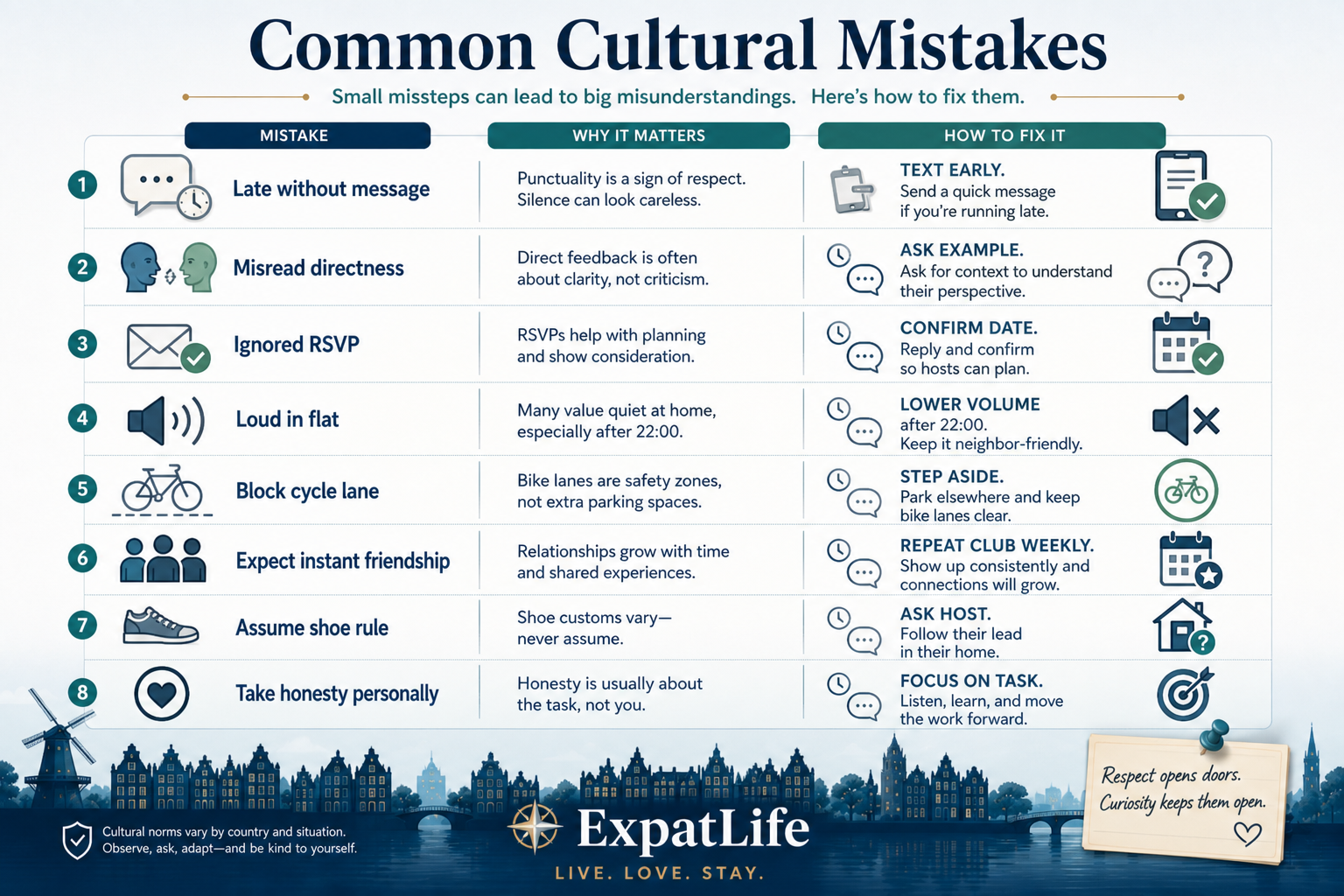
Damages trust in professional and social plans.
Message early and reschedule.
Short answers may feel rude without context.
Ask what outcome is needed.
Calendars are taken seriously.
RSVP and update promptly.
Apartment buildings amplify sound.
Lower volume after 22:00.
Creates danger and frustration.
Step aside and apologise.
Relationships often build through activities.
Repeat the same club or class.
Shoes, gifts and visits vary.
Ask politely.
Issue-focused tone is common.
Separate task from identity.
| Mistake | Recovery move | Note |
|---|---|---|
| Arrived late to dinner | Message before you're late; bring dessert as a peace offering. | One-off delays are forgiven with communication. |
| Misread direct comment | Ask: 'Can you give me an example of what you mean?' | Clarify before defending. |
| Loud in apartment | Lower volume immediately; apologise to neighbours next day. | Repeat issues need a structural fix. |
| Wrong waste sorting | Ask neighbour or check gemeente guide; fix before next collection. | Bins left out wrong may not be emptied. |
Work through over your first months — consistency beats perfection.
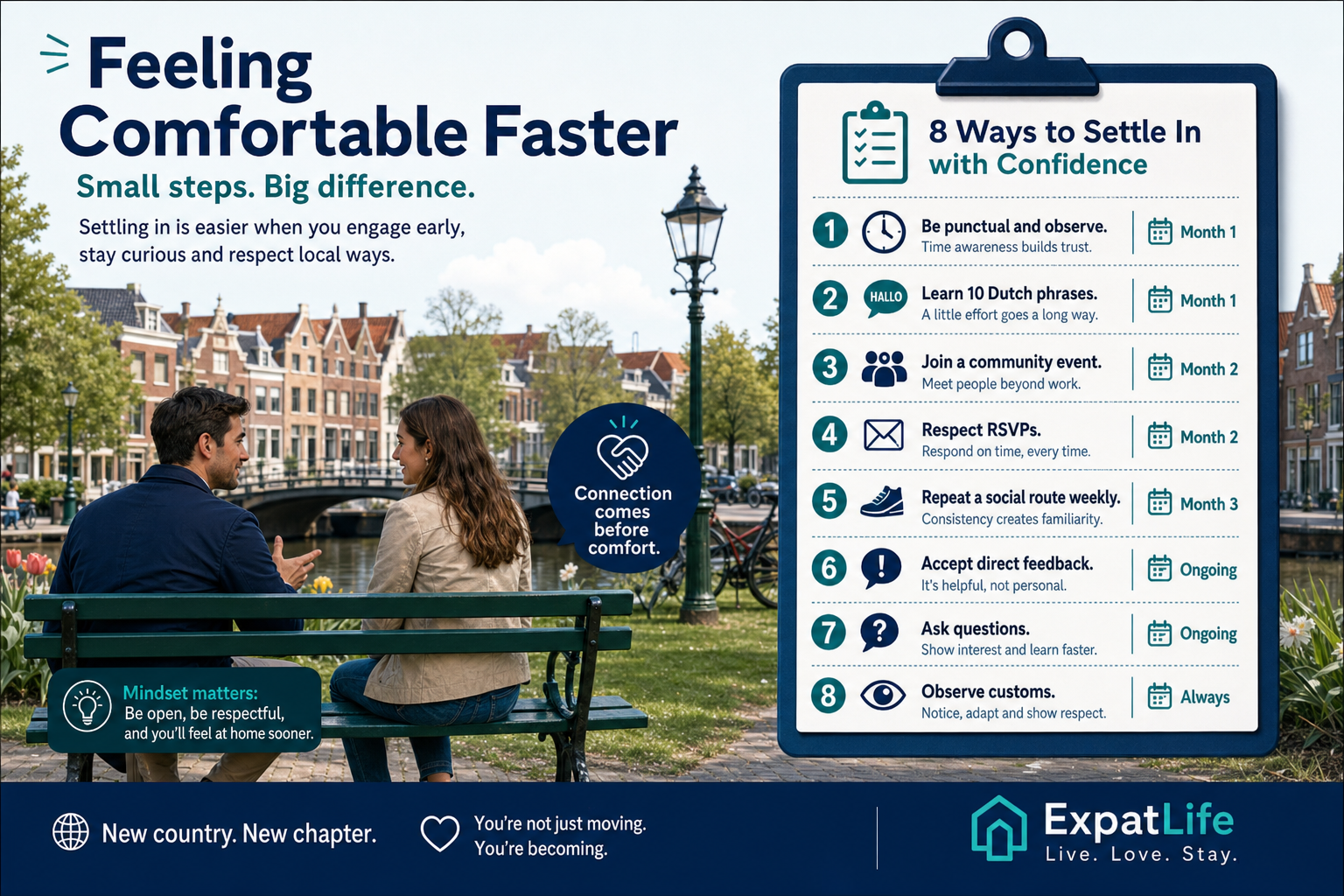
Social success checklist
Balanced explanations — individuals and cities vary widely.

Myth
Direct communication is often valued for clarity — tone varies by person and context.
Myth
Friendships frequently grow through sports, hobbies and repeated contact rather than instant intimacy.
Myth
Emotion may appear through loyalty and reliability more than effusive language.
Myth
Cycling is common in cities, but cars and OV matter too — especially outside dense urban cores.
Myth
English helps daily, but Dutch effort opens deeper social and professional doors.
Myth
Region, age, international background and personality shape behaviour more than a single national type.
Confirm specifics with neighbours and colleagues — norms vary by region.
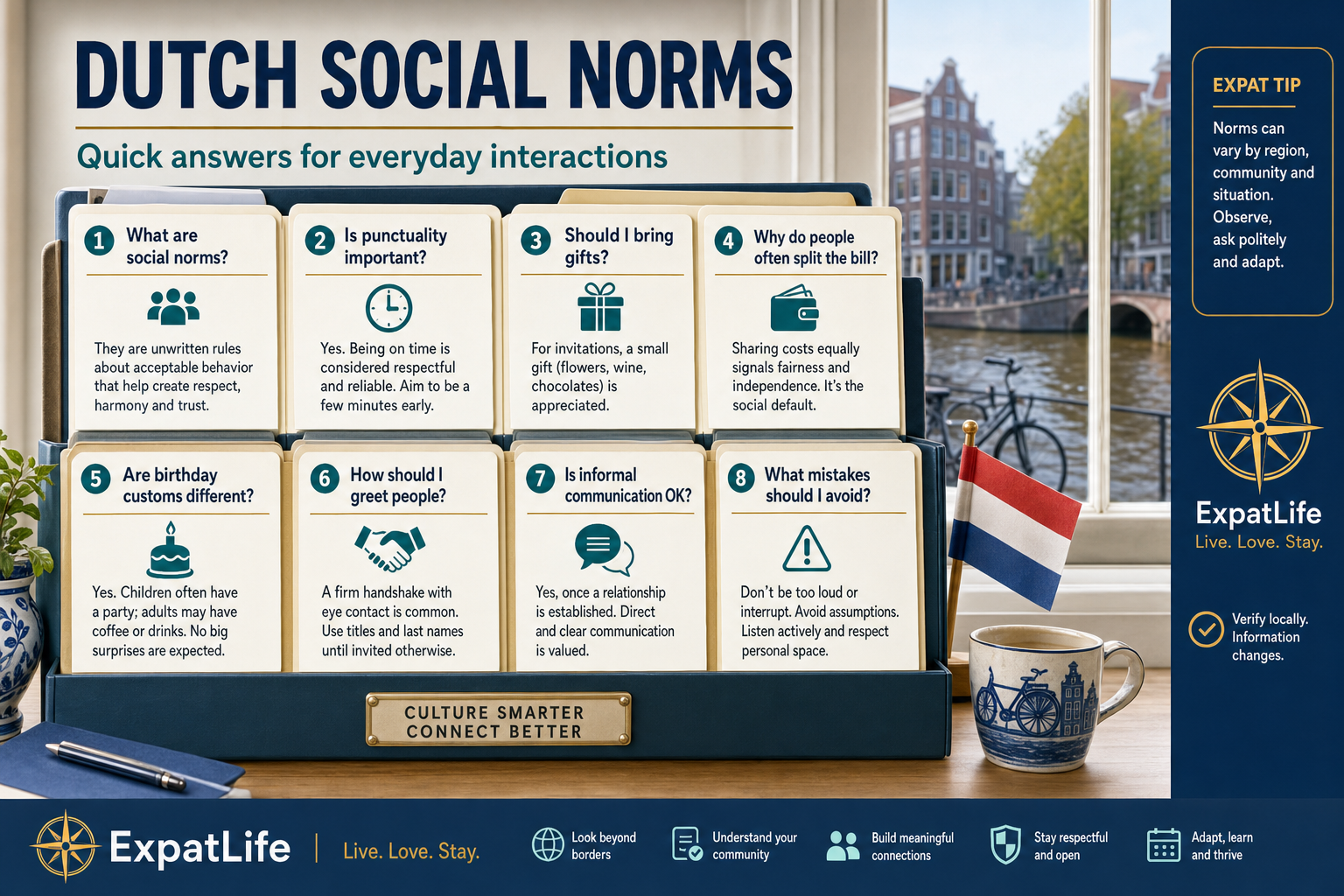
Common patterns include punctuality, direct communication, personal space, practical planning and egalitarian social habits — expressed differently by person and place.
Yes for appointments, work and many social plans. Casual meetups may allow small delays — message the group if you are late.
A small gift is often appreciated but not required. Flowers, wine or dessert are safe choices — ask if unsure.
Fair cost-sharing is everyday practice. Tikkie and itemised splits keep group finances clear.
Office circles with cake, home kringverjaardag parties with seated circles and congratulating relatives in some settings — see our Dutch Birthday Traditions guide for the full etiquette deep dive.
Handshake in professional settings; cheek kisses possible among friends — follow the other person's lead.
Many social and work settings use first names quickly, but formality still appears in official and first meetings.
Repeated lateness, ignoring RSVPs, loud behaviour in shared spaces and misreading direct tone as personal attack are common adaptation gaps.
Continue from social norms into community, workplace and language guides.

Explore next
Move from social norms orientation into community integration, workplace culture and language learning.
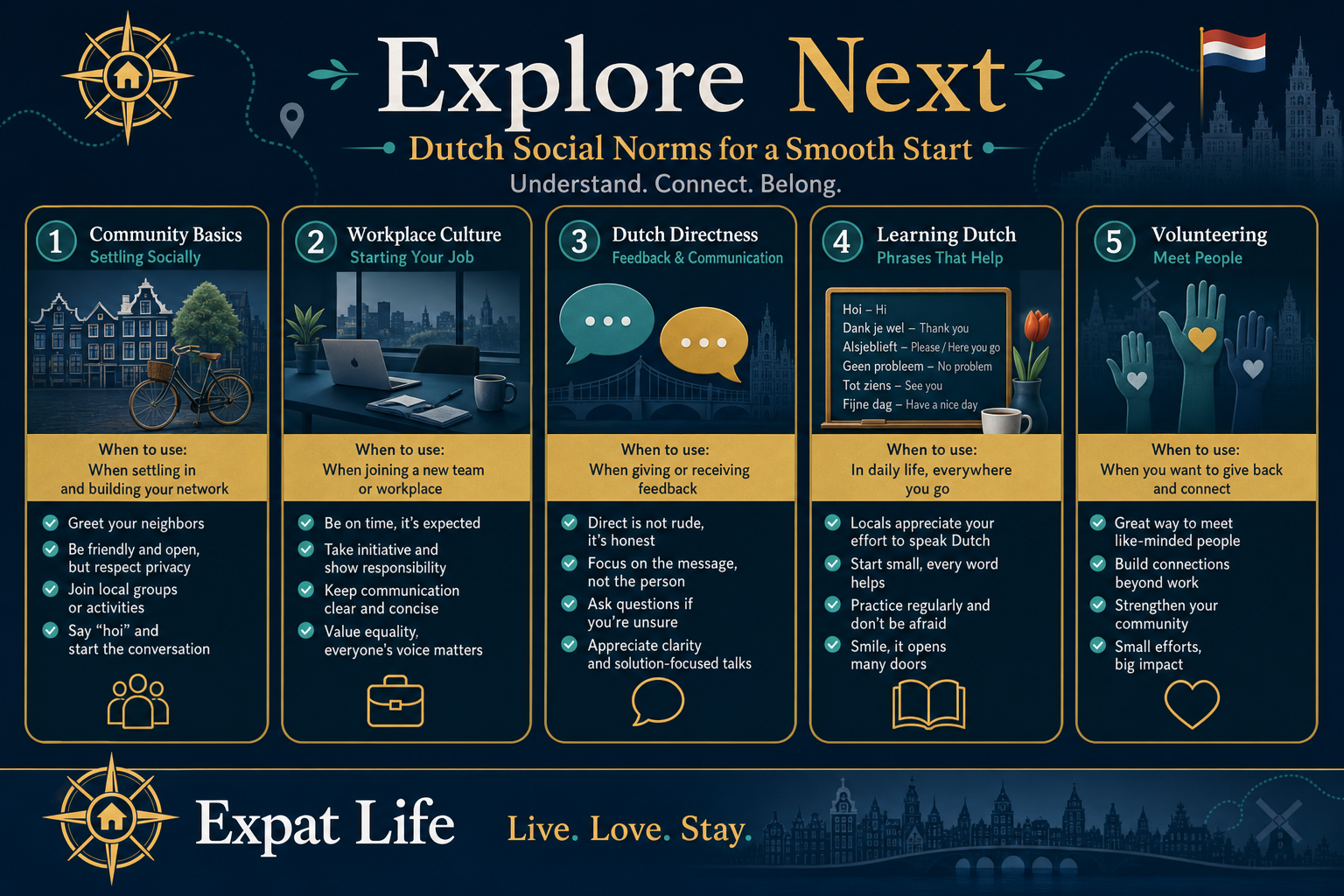
Community Events
Community events reveal Dutch social rhythms. King's Day turns cities orange with markets and music. Neighbourhood clean-ups, local markets and sports club open days offer low-pressure ways to meet people.
Volunteer shifts and festival steward roles combine social contact with practical contribution. Pair events with Community Basics for longer-term integration strategies.
King's Day
Street markets, orange dress, family-friendly crowds — plan transport early.
Neighbourhood festivals
Local food stalls and music — greet organisers and neighbours.
Sports clubs
Trial training sessions (proefles) — common adult friendship route.
Volunteer days
Gemeente and NGO listings — recurring shifts build familiarity.
Before you go