
Dry & deadpan
Flat delivery — the funny part is the calm statement itself.
Life in the Netherlands · Culture
Discover why Dutch humour often surprises newcomers, how it relates to direct communication and how you can better understand jokes, sarcasm and everyday conversations.
Orientation only — humour varies widely by person, age, region and context. Examples here are illustrative, not stereotypes about any nationality or group.

Quick answer
Expats often arrive in the Netherlands prepared for wind, bikes and direct feedback — then discover a layer of humour that feels understated, ironic or unexpectedly blunt. A comment about the weather, a meeting or a delayed train may be a joke, a sincere complaint, or both at once.
This guide explains how Dutch humour tends to work in everyday life: sarcasm, teasing, self-deprecation and the link to direct communication. For broader social values, see Dutch Social Norms. For manners in specific situations, see Dutch Etiquette. For high-level culture context, see Dutch Culture.

Flat delivery — the funny part is the calm statement itself.
Meaning opposite to the words — shared context helps decode it.
Comments on everyday Dutch life — OV delays, rain, bureaucracy.
The speaker makes themselves the target — invites others to relax.
Friendly ribbing among people who know each other well.
Humour about the moment — a long queue, a broken bike pump, a meeting that could have been an email.
Social Norms covers unwritten rules broadly. This guide focuses specifically on jokes, sarcasm, teasing and wit.
Many use sarcasm in casual settings — not everyone, and not always. Context and relationship matter.
Among friends it often signals closeness. With strangers or in formal settings, keep comments warm and neutral.
Smile, observe and ask when unsure. Most people prefer a clarifying question over silent confusion.
At a glance
Six common styles — then verify with your friend group and colleagues.

Week 1
Observe tone
Meetings vs borrels
Month 1
Ask one friend
How does your group joke?
Month 3
Join lightly
Shared-experience jokes
Month 6+
Inside jokes
Trust-dependent
Jokes delivered calmly — the humour is in the understatement, not a big performance.
Comments that say plainly what others might hint at — often about shared situations.
Saying the opposite of what is meant — tone and exaggeration are the clues.
Making yourself the subject of the joke — often signals humility and ease.
Gentle ribbing among friends — usually increases as trust grows.
Puns and double meanings reward Dutch language learning over time.
Dutch humour often sits inside wider communication habits: openness about opinions, practical problem-solving, egalitarian social relations and a preference for saying things plainly. A joke about a delayed train may be both genuine annoyance and a shared bonding moment.
Newcomers sometimes misread dry or sarcastic comments as criticism because the emotional packaging is smaller than in some cultures. Warmth may appear through reliability, invitations and shared activities rather than effusive language — humour included.

People may comment honestly on situations — humour is one way to soften blunt truths.
Jokes about inefficiency, weather or logistics reflect everyday shared experience.
Teasing among peers signals that hierarchy is relaxed in social settings.
Humour and honesty overlap — learn to read tone, not just words.
Same words, different meaning — situation and relationship decide.
| Situation | Example comment | How to read it |
|---|---|---|
| OV delay announcement | 'Perfect — just what I needed today.' | Situational sarcasm about shared frustration — not directed at you. |
| Friend cancels last minute | 'No problem, I had nothing else to do anyway.' | Dry humour masking mild annoyance — warmth often returns quickly. |
| Colleague praises a long meeting | 'Short and sweet, as always.' | Workplace sarcasm about the meeting itself — observe who laughs. |
| Neighbour mentions bike parking | 'Nice spot you've found there.' | May be gentle sarcasm about a blocked path — clarify calmly if needed. |
| Group photo in the rain | 'Gezellig weather for pictures.' | Irony about bad weather — shared bonding, not criticism of you. |
Many Dutch jokes rely on honesty, exaggeration and playful bluntness. A colleague who says 'Well, that was efficient' after a long meeting may be sarcastic about the meeting, not attacking you personally.
Directness at work has its own rules — feedback in meetings is usually issue-focused. Humour among friends can be sharper. The same sentence means different things depending on who says it, where and how well you know them.

Fictional examples — tone and relationship change the meaning.
| Situation | Example comment | Likely meaning | Tip |
|---|---|---|---|
| Friend after rain on a bike ride | 'Lekker weer, hè?' | Sarcasm about bad weather — shared suffering as bonding. | A grin or eye-roll confirms the joke. |
| Colleague after a long presentation | 'Kort en krachtig.' (Short and powerful.) | Possible sarcasm if the presentation ran long — observe tone. | See Dutch Directness at Work for meeting culture. |
| Neighbour about parking | 'Fijn dat je daar staat.' | May be sarcasm about a blocked spot — or a polite complaint. | Calm clarification beats assuming hostility. |
No single style defines everyone. These types appear often enough that recognising them helps newcomers relax. Examples below are fictional and safe — real humour always depends on relationship and context.
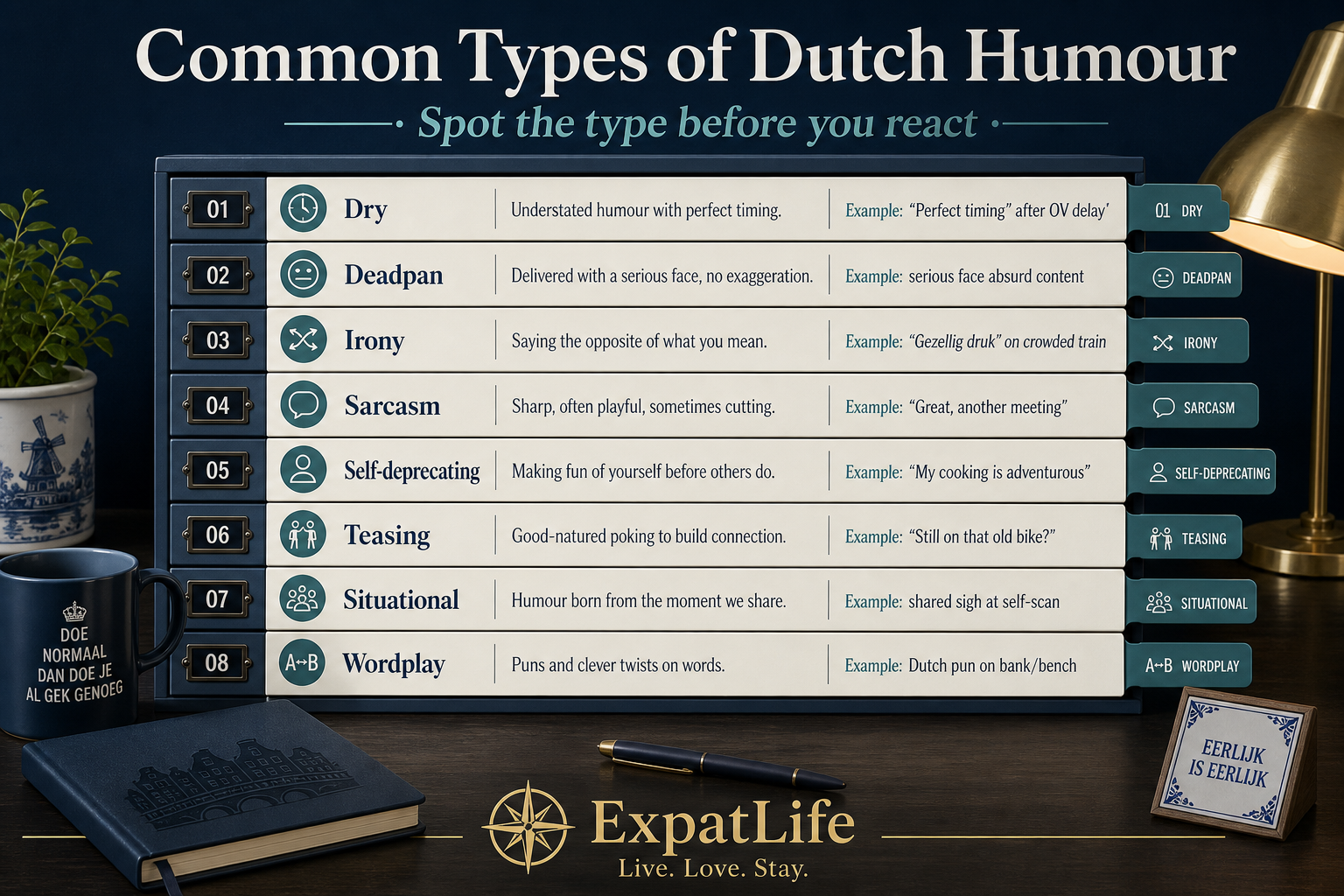
Calm delivery without a big laugh cue.
Example: After a 20-minute OV delay: 'Perfect timing.'
Serious face, absurd content.
Example: 'I love standing in the rain. Very refreshing.'
Words mean the opposite of the situation.
Example: 'Gezellig druk hier' in an overcrowded train.
Mock praise or mock complaint.
Example: 'Great idea to schedule this at 8 a.m.'
Speaker targets themselves.
Example: 'My cooking is… an adventure.'
Gentle ribbing of a friend.
Example: 'Still on that old bike? Classic.'
The moment is the joke.
Example: Everyone silently watching a self-checkout error.
Puns and double meanings in Dutch.
Example: Play on 'bank' (bench/bank) — rewards language learning.
Everyday humour is often low-key — a comment, a look, a shared eye-roll. Understanding why something is funny usually requires knowing the situation: Dutch weather, cycling culture, appointment planning or sports club dynamics.

Someone orders bitterballen and a friend says 'Healthy choice.' Tone is affectionate sarcasm about Dutch snack culture.
Join with a light counter-joke or laugh — no need to defend the snack.
Comment about 'nice and quiet' after a weekend drill — gentle situational humour about shared building life.
Keep responses brief and friendly.
Waiter is slow; someone says 'No rush, we have all evening' — sarcasm about Dutch service pace.
Common among friends; less common with strangers serving you.
Teasing about missed goals or old equipment — group bonding through mild ribbing.
Observe who teases whom before joining in.
Parent jokes about their own cooking; teenager responds with deadpan 'It is edible.'
Self-deprecation plus dry reply — affectionate family rhythm.
Shared sigh when self-scan fails — situational humour without a formal punchline.
A commiserating comment builds instant rapport.
Workplace humour varies by team, sector and manager. Many offices allow light sarcasm at coffee machines but keep meetings focused. Self-deprecation from leaders can signal approachability; teasing newcomers too early can misfire.
Professional boundaries matter — humour about performance, appearance or personal life can cross lines quickly. When employed, pair this section with Dutch Workplace Culture and Dutch Directness at Work.

Professional boundaries vary by team — observe before matching tone.
| Situation | Example | Boundary note |
|---|---|---|
| Monday meeting | Colleague: 'Shall we keep this under three hours?' after agenda review. | Team-dependent — fine if group uses meeting humour; stay neutral if new. |
| Coffee break | Jokes about email volume or printer failures. | Usually safe — situational, not personal. |
| Manager self-deprecates | 'My spreadsheet skills are legendary — for the wrong reasons.' | Signals approachability — respond warmly, do not escalate. |
| Friday borrel | Teasing loosens; inside jokes appear. | Optional attendance — observe before matching tone. |
| Video call glitch | 'Technology working perfectly as usual.' | Shared situational humour — a smile is enough if new to the team. |
| Deadline pressure | Dry comment about 'realistic planning.' | Avoid piling on individuals — keep humour about the situation. |
Friendship humour builds slowly. Playful teasing, nicknames and inside jokes usually appear after shared activities — sports, volunteering, language classes or repeated borrels. Teasing often signals that you are part of the group, not that you are unwelcome.

Teammates joke about missed passes — ribbing signals you belong to the group.
Laugh first; join with a light counter-joke only when rapport is clear.
Classmates mock their own Dutch mistakes — self-deprecation invites warmth.
Share your own small language slip rather than correcting others.
Nicknames and sharper sarcasm appear after months of shared history.
Do not match intensity until you know the group's boundaries.
Humour stays gentle — situational comments about weather or queues.
Build trust through repeated activities before playful teasing.
Sarcasm uses tone and exaggeration to mean the opposite of the literal words. It differs from criticism when the target is a situation (traffic, weather, meetings) rather than a person's character. Among friends, sarcasm often replaces a longer emotional explanation.
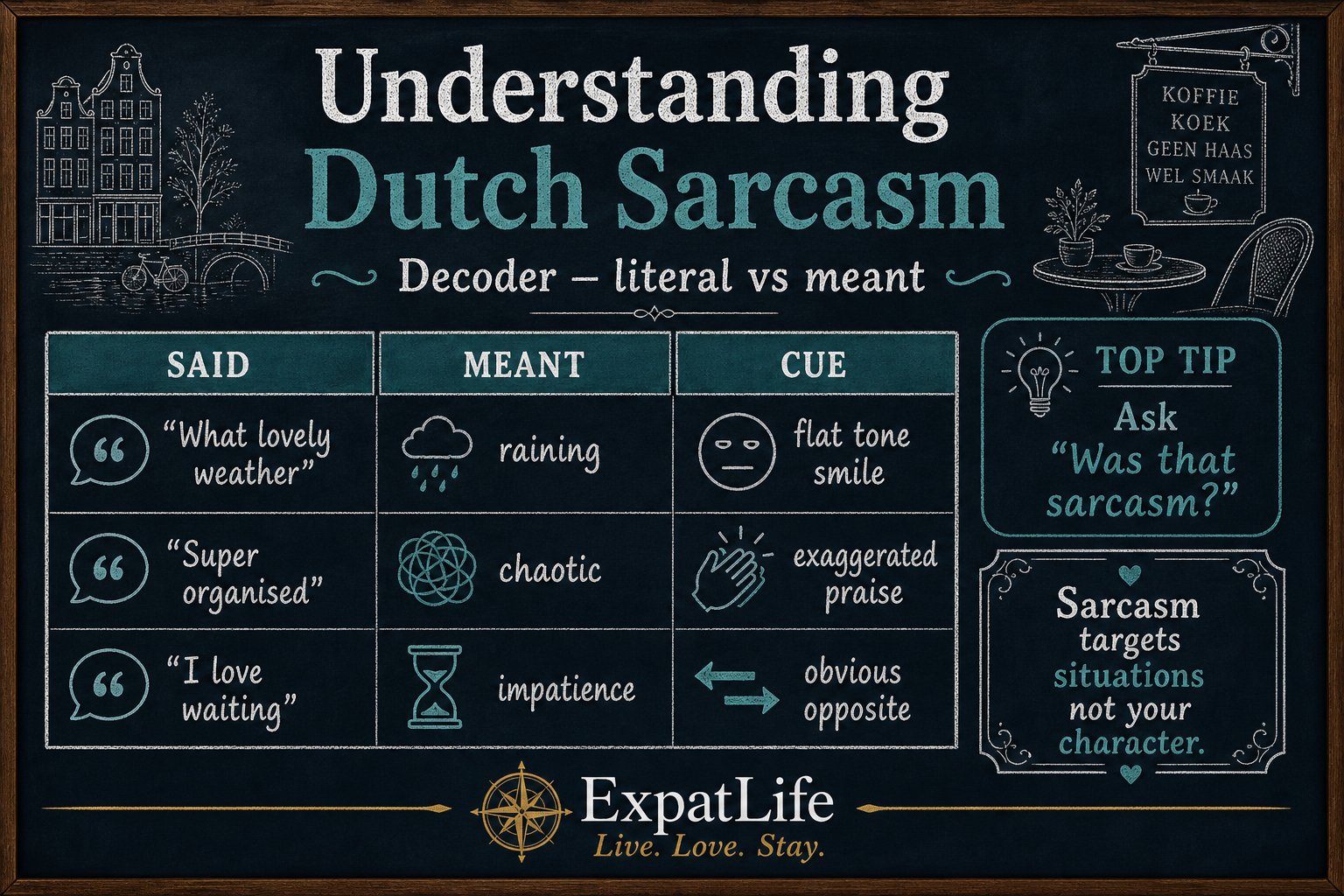
What is said versus what is meant — tone is the clue.
| What is said | What is meant | Tone cue |
|---|---|---|
| 'What lovely weather.' | It is raining — shared complaint as joke. | Flat tone, eye contact, maybe a smile. |
| 'That was super organised.' | Something was chaotic — situational sarcasm. | Exaggeration of praise for obvious failure. |
| 'No, I love waiting.' | Impatience expressed humorously. | Obvious opposite of true feeling. |
| 'Great, another meeting.' | Mild complaint about calendar load. | Eye-roll or sigh — rarely seeks a serious answer. |
| 'Lekker rustig hier.' (Nice and quiet here.) | Comment on noise, crowds or chaos. | Common in trains, offices or building work. |
| 'Dat ging lekker soepel.' (That went smoothly.) | Something did not go smoothly. | Deadpan delivery after a visible mishap. |
Light clarifying questions are normal — not rude.
| You heard | Try saying | Note |
|---|---|---|
| Flat praise after something went wrong | Serieus of grapje? (Serious or joking?) | Most people appreciate clarity — not considered rude. |
| Comment about weather while raining | Ja, lekker… (Yeah, lovely…) with a smile | Mirroring lightly shows you got the joke. |
| Teasing about being late | Guilty — OV strikes again. | Self-deprecating counter-joke often lands well among friends. |
| Sarcasm you did not catch in a group | Wait — were you being sarcastic? | Better than pretending you understood. |
Many Dutch people comfortably make themselves the subject of jokes — about cooking, navigation, sport skills or language mistakes. This can signal humility and invite others to relax. It is rarely an invitation for others to pile on harshly.

| Example | Why it works |
|---|---|
| 'I am not built for mornings.' | Shared human flaw — invites agreement or counter self-joke. |
| 'My Dutch is creative grammar.' | Language learners often use this — warmth, not shame. |
| 'I have no sense of direction — GPS is my friend.' | Practical self-mockery common in cycling culture. |
| 'My cooking is an experiment every time.' | Signals humility before hosting — guests relax. |
| 'I am terrible at remembering names.' | Pre-empts awkwardness — others often share the same flaw. |
| 'My bike maintenance skills are… optimistic.' | Cycling culture makes this instantly relatable. |
Warmth beats escalation — self-deprecation invites rapport, not pile-on.
| They say | Good response | Avoid |
|---|---|---|
| Friend: 'My presentation was a disaster.' | 'Happens to everyone — what part felt hardest?' | Piling on with harsher jokes about their skills. |
| Colleague: 'My Dutch is hopeless.' | 'You're doing fine — I still mix up de and het.' | Correcting their grammar in front of others. |
| Neighbour: 'I'm useless at DIY.' | 'Same here — I call the huismeester.' | Listing everything they got wrong. |
| New acquaintance downplays their cooking | Warm acceptance — 'Sounds gezellig anyway.' | Escalating with 'Yes, it was pretty bad.' |
Regional differences exist but individuals vary widely. International cities blend many traditions. Carnival regions may feel more expressive seasonally. Avoid treating any area as a uniform personality — these are tendencies for curious observers, not stereotypes.
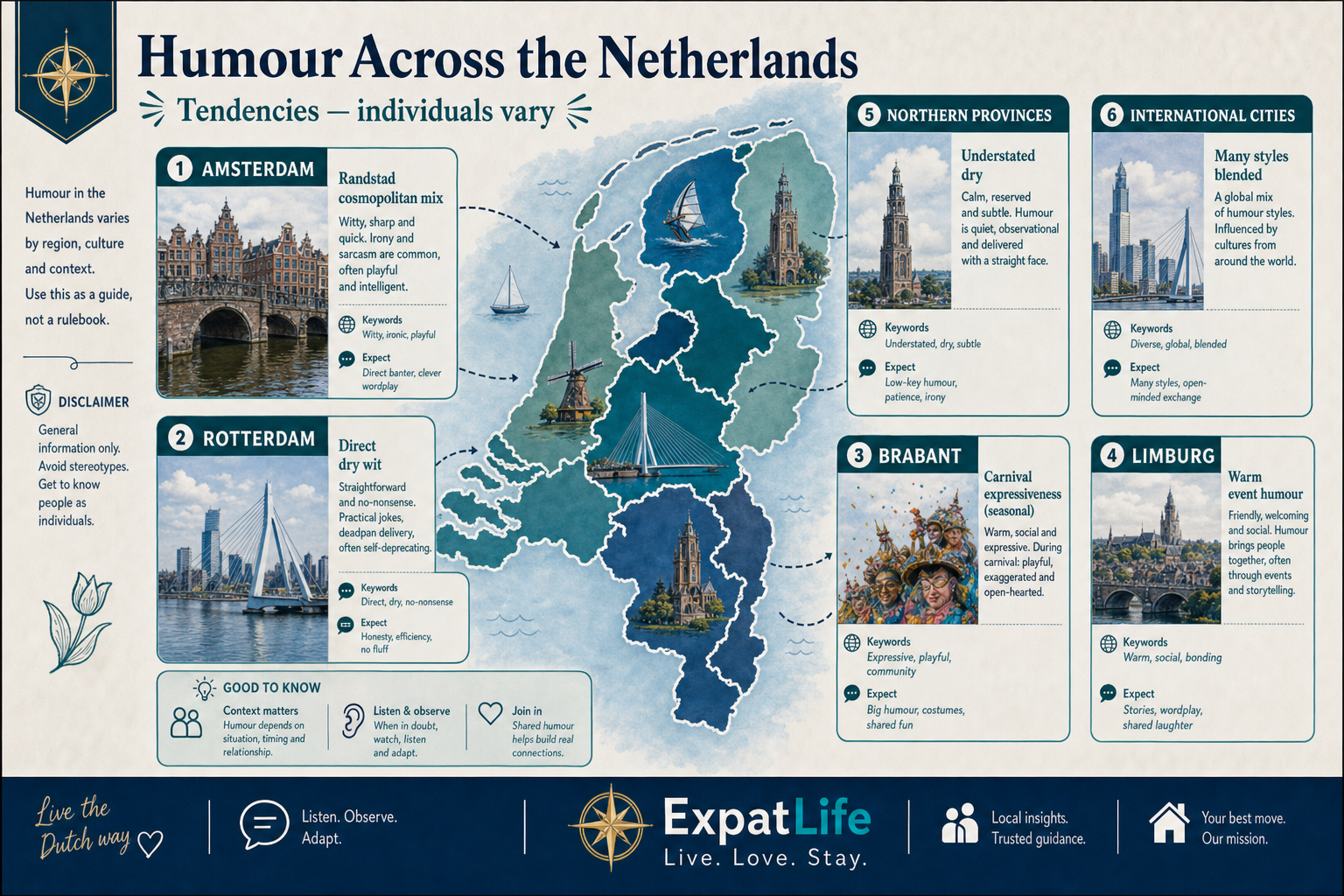
Individuals vary more than regional labels — use as orientation only.
| Region | Tendency | Note |
|---|---|---|
| Amsterdam & Randstad | Cosmopolitan mix — many humour styles side by side. | International exposure means less predictable national 'default'. |
| Rotterdam | Often described as direct and no-nonsense — dry wit common. | City pride and practicality appear in local jokes. |
| Brabant | Carnival season brings expressive, playful humour. | Seasonal — everyday tone may still be understated. |
| Limburg | Similar carnival culture; social warmth at events. | Regional dialect adds wordplay layers. |
| Northern provinces | Often described as dry and understated. | Individuals and cities still differ widely. |
| International cities | Office and university humour blends many cultures. | Your team may not match national generalisations. |
Fictional illustrations — your circle may sound nothing like this.
| Setting | Example | Note |
|---|---|---|
| Randstad office | Dry comment about train delays — everyone nods. | Shared commuter experience bonds the room. |
| Rotterdam pub | Blunt joke about city rivalry with Amsterdam. | Often affectionate — know your audience. |
| Brabant carnival | Costume humour and wordplay in dialect. | Seasonal expressiveness — everyday tone may differ. |
| University city | Mix of international and Dutch sarcasm in one group. | Your study or work circle matters more than the map. |
Misunderstandings are adaptation gaps, not permanent failures. Common patterns include taking ironic comments literally, hearing teasing as criticism, or expecting louder laugh cues. Time, context and one clarifying question usually help.
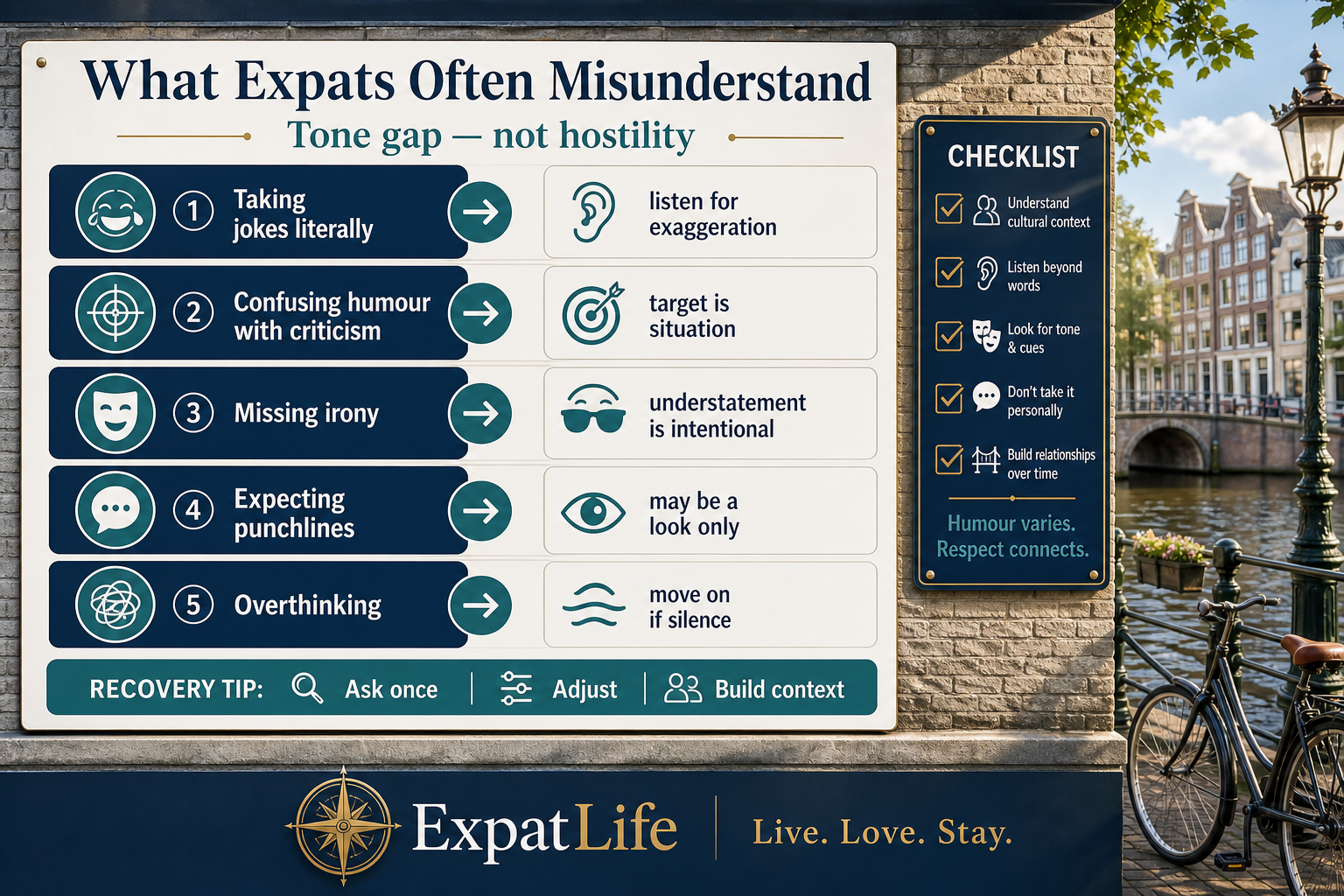
Sarcasm states the opposite — listen for exaggeration and shared context.
Comments often target situations (delays, weather) not your worth.
Understatement hides the joke — a calm delivery is intentional.
Humour may be a raised eyebrow, not a performed joke.
Not every dry remark is deep — sometimes it is just a quick shared moment.
One clarifying move usually resets the tone.
| What happened | Try this | Note |
|---|---|---|
| You took sarcastic praise literally | Laugh lightly and say 'Ah, sarcasm — got it.' | Most people move on quickly — no long apology needed. |
| Teasing felt like a personal attack | Calmly: 'Was that a joke? I'm still learning your group's tone.' | Directness is respected — better than silent resentment. |
| You responded seriously to an ironic comment | Add a smile: 'Right… lovely weather indeed.' | Mirroring shows you understood after a beat. |
| You tried to match teasing too early | Dial back — observe for a few more weeks. | Intensity grows with trust, not speed. |
| You assumed the whole culture is unfriendly | Compare one friend group with one workplace team. | Circles differ more than national labels suggest. |
Practical habits for joining conversations without forcing jokes.

Do
Smile and stay curious when unsure
Don't
Assume every dry comment is an insult
Do
Ask 'Serious or joking?' when tone is unclear
Don't
Force your own punchlines early in a friendship
Do
Join with light situational humour
Don't
Escalate someone else's self-deprecating joke
Do
Build context through shared activities
Don't
Correct Dutch humour as 'wrong' in front of a group
Do
Observe intensity before matching sarcasm
Don't
Take teasing personally without checking relationship depth
Humour styles differ globally. These are broad tendencies for orientation — not judgments about individuals. Your Dutch colleagues may have lived abroad; your international friends may share Dutch humour after years here.

Broad tendencies for orientation — not judgments about individuals.
| Culture / region | General tendency | Note |
|---|---|---|
| United Kingdom | Dry wit and understatement — some parallels with Dutch style. | Class and context cues differ — do not assume identical. |
| United States | Often more explicit setup and upbeat delivery. | Dutch humour may feel quieter or blunter by comparison. |
| Germany | Direct communication overlaps; humour varies by region. | Shared northern European understatement in places. |
| Southern Europe | Often more expressive gesture and warmth in delivery. | Dutch understatement may feel cool until rapport builds. |
| East & Southeast Asia | Varies widely — indirect humour and face-saving differ. | Ask colleagues about their preferred style. |
| Latin America | Often warmer, more performative humour in social settings. | Adaptation is mutual — share your style too. |
Dry wit may feel familiar — still confirm sarcasm in new groups.
Explicit punchlines are less common — listen for understatement.
Office humour may blend many styles — observe your desk first.
Humour at home can differ from humour at work — separate contexts help.
Context decides whether humour lands. Formal meetings, sensitive topics, new relationships and professional hierarchies require more caution. When unsure, stay friendly and factual until you know the group's norms.
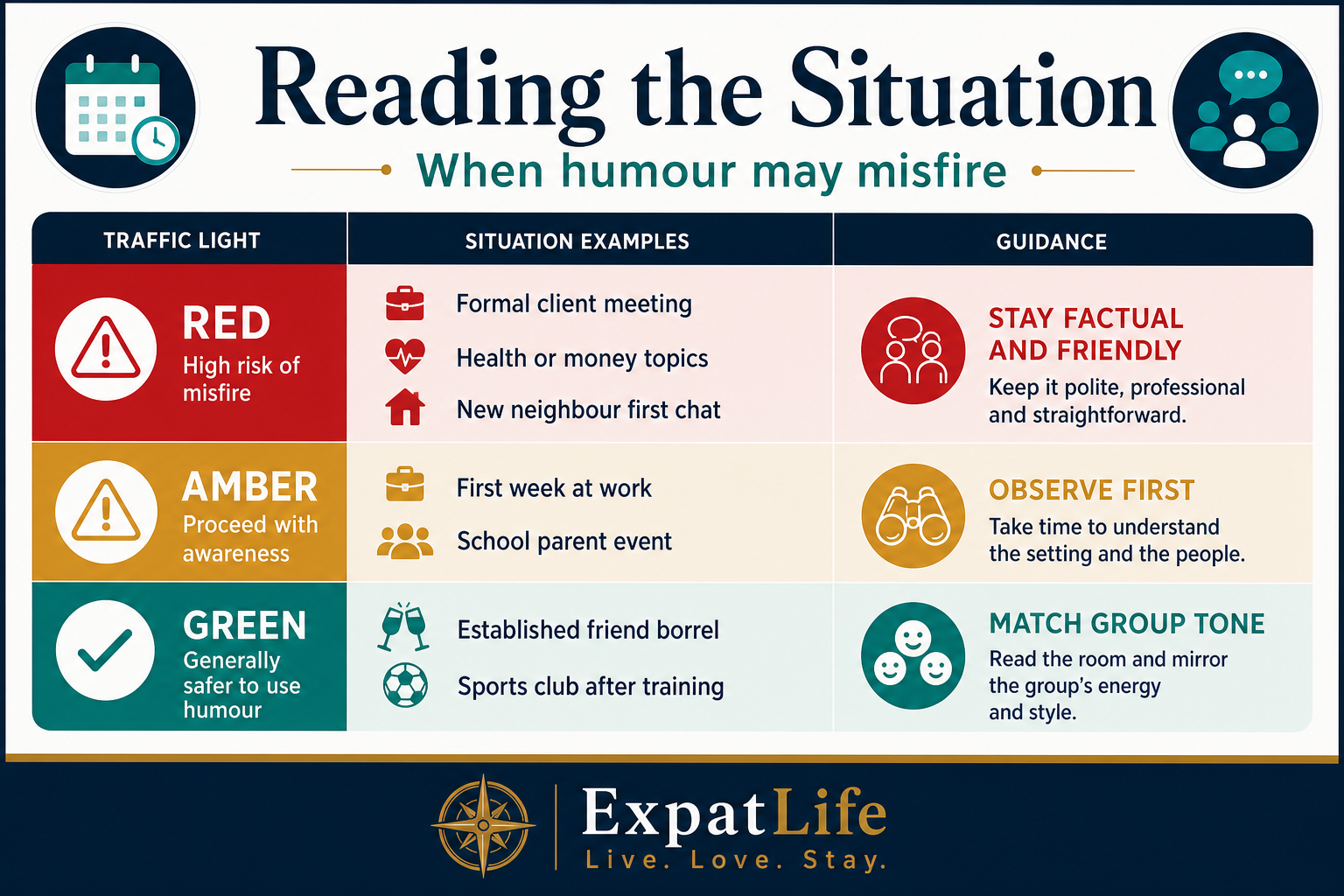
| Setting | Guidance | Note |
|---|---|---|
| Formal client meeting | Skip sarcasm — clarity and professionalism first. | Humour may appear after rapport exists. |
| New neighbour | Warm greetings, no teasing until familiarity grows. | See Dutch Etiquette for neighbour basics. |
| Health or money topics | Avoid jokes — these are private for many people. | Redirect to neutral subjects. |
| First week at work | Observe coffee-break humour before contributing. | See Workplace Culture guide. |
| School parent group | Keep humour gentle — children and policies vary. | Follow school communication norms. |
| Online group chats | Tone is easy to misread — prefer clarity over sarcasm. | Emoji or explicit 'joking' helps when unsure. |
| Mixed-language conversation | Wordplay may not land — use simple shared observations. | Language level affects humour reception. |
Balanced explanations — humour preferences vary as much as music taste.

Myth
Many use sarcasm casually; others prefer dry observation or warm sincerity. Personality and context vary widely.
Myth
Age, region, international background and friend group shape style as much as nationality.
Myth
Among friends, direct humour often signals comfort. With strangers or in formal settings, keep comments neutral.
Myth
Self-deprecating humour is common and often builds rapport.
Myth
It takes time — shared experiences and language help more than nationality labels.
Myth
Some enjoy sharp ribbing; others prefer gentle humour. Follow the group's lead.
Adaptation gaps — not permanent mismatches.
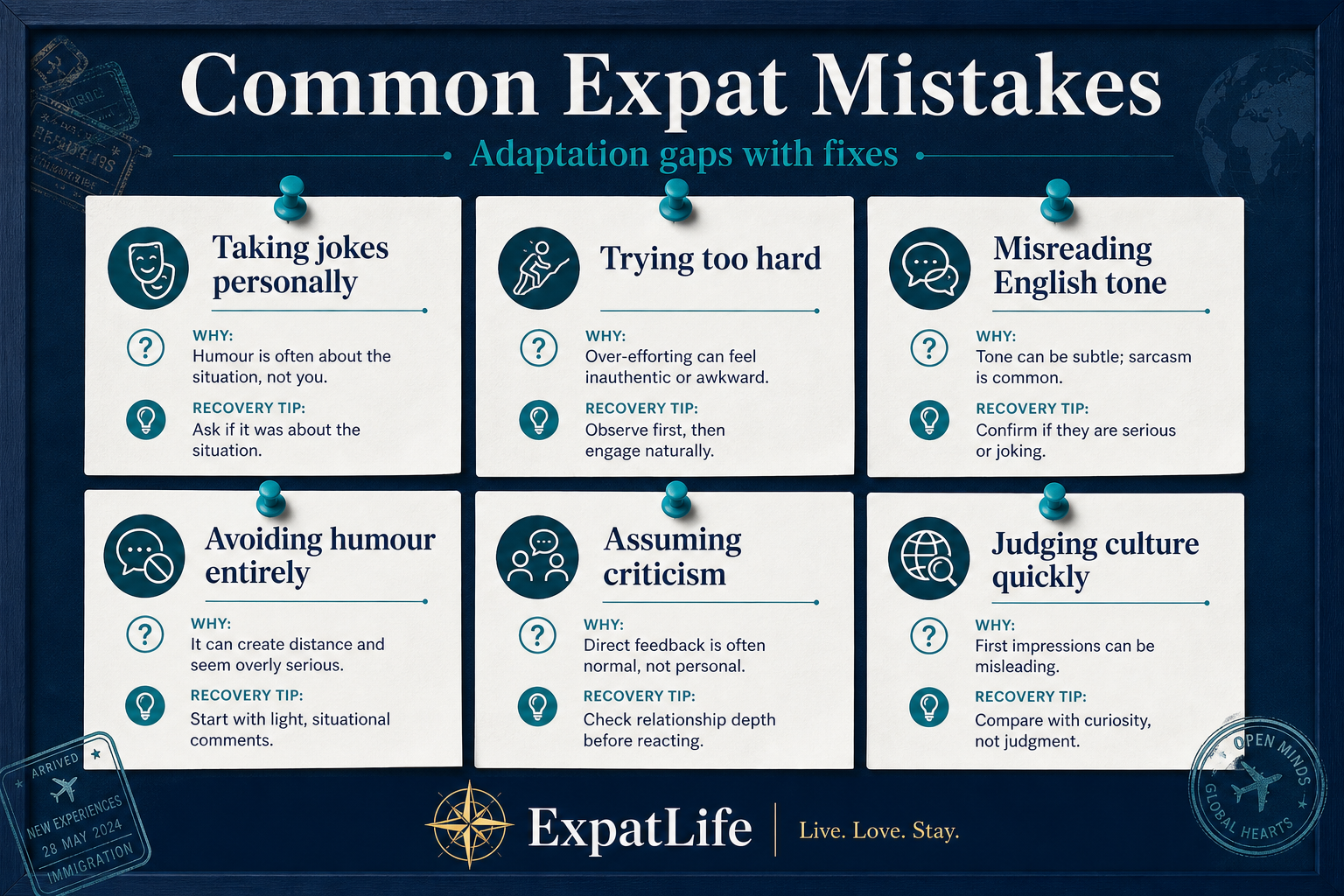
Many comments target situations — delays, weather, shared Dutch experiences.
Ask whether the remark was about the situation or about you.
Forced jokes early in a relationship can misfire.
Observe first; join with light, shared observations.
Sarcasm cues differ — flat delivery hides intent.
Confirm with 'Serious or joking?'
Never joking can slow social bonding.
Start with safe situational comments.
Direct phrasing may still be humour among friends.
Check relationship depth before reacting.
Labelling an entire culture 'unfunny' blocks learning.
Compare styles with curiosity, not rankings.
These phrases appear often in casual speech. Tone turns them sincere, playful or sarcastic. Hearing them in borrels and shops beats memorising alone.
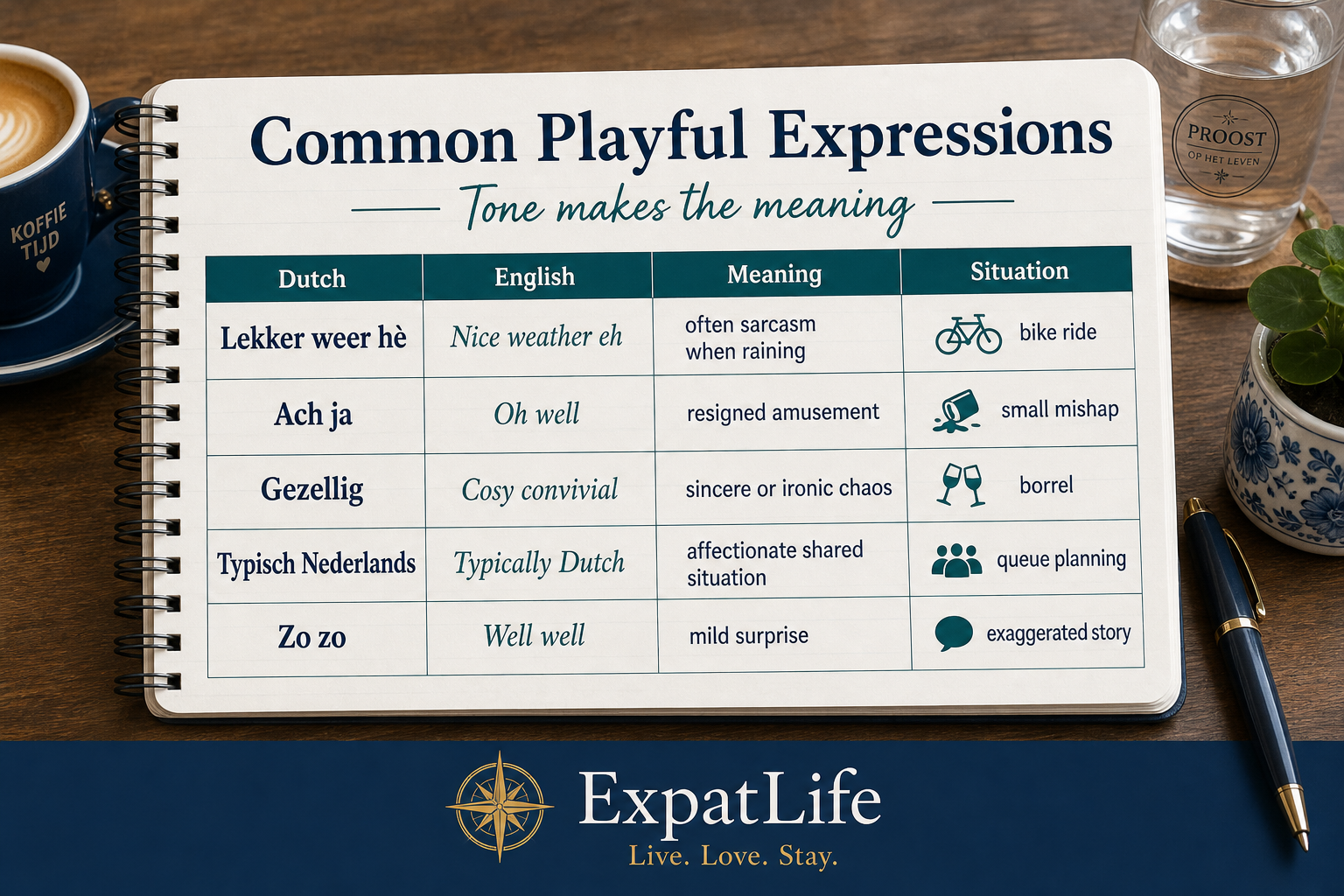
Tone turns these sincere, playful or sarcastic.
| Dutch | English | Meaning | Typical situation |
|---|---|---|---|
| Lekker weer, hè? | Nice weather, eh? | Often sarcastic when raining — shared weather complaint. | Bike rides, OV platforms, neighbour chat. |
| Ach ja… | Oh well… | Resigned amusement at minor mishaps. | Spilled coffee, missed train, small failures. |
| Nou ja | Well then / yeah well | Playful dismissal or 'it is what it is.' | End of a light debate or story. |
| Gezellig! | Cosy / convivial! | Sincere warmth or ironic comment on chaos. | Crowded borrel, busy train, family gathering. |
| Hè? / Hoor | Eh? / (emphasis particle) | Softeners or playful emphasis — tone decides. | Casual confirmations and teasing. |
| Zo zo | Well well | Mild surprise or mock admiration. | Someone tells an exaggerated story. |
| Typisch Nederlands | Typically Dutch | Comment on a very Dutch situation — often affectionate. | Queues, planning, directness, bike culture. |
| Dat kan ook… | That works too… | Dry acceptance of an odd solution. | Improvised fixes, pragmatic workarounds. |
Confirm specifics with friends and colleagues — humour is highly personal.
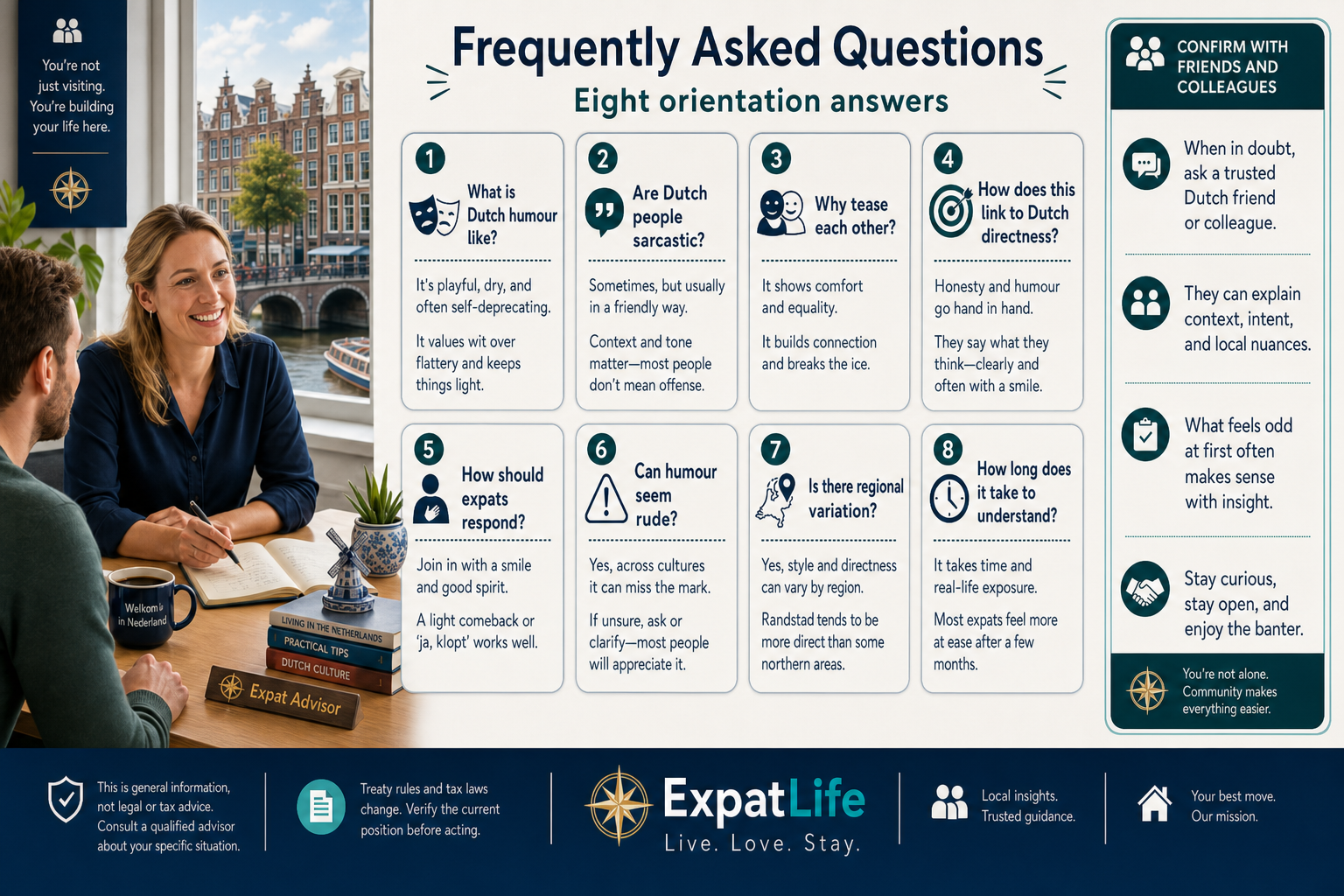
Often described as dry, direct, understated and sarcastic — but styles vary widely by person, region and context. Observational humour about everyday Dutch life is common.
Many use sarcasm in casual settings, especially among friends. Not everyone does, and professional contexts are usually more restrained. Tone and relationship matter.
Playful teasing among friends often signals comfort and equality. It usually grows with trust — it is not typically meant for strangers or formal settings.
Often yes — humour and honest communication overlap. Jokes may state plainly what others hint at. See Dutch Directness at Work for professional communication.
Smile, observe and ask when unsure. You do not need to joke back immediately. Shared activities build the context that makes humour easier to read.
Direct delivery can feel blunt without shared context. Among friends it is often affectionate. If uncomfortable, say so calmly — directness works both ways.
Yes — carnival regions may feel more expressive seasonally; cities differ in international mix. Individuals always vary more than regional labels.
Many expats feel more comfortable after a few months of shared experiences and friendships. Language learning helps with wordplay and nuance.
Continue from humour into culture, social norms and workplace communication.

Culture cluster
Navigate the full Dutch culture guide cluster from this humour hub.

Explore next
Move from humour orientation into directness, social integration and language learning.

Official Dutch government portal — society and cultural life.
Open official sourceNetherlands tourism board — cultural context for visitors.
Open official sourceIndependent English-language culture commentary — use as informal context, not authority.
Open official source