Salary and allowances
Gross salary, holiday allowance, bonuses and expense arrangements are usually spelled out in writing.
Netherlands · Jobs · Contracts
Understand how Dutch employment contracts work, including temporary and permanent contracts, probation periods, notice periods, benefits and what expats should review before signing.
This guide is practical orientation only — not legal or employment law advice. Contract outcomes depend on employer policy, sector rules, CAO context and your specific agreement.

Overview
Most employees in the Netherlands receive a written employment agreement that outlines salary, working hours, benefits, notice periods and contract duration. For expats, that document is often the bridge between a job offer and everyday life in the Netherlands.
Contracts can also influence visa status, relocation timing, mortgage conversations and long-term residency planning. Reading the agreement carefully helps you understand what you are committing to — without treating this guide as legal or employment law advice.
Contract topics
Gross salary, holiday allowance, bonuses and expense arrangements are usually spelled out in writing.
Permanent, fixed-term and agency contracts carry different expectations about renewal and continuity.
Early employment and exit rules are often defined separately from the rest of the package.
Pension participation, commuting support and equipment policies can change total compensation materially.
Expat angles
Sponsored roles may require contract wording, salary levels and employer status that align with current IND rules.
Relocation clauses, start dates and remote-work expectations affect housing and family logistics.
Lenders often ask about contract type, probation and income continuity before assessing borrowing capacity.
Home-country assumptions about notice, benefits or probation do not always match Dutch practice.
Before you sign
Examples
| Profile | Scenario | What to check |
|---|---|---|
| HS migrant joining a scale-up | 12-month fixed-term contract at €6,200/month gross with 2-month probation | IND salary threshold, recognised sponsor status, contract end date vs permit validity and conversion expectations. |
| Dual-income family relocating to Utrecht | One permanent contract (€4,800) + one 24-month fixed-term (€5,100) | Combined mortgage capacity, notice on each contract and whether relocation repayment applies to both roles. |
| Remote worker with foreign employer | Contract states 32 hours/week hybrid but employer entity is outside the Netherlands | Whether Dutch payroll and work-authorisation rules apply — this is not a standard Dutch employment contract pattern. |

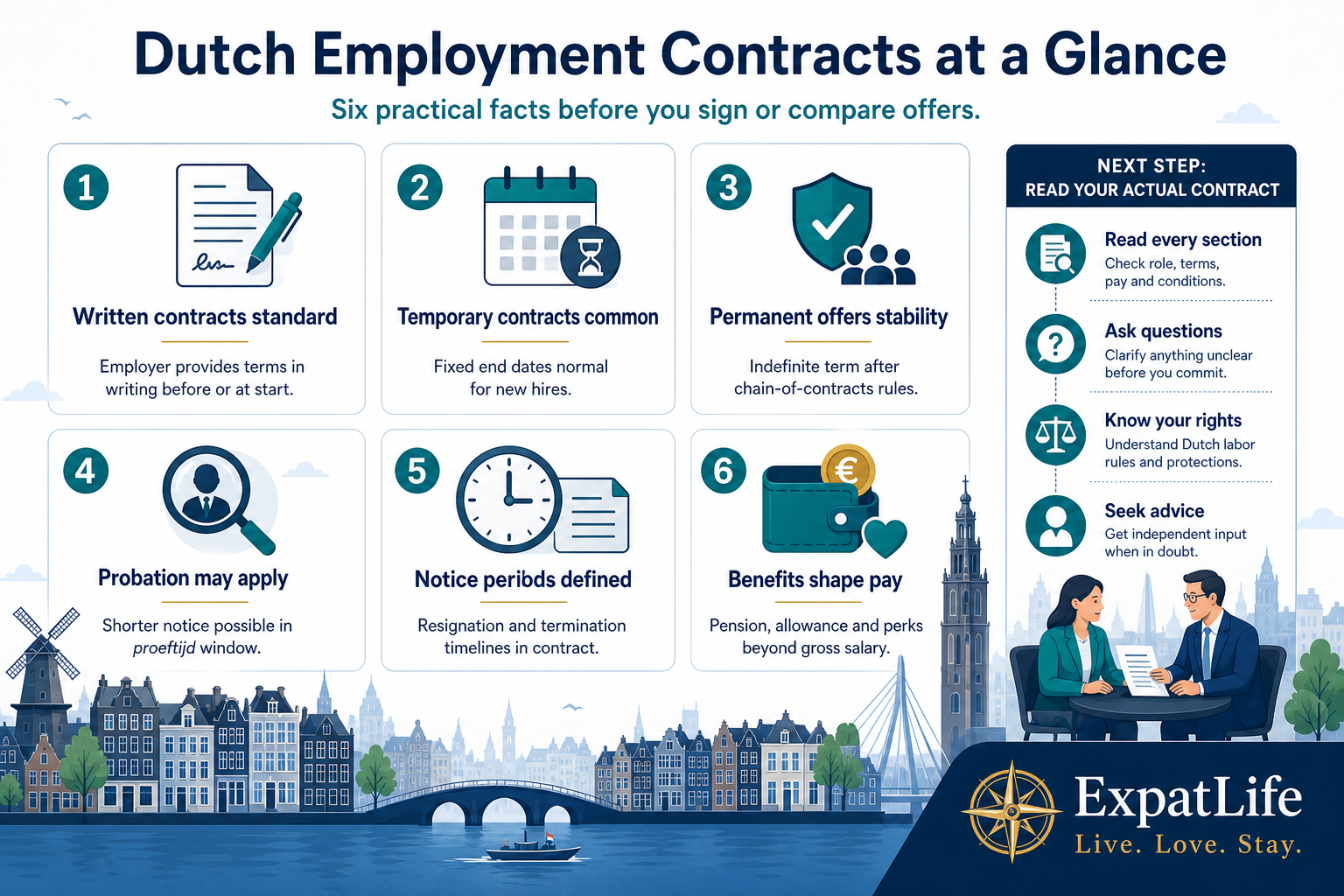
At a glance
Practical orientation points before you compare offers, negotiate terms or plan relocation.
Written contracts
Standard practice
Most Dutch employers provide a written agreement before or at start date.
Temporary contracts
Common for new hires
Fixed-term contracts are normal — especially in the first years of employment.
Permanent contracts
More stability
Indefinite contracts are often viewed as stronger continuity for long-term plans.
Probation periods
May apply
Some roles include a probation window with separate notice rules.
Notice periods
Usually defined
Employee and employer notice are typically stated in the contract or CAO context.
Benefits
Part of pay
Pension, allowances and perks often belong in total-compensation comparisons.
Three moves after reading this snapshot
Contract types
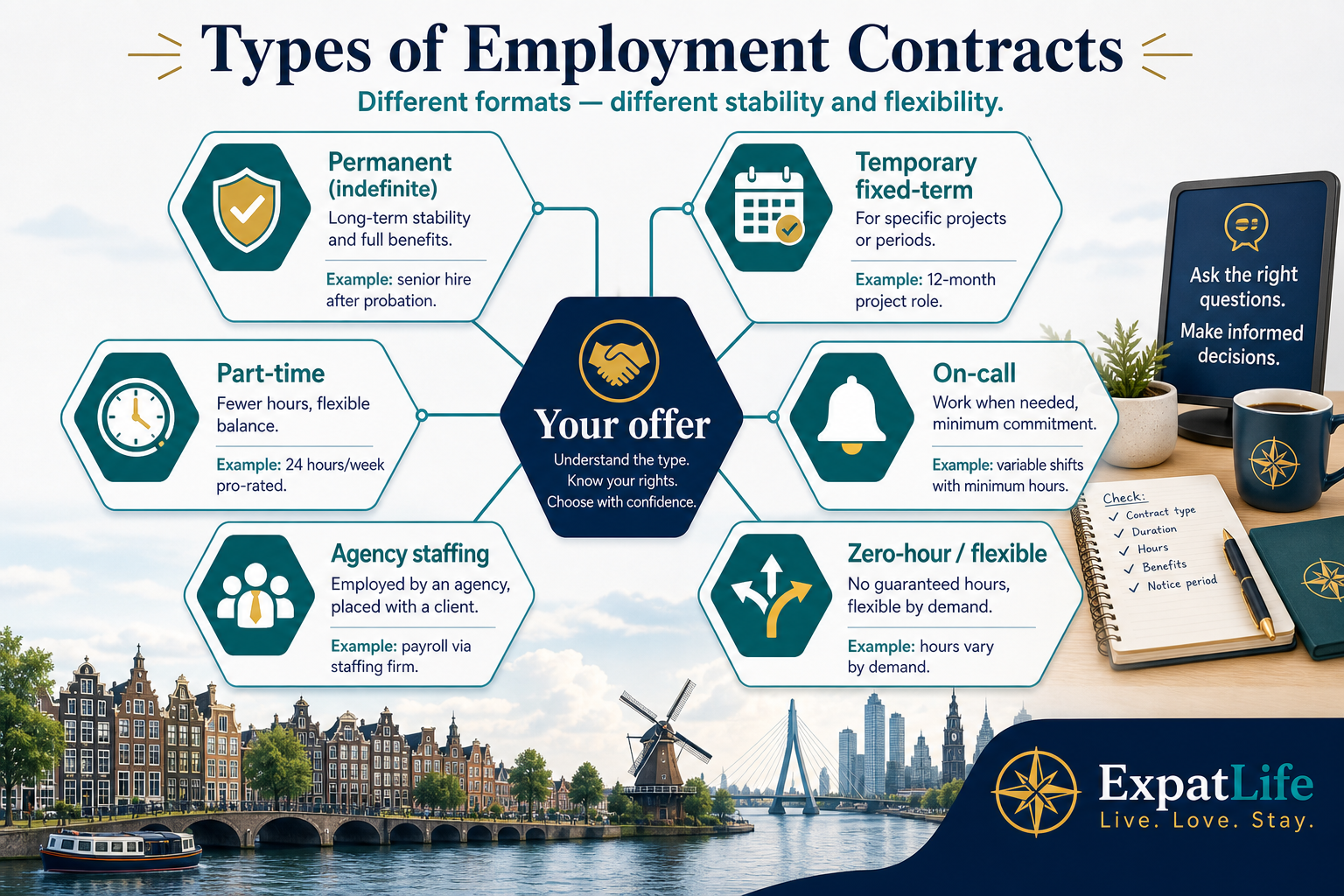
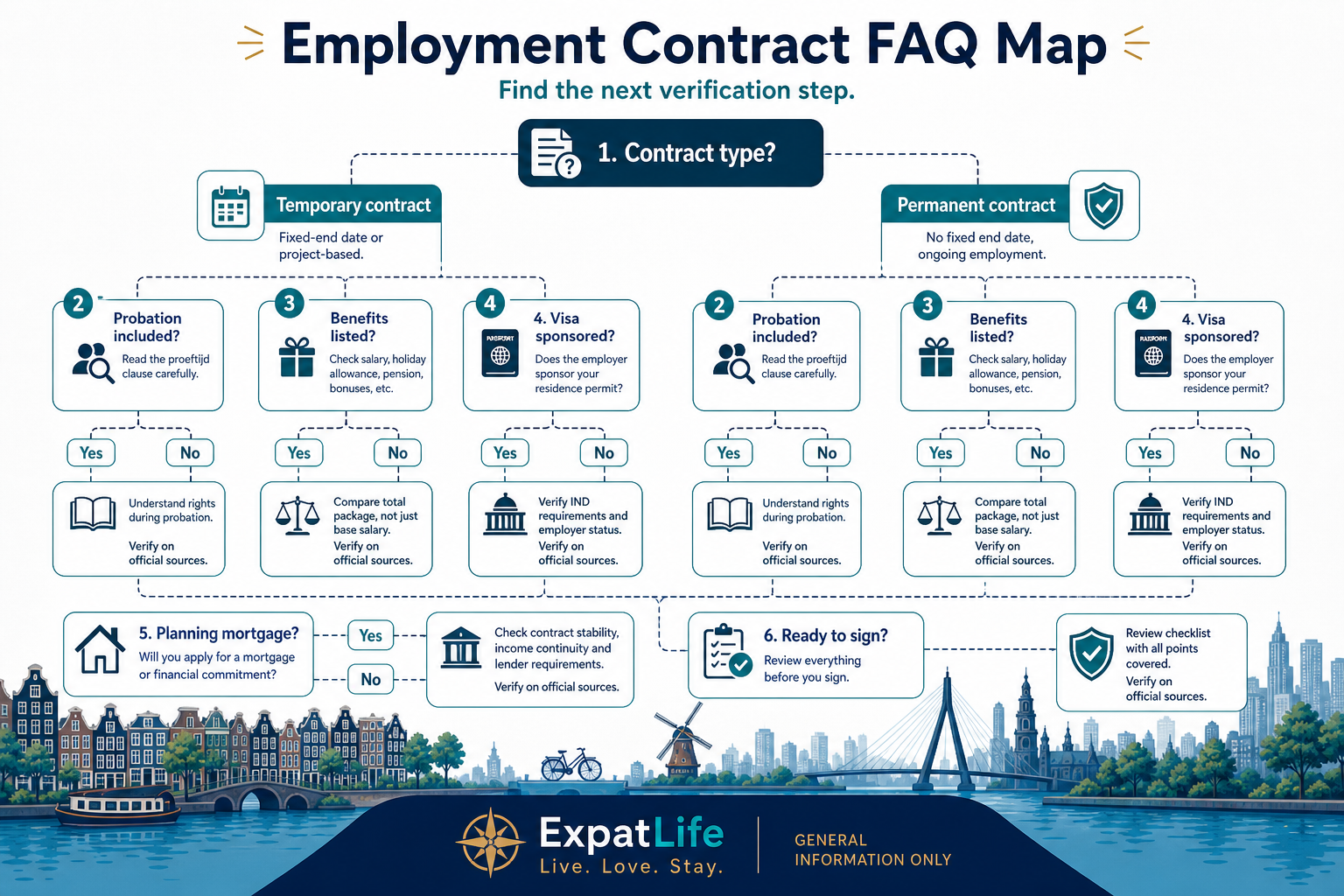
Dutch employers use several contract structures — labels vary, but the duration and renewal expectations usually matter most.
An indefinite employment agreement — often associated with stronger continuity for mortgages and long-term planning.
A fixed-duration agreement that may be renewed depending on employer needs and legal frameworks.
A contract with a defined end date — common when hiring for projects or probationary phases.
Reduced weekly hours with pro-rated salary, leave and benefits according to the agreement.
Work offered on variable schedules — hours and pay structures should be read carefully.
Employment through an agency or temp firm — responsibilities may differ from direct employer contracts.
Different contract types offer different levels of stability and flexibility. Treat labels as orientation — your specific agreement and any applicable CAO determine the details.
What to verify on your contract type
Examples
| Profile | Scenario | What to check |
|---|---|---|
| First Dutch role after relocation | Two consecutive 12-month fixed-term contracts, then indefinite | Written conversion criteria, chain-of-contract rules in your sector and whether HR confirms a permanent offer is realistic. |
| Project hire in consulting | 7-month fixed-term tied to client project end date | Exact end date, extension language, notice during probation and what happens if the project ends early. |
| Part-time return from parental leave | 0.8 FTE (32 hours) with pro-rated salary and leave | FTE percentage on payslip, pension accrual on part-time base and holiday allowance calculation method. |
| Agency placement before direct hire | Temp agency contract for first 6 months, then transfer to client payroll | Who pays pension and travel costs during agency phase, transfer date and whether benefits reset on conversion. |
| On-call hospitality or events role | Zero-hour style on-call with minimum monthly hours | Minimum guaranteed hours, call-out pay, cancellation rules and how annual leave accrues on variable income. |
Stability
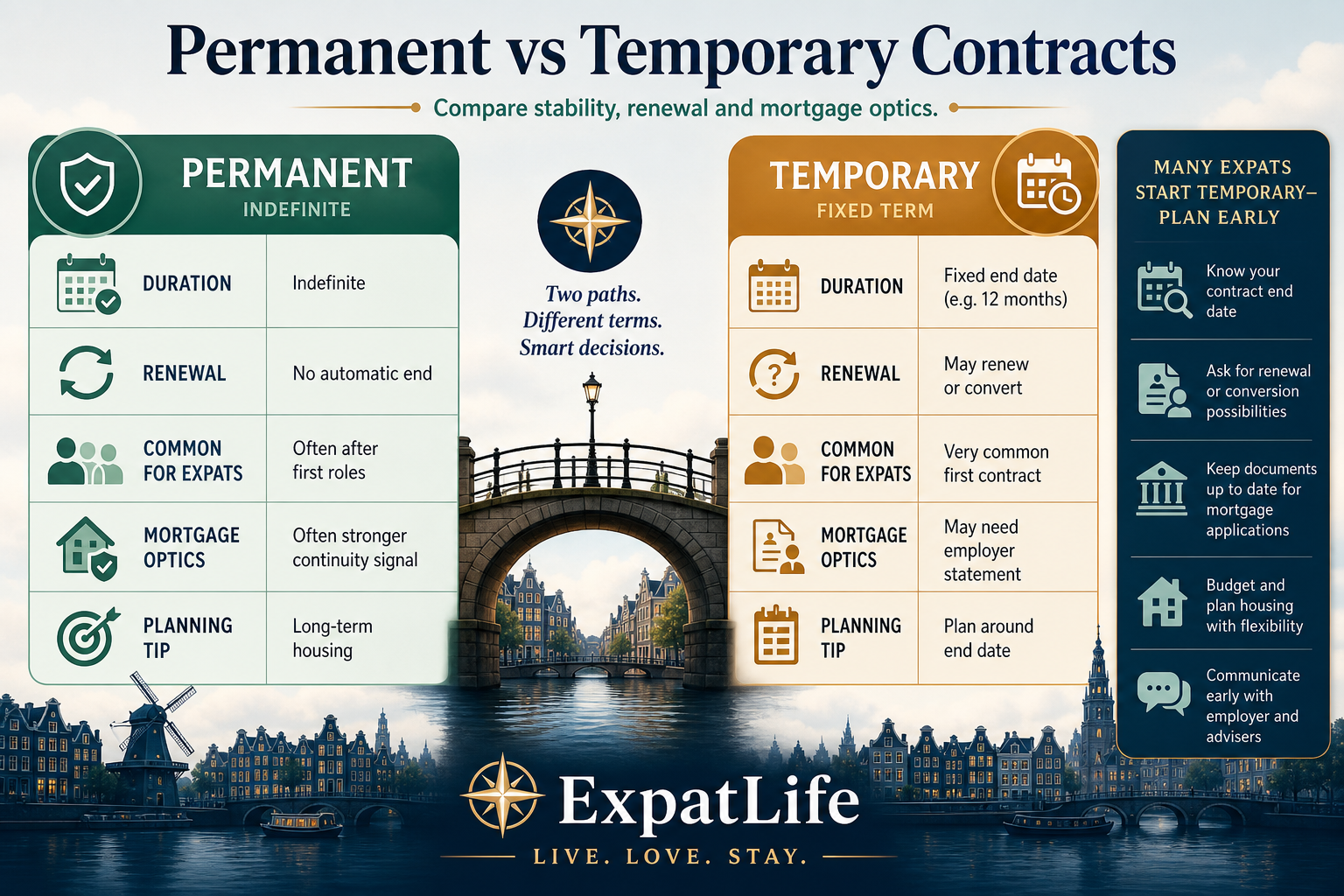
Permanent contracts are often associated with long-term stability, stronger employment continuity and more predictable optics for mortgages or relocation planning.
Temporary and fixed-term contracts are common — especially for new hires, project roles or employers testing fit. Many expats begin on temporary contracts before moving to more stable arrangements.
Compare
| Factor | Permanent contract | Temporary / fixed-term |
|---|---|---|
| Stability | Indefinite term — stronger long-term continuity signal | Fixed end date — renewal depends on employer and rules |
| Mortgage optics | Often viewed more favourably by lenders | May require extra income or employer statements |
| Renewal | No automatic end date | May be renewed or converted — not guaranteed |
| Common for expats | More common after initial fixed-term phases | Very common in first Dutch roles |
Examples
| Profile | Scenario | What to check |
|---|---|---|
| Fixed-term, planning to buy in year 2 | 18-month contract ending March 2027; wants €420k mortgage in 2026 | Lender may want employer statement on renewal intent, income history and probation completion before approval. |
| Permanent offer vs higher fixed-term pay | €5,400/month permanent vs €5,900/month 24-month fixed-term | Model net pay plus pension value — higher temporary gross may not offset weaker continuity for housing or visa extension. |
| Contract ends before lease does | 12-month work contract but 24-month rental agreement signed on arrival | Renewal probability, notice if role ends early and whether relocation package included temporary housing support. |
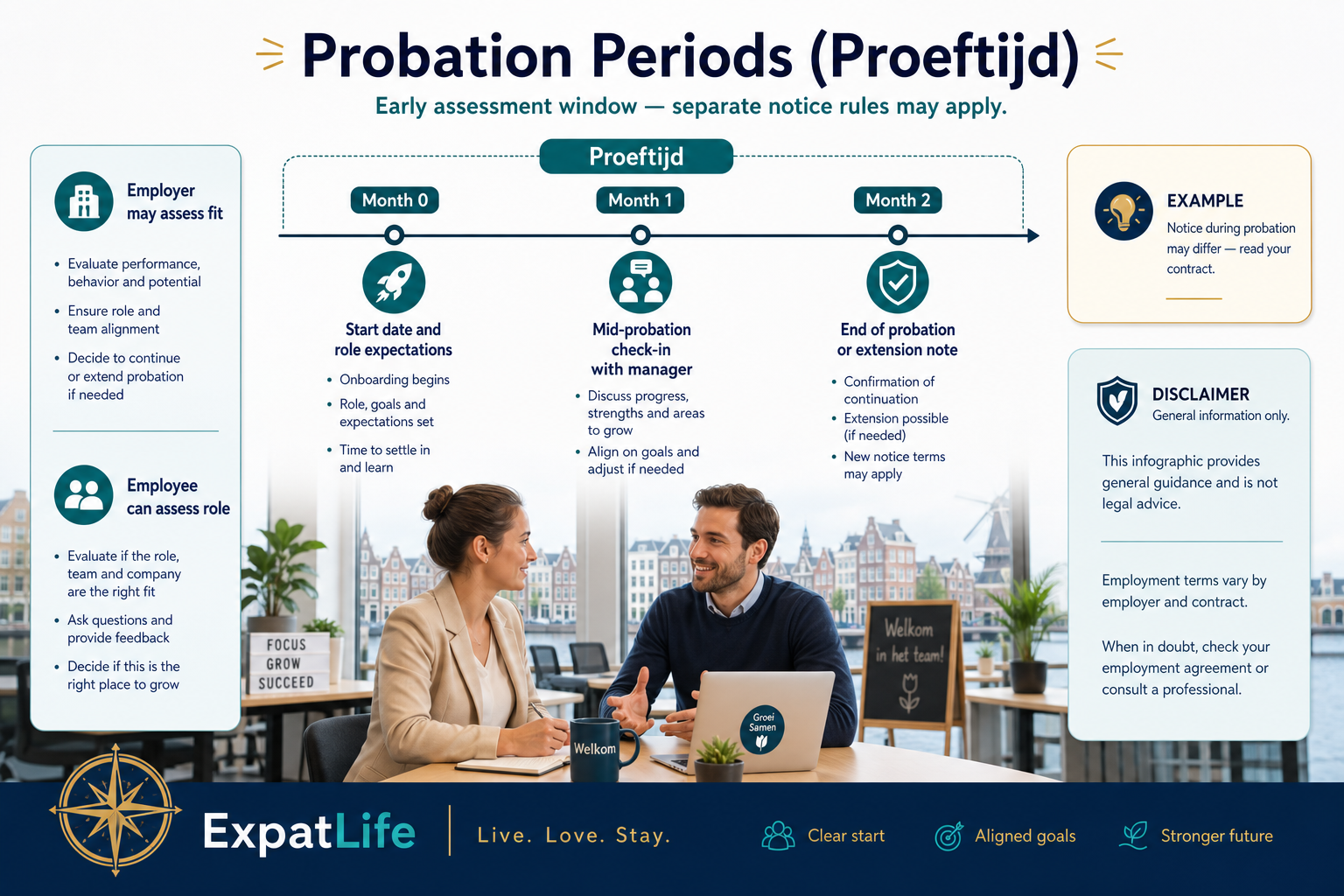
Probation
Some Dutch employment contracts include a probation period at the start of employment. During this window, employer and employee may assess whether the role, team and expectations fit.
Probation can affect notice periods and how quickly either side can end the relationship. The exact rules depend on your contract, role and applicable frameworks — verify details in your agreement and on official sources rather than assuming home-country norms.
Probation review checklist
Examples
| Profile | Scenario | What to check |
|---|---|---|
| Standard 2-month probation | Proeftijd 1 March – 30 April; role starts 1 March | Shorter notice during probation (often 1 week each way in many contracts — verify yours), bonus eligibility and pension start date. |
| HS migrant in probation | Loses role in week 6 of 2-month probation | Permit reaction time, job search window and whether a new sponsor contract must start before current permit expires — verify IND rules. |
| Probation extended informally | Manager says probation continues another month without contract amendment | Only written contract terms count — ask HR to confirm end date and post-probation notice in writing. |
Compensation
Dutch employment contracts usually quote gross salary and may reference holiday allowance, bonuses, pension contributions, travel allowances and overtime arrangements separately.
Expats often compare offers using headline salary alone. A stronger package may include pension participation, commuting support or structured bonuses that change take-home outcomes materially.
Base monthly or annual pay before payroll tax and deductions.
Net salary guideOften 8% of gross annual salary — usually paid in May.
Holiday allowance guidePerformance or signing bonuses may have separate tax treatment.
Bonus tax guideEmployer and employee pension participation affects long-term wealth.
Pension guideCommuting or travel costs may be reimbursed or structured separately.
Employee benefits guideOvertime rules vary by role, CAO and contract wording.
Average salary context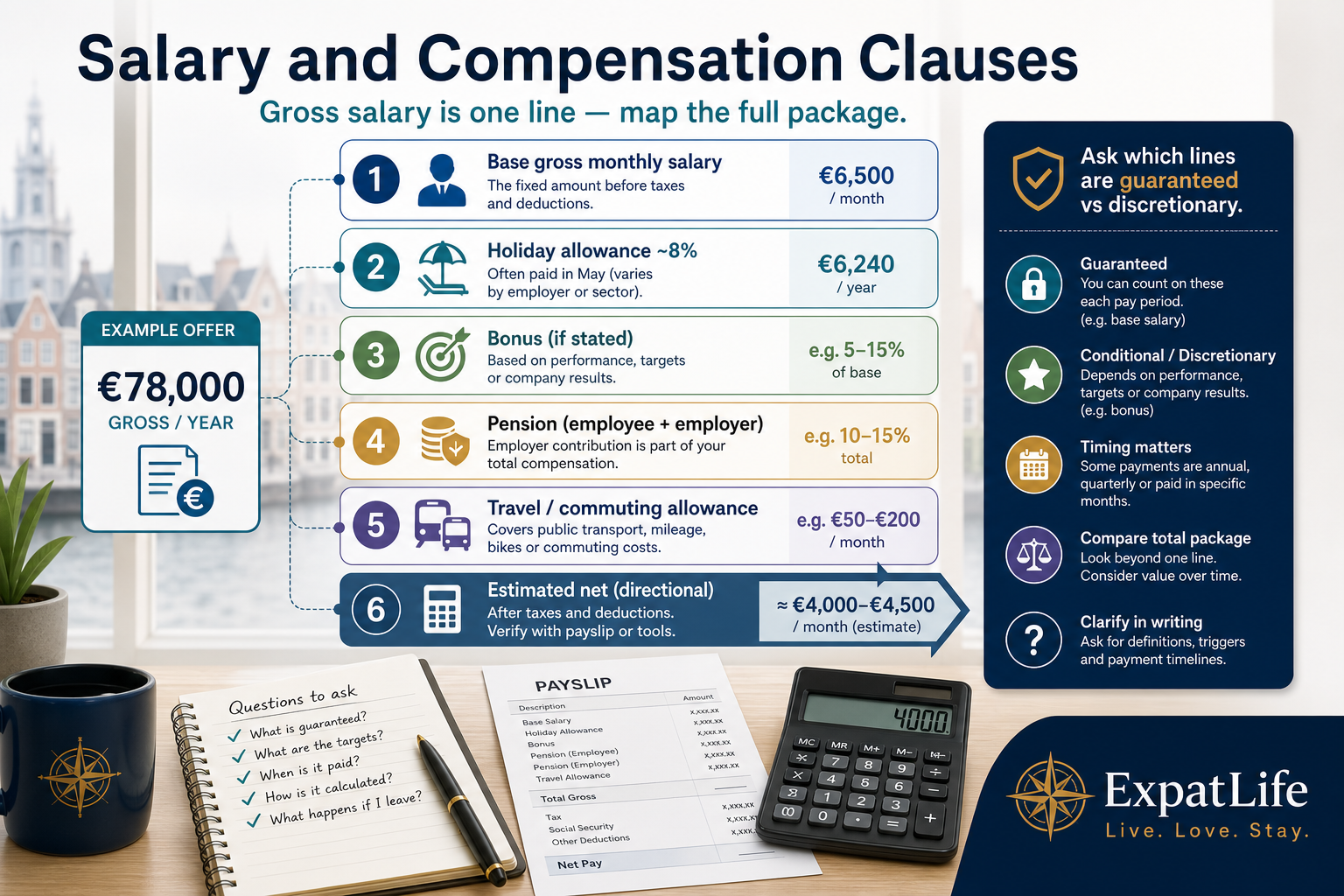
Compare offers
| Offer | Gross / month | Holiday allowance | Pension | Travel / extras | Planning note |
|---|---|---|---|---|---|
| Offer A — corporate HQ (Amsterdam) | €5,500 | 8% (paid May) | Employer ~67% / employee ~33% of premium | NS Business Card + €50 WFH allowance | Lower headline than B, but stronger pension and travel — often better long-term package. |
| Offer B — scale-up (Utrecht) | €6,100 | 8% (paid May) | Basic scheme — employee opt-in required | €0.23/km capped at €200/month | Higher gross, but confirm pension opt-in, bonus discretion and 12-month contract end date. |
| Offer C — agency placement | €4,950 (agency payroll) | Included in hourly rate structure | StiPP or agency scheme — read annex | Travel reimbursed after probation only | Compare agency phase vs promised direct-hire package before accepting relocation support. |
Tax & payroll
Helpful when gross pay, 30% ruling eligibility, relocation allowances or cross-border income make take-home modelling harder than the headline figure.
Blue Umbrella
Dutch tax filing and expat-focused support — useful for ruling-related questions, payroll context, and annual returns.
Paid services; confirm pricing for your case.
Visit provider →TaxSavers
Tax returns and advice aimed at internationals; helpful when you want hands-on filing or a second opinion on ruling paperwork.
Paid services; check current rates.
Visit provider →Expatax
Expat income tax guidance and ruling-related planning for employees in the Netherlands.
Paid services; confirm scope before engaging.
Visit provider →Some links may be affiliate or referral links. Listings are for discovery only — not pay-to-rank and not legal, tax or immigration advice. Confirm credentials and scope with any provider. Learn more
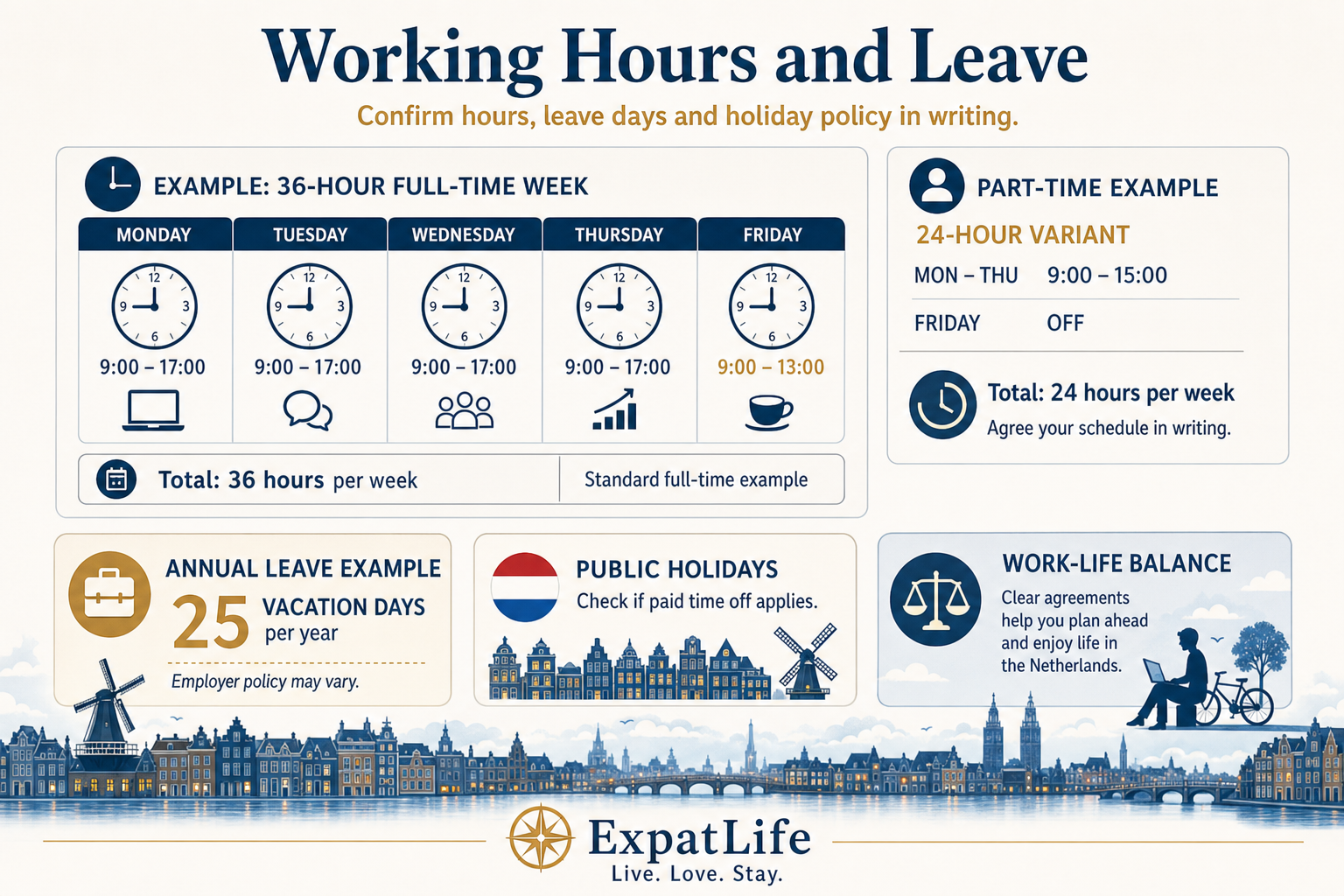
Hours & leave
Full-time schedules in the Netherlands are often around 36–40 hours per week, but part-time work is common and should be stated clearly in the contract.
Annual leave, public holidays and work-life balance expectations are part of Dutch employment culture — confirm how many leave days your agreement includes and whether any CAO references apply.
Contract states 36 hours/week, 4 office days — typical in many Dutch employers. Confirm whether overtime is paid, compensated as time off or excluded for salaried staff.
32 hours/week on €4,800 FTE-equivalent salary → pro-rated pay ~€3,840/month. Check leave days (often 25 × 0.8 = 20), pension base and holiday allowance calculation.
Contract allows 2 days/week from home in NL but prohibits work from outside the EU. Clarify before planning monthly trips to home country.
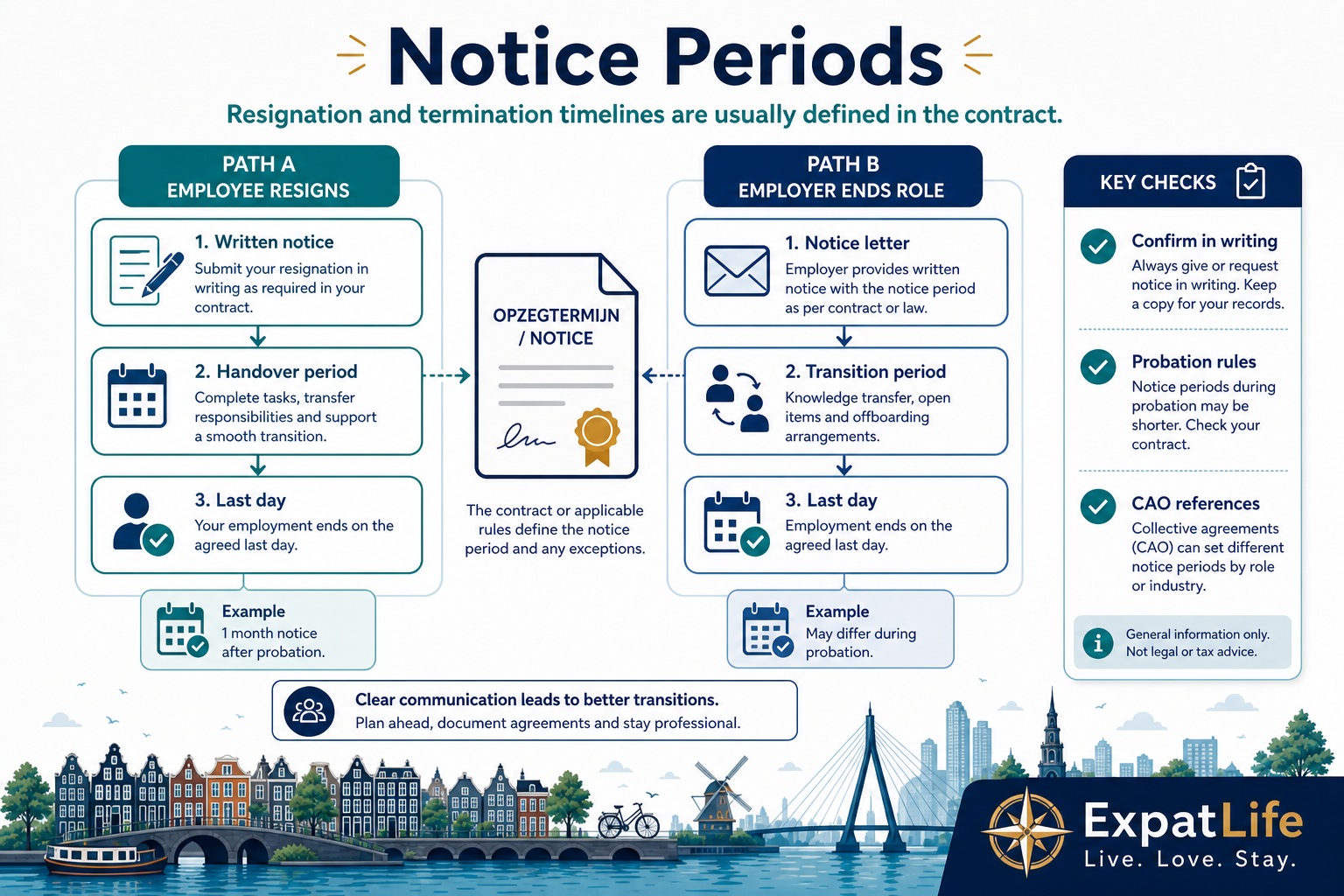
Notice
Employment contracts often define how much notice an employee must give when resigning and how much notice an employer must give when ending employment.
Notice periods can differ during probation, after long tenure or under specific CAO rules. Use this section for orientation only — do not treat it as dismissal or legal advice.
Resignation checklist
Examples
| Profile | Scenario | What to check |
|---|---|---|
| Resigning after probation | Employee notice stated as 1 calendar month in contract | Whether notice runs to month-end, unused leave offset rules and any relocation clawback if leaving within 12 months. |
| Employer non-renewal | Fixed-term ends 31 August; employer gives 1-month notice in July | Written confirmation, final payslip timing, transition payment references (if any) and permit/job-search implications. |
| Leaving during probation | Employee resigns with 1-week notice in week 5 of 8-week probation | Probation notice clause, equipment return, last working day confirmation and visa/permit next steps. |
Benefits
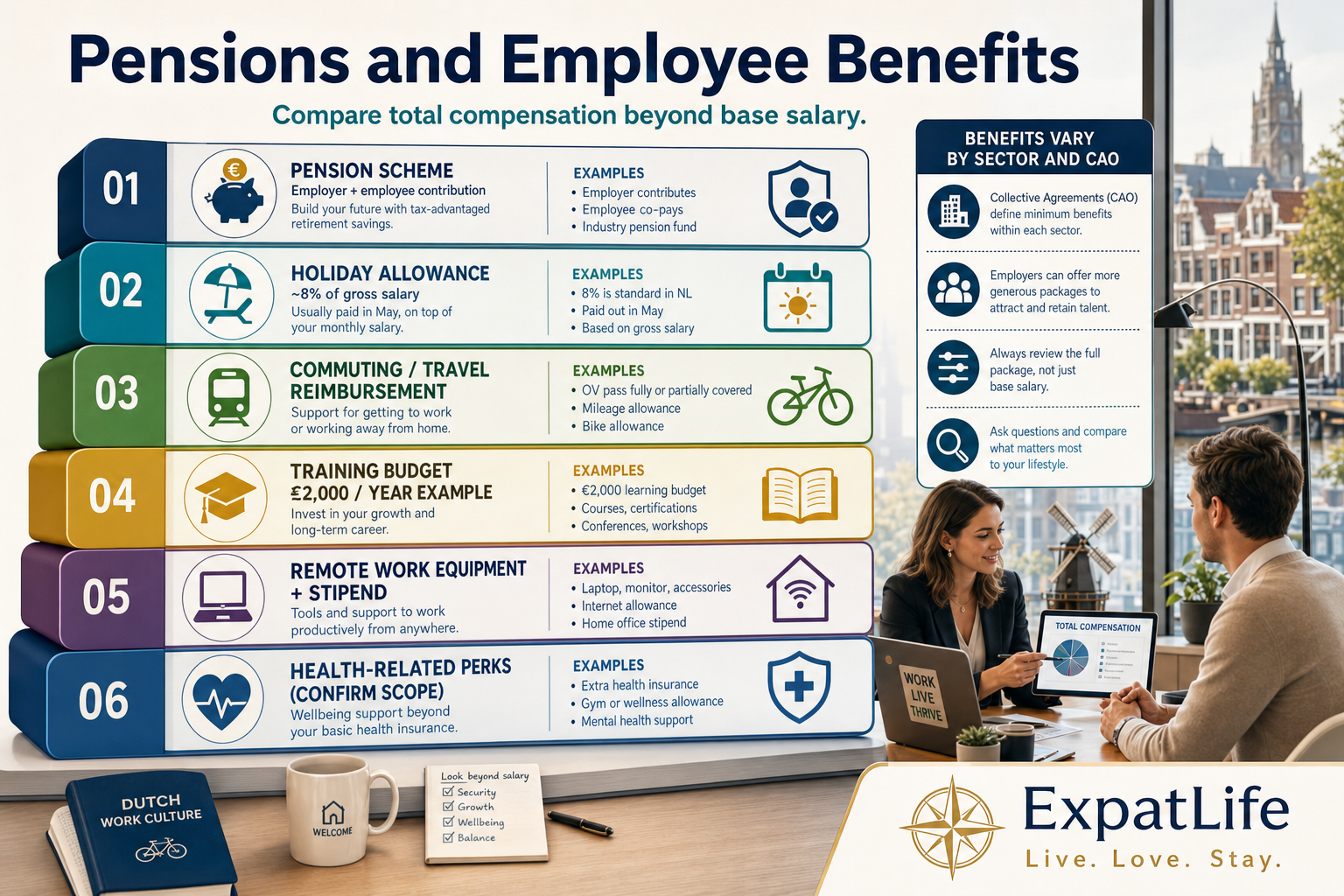
Beyond salary, Dutch contracts may reference pension plans, commuting allowances, training budgets, health-related benefits, remote-work policies and company equipment.
Benefits vary widely by employer size, sector and CAO. Compare total packages when evaluating offers — especially if you are relocating with a family or planning a mortgage.
Second-pillar pension participation can be a major long-term benefit.
Pension Netherlands guideTravel or home-office commuting support may be tax-relevant.
Employee benefits guideProfessional development allowances are common in larger employers.
Some employers offer supplementary perks — confirm scope and tax treatment.
Hybrid policies and equipment budgets should be explicit if flexibility matters.
Laptop, phone and tooling policies are often listed in HR appendices.
Examples
| Profile | Scenario | What to check |
|---|---|---|
| Large employer package | €5,200 gross + full pension + €150 travel + €1,500 training budget | Pension employee share via payslip, travel tax treatment and whether training budget requires approval. |
| Startup lean package | €6,000 gross + minimal pension + laptop only | Whether you must opt into pension, stock/option wording (if any) and health-related perks vs higher cash. |
| Family-focused package | €4,900 gross + extra parental leave days + childcare scheme reference | Eligibility rules, tax treatment and whether benefits start after probation. |
Highly skilled migrant
For highly skilled migrants and other sponsored routes, employment contracts often play an important role in visa applications, salary threshold checks and relocation planning.
Contract duration, gross salary, employer sponsor status and role description may all matter when permits are assessed. This is orientation only — not immigration advice. Verify current IND requirements independently.
Examples
| Profile | Scenario | What to check |
|---|---|---|
| Switching employers on HSM route | New role at different recognised sponsor within 3 months of arrival | New contract salary vs current IND threshold, start date alignment and whether permit change must complete before starting. |
| Fixed-term HSM contract | 12-month contract; permit validity tied to employment | Contract end date on permit, extension paperwork timeline and probation timing relative to permit renewal. |
| Salary mix in contract | €5,000 base + €800 allowance + target bonus | Which lines IND and payroll treat as qualifying gross — do not assume all allowances count for threshold checks. |
Visa & permits
Useful when salary thresholds, recognised sponsors or permit timing still need scoped professional help alongside official IND guidance — not as contract legal advice.

Fragomen
Global immigration law firm with a Netherlands practice. Handles corporate immigration, work permits, and relocations for employers and individuals.
From ~€175–300/hr; corporate packages on request
Visit provider →
Pathway Partners
Amsterdam-based immigration and legal services for individuals and businesses. Employment visas (HSM, Blue Card, ICT), self-employment permits, family reunification, naturalisation, objections (bezwaar), and humanitarian residence. Free eligibility assessment and consultation.
Free initial assessment; service fees vary. Family reunification from ~€500 per additional family member
Visit provider →
Everaert Advocaten
Dutch immigration law firm focused on residence permits, family migration, and IND procedures. One of the first in the Netherlands dedicated to immigration law.
From ~€150–275/hr; fixed fees for some applications
Visit provider →Immigration Advise NL
Immigration advisory practice (Marco van der Vinne; experience since 2001, formerly with Dutch Immigration Service). Affordable package options: pre-scan and DIY support, full handling, and objection procedures. MVV, residence permits, and extensions.
From ~€100 pre-scan and DIY; ~€200 full handling; ~€300 objection procedures (check current rates)
Visit provider →Some links may be affiliate or referral links. Listings are for discovery only — not pay-to-rank and not legal, tax or immigration advice. Confirm credentials and scope with any provider. Learn more

Review
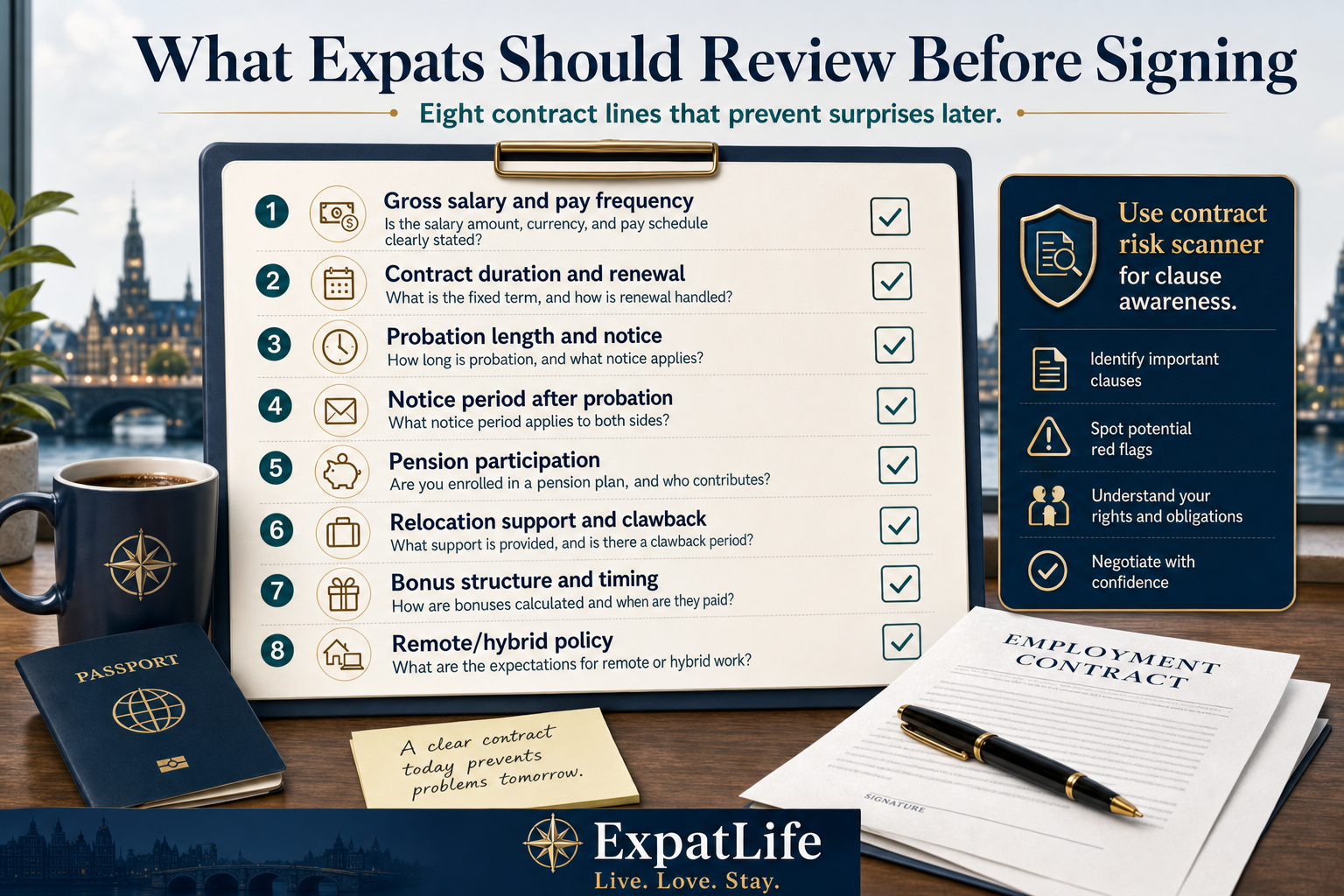
Understanding contract terms early can prevent misunderstandings later. Use this checklist for awareness — not as a substitute for reading your actual agreement or seeking qualified advice when needed.
Expat contract review checklist
Clause walkthrough
| Clause | Example wording | Why it matters |
|---|---|---|
| Contract duration | Arbeidsovereenkomst voor bepaalde tijd tot 31-12-2026 | Fixed end date — plan housing, permit renewal and mortgage timing around December 2026. |
| Probation | Proeftijd: 2 maanden vanaf 01-03-2026 | Shorter notice may apply until 30 April 2026 — different rules after probation ends. |
| Salary | Bruto maandsalaris €5.750 (fulltime 40 uur) | Confirm hours match your schedule; part-time pay scales from this FTE reference. |
| Holiday allowance | Vakantiegeld 8% uitbetaald in mei | May payment is a separate cash flow bump — model monthly budget without relying on it year-round. |
| Notice | Opzegtermijn werknemer 1 maand na proeftijd | Resignation timing affects start date at next employer and lease exit planning. |
| Relocation repayment | Relocatiekosten terug te betalen bij vertrek binnen 24 maanden | €8,000 relocation support could become repayable if you leave early — negotiate or clarify triggers. |
Mortgages
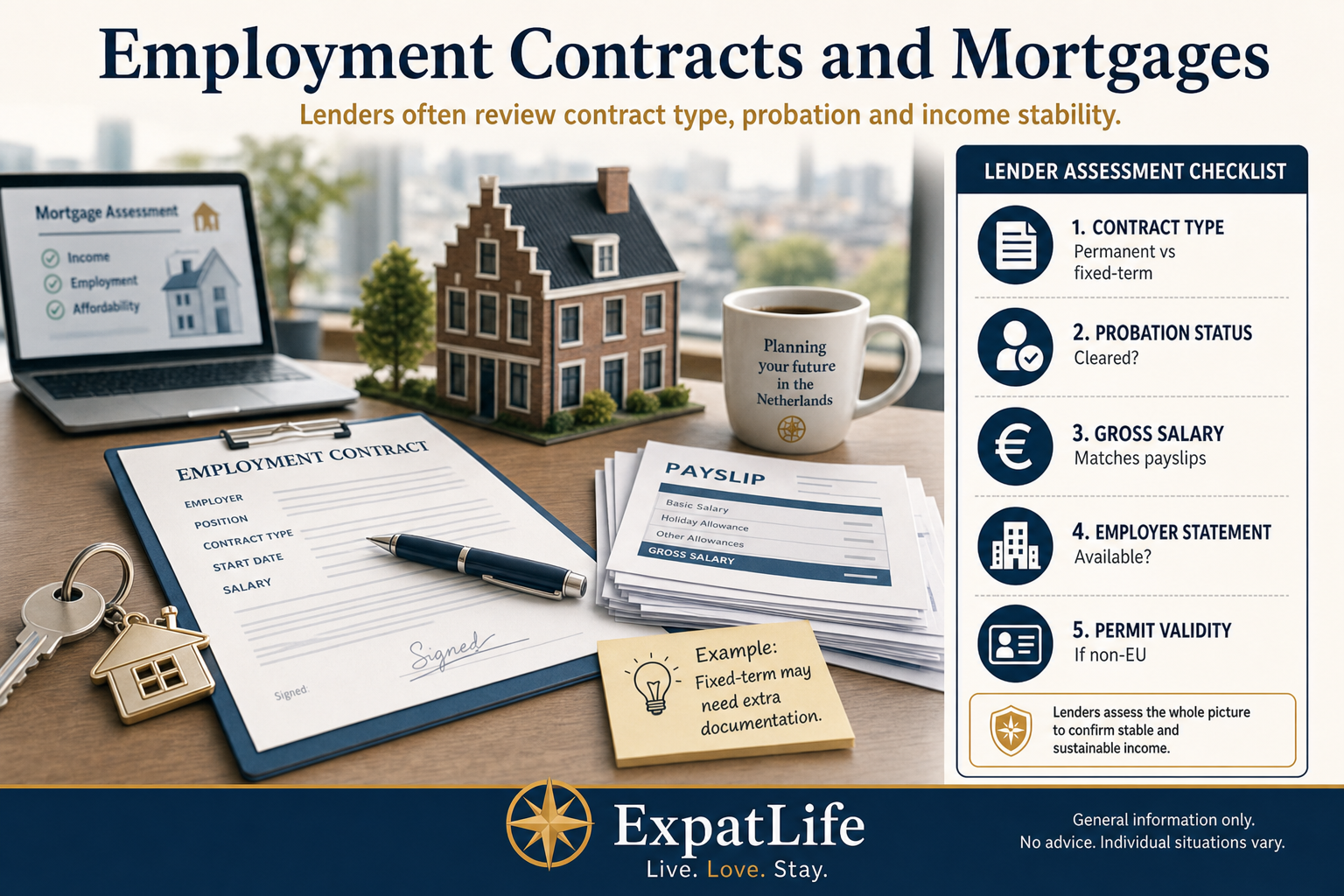
Mortgage providers often consider contract type, employment stability, probation status and salary level when assessing expat borrowers.
Permanent contracts may be viewed differently from fixed-term or probationary roles. Lender policy varies — confirm requirements with a mortgage adviser before assuming an offer supports borrowing.
Documents lenders may ask for
Examples
| Profile | Scenario | What to check |
|---|---|---|
| Permanent contract, past probation | €5,600/month gross, indefinite contract, 8 months in role | Payslips match contract, employer statement rarely needed — lender focuses on net income and debts. |
| Fixed-term with renewal letter | €6,800/month, 23 months remaining, employer letter confirms extension intent | Some lenders accept employer statements; others require permanent contract or longer track record. |
| Still in probation | Wants to bid on house during 2-month probation window | Many lenders wait until probation ends — confirm timing before paying notary deposits. |
| Dual income, mixed contract types | Partner permanent €4,200 + applicant fixed-term €5,100 | Lender may weight incomes differently — model worst-case if fixed-term is not renewed. |
Mortgage advisers
Lenders may treat probation, contract duration and visa status differently — confirm requirements with a licensed adviser rather than relying on the offer letter alone.
Expat Mortgages
Independent mortgage brokerage for international clients — useful when contract type, probation and visa status affect lender requirements.
Confirm fees, lender access and scope with the adviser.
Visit provider →Viisi Expats
Full-process mortgage advice with expat-focused pages — compare how lenders may view your contract and income.
Confirm advisory model and fees before engaging.
Visit provider →Hanno
Digital-first mortgage advice — helpful when you want online consultations alongside contract document checks.
Confirm credentials and pricing directly.
Visit provider →Mister Mortgage
Broker-style mortgage support in English — compare process guidance before assuming your contract supports borrowing.
Confirm broker fees and lender panel.
Visit provider →Some links may be affiliate or referral links. Listings are for discovery only — not pay-to-rank and not legal, tax or immigration advice. Confirm credentials and scope with any provider. Learn more
Avoidable mistakes
Use these cards to stress-test your agreement before signing or negotiating relocation support.
Holiday allowance, pension and allowances can change total value significantly.
Training, commuting and insurance-related perks are easy to overlook in headline comparisons.
Not all employers structure pension the same way — confirm employee vs employer contributions.
Resignation and termination notice may differ from what you expect from other countries.
Probation, leave and contract renewal norms may differ in the Netherlands.
A fixed end date is normal — plan housing and visas around renewal uncertainty.
Repayment or clawback terms for relocation support can be costly if you leave early.
Hybrid expectations should be explicit if you plan to work from abroad occasionally.
Examples
| Profile | Scenario | What to check |
|---|---|---|
| Signed without reading annex | Relocation repayment clause buried in HR appendix | Full PDF review including pension fund rules, travel policy and bonus plan — not only main contract pages. |
| Assumed UK notice rules | Gave 2 weeks' notice; contract required 1 month after probation | Employee notice in Dutch contract governs — informal HR chat does not override written terms. |
| Compared gross only | Accepted €6,000 offer over €5,700 without modelling pension and travel | Total compensation table with net calculator — €300 gross gap can shrink after pension opt-in and tax. |

Common questions
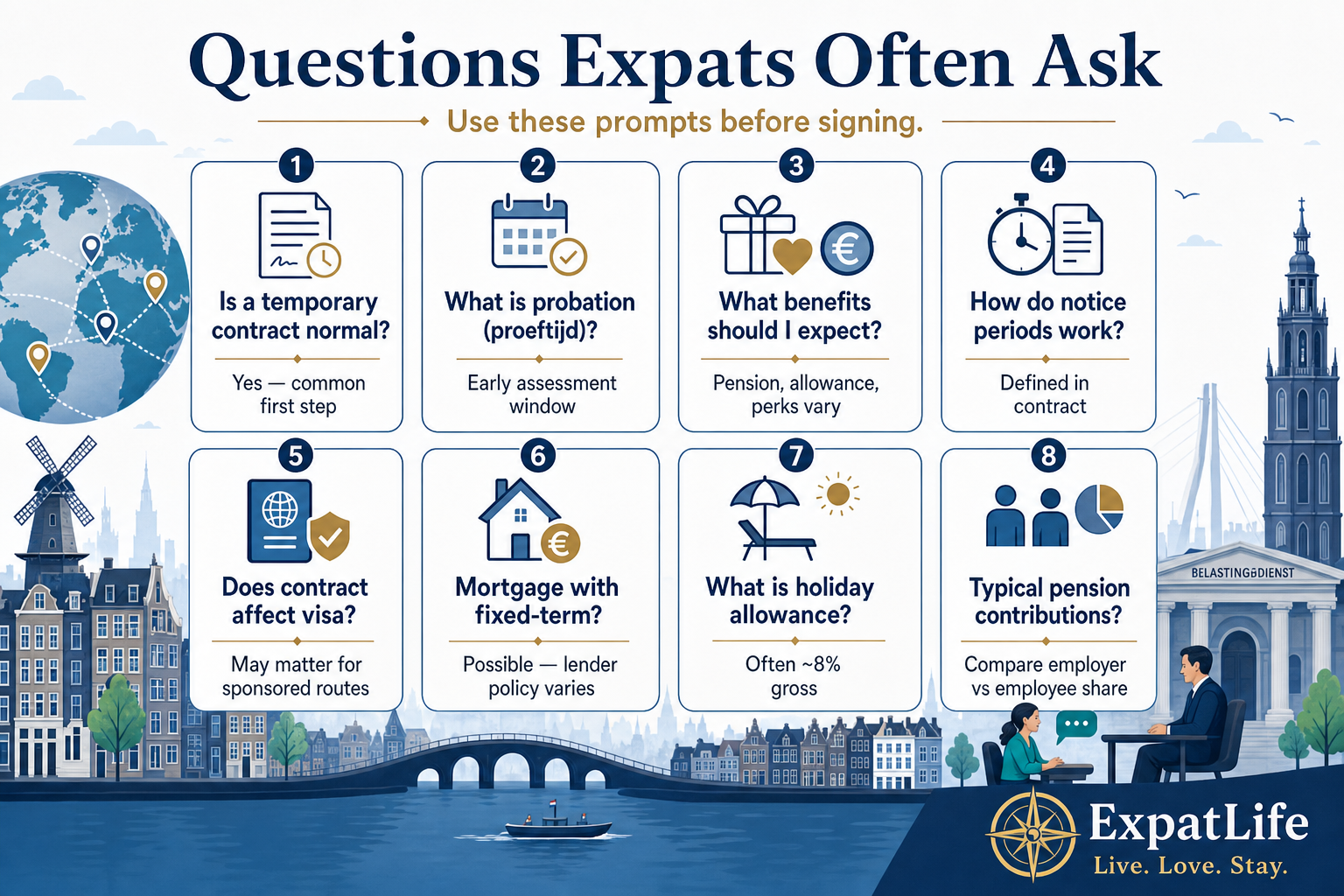
Quick orientation answers — verify specifics for your industry, visa route and contract type.
Yes. Fixed-term contracts are common for new hires and project roles. Many expats start temporary before moving to more stable arrangements.
A probation period (proeftijd) is an early assessment window where different notice rules may apply. Read your contract for exact duration and conditions.
Pension, holiday allowance, commuting support and training budgets are common — but packages vary by employer and sector.
Notice for resignation or termination is usually defined in the contract or applicable CAO. Do not assume home-country defaults.
For sponsored routes, salary, employer status and contract terms may matter for permits. Verify current IND rules on official sources.
Sometimes — but lenders often scrutinise fixed-term roles more closely. Policy varies by bank and profile.
A statutory-style allowance often around 8% of gross annual salary, usually paid in May — typically referenced in Dutch contracts.
Many employers participate in sector or company pension schemes. Structures vary — compare employer and employee shares.
Career guides
Connect contract review to job search, salary benchmarks, benefits and pension planning.

Services
Recruitment, immigration, career and relocation support may help with specific steps — this page does not replace reading your contract or qualified advice.
Contract review often overlaps with visa sponsorship, salary and tax questions, pension planning, relocation timing and mortgage readiness. These listings are for discovery when you need scoped help — not contract legal advice or placement guarantees. Confirm services, pricing and credentials before you commit.
Some links may be affiliate or referral links. If you use them, we may earn a commission at no extra cost to you. Ordering reflects relevance to contract planning, not pay-to-rank. This is not legal, employment or immigration advice — verify outcomes with employers, IND, UWV or qualified advisers. Learn more
Browse directories: Tax advisorsImmigration lawyersVisa consultantsFinancial advisorsMortgage advisorsRelocation servicesHousing platformsBrowse all services
Visa & permits
Helpful when sponsorship clauses, recognised employers or permit timing still feel unclear before you sign.
Fragomen
Global immigration law firm with a Netherlands practice. Handles corporate immigration, work permits, and relocations for employers and individuals.
From ~€175–300/hr; corporate packages on request
Visit provider →Pathway Partners
Amsterdam-based immigration and legal services for individuals and businesses. Employment visas (HSM, Blue Card, ICT), self-employment permits, family reunification, naturalisation, objections (bezwaar), and humanitarian residence. Free eligibility assessment and consultation.
Free initial assessment; service fees vary. Family reunification from ~€500 per additional family member
Visit provider →Everaert Advocaten
Dutch immigration law firm focused on residence permits, family migration, and IND procedures. One of the first in the Netherlands dedicated to immigration law.
From ~€150–275/hr; fixed fees for some applications
Visit provider →Immigration Advise NL
Immigration advisory practice (Marco van der Vinne; experience since 2001, formerly with Dutch Immigration Service). Affordable package options: pre-scan and DIY support, full handling, and objection procedures. MVV, residence permits, and extensions.
From ~€100 pre-scan and DIY; ~€200 full handling; ~€300 objection procedures (check current rates)
Visit provider →Tax & payroll
Many international hires compare gross lines, ruling eligibility and relocation allowances with scoped tax help — not as contract legal advice.
Blue Umbrella
Dutch tax filing and expat-focused support — useful for ruling-related questions, payroll context, and annual returns.
Paid services; confirm pricing for your case.
Visit provider →TaxSavers
Tax returns and advice aimed at internationals; helpful when you want hands-on filing or a second opinion on ruling paperwork.
Paid services; check current rates.
Visit provider →Expatax
Expat income tax guidance and ruling-related planning for employees in the Netherlands.
Paid services; confirm scope before engaging.
Visit provider →Relocation
Useful once city, start date and family logistics need planning alongside your new role — confirm what your employer covers.
Expat2Holland
Relocation and settling-in support for internationals, including housing, registration, and practical onboarding.
Full package from ~€1,500–3,000; à la carte from ~€200–500 per service. Employer packages often higher.
Visit provider →Jimble
Relocation and mobility services for expats and internationals in the Amsterdam area.
Packages vary; often €1,000–2,500+ for core relocation. Check directly for quote.
Visit provider →RSH Relocation and Immigration Services
Relocation and immigration services for internationals and families, including housing and registration support.
From ~€1,200 for basic package; full relocation €2,000–4,000+. Immigration support often separate.
Visit provider →RelocAid
Relocation support for expats and families, including housing search, registration, and settling-in assistance.
Packages from ~€1,000; full family relocation €2,000–3,500+. Confirm scope and quote.
Visit provider →Post-sign setup
Many international hires line up accounts, mandatory insurance and housing in parallel with contract signing — scope and fees differ by provider.

bunq
Digital bank with expat-friendly signup and multi-currency options. Often used for quick account setup and international use.
From ~€2.99/mo
Visit provider →
Zilveren Kruis
One of the largest Dutch health insurers (Achmea). Broad care network, basic and supplementary packages; widely recognised by expats.
~€145–162/mo
Visit provider →Funda
Major Dutch platform for homes for sale and rent. Listings from estate agents and landlords across the Netherlands.
Free to browse; agent or landlord fees may apply.
Visit provider →
Knab
Dutch online bank (no branches). Full Dutch payment account with iDEAL and debit card; often chosen for straightforward pricing and digital experience.
From ~€3.50/mo
Visit provider →
CZ
Large Dutch insurer with a big customer base. Standard basic and various supplementary packages; solid option for daily cover.
~€142–158/mo
Visit provider →
HousingAnywhere
Online platform connecting people looking for a home with landlords. Not a real estate agency. Mid- and long-term furnished rentals.
Check platform pricing and booking fees.
Visit provider →
Independer
Compare Dutch basic health and other insurance when you are choosing a policy.
Free comparison; insurer premiums vary.
Visit provider →ExpatCopilot may earn a commission from some partners. Listings here support contract planning — not pay-to-rank placement and not legal or immigration guarantees. Confirm scope, credentials and pricing with any provider. Learn more
Professional services may help with specific steps — they do not replace reading your contract, using official sources or obtaining qualified advice when needed.

FAQ
These answers help you identify what still needs verification — contract type, probation, notice, benefits and permit links.
A written agreement outlining employment terms such as salary, hours, benefits, notice periods and contract duration. Most employees in the Netherlands receive one.
Yes. Fixed-term contracts are common, especially for new hires. Many expats begin on temporary contracts before more stable arrangements.
An early assessment period (proeftijd) where different notice rules may apply. Duration and conditions should be stated in your contract.
Notice for resignation or termination is usually defined in the contract or applicable CAO. Rules may differ during probation.
Pension participation, holiday allowance, commuting support and training budgets are common — but vary by employer and sector.
For sponsored routes, contract salary, duration and employer status may matter. Verify current IND requirements on official sources — this is not immigration advice.
Lenders often review contract type, probation and income stability. Permanent contracts may be viewed differently from fixed-term roles.
Salary, duration, probation, notice, pension, relocation clauses, bonus structure and remote-work policy. Use our contract risk scanner for clause awareness — not legal verdicts.
Trust
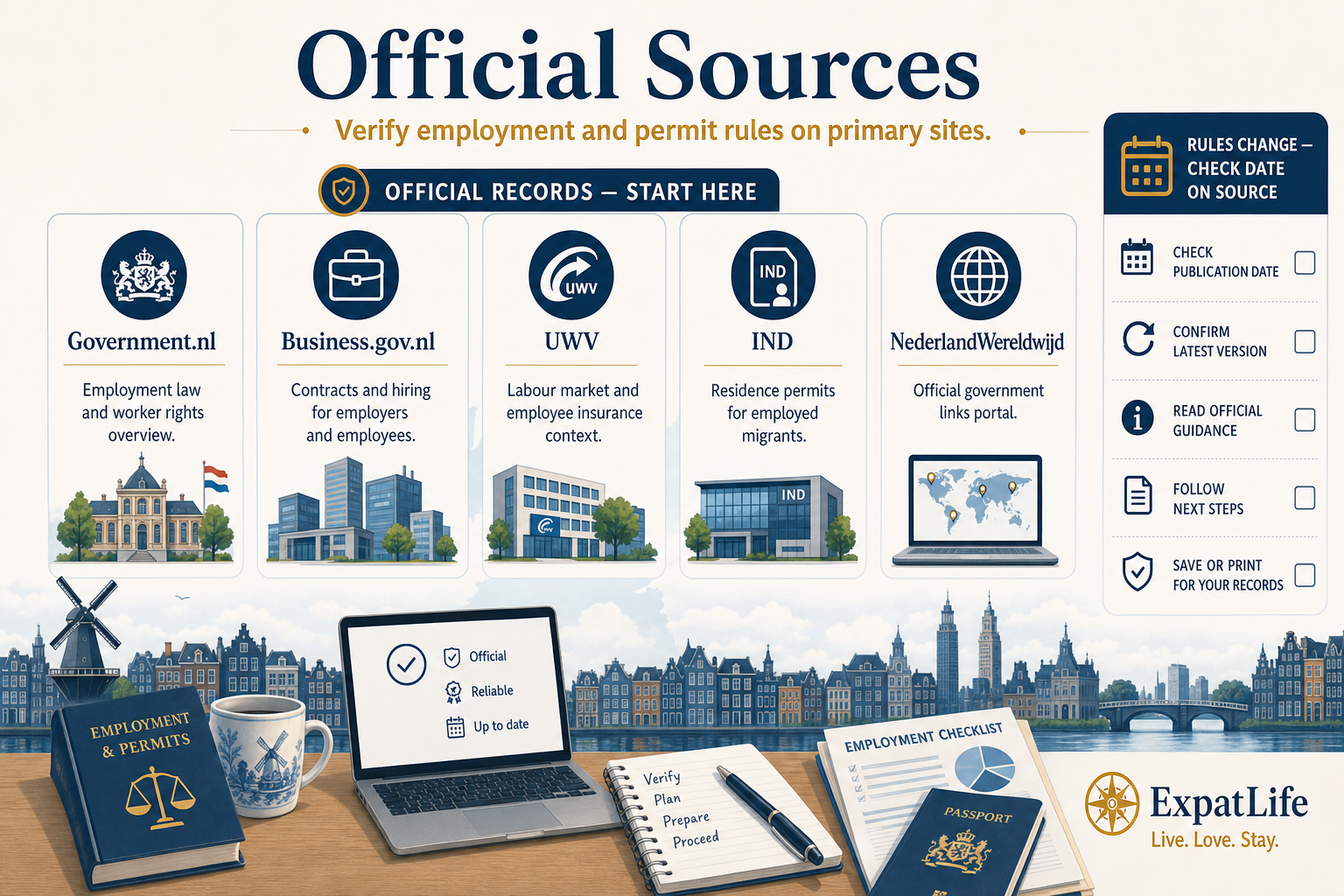
Employment law, visa sponsorship requirements and workplace regulations can change over time. Always verify current requirements through official resources.
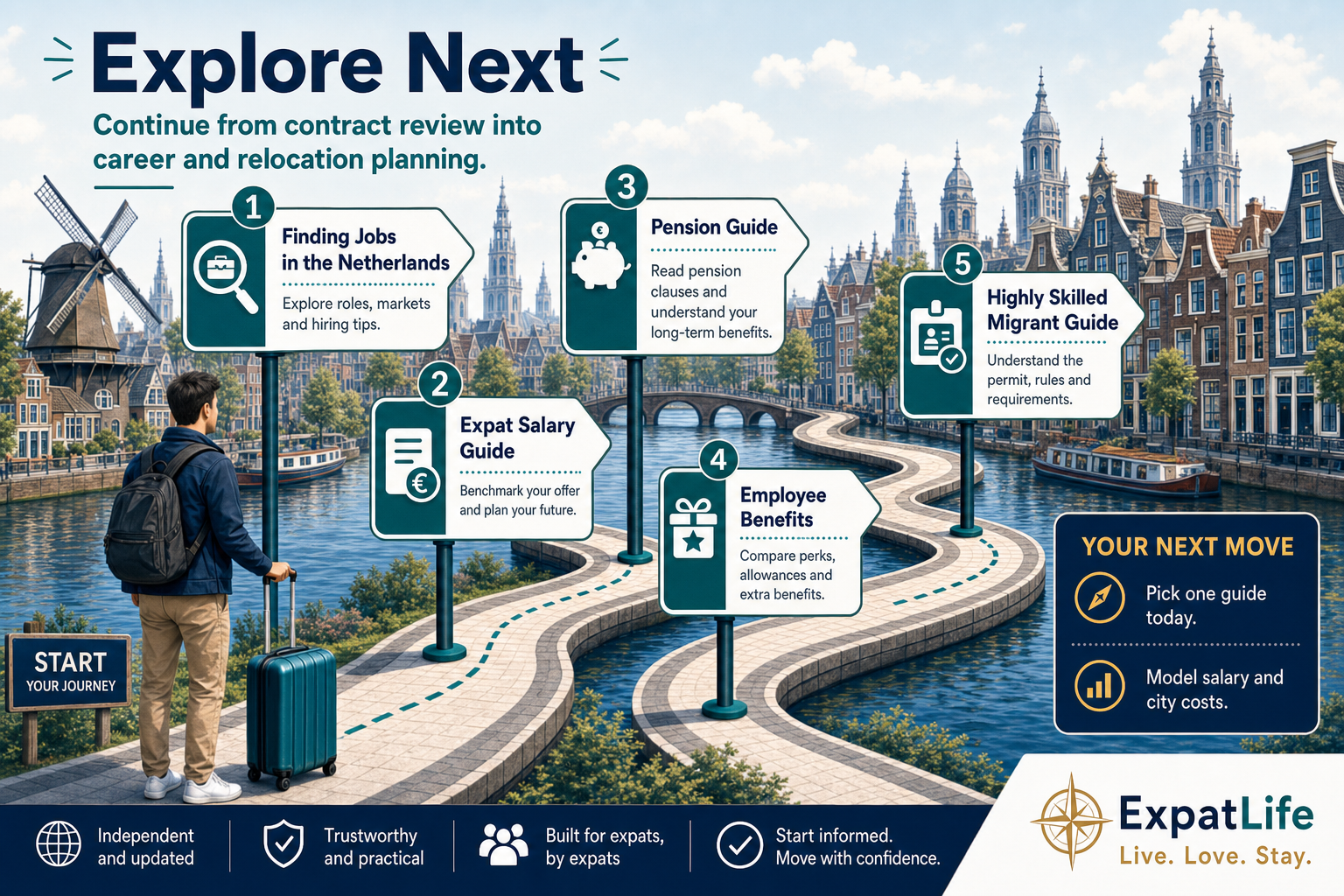
Explore next
Move from contract orientation into salary guides, benefits, visa routes and relocation planning.