Are Dutch colleagues really that direct?
Many teams favour straightforward communication about tasks and quality. It is often practical rather than personal — but styles vary by person and company.
Netherlands · Jobs · Workplace culture
Understand communication styles, work-life balance, management expectations and professional culture in the Netherlands.
Orientation only — workplace culture varies by company, team and sector. Confirm day-to-day norms with your manager and colleagues.

Quick answer
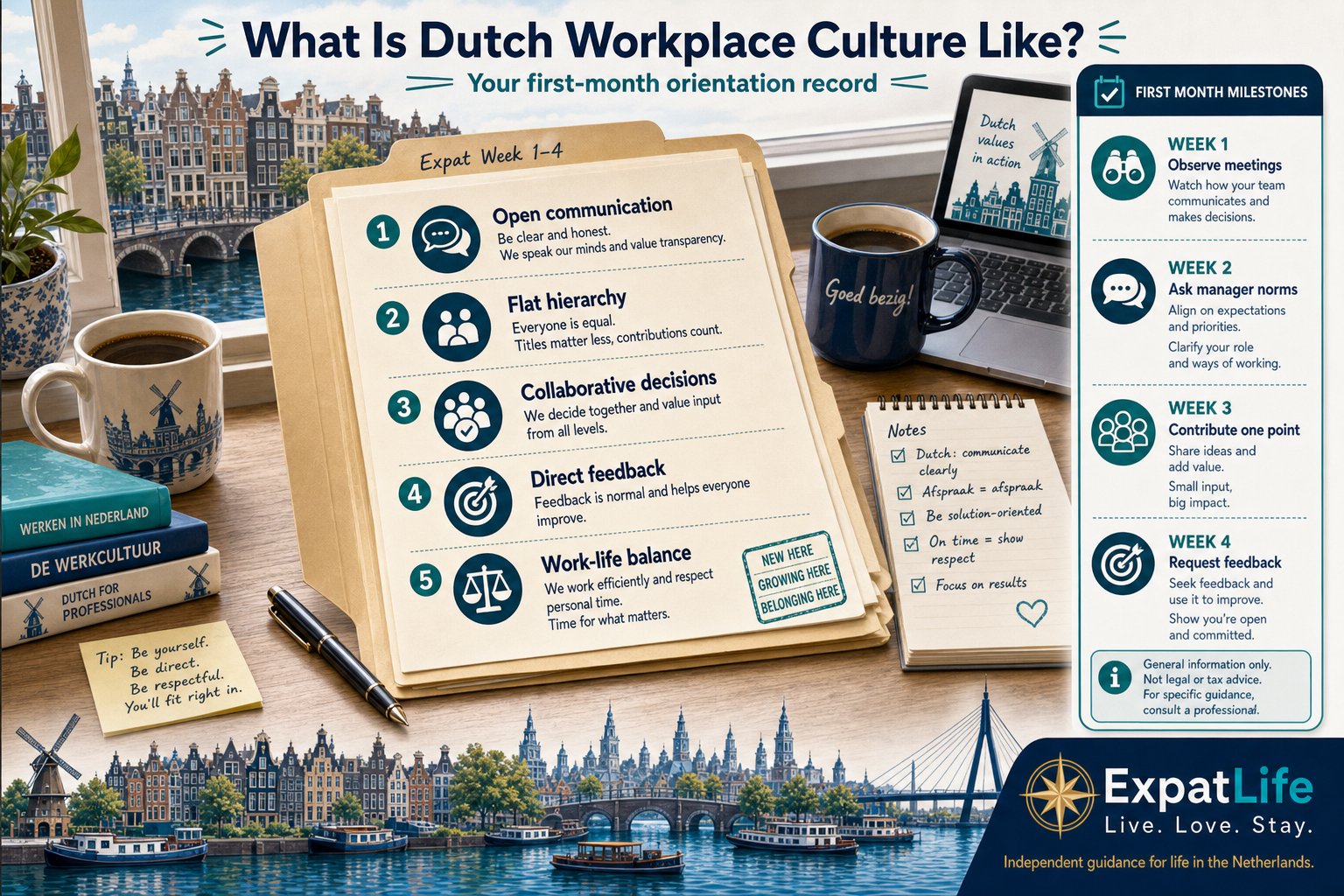
Many Dutch workplaces are often characterized by open communication, relatively flat hierarchies, collaborative decision making, direct feedback and strong work-life balance. These patterns are common enough that newcomers notice them quickly — but they are not universal rules.
Culture varies significantly by industry, company size, leadership style and international exposure. A scale-up product team in Amsterdam may feel very different from a regional government office or a family-owned logistics firm.
This guide helps expats and international professionals adapt faster with practical expectations and balanced examples. It is orientation only — not HR policy, legal advice or a guarantee about any specific employer.
Many teams favour straightforward communication about tasks and quality. It is often practical rather than personal — but styles vary by person and company.
Yes in many international companies and expat-heavy teams, especially in larger cities. Client-facing or public-sector roles may require Dutch over time.
Day-to-day communication may feel accessible, but formal authority and titles still exist. Confirm who makes final decisions on your projects.
Observe rituals, ask about feedback preferences, participate in meetings with prepared points and pair culture orientation with contract and employee-rights guides.
Phase 1
Watch meeting style, Slack norms, who speaks first and how disagreements are handled.
Phase 2
Ask your manager about core hours, hybrid rhythm, feedback cadence and escalation paths.
Phase 3
Prepare one structured talking point for a recurring meeting; confirm owners after decisions.
Phase 4
Request brief feedback on communication style; adjust written updates and meeting participation.
At a glance
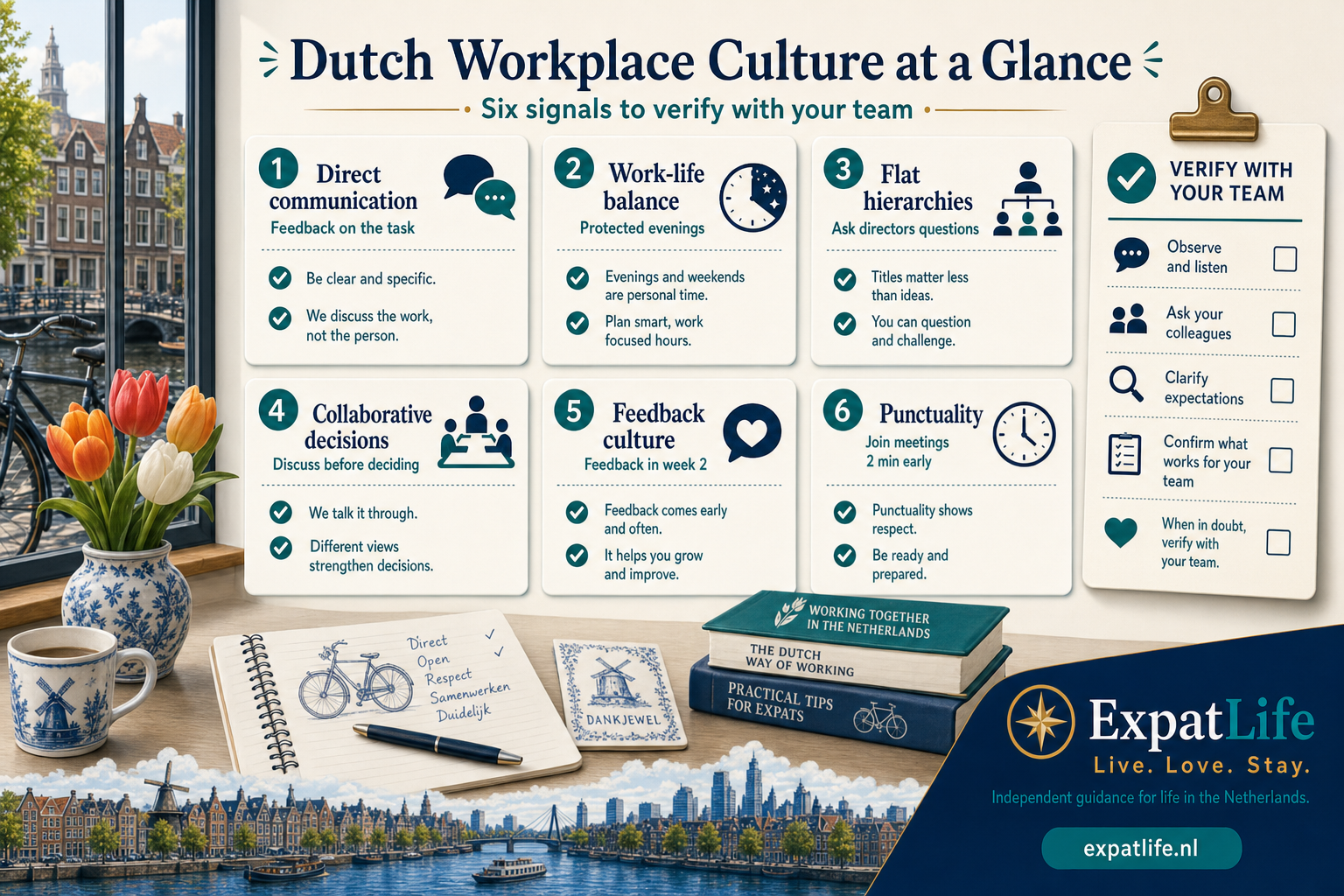
Use these signals to orient yourself on communication, hierarchy, balance and meetings — then verify with your team.
Week 1
Observe
Meetings, Slack, feedback tone
Week 2
Align
Core hours + escalation
Week 3
Contribute
One prepared talking point
Week 4
Refine
Ask for communication feedback
Feedback and opinions are often shared plainly — usually aimed at the task, not the person.
Protected evenings, vacation culture and flexible arrangements appear in many employers.
Titles exist, but many teams encourage questions and respectful challenge.
Consensus and discussion may precede final calls — especially in cross-functional teams.
Performance and project feedback may arrive earlier and more directly than some expats expect.
On-time meetings and reliable deadlines signal professionalism in most environments.
How to use this snapshot
Business culture
Many Dutch organizations value transparency, efficiency, practicality, collaboration and personal responsibility. Teams often prefer clear priorities, documented decisions and colleagues who follow through without micromanagement.
International companies with Dutch offices may blend global corporate culture with local norms — English may be the working language while meeting style still reflects Dutch directness and planning habits.
Observing how your team handles disagreements, deadlines and cross-department requests usually tells you more than any general article — including this one.
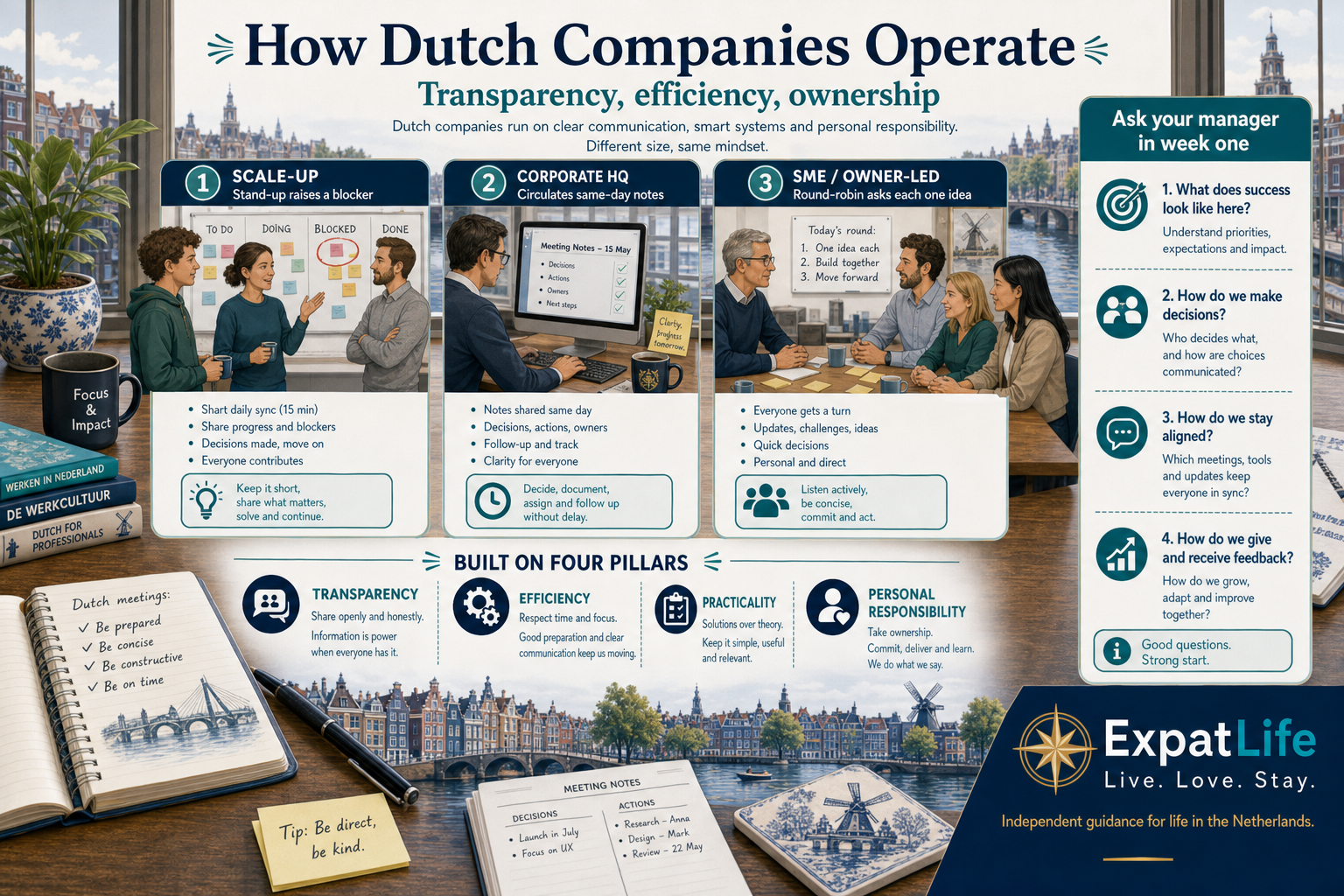
Engineer raises a launch risk in Slack before stand-up; manager thanks them and reschedules — directness seen as helpful.
Quarterly plan reviewed in a structured workshop; notes circulated same day — written follow-up reinforces verbal agreements.
Small team shares customer feedback weekly; owner asks each person for one improvement idea — flat input despite formal title.
Questions to ask your manager in week one
Communication
Many newcomers notice that workplace communication is often straightforward, honest and efficient. Colleagues may say what they mean with fewer softening phrases than in some other cultures.
Directness can speed up projects and reduce ambiguity — but it can also feel blunt if you are used to indirect feedback. Context, tone and relationship still matter.
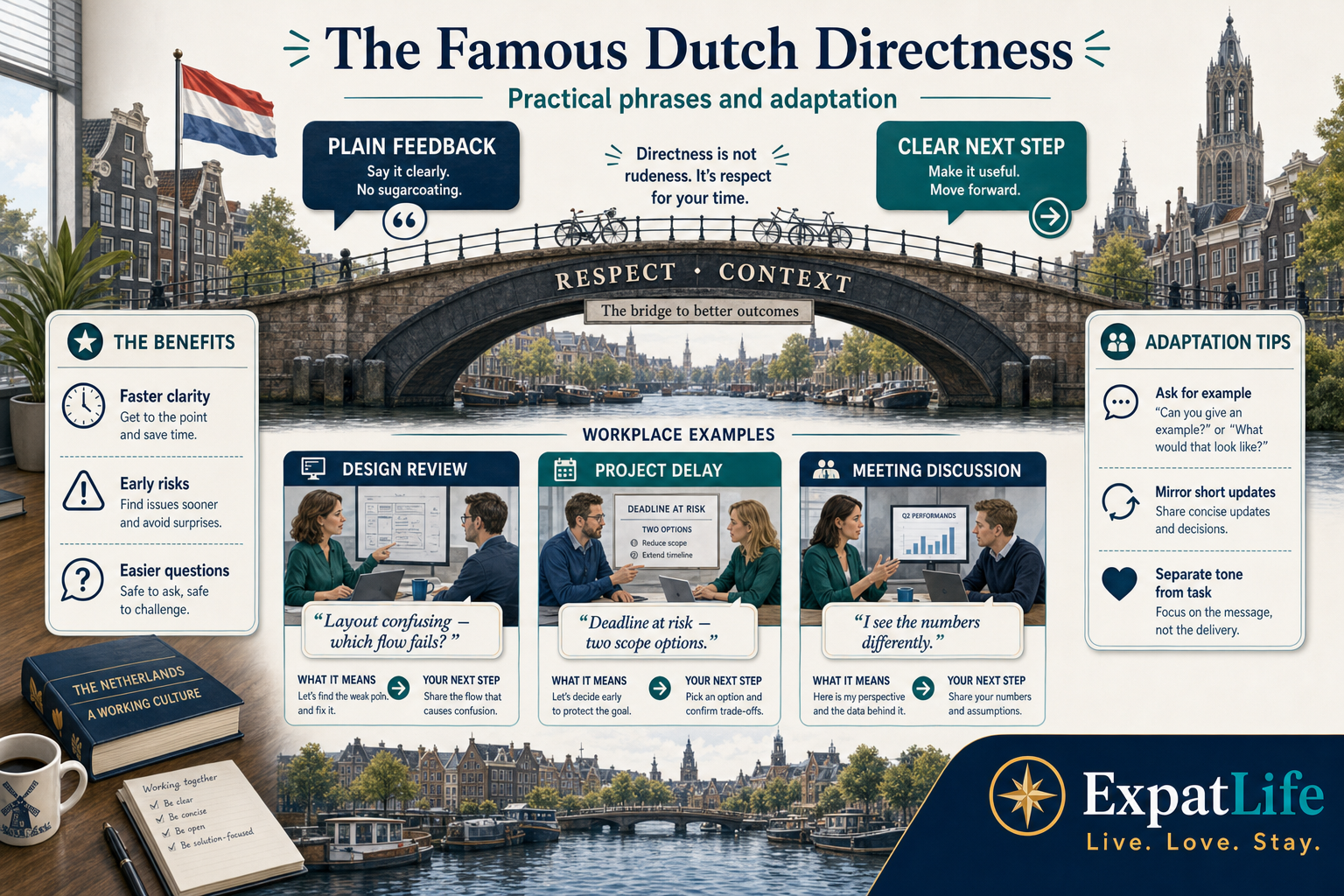
Benefits of directness
Common misunderstandings
How expats can adapt
| Situation | What happens | How to adapt |
|---|---|---|
| Design review | Colleague says the dashboard layout is confusing — not your effort. | Ask which user flow fails and propose one revision. |
| Project delay | Manager states the deadline will be missed unless scope drops. | Reply with two scope options and trade-offs — not apologies alone. |
| Meeting comment | Peer interrupts to disagree with a data point. | Verify the figure, thank them if correct, move on — debate is often normal. |
Structure
Many organizations encourage employees to ask questions, challenge ideas respectfully and contribute opinions regardless of seniority. Accessibility of managers varies, but open-door cultures are common in knowledge-work environments.
Decision making may still rest with a director or product owner — flatness describes communication more than absence of authority.

| Profile | Scenario | What to check |
|---|---|---|
| Junior analyst — Big Four | Asked to present findings to partner in client meeting | Prepare concise slides; expect direct questions — participation is a growth signal. |
| Senior engineer — scale-up | Disagrees with CTO architecture choice in architecture review | Bring data and alternatives; respectful challenge is often welcome if evidence-based. |
| Project coordinator — government | Must route decision through formal committee despite flat team chat | Follow process map; informal Slack agreement still needs written approval trail. |
Clarify authority early
Feedback
Feedback is often viewed as normal, constructive and part of improvement — not as an exceptional event. You may receive project comments in meetings, async docs or short 1:1s.
Receiving feedback positively does not mean agreeing silently — ask clarifying questions and confirm next steps.
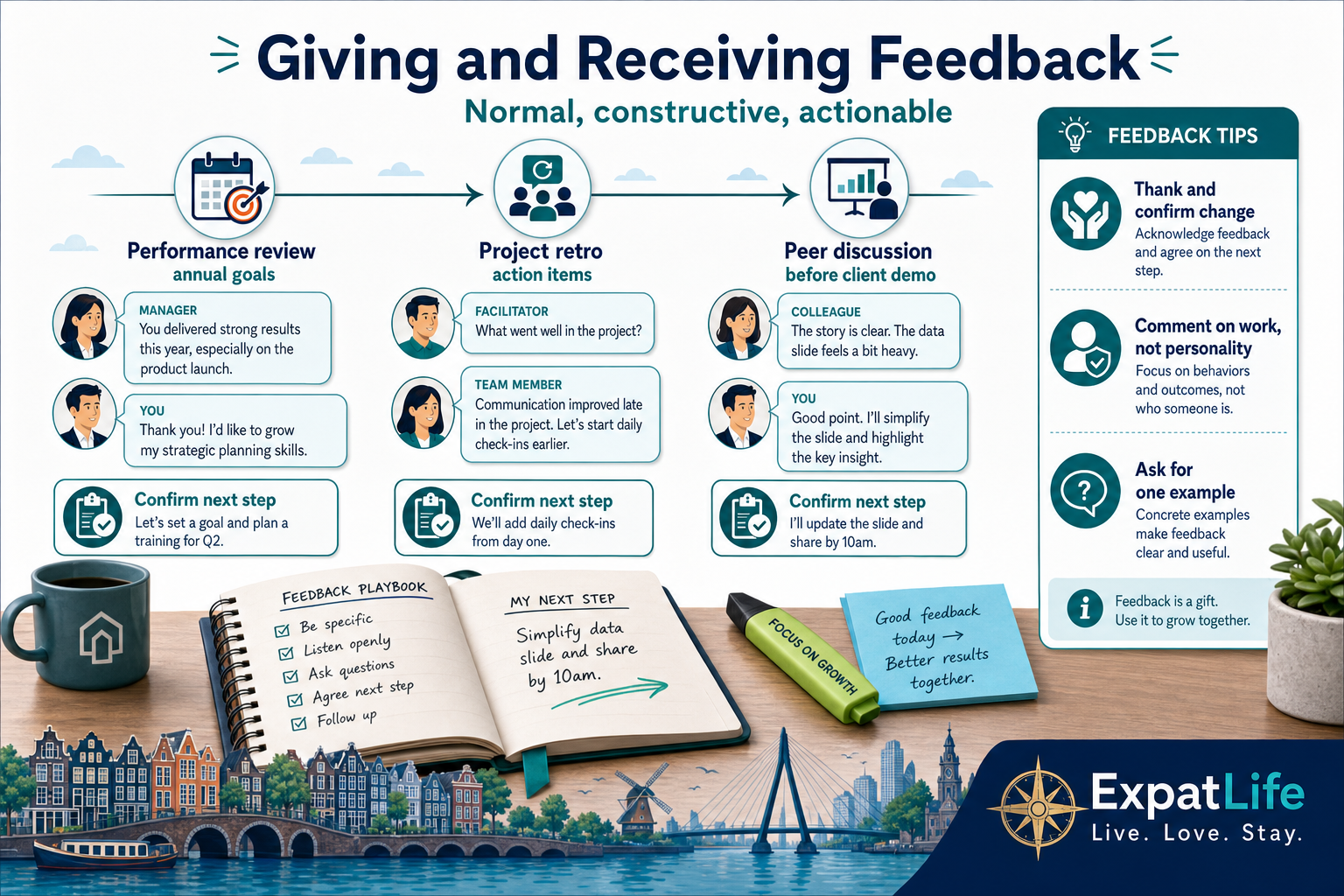
Annual review lists strengths and two development areas with measurable goals — often documented in HR system.
Team discusses what worked after a release; action items assigned openly.
Colleague suggests tighter slide titles before client demo — treat as collaboration.
Feedback tips
| Situation | What happens | Useful response |
|---|---|---|
| After blunt design comment | Colleague says the layout is confusing — not your effort. | Ask which user flow fails; propose one revision by agreed date. |
| After retro action item | Team assigns you an improvement task in open meeting. | Confirm owner and deadline: "I'll own item 2 by Friday — correct priority?" |
| Giving peer feedback | You notice a deliverable is hard to use before client demo. | Comment on the work: "Table needs column headers — can we add before Thursday?" |
Meetings
Meetings often rely on agendas, preparation and active participation. Broad discussion before consensus is common — especially when multiple departments are involved.
Decisions may be deferred until everyone has spoken; written summaries help lock outcomes.
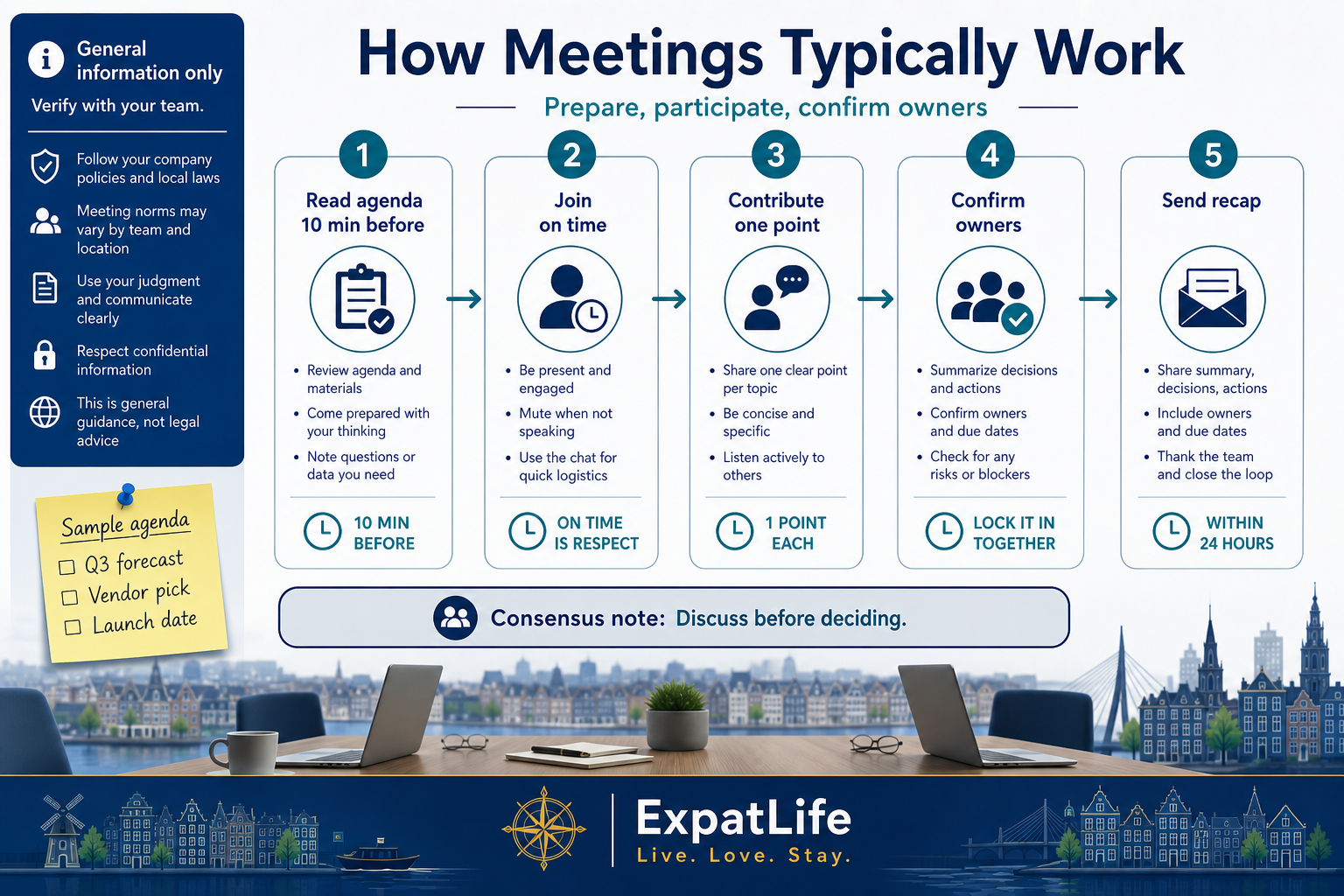
| Meeting type | Purpose | Expat tip |
|---|---|---|
| Daily stand-up | Blockers, priorities, quick sync | Keep updates under 60 seconds; flag risks early. |
| Planning / refinement | Scope, estimates, ownership | Bring written options if scope is contested. |
| Decision workshop | Cross-team alignment | Prepare one trade-off slide; confirm owner at end. |
| 1:1 with manager | Feedback, career, escalation | Bring your done/next/blocked list every time. |
Meeting checklist
Balance
Working hours, flexible schedules, family time, vacation culture and hybrid arrangements are frequently discussed topics in Dutch employment. Many employees value protected evenings and full vacation weeks.
Demanding roles still exist — especially in consulting, startups or client-facing jobs — so read your contract and team norms, not only national stereotypes.
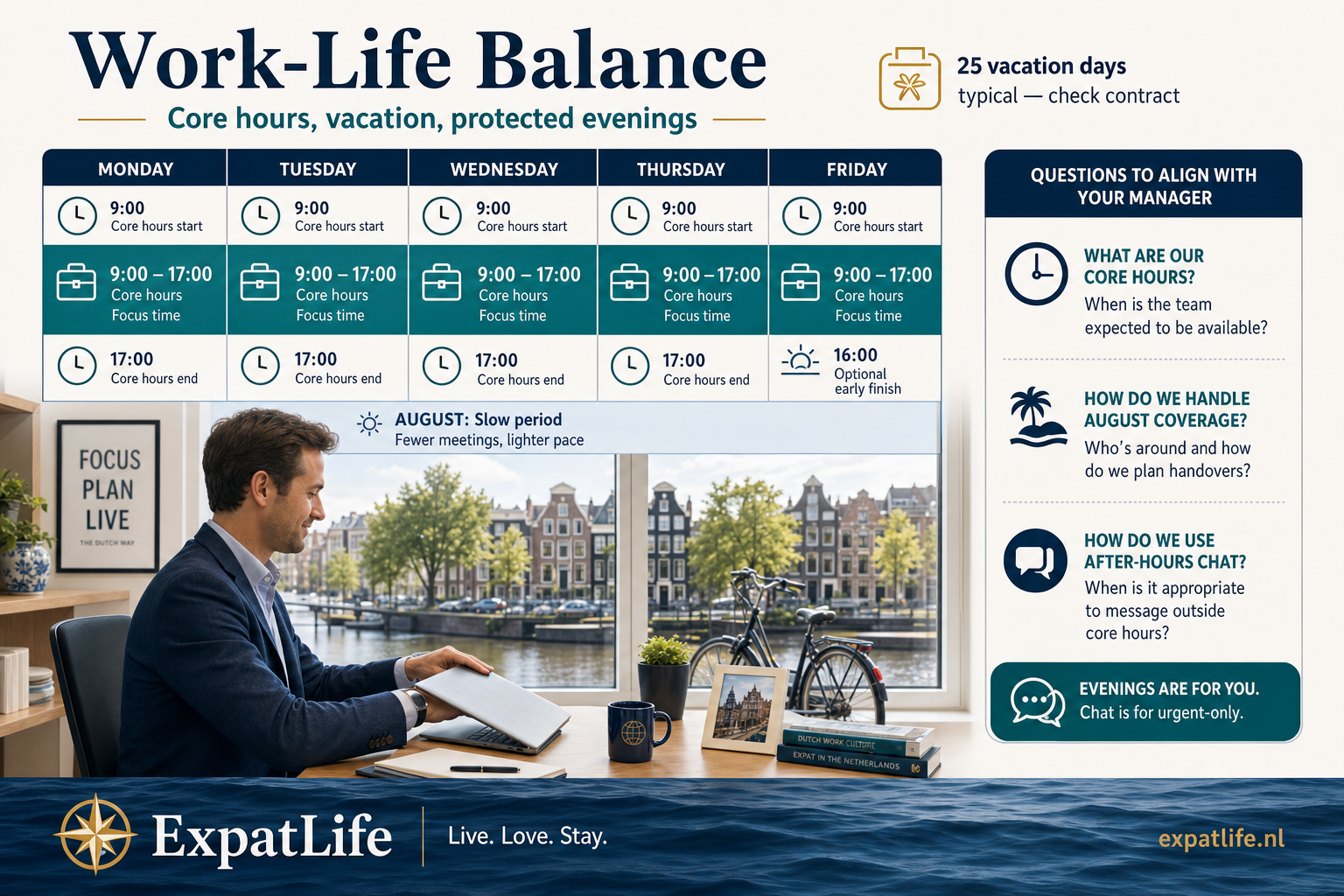
Team aligns on 9–17 availability; Slack quiet after 18:00 except on-call rotation.
Colleagues shift start times for school runs — still hit sprint commitments and meeting blocks.
External vendors and some internal approvers respond slowly — plan launches before or after summer.
Balance checklist
Ask your manager
Flexible work
Remote work, hybrid schedules, home office setups and digital collaboration tools expanded rapidly in many Dutch employers. Policies range from office-first to remote-friendly.
Confirm equipment budgets, office-day expectations and rules about working abroad — tax and permit issues may apply for cross-border remote work.
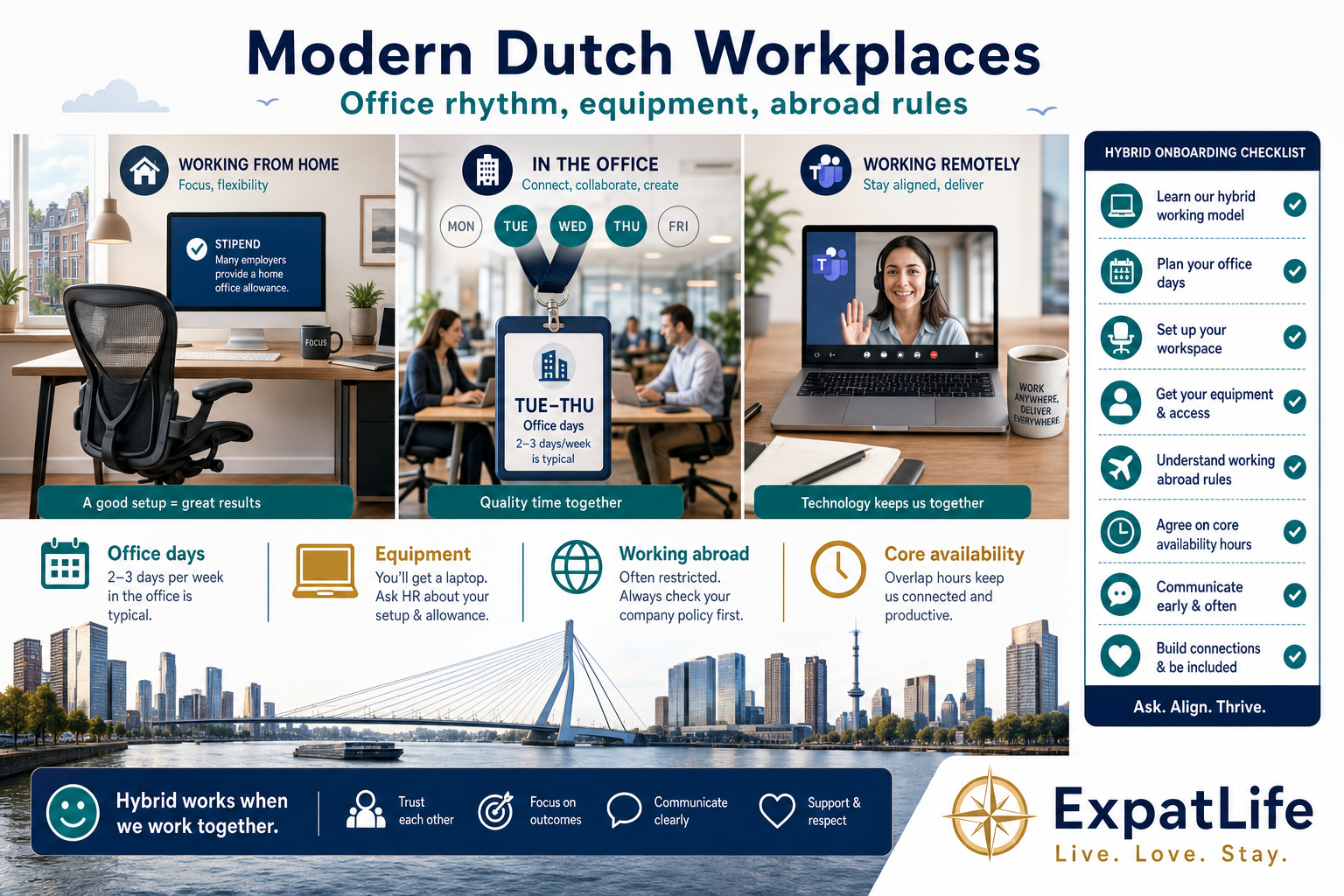
Team meets in office mid-week; Mon/Fri home for focus work and fewer commutes.
Employer provides laptop; €300 one-off for desk chair — confirm in onboarding pack.
HR requires tax check before working from home country — not automatic even if remote-friendly.
| Topic | Typical pattern | What to ask HR or manager |
|---|---|---|
| Office days | 2–3 days/week in many corporates | Which days are mandatory vs team choice? |
| Equipment | Laptop standard; extras vary | Is there a home-office budget or approval process? |
| Working abroad | Often restricted | How many days per year and which countries are allowed? |
| Core availability | Overlap hours for meetings | Which hours must I be online regardless of location? |
Hybrid onboarding checklist
Channels
Email and chat tools carry most day-to-day coordination. Many teams prefer short, structured messages with clear asks and deadlines.
Responsiveness expectations differ — some teams expect same-day chat replies; others protect focus blocks.
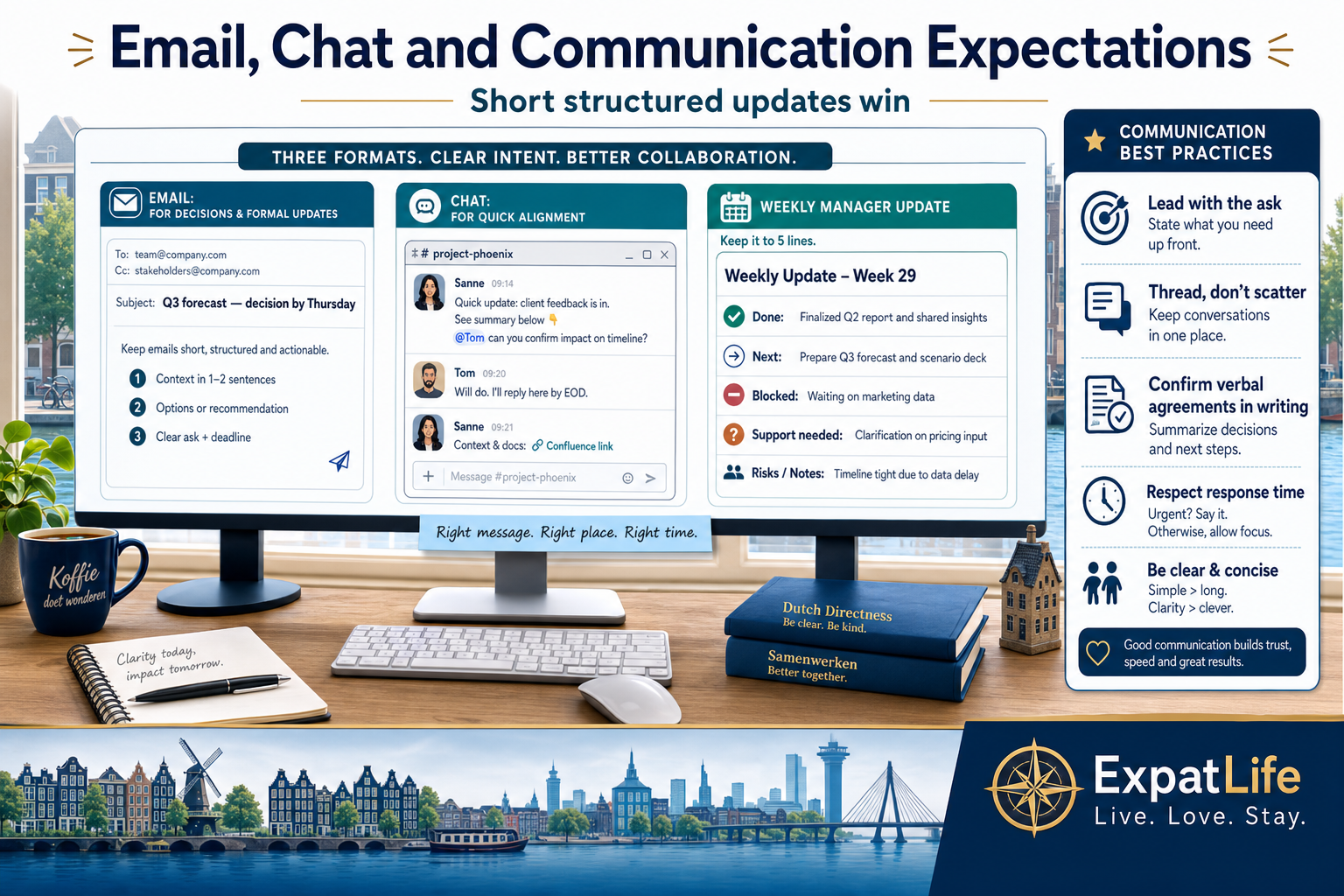
Subject: Q3 forecast — decision needed by Thursday. Three bullet options with recommendation.
Thread with context link, @mention owner, emoji ack for non-urgent items.
Weekly five-line status: done, next, blocked — no lengthy essays required.
| Channel | When to use | Example format |
|---|---|---|
| Decision or approval needed | Subject: Q3 forecast — decision by Thursday. Three bullet options with recommendation. | |
| Teams / Slack | Quick coordination or blocker | Thread with context link, @owner, clear ask and emoji ack for non-urgent items. |
| Manager update | Weekly or sprint status | Done / next / blocked — five lines max, no lengthy background essays. |
| Escalation | Deadline or scope at risk | Flag 24h+ ahead with two scope options, impact and recommended path. |
Email and chat checklist
Reliability
Punctuality for meetings, reliable deadlines and clear scheduling are professional expectations in most Dutch workplaces. Being late without notice can erode trust quickly.
If delays happen, communicate early with a revised time and impact assessment.
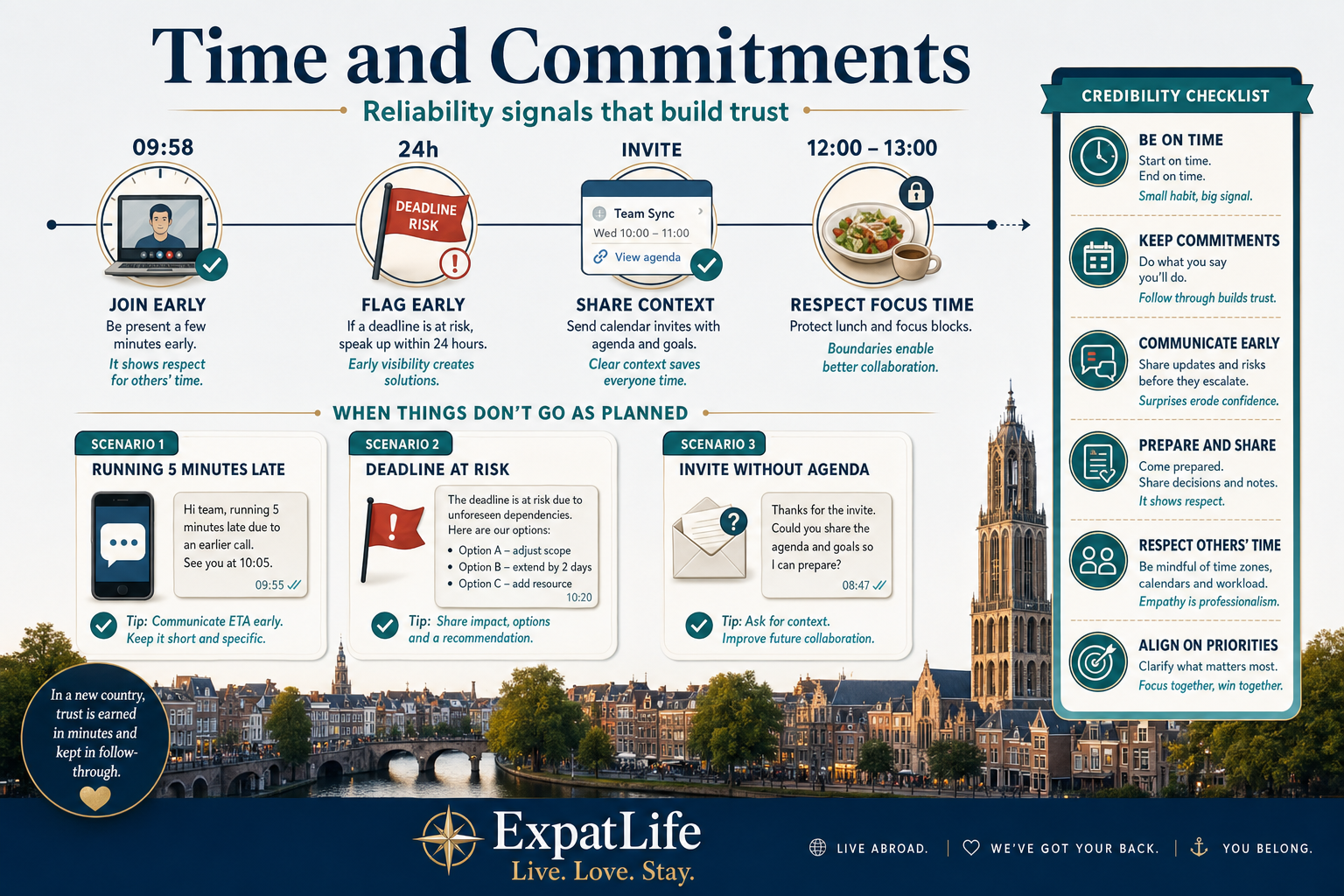
Time and commitment checklist
| Situation | What happens | How to adapt |
|---|---|---|
| Running 5 minutes late | Colleagues start without you; trust dips if repeated. | Message in chat immediately with ETA; join muted and catch up async. |
| Deadline at risk | Manager expects early warning with scope options. | Flag 24h+ ahead with two trade-off paths — not last-minute surprise. |
| Calendar invite without agenda | Some teams decline or reschedule. | Offer a three-bullet agenda when sending or accepting invites. |
International teams
Global companies, English-speaking workplaces, multicultural teams and cross-cultural collaboration are common — especially in Randstad cities and international sectors.
Working in English is normal in many expat-heavy teams; learning Dutch still helps for broader integration and some client-facing roles.
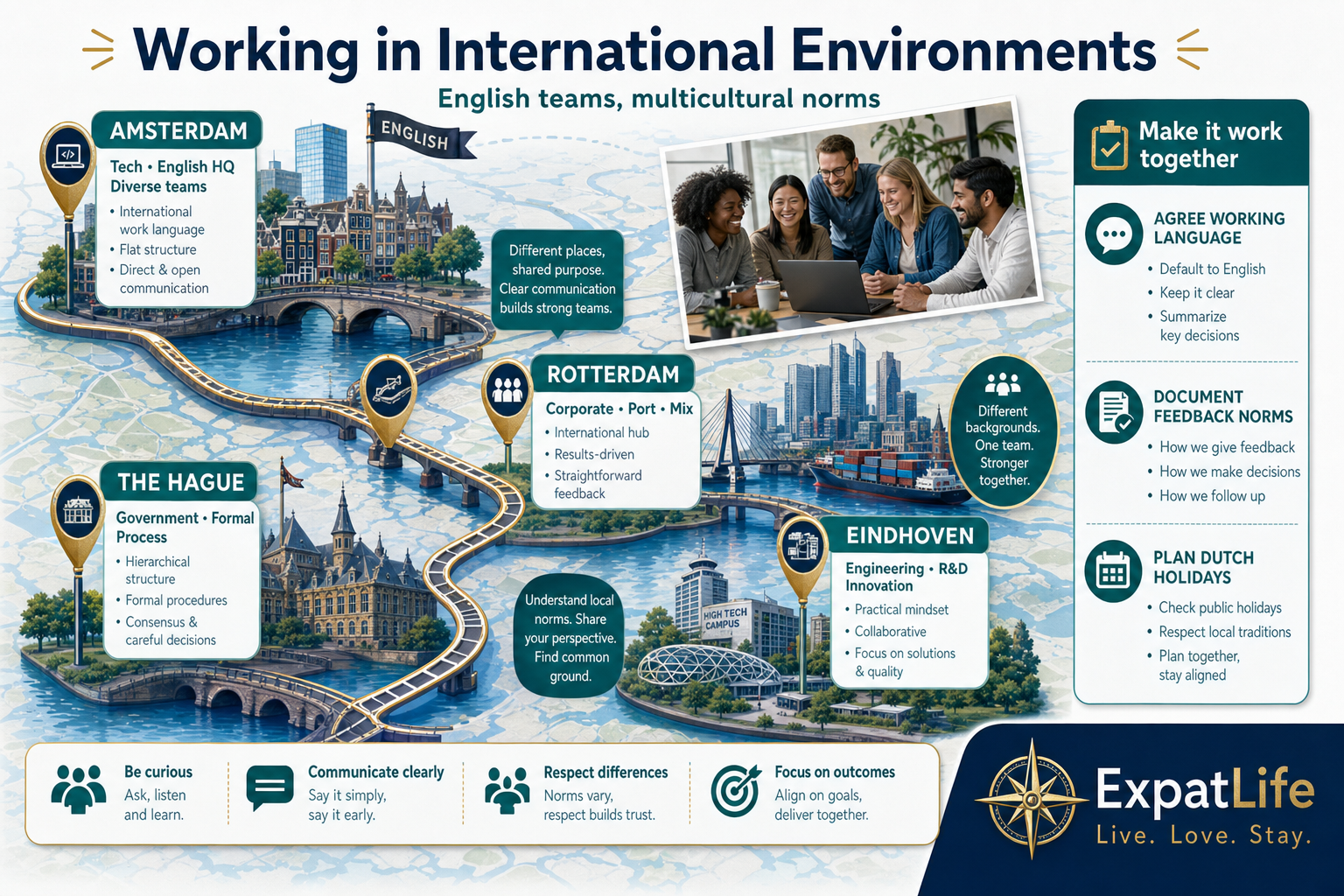
English common; diverse teams; fast pace and flat stand-ups typical in many product companies.
International HQs and logistics; mix of Dutch and English; more formal client communication in some sectors.
High-tech and manufacturing; English in R&D teams; practical, data-driven meeting culture.
More formal process; Dutch often important for public-facing roles; longer decision cycles.
Relationships
Professional relationships grow through meetups, industry events, conferences, LinkedIn and sector communities — not only formal networking drinks.
Many expats build credibility by sharing expertise in communities and collaborating on visible projects first.
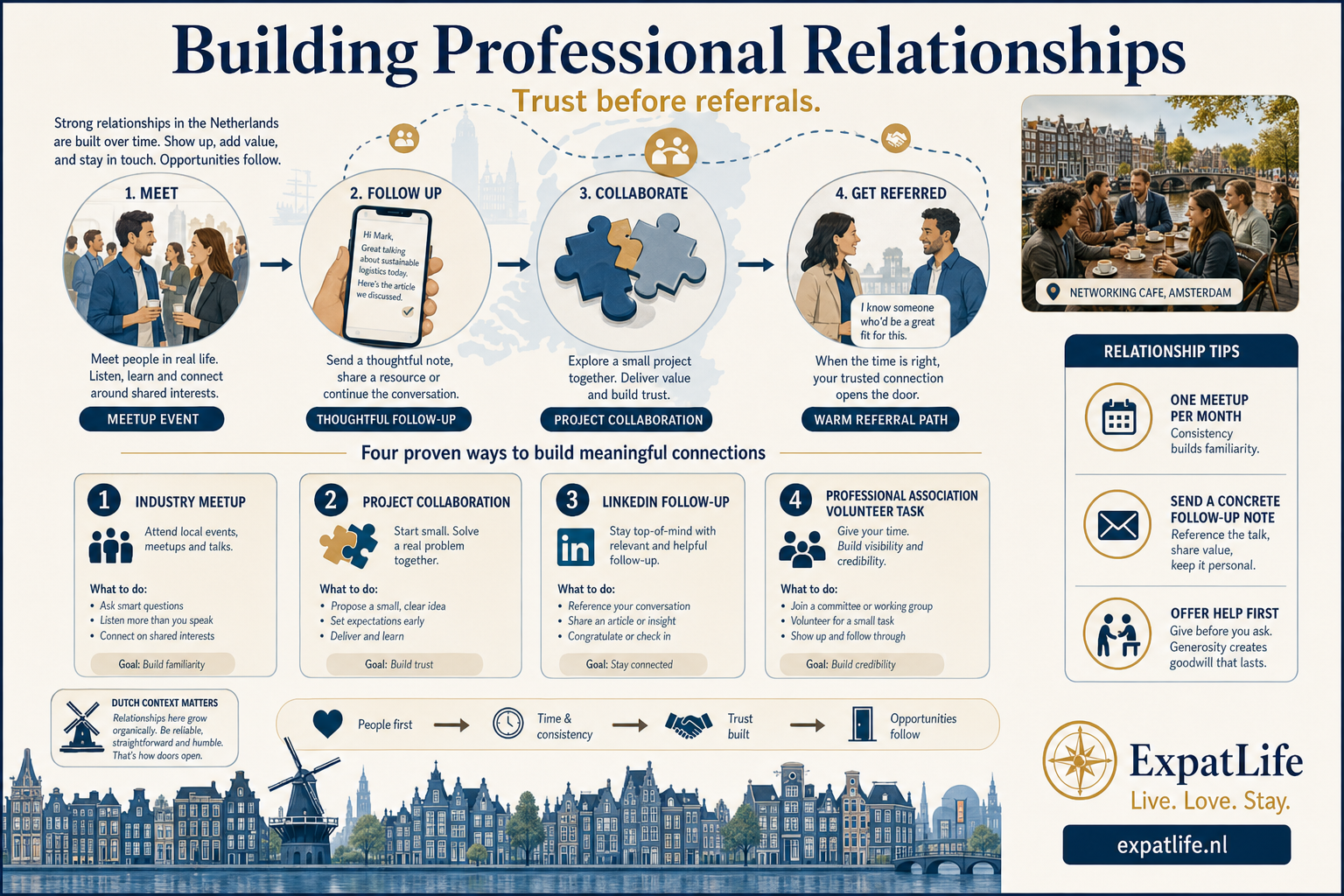
Networking tips
| Route | Example | First step |
|---|---|---|
| Meetup or industry event | Amsterdam Product Tank or sector-specific NL meetup | Attend one session; ask one thoughtful question. |
| Project collaboration | Cross-team initiative or open-source contribution | Deliver reliably; mention interest in similar work. |
| LinkedIn follow-up | Speaker or hiring manager from conference | Reference one talk point; suggest a 15-minute coffee chat. |
| Professional association | Sector body or expat professional network | Join mailing list; volunteer for one small committee task. |
Examples
Recognise common patterns so you can respond instead of guessing intent.
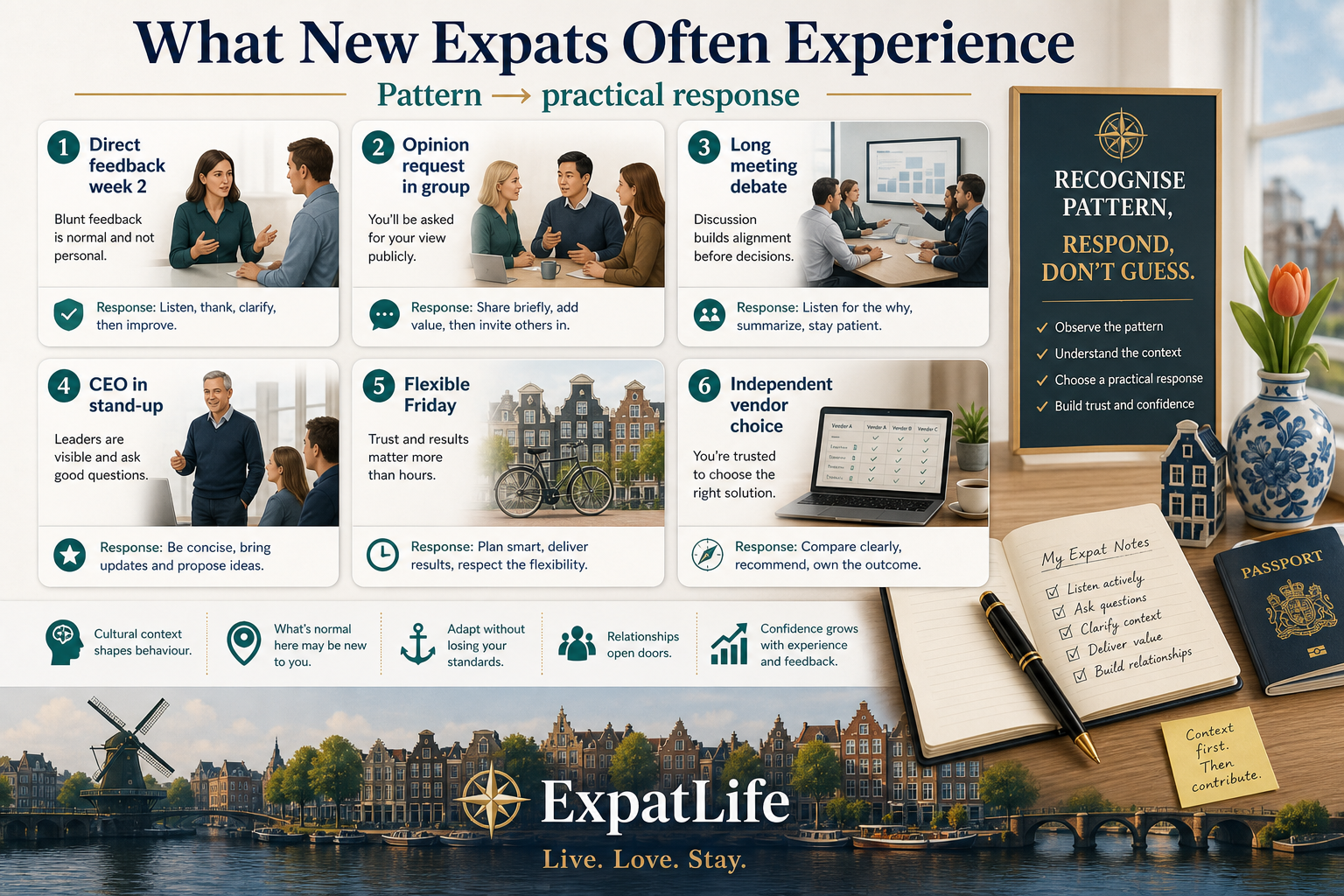
Project comment feels blunt in week two — usually about deliverable quality, not personal rejection.
Manager solicits your view in a group — participation signals engagement, not risk.
Meetings run long with debate — prepare one structured point rather than waiting to be called on.
CEO joins stand-up and asks juniors for input — respond with concise facts.
Team leaves early on Friday after delivering sprint — confirm norms rather than copying silently.
Expected to choose vendor after brief alignment — document rationale and share.
| Situation | What happens | How to respond |
|---|---|---|
| Receiving direct feedback | Plain comment on your deliverable in week two — usually about the task, not personal rejection. | Ask which part needs to change; propose one revision by an agreed date. |
| Being asked for opinions | Manager or lead asks your view in a group while others are listening. | Offer one concise view with trade-offs — silence can read as disengagement. |
| Long meeting debate | Discussion runs past the scheduled end while options are still weighed. | Contribute one structured point early; confirm the decision owner before leaving. |
| CEO in stand-up | Senior leader joins daily sync and asks junior colleagues directly. | Answer with concise facts — participation signals engagement, not overstepping. |
| Flexible Friday | Colleagues leave earlier after sprint delivery while you are unsure of the norm. | Confirm team rhythm with your manager before copying the pattern. |
| Independent vendor choice | Expected to select a vendor after brief alignment, not step-by-step instructions. | Document rationale, cost and timeline; share the decision in writing with your lead. |
Sectors
Adjust expectations when moving between startup pace and government process.
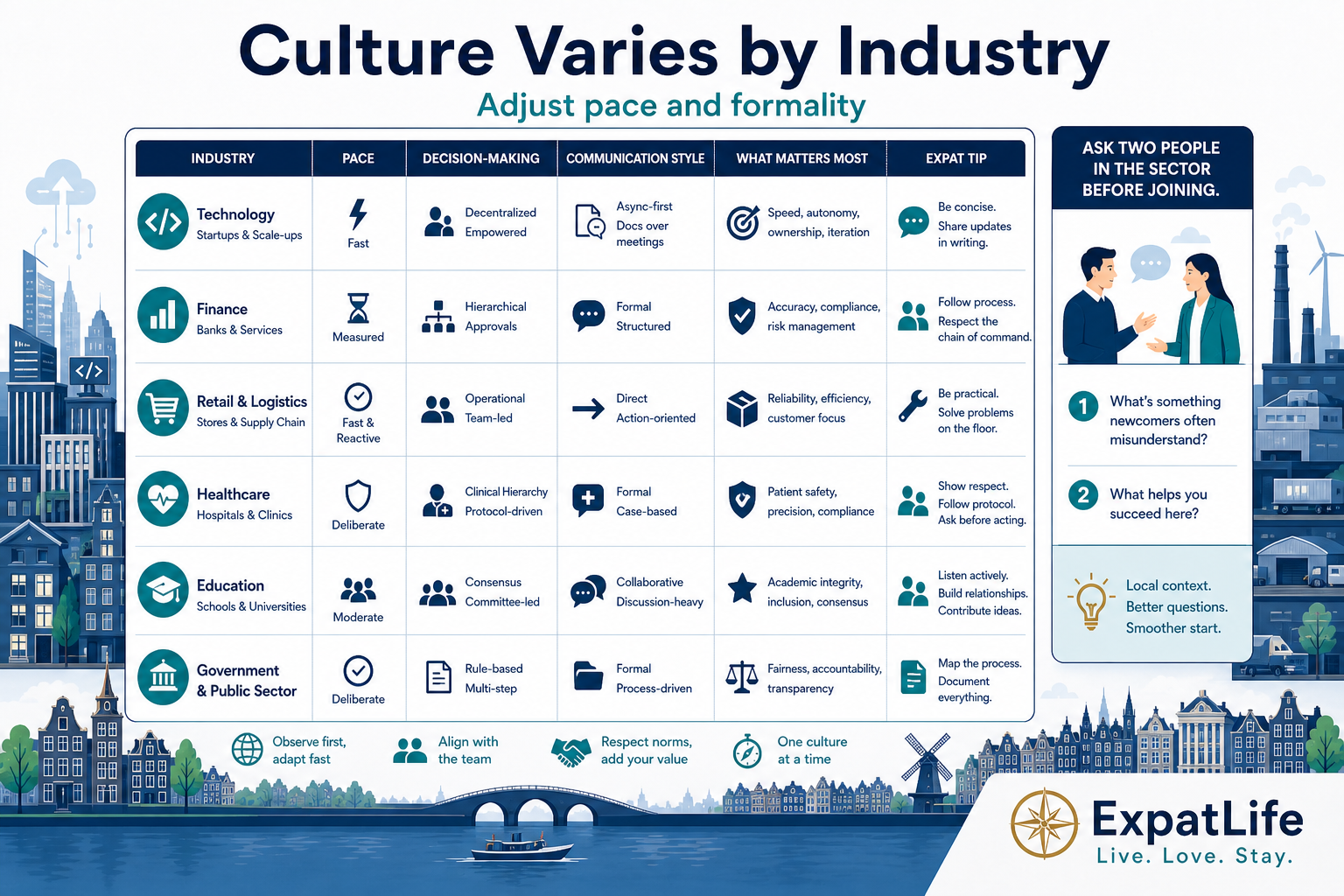
| Industry | Culture note | Expat tip |
|---|---|---|
| Technology | Fast iteration, async docs, flat teams common. | Default to written proposals and demo-driven decisions. |
| Finance | More formal process, compliance gates, structured meetings. | Prepare data-heavy materials and respect approval chains. |
| Retail & logistics | Operational pace, shift work, practical communication. | Prioritise reliability and clear handovers. |
| Healthcare | Protocol-driven, multidisciplinary coordination. | Respect clinical hierarchy where patient safety is involved. |
| Education | Consensus culture, academic calendars, committee work. | Allow longer decision cycles — build alliances early. |
| Government | Formal procedures, documentation, stakeholder alignment. | Master process maps and official communication channels. |
When changing sector
Challenges
Most friction is an adaptation gap — use the fix table as a weekly check.
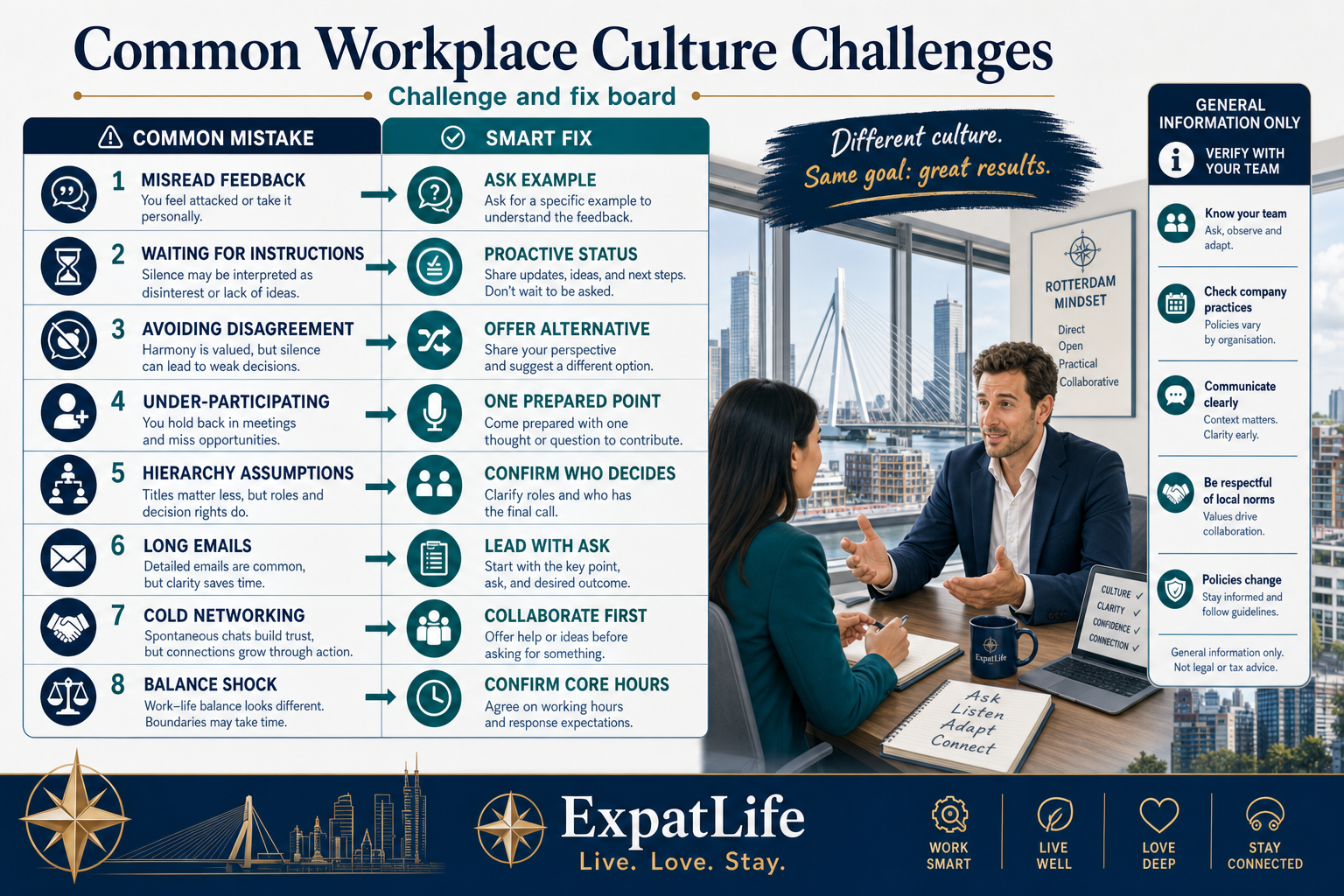
Plain language feels personal — ask for examples and intended outcome.
Managers expect proactive updates — share blockers before being asked.
Respectful dissent can be valued — bring alternatives, not silence.
Prepare one talking point; contribute early to show engagement.
Skip excessive formalities with accessible managers — stay respectful.
Confirm decisions in writing after verbal meetings.
Start with project collaborators before cold outreach.
Clarify core hours — some teams still expect evening availability.
Fixes
| Challenge | What to do instead |
|---|---|
| Misinterpreting direct feedback | Ask for a concrete example, the requested change and whether timing is urgent. |
| Waiting for instructions | Send a short status update with blockers before your manager asks. |
| Avoiding disagreement | Offer one alternative with trade-offs instead of silent agreement. |
| Under-participating in meetings | Prepare one structured point before every recurring meeting. |
| Overestimating hierarchy | Ask accessible managers direct questions — stay respectful of final decision owners. |
| Communication misunderstandings | Confirm verbal decisions in a brief email or Slack recap. |
| Networking challenges | Build credibility through project collaboration before cold LinkedIn outreach. |
| Work-life balance adjustment | Confirm core hours, on-call expectations and vacation norms in writing. |
Success
Run through this list during your first months in a Dutch team.
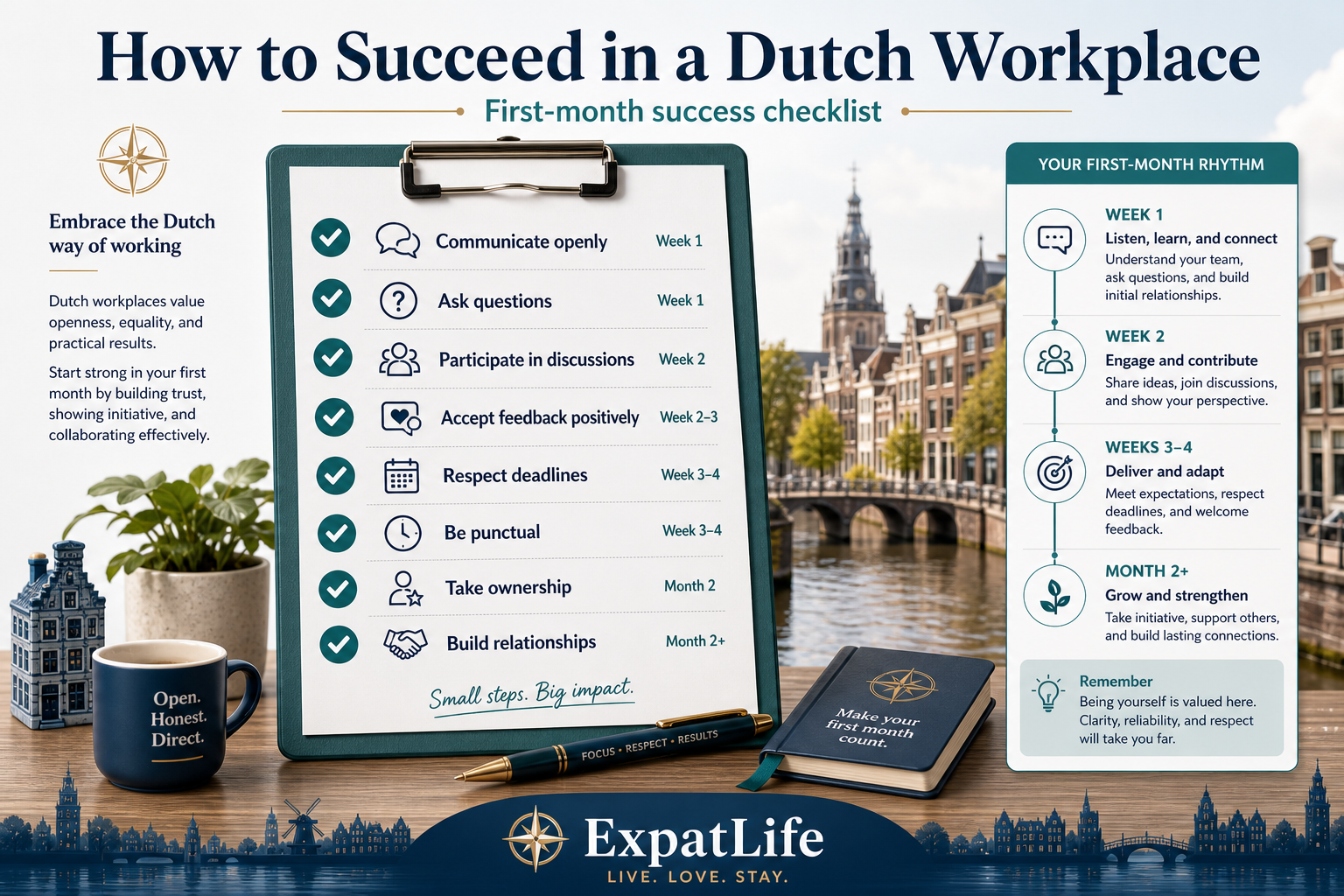
How to succeed in a Dutch workplace
Phase 1
Watch meeting style, Slack norms, who speaks first and how disagreements are handled.
Phase 2
Ask your manager about core hours, hybrid rhythm, feedback cadence and escalation paths.
Phase 3
Prepare one structured talking point for a recurring meeting; confirm owners after decisions.
Phase 4
Request brief feedback on communication style; adjust written updates and meeting participation.
Myths
Balanced explanations — culture varies by company, team and sector.
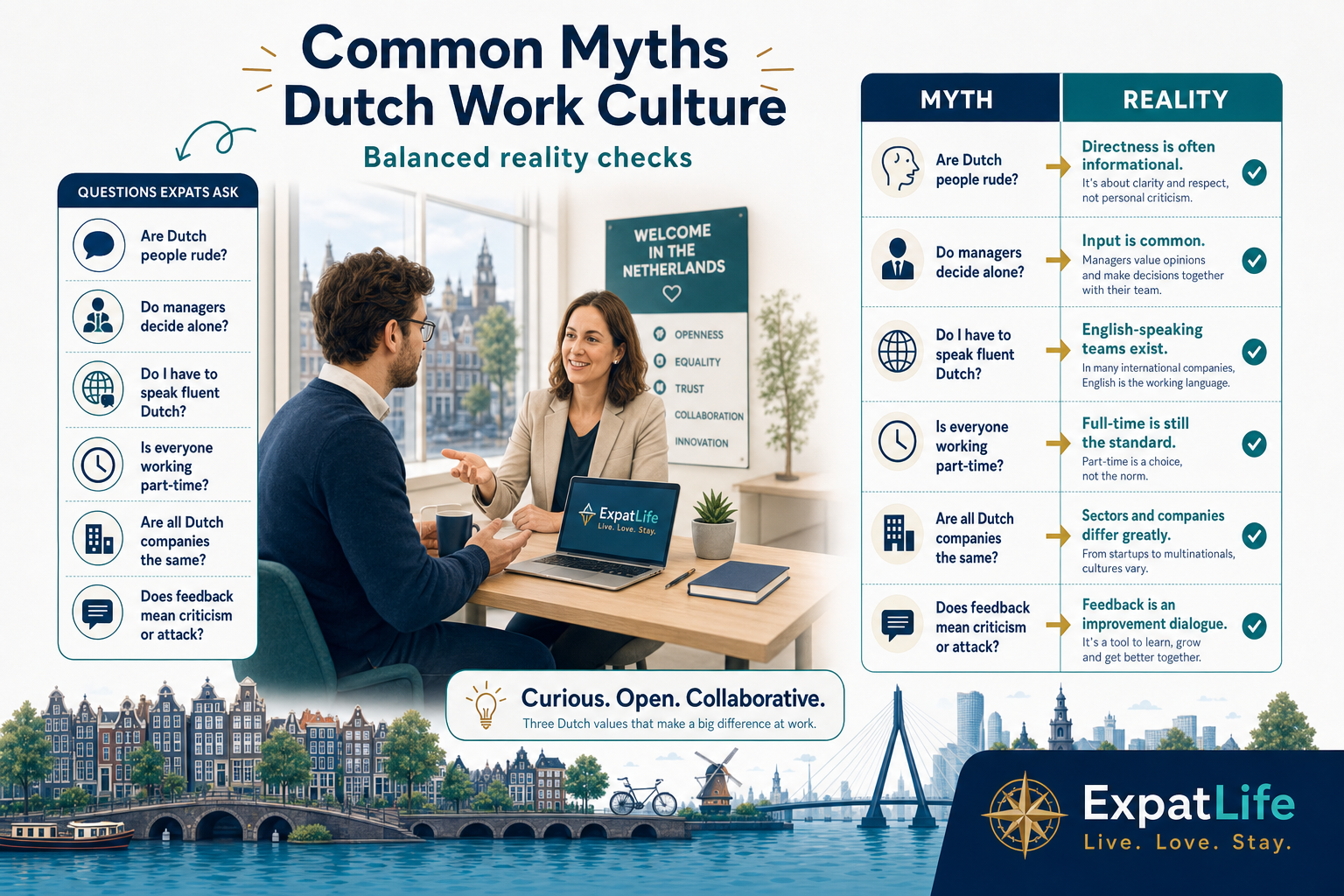
Myth
Directness is often informational. Tone and relationship context still matter — many colleagues are warm outside formal feedback.
Myth
Input from teams is common; final authority may still sit with a leader or committee.
Myth
Many international teams operate in English — Dutch helps for integration and some client roles.
Myth
Part-time is common and legally supported — full-time roles remain standard in many sectors.
Myth
Scale-ups, multinationals, SMEs and government bodies differ sharply.
Myth
Feedback often targets improvement and clarity — ask how to action it.
Replace myths with these questions
FAQ
Use these answers to know what to observe — confirm specifics with colleagues.
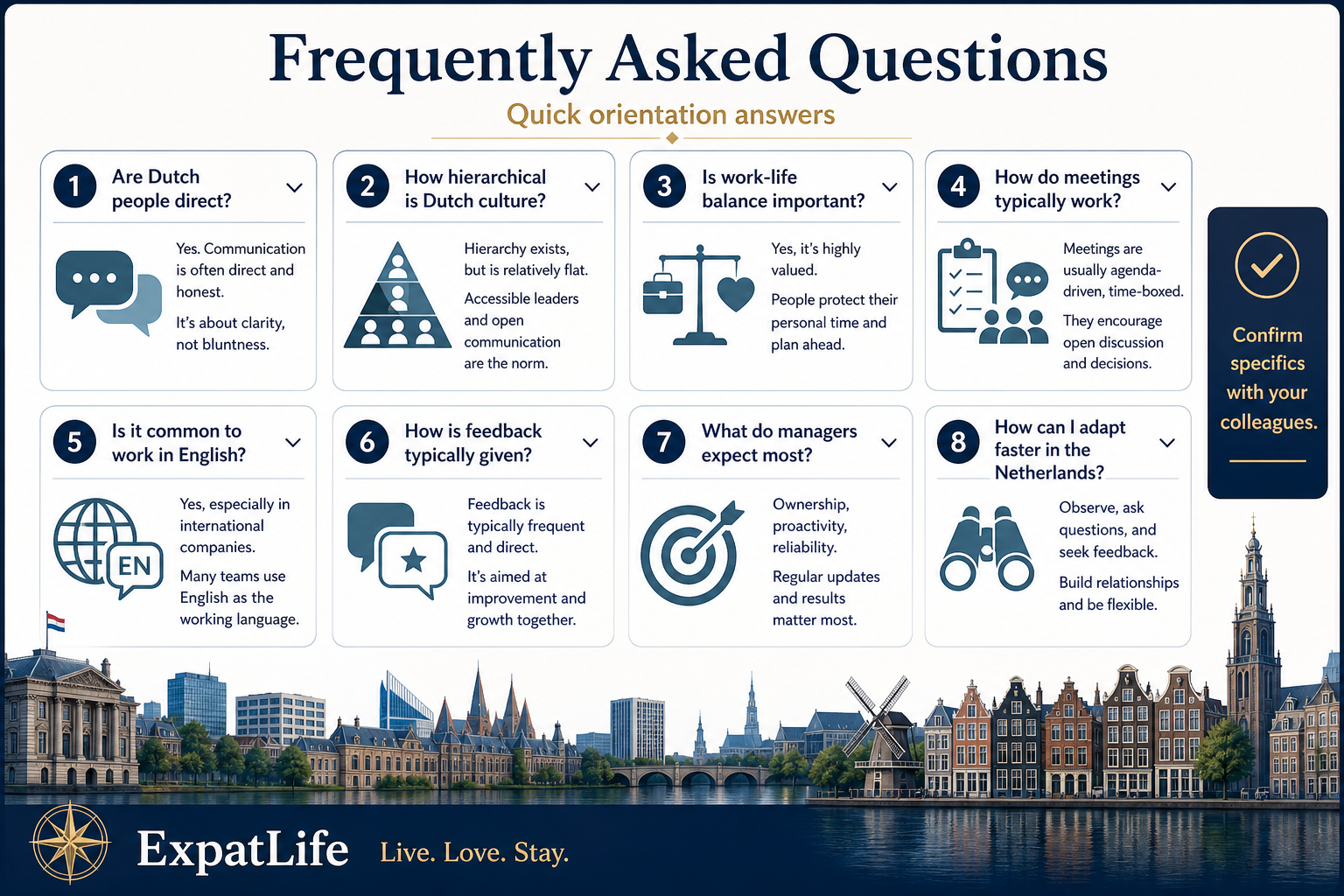
Many workplaces favour straightforward communication, especially about tasks and quality. It is often practical rather than personal — but styles vary by person and company.
Many knowledge-work teams feel relatively flat in day-to-day communication, though formal authority and titles still exist. Regulated or traditional sectors may feel more structured.
It is a common cultural value and appears in many employment policies. Demanding roles and global clients can still create pressure — check your team norms.
Agendas, preparation and discussion are typical. Decisions may follow consensus-building; written summaries help confirm outcomes.
Yes in many international companies and expat-heavy teams, especially in larger cities. Client-facing or public-sector roles may require Dutch over time.
Feedback may arrive frequently and directly. Treat it as normal dialogue — ask for examples and agreed next steps.
Many managers expect ownership, early escalation of blockers and concise updates. Accessibility varies — schedule regular 1:1s to align expectations.
Observe team rituals, ask about communication preferences, participate in meetings and pair this guide with contracts and employee-rights orientation.
Resources
Workplace culture varies significantly between companies, industries and teams. Use official sources for employment frameworks — observe your employer for day-to-day norms.
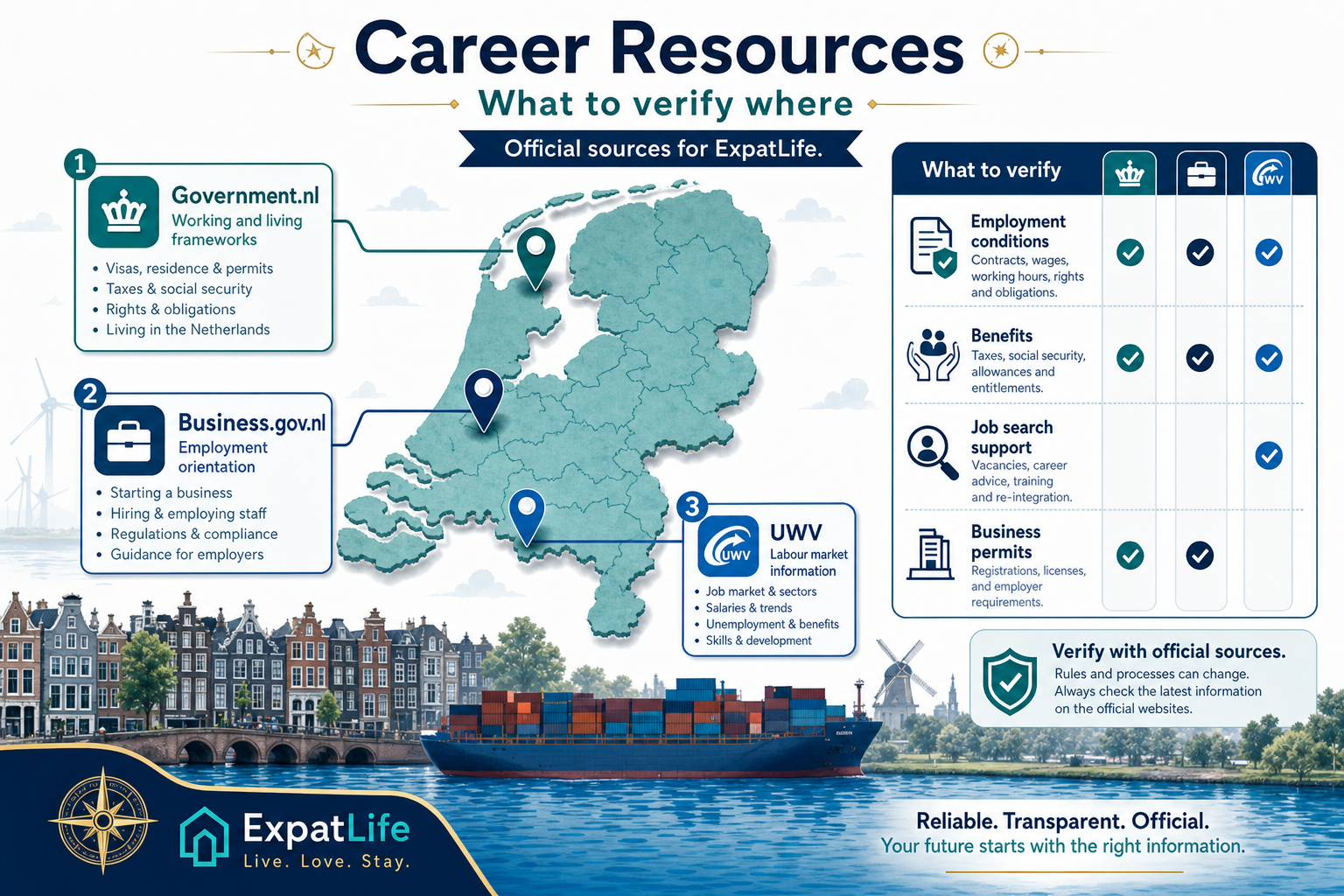
What to verify where
Career guides
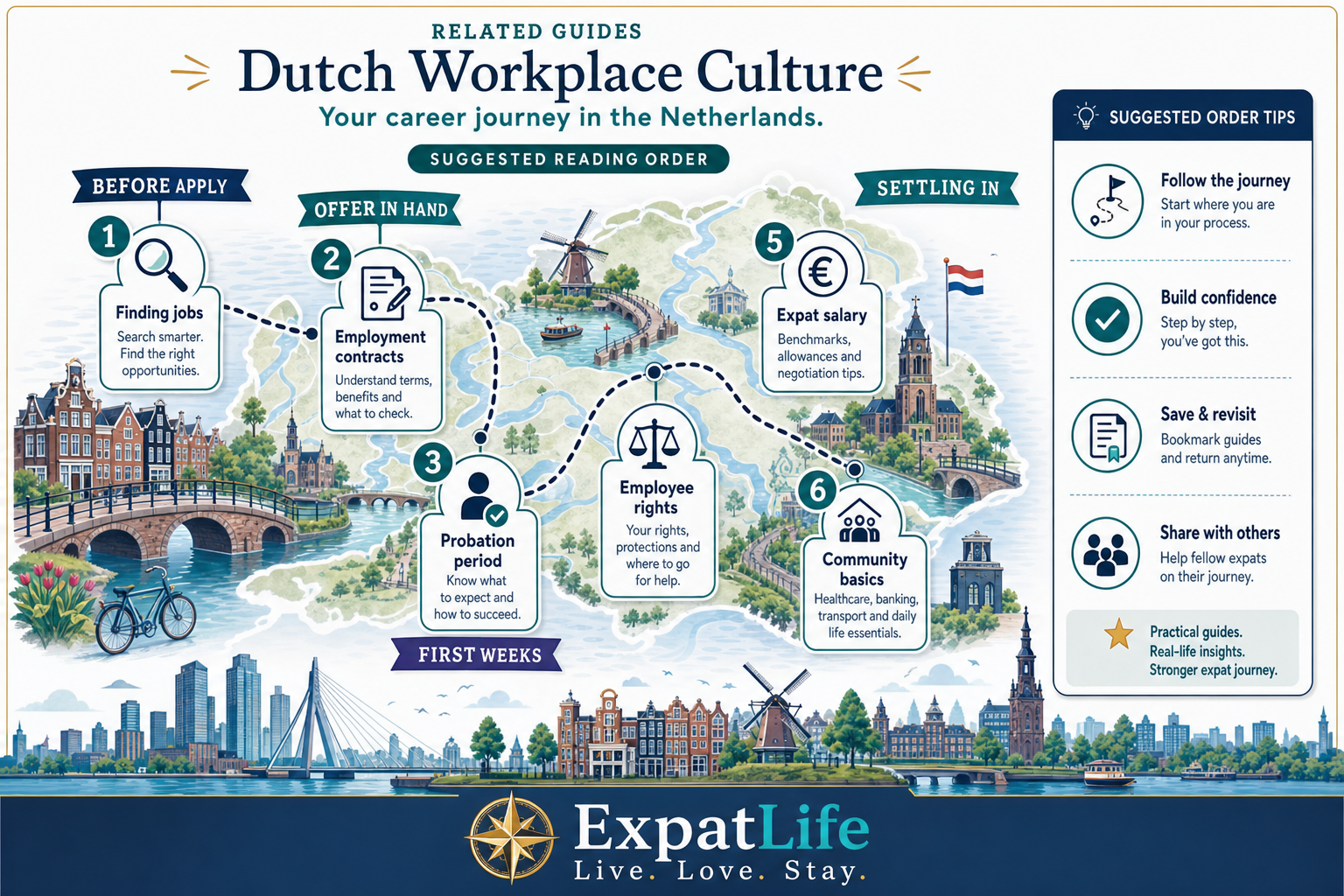
Suggested order: jobs search → contract review → rights orientation.
Phase 1
Finding jobs — market, recruiters and visa sponsorship context.
Phase 2
Employment contracts and probation — review before signing.
Phase 3
This culture guide plus employee rights for leave and protections.
Phase 4
Expat salary guide and community basics for life beyond the office.
Suggested reading order
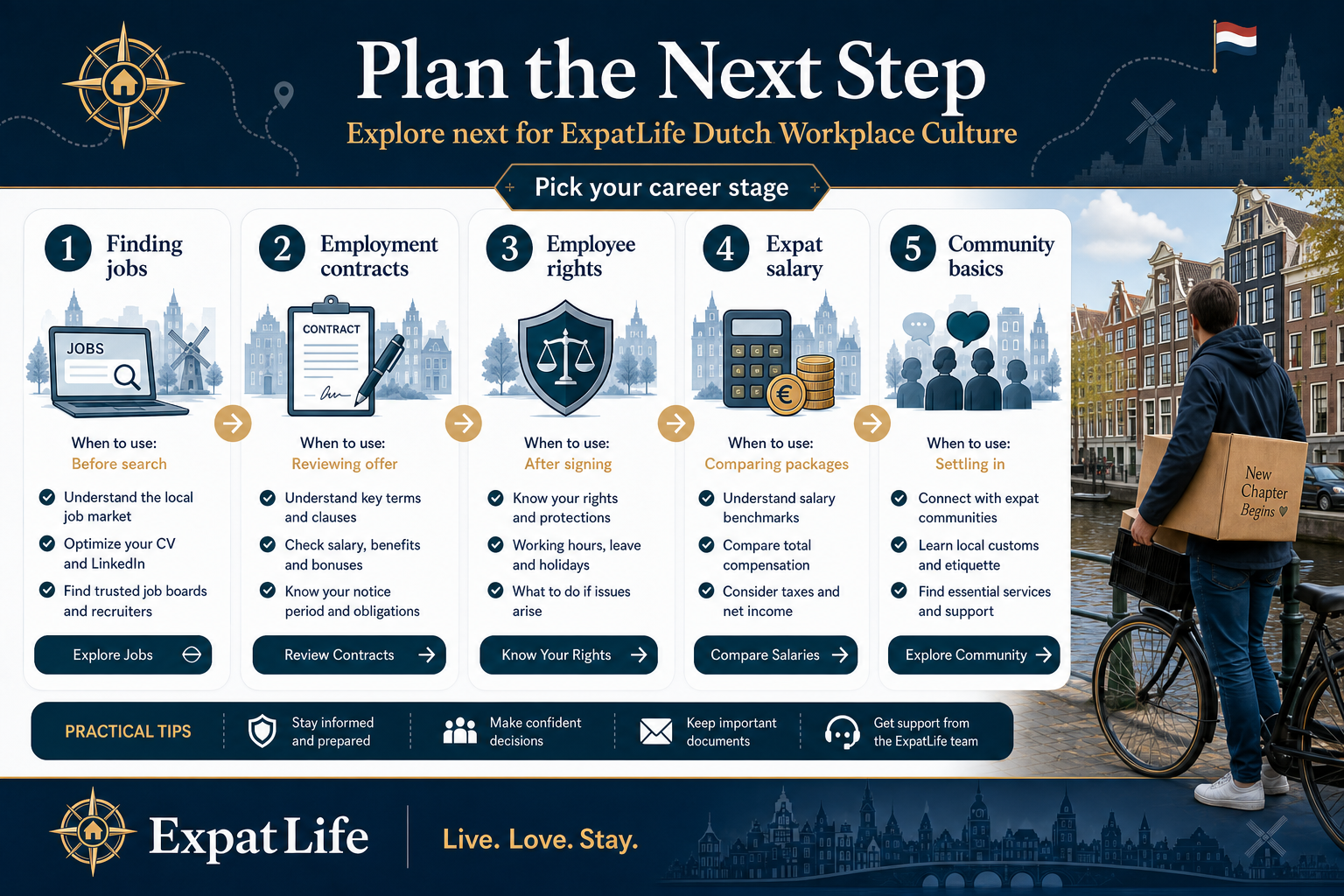
Explore next
Move from culture orientation into contracts, rights, salary and community integration.