Is Dutch directness the same as being rude?
Often not — many colleagues aim feedback at tasks and outcomes. Personal insults or exclusion are different from professional directness.
Netherlands · Jobs · Workplace culture
Learn how direct communication works in Dutch workplaces, why it is valued and how to navigate feedback, meetings and professional discussions with confidence.
Orientation only — communication styles vary by person, team and sector. Confirm norms with colleagues rather than assuming one national style fits everyone.

Quick answer
International professionals often arrive in the Netherlands with strong technical skills but unexpected friction in day-to-day communication. Dutch directness is one of the most discussed cultural differences — and one of the most misunderstood.
This guide explains what direct communication often looks like in Dutch workplaces, why many colleagues value it, how feedback and meetings typically work, and how you can respond professionally without changing your personality.
Pair this deep dive with our broader Dutch workplace culture guide for hierarchy, balance and industry context.
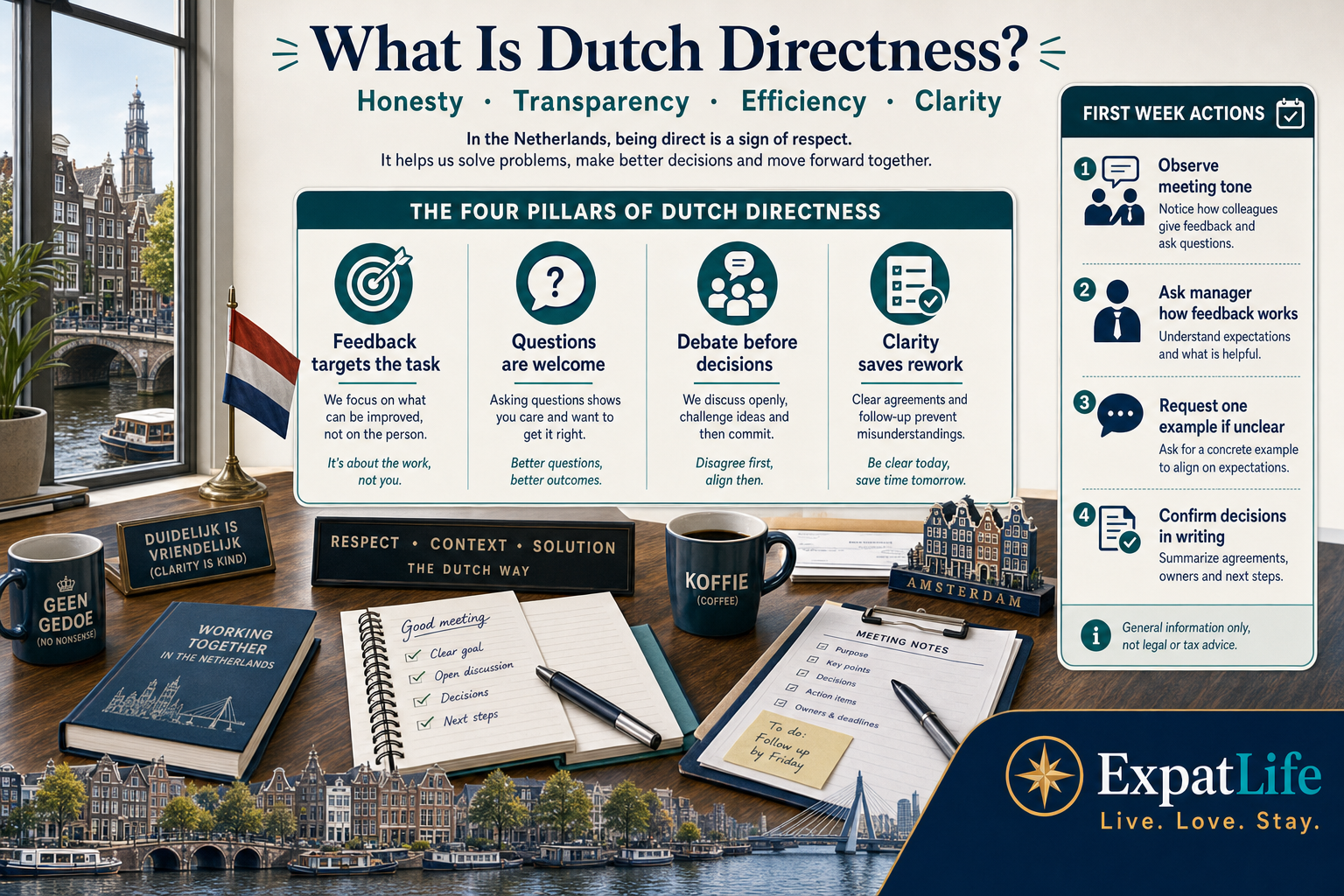
Often not — many colleagues aim feedback at tasks and outcomes. Personal insults or exclusion are different from professional directness.
In many teams, respectful challenge with data is welcome. Confirm whether your manager prefers debate in plenary or in 1:1s first.
Ask for one example and what success looks like next time. Many managers adjust once they know your preferred format.
Most professionals notice patterns within a few weeks. Small experiments — prepared meeting points, written recaps — beat changing your personality.
Phase 1
Watch how feedback is delivered, who speaks first in meetings and how disagreements close.
Phase 2
Ask your manager about feedback cadence, escalation and preferred channels for direct questions.
Phase 3
Prepare one structured talking point per recurring meeting; summarise decisions afterward.
Phase 4
Request brief feedback on your communication style; adjust email tone and meeting participation.
At a glance
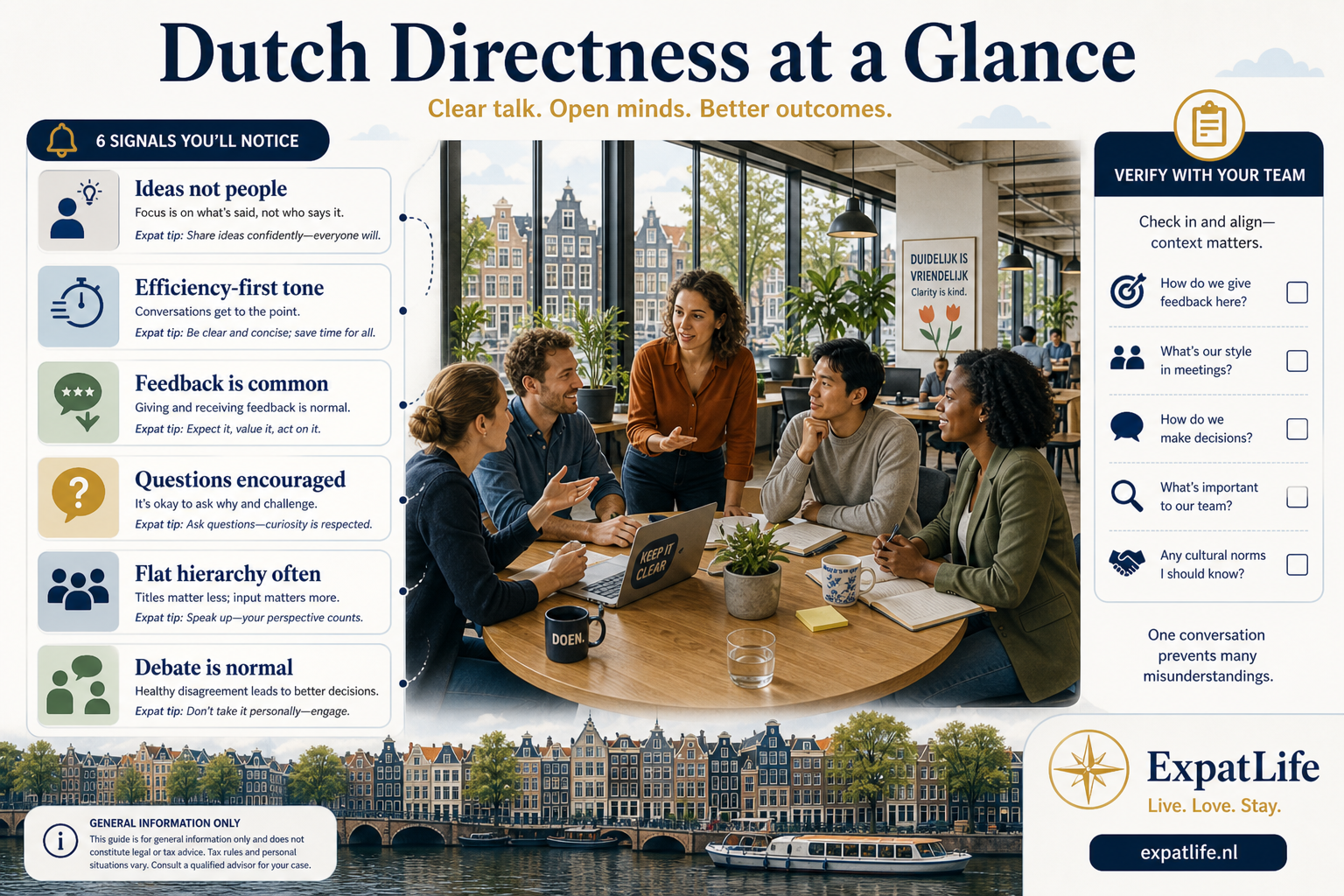
Six signals to orient yourself — then verify with your team.
Week 1
Observe
Feedback tone in meetings
Week 2
Align
Ask manager feedback style
Week 3
Contribute
One prepared meeting point
Week 4
Refine
Request communication feedback
Comments often address the work product, timeline or approach — not your character.
Plain language can reduce rework, misaligned expectations and long email chains.
Performance, project and peer feedback may arrive frequently and specifically.
Asking why or how is often seen as engagement, not insubordination.
Junior colleagues may challenge ideas in meetings — final authority still exists.
Open discussion before a decision is frequently part of consensus-building.
How to use this snapshot
Context
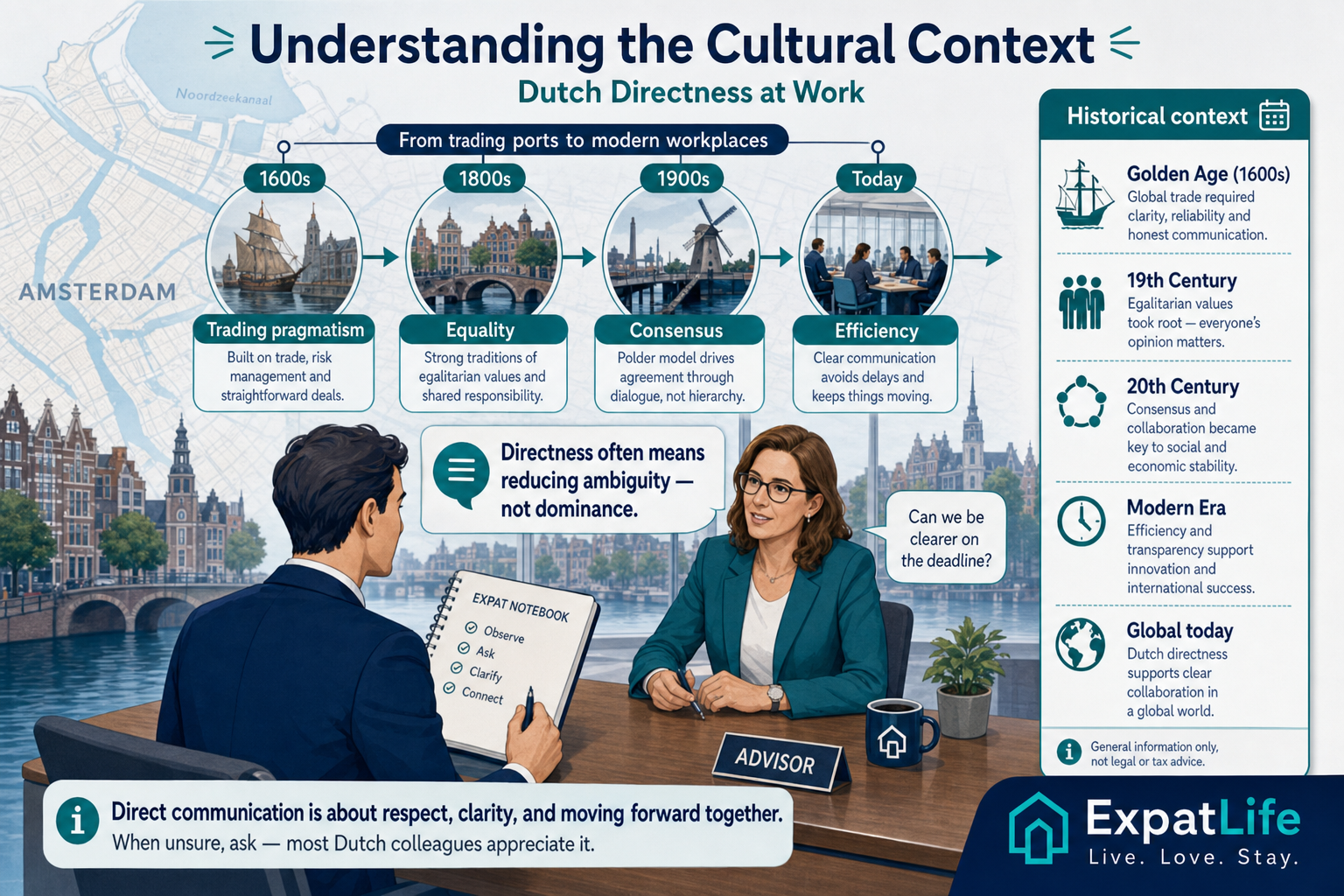
Dutch directness did not appear overnight. Historically, the Netherlands built wealth through trade, negotiation and pragmatic cooperation — environments where unclear terms cost money and time.
Cultural values such as equality, consensus and straightforward dealing still influence many workplaces. In that frame, directness is often interpreted as respect: you are trusted enough to hear the truth and contribute to a better outcome.
This does not mean every Dutch person communicates identically, or that all companies are informal. Multinationals, startups, government bodies and client-facing teams can feel very different.
Engineer flags a launch risk in Slack before stand-up — manager thanks them; directness read as responsible.
Workshop ends with same-day written summary of decisions — verbal debate followed by clear documented outcomes.
Formal titles remain, but project leads still invite written comments before sign-off — directness within process.
Questions to ask your manager
Examples
These scenarios appear often in expat conversations. The Dutch intent column describes what many colleagues mean — not a universal rule for every person.
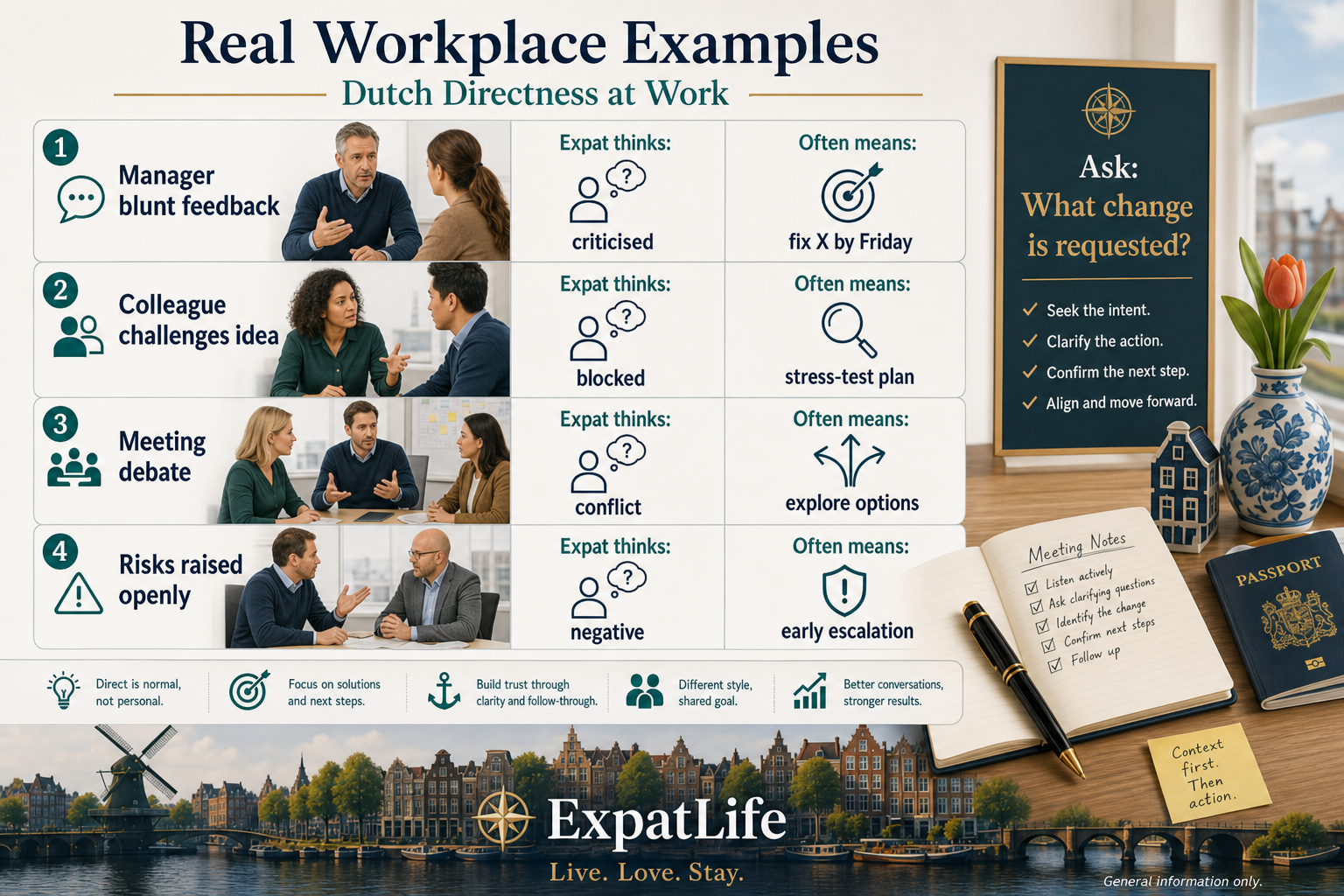
| Scenario | Expat may think | Dutch colleagues often mean |
|---|---|---|
| Manager gives blunt feedback | I am being criticised or singled out. | Here is a specific issue to fix so the project succeeds — please adjust X by Friday. |
| Colleague challenges your idea | They dislike me or want to block progress. | I see a risk or alternative — let's stress-test the plan before we commit. |
| Meeting discussion becomes debate | The team is conflicted or angry. | We are exploring options openly before documenting a decision. |
| Project risks raised openly | Someone is being negative or disloyal. | Early visibility prevents bigger problems — escalation is responsible. |
| When this happens | What you may feel | Try saying |
|---|---|---|
| After blunt feedback | You feel singled out in the moment. | Try: "Thanks — could you share one example and what good looks like by Friday?" |
| When a colleague challenges your idea | Debate starts in a group setting. | Try: "What risk do you see? I can adjust scope or timeline if we agree on the trade-off." |
| When a meeting feels intense | Multiple people disagree before a decision. | Try: "Can we summarise options A and B and confirm who decides today?" |
| When written feedback stings | Short email or Slack message feels harsh. | Try: "Quick call to align? I want to make sure I understand the requested change." |
Clarity
Direct communication and rudeness can sound similar if you come from a more indirect culture — especially under stress. The difference is usually intent, target and professionalism.
Feedback on work quality, timelines or ideas is widely accepted in many Dutch teams. Personal insults, exclusion, harassment or deliberate humiliation are not part of professional directness.
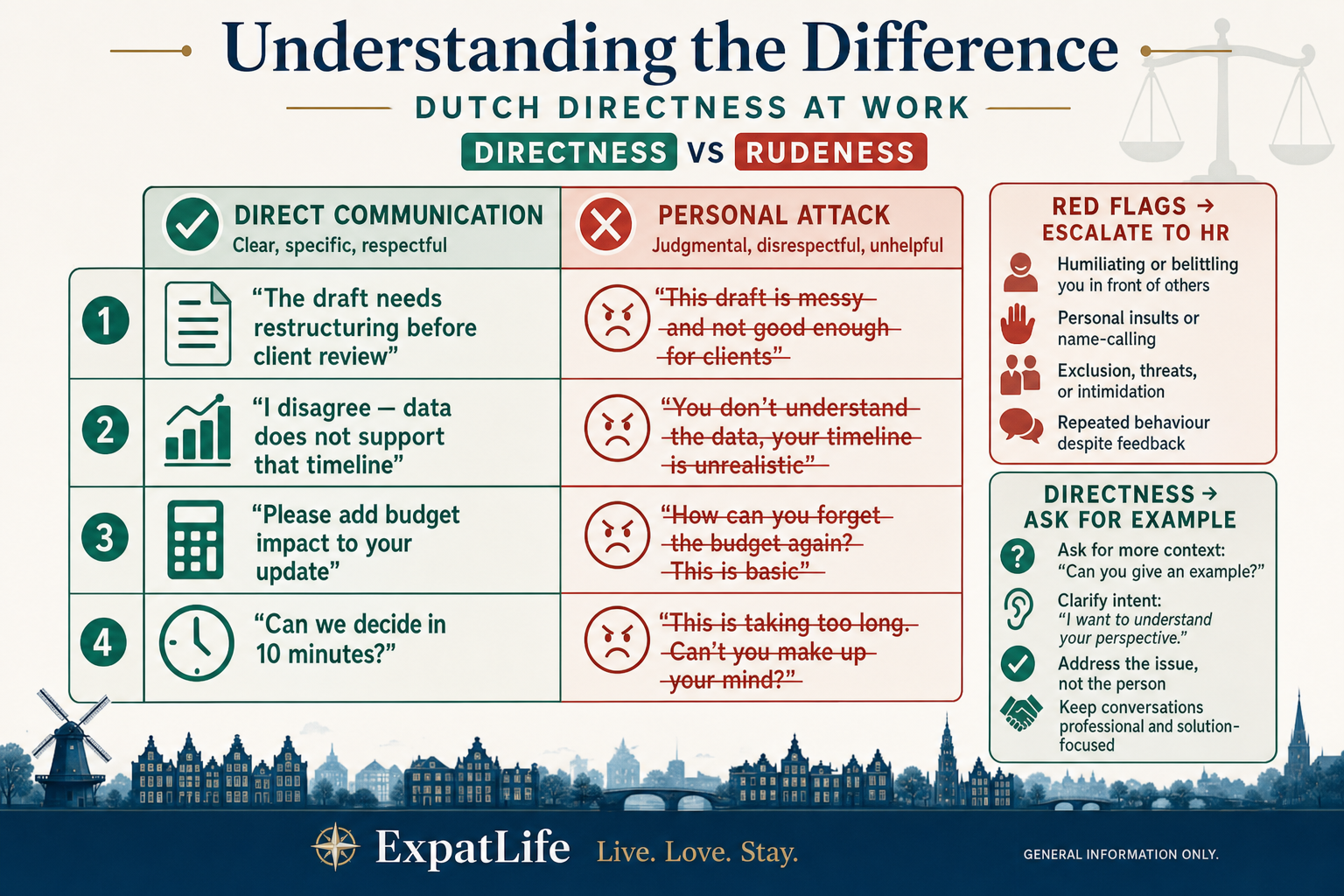
| Direct communication | Personal attack (not OK) |
|---|---|
| The draft needs restructuring before client review. | You clearly cannot write. |
| I disagree — the data does not support that timeline. | That is a stupid plan. |
| Can we move on? We need a decision in ten minutes. | Nobody here knows what they are doing. |
| Your update missed the budget impact — please add it. | You always forget important details. |
How to tell the difference
Feedback
Feedback in many Dutch workplaces is woven into performance cycles, project retrospectives and day-to-day collaboration. It may arrive sooner and more specifically than you expect — especially in knowledge-work teams.
Many managers expect you to receive feedback, ask clarifying questions and propose next steps. Peer feedback can flow upward as well — particularly in flat or agile environments.
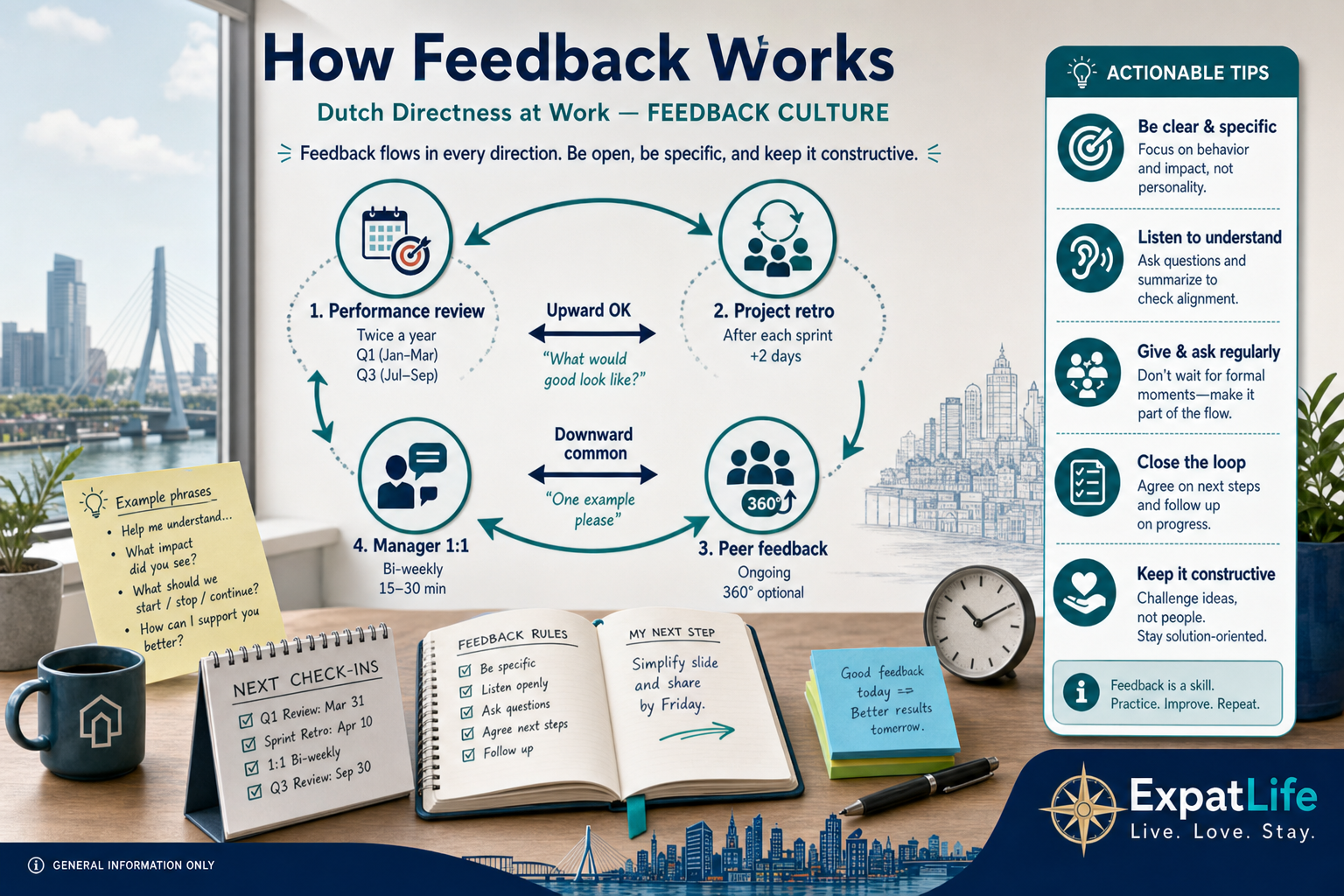
Structured cycles with goals, examples and development plans — often documented.
Retrospectives or post-mortems focusing on what worked, what did not and process improvements.
Colleagues may share observations in reviews or informally after deliverables.
Regular 1:1s with direct comments on priorities, quality and communication style.
Feedback tips
| Situation | What happens | Useful response |
|---|---|---|
| Manager says the report needs work | Plain comment without much cushioning. | Ask which sections to change and by when — thank them and confirm next steps in writing. |
| Peer says your approach won't scale | Direct challenge in a group review. | Treat as stress-testing — ask for the risk they see and propose an alternative. |
| 1:1 feedback on communication style | Specific comment on email length or meeting participation. | Request one example message and agree a format that works for the team. |
Meetings
In many Dutch teams, meetings are not only for status updates — they are spaces to test ideas, surface risks and align before committing resources.
Disagreement during discussion is often expected. Silence can sometimes be read as lack of preparation or engagement, especially in recurring project meetings.
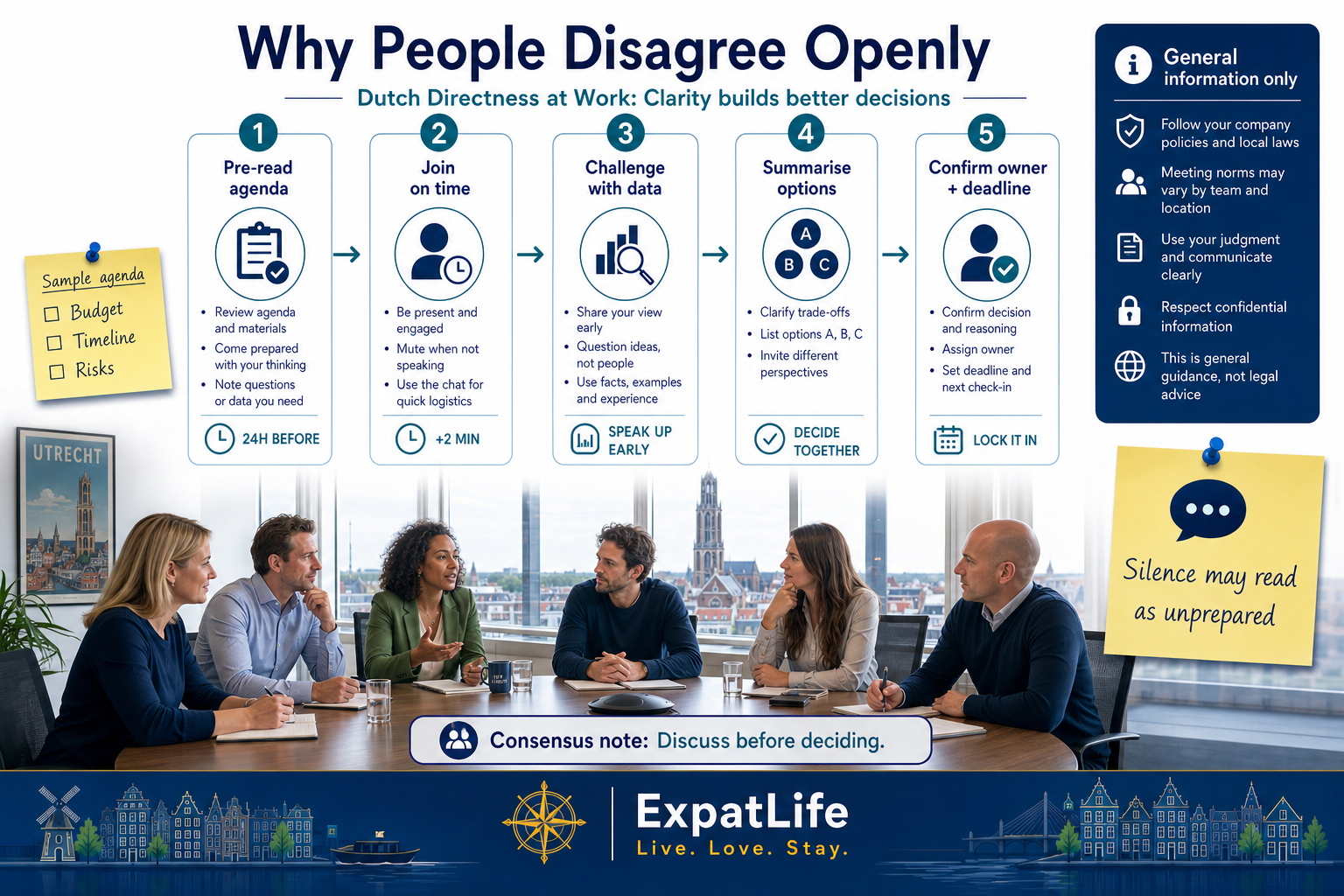
| Meeting type | Purpose | Expat tip |
|---|---|---|
| Stand-up / daily | Blockers and priorities | Keep updates factual — flag delays early, not after the call. |
| Project review | Stress-test plan and scope | Expect open challenge; bring data and one alternative. |
| Retrospective | Process improvement | Peer feedback is often task-focused — contribute one constructive point. |
| Steering / decision | Confirm owner and deadline | Summarise options before leaving; write recap same day. |
Meeting participation checklist
Cross-cultural
Your home culture shapes first impressions. These patterns are general tendencies — individuals and companies always vary. Use them to build empathy, not stereotypes.
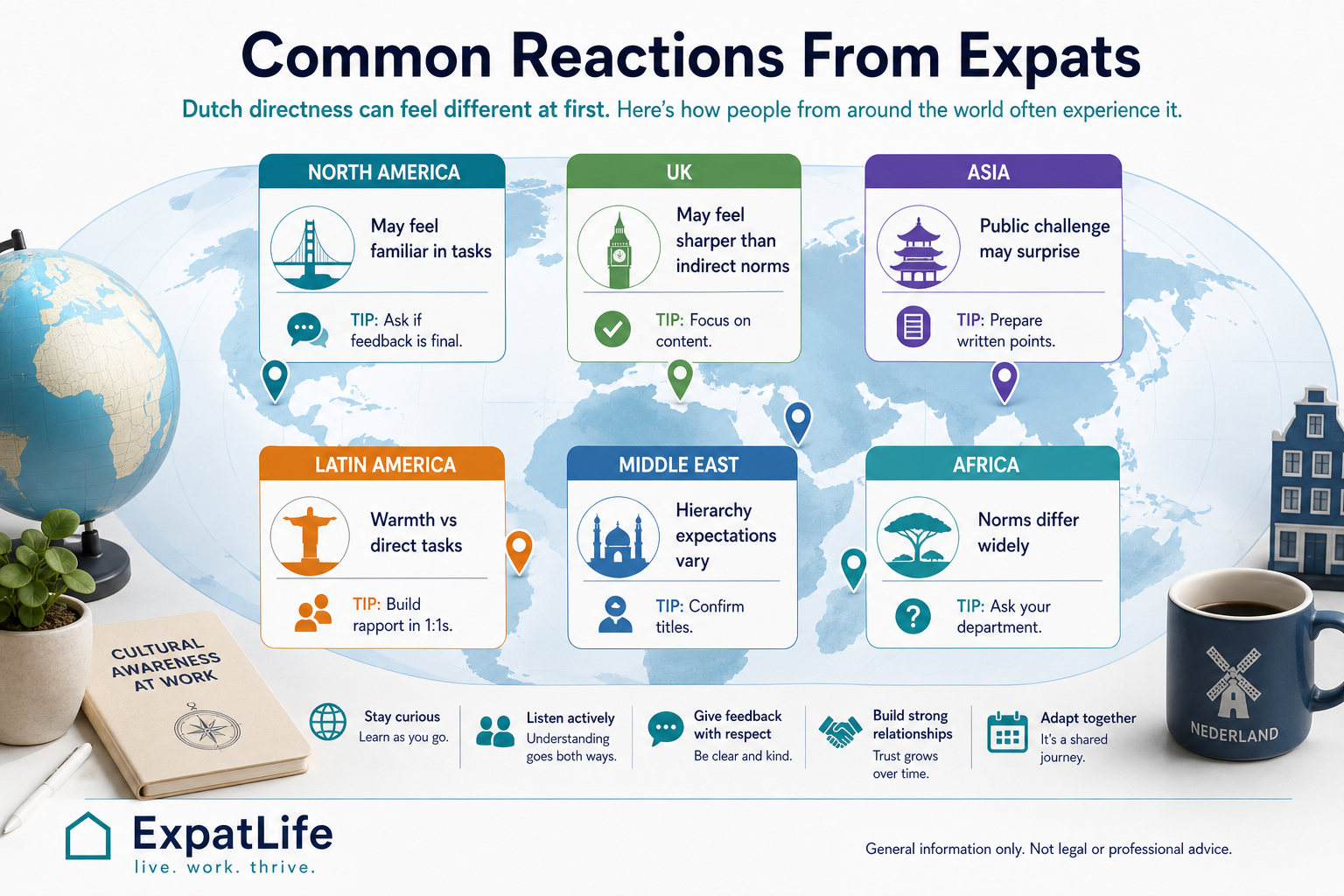
| Background | Common first reaction | Adaptation tip |
|---|---|---|
| North America | Directness may feel normal in task feedback but surprising in peer settings. | Mirror concise updates; ask whether feedback is exploratory or final. |
| United Kingdom | Dutch plain speech can feel sharper than indirect British workplace norms. | Focus on content; avoid over-interpreting softened subtext that may not be present. |
| Asia (varied) | Public challenge or blunt upward feedback may feel disrespectful at first. | Observe when debate is welcome; prepare written points if speaking up feels difficult. |
| Latin America | Relationship warmth and direct task feedback may feel disconnected initially. | Build rapport in 1:1s while adapting to direct group discussions. |
| Middle East | Hierarchy expectations may clash with flat debate cultures in some teams. | Confirm titles and decision rights while participating in idea discussion. |
| Africa (varied) | Communication norms differ widely — some teams feel familiar, others very direct. | Ask colleagues how feedback is usually delivered in this department. |
Adaptation
Adaptation does not mean becoming someone else. It means learning when directness is informational, how to respond calmly, and how to participate in the communication culture your team expects.
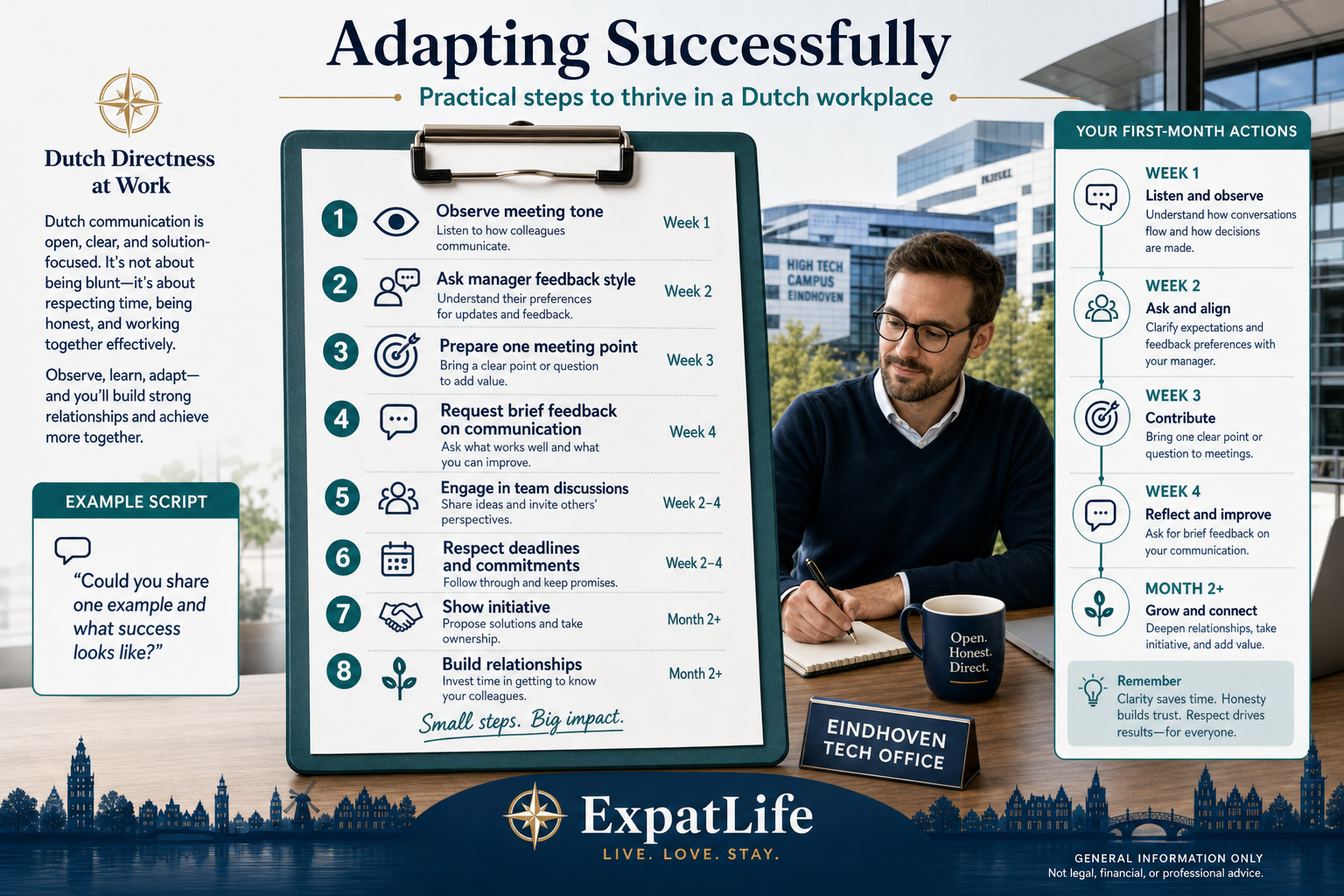
Adapting successfully
| Situation | Context | Example phrase |
|---|---|---|
| After unexpected feedback | Comment feels blunt in the moment. | "Could you share one example and what success looks like next time?" |
| Before disagreeing in a meeting | You see a risk others have not raised. | "I see a risk on timeline — can I share an alternative with trade-offs?" |
| When email tone stings | Short message feels personal. | "Happy to fix — can we do a 10-min call so I understand the priority?" |
| Aligning with your manager | Unclear how direct to be. | "How do you prefer I raise concerns — in stand-up, Slack or 1:1?" |
Phase 1
Watch how feedback is delivered, who speaks first in meetings and how disagreements close.
Phase 2
Ask your manager about feedback cadence, escalation and preferred channels for direct questions.
Phase 3
Prepare one structured talking point per recurring meeting; summarise decisions afterward.
Phase 4
Request brief feedback on your communication style; adjust email tone and meeting participation.
Advantages
Many expats grow to value clarity once norms are understood.
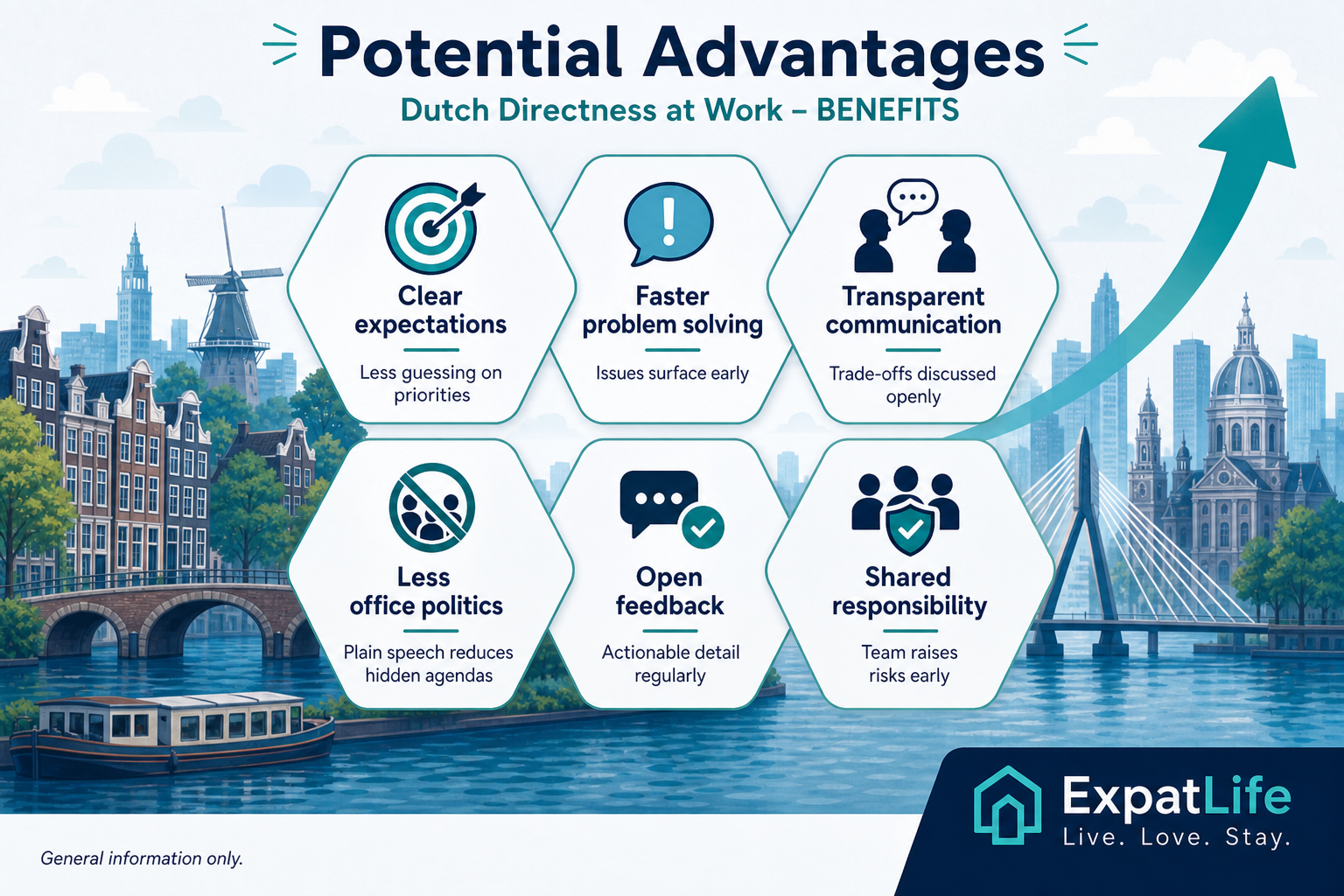
Less guessing about priorities, quality standards and deadlines.
Issues surface early instead of festering through indirect signals.
Decisions and trade-offs may be discussed openly.
Plain speech can reduce hidden agendas — though politics still exists.
Growth-oriented comments may arrive regularly with actionable detail.
Team members may feel empowered to raise risks and ideas.
Benefits in practice
Challenges
Most friction is an adaptation gap — not a permanent mismatch.
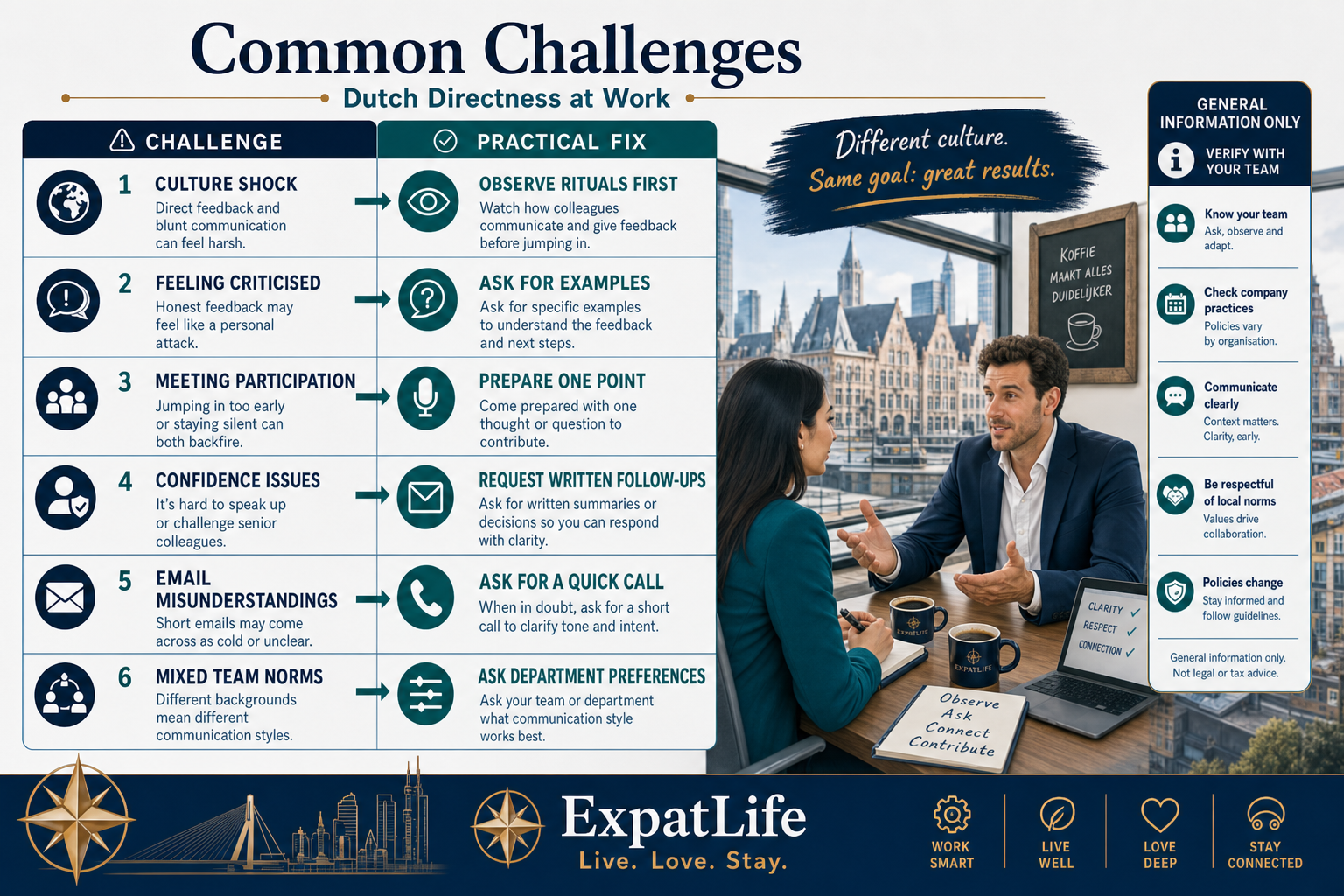
First weeks can feel emotionally intense until patterns become familiar.
Frequent feedback may trigger defensiveness if misread as personal.
Expectation to speak up may conflict with habits from previous workplaces.
Language barriers can make direct debate feel harder in English or Dutch.
Email and chat lack tone — written directness can sting.
Hybrid politeness norms across multicultural teams create mixed signals.
Fixes
| Mistake | What to do instead |
|---|---|
| Misreading blunt tone as personal attack | Ask for one example and the requested change before reacting. |
| Staying silent in debates | Prepare one data-backed point or clarifying question per meeting. |
| Long indirect emails | Use bullets, deadline and owner — match team brevity. |
| Avoiding upward feedback | Share risks early; many teams value escalation over surprises. |
| Assuming all Dutch teams are identical | Observe your department — multinationals and SMEs differ. |
| Not asking for format preferences | Tell your manager how you prefer to receive critique (1:1 vs written). |
Scenarios
Recognise the pattern so you can prepare a response.
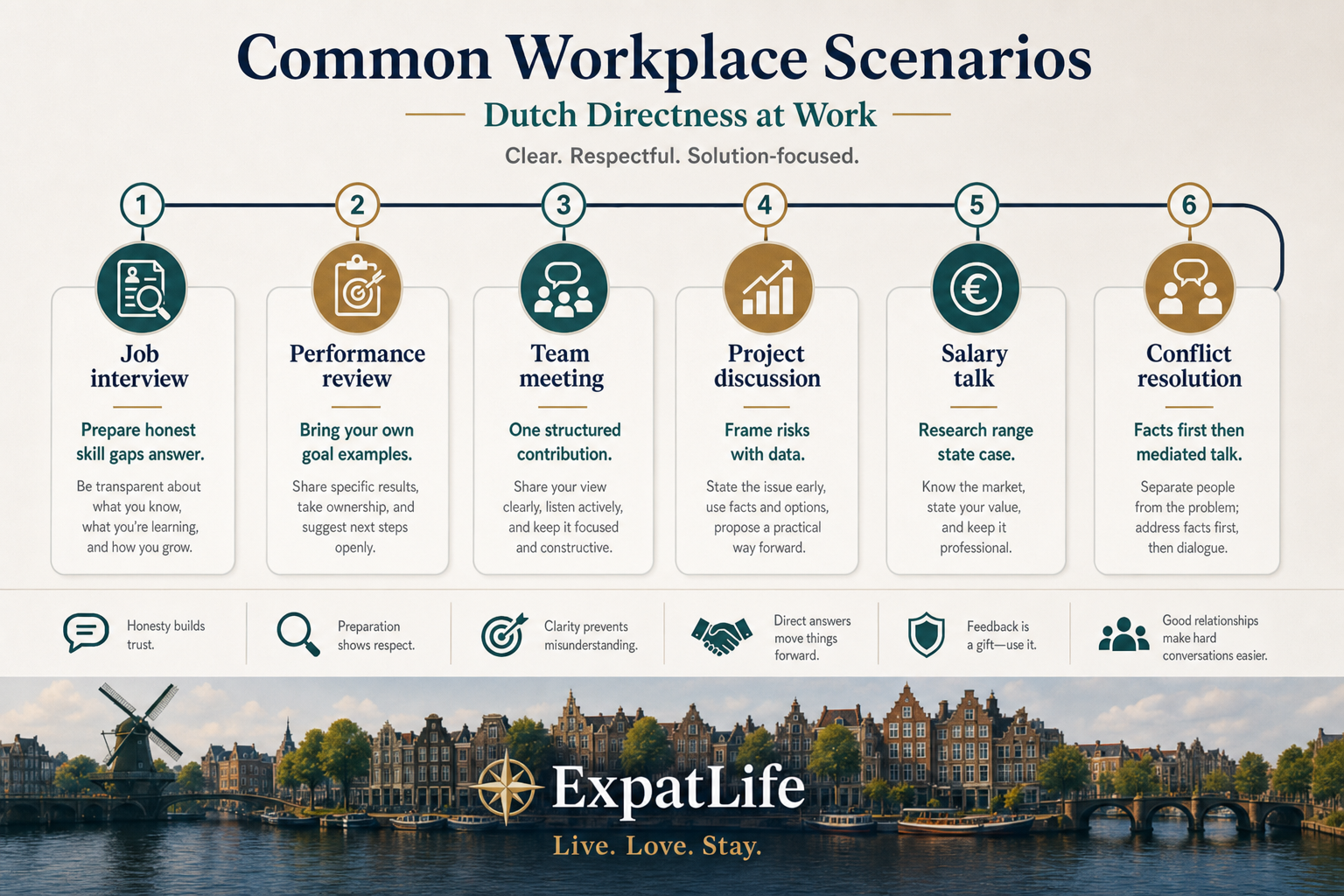
Interviewers may ask direct questions about skills gaps or salary expectations — prepare honest, concise answers.
Reviews may include specific improvement areas without much cushioning — bring examples and ask for goals.
Expect agenda items, time boxes and open challenge — prepare one contribution per meeting.
Risk call-outs and scope debates are often welcome — frame concerns with data.
Negotiation may be factual rather than relational — research ranges and state your case clearly.
Many teams prefer early direct conversation before escalation — document facts and request a mediated talk if needed.
| Situation | What happens | How to respond |
|---|---|---|
| Job interview direct question | Interviewer asks about a skill gap or salary expectation plainly. | Answer honestly with one example of how you are closing the gap; research salary ranges beforehand. |
| Performance review | Manager lists improvement areas without much softening language. | Bring your own goal examples; ask which priority matters most this quarter. |
| Team meeting debate | Colleagues challenge timelines or scope openly. | Contribute one structured point; confirm decision owner before leaving. |
| Salary negotiation | Discussion stays factual — ranges, role scope, market data. | State your case with research; avoid taking factual tone as rejection. |
| Peer gives blunt Slack feedback | Short message about missing detail in your deliverable. | Fix the task, confirm in thread, ask if format expectations differ. |
| Conflict with colleague | Direct conversation expected before involving HR. | Document facts, request a short sync, focus on behaviour and tasks — escalate if personal. |
Expectations
Beyond communication style, many Dutch colleagues expect reliability, ownership and constructive participation. Directness works best when paired with follow-through.

What many Dutch colleagues expect
Send a Tuesday status with blockers before being asked — direct teams often value early visibility.
Prepare one question or alternative per recurring meeting — silence may read as disengagement.
Join calls two minutes early; recap verbal decisions in writing the same day.
Ask your manager in week one
Digital
Directness does not disappear online — if anything, missing facial cues can make short messages feel sharper. Many teams rely on email, Teams or Slack for decisions, feedback and follow-ups.
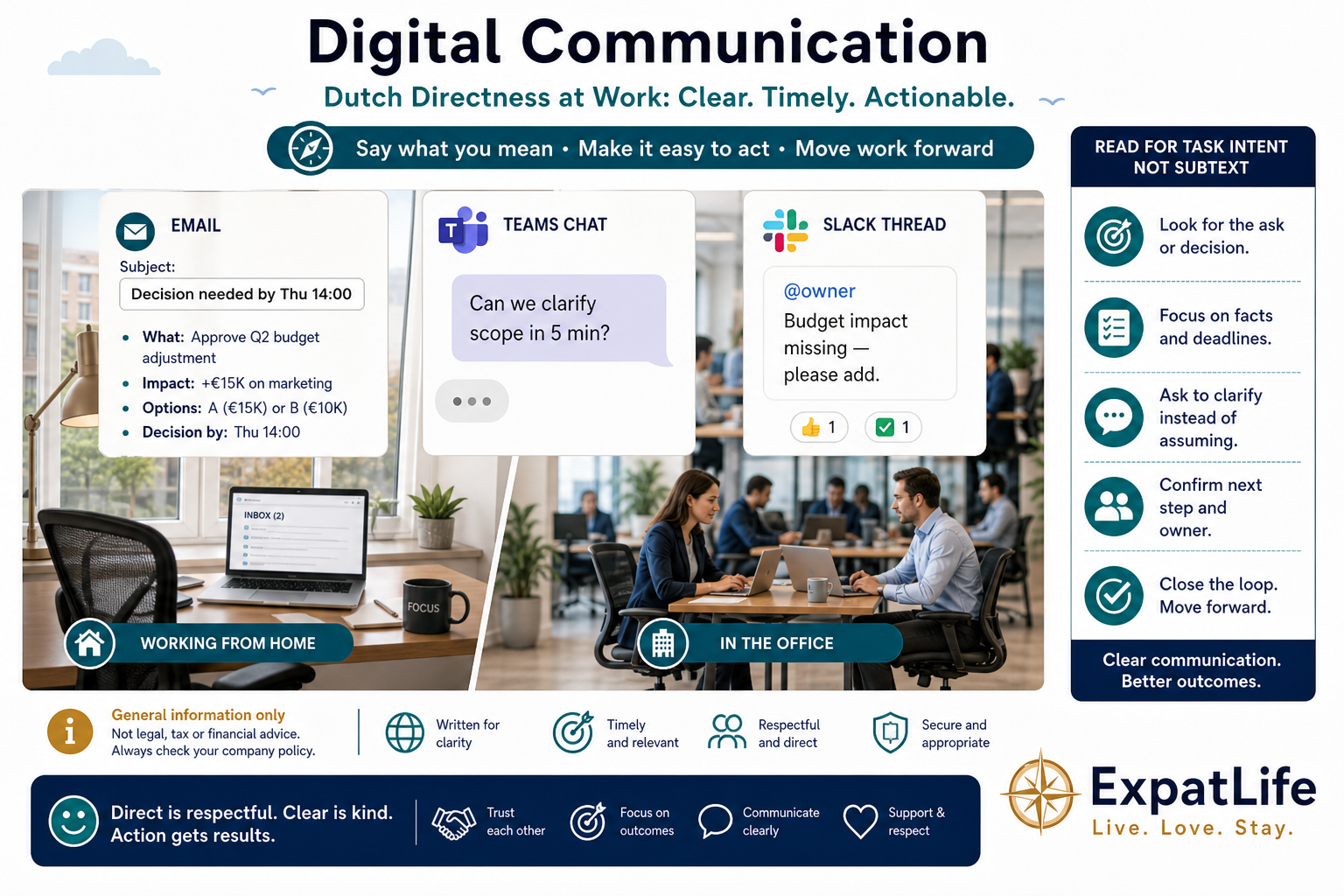
Subject lines like Decision needed by Thursday and bullet-point feedback are common.
Cameras may be optional; direct chat questions during presentations are normal in some teams.
Threaded debates and @mentions for owners — tone is often brief and task-focused.
| Channel | When to use | Example format |
|---|---|---|
| Decisions, feedback summaries, external stakeholders | Subject: Decision needed by Thu 14:00 — 4 bullets, owner, deadline | |
| Teams / Slack | Quick clarifications, async debate, owner mentions | @owner Budget line missing — can you add before stand-up? |
| Video call | Sensitive feedback, complex disagreement, tone repair | 15-min sync to align on scope after blunt thread |
Digital communication tips
Myths
Balanced explanations — individuals and companies vary.
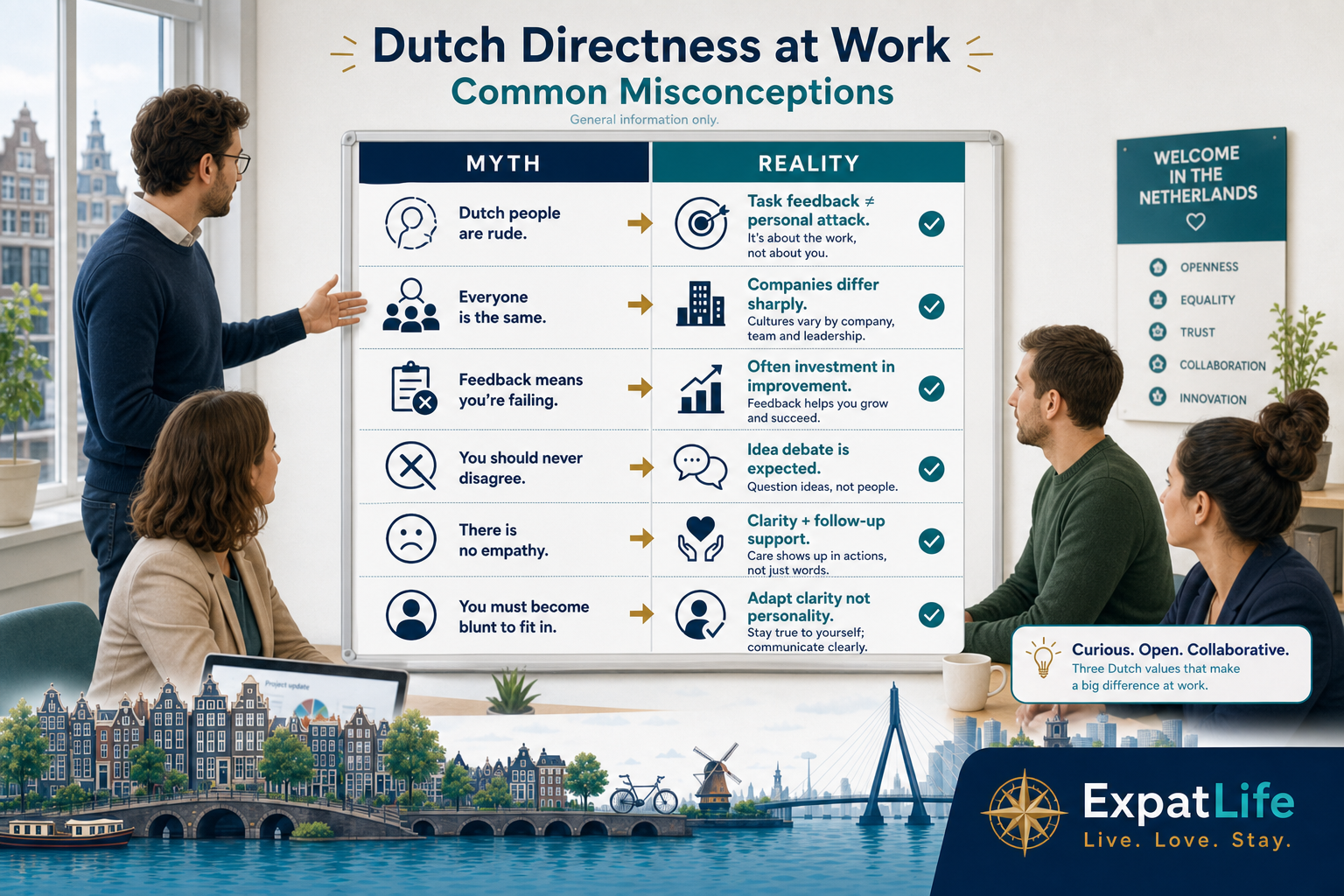
Myth
Many colleagues separate direct task feedback from personal warmth — context and relationship still matter.
Myth
Regional, generational and company cultures differ widely across the Netherlands.
Myth
Frequent feedback often signals investment in improvement — ask for priorities.
Myth
Respectful disagreement on ideas is often expected before decisions stick.
Myth
Empathy may show through fairness, clarity and follow-up support rather than soft language.
Myth
Adapt participation and clarity — you do not need to copy every tone or phrase.
Replace myths with these questions
Stories
Adaptation is a learning curve — most professionals adjust within months.

Challenge: Felt attacked when seniors critiqued code in group reviews.
Outcome: Asked for 1:1 feedback format; learned public comments targeted quality, not status — now leads retros.
Challenge: Team interpreted relational check-ins as micromanagement.
Outcome: Balanced brief personal warmth with agenda-driven meetings; trust scores improved in quarterly survey.
Challenge: British indirect style clashed with blunt client feedback loops.
Outcome: Documented revision requests literally; reduced rework and shortened approval cycles.
Challenge: Expected fast top-down decisions; frustrated by consensus pace.
Outcome: Mapped decision owners; learned debate shortened rework — now facilitates client workshops.
Challenge: Uncomfortable challenging senior ideas in plenary meetings.
Outcome: Prepared written questions pre-meeting; manager invited them first — participation became a strength.
Takeaways you can apply
Avoid
Use as a weekly self-check during onboarding.
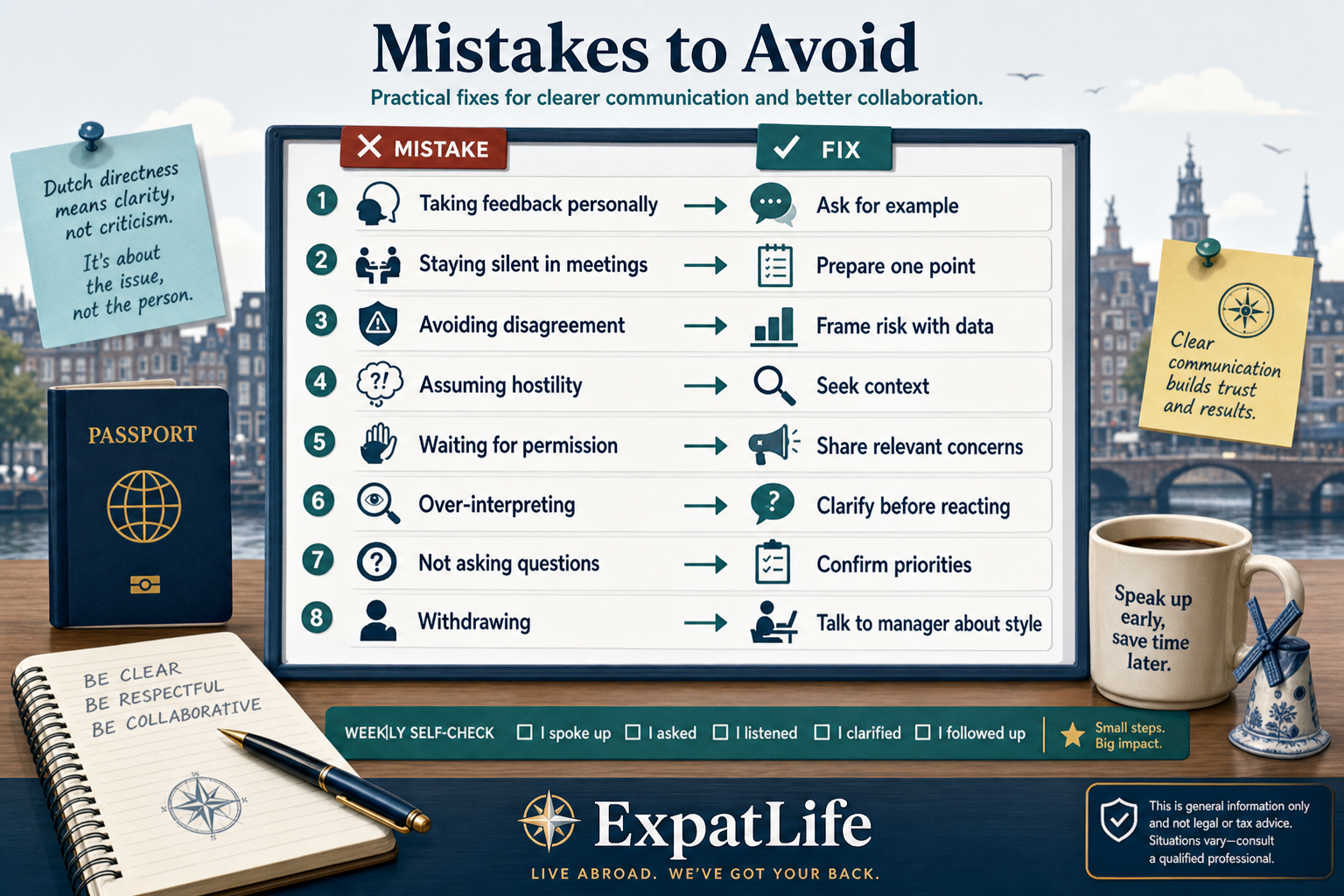
Mistakes to avoid
Fixes
| Mistake | What to do instead |
|---|---|
| Taking all feedback personally | Ask for one example and one requested change. |
| Staying silent in meetings | Prepare one structured point before each recurring meeting. |
| Avoiding disagreement | Frame risks with data — ask who decides after debate. |
| Assuming criticism is hostility | Clarify intent before reacting; confirm next steps in writing. |
| Waiting for permission to speak up | Share relevant concerns early — escalation is often valued. |
| Over-interpreting through home-culture lens | Ask a trusted colleague how they read the same comment. |
| Not asking questions | Use scripts: "Could you share one example?" |
| Withdrawing from discussions | Tell your manager which formats help you participate. |
FAQ
Confirm specifics with colleagues — norms vary by company.
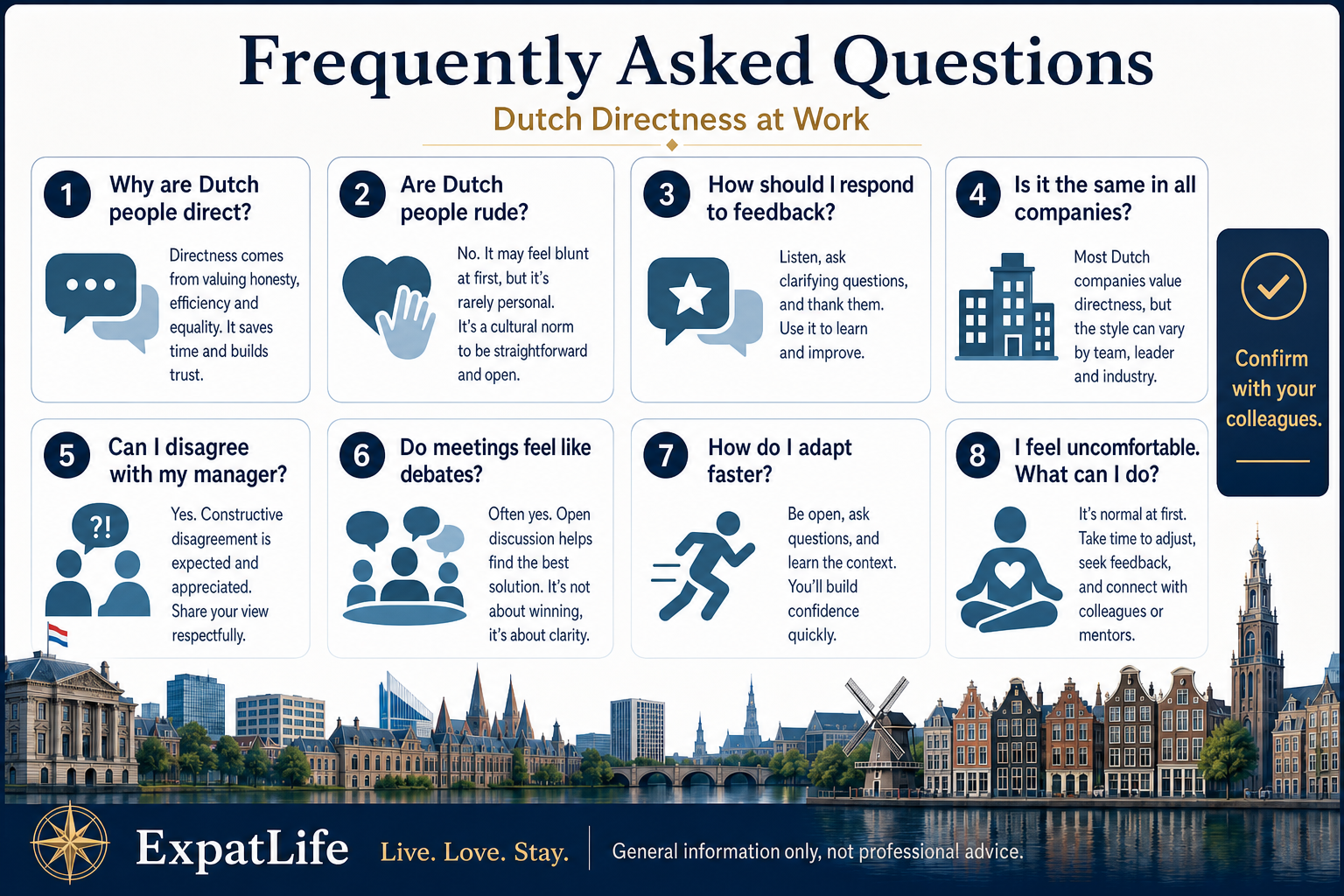
Many workplaces value clarity, efficiency and honest feedback. Historical trade culture and egalitarian norms influence this — but individuals and companies vary.
Direct task feedback can feel rude if you expect indirect cues. Often the intent is practical. Personal insults or exclusion are not acceptable professionalism.
Listen, ask for one example, confirm the requested change and follow up in writing. Thank the person if the feedback is constructive.
No. Startups, multinationals, government and client-facing teams differ. Observe your team and ask your manager.
In many knowledge-work teams, respectful disagreement on ideas is welcome. Confirm how your manager prefers challenges — in meetings or 1:1s.
Open discussion before decisions is common in consensus-oriented cultures. Summarise outcomes and owners afterward.
Observe, ask clarifying questions, participate with prepared points and pair this guide with workplace culture and employee-rights orientation.
Talk to your manager or HR if behaviour is personal, repeated or discriminatory. Directness should not cross into bullying.
Career guides
Start with workplace culture overview, then deepen with contracts and rights.
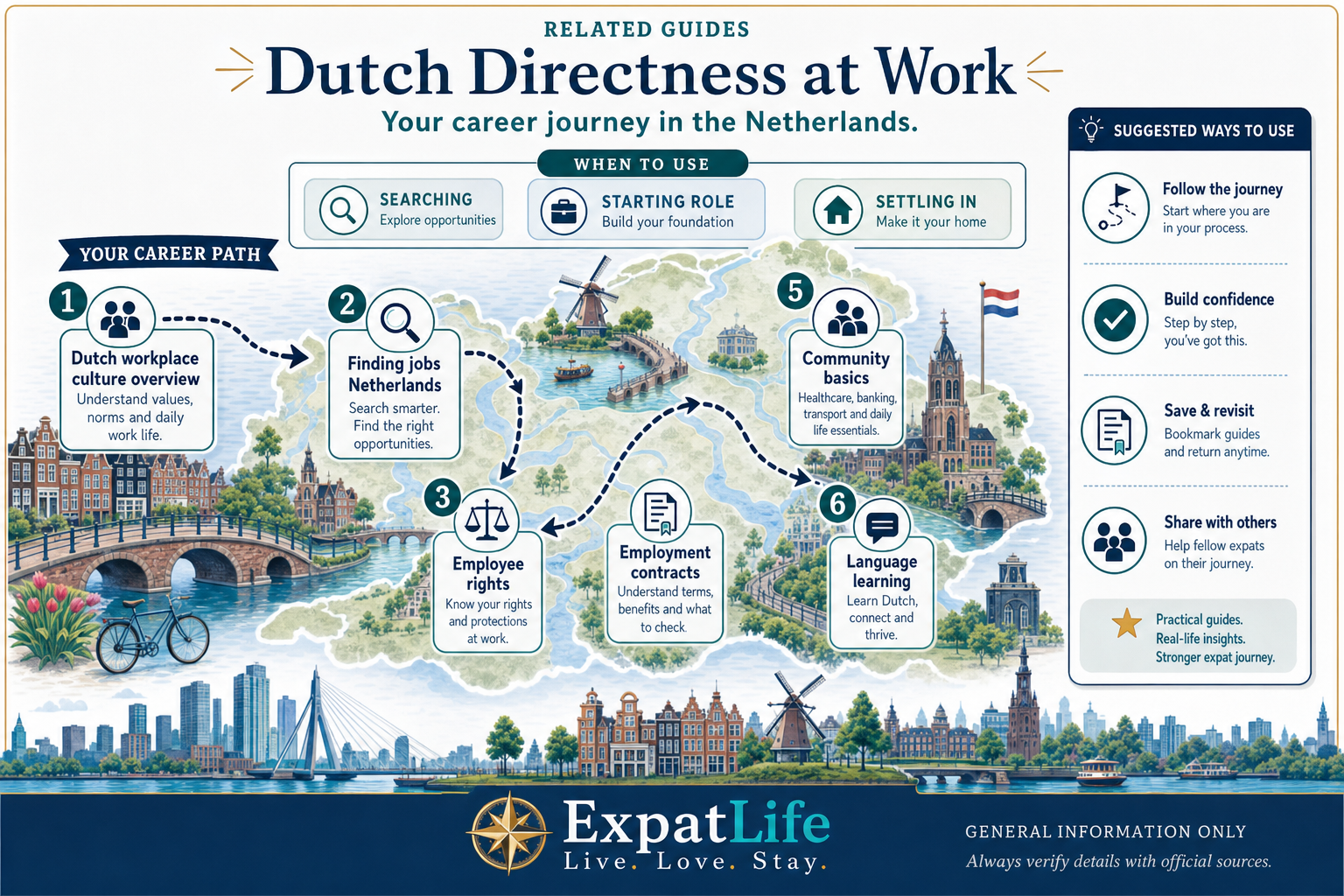
Phase 1
Dutch workplace culture — hierarchy, balance, meetings and industry context.
Phase 2
Finding jobs — interviews often include direct skill and salary questions.
Phase 3
Employment contracts and employee rights — pair culture with legal orientation.
Phase 4
Community basics and language learning — integration beyond the office.
Suggested reading order
Explore next
Move from directness orientation into workplace culture, contracts, rights and community integration.