Employment bundles protections
Example: €5,800/month role with employer pension, sick pay and vakantiegeld — compare total value, not contractor hourly rate alone.
Netherlands · Jobs · Work structure
Compare the benefits, tradeoffs and practical differences between working as an employee and working as a contractor or ZZP'er in the Netherlands.

Overview
International professionals in the Netherlands often face the same question: accept a salaried employment contract or work as an independent contractor — frequently through ZZP self-employment. Both paths are common in tech, consulting, creative services and interim management.
The choice affects monthly cash flow, benefit access, tax administration, pension building, mortgage eligibility and how much control you have over clients and schedule. Many expats compare a contractor day rate with an employment salary without modelling the full picture.
This guide offers a balanced comparison of typical patterns in the Netherlands. Your contract, permit, sector and client mix still determine exact terms — use official sources and qualified professionals to confirm your situation.

Key points
Example: €5,800/month role with employer pension, sick pay and vakantiegeld — compare total value, not contractor hourly rate alone.
Example: €95/hour ZZP consultant choosing clients and project length — plan tax reserves, pension gap and slow months.
Example: full-time work for one client via invoice — may resemble employment; verify independently before assuming contractor status.
Example: highly skilled migrant on sponsored employment — side or full contractor work may need separate IND clearance.
Three orientation moves
Examples
| Profile | Scenario | What to check |
|---|---|---|
| Data engineer — Amsterdam | €90/hour contractor vs €6,200/month employment with pension | Model 12-month net including pension, vakantiegeld, sick pay and admin time. |
| Designer — agency offer | Recruiter presents ZZP contract for otherwise employee-like role | Classification risk and employment contract guide for comparison. |
| Consultant — EU clients | Considering ZZP while employed at sponsor company | IND rules on additional activity plus employment contract clauses. |
| Parent — flexibility priority | Prefers contractor hours around school schedule | Buffer for unpaid gaps, health insurance and pension without employer accrual. |
Tax & accounting
Useful for employment vs contractor net comparisons, cross-border clients and classification questions — verify Belastingdienst rules independently.
Blue Umbrella
Dutch tax filing and expat-focused support — useful for ruling-related questions, payroll context, and annual returns.
Paid services; confirm pricing for your case.
Visit provider →TaxSavers
Tax returns and advice aimed at internationals; helpful when you want hands-on filing or a second opinion on ruling paperwork.
Paid services; check current rates.
Visit provider →Expatax
Expat income tax guidance and ruling-related planning for employees in the Netherlands.
Paid services; confirm scope before engaging.
Visit provider →Some links may be affiliate or referral links. Listings are for discovery only — not pay-to-rank. Confirm credentials and scope with any provider. Learn more
At a glance
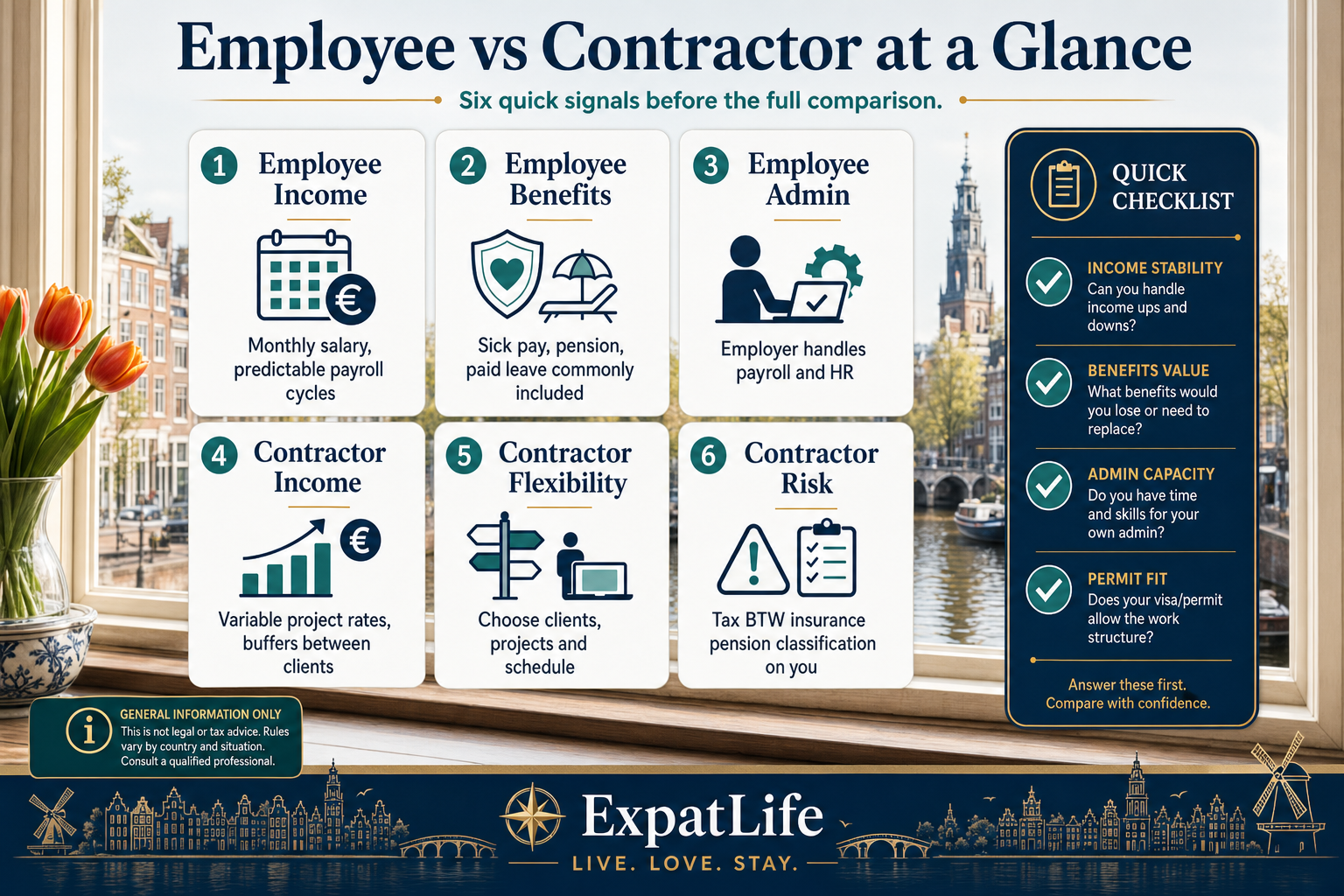
Six quick signals split between employment stability and contractor flexibility — use alongside the full comparison table.
Employee · Income
Monthly salary
Predictable payroll with holiday allowance and structured pay cycles.
Employee · Benefits
Employer package
Sick pay, pension contributions and paid leave commonly included.
Employee · Admin
Low personal
Employer handles payroll, tax withholding and much HR administration.
Contractor · Income
Variable
Project rates and client pipelines — buffers needed between engagements.
Contractor · Flexibility
High control
Choose clients, projects and schedule within contract and permit limits.
Contractor · Risk
Self-managed
Tax, BTW, insurance, pension and classification risk sit with you.
Start here
Before diving into all ten comparison rows, most expats start with income stability, benefits, pension and administration — the areas that most often change total compensation.
| Topic | Employee | Contractor |
|---|---|---|
| Income Stability | Monthly salary with predictable pay cycles and employer payroll | Project-based income — gaps between clients are common |
| Flexibility | Contracted hours, employer direction and hybrid policies | Greater control over clients, projects and schedule |
| Benefits | Sick pay, paid holiday and employer benefits often included | No employer sick pay or paid leave by default |
| Pension | Employer pension contributions common in many sectors | Voluntary pension savings — no automatic employer accrual |
Examples
| Profile | Scenario | What to check |
|---|---|---|
| Rate vs package | €85/hour contractor vs €5,500/month employment | Add pension, vakantiegeld, sick pay value and accountant fees to compare fairly. |
| Interim specialist | 6-month contractor extension at same employer | Classification if engagement resembles permanent employment. |
| Dual offers — tech | Startup employment vs agency ZZP placement | Equity, pension, notice and IND permit implications on each path. |
| Mortgage in 2 years | Choosing contractor now for higher headline rate | Lender preference for employment history — mortgage guide and adviser. |
Three moves after this snapshot
Compare
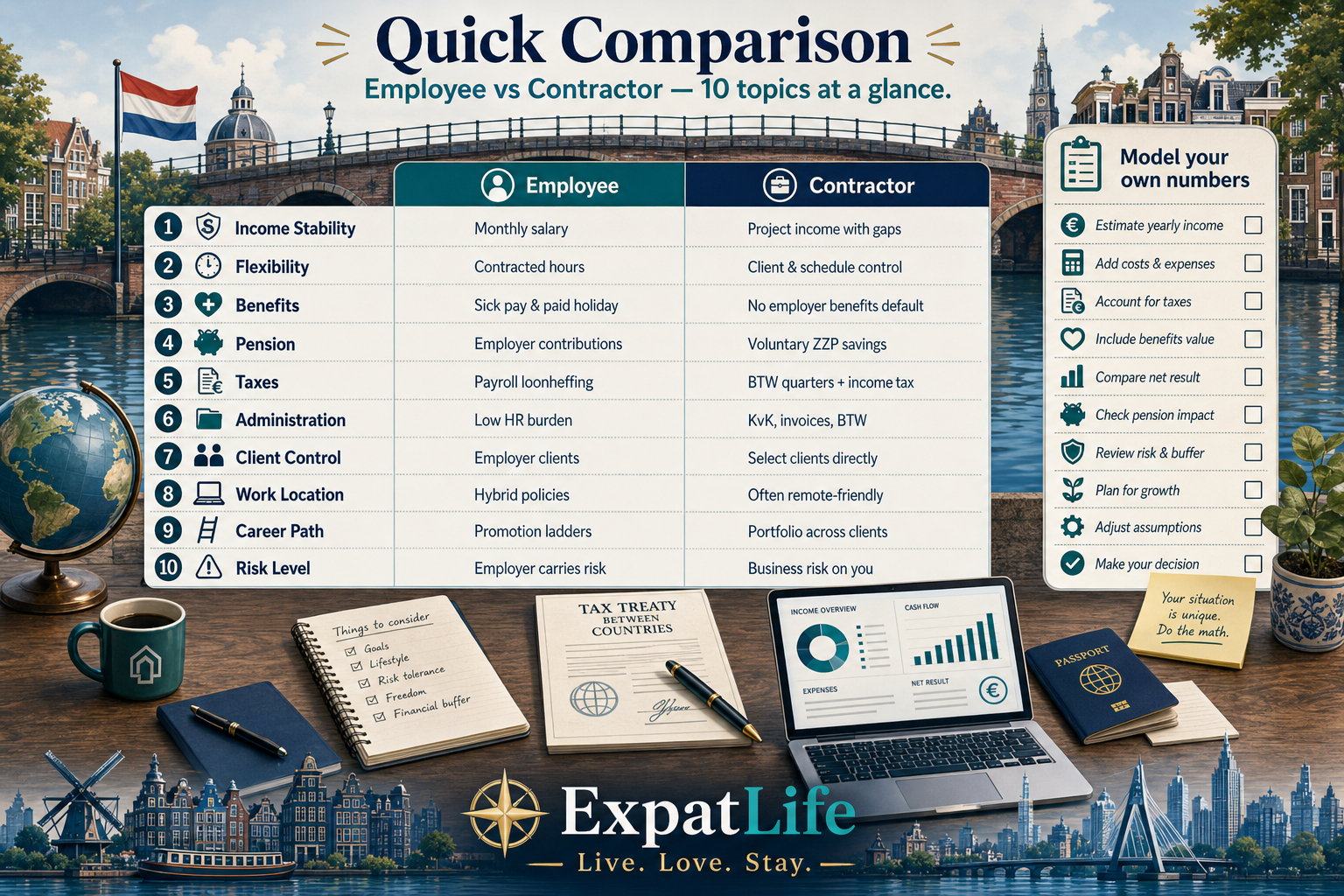
This table summarises typical differences international professionals see in the Netherlands. Exact terms depend on your contract, CAO, client mix and permit — use it to structure conversations, not as a substitute for personalised review.
| Topic | Employee | Contractor |
|---|---|---|
| Income Stability | Monthly salary with predictable pay cycles and employer payroll | Project-based income — gaps between clients are common |
| Flexibility | Contracted hours, employer direction and hybrid policies | Greater control over clients, projects and schedule |
| Benefits | Sick pay, paid holiday and employer benefits often included | No employer sick pay or paid leave by default |
| Pension | Employer pension contributions common in many sectors | Voluntary pension savings — no automatic employer accrual |
| Taxes | Payroll tax withheld by employer; annual return may still apply | Income tax, BTW filings and bookkeeping typically self-managed |
| Administration | Low — HR and payroll handle most compliance | KvK registration, invoices, contracts and quarterly BTW |
| Client Control | Work for employer clients and internal teams | Select and negotiate with multiple clients directly |
| Work Location | Hybrid and office policies set by employer | Often remote-friendly — confirm contract and permit rules |
| Career Path | Promotion ladders, training and internal mobility | Portfolio career across clients and sectors |
| Risk Level | Employer carries much employment and payroll risk | Business, classification and client payment risk on you |
Examples
| Profile | Scenario | What to check |
|---|---|---|
| Rate vs package | €85/hour contractor vs €5,500/month employment | Add pension, vakantiegeld, sick pay value and accountant fees to compare fairly. |
| Interim specialist | 6-month contractor extension at same employer | Classification if engagement resembles permanent employment. |
| Dual offers — tech | Startup employment vs agency ZZP placement | Equity, pension, notice and IND permit implications on each path. |
| Mortgage in 2 years | Choosing contractor now for higher headline rate | Lender preference for employment history — mortgage guide and adviser. |
Employment
Employment in the Netherlands typically means a written contract, payroll processing, employer pension contributions in many sectors, paid vacation, sick leave processes and HR support for workplace matters.
For expats, employment is often the default route on highly skilled migrant permits, intra-EU moves and roles with multinational employers. Protections and predictable income appeal when family stability or mortgage plans matter.
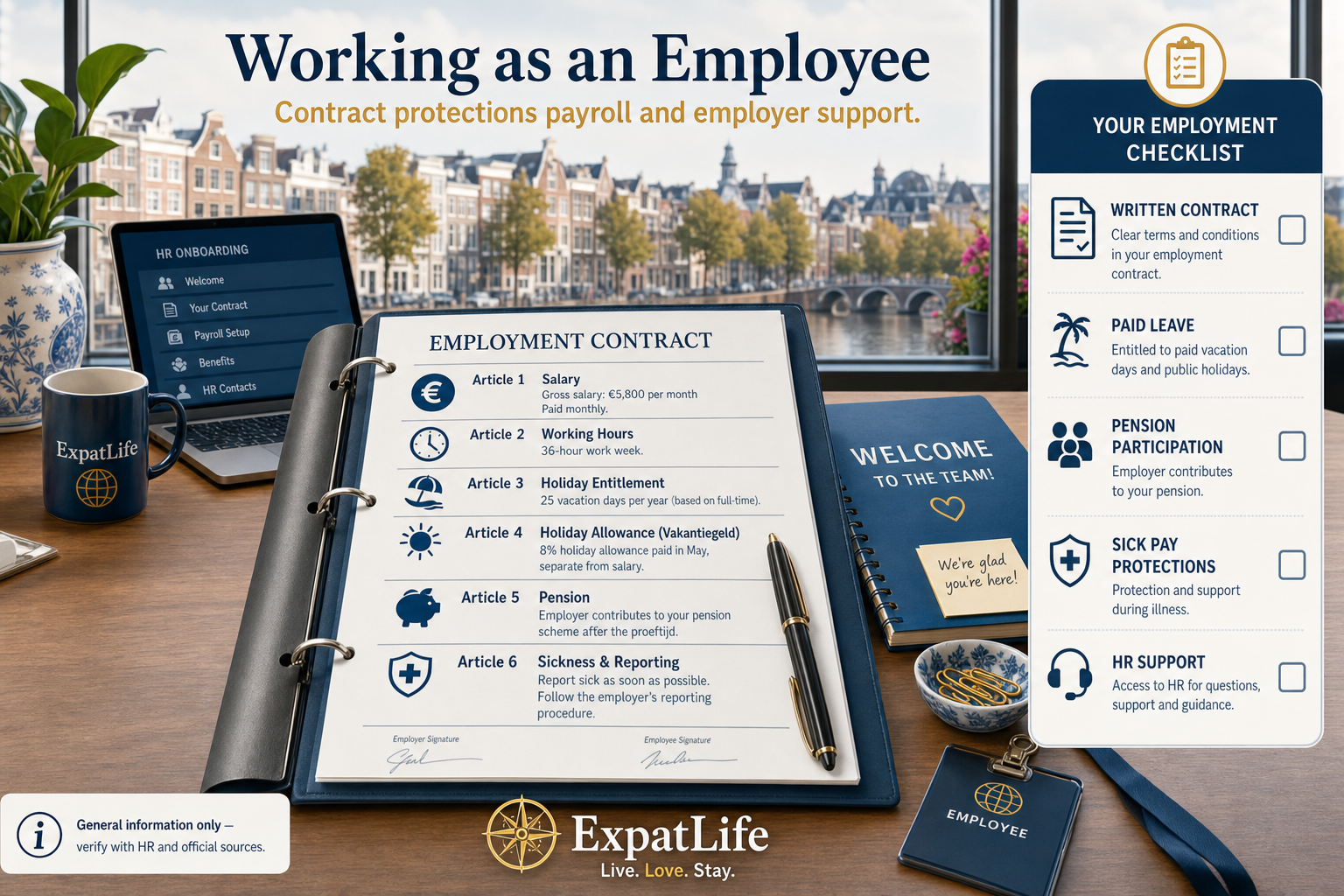
Example: monthly €5,800 gross with vakantiegeld in May — easier budgeting for rent and family costs.
Example: parental leave, anti-discrimination protections and sick pay per Dutch employment standards.
Example: training budget, equipment and internal career paths at larger employers.
Example: HSM route tied to sponsoring employer — straightforward for sponsored roles.
Employment checklist
Examples
| Profile | Scenario | What to check |
|---|---|---|
| First Dutch job — HR manager | Permanent contract €62k with 25 vacation days | Contract articles, pension scheme and hybrid policy before signing. |
| HSM transfer | Moves from UK employer to Amsterdam sponsor | IND salary threshold, contract start date and permit timing. |
| Part-time return — parent | 0.8 FTE after parental leave | Pro-rata benefits, pension accrual and vacation days. |
| Scale-up offer | Lower base but equity and learning budget | Total package vs contractor rate including risk and liquidity. |
Contractor
Contractors in the Netherlands often operate as ZZP freelancers — registered at KvK, invoicing clients, managing BTW and building their own client pipeline. Agencies and platforms also place contractors on interim assignments.
Higher headline rates can appeal when you have in-demand skills, multiple client options and tolerance for variable income. Admin, tax planning and classification risk are part of the trade-off.
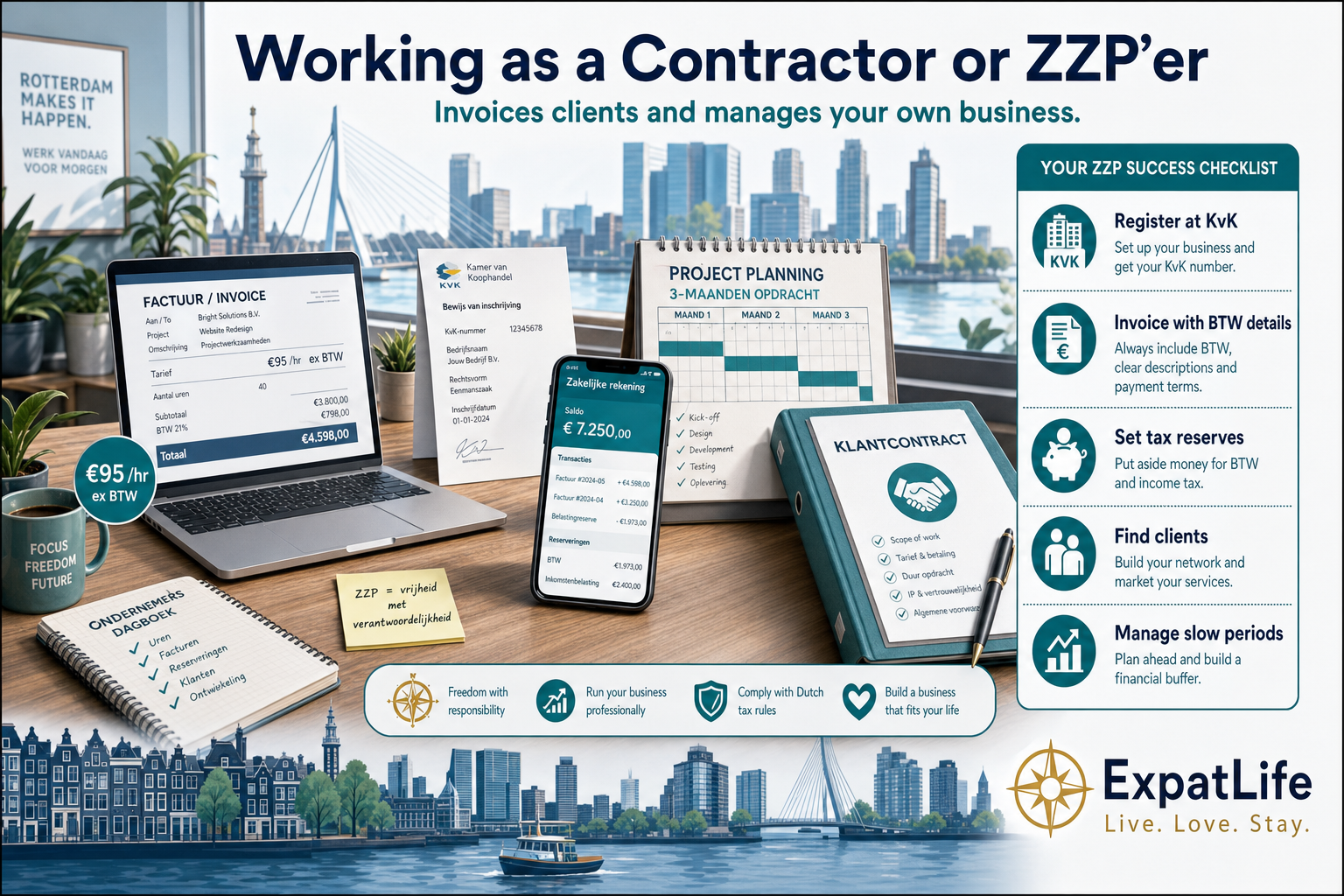
Example: senior consultant negotiates €110/hour ex BTW with two anchor clients.
Example: developer mixes Dutch startup and EU remote clients from Utrecht.
Example: interim CFO takes 3–9 month engagements across sectors.
Example: designer combines retainer clients with short campaign projects.
Contractor checklist
Examples
| Profile | Scenario | What to check |
|---|---|---|
| Agency placement — developer | 12-month ZZP via recruiter at €88/hour | Fee structure, classification and exclusivity clauses. |
| Former employer as client | Leaves team to invoice same company as contractor | Classification, IND if permit tied to employer, contract scope. |
| First ZZP year — consultant | Two Dutch clients and one German B2B client | KvK, BTW per client country and accountant onboarding. |
| Platform freelancer | Mixes platform gigs and direct clients | Effective rate after platform fees and tax set-aside. |
Income
Employment income arrives on predictable payroll cycles with holiday allowance often paid separately. Contractors experience peaks when projects run and gaps when pipelines slow — buffers matter.
A contractor day rate can look attractive until you subtract non-billable sales time, BTW and income tax reserves, accountant fees and the value of employer benefits you must self-fund.
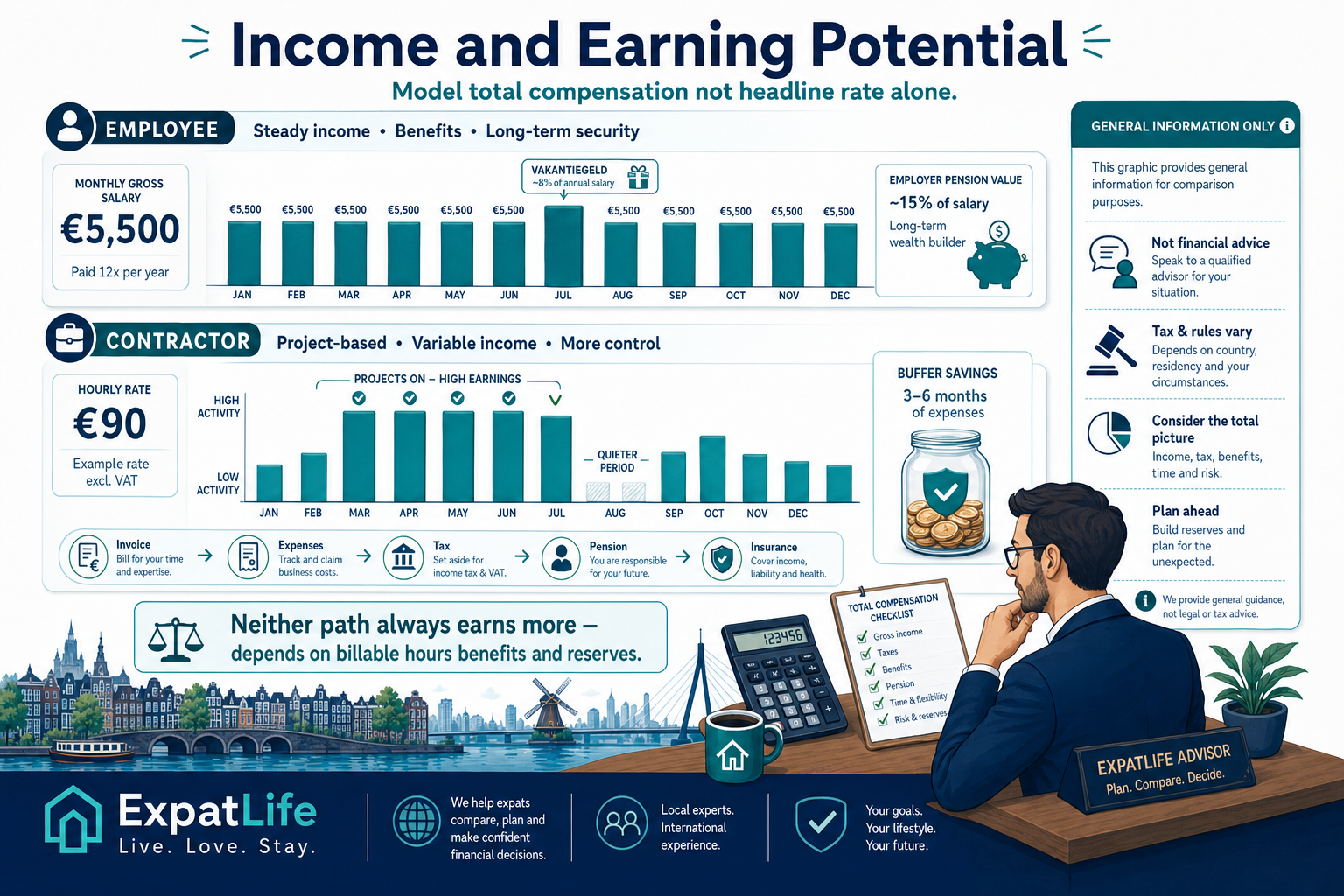
Example: fixed monthly pay supports rent, school fees and mortgage applications.
Example: strong Q1 and Q3; quiet summer — plan 3–6 month expense buffer.
Example: €100/hour × 24 billable hours/month ≠ €4,000 net take-home.
Example: employment Jan–Jun then contractor Jul–Dec — combined tax year planning.
Income planning checklist
Examples
| Profile | Scenario | What to check |
|---|---|---|
| Rate negotiation | Client offers €75/hour net without BTW clarity | Clarify ex/incl BTW and payment terms in writing. |
| Slow pipeline | Contractor — 8 weeks between projects | Buffer usage and whether employment would reduce stress. |
| Bonus vs project windfall | Employment bonus vs contractor large milestone payment | Tax treatment and timing — accountant orientation. |
| Part-time contractor | 0.5 FTE equivalent billable hours alongside family | Minimum viable rate with lower hours and fixed costs. |
Benefits
Dutch employees commonly receive paid vacation, sick leave processes, employer pension contributions and sometimes extras such as training budgets or equipment stipends. Contractors must arrange their own coverage and unpaid leave between projects.
Mandatory basic health insurance applies to all residents — the difference is who structures ancillary benefits and income protection during illness.

Example: employee sick process vs contractor 6 weeks no client work — savings buffer critical.
Example: vakantiegeld on employment — contractors build unpaid leave into rates.
Example: employer 6% pension match — add to employment total when comparing rates.
Example: €2k annual L&D on employment — contractor funds own upskilling.
Benefits checklist
Examples
| Profile | Scenario | What to check |
|---|---|---|
| Illness — contractor | Broken wrist; 10 weeks no billable work | Savings buffer; AOV for future — no employer sick pay. |
| Family planning | Parental leave on employment vs contractor pause | Employer top-up clauses and contractor buffer planning. |
| Equipment needs | Laptop and phone for remote work | Employer stipend vs contractor deductible purchase rules. |
| Insurance switch | Leaving employment to ZZP mid-year | Pick mandatory basic insurer within required window. |
Taxes
Employees see wage tax withheld through payroll; annual income tax returns may still apply for deductions or foreign income. Contractors manage income tax, BTW quarterly filings and deductible business expenses with accountant support.
Expats with 30% ruling history, foreign assets or cross-border clients should treat structure choice as part of broader tax planning — not an isolated rate comparison.
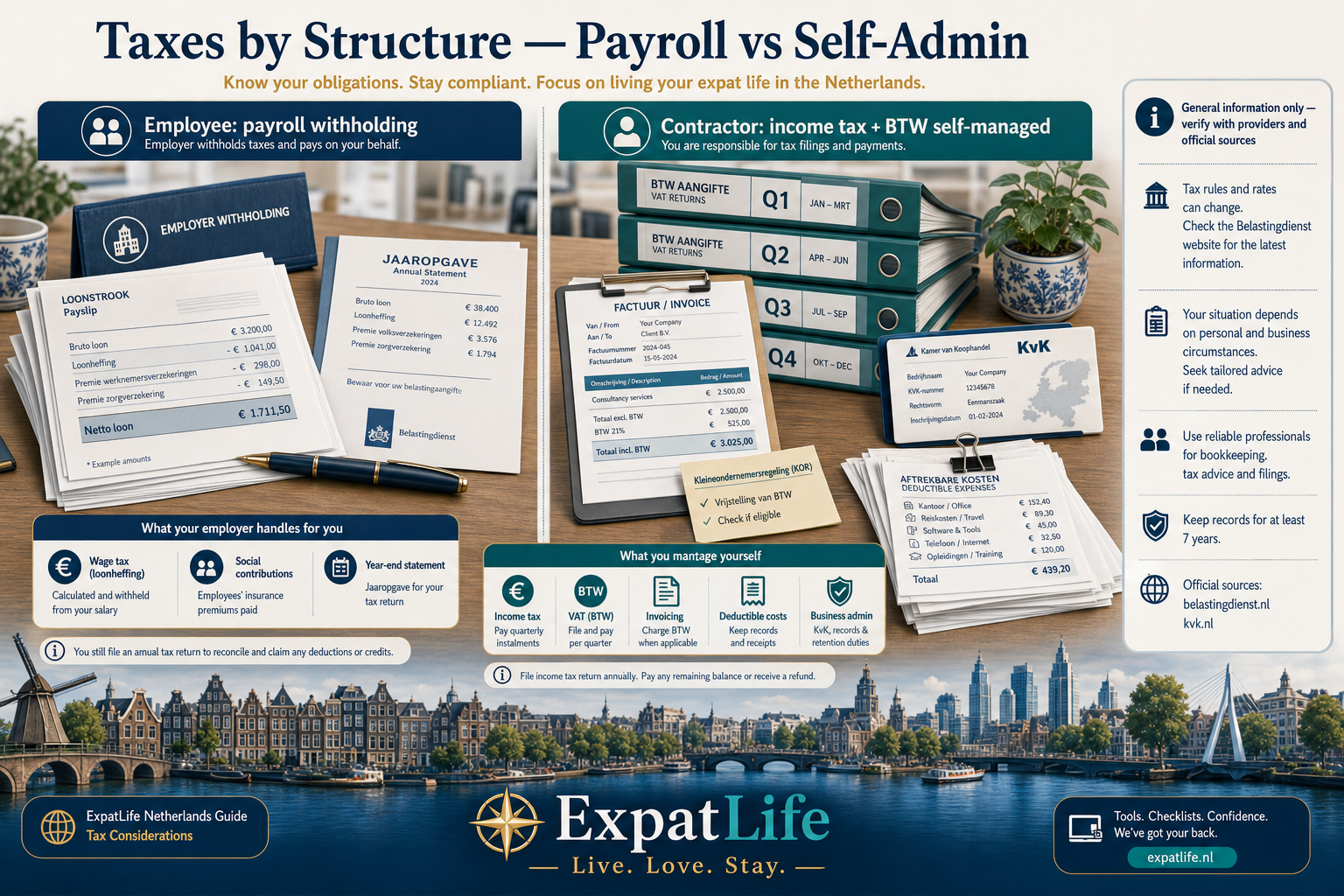
Example: employee sees loonheffing on payslip — employer remits; annual return may still apply for deductions.
Example: invoice €10,000 ex BTW in Q1 — set aside BTW and income tax before spending revenue.
Example: ruled employment income differs from ZZP assumptions — verify before switching structure.
Example: employment Jan–Jun then contractor Jul–Dec — combined annual planning with accountant.
Tax planning checklist
Examples
| Profile | Scenario | What to check |
|---|---|---|
| First ZZP year | Former employee starts contracting mid-year | Combined annual return and pro-rata BTW quarters. |
| 30% ruling — switch | Considering contractor after ruled employment | Tax adviser on ruling eligibility with self-employment income. |
| EU B2B client | Contractor invoices German company | Reverse charge VAT wording with accountant. |
| Home office | Wants to deduct rent portion as contractor | Belastingdienst workspace rules — accountant calculation. |
Tax & accounting
Useful for employment vs contractor net comparisons, cross-border clients and classification questions — verify Belastingdienst rules independently.
Blue Umbrella
Dutch tax filing and expat-focused support — useful for ruling-related questions, payroll context, and annual returns.
Paid services; confirm pricing for your case.
Visit provider →TaxSavers
Tax returns and advice aimed at internationals; helpful when you want hands-on filing or a second opinion on ruling paperwork.
Paid services; check current rates.
Visit provider →Expatax
Expat income tax guidance and ruling-related planning for employees in the Netherlands.
Paid services; confirm scope before engaging.
Visit provider →Some links may be affiliate or referral links. Listings are for discovery only — not pay-to-rank. Confirm credentials and scope with any provider. Learn more
Flexibility
Contractors typically choose clients, project length and daily schedule within contract limits. Employees follow employer hours, hybrid policies and team expectations — though Dutch employers increasingly offer hybrid flexibility.
Flexibility cuts both ways: contractors gain autonomy but carry pipeline risk; employees gain stability but less client choice.
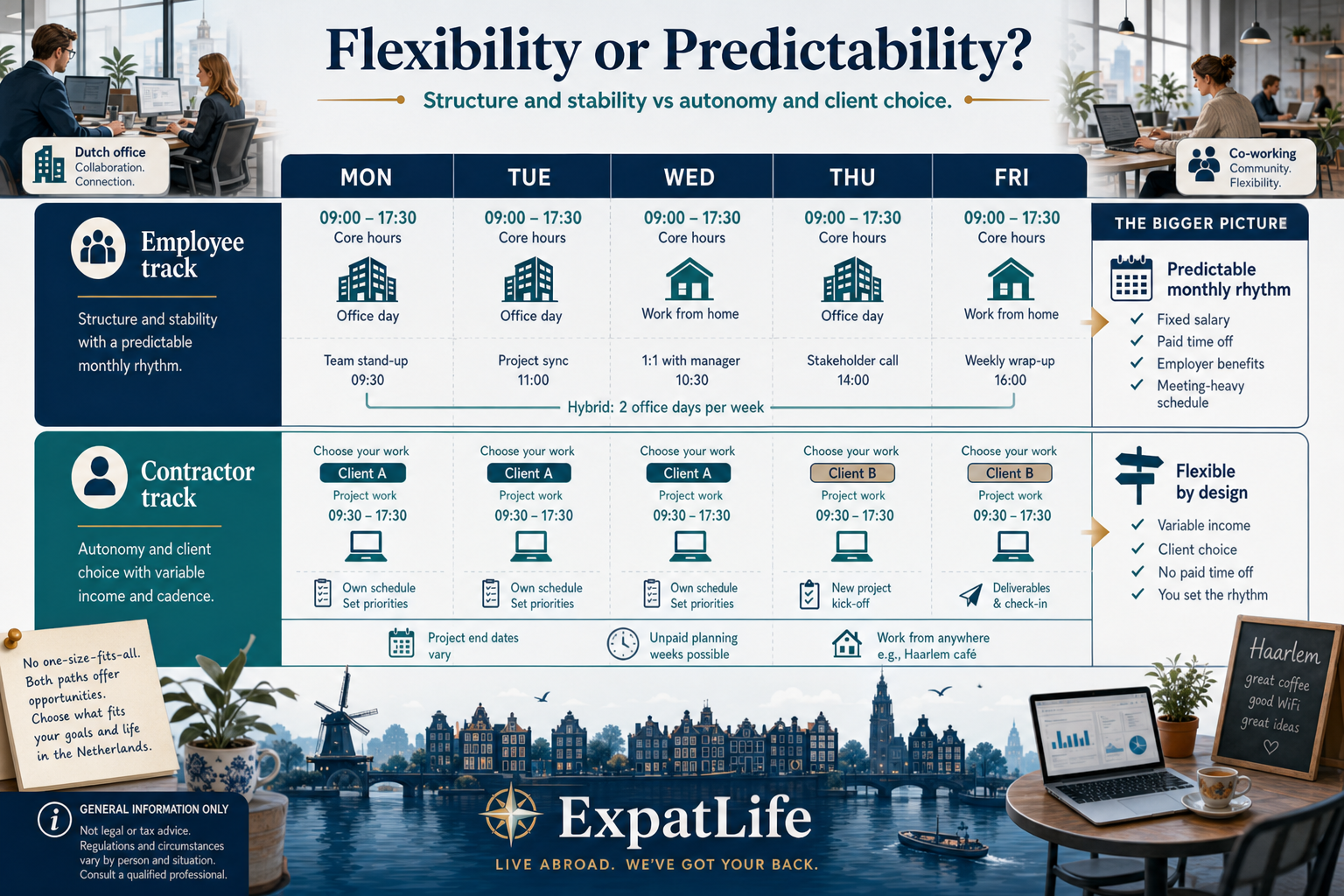
Example: contractor blocks mornings for family; employees align to team core hours.
Example: consultant declines sector misaligned with values — harder as employee.
Example: December work-from-home-country — employee needs HR approval; contractor checks permit and tax.
Example: contractor ends engagement at contract date — employee notice periods apply.
Flexibility checklist
Examples
| Profile | Scenario | What to check |
|---|---|---|
| School-hours parent | Prefers contractor afternoons-only availability | Rate high enough for reduced billable hours and gaps. |
| Travel-heavy role | Employment requires 2 days office in Randstad | Commute cost vs contractor remote from smaller city. |
| Portfolio builder | Wants multiple short clients per year | Contractor path fits; employment may limit side activity. |
| Stability seeker | Prefers predictable team and manager | Employment may outweigh contractor rate premium. |
Pensions
Many Dutch employers contribute to pension schemes — a significant part of total compensation that contractors must replace voluntarily. Pension gaps compound over decades and are easy to miss in headline rate comparisons.
Contractors explore voluntary pension products, investments and financial adviser support. Employees should still read pension scheme documents to understand accrual, portability and partner benefits.
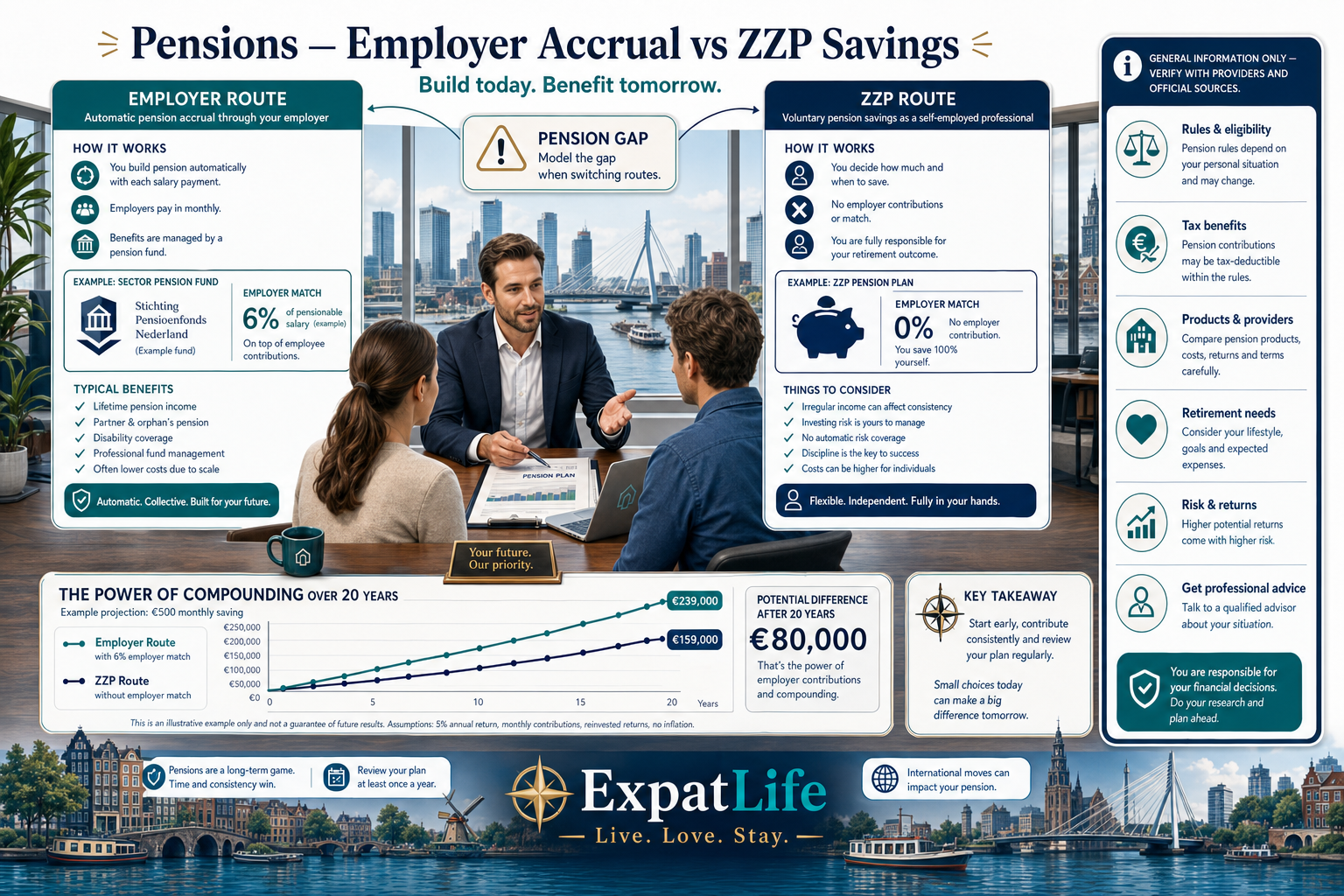
Example: 6% employer pension on €5,800/month — add to employment total when comparing contractor rate.
Example: contractor sets €400/month to pension product — price into effective hourly rate.
Example: UK pension pot plus Dutch employment — cross-border adviser for consolidation questions.
Example: lender may ask about pension assets — structure choice affects long-term planning narrative.
Pension checklist
Examples
| Profile | Scenario | What to check |
|---|---|---|
| Age 40 — switch | Leaving corporate pension to ZZP | Voluntary pension vs investments; rate adjustment for gap. |
| Young professional | Ignores pension on first contractor year | Start small voluntary contributions early — compounding matters. |
| EU pension abroad | Contractor in NL with UK pension pot | Cross-border adviser on consolidation and tax. |
| Near retirement | Short contractor contract before retirement | Accrual limits and AOW timing — financial adviser scope. |
Expats
Nationality and residence permit type often shape whether employment or contractor work is practical. EU citizens generally have broader self-employment access subject to registration. Highly skilled migrants and other permit holders may be tied to sponsoring employers.
IND rules and KvK registration are separate planning tracks — verify ind.nl before invoicing clients or changing structure.
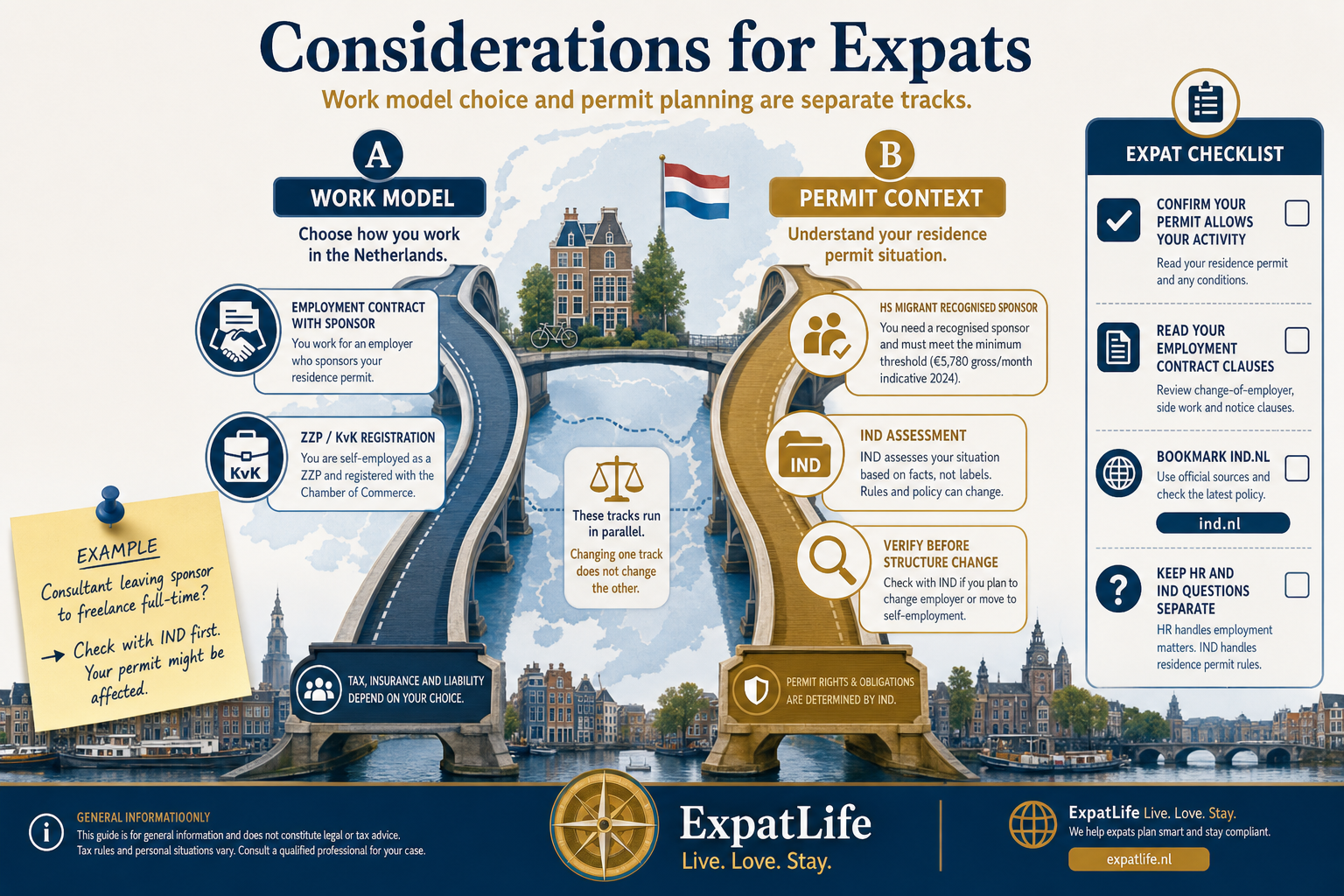
Example: EU consultant registers KvK after BSN — broader self-employment access with registration.
Example: sponsored employment at scale-up — side ZZP often needs IND clearance first.
Example: entrepreneur permit separate from employment sponsor — verify on ind.nl.
Example: leaving sponsor to freelance — IND timing before last employment day critical.
Permit checklist
Examples
| Profile | Scenario | What to check |
|---|---|---|
| HSM — side project | Weekend consulting while on sponsored job | IND rules and employment moonlighting clause. |
| EU consultant — relocation | Moves to NL and registers KvK immediately | BSN, address registration and tax residency shift. |
| Permit change | Leaving sponsor to freelance full time | IND timing before last employment day and KvK start. |
| Partner permit | Work rights on family reunification card | Sticker text on residence document and ind.nl FAQ. |
Visa & permits
Permit rules may limit contractor activity — use qualified help for IND timing, not everyday offer comparisons.

Fragomen
Global immigration law firm with a Netherlands practice. Handles corporate immigration, work permits, and relocations for employers and individuals.
From ~€175–300/hr; corporate packages on request
Visit provider →
Pathway Partners
Amsterdam-based immigration and legal services for individuals and businesses. Employment visas (HSM, Blue Card, ICT), self-employment permits, family reunification, naturalisation, objections (bezwaar), and humanitarian residence. Free eligibility assessment and consultation.
Free initial assessment; service fees vary. Family reunification from ~€500 per additional family member
Visit provider →
Everaert Advocaten
Dutch immigration law firm focused on residence permits, family migration, and IND procedures. One of the first in the Netherlands dedicated to immigration law.
From ~€150–275/hr; fixed fees for some applications
Visit provider →Immigration Advise NL
Immigration advisory practice (Marco van der Vinne; experience since 2001, formerly with Dutch Immigration Service). Affordable package options: pre-scan and DIY support, full handling, and objection procedures. MVV, residence permits, and extensions.
From ~€100 pre-scan and DIY; ~€200 full handling; ~€300 objection procedures (check current rates)
Visit provider →Some links may be affiliate or referral links. Listings are for discovery only — not pay-to-rank. Confirm credentials and scope with any provider. Learn more
Mortgages
Dutch mortgage lenders often prefer stable employment income with contract history. Contractor income may require longer track records, higher buffers or specialist expat mortgage advisers.
If buying property within a few years, structure choice and income documentation matter early — not only when you submit a mortgage application.

Example: permanent contract plus 3 months payslips — common lender starting point.
Example: 2–3 years averaged ZZP profit — accountant statement supports application.
Example: lender may haircut variable contractor income — adviser explains narrative.
Example: residence valid 3+ years — some lenders link mortgage capacity to permit expiry.
Mortgage planning checklist
Examples
| Profile | Scenario | What to check |
|---|---|---|
| Buying in 18 months | Contractor now vs employment offer | Lender view of ZZP history — employment may help short term. |
| Two-year ZZP track | Established contractor applying for mortgage | Average income documentation with mortgage adviser. |
| Couple — mixed | Employee partner plus contractor applicant | Combined assessment and permit validity. |
| Permit renewal | Mortgage while residence expires in 2 years | Lender policy on permit length — adviser guidance. |
International
Many Netherlands-based professionals serve EU and global clients whether employed or contracting. Client location affects VAT, contract law, currency and sometimes permit rules for work performed abroad.
Contractors invoicing internationally need per-client BTW review. Employees working abroad even temporarily may need employer and tax clearance.

Example: contractor invoices German agency — reverse charge VAT with valid client VAT ID.
Example: US SaaS client paying USD — FX buffer and tax residency review with accountant.
Example: hybrid employee wants family visit work — HR approval for tax and permit context.
Example: NL, BE and UK clients — separate invoice templates and VAT treatment per client.
International checklist
Examples
| Profile | Scenario | What to check |
|---|---|---|
| German B2B client | Contractor invoices Berlin agency monthly | Reverse charge VAT and contract payment terms. |
| US SaaS client | USD hourly contract from Amsterdam base | Tax residency, BTW and FX buffer with accountant. |
| Employee — work abroad December | Wants holidays at family home while employed | HR approval for tax and permit implications. |
| Multi-country clients | Contractor with NL, BE and UK clients | Per-client VAT templates and accountant coordination. |
Profiles
There is no universal right answer. Professionals lean toward employment when stability, benefits, internal career paths or mortgage timing dominate. Contractors often choose flexibility, rate control, portfolio careers or interim specialist markets.
Some expats alternate paths over a Netherlands career — employment for permit and mortgage setup, then contractor phases for higher rates or project variety.

Example: prefers predictable payroll, employer pension and HR support — employment fits.
Example: 6–12 month CFO or architect engagements — contractor interim market.
Example: senior dev with multiple client options — ZZP rate control.
Example: school-hour scheduling — contractor with buffer planning.
Example: mixes sectors and clients — contractor portfolio path.
Example: employment short term before property purchase — structure sequencing.
Examples
| Profile | Scenario | What to check |
|---|---|---|
| Risk-averse — finance | Chooses employment despite higher contractor rate | Values sick pay and pension over headline premium. |
| Agency interim | Specialist takes repeated contractor placements | Classification and fee structure each engagement. |
| Startup employee | Equity upside with employment at early-stage company | Liquidity risk vs contractor cash now. |
| Bridge to ZZP | Employment while building client pipeline | Moonlighting clauses and IND if permit restricts side work. |
Balance
Balanced pros and cons help compare employment packages with contractor offers on equal footing — include benefits, pension, admin and risk alongside headline numbers.
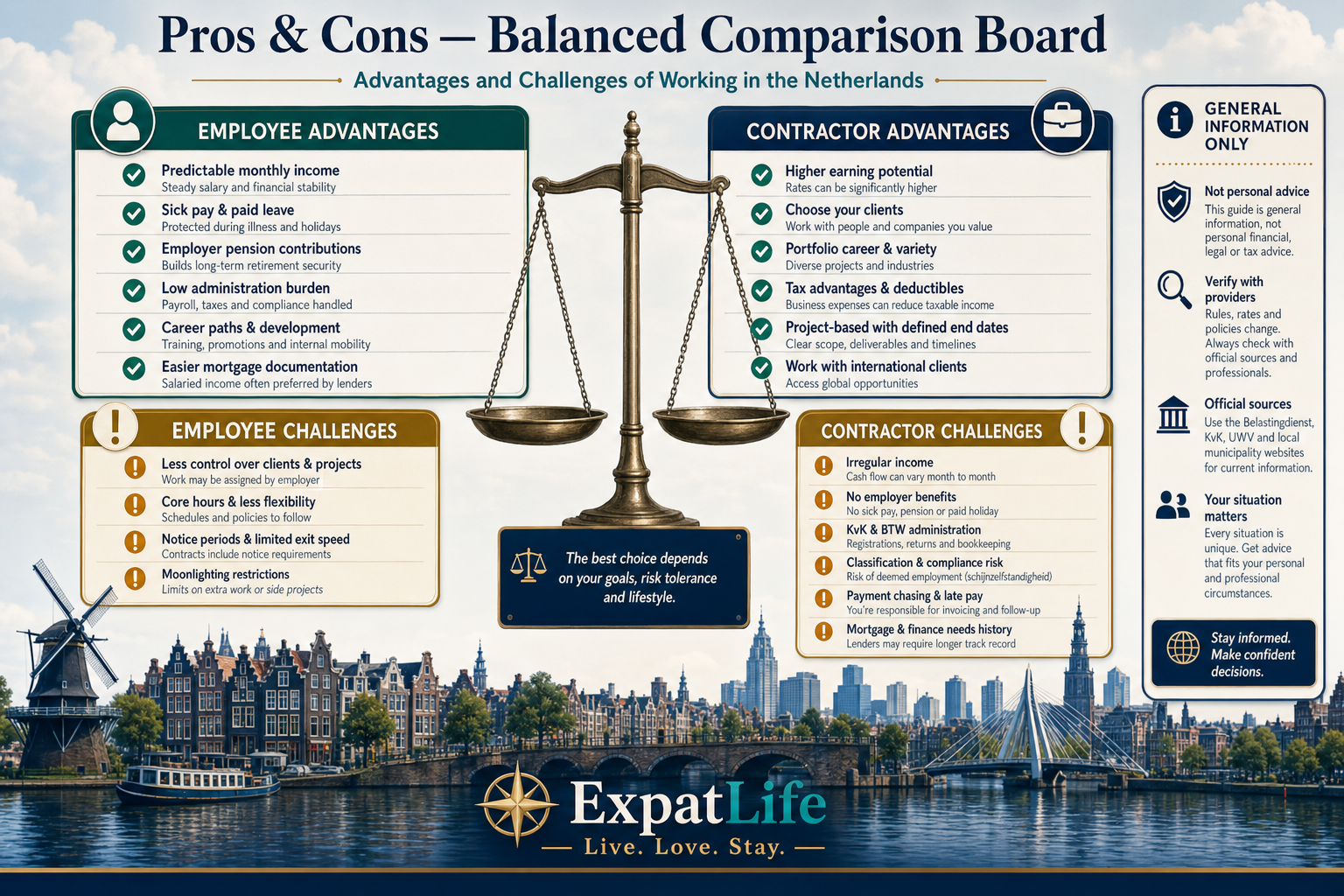
Employee route
Advantages
Challenges
Contractor route
Advantages
Challenges
Examples
| Profile | Scenario | What to check |
|---|---|---|
| High rate — dev | €110/hour contractor vs €7k employment | Still model pension, sick buffer and 25% non-billable time. |
| Parent — flexibility | Chooses contractor for schedule | Buffer for unpaid leave and insurance during gaps. |
| Mortgage in 2 years | Employment preferred for lender story | Short employment before property if contractor is long-term goal. |
| Risk-averse consultant | Employment despite lower gross | Values stability over rate — valid choice with eyes open. |
Avoid
Expats often repeat predictable errors when weighing contractor vs employee paths: comparing gross day rates to monthly salary, ignoring pension and sick pay, overlooking permit rules or assuming mortgage lenders treat ZZP like payroll.
Most issues are easier to prevent before signing than to fix after the wrong structure is locked in.
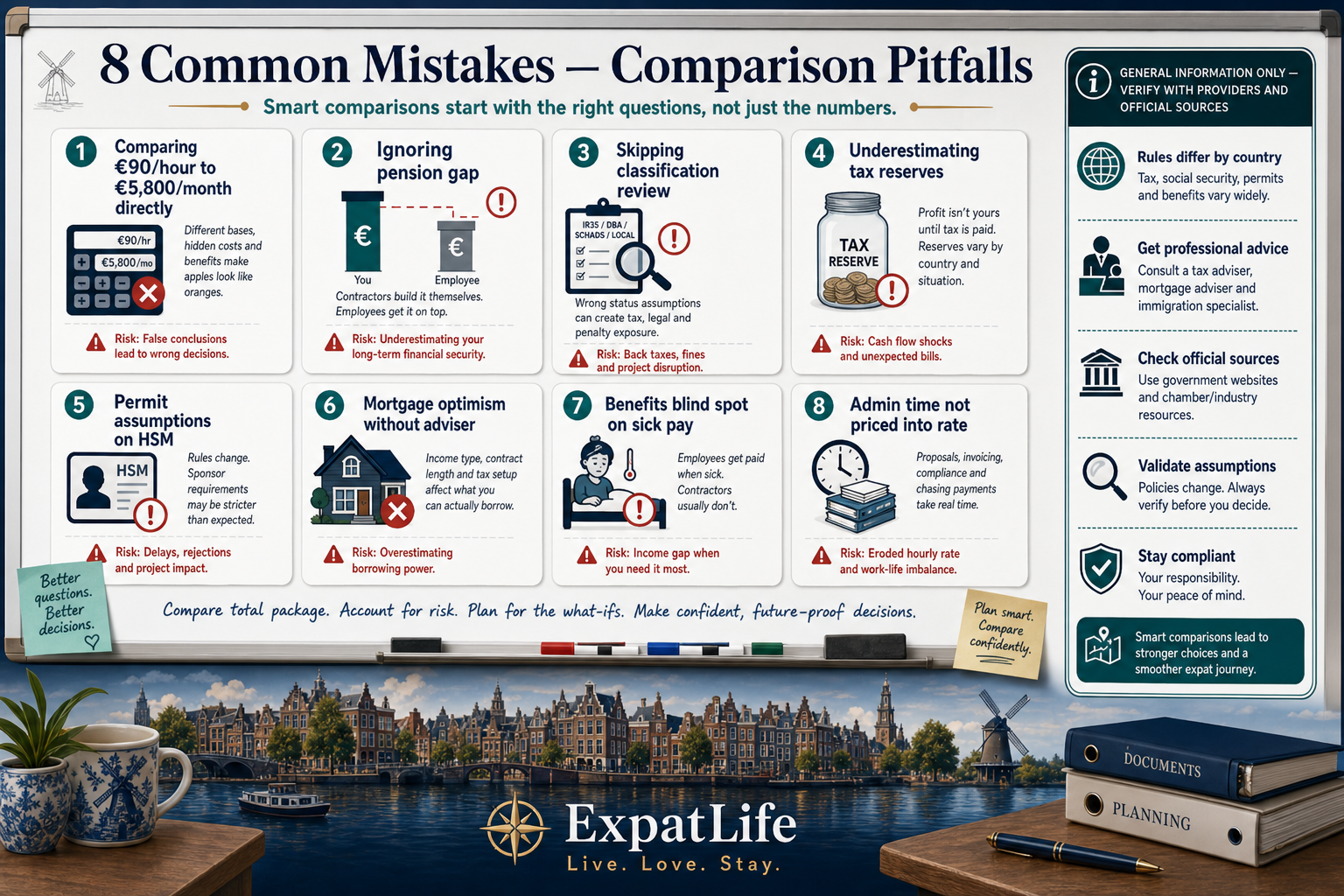
Example: €90/hour vs €5,800/month without pension, vakantiegeld or tax admin.
Example: strong contractor year with zero retirement savings — employer accrual lost.
Example: 12-month single-client ZZP resembling employment — compliance risk.
Example: spends full contractor invoices — BTW and income tax shock.
Example: HSM invoices side work without IND clearance.
Example: contractor path chosen months before mortgage application without adviser input.
Example: ignores sick pay value until first illness without savings.
Example: 15 hours/month bookkeeping not priced into contractor rate.
Reality check before you sign
Examples
| Profile | Scenario | What to check |
|---|---|---|
| Late classification review | 9-month exclusive ZZP; client requests employment switch | Accountant and employment contract guide comparison. |
| Tax bill — year one ZZP | No reserves; April payment due | Belastingdienst plan and next-year reserve automation. |
| Permit violation | Side freelance on employment permit | Immigration lawyer before continuing invoicing. |
| Mortgage declined | One-year ZZP history insufficient for lender | Mortgage adviser on documentation and timing. |
Self-check
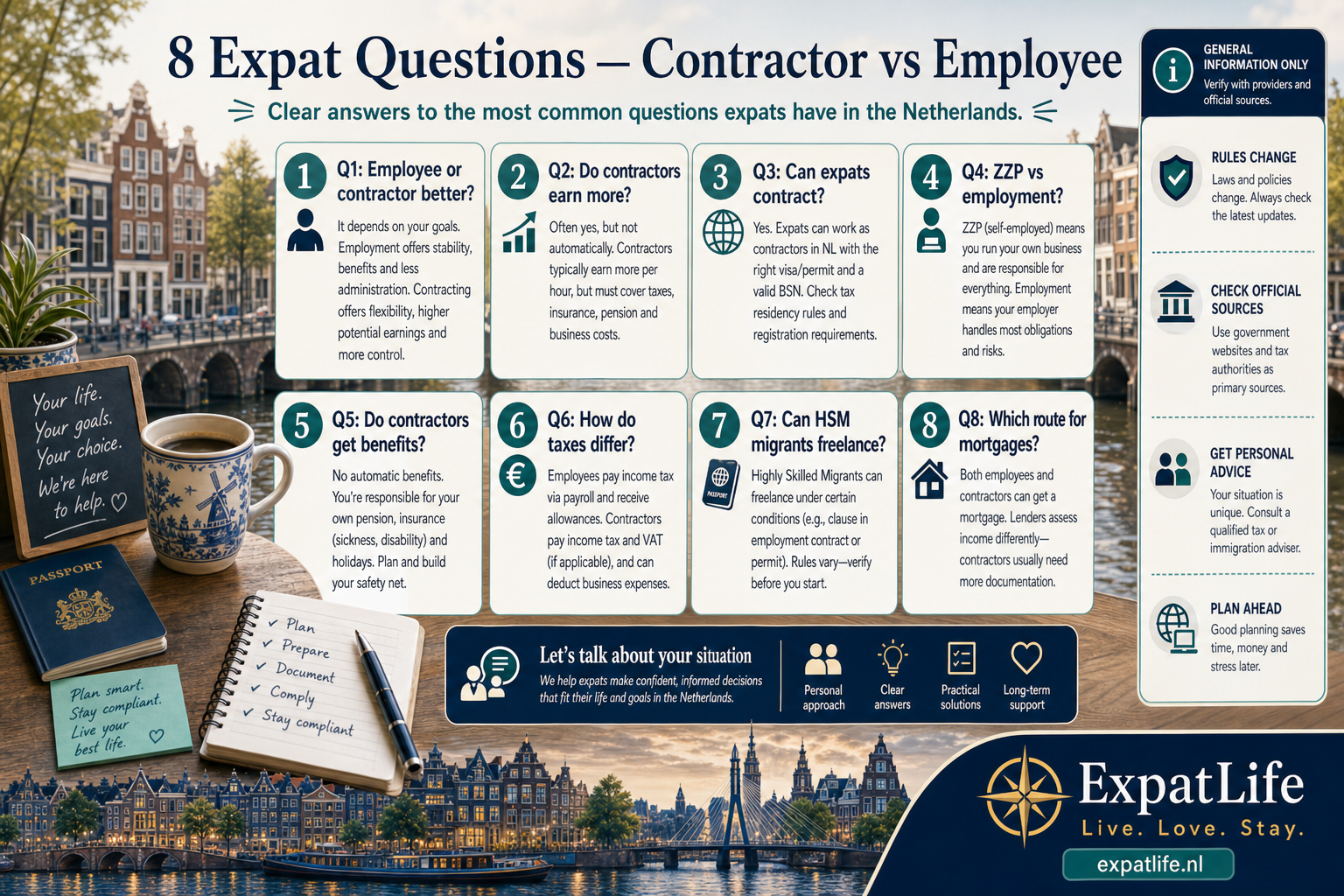
These questions help structure your decision — they do not produce a score or recommendation. Work through them with your offers, permit documents and financial goals in front of you.

Eight questions to work through
Examples
| Profile | Scenario | What to check |
|---|---|---|
| Stable income need | Young family with fixed rent and school fees | Employment may outweigh contractor rate if buffers are thin. |
| Admin capacity low | Prefers not to manage BTW and invoices | Employment or agency payroll interim vs solo ZZP. |
| Permit constraint | HSM cannot side freelance | Employment or formal permit change before contractor path. |
| Portfolio goal | Wants multiple sectors and clients | Contractor fit if permit and buffers align. |
Ask early
Use these prompts with HR, accountants and official sources when comparing routes.
| Ask | Question | Why it matters |
|---|---|---|
| HR | Can you break down pension match, vakantiegeld and hybrid policy in writing? | Total employment package beats verbal salary assurances. |
| Accountant | Does this engagement risk employment classification? | Single-client ZZP needs independent review. |
| IND / lawyer | Does my permit allow this contractor activity? | Structure choice may be permit-constrained. |
| Mortgage adviser | How would ZZP vs employment affect my application timeline? | Property goals may sequence structure choice. |
| Client | Are rates ex or incl BTW with 14-day payment terms? | Avoid ambiguous net pricing on contractor offers. |
| Financial adviser | How should I model pension gap in my rate? | Long-term savings often missing from rate comparisons. |
Quick answers
Depends on income stability needs, benefits value, permit rules, admin capacity and career goals — compare total package, not headline rate alone.
Headline rates can be higher but contractors cover tax, pension, sick periods and admin — net comparison varies by sector and hours.
Often yes for EU citizens with KvK registration; permit holders must verify IND rules for their document before invoicing.
ZZP is self-employment without employees, usually invoicing clients; employment is a contract with employer payroll and protections.
No employer sick pay or paid holiday by default — contractors self-fund insurance, buffers and voluntary pension.
Employees have payroll withholding; contractors manage income tax, BTW and deductions — confirm with Belastingdienst and advisers.
Often restricted because employment is tied to a sponsor — verify ind.nl before contractor activity.
Lenders often prefer stable employment history; contractors may need longer track records and specialist advisers.
Examples
| Profile | Scenario | What to check |
|---|---|---|
| Offer comparison week | Two written offers — employment vs contractor | Use HR and accountant prompts before deadline. |
| Permit + structure | Considering contractor while on employment permit | IND/lawyer prompt before KvK registration. |
| Mortgage planning | Buying apartment in 24 months | Mortgage adviser prompt on income documentation. |
| Rate negotiation | Client pushes net hourly without BTW clarity | Contract prompt on ex/incl BTW and payment deadline. |
Work & business
Connect this comparison to freelancing, ZZP, employment contracts, employee rights, expat taxes and financial planning.

Suggested reading order
Examples
| Profile | Scenario | What to check |
|---|---|---|
| Employment path | Accepting permanent offer next week | Employment contract → employee rights → benefits order. |
| Contractor path | First KvK registration planned | ZZP → freelancing → expat taxes for client mix. |
| Undecided | Two offers with signing deadlines | This comparison page plus accountant call before signing. |
| Pension focus | Leaving employer pension scheme | Pension for expats and financial advisors guides. |
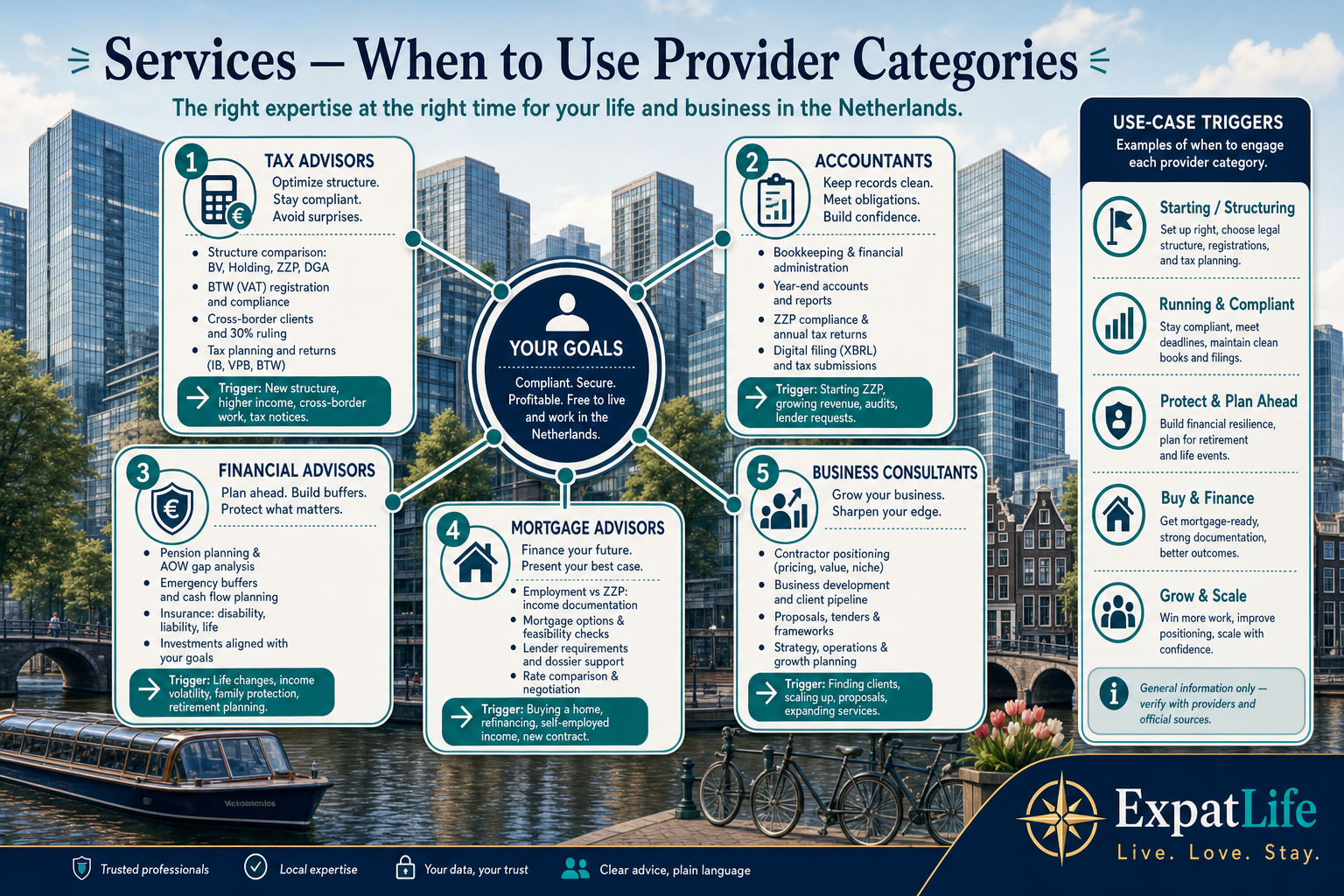
Professional support
Tax, mortgage, immigration and business support may help with specific comparison steps.
Examples
| Profile | Scenario | What to check |
|---|---|---|
| Offer comparison | Employment vs contractor with signing deadline | Tax adviser on net comparison and classification. |
| Mortgage in 18 months | Choosing contractor now | Mortgage adviser on income history requirements. |
| First ZZP year | Complex EU clients | Accountant onboarding and BTW per client. |
| Pension switch | Corporate to contractor at age 42 | Financial adviser on voluntary pension and rate model. |
Comparing employment and contractor paths often overlaps with tax and structure advice, accounting and ZZP setup, immigration and permit checks, mortgage planning, financial and pension planning and business positioning. These listings are for discovery when you need scoped help — confirm services, pricing and credentials before you commit.
Some links may be affiliate or referral links. If you use them, we may earn a commission at no extra cost to you. Ordering reflects relevance to contractor vs employee decisions, not pay-to-rank. Verify outcomes with KvK, Belastingdienst, IND or qualified advisers. Learn more
Browse more companies: Financial advisorsTax advisorsAccountantsMortgage advisorsBusiness consultantsImmigration lawyersBrowse all services
Tax & accounting
Core support for comparing employment packages with contractor income, BTW and cross-border context.
Blue Umbrella
Dutch tax filing and expat-focused support — useful for ruling-related questions, payroll context, and annual returns.
Paid services; confirm pricing for your case.
Visit provider →TaxSavers
Tax returns and advice aimed at internationals; helpful when you want hands-on filing or a second opinion on ruling paperwork.
Paid services; check current rates.
Visit provider →Expatax
Expat income tax guidance and ruling-related planning for employees in the Netherlands.
Paid services; confirm scope before engaging.
Visit provider →Visa & permits
Route changes, side contractor activity and permit restrictions alongside employment offers.
Fragomen
Global immigration law firm with a Netherlands practice. Handles corporate immigration, work permits, and relocations for employers and individuals.
From ~€175–300/hr; corporate packages on request
Visit provider →Pathway Partners
Amsterdam-based immigration and legal services for individuals and businesses. Employment visas (HSM, Blue Card, ICT), self-employment permits, family reunification, naturalisation, objections (bezwaar), and humanitarian residence. Free eligibility assessment and consultation.
Free initial assessment; service fees vary. Family reunification from ~€500 per additional family member
Visit provider →Everaert Advocaten
Dutch immigration law firm focused on residence permits, family migration, and IND procedures. One of the first in the Netherlands dedicated to immigration law.
From ~€150–275/hr; fixed fees for some applications
Visit provider →Immigration Advise NL
Immigration advisory practice (Marco van der Vinne; experience since 2001, formerly with Dutch Immigration Service). Affordable package options: pre-scan and DIY support, full handling, and objection procedures. MVV, residence permits, and extensions.
From ~€100 pre-scan and DIY; ~€200 full handling; ~€300 objection procedures (check current rates)
Visit provider →Relocation
Moves that depend on offer type, housing search and arrival planning.
Expat2Holland
Relocation and settling-in support for internationals, including housing, registration, and practical onboarding.
Full package from ~€1,500–3,000; à la carte from ~€200–500 per service. Employer packages often higher.
Visit provider →Jimble
Relocation and mobility services for expats and internationals in the Amsterdam area.
Packages vary; often €1,000–2,500+ for core relocation. Check directly for quote.
Visit provider →RSH Relocation and Immigration Services
Relocation and immigration services for internationals and families, including housing and registration support.
From ~€1,200 for basic package; full relocation €2,000–4,000+. Immigration support often separate.
Visit provider →RelocAid
Relocation support for expats and families, including housing search, registration, and settling-in assistance.
Packages from ~€1,000; full family relocation €2,000–3,500+. Confirm scope and quote.
Visit provider →Post-move setup
Many professionals coordinate accounts and insurance around structure changes.

bunq
Digital bank with expat-friendly signup and multi-currency options. Often used for quick account setup and international use.
From ~€2.99/mo
Visit provider →
Zilveren Kruis
One of the largest Dutch health insurers (Achmea). Broad care network, basic and supplementary packages; widely recognised by expats.
~€145–162/mo
Visit provider →Funda
Major Dutch platform for homes for sale and rent. Listings from estate agents and landlords across the Netherlands.
Free to browse; agent or landlord fees may apply.
Visit provider →
Knab
Dutch online bank (no branches). Full Dutch payment account with iDEAL and debit card; often chosen for straightforward pricing and digital experience.
From ~€3.50/mo
Visit provider →
CZ
Large Dutch insurer with a big customer base. Standard basic and various supplementary packages; solid option for daily cover.
~€142–158/mo
Visit provider →
HousingAnywhere
Online platform connecting people looking for a home with landlords. Not a real estate agency. Mid- and long-term furnished rentals.
Check platform pricing and booking fees.
Visit provider →
Independer
Compare Dutch basic health and other insurance when you are choosing a policy.
Free comparison; insurer premiums vary.
Visit provider →Some links may be affiliate or referral links. Listings are for discovery only — not pay-to-rank. Confirm credentials and scope with any provider. Learn more
Professional services may help with specific comparison steps — they do not replace reading official sources or obtaining qualified advice for your situation.
FAQ
These answers help identify what still needs verification — structure, tax, permits and financial planning.
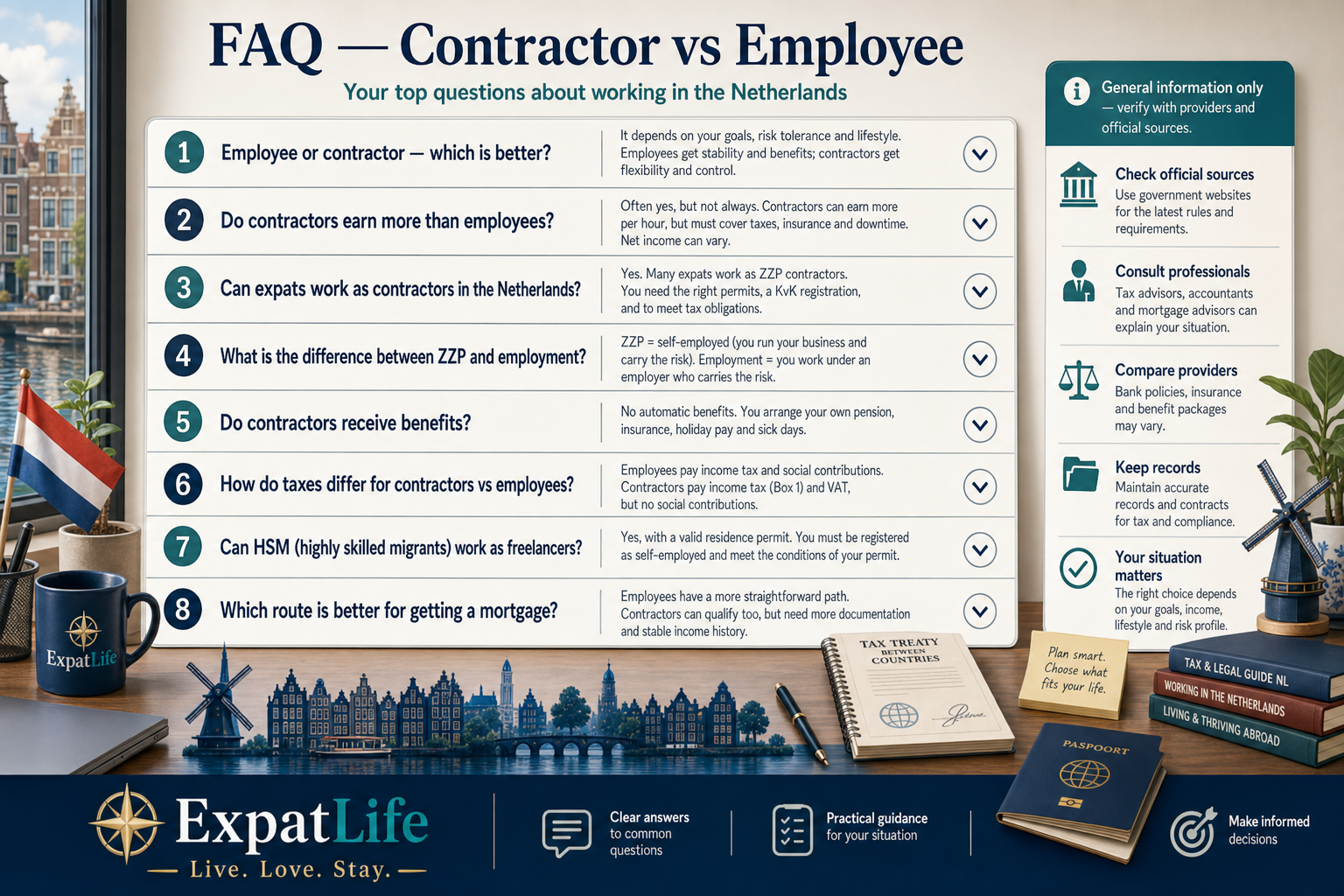
It depends on stability needs, benefits value, permit rules and admin capacity — compare total compensation, not headline rate alone.
Contractor rates can be higher gross but contractors cover tax reserves, pension gaps, sick periods and admin — net outcomes vary widely.
Often yes for EU citizens with KvK registration; permit holders must verify IND rules on ind.nl before invoicing clients.
ZZP is self-employment invoicing clients; employment is a contract with employer payroll, sick pay and often pension contributions.
Not by default — contractors arrange health insurance, buffers and voluntary pension without employer sick pay or paid holiday.
Employees have wage tax withheld; contractors manage income tax, BTW filings and business deductions — confirm with Belastingdienst and advisers.
Often restricted because employment is tied to a sponsor — verify ind.nl before side or full freelance activity.
Lenders often prefer stable employment income; contractors may need longer track records and specialist expat mortgage advisers.
Examples
| Profile | Scenario | What to check |
|---|---|---|
| Signing deadline | Two offers expire Friday | Accountant call and written HR benefit breakdown today. |
| HSM side gig | Weekend contractor idea while employed | IND FAQ and immigration lawyer before invoicing. |
| Mortgage timeline | Purchase planned in 20 months | Mortgage adviser on employment vs ZZP documentation. |
| Rate confusion | Client quotes net hourly rate | Clarify BTW and payment terms in contract. |
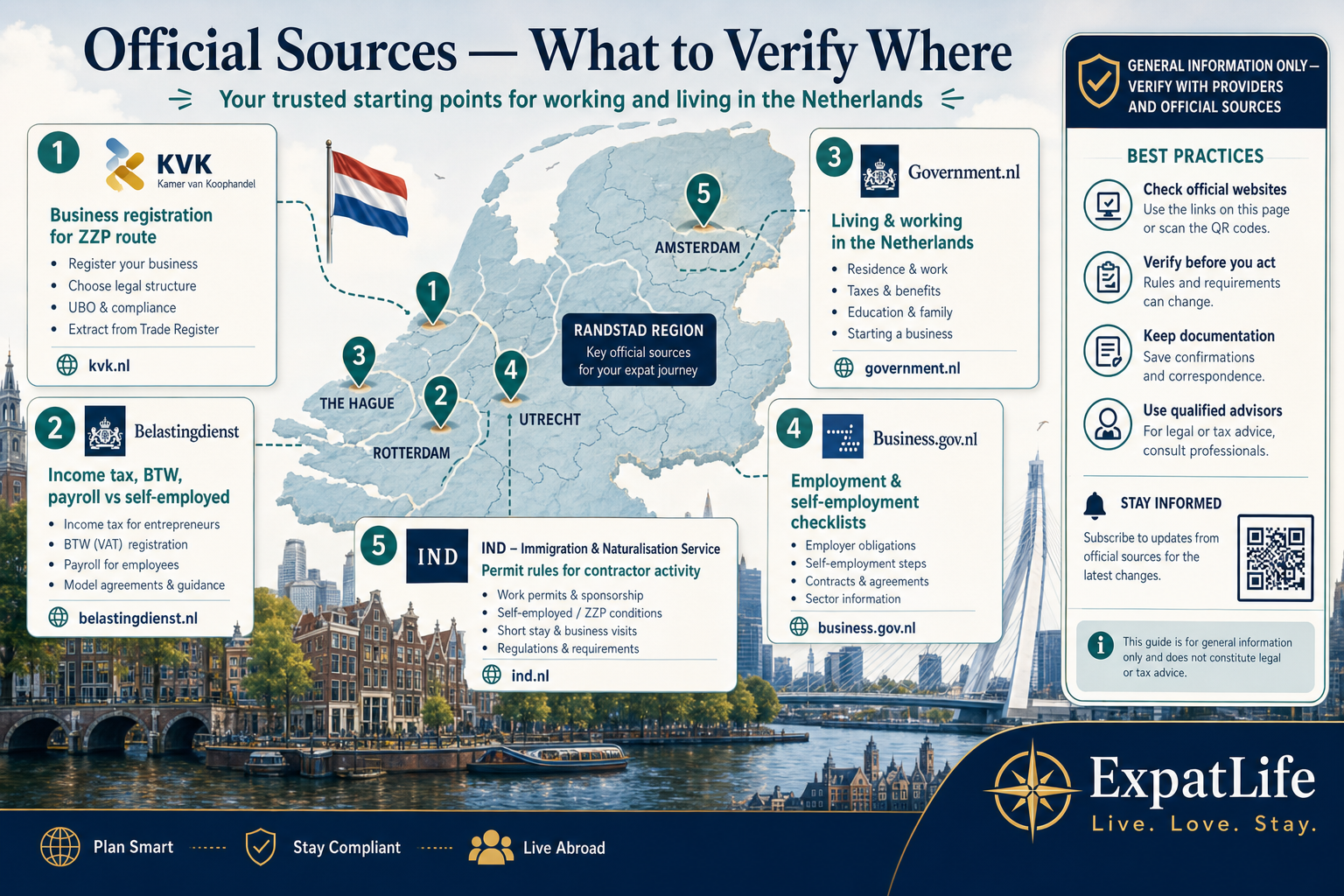
Trust
Employment law, tax thresholds and permit requirements change over time. Verify current rules through official resources — this page is orientation for comparison purposes.
Examples
| Profile | Scenario | What to check |
|---|---|---|
| First KvK registration | Choosing contractor path after employment | KvK online wizard and Business.gov.nl activity codes. |
| BTW first quarter | Contractor with approaching filing deadline | Belastingdienst portal and accountant coordination. |
| Permit sticker review | Unsure if self-employment allowed | IND website for document-specific work rights. |
| Leaving employment | Last employment day in 30 days | IND if permit tied to sponsor plus KvK timing. |
Explore
Continue into jobs, taxes, services and housing guides from this comparison hub.
Explore next
Move from this comparison into freelancing, ZZP, employment contracts, expat taxes and financial planning.