
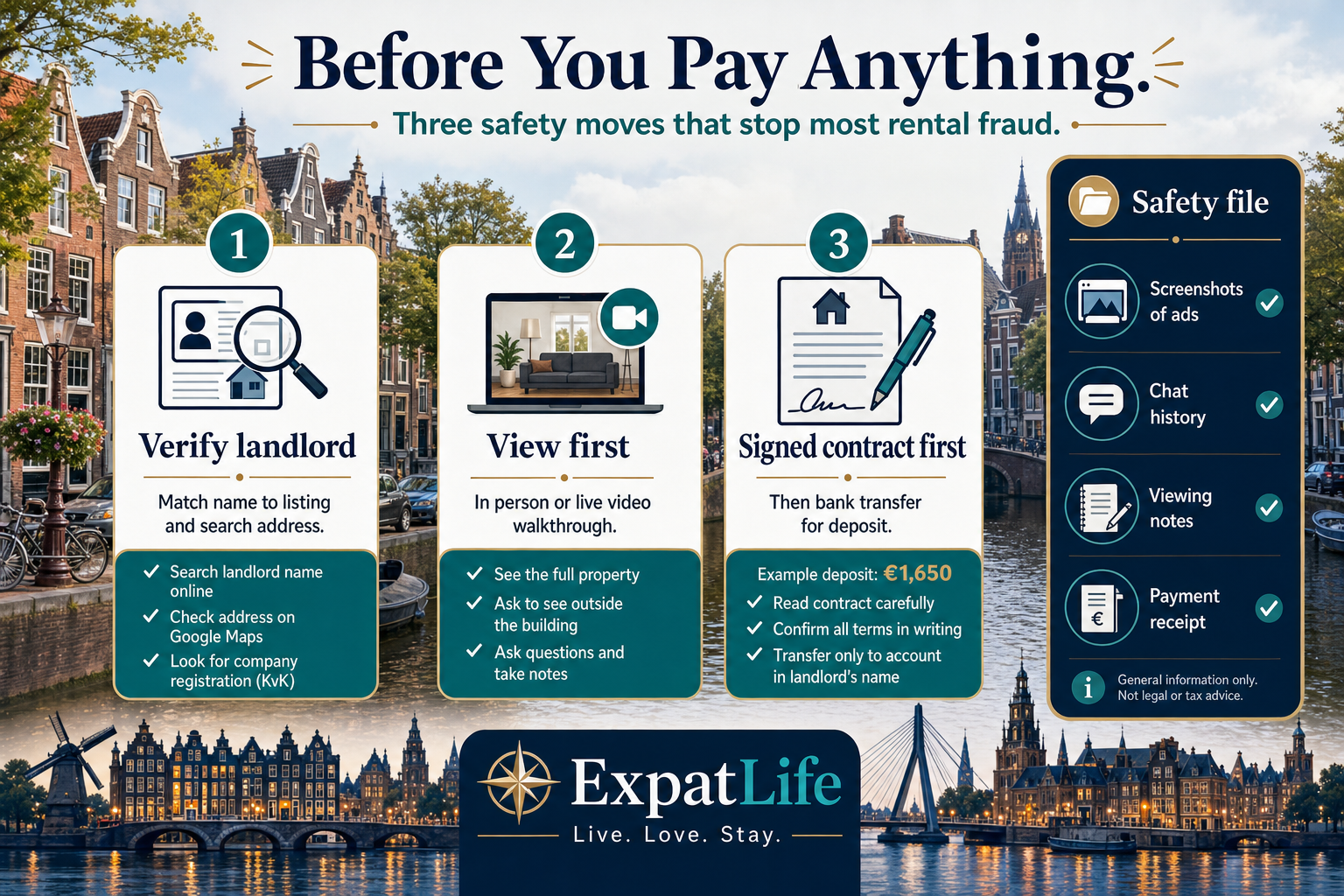
Rule one
Verify first
Identity and ownership before money
Netherlands · Housing · Safety
Protect yourself from housing fraud by learning how legitimate rentals work, spotting warning signs and renting safely in the Netherlands.
General safety orientation only — not legal advice. Verify listings, contracts and payments independently. Report suspected fraud through police and Fraudehelpdesk channels when appropriate.
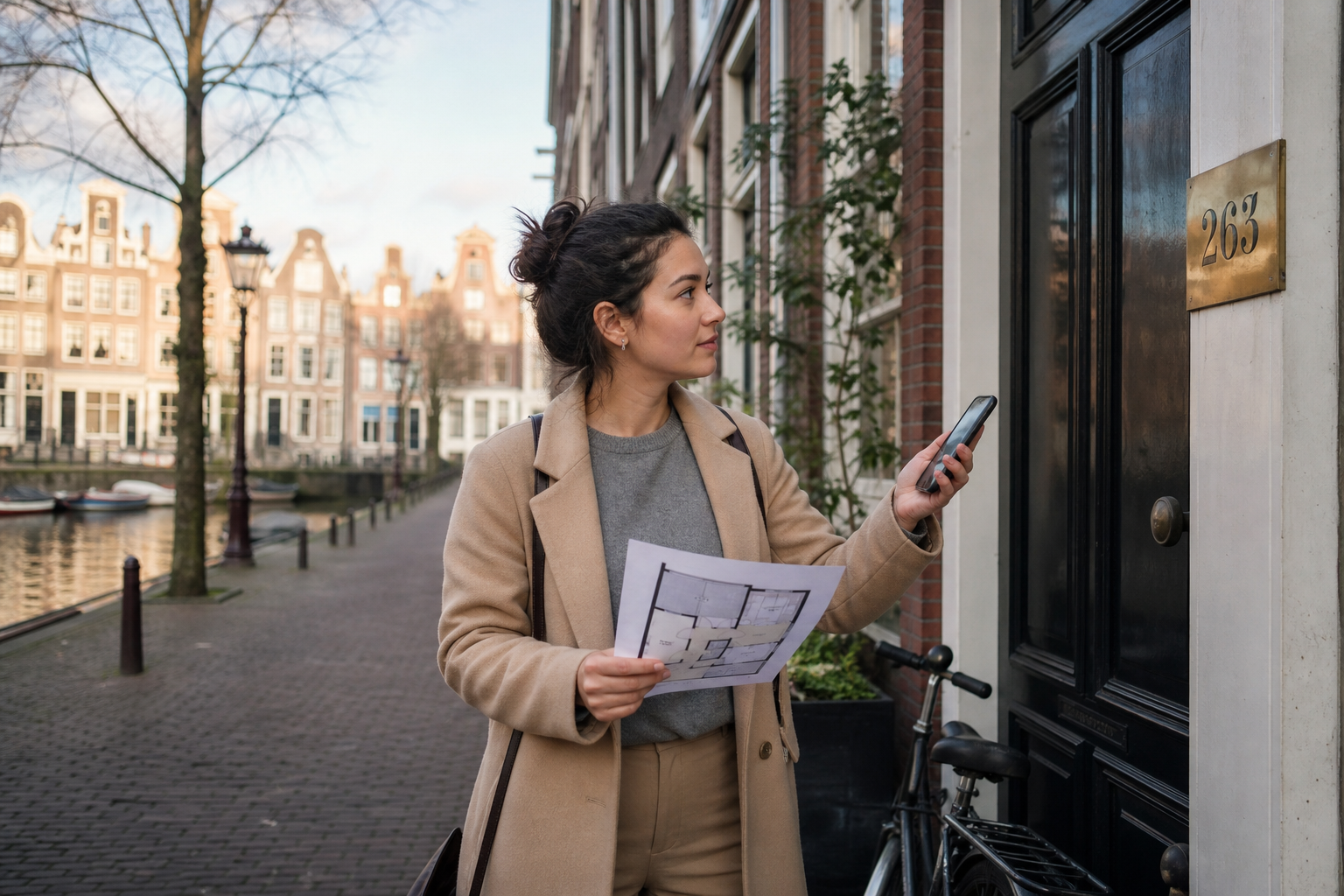
Quick answer
Finding a home in the Netherlands can feel like a race. Listings disappear within hours in the busiest cities, employers and universities set start dates, and many newcomers search from abroad before they can visit. That combination of speed, distance and unfamiliar rules is exactly what rental fraud relies on — not carelessness.
The good news is that legitimate Dutch rentals follow a fairly predictable pattern, and almost every fraud attempt breaks it somewhere. Once you know the normal order — advert, viewing, application, approval, signed agreement, deposit, keys — the warning signs become much easier to see.
This guide explains how renting normally works, the scam patterns most often reported, the red flags worth stopping for, how to verify a landlord or agency, how to pay safely, and what to do if you have already lost money. It is practical safety orientation — not legal advice, and not a substitute for the police, your bank or a qualified legal service.
Snapshot
Read all six cards before responding to any listing with documents or money. Most fraud attempts fail at one of these gates — which is exactly why they try to persuade you to skip one.
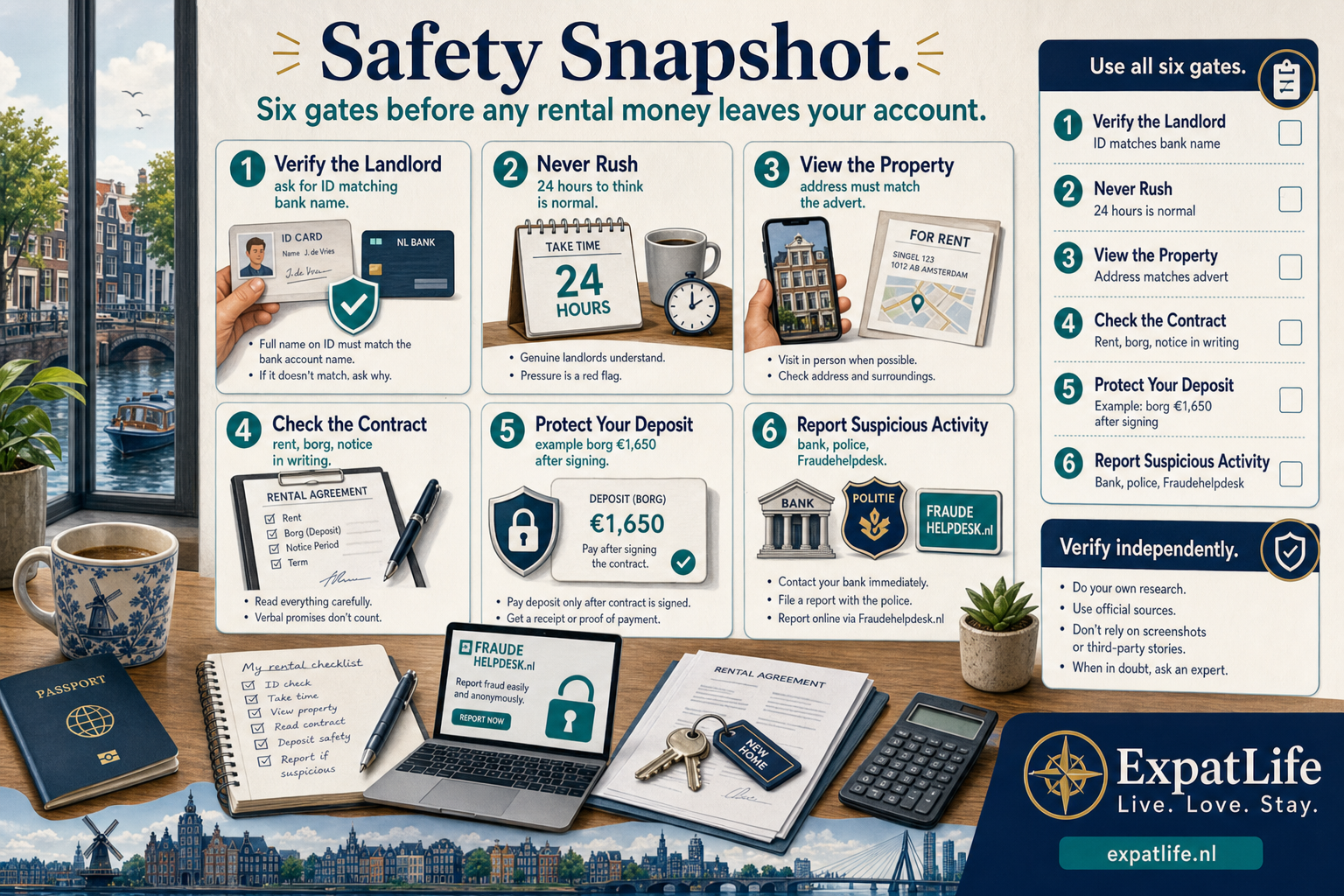
Rule one
Verify first
Identity and ownership before money
Rule two
Never rush
Urgency is a warning, not a reason
Rule three
View if possible
In person or live video call
Rule four
Protect deposits
Signed contract before payment
Ask who owns or manages the property and request evidence in writing. Search the name, company and phone number independently — never rely only on documents or links sent to you.
Pressure is the most common tool in rental fraud: another applicant is waiting, the discount expires tonight, transfer now to hold it. A genuine landlord can wait for you to read a contract.
A viewing confirms the property exists, matches the advert and that your contact has access. If you cannot attend, ask for a live video walkthrough showing the street sign and door number.
Read the full huurcontract before paying anything. It should name both parties, the exact address, rent, deposit amount, notice period and whether gemeente registration is permitted.
Pay by regular Dutch bank transfer after signing, confirm the account holder name matches the contract, and keep the payment confirmation with your signed documents.
Report suspicious listings to the platform, and report suspected fraud to the police and Fraudehelpdesk. Reporting helps others and is often required for bank or insurance follow-up.
Normal process
Most legitimate Dutch rentals — whether through an agency, a corporate landlord or a private owner — follow a recognisable sequence. The property is advertised, interested tenants view it, applicants submit documents, the landlord selects a tenant, both parties sign a written agreement, the deposit and first rent are paid, and keys are handed over with an inventory list.
The order is what protects you. Money normally moves after a signed agreement, and keys are handed over in person. When someone proposes a different order — payment before viewing, keys posted after a transfer, a deposit to 'reserve' a property you have never seen — that change of sequence is the signal, regardless of how professional the messages look.
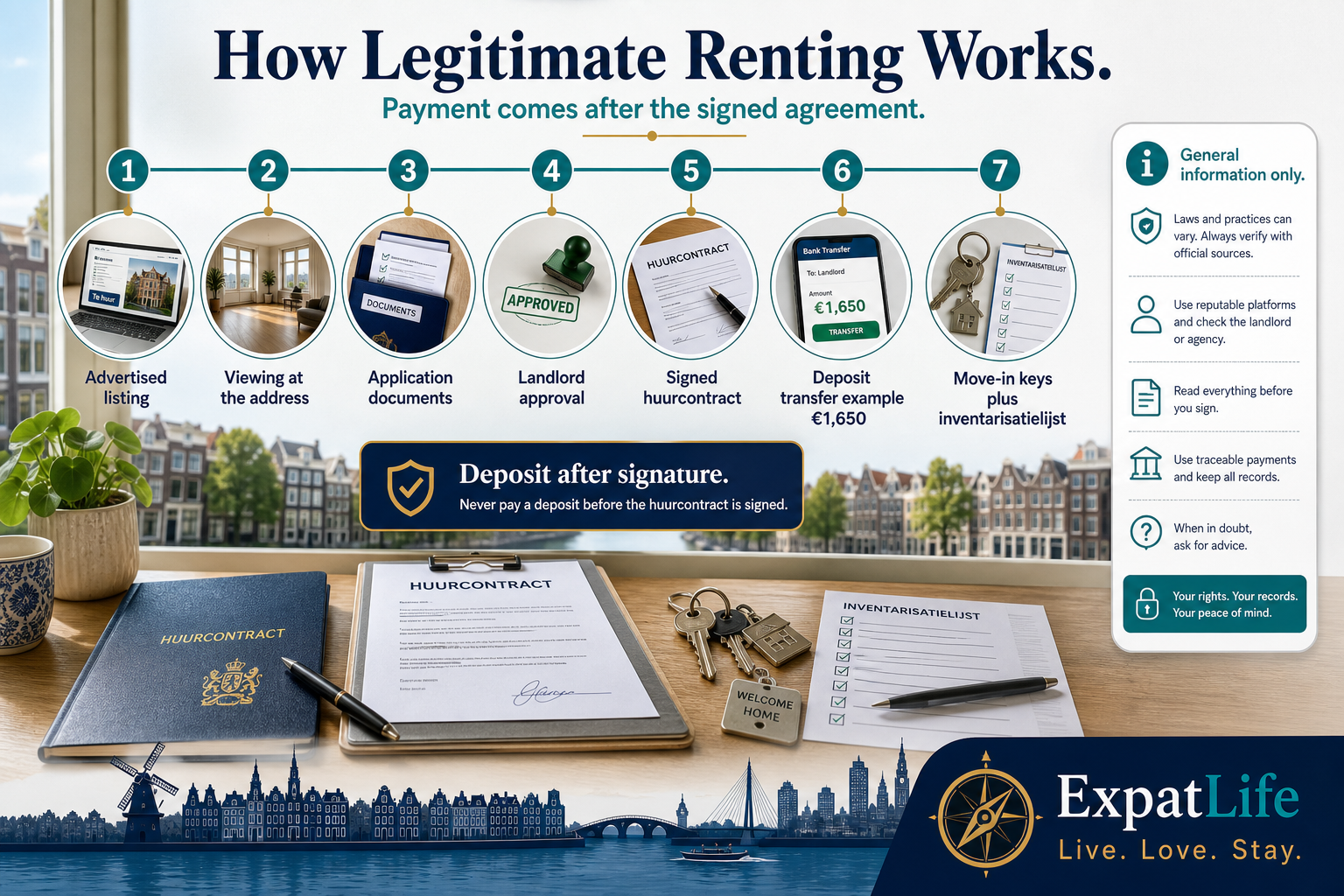
Step 1
The home appears on a platform, agency site or corporate landlord portal with photos, rent, size and availability date. Note the advert details and take screenshots for later comparison.
Step 2
You visit the property, often alongside other applicants, or join a scheduled group viewing. Agencies confirm appointments in writing and identify the person showing the home.
Step 3
You submit documents — identification, employment contract or enrolment proof, recent payslips and sometimes references. Share only what the process reasonably requires.
Step 4
The landlord or agency selects a tenant and confirms the offer in writing, including rent, start date and deposit amount. Ask for this confirmation before discussing payment.
Step 5
Both parties sign the huurcontract. Read every clause: parties, address, rent, servicekosten, deposit, notice period, maintenance split and registration permission.
Step 6
The borg and often the first month's rent are transferred by bank payment after signing. Confirm the account holder name matches the landlord or agency named in the contract.
Step 7
You receive the keys in person, complete a move-in inspection, sign the inventarisatielijst and photograph the property and meter readings on day one.
Scam types
These are the patterns most often described by newcomers and consumer information services. You do not need to memorise every story — recognise the shape: an unusually attractive property, a reason you cannot verify it, and pressure to pay quickly.
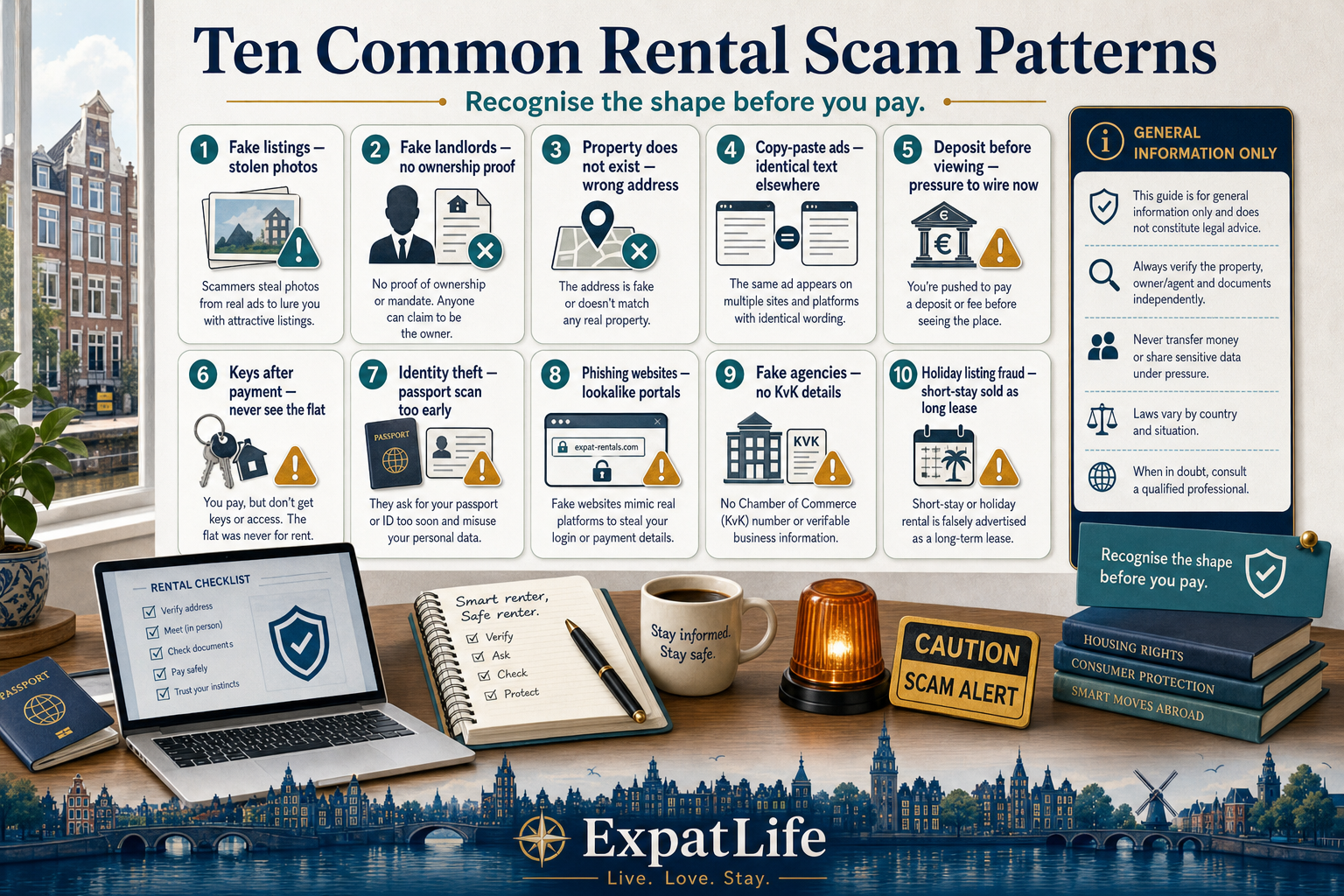
Pattern 1
An attractive home that was never available to rent.
How it works
An advert is created for a property the poster does not own or manage, often using photos taken from other listings, holiday rentals or estate-agent archives. The rent is set slightly below market to attract many replies quickly.
Warning signs
How to avoid it
Pattern 2
A convincing person who has no right to rent the property.
How it works
Someone poses as the owner, a family member managing the home, or an employee of a management company. They may send an identity document image and a plausible contract template, then request a deposit to secure the tenancy.
Warning signs
How to avoid it
Pattern 3
An address that is not a rentable home at all.
How it works
The advert lists an address that is an office, a demolished building, a non-existent house number or a property in a completely different city. Because the tenant is searching from abroad, the address is never checked on the ground.
Warning signs
How to avoid it
Pattern 4
A real property duplicated by someone with no connection to it.
How it works
A genuine listing from an agency or platform is copied — photos, description and floor plan — and reposted at a lower rent with new contact details. The original property may be genuinely available, which makes the copy look credible.
Warning signs
How to avoid it
Pattern 5
Money requested to 'hold' a property you have not seen.
How it works
The contact explains that demand is high and a deposit or reservation fee is required before a viewing can be arranged. Once the payment arrives, the viewing is postponed, then cancelled, and contact stops.
Warning signs
How to avoid it
Pattern 6
A promise to post keys once the money clears.
How it works
The supposed landlord says they are abroad for work or family reasons and will courier the keys after receiving the deposit and first rent. Sometimes an envelope arrives containing keys that do not open anything.
Warning signs
How to avoid it
Pattern 7
A 'rental application' designed to harvest your documents.
How it works
Under the guise of screening, the contact requests full passport scans, BSN, bank statements and signed forms very early — sometimes before a viewing. The documents are then used for fraudulent accounts or applications rather than tenancy screening.
Warning signs
How to avoid it
Pattern 8
A convincing imitation of a platform or payment page.
How it works
You receive a link that looks like a familiar housing platform, agency portal or payment page. The design is copied closely, but the web address differs slightly. Login details or payment data entered there go to the fraudster.
Warning signs
How to avoid it
Pattern 9
A professional-looking agency that does not exist.
How it works
A website, logo, staff photos and contract templates are created for an agency with no real operations. Fees are charged for registration, viewings, 'screening' or a guaranteed shortlist, and the promised properties never materialise.
Warning signs
How to avoid it
Pattern 10
A holiday rental presented as a long-term home.
How it works
A short-stay or holiday apartment is advertised as a long-term rental. In some cases the person has only booked the property briefly; in others the listing is entirely fabricated. Tenants pay for months and lose access within days.
Warning signs
How to avoid it
Red flags
Red flags are not proof of fraud — plenty of legitimate landlords are disorganised, and some genuinely live abroad. Treat them as triggers for independent verification rather than accusations. One flag means slow down; two or more means stop and verify before you reply again.
Write down what evidence you actually hold: a confirmed address, a viewing, a named contract party, a matching bank account holder. If the list is thin and the pressure is high, that gap is the risk.
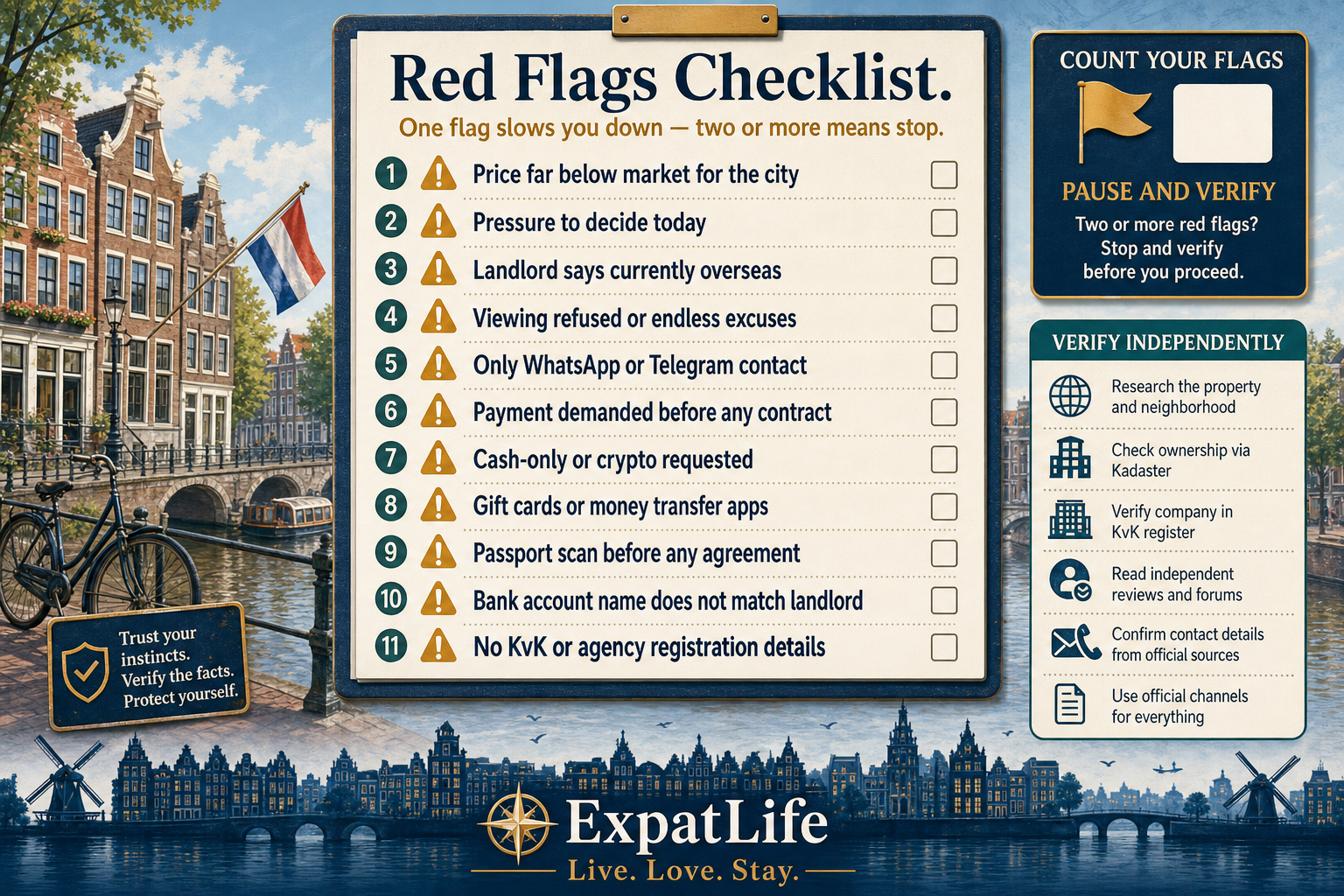
Decision tree
Work through the questions in order. Each step is a small, cheap check. If you cannot answer yes with actual evidence — not a promise — treat that as your stopping point and verify before going further.
Does the rent look realistic for this area, size and condition?
Yes
Continue to step 2, and keep the comparison listings you used as a reference.
No — or unsure
Compare at least three current listings nearby. A large unexplained discount is the most common hook — verify everything else before replying.
Can you confirm the exact address, and does it match a real residential building?
Yes
Continue to step 3 and note the street name, house number and building type.
No — or unsure
Ask for the full address in writing. Refusal to confirm an address before payment is a stop signal.
Do the photos and description appear only in this listing?
Yes
Continue to step 4 — the advert is at least not an obvious copy.
No — or unsure
You may be looking at a copied advert. Contact the agency named in the original listing through their own website instead.
Can you view the property in person, or by a live video call showing the address?
Yes
Continue to step 5 and confirm the advert matches what you saw.
No — or unsure
Stop. A refused viewing with no local representative is the single strongest warning sign in rental fraud.
Can the landlord or agency evidence who owns or manages the property?
Yes
Continue to step 6 and keep the evidence with your file.
No — or unsure
Search the owner or company name independently. Do not rely on documents or links the contact sent you.
Is there a written rental agreement naming both parties, the address, rent and deposit?
Yes
Continue to step 7 after reading every clause, including notice period and registration permission.
No — or unsure
Do not pay. A written agreement is your main protection and the basis for any later dispute.
Does the bank account holder name match the party named in the contract?
Yes
You have completed the core checks. Pay by regular bank transfer and save the confirmation with the contract.
No — or unsure
Stop and ask why. A mismatch between the contract party and the account holder is a common fraud indicator.
The listing has passed the core safety checks. Pay by normal bank transfer against the signed contract, keep the confirmation, and complete a move-in inspection with photos on day one.
Pause the conversation and resolve that single step in writing before continuing. Ask directly for the missing address, evidence, viewing or contract — a legitimate landlord can provide it.
Treat the listing as unsafe. Stop sending documents or money, report the listing to the platform, and continue your search through verified channels.
This tree is an orientation aid, not a guarantee. Passing every step reduces risk but does not remove it — keep documentation, and contact your bank and the police immediately if something later looks wrong.
Verification
Verification means gathering evidence from sources the other party does not control. A document image, a smart-looking contract template and a professional website can all be produced quickly. A confirmed company registration, a phone number that reaches a real office and a viewing you attended cannot.
You do not need to be confrontational. Framing the request as standard practice works well: 'Before I transfer the deposit I confirm ownership details and the account holder name — could you send those in writing?' A legitimate landlord or agency will recognise this as normal tenant diligence.
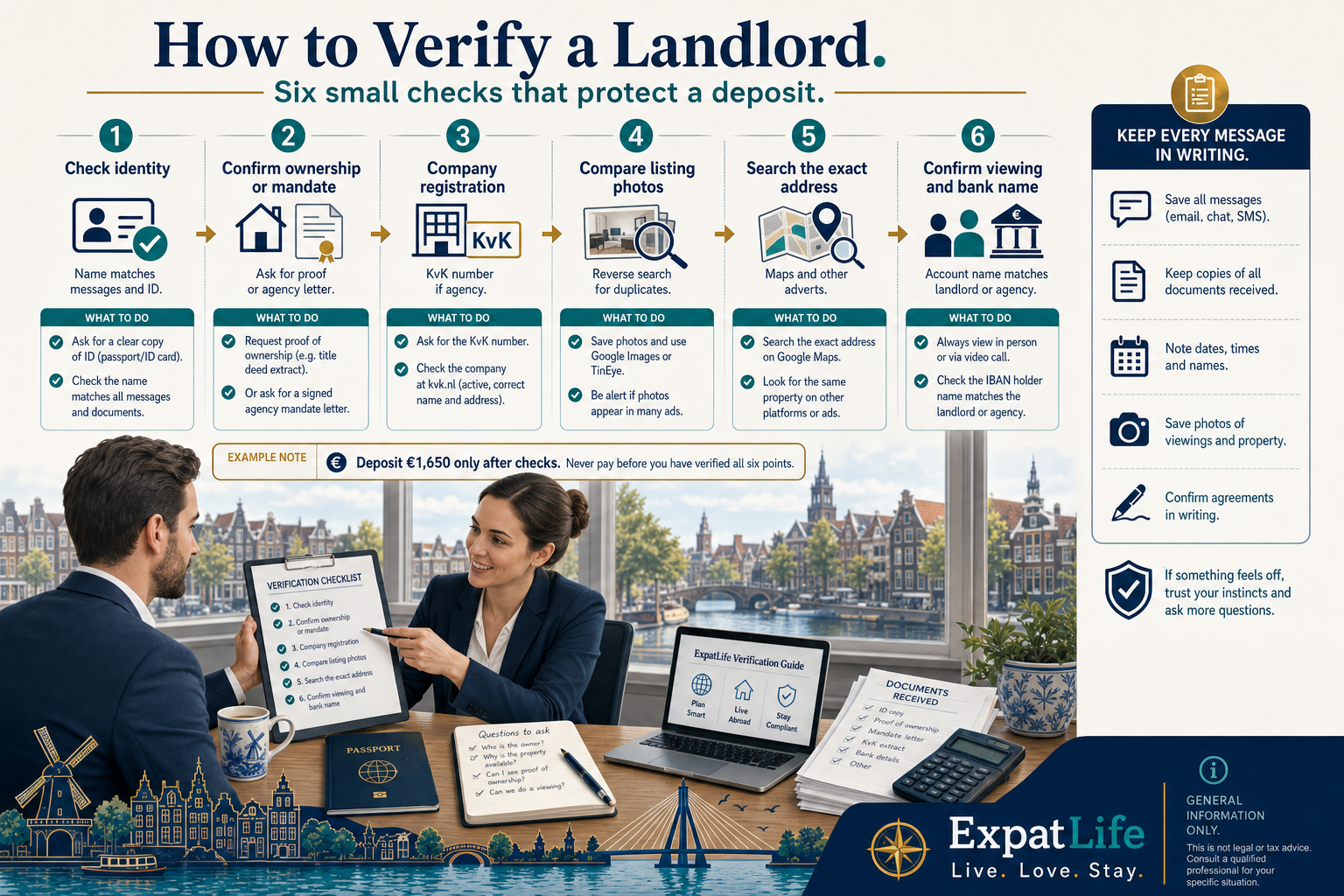
Treat the advert as a claim to be tested rather than a description to be trusted.
Establish who the person is and on what basis they can let the property.
Use public records and your own searches — not links or attachments they provide.
A viewing verifies existence, condition and access all at once.
The final gate before money moves is a name match between contract and bank account.
Documentation is what makes a later bank, police or legal conversation possible.
Questions worth asking in writing
Examples
| Situation | Approach | First step |
|---|---|---|
| Searching from abroad before arrival | Substitute distance with verified eyes on the ground | Request a live video walkthrough showing the street sign and door number |
| Landlord says they are working overseas | Ask for a local representative rather than accepting a postal handover | Request the name and number of the agency, caretaker or family member with keys |
| Agency asks for a registration fee before any viewing | Separate paying for access from paying for a tenancy | Verify the agency independently and ask what the fee contractually entitles you to |
| Contract party and bank account name differ | Treat the mismatch as unresolved until explained in writing | Pause the payment and request written clarification of the account holder |
Payments
In the Netherlands, rent and deposits are normally paid by ordinary bank transfer from your own account, after a written agreement is signed. The transfer names a landlord or agency, the reference mentions the property or contract, and you keep the confirmation alongside the signed contract.
Requests that step outside that pattern are the clearest financial warning sign. Gift cards, cryptocurrency, cash couriers and international money-transfer services are difficult or impossible to reverse — which is precisely why they are requested. A landlord who cannot accept a normal bank transfer is telling you something important.
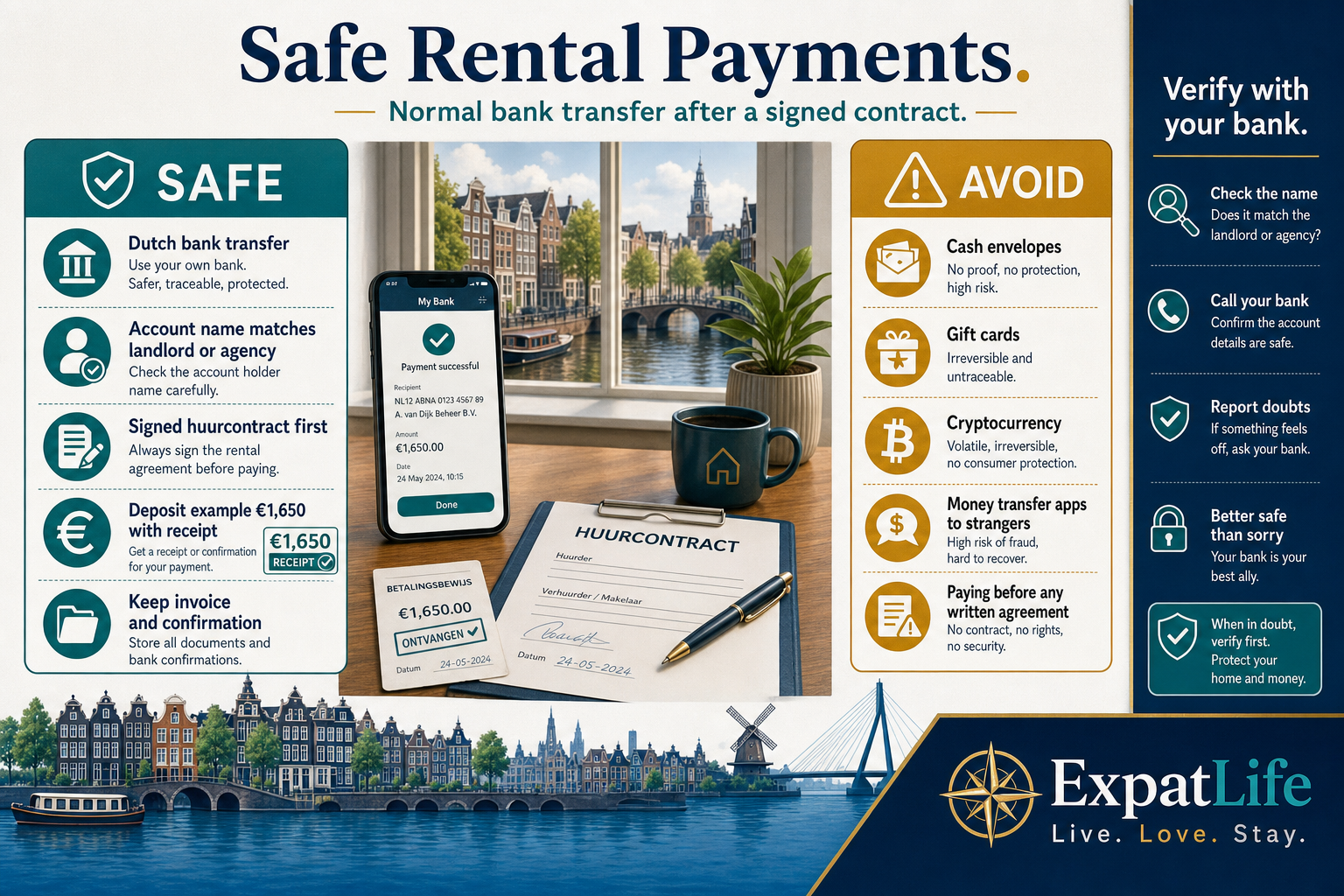
| Stage | Safe practice | Warning sign |
|---|---|---|
| Before any payment | Signed rental agreement naming both parties, address, rent and deposit terms | Reservation or holding fee requested with no contract and no viewing |
| Choosing the method | Regular bank transfer from your own account with a clear reference | Gift cards, cryptocurrency, cash couriers or money-transfer services |
| Checking the recipient | Account holder name matches the landlord or agency in the contract | Personal account with an unrelated name, or a 'colleague's' account |
| Amount and timing | Deposit and first rent as stated in the signed agreement | Escalating requests — extra 'insurance', 'screening' or 'guarantee' fees |
| Proof of payment | Bank confirmation saved with the contract and correspondence | Requests to send screenshots of cash receipts instead of bank records |
| After payment | Written confirmation of receipt and an agreed in-person key handover | Contact becomes slower, handover is postponed or keys are posted |
Safe payment habits
Viewings
A viewing does two jobs. It protects you from fraud by confirming the property exists and your contact has access, and it protects you as a tenant by revealing condition problems the photos hid. Both matter, so treat the viewing as a required step rather than a courtesy.
Personal safety also deserves a moment of planning. Book daylight appointments, tell someone where you are going, and bring a friend or future housemate when you can. If you are searching from abroad, a live video walkthrough is a reasonable substitute — a pre-recorded clip is not, because it proves nothing about who currently has access.
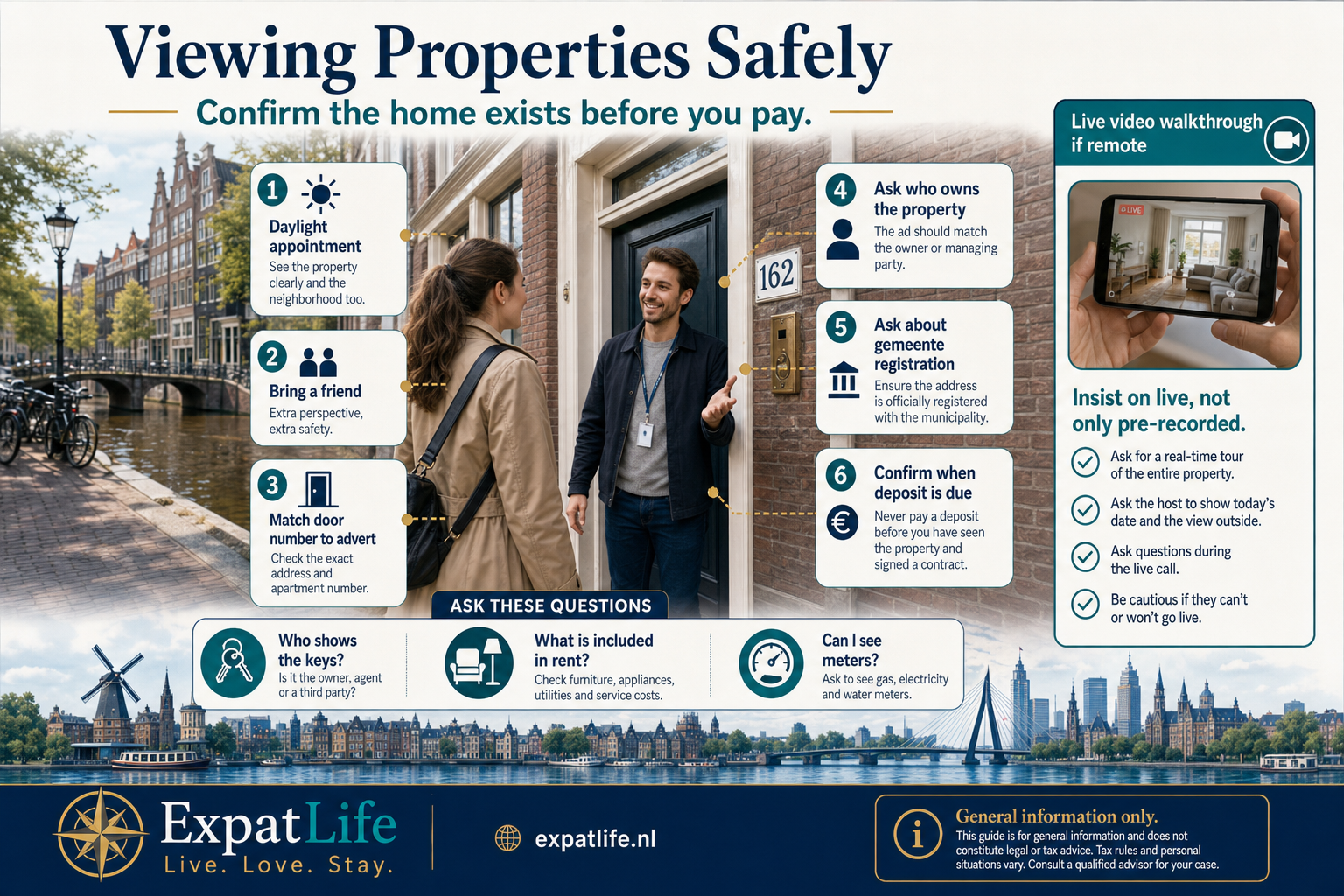
Viewing checklist
Questions to ask at the viewing
Contracts
The huurcontract is the document that turns a conversation into an enforceable arrangement. It names the parties, the exact property, the rent, the deposit, the notice period and often whether you may register the address with your gemeente. Without it, you have almost nothing to point to if something goes wrong.
Read the whole agreement before any deposit leaves your account, including appendices. If a clause is unclear, ask in writing and keep the reply. Our dedicated contracts and deposits guide walks through the clauses, inventory lists and inspections in detail.
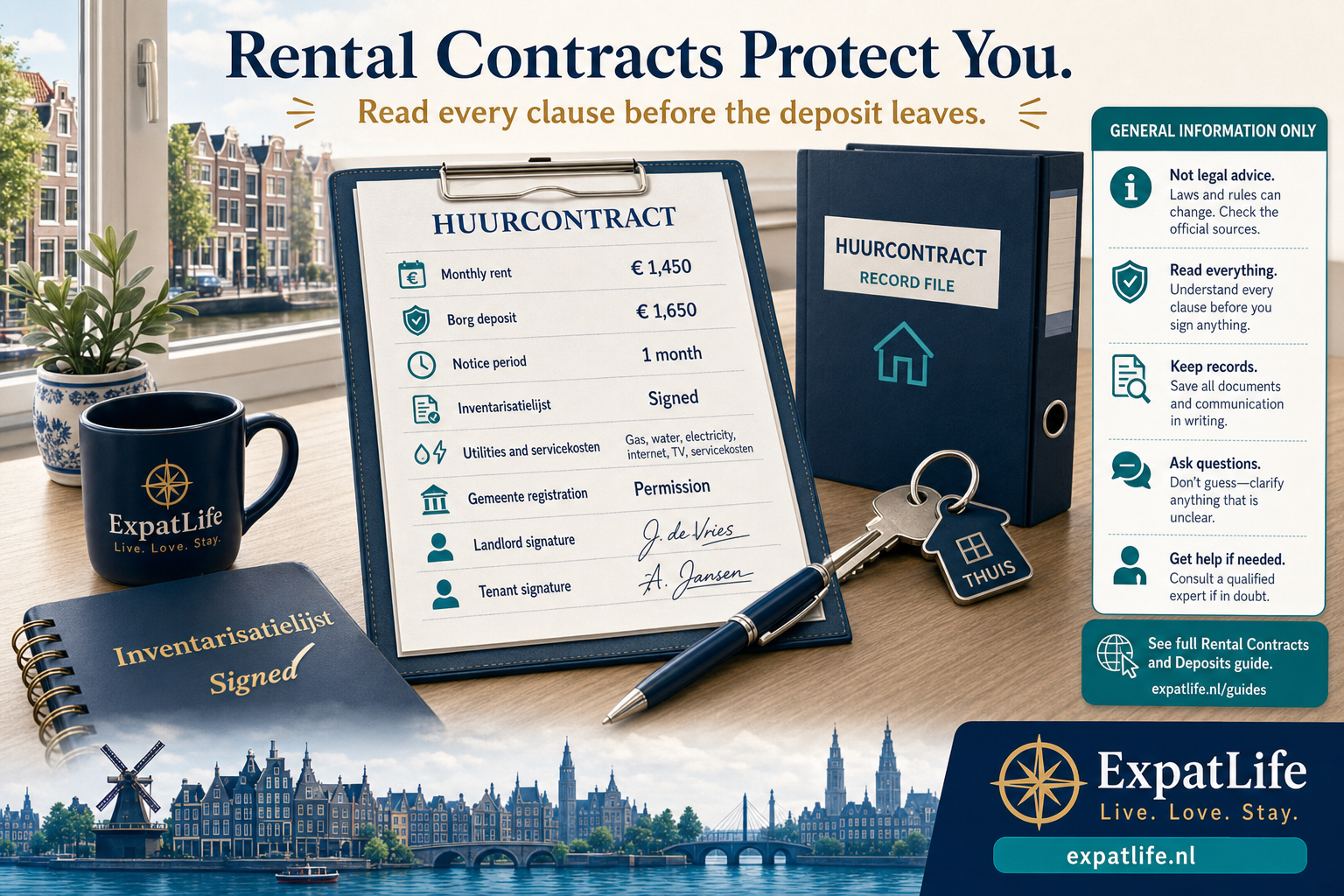
What the agreement should contain
Platforms
These are widely used, publicly known Dutch platforms, corporate landlords and property managers. Listing on a well-known site reduces exposure to obvious fraud, but it does not remove your verification step — always confirm the landlord, view the property and read the contract before paying.
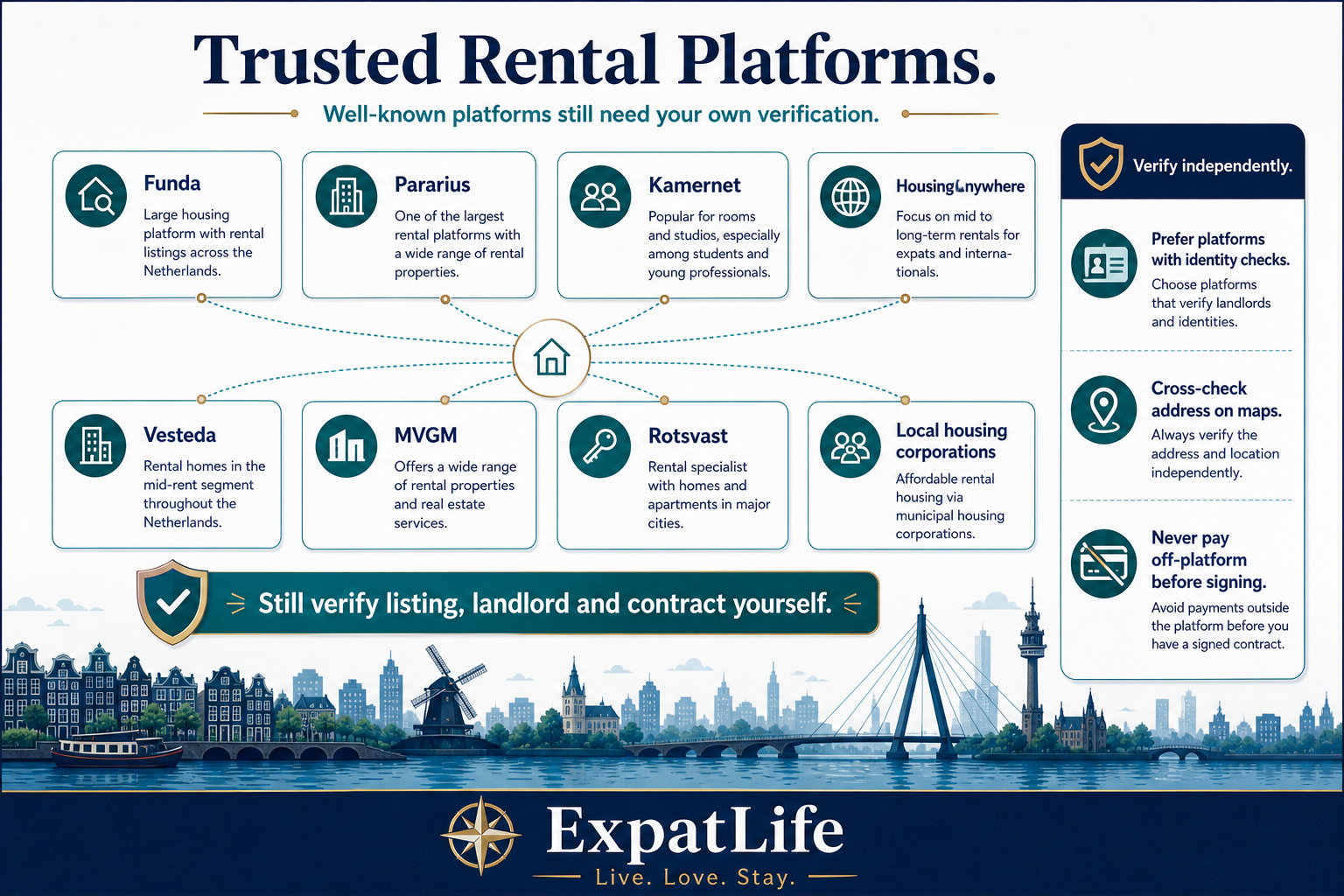
Property portal
Buyers and renters nationwide
Large Dutch property portal listing homes through registered estate agents. Contact the agency named on the listing through its own channels.
Visit siteRental portal
Renters, including internationals
Rental-focused portal with agency-listed apartments and houses. Verify the letting agency independently before paying anything.
Visit siteRooms and studios
Students and young professionals
Widely used for rooms, studios and shared housing. Keep conversations in-platform and be cautious if a contact moves you off it immediately.
Visit siteMid-term rentals
International students and expats
Platform aimed at internationals booking before arrival, with in-platform booking flows. Use the platform's own payment route rather than side transfers.
Visit siteCorporate landlord
Long-term renters
Institutional residential landlord letting directly through its own portal. Apply via the official website rather than third-party intermediaries.
Visit siteProperty manager
Renters of managed portfolios
Property management company handling residential portfolios. Confirm any contact claiming to represent them through published company channels.
Visit siteLetting agency network
Renters in multiple cities
Franchise network of letting offices across the Netherlands. Check the local branch details and office address independently.
Visit siteSocial housing (woningcorporaties)
Registered social-housing applicants
Municipal and regional corporations allocate income-capped social housing through official registration systems with waiting lists. Register only via official portals.
Visit sitePlatform presence is not an endorsement of any individual listing. Verify the landlord or agency independently, view the property in person or by live video call, and pay only against a signed agreement.
If it happens
If you think you have paid a fraudster, act quickly and in order. The first hours matter most for any chance of stopping or recovering a transfer, and the evidence you save now determines what the police, your bank or a legal service can do later.
Being scammed is not a personal failure, and reporting is worth the effort even when recovery is uncertain. Reports help authorities identify patterns and often warn others before they pay.
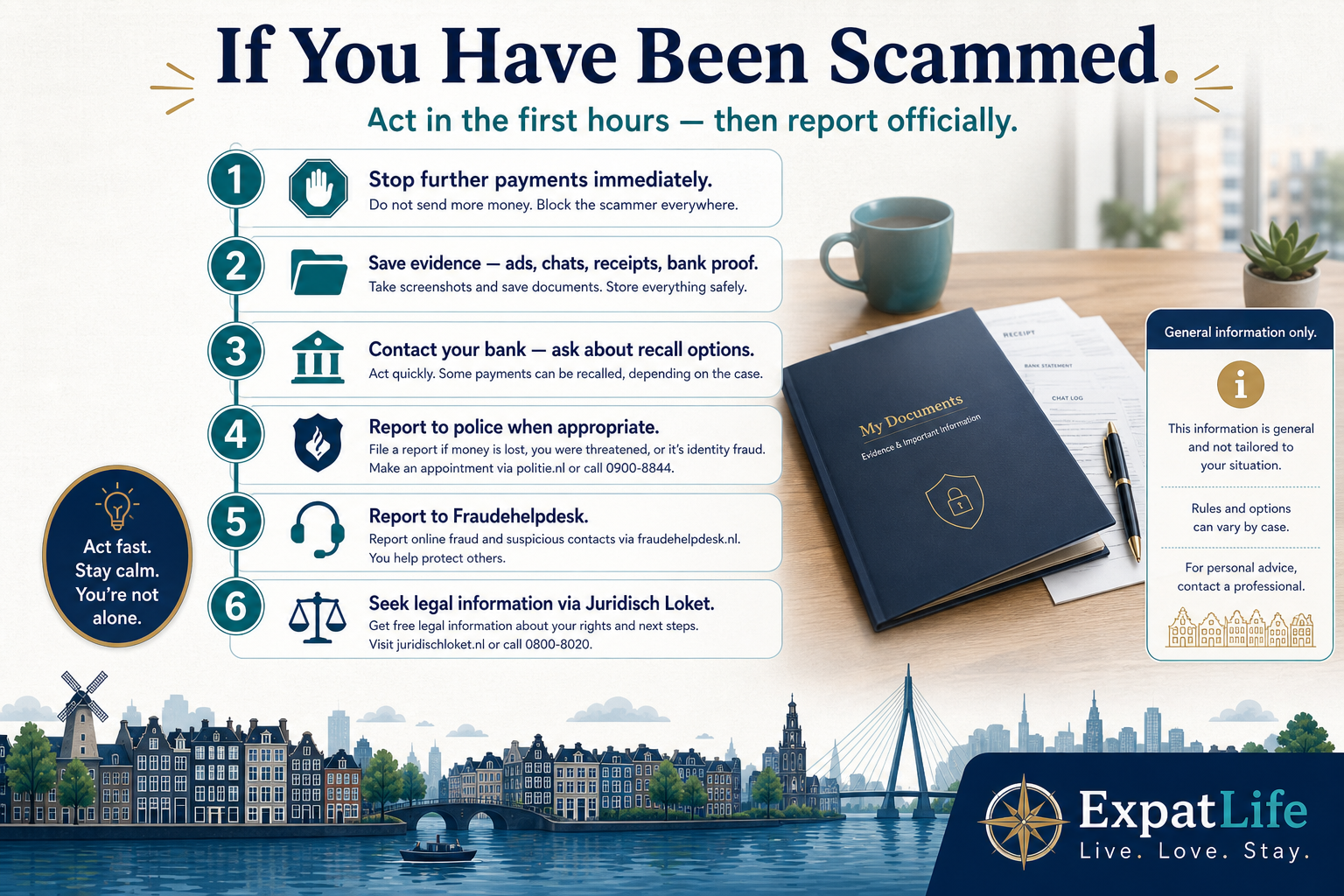
Action 1
Cancel any scheduled or recurring transfers immediately and make no further payments, including 'administration' or 'release' fees. Additional payments are a common follow-up tactic.
Action 2
Screenshot the advert, full chat and email threads, contract documents, phone numbers, profile pages and bank confirmations before anything is deleted or taken offline.
Action 3
Call your bank's fraud line as soon as possible and explain what happened. Ask whether the transfer can be recalled and what they need from you in writing.
Action 4
File a report with the Dutch police (Politie). Bring your evidence file and note the report reference — banks, platforms and insurers often ask for it.
Action 5
Report the case to Fraudehelpdesk, the national fraud reporting and information point. They collect fraud reports and publish information about current patterns.
Action 6
Contact Juridisch Loket for free legal information about your situation and possible next steps, and ask about options if you also signed documents or shared identity data.
Evidence to save immediately
Students & expats
International students and newly arriving expats are not targeted because they are careless. They are targeted because their situation removes the checks that protect other renters: they often search from another country, work against a fixed start date, do not yet know what a normal rent looks like, and cannot easily walk past a building to confirm it exists.
Understanding the specific vulnerability makes it easier to close. If distance is the gap, arrange verified eyes on the ground. If deadline pressure is the gap, secure a short temporary stay so you are not forced to decide in one evening. If market knowledge is the gap, compare several listings before believing any single one.
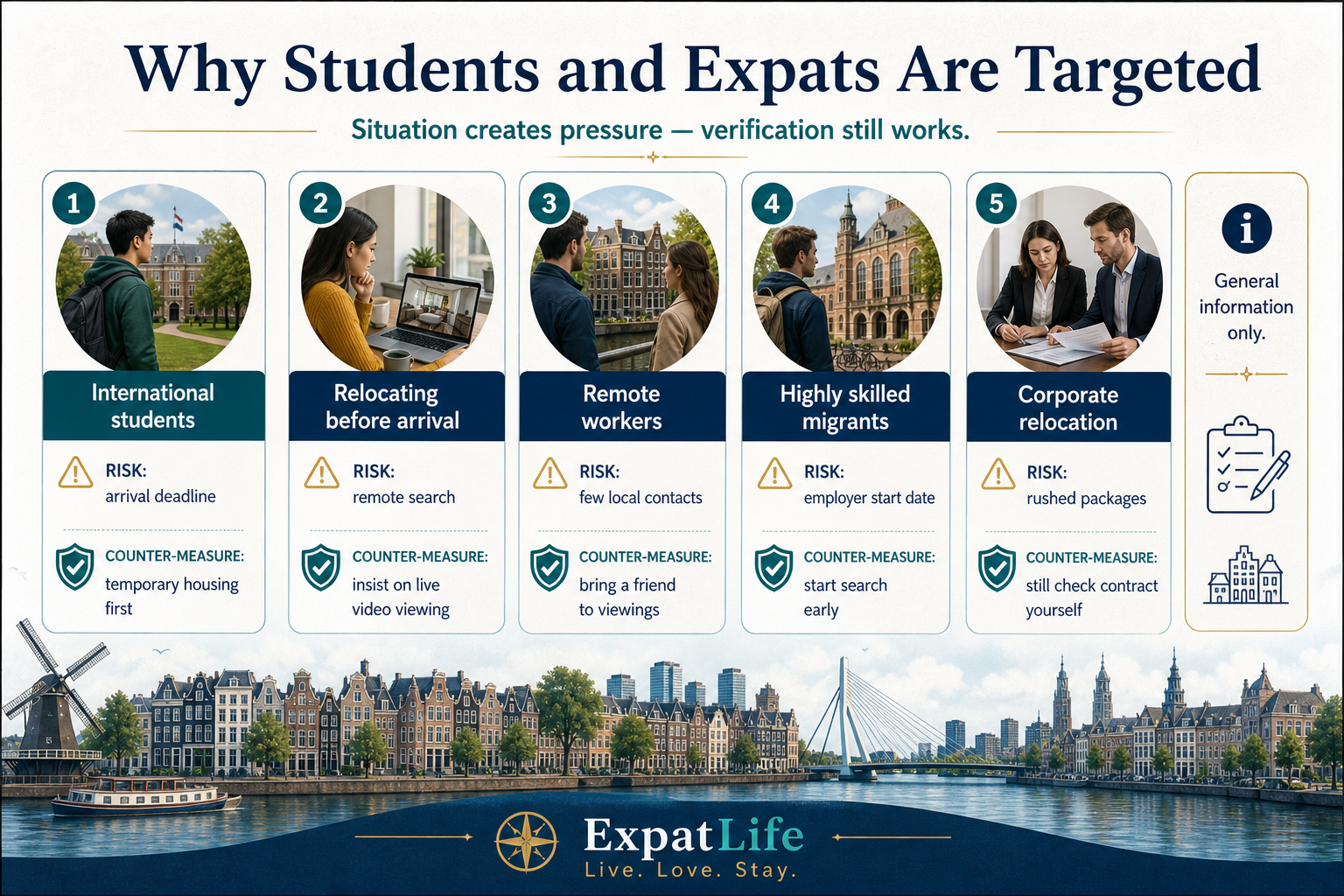
Without a viewing, you rely entirely on what the other party tells you. Fraud attempts often begin by making distance sound like a normal reason to pay first.
Semester start, a job start date or an expiring temporary booking creates urgency — the exact condition fraud needs to bypass verification.
If you do not yet know typical rents, deposits or contract steps, a below-market listing looks like good fortune rather than a warning sign.
Dutch contracts and platform messages can be hard to assess quickly, which makes an English-speaking, confident contact feel safer than the documents justify.
Newcomers often have nobody who can check an address, meet a landlord or sanity-check a contract before payment.
Sending a large deposit abroad or in an unfamiliar way makes unusual requests feel like part of the international process.
How to close the gaps
Examples
| Situation | Approach | First step |
|---|---|---|
| Semester starts in three weeks and nothing is confirmed | Separate the housing deadline from the arrival deadline | Book two to four weeks of temporary accommodation, then view in person |
| Employer relocation package with a tight start date | Use the relocation contact as a verification channel | Ask them to confirm the agency and contract before you transfer anything |
| Studying remotely with no local contacts | Replace an in-person viewing with a live video walkthrough | Request a continuous live call showing the street sign and every room |
| Shared flat offered by a current tenant | Confirm the landlord permits the arrangement in writing | Ask for the landlord or agency contact and a written agreement naming you |
By city
These cities have well-known housing pressure, which matters for safety because competition creates urgency — and urgency is what fraud depends on. This is a market-pressure overview, not a ranking of fraud levels: no city is inherently unsafe, and the same verification steps apply everywhere.
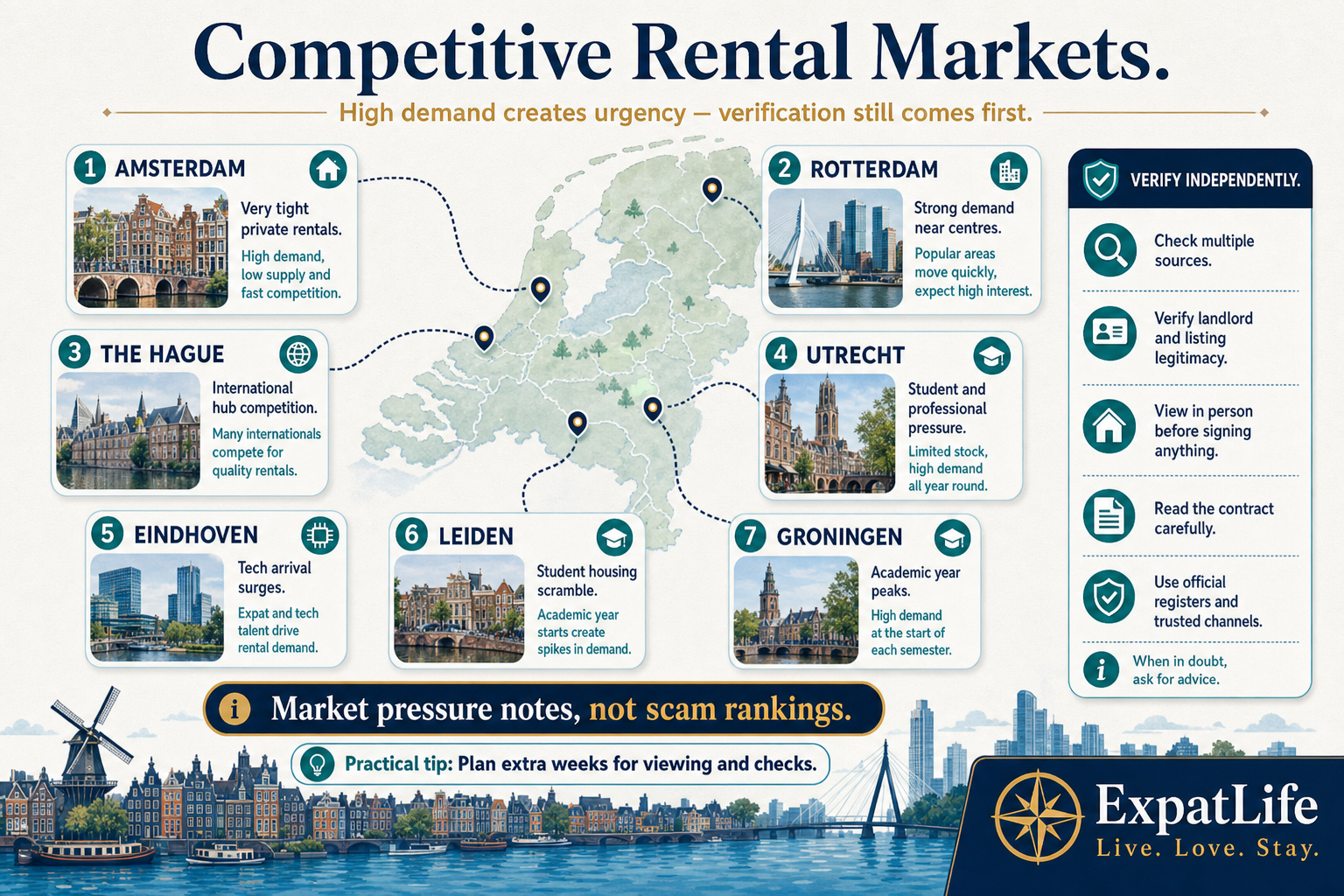
| City | Market pressure | What to watch for | Safer approach |
|---|---|---|---|
| Amsterdam | Very high demand; listings can receive many responses within hours | Below-market studios and 'available immediately' adverts that discourage viewings | Compare several listings before replying and consider Amstelveen, Zaandam or Haarlem with good rail links |
| Rotterdam | High demand with fast-moving city-centre and waterfront listings | Copied adverts reusing photos from newer developments | Contact the agency named in the photos through its own website and view before paying |
| The Hague | Strong international demand around institutions and coastal districts | Short-stay and holiday properties presented as long-term homes | Require a normal huurcontract and confirm registration permission at the address |
| Utrecht | Very high demand from students, commuters and families | Room and studio listings that request a reservation fee before viewings | Use university housing routes and established platforms; refuse pre-viewing payments |
| Eindhoven | Strong demand linked to tech employers and student intake periods | Relocation-themed offers arriving by direct message with tight deadlines | Verify through your employer relocation contact and the agency's published channels |
| Leiden | Compact rental stock with concentrated academic-year demand | Peak-season listings pressuring students to decide within hours | Register early with student housing services and plan a temporary stay for August |
| Groningen | Large student population creating sharp seasonal pressure | Room offers from accounts created shortly before the academic year | Prefer established platforms and university-linked housing routes; view before paying |
Market pressure descriptions are general orientation drawn from widely reported housing-demand patterns. They are not fraud statistics and should not be read as ranking cities by scam frequency.
Checklist
Work through this list in order before any money leaves your account. If you cannot tick an item, resolve it in writing first — a legitimate landlord or agency will be able to help you complete every line.
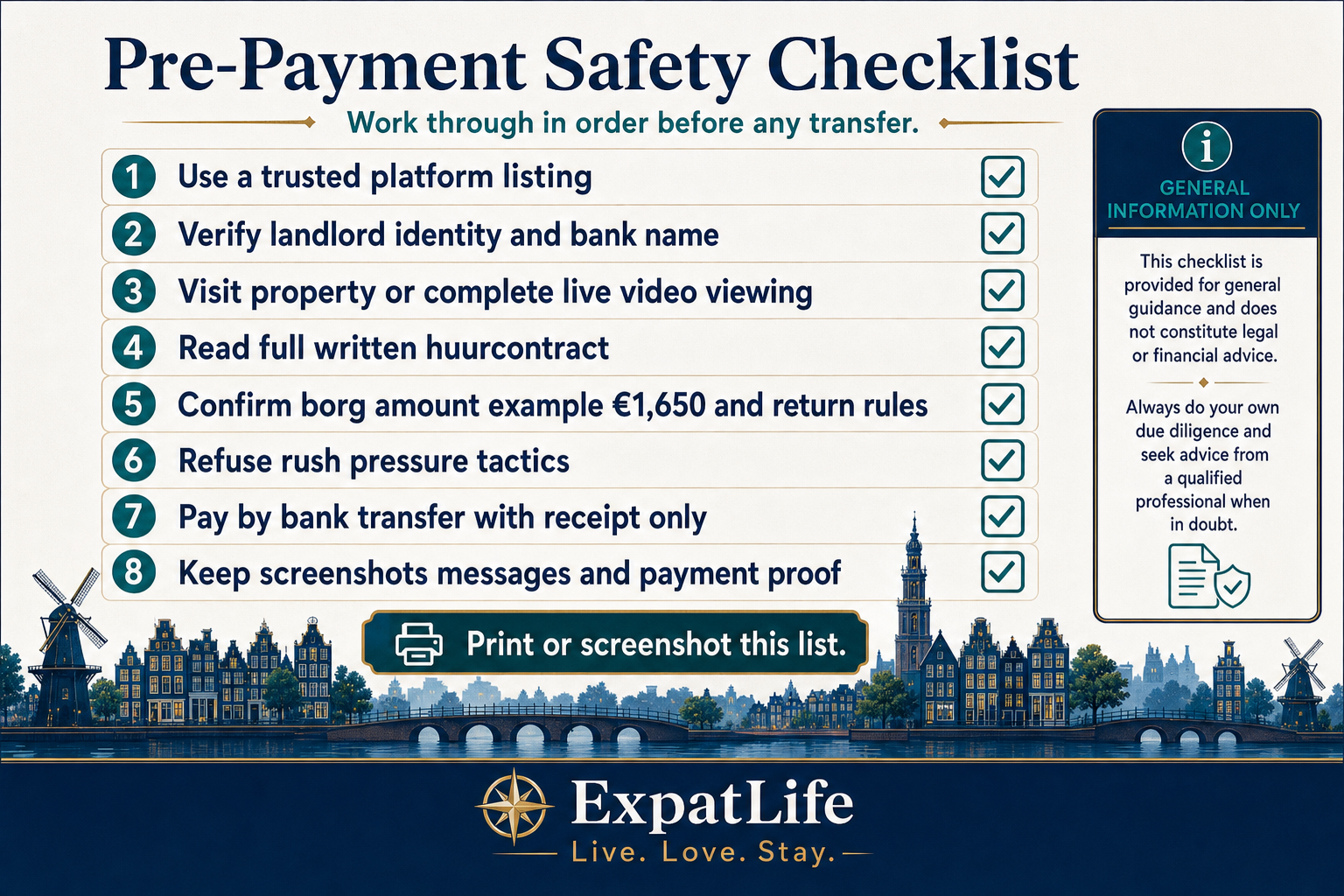
Complete before any payment
Mistakes
These are the habits that most often turn a suspicious listing into a real loss. Each has a straightforward replacement.

Reservation fees and deposits for unseen properties are the single most common route to losing money, especially when searching from abroad.
Fix: Pay only after a viewing or live video walkthrough and a signed written agreement.
Elaborate explanations — a family emergency, a posting overseas, a missionary assignment — exist to justify skipping normal steps.
Fix: Judge the evidence you hold, not how sympathetic or urgent the story sounds.
A mismatch between the contract party and the bank account holder is a well-known indicator and makes recovery far harder.
Fix: Confirm the account holder name matches the contract before authorising any transfer.
Full passport scans, BSN and bank statements sent before a viewing or written offer can be used for identity fraud rather than screening.
Fix: Share documents only after a viewing and written offer, through official channels.
Without a signed agreement naming parties, address, rent and deposit, you have very little to rely on if the arrangement collapses.
Fix: Insist on the full huurcontract in writing and read every clause before paying.
Embarrassment delays the bank call and the police report — the two actions where speed matters most.
Fix: Report immediately to your bank, the police and Fraudehelpdesk, then warn your community.
FAQ
Quick answers for orientation. Confirm current reporting procedures with your bank, the police and official consumer services before acting.
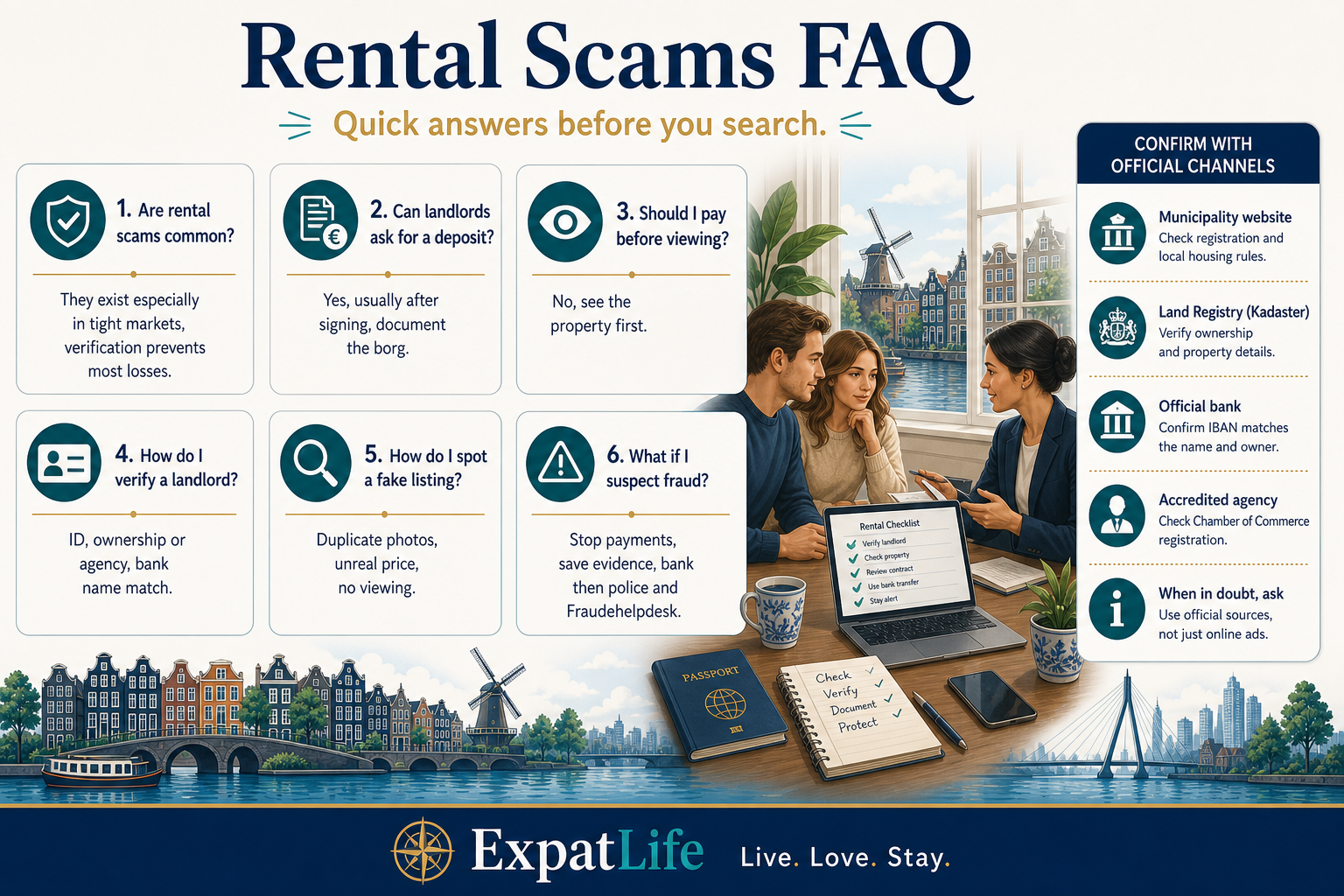
Rental fraud is a recognised problem in competitive Dutch housing markets, and consumer information services and police publish warnings about it — particularly around student intake and peak relocation periods. We do not publish figures here because reliable, current statistics are hard to compare and easy to misread. The practical takeaway is that the risk is real enough to justify verification on every listing, and that following the normal rental order removes most of the exposure.
Look at the sequence rather than the story. Warning signs include rent well below comparable listings, refusal or repeated postponement of a viewing, pressure to transfer money today, a deposit requested before any written agreement, payment to an account holder whose name does not match the contract, and requests for full passport or bank details early on. One of these means slow down and verify independently; two or more means stop.
As a rule, no. In the normal Dutch process the deposit follows a signed rental agreement, and viewings come before that. If you genuinely cannot travel, a live video walkthrough showing the street sign, door number and every room — plus verified landlord or agency details and a signed contract — is the minimum substitute. A reservation fee to view a property you have never seen is not a standard step.
Ask in writing who owns the property and on what basis the contact can let it, then verify independently: search the person and company name, confirm the business registration and office address, call a published office number rather than a mobile from a chat, and check that the agency shown in the listing photos is the one you are speaking to. Finally, confirm the bank account holder name matches the party named in the contract before paying.
Act in order. Stop all further payments and cancel scheduled transfers. Save every piece of evidence — advert screenshots, chat and email threads, contracts, bank confirmations and contact details. Call your bank's fraud line immediately and ask whether the transfer can be recalled. File a report with the Dutch police, notify Fraudehelpdesk, and contact Juridisch Loket for free legal information about your next steps.
Established letting agencies and corporate landlords are a common and generally lower-risk route, because they have verifiable registrations, offices and published contact channels. The risk is impersonation: someone claiming to represent an agency, or a fabricated agency with a convincing website. Always reach agencies through their own published website or phone number, apply through their official process, and be cautious about upfront fees that buy access rather than a signed tenancy.
Because of situation, not judgement. Newcomers often search from abroad without the ability to view a property, work against a fixed semester or job start date, do not yet know what a realistic rent looks like, and have no local contact who can check an address. Each of those gaps can be closed: start earlier, book a short temporary stay so you can view in person, compare several listings before believing any price, and ask a university housing office, employer relocation contact or trusted local to sanity-check a listing.
Related
Scam awareness works best alongside contract knowledge, realistic budgets and a search plan that does not force you to decide in one evening.
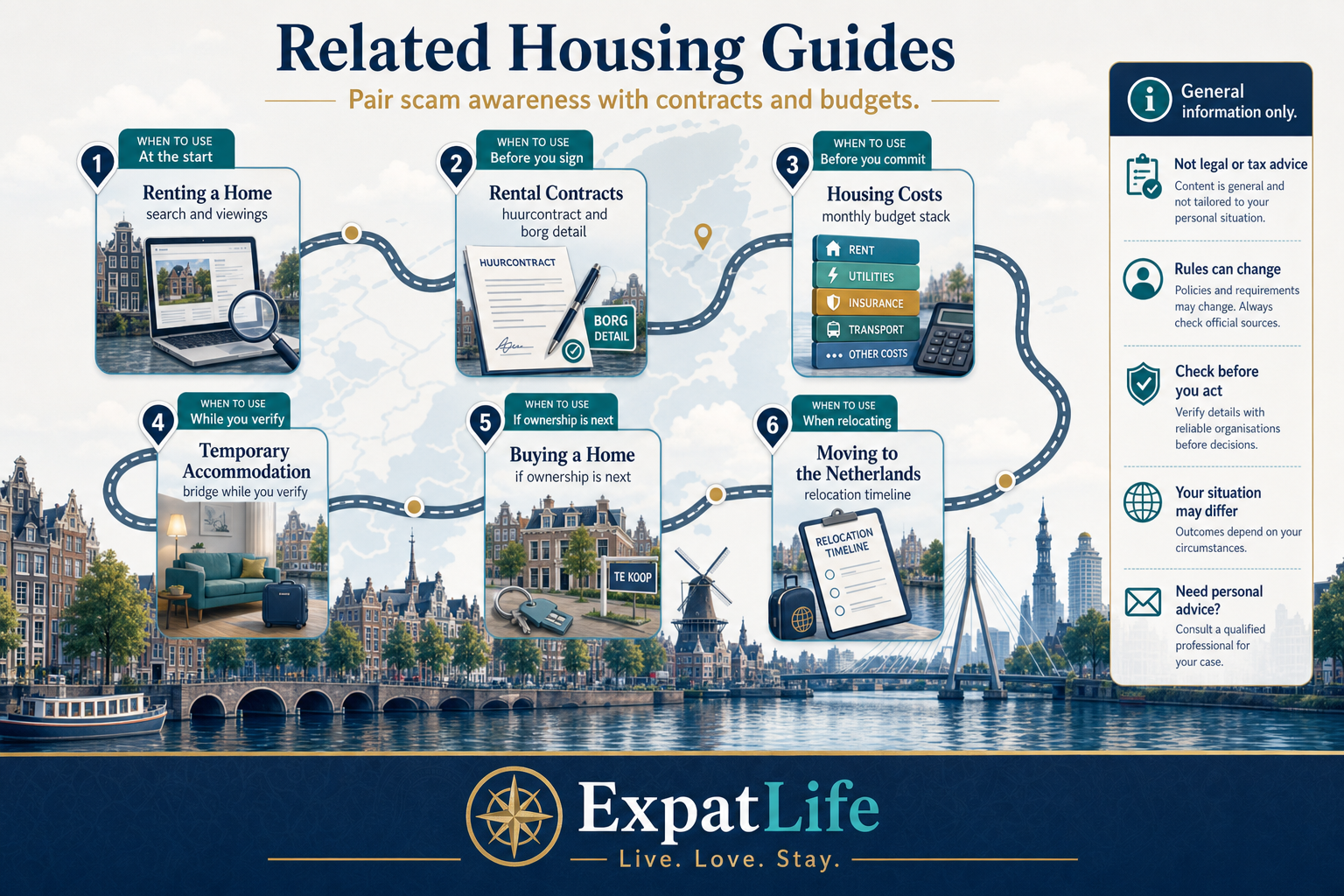
Housing hub
Use the housing hub to sequence budget, search, contracts, deposits and registration around the safety checks on this page.
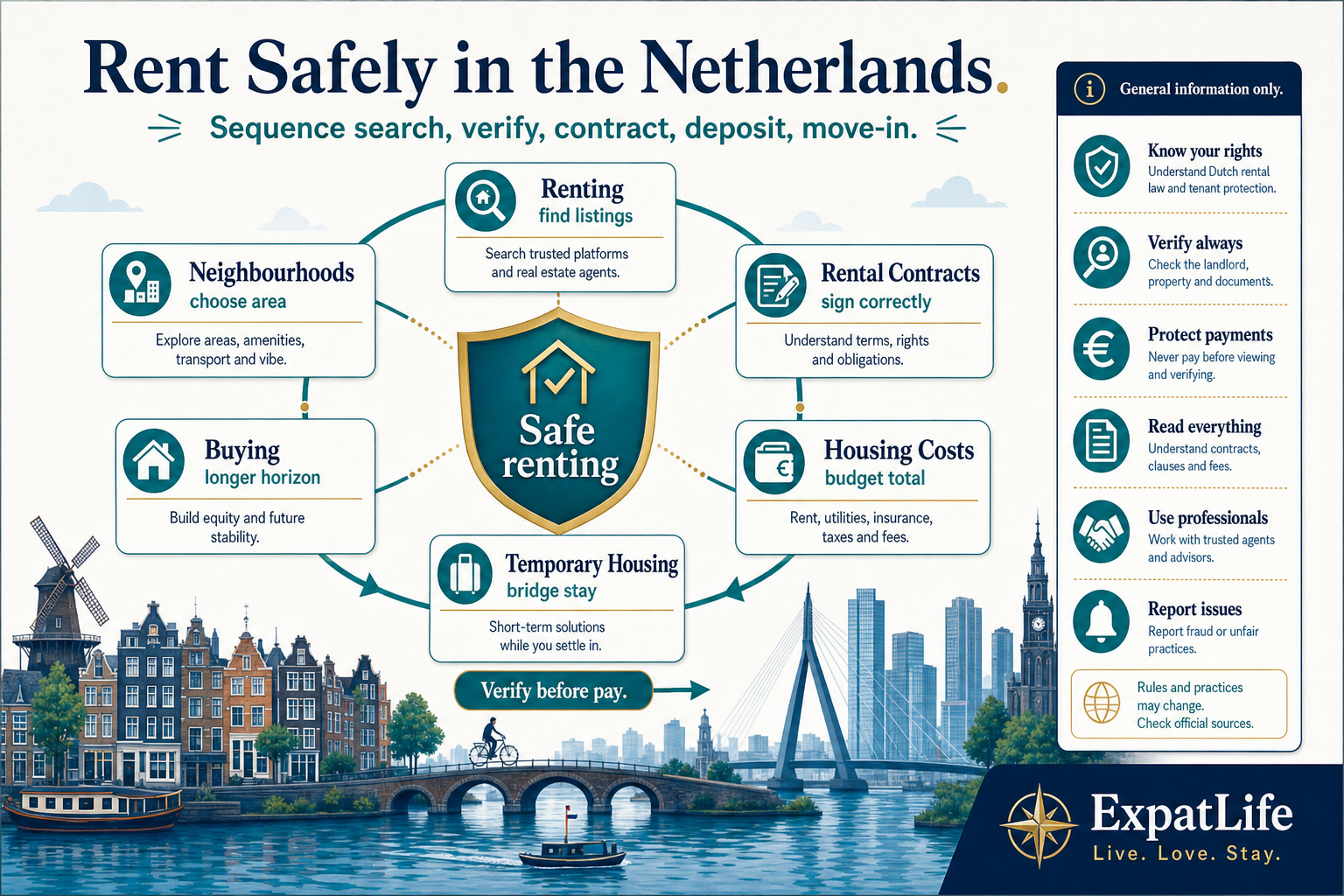
Explore next
Pick the card matching whether you need contract detail, realistic budgets or a temporary base while you verify listings safely.

Trust
Official links are for orientation only. Reporting procedures, contact routes and consumer guidance change over time — open the source site to confirm current steps. This guide is not legal advice and does not assess your specific listing, contract or case.