How much is rent in Amsterdam for a studio?
Orientation ranges often start around €1,200–€1,800+ per month for studios in popular districts — outer areas and shared setups can sit lower. Verify live listings for your exact neighbourhood.
Netherlands · Housing · Costs & budgeting
Understand what it really costs to rent, buy and live in the Netherlands, with practical examples, city comparisons and budgeting guidance.
Orientation ranges only — not quotes, investment advice or price guarantees. Verify current listings and official data on CBS, Kadaster and Government.nl.
Quick answer
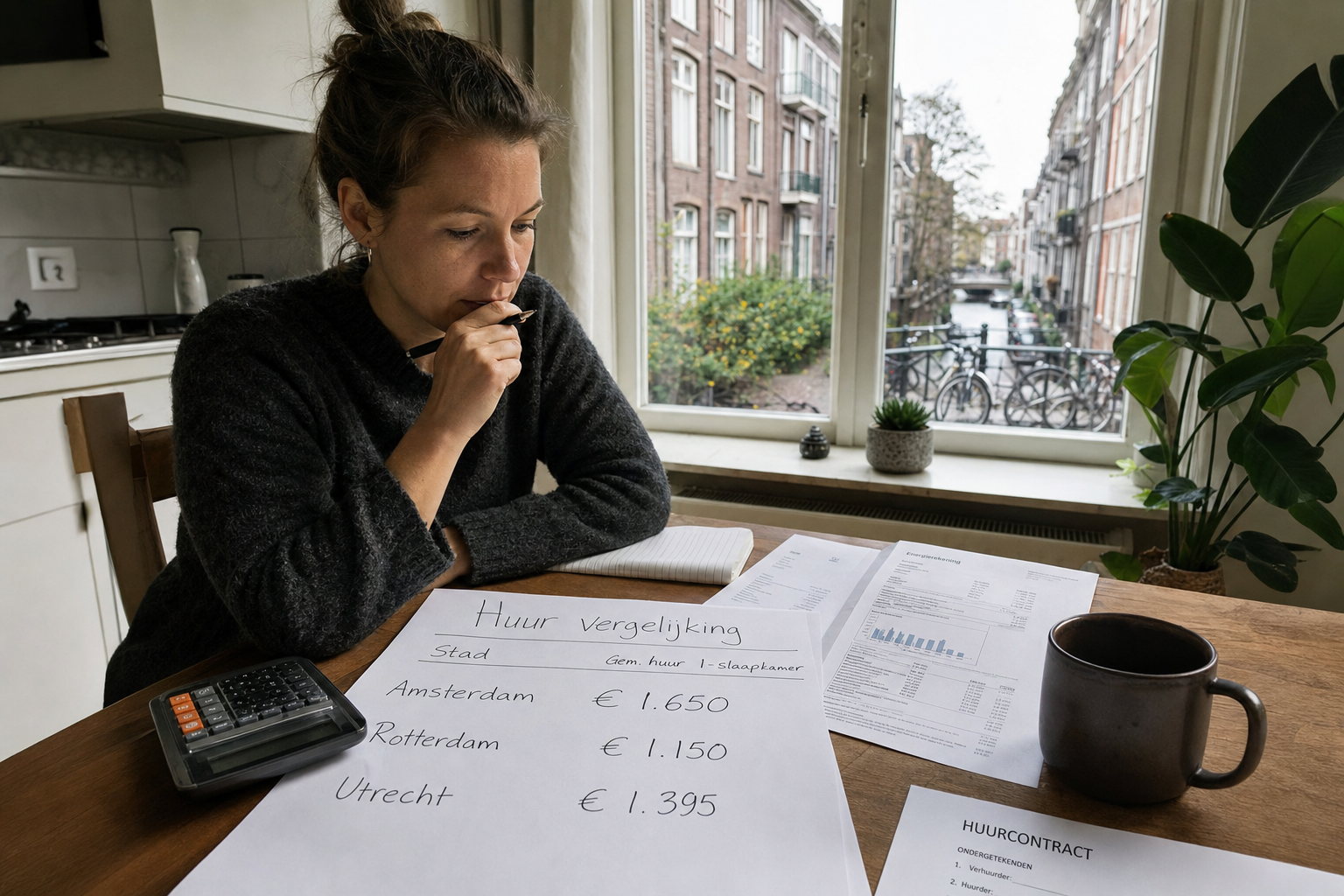
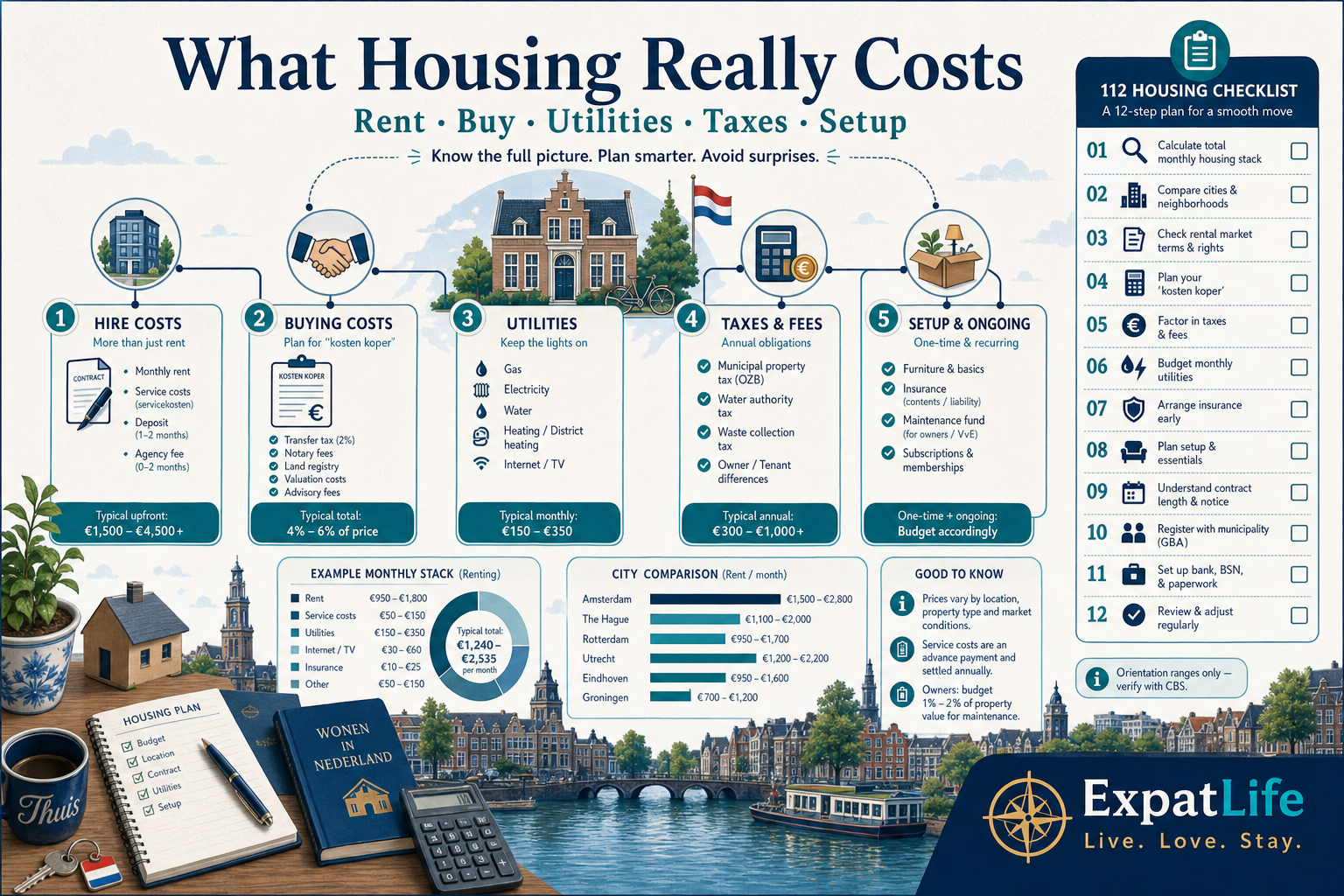
Housing is usually the largest monthly expense for expats in the Netherlands. Costs vary sharply by city, neighbourhood, property size and whether you rent or buy. Amsterdam and parts of the Randstad sit at the top of national benchmarks, while cities such as Groningen, Maastricht and parts of Limburg can offer lower monthly stacks for comparable space.
This guide explains orientation ranges for rent and purchase, utility and insurance layers, municipal charges and hidden setup costs. Figures are examples for planning — not quotes, predictions or investment advice. Always verify current listings, CBS statistics and Kadaster context before committing.
Use the city comparison tables and sample budgets to stress-test your relocation plan, then connect to renting, buying, mortgage and utilities guides for the next steps.
Orientation ranges often start around €1,200–€1,800+ per month for studios in popular districts — outer areas and shared setups can sit lower. Verify live listings for your exact neighbourhood.
Often not. Electricity, gas, water, internet and waste charges are frequently separate — budget €150–€350+ monthly beyond headline rent for many households.
Buyer-side costs on top of the mortgage — transfer tax, notary, valuation and advice. On a €400,000 purchase, orientation totals often reach roughly €13,000–€25,000+ before overbidding.
Not always. Buying adds upfront kosten koper, maintenance and market risk; renting preserves flexibility. Compare total cost over your expected stay horizon using the buy vs rent guide.
At a glance
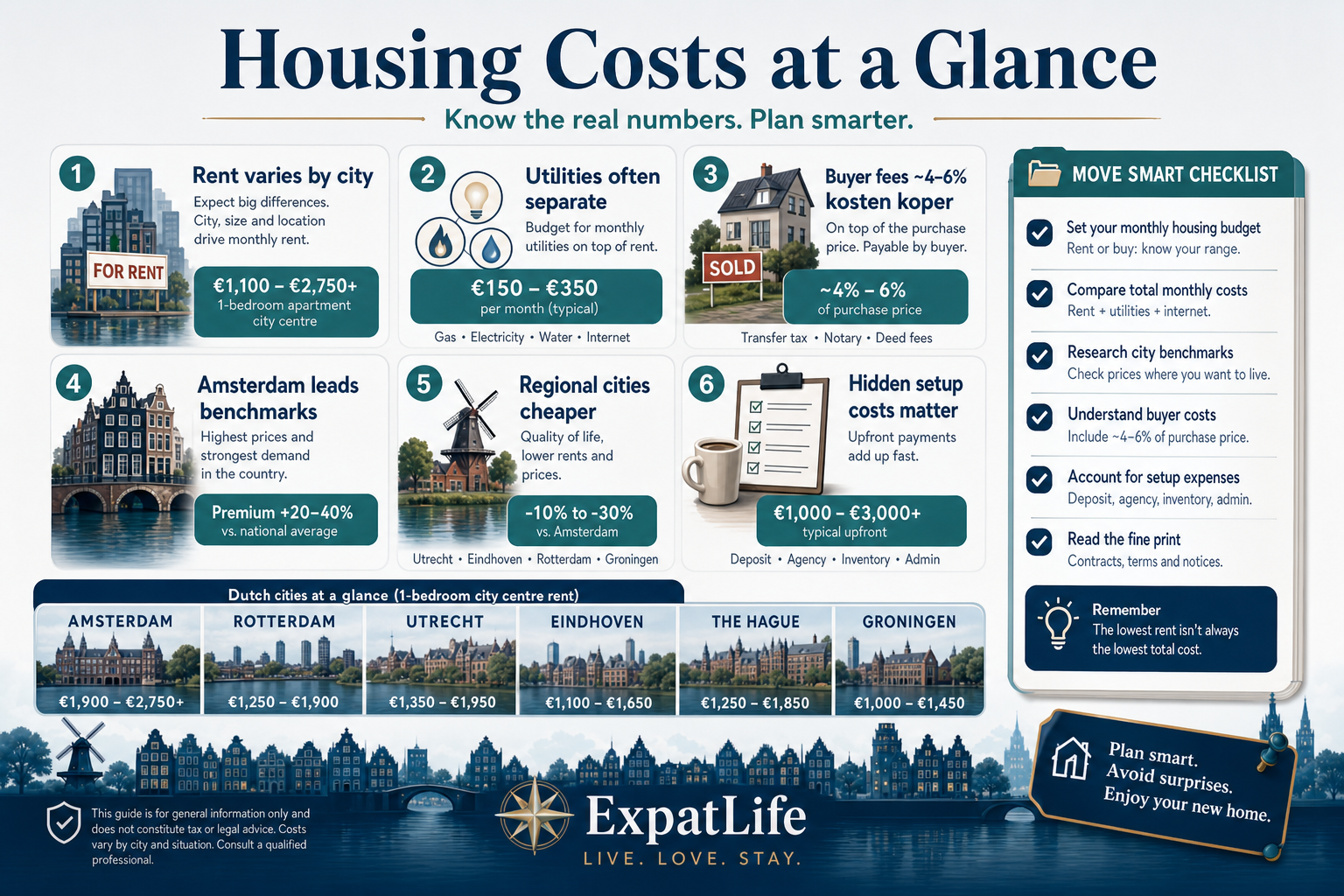
Use these signals to orient yourself on rent variance, utility separation, buyer fees and regional city costs before you narrow your search.
Before search
Net salary budget
Include utilities and commute
Viewing stage
Total monthly stack
Rent + service + utilities
Before signing
Setup cash plan
Deposit, furnish, insurance
After move-in
Track actuals
Adjust budget with real bills
The same apartment type can cost 30–50% less outside Amsterdam core districts.
Electricity, gas, water, internet and waste rarely sit inside headline rent.
Transfer tax, notary, valuation and advice add to the mortgage down payment story.
Autumn student intake and corporate hiring waves tighten rental markets.
Groningen, Maastricht and smaller Randstad suburbs often trade space for commute.
Deposits, furniture, insurance and parking change first-year cash needs materially.
How to use this snapshot
Cost drivers
Location, property type, energy efficiency and market demand combine to create wide spreads — even within the same city. Compare total monthly stack, not headline rent alone.
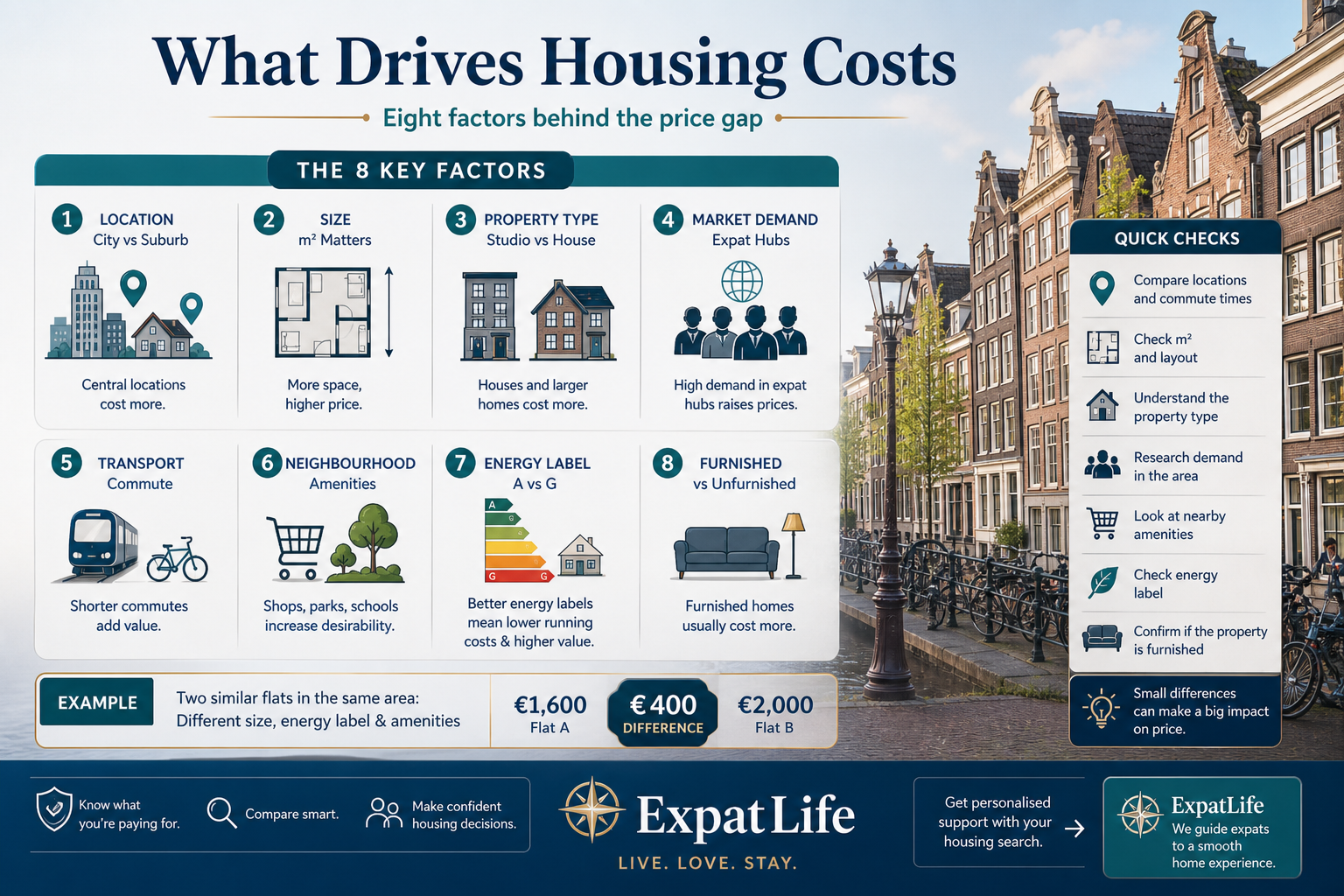
City centre vs suburb vs commuter town — the largest cost driver for both rent and purchase.
Bedrooms, floor area and outdoor space scale rent, utilities and maintenance together.
Studio, apartment, townhouse and detached home carry different cost profiles.
Student intake, corporate hiring and low supply tighten markets seasonally.
Near-station premiums apply in Amsterdam, Utrecht and Rotterdam hubs.
Canal belts, waterfront and school districts command sustained premiums.
Energy label A–G affects heating and electricity — especially in older stock.
Renovation-ready homes trade lower rent for future repair spend.
Cost breakdown
| Item | Orientation range | Notes |
|---|---|---|
| Label A or B (efficient) | Often €80–€150 / month energy | Newer builds and recent renovations |
| Label C or D (average) | Often €120–€200 / month energy | Typical post-war apartments |
| Label E, F or G (poor) | Often €180–€350+ / month energy | Winter heating spikes materially |
| Furnished premium | +10–25% on rent | Compare total stack vs furnishing cash |
Rent
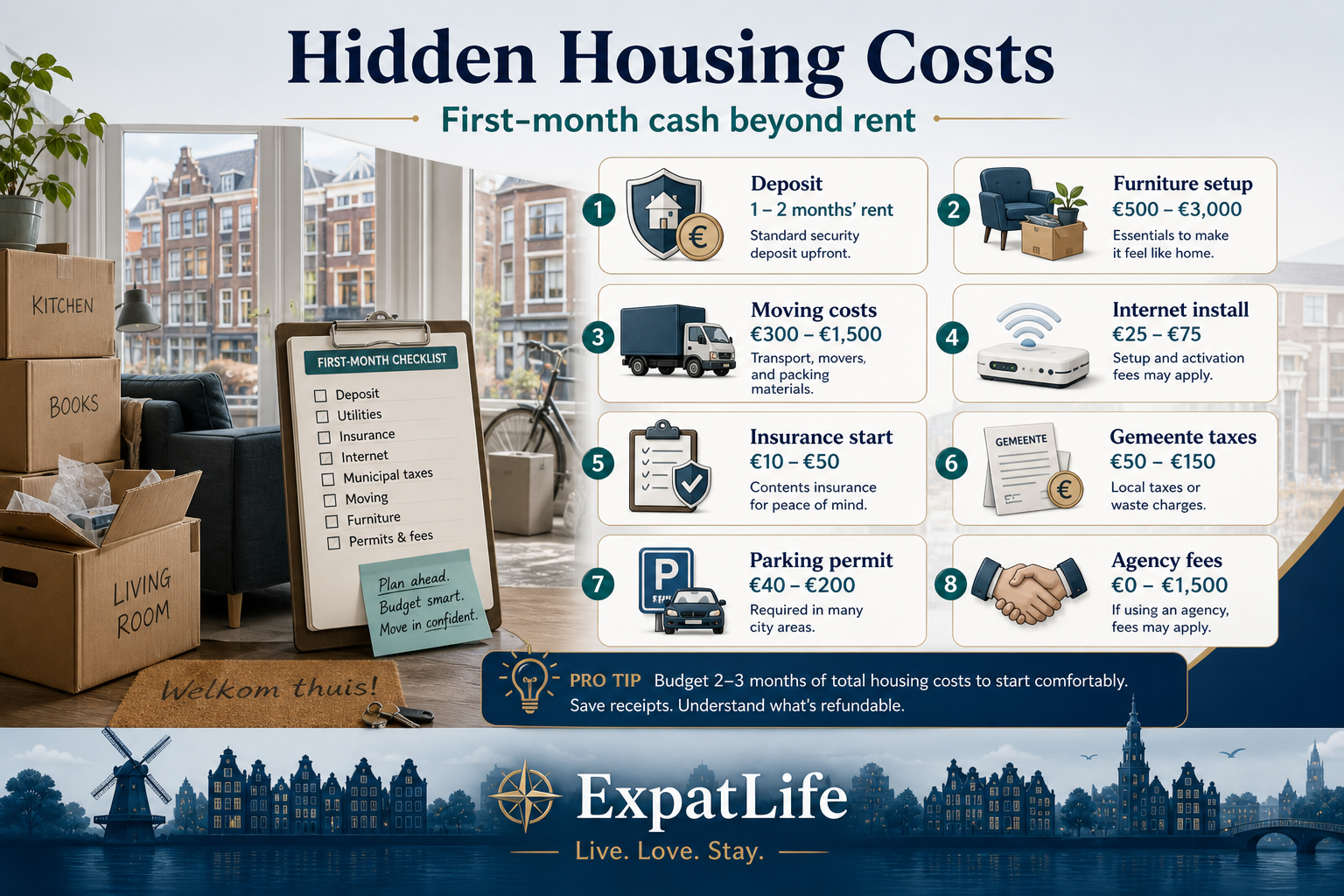
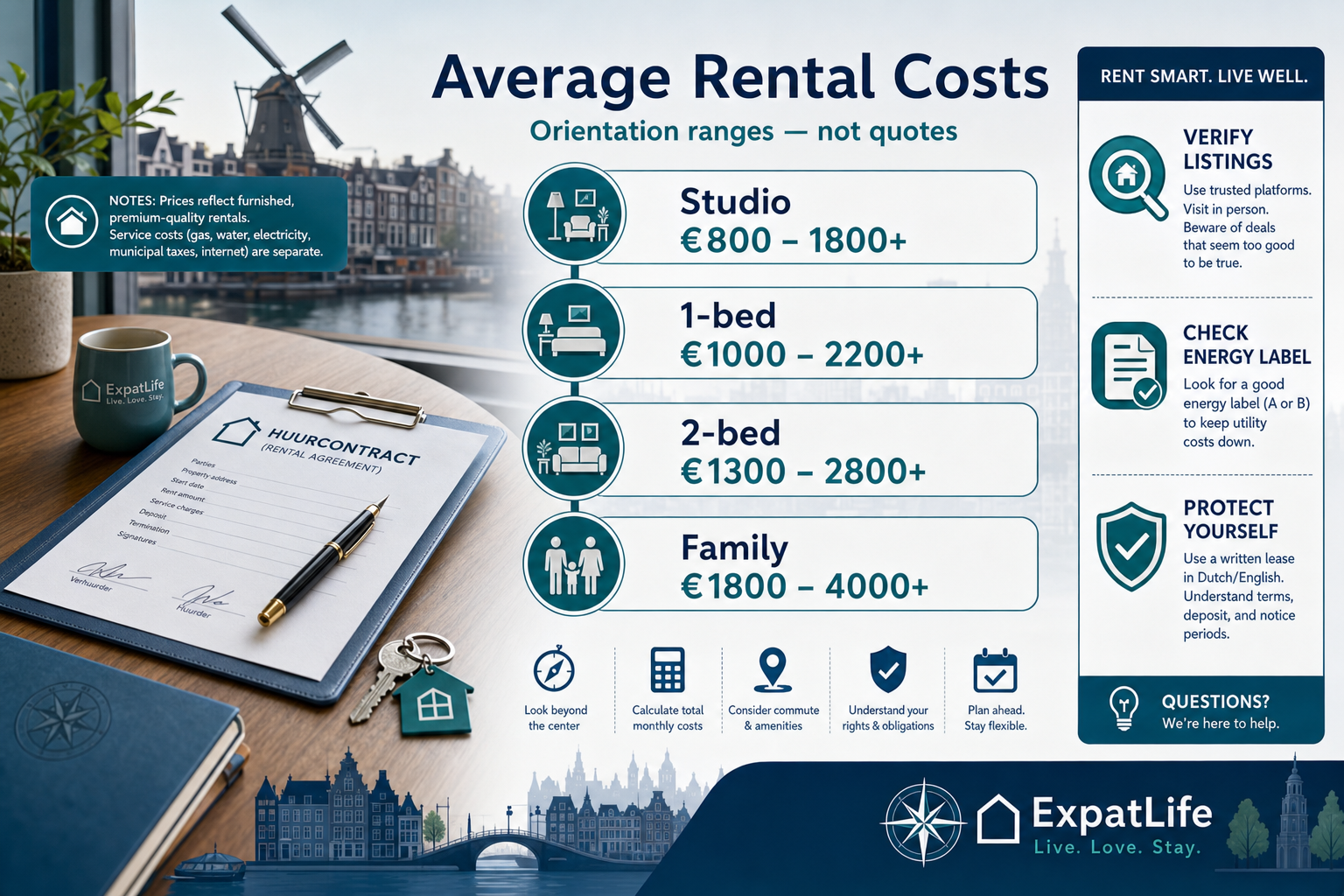
Orientation rent bands vary by city, neighbourhood and furnishing. Service costs and utilities are frequently separate from headline rent — always confirm what is included.
| Property type | Orientation range | Notes |
|---|---|---|
| Studio apartment | €800–€1,800+ / month | Amsterdam core often highest; regional cities lower |
| 1-bedroom apartment | €1,000–€2,200+ / month | Furnished and centre premiums common |
| 2-bedroom apartment | €1,300–€2,800+ / month | Family demand in Utrecht and Haarlem |
| Family home (rent) | €1,800–€4,000+ / month | Suburban space vs inner-city apartments |
Examples
| Situation | Orientation cost | Note |
|---|---|---|
| Single professional — Amsterdam studio (unfurnished) | ~€1,500 rent + €200 utilities | Centre premiums and energy label G can push utilities higher in winter. |
| Couple — Rotterdam two-bedroom suburb vs centre | €1,400 outer district vs €1,850 inner city | Commute time and parking needs often decide whether suburb savings work. |
| Family — Haarlem commuter vs Amsterdam centre | €2,100 Haarlem vs €2,600+ Amsterdam comparable space | OV commute €90–€150 monthly may still beat inner-city rent premiums. |
Buying
Buying adds kosten koper on top of the mortgage — transfer tax, notary, valuation and advice are cash needs before you bid. Ongoing owner costs follow after transfer.
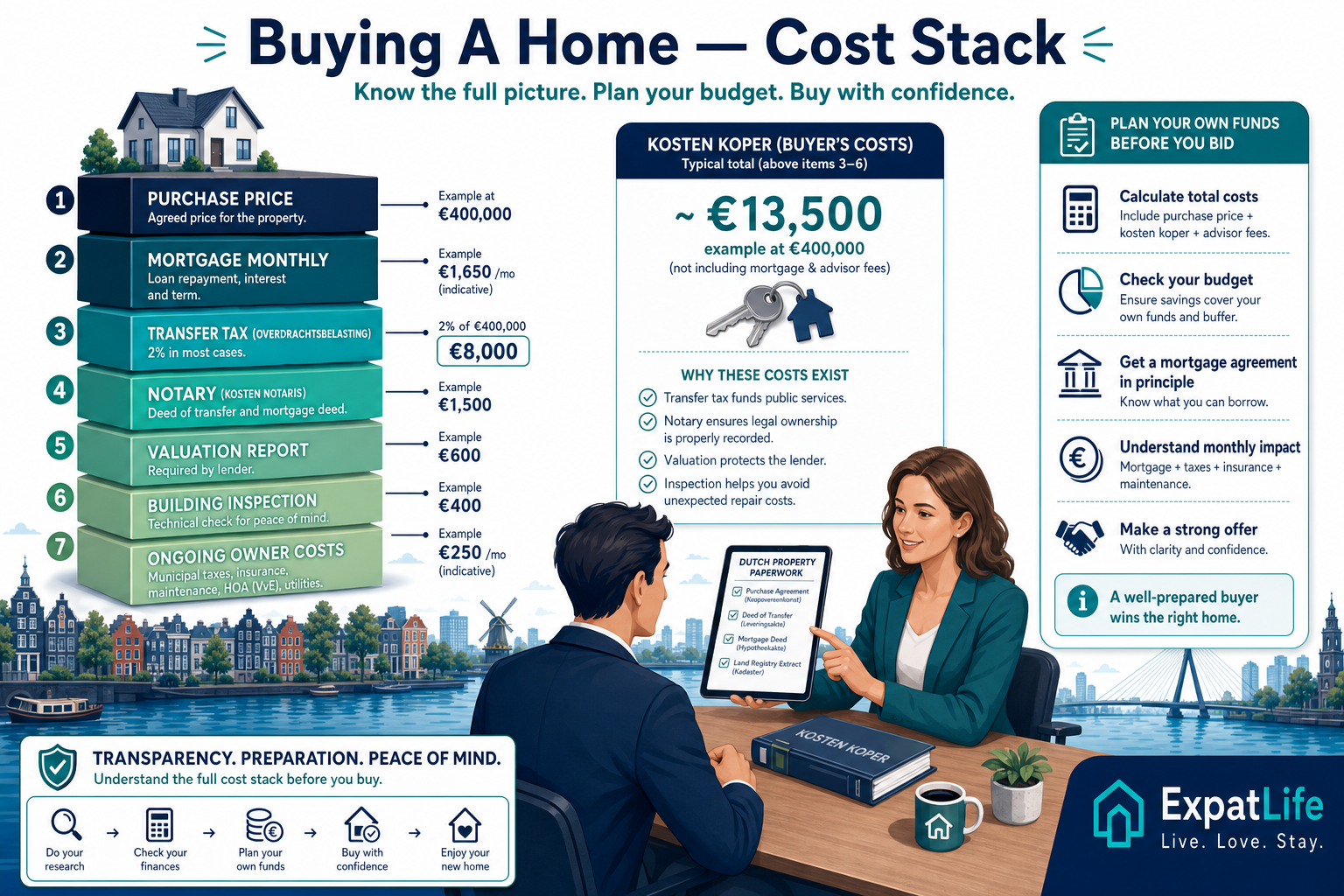
Market value varies by city — CBS and Kadaster publish trend context, not personal quotes.
Depends on rate, term, NHG eligibility and lender stress tests — see mortgage guide.
Owner-occupied often 2%; investment property higher — verify current Belastingdienst rates.
Transfer deed and mortgage deed costs — typically part of kosten koper.
Bank valuation and optional building inspection before transfer.
Maintenance, VvE, insurance and municipal taxes after purchase.
Cost breakdown
| Item | Orientation range | Notes |
|---|---|---|
| €300,000 purchase (orientation) | ~€10,000–€16,000 kosten koper | Transfer tax, notary, valuation, advice — before overbidding |
| €400,000 purchase (orientation) | ~€13,000–€22,000 kosten koper | Common Randstad benchmark for couples |
| €500,000 purchase (orientation) | ~€16,000–€28,000+ kosten koper | Higher transfer tax base; NHG cap may apply |
| Monthly owner stack (example) | Mortgage + €200–€500+ extras | Insurance, OZB, maintenance, VvE not in mortgage payment |
Examples
| Situation | Orientation cost | Note |
|---|---|---|
| First-time buyer — €400k apartment Utrecht | ~€15,000 kosten koper + €40k+ own funds | Lenders rarely finance buyer fees — cash needed before bidding. |
| Overbid €25k above asking — appraisal gap | Extra cash or lower mortgage amount | Bank lends on valuation — gap must come from savings. |
| Owner-occupied vs investment purchase | Different transfer tax rates | Verify Belastingdienst rates — investment property often higher. |
Cities
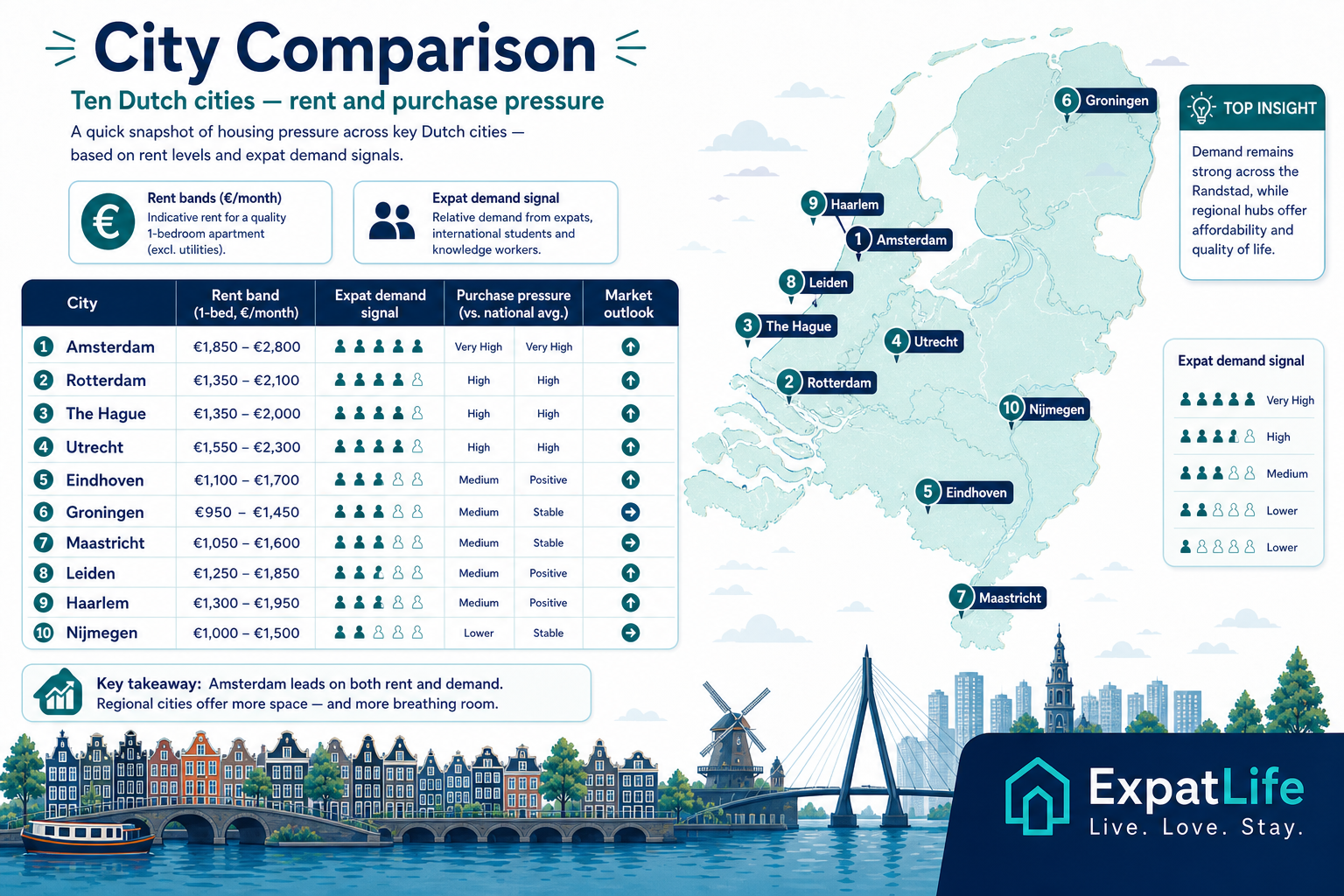
City choice often matters more than property type for your monthly budget. Compare rent bands, purchase pressure and expat demand across major Dutch markets.
| City | Typical rent | Purchase prices | Competition | Expat popularity |
|---|---|---|---|---|
| Amsterdam | €1,200–€2,800+ studio–family | High — strong bidding pressure | Very high | Highest international hub |
| Rotterdam | €900–€2,100+ studio–family | Moderate–high | High in popular districts | Growing port and tech community |
| The Hague | €950–€2,200+ studio–family | Moderate–high | High near centre and coast | Diplomats, NGOs, legal sector |
| Utrecht | €1,000–€2,400+ studio–family | High | Very high near station | University and commuter hub |
| Eindhoven | €850–€1,900+ studio–family | Moderate | Moderate–high | Tech and Brainport employers |
| Haarlem | €1,000–€2,300+ studio–family | High vs national avg | High | Amsterdam commuter lifestyle |
| Leiden | €950–€2,100+ studio–family | Moderate–high | High (students) | University and research |
| Delft | €900–€2,000+ studio–family | Moderate–high | High near TU Delft | Engineering and students |
| Groningen | €700–€1,600+ studio–family | Lower than Randstad | Moderate (student cycles) | University city in north |
| Maastricht | €750–€1,700+ studio–family | Moderate | Moderate | EU border and university |
Amsterdam
Amsterdam is usually among the priciest markets — compare commute, lifestyle and availability before assuming it is your only option.
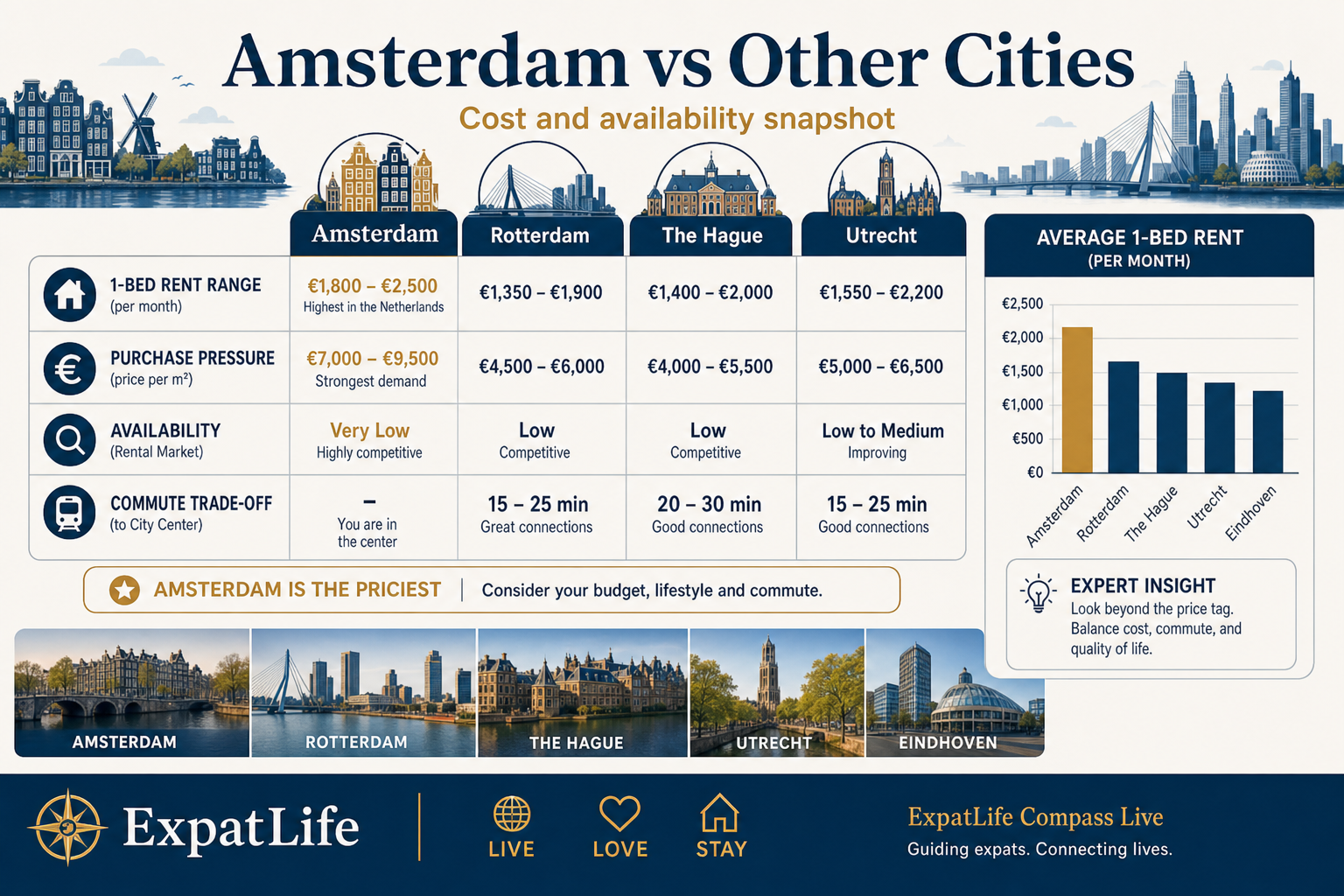
| Factor | Amsterdam | Rotterdam | The Hague | Utrecht | Eindhoven |
|---|---|---|---|---|---|
| Typical rent (orientation) | Highest national benchmarks | Often 15–30% lower for similar size | Moderate–high; coast premiums | High; strong family demand | Often better space per euro |
| Purchase competition | Very high overbidding risk | High in popular districts | Moderate–high | High near centre | Moderate |
| Availability | Tight stock; fast timelines | More variety per euro | Mixed embassy and family stock | Competitive near station | Growing supply |
| Lifestyle | International nightlife and canals | Modern urban and waterfront | Coast and institutions | Compact historic centre | Tech campus suburbs |
| Commuting | OV hub; bike-first | Good OV; port districts spread | Randstad links | Central rail hub | Car useful in suburbs |
Utilities
Electricity, gas, water, internet and municipal charges often add €150–€350+ monthly beyond headline housing costs. Energy label and household size matter materially.
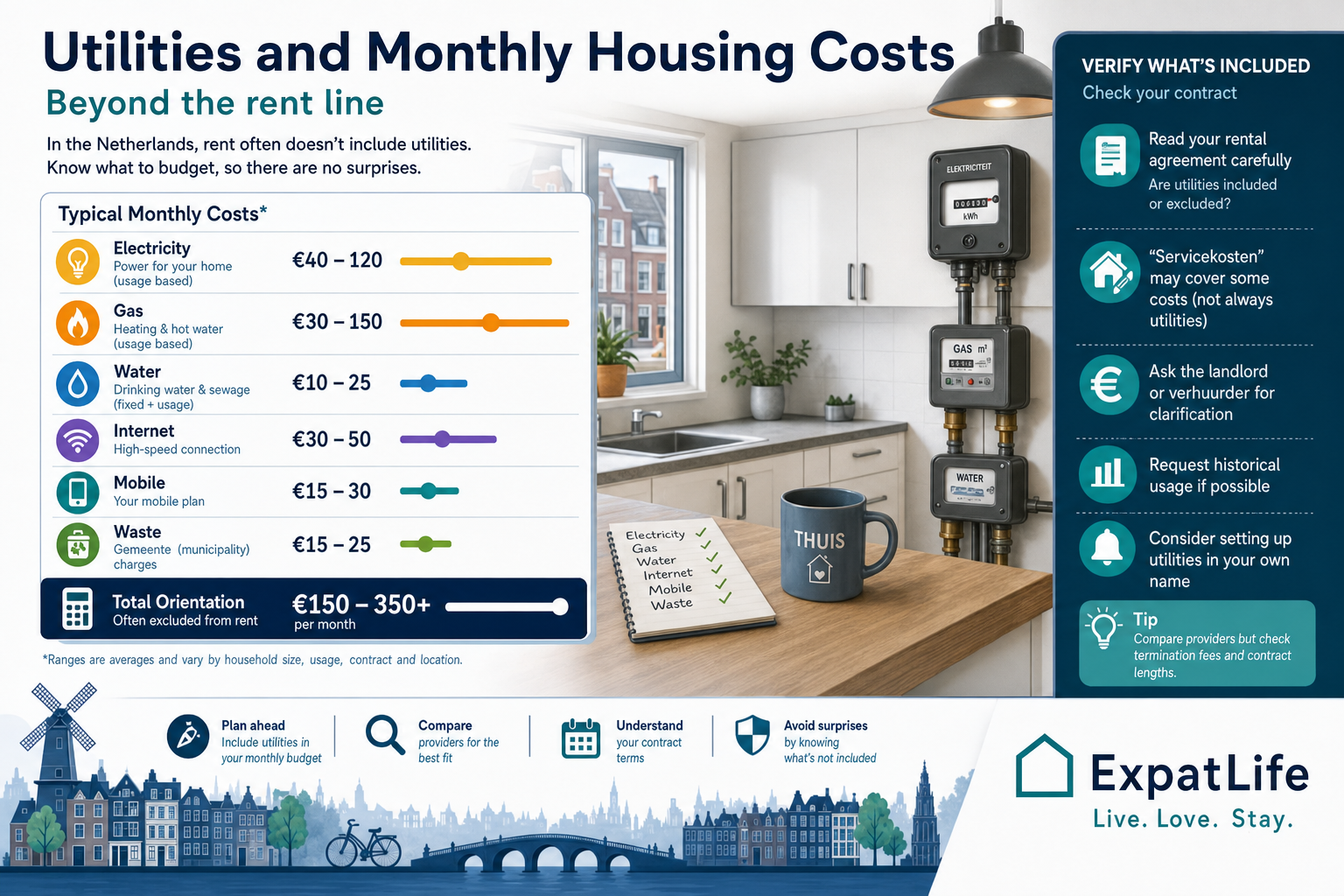
Cost breakdown
| Item | Orientation range | Notes |
|---|---|---|
| Electricity | €40–€120+ / month | Usage, label and contract type |
| Gas / district heating | €30–€150+ / month | Winter peaks on label G stock |
| Water | €10–€25 / month | Sometimes via landlord or gemeente |
| Internet broadband | €30–€50 / month | Fibre vs cable; contract terms vary |
| Mobile phone | €15–€35 / month | Often separate from home broadband |
| Waste / water board | €15–€50 / month combined | May appear on gemeente invoice |
Often €100–€250+ / month combined for apartments — energy label and usage matter.
Frequently €15–€40 / month for households; sometimes via landlord or gemeente.
Broadband €30–€50+; mobile €15–€35+ depending on bundle.
Waste collection and water board charges may appear on gemeente invoices.
Insurance
Contents insurance is common for renters; owners add building cover and higher liability buffers. Compare providers before move-in deadlines.

Cost breakdown
| Cover type | Orientation range | Notes |
|---|---|---|
| Contents (inboedel) | €10–€25 / month | Standard for renters; covers belongings |
| Liability (AVP) | €5–€15 / month | Often bundled with contents policies |
| Home / building (opstal) | €15–€40+ / month | Owners; apartments may involve VvE cover |
| Combined household | €20–€50 / month | Contents + liability bundles common |
Inboedelverzekering — common for renters; covers furniture and belongings.
Aansprakelijkheidsverzekering — often bundled; check coverage limits.
Opstalverzekering for owners; apartments may involve VvE building cover.
Taxes
Owners face recurring municipal levies on property; renters may still pay waste collection and water board charges depending on contract structure.
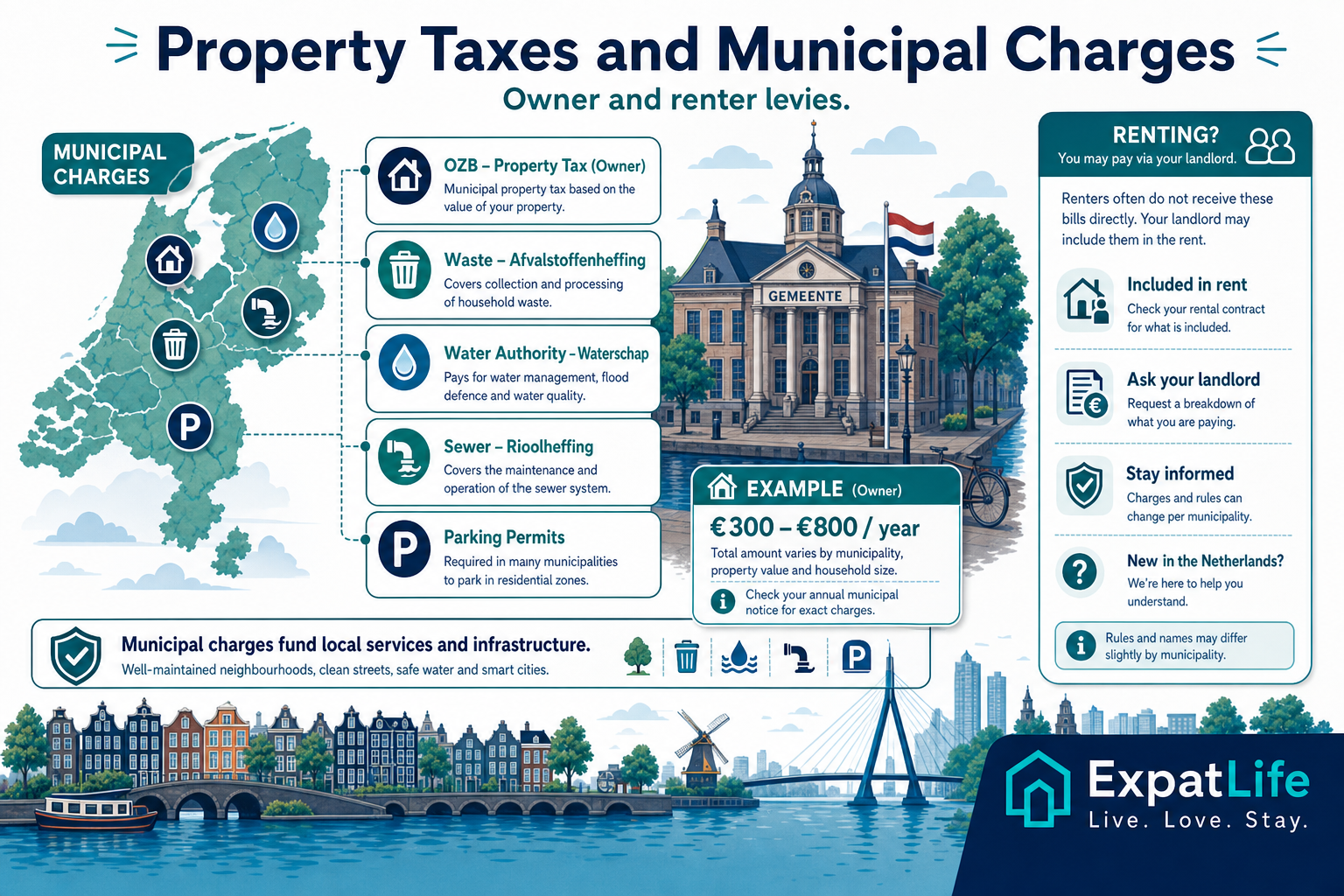
Cost breakdown
| Item | Orientation range | Notes |
|---|---|---|
| OZB (municipal property tax) | €200–€800+ / year | Owners — based on WOZ value |
| Waste (afvalstoffenheffing) | €100–€300+ / year | Owner or renter depending on contract |
| Water board (waterschap) | €100–€250+ / year | Regional levy; often per household |
| Parking permit | €300–€600+ / year | Dense districts — separate from rent |
Life stages
Students, professionals, couples, families and retirees face different cost shapes — household size, contract stability and city choice all shift the monthly stack.
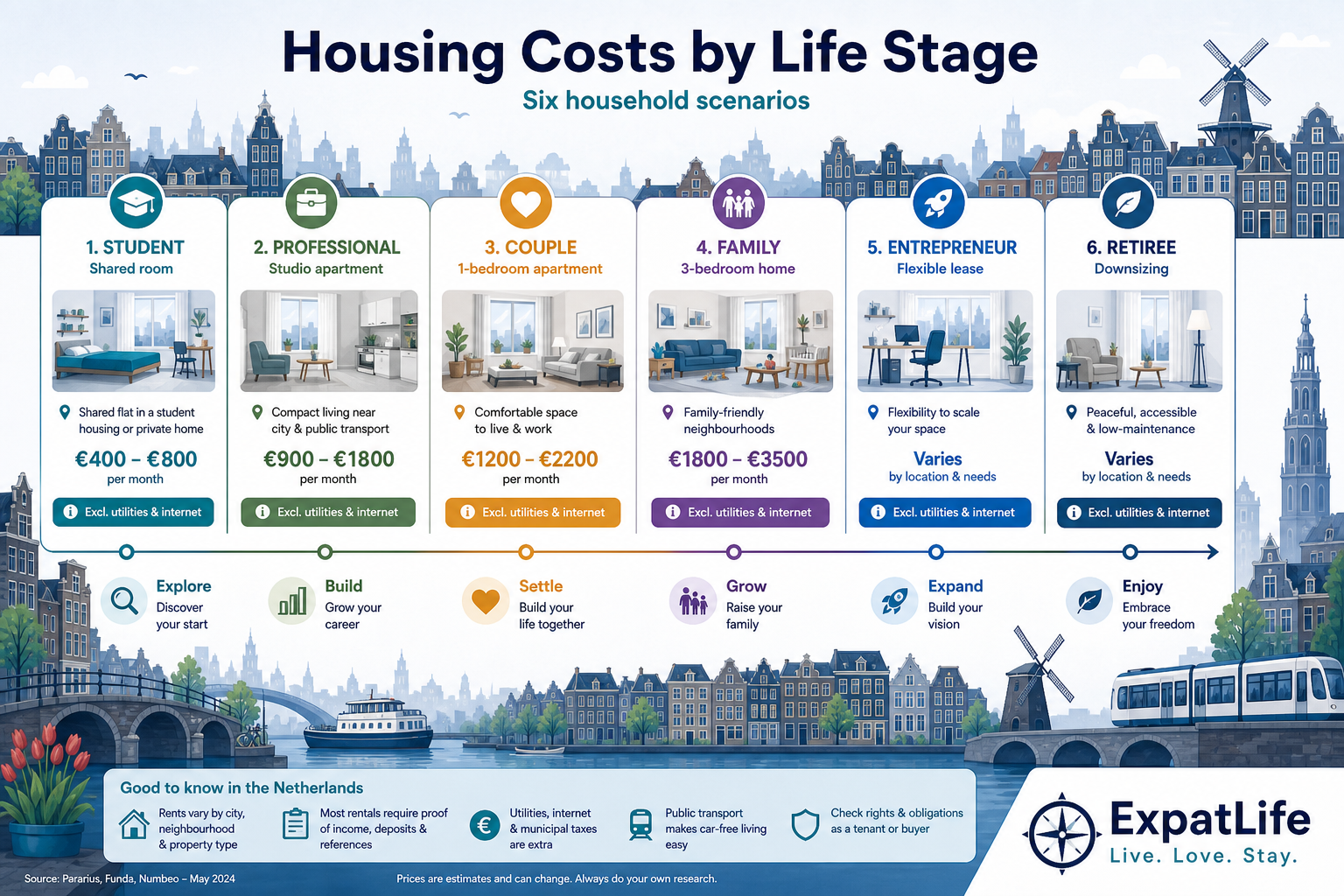
Often accept smaller studios in university cities; verify registration and contract type.
Randstad apartments with OV commute; budget utilities and furnishing.
Two-bedroom apartments in Utrecht, Rotterdam or Haarlem — shared income helps.
Suburban homes with schools and gardens; higher utilities and insurance.
Variable income — stress-test rent against conservative revenue scenarios.
Lower maintenance apartments; healthcare proximity may outweigh city centre rent.
Examples
| Situation | Orientation cost | Note |
|---|---|---|
| Student — Groningen shared room | €400–€700 rent + utilities share | Verify registration and contract type for BSN. |
| Young professional — Amsterdam studio | €1,400–€1,800+ total stack | Utilities and furnishing add materially to headline rent. |
| Couple — Rotterdam two-bedroom | €1,600–€2,100 total stack | Shared income unlocks larger apartments earlier. |
| Family — Hague suburban rental | €2,200–€2,800+ total stack | School zones and garden space drive premiums. |
| Entrepreneur — flexible lease | Stress-test at 70% revenue | Variable income needs conservative rent cap. |
| Retiree — downsized apartment | €900–€1,400 total stack | Healthcare access may outweigh lowest rent option. |
Property types
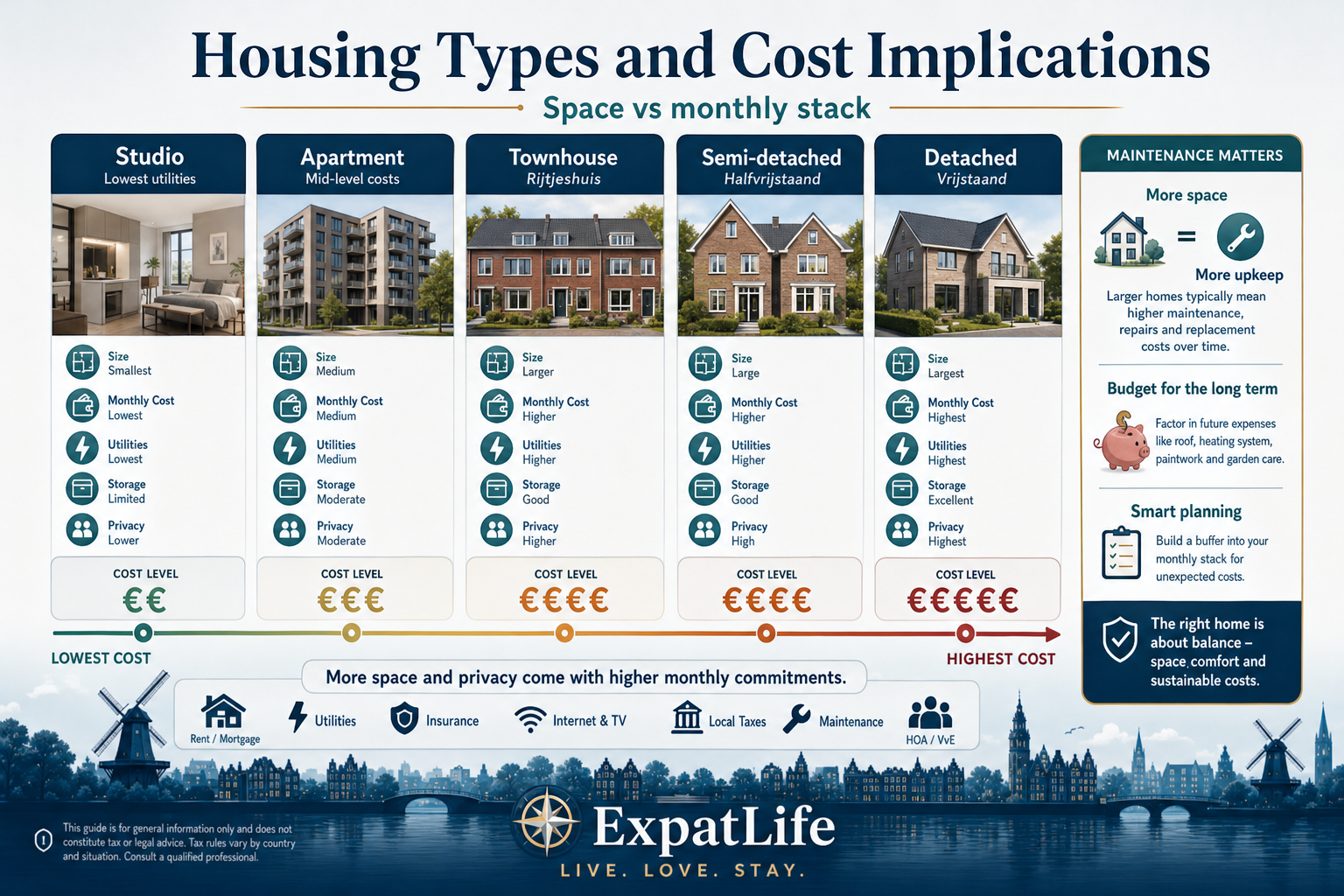
Studios minimise rent but limit growth; houses add garden maintenance and higher utilities. Parking is often a separate monthly charge in cities.
Cost breakdown
| Property type | Orientation range | Notes |
|---|---|---|
| Studio | €800–€1,800+ rent | Lowest rent band; high cost per m² for utilities |
| Apartment (2-bed) | €1,300–€2,800+ rent | VvE fees if buying; service costs if renting |
| Townhouse (rijtjeshuis) | €1,600–€3,200+ rent | Garden maintenance and parking permits |
| Semi-detached | €1,800–€3,500+ rent | Suburban; higher heating on older stock |
| Detached house | €2,200–€4,500+ rent | Highest utilities and maintenance responsibility |
Lowest rent band but limited space; utilities per m² can be high.
Common expat choice; check VvE fees if buying; service costs if renting.
More space; higher utilities and often parking permits.
Family suburbs; garden maintenance adds monthly equivalent cost.
Highest space and maintenance; strongest in commuter municipalities.
Affordability
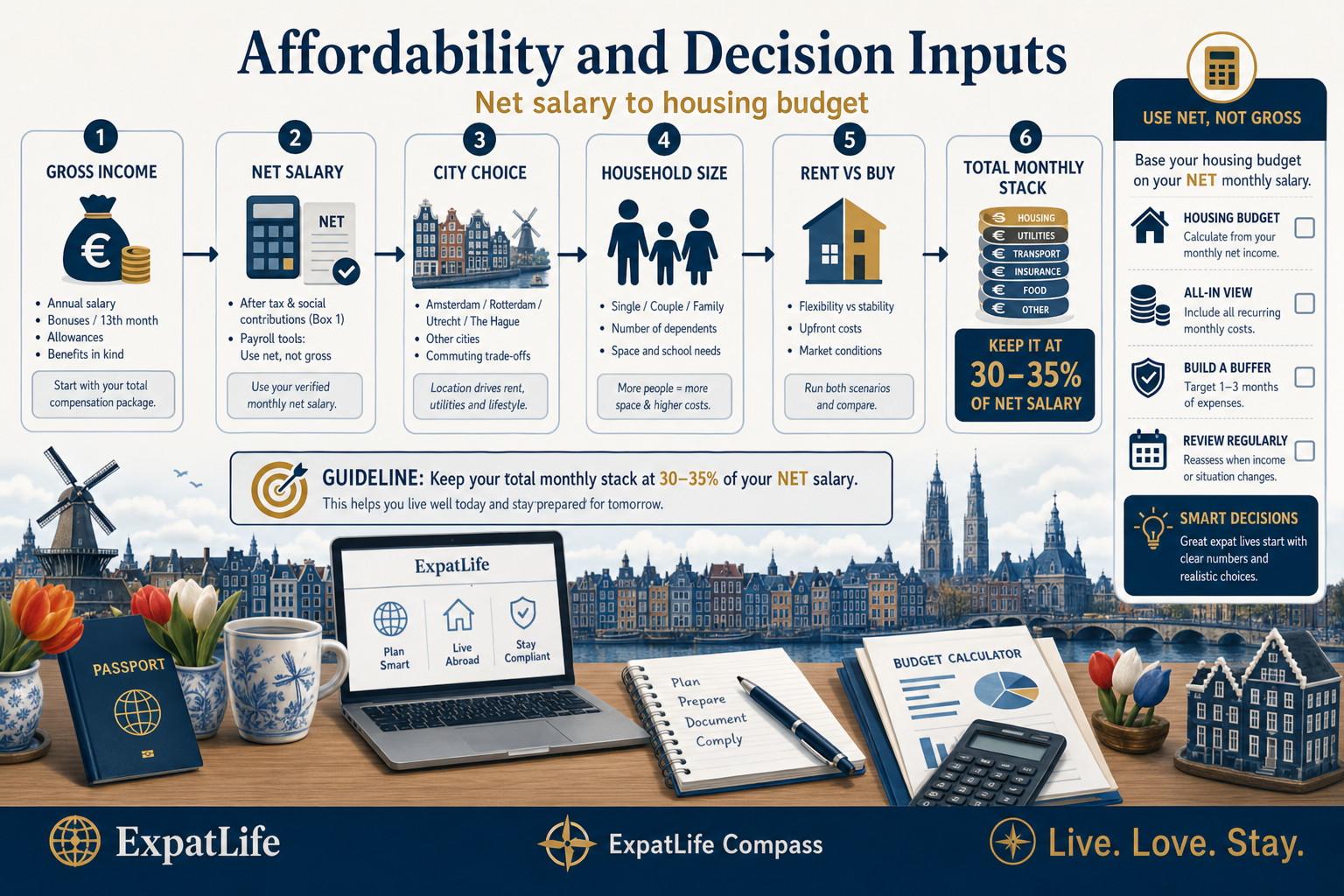
Dutch lenders and landlords effectively test affordability against income, household size and existing debts. A common orientation for rent is that total housing costs should remain comfortable within net household income — many expats target roughly 30–35% of net income for the full housing stack, not headline rent alone.
Buying affordability is assessed separately through mortgage stress tests, NHG limits and kosten koper cash requirements. Use net salary tools and mortgage orientation before treating online listing prices as achievable.
Examples
| Situation | Orientation cost | Note |
|---|---|---|
| €4,500 gross salary — single professional | Net ~€3,200 → cap ~€960–€1,100 housing stack | Use net salary — 30–35% guideline applies to rent + utilities + insurance. |
| Couple €7,000 gross — rent vs buy decision | Mortgage capacity vs €2,000+ rent stack | Lenders stress-test income; kosten koper cash sits outside monthly mortgage. |
| Student shared room — lower income band | €400–€800 room + utilities share | Check huurtoeslag eligibility thresholds if income and rent qualify. |
Budgets
Illustrative stacks for common expat profiles — adjust for your city, energy label and commute pattern. These are planning examples, not quotes.
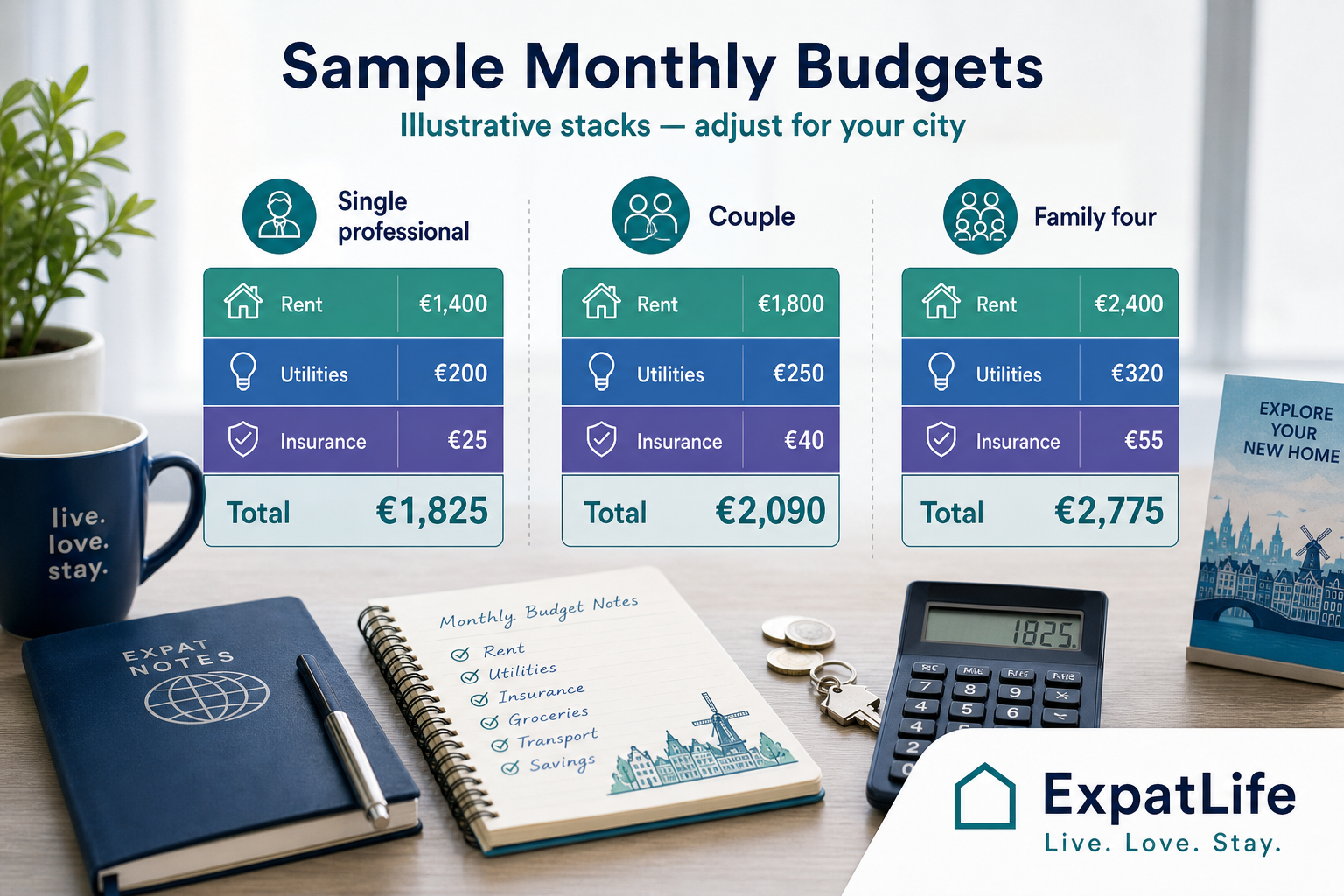
| Profile | Housing | Utilities | Insurance | Transport | Notes |
|---|---|---|---|---|---|
| Single professional — Rotterdam apartment | €1,400 rent + €120 service | €180 energy/water/internet | €25 contents | €90 OV | Illustrative — centre vs suburb shifts rent by €200–€400. |
| Couple — Utrecht two-bedroom | €1,850 rent | €220 combined | €40 contents + liability | €120 OV + bike | Parking add €80–€150 if required. |
| Family of four — suburban Hague | €2,400 rent | €280 energy + water | €55 home contents | €180 OV + car | School zone premiums can add €200+ vs outer districts. |
Avoidable mistakes
Rent-only budgeting is the most common gap — utilities, insurance, taxes and setup cash follow quickly after signing.
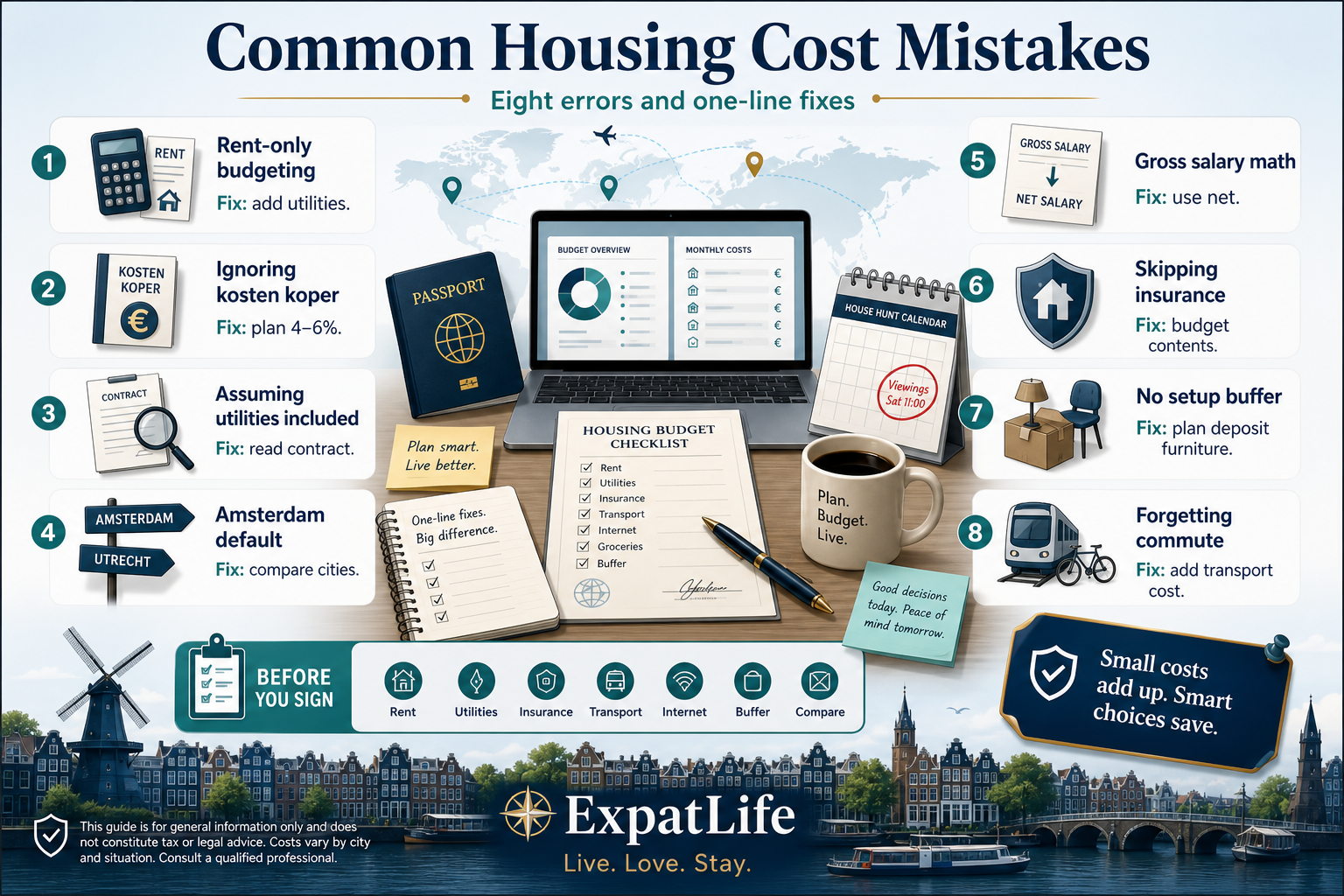
Utilities, insurance and service costs change the real monthly stack.
Poor energy labels can add €100+ monthly vs efficient homes.
Deposit plus furnishing often exceeds one month of rent.
Commuter cities may cut housing costs 20–40% with workable OV links.
Cheaper rent plus long commute can erase savings.
Gemeente invoices arrive separately from rent or mortgage.
Contents insurance is cheap relative to uncovered loss risk.
Repairs, deposit disputes and job gaps need cash reserves.
Fixes
| Mistake | What to do instead |
|---|---|
| Budgeting only headline rent | Add utilities, insurance, service costs and parking to monthly stack. |
| Ignoring energy label at viewing | Ask for label and estimate — label G can add €100+ monthly in winter. |
| Assuming Amsterdam is the only option | Compare total stack in Rotterdam, Hague, Haarlem or Utrecht satellites. |
| Skipping kosten koper planning | Budget 4–6% buyer cash separately from mortgage down payment. |
| No setup cash buffer | Plan deposit + furnishing + moving before first month's rent transfer. |
| Forgetting commute cost | Add OV, car and parking to location comparison spreadsheet. |
| Skipping contents insurance | Quote €10–€25/month cover before key handover. |
| No emergency fund after move | Keep 2–3 months housing stack in savings beyond deposit cash. |
Checklist
Run this list before lease or mortgage commitment — not after moving in.
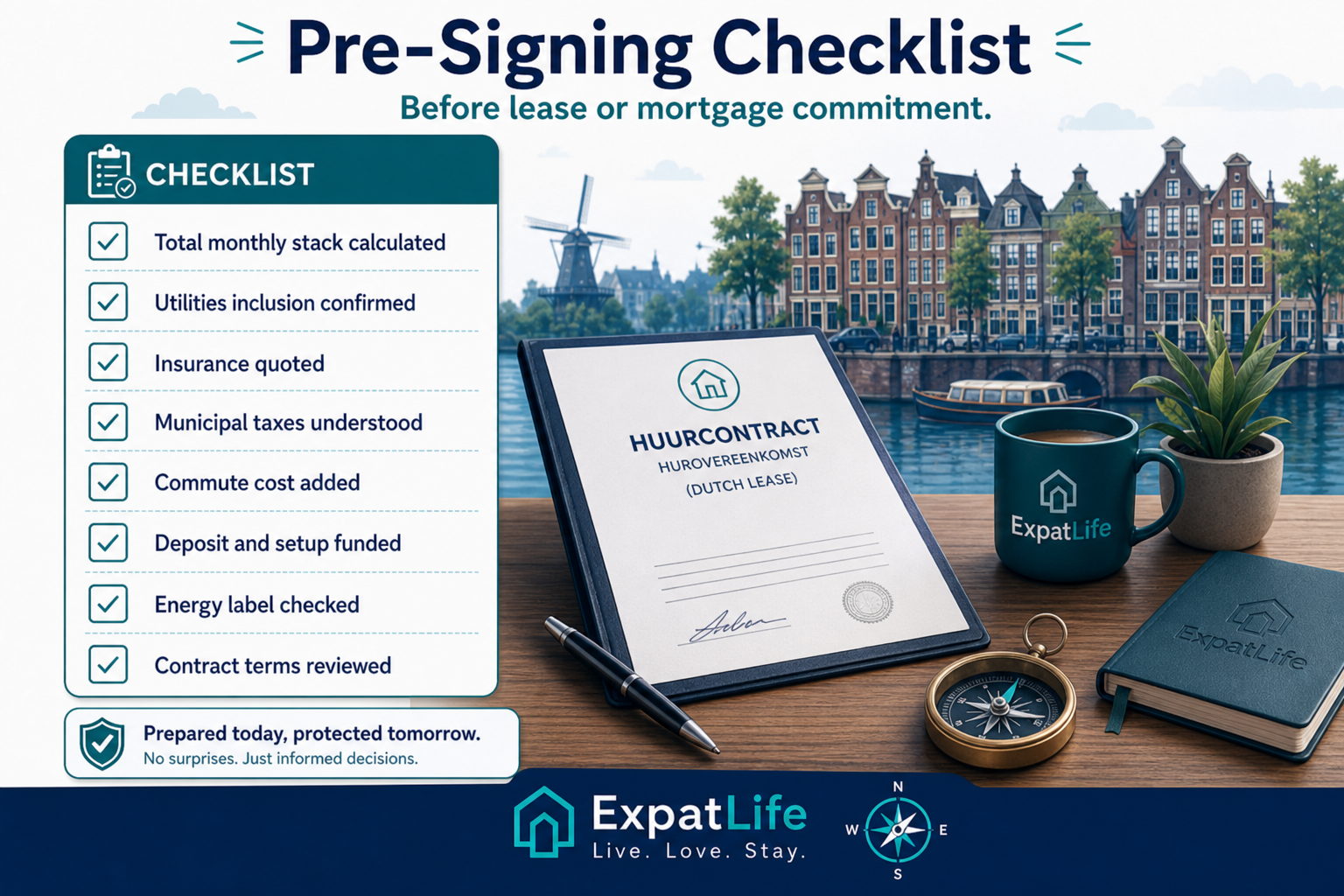
Before search
Rent or mortgage + utilities + insurance + parking + commute.
At viewing
Electricity, gas, water, internet, waste — ask what is included.
Before signing
Contents and liability for renters; building cover for owners.
Before signing
Waste, water board and parking permit responsibility.
Before transfer
Deposit, furnishing, moving, energy supplier deposit.
Before narrowing search
Total stack including commute — not headline rent alone.
At viewing
Label A–G materially affects winter utility bills.
After move-in
Adjust budget with real data after 2–3 months.
Quick checklist summary
FAQ
Quick answers to the questions expats ask before relocating — verify live listings and official data for your target city.

Orientation ranges vary widely: studios from roughly €800 in smaller cities to €1,800+ in Amsterdam centre; family homes can exceed €3,000 in Randstad hotspots. Always verify live listings for your target neighbourhood.
Amsterdam is generally among the most expensive Dutch housing markets for both rent and purchase. Many expats compare Rotterdam, The Hague, Utrecht satellite towns or Haarlem for lower monthly stacks with workable commutes.
There is no single cheapest city — Groningen, Maastricht and parts of Limburg often offer lower rents, while satellite towns around Randstad cities trade commute time for space. Compare total monthly stack, not headline rent alone.
Many households pay roughly €150–€350+ monthly for energy, water, internet and mobile combined, depending on property size, energy label and usage. Poor insulation increases heating costs materially.
Deposit, furnishing, moving, insurance, municipal charges, parking permits and utility activation deposits commonly surprise newcomers who budget only headline rent.
Many expats may qualify depending on residency, employment contract, income stability and lender policy — but kosten koper cash and NHG limits still apply. See the mortgages for expats guide and AFM-regulated advice.
Lenders and landlords assess net income, debts and household size. Orientation: keep total housing stack comfortable within net income — many households target roughly 30–35% for all housing-related costs.
Not always. Buying adds upfront kosten koper, maintenance and market risk; renting preserves flexibility. Compare total cost over your expected stay horizon using the buy vs rent guide.
Market data changes quarterly — check publication dates on official statistics before making decisions.
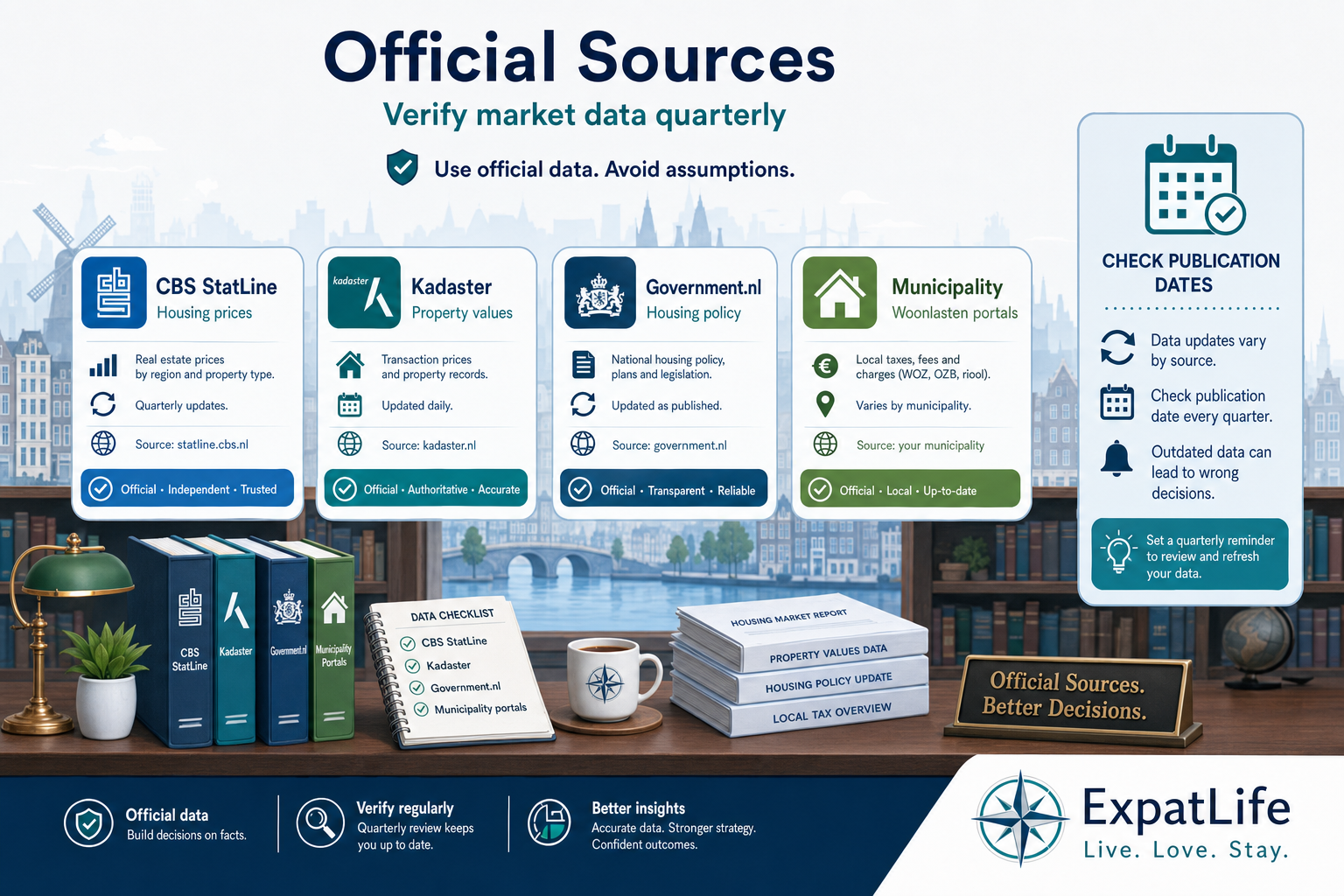
Housing prices and rental costs change regularly. Always verify current market conditions using official statistics, live listings and local municipality sources before making decisions.
How to use these resources
Continue into renting, buying, mortgages, utilities and insurance guides to complete your housing setup.
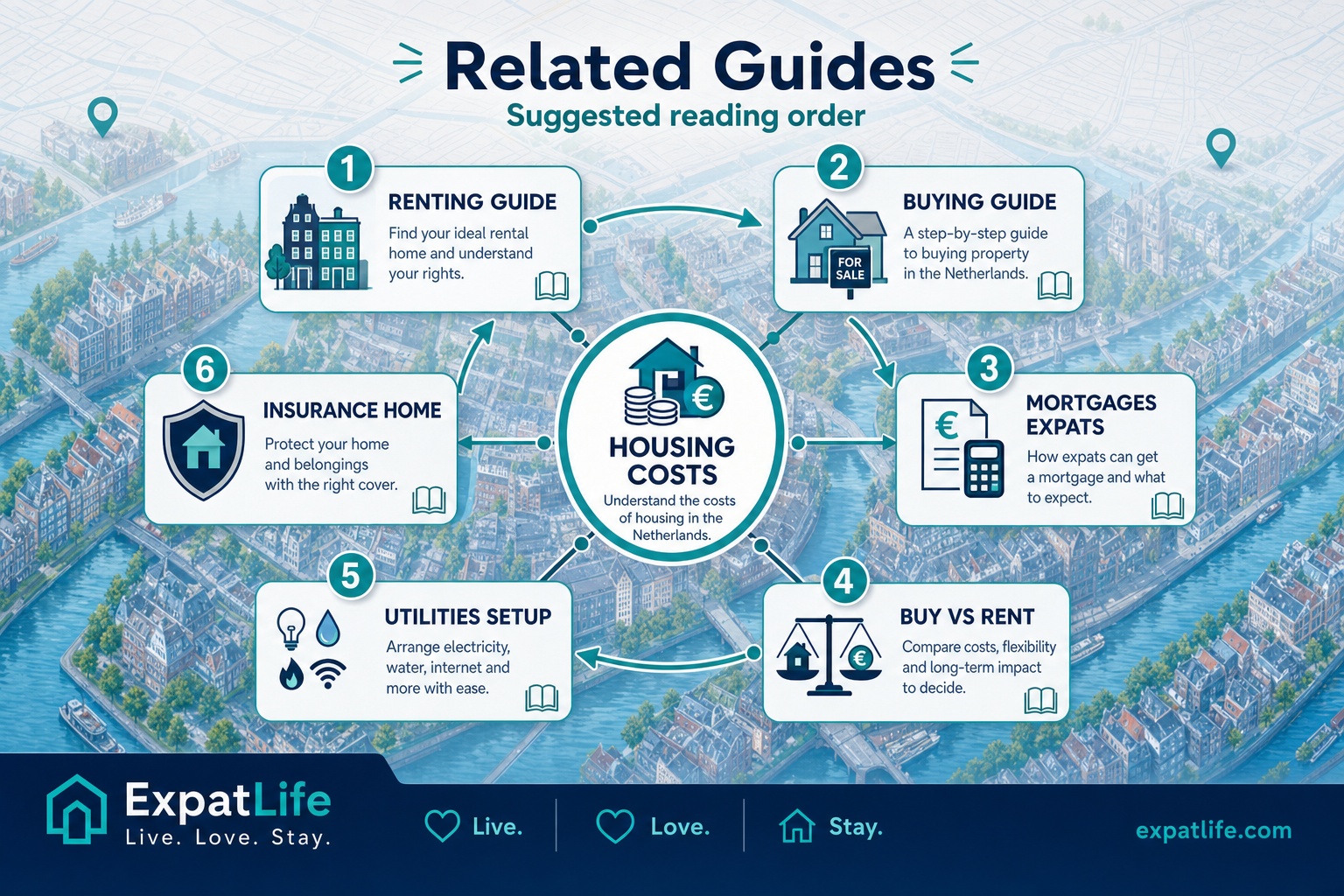
Explore next
Pick the guide that matches your next housing decision — renting, buying, mortgage, utilities or insurance.