
First contact
Huisarts (GP)
Illness, prescriptions and most referrals start at the family practice.
Netherlands · Health · Primary Care
How Dutch GPs work for expats — registration, appointments, referrals, prescriptions, home visits, out-of-hours care and what to expect from the huisarts system.
General orientation only — not medical advice, diagnosis or treatment recommendations. For individual concerns, contact a GP, the huisartsenpost or emergency services. Always verify coverage with your insurer.

Quick answer
The Dutch huisarts is the centre of gravity in primary care. For everyday illness, injuries, prescriptions, chronic condition follow-up and most first assessments of new symptoms, the family doctor is where care starts. Practices are local by design: most accept patients living within a defined catchment area around the practice, so your postcode matters more than a preferred brand name.
What often surprises newcomers is not the quality of care but the structure. Appointments are typically short and triaged by a trained practice assistant (doktersassistent). Specialists are usually reached through a referral rather than booked directly. Out-of-hours care starts with a phone call to the huisartsenpost rather than a walk-in at the hospital emergency department.
This guide is orientation for expats: how the system works, how to register, how to book and prepare for a consult, how referrals and prescriptions work, when home visits apply, how out-of-hours and emergency routes differ, and what commonly feels different if you arrive from another healthcare culture. It is not medical advice — for anything about your own health, speak to a GP, the huisartsenpost or, in an emergency, call 112.
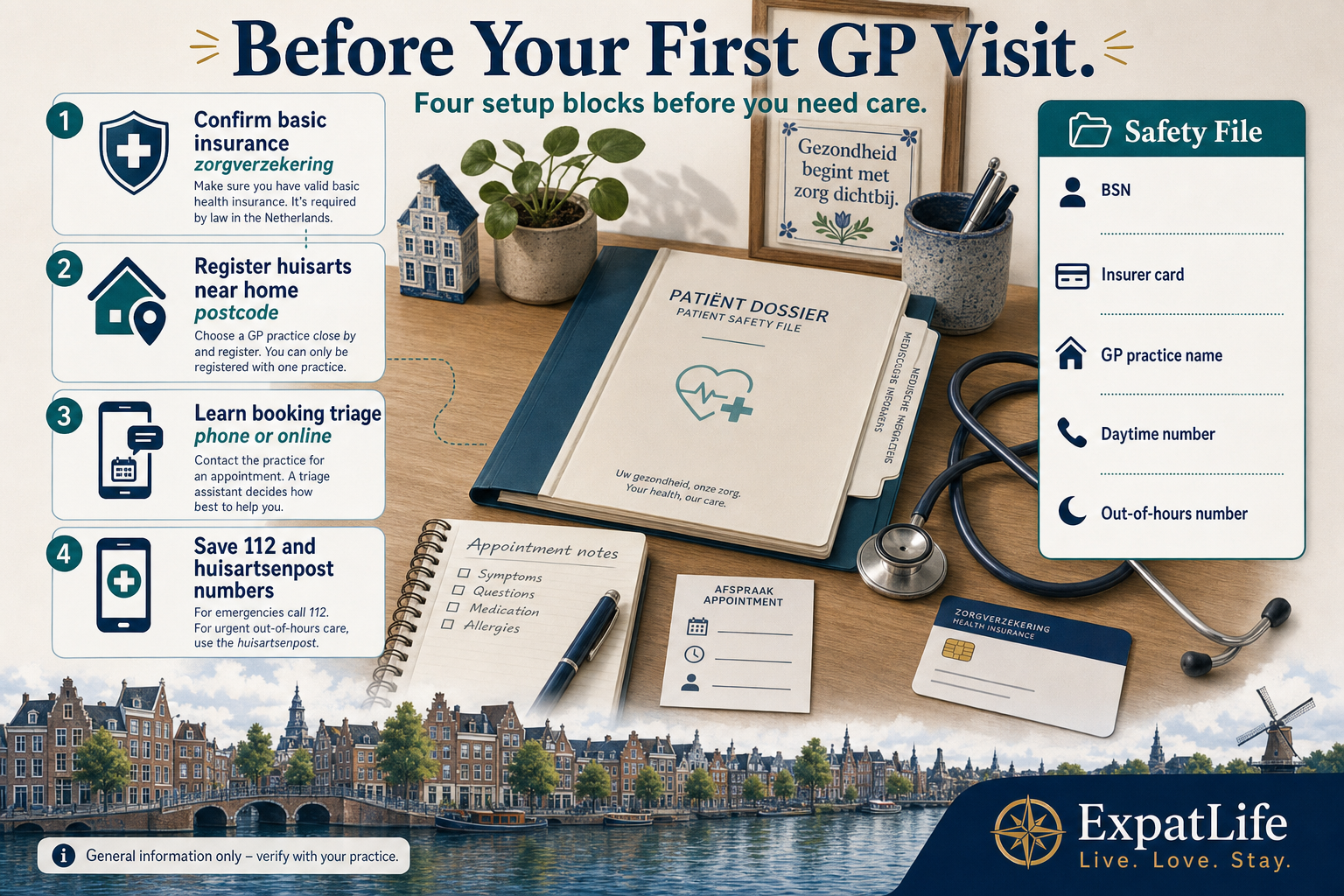
Safety file — keep these together
Examples
| Situation | How it works here | First step |
|---|---|---|
| Just arrived and not yet registered | Finish municipal registration and insurance first, then search huisarts practices by postcode that are accepting patients. | Confirm BSN and insurer details, then complete the practice aanmelden form. |
| Need care tonight and the practice is closed | For urgent but not life-threatening problems, call the regional huisartsenpost; for life-threatening situations call 112. | Save both numbers in your phone before the first evening you need them. |
| Want to see a specialist directly | In most cases you start with the GP, who assesses and writes a referral when specialist care is indicated. | Book a GP consult and explain why you believe specialist assessment is needed. |
| Managing a chronic condition from abroad | Continuity depends on a written handover — the Dutch GP builds the file from your summary and then coordinates repeats and referrals. | Bring an English or Dutch medical summary plus current prescriptions with generic names. |
Snapshot
Almost every question expats ask about the huisarts fits into one of these six blocks. Read them once now, then use the detailed sections below when you need the specifics.
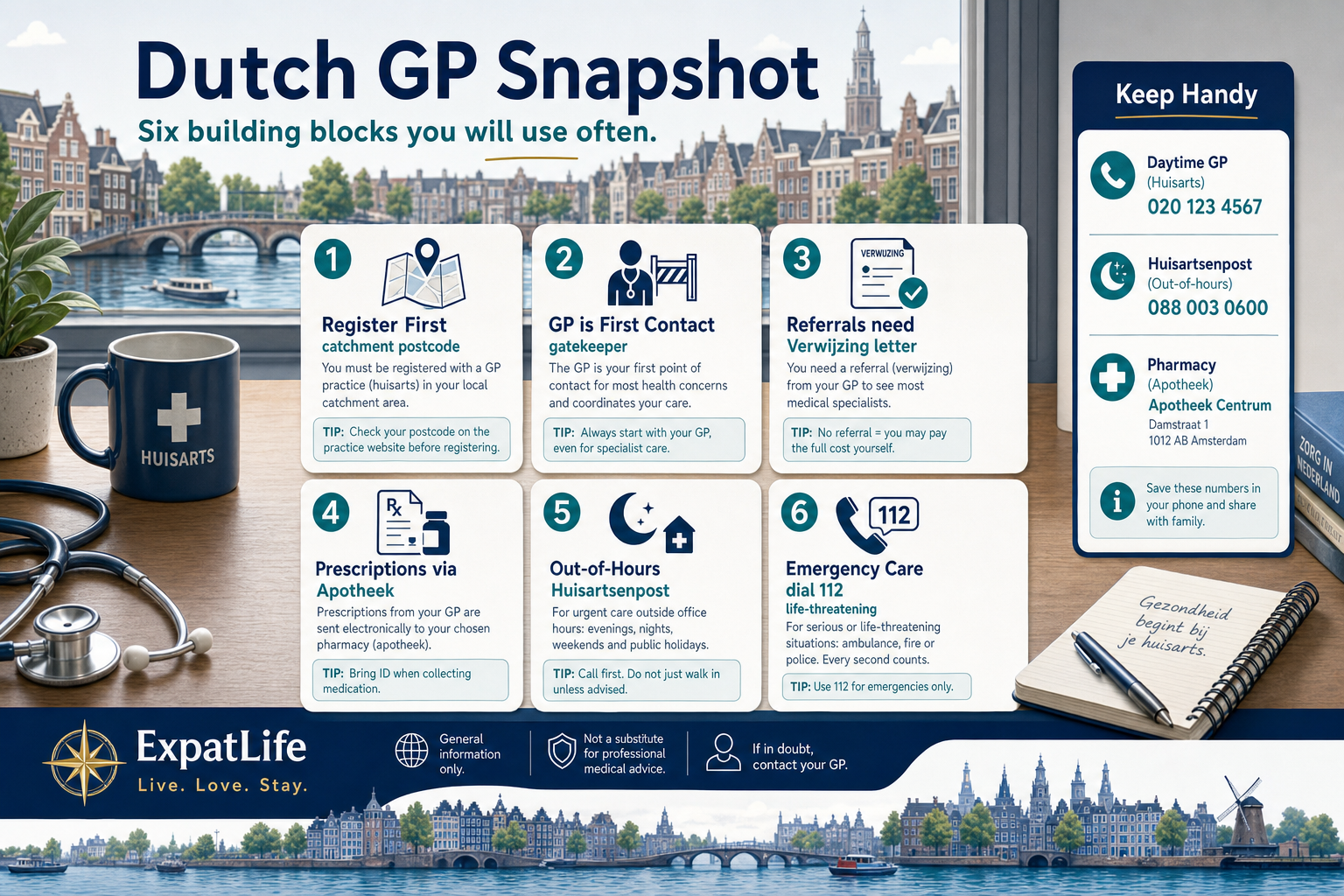
First contact
Huisarts (GP)
Illness, prescriptions and most referrals start at the family practice.
Registration
Local catchment
Most practices accept patients living near the practice only.
Specialists
Referral letter
A verwijzing is usually required for hospital and specialist care.
Out of hours
Huisartsenpost / 112
Call the GP post for urgent care; call 112 for life-threatening emergencies.
Your GP assesses new symptoms, treats what can be treated in the practice, and writes the referral that unlocks most specialist and hospital care.
You usually register with one practice near home. Closed lists are common in busy cities — ask which nearby practices are accepting patients.
A standard consult is often around ten minutes. A practice assistant asks what the problem is before you get a slot — clear facts help.
Hospital outpatient clinics and many specialists expect a referral letter from your GP. Keep a copy for your own records.
Prescriptions usually go digitally to your registered apotheek. Over-the-counter basics sit at the drogist; prescribed medicines at the pharmacy.
Evenings and weekends: call the huisartsenpost for urgent GP-level care. Life-threatening situations: call 112 immediately.
How it works
Dutch primary care is organised around the huisarts as both clinician and coordinator. You contact the practice for most non-emergency problems. The practice assesses urgency, offers advice, a phone consult, an e-consult or an in-person appointment, and treats what belongs in general practice.
When specialist assessment, diagnostics or hospital treatment are needed, the GP writes a referral letter (verwijzing). That letter is what most hospitals use to book and to bill your insurer. The design keeps continuity with one doctor who knows your history, and it means the quality of your GP relationship matters more than in systems where patients book specialists directly.
Outside practice hours, urgent GP-level care moves to the regional huisartsenpost. Life-threatening emergencies go straight to 112. Understanding which door to use — daytime GP, out-of-hours post, or emergency services — removes most of the stress newcomers feel on the first difficult evening.
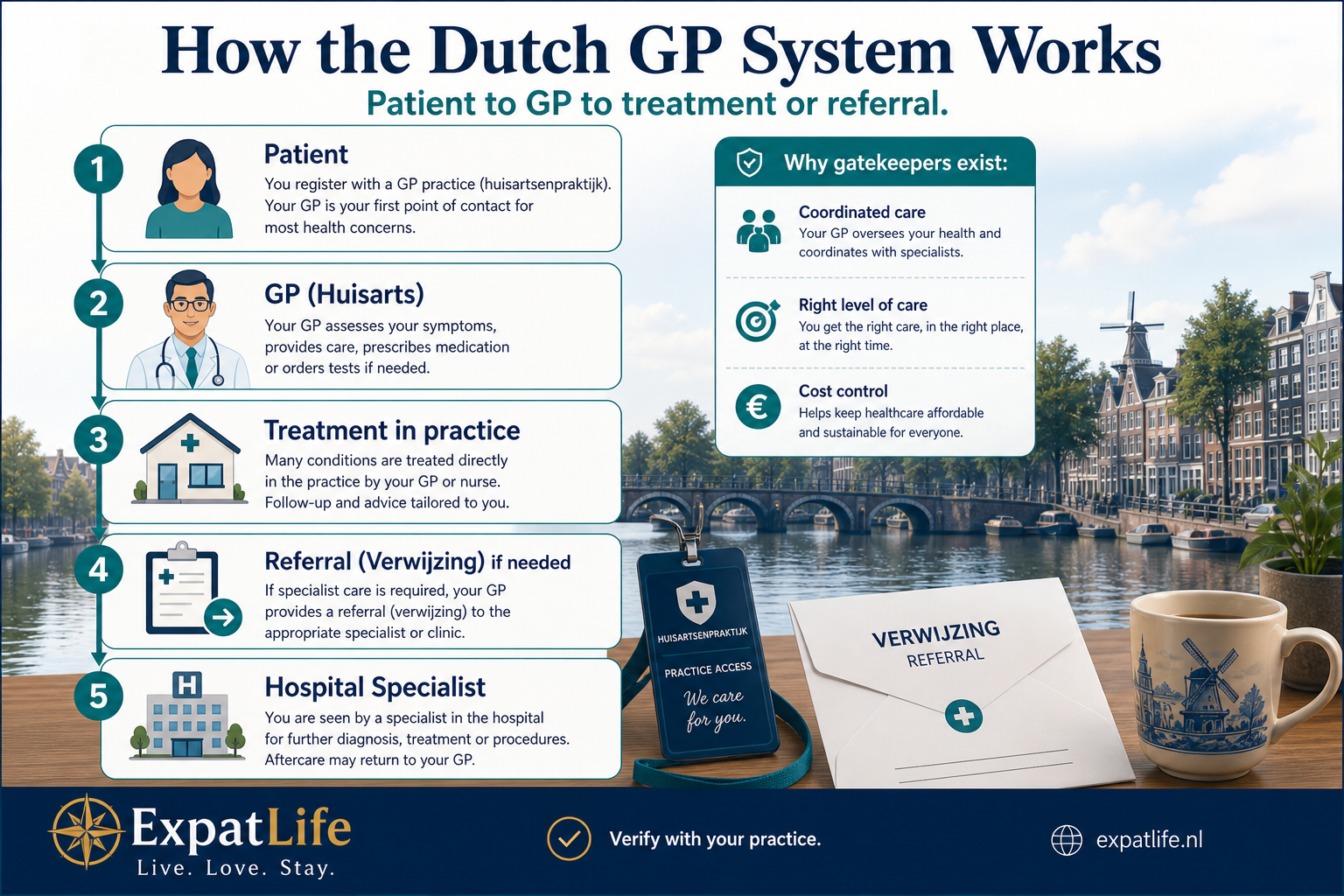
Step 1
New symptoms, follow-up, prescriptions, chronic condition questions or a worry that something needs checking.
Step 2
Call, use online booking or send an e-consult. A practice assistant triages urgency and the type of contact needed.
Step 3
In person, by phone or via e-consult, the GP assesses the problem, explains the working plan and agrees what should trigger a return visit.
Step 4
Many issues are treated entirely in general practice — advice, monitoring, prescriptions, minor procedures or practice-nurse follow-up.
Step 5
If specialist or hospital care is indicated, the GP writes a referral letter that unlocks the next step in the insured system.
Step 6
The hospital or clinic books from the referral. Letters ideally copy back to your GP so coordination stays in one place.
If you believe specialist assessment is needed, say so explicitly and ask what would need to be true for a referral. Asking directly is normal here — it is not considered rude.
Role
A huisarts is a fully trained medical doctor specialising in general practice. The role covers a wide range of first-line care: infections, injuries, skin problems, musculoskeletal complaints, women's and men's health questions, chronic disease follow-up, preventive advice and first assessment of mental health concerns.
Many practices also include practice nurses and a mental health practice nurse (POH-GGZ). That team model means some follow-up happens with a nurse rather than always with the doctor — which is a normal feature of Dutch primary care, not a lower tier of care.
What the GP generally does not do is replace hospital emergency departments for life-threatening events, or act as a direct booking desk for every specialist preference. The value of the role is continuity, triage and coordination across the rest of the system.
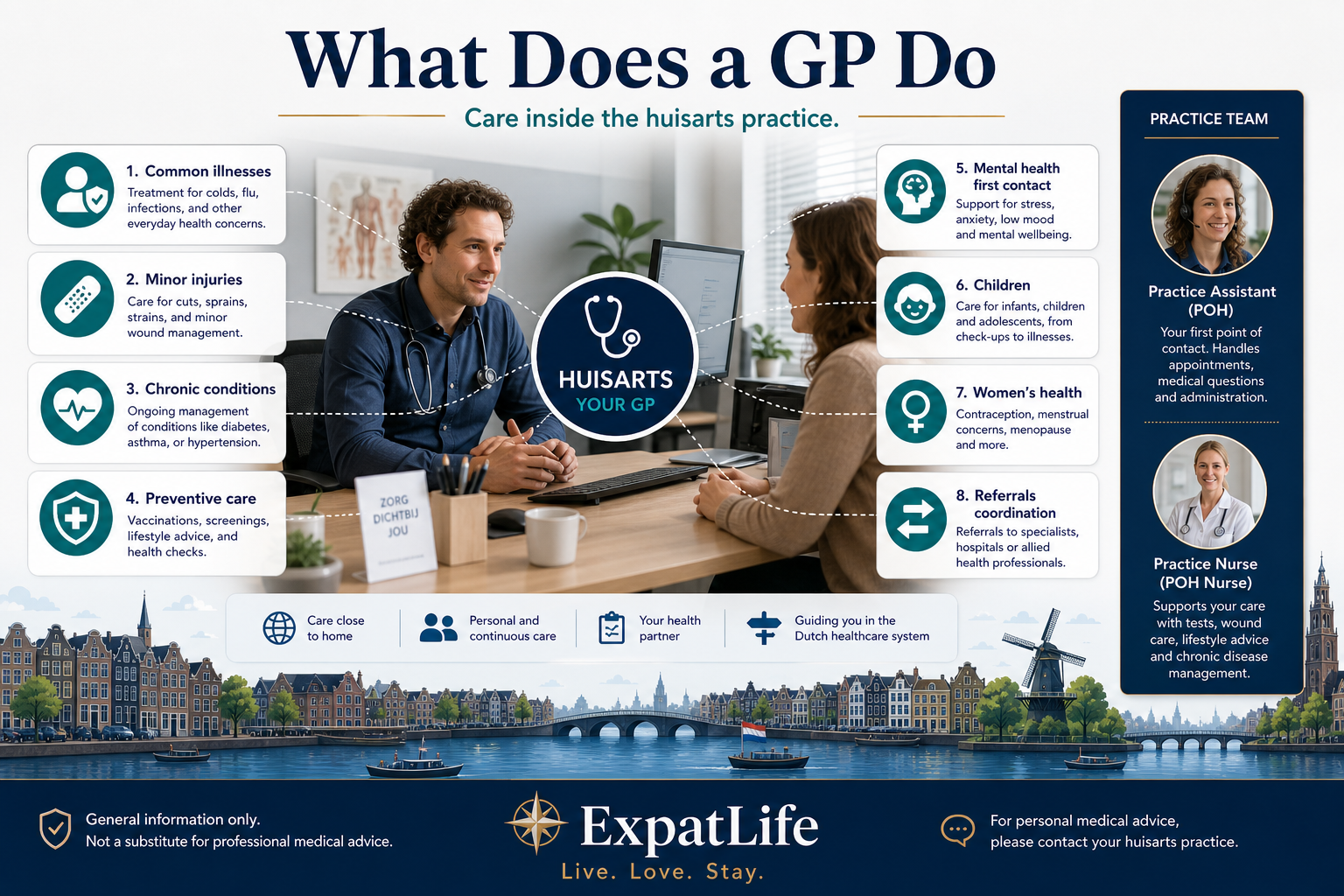
Assessment, diagnosis orientation, treatment plan, referrals and prescriptions.
Phone triage, appointment booking, admin and practical care questions.
Chronic condition follow-up and structured monitoring.
First-line mental health conversations and stepped support inside the practice.
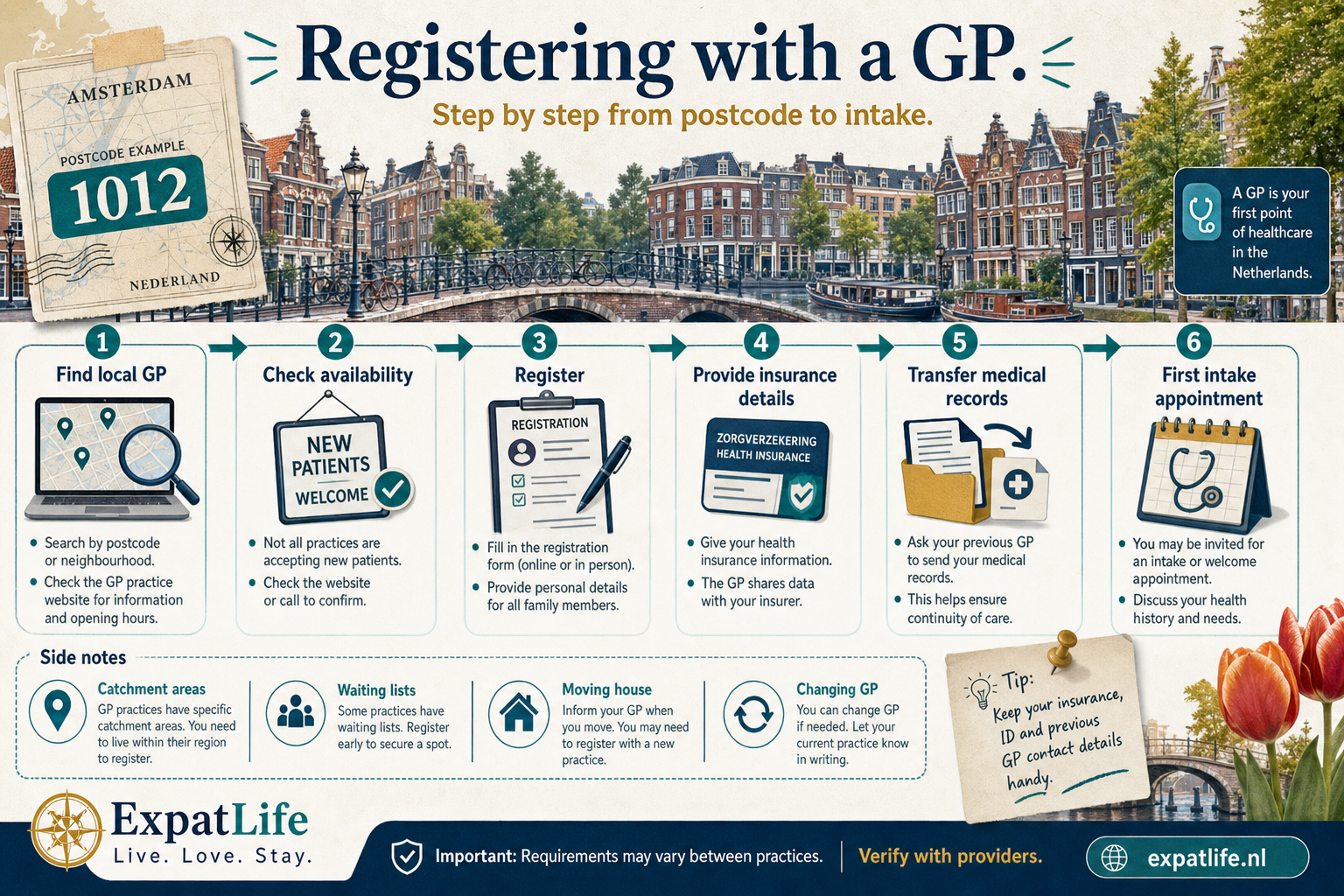
Registering
Registering with a huisarts is one of the highest-leverage admin steps after you arrive. Practices need your identity details, BSN and insurance information, and they usually only accept patients who live in their catchment area. In popular city neighbourhoods, lists can be closed — being registered somewhere nearby is far better than searching while you are unwell.
If your first choice is full, ask the assistant which neighbouring practices are accepting patients. Practice websites often have an aanmelden (registration) page; some use a shared regional registration tool. Bring or upload ID, insurance details and, if you have one, a medical summary from your previous doctor.
After registration, save the daytime number, any practice urgent line, the regional huisartsenpost number and 112. Book an introduction or intake consult if offered — especially if you manage a chronic condition, allergies, pregnancy or regular medication.
Phase Week 1
Start searching practices by postcode and shortlist those accepting patients.
Phase Week 1–2
Complete aanmelden forms and send ID, insurance and medical summary documents.
Phase Week 2–3
Confirm you are on the list and book an introduction consult if available.
Phase Ongoing
Update the practice when you move address, change insurer or start new long-term medication.
Registration checklist
Step 1
Make sure you have a BSN from municipal registration and are registered on a Dutch basic health insurance policy. Practices ask for both when you register.
Step 2
Search for 'huisarts' with your postcode and check each practice website for an aanmelden page. Confirm the practice serves your address catchment area.
Step 3
Compare distance from home, opening hours, booking method, whether staff speak English, and experience with any condition you manage.
Step 4
Complete the practice registration form with BSN, insurance details, date of birth and a copy of ID or residence documents where requested.
Step 5
Ask your previous doctor for a medical summary and current medication list, in English or Dutch, and pass it to the new practice.
Step 6
If the practice offers a kennismakingsgesprek or intake, use it to discuss chronic conditions, allergies, medication and how to reach the practice urgently.
Step 7
Store the practice daytime number, any practice urgent line, the regional huisartsenpost number and 112 in your phone.
Booking
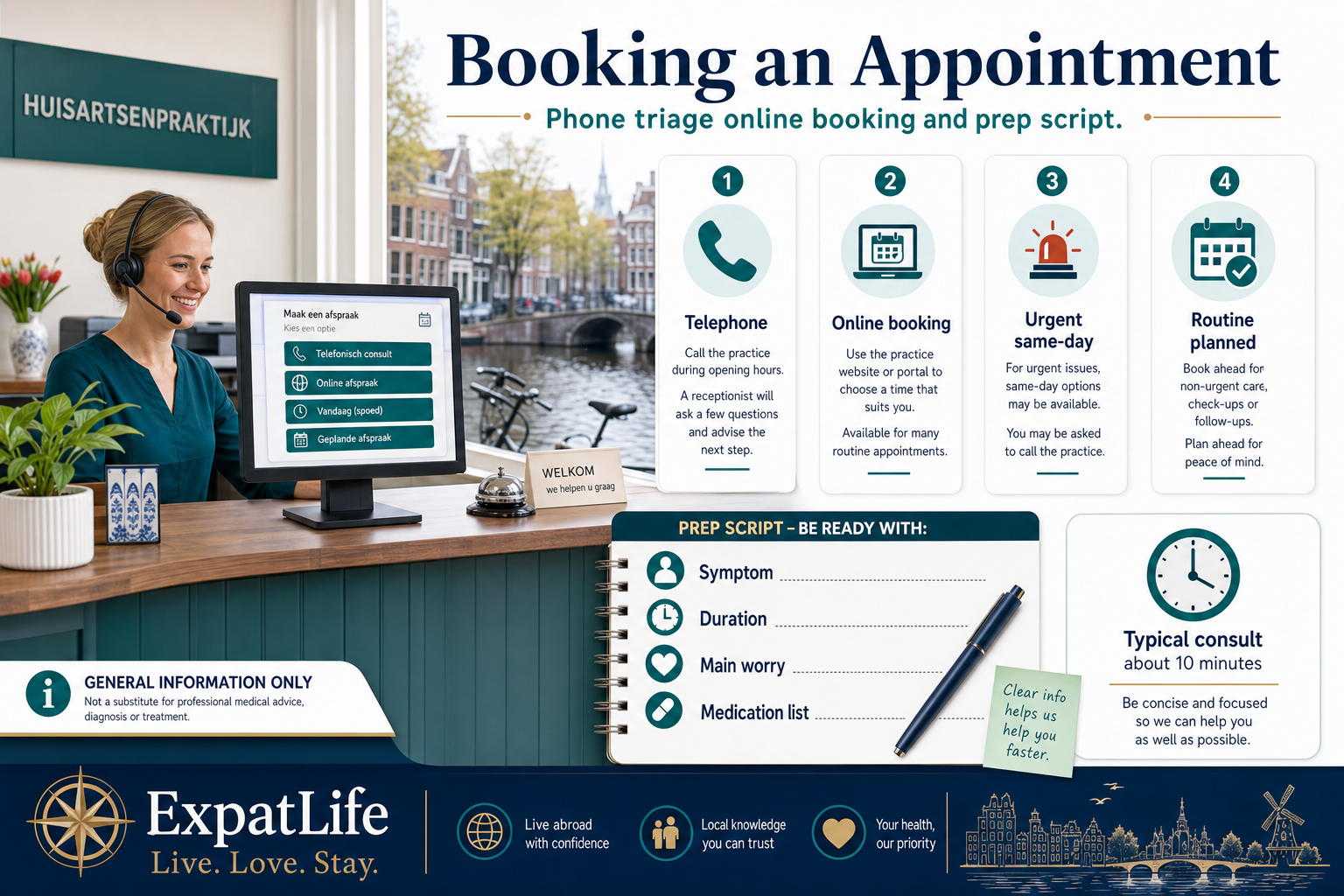
Most practices ask you to explain the reason for contact when you book. That triage step decides whether you get advice only, a same-day slot, a planned consult, a phone consult or an e-consult. It is not meant to block care — it matches urgency to capacity.
Being specific helps: say what the symptom is, how long it has lasted, what you have already tried, and what specifically worries you. If you have several issues, say so when booking and ask whether a longer or double appointment is possible.
Booking channels vary by practice: phone during opening hours, online portals, apps or secure e-consult forms. Learn your practice's preferred route once, then reuse it.
Have this ready when you call
Same-day urgency, unclear problems, booking help from the assistant.
Planned non-urgent consults when the portal shows open slots.
Simple written questions, results follow-up or admin medication requests where offered.
Advice and follow-up that does not need physical examination.
Examples
| Situation | How it works here | First step |
|---|---|---|
| Woke up with escalating symptoms | Call as soon as the practice opens — same-day slots often release early. | State urgency, symptom and duration in one clear sentence. |
| Multiple issues or a chronic review | Request a longer or double slot when booking; do not try to squeeze three topics into ten minutes. | List topics in priority order before you call. |
| Simple results or admin question | Use e-consult or the portal if offered — that frees phone capacity for urgent triage. | Check the practice website for the preferred digital route. |
| Need care but the practice is closed | Do not leave a voicemail and wait — use the huisartsenpost for urgent non-emergency care. | Call the regional huisartsenpost number saved in your phone. |
Consultation
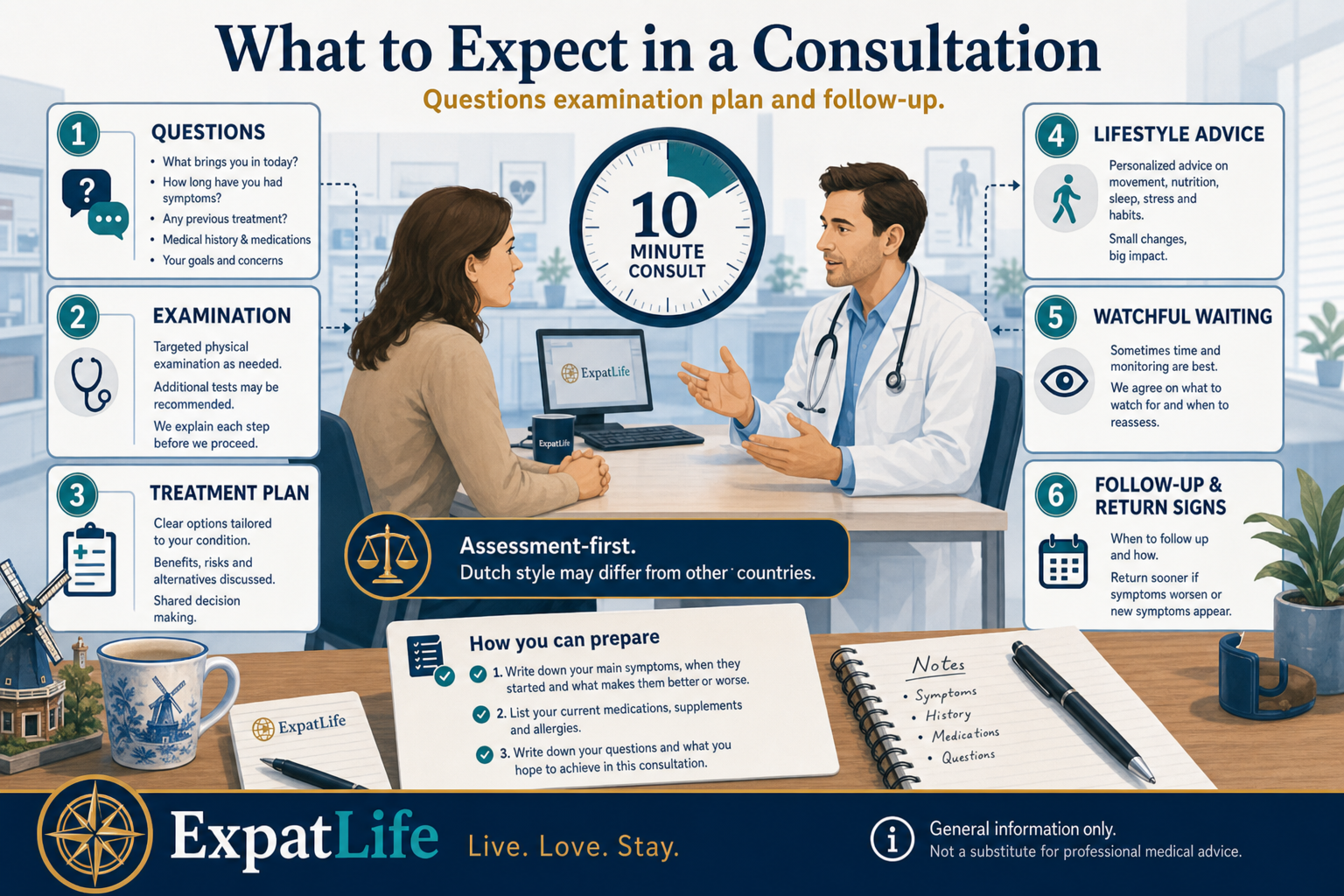
A standard Dutch GP consult is short — often around ten minutes. The conversation is direct: the GP focuses on the main problem, examines as needed, explains the working plan and agrees warning signs that should bring you back.
Assessment-first care is common. You may leave with a monitoring plan and clear return criteria rather than an immediate prescription. That reflects Dutch prescribing culture and shared decision-making, not dismissal of your concern.
Preparation turns a short slot into a useful one. Arrive with three sentences ready, your medication list, and one clear ask — diagnosis clarification, a prescription, a referral discussion or a sick-note related question, depending on your need.
Prepare before you go
Referrals
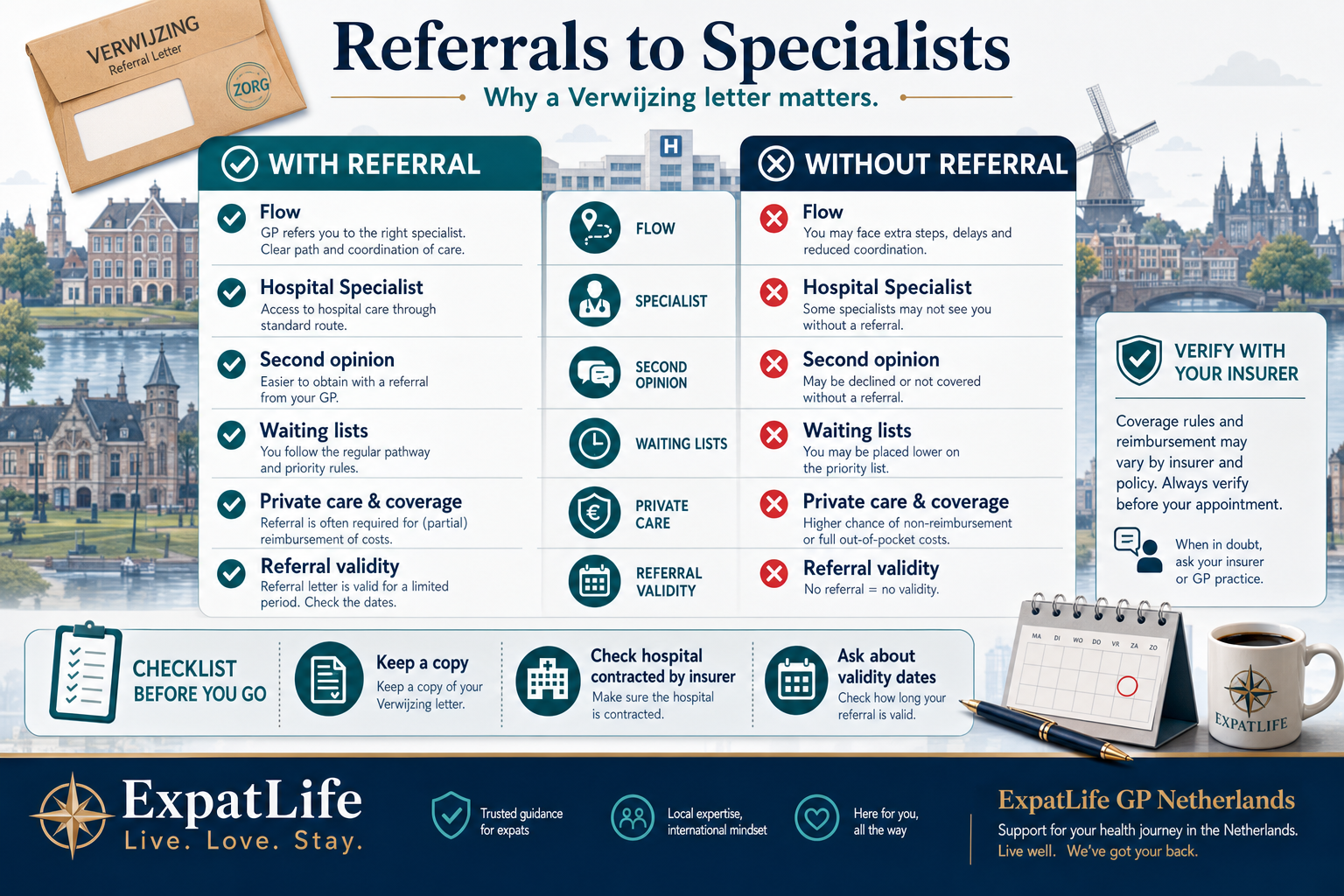
A referral letter (verwijzing) is the usual key to hospital outpatient clinics and many specialist services. The GP assesses whether specialist care is indicated, writes the referral, and the hospital or clinic uses it to schedule and to coordinate billing with your insurer.
You can and should discuss referral requests openly. Explain symptoms, duration, functional impact and any previous investigations. Ask what would need to be true for a referral now versus a period of monitoring first.
After a referral, keep a copy, check whether the hospital is contracted by your insurer, and ask that specialist letters are copied back to your GP so your primary-care file stays complete.
| Topic | With GP referral | Without referral |
|---|---|---|
| Access to hospital outpatient clinic | Standard route — clinic books from the GP letter | Often limited; many clinics expect a referral first |
| Insurance reimbursement | Usually the expected pathway under basic insurance | May be declined or only partially reimbursed — verify with your insurer |
| Clinical coordination | GP remains the coordinator and receives follow-up letters | Harder to keep one continuous medical record |
| Urgency handling | GP can mark urgency and choose an appropriate pathway | Walk-in specialist access is not the Dutch default |
After the referral letter
Prescriptions
Dutch GPs usually send prescriptions digitally to your registered pharmacy (apotheek). Registering with one nearby pharmacy keeps interaction checks, repeats and dosing advice in one place.
Prescribing culture is often more conservative than in some other countries — especially for antibiotics and some symptom-relief medicines. Ask what you should watch for and when to return if you expected a prescription and received a monitoring plan instead.
For over-the-counter basics, the drugstore (drogist) is the usual first stop. Prescription-only medicines, many interactions checks and professional dosing advice sit with the apotheek. Out of hours, urgent dispensing may go through a regional dienstapotheek after contact with the huisartsenpost.
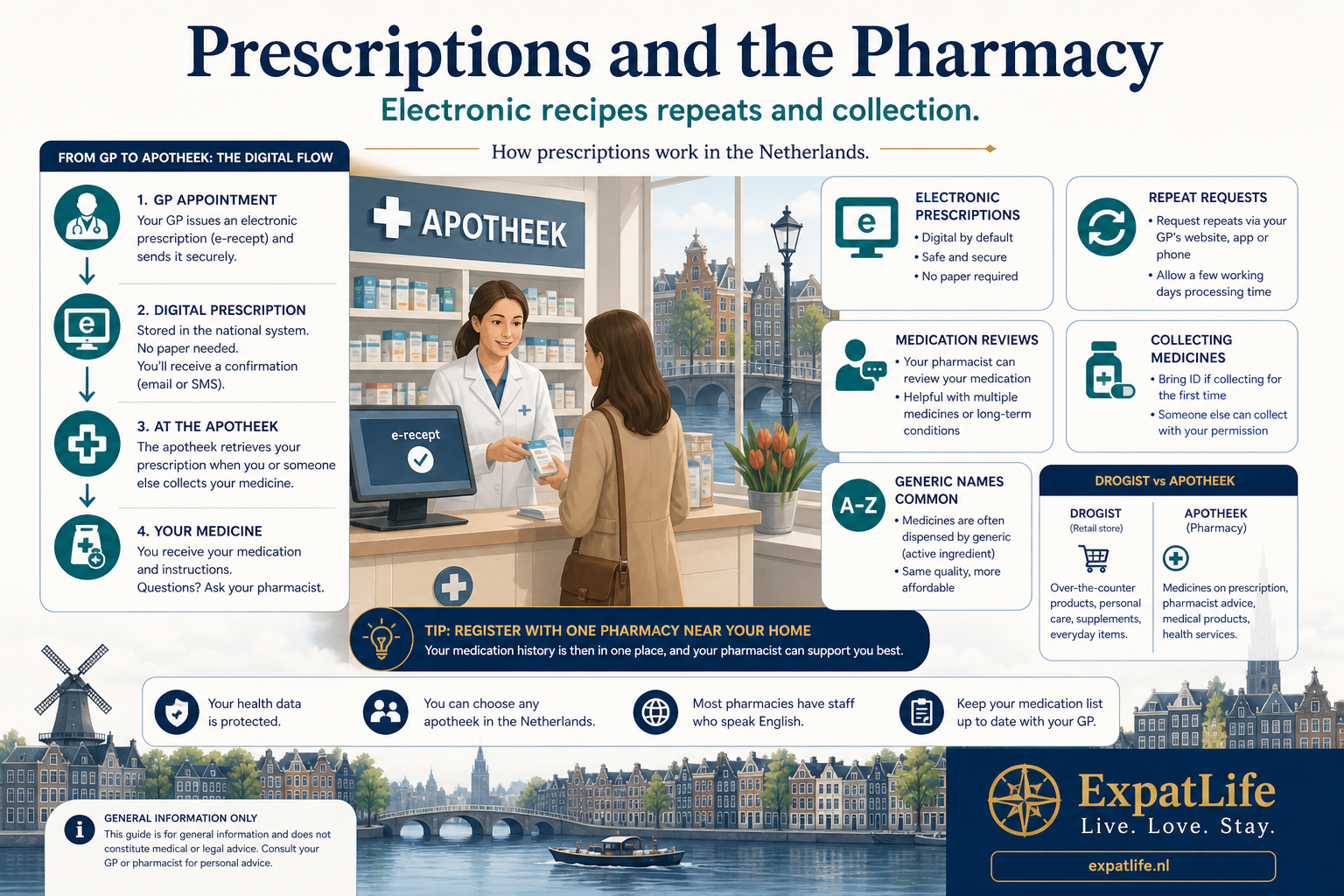
Medication continuity checklist
Pharmacy setup checklist
Home visits
Dutch GPs can visit patients at home when medically appropriate — for example when someone cannot reasonably travel to the practice because of acute illness, immobility or frailty. Home visits are assessed case by case through the practice or, outside hours, via the huisartsenpost.
A preference for convenience alone is usually not enough. Many issues that feel urgent are still handled more effectively by phone triage first, then a practice visit if examination is needed and travel is possible.
If you think a home visit is required, explain clearly why travel is not possible and what symptoms are present. The assistant or triage nurse will advise whether a visit, practice appointment, phone advice or emergency pathway fits.
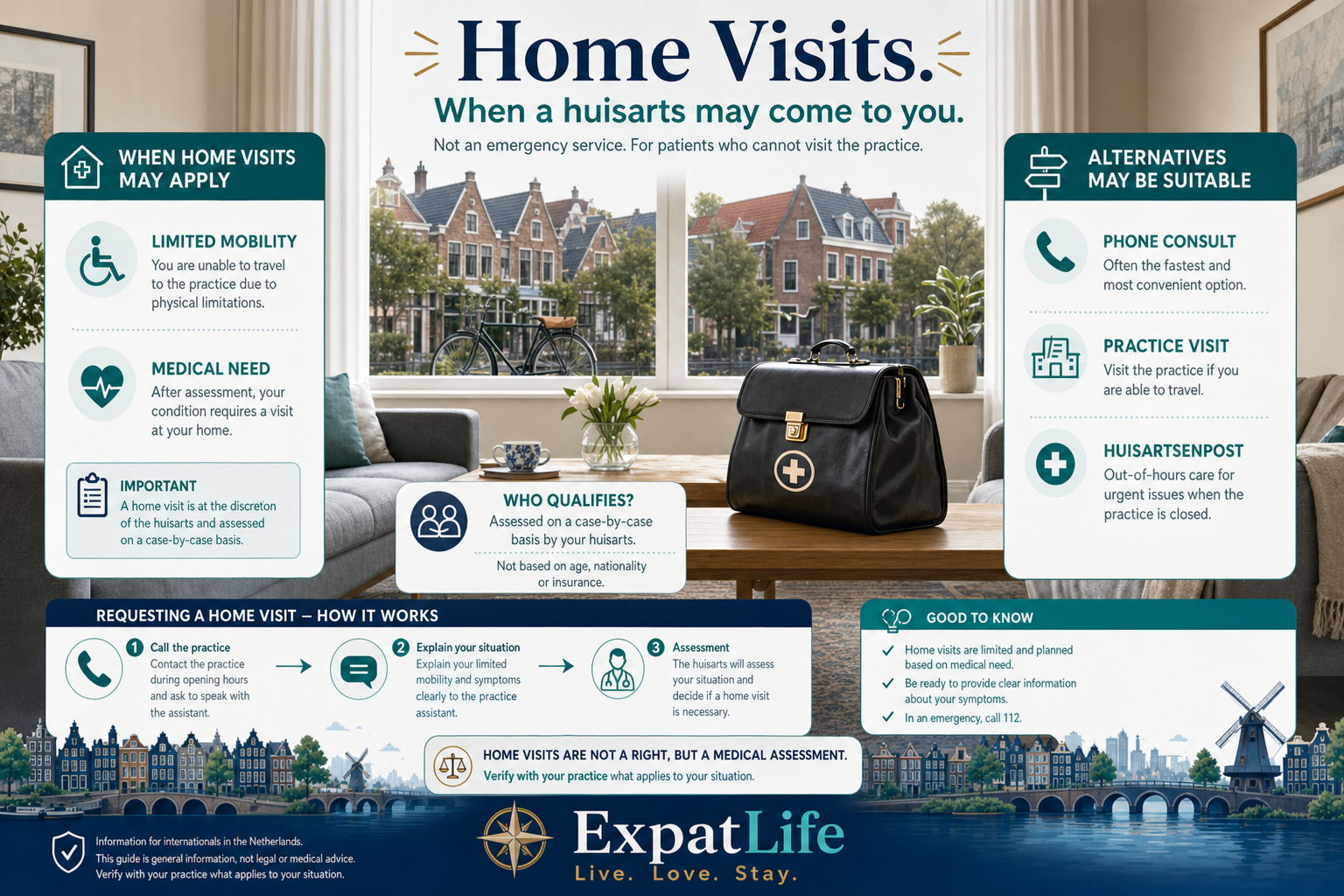
Out of hours
When your own GP practice is closed — evenings, nights, weekends and public holidays — urgent GP-level care is organised through the regional out-of-hours GP post (huisartsenpost). You call first; a triage nurse assesses urgency and may give advice, arrange a phone consult, invite you to the post, or escalate.
Hospital emergency departments are generally for emergencies and referred urgent care, not for routine after-hours primary care. Walking in with a non-emergency problem often results in redirection to the huisartsenpost pathway.
Find your regional number once your address is known and save it beside 112. Your GP practice website or assistant can tell you which post covers your area.
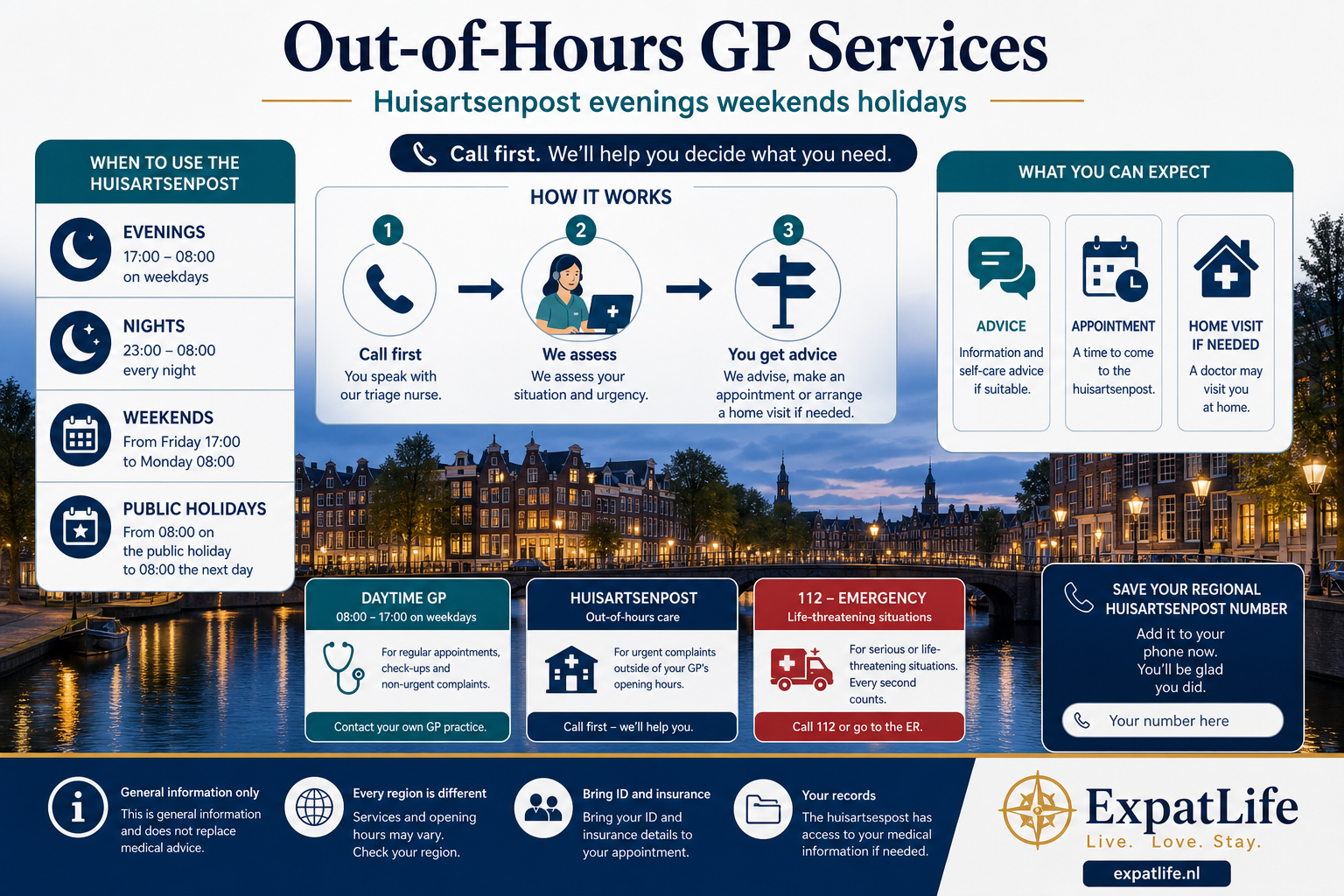
| Route | When | How | Note |
|---|---|---|---|
| Own GP (daytime) | Practice opening hours | Phone, online booking or e-consult | Best for routine and same-day non-emergency care. |
| Huisartsenpost | Evenings, nights, weekends, public holidays | Call regional number first for triage | Urgent GP-level care that cannot wait for the practice to reopen. |
| 112 | Life-threatening emergency | Call immediately | Unresponsiveness, severe breathing difficulty, heavy bleeding, stroke signs, severe allergic reaction and similar crises. |
Emergencies
Choosing the right door is one of the most useful skills for newcomers. Life-threatening emergencies go to 112. Urgent problems that cannot wait for your practice to reopen go to the huisartsenpost. Routine concerns wait for a normal GP appointment.
Operators on 112 can work in English. When you call the huisartsenpost, state the main symptom, how fast it started, and what specifically worries you. If you are unsure whether something is life-threatening, call — triage exists to make that call with you.
This section is orientation only. It cannot replace professional triage for your situation.
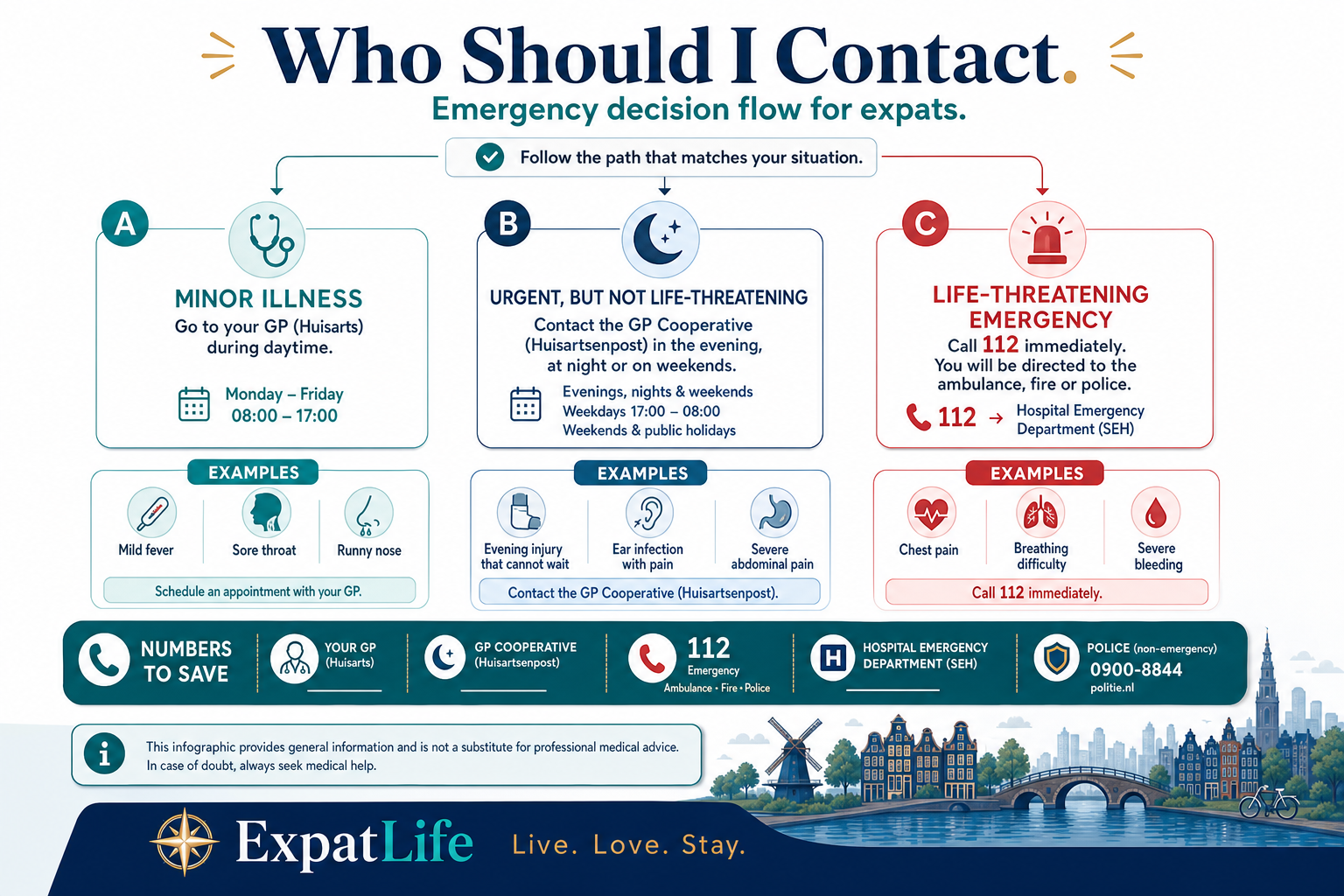
Life-threatening situations. Operators can work in English. Give your location first, then what is wrong.
Same-day urgency and routine care during practice opening hours via phone, portal or e-consult.
Evenings, nights, weekends and public holidays. Call first for urgent non-life-threatening care.
Urgent out-of-hours dispensing after huisartsenpost triage when a medicine cannot wait.
Call 112 now
Unresponsiveness, severe breathing difficulty, or suspected stroke
Call 112 immediately.
Heavy bleeding, severe allergic reaction, or major trauma
Call 112 immediately.
Chest pain with worrying features
Call 112 — do not wait for a GP appointment.
Same day / out of hours
High fever with rapid worsening outside practice hours
Call the huisartsenpost for triage.
Severe pain or acute injury that cannot wait until morning
Call the huisartsenpost; they may advise the post or escalate.
Urgent prescription need outside hours
Call the huisartsenpost — urgent dispensing may go via the dienstapotheek.
Next working day
Mild cold, minor symptoms, routine follow-up
Book a normal GP appointment or use e-consult if offered.
Repeat prescription for a stable condition
Use your practice repeat process or pharmacy request route.
Non-urgent referral discussion
Book a planned GP consult and prepare your reasons.
What to say when you call
Prepare before you need it
For expats
Most friction newcomers feel with Dutch GPs comes from mismatched expectations, not from a broken system. The huisarts model is designed around continuity, triage and stepped care. Once you know the characteristics, the pathway becomes predictable.
Advantages include a single coordinating doctor, strong primary-care coverage under basic insurance, organised out-of-hours GP services, and a clear emergency number. Limitations include short slots, referral requirements for many specialists, and variable English availability outside international hubs.
Presenting these as system characteristics — rather than personal slights — makes conversations with practice staff easier and more effective.
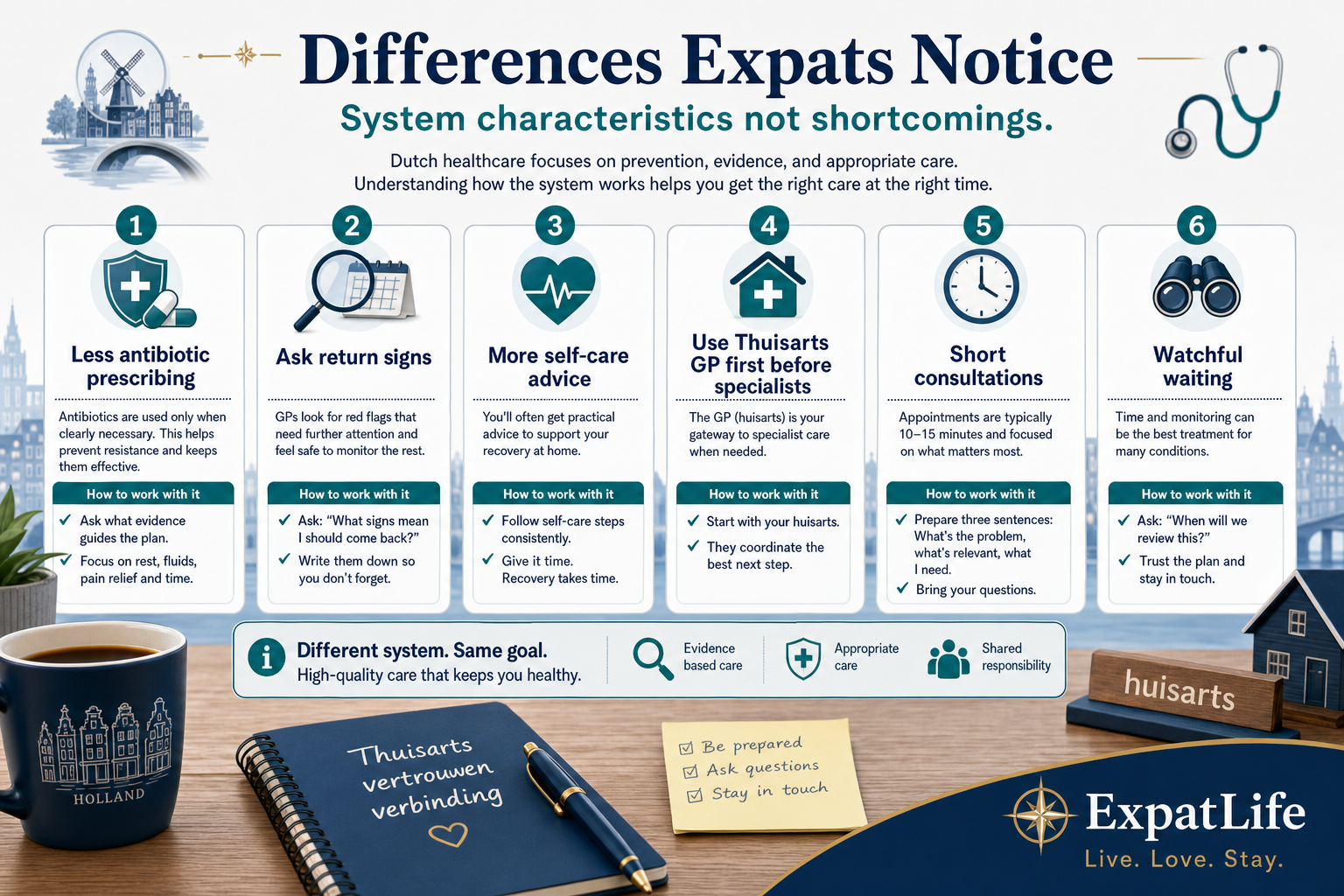
You usually cannot book many hospital specialists directly. Care beyond the practice often needs a GP referral letter.
Fix: Register early and discuss referral requests explicitly with reasons and functional impact.
Ten-minute slots and assistant triage are standard. Unprepared visits feel rushed.
Fix: Prepare three sentences and ask for a longer appointment when you have multiple issues.
Monitoring plans are common; antibiotics and some medicines are reserved for clearer indications.
Fix: Ask what should make you return and by when you should see improvement.
Practices serve defined areas and may close lists in busy neighbourhoods.
Fix: Search by postcode early and accept a nearby practice that is open rather than waiting indefinitely.
Evening and weekend care starts with the huisartsenpost phone line, not a hospital walk-in.
Fix: Save the regional number now and call first outside practice hours.
Many city practices manage English well; it is less consistent everywhere.
Fix: Ask when registering, and bring a written symptom summary if language feels uncertain.
Family
Families usually register children at the same huisarts practice as the parents. The GP handles childhood illness, injuries, prescriptions and referrals to paediatric specialists. Preventive care — growth checks, developmental screening and many childhood vaccinations — often runs through Youth Healthcare (JGZ) and the consultatiebureau rather than only through the GP.
That split is a system characteristic: illness and referrals with the GP; scheduled prevention with JGZ. You need both set up for a complete children's healthcare pathway.
For the full children's healthcare cornerstone — insurance for under-18s, JGZ, vaccinations, hospitals and emergencies — use the Healthcare for Children guide.
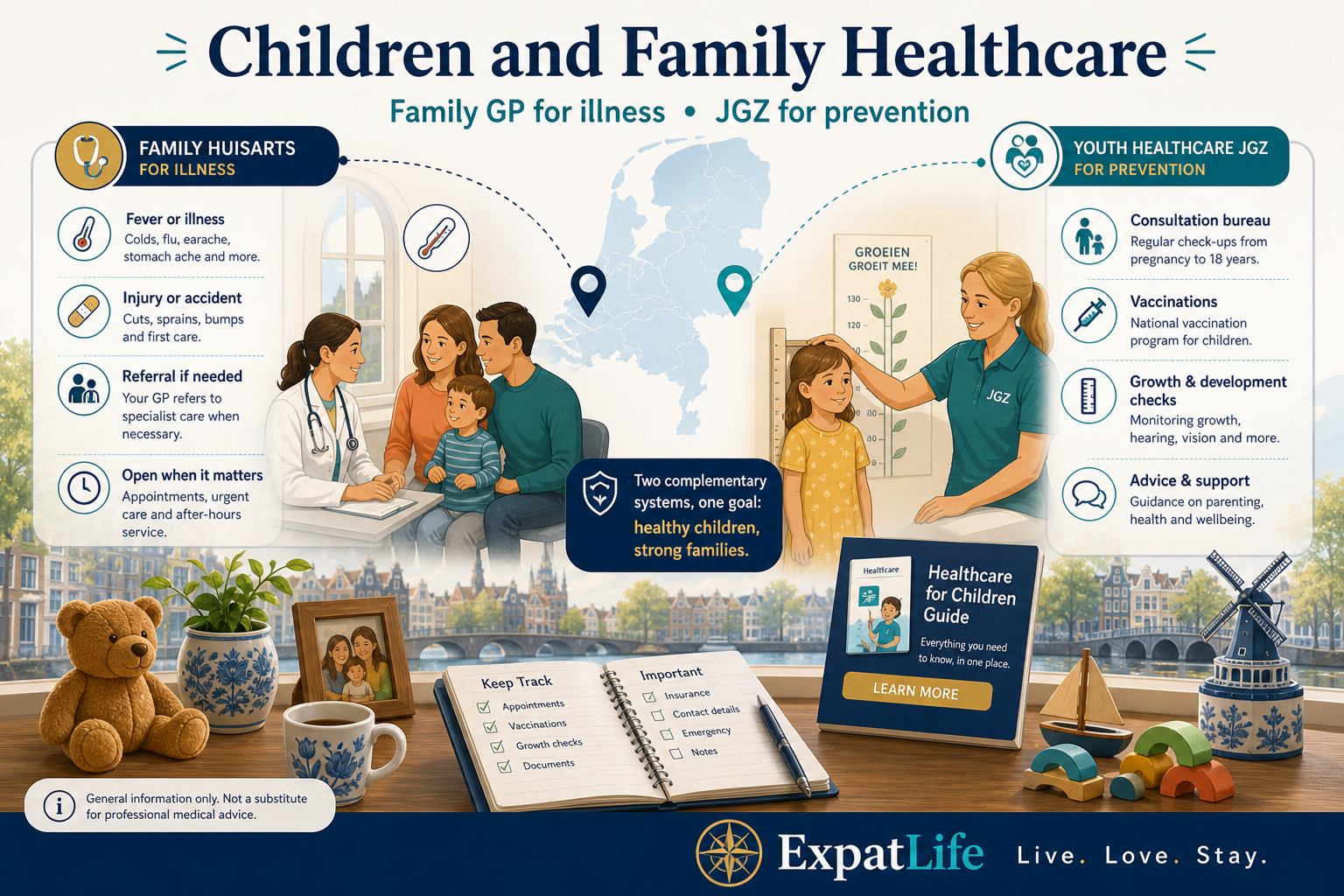
Fever, injury, rashes, prescriptions, referrals to paediatric specialists and urgent day-time triage for registered children.
Growth checks, developmental screening, many childhood vaccinations and scheduled preventive appointments.
Mental health
For many people in the Netherlands, the huisarts is the first contact for stress, anxiety, low mood, sleep problems or other mental health concerns. This is orientation only — not diagnosis, not treatment advice, and not a substitute for professional care.
Many practices have a mental health practice nurse (POH-GGZ) who can offer structured conversations and help decide whether further GGZ support is appropriate. The GP can also discuss referral options when stepped care beyond the practice is needed.
If you or someone else is in immediate danger, call 112. For suicidal thoughts, the national 113 service is a dedicated crisis resource. Practice staff can help you navigate non-emergency next steps during opening hours.
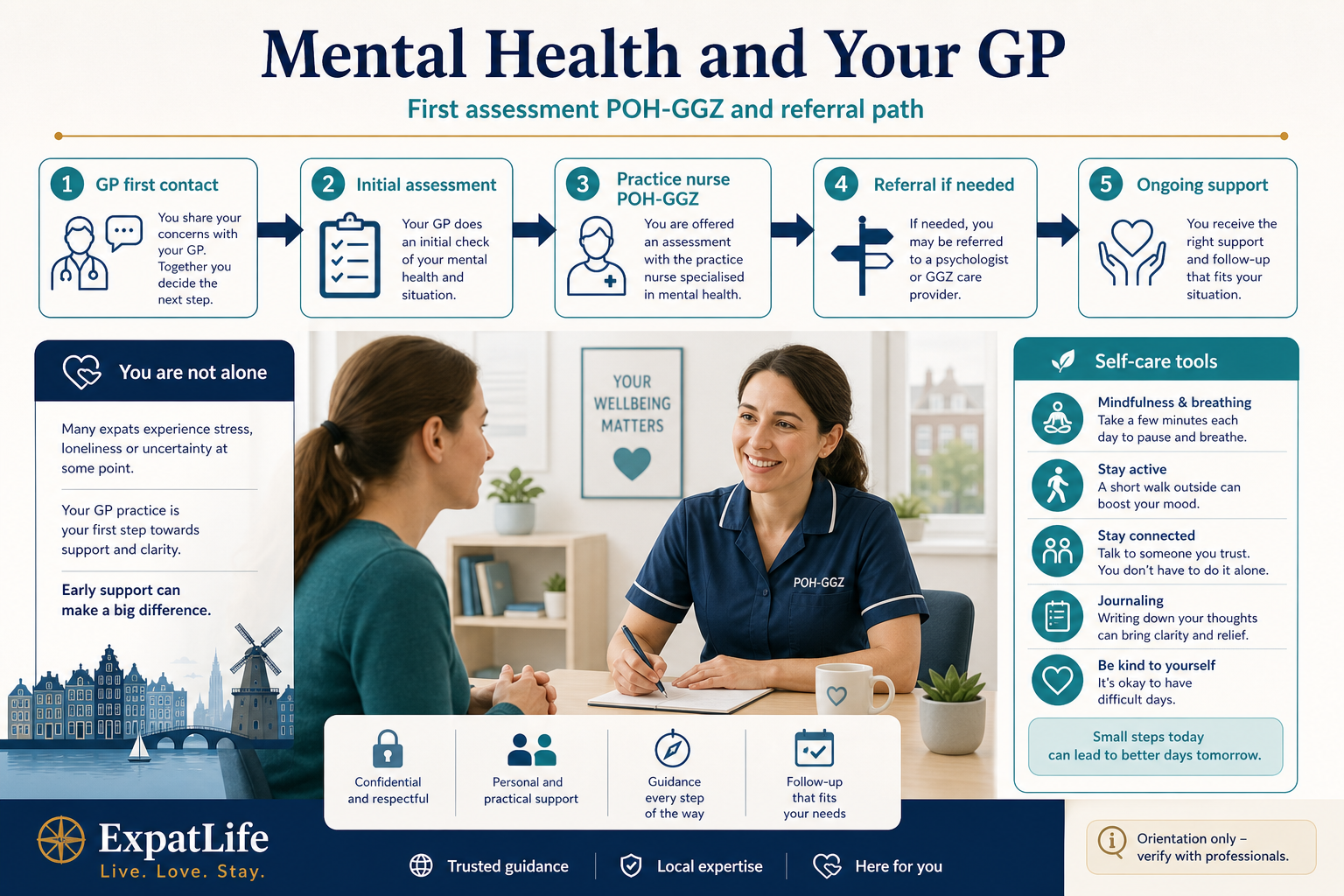
Common starting point for non-emergency concerns — assessment, advice and next-step planning.
Practice-based mental health nurse conversations and stepped support inside primary care.
Specialist mental health pathway when indicated; waiting times and entry criteria vary.
112 for immediate danger; 113 for suicidal thoughts support — do not wait for a routine GP slot.
This section provides system orientation only. It does not assess, diagnose or treat mental health conditions. Seek professional help for your own situation.
A dedicated adult mental health guide is planned. Until then, start with your GP and the official crisis resources above.
Avoid
These patterns create avoidable stress. Each includes a practical Fix so you can adapt to the system rather than fight it.
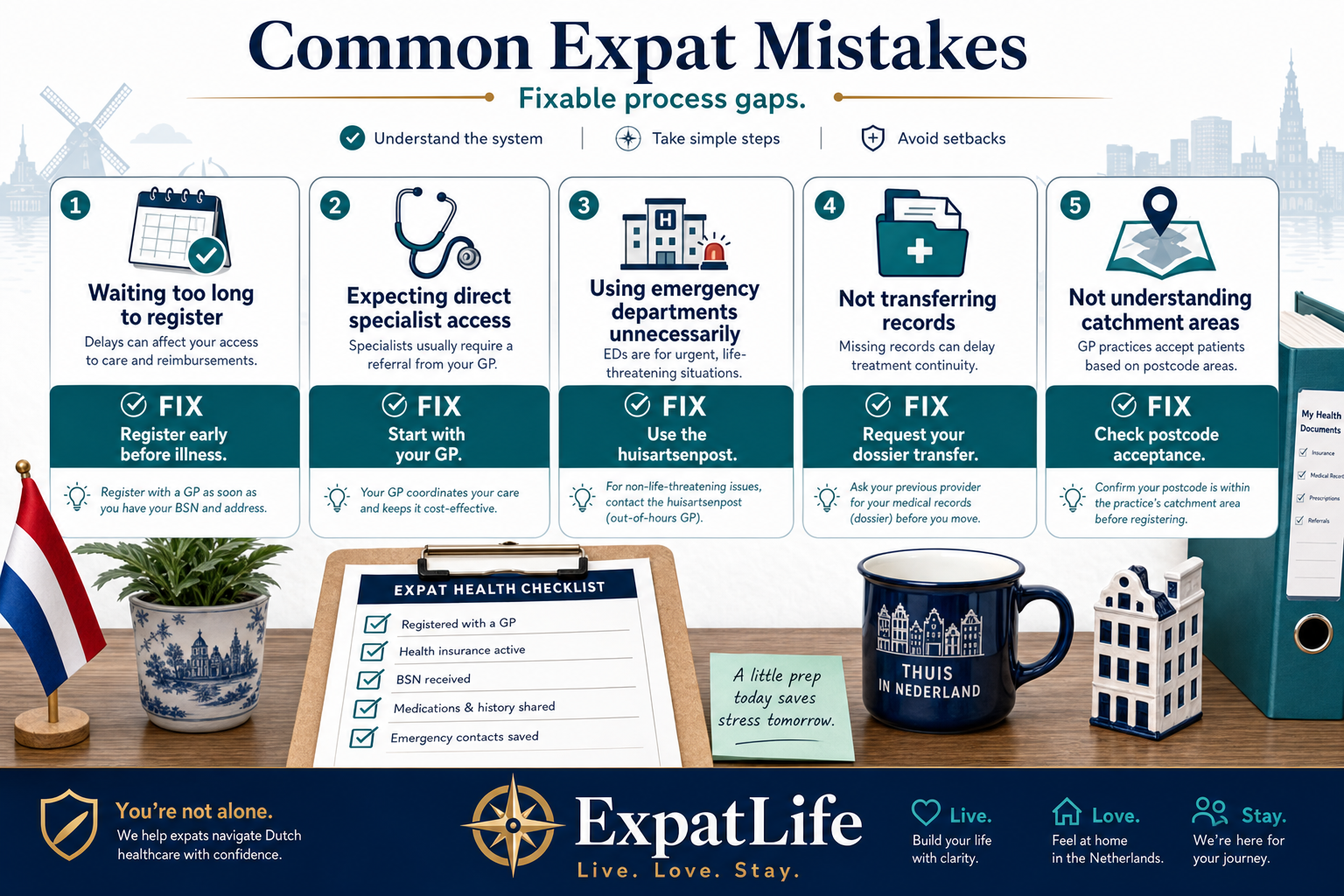
Example: searching closed city lists on a Friday night with fever — assistants triage registered patients first.
Fix: Register in week 1–2 after BSN and insurance are in place.
Example: arriving at SEH with a non-emergency problem and being redirected to the huisartsenpost pathway.
Fix: Use your GP by day and the huisartsenpost out of hours; call 112 for life-threatening situations.
Example: calling a hospital clinic and being told to return with a GP verwijzing.
Fix: Book a GP consult and present a clear case for why specialist assessment is needed.
Example: ten minutes gone before the main worry is clear.
Fix: Prepare three sentences, lead with your main worry, and ask for return-if-worse criteria.
Example: registering without asking, then struggling to explain symptoms under pressure.
Fix: Ask when registering and bring a written summary if helpful.
Example: prescriptions bouncing between pharmacies with incomplete interaction checks.
Fix: Register with one nearby pharmacy when you register with your GP.
Checklist
Work through these steps once your address, BSN and insurance are in motion.
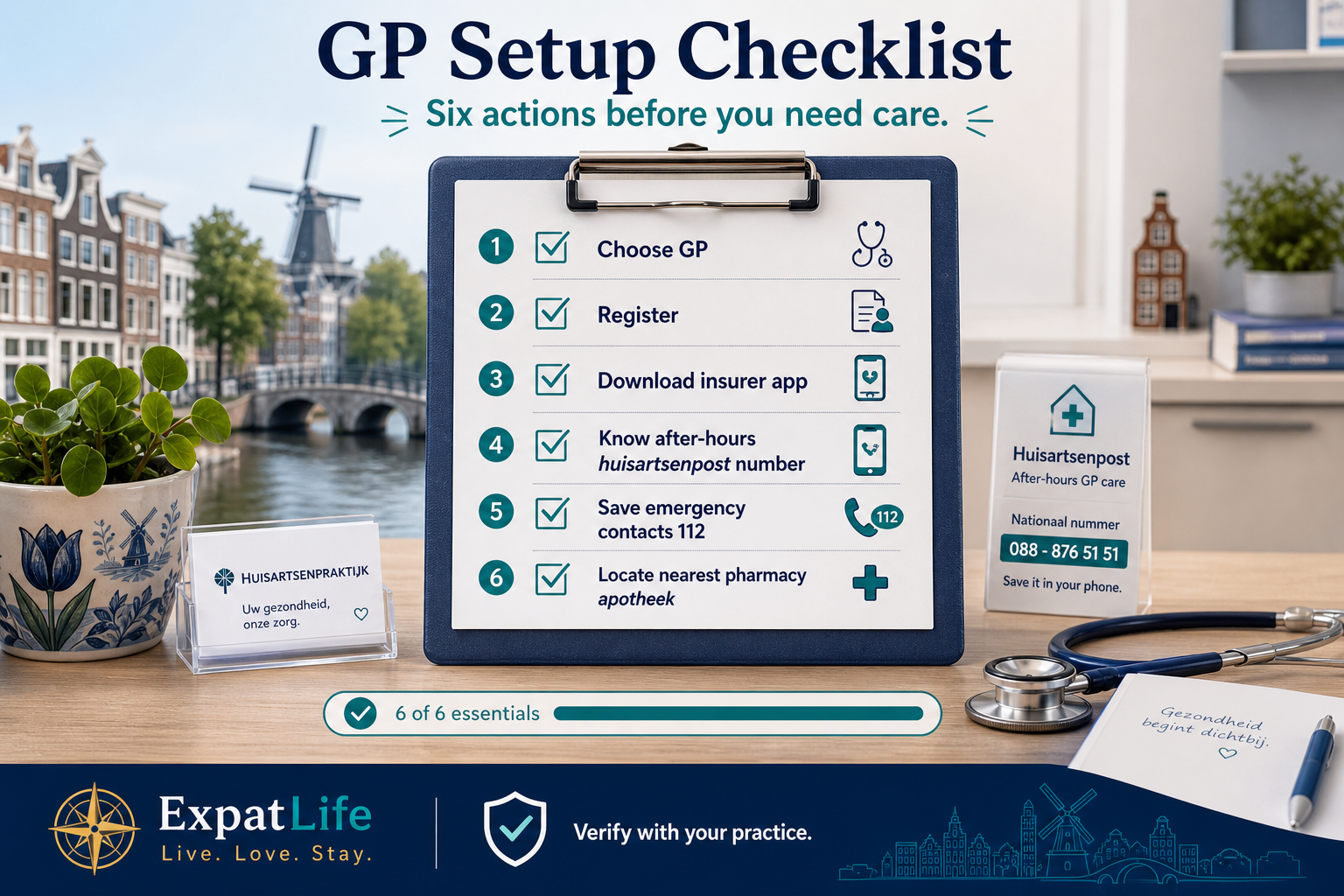
Phase 1 — early research
Phase 2 — registration
Phase 3 — readiness
Full GP setup checklist
FAQ
Orientation answers only — confirm practice rules, insurer contracting and your own clinical situation with professionals.
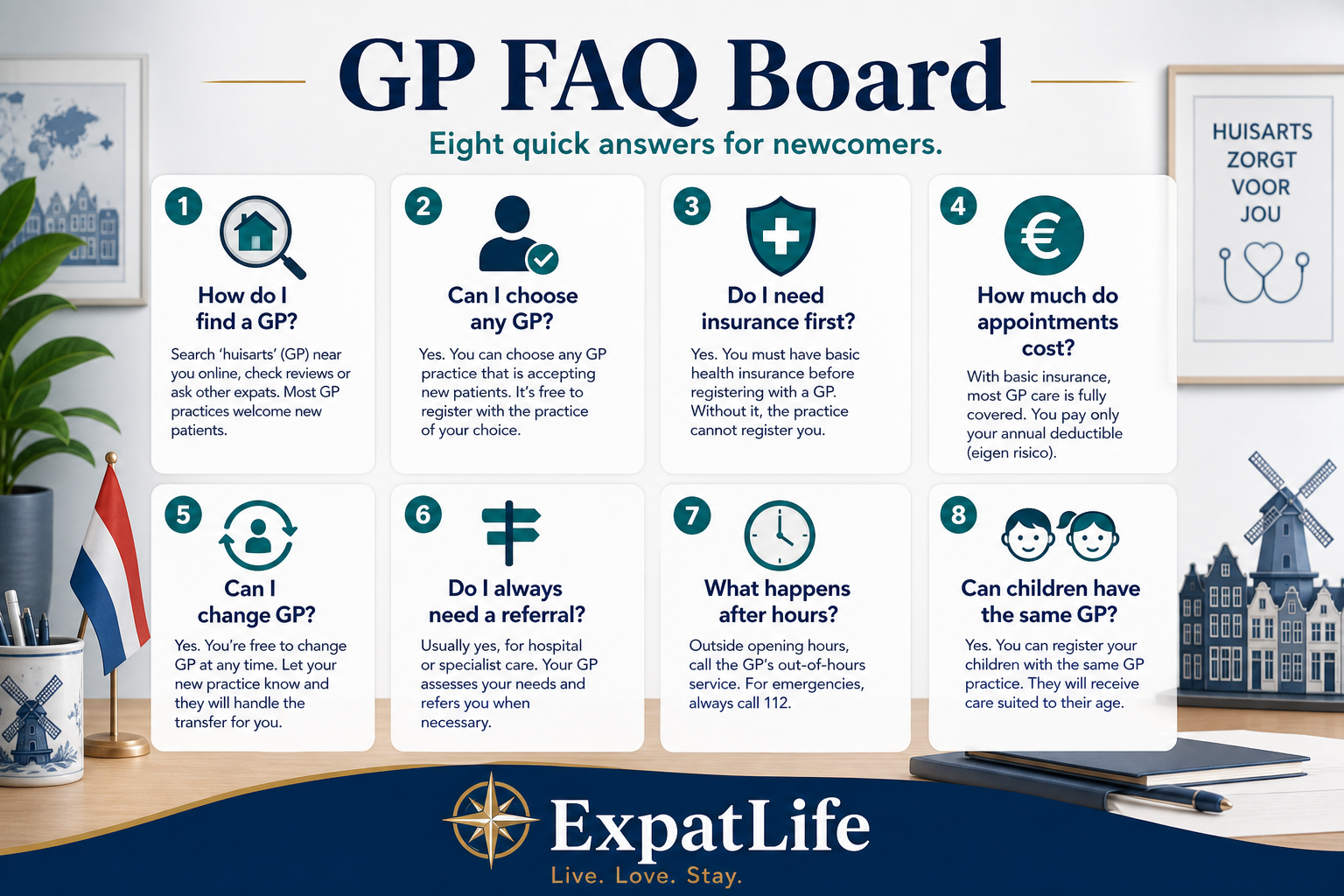
A huisarts is a Dutch general practitioner — a fully trained medical doctor who provides first-line care and coordinates much of what happens beyond the practice. For most non-emergency problems, the huisarts is the usual starting point for assessment, treatment, prescriptions and referrals.
In practice, yes, if you want reliable access to primary care. Practices need you on their patient list before routine booking and continuity work smoothly. Register once your BSN and Dutch health insurance are in place, ideally before you need urgent care.
Search for huisarts practices near your postcode, check which ones accept new patients and serve your catchment area, then complete the practice registration (aanmelden) form with BSN, insurance details and ID. Hand over a medical summary if you have one, and save the practice and huisartsenpost numbers afterwards.
Often not for hospital outpatient care. Many specialists and clinics expect a referral letter (verwijzing) from your GP. Some private or specific pathways differ — verify with the clinic and your insurer — but the standard insured route starts with the huisarts.
Call the practice, use online booking, or send an e-consult if offered. A practice assistant usually asks what the problem is to match urgency and appointment type. Be specific about symptoms, duration and your main worry.
For urgent GP-level care in evenings, nights, weekends and public holidays, call your regional huisartsenpost. They triage by phone and may give advice, arrange a visit to the post, or escalate. For life-threatening emergencies, call 112 instead.
Call 112 for life-threatening situations such as unresponsiveness, severe breathing difficulty, heavy bleeding, signs of stroke, severe allergic reaction or major trauma. Use the huisartsenpost for urgent problems that are not life-threatening but cannot wait until your practice reopens. If life may be at risk, call 112.
Many do, especially in internationally oriented cities and practices, but it is not guaranteed everywhere. Ask when you register. If language feels uncertain, bring a short written summary of symptoms and medication.
GPs usually send prescriptions digitally to your registered pharmacy (apotheek). Register with one nearby pharmacy so repeats and interaction checks stay in one place. Bring generic drug names, and ask the pharmacist about any personal contribution before dispensing.
Yes, when medically appropriate — for example if you cannot reasonably travel to the practice. Home visits are assessed case by case via the practice or huisartsenpost. Life-threatening emergencies still go to 112 rather than waiting for a home visit.
GP care is part of the basic insurance package. Rules around the annual deductible (eigen risico) and medicine reimbursement can still affect related costs — verify your own policy with your insurer. Children under 18 are treated differently for premiums and deductible; see the children's healthcare guide for family details.
Ask closed practices which nearby lists are open, widen your search slightly, and register as soon as your address is stable. A slightly farther accepting practice is better than remaining unregistered.
GP care itself is part of basic insurance. Related costs — medicines, diagnostics or hospital care — can still hit the annual deductible (eigen risico) for adults. Verify your own policy with your insurer.
Yes if another practice accepts you and serves your address. Ask about deregistration and medical-record transfer. Temporary options vary by practice and situation — ask the practice and your insurer.
Practices handle arbeidsverzuim documentation differently. Ask what paperwork they provide and what your employer expects — rules and forms vary by workplace.
Call practices for urgent daytime advice if they can help; for urgent out-of-hours care call the huisartsenpost; for life-threatening situations call 112. Register as soon as possible for continuity.
These are often ordered by the GP after assessment when indicated. The practice or lab explains booking and how results are followed up — ask who will contact whom.
Related
Connect GP registration with insurance, family healthcare, emergencies and living healthcare basics.
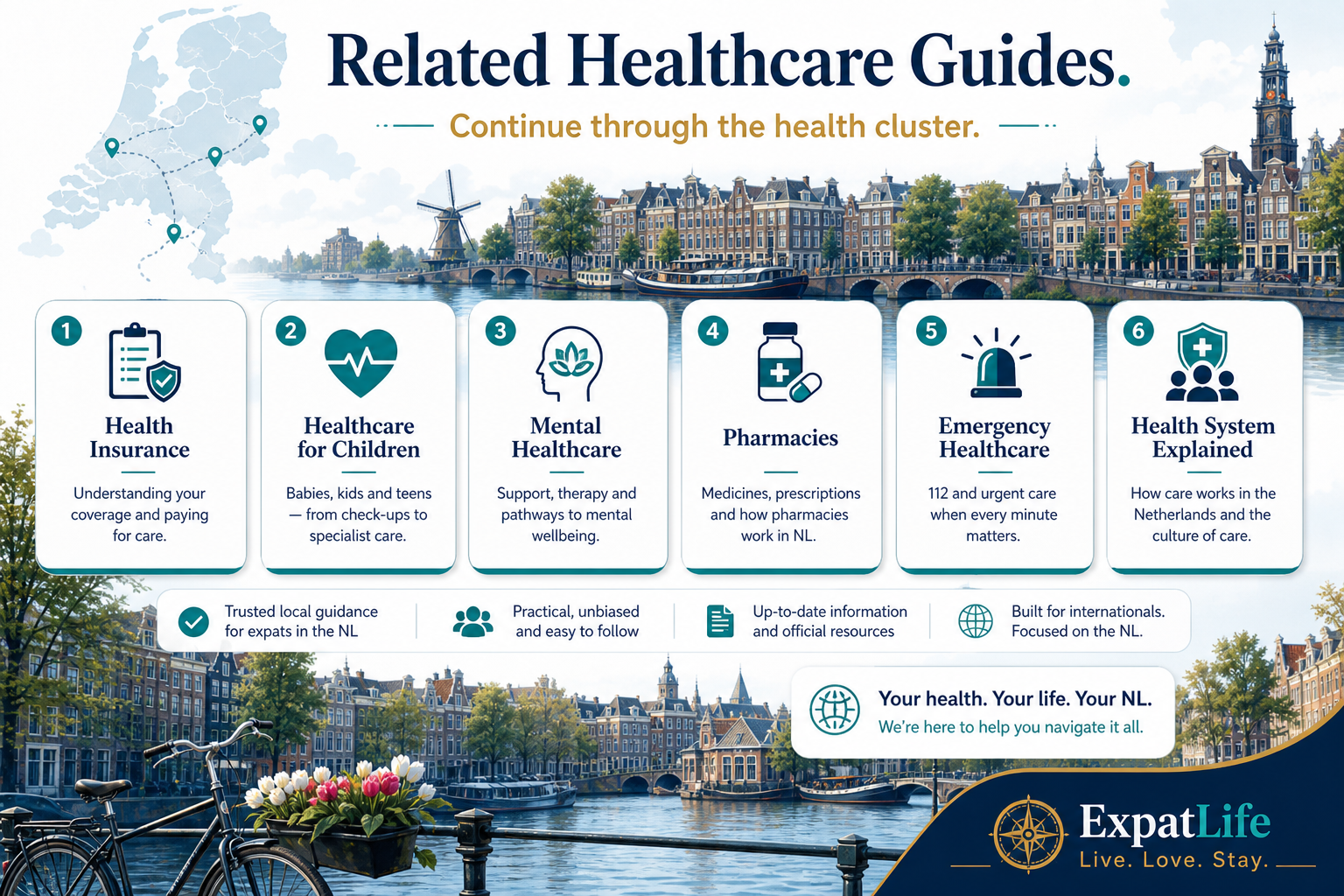
Health hub
This page is the GP cornerstone — explore related health topics next.
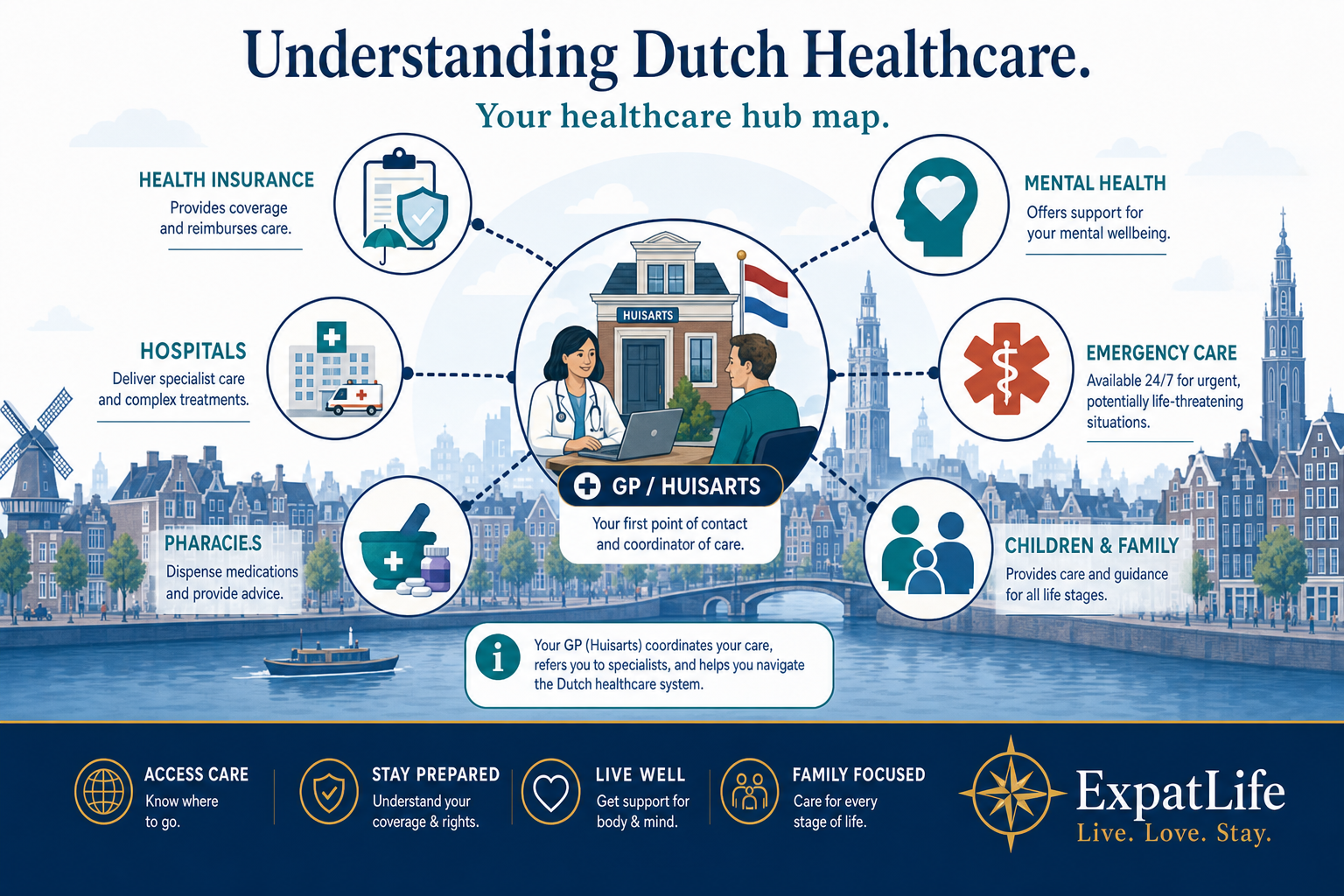
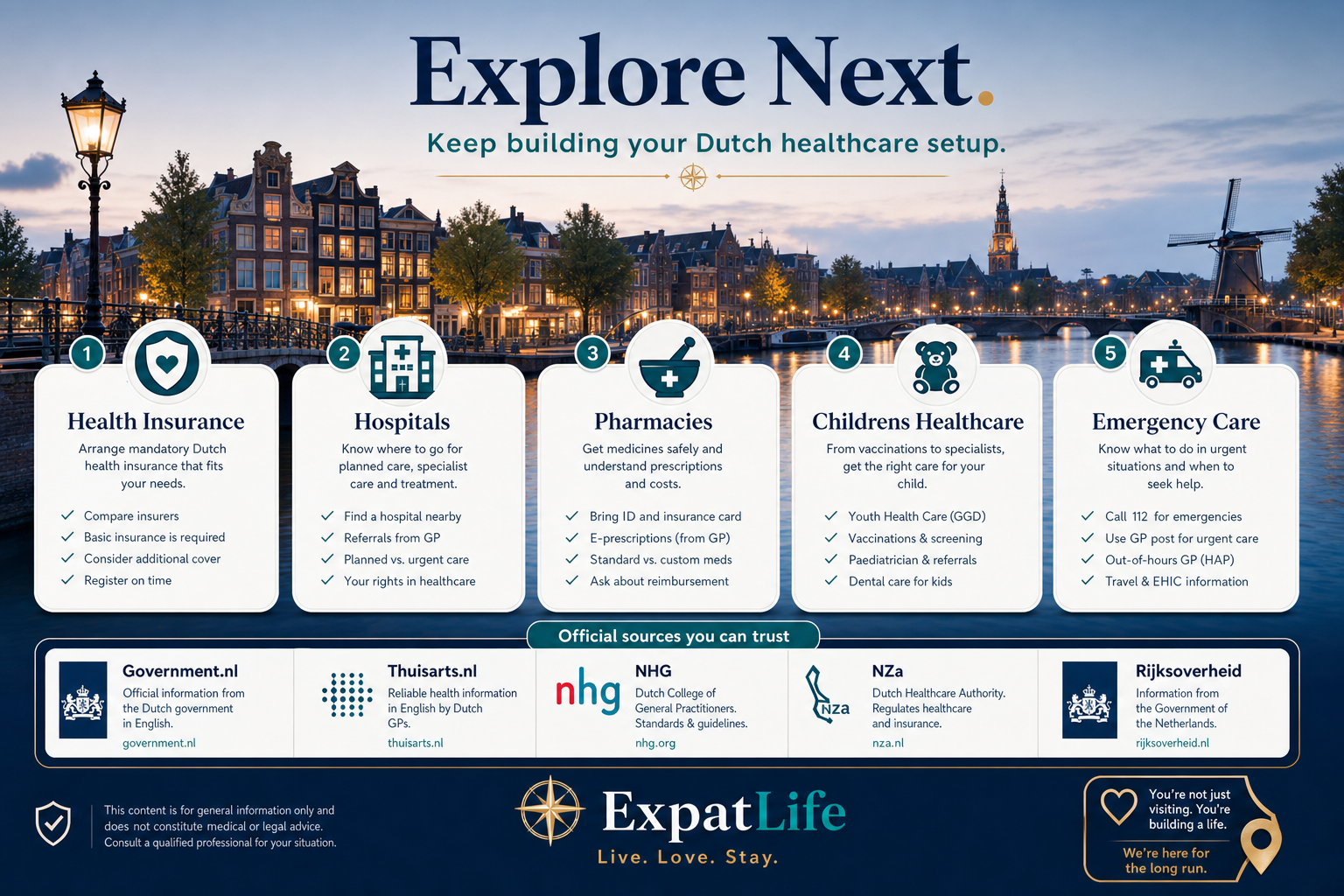
Explore next
Pick the card that matches what is still open — insurance, system basics, children's care or emergencies — and verify specifics on the official sources below.
Trust
General information only — not medical advice. Local practice rules, insurer contracting and clinical pathways change, so verify your own situation with your GP, insurer and the official sources above. In an emergency, call 112.