
Life-threatening
Call 112
National emergency number for ambulance, fire and police.
Netherlands · Health · Emergency Care
Understand exactly what to do during a medical emergency, who to call and which healthcare service to use—from 112 and ambulances to GP cooperatives and emergency departments.
General orientation only — not medical advice, diagnosis or treatment recommendations. For individual concerns, contact a GP, the huisartsenpost or emergency services. Always verify coverage with your insurer. Call 112 for life-threatening emergencies.
Quick answer
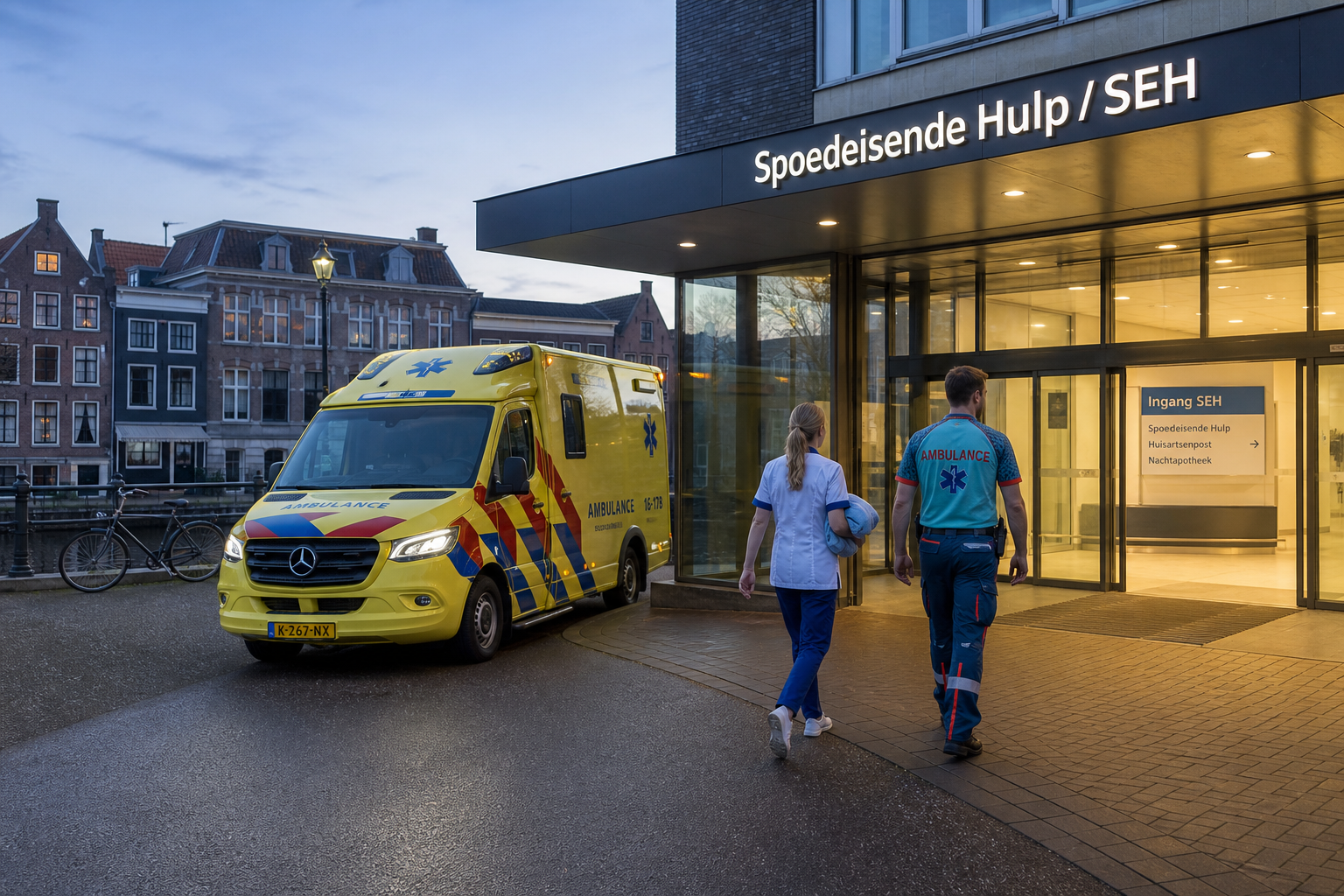
Emergency healthcare in the Netherlands is organised as a set of clear doors rather than a single walk-in hospital entrance. Life-threatening situations go to 112. Urgent problems that are not life-threatening usually go to your huisarts by day or the regional Huisartsenpost after hours. Hospital emergency departments (spoedeisende hulp, SEH) focus on serious emergencies and referred or ambulance arrivals.
That structure can feel unfamiliar if you are used to emergency rooms as the default after-hours option. Once you know which door matches severity — and you have the numbers saved — most stressful evenings become more manageable. The system is designed to get the right help quickly, not to make people wait when they are in danger.
This guide is calm, practical orientation for expats, students, tourists and newcomers: how to choose between 112, the GP, the Huisartsenpost and SEH; what happens when you call an ambulance; how emergency pharmacies and dentists fit in; what costs and insurance usually mean; and how to prepare before anything goes wrong. It is not medical advice — for your own situation, contact a clinician or call 112 in an emergency.
Emergency file — keep these together
Examples
| Situation | How it works here | First step |
|---|---|---|
| Someone collapses or cannot breathe | Treat this as a life-threatening emergency — do not wait for a GP appointment or search for a hospital entrance. | Call 112 immediately and give your exact location first. |
| High fever and severe pain on a Sunday evening | Urgent but not clearly life-threatening care usually starts with the Huisartsenpost telephone triage line. | Call your regional huisartsenpost number and describe onset, severity and what specifically worries you. |
| Same concern during GP opening hours | Contact your own huisarts practice for same-day triage rather than going straight to SEH. | Call the practice urgent line or follow the practice's same-day booking route. |
| Just arrived and not yet registered with a GP | Still use 112 for life-threatening emergencies. For urgent non-emergency care after hours, call the regional huisartsenpost; register a GP as soon as you can. | Save the local huisartsenpost number today and start GP registration this week. |
Decision tree
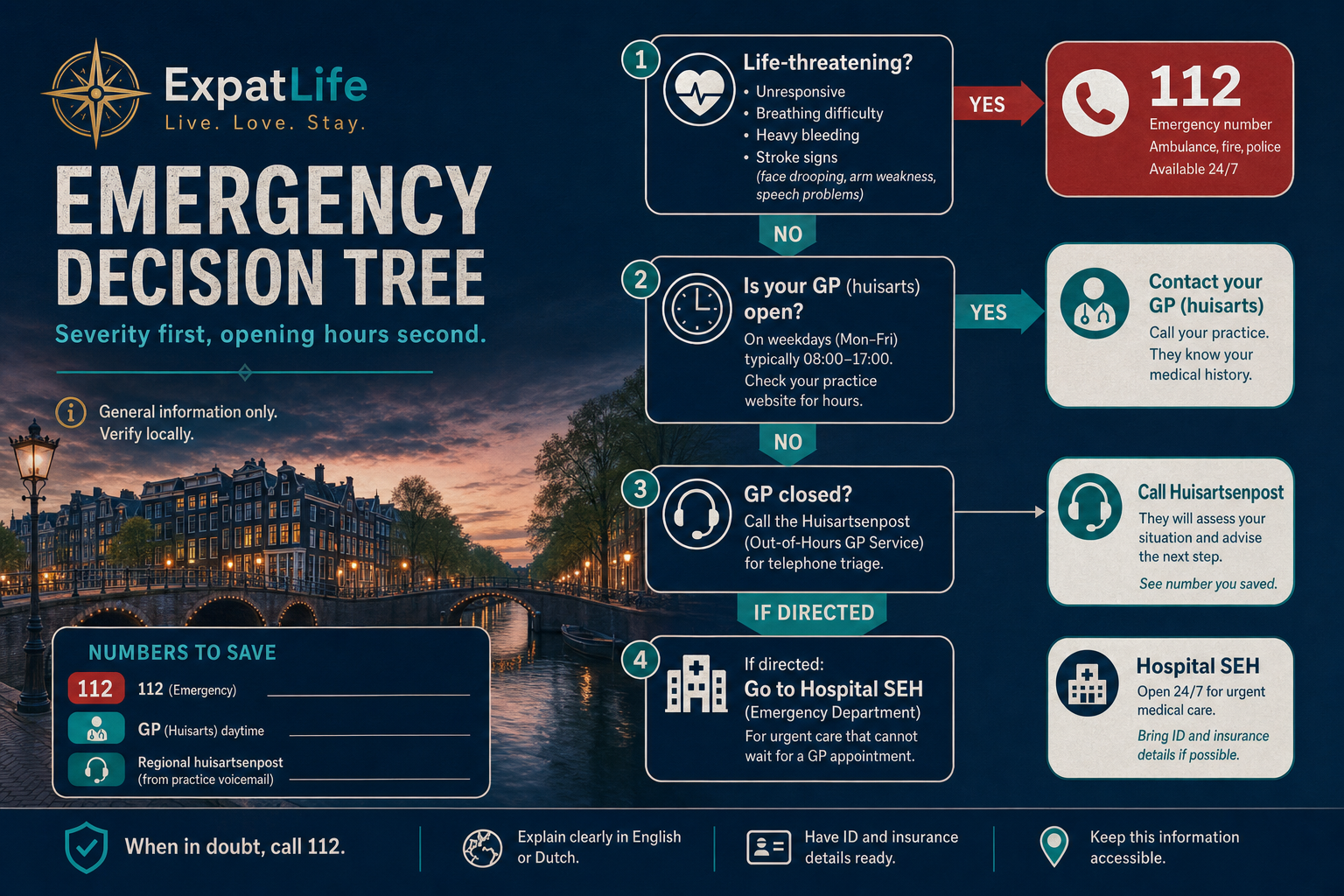
When something feels urgent, start with one question: could this be life-threatening right now? If yes — or if you are unsure and life may be at risk — call 112. If not, the next question is whether your GP practice is open.
The Dutch pathway is designed to match severity to the right service quickly. Calling the Huisartsenpost or your GP first for non-life-threatening problems is not a delay tactic — it is often the fastest route to advice, an urgent appointment or a referral into hospital care when needed.
If symptoms worsen while you are waiting for a callback or appointment, reassess. A situation that started as urgent can become an emergency — call 112 if life may now be at risk.
Decision path
Step 1
Unresponsiveness, severe breathing difficulty, heavy bleeding, stroke signs, severe allergic reaction, major trauma, chest pain with worrying features — call 112 now.
Step 2
During practice hours, contact your huisarts for urgent same-day triage, advice or an appointment.
Step 3
Call the regional Huisartsenpost. Telephone triage may give advice, invite you in, arrange a home visit or escalate.
Step 4
Follow ambulance transport or a GP / huisartsenpost referral into the hospital emergency department when that is the indicated pathway.
Call 112 now
Unresponsiveness, severe breathing difficulty, or suspected stroke
Call 112 immediately.
Heavy bleeding, severe allergic reaction, or major trauma
Call 112 immediately.
Chest pain with worrying features
Call 112 — do not wait for a GP appointment.
Same day / out of hours
High fever with rapid worsening outside practice hours
Call the huisartsenpost for triage.
Severe pain or acute injury that cannot wait until morning
Call the huisartsenpost; they may advise the post, a visit or escalation.
Urgent prescription need outside hours
Call the huisartsenpost — urgent dispensing may go via the dienstapotheek.
Next appointment
Mild cold, minor symptoms, routine follow-up
Book a normal GP appointment or use e-consult if offered.
Non-urgent specialist discussion
Book a planned GP consult rather than using emergency routes.
How to
Step 1
If someone is unresponsive, cannot breathe adequately, has heavy bleeding, stroke signs, a severe allergic reaction, major trauma or other life-threatening features — or you are unsure and life may be at risk — call 112 immediately.
Step 2
Give your exact location first, then explain what is wrong, who needs help and a callback number. Stay on the line and follow the operator's instructions.
Step 3
During practice hours, contact your huisarts for same-day urgent triage rather than walking into a hospital emergency department.
Step 4
Use your regional out-of-hours GP cooperative number. Describe the main symptom, how fast it started and what specifically worries you.
Step 5
Accept advice, an appointment at the post, a home visit or escalation to hospital when that is the outcome of triage.
Step 6
Hospital emergency departments prioritise by severity. Bring ID, insurance details and a medication list when you are able to.
Step 7
If the situation becomes life-threatening while waiting, call 112 immediately — do not wait for a previously arranged slot.
Snapshot
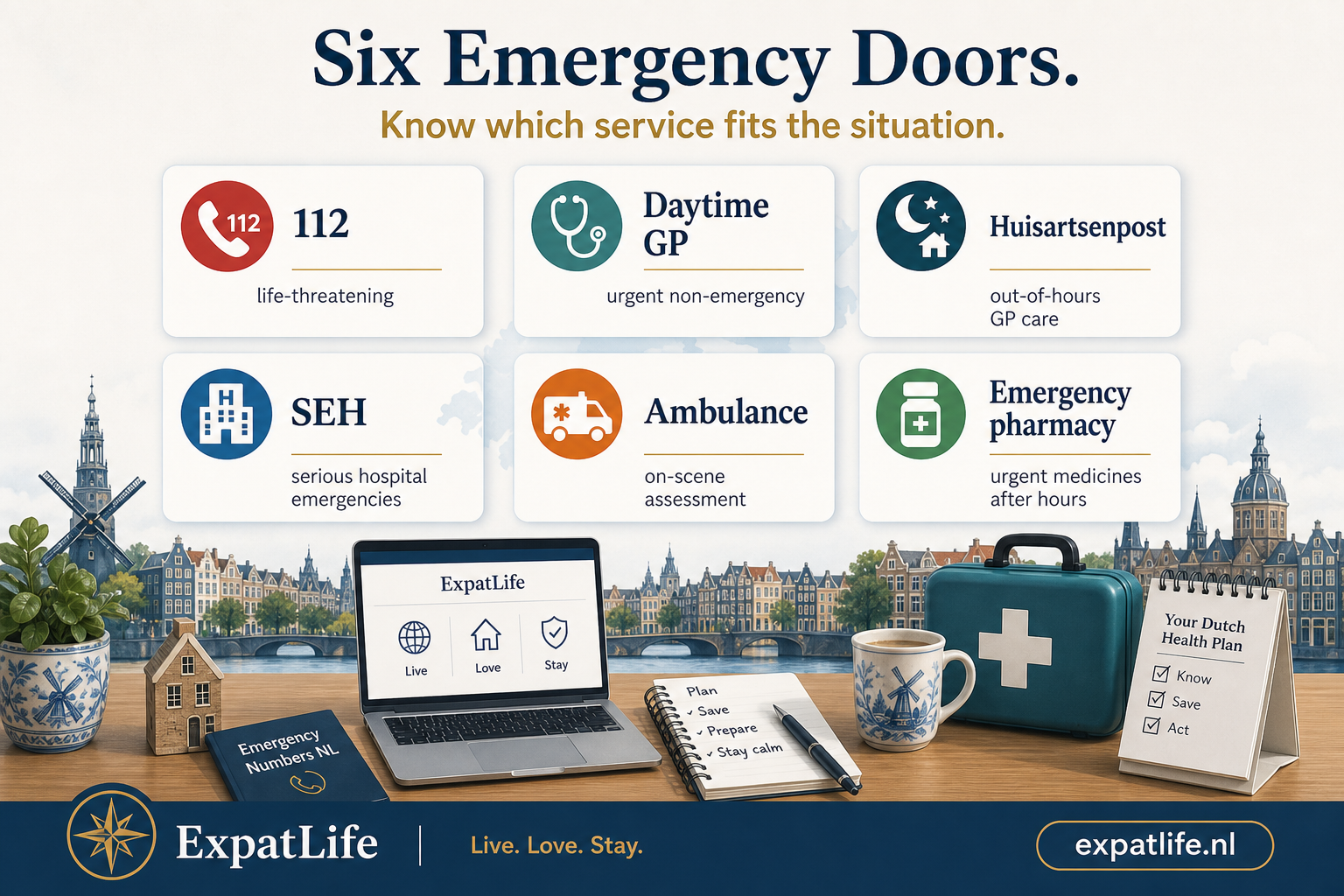
Almost every urgent situation expats face fits into one of these six doors. Read them once now, then use the detailed sections below when you need the specifics.
Life-threatening
Call 112
National emergency number for ambulance, fire and police.
Daytime urgent
Your GP
Contact the huisarts during opening hours for non-life-threatening urgency.
Out of hours
Huisartsenpost
Regional GP cooperative — call first for triage.
Serious emergency
SEH / ambulance
Hospital emergency pathway, often via ambulance or referral.
National emergency number for life-threatening situations. Reaches ambulance, fire and police. Operators can work in English.
First contact for urgent non-life-threatening problems during practice opening hours, including same-day triage.
Regional out-of-hours GP cooperative for evenings, nights, weekends and public holidays — call first.
Hospital spoedeisende hulp for serious emergencies, typically via ambulance or referral rather than routine walk-in.
Emergency medical response with on-scene assessment and treatment; transport follows clinical need.
Regional dienstapotheek for urgent medicines outside normal pharmacy hours, usually after triage guidance.
Calling 112
112 is the European emergency number used in the Netherlands for life-threatening situations. One call can reach ambulance, fire and police. You do not need to decide which service is needed before dialling — the operator helps route the response.
Operators can work in English. Start with your location: full address, building name, floor, entrance, nearby landmark or GPS pin if you are outside. Then explain what is wrong, who needs help, approximate age, and whether the person is breathing, conscious or bleeding heavily.
Stay on the line. Follow instructions on speakerphone if you need your hands free. If you called from a mobile, keep the phone available for a callback. After the call, someone should meet responders at the entrance when it is safe to do so.
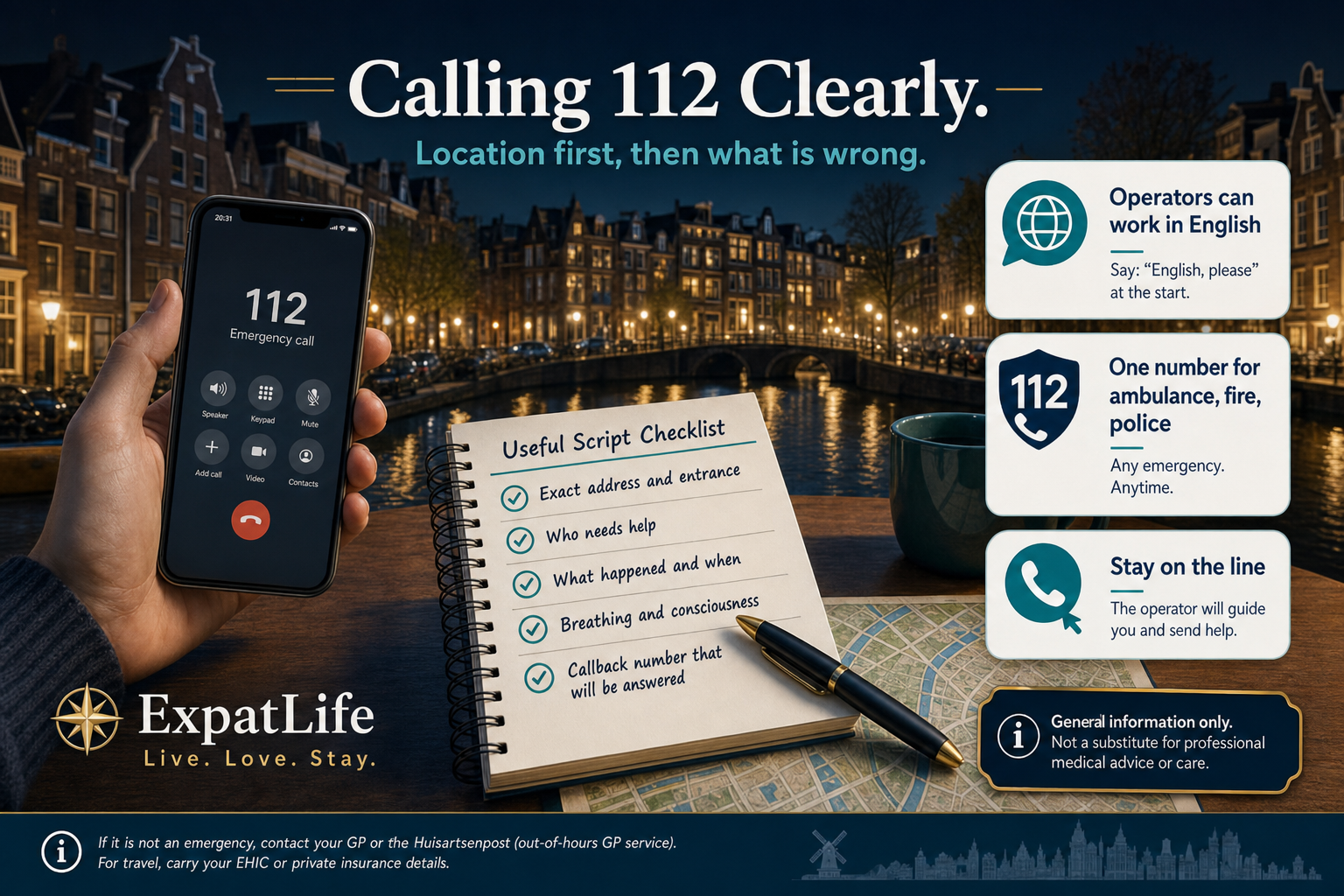
What to say when you call
Medical emergencies needing urgent assessment, treatment and possible hospital transport.
Fire, rescue and related emergency response coordinated through the same 112 entry point.
Immediate danger, serious incidents and public-safety emergencies.
After calling
You can ask for English. Speak clearly, one fact at a time. Location first remains the priority even if language feels stressful.
Examples
| Situation | How it works here | First step |
|---|---|---|
| You are unsure whether it is serious enough for 112 | If life may be at risk, call 112. Operators and ambulance triage exist to assess urgency with you. | Call 112 and describe what you see, including breathing and consciousness. |
| You do not speak Dutch | Call anyway — ask for English and keep sentences short and factual. | State the address first, then the main problem in plain English. |
| You are not at home | Use landmarks, street names, building numbers, station names or a maps pin. | Look for a street sign or entrance number while the call connects. |
GP vs post vs SEH
Most expat confusion comes from treating these three services as interchangeable. They are not. Each has a different purpose, access route and urgency level.
Your daytime GP handles urgent non-life-threatening problems while the practice is open. The Huisartsenpost extends that GP-level role into evenings, nights, weekends and public holidays through call-first triage. The hospital SEH focuses on serious emergencies and higher-acuity care.
Using the comparison below as orientation — not as a self-diagnosis tool — helps you choose faster under pressure.
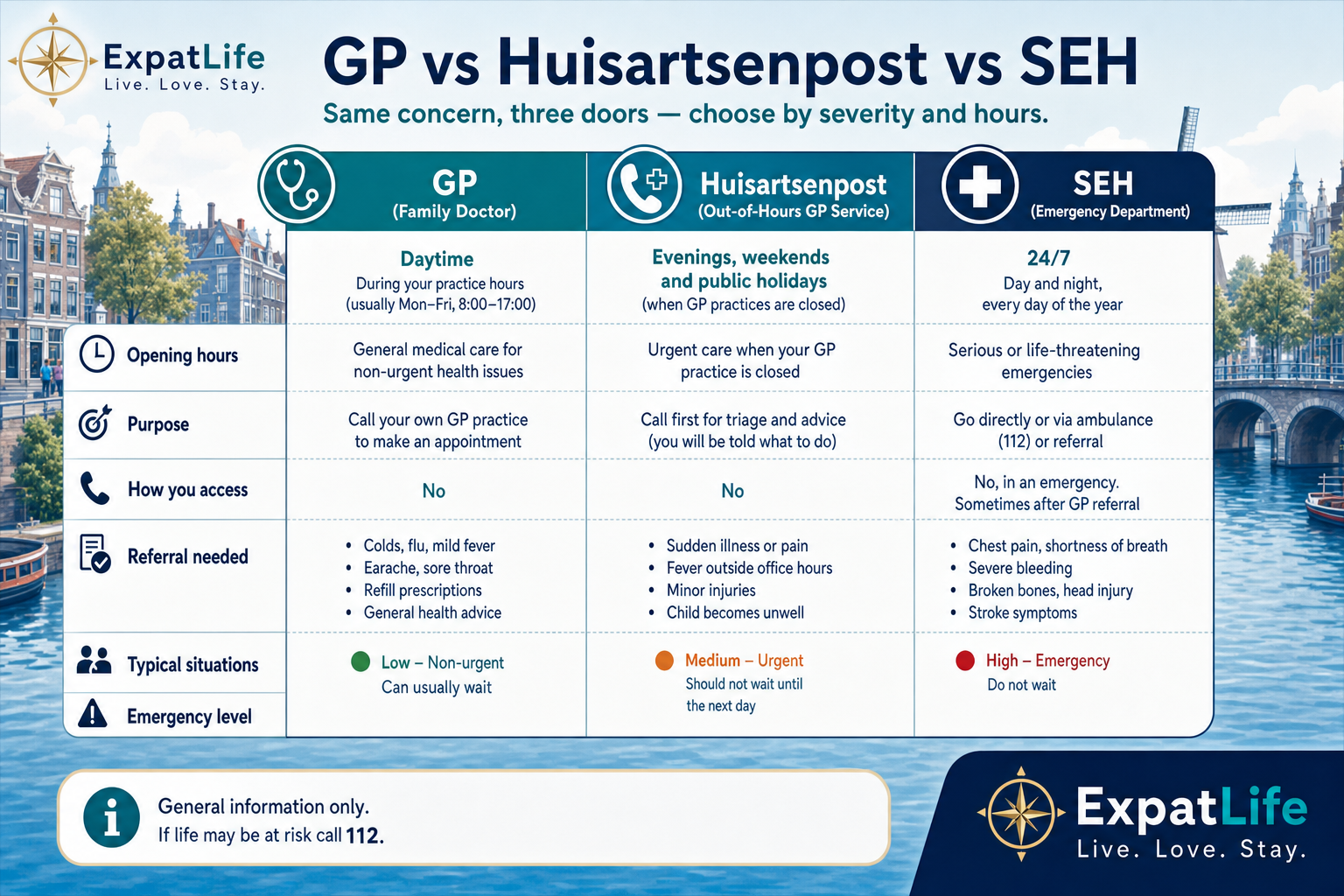
| Topic | GP | Huisartsenpost | SEH |
|---|---|---|---|
| Opening hours | Practice opening hours on working days | Evenings, nights, weekends and public holidays | 24/7 hospital emergency department |
| Purpose | Primary care, same-day urgency and coordination | Urgent GP-level care when the practice is closed | Serious emergencies and high-acuity assessment |
| How you access care | Phone, online booking or e-consult | Call regional number first for triage | Often ambulance arrival or referral; walk-in primary care commonly redirected |
| Referral needed | No — you contact your own practice | No referral to call; may refer you onward to hospital | Many non-ambulance arrivals are expected to come via GP or post referral |
| Typical situations | Fever, infections, injuries and urgent daytime concerns that are not life-threatening | Same type of urgent GP problems outside practice hours | Major trauma, acute life-threatening illness, ambulance arrivals and referred emergencies |
| Costs orientation | Usually within basic insurance primary-care rules | Urgent GP-level pathway; verify insurer details for your policy | Hospital emergency care may involve your annual deductible (eigen risico) |
| Waiting / triage | Practice assistant triage; same-day slots when clinically needed | Telephone triage first, then advice, appointment or escalation | Severity triage — the most urgent patients are seen first |
| Emergency level | Urgent non-emergency primary care | Urgent non-life-threatening out-of-hours care | Serious / life-threatening emergency pathway |
Before you choose a door
Examples
| Situation | How it works here | First step |
|---|---|---|
| Fever and ear pain at 10:00 on a weekday | Contact your own GP for same-day triage rather than going to SEH. | Call the practice urgent line and state onset, severity and your main worry. |
| Same symptoms at 22:00 on a Sunday | Call the Huisartsenpost for out-of-hours GP-level triage. | Use the saved regional number and follow telephone triage advice. |
| Chest pain with worrying features now | Skip GP vs post comparisons — treat as a potential emergency. | Call 112 immediately and give your location first. |
Huisartsenpost
When your own GP practice is closed — evenings, nights, weekends and public holidays — urgent GP-level care is organised through the regional Huisartsenpost (GP cooperative / out-of-hours GP post). You call first. A trained triage nurse assesses urgency and may give advice, arrange a phone consult, invite you to the post, organise a home visit or escalate toward hospital care.
Hospital emergency departments are generally for emergencies and referred urgent care, not for routine after-hours primary care. Walking in with a non-emergency problem often results in redirection to the huisartsenpost pathway.
Find your regional number once your address is known and save it beside 112. Your GP practice website or assistant can tell you which post covers your area. Posts are often near a hospital but use a separate entrance.
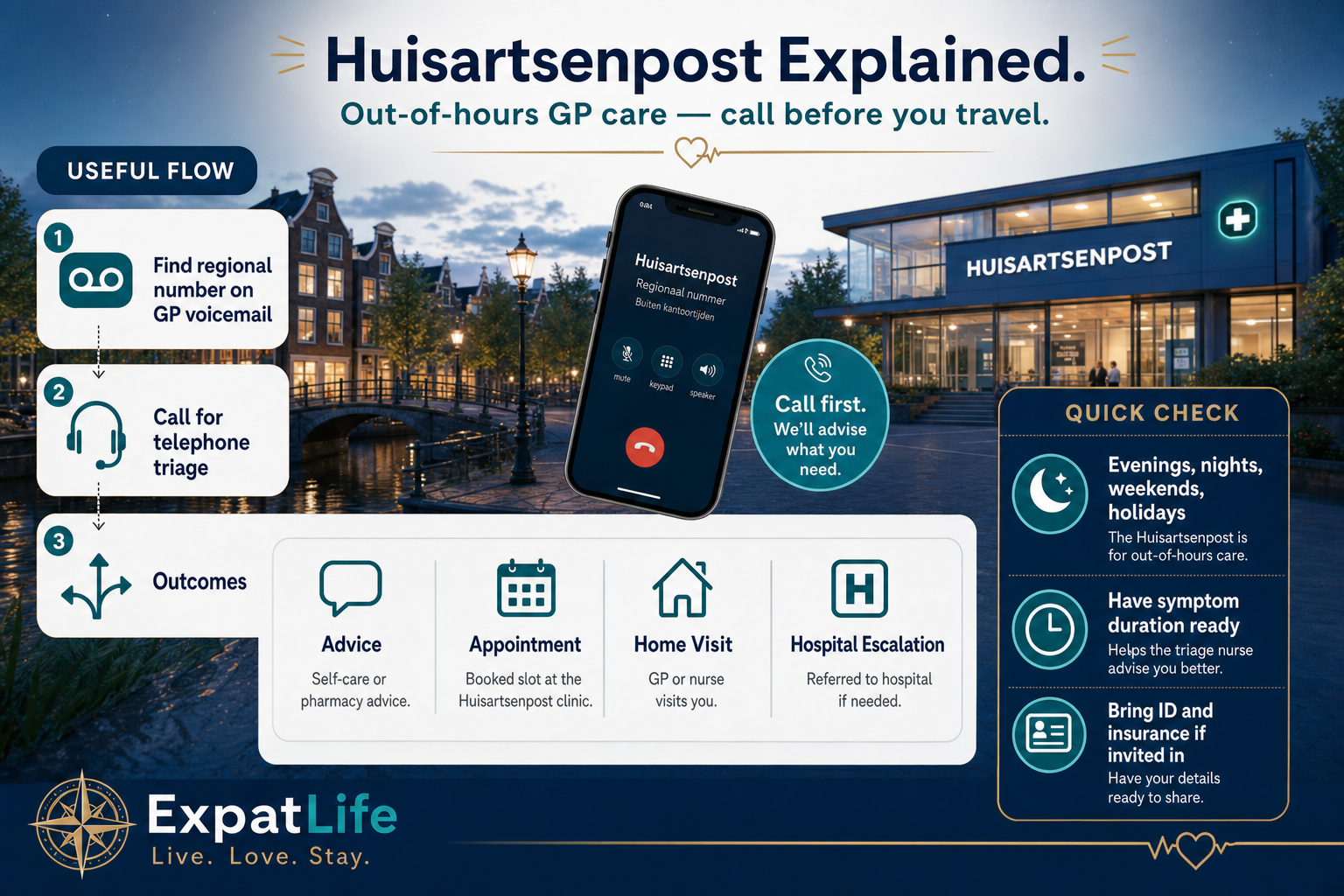
| Route | When | How | Note |
|---|---|---|---|
| Own GP (daytime) | Practice opening hours | Phone, online booking or e-consult | Best for routine and same-day non-emergency care. |
| Huisartsenpost | Evenings, nights, weekends, public holidays | Call regional number first for triage | Urgent GP-level care that cannot wait for the practice to reopen. |
| 112 | Life-threatening emergency | Call immediately | Unresponsiveness, severe breathing difficulty, heavy bleeding, stroke signs, severe allergic reaction and similar crises. |
Huisartsenpost checklist
Examples
| Situation | How it works here | First step |
|---|---|---|
| Child with high fever on Saturday night | Call the huisartsenpost for paediatric triage rather than driving to SEH by default. | Have the child's age, temperature trend and fluid intake ready when you call. |
| Urgent medicine needed after pharmacy closing time | Call the huisartsenpost — they can advise whether a dienstapotheek route is appropriate. | State the medicine name, why it cannot wait, and any allergies. |
| Triage invites you to the post | Go to the stated entrance with ID and insurance details; do not assume it is the main hospital lobby. | Confirm the address and entrance before you leave. |
Emergency department
Dutch hospital emergency departments are called spoedeisende hulp (SEH). They are organised for serious emergencies and high-acuity care. Patients are triaged by severity, so waiting times vary — the most urgent cases are seen first.
Many people arrive by ambulance or with a referral from a GP or Huisartsenpost. Self-referral walk-ins with primary-care problems are commonly redirected to the appropriate GP-level pathway. That is a system design choice, not a refusal of genuine emergency care.
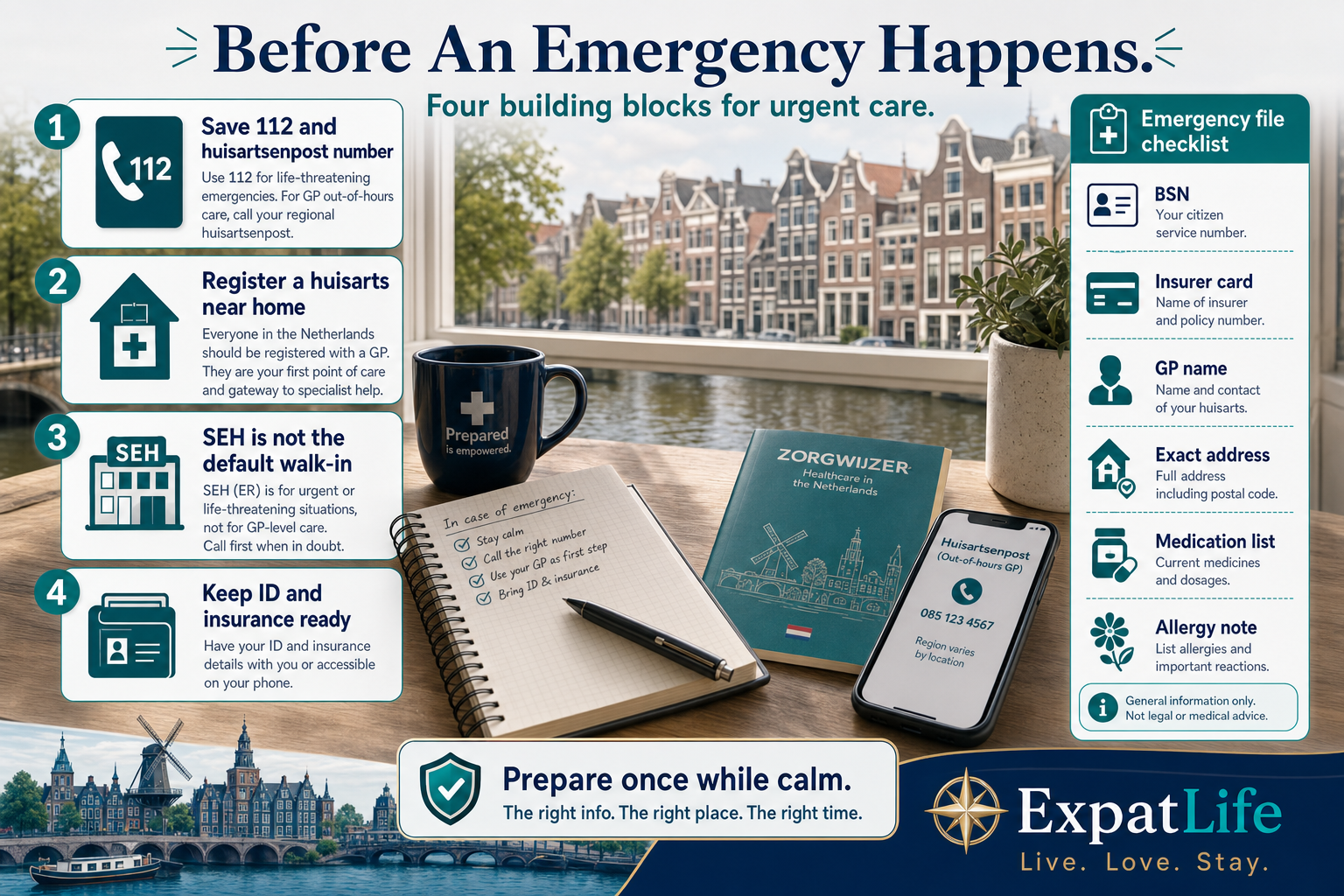
If you are directed to SEH, bring ID, insurance details, a medication and allergy list, and a short timeline of what happened. Ask who will receive the discharge information and whether you should contact your own GP afterward.
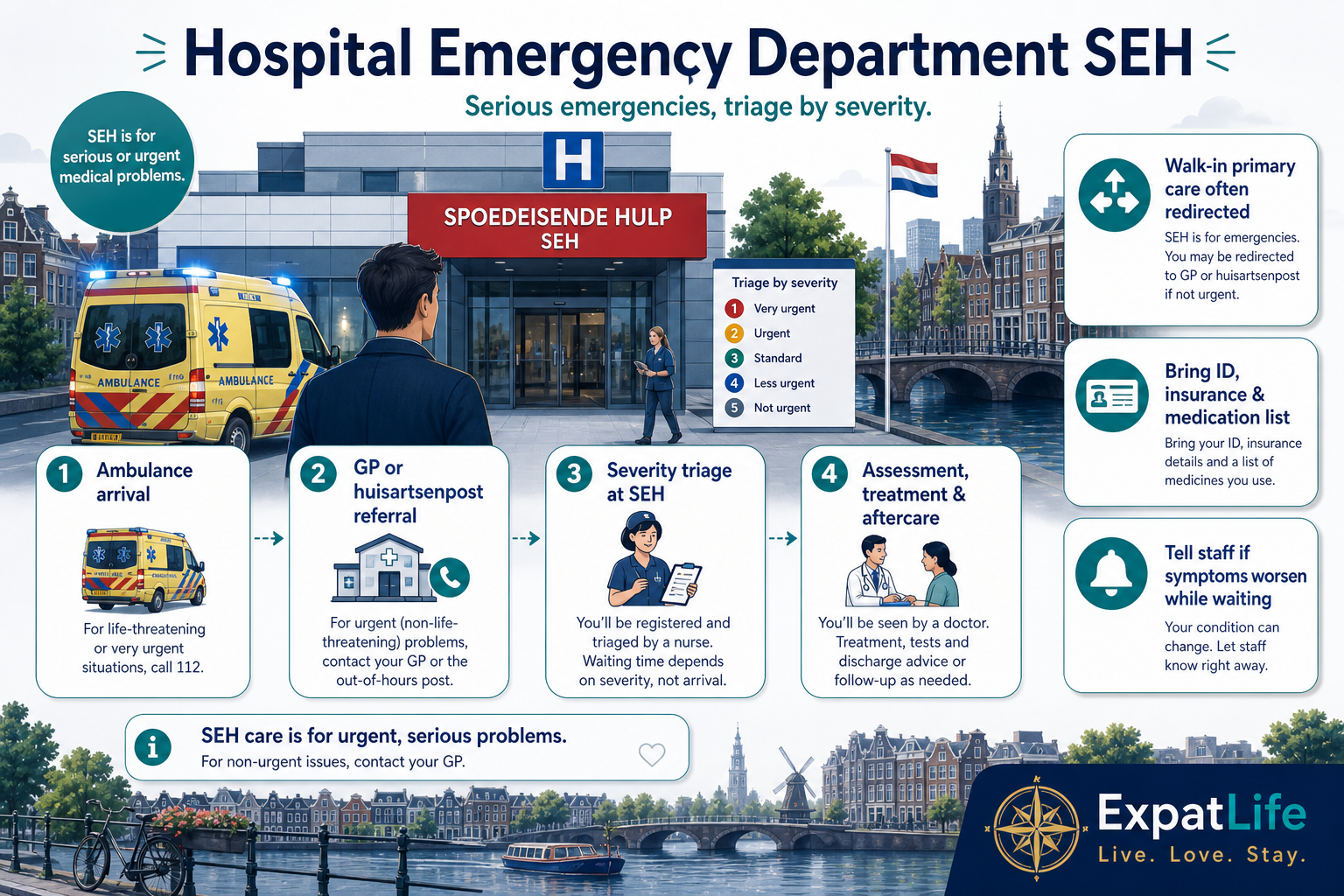
Ambulance professionals assess on scene, treat as needed and transport to an appropriate hospital when clinically indicated.
A GP or Huisartsenpost may refer you to SEH after triage when hospital emergency assessment is the right next step.
SEH staff assess urgency, then provide emergency diagnostics and treatment, involving specialists when needed.
You may be discharged with advice, observed further, admitted, or directed back to GP follow-up.
What to bring
Examples
| Situation | How it works here | First step |
|---|---|---|
| Huisartsenpost refers you to SEH | Follow the referral instructions exactly — entrance, timing and what to tell triage. | Confirm whether you should travel yourself or await further transport advice. |
| Long wait after triage | Severity triage means less urgent cases wait longer — tell staff immediately if symptoms worsen. | Ask what symptom changes should trigger an immediate re-check. |
Ambulance
Ambulances in the Netherlands are emergency medical responses, not only transport vehicles. Crews assess the situation, provide treatment on scene and decide whether hospital transport is needed. Not every assessed patient is transported — that decision is clinical.
You usually reach ambulance care by calling 112. Give a clear location and describe what is wrong. The dispatch centre may give instructions while help is on the way.
When the ambulance arrives, make access easy: lights on, entrance unlocked if safe, someone waiting outside when possible. Share medication, allergy and medical-history details if you know them.
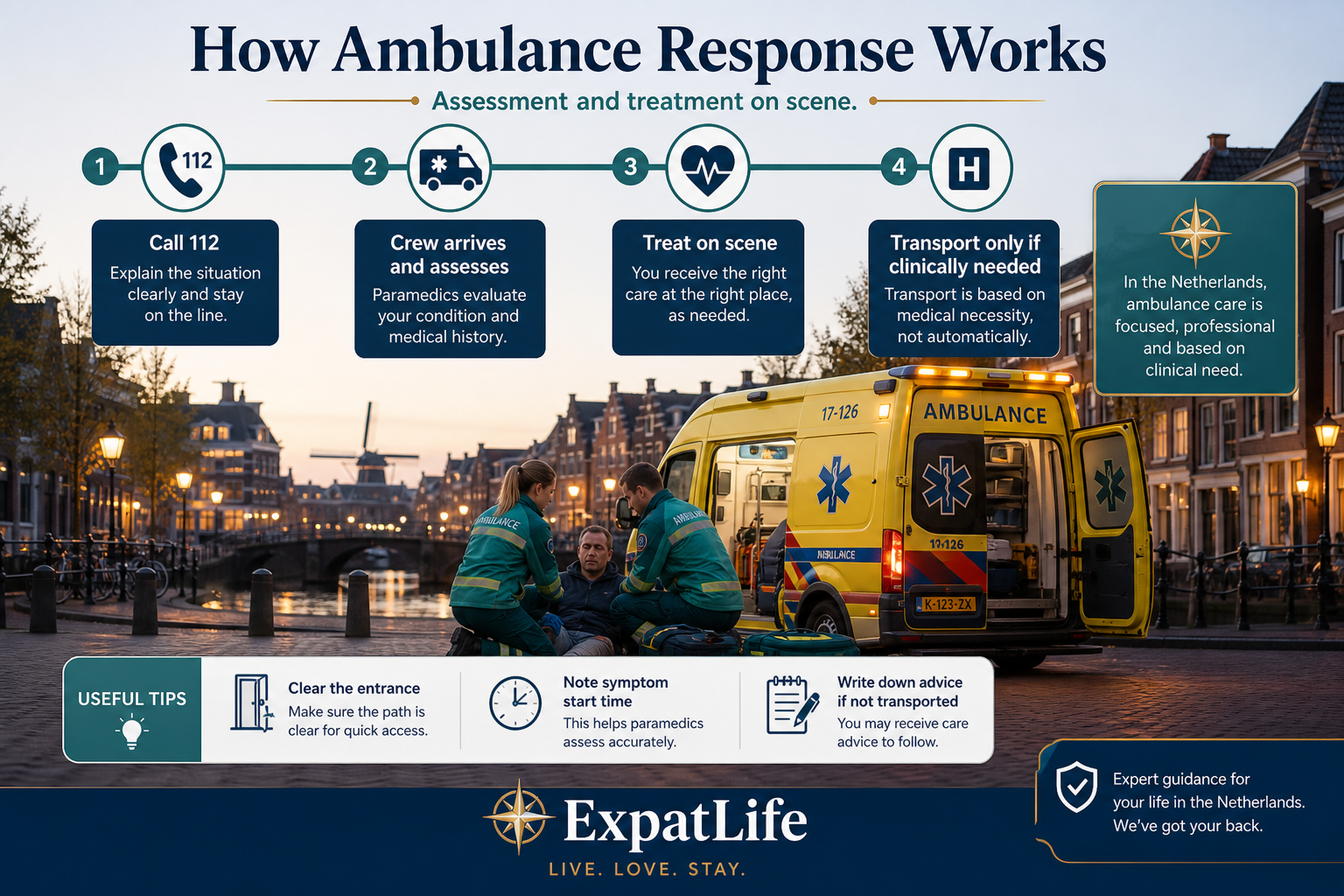
Stage 1
112 takes location and urgency details and mobilises the appropriate response.
Stage 2
Ambulance professionals evaluate the patient and begin treatment as needed.
Stage 3
Care may continue on scene, with transport, or with advice that another pathway fits better.
Stage 4
If transport is needed, the crew coordinates with an appropriate emergency department.
| Route | When | How | Note |
|---|---|---|---|
| Ambulance via 112 | Life-threatening or dispatcher decides emergency response is needed | Call 112 and follow operator instructions | Crews assess and treat on scene; transport is clinical, not automatic. |
| Self-travel to SEH | Only when triage or clinical advice says it is safe and appropriate | Follow the referring clinician's entrance and timing instructions | Do not drive yourself if unsafe; call 112 if the situation worsens. |
| Huisartsenpost / GP | Urgent but not life-threatening after assessment | Call the appropriate GP-level number | Ambulance advice may redirect you here when hospital transport is not needed. |
While waiting for help
Examples
| Situation | How it works here | First step |
|---|---|---|
| Ambulance assesses but does not transport | Follow the safety-net advice you are given — including when to call back or contact the huisartsenpost or GP. | Write down the advice and any recommended next contact before the crew leaves. |
| You called for someone else | Stay until responders arrive if safe, and pass on what you observed. | Note the time symptoms started and any medicines already taken. |
Children
Children use the same three doors as adults: 112 for life-threatening emergencies, the Huisartsenpost for urgent out-of-hours GP-level care, and the daytime huisarts for non-life-threatening urgency during practice hours. Paediatric triage questions often focus on breathing, alertness, fluid intake, fever pattern and how quickly the child has changed.
Parents sometimes feel pressure to go straight to hospital. In the Dutch system, calling first is often the fastest way to the right place — and if the situation is life-threatening, 112 remains the correct first call.
For the full children's healthcare pathway — GP care, Youth Healthcare (JGZ), vaccinations, hospitals and family setup — use the Healthcare for Children guide.
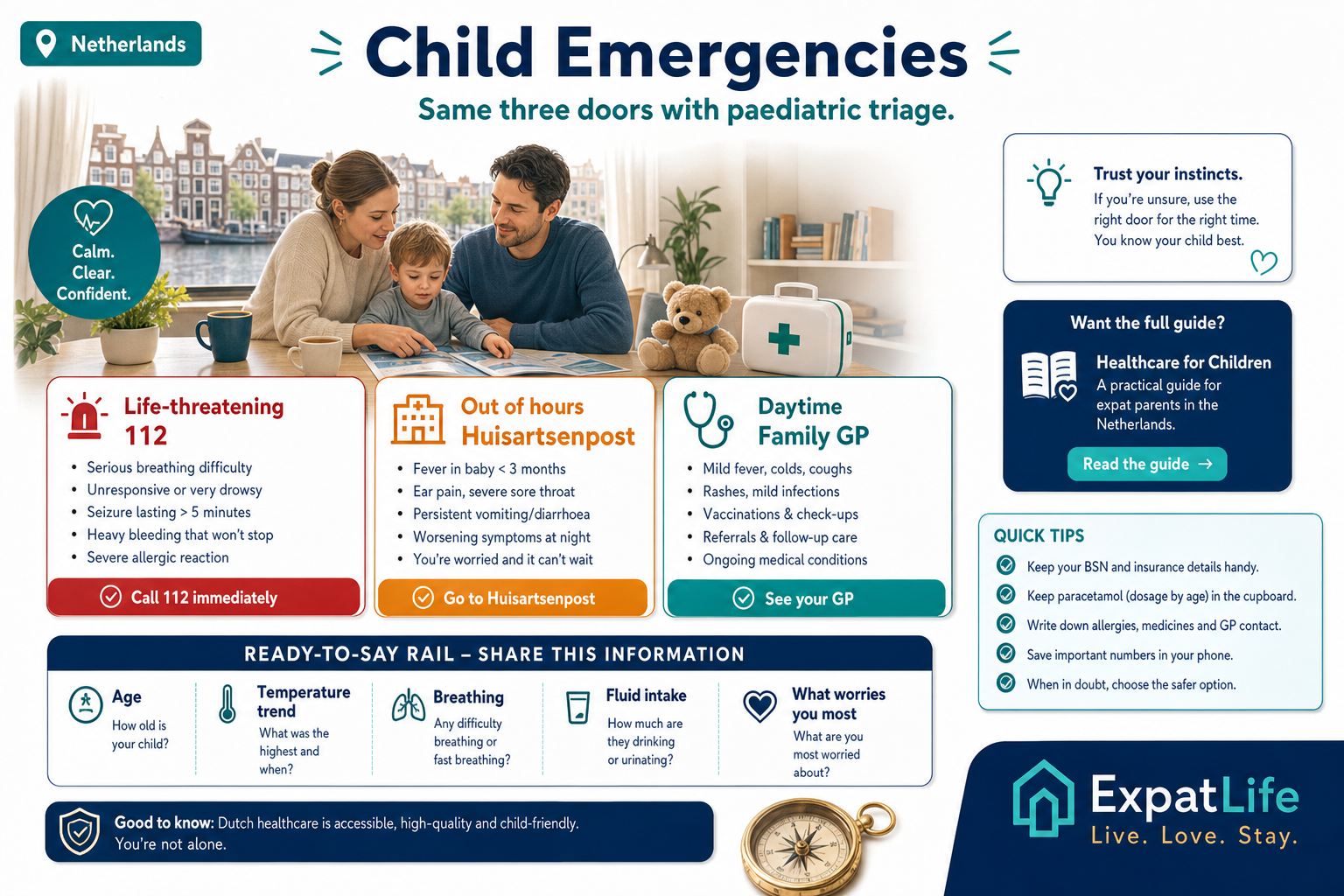
Unresponsive, severe breathing difficulty, major trauma or rapid dangerous deterioration — call immediately.
Urgent paediatric concerns when the family GP is closed — call first for telephone triage.
Same-day urgent concerns during practice hours; continuity helps when the child is known to the practice.
Youth Healthcare handles growth checks and many vaccinations — it does not replace urgent GP or 112 pathways.
Call 112 now
Child unresponsive, severe breathing difficulty or major trauma
Call 112 immediately.
Same day / out of hours
Infant under three months with fever
Seek urgent clinical triage the same day — GP or huisartsenpost; call 112 if the child deteriorates.
High fever with rapid worsening outside practice hours
Call the huisartsenpost for triage.
Next appointment
Mild cold symptoms in an otherwise well child
Use routine GP advice routes or next available appointment unless warning signs appear.
Prepare before calling
Examples
| Situation | How it works here | First step |
|---|---|---|
| Toddler with high fever on Saturday evening | Call the huisartsenpost for paediatric triage rather than defaulting to SEH. | Have age, temperature trend, fluids and alertness ready when you call. |
| Child suddenly floppy or hard to wake | Treat as a potential emergency — do not wait for a routine appointment. | Call 112 immediately and stay on the line. |
| School reports an injury during GP opening hours | Call the family GP for same-day triage unless life-threatening features are present. | Ask what the school has already observed and whether breathing is affected. |
Mental health
Urgent mental health situations are part of emergency planning too. This section is system orientation only — not diagnosis, not treatment advice, and not a substitute for professional care.
If you or someone else is in immediate danger, call 112. For suicidal thoughts, the national 113 service is a dedicated crisis resource. For urgent but non-life-threatening mental health concerns outside GP hours, the Huisartsenpost can help with triage and next steps. During opening hours, your huisarts is often the first contact and may involve a mental health practice nurse (POH-GGZ) or referral pathways.
Regional crisis services can become involved when urgent psychiatric assessment is needed. Exact local routes vary — triage clinicians help direct you.
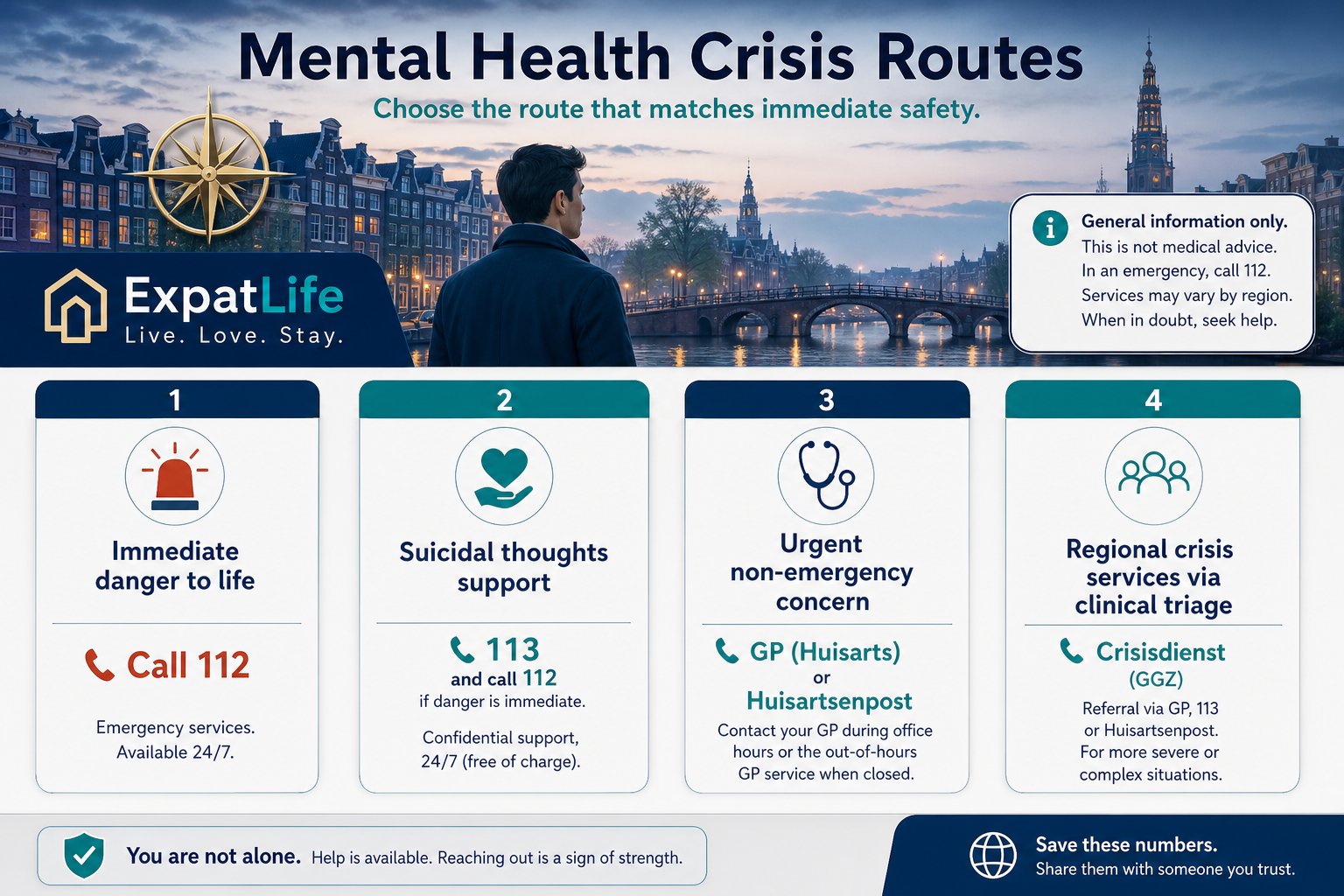
Use when there is immediate danger to life or safety, including severe self-harm risk or a medical emergency accompanying a crisis.
National resource for suicidal thoughts support. If danger is immediate, call 112.
Urgent non-life-threatening mental health concerns and next-step planning, including escalation when indicated.
Urgent psychiatric assessment pathways arranged through clinical triage when needed.
| Route | When | How | Note |
|---|---|---|---|
| 112 | Immediate danger to life or safety | Call 112 and stay on the line | Use when self-harm risk is immediate or a medical emergency accompanies a crisis. |
| 113 | Suicidal thoughts and you need dedicated crisis support | Contact 113 for suicidal thoughts support | If danger is immediate, call 112 instead of or as well as 113. |
| GP / Huisartsenpost | Urgent mental health concern that is not immediately life-threatening | Call your GP by day or the huisartsenpost after hours | Triage can advise next steps, including crisis-service involvement. |
| Regional crisis services | Urgent psychiatric assessment is needed after clinical triage | Arranged through GP, huisartsenpost or emergency pathways | Exact local names and doors vary by region. |
Prepare before a crisis night
Examples
| Situation | How it works here | First step |
|---|---|---|
| You feel unsafe alone tonight but are not in immediate danger | Contact 113 if suicidal thoughts are present, or the huisartsenpost / GP for urgent triage and next steps. | Tell the person on the line you feel unsafe alone and whether anyone can stay with you. |
| A friend talks about ending their life and has a plan | Treat immediate danger as an emergency — call 112 rather than debating the perfect service name. | Stay with them if safe, call 112, and pass on what you heard and observed. |
| Severe anxiety spike during GP opening hours | Contact your huisarts for same-day urgency triage and ask about POH-GGZ or next-step options. | Say what changed today, whether you feel safe, and what support you already have. |
Pharmacy
During the day, prescriptions are usually dispensed by your regular apotheek. Outside normal opening hours, urgent medicines may be dispensed by a regional out-of-hours pharmacy (dienstapotheek).
You typically reach that route after contact with the Huisartsenpost or another clinician who confirms the medicine cannot wait. The triage service can tell you which emergency pharmacy covers your area and whether a prescription pathway is arranged.
A drogist (drugstore such as Etos or Kruidvat) sells selected over-the-counter products but is not a substitute for prescription dispensing or clinical triage.
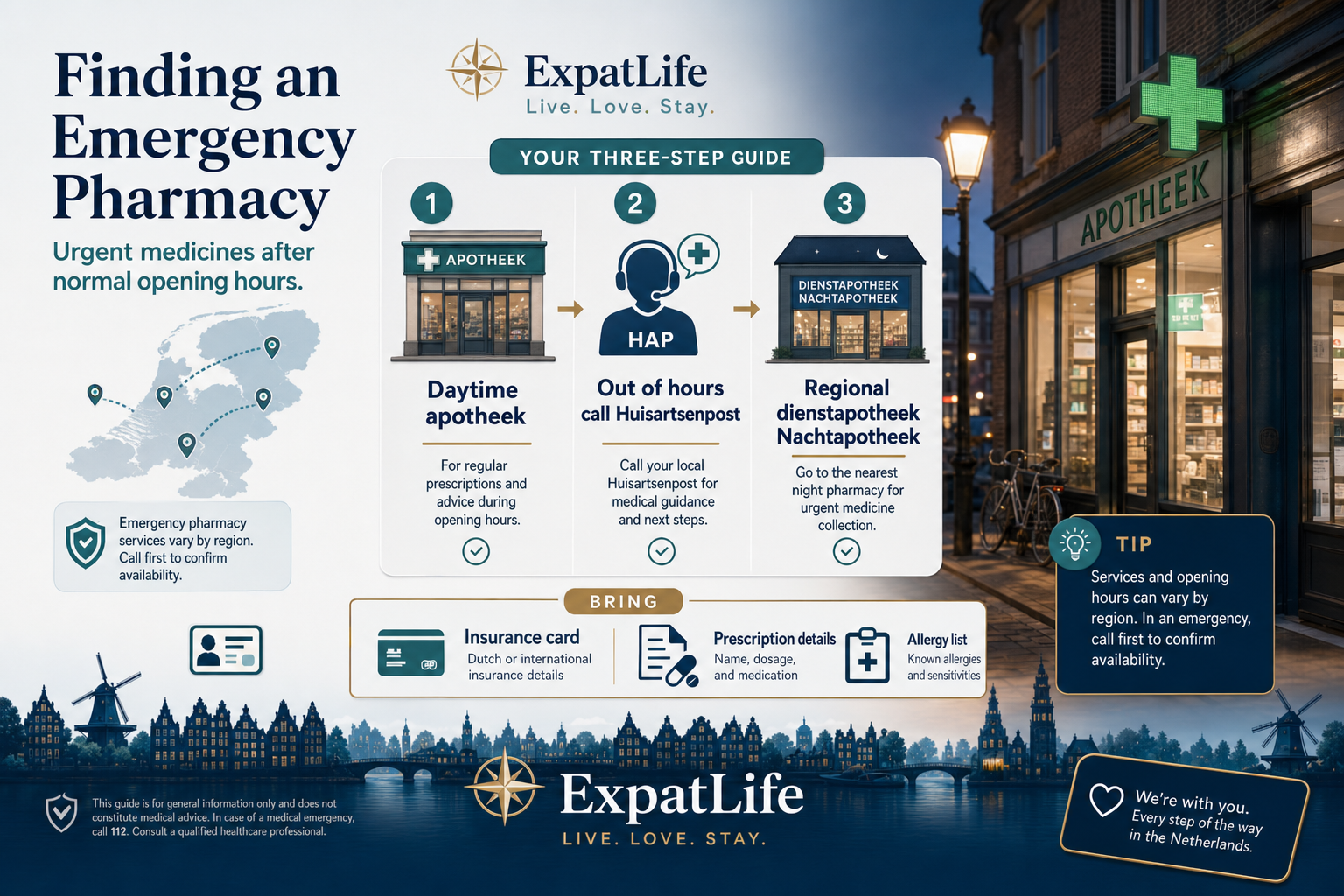
| Route | When | How | Note |
|---|---|---|---|
| Regular apotheek | Daytime dispensing and prescription collection | Use your usual pharmacy where possible | Best place for medication history and repeat prescriptions during opening hours. |
| Dienstapotheek | Urgent medicines outside normal pharmacy hours | Reached after Huisartsenpost or clinician confirms urgency | Call first — confirm opening status and that your prescription can be dispensed. |
| Drogist | Selected over-the-counter products when open | Buy simple OTC items if clinically appropriate | Not a substitute for prescription dispensing or medical triage. |
Pharmacy checklist
Examples
| Situation | How it works here | First step |
|---|---|---|
| Ran out of essential medicine on a Sunday | Contact the huisartsenpost to assess urgency and the correct dienstapotheek route. | Have the medicine name, dose and your pharmacy history ready. |
| Need over-the-counter pain relief late at night | A drogist may help for simple OTC products when open; for clinical urgency or prescription needs, use triage routes. | If symptoms are severe or worrying, call the huisartsenpost or 112 as appropriate rather than focusing only on a shop. |
Emergency dentists
Dental emergencies have a parallel pathway. During opening hours, contact your own tandarts. Outside hours, urgent but non-life-threatening dental problems usually go to the regional out-of-hours dental service (dienstdoenende tandarts).
Call 112 or use hospital emergency care for genuine medical emergencies involving the face or airway — for example severe swelling affecting breathing, uncontrolled bleeding or major facial trauma. Ordinary toothache belongs with dental services, not SEH by default.
For finding a dentist, insurance, costs and children's dental care, use the Dentists in the Netherlands guide.
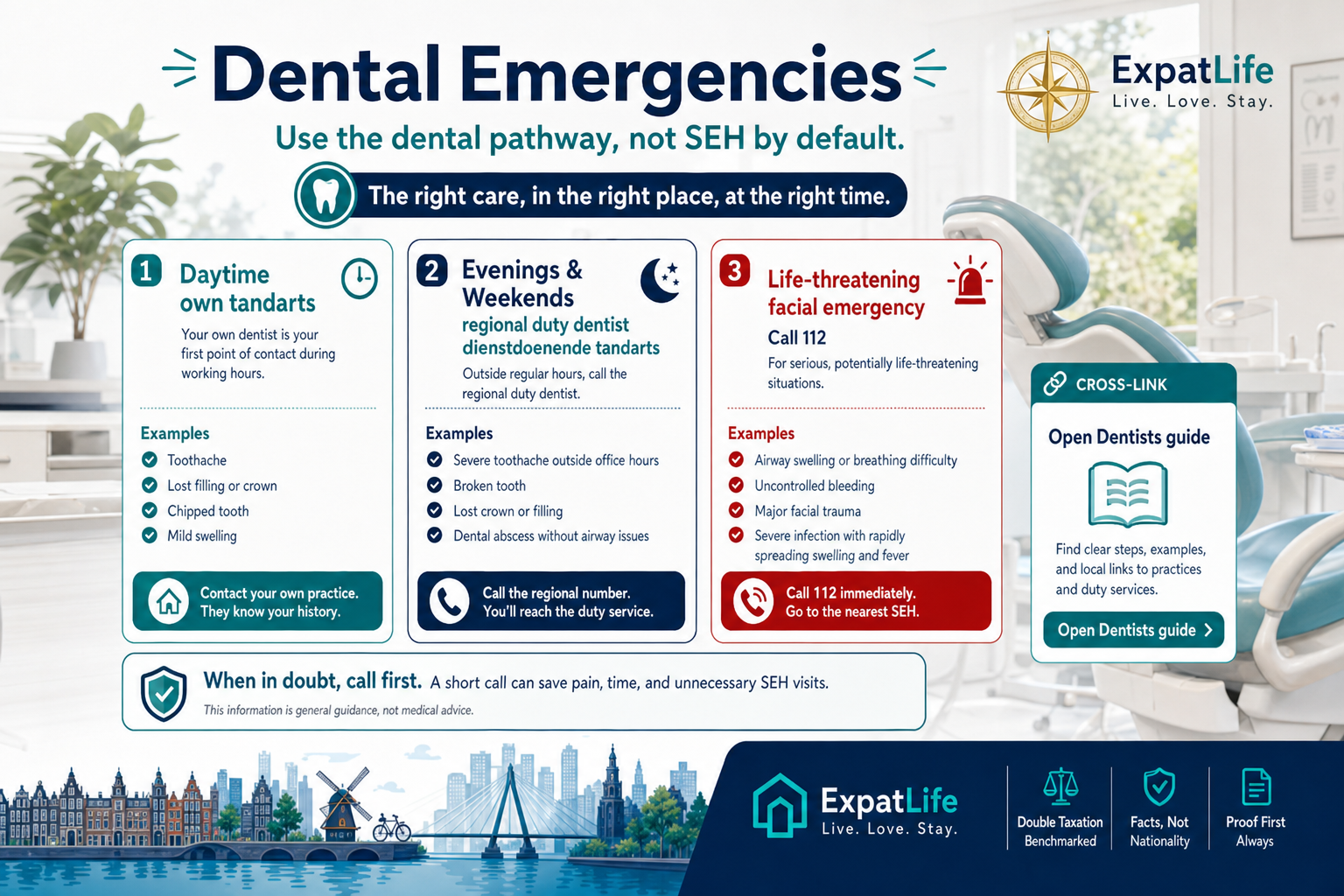
Same-day dental urgency and advice during practice opening hours via phone or the practice booking route.
Regional out-of-hours dental service for urgent problems that cannot wait until the practice reopens.
Airway-threatening swelling, uncontrolled bleeding, major facial trauma or other life-threatening medical emergencies.
Call 112 now
Severe facial swelling affecting breathing
Call 112 immediately.
Uncontrolled oral bleeding or major facial trauma
Call 112 or use hospital emergency care now.
Same day / out of hours
Severe toothache or knocked-out tooth outside dental hours
Call the regional out-of-hours dental service.
Mild toothache during practice hours
Call your own dentist for same-day advice.
| Route | When | How | Note |
|---|---|---|---|
| Own dentist | Practice opening hours — urgent or same-day dental problems | Call your registered tandarts | Default first door for non-life-threatening dental urgency by day. |
| Out-of-hours dental service | Evenings, nights and weekends — urgent, not life-threatening | Call the regional dienstdoenende tandarts number for your postcode | Ask your practice in advance which number covers your area. |
| 112 / SEH | Breathing, swallowing, uncontrolled bleeding or major facial trauma | Call 112 or follow emergency pathway advice | Ordinary toothache is usually not an SEH walk-in. |
What to say when you call
Prepare before you need it
Examples
| Situation | How it works here | First step |
|---|---|---|
| Severe toothache at 23:00 on a Saturday | Call the regional out-of-hours dental service rather than walking into SEH. | Describe pain, swelling, fever and whether breathing or swallowing is affected. |
| Knocked-out permanent tooth after a fall | Treat as urgent dental emergency and call dental emergency services immediately. | Follow phone advice on handling the tooth and how quickly you need to be seen. |
| Rapid facial swelling making breathing harder | Treat as a medical emergency — this is not a routine dental booking. | Call 112 immediately and stay on the line. |
Costs
Emergency care in the Netherlands interacts with mandatory basic health insurance (basisverzekering), your annual deductible (eigen risico) for many non-GP hospital pathways, and — for some services such as adult dental care — separate funding rules. Exact amounts change over time, so this guide does not hardcode fee figures.
As orientation: primary-care GP routes often work differently from hospital emergency and ambulance pathways when it comes to deductible. Children's coverage rules can also differ from adult rules. Tourists and uninsured situations have different practical and financial consequences — clinical emergency help should still be sought when life is at risk.
After an emergency, keep invoices, referral notes and discharge papers. Check your insurer's claims process and ask customer service to explain any deductible application for your specific event.
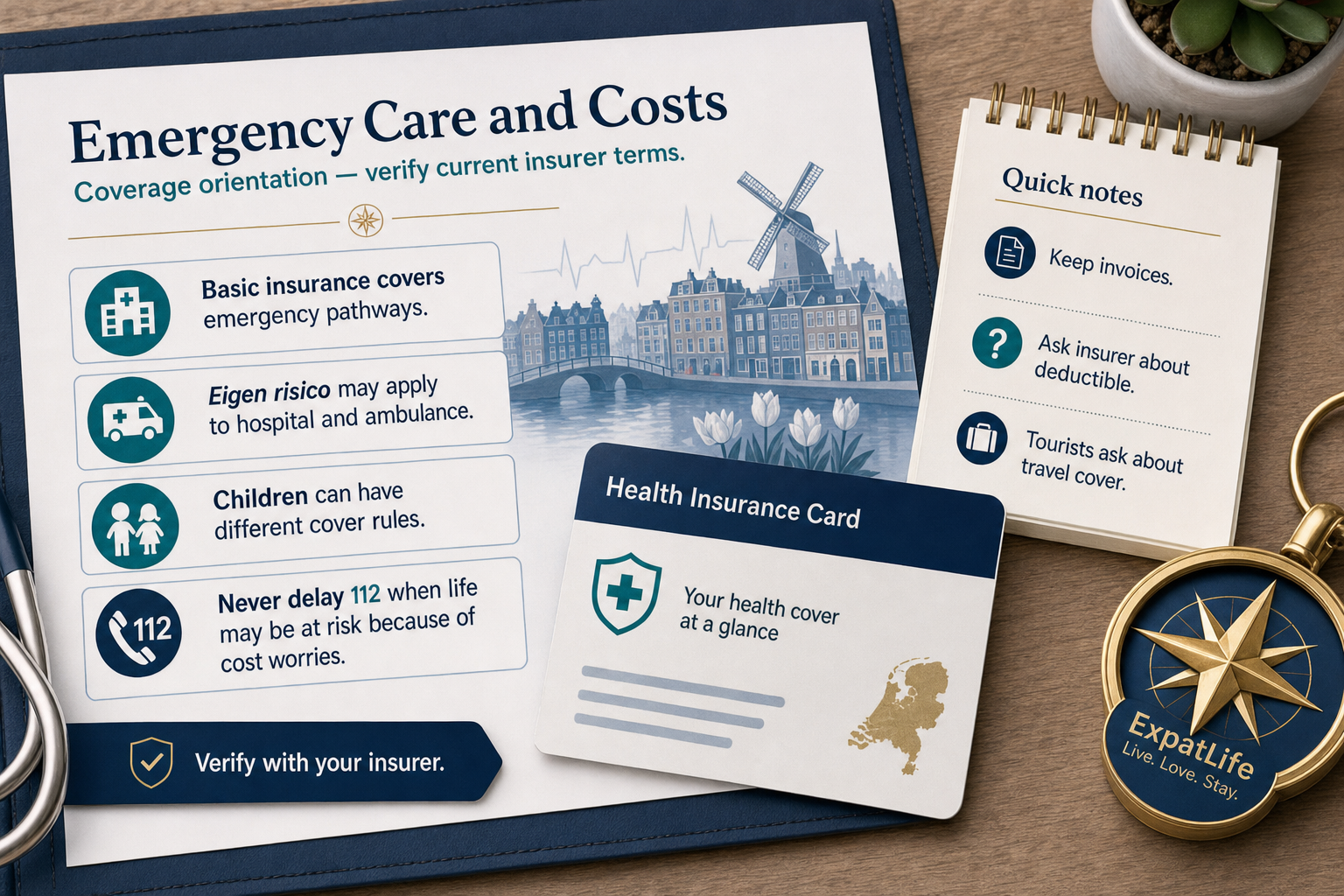
This section is cost orientation only — not a fee schedule, quote or guarantee. Coverage, deductible and dental-funding rules change over time. Always verify current terms with your own insurer, and never delay calling 112 when life may be at risk because of cost uncertainty.
Residents generally need Dutch basic health insurance. Emergency medically necessary care is part of how the system is organised — verify your own policy details with your insurer.
Adults usually have an annual deductible that can apply to many hospital and specialist pathways. Confirm whether your emergency event touches deductible with your insurer.
Ambulance and hospital emergency care can involve insurance billing and deductible rules. Never delay calling 112 because of cost worries when life may be at risk.
Children often have different premium and deductible treatment under basic insurance than adults — confirm family cover with your insurer.
Adult dental care frequently sits outside basic insurance. Check supplementary dental cover separately.
Keep referral letters, discharge notes and invoices — insurers usually need documentation for reimbursement questions.
Costs checklist
Examples
| Situation | How it works here | First step |
|---|---|---|
| Ambulance visit then discharge home | Expect insurance paperwork later; ask your insurer how deductible applied to this event. | Keep the discharge or crew advice note and any invoice references. |
| Huisartsenpost advice without hospital care | Primary-care routes often interact with insurance differently from SEH — confirm with your insurer if unsure. | Note the date, advice given and any prescription issued for your records. |
| Adult dental emergency at the duty dentist | Check supplementary dental cover separately from basic medical insurance. | Ask the dental service what will be billed and what your insurer needs for reimbursement questions. |
Surprises
None of these are problems once you expect them. Each card is a system characteristic that becomes easier after the first experience.
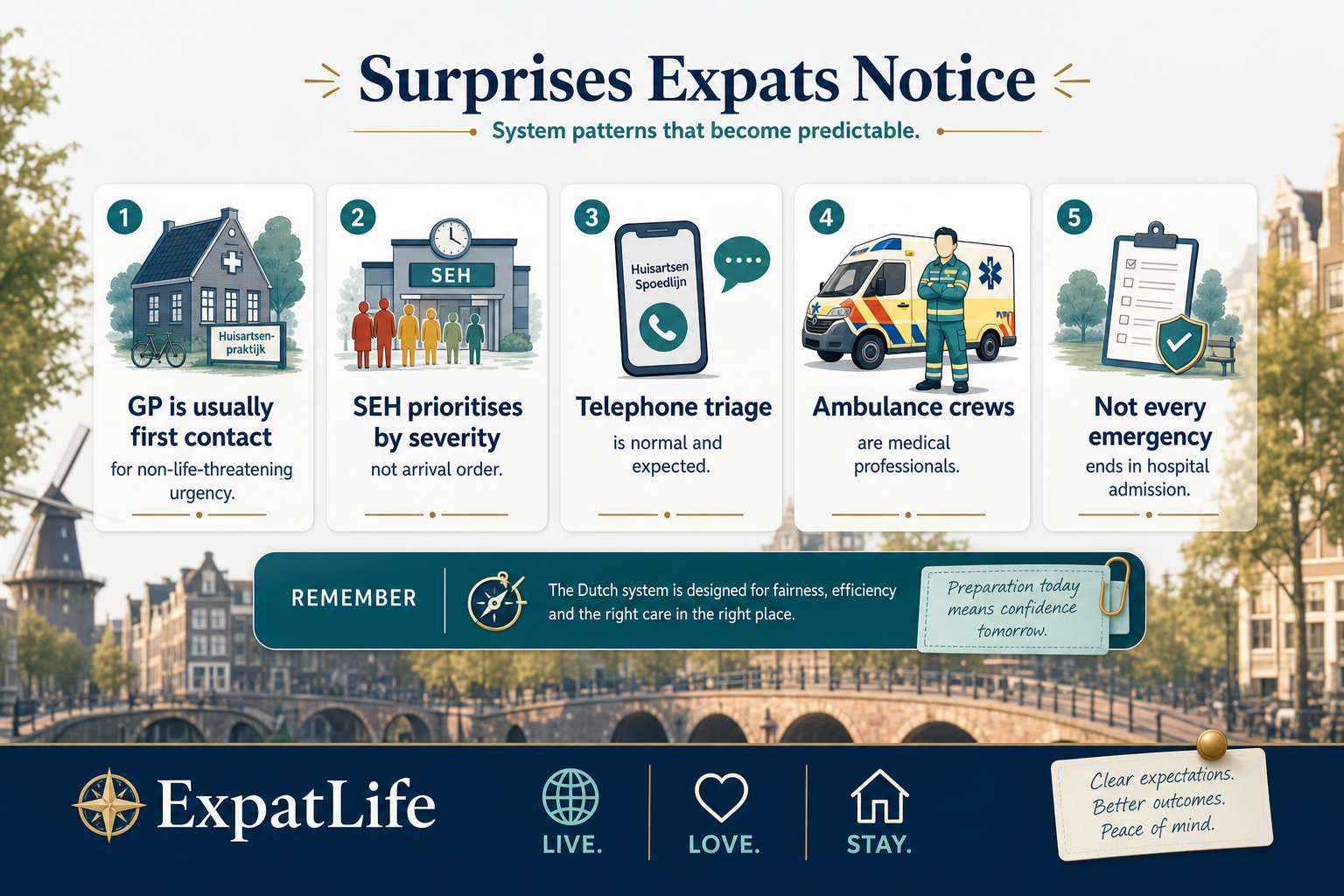
For urgent but non-life-threatening problems, the huisarts or Huisartsenpost is the normal front door — not the hospital lobby.
Fix: Save both numbers and practise the decision tree once while calm.
A long wait can mean someone else is more critically ill. Re-report immediately if you deteriorate.
Fix: Describe the most dangerous feature first at triage.
Out-of-hours care usually starts with a call, questions and a planned next step.
Fix: Prepare location, symptom, onset and callback number before dialling.
Crews assess and treat on scene; transport is a clinical decision, not an automatic ride.
Fix: Follow on-scene advice and ask what should trigger a new 112 call.
You may be treated, observed, discharged with safety-net advice or referred back to your GP.
Fix: Leave with written or clear verbal aftercare instructions.
112 operators can work in English, and many clinicians in cities manage English, but it is not guaranteed everywhere.
Fix: Ask for English early and keep a short written summary of the problem.
Preparation
The best emergency plan is boring and written down before you need it. Ten minutes of preparation removes most panic about which number to call and what to take with you.
Store the same core details in every adult's phone and in a shared household note. If you have children, caregivers and schools should know who to call and where key documents live.
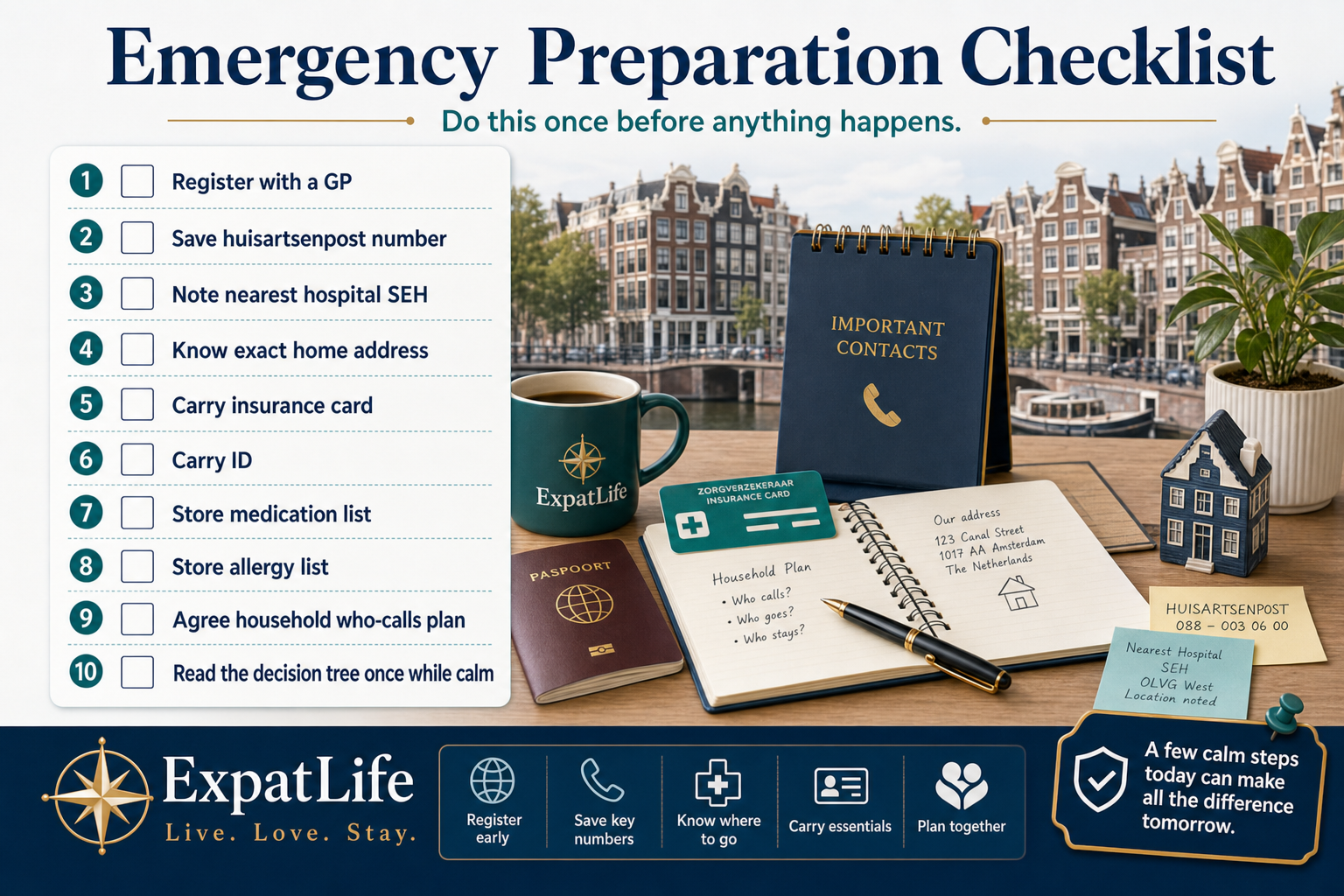
Preparation checklist
Keeps numbers current and makes sure every adult has them.
Dials 112 or the huisartsenpost and stays on the line.
Meets responders at the entrance with lights and access.
Grabs ID, insurance details and medication list when safe.
Avoid
These mistakes are common because emergency systems differ between countries. Each one has a simple fix.
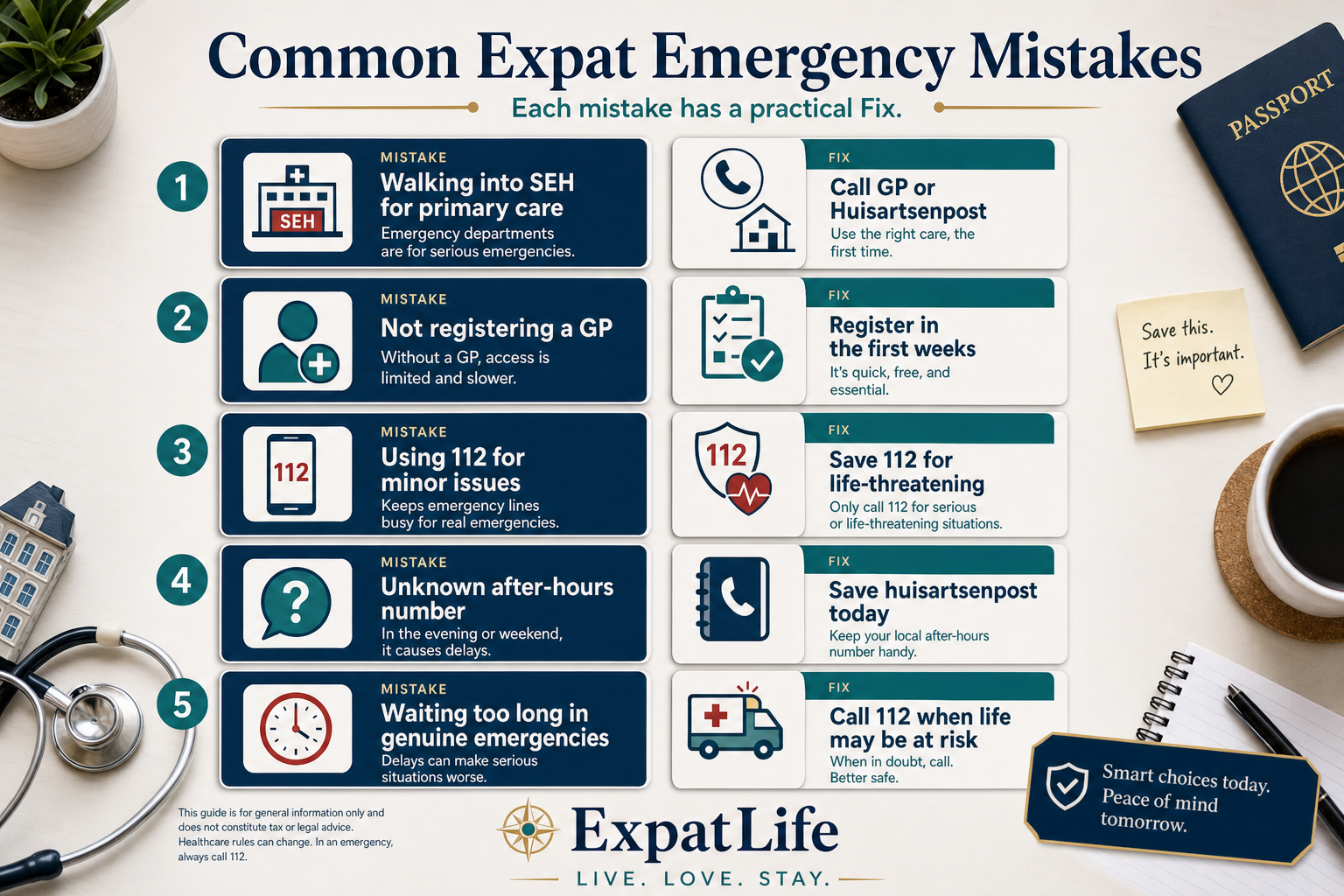
Example: walking into SEH with a non-emergency problem and being redirected to the Huisartsenpost.
Fix: Use GP by day and Huisartsenpost after hours for urgent non-life-threatening care; call 112 when life may be at risk.
Example: searching for daytime urgent care while already unwell and unregistered.
Fix: Register with a huisarts in your first weeks, even if you feel fine.
Example: calling 112 only to ask where a routine clinic is.
Fix: Keep 112 for emergencies — and still call 112 immediately whenever life may be at risk.
Example: discovering the Huisartsenpost exists only after a stressful weekend search.
Fix: Save the regional number and entrance notes now.
Example: delaying a 112 call because you are worried about bothering someone or about cost.
Fix: If life may be at risk, call 112 now — triage would rather assess early than late.
Example: driving an unstable person yourself and losing the chance for on-scene treatment.
Fix: Call 112 when emergency medical response may be needed on the way.
Example: arriving at the post or SEH without identification or policy information.
Fix: Keep phone photos of ID and insurance cards in an easy folder.
Example: waiting in a hospital emergency department for a dental problem that needs the duty dentist.
Fix: Use dental emergency routes for dental urgency unless there is a medical airway or trauma emergency.
FAQ
Orientation answers only — confirm your own situation with clinicians, the huisartsenpost or 112. Call 112 in an emergency.
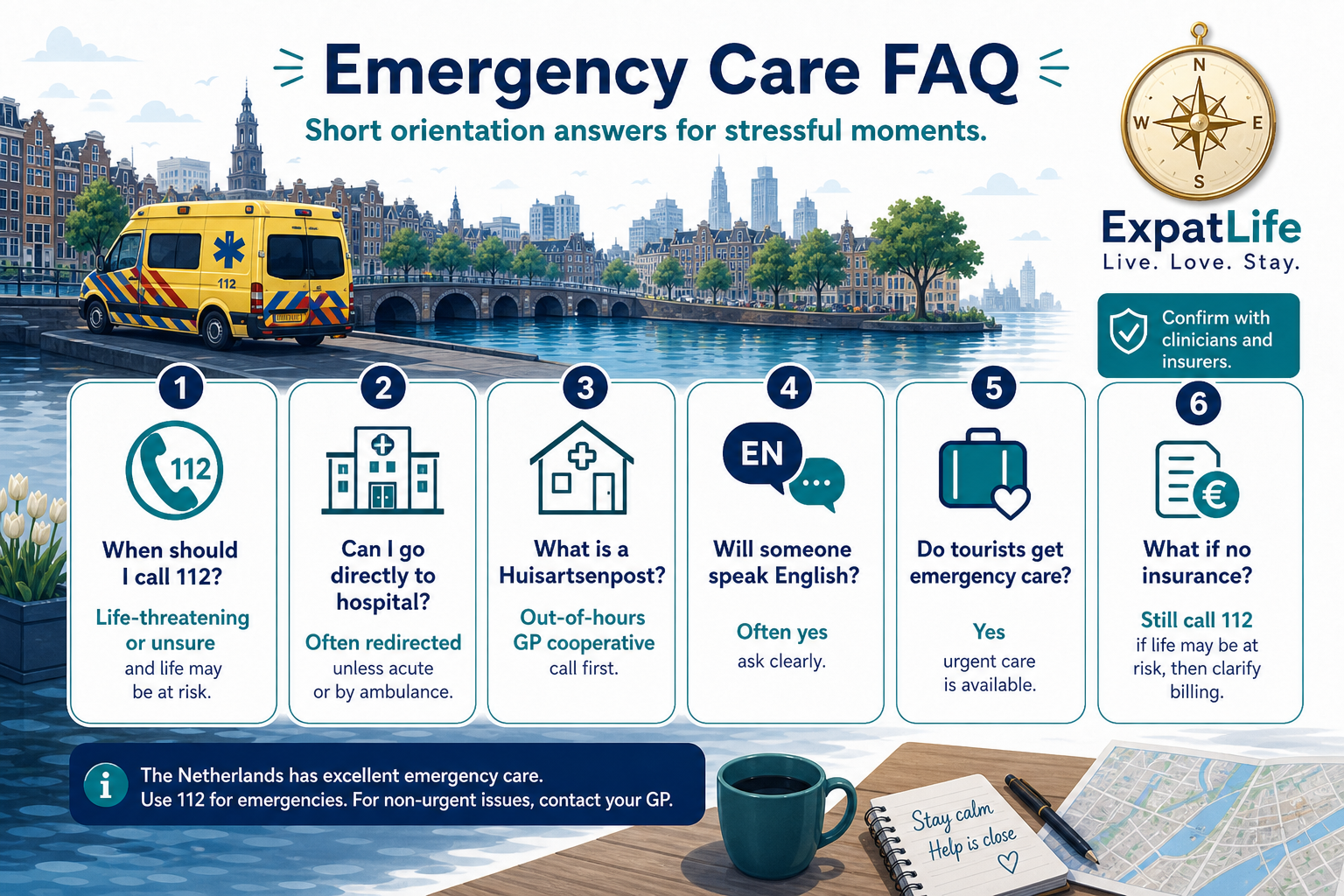
Call 112 for life-threatening emergencies such as unresponsiveness, severe breathing difficulty, heavy bleeding, stroke signs, severe allergic reaction, major trauma or chest pain with worrying features. If you are unsure and life may be at risk, call — operators and triage exist to assess with you.
SEH departments are for serious emergencies and often receive patients by ambulance or with a GP / Huisartsenpost referral. Walking in with a non-emergency primary-care problem commonly leads to redirection. For urgent non-life-threatening issues, contact your GP or the Huisartsenpost first. If life may be at risk, call 112.
A Huisartsenpost is the regional out-of-hours GP cooperative. When your own practice is closed — evenings, nights, weekends and public holidays — you call the post for urgent GP-level care. Telephone triage may give advice, invite you in, arrange a home visit or escalate.
Ambulance billing interacts with health insurance and may involve your annual deductible depending on the situation and policy. This guide does not quote amounts that change over time — verify current terms with your insurer. Never delay calling 112 because of cost concerns when life may be at risk.
112 operators can work in English. Speak clearly, give your location first, then what is wrong. In hospitals and GP posts, English availability varies by location — ask for English support early.
Yes — in a life-threatening emergency, call 112. Tourists should also check travel insurance for financial coverage, but clinical emergency response should not wait on paperwork. For urgent non-emergency problems, local out-of-hours GP routes may still apply.
Seek emergency help anyway if life may be at risk — call 112. Residents are generally required to hold basic health insurance, and uninsured care can create financial follow-up. Arrange cover as soon as you are obligated to, and speak with hospital administration or an insurer about your situation after urgent care is underway.
You are triaged by severity, then assessed and treated according to urgency. You may be discharged with advice, observed, admitted or referred for further specialist care. Ask for clear aftercare instructions and whether your GP will receive information.
112 is for life-threatening emergencies and dispatches ambulance, fire or police as needed. The Huisartsenpost is for urgent GP-level problems outside practice hours that are not life-threatening. If you are unsure and life may be at risk, call 112.
Check your GP practice website's spoed or urgent-care page, ask the practice assistant, or search for huisartsenpost plus your postcode. Save the number, address and entrance notes beside 112.
Urgent out-of-hours dispensing usually goes through a regional dienstapotheek. The Huisartsenpost can tell you which pharmacy applies after assessing whether the medicine need is clinically urgent.
Contact your dentist during opening hours or the regional out-of-hours dental service after hours for urgent dental problems. Call 112 for airway-threatening swelling, uncontrolled bleeding or major facial trauma. See the Dentists guide for full dental-emergency detail.
Many adult hospital and specialist pathways can touch the annual deductible, while GP-level primary care often works under different rules. Confirm your own event with your insurer. Cost questions should never delay a 112 call when life may be at risk.
Save 112, your GP number and Huisartsenpost number; keep ID and insurance details available; store a medication and allergy list; and agree who calls and who meets responders. The preparation checklist on this page covers the full set.
Related
Connect emergency care with GP care, insurance, family healthcare, dentists and living healthcare basics.
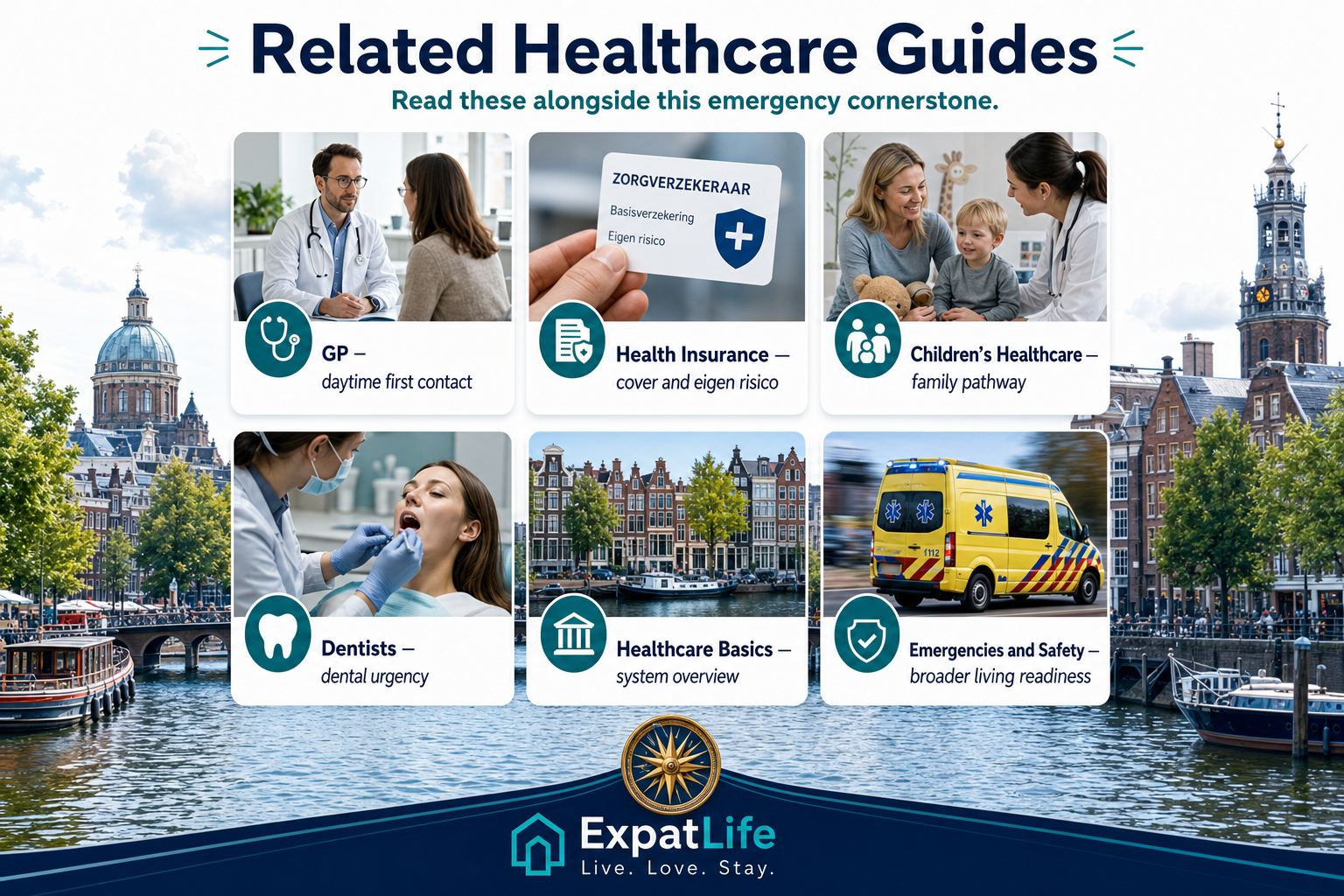
Health hub
This page is the emergency-care cornerstone — explore related health topics next.
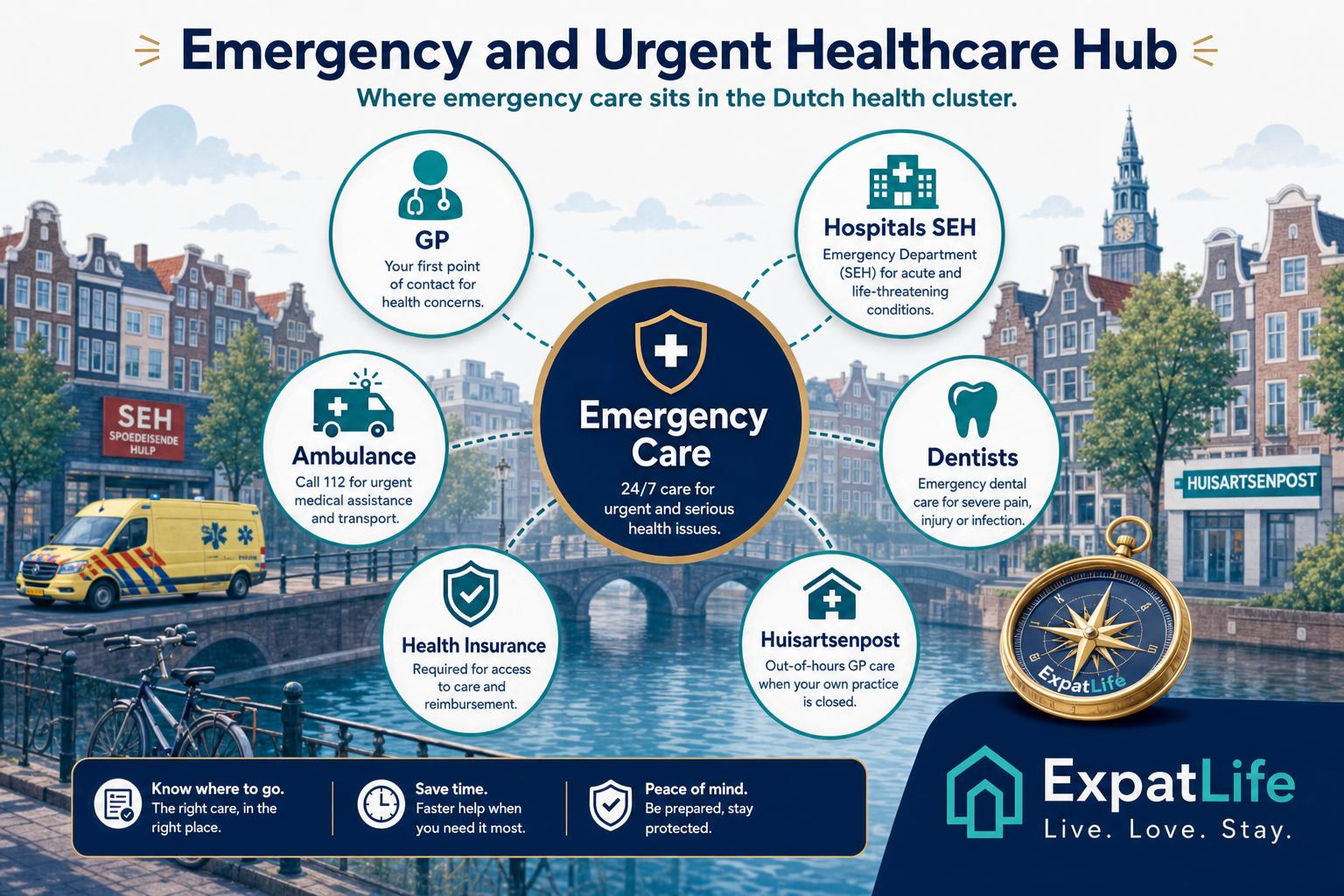
Explore next
Pick the card that matches what is still open — GP registration, insurance, children's care or dental routes — and verify specifics on the official sources below.
Trust
General information only — not medical advice. Local huisartsenpost procedures, hospital pathways and insurer terms change, so verify your own situation with clinicians, your insurer and the official sources above. In an emergency, call 112.