
First door
Verloskundige
Register early after confirmation
Netherlands · Family · Pregnancy
Calm prenatal orientation for newcomers — finding a midwife, trimester checkpoints, BSN and registration timing awareness, insurance basics and what to prepare before deeper maternity pathways.
General orientation only — not medical advice, not a birth plan, and not a ranking of midwives, hospitals or insurers. For your own pregnancy, speak with your midwife, obstetric team or GP. Call 112 for life-threatening emergencies.
Quick answer
Pregnancy care in the Netherlands is often midwife-led (verloskundige) for pregnancies considered low risk. After confirmation, many people contact a midwife practice early, complete intake, and follow antenatal check-ups there — with obstetric or hospital pathways when indicated.
This guide is the prenatal journey cornerstone for newcomers: finding a midwife, trimester checkpoints, BSN and registration timing awareness, insurance basics and what to prepare. Full maternity-system depth lives on Maternity care. Birth-day orientation continues on Giving birth. Family leisure lives on Family activities.
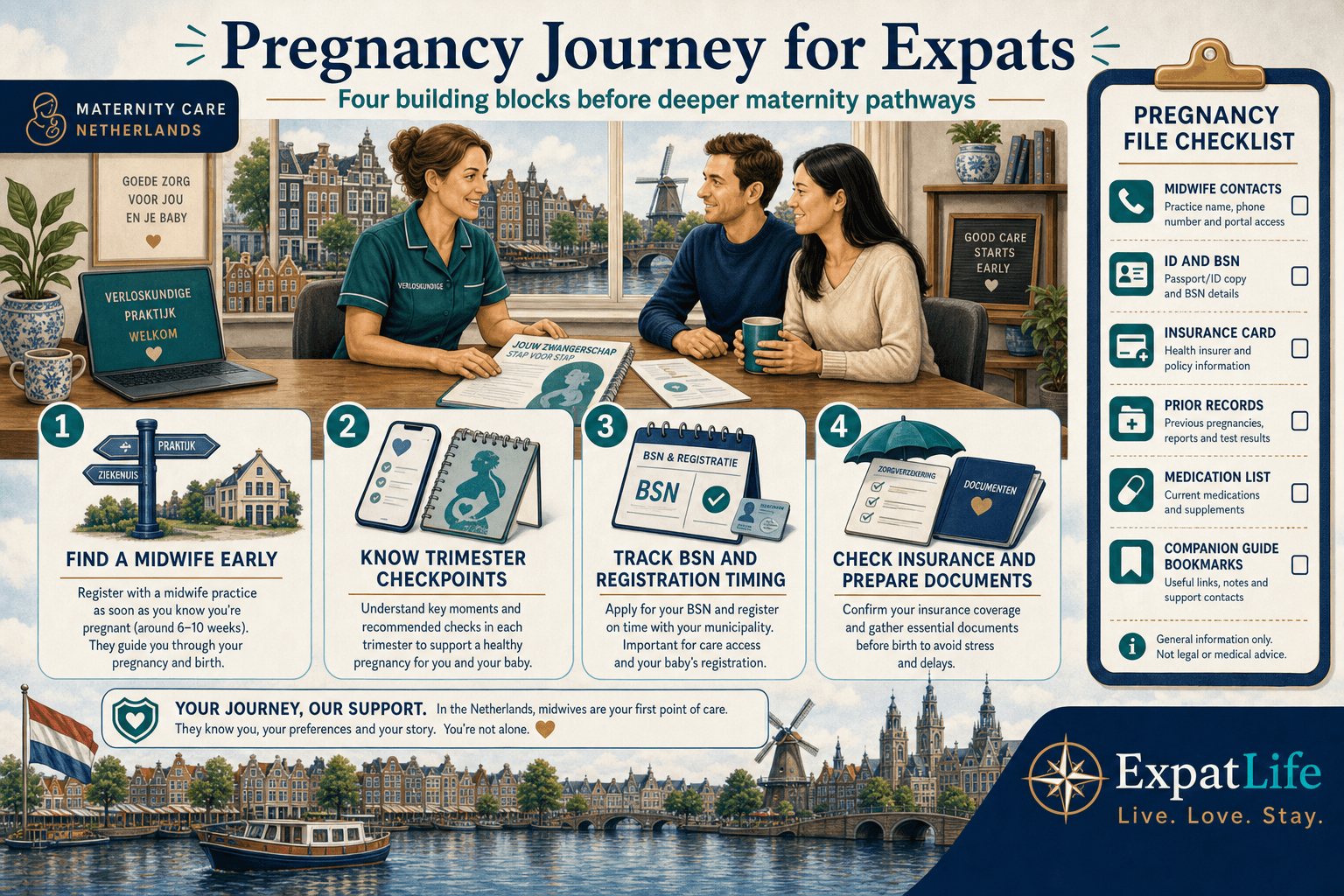
Pregnancy file checklist
Examples
| Situation | How it works here | First step |
|---|---|---|
| We just confirmed pregnancy in the Netherlands | Many people start by contacting a nearby verloskundige practice for capacity and intake — not by waiting for an obstetrician by default. | Call 2–3 midwife practices this week; ask about English support and documents needed. |
| We are relocating mid-pregnancy | Bring prior records and register with a local midwife quickly; BSN and insurance timing often need parallel admin. | Contact practices before or on arrival; gather records into one phone folder. |
| We expected hospital obstetric care from week one | Dutch pathways often begin with a midwife; obstetric or hospital care applies when indications call for it. | Read Maternity care for system depth; use this page for the prenatal starting journey. |
Snapshot
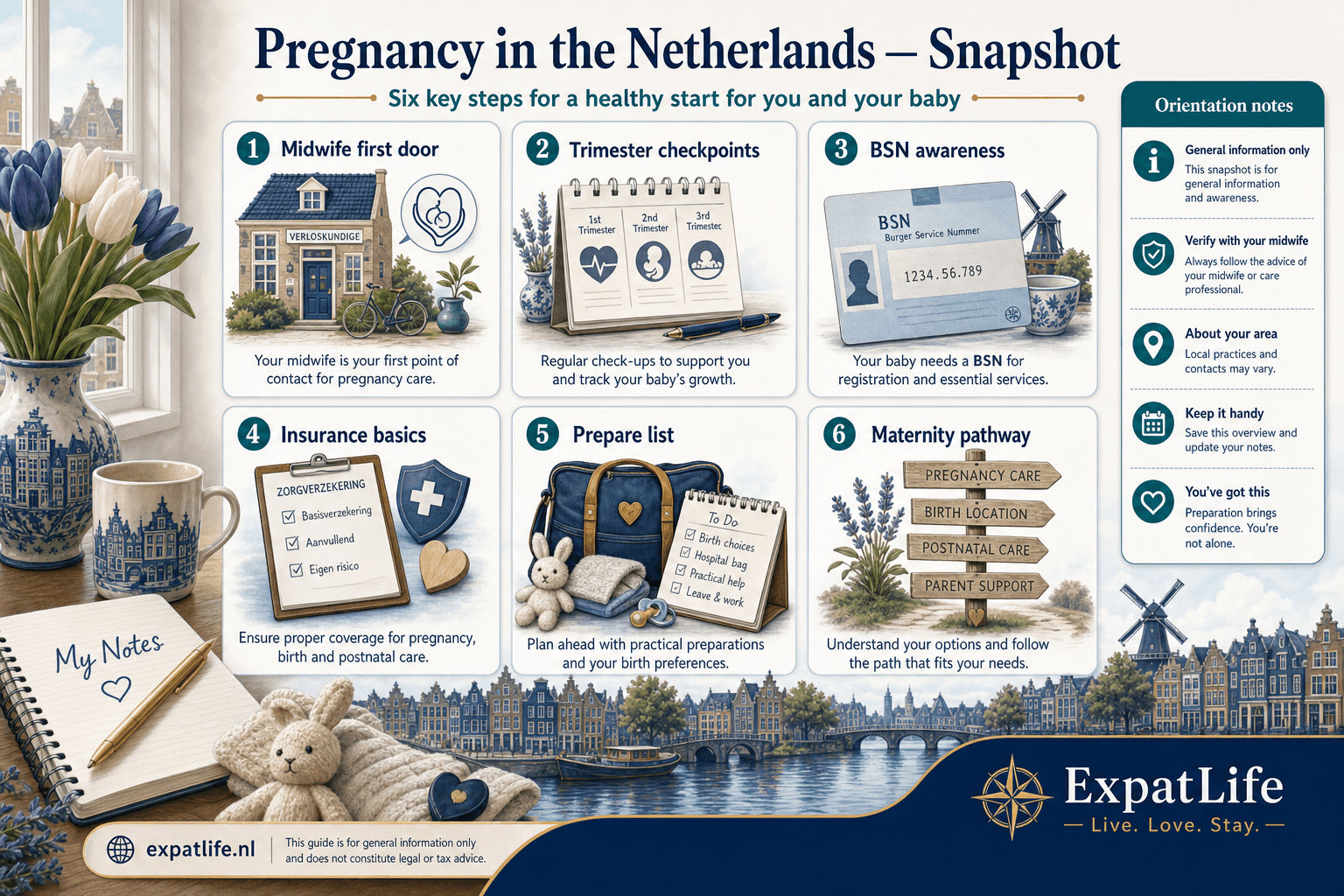
Six cards cover midwife finding, trimester checkpoints, BSN timing, insurance basics, what to prepare and companion guides — deeper sections expand each theme without medical advice.
First door
Verloskundige
Register early after confirmation
Rhythm
Trimester checks
Your midwife sets the schedule
Admin
BSN + insurance
Timing matters when relocating
Next guides
Maternity · Birth
System depth and birth day
Search by postcode, ask about capacity and English, complete intake with documents ready.
Early intake, mid-pregnancy rhythm, late-pregnancy planning talks — personal schedule with your team.
Municipality registration and BSN timing affect insurance and care logistics for newcomers.
Much maternity care sits in the basic package — verify policy year details with your insurer.
ID, records, medication list, midwife contacts and partner logistics in one calm folder.
Maternity care for system depth; Giving birth for labour day; Family activities for leisure later.
Midwife
For many low-risk pregnancies, a neighbourhood midwife practice (verloskundige) is the first and main door. Register early — popular areas fill and intake paperwork takes time.
Search practices by postcode or neighbourhood, ask about capacity for your due date, English support, how they work with nearby hospitals, and what documents to bring to intake. Save day and on-call numbers after registration.
If indications later call for obstetric or hospital pathways, your midwife team usually explains the change. Full pathway maps live on Maternity care — this section stays focused on getting started.
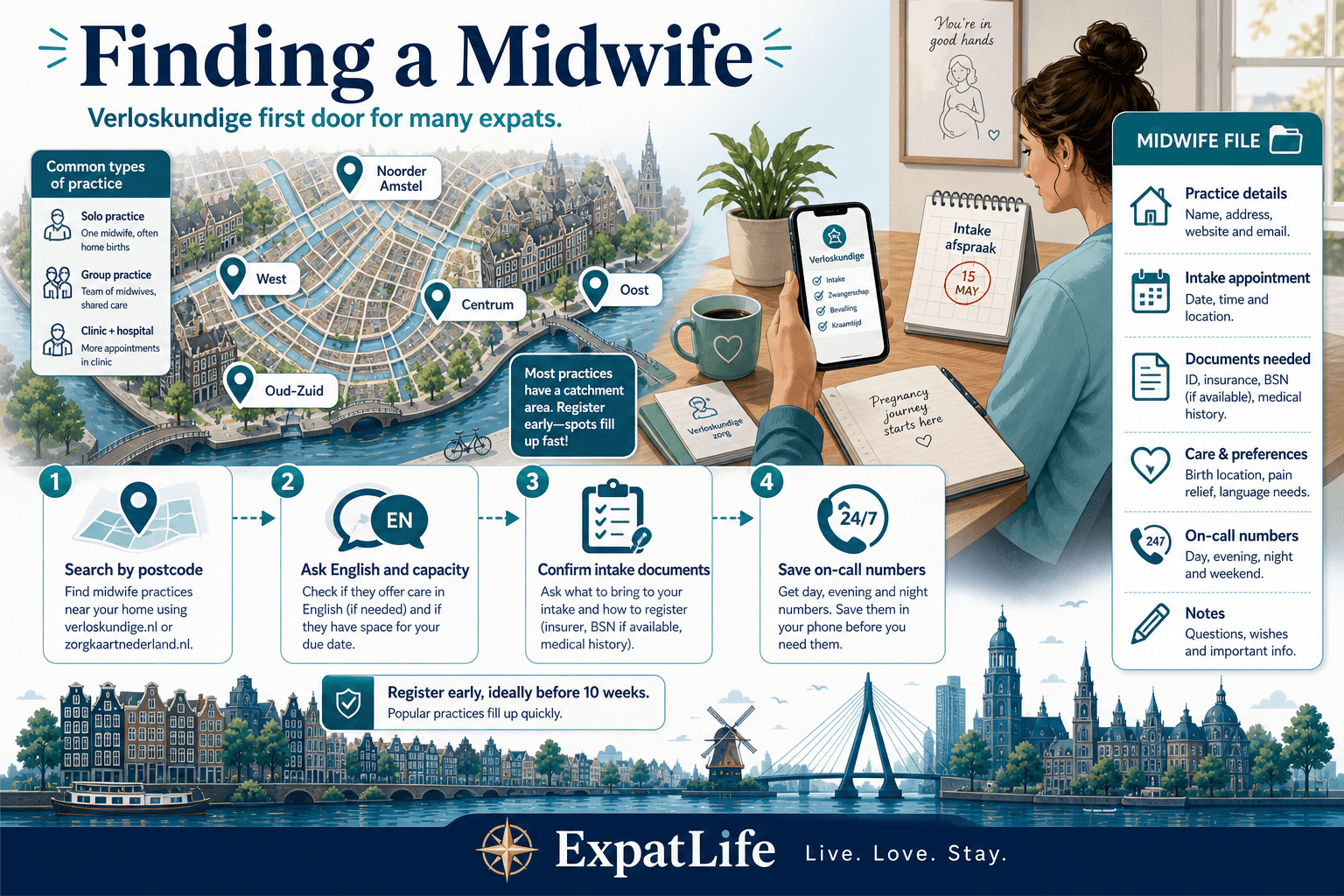
Start with practices close to home — travel during pregnancy and labour cues is easier nearby.
Confirm intake slots for your due window and whether English visits or interpreters are available.
Bring ID, insurance, medical history and prior pregnancy notes if relevant.
Store practice and on-call numbers on two phones; ask how urgent concerns are handled.
Midwife registration checklist
Checkpoints
Dutch antenatal care usually follows a check-up rhythm your midwife explains. The themes below are orientation only — not a clinical schedule or week-by-week medical advice.
Early pregnancy often focuses on intake, history and first checks. Mid-pregnancy continues monitoring and planning conversations. Late pregnancy often includes birth-place discussion, call cues and practical readiness — details that continue on Giving birth and Maternity care.
If something feels urgent at any stage, use the contacts your midwife gave you — or 112 for life-threatening emergencies.
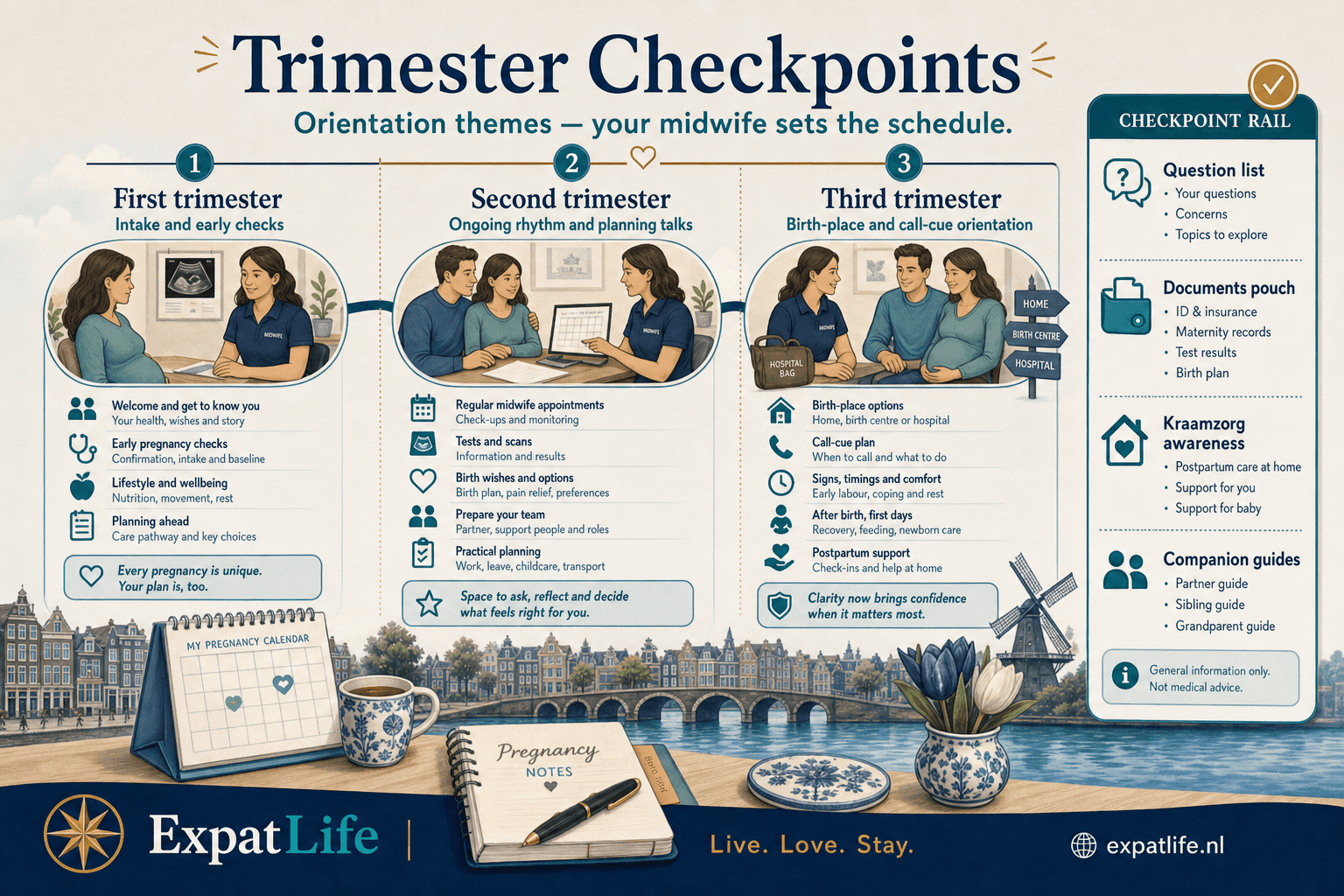
| Trimester | Focus | Admin | Tip |
|---|---|---|---|
| First | Confirmation, midwife intake, early checks, questions list | Insurance details, ID/BSN awareness, prior records | Contact practices as soon as pregnancy is confirmed |
| Second | Ongoing check-ups, planning talks, language preferences | Keep policy and address details current | Raise kraamzorg awareness and birth-place questions early |
| Third | Birth-place discussion, call cues, packing orientation | Documents pouch ready; on-call numbers confirmed | Bookmark Giving birth for labour-day detail |
Prenatal flow
Stage 1
Contact midwife practices; complete intake with documents.
Stage 2
Attend check-ups your team schedules; keep a written question list.
Stage 3
Birth-place and call-cue talks; prepare bag and partner roles later.
Stage 4
Maternity care for system depth; Giving birth for labour day; JGZ after birth.
Admin
For newcomers, municipality registration and BSN timing often run in parallel with midwife intake. This section is awareness — not legal advice or a full gemeente encyclopedia.
A BSN (citizen service number) is commonly needed for healthcare and insurance administration. If you are relocating, start municipality registration as early as your situation allows and tell midwife practices what documents you already have.
Moving mid-pregnancy adds urgency: bring prior pregnancy records, medication lists and ultrasound reports, and explain your due date clearly on first contact.
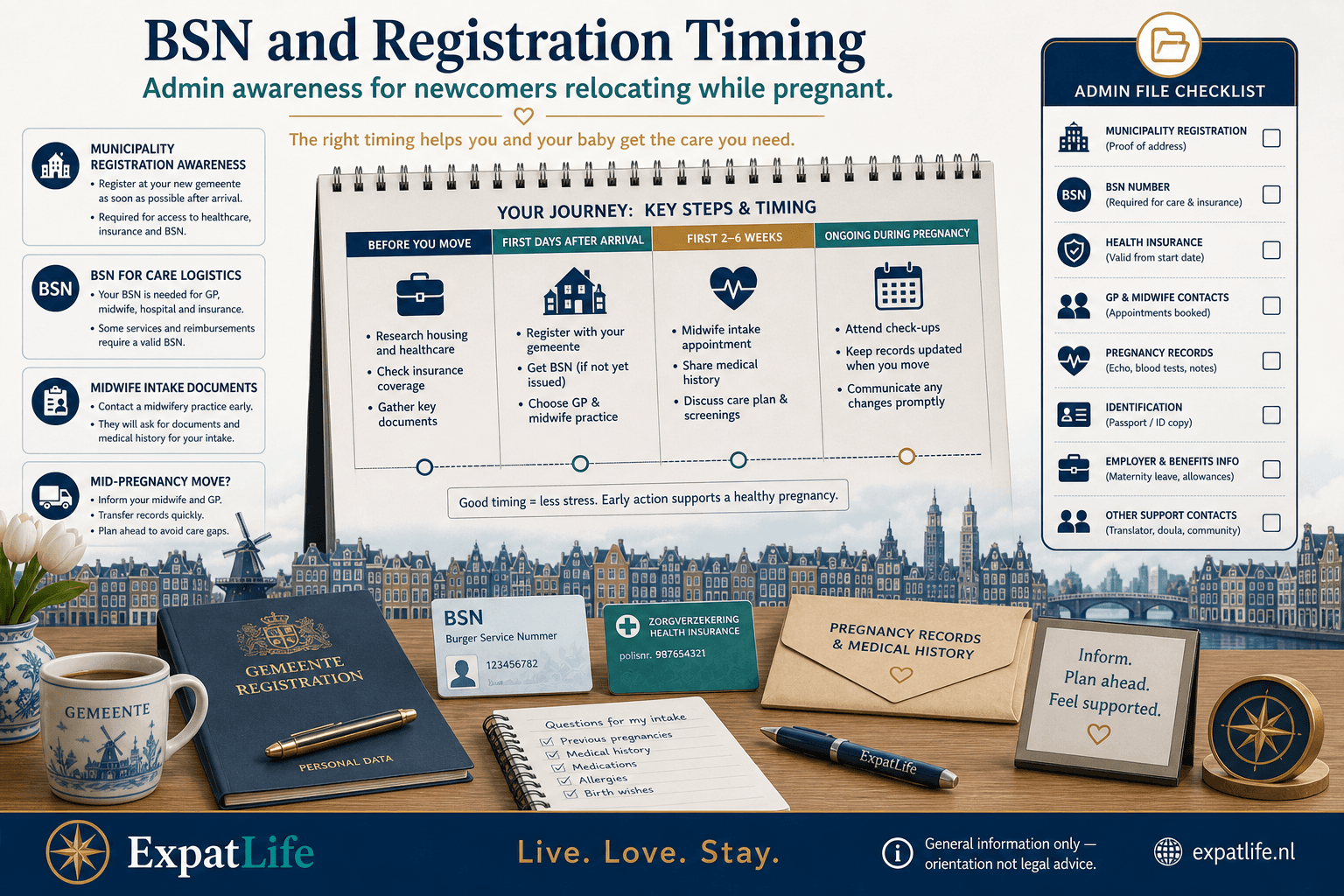
Registration timing affects many admin doors — ask your gemeente or relocation support what applies to you.
Practices and insurers often need BSN once issued — keep the number in your documents pouch.
ID, insurance, medical history and prior pregnancy notes speed the first visit.
Contact local practices before or on arrival; do not wait for perfect admin completion.
Cover
Much maternity care is oriented within Dutch basic health insurance, with separate awareness for own contributions (for example kraamzorg or some birth settings). Always verify your policy year with your insurer.
If you are choosing or renewing cover while pregnant or planning pregnancy, compare factors calmly — basic vs supplementary questions, networks and own-risk rules. Use Health insurance comparison for a decision framework, not an insurer ranking.
This page does not quote personal premiums or promise cover. Maternity care expands insurance orientation for maternity pathways; Health Insurance covers package basics.
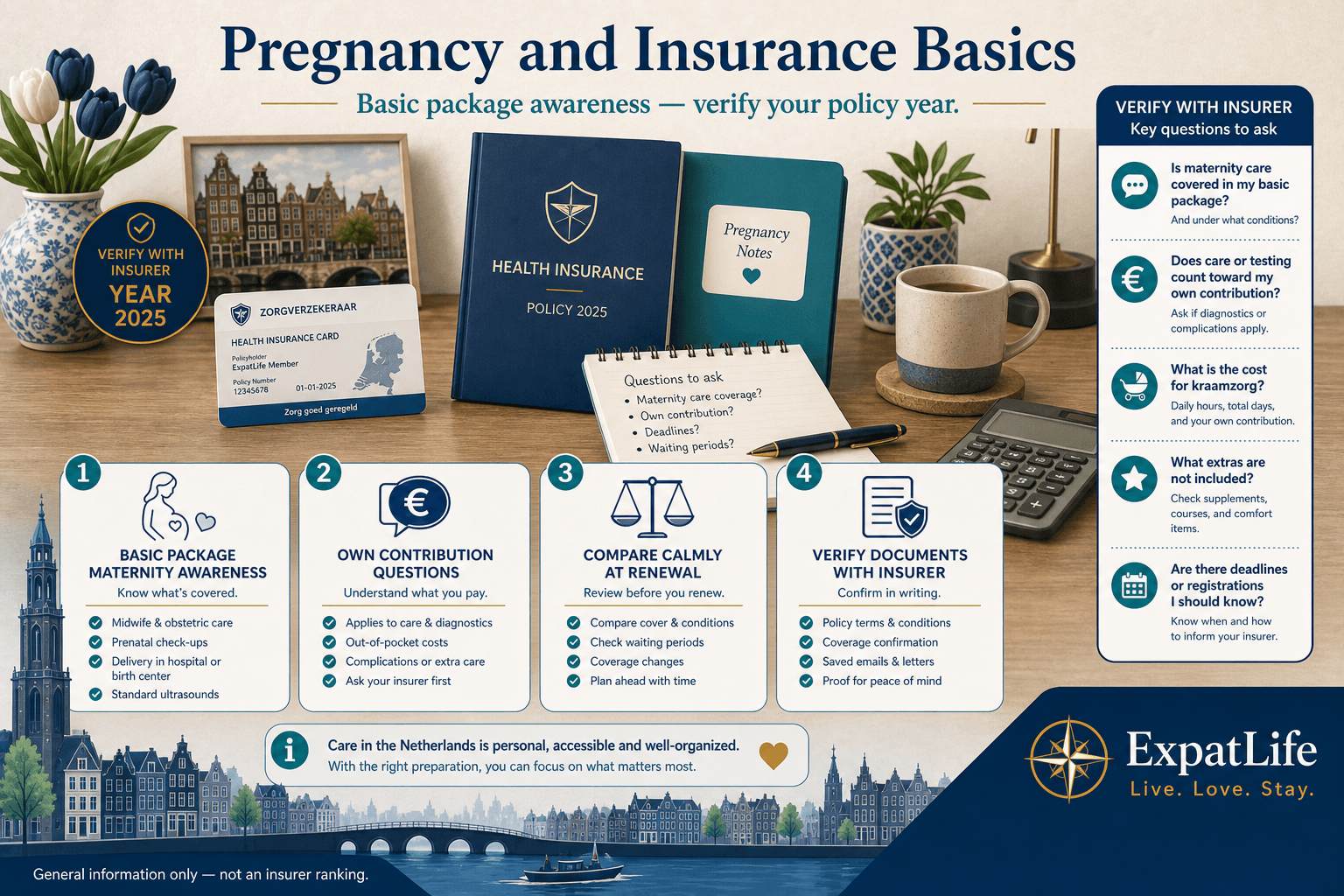
Many maternity pathway elements sit in basic cover — confirm what applies to your policy year.
Ask about kraamzorg and birth-related own contributions early — details vary.
Use comparison frameworks before renewal if you expect pregnancy-related costs.
Insurer and midwife admin teams confirm what documents they need from you.
Prepare
A calm prepare list keeps antenatal visits focused on your questions. Pack documents early; birth-day packing detail continues on Giving birth.
Prioritise ID, insurance, midwife contacts, medication lists and prior records. Add partner logistics, language needs and bookmarks for Maternity care and Giving birth. Kraamzorg awareness and children’s healthcare doors matter before the due date — not only after birth.
Child benefits and childcare allowance become relevant after birth for many families — short links below; they are not pregnancy-care pathways.
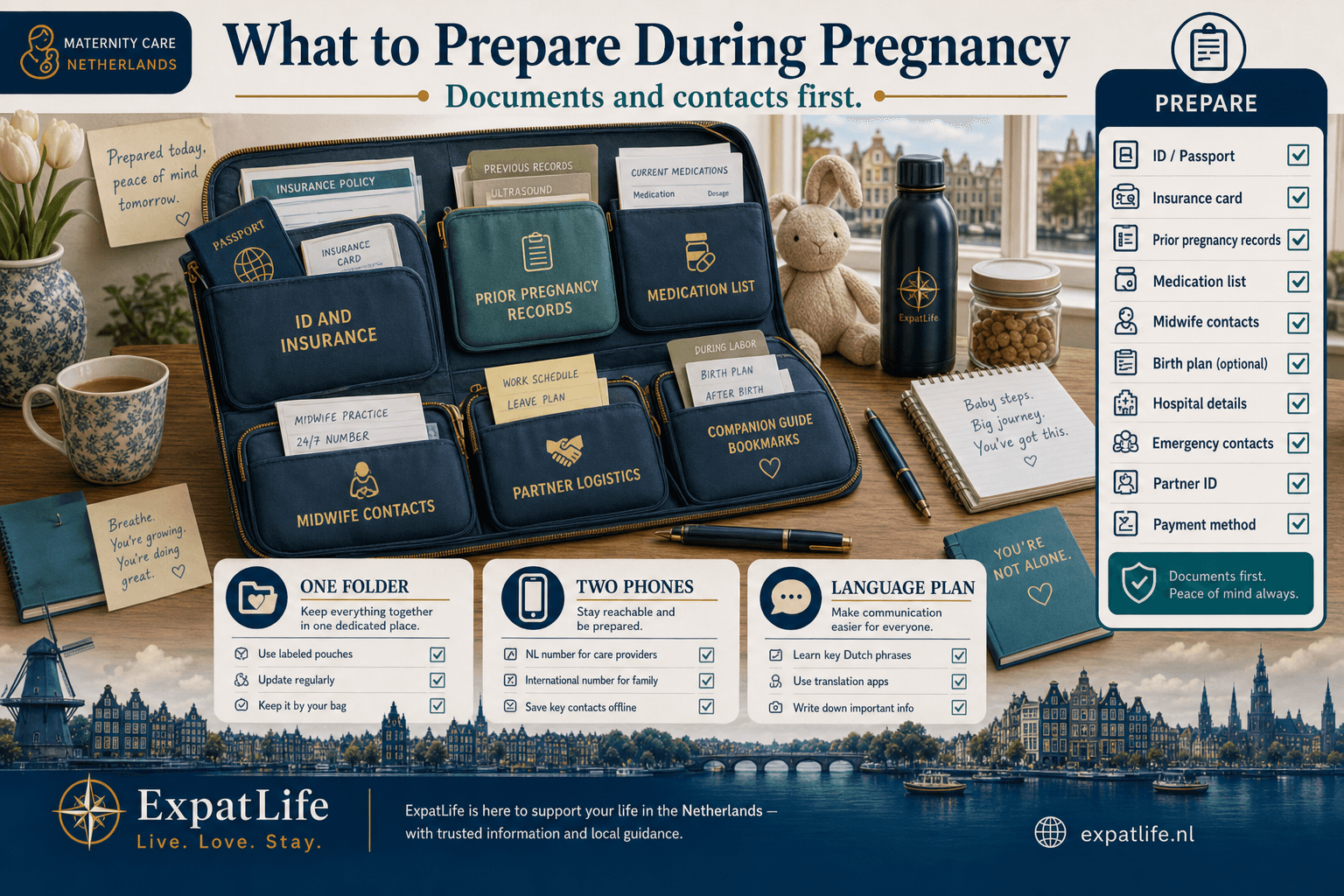
| Item | Why | When |
|---|---|---|
| Documents pouch | Speeds intake and urgent calls | As soon as midwife contact starts |
| Question list | Language and pathway clarity | Before each antenatal visit |
| Partner logistics | Transport, advocacy, contacts | Second / third trimester |
| Birth-day bookmarks | Call cues and packing later | Third trimester orientation |
| Kraamzorg awareness | Postpartum home support door | Often during pregnancy |
| JGZ / children’s healthcare pointer | Baby care after birth | Late pregnancy |
Keep scans and paper copies of ID, insurance and records together.
Save midwife and emergency numbers on parent and partner devices.
Ask for English materials or interpreter support before late pregnancy.
Differences
Many newcomers arrive from obstetrician-first systems. Dutch prenatal culture often starts with a midwife and an open birth-place conversation — when clinically suitable.
Hospital birth is common and available when indicated or preferred within pathway rules — but it is not the only culturally discussed option. Registration, insurance and kraamzorg awareness are practical Dutch norms to learn early.
This page stays calm and practical. It does not rank practices or hospitals and does not tell you which birth place is “best”.
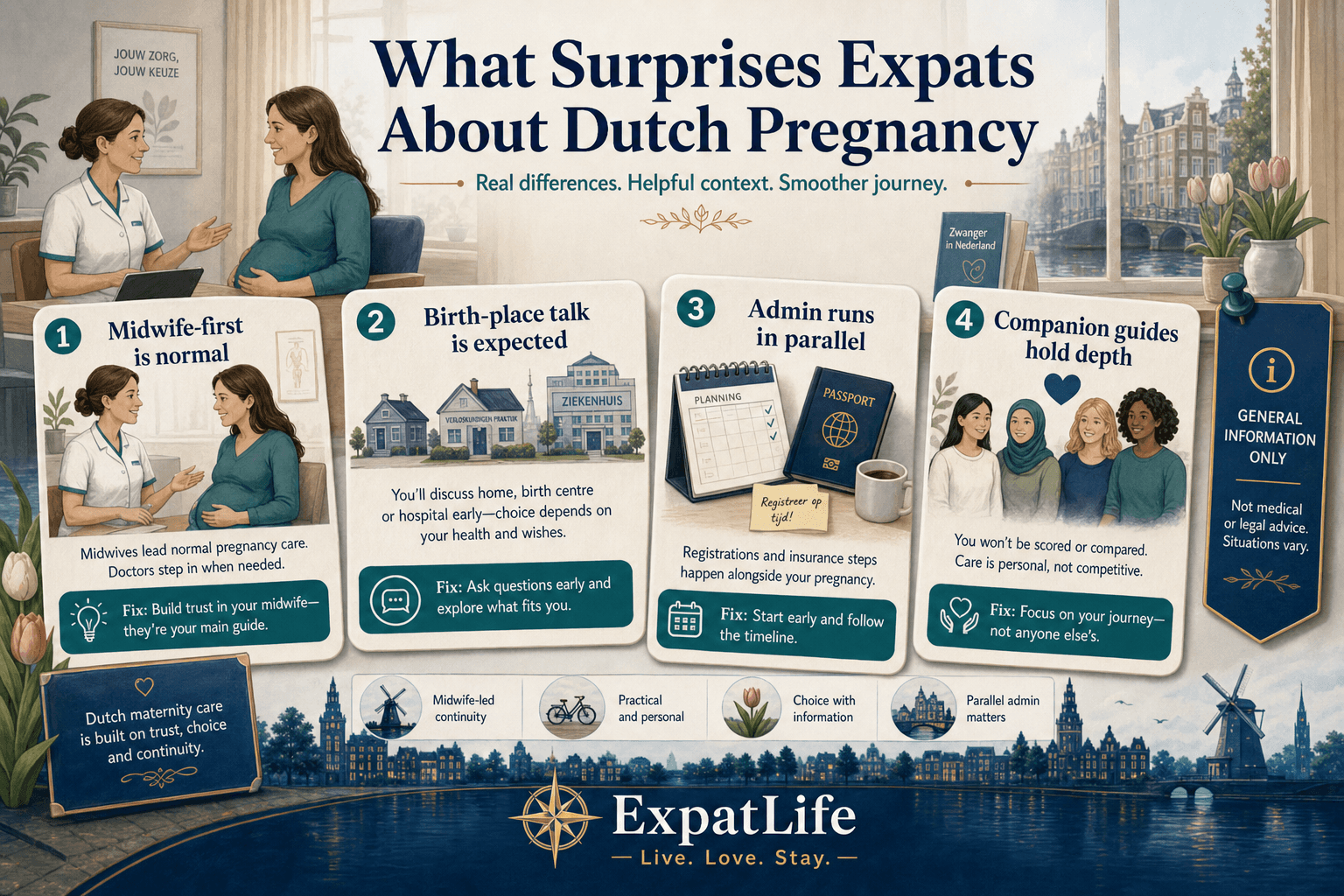
Verloskundige care is a designed first door for many pregnancies — not a lesser pathway.
Home, birth centre and hospital may all be discussed — suitability is clinical.
BSN, insurance and intake documents matter as much as appointment dates.
Maternity care and Giving birth hold system and birth-day depth on purpose.
Scenarios
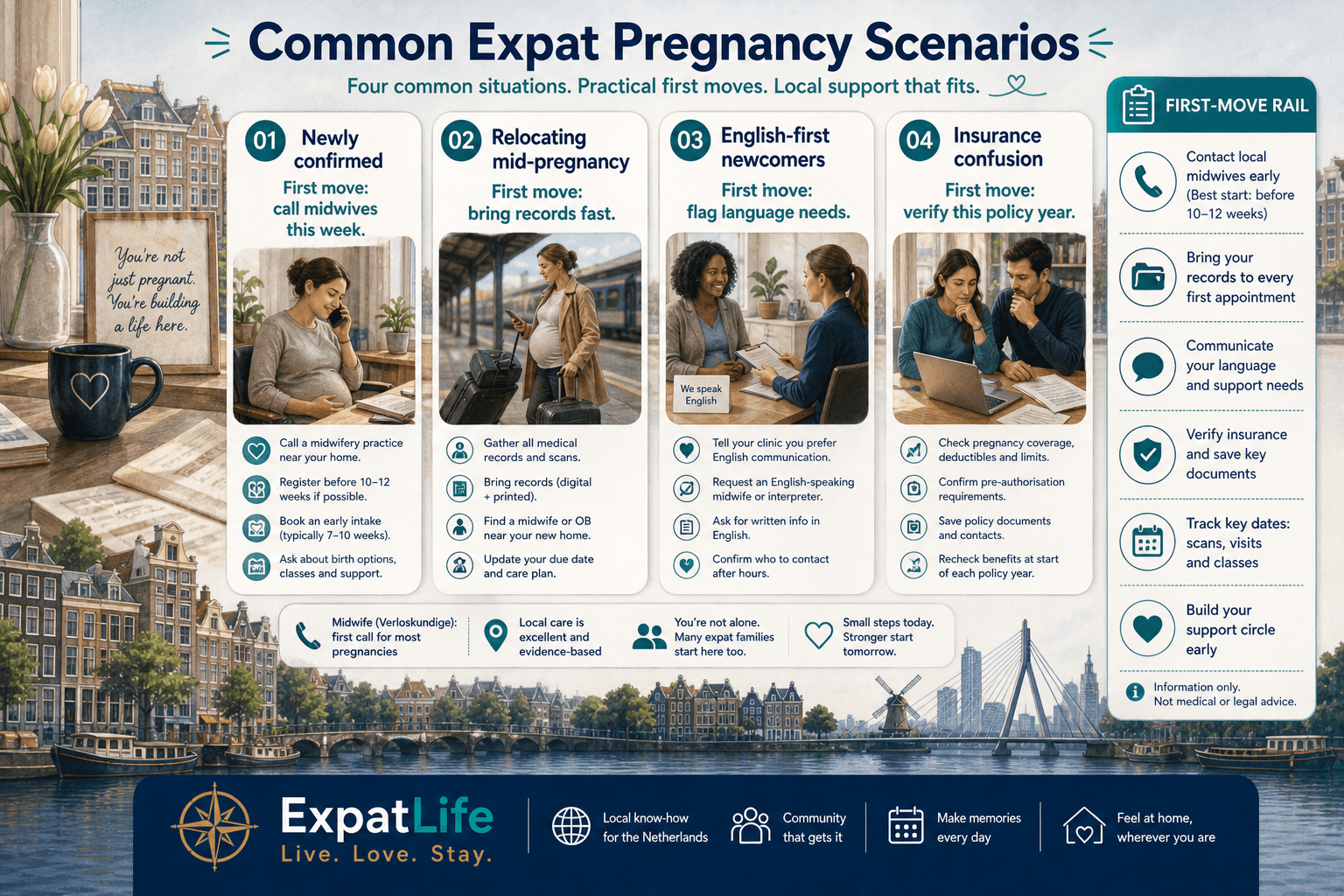
Match your starting point to a calm first step — then deepen on Maternity care or Giving birth as needed.
Examples
| Situation | How it works here | First step |
|---|---|---|
| Newly confirmed pregnancy, already living in NL | Contact nearby midwife practices for capacity; gather ID and insurance for intake. | Call practices this week; book the earliest suitable intake. |
| Relocating while pregnant | Bring records, contact local midwives early, track BSN and insurance in parallel. | Email or call practices with due date and language needs before arrival if possible. |
| English-first and unsure about pathways | Ask practices about English visits; use Maternity care for system maps. | Flag language needs at first contact; keep a written question list. |
| Expecting obstetrician-led care from week one | Understand midwife-first norms; obstetric doors open when indicated. | Read Maternity care obstetric pathways; register with a midwife unless advised otherwise. |
| Insurance confusion during pregnancy | Verify basic-package maternity awareness with insurer; compare calmly at renewal. | Open Health Insurance / comparison guides; ask midwife which documents they need. |
| Want leisure ideas while pregnant | Keep activity plans gentle and practical — Family activities covers parks, museums and rainy-day options. | Bookmark Family activities for low-pressure outings; follow your midwife on activity limits. |
Avoid
These patterns create avoidable stress — early midwife contact and calm admin beat last-minute improvisation.
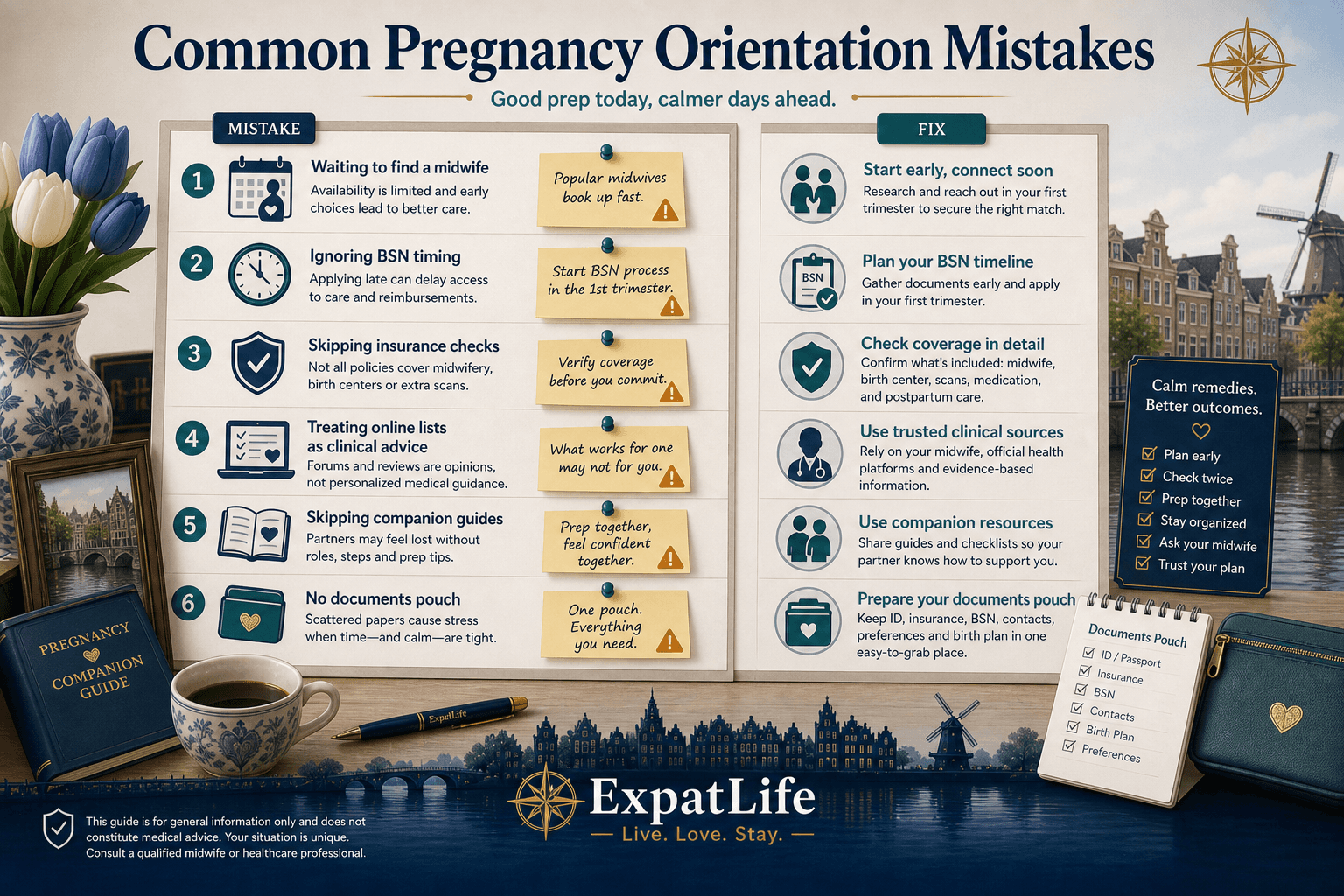
Popular neighbourhoods fill; late contact shrinks options.
Fix: Call practices as soon as pregnancy is confirmed or on arrival if relocating.
Admin delays can slow insurance and care logistics for newcomers.
Fix: Start municipality / BSN awareness early and tell practices what you already have.
Assuming “everything is free” without verifying own contributions creates surprise bills.
Fix: Verify maternity-related cover and contributions with your insurer for this policy year.
Online trimester lists cannot replace your midwife’s schedule.
Fix: Use this guide for orientation; ask clinical questions in appointments.
Pathway depth and birth-day packing live elsewhere on purpose.
Fix: Bookmark Maternity care and Giving birth before the third trimester.
Searching for ID during intake or urgent calls adds stress.
Fix: Build one folder early — ID, insurance, records, medication list.
Ready
Use this from confirmation through late pregnancy orientation. Confirm clinical details with your midwife — this is not a medical checklist.
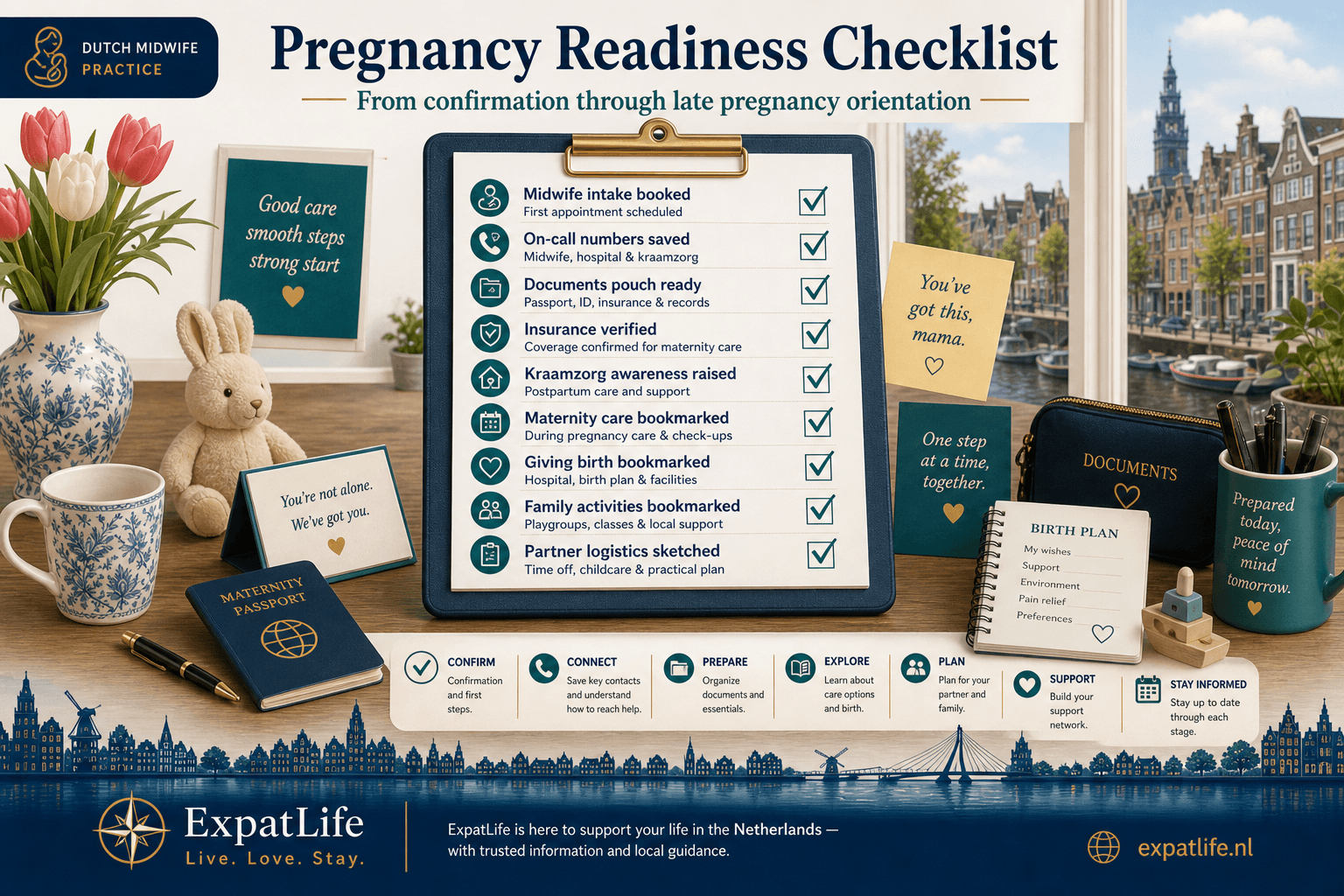
Pregnancy readiness checklist
How-to
Five orientation steps for expats starting prenatal care with a Dutch midwife practice.
Step 1
After confirmation, call nearby verloskundige practices about capacity, language and intake documents.
Step 2
Bring ID, insurance, medical history and prior records; save on-call numbers afterwards.
Step 3
Track municipality registration and BSN awareness in parallel if you are new to the Netherlands.
Step 4
Confirm maternity-related cover questions with your insurer; use comparison guides for renewal decisions.
Step 5
Keep a question list, raise kraamzorg awareness, and bookmark Maternity care plus Giving birth.
FAQ
Short answers for the searches expats ask most often about pregnancy in the Netherlands.
Many low-risk pregnancies are midwife-led. Obstetric or hospital pathways apply when medical indications call for them. Your midwife or GP explains pathway changes. See Maternity care for system depth.
Contact practices early after pregnancy confirmation — capacity can be limited, especially in busy areas. If you move mid-pregnancy, register as soon as you arrive.
Typically ID, insurance details, medical history, medication lists and prior pregnancy records if available. Ask the practice for their exact list and whether BSN is required yet.
Your midwife sets the check-up rhythm. This guide offers orientation themes by trimester — not a personal clinical schedule. Ask questions at each visit.
BSN timing often matters for healthcare and insurance admin. Start municipality registration awareness early and tell practices which documents you already have. This is not legal advice.
Much maternity care is oriented within the basic package, with separate awareness for some own contributions. Verify your policy year with your insurer. See Maternity care and Health Insurance guides.
Giving birth covers place of birth, call cues, packing and first hours. Maternity care covers verloskundige pathways, obstetric doors, registration timing depth and kraamzorg awareness.
Family activities covers parks, museums, libraries and rainy-day ideas. Always follow your midwife’s guidance on activity limits.
Parenting covers Dutch family culture. Healthcare for Children covers JGZ and children’s healthcare after birth.
No. ExpatLife provides general orientation only. Follow your midwife, obstetric team or GP for personal clinical guidance. Call 112 for life-threatening emergencies.
Related
Maternity care is the required system companion. Family activities is the cluster leisure sibling. Giving birth continues labour-day detail.
Hub
Stay inside the family cluster — pregnancy, family activities, maternity care, giving birth, parenting and children’s healthcare.
Explore next
Continue to maternity pathways, birth day, family activities, children’s healthcare or insurance comparison.
Trust
Confirm personal clinical guidance with your midwife or obstetric team — these sources are orientation only.
ExpatLife provides general orientation for international newcomers. We do not provide medical, legal or insurance advice, and we do not rank midwives, hospitals or insurers. Verify personal decisions with your midwife, obstetric team, GP, insurer and official sources.