
Is it harder as an expat?
Circles are often established — clubs and volunteering bridge the gap. Patience plus weekly consistency helps.
Life in the Netherlands · Social life
Rebuild your social circle in the Netherlands with activity-first routes — sports clubs, volunteering, language cafés, neighbourhood life and balanced expat communities.
Orientation only — groups, costs and language requirements change by city and season. Verify details on official provider sites before joining or committing.
Quick answer
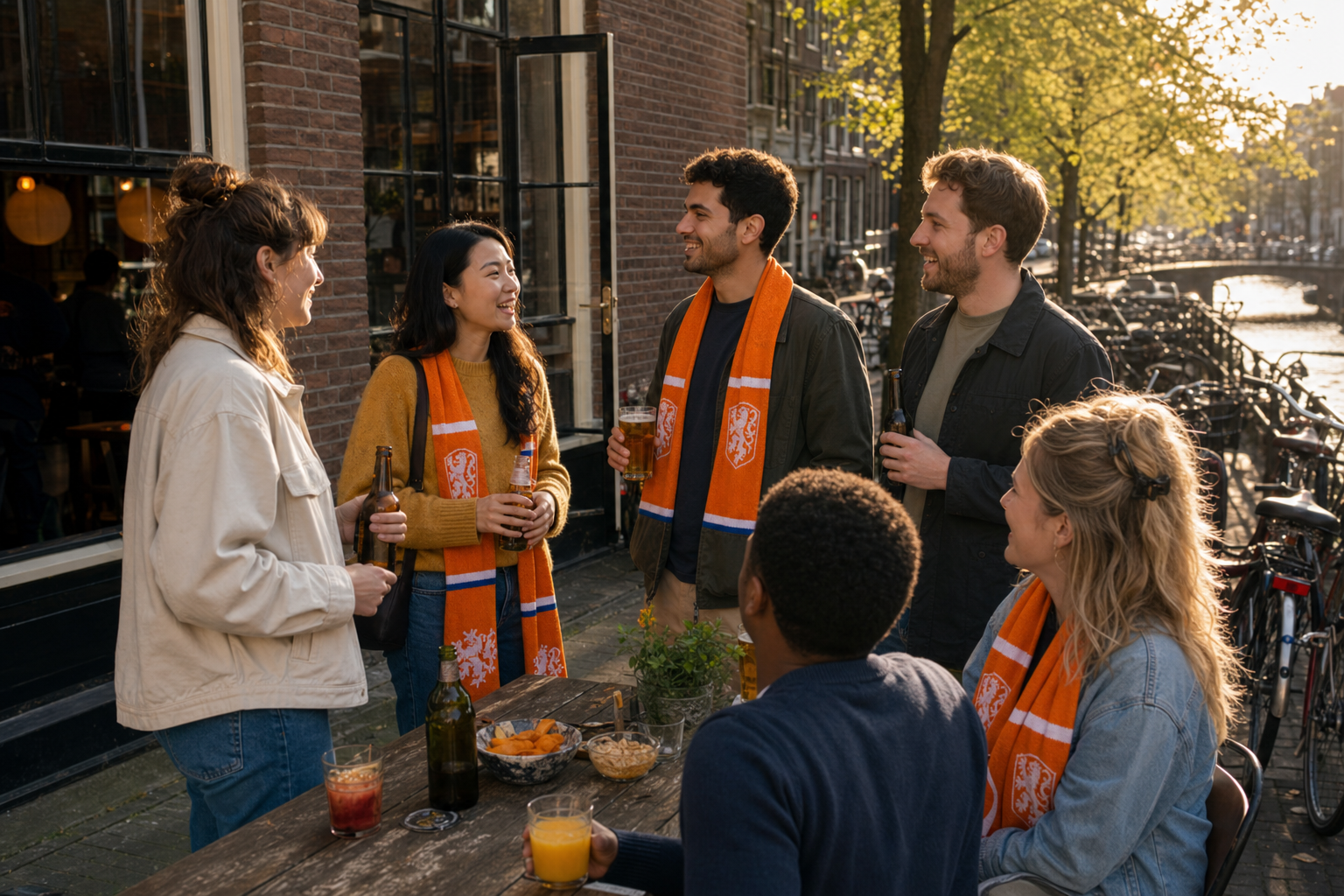
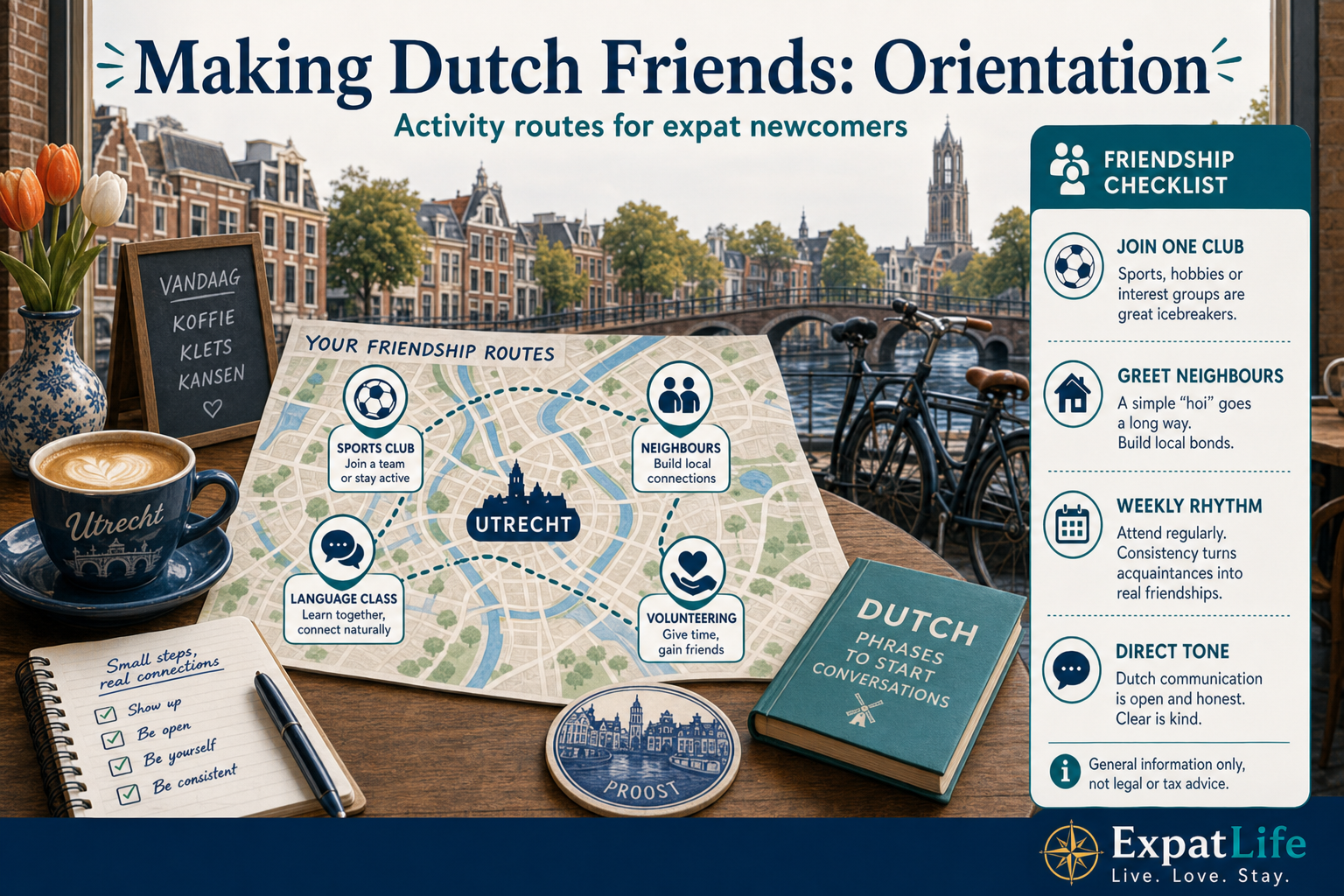
Moving to the Netherlands often means rebuilding your entire social circle. Many expats arrive with colleagues but few close friends outside work. Dutch social life is activity-first: sports clubs, hobby associations, volunteer shifts, language cafés and neighbourhood rituals create the repeat contact where friendships actually grow.
This guide maps practical routes with real organisations, ranked comparisons and city notes — not vague advice to 'be more social'. Pair it with Dutch Social Norms for etiquette context and Community Basics for broader integration.
Circles are often established — clubs and volunteering bridge the gap. Patience plus weekly consistency helps.
Yes, especially in international cities — shared activities matter more than passport.
Not to start in cities — Dutch effort is appreciated and opens deeper local friendships.
Use both — expat groups for orientation, local clubs for long-term roots.
At a glance
Six orientation signals — then pick two routes for your first six weeks.
First month
1–2 activities
Choose weekly rhythm
Borrel culture
Informal drinks
Common after clubs
Neighbours
Small rituals
Hellos and WhatsApp
Depth
Months 3–6
When familiarity deepens
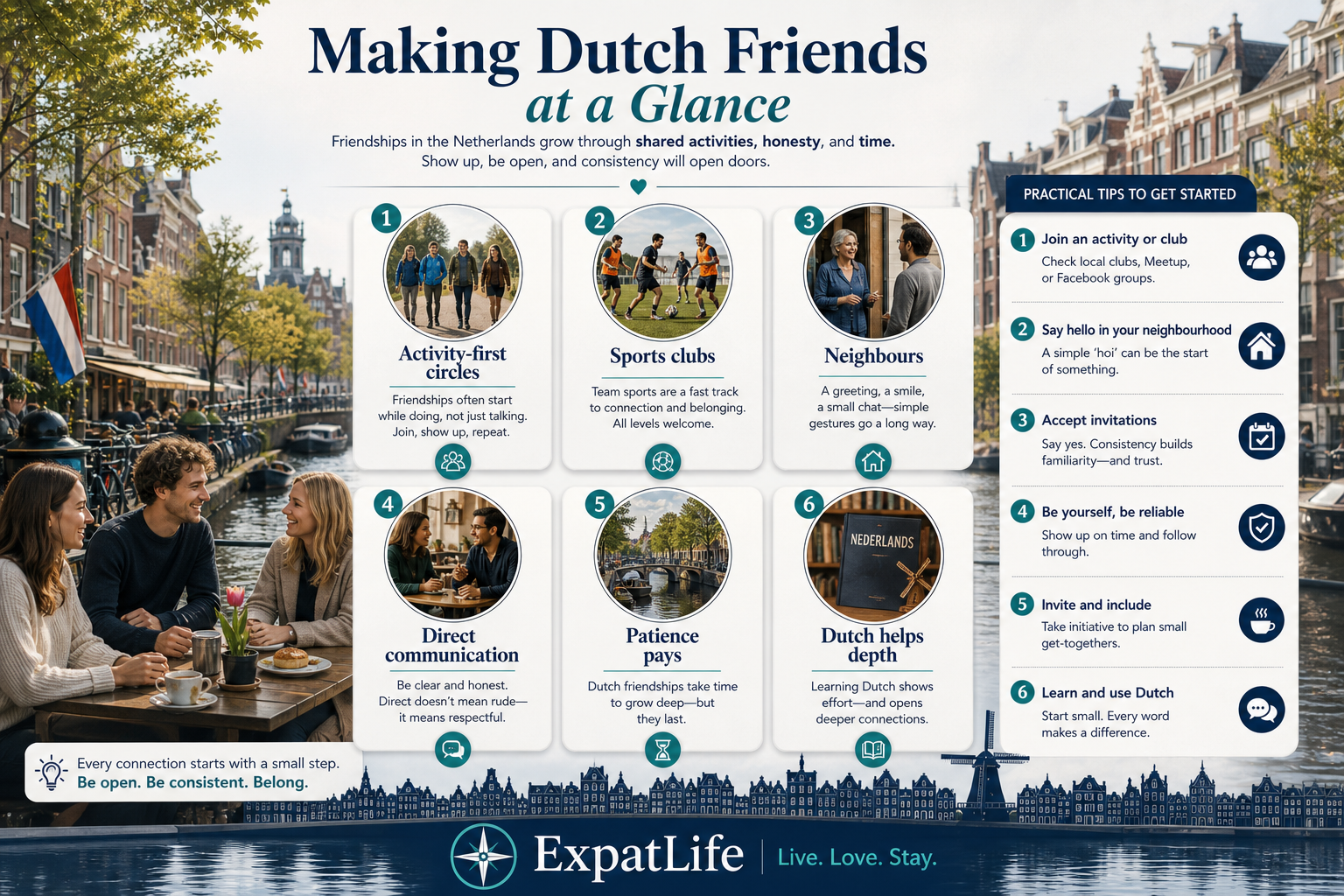
Sports and hobby verenigingen are how many Dutch adults socialise — ask about proefles trial sessions.
Friendships deepen through repetition — six weeks of the same group beats six one-off events.
International workplaces and Randstad cities are English-friendly — Dutch still helps for local roots.
People plan ahead — propose coffee two weeks out rather than 'sometime soon'.
Hallway greetings, buurt WhatsApp groups and street BBQs build nearby friendships.
Weekly food-bank or shelter shifts create familiar faces faster than sporadic mixers.
How to use this snapshot
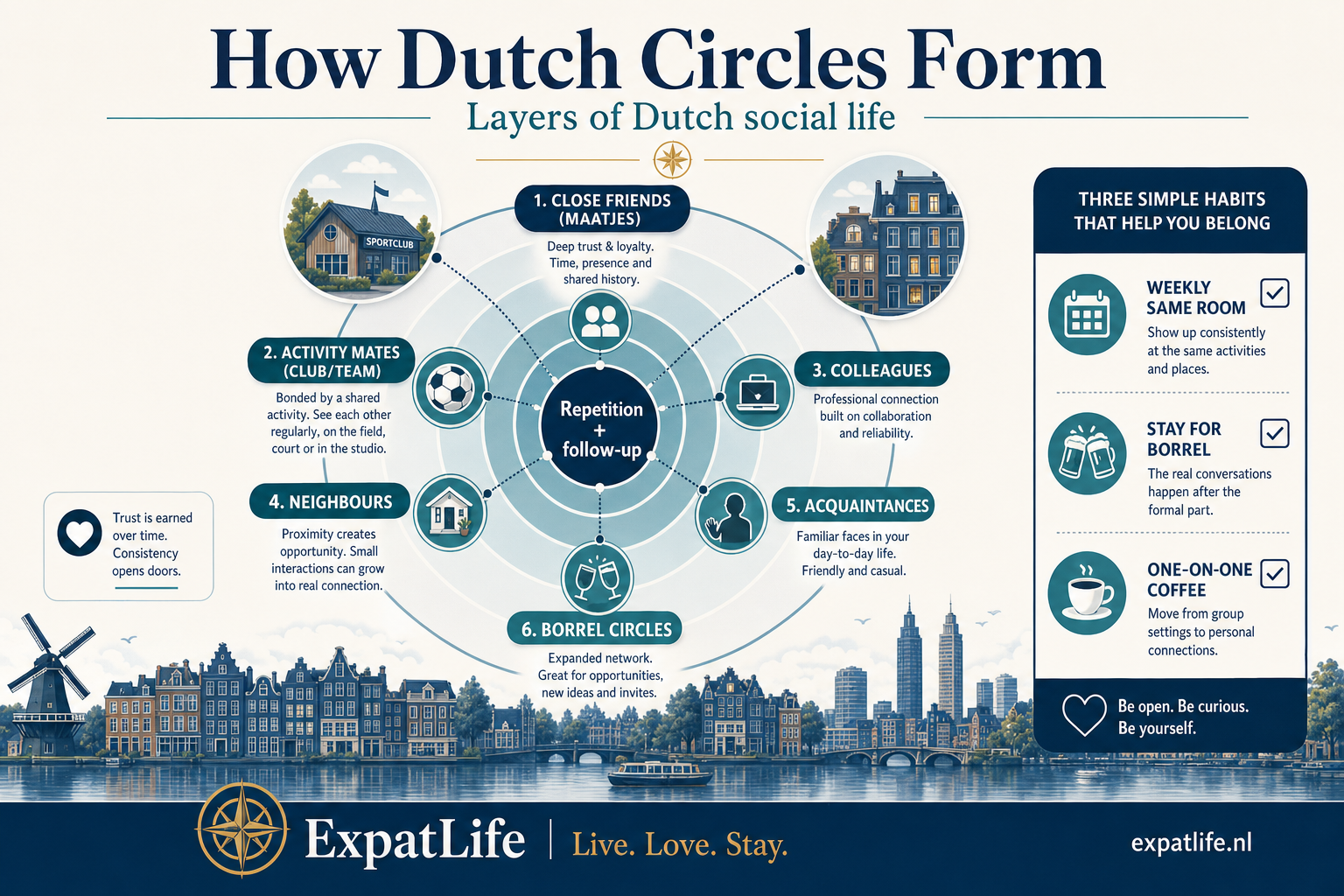
Dutch friendships often grow through shared routines rather than spontaneous street encounters. Sports training, choir rehearsal, parent groups at school and monthly borrels (informal drinks) create predictable contact. People may seem reserved at first while calendars and trust build — this is common, not necessarily unfriendly.
Group size tends to stay small. Deep friendships may take months of weekly contact. Invitations are often concrete ('Tuesday 19:00 at Café de Jaren') rather than open-ended. Reliability — showing up when you said you would — signals you are worth investing in.
Regional and generational differences exist. International cities blend many norms. The practical pattern: find a recurring group, participate consistently, accept small invitations and let friendships develop without forcing instant intimacy.
| Topic | What to expect |
|---|---|
| Borrels | Informal drinks after work or club training — low-pressure group socialising. |
| Circle parties | Birthday kringverjaardag introduces you to someone's existing circle — see our birthday traditions guide. |
| Planning ahead | Calendars fill early — propose specific dates and confirm RSVPs. |
| Small groups | Three to six close friends is common — depth over large networks. |
| Reliability | Weekly attendance matters more than charisma at one event. |
| Direct invites | Clear yes/no answers — ask rather than decode vague replies. |
Many Dutch adults formed their core circles at school, university or through decades in the same neighbourhood. As a newcomer you are joining mid-stream — not facing personal rejection, but structural timing. One-off parties rarely replace the familiarity built through a weekly club.
Language can slow early bonding even when everyone speaks English at work. Calendar culture means people may decline spontaneous plans not because they dislike you, but because Tuesday was booked three weeks ago. Direct communication can feel blunt until you learn it is often practical, not personal.
Seasonality matters: summer festivals and terrace season feel social; grey February rewards indoor clubs and volunteer shifts. Adjust expectations — friendship depth often arrives between months three and six, not week one.

Long-standing friend groups are normal — activities create new entry points outside existing networks.
People plan ahead — propose concrete dates and accept that 'maybe' can mean genuine uncertainty.
English suffices initially — Dutch effort signals long-term intent and opens local-only groups.
Plain feedback is often practical — separate tone from intent and ask clarifying questions.
Trust builds through repetition — six weekly sessions beat six different events.
Summer terraces and winter club seasons feel different — pick routes that match the calendar.
Compare channels by ease, cost, chance of meaningful connection and repeat interaction. Combine one high-repeat weekly method with one wider-reach channel.
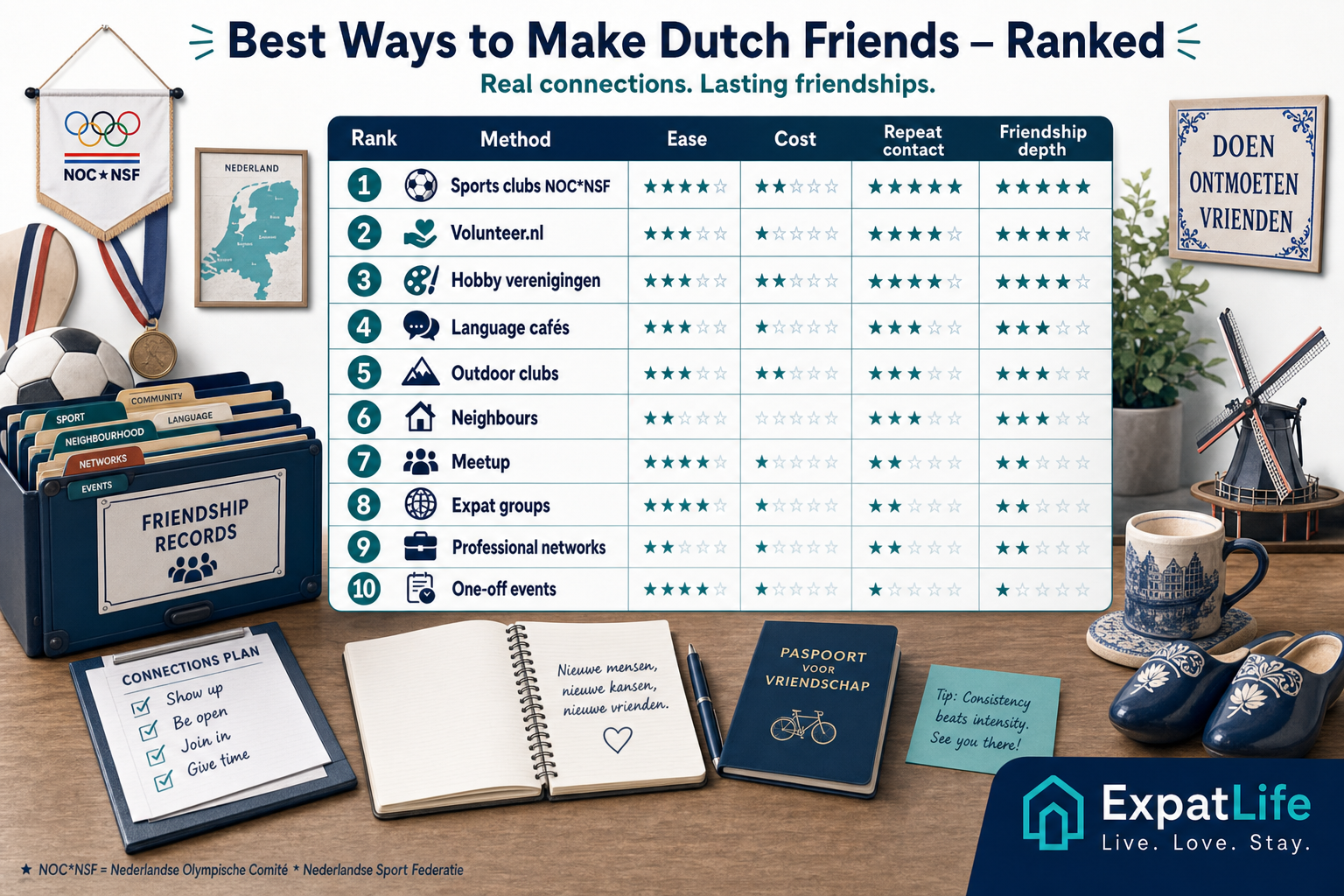
| Method | Ease | Cost | Meaningful connections | Repeat interaction |
|---|---|---|---|---|
| Sports clubs | Medium | Medium | High | Weekly |
| Volunteering | Medium | Free | High | Weekly |
| Hobby clubs | Medium | Low–medium | High | Weekly |
| Language exchanges | High | Free–low | Medium–high | Weekly |
| Neighbourhood life | Medium | Free | Medium | Ongoing |
| Meetup groups | High | Low | Medium | Varies |
| Expat communities | High | Low–medium | Medium | Monthly events |
| Professional networks | Medium | Low–medium | Medium | Monthly |
| Bars & nightlife only | High | Medium | Low | Sporadic |
| If you are… | Start with | Add within month 1 | Why this pair |
|---|---|---|---|
| New in Amsterdam, 28–35 | Padel or running club | InterNations or Meetup hobby group | Weekly repeat contact plus wide international reach. |
| Student in Utrecht or Groningen | University sport intro | Library TaalCafé | Low-cost weekly rhythm and classmates. |
| Parent with young children | School parent association | Saturday sport club for kids + parents | Natural recurring contact at gates and tournaments. |
| Introvert, prefers structure | Board-game café or book club | Volunteer library shift | Activity-first conversation with clear start and end. |
| Professional, little Dutch | Coworking community events | Food-bank volunteer shift | Career contacts plus local weekly familiarity. |
| Retiree or remote worker | Walking club (Wandelnet) | Buurtcentrum craft or coffee group | Daytime social rhythm and neighbourhood roots. |
Hiking, cycling and nature volunteer groups offer low-pressure conversation while moving. Meetup listings, NKBV sections, Wandelnet walking associations and Staatsbosbeheer conservation projects all welcome newcomers who show up prepared and punctual.
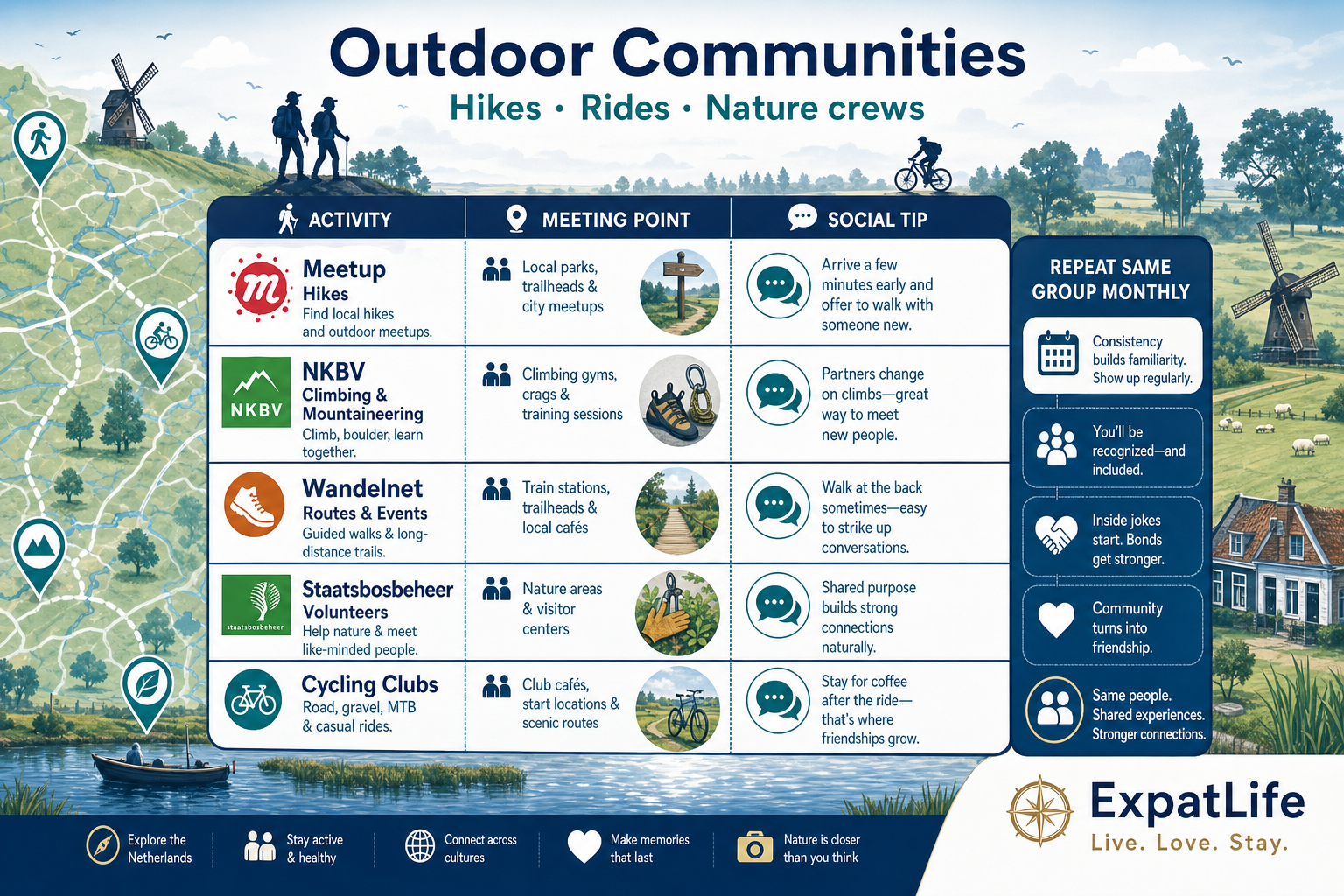
| Name | Audience | Age | Typical cost | Cities | Note | Try it |
|---|---|---|---|---|---|---|
| Meetup hiking | Mixed expat/local | All ages | Free–€15 | All major cities | Search hiking + your city. | Find hikes |
| NKBV | Mountaineering & hiking | 18–70+ | Membership + trips | Nationwide sections | Training and alpine trips. | Find a section |
| Wandelnet / walking clubs | Day hikers | 30–65+ | Low membership | Regional clubs | Sunday walks common. | Browse routes |
| Staatsbosbeheer | Nature volunteers | 18+ | Free | Regional | Conservation work days. | Volunteer outdoors |
| Fietsersbond rides | Cycling advocates | 25–65+ | Low | Local chapters | Social and advocacy rides. | Find chapter |
| Expat hiking clubs | English-speaking walkers | 25–50 | Free–€10 | Amsterdam, Utrecht, Maastricht | Facebook and Meetup listings. | Find groups |
Outdoor group checklist
Recurring training creates familiarity — why verenigingen outperform one-off parties for meaningful friendship. Ask about proefles (trial lesson) before annual membership. NOC*NSF-affiliated clubs span almost every sport from football to korfball.
Post-training borrel drinks are common. Team sports, partner sports (padel, tennis doubles) and group fitness create faster bonds than solo gym visits.
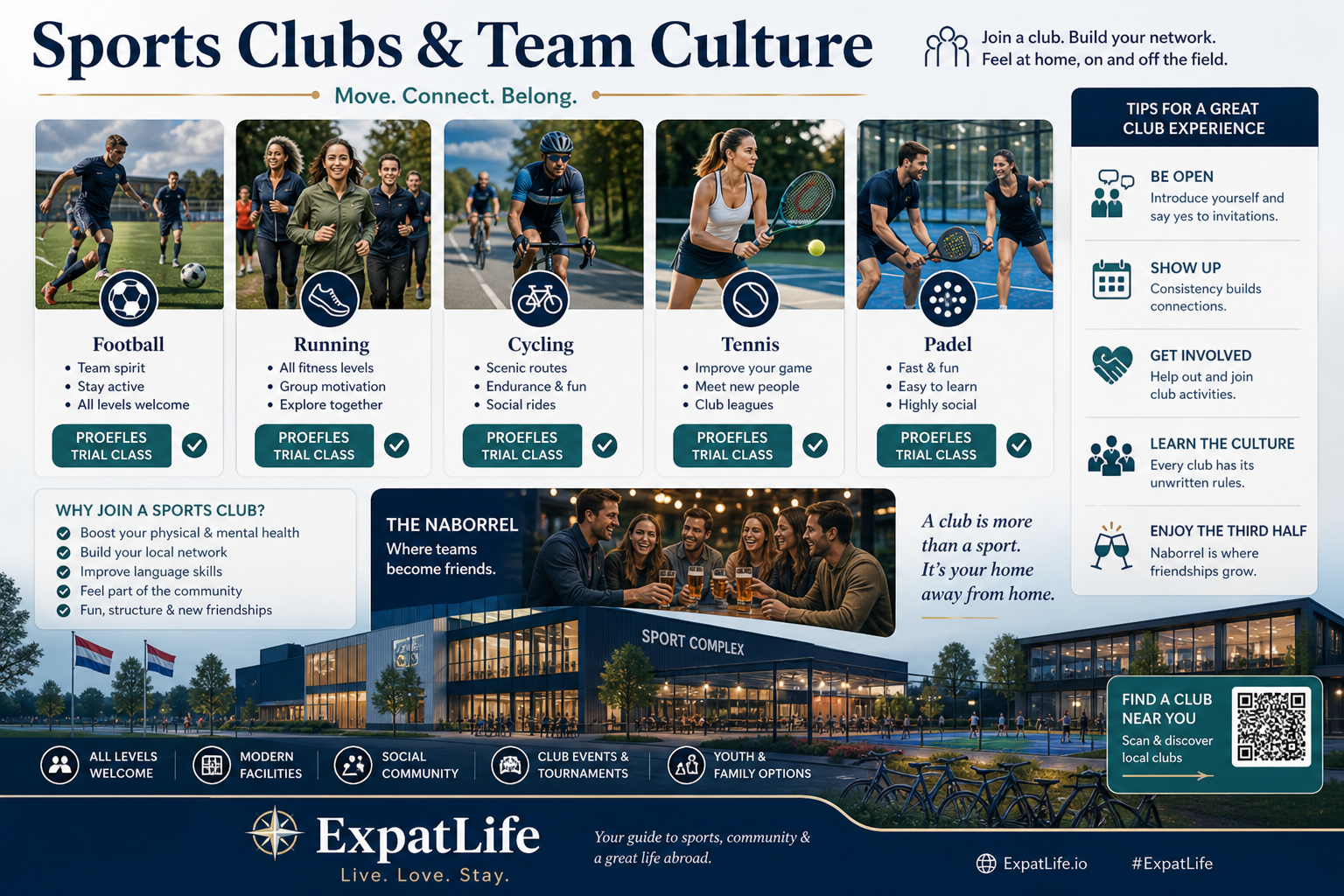
| Name | Audience | Age | Typical cost | Cities | Note | Try it |
|---|---|---|---|---|---|---|
| Parkrun | Free weekly 5K | All ages | Free | Nationwide | Saturday morning community runs. | Find Parkrun |
| Padel | Fast-growing doubles sport | 25–45 | €15–€35/court | Randstad boom | Clubs match solo players. | Find courts |
| Football verenigingen | Team sport | 16–50+ | Club membership | Every town | Social and beginner teams exist. | Find clubs |
| Rowing clubs | Team water sport | 18–45 | Club fees | Canal cities | Spring intro weeks. | Find clubs |
| Climbing / bouldering | Indoor climbers | 20–40 | Day pass or membership | Urban centres | Partner boards at gyms. | Search groups |
| Dance classes | Salsa, bachata, swing | 22–45 | €10–€20/class | Major cities | Partner rotation in class. | Search classes |
| Cycling clubs | Road and touring | 25–60+ | Membership | Nationwide | Weekend group rides. | Find clubs |
| Tennis clubs | Singles and doubles | 20–60+ | Membership | Nationwide | Ladder play and clubhouse culture. | Find clubs |
Join a sports club
Language evenings attract internationals and Dutch locals curious about other cultures. Library TaalCafés, Meetup tandem groups, university conversation tables and municipal inburgering courses all create recurring classmates. Fair language turn-taking builds trust faster than one-sided English conversations.
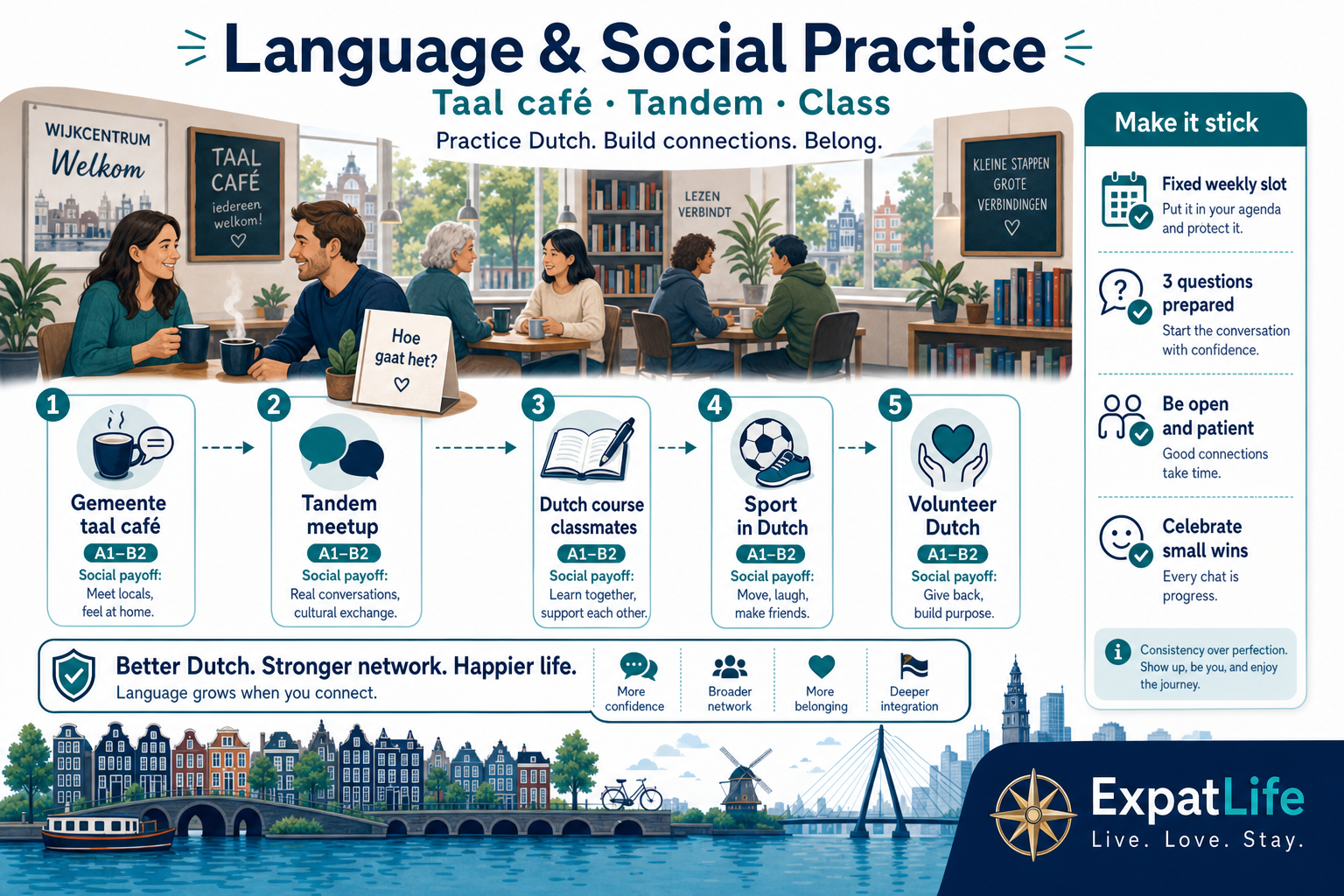
| Name | Audience | Age | Typical cost | Cities | Note | Try it |
|---|---|---|---|---|---|---|
| Library TaalCafés | All levels | 18+ | Free | Most cities | Search ob.nl for your library. | Find libraries |
| Meetup language exchanges | Tandem learners | 20–45 | Free–€5 | Major cities | Dutch–English pairs common. | Find exchanges |
| Taalhuis (municipal) | Newcomers | 18+ | Free–subsidised | Per gemeente | Integration language routes. | Municipal info |
| Uva / EUR language buddies | Students | 18–30 | Free | Amsterdam, Rotterdam | University tandem programmes. | University routes |
| Duolingo Events | Casual learners | 18–40 | Free | Urban | Informal practice meetups. | Find events |
| Bart de Pau Dutch cafés | Learners | 20–50 | Free–low | Amsterdam area | Structured beginner-friendly tables. | See schedule |
Language practice tips
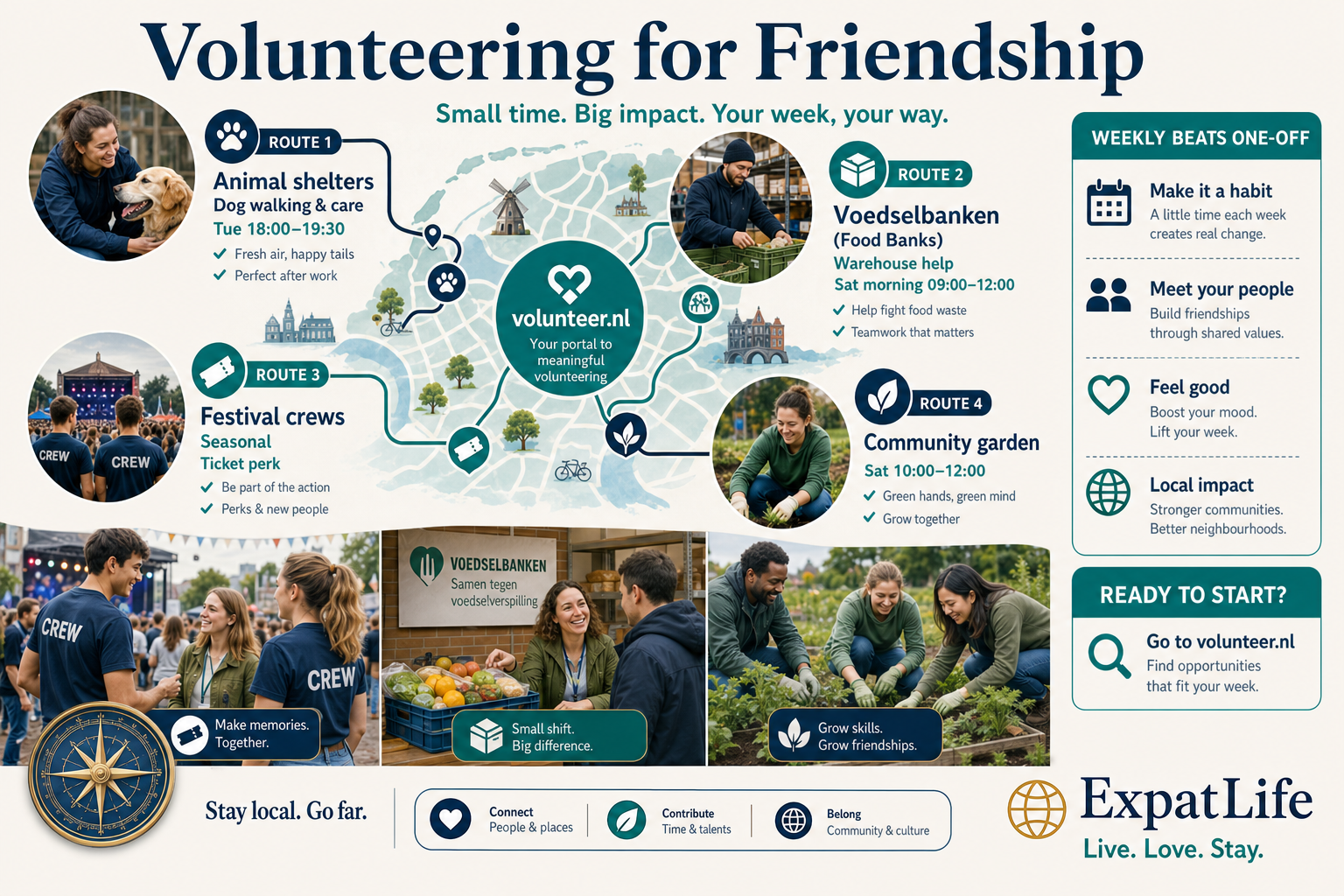
Volunteering builds familiar faces through reliable shifts. Food banks (voedselbanken), animal shelters, library programmes and festival crews all need help — but weekly roles create stronger friendship potential than one-off open days.
| Name | Audience | Age | Typical cost | Cities | Note | Try it |
|---|---|---|---|---|---|---|
| Vrijwilligerswerk.nl | All causes | 16+ | Free | Nationwide | Search by city and weekly availability. | Search roles |
| Voedselbanken | Food distribution | 18+ | Free | Nationwide | Saturday shifts common. | Find food bank |
| Dierenasielen | Animal shelters | 16+ | Free | Per city | Dog walking needs reliability. | Find shelter |
| Bibliotheek programmes | Library volunteers | 18+ | Free | Nationwide | TaalCafé and children's hours. | Local library |
| NL Cares | Flexible volunteering | 18+ | Free | Amsterdam, Rotterdam, Den Haag, Utrecht | One-off and recurring projects. | Browse projects |
| Festival crews | Event volunteers | 18+ | Free (often ticket perks) | Seasonal | Social but episodic — pair with weekly role. | Festival search |
Volunteer for social contact
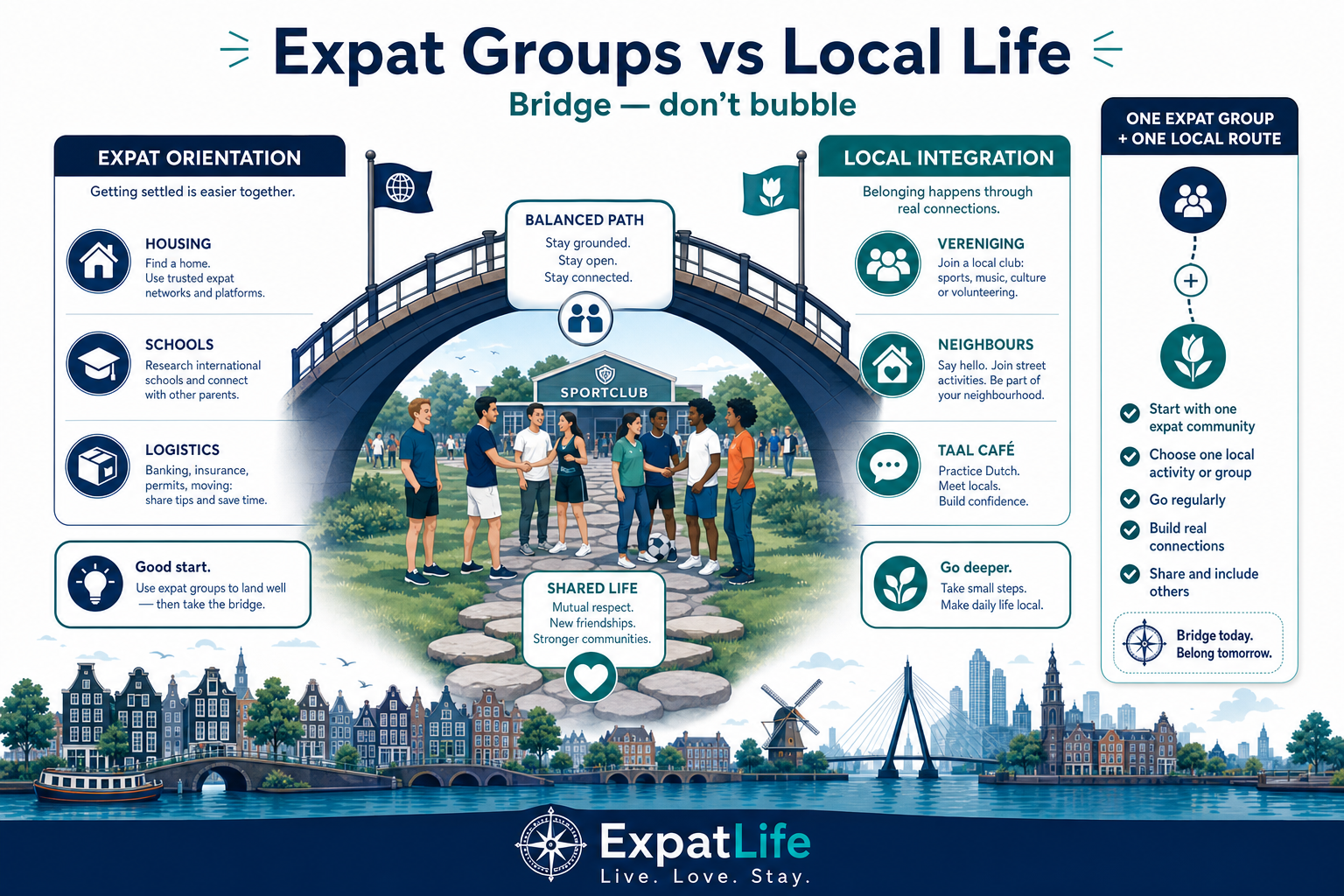
Expat groups, international centres and Facebook communities help you orient quickly — housing tips, school advice and familiar social formats during early culture shock. Balance them with at least one local club or volunteer route so friendships are not only international.
| Name | Audience | Age | Typical cost | Cities | Note | Try it |
|---|---|---|---|---|---|---|
| InterNations | Global expats | 25–55 | Free–paid events | Major cities | Large welcome events. | Join community |
| IN Amsterdam | Amsterdam newcomers | All | Free resources | Amsterdam | Events and settling-in desk. | Newcomer hub |
| Rotterdam International Center | Rotterdam newcomers | All | Free | Rotterdam | Practical and social events. | Visit centre |
| The Hague International Centre | The Hague newcomers | All | Free | The Hague | Diplomatic and expat hub. | Visit centre |
| Meetup expat groups | Interest-based | 20–45 | Free–€15 | All cities | Filter expat + your city. | Find groups |
| Expat Facebook groups | City communities | All | Free | Per city | Search 'Expats in [city]'. | Search Facebook |
Balance expat and local life
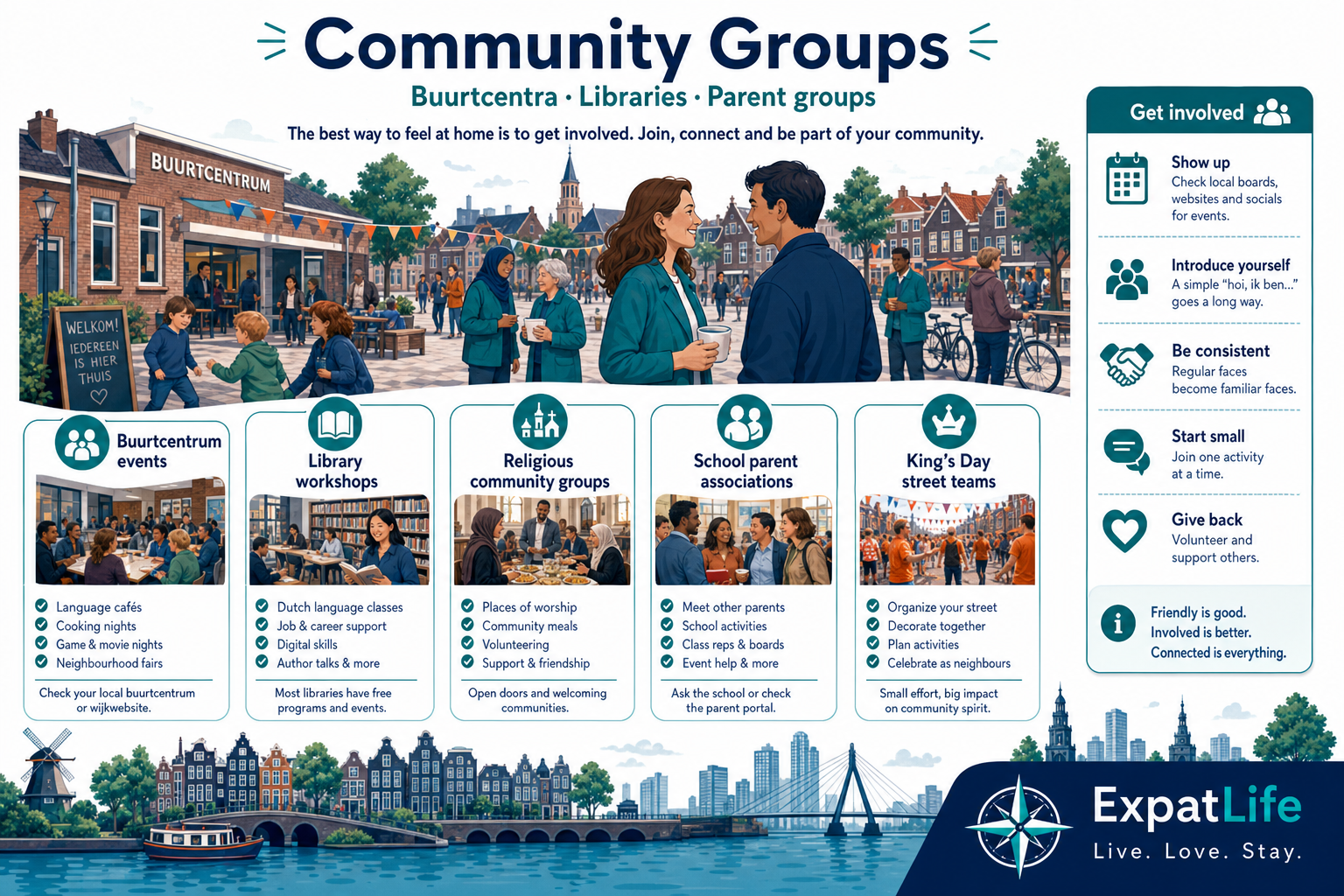
Neighbourhood community centres (buurtcentra), libraries, parent associations and religious communities offer affordable structured social life. Municipal newcomer pages list integration activities — often under-researched by expats focused only on Meetup.
| Name | Audience | Age | Typical cost | Cities | Note | Try it |
|---|---|---|---|---|---|---|
| Buurtcentra | Neighbourhood residents | All ages | Low | Per neighbourhood | Craft, coffee and parent groups. | Find gemeente |
| Oudercommissie / school parents | Parents | 25–50 | Free | Per school | School gate friendships. | School info |
| Humanitas | Buddy programmes | 18+ | Free | Nationwide | Mentoring and language buddies. | Volunteer |
| Kerken / moskeeën community | Faith communities | All ages | Free | Local | Strong social layer beyond services. | Local communities |
| King's Day street teams | Neighbours | All ages | Free | Nationwide | April street parties — join organising. | King's Day info |
Community group tips
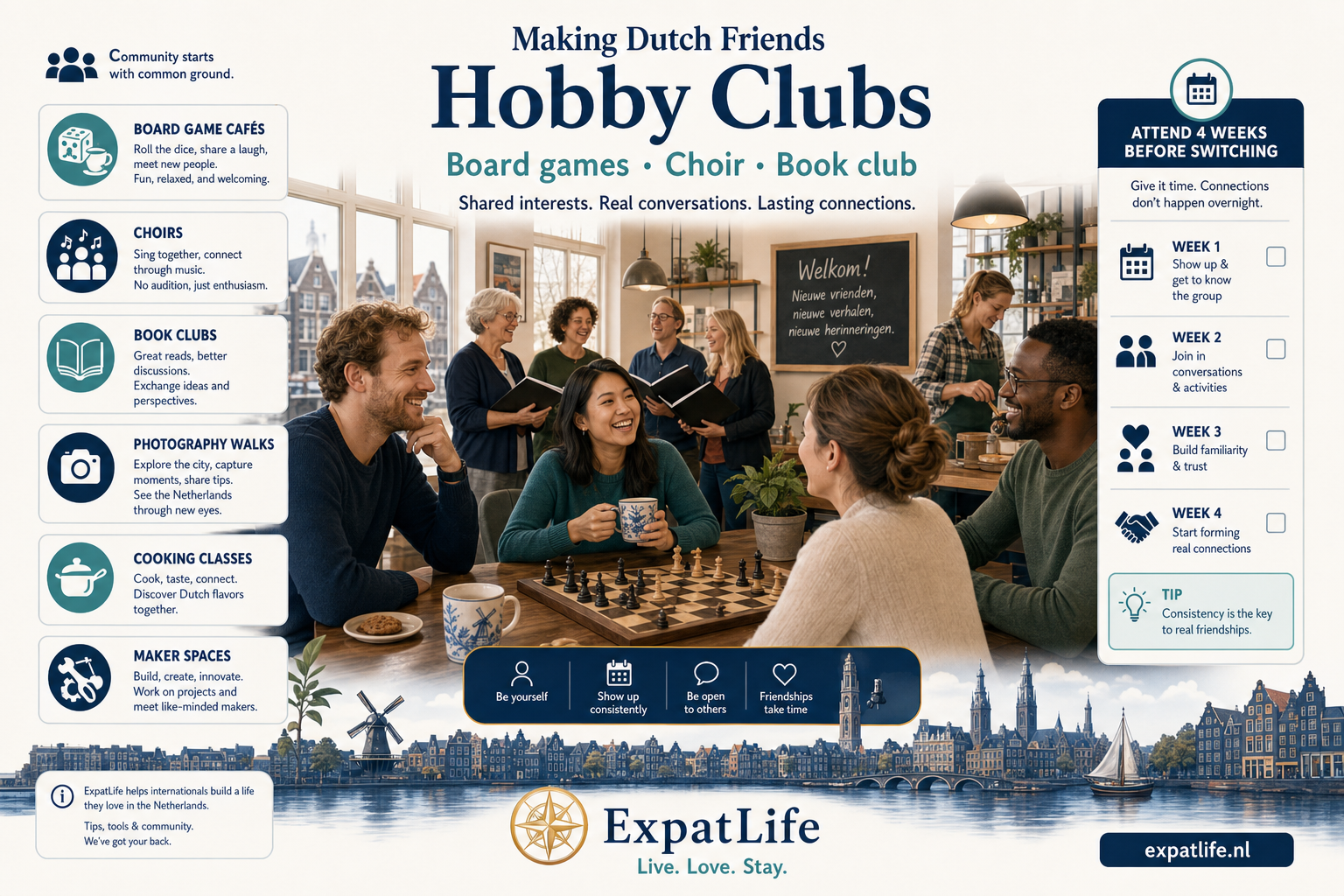
Board-game cafés, choirs, book clubs, photography walks and maker spaces give you something to discuss besides small talk. Pick an activity you would enjoy alone — authenticity beats 'friendship strategy' hobbies you abandon in month two.
| Name | Audience | Age | Typical cost | Cities | Note | Try it |
|---|---|---|---|---|---|---|
| Board-game cafés | Casual gamers | 20–40 | Table fee + drinks | Amsterdam, Utrecht, Den Bosch | Open tables on weeknights. | Find cafés |
| Book clubs | Readers | 25–55 | Free–€5 | Libraries nationwide | English clubs in cities. | Find clubs |
| Choirs | Singers | 20–70+ | Membership | Most cities | No-audition choirs exist. | Search choirs |
| Photography walks | Creatives | 22–50 | Free–€15 | Meetup groups | Street and canal themes. | Find walks |
| Maker spaces | DIY / tech | 20–45 | Membership | Urban | Workshop nights and open days. | Find spaces |
| Cooking workshops | Food lovers | 25–50 | €30–€60 | Randstad | Group tables and shared tasks. | Find workshops |
Pick and stick with one hobby
Industry meetups, coworking communities and alumni chapters help career movers build contacts — but work-only networks can feel transactional. Add a non-work club so friendships exist outside quarterly networking pitches.

| Name | Audience | Age | Typical cost | Cities | Note | Try it |
|---|---|---|---|---|---|---|
| Meetup professional | Industry groups | 25–50 | Free–€25 | Randstad | Tech, marketing, finance niches. | Find meetups |
| WeWork / Spaces events | Coworking members | 25–45 | Membership | Major cities | Lunches and community managers. | Find location |
| LinkedIn Local | Professionals | 25–55 | Free events | Urban | Search LinkedIn Events NL. | Browse events |
| BNI / networking chapters | Business owners | 30–55 | Chapter fees | Nationwide | Structured weekly referrals. | Find chapter |
| Alumni chapters | University grads | 22–50 | Free–low | Per university | Dutch and international alumni. | Search alumni |
Balance work and social life
Neighbourhood friendships start with small rituals: hallway greetings, nodding on the street, a brief note when you move in. Many buildings use WhatsApp for packages, lost keys and street events — join when invited and keep messages practical at first.
Buurt BBQs, King's Day street parties and community garden days connect you to people who live closest. Municipal newcomer pages and library boards list neighbourhood programmes that vary by gemeente.
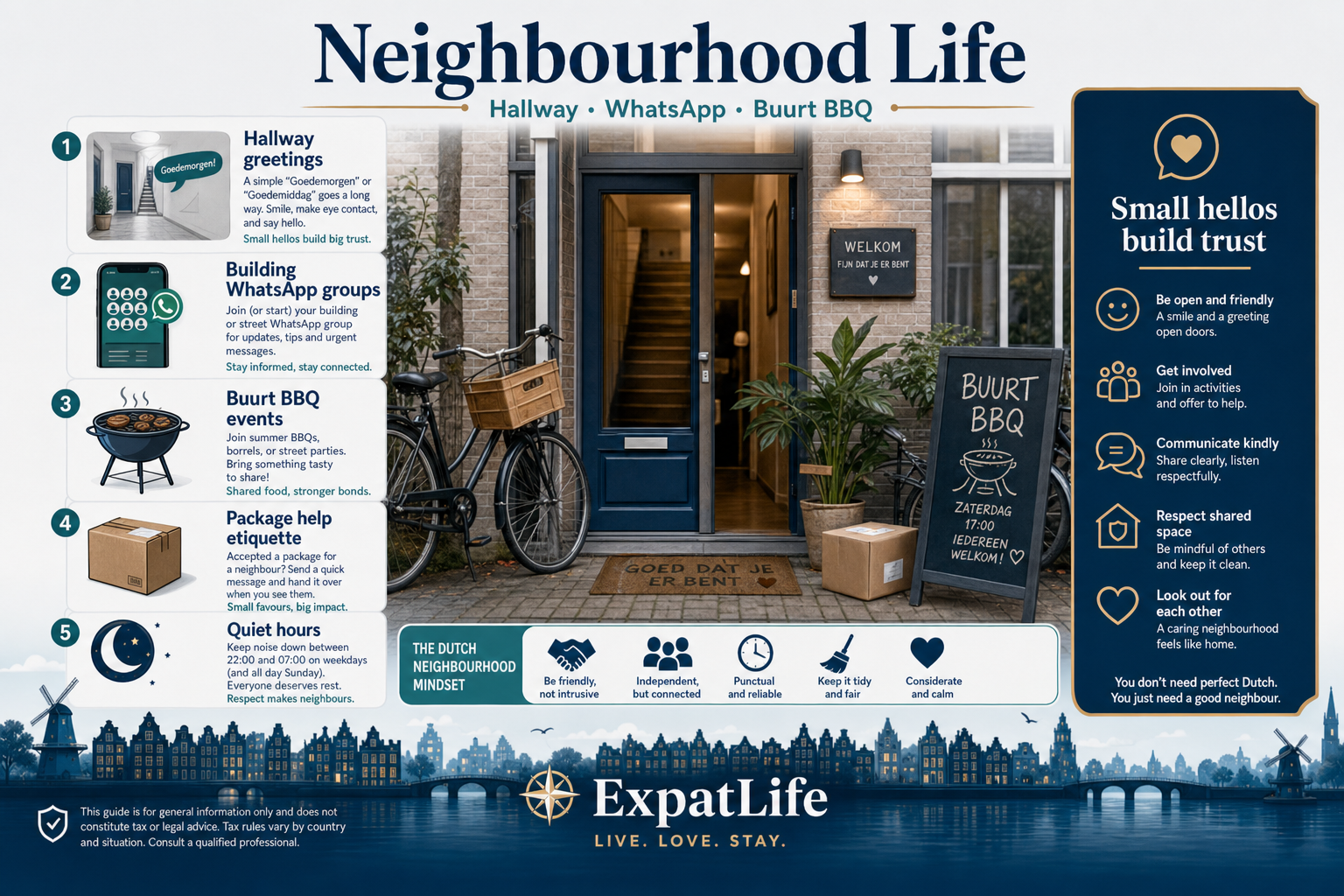
| Route | Example | First step |
|---|---|---|
| Building WhatsApp | Package alerts and lost-key help in Amsterdam apartment | Ask a neighbour how to join — stay practical at first |
| Buurt BBQ | Summer street party in Utrecht terraced neighbourhood | Bring a salad or drinks — offer to help setup |
| Community garden | Shared plot in Rotterdam south | Email gemeente or garden association for open days |
| Hallway ritual | Daily hello in The Hague apartment block | Learn names — invite for coffee after a month of greetings |
Neighbour friendship tips
Some strategies feel productive but rarely build Dutch friendships on their own. Recognising anti-patterns saves months of frustration — replace passive waiting with one recurring activity you genuinely enjoy.

| What often fails | Why | Try instead |
|---|---|---|
| Bars and nightlife only | Sporadic contact without shared context | Join a weekly club or volunteer shift |
| Waiting to be invited | People assume newcomers are busy or temporary | Send one coffee invite per week |
| Expat-only bubble for years | Fast orientation but slow local roots | Add one Dutch-language activity |
| One-off event hopping | No familiarity between events | Attend the same group six times |
| Instant deep friendship expectations | Trust needs repetition over months | Celebrate activity partners first |
| Ignoring calendar culture | Vague plans rarely happen | Propose Tuesday 19:00 with a venue |
| Only work colleagues | Relationships stay transactional | Join a non-work hobby club |
| Giving up in month one | Circles form seasons, not weeks | Track attendance for six weeks minimum |
Your best friendship channels depend on schedule, family status and energy. Students, young professionals, parents, couples and retirees each need different routes — forcing the most popular option rarely works.

Challenges: Transient classmates, tight budgets
Best routes: University sports intros, student associations, library TaalCafé
Join one society for the full year — not only intro week.
Challenges: Work-heavy weeks, international turnover
Best routes: Padel, running club, Meetup hobbies, coworking events
Schedule social time like gym sessions — recurring slots.
Challenges: Couple-friend matching takes longer
Best routes: Double-date dinners via club friends, board-game cafés, hiking groups
Befriend couples from your activity — invite for borrel at home.
Challenges: Limited evening time
Best routes: School gates, kids' sport clubs, parent associations, buurtcentrum
Saturday kids' sport is a parent social hub — stay for coffee.
Challenges: Isolation without office
Best routes: Coworking, library work sessions, daytime walking clubs
Leave home for social contact at least three days weekly.
Challenges: Smaller digital-first networks
Best routes: Wandelnet walks, library groups, volunteer desks, choir
Buurtcentrum daytime programmes are underrated.
International population, club density and expat hub access vary sharply by city. Use city guides for neighbourhood detail — this table orients your friendship strategy.
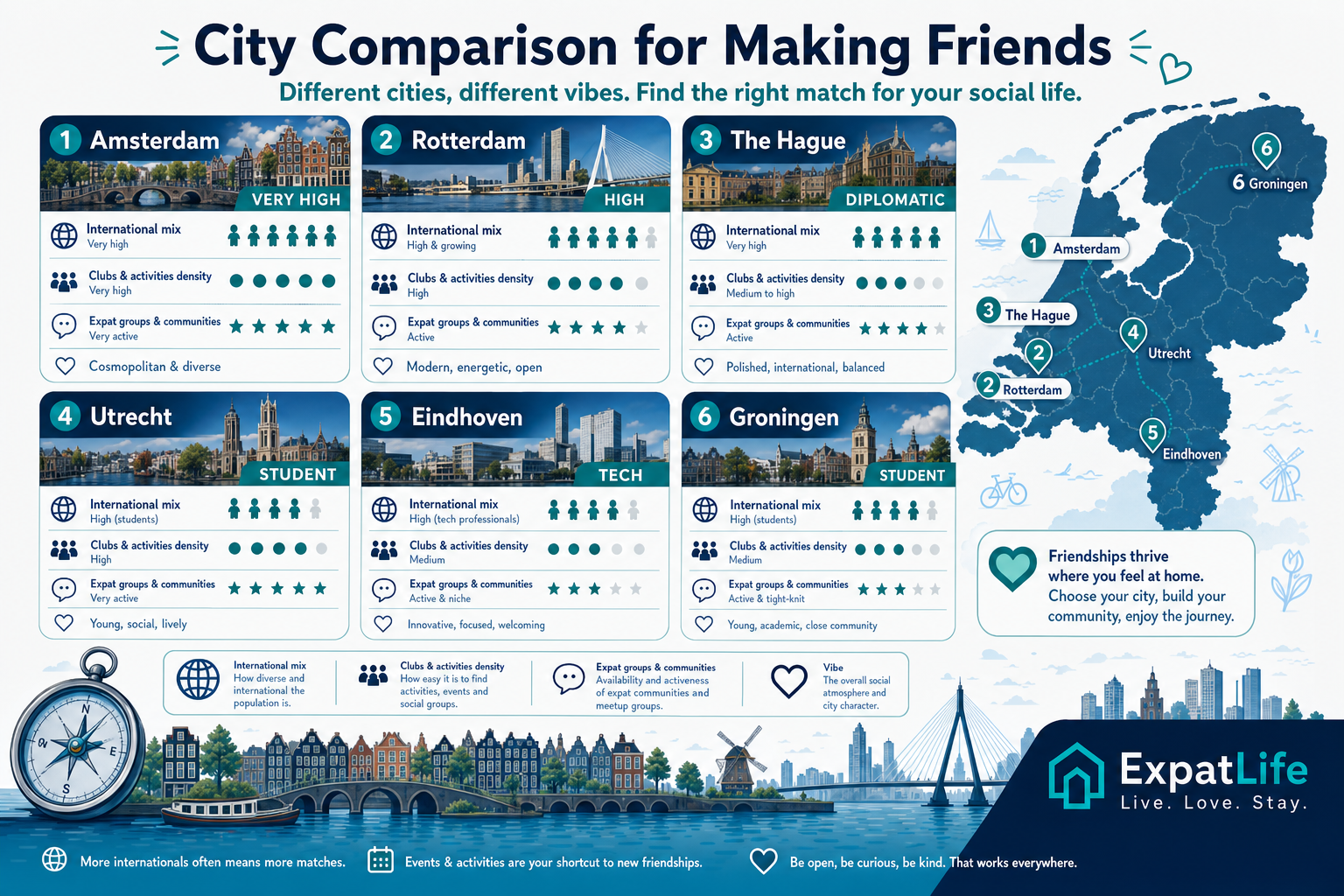
Choose your city strategy
These anonymised patterns come from common expat experiences — not guarantees. Most share weekly consistency over several months before friendships deepened.
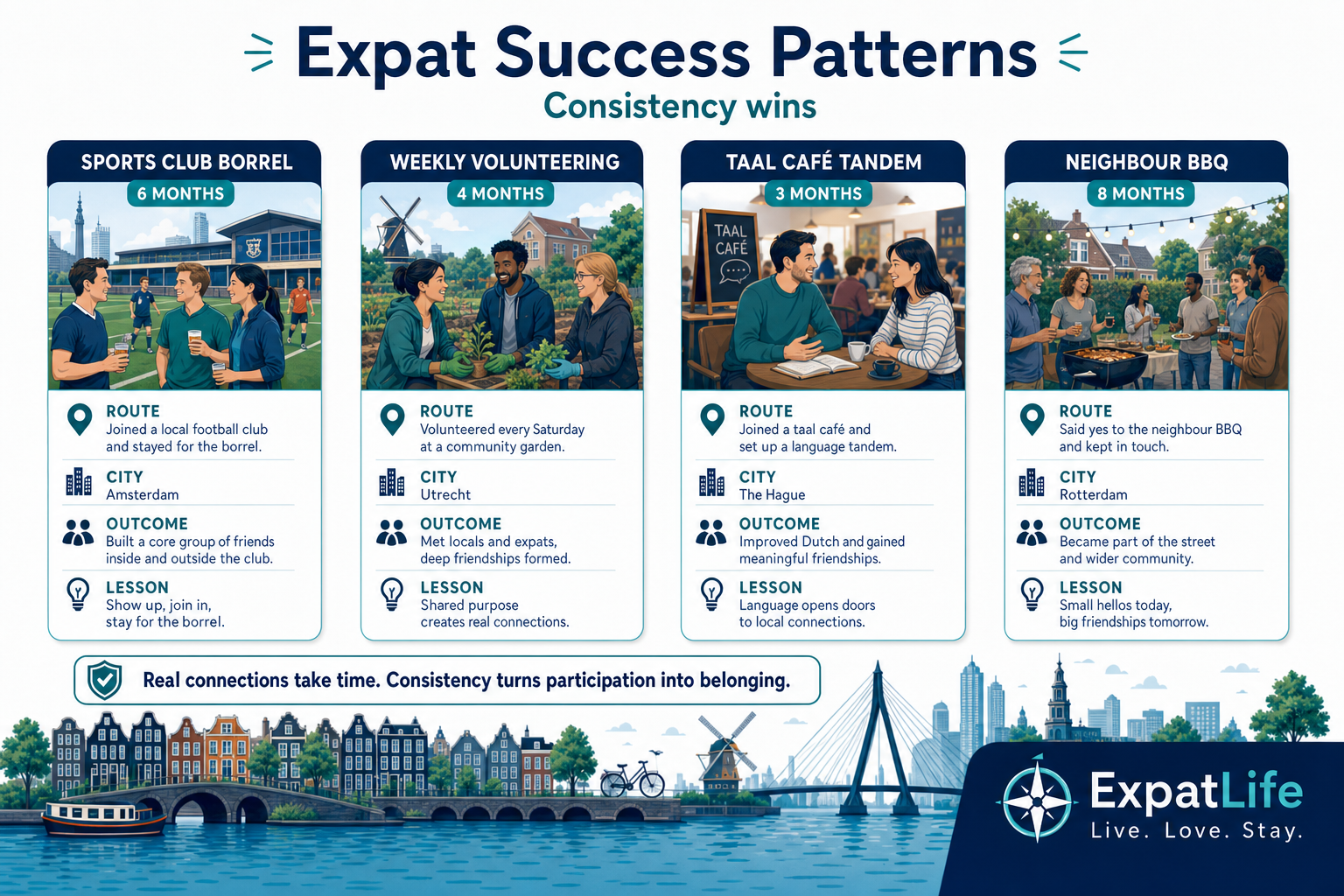
Amsterdam
Route: Padel club via Meetup
Outcome: Three close friends after 4 months of weekly doubles
Partner sports create natural repeat contact — stayed after training for borrel.
Utrecht
Route: Kids' football club + school gate
Outcome: Neighbourhood parent group for coffee and childcare swaps
Saturday sport sidelines are underrated parent social hubs.
Haarlem
Route: Wandelnet Sunday walks
Outcome: Walking group became lunch friends and travel companions
Daytime clubs suit retirees better than evening Meetup events.
Groningen
Route: University rowing intro + TaalCafé
Outcome: Mixed Dutch–international friend circle by second semester
Student sport intros are the fastest structured entry point.
Rotterdam
Route: NL Cares food-bank shift
Outcome: Weekly volunteer team became dinner friends
Volunteering created deeper bonds than large expat mixers.
The Hague
Route: Buurt BBQ + building WhatsApp
Outcome: Close neighbours who watch cats and share tools
Small neighbour rituals for months preceded the first home invite.
Common strategy gaps — adjust channels before concluding friendship is impossible here.
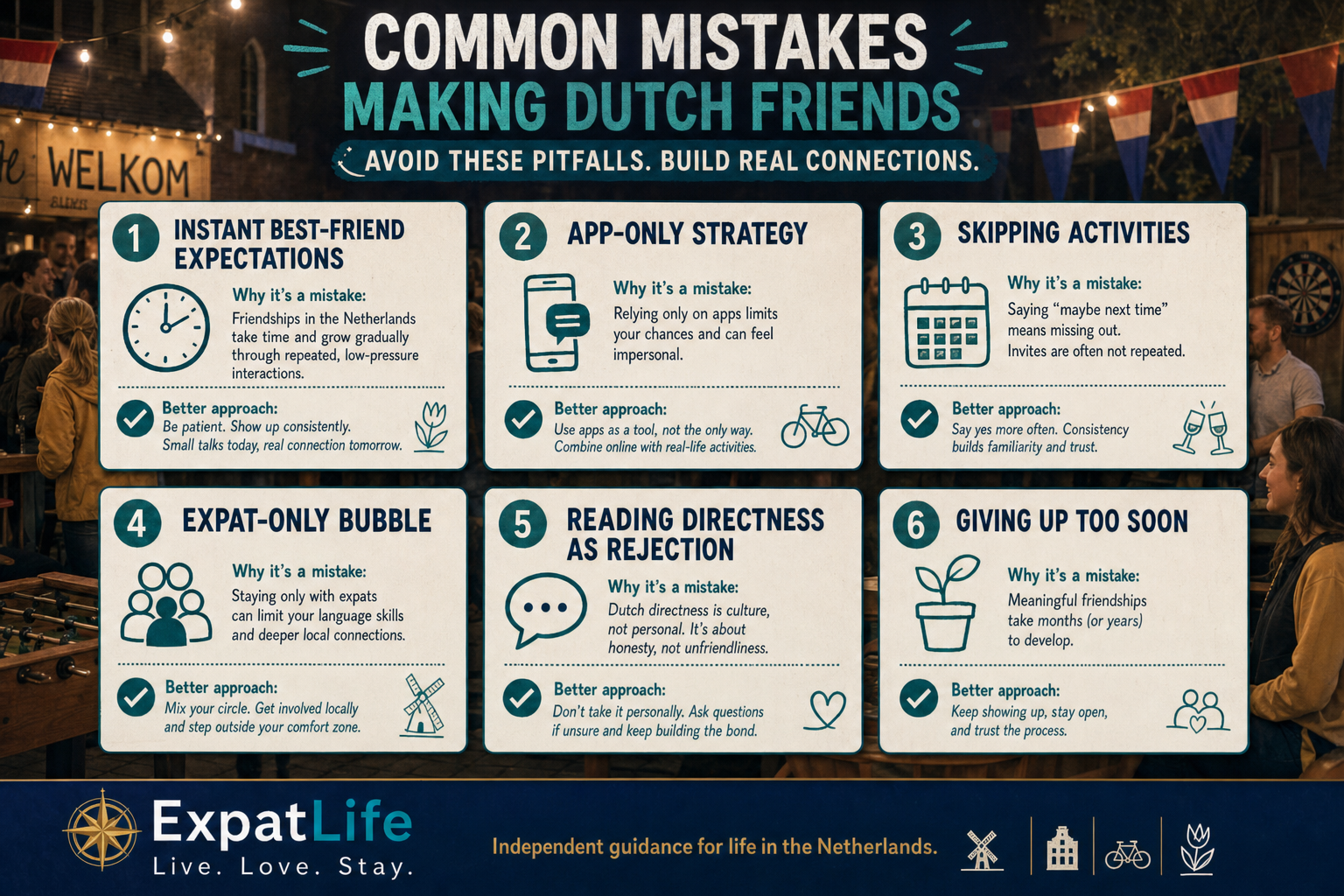
Welcome events orient but rarely deepen — add a weekly local activity.
Join one vereniging or volunteer shift.
Waiting for spontaneous friendship misses Dutch activity-first culture.
Book a proefles sport intro this week.
Trust builds through repetition — give clubs six weeks.
Return to the same group.
People assume you are busy — invite others to coffee.
Send one invite per week.
English suffices initially — Dutch opens local circles.
Learn ten neighbour phrases.
International friends help — local clubs deepen roots.
Add one Dutch-language activity.
Six different events beat six visits to one group for depth.
Pick one route and attend six times.
Circles take seasons, not weeks, to form.
Track attendance, not instant outcomes.
Use this as a realistic rhythm — not a rigid script. Friendships often deepen between months three and six when familiar faces become trusted contacts.
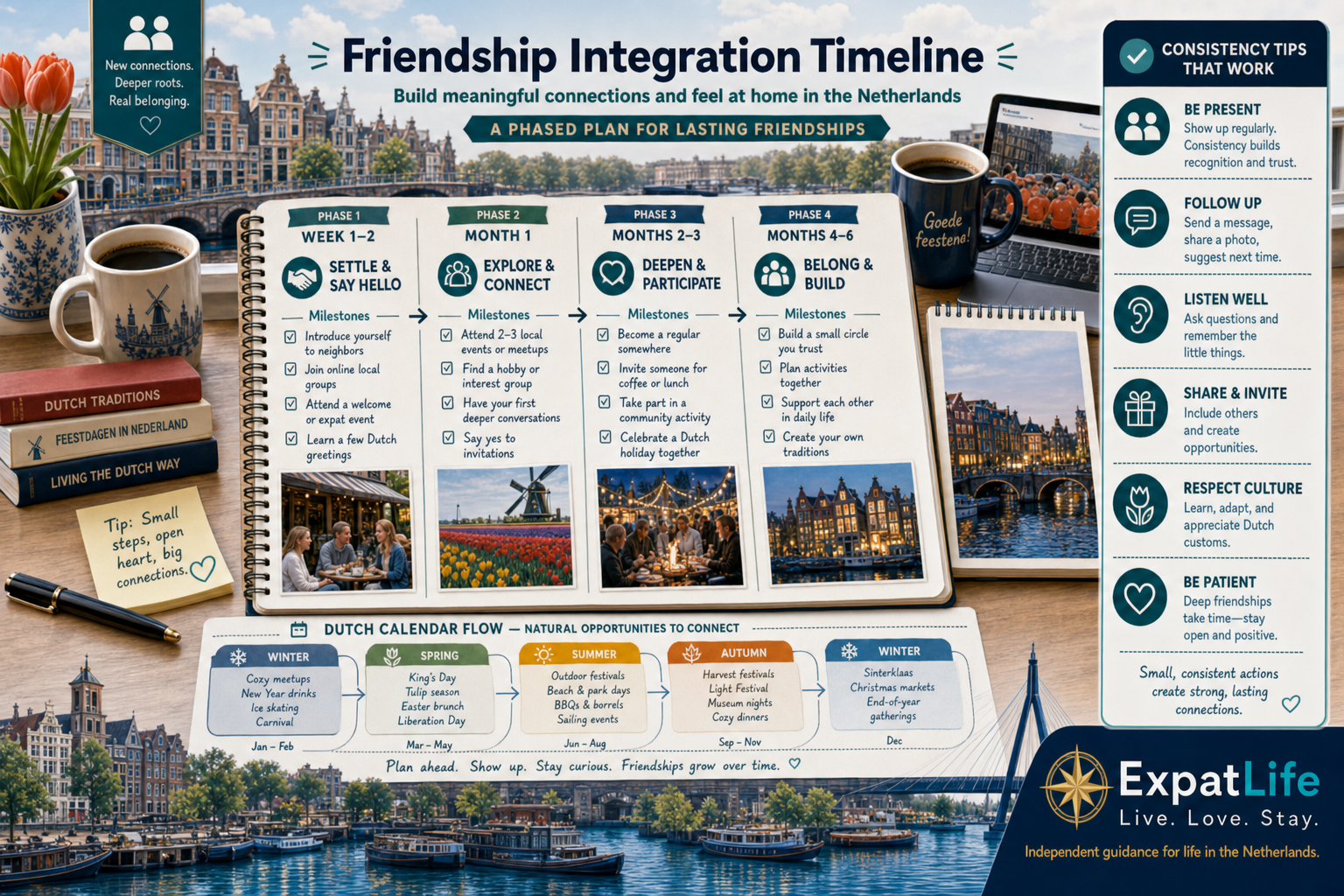
Week 1–2
Month 1
Month 2–3
Month 4–6
Confirm club and group details locally — offerings change by season and city.
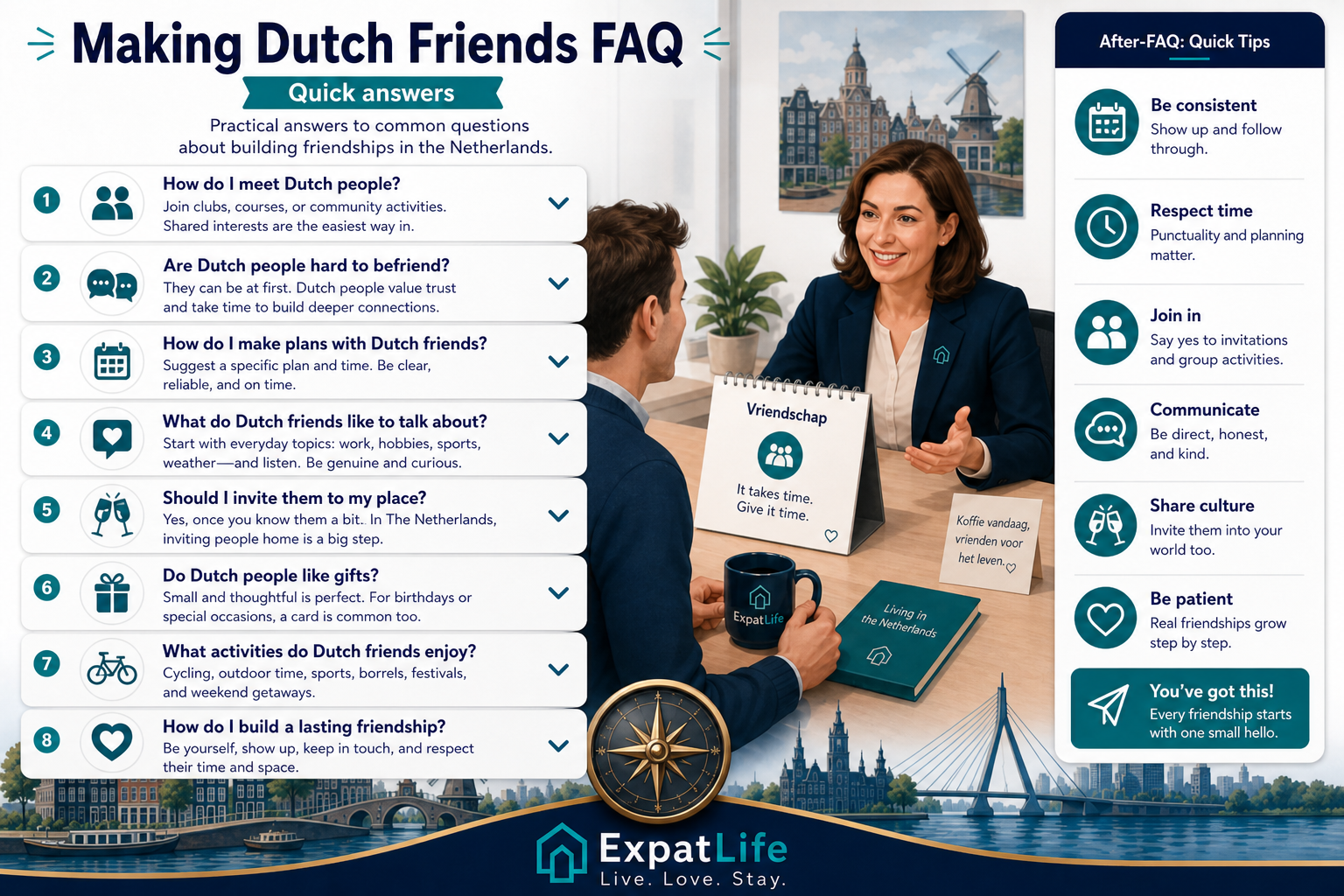
It can feel slow at first because many adults have established circles. Sports clubs, volunteering, language cafés and neighbourhood life all help — weekly consistency matters more than any single channel.
Yes, especially in international cities and shared activities — sports, hobbies and volunteer teams. Shared routines matter more than nationality.
Not to start in Randstad cities — English works in many clubs and Meetups. Dutch effort is appreciated and opens local-only groups over time.
Combine one high-repeat weekly activity (sport, volunteer shift, hobby club) with one wider channel (Meetup, expat welcome event, neighbour gathering).
Activity partners often appear in weeks; deeper friendships commonly develop between months three and six of the same weekly group.
Good for orientation — pair with at least one local club or volunteer route for long-term roots and language practice.
Small rituals: hallway greetings, joining building WhatsApp, accepting buurt BBQ invites and learning quiet-hour rules.
Bar-only socialising, waiting to be invited, one-off event hopping, expat-only bubbles for years and giving up before six weeks of the same activity.
Continue from friendship routes into community integration, social norms and city guides.

Explore next
Move from friendship orientation into community integration, social norms and language learning.

Find local interest, language and social groups by city.
Open official sourceNational volunteer opportunity portal.
Open official sourceDutch sports federation — find affiliated clubs.
Open official sourceLibrary TaalCafés and community programmes nationwide.
Open official source