
Greetings
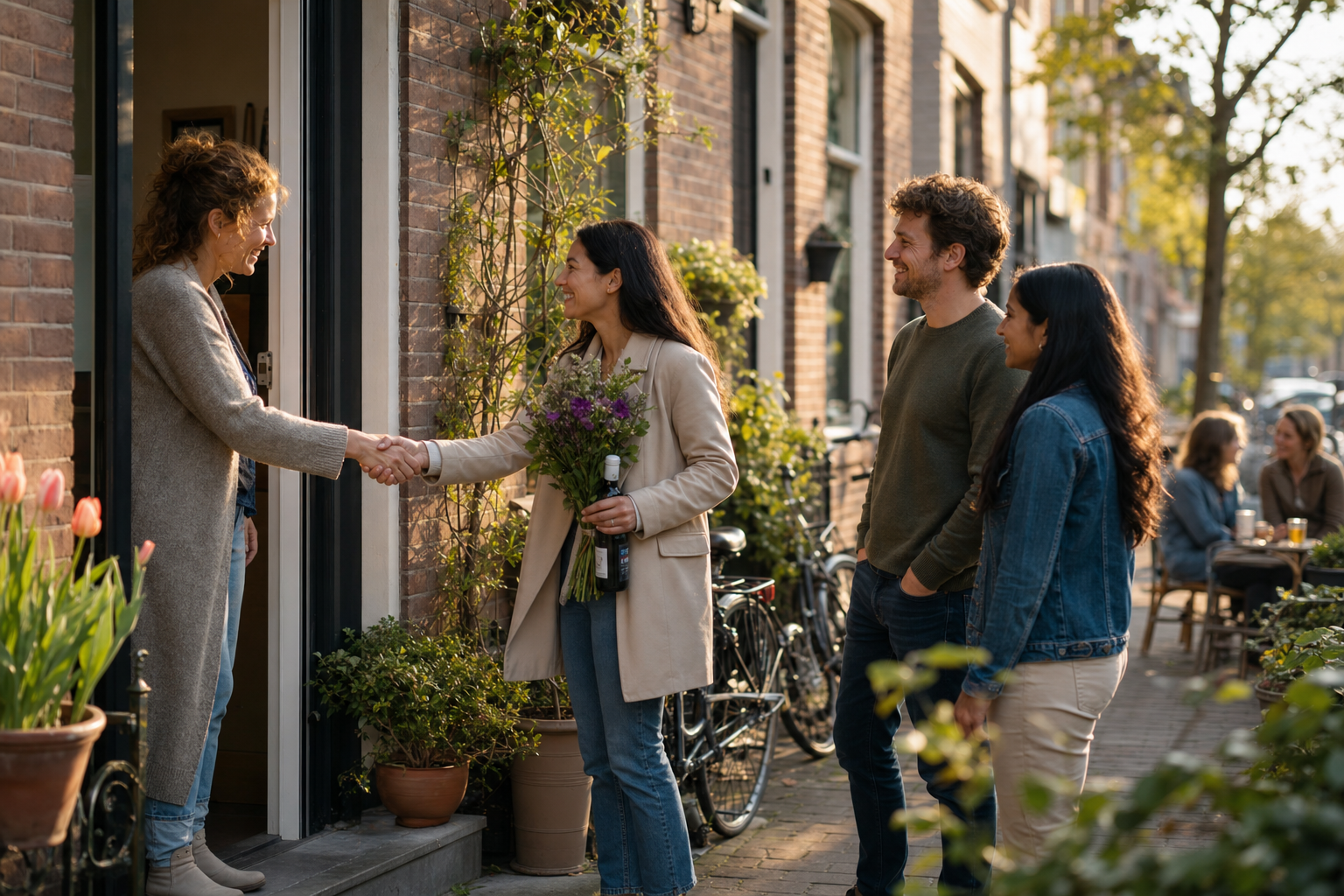
Handshakes, cheek kisses, time-of-day phrases and professional introductions.
Life in the Netherlands · Culture
Understand the everyday etiquette, manners and unwritten rules that help newcomers feel comfortable living in the Netherlands.
Orientation only — etiquette varies by household, region, age and workplace. Observe locally and ask politely rather than assuming one national style fits everyone.
Quick answer
Moving to the Netherlands means learning practical systems — housing, registration, banking — and a quieter layer of social etiquette. How to greet neighbours, behave at dinner, give gifts and navigate public space can surprise newcomers even when Dutch colleagues speak excellent English.
This guide focuses on manners and behaviour in specific situations: greetings, dining, invitations, gifts, neighbours, workplaces and public spaces. For broader social values and unwritten rules, see Dutch Social Norms. For high-level culture overview, see Dutch Culture.

Handshakes, cheek kisses, time-of-day phrases and professional introductions.
RSVP, arrival time, gifts, shoes and thank-you follow-up.
Restaurants, bill splitting, coffee invitations and table manners.
Birthdays, housewarming, holidays and thank-you gestures.
Hallway greetings, noise, bins, parking and community events.
Queues, cycling, transport, phone calls and shared areas.
This guide covers practical manners in specific situations. Social Norms explains broader unwritten rules and values.
Often appreciated, rarely required — flowers, wine or chocolate are safe. Ask the host if unsure.
Usually issue-focused — ask what practical outcome is needed before reacting.
Brief apology and adjustment go far — most Dutch people appreciate effort over perfection.
At a glance
Six orientation signals — then verify with your neighbourhood and colleagues.

Greetings
Handshake or cheek kisses
Follow the other person's lead
Visiting
RSVP + small gift
Ask about shoes
Dining
Split or Tikkie
Confirm before ordering
Neighbours
Brief hello
Quiet hours matter
Arriving at the agreed time shows respect — confirm expectations for casual plans.
Direct questions and answers are common — ask for context if tone surprises you.
Unplanned visits and personal questions may feel intrusive — plan ahead.
Flowers, wine or chocolate are safe when invited to someone's home.
Clarity is valued — polite honesty beats vague hints in many settings.
Queues, cycle paths and quiet zones expect considerate behaviour.
How to use this snapshot
Greetings set the tone for Dutch social life. In professional settings, a firm handshake and eye contact are standard for introductions. Among friends and family, cheek kisses (often three) may appear — follow the other person's lead if you are unsure.
In shops, offices and neighbourhoods, time-of-day greetings (goedemorgen, goedemiddag, goedenavond) are widely used. Casual doei or tot ziens work among peers. When meeting someone new, stating your name clearly and asking theirs is a safe default.

Match the greeting to the time of day and setting.
| Situation | Dutch phrase | English | Note |
|---|---|---|---|
| Morning — shop or neighbour | Goedemorgen | Good morning | Widely expected before noon. |
| Afternoon — office or café | Goedemiddag | Good afternoon | Polite default until early evening. |
| Evening — restaurant | Goedenavond | Good evening | Use from late afternoon onward. |
| Casual goodbye | Doei / Tot ziens | Bye / See you | Fine among peers and neighbours. |
| First introduction | Aangenaam, ik ben… | Nice to meet you, I'm… | Handshake + eye contact in professional settings. |
| Birthday | Gefeliciteerd! | Congratulations! | Add the person's name — see Birthday Traditions. |
| Setting | Hello | Goodbye | Note |
|---|---|---|---|
| Office — first meeting | Handshake + 'Aangenaam, ik ben…' | 'Fijne dag' / 'Tot morgen' | Use first names once invited. |
| Friends — borrel | Cheek kisses or handshake | 'Doei, tot snel' | Follow the group's established style. |
| Neighbour — hallway | 'Hallo' / 'Goedemorgen' | Nod or brief 'Doei' | Short and friendly is enough. |
| Shop or café | 'Goedemiddag' to staff | 'Dank u wel, tot ziens' | Politeness is noticed even in quick transactions. |
Invitations are usually planned in advance. Spontaneous drop-ins are less common than in some cultures. When invited, confirm time, location and whether partners or children are welcome.
A small gift — flowers, wine, chocolate or something for the children — is often appreciated but not mandatory. Some households ask guests to remove shoes; others do not. When in doubt, ask or follow the host's example. Customs vary by household.

| Step | What to do |
|---|---|
| Before you go | Confirm time, address, parking and whether partners or children are welcome. |
| What to bring | Small gift optional — flowers, wine, chocolate or something for children. |
| Arrival | Ring the bell at the agreed time; wait to be invited in. |
| Shoes | Follow the host — ask 'Schoenen uit?' if you see a shoe rack or others remove theirs. |
| During the visit | Offer to help once; accept 'no' gracefully; keep voice moderate. |
| Afterward | Send a brief thank-you message — 'Bedankt voor de gezellige avond' works well. |
Dutch dining etiquette blends European table manners with practical, egalitarian habits. At restaurants, waiting staff may not rush — flag them politely when ready to order or pay. Many friend groups split bills item by item or use Tikkie after the meal.
Coffee invitations (koffie) are often short and scheduled. Dinner invitations usually mean arrive on time, wait for everyone to be served, and offer to help clear. Buffets and barbecues follow host instructions — ask where to place used plates or whether to bring a dish.

| Context | Common practice | Note |
|---|---|---|
| Restaurant with friends | Confirm split style before ordering | Itemised splits and Tikkie are common. |
| Coffee at someone's home | Arrive on time; stay 45–90 minutes unless invited longer | Often a weekday afternoon slot. |
| Dinner party | Wait to start eating; offer to help clear | Ask about dietary restrictions when RSVPing. |
| Buffet or barbecue | Follow host cues; bring a dish if asked | Do not arrive empty-handed if potluck was agreed. |
Table manners
Gift-giving in the Netherlands tends toward modest, thoughtful gestures rather than extravagant displays. For home invitations, flowers, wine, good chocolate or a dessert contribution are safe choices.
Birthdays, housewarming, Christmas and Sinterklaas each have their own customs. Business gifts should stay appropriate and modest. When unsure, ask a colleague or neighbour what is typical in your circle.

| Occasion | Appropriate gift | Note |
|---|---|---|
| Home invitation | Flowers, wine, chocolate or bakery | Odd flower numbers for some occasions — ask the florist. |
| Birthday | Book, flowers, wine or group Tikkie contribution | See Dutch Birthday Traditions for circle parties. |
| Housewarming | Plant, wine, kitchen item or local treat | Practical gifts are often appreciated. |
| Christmas / Sinterklaas | Modest token; surprise gifts for children | Sinterklaas has its own rhyming and surprise traditions. |
| Thank-you | Card, flowers or small treat after help | A message alone is often enough. |
| Business | Modest branded or local item | Check company policy — some firms restrict gifts. |
Can create awkward obligation — modest and thoughtful beats lavish for most home visits.
Perfume, clothing or intimate gifts are inappropriate in professional settings.
Associated with funerals in the Netherlands — choose mixed bouquets for celebrations.
Bring a non-alcoholic option or ask the host in advance.
Dutch workplace etiquette tends toward punctuality, direct feedback and relatively flat hierarchies. Arrive on time for meetings, reply promptly to scheduling emails and use clear subject lines.
Direct comments often target the task, not the person. First names appear quickly in many teams. For deeper context on meetings, borrels, emails and hierarchy, see our Dutch Workplace Culture guide.

What to expect and how to respond in common professional settings.
| Situation | What to expect | Practical tip |
|---|---|---|
| First team meeting | Handshake or brief intro; use first name if invited | Take notes — action items are often stated plainly. |
| Direct feedback in meeting | Issue-focused comment, not personal attack | Ask: 'Can you give an example?' |
| Scheduling email | Reply within one business day with availability | Propose two time slots if declining. |
| Friday borrel | Optional but builds rapport; one drink is fine | Ask colleagues about unwritten team customs first. |
Neighbour etiquette in the Netherlands combines friendly practicality with respect for privacy and quiet. A brief hello in the hallway or on the street is normal. Noise, bins, parking and shared gardens are common discussion topics — calm conversation works best.
Many neighbourhoods use WhatsApp or buurt apps for local updates. Join when invited and keep messages constructive. For broader integration routes, see Community Basics.

| Situation | Helpful action | Note |
|---|---|---|
| First meeting in hallway | Brief hello — 'Hallo' or time-of-day greeting | No need for long conversation every time. |
| Noise complaint | Message calmly or knock once; avoid shouting | Quiet hours vary by building and gemeente. |
| Shared garden or bin area | Follow posted schedules; keep areas tidy | Ask VvE or neighbours about rules. |
| Parking dispute | Discuss calmly; check permit rules | Street parking varies by city. |
| Community event | Attend if invited; introduce yourself | Low-pressure way to learn local norms. |
Public etiquette in the Netherlands expects quiet, orderly behaviour in shared spaces. Queue in order at counters and transport stops. Keep phone conversations brief or move aside in quiet zones.
Cycling courtesy matters — use bike lanes, signal turns, use lights after dark and do not block paths. On public transport, check in and out, offer priority seats and keep backpacks off seats during busy periods.

| Scenario | Expected behaviour | Note |
|---|---|---|
| Supermarket queue | Wait in line; have payment ready | Self-checkout has its own queue etiquette. |
| Train — quiet zone | No phone calls; low voice | First class may have additional rules. |
| Cycle path | Stay right; ring bell early; use lights at night | Blocking paths frustrates commuters. |
| Escalator | Stand right, walk left in many cities | Observe local habit — not universal. |
| Park or library | Moderate voice; clean up after yourself | Shared spaces expect consideration. |
Cycling etiquette
Shopping etiquette is straightforward: wait your turn, greet staff in smaller shops and markets, and pack efficiently at busy self-checkout stations. Many supermarkets charge for plastic bags — bring reusable ones.
At markets, ask before handling produce at some stalls. Pay promptly and thank the vendor. Albert Heijn and Jumbo self-scan flows expect you to scan and bag without blocking others.

How to navigate common Dutch retail settings with confidence.
| Setting | What to do | Note |
|---|---|---|
| Small shop or bakery | Greet staff on entry; say dank u wel when leaving | A quick hello is noticed even in fast transactions. |
| Albert Heijn / Jumbo self-scan | Scan steadily; bag without blocking the next person | Staff may spot-check your basket — stay calm. |
| Saturday market | Wait your turn; ask vendor to pick produce if unsure | Pay promptly; small talk is optional not required. |
| Checkout queue | Have payment ready; keep trolley behind the line | Do not skip ahead even if you have fewer items. |
Shopping courtesy
WhatsApp dominates informal communication — friend groups, sports teams and many neighbour chats. Response times vary; read the room before expecting instant replies.
Professional email expects clear subject lines and concise messages. Neighbourhood apps (Nextdoor, buurt platforms) work best with factual, constructive posts. Avoid late-night messages unless the relationship is clearly informal.
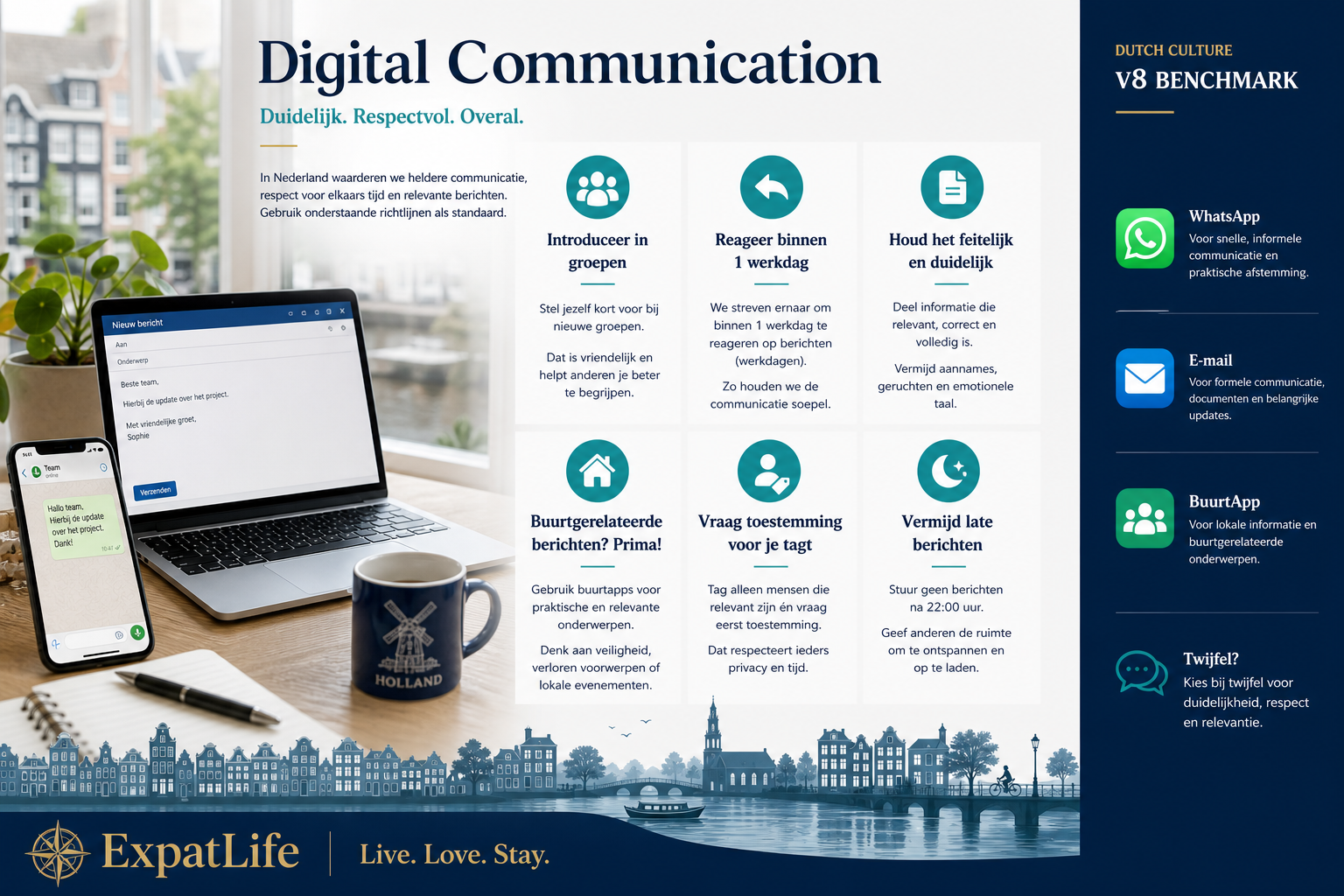
Tone and response expectations vary by platform — match the channel.
| Channel | Expectation | Tip |
|---|---|---|
| WhatsApp — friend group | Casual tone; response within a day is fine | Introduce yourself when added to a new group. |
| WhatsApp — neighbour chat | Factual updates; avoid personal disputes | Keep noise or parking issues calm and specific. |
| Work email | Clear subject line; one main question or action | Reply within one business day when possible. |
| Buurt / Nextdoor app | Lost items, events, practical local info | Do not use for neighbour arguments. |
| LinkedIn / professional | More formal than WhatsApp; still concise | Match the tone of the person who contacted you. |
Digital communication
Family etiquette varies widely by household, region and international background. Birthdays may involve circle seating, family congratulations and coffee with cake — see Dutch Birthday Traditions for depth.
Respect host routines: ask about children, dietary needs and timing. Do not overstay without invitation. Multi-generational visits often balance warmth with structured timing.

Birthdays, dinners and school events each have their own rhythm.
| Occasion | What to expect | Practical tip |
|---|---|---|
| Home birthday circle | Arrive on time; congratulate birthday person and sometimes family | See Dutch Birthday Traditions for circle seating. |
| Dinner with children present | Ask about bedtime and dietary needs when RSVPing | Offer to help clear once — hosts may decline. |
| Multi-generational visit | Structured timing; do not overstay without invitation | Short warm goodbye beats a long lingering exit. |
| School parent event | Follow school communication channels and treat policies | Ask teacher for parent etiquette guidelines. |
Family gathering tips
Newcomers often notice direct communication, advance planning, strong privacy norms, bill splitting, shorter small talk and the importance of appointments. These differences are adaptation gaps, not failures.
Observe locally, ask one clarifying question when unsure, and adjust gradually. Your city, neighbourhood and social circle may differ from general patterns described here.

Short, clear answers are common — ask for context if tone surprises you.
Calendars fill early — RSVP promptly and confirm times.
Personal questions about income or relationships may feel intrusive — deflect politely.
Fair splits and Tikkie are everyday tools — confirm before ordering.
Conversations may get practical quickly — depth builds through repeated contact.
Agreed times are taken seriously — message if you will be late.
Try these responses before assuming the interaction is personal.
| What may surprise you | Try saying | Why |
|---|---|---|
| Blunt feedback at work | Can you give me a concrete example of what would work better? | Clarity is usually the goal, not criticism of you. |
| Asked to split bill item by item | Shall we split fairly or use Tikkie after? | Confirm before ordering — avoids awkwardness at payment. |
| Personal question about salary | I prefer not to discuss that — how about [change topic]? | Polite deflection is widely accepted. |
| No spontaneous drop-in culture | Are you free for coffee next week? I can do Tuesday or Thursday. | Planning ahead shows respect for others' time. |
Practical advice for everyday settings — observe locally before assuming intent.

Greet staff; confirm bill split; tip modestly if service was good — not always expected.
Say 'Mag ik de rekening?' when ready to pay.
Congratulate by name; bring a modest gift to home parties; observe circle customs.
See Dutch Birthday Traditions for circle parties.
Punctual meetings; direct feedback; participate in borrels when invited.
Open Dutch Workplace Culture for depth.
Brief hallway hello; respect quiet hours; discuss shared spaces calmly.
Community Basics covers buurt integration.
Introduce yourself; join post-match borrel; follow club dress and scheduling rules.
Repeated contact builds friendships.
Arrive on time; follow coordinator instructions; thank organisers afterward.
Low-pressure way to observe Dutch social rhythms.
Respect teacher communication channels; follow treat and birthday policies.
Ask school for parent etiquette guidelines.
Check in/out; quiet zones; priority seats; keep bags off seats.
Offer seat when appropriate.
Quick reference for common social settings in the Netherlands.
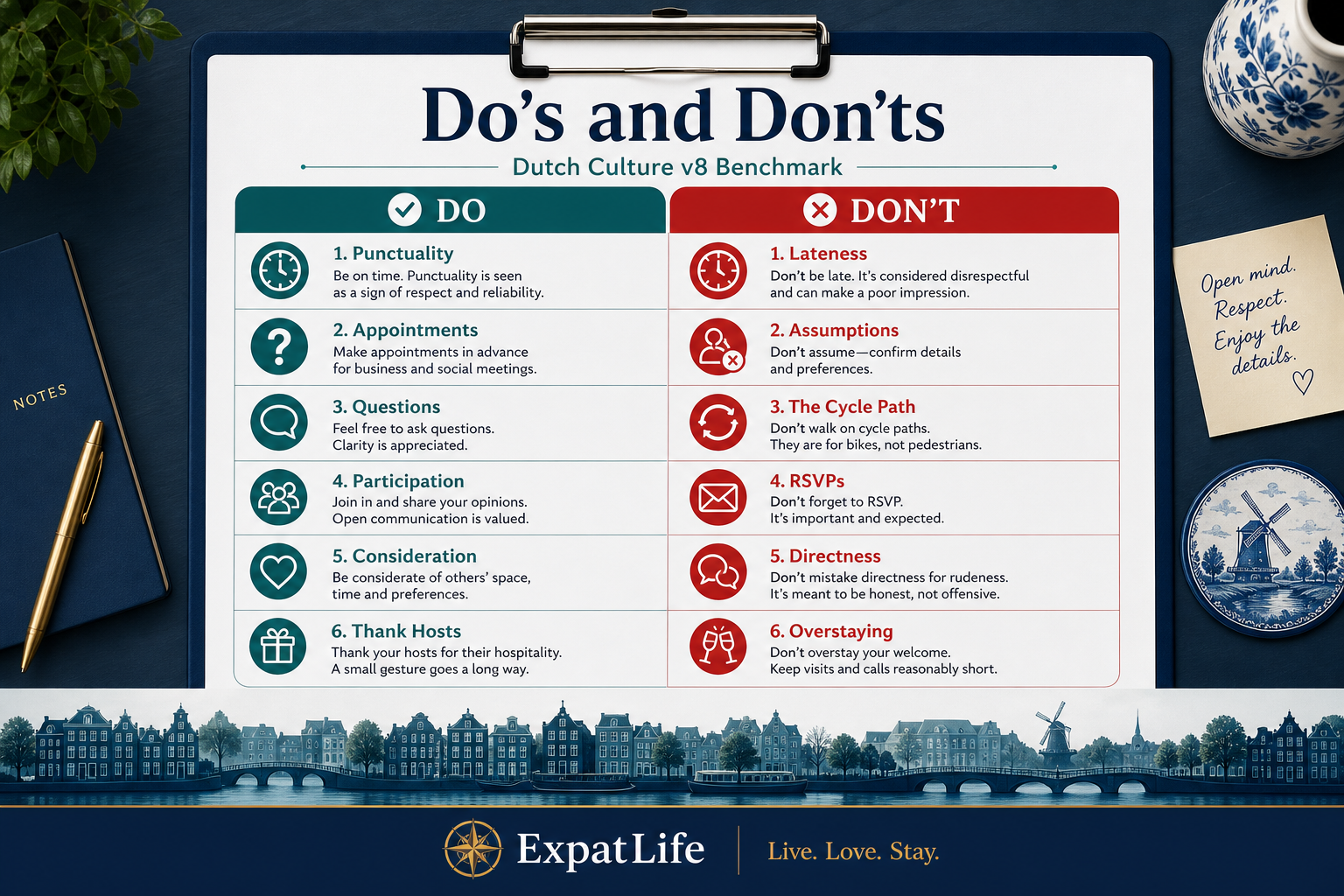
Do
Be punctual
Don't
Arrive very late without messaging
Do
Respect appointments
Don't
Assume customs are identical to your home country
Do
Ask questions
Don't
Block cycle paths or wheelchair ramps
Do
Participate politely
Don't
Ignore invitations or RSVPs
Do
Be considerate in shared spaces
Don't
Make loud assumptions about Dutch people
Do
Thank hosts and follow up
Don't
Take directness personally without asking
Common adaptation gaps — not permanent mismatches.

Many hosts and colleagues expect agreed times — repeated lateness signals disrespect.
Message early and build in buffer time.
Calendars fill early — failing to respond frustrates hosts planning food and seating.
Reply yes, no or maybe promptly.
Parked bikes and pedestrians in cycle paths cause daily friction in Dutch cities.
Use designated parking; move promptly if asked.
Drop-ins are less common — people often plan visits days ahead.
Message before arriving unannounced.
Short feedback often targets the issue, not your character.
Ask 'What would work better?'
Noise, bins and parking without conversation builds resentment.
Brief hello and calm discussion go far.
A message the next day strengthens social bonds.
'Bedankt voor de gezellige avond' works well.
Trains, libraries and residential streets expect moderate volume.
Lower voice or move aside for phone calls.
Work through over your first months — consistency beats perfection.

What each checklist item looks like in practice.
| Habit | What it looks like in practice |
|---|---|
| Be punctual | Arrive at the agreed time; message the host if you will be more than 10 minutes late. |
| Respect privacy | Plan visits ahead; avoid unannounced drop-ins and intrusive personal questions. |
| Follow through on plans | RSVP promptly and update the group if plans change. |
| Congratulate on birthdays | Say 'Gefeliciteerd!' with the person's name — observe whether family is congratulated too. |
| Participate politely | Join local events, club borrels or neighbour gatherings when invited. |
| Learn basic Dutch phrases | Start with goedemorgen, dank u wel, tot ziens and gefeliciteerd. |
| Respect public spaces | Queue in order, keep quiet in designated zones, do not block cycle paths. |
| Be open to direct communication | Ask what practical outcome is needed before reacting to blunt tone. |
Start with these — they cover most everyday etiquette moments.
| Dutch | English | When to use |
|---|---|---|
| Goedemorgen / Goedemiddag | Good morning / Good afternoon | Shops, neighbours, office arrival |
| Dank u wel | Thank you | After service, when leaving a home visit |
| Tot ziens | Goodbye | Shops, casual farewells |
| Gefeliciteerd! | Congratulations! | Birthdays — add the person's name |
| Mag ik de rekening? | Can I have the bill? | Restaurants when ready to pay |
| Bedankt voor de gezellige avond | Thanks for the cosy evening | Thank-you message after a home visit |
| Schoenen uit? | Shoes off? | Asking about indoor shoe customs |
| Eet smakelijk! | Enjoy your meal | Before starting to eat at dinner |
Everyday etiquette checklist
Balanced explanations — individuals and cities vary widely.

Myth
Direct communication is often valued for clarity — warmth may show through reliability, invitations and practical help rather than effusive language.
Myth
Fair splitting and Tikkie are common among friends, but practices vary — some hosts treat, some couples alternate, some groups round up.
Myth
Regional, generational, international and household differences are significant — ask rather than assume.
Myth
Informality is common but context matters — first meetings, official appointments and some neighbours expect more structure.
Myth
English is widely spoken in cities but Dutch effort is often appreciated — especially with older neighbours and in smaller towns.
Myth
Shoe customs vary by household — follow the host's example or ask politely.
Confirm specifics with neighbours and colleagues — customs vary by region.

Punctuality, clear communication, respecting appointments and shared spaces, modest gifts when invited, and thanking hosts are widely appreciated. Politeness often shows through reliability and consideration rather than elaborate formality.
A small gift — flowers, wine, chocolate or a dessert contribution — is often appreciated but rarely required. Ask the host if unsure. Office birthdays usually expect the birthday person to bring treats, not guests.
Handshake and eye contact in professional first meetings; cheek kisses may appear among friends — follow the other person's lead. Use goedemorgen, goedemiddag or goedenavond in shops and offices.
Yes — agreed times for dinners, appointments and meetings are usually taken seriously. Casual drinks may allow slight flexibility — message the group if delayed.
Many friend groups split fairly or use Tikkie — confirm before ordering at restaurants. Practices vary; follow the group's established habit.
Repeated lateness without notice, ignoring RSVPs, blocking cycle paths, loud behaviour in quiet zones, unplanned drop-ins and ignoring neighbour concerns are commonly seen as inconsiderate.
Varies by building and city — hallway greetings are common; deep friendship is not automatic. Buurt apps and street events help people connect.
Many settings are relatively informal — first names appear quickly. Context still matters: official appointments, first business meetings and some neighbour interactions expect more structure.
Continue from etiquette into culture, community and workplace guides.

Culture cluster
Navigate the full Dutch culture guide cluster from this etiquette hub.

Explore next
Move from etiquette orientation into social norms, community integration and language learning.

Official Dutch government portal — public information and cultural life.
Open official sourceGovernment information for Dutch citizens and internationals abroad.
Open official sourceNetherlands tourism board — cultural context and visitor etiquette.
Open official source