
Is there one Dutch culture?
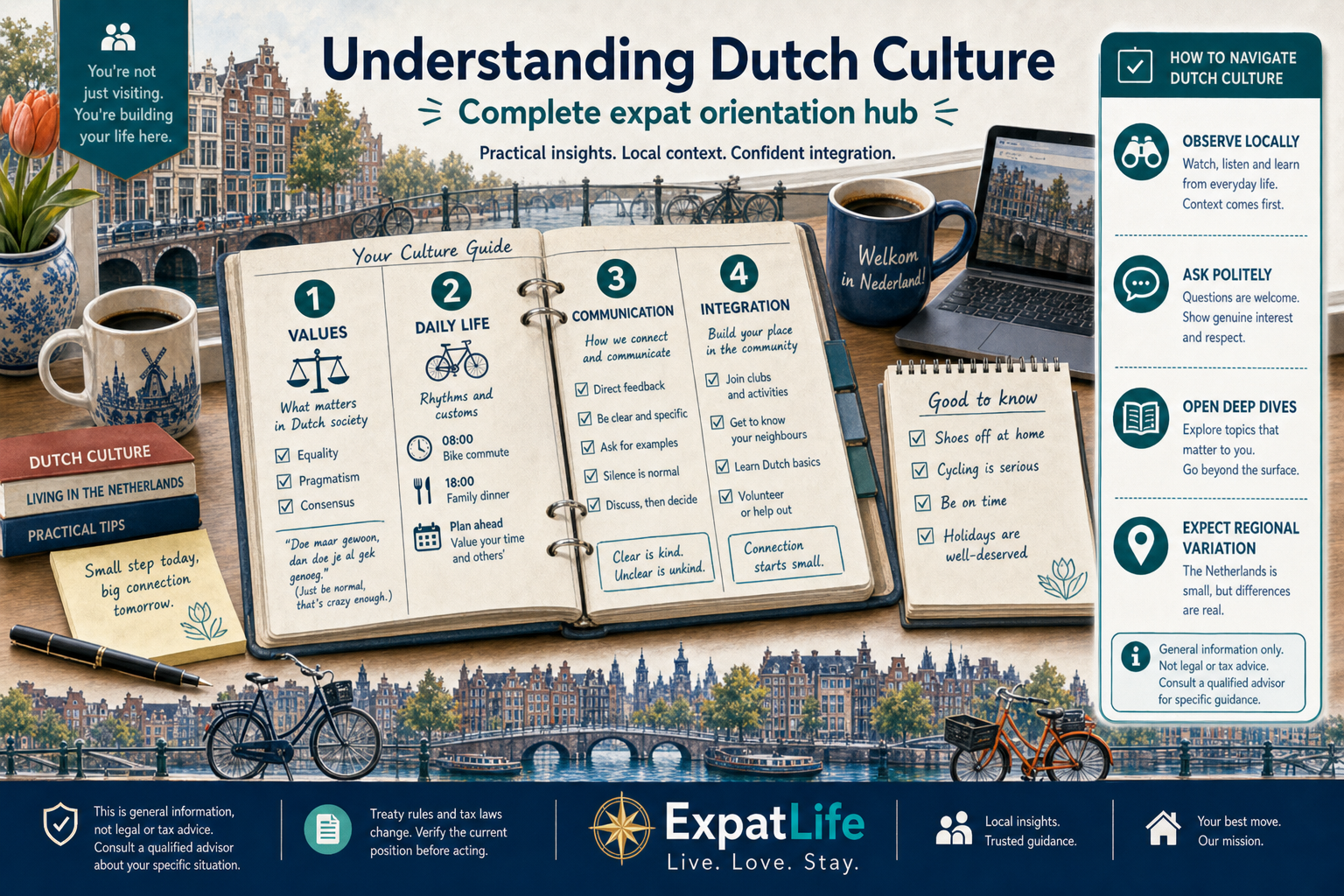
No — Randstad, Brabant, Friesland and international workplaces feel different. Observe locally rather than assuming one national style.
Life in the Netherlands · Culture hub
Understand the values, traditions and everyday customs that shape life in the Netherlands and help newcomers feel at home.
Orientation only — individuals, regions and communities vary widely. Observe locally and ask politely rather than assuming one national stereotype fits everyone.
Quick answer
The Netherlands combines historical trade openness, pragmatic governance and strong local identities. For expats, culture shows up in calendar invites, meeting feedback, neighbour notes and what children learn at school — not only in museums.
This cornerstone hub explains values, daily life, communication, work, food, holidays and regional differences without stereotypes. Each section links to dedicated guides when you need step-by-step etiquette or professional detail.
No — Randstad, Brabant, Friesland and international workplaces feel different. Observe locally rather than assuming one national style.
English works in cities and global jobs — Dutch helps with neighbours, doctors, gemeente portals and deeper friendships.
Clarity saves time in meetings and reviews — ask what should change and by when before treating tone as personal.
Join one club for a full season, introduce yourself to neighbours early and experience one local tradition outside your home city.
At a glance
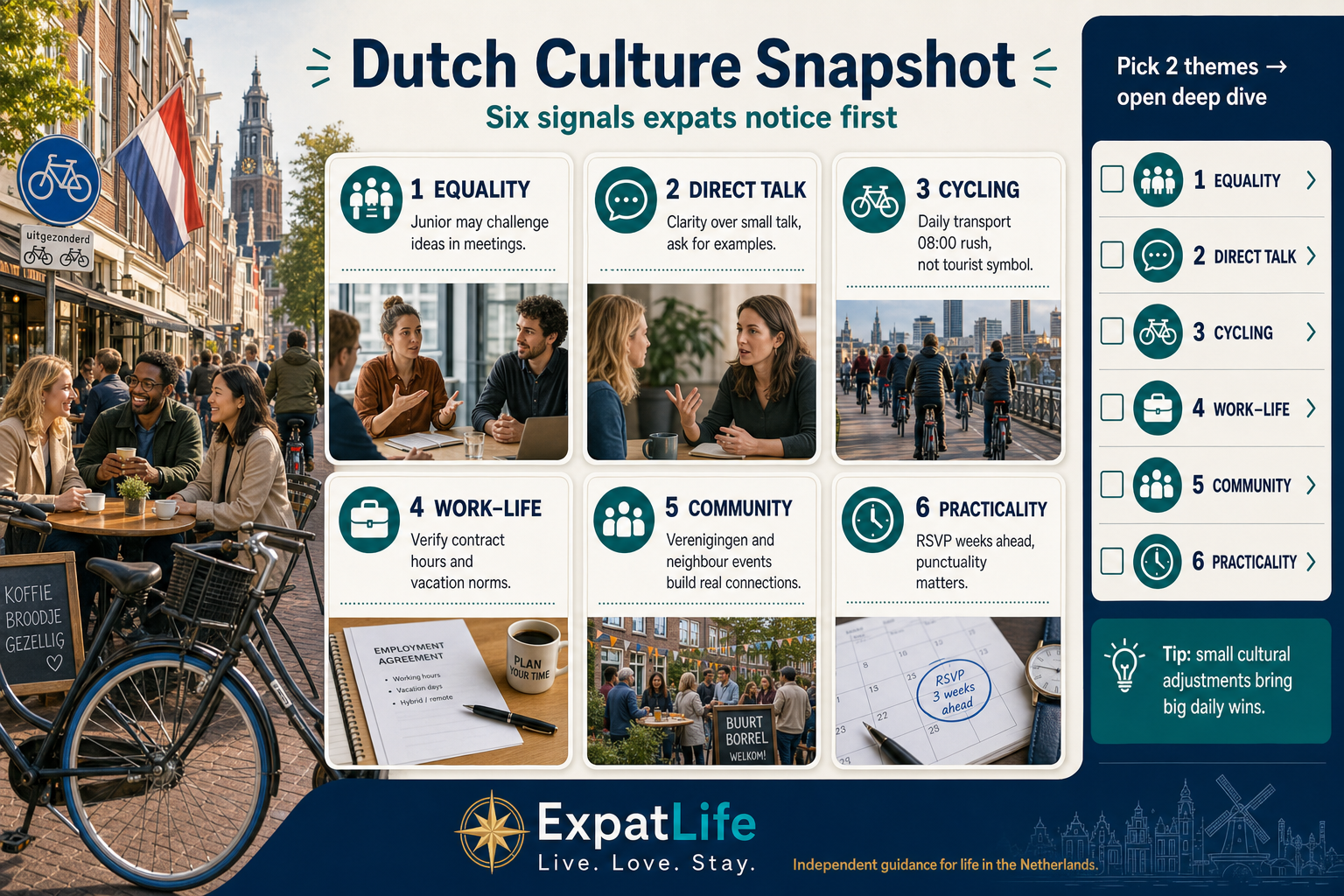
Six orientation signals expats notice first — equality, direct talk, cycling, work-life balance, community and practicality.
Experiences still vary by city, age and workplace — use this snapshot to pick which deep-dive guide to open next.
Community
Clubs & neighbours
Associations and sport teams
Practicality
Planning culture
Calendars and appointments
Tolerance
Live-and-let-live
Individual choices respected
Regional
Not one style
South, north and Randstad differ
Many workplaces and social settings expect participation regardless of title — though decision owners still exist.
Honest feedback and clear questions are normal — separate tone from intent by asking for specifics.
Bikes are daily transport for students, parents and professionals — not only a tourist symbol.
Evenings, vacations and parental leave are discussed openly — verify your contract and team norms.
Neighbourhood events, associations and volunteering build belonging faster than passive observation.
Agendas, RSVPs and punctuality reduce friction — planning is a social skill here.
How to use this snapshot
Values appear in meetings, neighbourhoods and calendars — not as slogans on walls.
Each card below pairs a value with a practical example you may see in Dutch workplaces and daily life.
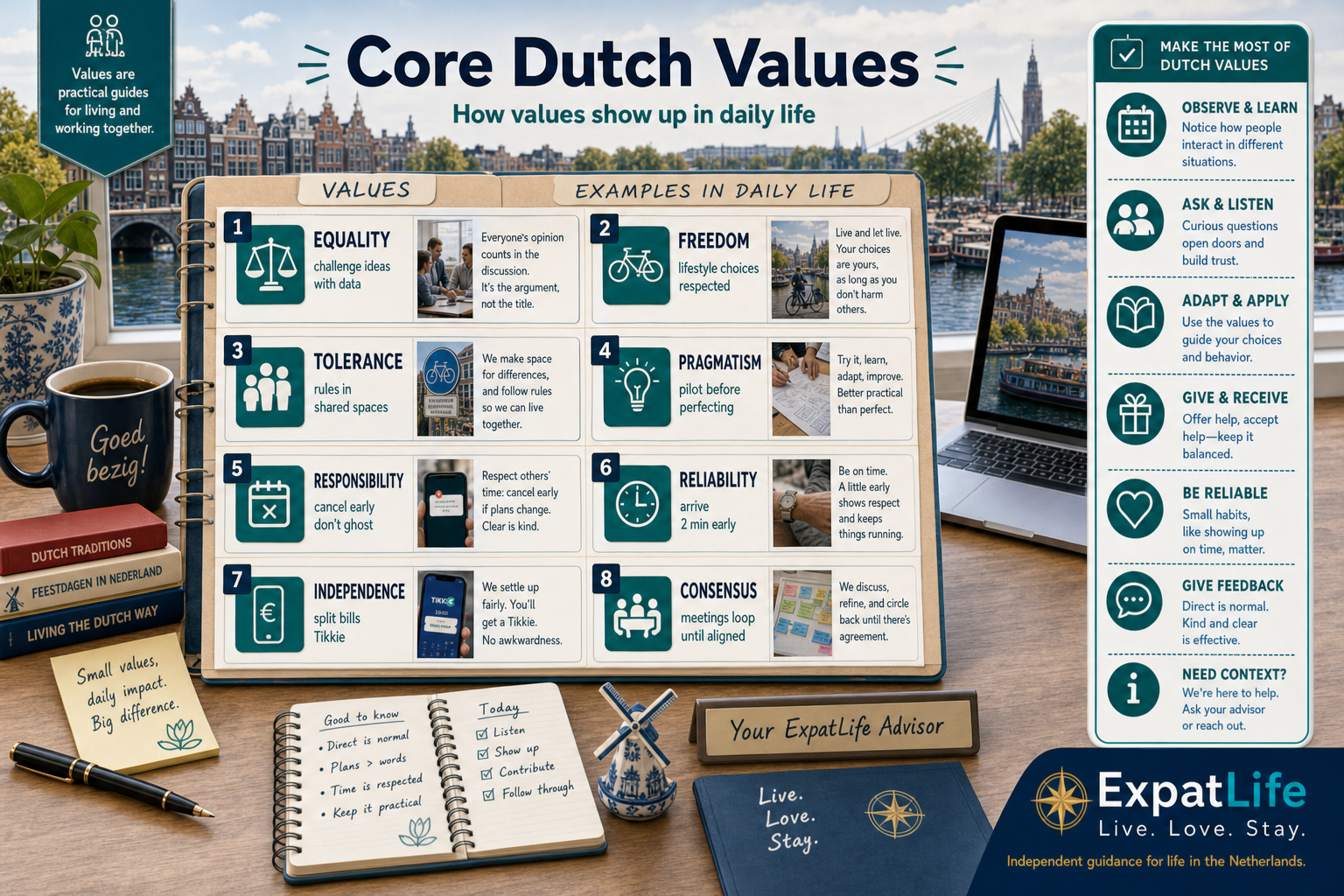
Many settings minimise visible status — though expertise and roles still matter.
Example: Junior colleagues may challenge ideas in meetings when data supports it.
Individual choices in lifestyle, religion and leisure are widely accepted.
Example: Neighbours may differ on traditions without expecting conformity.
Live-and-let-live attitudes are common — paired with clear rules in shared spaces.
Example: Quiet hours and waste sorting are enforced even in tolerant cities.
Workable solutions beat prolonged debate when deadlines loom.
Example: Pilot a process change before perfecting every detail.
People expect you to follow through on commitments and appointments.
Example: Cancel early if you cannot attend — ghosting reads poorly.
Punctuality and prepared meetings signal professionalism and respect.
Example: Arrive two minutes early with one structured meeting contribution.
Adults manage their own schedules, bills and transport without default help.
Example: Split bills and arrange your own return ride after social events.
Groups often seek broad agreement before major decisions.
Example: Meetings may loop until stakeholders align — patience helps.
Values in practice
Daily routines blend work, family, cycling and planned social time — calendars structure much of the week.
Thursday shopping peaks, Saturday sport and Sunday quieter residential pace are common patterns nationwide.
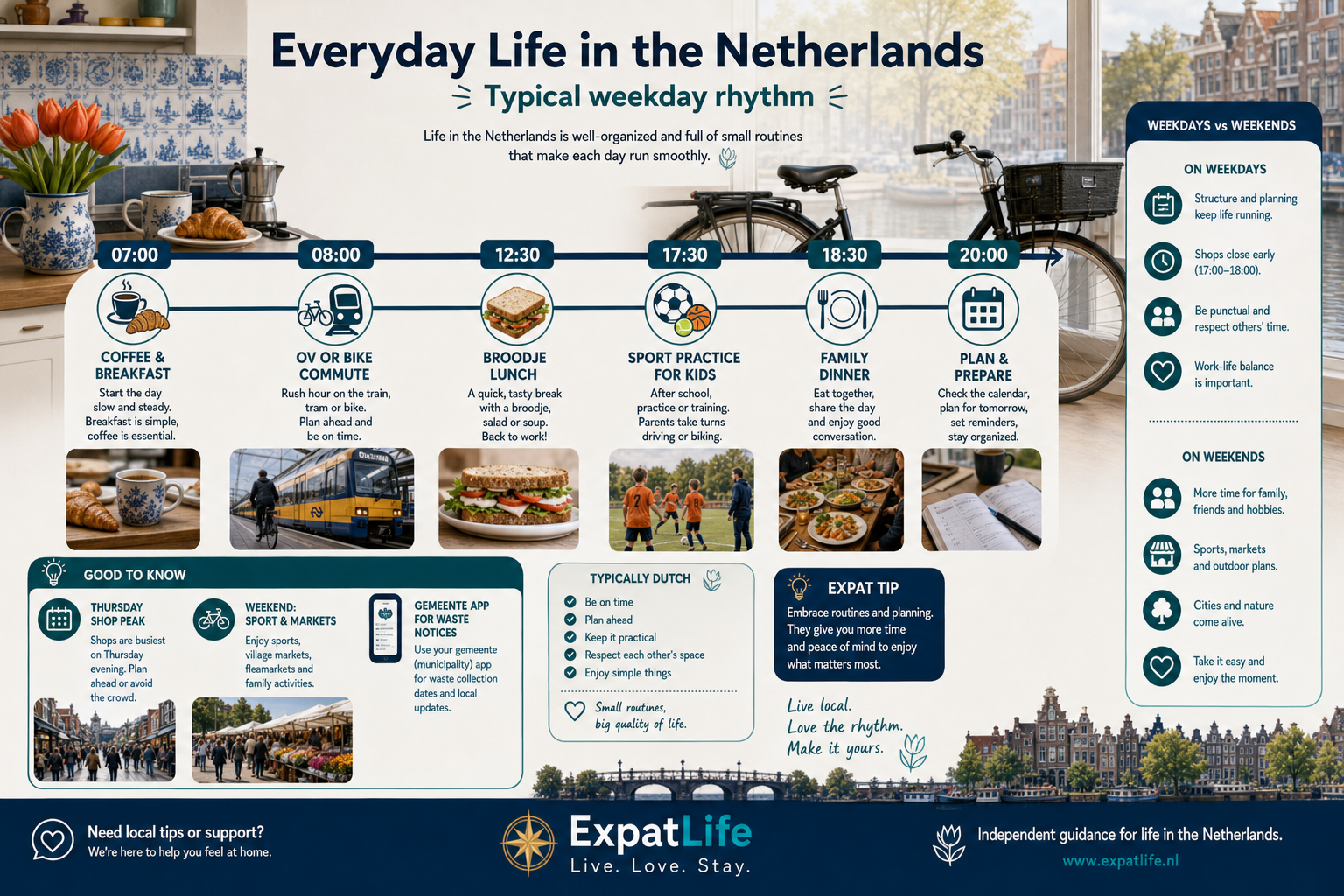
| Topic | What to expect |
|---|---|
| Morning routines | Coffee, quick breakfast and OV or bike commute — rush hour peaks 08:00–09:00. |
| Work rhythm | Core hours often 9–17 with lunch breaks — hybrid patterns vary by employer. |
| Family evenings | Sports practices, homework and early dinners on school nights. |
| Shopping | Supermarkets, markets and online delivery — Thursday evening shopping peaks. |
| Weekends | Sport, nature trips, family visits and planned social appointments. |
| Planning | Calendar invites for social events weeks ahead — spontaneity exists but is scheduled. |
Daily life tips
Directness prioritises clarity — feedback, debate and questions are often issue-focused rather than personal.
When tone feels sharp, ask for examples and next steps before assuming hostility.

| Topic | What to expect |
|---|---|
| Honesty | Clear opinions in meetings — ask for examples if tone feels sharp. |
| Feedback | Improvement-focused — confirm next steps after reviews. |
| Debates | Challenge ideas openly — disagreement is not always personal. |
| Listening | Take turns in groups — interrupting less than in some cultures. |
| Questions | Direct questions save time — prepare one precise ask. |
A colleague says your slide is unclear without much preamble.
Tip: Ask: which part should change and what format do you prefer?
People challenge your idea openly in a team discussion.
Tip: Respond with data or questions — disagreement often targets the idea, not you.
You receive a two-line answer to a long question.
Tip: Ask one follow-up with a numbered list — brevity is efficiency, not dismissal.
Meetings jump straight to topics without warm-up chat.
Tip: Save relationship building for coffee breaks or club activities.
Flat dialogue, structured meetings and explicit work-life boundaries are common — sector and employer still matter.
Confirm holiday policy, hybrid rules and who owns decisions even when titles feel informal.
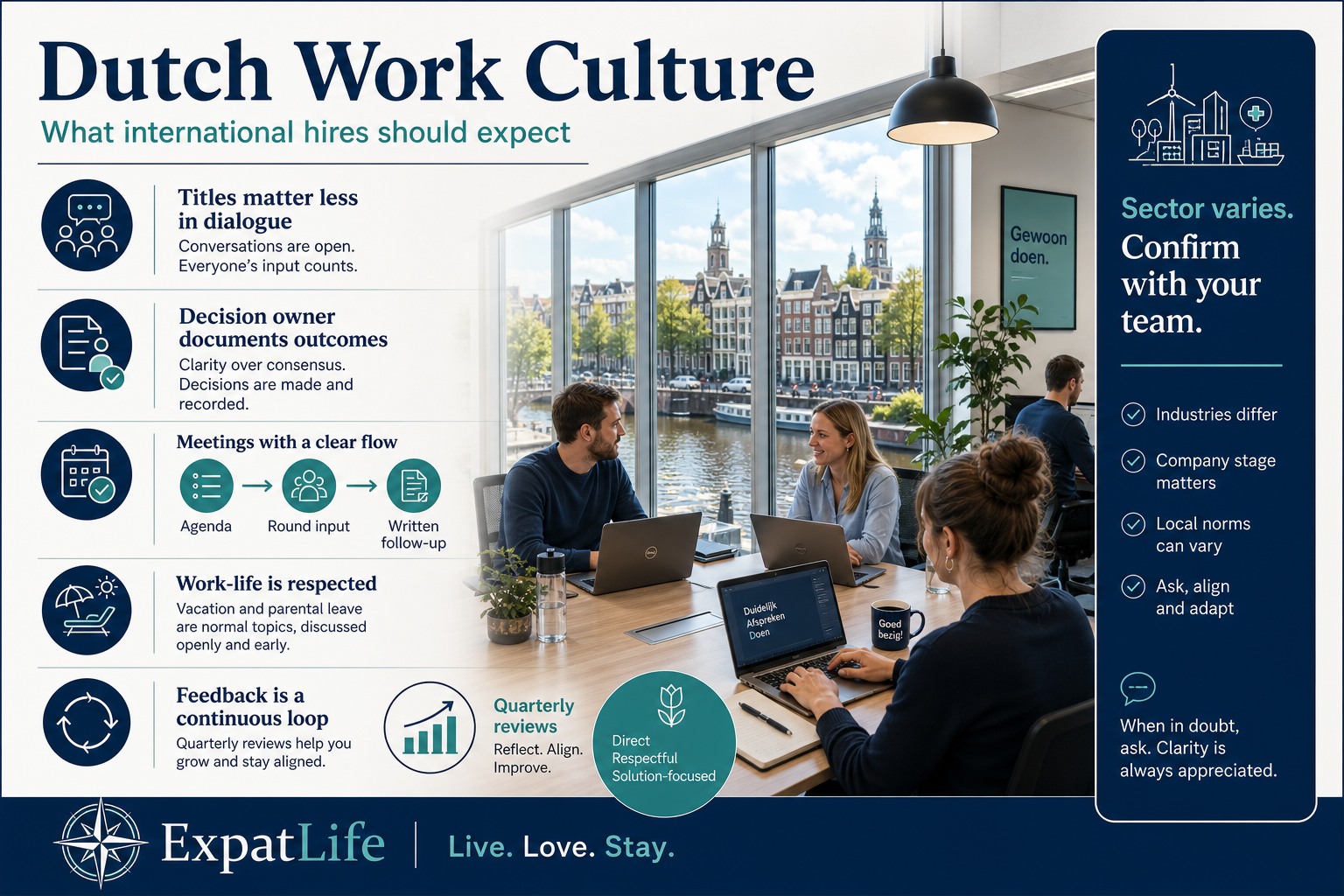
| Topic | What to expect |
|---|---|
| Flat hierarchies | Titles matter less in dialogue — decision owners still document outcomes. |
| Meetings | Agendas, time boxes and written follow-ups are common. |
| Work-life balance | Vacation, parental leave and evening boundaries discussed openly. |
| Feedback | Regular performance dialogue — adapt to concise Dutch style. |
New job checklist
Everyone receives a pre-read and speaks in turn.
Tip: Prepare one concrete point — skipping the round can look unprepared.
Manager lists improvements without much praise padding.
Tip: Confirm priorities in writing and set check-in dates.
Colleagues leave on schedule without long goodbyes.
Tip: Respect contracted hours — staying late is not the default signal of dedication.
School calendars, sports clubs and weekend rhythms shape family logistics more than many expats expect.
Regional school holiday PDFs and Saturday club matches often drive the household calendar.
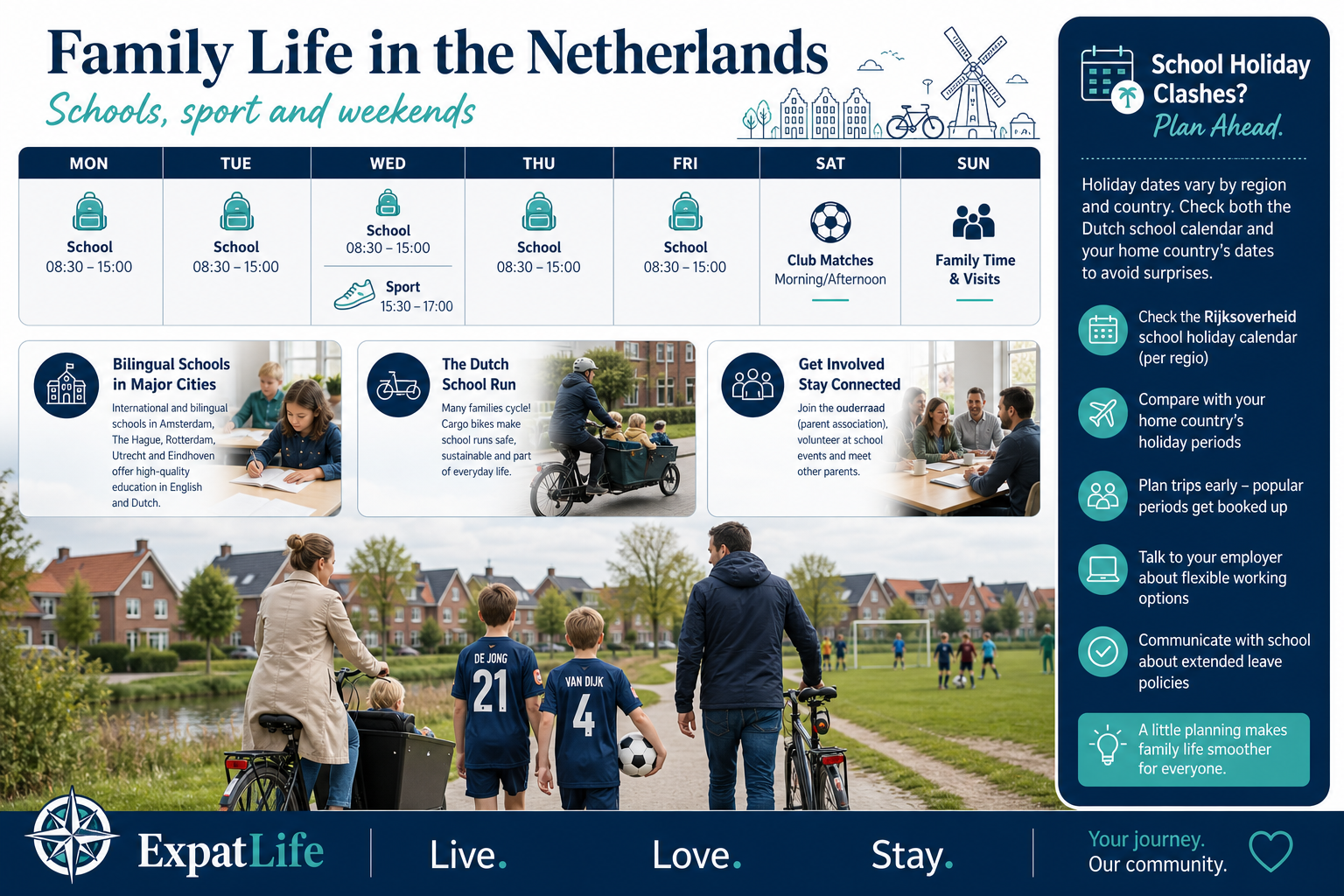
Patterns vary by school and club — sync schedules early after relocation.
| When | What happens | Expat note |
|---|---|---|
| School days | 08:30–15:00 typical; Wednesday afternoon sport common | Bike or cargo-bike school runs peak at 08:00. |
| Thursday | Late shopping and market visits in many cities | Plan groceries if Friday sport or travel. |
| Saturday | Club matches, errands, family visits | Whole neighbourhoods revolve around youth sport. |
| Sunday | Quieter residential pace; family lunches | Limited shop hours — plan Saturday errands. |
| Topic | What to expect |
|---|---|
| Children | Outdoor play, sport clubs and structured school weeks. |
| Schools | Regional calendars, parent associations and bilingual options in cities. |
| Sports | Saturday matches and weekday training — family schedules revolve around clubs. |
| Family time | Sunday visits to parents — second Christmas day extensions. |
| Parenting | Independence encouraged early — cycling to school common. |
Family settling checklist
Simple lunches, office coffee rituals and seasonal markets reveal real habits better than cheese-and-tulip stereotypes.
Meal timing and borrel snacks differ from many home countries — markets show regional variety.
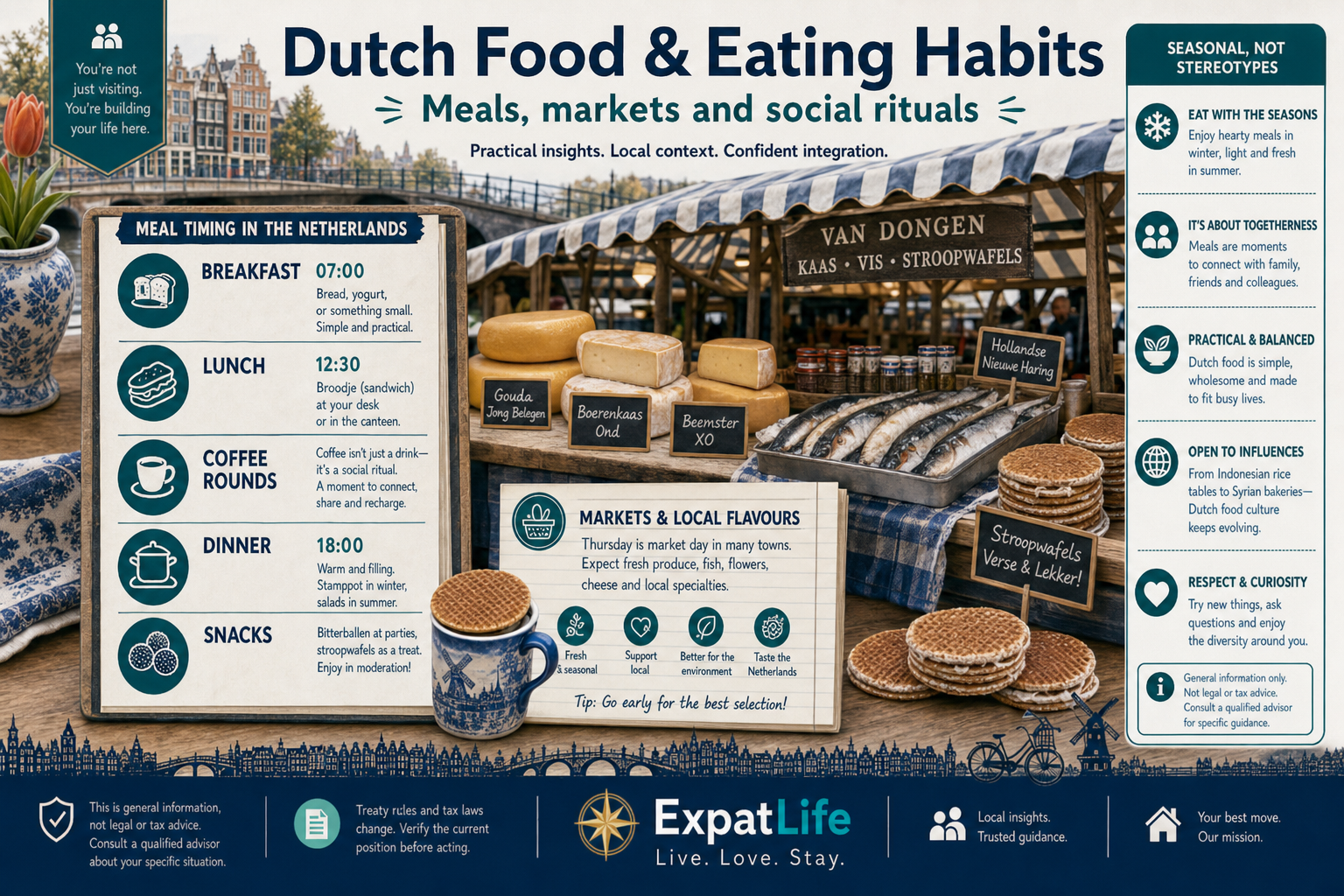
When and where people eat — useful for office and family planning.
| Meal / ritual | What to expect |
|---|---|
| Breakfast | Bread, cereal, yogurt — coffee at home or office. |
| Lunch | Broodje, salad or soup — many eat at desk or canteen. |
| Dinner | Early evening family meals — stamppot in winter, salads in summer. |
| Coffee | Office coffee rounds and café meetings — social ritual. |
| Snacks | Bitterballen at parties, stroopwafels as treats, cheese boards at gatherings. |
| Markets | Weekly street markets for produce, fish and seasonal specialties. |
Seasonal treats and party snacks — timing matters more than assuming daily habits.
| Food | When | What to expect |
|---|---|---|
| Broodje lunch | Daily | Sandwich, soup or salad — often 12:00–13:00 at desk or terrace. |
| Stamppot | Winter | Potato mash with vegetables — hearty family dinner staple. |
| Bitterballen | Parties | Deep-fried snack with mustard at borrels and events. |
| Stroopwafels | Treats | Syrup waffle — bakery and market favourite, not daily breakfast. |
| Oliebollen | New Year | Fried dough balls sold from December through early January. |
| Pepernoten | Sinterklaas | Spiced biscuits from October — separate from Christmas for many families. |
Food culture tips
The annual calendar shapes shop hours, school conversations and neighbourhood events.
King's Day, Sinterklaas and remembrance traditions catch newcomers by surprise if not planned early.
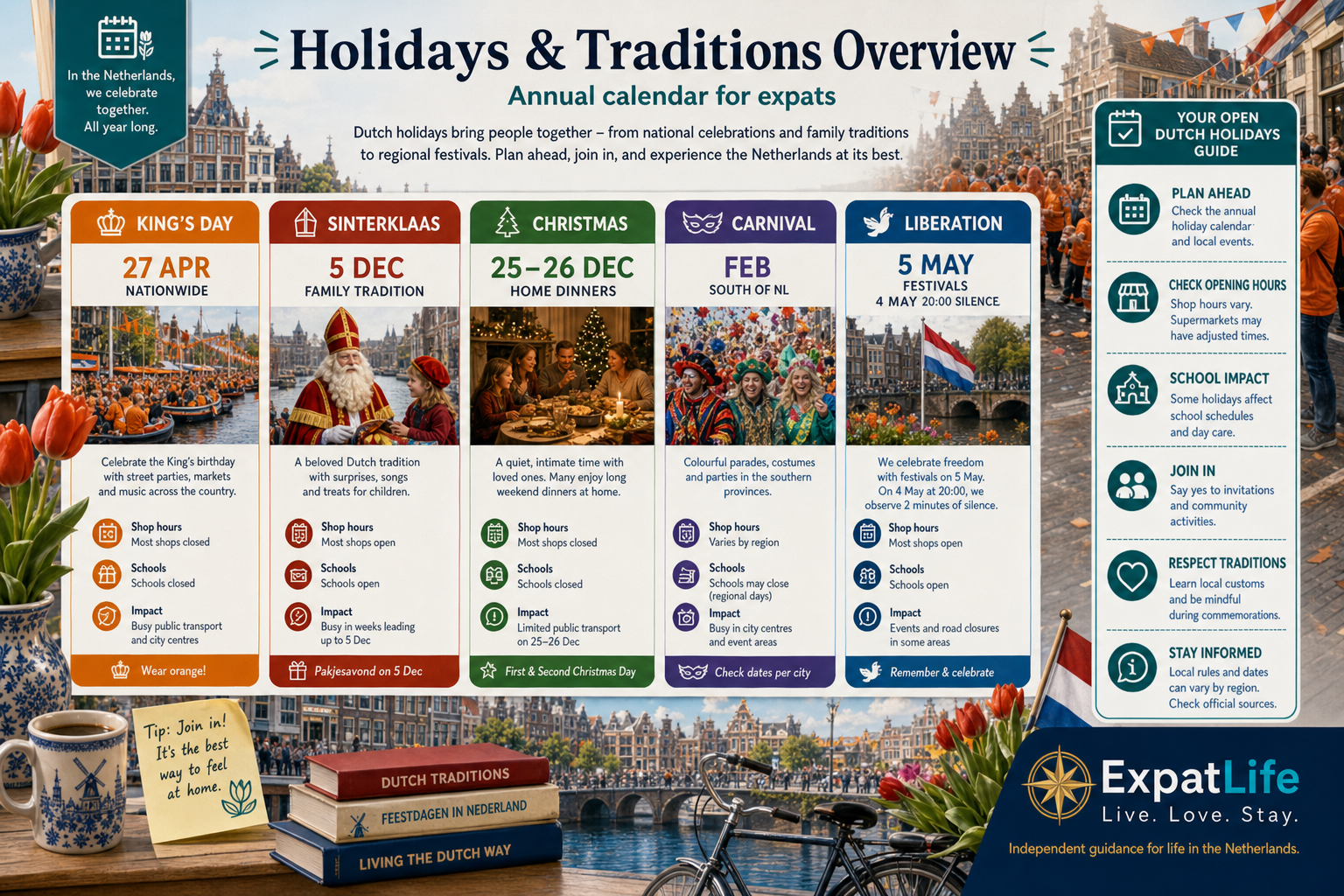
Confirm exact dates yearly — Easter, Ascension and Pentecost move; Carnival is regional.
| Tradition | When | Expat note |
|---|---|---|
| King's Day | 27 April (26 Apr if Sunday) | Book travel early — nationwide crowds and orange dress common. |
| Remembrance Day | 4 May, 20:00 silence | Stay quiet in public spaces during the national minute. |
| Liberation Day | 5 May | Festivals in many cities — verify if your employer treats it as a day off. |
| Sinterklaas | 5 December pakjesavond | Schools and shops build anticipation from October. |
| Christmas | 25–26 December public holidays | Family-focused — reserve restaurants early if dining out. |
| Carnival | February (south) | Not nationwide — strongest in Brabant and Limburg. |
Bikes are everyday transport for students, parents and professionals — infrastructure and etiquette vary by city.
Rain, lights, locks and lane rules matter for safety and fitting in on commuter routes.
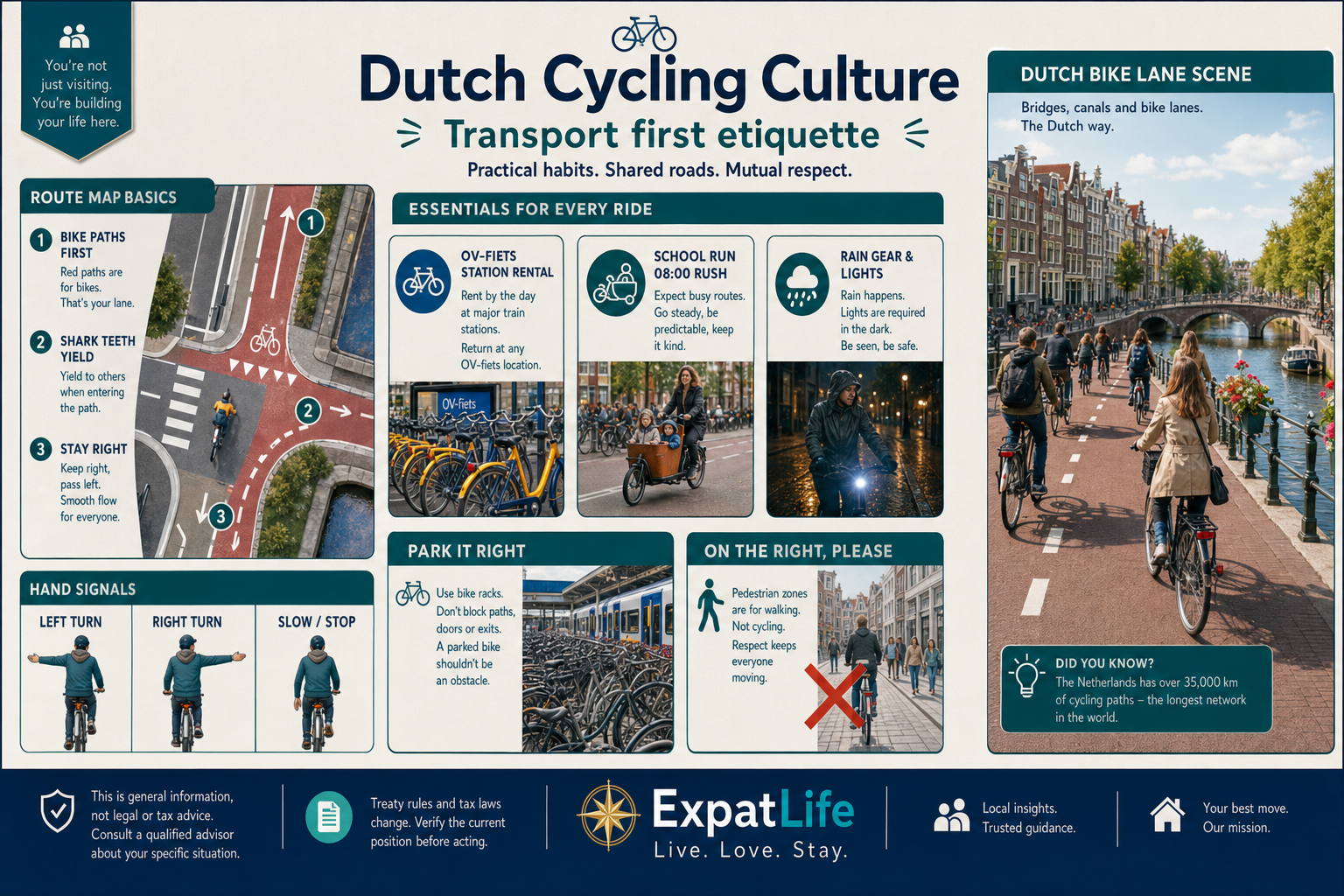
Rules and habits that reduce friction on busy lanes.
| Situation | Local habit | Expat tip |
|---|---|---|
| Bike lane rush hour | Keep pace, stay right, signal stops | 08:00 school run lanes are busiest — leave extra time. |
| Pedestrian zone | Walk bike or ride slowly where signed | Do not block café terraces or shop entrances. |
| OV station parking | Use marked racks; lock both wheels | Photo your rack row — large stations are maze-like. |
| Rain burst | Brake earlier; allow longer following distance | Invest in waterproof layer and gloves — plans continue. |
| Topic | What to expect |
|---|---|
| Commuting | OV-bike rentals, bike parking at stations and rain gear norms. |
| Etiquette | Stay right, signal turns, don't block pedestrian zones. |
| Infrastructure | Red paths, shark teeth markings and priority rules at crossings. |
| Children | Cargo bikes and school runs — expect busy bike lanes at 08:00. |
Cycling setup checklist
Clubs and outdoor activities are common social routes — especially for families and weekend rhythm.
One full season in a vereniging often builds more connection than occasional networking events.
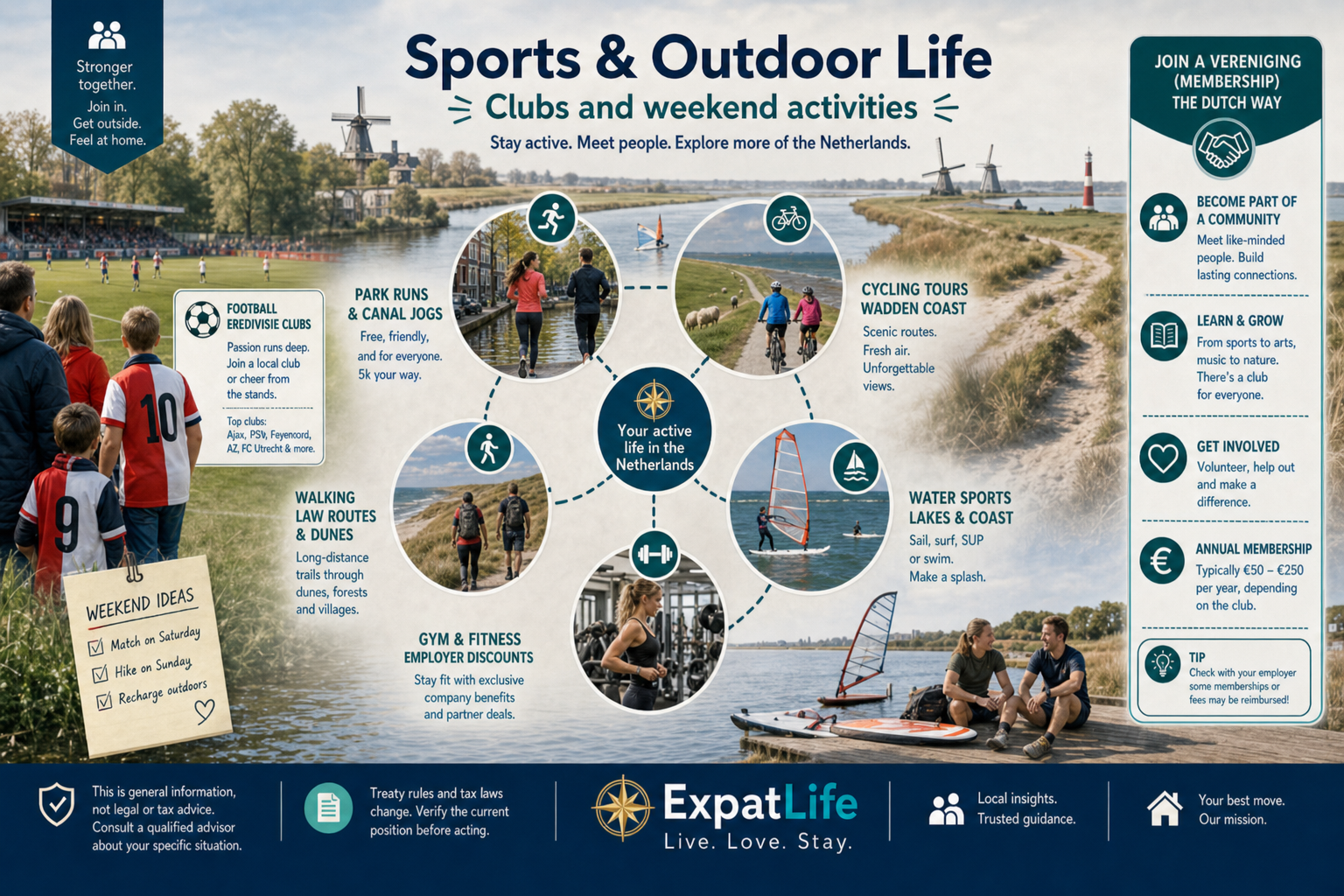
Saturday matches, weekday training, strong local loyalty — parents socialize on sidelines.
Canal-side jogs and park runs — groups post on Facebook and gemeente boards.
Marked LAW routes and organised weekend hikes — low language barrier entry.
Employer discounts common — good for winter social rhythm.
| Topic | What to expect |
|---|---|
| Football | Club culture and watching Eredivisie — local loyalty strong. |
| Running | Park runs and canal-side jogs — groups post on social media. |
| Cycling sport | Recreational tours and racing clubs beyond daily commute. |
| Walking | Nature reserves and dune paths — weekend family default. |
| Water sports | Sailing, rowing and SUP on lakes and coast. |
| Fitness | Gyms and group classes — employer discounts sometimes available. |
| Hiking | Marked routes (LAW) and organised walking clubs. |
Get moving locally
Neighbours, associations and volunteering accelerate belonging when you show up repeatedly.
Street events, clubs and gemeente listings offer low-pressure entry points for newcomers.
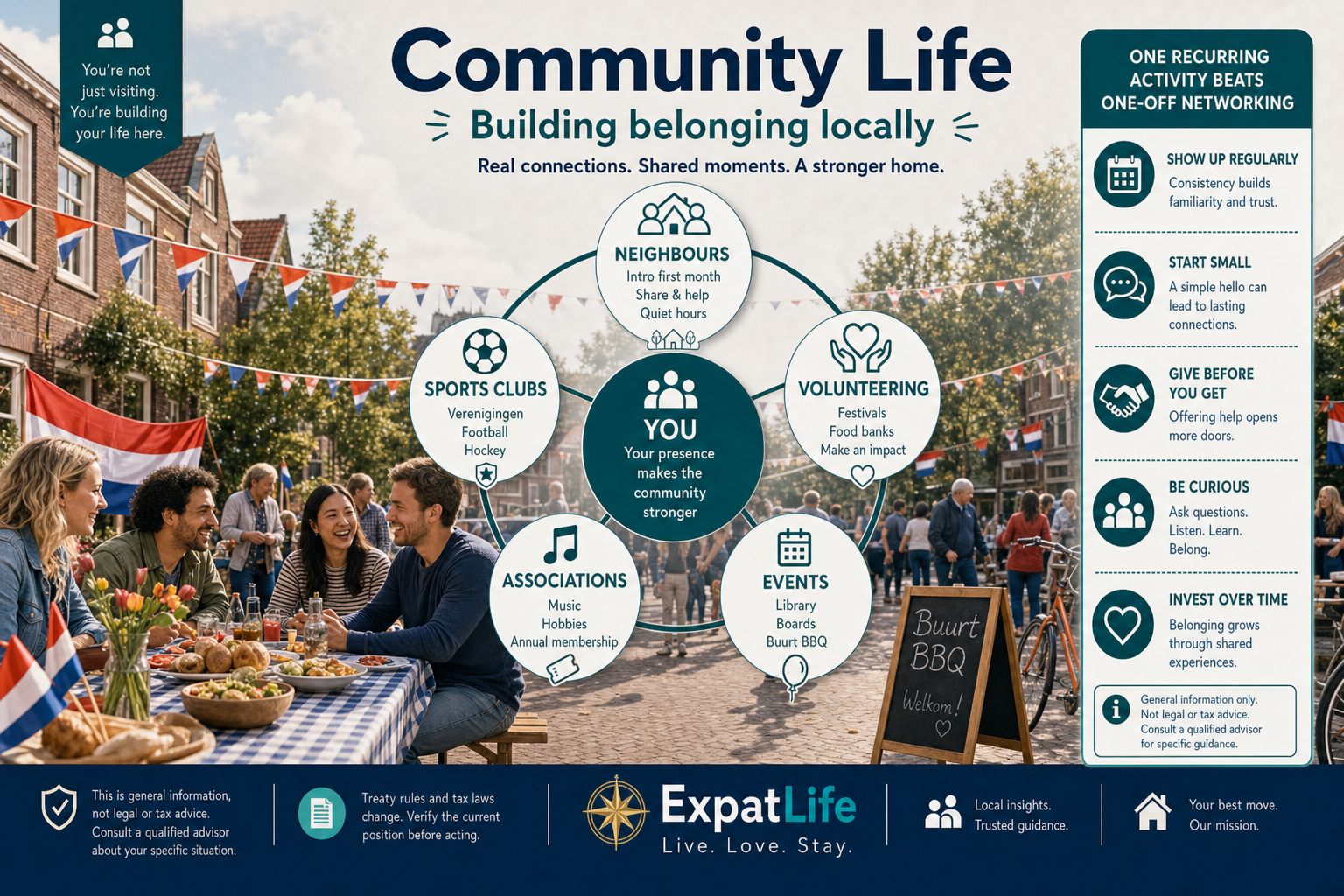
| Topic | What to expect |
|---|---|
| Neighbours | Introduce yourself, respect quiet hours, join street events if invited. |
| Sports clubs | Verenigingen for football, hockey, tennis and more. |
| Volunteering | Festivals, food banks and neighbourhood projects welcome newcomers. |
| Associations | Music, culture and hobby clubs with annual membership. |
| Events | Library boards, buurt BBQs and municipal festivals. |
Community integration checklist
Neighbours host a buurt BBQ or block event.
Tip: Attend briefly, introduce yourself, offer to help cleanup — visibility matters.
Registration opens in summer for autumn season.
Tip: Ask about beginner groups and English-friendly coaches before committing.
Festival or fair needs short volunteer slots.
Tip: One shift introduces you to organisers who know other local groups.
Regional pace, dialects and traditions differ more than stereotypes suggest — Randstad, south and north feel distinct.
Visit another province before generalising national culture from one city or workplace.
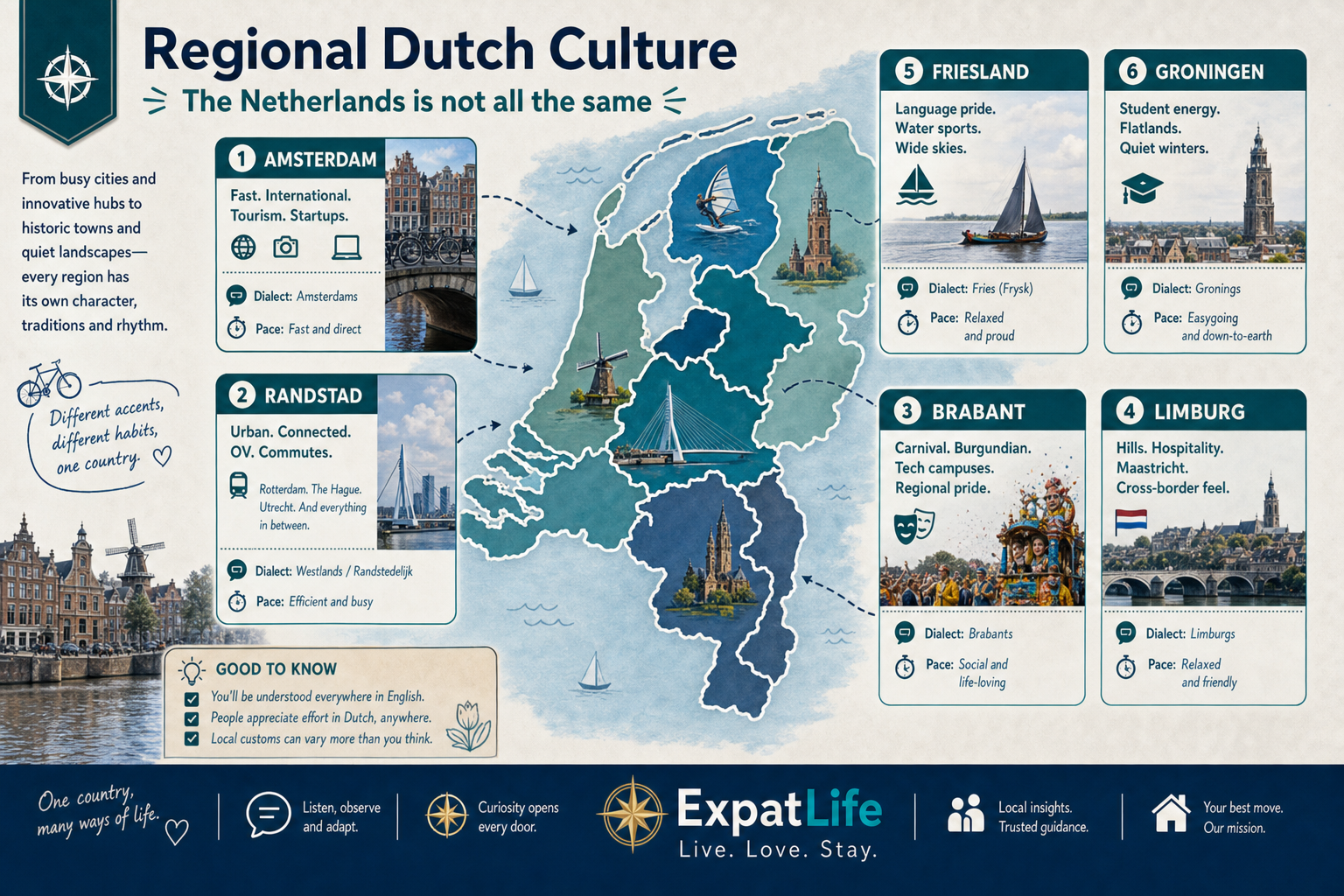
Use this table to sanity-check generalisations — local gemeente and city guides add detail.
| Region | Pace | Traits | Expat tip |
|---|---|---|---|
| Amsterdam | Fast | International startups, tourism | Networks churn — refresh contacts yearly. |
| Randstad | Urban | Rotterdam, Hague, Utrecht hubs | OV-linked commutes dominate daily life. |
| Brabant | Festive | Carnival, tech campuses | Strong regional pride — visit during Carnival once. |
| Limburg | Relaxed | Hills, cross-border Maastricht | Feels more southern — different calendar rhythm. |
| Friesland | Regional | Language pride, water sports | Learn a few Frisian greetings if you relocate north. |
| Groningen | Student | Young population, flatlands | Quiet winters — plan indoor social routes. |
Fast, international
Tourism, startups, diverse food
High churn — networks need renewal
Urban, connected
Rotterdam, Hague, Utrecht hubs
OV-linked commutes dominate
Social, festive
Carnival, tech campuses
Strong regional pride
Southern European feel
Hills, Carnival, cross-border
Maastricht culture distinct
Regional identity
Language pride, water sports
Elfstedentocht folklore
Student energy
Young population, cycling flatlands
Northern quiet winters
Participation and patience beat performing stereotypes — integration is gradual and practical.
Language basics, one recurring club and neighbour introductions compound over months.
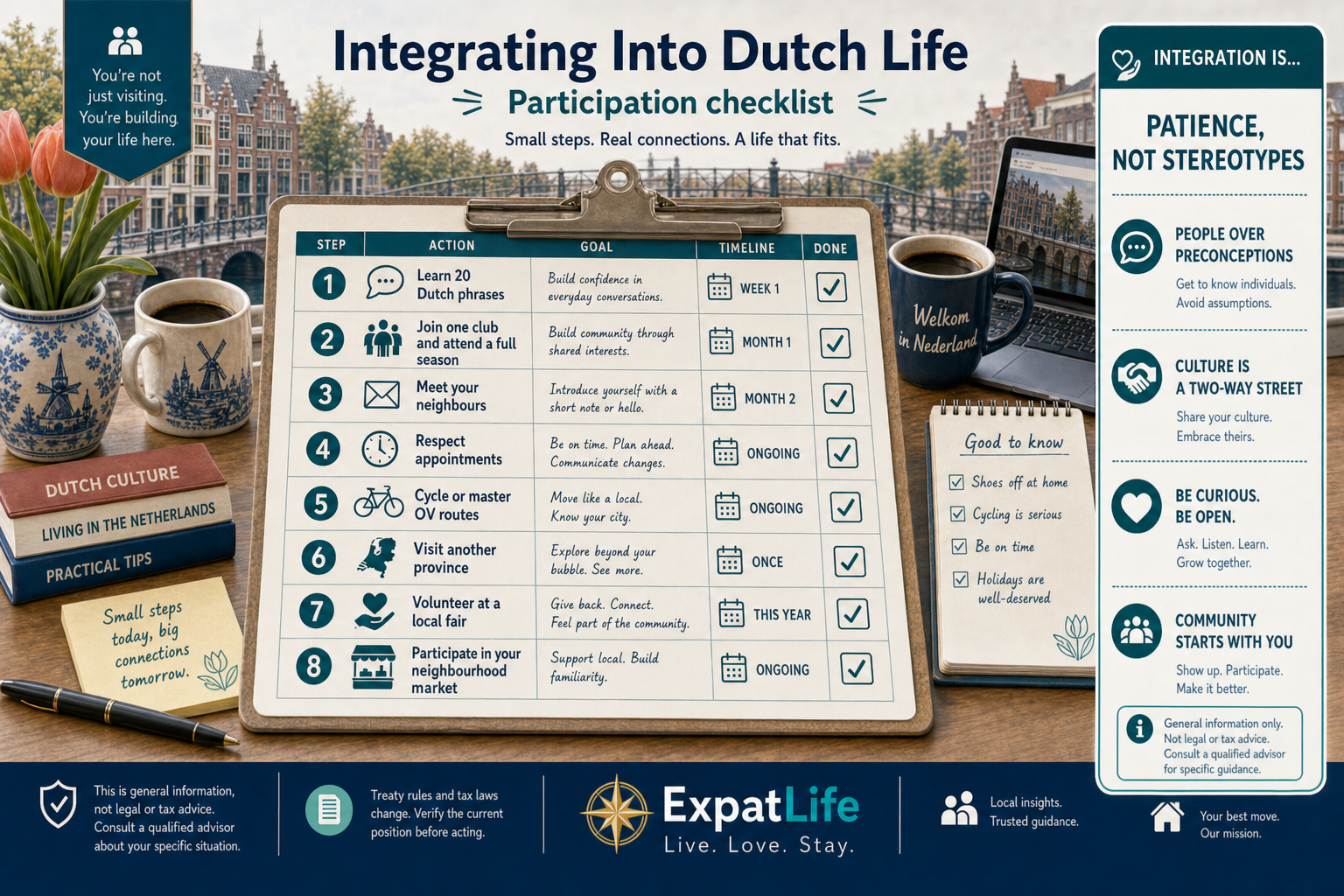
Integration checklist
Meetings may start with agendas and direct questions — less small-talk warm-up than some cultures.
Tip: Prepare one structured contribution and ask what follow-up format your manager prefers.
Neighbours may seem reserved until you introduce yourself — a short note or door visit helps.
Tip: Mention your name, household size and that you want to be a considerate neighbour.
Guests often bring a dish or drink; bills may be split via Tikkie after the meal.
Tip: Ask the host about contributions and arrival time — punctuality matters.
Family calendars revolve around club training, Saturday matches and school holiday regions.
Tip: Save your school region PDF and sync sport schedules to a shared household calendar.
Most friction eases once you understand the logic behind the habit — direct talk, planning, bills and admin systems.
Each card pairs a common shock with a practical response tip.
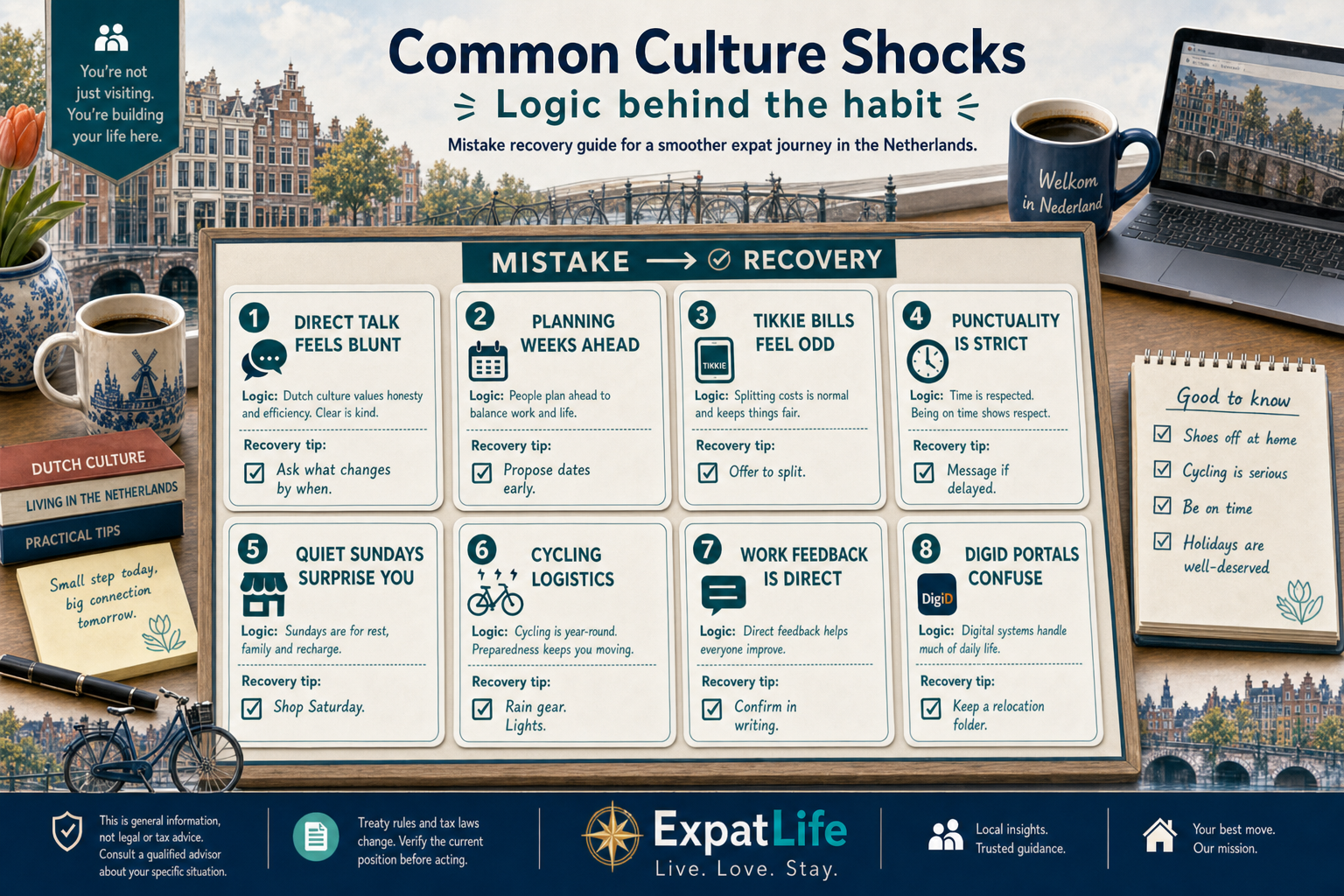
Feedback may sound blunt without warm-up small talk.
Tip: Ask: what should change by when?
Social plans booked weeks in advance.
Tip: Propose dates early — spontaneity still possible.
Tikkie requests after shared meals are normal.
Tip: Offer to split — don't insist on paying alone.
Arriving late without message frustrates hosts.
Tip: Message if delayed — even five minutes.
Residential areas quiet afternoons — limited shop hours.
Tip: Plan groceries Saturday.
Bike logistics affect clothing, hair and rain plans.
Tip: Buy quality rain gear and lights.
Performance talk is direct — less praise padding.
Tip: Confirm requested changes in writing.
DigiD, gemeente portals and PDF archives matter.
Tip: Keep a relocation folder digitally.
When culture shock hits
Replace stereotypes with questions about your specific city, workplace and neighbours.
These myths are common online — reality is more varied and regional.
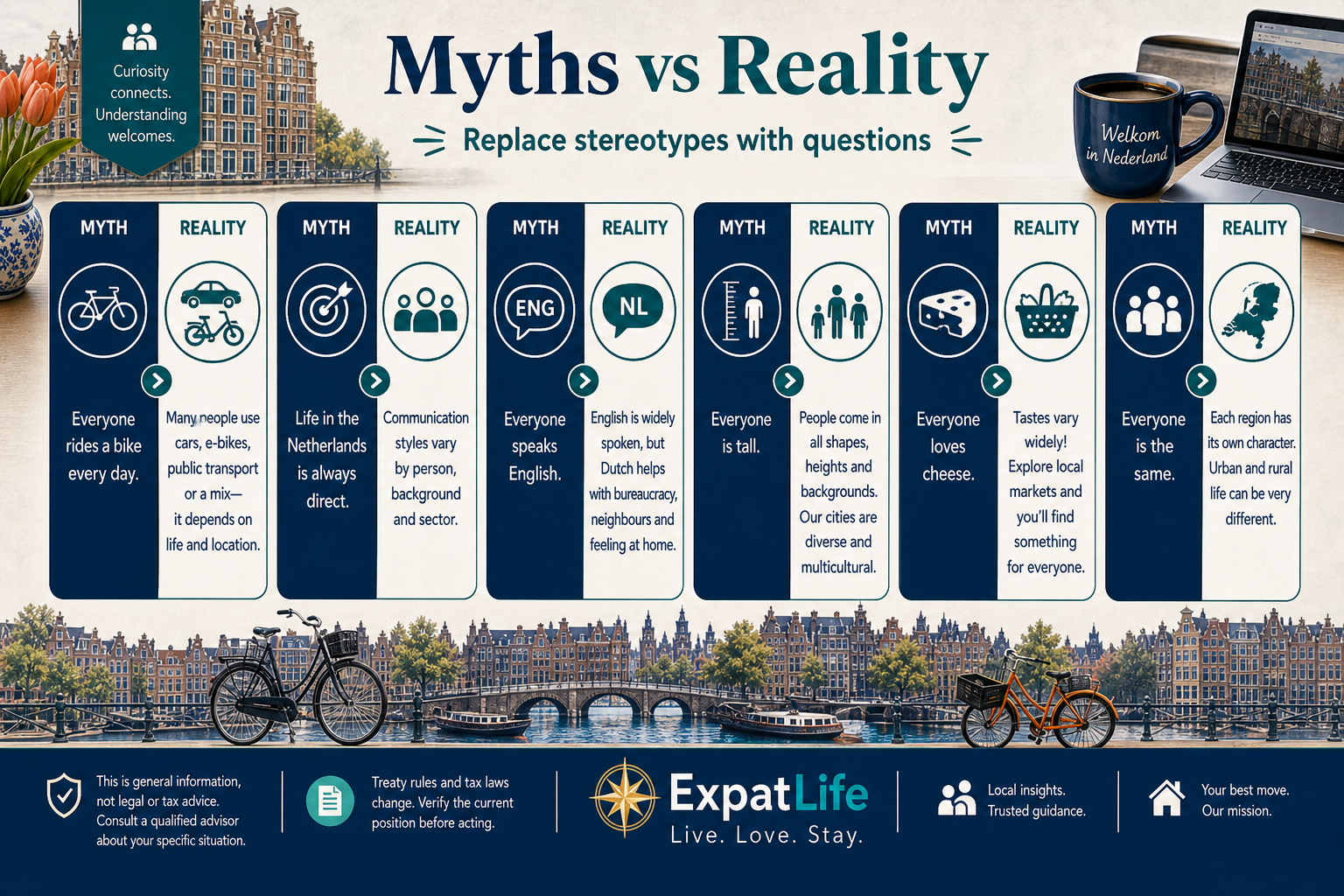
Myth
Cycling is common but OV, cars and e-bikes fill gaps — especially outside city cores.
Myth
Directness varies by person, sector and friendship depth — context matters.
Myth
English works in cities and international jobs — Dutch helps with neighbours, doctors and bureaucracy.
Myth
Height averages are high — diversity is normal in multicultural cities.
Myth
Cheese culture is real but food tastes vary — markets offer far more than gouda stereotypes.
Myth
Regional, urban-rural and international backgrounds create very different daily experiences.
Reflect before you generalise
High-level history explains pragmatism, water management and international outlook — not daily etiquette rules.
See how past eras still echo in planning culture, trade openness and multicultural cities today.
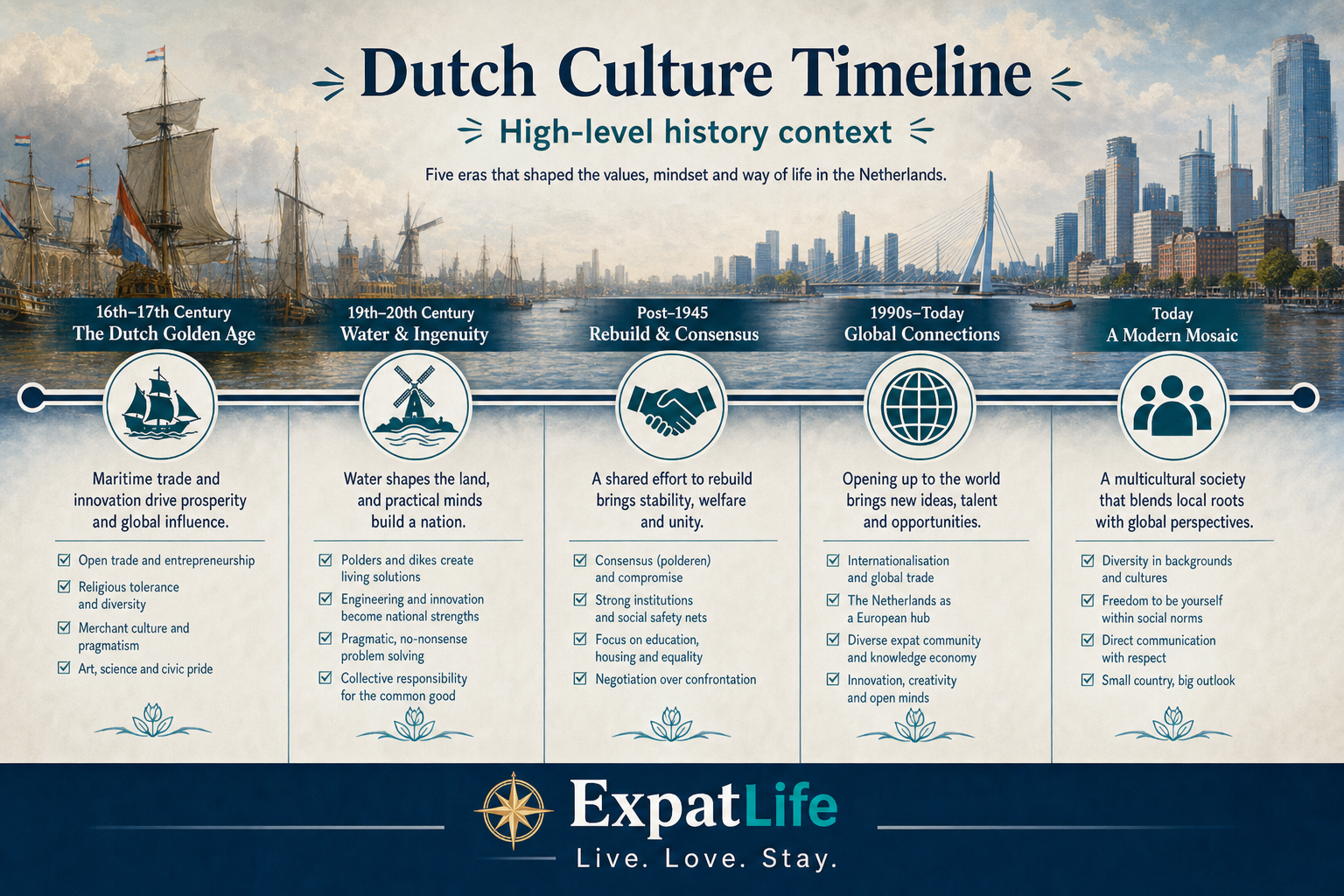
16th–17th c.
Maritime commerce connected Amsterdam to global markets and tolerant merchant culture.
19th–20th c.
Polders, canals and collective infrastructure shaped pragmatic problem-solving.
Post-1945
Pillarisation eased into modern pluralism — institutions value negotiation.
1990s–today
EU hub economy, expat workforce and multicultural cities — especially Randstad.
Today
Dutch culture blends local traditions with global professionals, students and families.
Balanced orientation on friendliness, directness, values, integration and regional variation.
Confirm specifics with neighbours, employers and gemeente sources when decisions matter.
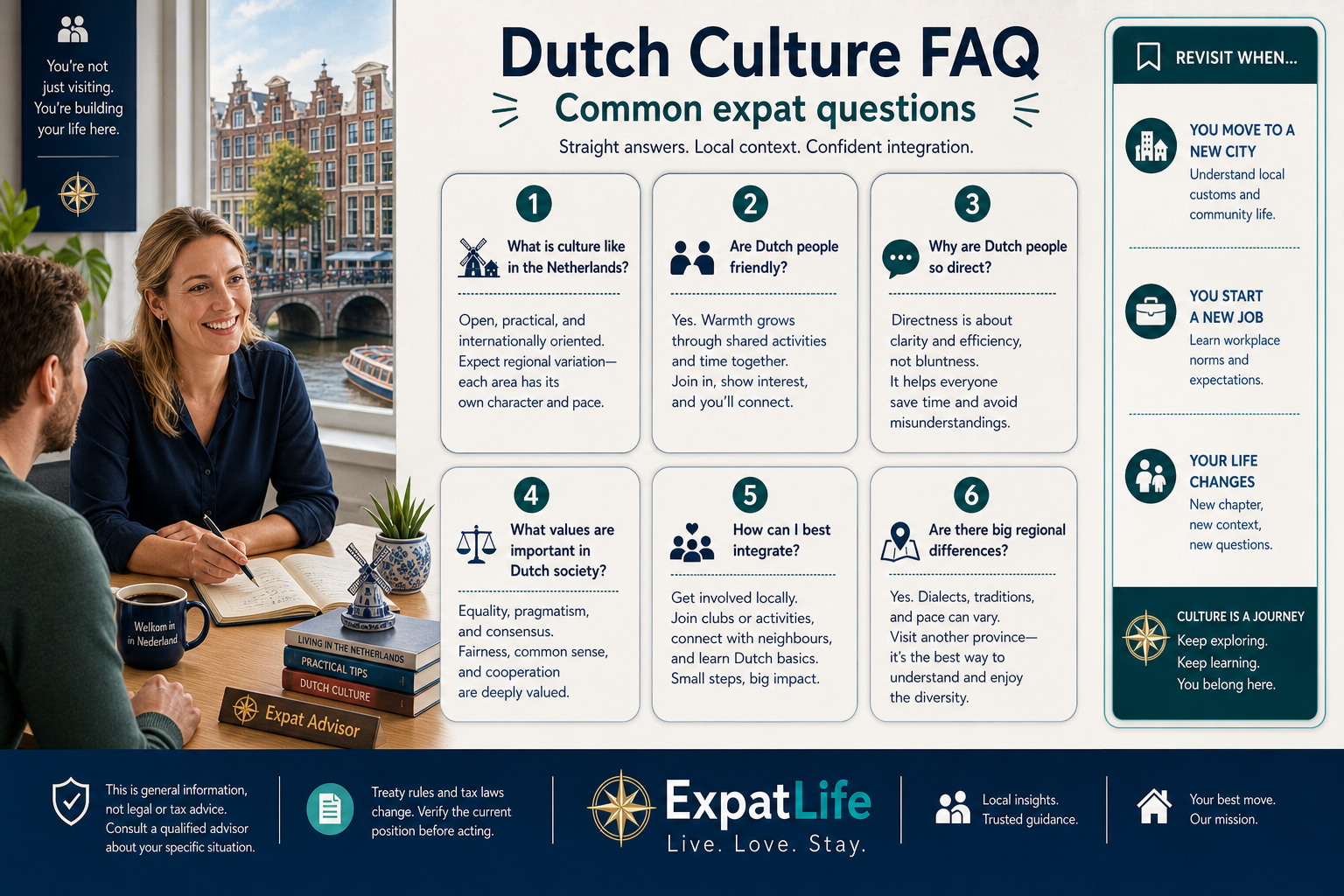
Often described as open, practical, egalitarian and direct — with strong regional variation. Daily life emphasises planning, punctuality, cycling and work-life boundaries. Experiences differ by city, workplace and community.
Friendliness may look different from small-talk cultures — neighbours can be helpful once introduced, and colleagues socialise through activities. Join clubs or repeat events to build warmth over time.
Direct communication often prioritises clarity and efficiency — less ritual politeness than in some countries. Ask for examples if feedback feels personal.
Equality, freedom, tolerance, pragmatism, responsibility and consensus appear in politics, workplaces and neighbourhoods — expressed through rules and calendars as much as speeches.
Learn basic Dutch, join associations, meet neighbours, respect appointments and participate in local traditions. Integration is gradual — repetition beats one-off networking.
King's Day, Sinterklaas, Christmas, Carnival (south) and Liberation Day shape calendars and shop hours. See the Dutch Holidays guide for dates and participation tips.
Yes — Carnival south, maritime north, international Randstad and student Groningen feel distinct. Visit another province before generalising.
Direct feedback, bill splitting, quiet Sundays, cycling logistics and administrative portals — plus how much calendars structure social life.
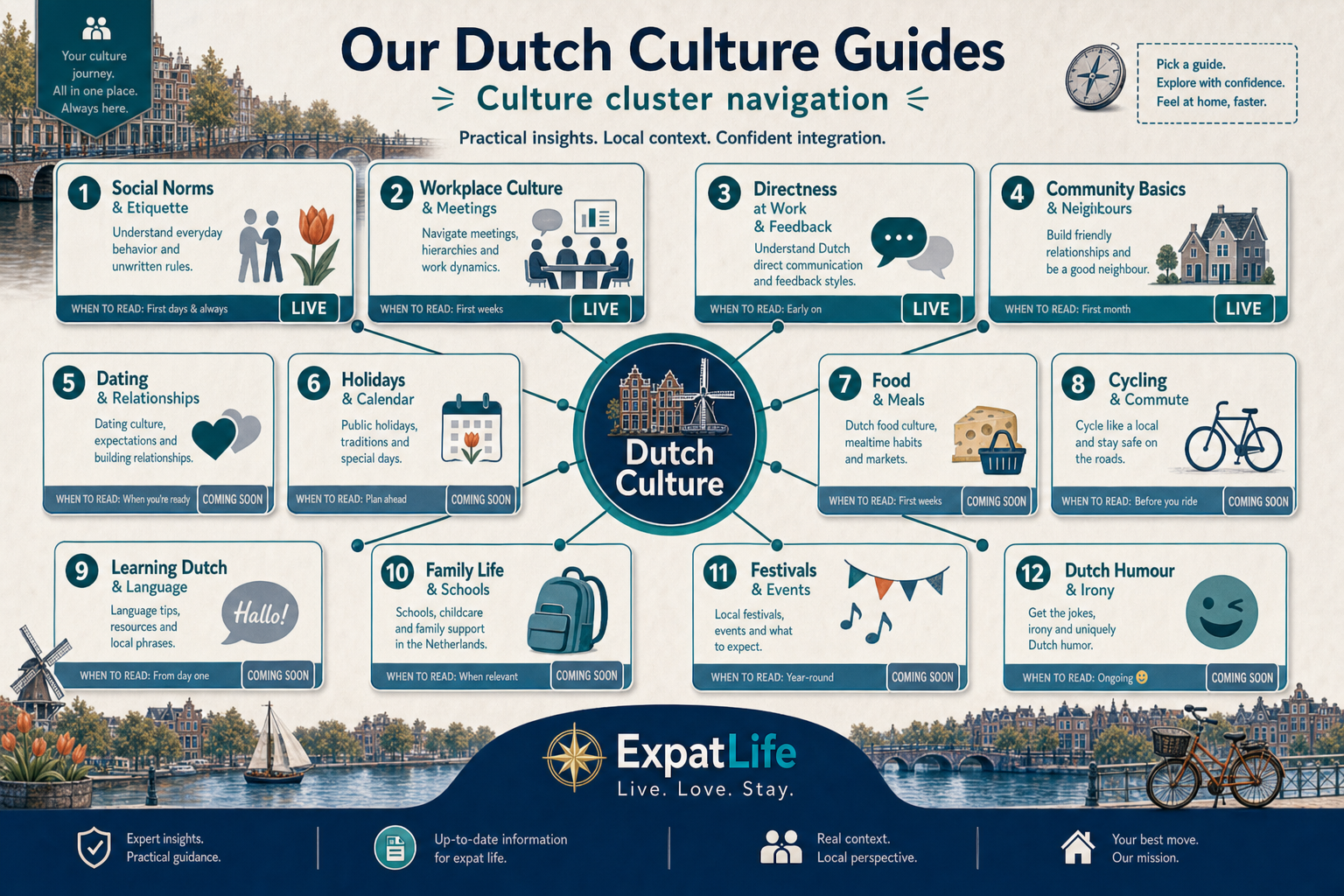
Continue from this hub into etiquette, work, community and holiday guides.
Follow the reading order below if you are unsure which deep dive to open first.

Deep-dive guides for every major culture topic — open live guides now; coming-soon cards show planned coverage in this cluster.
Live guides cover etiquette, work, holidays and community — coming-soon cards show planned cluster depth.
Explore next
Move from culture orientation into social norms, community integration and language learning.

Official Dutch government information on society and public services.
Open official sourceGovernment portal for internationals living in the Netherlands.
Open official sourceDemographics, society and regional data.
Open official sourceNational tourist board — events and regional inspiration.
Open official source
Social Norms Overview
Brief orientation on greetings, punctuality, neighbours and paying — etiquette detail lives in the Social Norms guide.
Observe your building and workplace first; norms shift between cities, generations and international teams.
Everyday situations expats notice
Common settings where unwritten rules show up — open the full guide for birthdays, visiting and transport etiquette.