
Should I congratulate everyone?
At home parties with family present, guests often congratulate partner, parents or children — watch the first guest and mirror their pattern.
Life in the Netherlands · Culture
Understand how birthdays are celebrated in the Netherlands so you can confidently enjoy invitations, workplace celebrations and family gatherings.
Orientation only — families, regions and generations celebrate differently. Ask hosts and colleagues about their customs rather than assuming one national script.
Quick answer
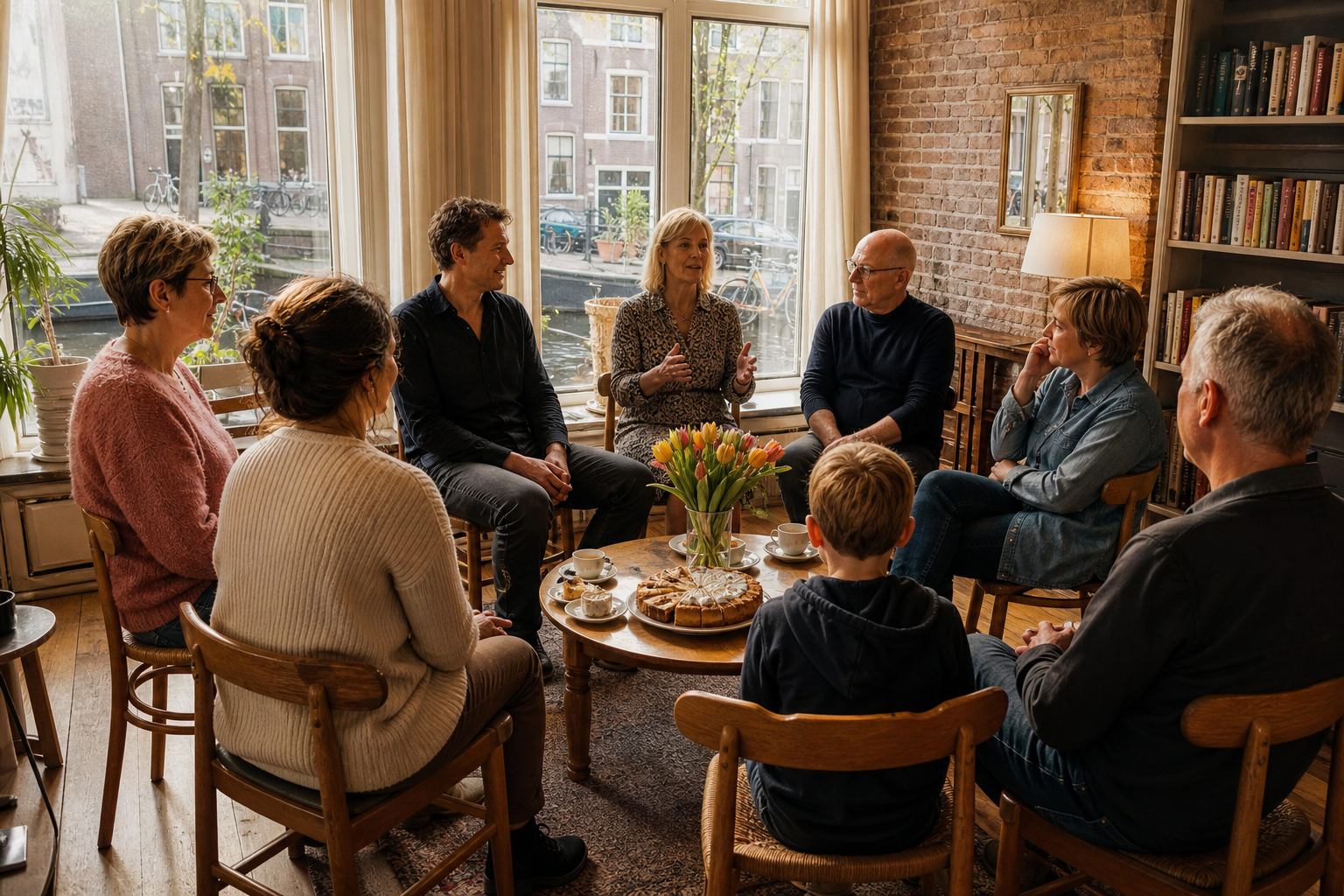
Dutch birthday culture surprises many expats the first time they hear 'Gefeliciteerd!' directed at a parent or partner, or when they walk into a living room full of chairs arranged in a careful circle. These customs are not random quirks — they reflect values of equality, inclusion and gezelligheid (cosy togetherness) that run through much of Dutch social life.
This guide explains traditional home parties, the kringverjaardag, family congratulations, gifts, children's and workplace birthdays, food, regional differences and how traditions are evolving. For broader etiquette on visits and neighbours, pair it with our Dutch Social Norms guide.

At home parties with family present, guests often congratulate partner, parents or children — watch the first guest and mirror their pattern.
For home invitations, flowers, wine or chocolate are safe unless the invitation says otherwise. Office birthdays usually expect the birthday person to bring treats.
Kringverjaardag puts everyone at the same level for conversation — calm and gezellig, not a loud club party.
Observation is fine — Dutch hosts usually explain their family style when asked. Pair this guide with Dutch Social Norms for visiting etiquette.
At a glance
Six orientation signals — then read the circle party and congratulations sections before your first invitation.

Home visit
Coffee & taart
Circle seating common
Congratulations
Gefeliciteerd!
Often includes family
Office
You bring cake
Ask HR before your birthday
School
Class traktaties
Allergy-safe treats
Most home birthdays centre on coffee or tea with taart, vlaai or appeltaart — simple, gezellig and easy to join.
Chairs arranged in a kring (circle) so every guest can talk — the famous kringverjaardag format.
Guests often congratulate the birthday person's partner, parents or children — not only the person turning a year older.
Flowers, wine, chocolate or a book — modest and thoughtful rather than extravagant.
Birthdays reinforce family ties — multiple generations may attend afternoon or evening visits.
Paper calendars in the toilet help households remember extended family and friends' dates.
How to use this snapshot
In the Netherlands, a birthday is often less about throwing a spectacular event and more about marking someone's place in a network of family, friends and colleagues. The invitation itself says: you matter enough to spend an afternoon together.
Historically, home space was limited and gatherings were practical. Coffee, cake and a circle of chairs allowed everyone to participate without expensive catering. Museums and cultural historians note that post-war Dutch domestic life reinforced small, frequent social visits over rare grand banquets — birthdays fit that pattern.
For expats, the payoff is predictability. Once you learn the script — congratulate, sit, chat, eat cake, thank the host — you can relax into a rhythm that repeats across many households.
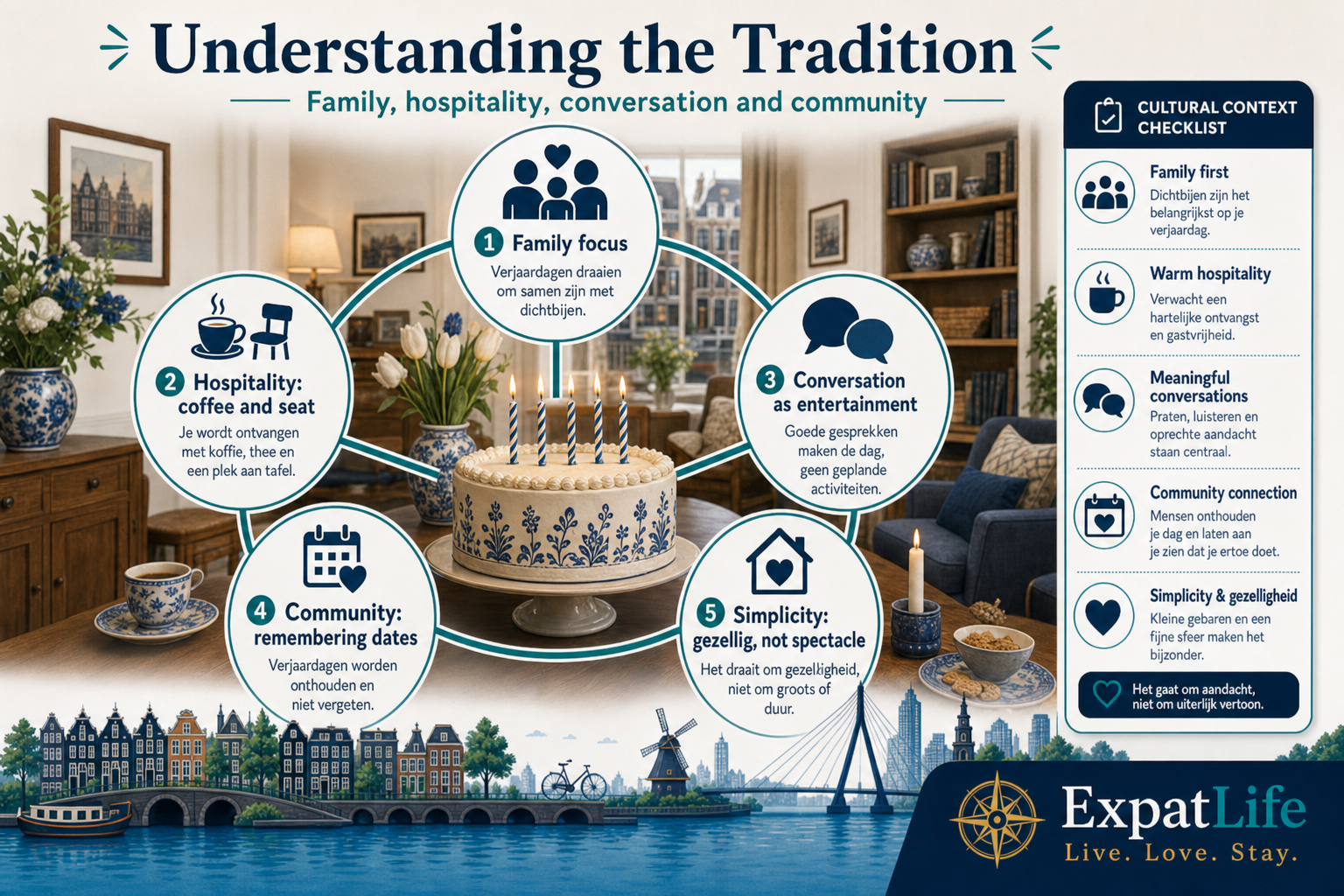
Birthdays are occasions to see people you might not meet every week — grandparents, cousins and close friends gather for an afternoon or evening.
Hosts provide coffee, cake and a comfortable seat. Guests are expected to stay long enough for conversation — rushing in and out feels unusual.
The party is the talk itself. Unlike loud club-style birthdays, Dutch home circles prioritise catching up with everyone in the room.
Remembering birthdays — via calendars, messages or visits — signals that someone belongs in your social circle.
Elaborate decorations are less central than in some cultures. A clean home, good cake and warm welcome carry the day.
Circle seating puts everyone at the same level — no head table, no VIP corner. That layout matches broader Dutch egalitarian social habits.
Featured
The kringverjaardag is probably the best-known Dutch birthday format abroad — often described online with affectionate humour. Guests sit in a circle (kring) of chairs, usually in the living room, sometimes spilling into the kitchen or garden.
The birthday person may sit slightly apart or move between guests as people arrive. New arrivals congratulate them, then often congratulate close family members present. Conversation flows in the round; there is rarely a programme of games or speeches unless it is a milestone age.
Expats sometimes find the format quiet compared with parties at home. That calm is intentional — the goal is to speak with everyone, not to maximise noise or activity. Staying an hour or two, eating cake and joining a few conversations is exactly what hosts hope for.
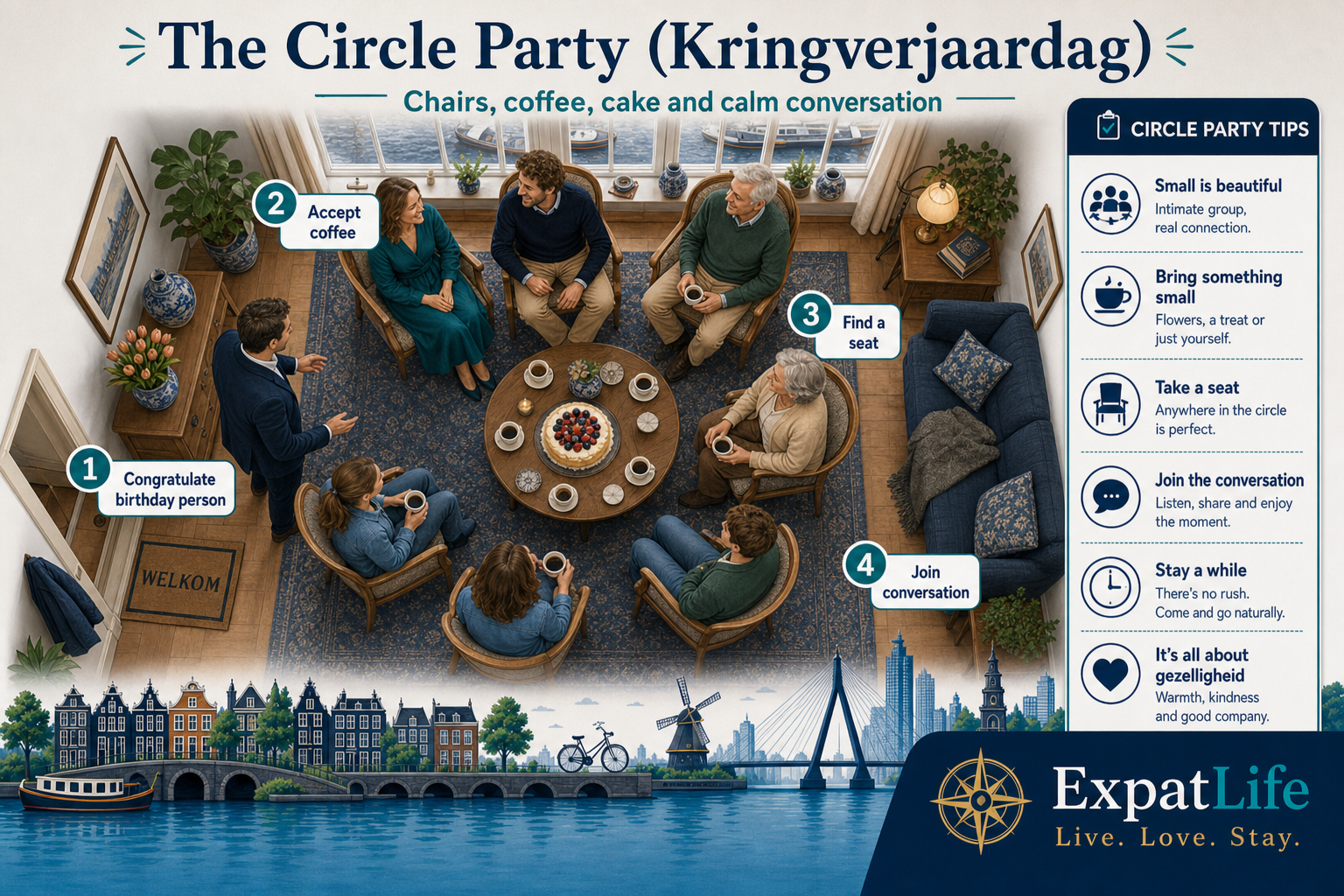
| Topic | What to expect |
|---|---|
| Why a circle? | Everyone sees and hears each other — no one is left on the edge of a loud crowd. |
| Arrival flow | Congratulate the birthday person, accept coffee, find a seat. Watch others for the family-congratulations pattern. |
| Conversation | Small talk about work, children, holidays and news — direct but friendly. |
| Duration | Open-house style visits may span afternoon into evening; stay at least long enough for coffee and cake. |
| Expat experience | First circle can feel formal — second and third feel warmly familiar. |
Circle party practical tips
One of the most distinctive Dutch birthday customs is congratulating not only the person whose birthday it is, but also their partner, parents, children or sometimes siblings. The logic is relational: family members are seen as sharing the day.
You might hear 'Gefeliciteerd met Jan!' addressed to Jan's wife, meaning congratulations on Jan's birthday. This is not sarcasm — it is a conventional form of goodwill. Expats who only congratulate the birthday person are not rude, but matching local practice helps you blend in.
The custom is strongest at home parties with multiple generations. At the office or in a bar, people usually congratulate only the birthday person.

Use these as templates — always add the person's name.
| Who | Dutch | English | Note |
|---|---|---|---|
| Birthday person | Gefeliciteerd met je verjaardag, Lisa! | Congratulations on your birthday, Lisa! | Always start here — use their name. |
| Partner | Gefeliciteerd met Lisa! | Congratulations on Lisa's birthday! | Common when partner is in the room. |
| Parent (of adult child) | Gefeliciteerd met je zoon/dochter! | Congratulations on your son/daughter! | When parent hosts or attends. |
| Child (in family party) | Gefeliciteerd met papa/mama! | Congratulations on dad/mom's birthday! | Children are included in the ritual. |
| Grandparent | Gefeliciteerd met je kleinkind! | Congratulations on your grandchild! | Less common but appears in three-generation homes. |
Congratulations tips
Dutch birthday gifts tend to be modest, practical and easy to carry. Flowers, a bottle of wine, good chocolate, a book or a small plant suit most adult home visits. Gift cards to bookshops or department stores work when you know the person's tastes.
Close friends and partners exchange more personal gifts; colleagues often organise a small collective gift or expect no gift at all beyond office treats. Children's parties may request no gifts or specify a small amount — read the invitation.
Wrapping is neat but not extravagant. A card with a short message is valued. When unsure, flowers or something edible rarely offend.

| Topic | What to expect |
|---|---|
| Flowers | Always appropriate for hosts — odd numbers are traditional for bouquets. |
| Wine or beer | Fine for evening visits; check if hosts drink alcohol. |
| Chocolate | Quality chocolate or stroopwafels — easy shared gift. |
| Books | Popular in a reading culture — match genre to the person. |
| Gift cards | Acceptable for close colleagues and friends when personal taste is unknown. |
| Children | Small toys or books unless invitation says otherwise. |
Gift etiquette tips
Coffee and cake anchor most Dutch home birthdays — hosts offer filter coffee or tea first, then slice taart or vlaai for every guest. The ritual is simple and repeatable: drink, eat, talk, maybe stay for a second cup.
Regional pastries add character. Limburg families often serve vlaai; Frisian households may offer oranjekoek; Randstad hosts might buy slagroomtaart from a neighbourhood bakkerij. Evening borrel birthdays extend the menu with wine, beer, cheese cubes and warm bitterballen.
Office birthdays follow a similar pattern at scale — the birthday person brings a whole taart to the kitchen, colleagues gather for coffee and a slice. Mention dietary needs when accepting invitations; most hosts appreciate a heads-up about allergies or vegetarian preferences.

| Item | Category | What to expect |
|---|---|---|
| Coffee | Drinks | Almost always offered first — filter coffee or espresso after a meal. |
| Tea | Drinks | Common alternative — milk on the side. |
| Cake (taart) | Sweet | Slagroomtaart, fruit taart or home-baked cakes — central to the visit. |
| Appeltaart | Sweet | Dutch apple pie with cream — birthday classic. |
| Vlaai | Sweet | Limburg fruit tart — regional favourite at celebrations. |
| Snacks | Savoury | Bitterkoekjes, nuts or crisps as the afternoon extends. |
| Cheese | Savoury | Cubed cheese with mustard for evening borrel birthdays. |
| Bitterballen | Savoury | Warm fried snacks if guests stay into the evening. |
| Wine & beer | Drinks | Evening visits may shift from coffee to borrel drinks. |
| Evening snacks | Savoury | Bread, dips or a simple buffet if the party runs late. |
Food tips for guests
Children's birthdays in the Netherlands combine school rituals with home parties. At school, the birthday child often wears a paper crown (verjaardagskroon), brings treats (traktaties) for the class and may choose a small game or song led by the teacher.
Home parties vary by age and family. Young children may invite classmates to play at home or in a park; teenagers might prefer cinema or bowling. Dutch parents often cap guest numbers and keep parties shorter than some international equivalents.
Traktaties must follow school allergy policies — pre-packaged items with ingredient labels are increasingly required.

| Topic | What to expect |
|---|---|
| School treats | One shared snack per child — fruit, cookies or small toys. |
| Birthday crown | Classroom tradition — child is centre of attention briefly. |
| Inviting classmates | Often whole class or same-gender group — ask school norms. |
| Games | Simple party games at home; organised activities for older kids. |
| Gifts | Small gifts common; some families request none. |
Children's birthday tips
Office birthday culture catches many expats off guard: on your own birthday, you are often expected to bring cake or pastries for colleagues. The birthday person treats the team — not the other way around.
Colleagues congratulate you when they see you — sometimes a short morning gathering in a meeting room or kitchen. Larger firms may email congratulations; small teams walk to your desk. Some teams circulate a card or organise a gift collection.
Ask HR or a colleague before your birthday arrives. Knowing whether your team does morning coffee, afternoon cake or nothing prevents surprises.

| Topic | What to expect |
|---|---|
| Bring cake | Taart from bakkerij or supermarket — enough for the team. |
| Congratulations | Colleagues say gefeliciteerd — you thank them. |
| Gift pools | Optional Tikkie for milestone ages or managers. |
| Remote workers | Video call shout-outs and delivery treats increasingly common. |
Office birthday checklist
Dutch primary schools (basisschool) usually mark each child's birthday once during the school year on or near their date. The child may sit on a special chair, wear a crown and distribute traktaties while classmates sing.
Teachers manage time so the ritual fits between lessons — it is short, inclusive and repeated for every child. International and secondary schools may adapt rules but often keep a visible birthday moment.
Parents receive guidelines on treats, nuts, sugar and packaging from school newsletters — follow them exactly.

| Topic | What to expect |
|---|---|
| Treats (traktaties) | Individually wrapped portions for every classmate. |
| Songs | 'Lang zal hij/zij leven' or school-specific versions. |
| Teacher role | Facilitates — ensures every child gets a turn across the year. |
| Allergy policy | Strict in most schools — label ingredients or buy sealed packs. |
School birthday tips
The verjaardagskalender (birthday calendar) hanging in the toilet is a Dutch household classic. It lists birthdays of family, friends and neighbours without a year — so the same calendar works annually.
Guests often study the calendar during a visit — it is a conversation starter and a memory aid. Updating it when someone new joins your life is a small gesture of inclusion.
Digital calendars and Facebook reminders supplement paper for younger Dutch, but the toilet calendar remains a cultural touchstone — museum gift shops still sell them.
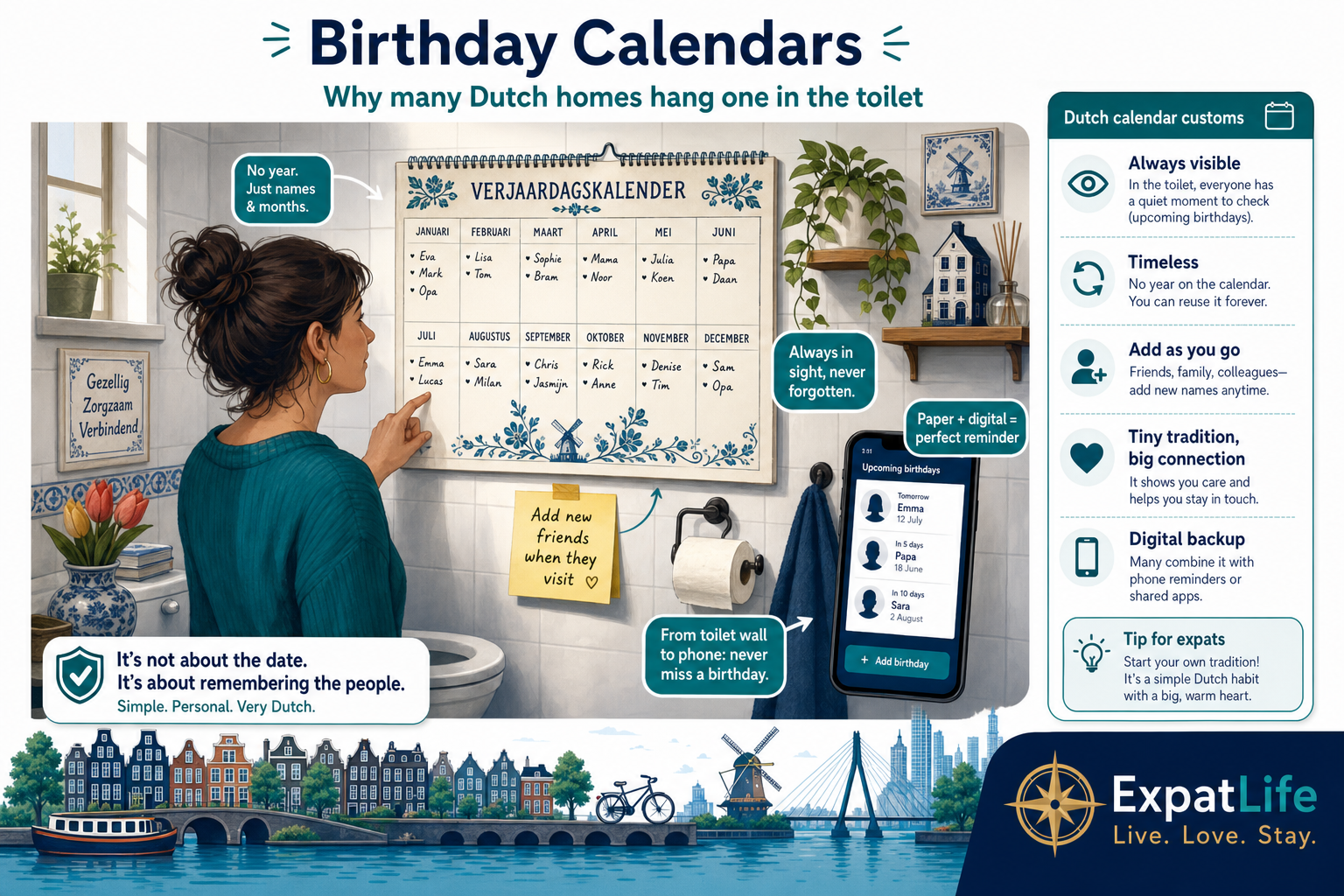
| Topic | What to expect |
|---|---|
| Toilet calendar | Month-by-month list without year — reusable annually in many Dutch homes. |
| Guest ritual | Visitors often read names while waiting — a quiet social cue. |
| Updating names | Adding a new friend or neighbour signals inclusion. |
| Digital backup | Phone reminders complement paper — younger Dutch use both. |
| Gift-shop calendars | Popular housewarming present — illustrated versions in museum shops. |
Birthday calendar customs
Younger Dutch and international households blend traditional circles with restaurant dinners, weekend trips or activity parties. Amsterdam, Rotterdam and Utrecht see more fusion styles than smaller towns.
Second-generation and expat families may keep coffee-and-cake for grandparents and plan a separate friends' borrel on another evening. Milestone ages — 16, 18, 21, 40, 50 — often trigger larger celebrations.
Social media posts and WhatsApp groups have not replaced home visits — they extend them. A photo of the cake may go to the group chat while the circle continues in the living room.

| Topic | What to expect |
|---|---|
| Younger generations | Bar borrels and dinners complement home circles. |
| International influence | Surprise parties and themed children's events in urban areas. |
| Restaurants | Dinner birthdays growing — still often with family. |
| Smaller gatherings | Some prefer three close friends over twenty acquaintances. |
| Milestone ages | 18, 21, 40 and 50 often trigger bigger parties or trips. |
| WhatsApp groups | Photos and messages extend the circle — they rarely replace it. |
Modern birthday tips
No single Dutch birthday script covers every province. Limburg's vlaai culture shapes celebration food; Brabant retains strong afternoon visit traditions; Randstad cities absorb international formats faster.
International cities like Amsterdam and The Hague host expat-heavy circles where English mixes with Dutch and customs hybridise. Northern provinces may favour quieter, shorter visits.
Observe your gemeente and colleague networks — regional pride appears in cake choice, borrel length and how many generations attend.
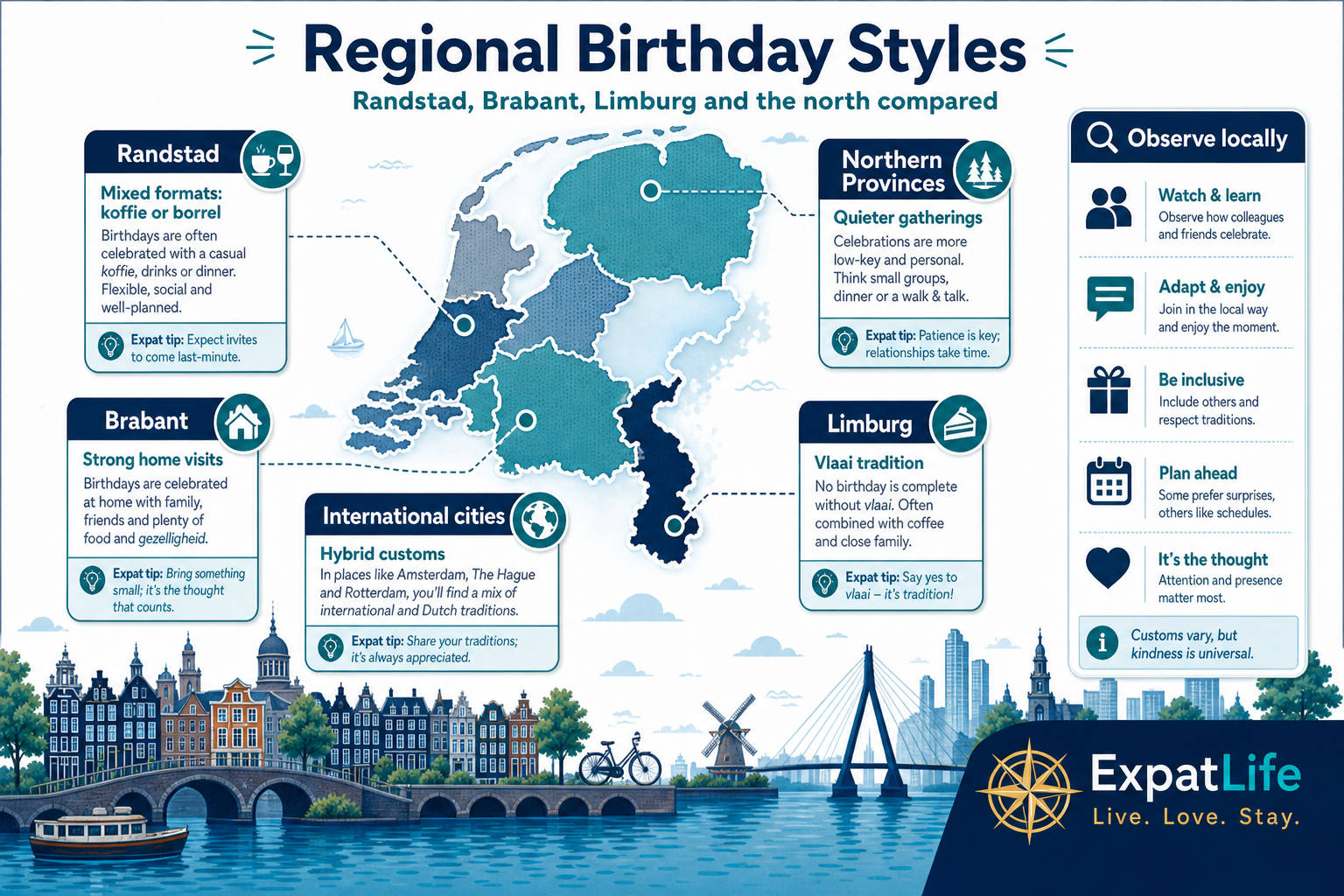
Traditions vary — observe locally rather than assuming one national format.
| Region | Style | Note | Expat tip |
|---|---|---|---|
| Randstad | Mixed formats | Home circles plus restaurant and borrel evenings | Ask if the invite is koffie en taart or avondborrel. |
| North Brabant | Strong home visits | Gezellig afternoon circles remain common | Expect generous cake and long conversation. |
| Limburg | Vlaai tradition | Fruit tarts feature at many birthdays | Compliment the vlaai — regional pride is real. |
| Northern provinces | Quieter gatherings | Smaller groups, shorter visits in some towns | Punctuality and thanks matter highly. |
| International cities | Hybrid customs | English, multiple cuisines, flexible seating | Still congratulate family if Dutch hosts are present. |
Most expat awkwardness at Dutch birthdays comes from surprise, not bad intentions. Learning the congratulations pattern, circle seating and office cake custom prevents 90% of uncomfortable moments.
Dutch hosts generally appreciate curiosity — asking 'What do you usually do for birthdays?' builds rapport. Nobody expects perfection on your first visit.

Expat survival checklist
Small etiquette gaps are easy to fix once you know the local rhythm — most Dutch hosts are patient with newcomers.

At home parties with family present, guests often congratulate relatives too — missing this feels slightly off.
Watch the first guest and repeat their pattern.
Open-house circles still have a rhythm — very late arrival disrupts seating and food planning.
Message ahead if delayed; arrive within the stated window.
Many Dutch birthdays are calm afternoon circles — not club nights or surprise crowds.
Adjust expectations — conversation is the main event.
Guests sometimes hesitate at the circle — standing awkwardly by the door.
Accept coffee and take the seat indicated by the host.
A modest gift or flowers is normal for home invitations unless told not to.
Flowers or good chocolate are safe defaults.
A quick goodbye and thanks for gezelligheid closes the visit warmly.
Say 'Bedankt voor de gezelligheid' or thank them in English sincerely.
Balanced explanations — Dutch birthday culture is more varied than social media memes suggest.
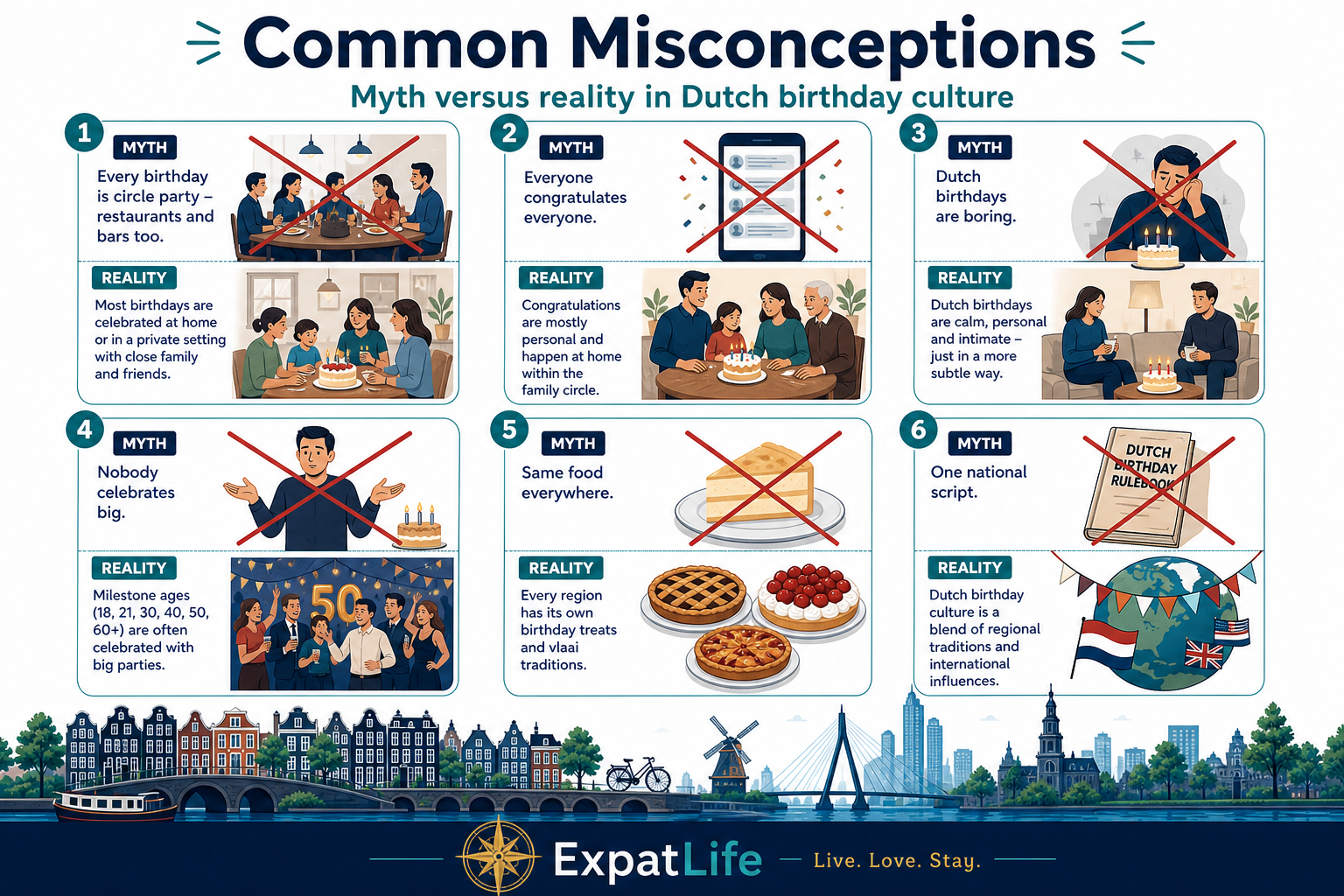
Myth
Kringverjaardag is common but not universal — restaurants, bars, gardens and small dinners are widely used, especially among younger urban Dutch.
Myth
Family congratulations are strong at home parties with relatives present; at work or drinks-only events, people usually congratulate only the birthday person.
Myth
The format is calm, not dull — guests who engage in conversation often find circles warmly intimate rather than flat.
Myth
Milestone ages, 50th parties and group holidays abroad are common — scale varies by family and occasion.
Myth
Limburg vlaai, Frisian specialties and international families' cuisines vary widely — coffee and cake are the thread, not the only menu.
Myth
Regional, generational and international blends make Dutch birthday culture diverse — ask rather than assume.
A few Dutch phrases go a long way at parties and in the office — practice pronunciation before your first celebration.
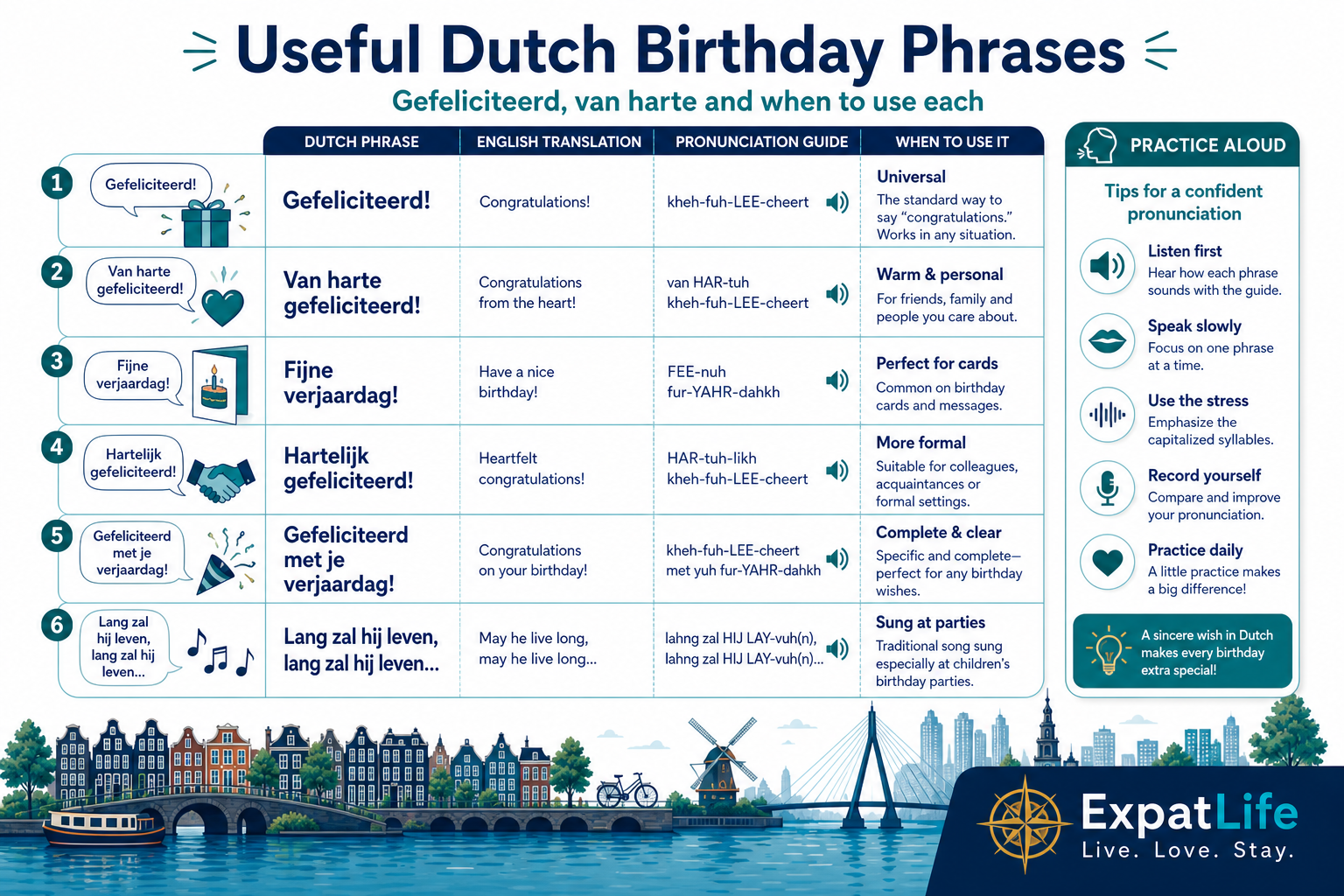
Add the person's name for warmth — mirror cheek kisses or handshakes from the birthday person.
| Dutch | English | Pronunciation | When to use |
|---|---|---|---|
| Gefeliciteerd! | Congratulations! | geh-feh-lee-see-TSEHRT | Universal — any birthday greeting |
| Van harte gefeliciteerd! | Congratulations from the heart! | van HAR-tuh geh-feh-lee-see-TSEHRT | Warm, sincere — friends and family |
| Fijne verjaardag! | Happy birthday! | FAY-nuh ver-YAAR-dakh | Cards, messages, casual tone |
| Hartelijk gefeliciteerd! | Heartfelt congratulations! | HAR-tuh-lik geh-feh-lee-see-TSEHRT | Slightly formal — colleagues and neighbours |
| Gefeliciteerd met je verjaardag! | Congratulations on your birthday! | geh-feh-lee-see-TSEHRT met yuh ver-YAAR-dakh | Direct address to birthday person |
| Lang zal hij/zij leven! | Long may he/she live! | lahng zahl high/zay LAY-vun | Sung at children's birthdays |
Confirm specifics with hosts and colleagues — families and regions celebrate differently.
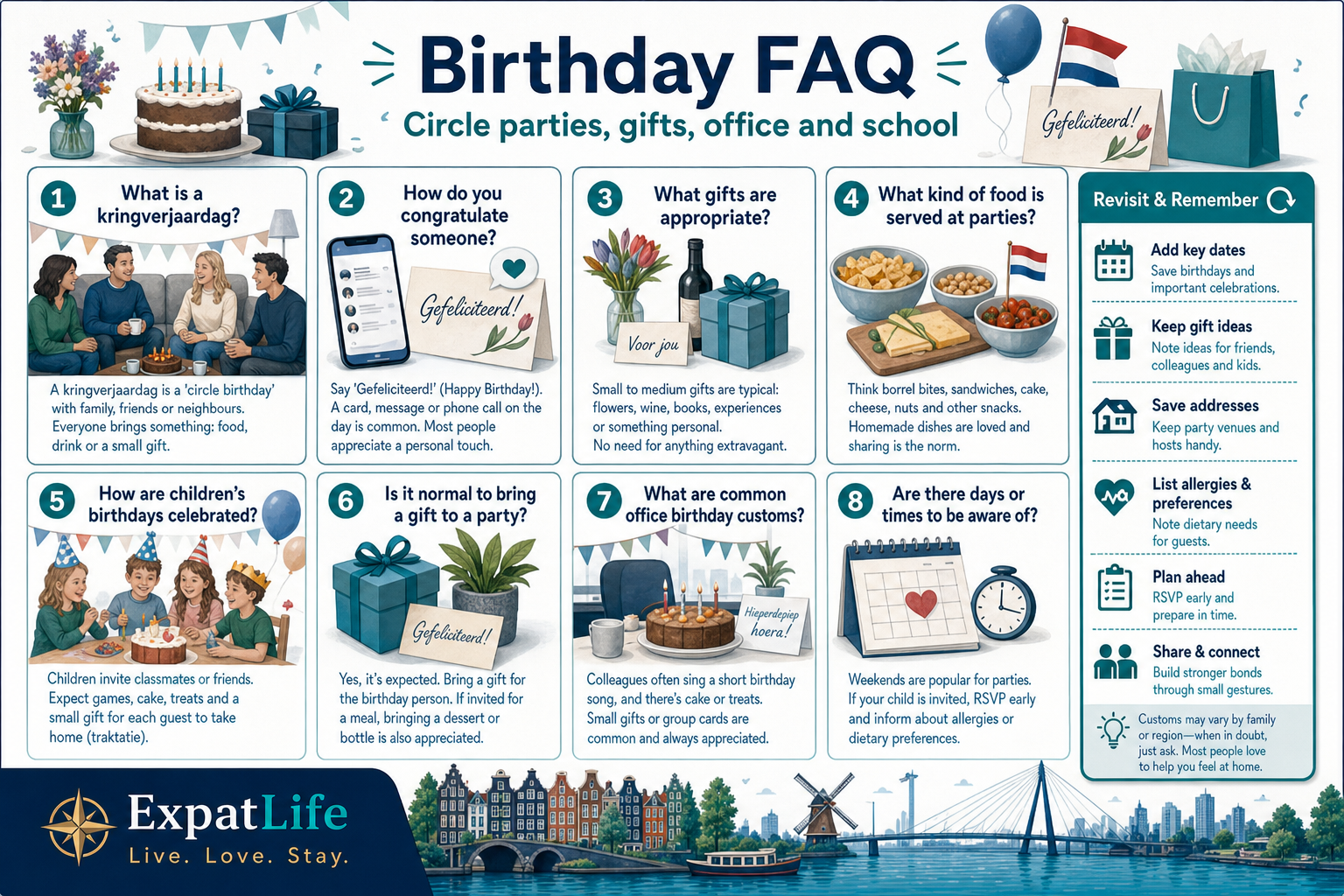
Congratulating family members acknowledges that birthdays are shared occasions — partners, parents and children are seen as connected to the day. It is strongest at home parties with relatives present. At work, people usually congratulate only the birthday person.
A kringverjaardag (circle birthday) is a home party where guests sit in a circle of chairs, drink coffee, eat cake and converse. It prioritises inclusion and calm conversation over loud entertainment.
For home invitations, a modest gift — flowers, wine, chocolate or a book — is normal unless the invitation says otherwise. Office birthdays usually expect the birthday person to bring treats, not guests to bring gifts.
Coffee and tea with cake or pie anchor most visits. Appeltaart and vlaai are classics. Evening parties may add wine, beer, cheese and bitterballen.
Children bring traktaties to school, may wear a birthday crown, and host home or activity parties with classmates. Schools publish allergy and treat guidelines for parents.
Yes — colleagues congratulate you and often expect you to bring cake or pastries on your own birthday. Ask your team about their usual practice.
At home parties where parents of the birthday person are present, many guests congratulate them too — 'Gefeliciteerd met [name]!' Follow what other guests do if unsure.
Expect a calm, conversational format at many home parties, family congratulations, modest gifts and punctual arrival. Ask hosts and colleagues about their customs — variation is normal.
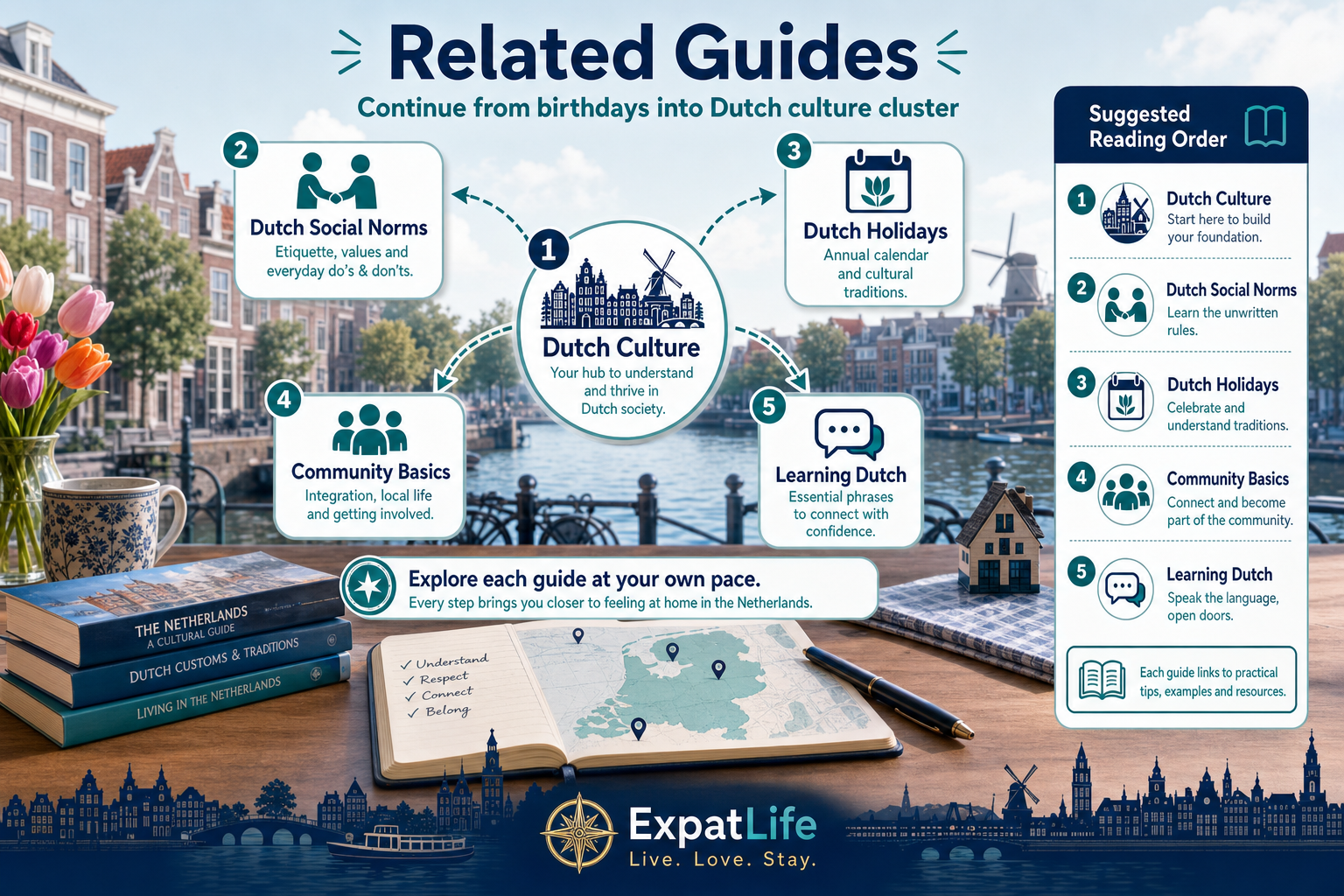
Continue from birthdays into culture, social norms, holidays and community guides.
Explore next
Move from birthday etiquette into social norms, community integration and language learning.

Official Dutch government portal — cultural life and public information.
Open official sourceGovernment information for Dutch citizens and internationals abroad.
Open official sourceNetherlands Open Air Museum — historical domestic and social customs.
Open official source