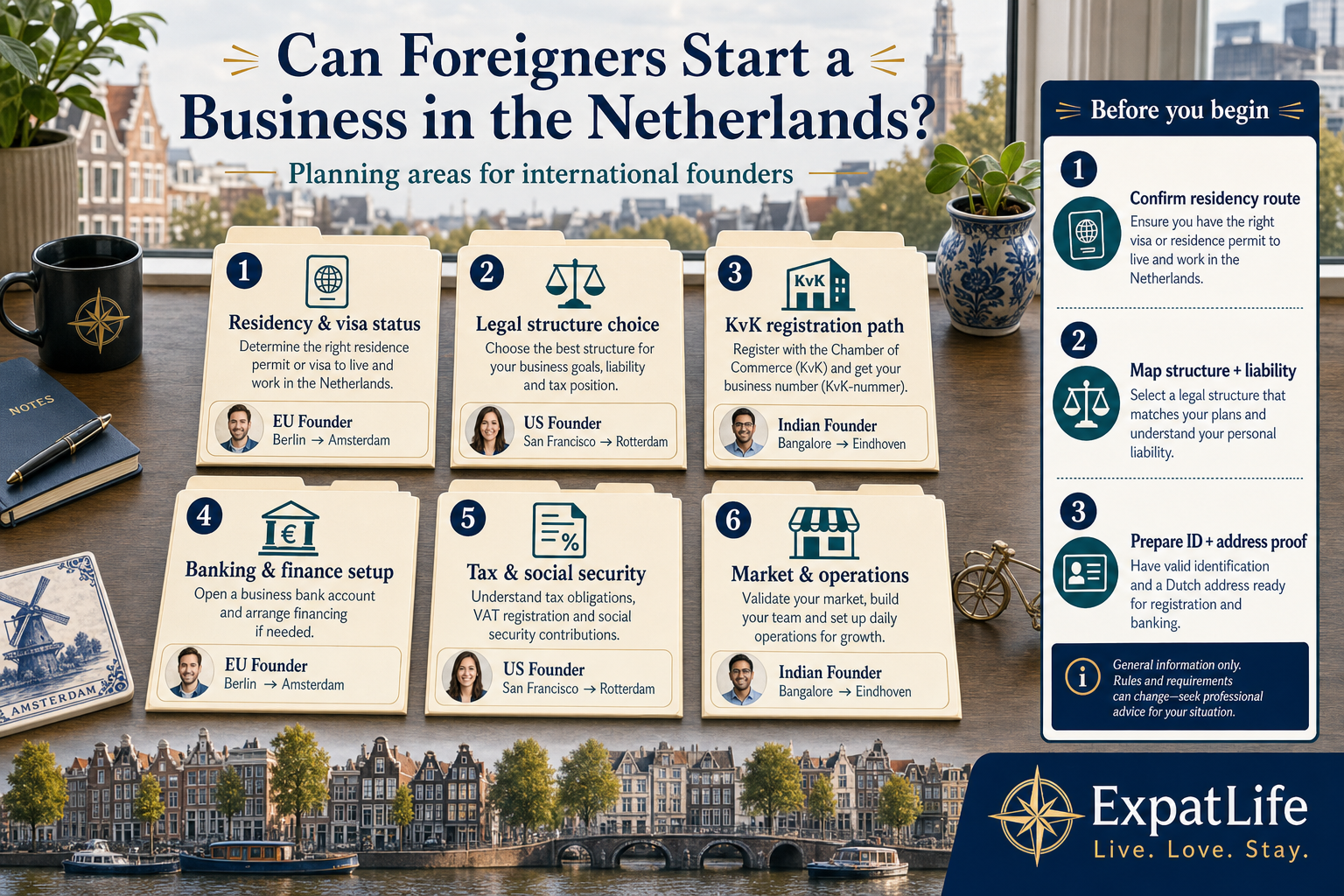
Foreign entrepreneurs are common
Example: US SaaS founder with BSN registers eenmanszaak online — KvK number often within 1–5 business days; IND rules still apply separately for non-EU founders.
Netherlands · Business · Entrepreneurship
Learn how entrepreneurs and expats start businesses in the Netherlands, including registration, taxes, banking, administration and practical first steps.
This guide is practical orientation only — not tax, legal or immigration advice. Business rules depend on your structure, nationality, registration and official regulations.

Overview
Yes — many international entrepreneurs start businesses in the Netherlands. The country attracts founders because of its international economy, strong infrastructure, English proficiency, startup ecosystem and EU market access.
Requirements depend on your nationality, residence status, business activity and chosen legal structure. Registration, tax administration and banking typically follow once your concept is clear.
This guide explains how starting a business works for expats and newcomers. It is practical orientation only — not tax, legal, immigration or business consulting advice. Verify your situation with KvK, Belastingdienst, IND and qualified professionals.
Key points
Example: US SaaS founder with BSN registers eenmanszaak online — KvK number often within 1–5 business days; IND rules still apply separately for non-EU founders.
Example: consultant pays around €80 one-time KvK fee (verify on kvk.nl), then invoices first Dutch client at €4,500 ex BTW — BTW and income tax reserves needed from that payment.
Example: solo developer at €90/hour × 22 billable hours/month (~€1,980 revenue) often starts as eenmanszaak; two co-founders planning a €120k/year hire may budget €1,500–€3,000+ notary BV setup.
Example: agency founder invoices €12,000 before KvK — backdating and BTW on past work is harder than registering first and invoicing from week 3.
Three orientation moves before registration
Worked examples
| Profile | Key figures | Example calculation | What to confirm |
|---|---|---|---|
| Solo consultant — year one | €95/hr · 22 billable hrs/mo · ~€25k revenue | Gross ~€2,090/mo → reserve ~€520–730/mo (25–35%) for BTW + income tax before spending | Accountant refines; employment at €6,200/mo may beat headline rate after benefits. |
| Lean ecommerce — year one | KvK ~€80 · stock €8k · software ~€120/mo | Registration fee is small vs inventory — model 6-month stock + ads budget separately | BTW on B2C sales and returns policy before scaling ad spend. |
| BV with co-founder | Notary ~€1,500–€3,000 · accountant ~€200/mo · hire at €55k salary | Setup often €5k–€15k+ before revenue — plan payroll tax from first employee month | Notary quote + shareholder agreement before incorporating. |
Examples
| Profile | Scenario | What to check |
|---|---|---|
| EU founder — Amsterdam | SaaS consultancy; €6,500/mo target; has BSN and address | KvK in week 1–2, BTW on Dutch B2B invoices (often 21%), reserve ~30% of first €20k revenue. |
| Non-EU — self-employed route | Planning IND points route; €45k year-one revenue forecast | IND business plan separate from €80 KvK step — do not invoice before permit clarity. |
| Employed expat — side venture | €7,200/mo job plus €800/mo ecommerce side income target | Employment contract + IND side-activity rules before crossing €5k cumulative sales. |
| Remote founder — EU clients | Relocates to Rotterdam; €18k/quarter from DE and UK clients | Tax residency shift, KvK registration and cross-border BTW with accountant before Q2 filings. |
Tax & registration
Useful when structure choice, BTW registration or first-year filings still need scoped professional help alongside Belastingdienst guidance — not tax advice.
Blue Umbrella
Dutch tax filing and expat-focused support — useful for ruling-related questions, payroll context, and annual returns.
Paid services; confirm pricing for your case.
Visit provider →TaxSavers
Tax returns and advice aimed at internationals; helpful when you want hands-on filing or a second opinion on ruling paperwork.
Paid services; check current rates.
Visit provider →Expatax
Expat income tax guidance and ruling-related planning for employees in the Netherlands.
Paid services; confirm scope before engaging.
Visit provider →Some links may be affiliate or referral links. Listings are for discovery only — not pay-to-rank and not tax advice. Confirm credentials and scope with any provider. Learn more
At a glance
Use this snapshot to orient yourself before diving into structures, KvK registration and tax planning — headline enthusiasm rarely matches admin reality.
Exact requirements depend on nationality, structure and activity. Treat these cards as planning prompts, not guarantees.
Foreign entrepreneurs
Can start
Non-EU founders often need IND route first — KvK alone does not replace permit rules.
KvK registration
1–5 days
Online eenmanszaak often same day to a few business days once ID, BSN and address are ready.
Typical KvK fee
~€80
One-time eenmanszaak orientation figure — verify current fee on kvk.nl before budgeting.
BTW on invoices
Often 21%
Many B2B services charge 21% BTW — set aside BTW collected plus income tax on profit.
Tax reserve habit
25–35%
Common orientation reserve on revenue until accountant confirms your mix.
Runway buffer
3–6 months
Example: €2,500/mo living costs → €7,500–€15,000 buffer before quitting employment.
Comparison
Many expats compare a job offer with entrepreneurship — use this table to orient yourself before choosing a path.
| Topic | Typical context | What to confirm |
|---|---|---|
| Income pattern | Example: €6,200/mo salary + 8% vakantiegeld | Example: €95/hr × 22 hrs = ~€2,090/mo variable — plan quiet months |
| Registration | Employer handles payroll setup | KvK ~€80 + your Belastingdienst BTW choices |
| Tax admin | Payroll tax via employer | Quarterly BTW + annual income tax — reserve 25–35% orientation |
| Leave & sick pay | Statutory paid leave + sick pay | No paid leave unless contracted — 3–6 month buffer |
| Setup cost | Near zero for employee | €2k–€5k lean ZZP year one vs €5k–€15k+ BV setup |
Worked examples
| Profile | Key figures | Example calculation | What to confirm |
|---|---|---|---|
| Job vs startup — consultant | Employment €7,200/mo vs €95/hr ZZP | ZZP ~€2,090/mo at 22 billable hours — far below salary unless hours/rate rise | Add pension, holiday, sick pay and 25% non-billable time before quitting. |
| First-year revenue swing | Q1 €14k · Q2 €9k · Q3 €4k | Quiet summer without buffer — plan €3k/mo minimum personal draw | Pipeline rebuild and tax reserves on strong quarters. |
Examples
| Profile | Scenario | What to check |
|---|---|---|
| Job vs startup — consultant | €7,200/mo employment vs agency idea | Model pension, holiday, sick pay and 12-month runway before quitting. |
| First-year revenue swing | Strong Q1 then quiet summer | Buffer fund and pipeline rebuild — normal entrepreneur cycle. |
Three moves after reading this snapshot
Location
Entrepreneurs choose the Netherlands for practical reasons: EU market access, logistics, English-friendly business culture and a dense startup network in major cities.
Advantages do not remove registration, tax or permit obligations — they reduce friction for international founders who plan carefully.
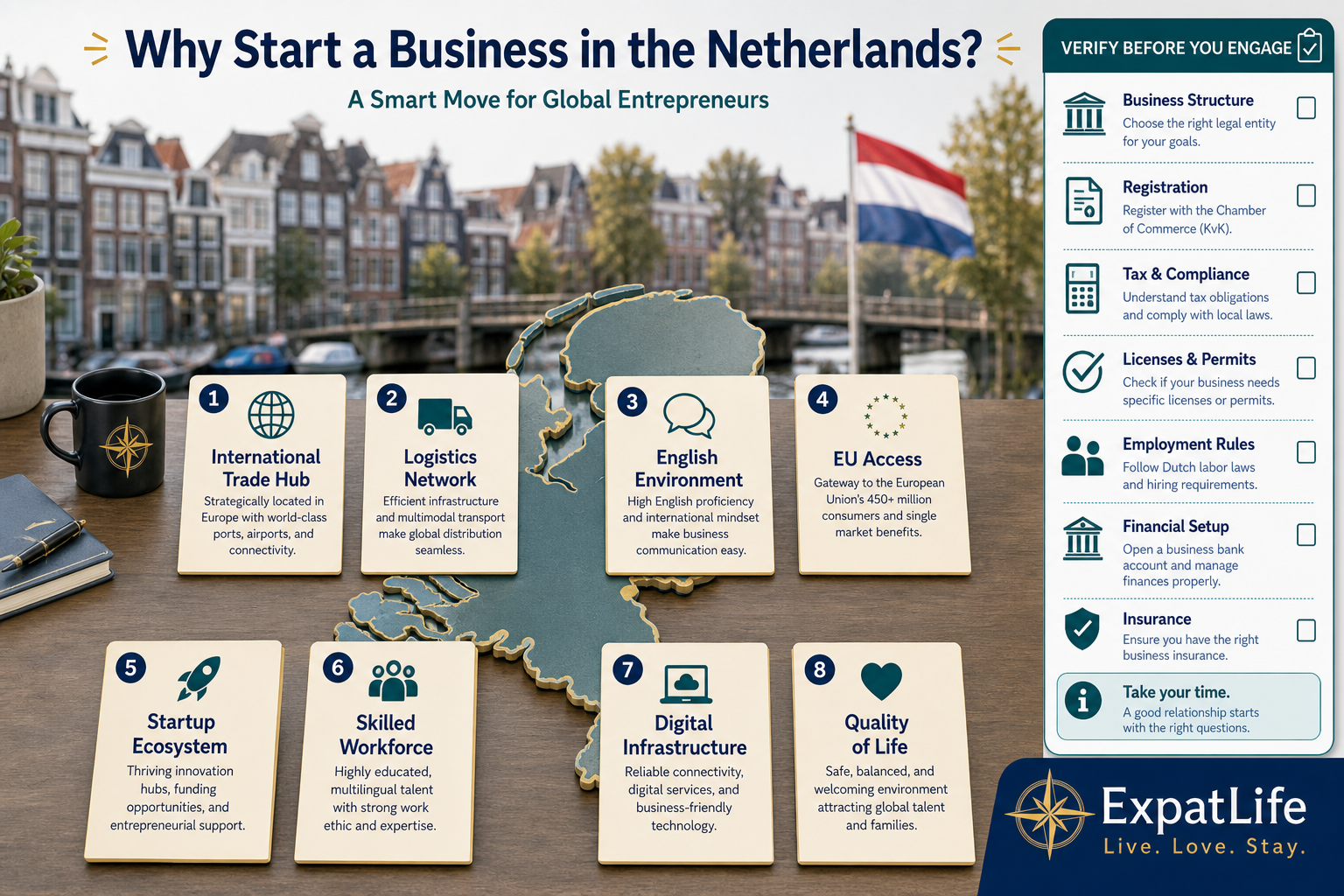
Rotterdam port and Schiphol connect European and global supply chains — relevant for trade and logistics ventures.
Distribution, fulfilment and B2B services benefit from dense transport infrastructure.
Many startups, agencies and corporates operate in English — helpful for expat founders.
Dutch registration sits inside the EU single market — cross-border clients still need per-country tax checks.
Incubators, accelerators and investor networks cluster in Amsterdam, Rotterdam, Utrecht and Eindhoven.
Universities and tech employers feed talent into consulting, tech and creative sectors.
Reliable connectivity supports remote teams, SaaS and digital service businesses.
Cities offer international schools, cycling culture and stable public services — useful for relocating teams.
Examples
| Profile | Scenario | What to check |
|---|---|---|
| Ecommerce founder | Wants EU fulfilment base near Rotterdam | Logistics partners, KvK activity description and BTW orientation. |
| Tech consultant — remote team | Hires contractors across EU from Utrecht | Structure beyond solo ZZP if payroll and liability grow. |
| Life sciences — Leiden | Spin-off from university research network | Sector grants via RVO; IP and partnership agreements with lawyer. |
Three moves after reading this section
Legal forms
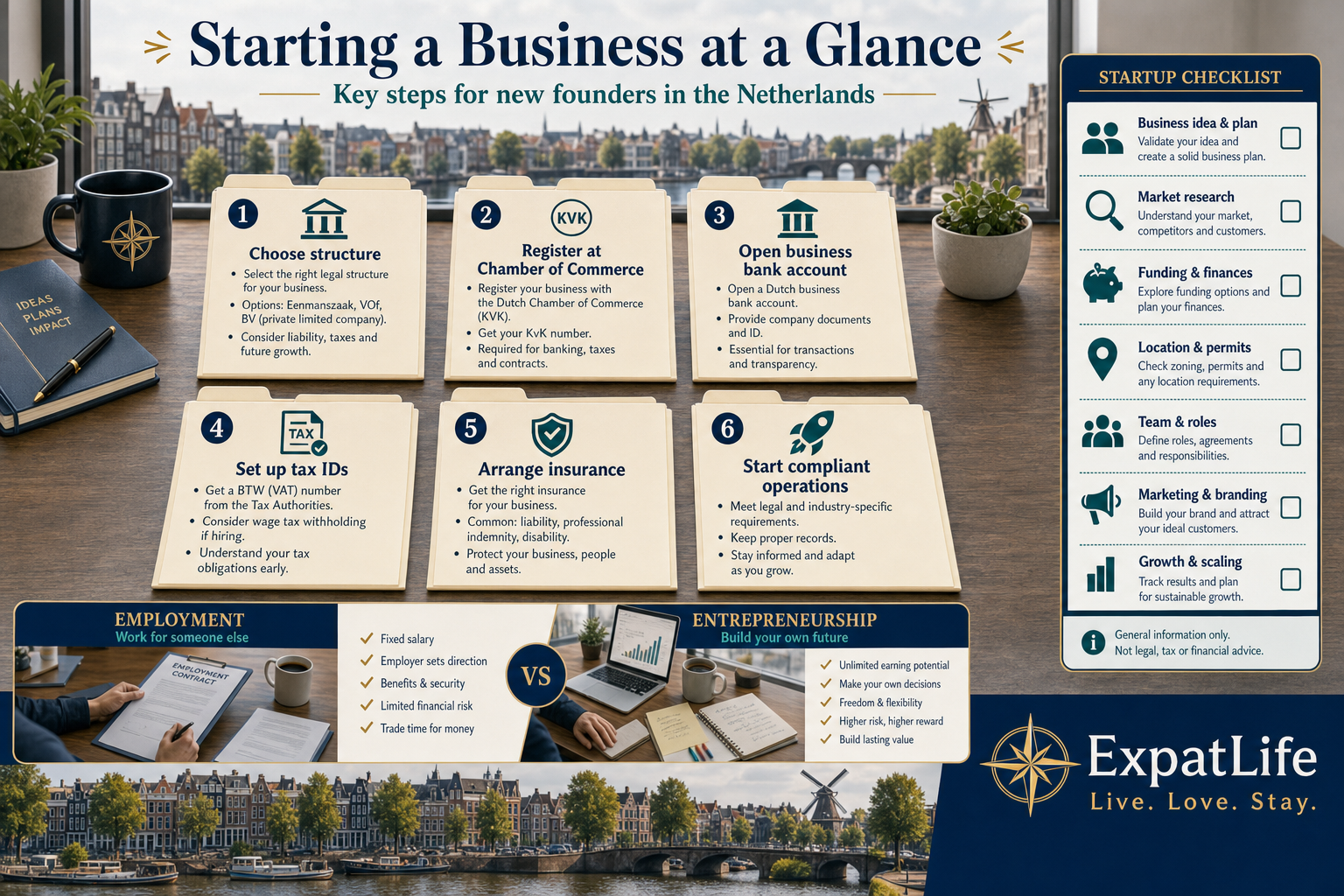
Dutch businesses take several legal forms — from solo self-employment (often ZZP/eenmanszaak) to BV companies and partnerships.
Different structures suit different goals, liability preferences and growth plans. This section orients you — it does not recommend one option.
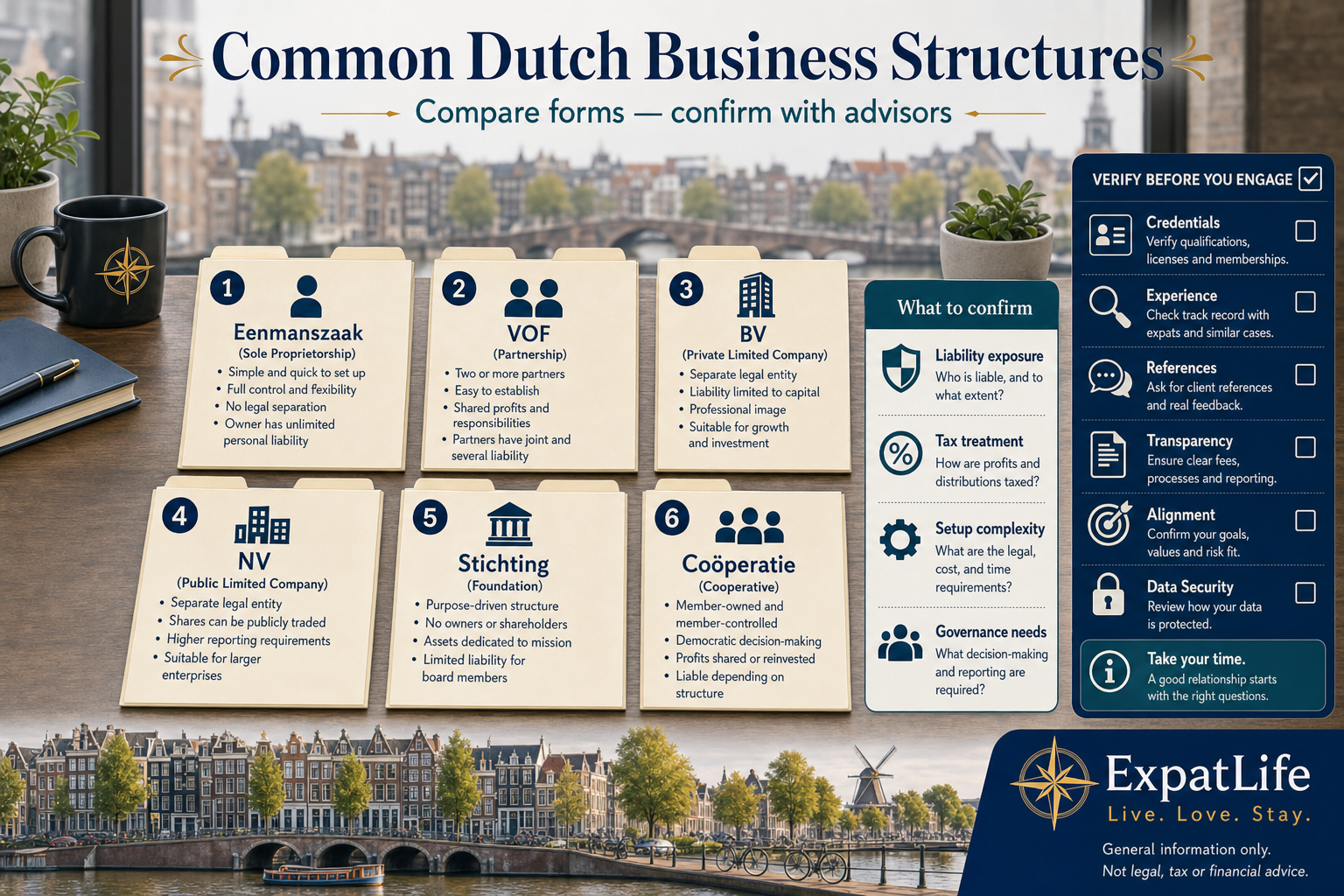
Example: developer registers online for ~€80 KvK fee, invoices €4,500/project ex BTW — fast solo path; liability often linked to you personally.
Example: two founders budget €1,500–€3,000 notary + €250/mo accountant before first €100k revenue year — separate legal entity.
Example: two accountants share profits 60/40 — partnership agreement should fix exits and capital calls in writing.
Example: retail partners split €180k turnover — verify how joint liability works with a lawyer before signing.
Example: non-profit arm holding grants — different from commercial BV; verify activity rules.
Example: foreign branch registration — specialist setup often €2k+ in professional fees beyond KvK.
| Structure | Typical use | Confirm with adviser |
|---|---|---|
| ZZP / eenmanszaak | KvK ~€80 · setup often under €2k year one | Liability and tax on profit with accountant |
| BV | Notary ~€1.5k–€3k+ · accountant ~€150–€400/mo | Director salary, corporate tax and payroll if hiring |
| VOF / maatschap | Lower entry than BV; shared liability | Written partner agreement before first €10k revenue |
| Scaling path | Many convert after ~€80k–€120k solo revenue | Tax adviser on timing of BV conversion |
Worked examples
| Profile | Key figures | Example calculation | What to confirm |
|---|---|---|---|
| Solo consultant | €90/hr · 24 hrs/mo · ~€26k/yr | Eenmanszaak often sufficient year one — BV may add €2k+ setup without benefit yet | Accountant scoping call with revenue forecast. |
| Co-founders — tech | 2 founders · hire at €60k in month 8 | BV + notary ~€2k + payroll tax from hire month — plan €8k+ pre-revenue buffer | Shareholder agreement before first investor conversation. |
| Agency + subcontractors | €35k/mo client · €18k/mo to freelancers | Classification risk if 80% revenue via one client — structure review before scaling | Lawyer + accountant on VOF vs BV vs ZZP mix. |
Examples
| Profile | Scenario | What to check |
|---|---|---|
| Solo consultant | Day-rate work; no employees planned year one | ZZP/eenmanszaak vs premature BV — accountant scoping call. |
| Co-founders — tech startup | Two founders; planning hire in 6 months | BV with shareholder agreement vs VOF — notary and lawyer input. |
| Agency with subcontractors | Invoices clients; uses freelancers | Classification and liability — structure review before scaling. |
Three moves after comparing structures
KvK
The KVK (Kamer van Koophandel) is the Dutch Chamber of Commerce. It plays a central role in business registration and maintains public company records.
Entrepreneurs use KvK for registration, updating business information and accessing official orientation resources. Requirements vary by legal form and activity.
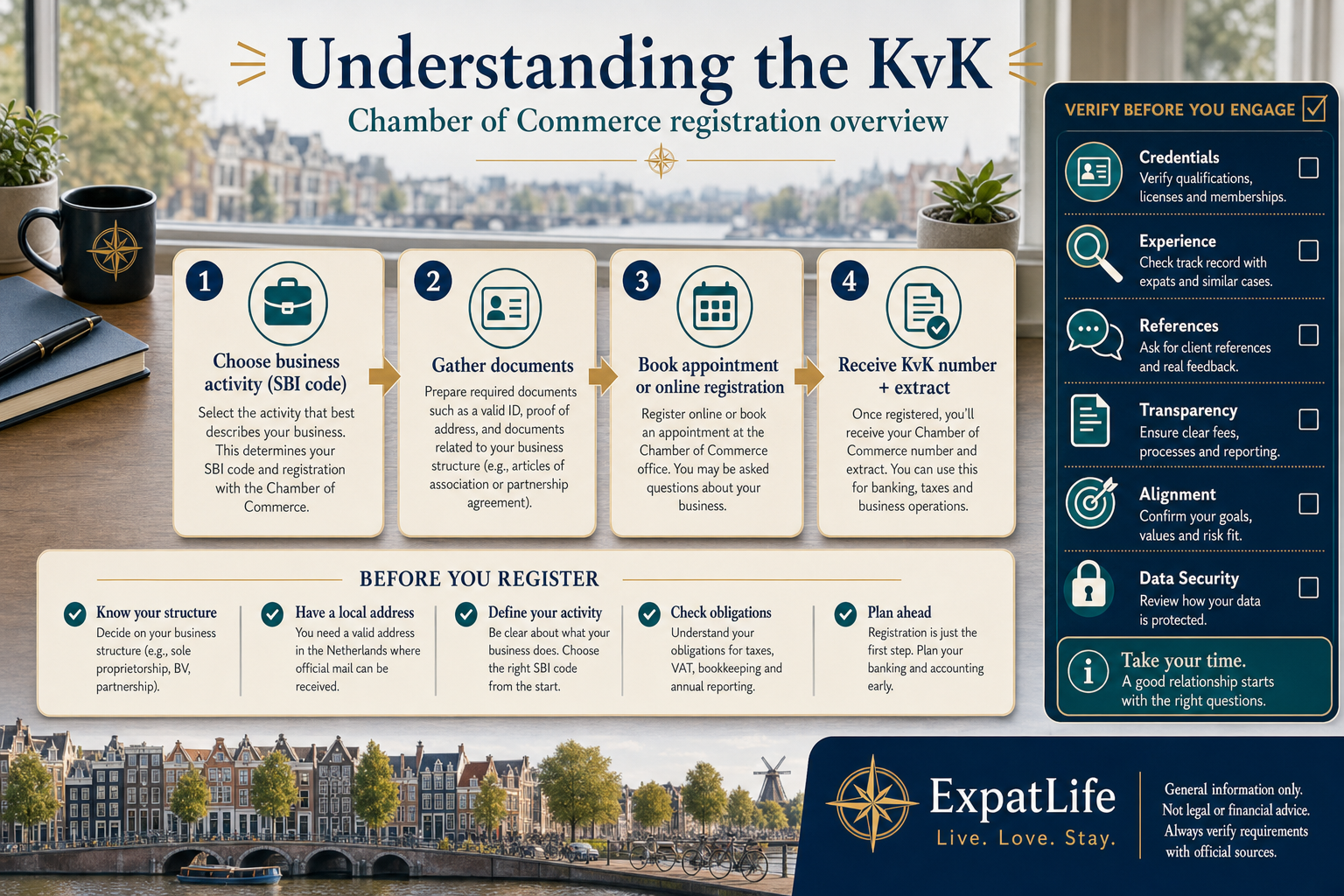
KvK checklist
Worked examples
| Profile | Key figures | Example calculation | What to confirm |
|---|---|---|---|
| Online eenmanszaak | Fee ~€80 · timing 1–5 days | Register Tuesday with BSN ready → KvK number often same week → bank asks for extract next | Fee and steps on kvk.nl before paying. |
| Trade name vs personal name | Brand 'Northline Studio' on invoices | KvK trade name registration may differ from personal legal name — align with client contracts | Invoice template matches KvK extract. |
| Dual activity | Consulting now · ecommerce in 6 months | Activity description too narrow → KvK update later; plan broader description if allowed | KvK guidance on combined activities. |
Examples
| Profile | Scenario | What to check |
|---|---|---|
| Trade name choice | Wants brand name vs personal name on invoices | KvK trade name rules and client contract expectations. |
| Activity description | Consulting plus planned ecommerce revenue | Whether KvK activity covers both or needs update later. |
| Address change | Moves from Amsterdam to Utrecht mid-year | Update KvK and invoice details; contracts may reference location. |
| Online registration | Expat registers via kvk.nl without Dutch fluency | English resources on kvk.nl; prepare BSN, ID and activity text. |
Three moves after reading KvK orientation
Setup
Registration is a conceptual sequence — exact order and requirements depend on your situation, nationality, structure and business activity.
Most entrepreneurs clarify their concept, choose a structure, register with KvK, set up tax administration, open banking and prepare invoicing before substantial operations.
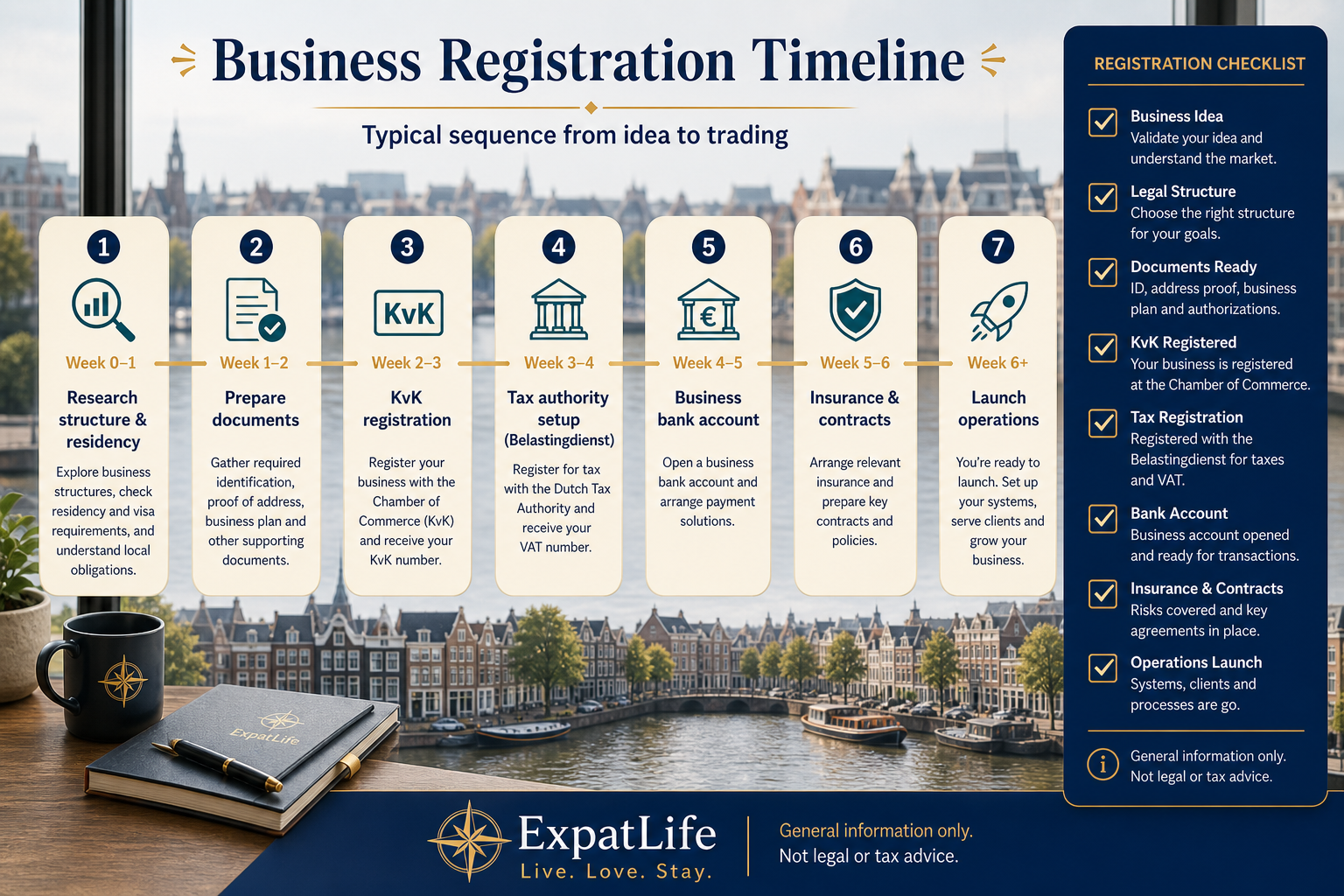
Typical timing
| Step | Typical timing | Example |
|---|---|---|
| Concept + structure choice | Week 1–2 | Model €35k year-one revenue; pick eenmanszaak vs BV |
| KvK registration | Week 2–3 | Pay ~€80 online; receive 8-digit KvK number |
| Belastingdienst BTW setup | Week 3 | Confirm BTW filing frequency before first 21% invoice |
| Business bank account | Week 3–5 | Allow 2–4 weeks; some banks wait after KvK date |
| First client invoice | Week 4+ | €4,500 ex BTW → €945 BTW line item if standard rate applies |
Registration checklist
Examples
| Profile | Scenario | What to check |
|---|---|---|
| New arrival — BSN first | Has BSN and address; launch date in 4 weeks | KvK timeline + BTW choice before first invoice. |
| BV with co-founder | Two shareholders; plans first hire in Q3 | Notary incorporation, shareholder agreement and payroll setup order. |
| Remote EU founder — Rotterdam | Existing EU clients; relocates to Netherlands | Tax residency shift, KvK registration and cross-border VAT with accountant. |
| Late registration | Operated 2 months before KvK | Backdating questions, BTW on past invoices — Belastingdienst and accountant. |
Three moves after mapping your registration order
Tax
Businesses in the Netherlands may encounter income tax, corporate tax, BTW (VAT), payroll taxes and ongoing reporting obligations — exact mix depends on structure and activity.
Expats with foreign clients, assets abroad or prior employment in other countries should treat tax planning as core setup. This is orientation only, not tax advice.
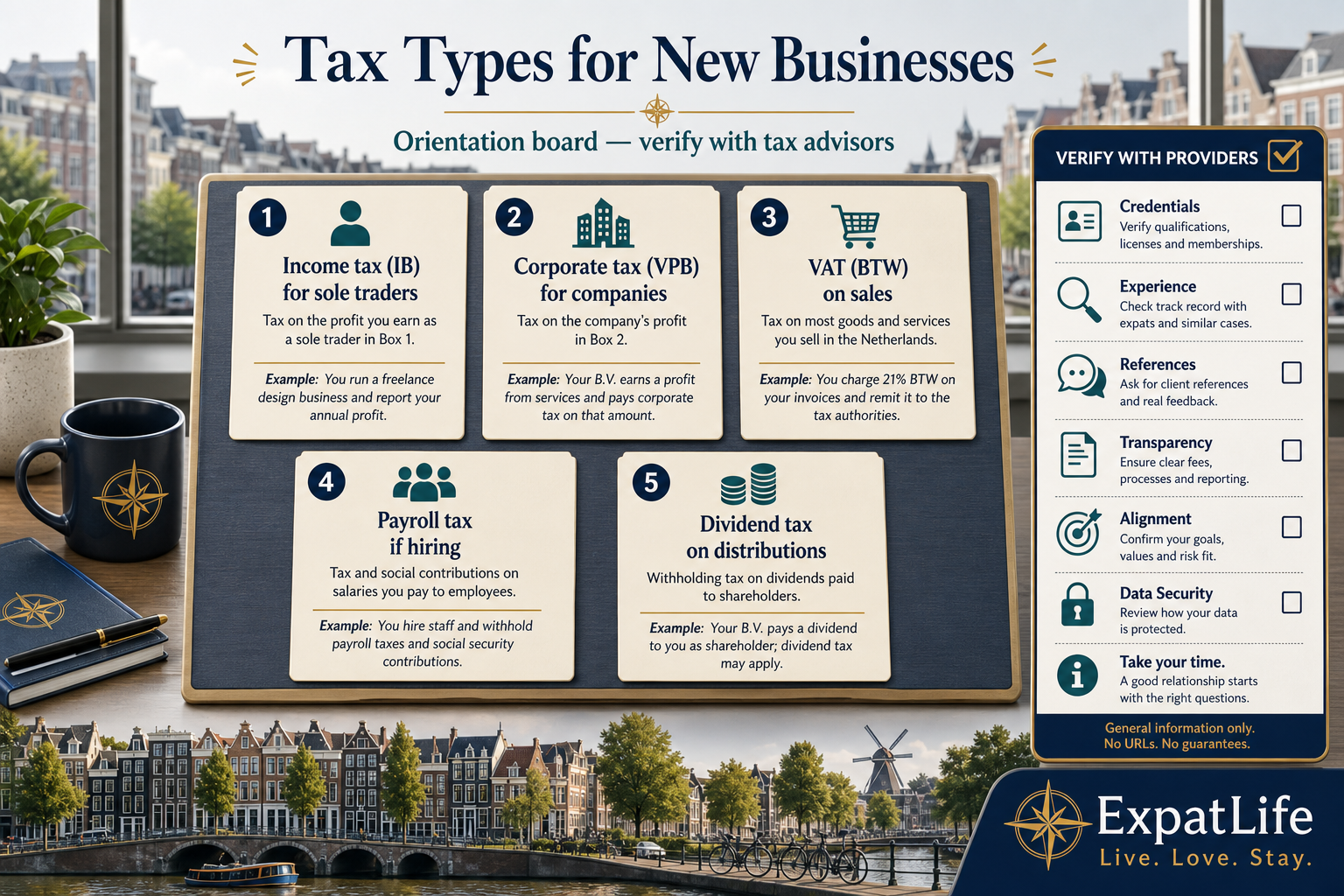
Tax planning checklist
| Tax area | Typical context | Confirm with accountant |
|---|---|---|
| Solo ZZP / eenmanszaak | Example: €30k profit → income tax on profit + often 21% BTW on invoices | KOR small business scheme if turnover under ~€20k — verify rules |
| BV | Corporate tax on profit + director salary/payroll | DGA salary norms with tax adviser — not forum guesses |
| EU B2B clients | Reverse charge may apply — 0% BTW on invoice with client VAT ID | Valid VAT ID proof on file per invoice |
| Quarterly BTW | Example: Q1 sales €24k ex BTW → ~€5,040 BTW collected to remit | Filing deadline on belastingdienst.nl calendar |
Worked examples
| Profile | Key figures | Example calculation | What to confirm |
|---|---|---|---|
| First BTW quarter — consultant | Q1 revenue €18,000 ex BTW | 21% BTW ≈ €3,780 to set aside; spent full €18k → cash crunch at filing | Payment plan with Belastingdienst if needed; accountant catch-up. |
| Mixed employment + business | Jan–Jun salary €42k · Jul–Dec profit €22k | Combined annual return — pro-rata BTW quarters in H2 | Accountant before first H2 invoice. |
| US SaaS clients — USD | $5,000/mo retainer · EUR accounting | Convert at invoice date; BTW/VAT treatment varies — reserve 30% orientation | Tax adviser before month 3 of billing. |
Examples
| Profile | Scenario | What to check |
|---|---|---|
| First-year surprise | Spent full revenue; large tax bill due | Payment plan with Belastingdienst; accountant for next-year reserves. |
| BV founder salary | Unsure about director salary vs dividends | Tax adviser on DGA and corporate tax — not forum advice. |
| Mixed employment + business | Jan–Jun employed; Jul–Dec entrepreneurship same year | Combined annual return and pro-rata BTW quarters with accountant. |
| US client retainer | Monthly USD invoices from SaaS customers | BTW/VAT treatment and income tax reporting — tax adviser setup. |
Three tax planning moves for year one
Tax & registration
Useful when structure choice, BTW registration or first-year filings still need scoped professional help alongside Belastingdienst guidance — not tax advice.
Blue Umbrella
Dutch tax filing and expat-focused support — useful for ruling-related questions, payroll context, and annual returns.
Paid services; confirm pricing for your case.
Visit provider →TaxSavers
Tax returns and advice aimed at internationals; helpful when you want hands-on filing or a second opinion on ruling paperwork.
Paid services; check current rates.
Visit provider →Expatax
Expat income tax guidance and ruling-related planning for employees in the Netherlands.
Paid services; confirm scope before engaging.
Visit provider →Some links may be affiliate or referral links. Listings are for discovery only — not pay-to-rank and not tax advice. Confirm credentials and scope with any provider. Learn more
Banking
Many businesses choose dedicated business banking to separate client payments from personal spending, simplify bookkeeping and present professionally to clients and partners.
Banks vary in fees, English support, integration with accounting tools and onboarding requirements for new KvK registrations.
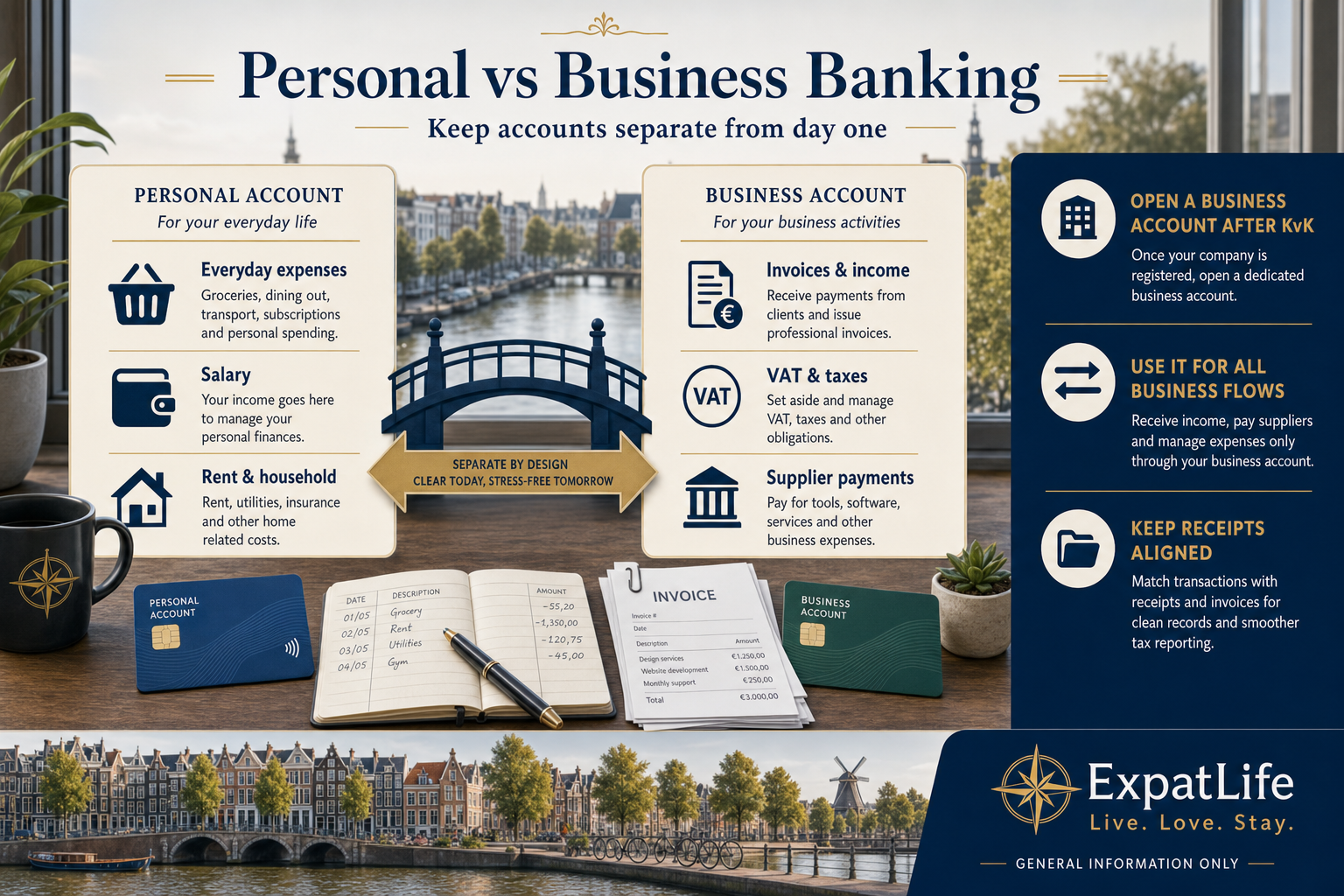
Business banking checklist
| Banking context | Typical pattern | What to confirm |
|---|---|---|
| Solo ZZP | Accounts often €0–€15/mo; some free tiers for 12 months | English support and accounting export format |
| BV | Corporate packages ~€15–€40/mo; payroll add-on extra | Multi-user access before first hire |
| International clients | SEPA €0–€0.25; FX on USD clients ~0.5–1.5%+ | Wise/PayPal vs bank for USD retainer |
| New KvK | Onboarding often 2–4 weeks after registration | Interim payment instructions for first €5k client |
Worked examples
| Profile | Key figures | Example calculation | What to confirm |
|---|---|---|---|
| New KvK — 3-week delay | Client pays €6,200 in week 2 | Temporary personal account receipt → transfer to business account when open; document for bookkeeper | Bank's KvK-age policy before signing client. |
| Multi-currency SaaS | €12k EUR + $8k USD/quarter | FX spread on $8k can cost €80–€150+/quarter — compare providers | Accounting treatment of FX gains/losses. |
Examples
| Profile | Scenario | What to check |
|---|---|---|
| New KvK — account delay | Bank wants 4 weeks after registration | Interim payment flow; inform clients of banking timeline. |
| Multi-currency clients | USD and EUR invoices same quarter | FX fees and accounting treatment — accountant and bank comparison. |
| Personal account mixing | All revenue through private account 6 months | Separate business account; retrospective bookkeeping cleanup. |
| BV payroll later | Plans first employee in 9 months | Bank payroll features and fee schedule before hiring. |
Three moves after comparing banks
Admin
Strong administration — bookkeeping, invoices, contracts, receipts and reporting — is critical for long-term business success and calmer tax seasons.
Systems set up in month one cost far less than reconstructing records after a busy launch quarter.

Administration checklist
| Admin area | Typical rhythm | What to confirm |
|---|---|---|
| Bookkeeping rhythm | Weekly capture, monthly reconcile is a common pattern | Software or accountant from first transaction |
| Invoices | Required fields differ when BTW applies | Template review before first Dutch B2B invoice |
| Contracts | Scope and IP disputes are expensive without writing | SOW for projects over a few days of work |
| BTW filings | Quarterly or annual depending on scheme | Belastingdienst deadlines in calendar from month one |
Examples
| Profile | Scenario | What to check |
|---|---|---|
| Shoebox receipts | No digital capture after 8 months trading | Accountant catch-up; implement app workflow immediately. |
| Verbal client deals | Scope disputes on fixed-fee project | Written SOW and change-order process for future work. |
| Subcontractor invoices | Pays freelancers without formal agreements | Contractor agreements and BTW on incoming invoices. |
| Annual accounts deadline | BV year-end approaching; books incomplete | Accountant engagement 6–8 weeks before deadline. |
Three admin moves for month one
Permits
Some entrepreneurs must consider residence permits, self-employment routes and startup programmes before relying on business income. Permit route and KvK registration are separate planning tracks.
This is orientation only — not immigration advice. Verify current rules on ind.nl and with qualified immigration advisers.
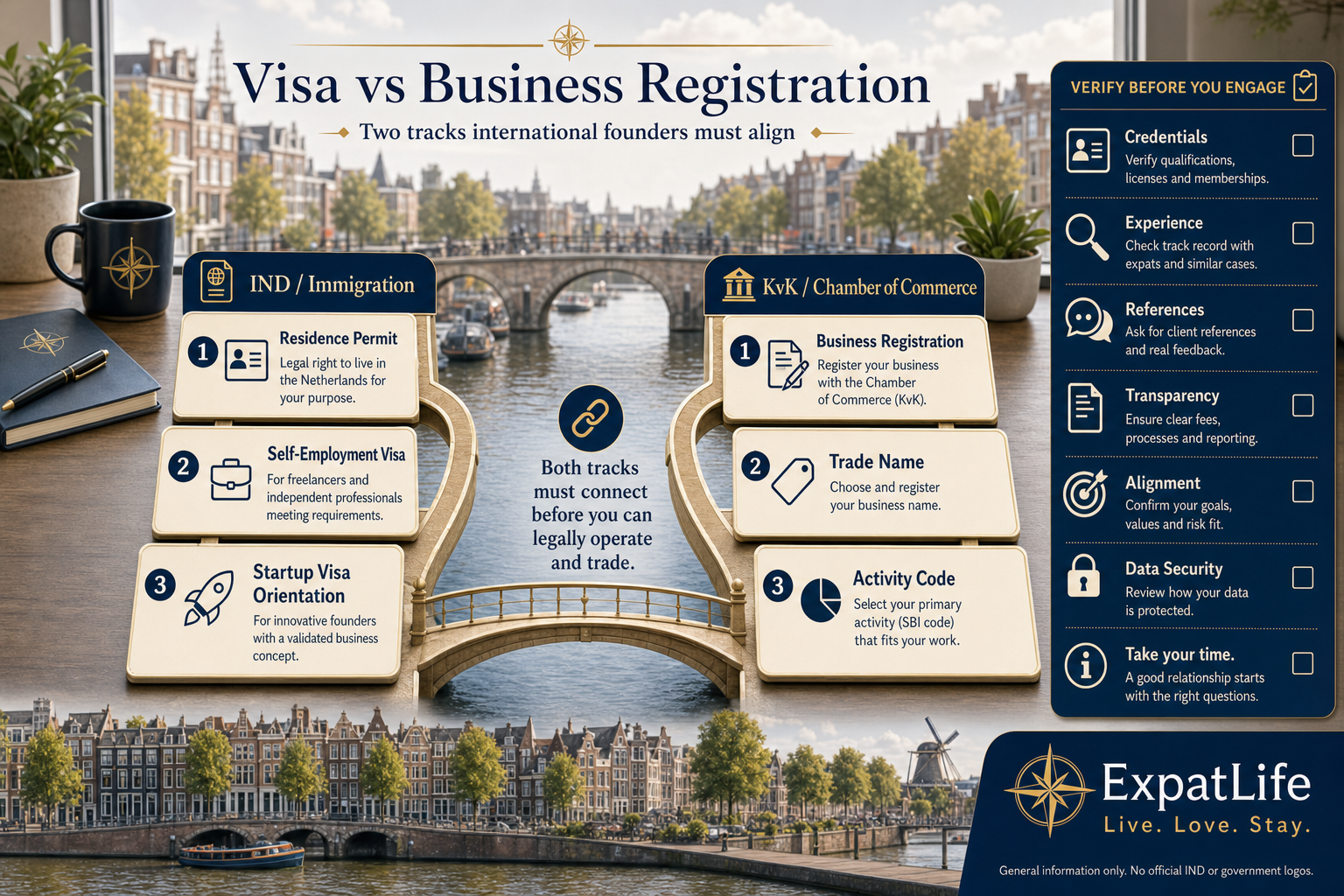
Permit checklist before KvK
| Route | Typical context | Verify on ind.nl |
|---|---|---|
| EU free movement | Often straightforward business registration | Activity, insurance and tax still your responsibility |
| Self-employed visa | Points-based entrepreneur route | Business plan and IND criteria — separate from casual projects |
| Startup visa | Facilitator-linked innovative startup route | Eligible facilitators on ind.nl; not all businesses qualify |
| Employment permit | Primary job tied to sponsor | Side business may be restricted — IND first |
Examples
| Profile | Scenario | What to check |
|---|---|---|
| HSM — side venture | Weekend ecommerce while in sponsored role | IND rules on additional activity before any sales. |
| Self-employed visa applicant | Building points-based business plan | IND criteria separate from KvK registration timing. |
| EU citizen — straightforward | German founder registers in Amsterdam | Still verify tax, insurance and activity — permit simpler than non-EU. |
| Startup facilitator | Accepted into accelerator; needs startup visa | Facilitator requirements on ind.nl and contract with programme. |
Three permit moves before relying on business income
Visa & permits
Useful when self-employment routes, startup permits or IND questions still need scoped professional help alongside official IND guidance — not immigration advice.

Fragomen
Global immigration law firm with a Netherlands practice. Handles corporate immigration, work permits, and relocations for employers and individuals.
From ~€175–300/hr; corporate packages on request
Visit provider →
Pathway Partners
Amsterdam-based immigration and legal services for individuals and businesses. Employment visas (HSM, Blue Card, ICT), self-employment permits, family reunification, naturalisation, objections (bezwaar), and humanitarian residence. Free eligibility assessment and consultation.
Free initial assessment; service fees vary. Family reunification from ~€500 per additional family member
Visit provider →
Everaert Advocaten
Dutch immigration law firm focused on residence permits, family migration, and IND procedures. One of the first in the Netherlands dedicated to immigration law.
From ~€150–275/hr; fixed fees for some applications
Visit provider →Immigration Advise NL
Immigration advisory practice (Marco van der Vinne; experience since 2001, formerly with Dutch Immigration Service). Affordable package options: pre-scan and DIY support, full handling, and objection procedures. MVV, residence permits, and extensions.
From ~€100 pre-scan and DIY; ~€200 full handling; ~€300 objection procedures (check current rates)
Visit provider →Some links may be affiliate or referral links. Listings are for discovery only — not pay-to-rank and not immigration advice. Confirm credentials and scope with any provider. Learn more
Ecosystem
The Netherlands hosts a dense startup ecosystem — incubators, accelerators, co-working spaces and investor networks cluster in Amsterdam, Rotterdam, Utrecht, Eindhoven and Delft.
Ecosystem support helps with network and mentorship; it does not replace KvK registration, tax compliance or permit rules.
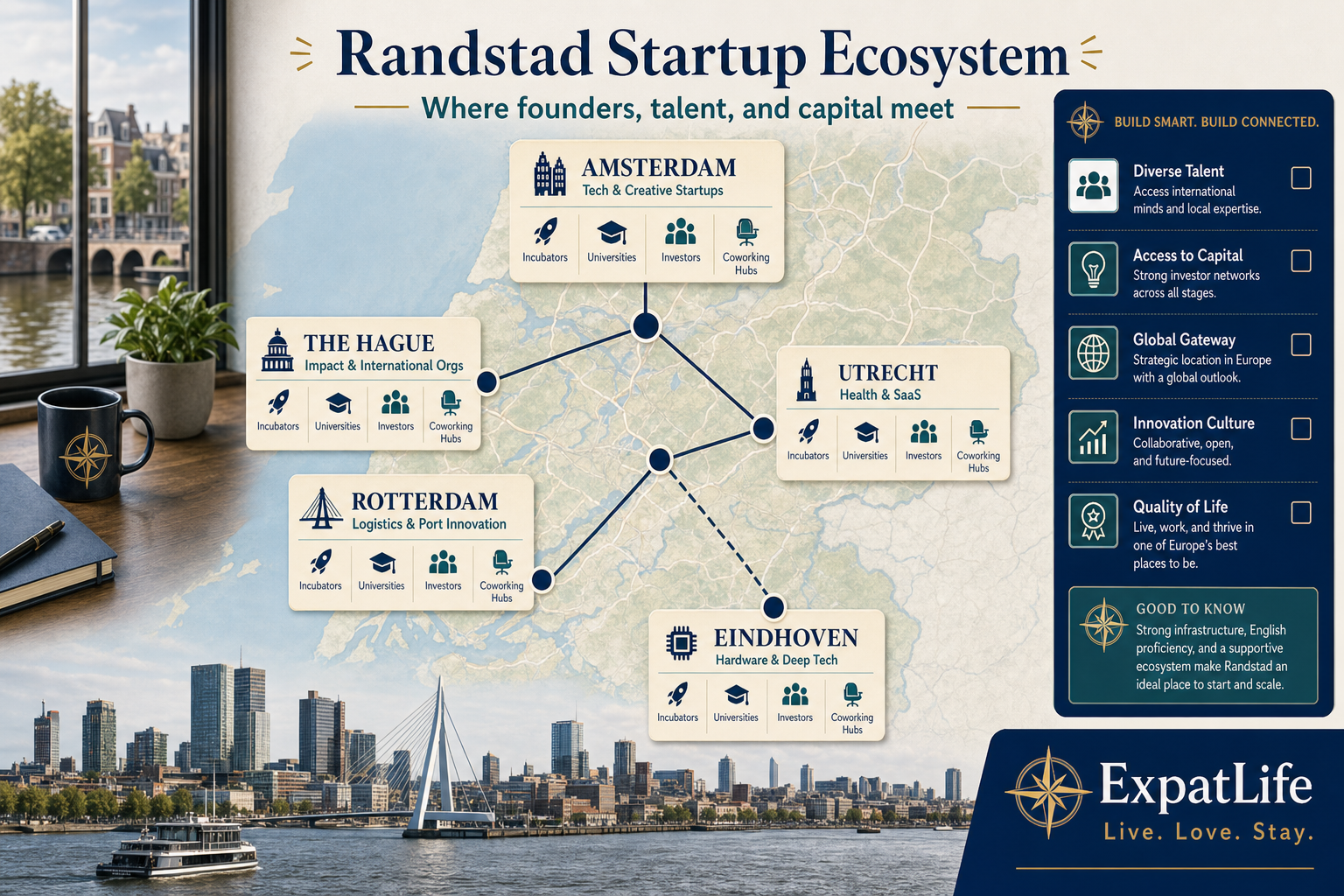
Programmes offer mentorship, workspace and sometimes startup visa facilitation — verify fit and equity terms.
Flexible space for early teams without long office leases — compare city costs.
Angels and VCs active in Amsterdam and Eindhoven — prepare admin and cap table basics first.
Brainport and Randstad corporates run innovation programmes — useful for B2B pilots.
RVO and regional agencies publish grants and orientation — verify eligibility on official sites.
Expat founder groups and industry meetups help with hiring and client introductions.
Examples
| Profile | Scenario | What to check |
|---|---|---|
| Accelerator acceptance | Offers €50k for 8% equity | Lawyer review of terms; KvK structure and cap table alignment. |
| Corporate pilot — Eindhoven | Hardware startup partners with ASML supplier network | IP, NDA and BV liability context before scaling production. |
| Grant application — RVO | Applies for innovation subsidy | Eligibility on rvo.nl; accountant for project accounting rules. |
Three moves when exploring the ecosystem
Location
City choice affects client access, costs, talent pools and startup networks. The Randstad and Brainport dominate international entrepreneurship, but smaller cities offer niche strengths.
Verify sector fit and cost of living before signing leases — remote and hybrid models reduce city lock-in for some businesses.
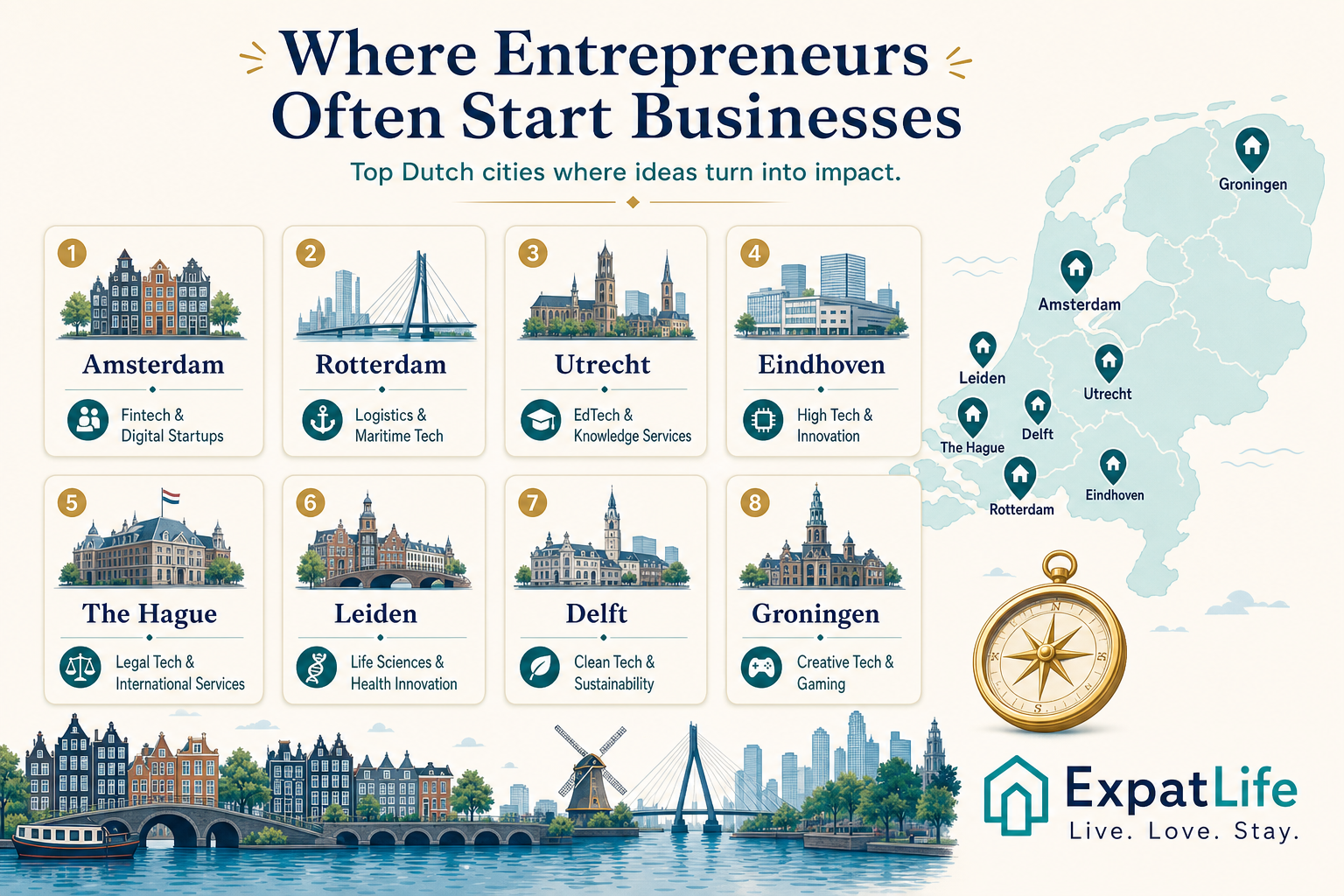
Strengths: tech, agencies, international clients. Co-working often €350–€650/month; higher salary competition.
Strengths: logistics, port trade. Office/co-working often €250–€450/month — lower than Amsterdam for many founders.
Central Randstad access; co-working ~€280–€500/month; strong health and gaming hiring pool.
Brainport hardware/deep tech; lab space premiums; strong TU/e intern pipeline.
International orgs and legal services; B2G clients; office costs mid-Randstad.
Life sciences cluster; Bio Science Park network; smaller founder scene than Amsterdam.
Engineering spin-offs; TU Delft talent; lower living costs than Amsterdam.
Northern hub; co-working ~€150–€300/month orientation; lower living costs.
| Factor | Typical pattern | Confirm for your sector |
|---|---|---|
| Client access | Amsterdam highest international density | Remote sales may reduce need to be in capital |
| Office cost | Amsterdam typically highest; Groningen lower | Co-working vs lease for your team size |
| Sector fit | Eindhoven hardware; Hague legal/institutional | Match city to industry network |
| Hiring pool | Randstad broad; university cities for interns | Hybrid roles widen geographic recruiting |
Worked examples
| Profile | Key figures | Example calculation | What to confirm |
|---|---|---|---|
| Amsterdam vs Utrecht — agency of 3 | Amsterdam desk €600/mo · Utrecht €380/mo | Save ~€2,640/year on space — weigh against client networking density | Visit two meetups in each city before lease. |
| Remote-first SaaS | Founder in Groningen · clients EU-wide | City cost matters less if sales are remote — still pick KvK address correctly | Registered address rules with KvK. |
City choice checklist
Examples
| Profile | Scenario | What to check |
|---|---|---|
| Amsterdam vs Utrecht — agency | Clients mostly remote; team of three | Utrecht office cost savings vs Amsterdam networking — test both meetups. |
| Hardware — Eindhoven | Needs lab space and TU/e interns | Brainport facilities and RVO programmes before Amsterdam default. |
| Diplomatic services — Hague | B2G and NGO clients | Sector network in Hague vs Amsterdam generalist scene. |
Compare routes
Some entrepreneurs start with freelancing, consulting or ZZP — others build agencies, technology companies, ecommerce brands or multi-person service businesses from day one.
The path can evolve: many founders register as ZZP first and restructure into BV or partnerships when hiring, raising capital or sharing ownership.
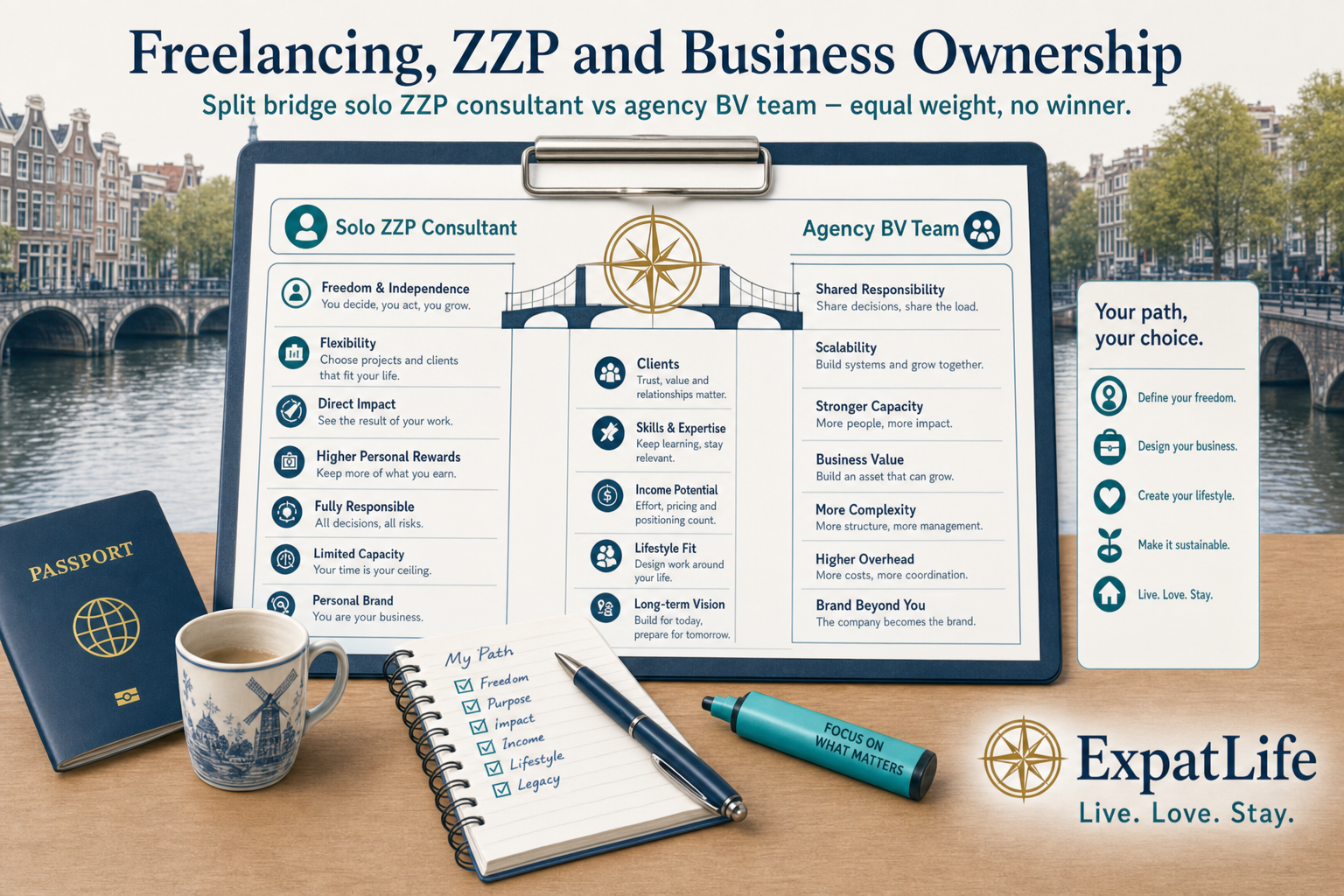
| Topic | Freelancing / ZZP | Broader business |
|---|---|---|
| Starting point | ZZP/eenmanszaak — fast solo setup | Agency or BV when hiring or sharing ownership |
| Income model | Client invoices; variable cash flow | Product revenue, retainers and payroll as you scale |
| Admin load | Bookkeeping + often BTW yourself | Payroll, corporate accounts and governance later |
| Permit context | Self-employment rules for solo work | Startup visa or employer sponsorship if team scales |
| Growth path | Many start ZZP; restructure later | Timing of BV conversion with tax adviser |
Examples
| Profile | Scenario | What to check |
|---|---|---|
| Consultant → agency | Year one ZZP; plans two hires year two | BV timing, payroll and client contract updates with accountant. |
| Ecommerce solo | Shopify store; no employees yet | BTW on sales, inventory accounting and KvK activity description. |
| Tech co-founders | Skip ZZP; start BV with two shareholders | Notary costs vs speed — lawyer for shareholder agreement. |
Three moves when choosing your route
Budget
Startup costs vary widely by structure, sector and speed of launch. Model categories conservatively — under-budgeting tax reserves and professional fees is common.
Ranges below are orientation examples, not quotes or guarantees. Confirm current fees on official sites and with providers.
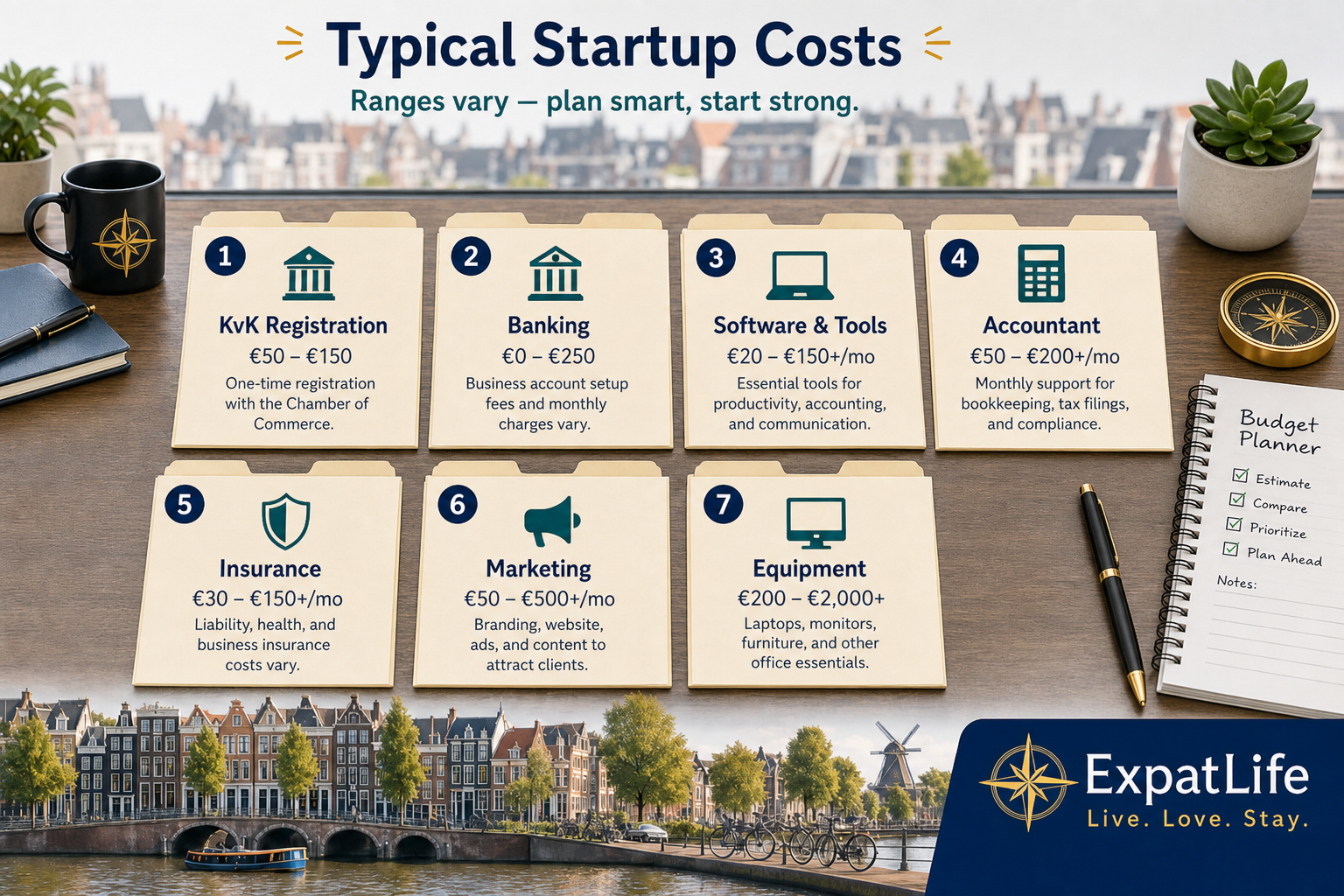
Eenmanszaak orientation: around €80 one-time (verify on kvk.nl). BV adds notary fees on top.
Typical range €0–€15/month early stage; corporate packages higher with payroll features.
Bookkeeping + invoicing often €15–€40/month; CRM add-ons €20–€80/month.
ZZP annual support often €800–€2,500/year; BV monthly €150–€400+ depending on complexity.
Professional liability often €30–€120/month by sector; ecommerce stock insurance separate.
Basic site €500–€3,000 launch; paid ads budget highly variable — model separately from registration.
| Cost area | Typical range / context | What to verify |
|---|---|---|
| ZZP / eenmanszaak | Lower setup; KvK fee + basic tools | Accountant and insurance as revenue grows |
| BV | Notary + higher ongoing compliance | Total first-year cost with corporate accountant |
| Ecommerce | Inventory and fulfilment cash tied up | Working capital separate from registration fees |
| Tax reserves | Many set aside 25–35% of revenue | Accountant refines for your structure and clients |
Worked examples
| Profile | Key figures | Example calculation | What to confirm |
|---|---|---|---|
| Lean ZZP — consultant | KvK €80 · software €25/mo · accountant €1,200/yr | Year-one setup ~€80 + €300 + €1,200 ≈ €1,580 before living costs | Add 25–35% tax reserve on revenue. |
| BV — two founders | Notary €2,000 · accountant €250/mo · minimal ads €1,000 | Pre-revenue setup often €5k–€8k in first 90 days | Notary quote before signing term sheet. |
| Ecommerce launch | KvK €80 · stock €12,000 · Shopify ~€30/mo | Inventory dominates — registration fee is not the main budget line | 6-month stock + returns buffer. |
Examples
| Profile | Scenario | What to check |
|---|---|---|
| Lean ZZP — consultant | KvK + software + accountant setup | €2–5k first-year orientation budget excluding living costs. |
| BV with two founders | Notary, accountant, minimal marketing | €5–15k+ setup range — get notary quote before committing. |
| Ecommerce launch | Stock purchase dominates registration fee | Inventory cash flow model separate from KvK cost. |
Three budget moves before you launch
Avoid
New entrepreneurs — especially expats — often repeat predictable errors: weak admin, optimistic tax math, no runway and structures chosen for appearance rather than fit.
Most costly mistakes happen in the first 90 days — before habits, buffers and professional relationships are in place. Use this section as a pre-launch reality check, not a post-mortem.
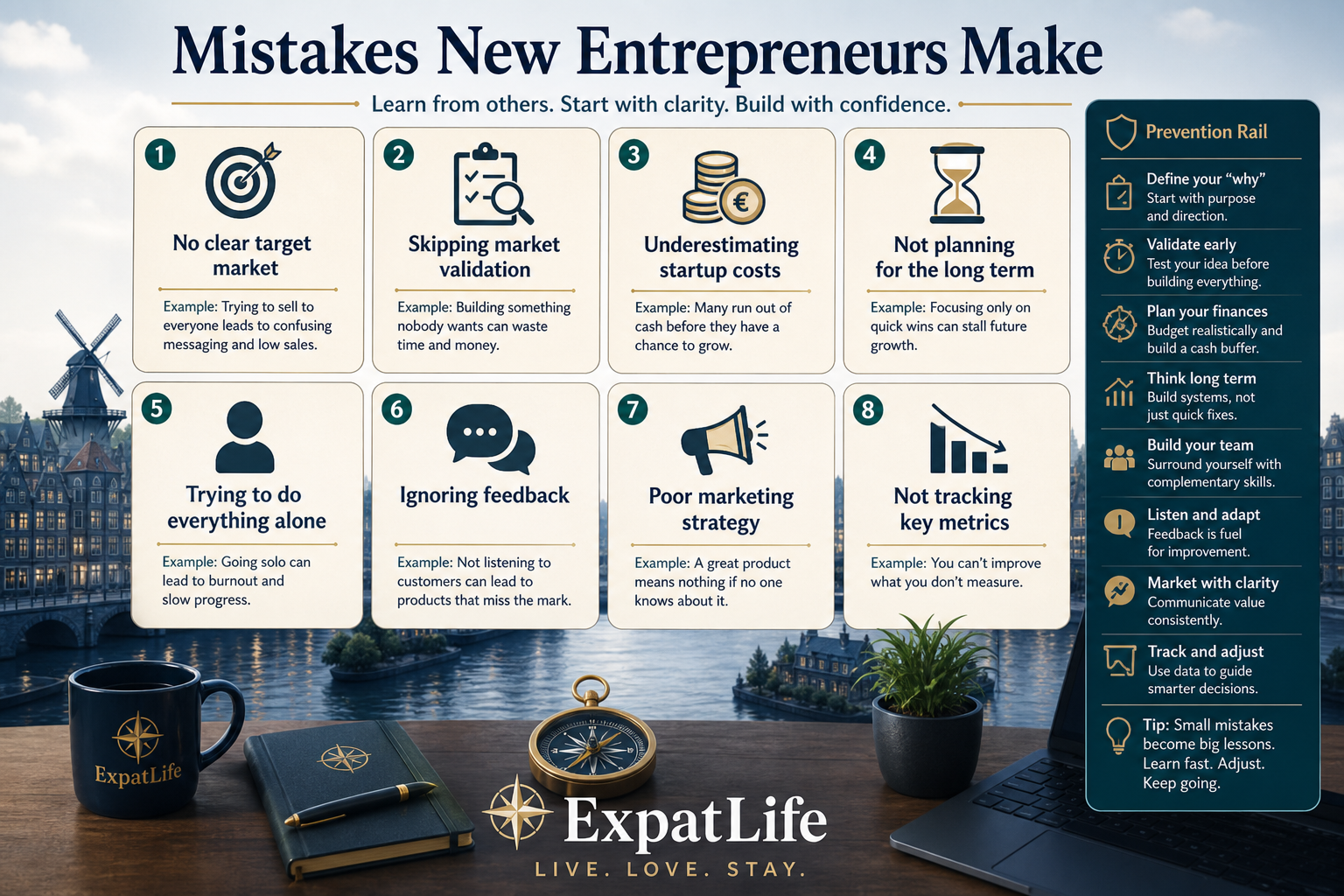
Scrambling at year-end costs time, money and risks compliance gaps.
Spending full revenue before BTW and income tax due dates.
No monthly cash-flow view; surprise shortfalls in quiet quarters.
Three to six months of personal expenses is a common buffer target.
Assuming international demand without Dutch client validation.
BV or partnership overhead before revenue justifies it.
Verbal deals fail on scope, IP and payment disputes.
Deferring accountant, lawyer or immigration help when complexity is already high.
Reality check before you launch
Examples
| Profile | Scenario | What to check |
|---|---|---|
| Premature BV | Incorporates before first paying client | ZZP may suffice year one — accountant on timing. |
| Permit + revenue | Invoices before IND clearance on side venture | Immigration lawyer before continuing activity. |
| No market test | Quits job for product with no pilot customers | Validate willingness to pay in Netherlands before full leap. |
| DIY cross-border tax | EU and UK clients; no accountant year one | Tax adviser before Q4 BTW and income tax surprise. |
Three moves after reading this section
Professional support
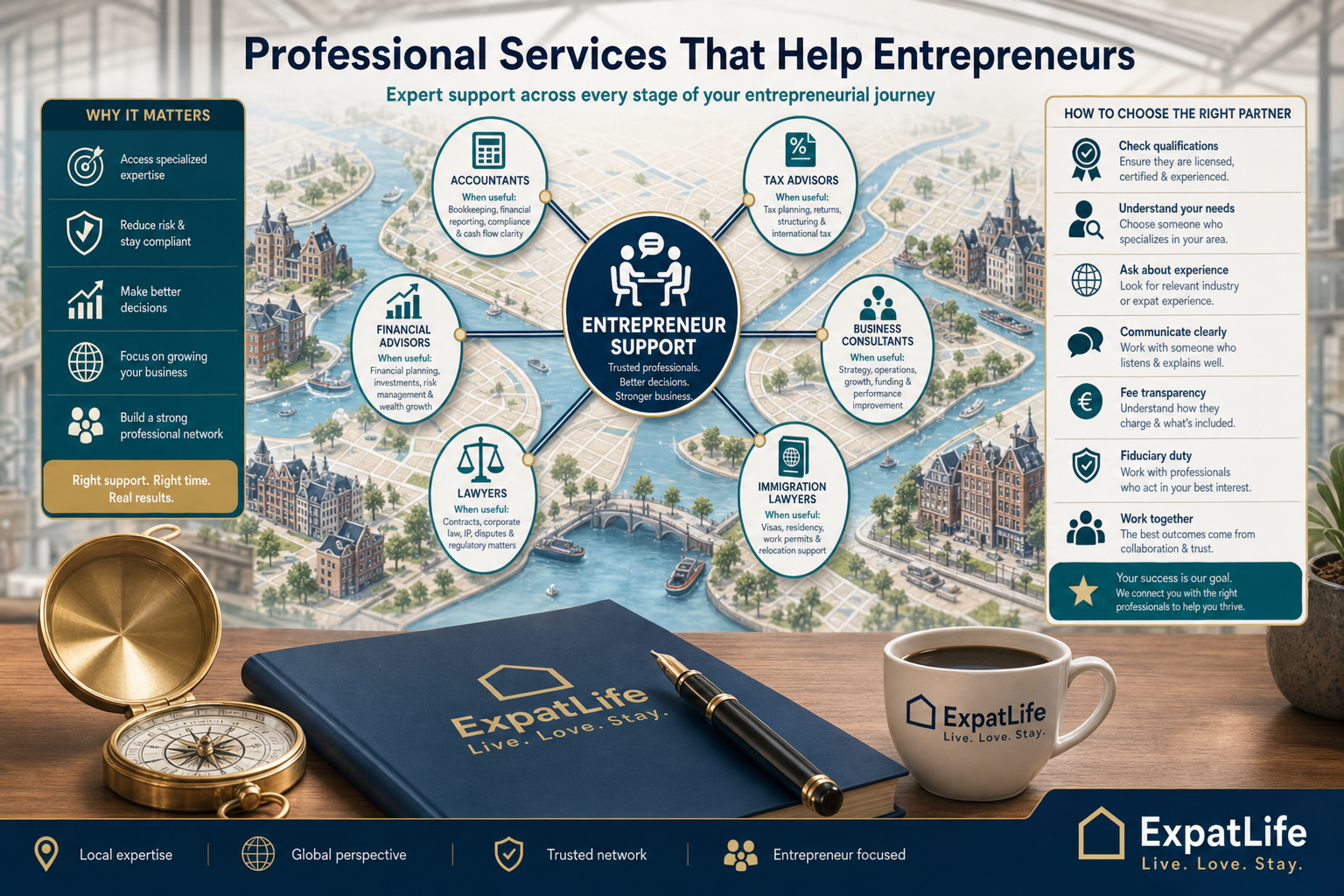
Accountants, tax advisers, immigration lawyers and business consultants can help with specific steps — they do not replace KvK registration, Belastingdienst filings or IND compliance.
Use professionals for scoped review on structure, cross-border clients, permits and first-year admin — still read official sources yourself.
Examples
| Profile | Scenario | What to check |
|---|---|---|
| Complex first year | EU + US clients; considering BV mid-year | Tax advisor + accountant scoping before structure change. |
| Permit change | Employment permit ending; wants full-time business | Immigration lawyer before relying on revenue pipeline. |
| First hire | ZZP founder ready to employ designer | Accountant on payroll; business consultant on org design. |
Launching a business often overlaps with KvK registration, structure questions, BTW and income tax setup, business banking, bookkeeping, immigration and permit checks and financial planning. These listings are for discovery when you need scoped help — not legal, tax or immigration advice. Confirm services, pricing and credentials before you commit.
Some links may be affiliate or referral links. If you use them, we may earn a commission at no extra cost to you. Ordering reflects relevance to business setup, not pay-to-rank. This is not legal, tax or immigration advice — verify outcomes with KvK, Belastingdienst, IND or qualified advisers. Learn more
Browse directories: Tax advisorsAccountantsImmigration lawyersBusiness consultantsFinancial advisorsBrowse all services
Tax & accounting
Helpful when structure, BTW and first-year filings still feel unclear before you register at KvK.
Blue Umbrella
Dutch tax filing and expat-focused support — useful for ruling-related questions, payroll context, and annual returns.
Paid services; confirm pricing for your case.
Visit provider →TaxSavers
Tax returns and advice aimed at internationals; helpful when you want hands-on filing or a second opinion on ruling paperwork.
Paid services; check current rates.
Visit provider →Expatax
Expat income tax guidance and ruling-related planning for employees in the Netherlands.
Paid services; confirm scope before engaging.
Visit provider →Visa & permits
Useful when residency status or self-employment routes may constrain when and how you can operate.
Fragomen
Global immigration law firm with a Netherlands practice. Handles corporate immigration, work permits, and relocations for employers and individuals.
From ~€175–300/hr; corporate packages on request
Visit provider →Pathway Partners
Amsterdam-based immigration and legal services for individuals and businesses. Employment visas (HSM, Blue Card, ICT), self-employment permits, family reunification, naturalisation, objections (bezwaar), and humanitarian residence. Free eligibility assessment and consultation.
Free initial assessment; service fees vary. Family reunification from ~€500 per additional family member
Visit provider →Everaert Advocaten
Dutch immigration law firm focused on residence permits, family migration, and IND procedures. One of the first in the Netherlands dedicated to immigration law.
From ~€150–275/hr; fixed fees for some applications
Visit provider →Immigration Advise NL
Immigration advisory practice (Marco van der Vinne; experience since 2001, formerly with Dutch Immigration Service). Affordable package options: pre-scan and DIY support, full handling, and objection procedures. MVV, residence permits, and extensions.
From ~€100 pre-scan and DIY; ~€200 full handling; ~€300 objection procedures (check current rates)
Visit provider →Relocation
Many founders line up housing, banking and family logistics alongside registration — confirm what you need independently.
Expat2Holland
Relocation and settling-in support for internationals, including housing, registration, and practical onboarding.
Full package from ~€1,500–3,000; à la carte from ~€200–500 per service. Employer packages often higher.
Visit provider →Jimble
Relocation and mobility services for expats and internationals in the Amsterdam area.
Packages vary; often €1,000–2,500+ for core relocation. Check directly for quote.
Visit provider →RSH Relocation and Immigration Services
Relocation and immigration services for internationals and families, including housing and registration support.
From ~€1,200 for basic package; full relocation €2,000–4,000+. Immigration support often separate.
Visit provider →RelocAid
Relocation support for expats and families, including housing search, registration, and settling-in assistance.
Packages from ~€1,000; full family relocation €2,000–3,500+. Confirm scope and quote.
Visit provider →Post-setup essentials
Separate business finances, mandatory insurance and admin tools often follow KvK registration — scope and fees differ by provider.

bunq
Digital bank with expat-friendly signup and multi-currency options. Often used for quick account setup and international use.
From ~€2.99/mo
Visit provider →
Zilveren Kruis
One of the largest Dutch health insurers (Achmea). Broad care network, basic and supplementary packages; widely recognised by expats.
~€145–162/mo
Visit provider →Funda
Major Dutch platform for homes for sale and rent. Listings from estate agents and landlords across the Netherlands.
Free to browse; agent or landlord fees may apply.
Visit provider →
Knab
Dutch online bank (no branches). Full Dutch payment account with iDEAL and debit card; often chosen for straightforward pricing and digital experience.
From ~€3.50/mo
Visit provider →
CZ
Large Dutch insurer with a big customer base. Standard basic and various supplementary packages; solid option for daily cover.
~€142–158/mo
Visit provider →
HousingAnywhere
Online platform connecting people looking for a home with landlords. Not a real estate agency. Mid- and long-term furnished rentals.
Check platform pricing and booking fees.
Visit provider →
Independer
Compare Dutch basic health and other insurance when you are choosing a policy.
Free comparison; insurer premiums vary.
Visit provider →ExpatCopilot may earn a commission from some partners. Listings here support business setup planning — not pay-to-rank placement and not legal, tax or immigration guarantees. Confirm scope, credentials and pricing with any provider. Learn more
Professional listings help discovery — they do not replace KvK registration, Belastingdienst filings or IND compliance. Confirm credentials and scope before hiring.
Launch
Use this checklist as a practical launch sequence — adapt order if your permit or structure requires different timing.
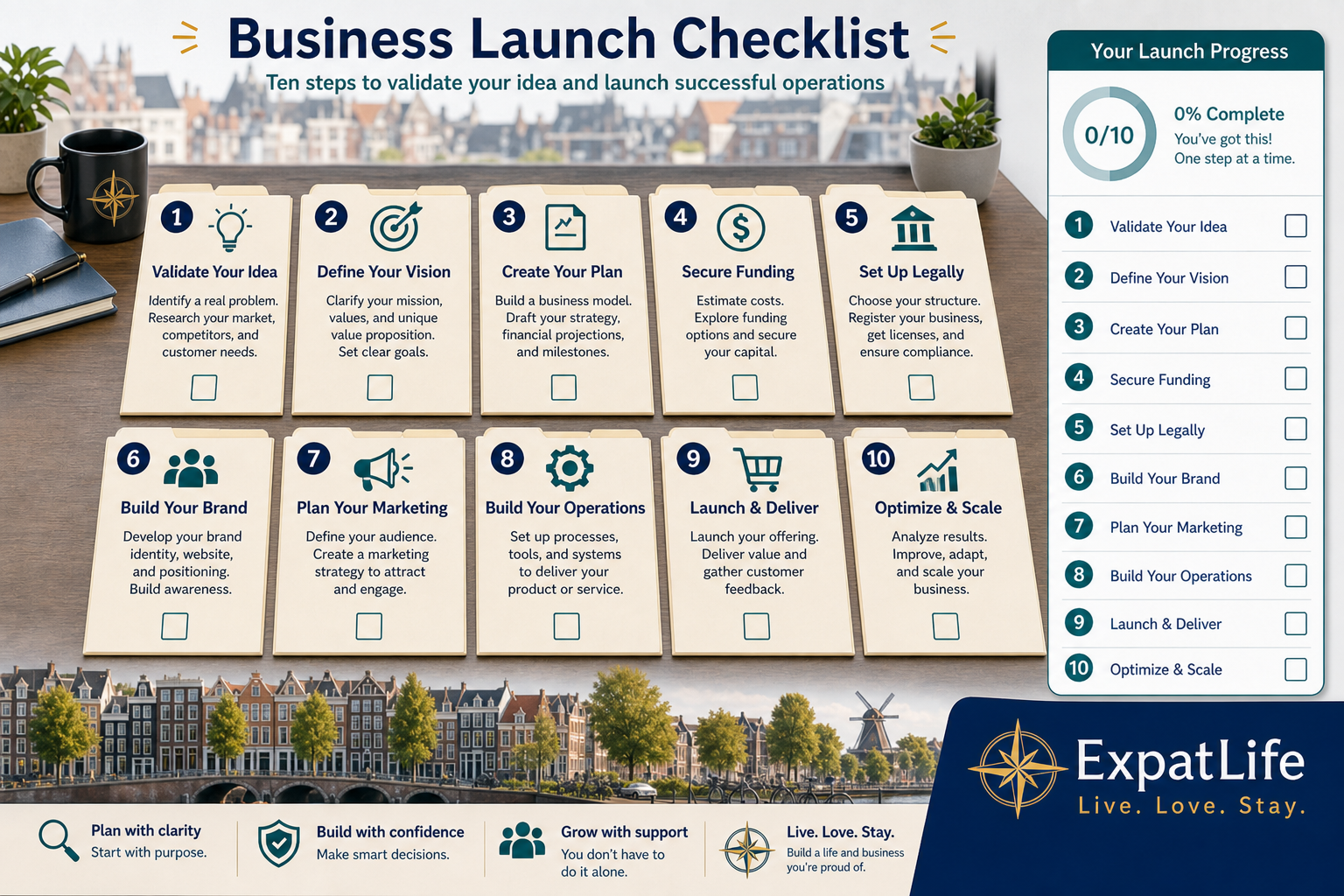
Business launch checklist
Examples
| Profile | Scenario | What to check |
|---|---|---|
| Permit-first founder | IND clearance pending; concept validated | Permit before KvK if employment-linked; otherwise parallel planning. |
| Ecommerce launch | Shop ready; stock inbound | BTW on sales, returns policy and inventory records before ads go live. |
| Agency — two founders | BV incorporated; no clients yet | Contracts and banking before team salaries or subcontractor spend. |
Three moves after working through the checklist
Ask early
Use these prompts with accountants, KvK, IND and advisers — verify your situation independently.

| Ask | Question | Why it matters |
|---|---|---|
| KvK | Which legal form fits my activity and ownership plans? | Registration choice affects admin and public records from day one. |
| Accountant | What tax and BTW setup fits my client mix in year one? | Avoid incorrect invoices and Belastingdienst corrections. |
| IND / immigration adviser | Does my permit allow this business activity and revenue? | KvK success does not replace permit compliance. |
| Bank | What documents do you need for a new KvK registration? | Prevents payment delays while account onboarding completes. |
| Co-founder / partner | What happens if one of us exits in the first 12 months? | Shareholder or partnership agreements should cover exits early. |
| Financial adviser | How many months of runway should I hold before going full-time? | Employment safety nets do not transfer automatically. |
Quick answers
Yes — example: EU founder registers eenmanszaak online in week 2; non-EU founder may need IND route first. KvK success does not replace permit rules.
No — citizenship is not required. Example: Indian consultant with valid residence permit registers at KvK for ~€80; verify work rights on ind.nl.
Chamber of Commerce — assigns 8-digit KvK number (e.g. 12345678 format). Central to registration; fee for eenmanszaak around €80 (verify on kvk.nl).
Often 21% BTW on B2B invoices plus income tax on profit. Example: €10k ex BTW sale → ~€2.1k BTW to set aside; many founders reserve 25–35% total until accountant confirms.
Not always mandatory for every form, but practical from first €5k+ client payment — banks often want KvK extract and ID; onboarding 2–4 weeks.
Yes — example: Rotterdam consultant invoices DE client €8k/quarter with reverse charge. Cross-border rules vary per client country.
Lean ZZP often €1.5k–€5k year one (excl. living costs): KvK ~€80, software, accountant. BV setups often €5k–€15k+ with notary.
Depends on revenue and co-founders — example: €30k solo → eenmanszaak; two founders hiring at €60k → BV discussion. Confirm with accountant.
Examples
| Profile | Scenario | What to check |
|---|---|---|
| Before registering | Knows KvK basics but not permit rules | IND first for employment-linked permits, then KvK. |
| Structure paralysis | Debating BV vs ZZP for 3 months | Accountant scoping call with revenue forecast — decide and move. |
| Bank + tax same week | Launch date fixed; admin not ready | Use conversation prompts with bank and accountant in one planning week. |
FAQ
These answers help you identify what still needs verification — registration, tax, permits and financial planning.
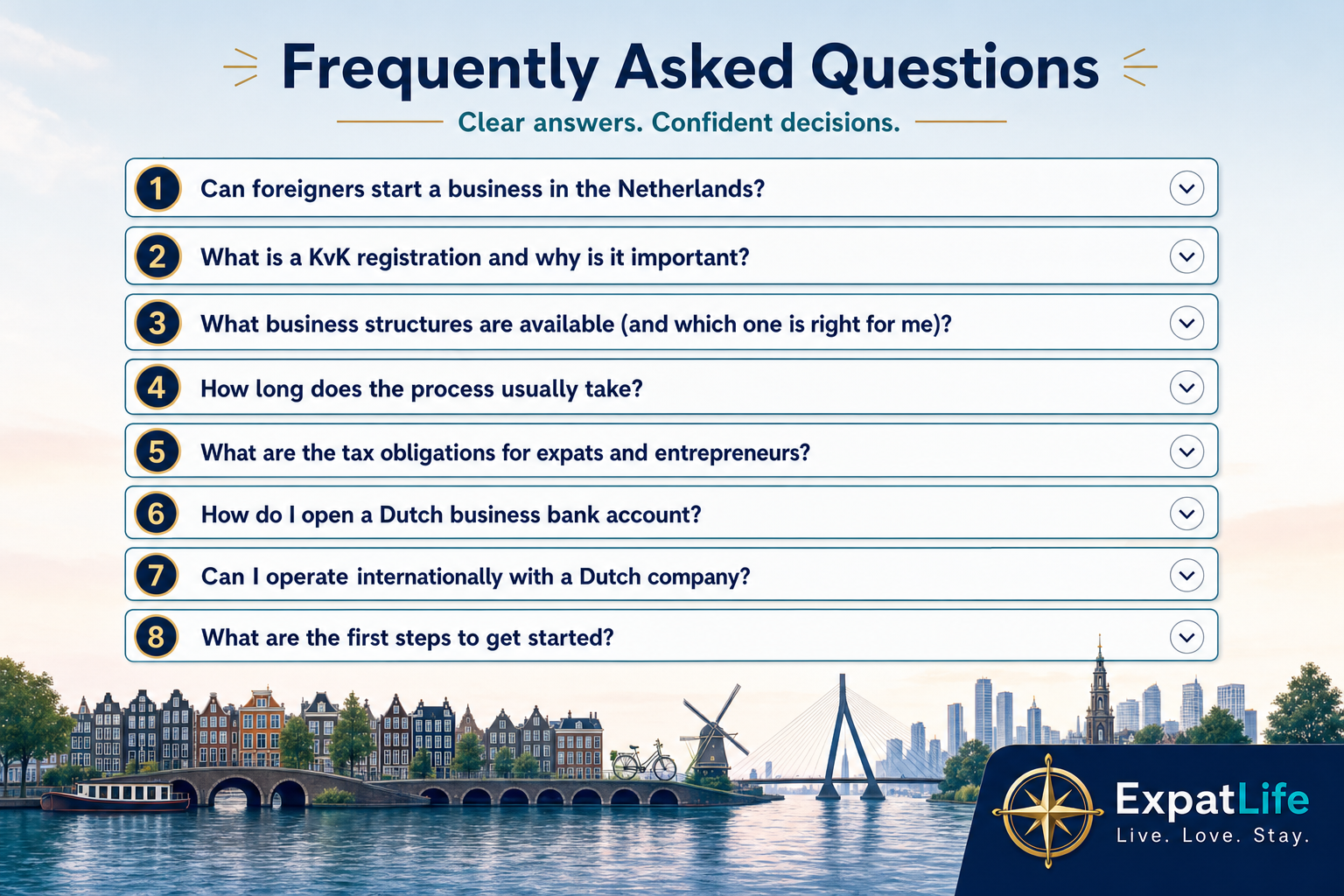
Yes — EU founders often register within 1–5 business days once BSN and address are ready. Non-EU founders should verify IND rules before relying on revenue.
The Dutch Chamber of Commerce. You receive an 8-digit KvK number; eenmanszaak registration fee is around €80 (verify on kvk.nl).
Common forms include eenmanszaak (solo, ~€80 KvK), BV (notary ~€1.5k–€3k+), VOF/maatschap partnerships and stichting non-profits.
Solo KvK online often 1–5 business days; BV adds notary weeks. Banking may take 2–4 weeks after KvK.
Often 21% BTW on invoices plus income tax on profit. Example: reserve 25–35% of revenue until an accountant confirms your situation.
Strongly practical from early client payments — many founders open one in week 3–5 after KvK, before €5k+ invoices.
Yes — many invoice EU clients with reverse charge or local VAT rules. Confirm per client with accountant before scaling cross-border.
Model year-one revenue, confirm permit if needed, register KvK (~€80), set BTW admin, open bank (2–4 weeks), then invoice with contracts and reserves in place.
Examples
| Profile | Scenario | What to check |
|---|---|---|
| FAQ to action | Understands foreigners can start; ready to register | Walk registration section + accountant shortlist. |
| Structure FAQ | Read structures list — still unsure | KvK orientation call or accountant scoping — do not guess. |
| International FAQ | Plans US and EU clients from year one | Foreign income guide + tax adviser before cross-border invoices. |
Trust
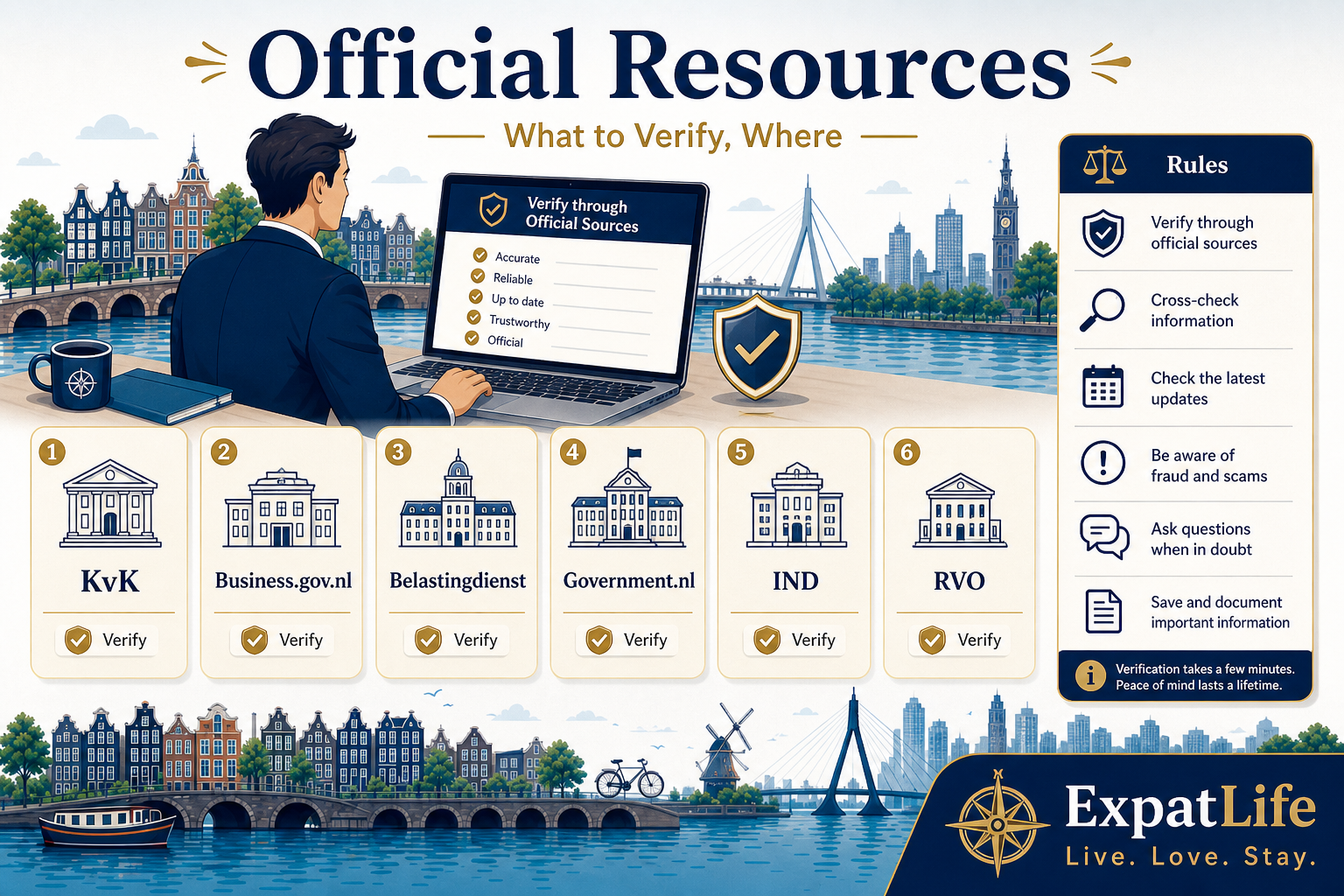
Business regulations, registration requirements, taxes and immigration rules can change over time. Always verify current information through official resources.
Examples
| Profile | Scenario | What to check |
|---|---|---|
| Source routing | Unsure whether question is tax or permit | Permit → IND; registration → KvK; tax → Belastingdienst; grants → RVO. |
| KvK vs Belastingdienst | Registered at KvK; unsure about BTW filing | Belastingdienst for BTW; KvK does not handle tax returns. |
| Business.gov.nl orientation | Wants English setup checklist | Business.gov.nl overview, then KvK and Belastingdienst for specifics. |
Business & work
Connect business setup to ZZP, freelancing, taxes, services and financial planning.
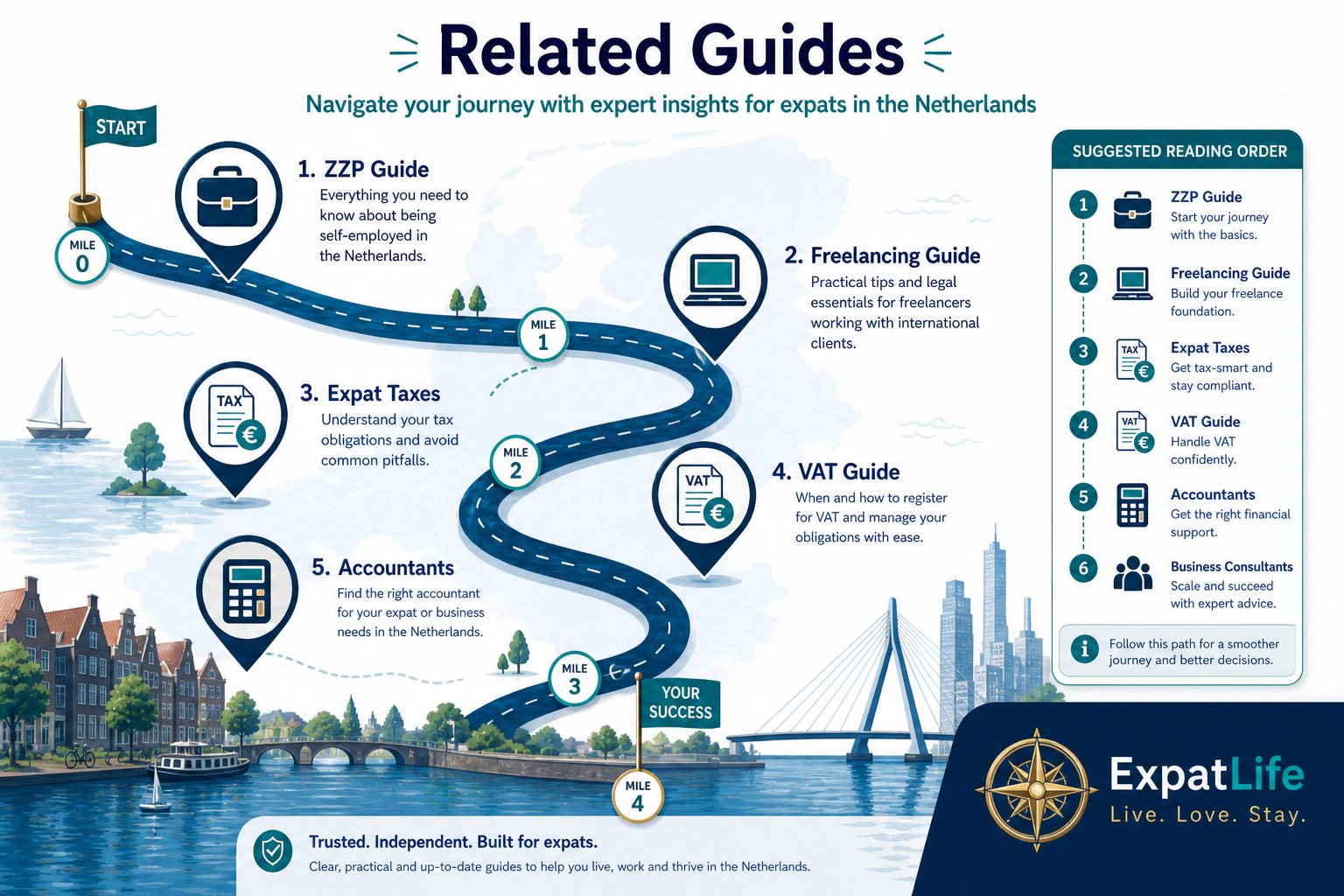
Suggested reading order
Examples
| Profile | Scenario | What to check |
|---|---|---|
| Just registered | KvK done; first Dutch client next week | ZZP or freelancing invoicing guides + expat taxes for set-asides. |
| Scaling EU clients | Three new countries in pipeline | Foreign income and tax advisors before first cross-border invoice. |
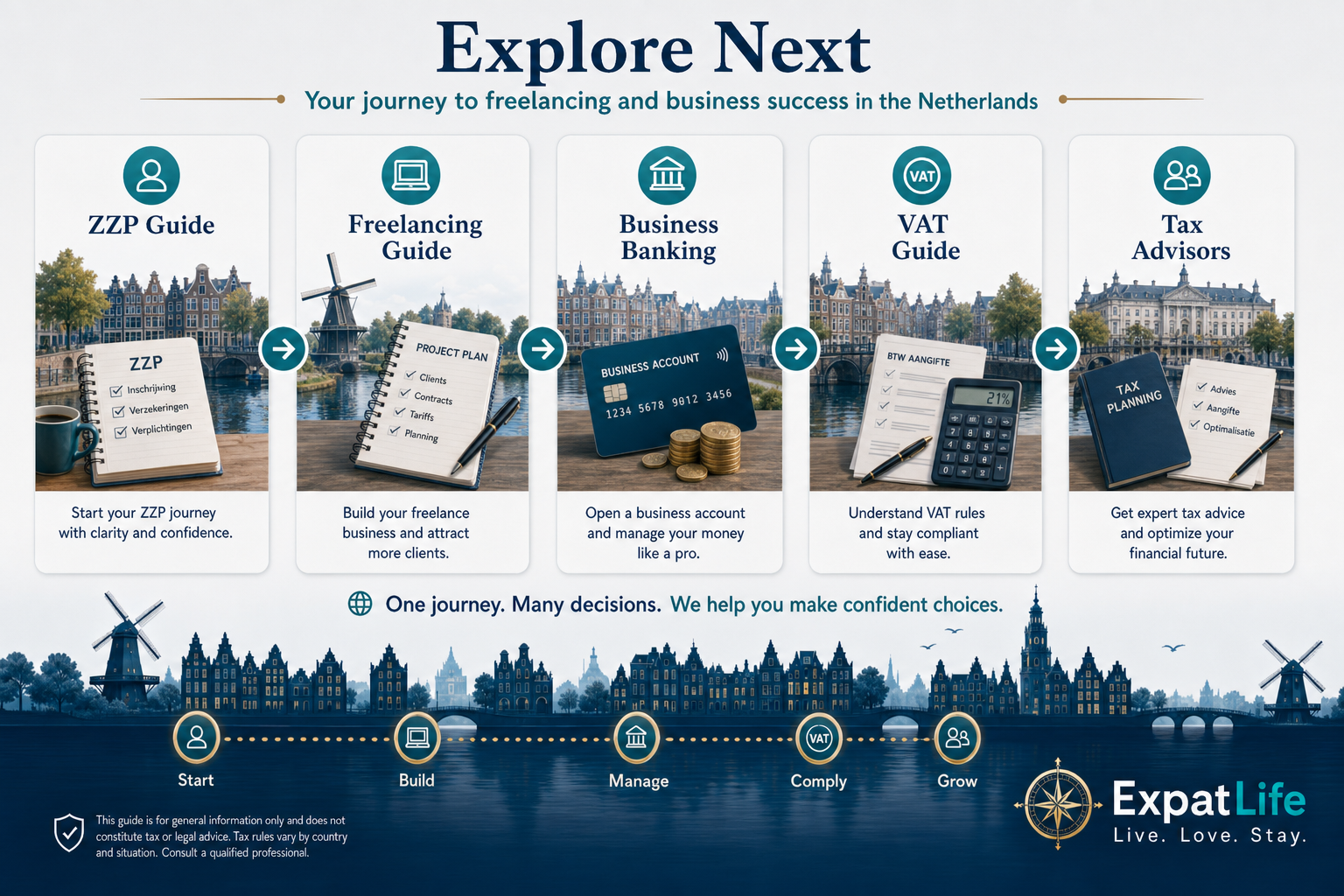
Explore next
Move from business orientation into ZZP, freelancing, taxes, banking and professional support.