
Dutch name
Studentrekening
Everyday IBAN with student pricing
Netherlands · Money · Banking
How a Dutch studentrekening works for enrolled students: eligibility cues, package perks, indicative 2026 fee bands, international student documents, and a calm graduation transition — orientation only.
General orientation only — not financial, legal or immigration advice. Student products, fees, age limits and enrolment proofs differ by bank and personal situation. Confirm details with your bank and, when needed, a qualified adviser before you open or convert an account. Visa questions belong on the Student visa guide.

Quick answer
A Dutch studentrekening is a student everyday bank account: an IBAN designed for enrolled students, often with lower monthly fees and package perks while you study. International and Dutch students use it for rent, tuition transfers, groceries and everyday Dutch debit payments.
This page is the student-package deep dive — eligibility cues, perks, indicative 2026 fee bands, international documents, and what happens after graduation. The full account-types taxonomy lives on Types of bank accounts. Visa and residence questions live on Student visa. Shared household IBANs live on Joint bank accounts.
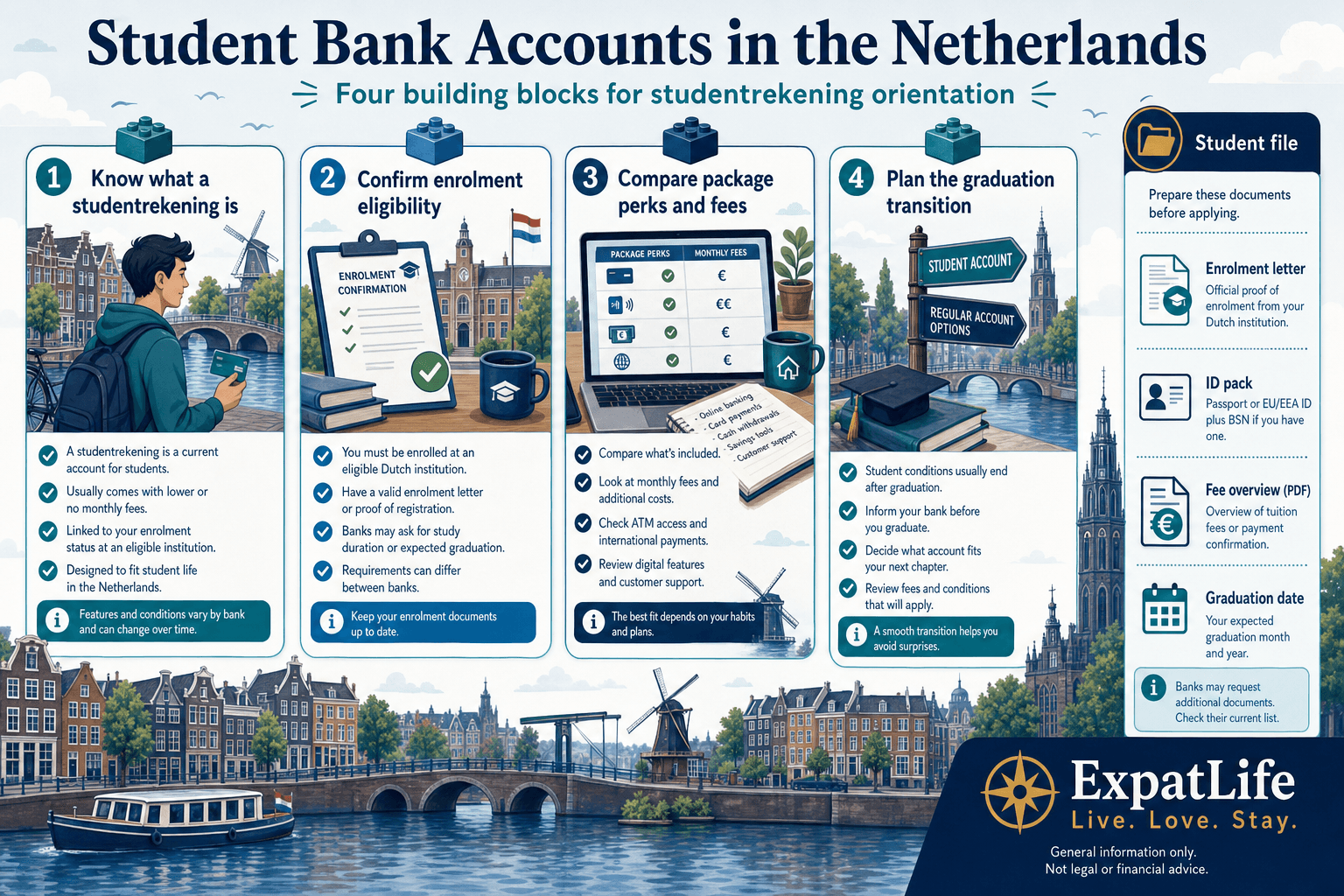
Student readiness file — keep these together
Examples
| Situation | How it works here | First step |
|---|---|---|
| Just enrolled at a Dutch university | Open a student package once enrolment proof is ready | Download the enrolment letter before you start the bank form |
| International student with a new BSN | Complete KYC with ID, address and enrolment — visa detail lives on Student visa | Check Open a bank account for document timing |
| Graduating in six months | Keep the IBAN if possible; budget the switch to regular pricing | Ask the bank how student-to-regular conversion works |
Snapshot
Six cards summarise studentrekening norms for enrolled students. Deeper sections expand each theme without ranking banks.
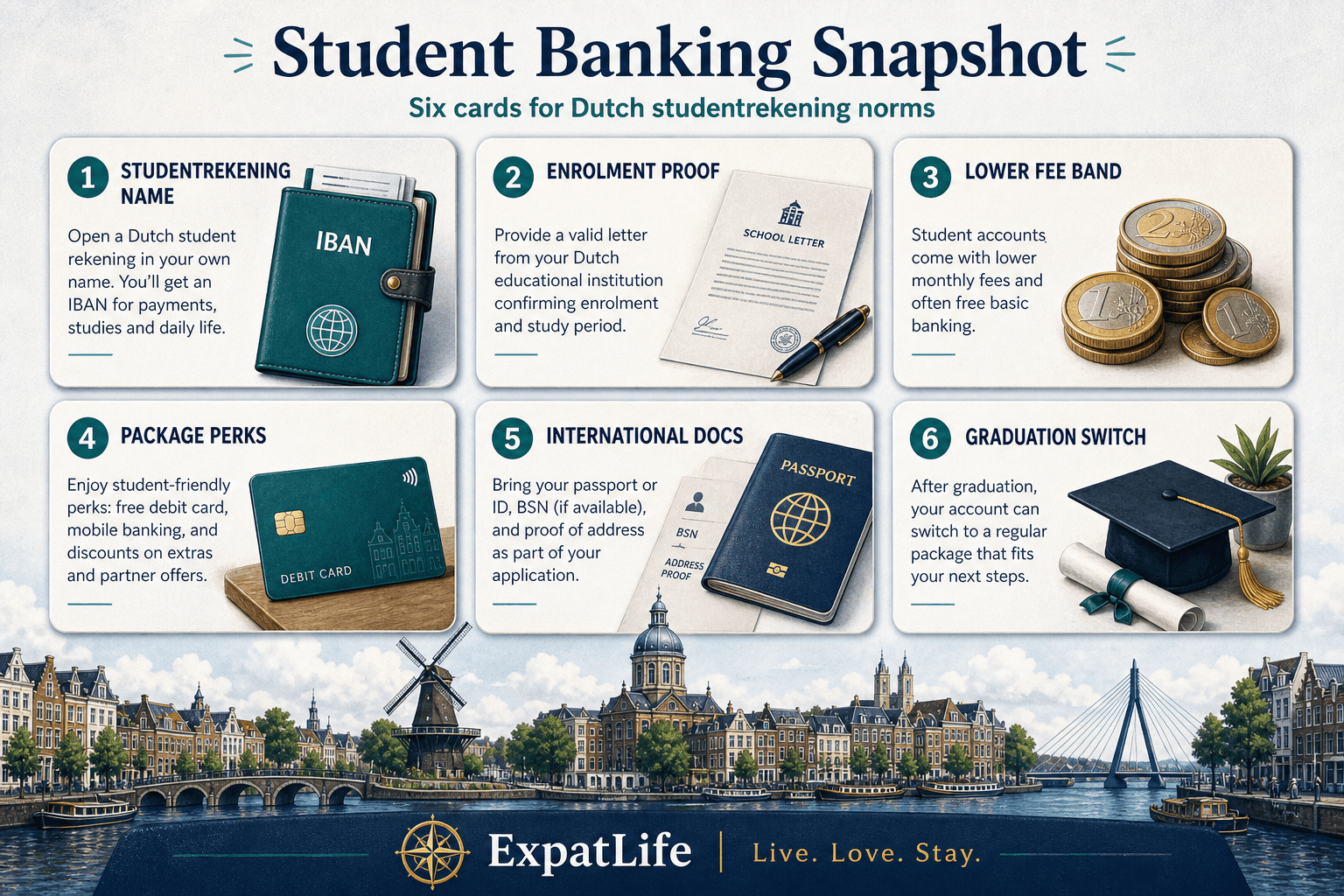
Dutch name
Studentrekening
Everyday IBAN with student pricing
Must show
Enrolment proof
School or university confirmation
2026 cost cue
Often €0–€3.50/mo
Below many regular packages
Must plan
Graduation switch
Student pricing usually ends
Eligibility, package perks, indicative student fee bands, international documents and graduation transition for expats.
An everyday payment account with student-oriented pricing while you are enrolled.
Enrolled students who meet the bank’s age and enrolment rules and complete identification.
Lower monthly fees and student extras are common — always verify live package pages.
Account taxonomy → Types of accounts. Visas → Student visa. Shared IBANs → Joint bank accounts.
Need the general onboarding path first? Open a bank account — then return here for student-specific habits.
Definition
Studentrekening is the everyday Dutch phrase for a student current account: a payment IBAN with student-oriented fees and perks while you are enrolled. It is not a separate “magic product type” outside the banking system — it is an everyday account with student eligibility rules.
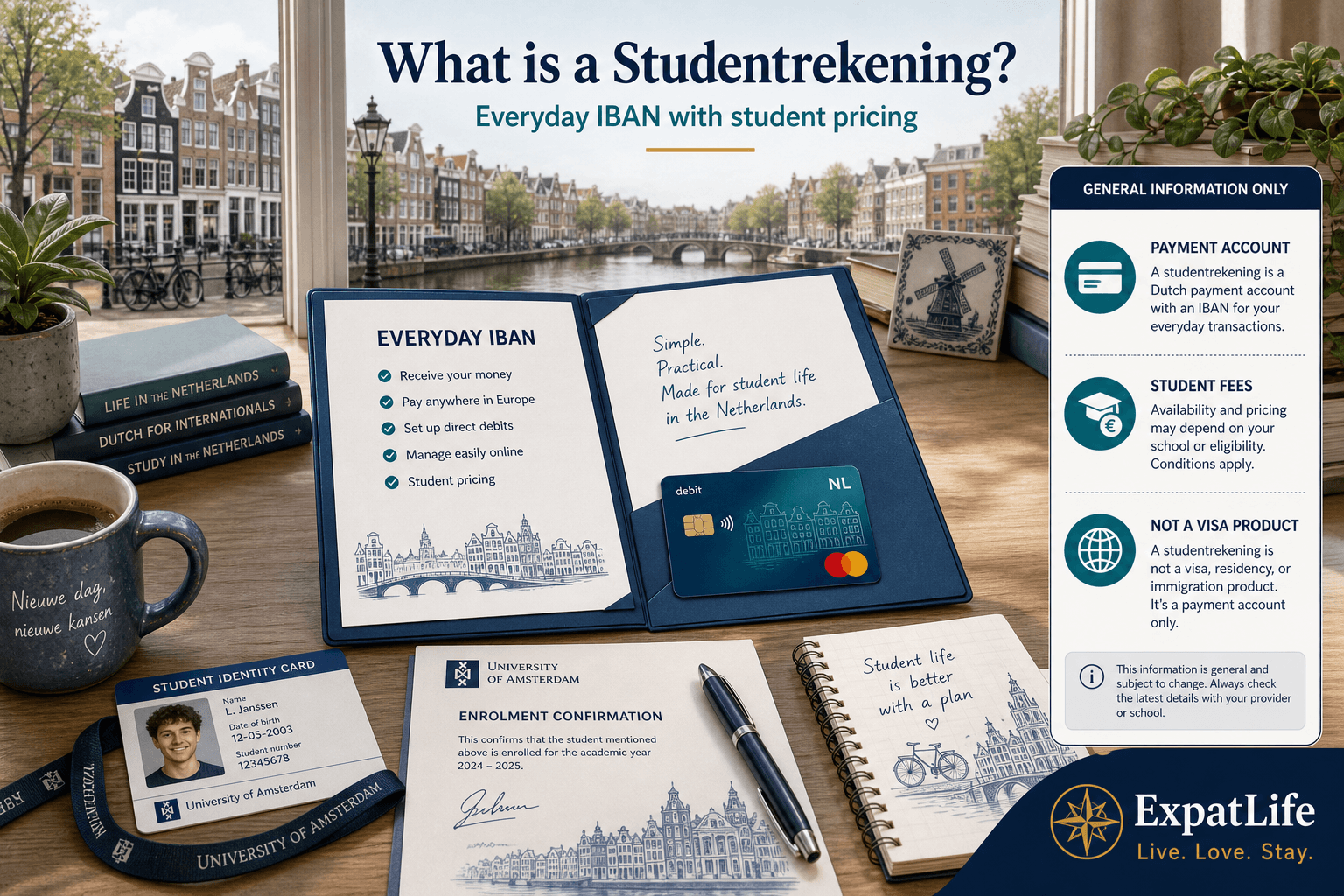
What a studentrekening is
Most students use the IBAN for rent, public transport top-ups, groceries and online iDEAL checkouts — same rails as other everyday accounts.
Savings, joint, business and app-only categories belong on Types of bank accounts. This page stays on student eligibility, perks, fees and graduation.
Residence permits, proof of funds and IND steps live on Student visa. Link out for immigration; keep this page on banking products.
You may see “student account”, “youth package” or Dutch product names. Confirm enrolment rules, fee duration and conversion terms.
Eligibility
In practice, banks offer student packages to enrolled students who meet age bands and provide enrolment proof. International students usually follow the same identification path as other newcomers — banks decide residency, ID, BSN timing and product availability.
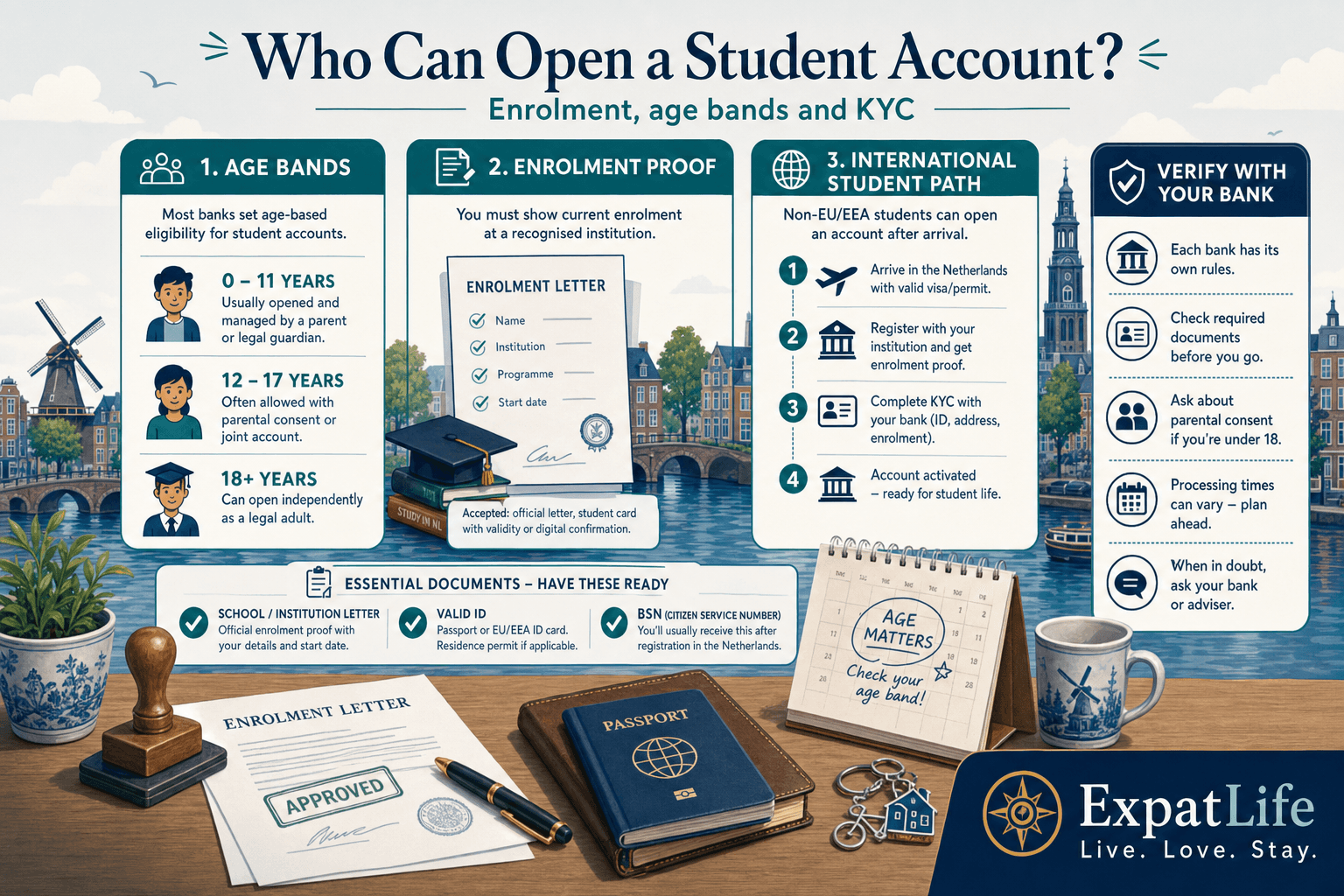
Who usually opens
With a Dutch address and enrolment letter, many retail student packages are reachable once KYC is complete.
Expect passport, enrolment proof and often BSN/address timing. Residence-permit detail belongs on Student visa — this page stays on banking docs.
Some packages stop at a stated age or after a maximum number of study years. Read the fine print before you rely on student pricing.
Ask whether your bank can convert a betaalrekening into a student package, or whether a fresh student product is cleaner.
| Setting | Common habit elsewhere | Dutch student norm | Practical tip |
|---|---|---|---|
| Newly enrolled student | Open any account and hope for a student discount later | Show enrolment proof when you apply for the student package | Download the letter before you start the form |
| International student | Treat the visa letter as the bank application | Bank KYC plus enrolment proof; visa is a separate process | Bookmark Student visa for IND questions |
| Age near the package limit | Ignore the age line on the product page | Banks publish age or duration ceilings | Check how long student pricing lasts |
| Account rejection risk | Retry the same incomplete file | Incomplete ID/address/enrolment packs stall onboarding | See Account rejection orientation |
Package perks
Student packages compete on more than the monthly fee: debit-card inclusion, youth discounts, cashback pilots and partner deals. Treat perk lists as orientation — banks change promotions, and this guide does not endorse any offer.
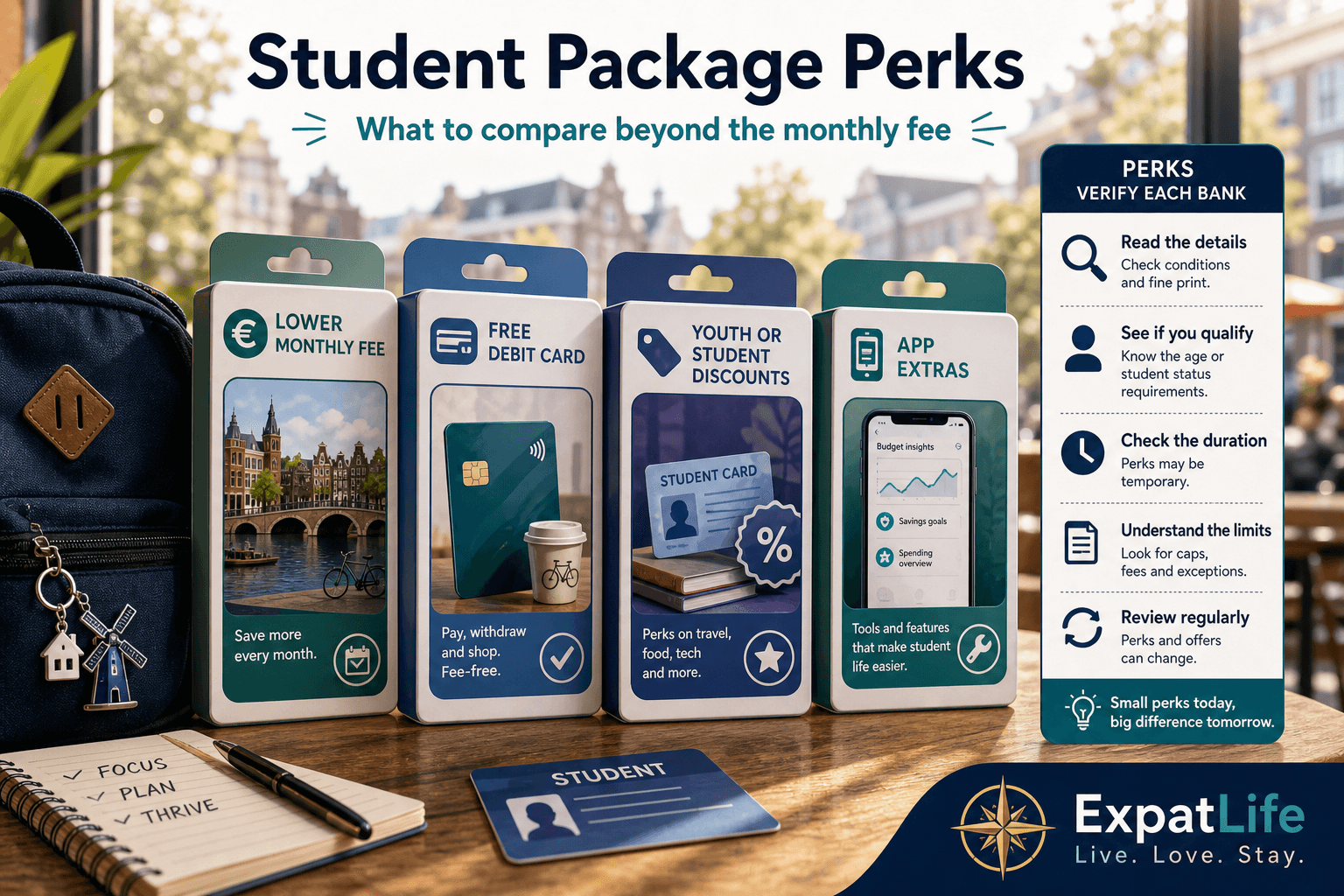
Perk orientation
The main reason students choose a studentrekening is a lower monthly package cost versus a regular betaalrekening.
Everyday Dutch payments are pinpas-first. See Debit cards for till culture once your student card arrives.
Some banks advertise student discounts with retailers or services. Confirm start/end dates on the official page.
Not a ranking of “best student perks” and not a promise that any promotion will still exist when you apply.
Costs
Student everyday packages often cost less than regular pinpas packages while enrolment continues. Euro figures below are indicative orientation for 2026 planning conversations — not live tariffs, not a ranking of banks, and not personal advice. Always verify current package prices on your bank’s official pages.
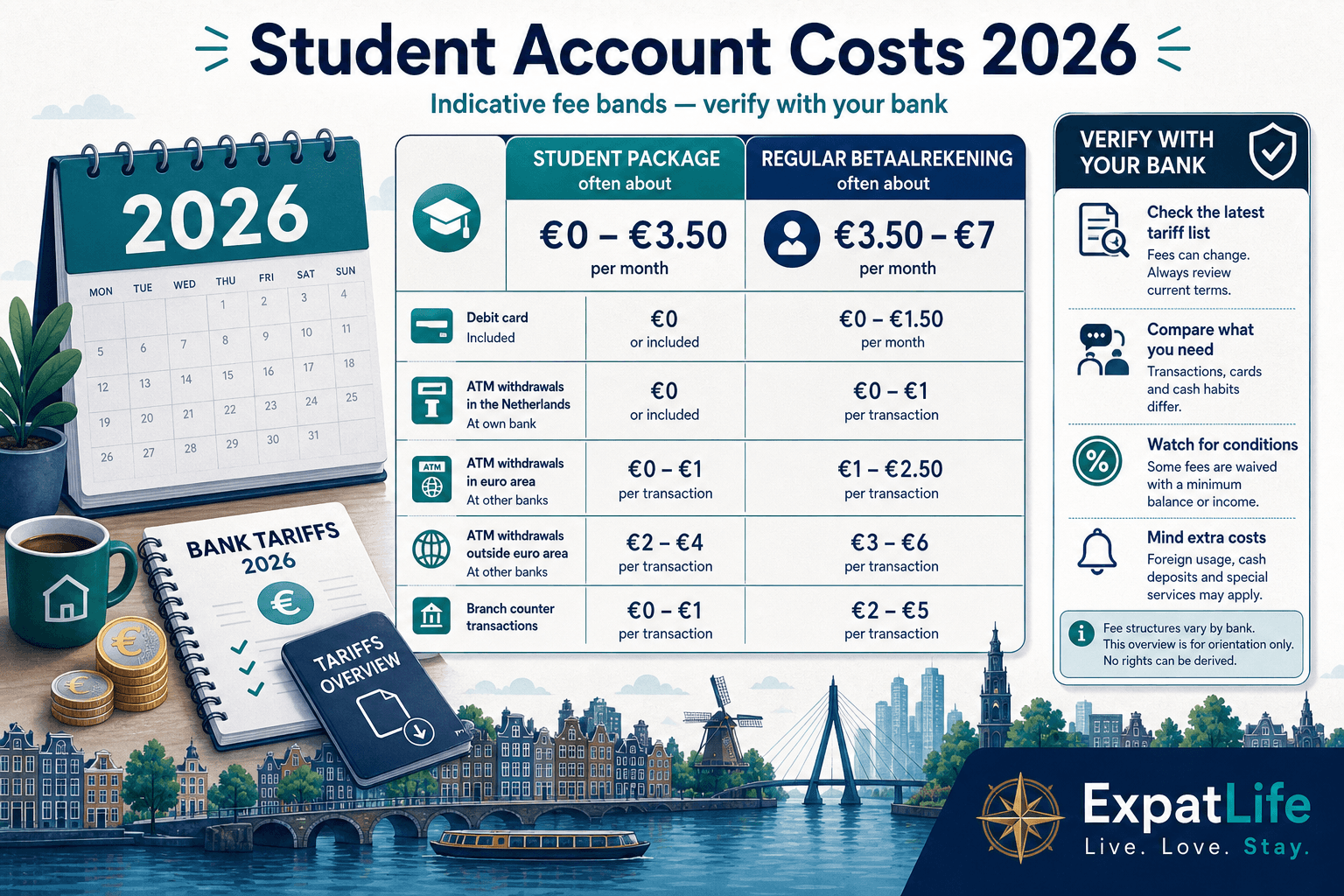
What to verify with banks
As orientation, many mainstream student packages land around €0–€3.50 per month in 2026 while enrolment proof remains valid.
After graduation — or without student eligibility — many everyday packages sit around €3.50–€7 per month. Budget the uplift early.
First debit cards are often included in student packages; replacement and foreign-ATM fees still appear on tariff PDFs.
Not a cheapest-bank ranking and not a live fee table. Use Banking fees, Cheapest accounts and Best banks for broader comparison — then verify PDFs.
| Cost line | Indicative 2026 band | Practical tip |
|---|---|---|
| Student everyday package (big banks) | ~€0–€3.50 / month (~€0–€42 / year) | While enrolment proof remains valid |
| Regular betaalrekening (big banks) | ~€3.50–€7 / month (~€42–€84 / year) | Typical post-graduation baseline |
| Student → regular uplift (indicative) | Often ~€2–€7 / month more after conversion | Ask the bank how conversion is priced |
| Digital / neo student-friendly options | Often €0–€10+ / month depending on tier | Watch physical card costs |
| Replacement debit card | Commonly ~€7–€15 one-off | Same order as debit-card guide |
| Own-bank ATM (NL) | Often free within package limits | Prefer your own network |
Vs regular
Both are everyday payment accounts with an IBAN. The difference is usually eligibility, monthly pricing and perk duration — not a different payments network. After graduation, most students move onto regular package pricing while keeping the same IBAN when the bank allows.
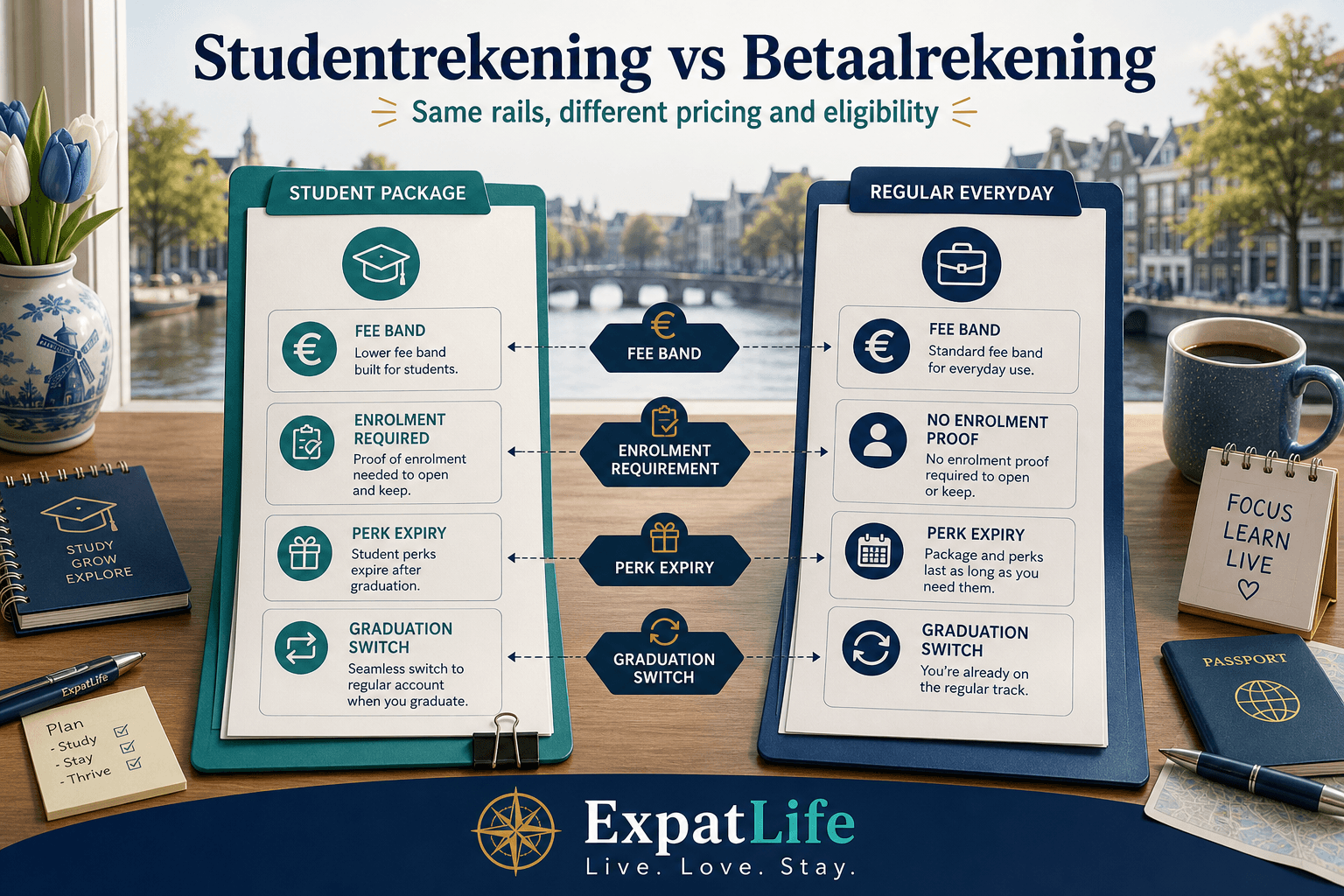
Student vs regular habits
If you are enrolled and meet age rules, a student package can keep monthly costs lower during study years.
If you already have a workable everyday account and cannot meet student eligibility, stay on regular pricing rather than forcing a mismatch.
Shared household IBANs are a different product family — see Joint bank accounts. Student packages are usually individual everyday accounts.
For the full map of everyday, savings, joint, student and business accounts, use Types of bank accounts.
| Setting | Common habit elsewhere | Dutch student norm | Practical tip |
|---|---|---|---|
| Monthly package fee | Assume student and regular cost the same | Student packages often cost less while enrolled | Compare both lines on the tariff PDF |
| Eligibility | Anyone can claim student pricing | Enrolment proof and age rules usually apply | Keep the letter ready for renewals |
| After graduation | Keep student pricing forever | Banks convert to regular packages | Ask how the switch is billed |
| Shared rent with a partner | Force a student package to be joint | Joint products are a separate path | See Joint bank accounts for shared access |
International
International students usually need the same banking identification as other newcomers, plus enrolment proof for a student package. Keep immigration questions on the Student visa guide — this section stays on banking documents and timing.
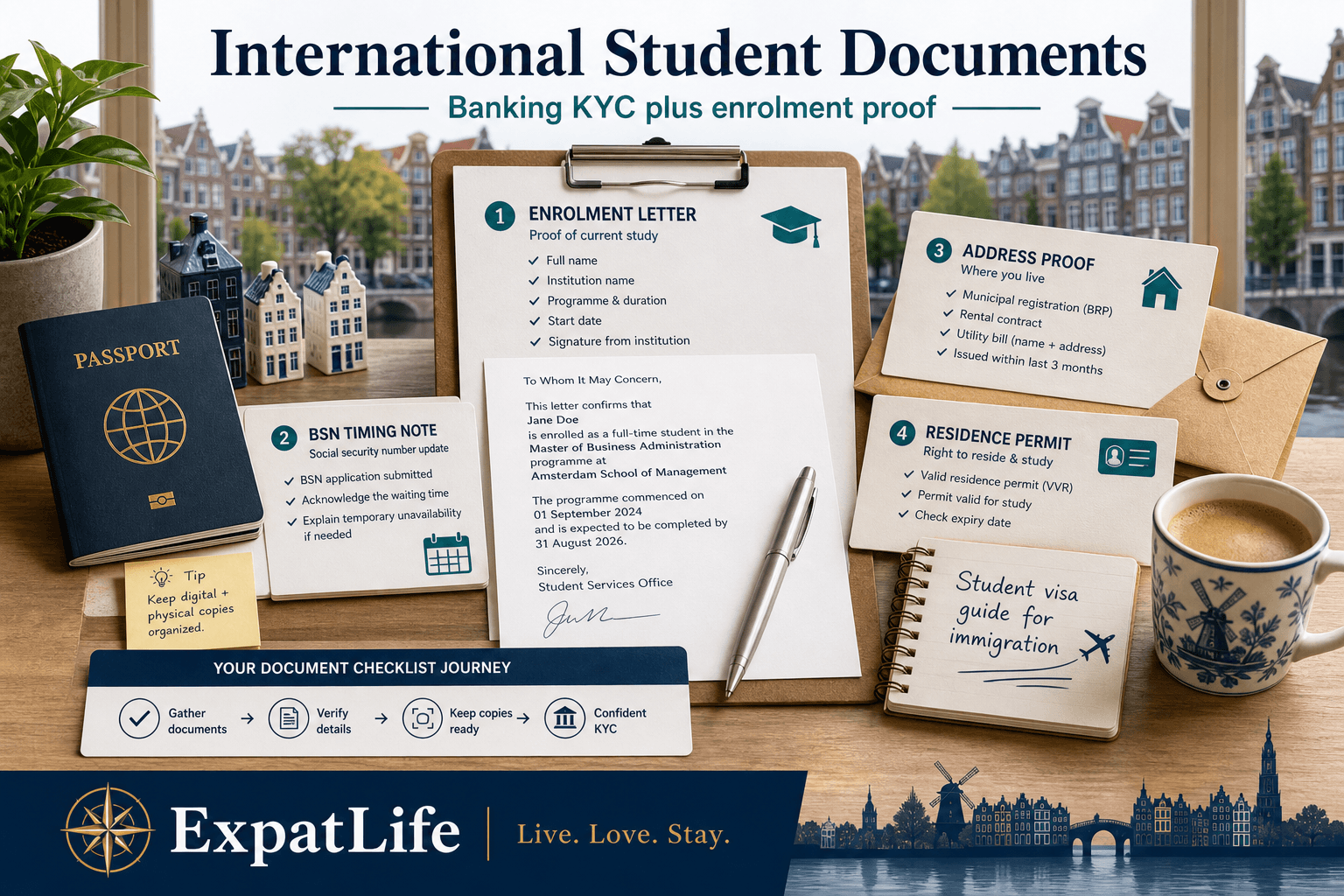
Document habits
ID, address proof, and any BSN documents your bank lists. Incomplete packs stall applications.
A dated letter or student-portal screenshot that shows you are enrolled. Banks decide what format they accept.
Proof of funds, MVV/residence and IND timelines belong on Student visa. Do not treat this banking page as immigration advice.
Account rejection orientation explains incomplete files and bank decisions without ranking providers.
International student document checklist
Graduation
Student pricing usually ends when enrolment ends or when you hit a bank’s age/duration limit. Treat graduation as a money-ops moment: confirm conversion terms, budget the fee uplift, and keep your IBAN stable for rent and payroll when possible.

Graduation habits
Some banks convert automatically when enrolment expires; others ask you to confirm a regular package. Read the letter or app notice carefully.
Moving from ~€0–€3.50 to ~€3.50–€7 per month is a common orientation jump — not a live quote. Verify your tariff PDF.
Give employers the IBAN that will remain after conversion. Avoid changing payroll details mid-cycle if you can help it.
If you start freelancing, keep business money separate — see Best bank for ZZP rather than stretching a student package.
Graduation 1
Put a calendar reminder a few months before graduation or the bank’s age limit.
Graduation 2
Confirm whether the IBAN stays, which regular package you move to, and the new monthly fee.
Graduation 3
Use Banking fees / Cheapest accounts for context, then verify the live PDF.
Graduation 4
Only update landlord or employer IBANs if the bank actually issues a new number.
Situations
Same product family, different first moves depending on whether you are newly enrolled, arriving on a study route, converting from a regular package, or graduating into work.
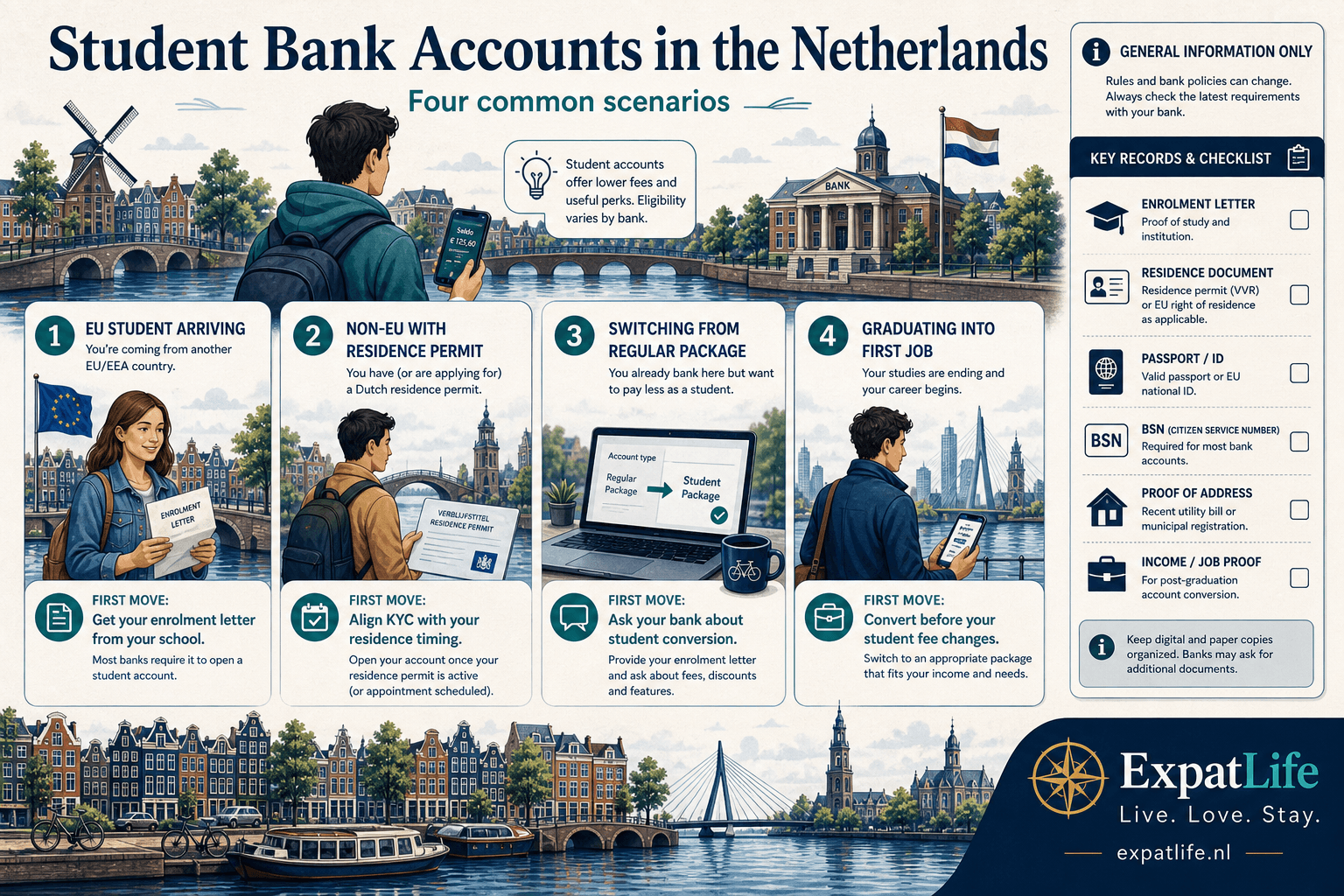
Examples
| Situation | How it works here | First step |
|---|---|---|
| EU student starting a Dutch degree | Open a student package once enrolment proof and address docs are ready | Download the enrolment letter before the bank form |
| Non-EU student with residence timing | Complete banking KYC beside enrolment; keep IND questions on Student visa | Align Open a bank account document order with your arrival week |
| Already have a regular betaalrekening | Ask about conversion to a student package versus opening fresh | Call or chat with the bank using your enrolment letter |
| Graduating into a first job | Convert to regular pricing, keep IBAN stable for payroll and rent | Start the graduation timeline two to three months early |
Avoid
These patterns create avoidable student-account friction — calm graduation planning beats rushed fee surprises.
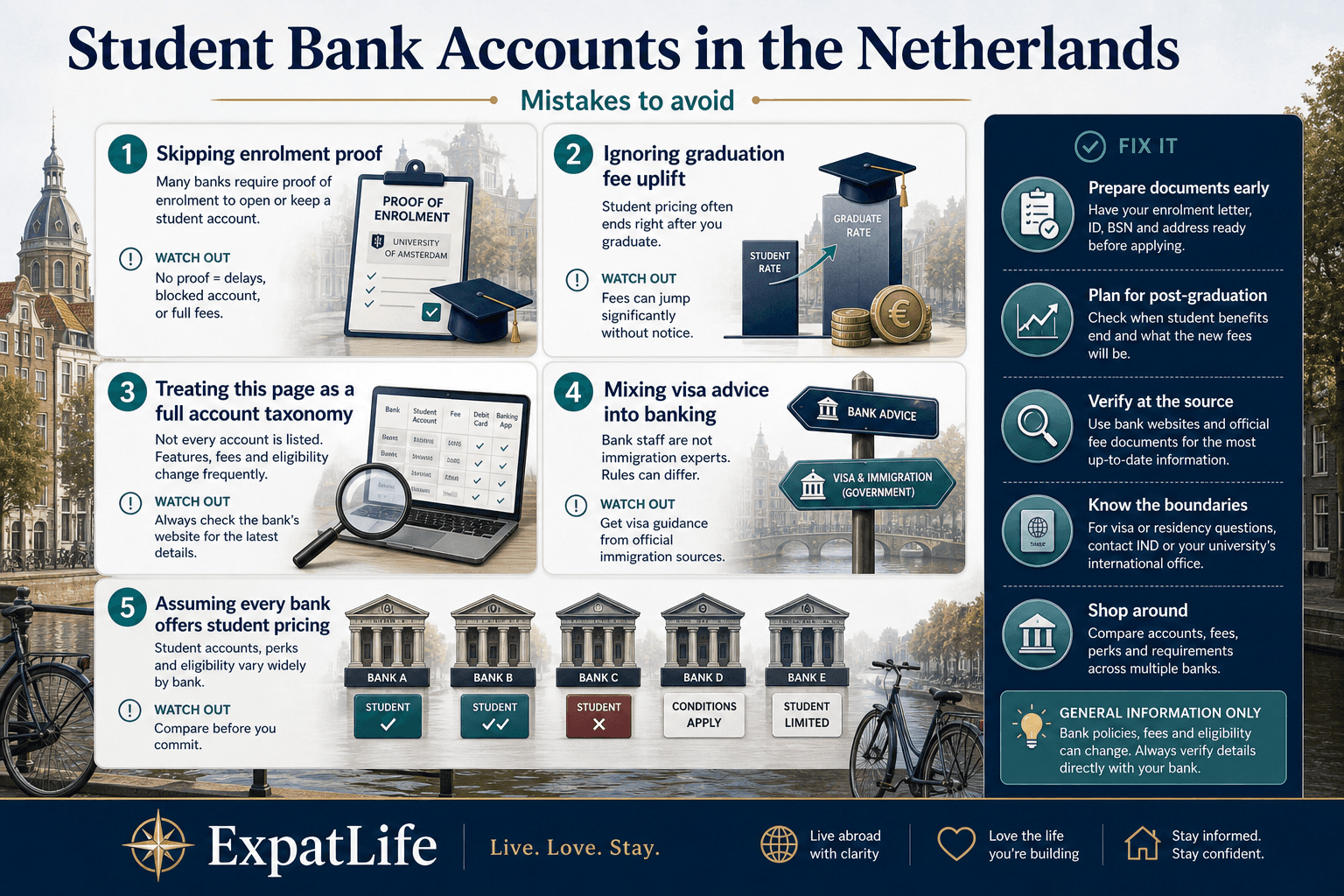
Student pricing usually needs a dated enrolment letter or portal confirmation.
Fix: Download proof before you start the application.
Student packages often step up to regular pricing when enrolment ends.
Fix: Set a conversion reminder months before graduation.
IND and residence-permit questions belong on Student visa.
Fix: Keep this page for products and fees; link out for immigration.
Best-banks comparison tables belong on sibling guides.
Fix: Shortlist on Best banks for expats; verify student products on official sites.
Some digital or neo products use different youth tiers — or none.
Fix: Read the product page; do not invent eligibility.
Shared household IBANs are a different deep dive.
Fix: Use Joint bank accounts when two adults need shared access.
Ready for student
Work through this list before you rely on a student IBAN for rent or tuition.
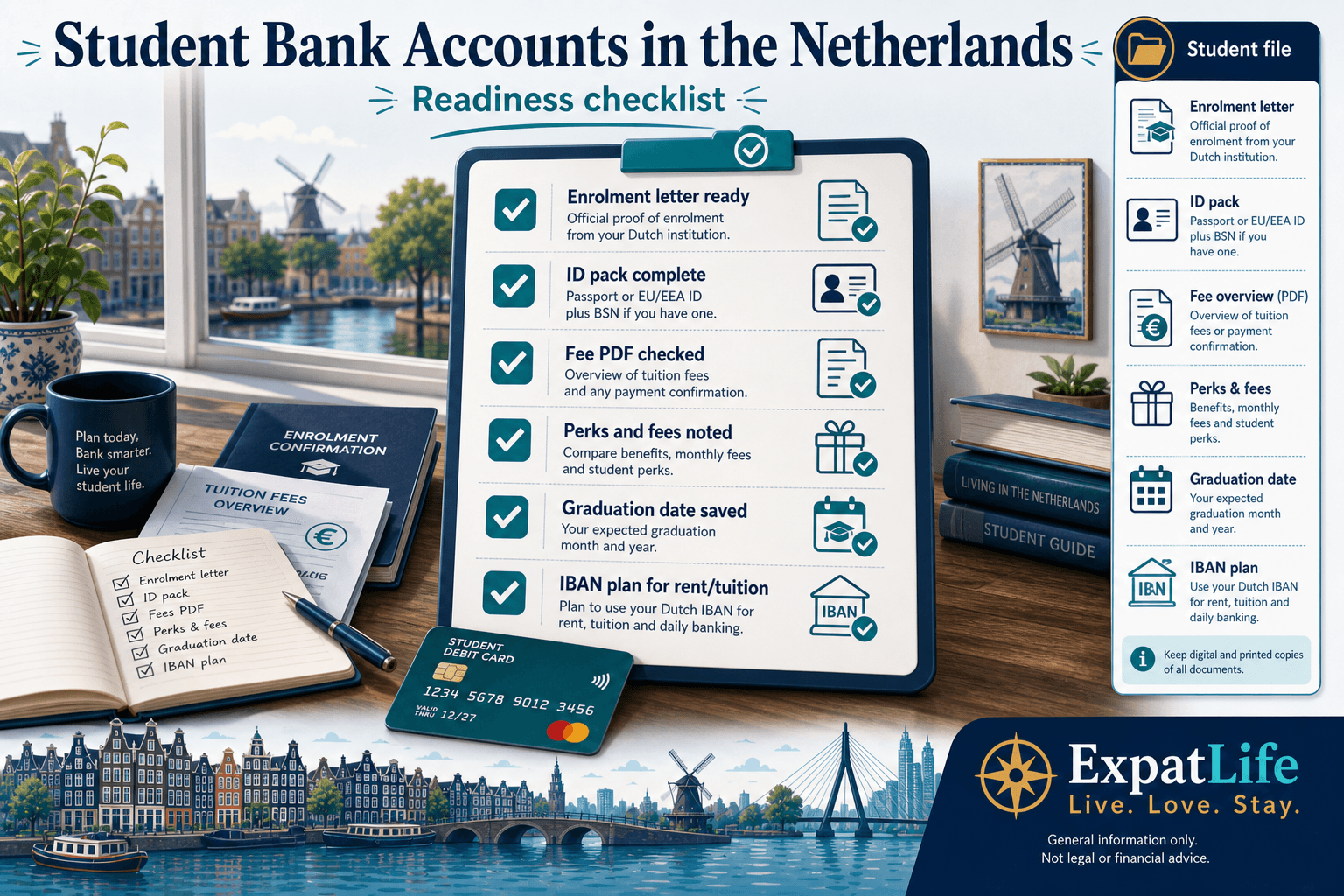
Student readiness checklist
How-to
A calm sequence for your first Dutch student money cycle — banks remain authoritative for fees and eligibility.
Step 1
Check enrolment, age and duration lines on the bank’s student product page. Do not rely on this guide as a ranking.
Step 2
Download the enrolment letter, prepare ID and address packs, and note BSN timing. Use Open a bank account for document order.
Step 3
Complete identification, set your PIN, and make one small test purchase before rent or tuition day.
Step 4
Save the tariff sheet covering student pricing, card fees and ATM lines. Use Banking fees for broader context.
Step 5
Note when enrolment ends and how the bank converts to a regular package so the fee uplift is not a surprise.
Tools
Use tools for account and cost planning — then verify student products and fees on each bank’s official pages.
Provider listings
Soft CTAs — we are not opening accounts for you. Use these cards to jump to official sites for student-oriented everyday account options, then validate enrolment rules and fees yourself.
FAQ
Short answers for the searches expats ask most often about Dutch studentrekeningen and student package banking.
A Dutch student everyday bank account: a payment IBAN with student-oriented fees and perks while you are enrolled. Features and eligibility follow each bank’s product rules.
Often yes if you meet the bank’s enrolment, age and identification rules. Visa and residence-permit questions belong on the Student visa guide — this page stays on banking documents and products.
As orientation only: many student packages sit around €0–€3.50 per month, while many regular packages sit around €3.50–€7 per month. Always verify live tariffs with your bank.
Student pricing usually ends. Banks typically convert you to a regular everyday package. Ask whether your IBAN stays the same and budget the fee uplift early.
Both are everyday payment accounts. The usual differences are enrolment eligibility, monthly pricing and perk duration — not a different payments network.
Banks set their own eligibility. Immigration status is a separate process — see Student visa for study-route orientation, and Open a bank account for KYC document order.
No. Types of accounts owns the taxonomy of everyday, savings, joint, student and business products. This page owns student eligibility, perks, fees and graduation orientation.
Student packages are usually individual. For a shared rent IBAN, see Joint bank accounts.
This guide does not rank banks. Use Best banks for expats and Open a bank account for shortlists, then confirm student package rules on official sites.
No. This is general orientation for newcomers. Banks set fees, eligibility and conversion rules — verify with them and seek qualified advice when your situation is complex.
Related
Live cluster siblings stay linkable — Types of accounts, Joint bank accounts, Open a bank account, Student visa and Best banks.
Hub
Return to the Banking hub or jump to Types of accounts, Joint bank accounts, Open a bank account, and live cluster peers.
Explore next
Learn account types, open an account, shortlist banks, check the student visa path, or model costs.
Trust
Confirm student product rules and fees with banks — tariffs and eligibility change.
Some links on this page — including the Recommended options block — may be affiliate or referral links. If you use them, we may earn a commission at no extra cost to you. Affiliate status never changes bank eligibility, fees or conversion rules.