
Dutch name
Gezamenlijke rekening
Shared everyday IBAN for household money
Netherlands · Money · Banking
How a Dutch gezamenlijke rekening works for couples and housemates: shared access, dual cards, household money habits, indicative joint fee uplifts, opening steps and a calm exit checklist — orientation only.
General orientation only — not financial, legal or relationship advice. Joint products, fees, liability and exit rules differ by bank and personal situation. Confirm details with your bank and, when needed, a qualified adviser before you open or close a shared account.

Quick answer
A Dutch gezamenlijke rekening is a joint everyday bank account: one IBAN that more than one adult can use for household money. Couples and housemates often open one for rent, utilities and shared groceries while keeping personal accounts for individual spending.
This page is the shared-access deep dive — dual cards, household habits, indicative 2026 joint fee uplifts, opening steps and a calm exit checklist. The full account-types taxonomy lives on Types of bank accounts. Bank shortlists and comparison tables live on Best banks for expats and Open a bank account.
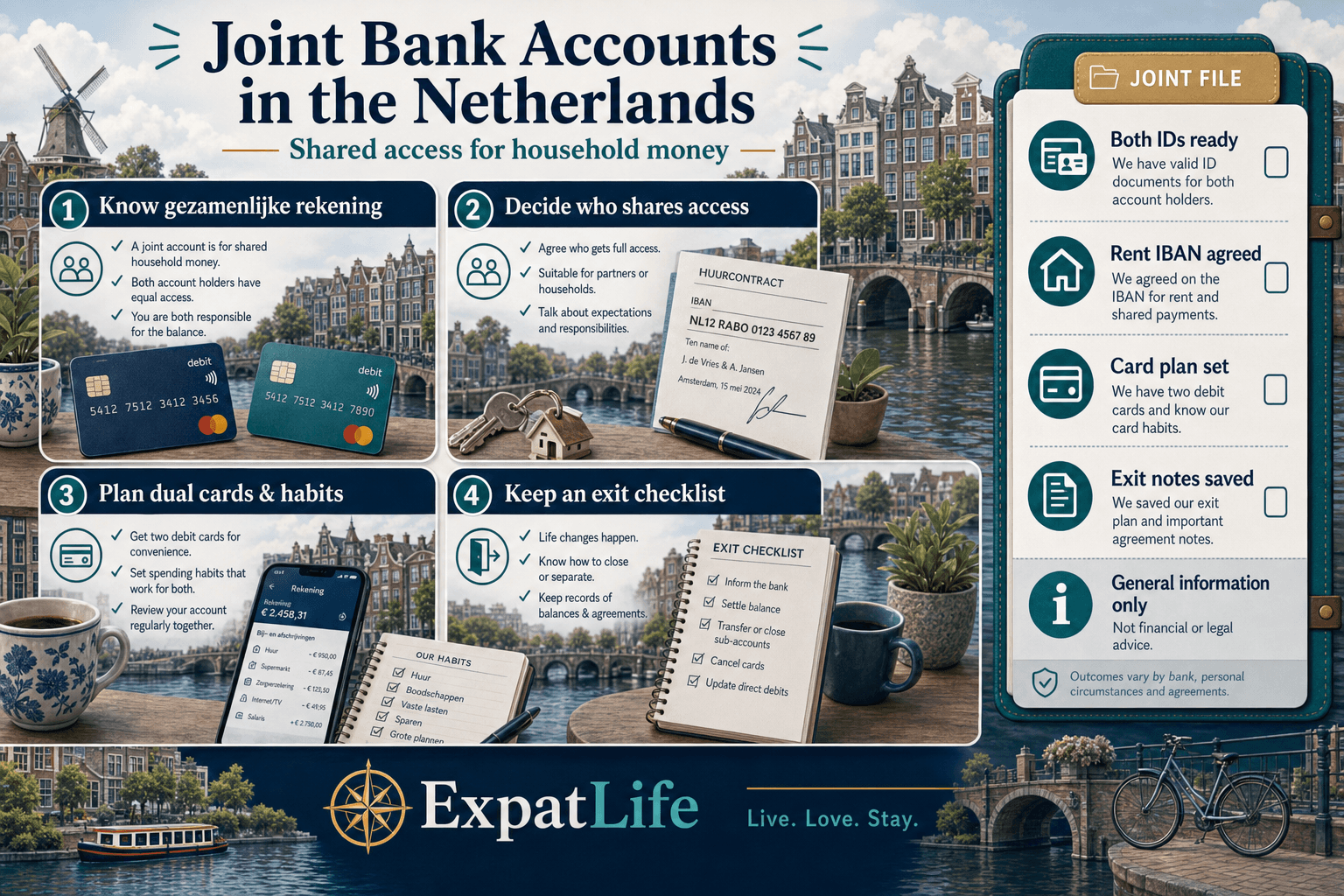
Joint readiness file — keep these together
Examples
| Situation | How it works here | First step |
|---|---|---|
| Couple signing a rental contract | One shared IBAN for rent and utilities keeps landlord payments simple | Confirm the bank offers a joint product before lease day |
| Housemates splitting fixed bills | Joint for shared costs, solo accounts for personal spend | Write down contribution rules and an exit plan |
| One partner already has a Dutch account | Add a co-holder or open a fresh joint product — bank rules differ | Ask the bank which path they support for your IDs |
Snapshot
Six cards cover gezamenlijke rekening norms for couples and housemates. Deeper sections expand each theme without ranking banks.
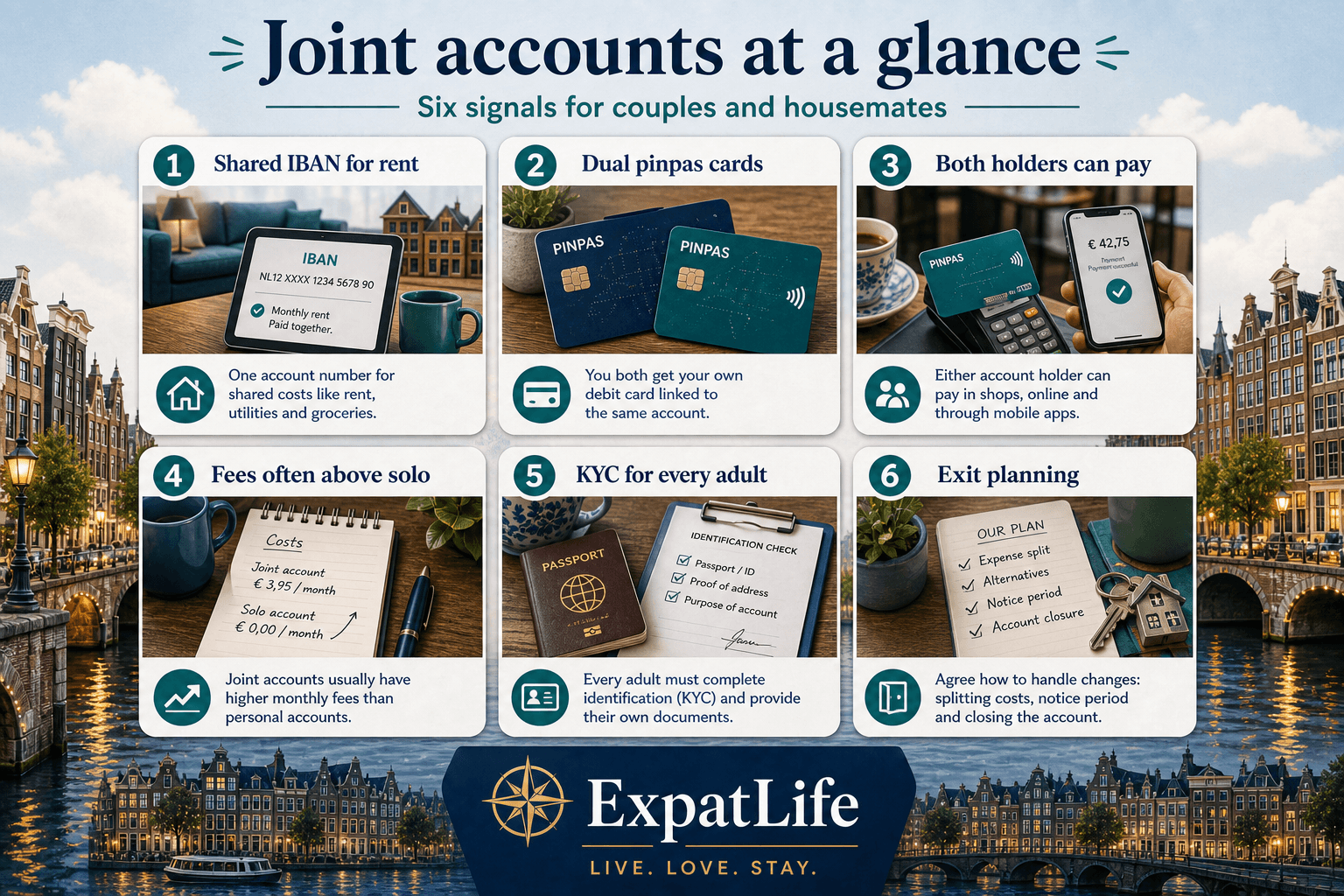
Dutch name
Gezamenlijke rekening
Shared everyday IBAN for household money
Cards
Often dual pinpas
Each adult usually gets a debit card
2026 cost cue
Solo + uplift
Often ~€1–€4/month above solo packages
Must plan
Exit path
Move rent IBAN before you close
Shared access, dual cards, household habits, indicative joint fee uplifts, opening steps and exit ops for expats.
One everyday IBAN used by more than one adult — usually for rent and household bills.
Couples and housemates who both complete the bank’s identification steps.
Dual debit cards and app visibility are common — liability still follows the contract.
Account taxonomy → Types of accounts. Rankings → Best banks. Setup docs → Open a bank account.
Need the solo onboarding path first? Open a bank account — then return here for joint-specific habits.
Definition
Gezamenlijke rekening is the everyday Dutch phrase for a joint current account: one IBAN, more than one account holder, usually used for household money. It is not a separate “magic product type” outside the banking system — it is a shared everyday account with joint-oriented features such as dual cards and shared visibility.
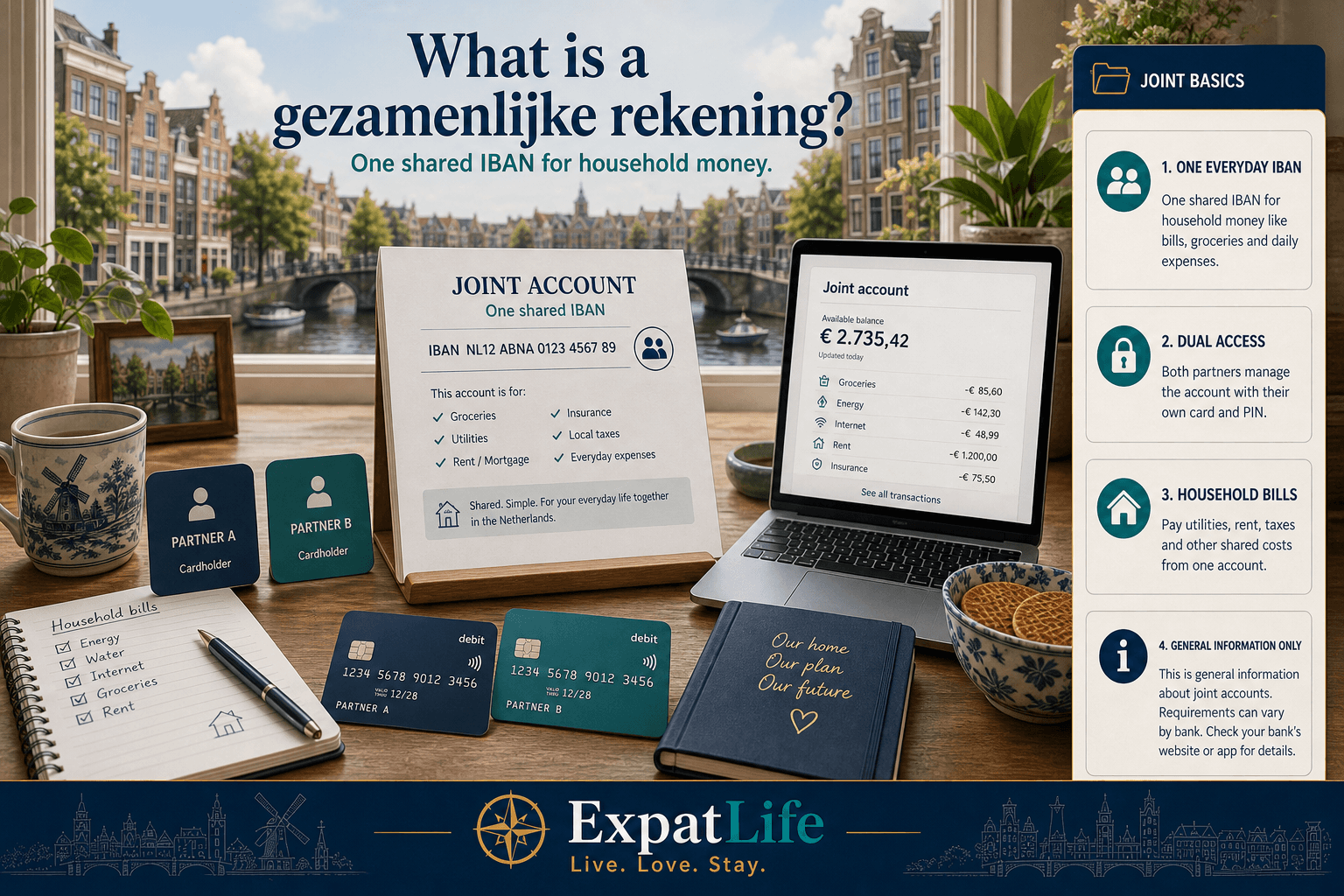
What a gezamenlijke rekening is
Most people use the joint IBAN for rent, energy, internet and shared groceries — not necessarily for every personal café visit.
Savings, student, business and app-only categories belong on Types of bank accounts. This page stays on shared access and exit ops.
Banks set how joint liability, overdrafts and card limits work. Read the contract; this guide is orientation only.
You may see “joint account”, “partner account” or Dutch product names. Confirm the features you need: dual cards, app access and who can close.
Eligibility
In practice, adult couples and housemates commonly open a gezamenlijke rekening when every person completes the bank’s identification and eligibility checks. Banks decide residency, ID, BSN timing and product availability — there is no single national “joint account form” that overrides bank rules.
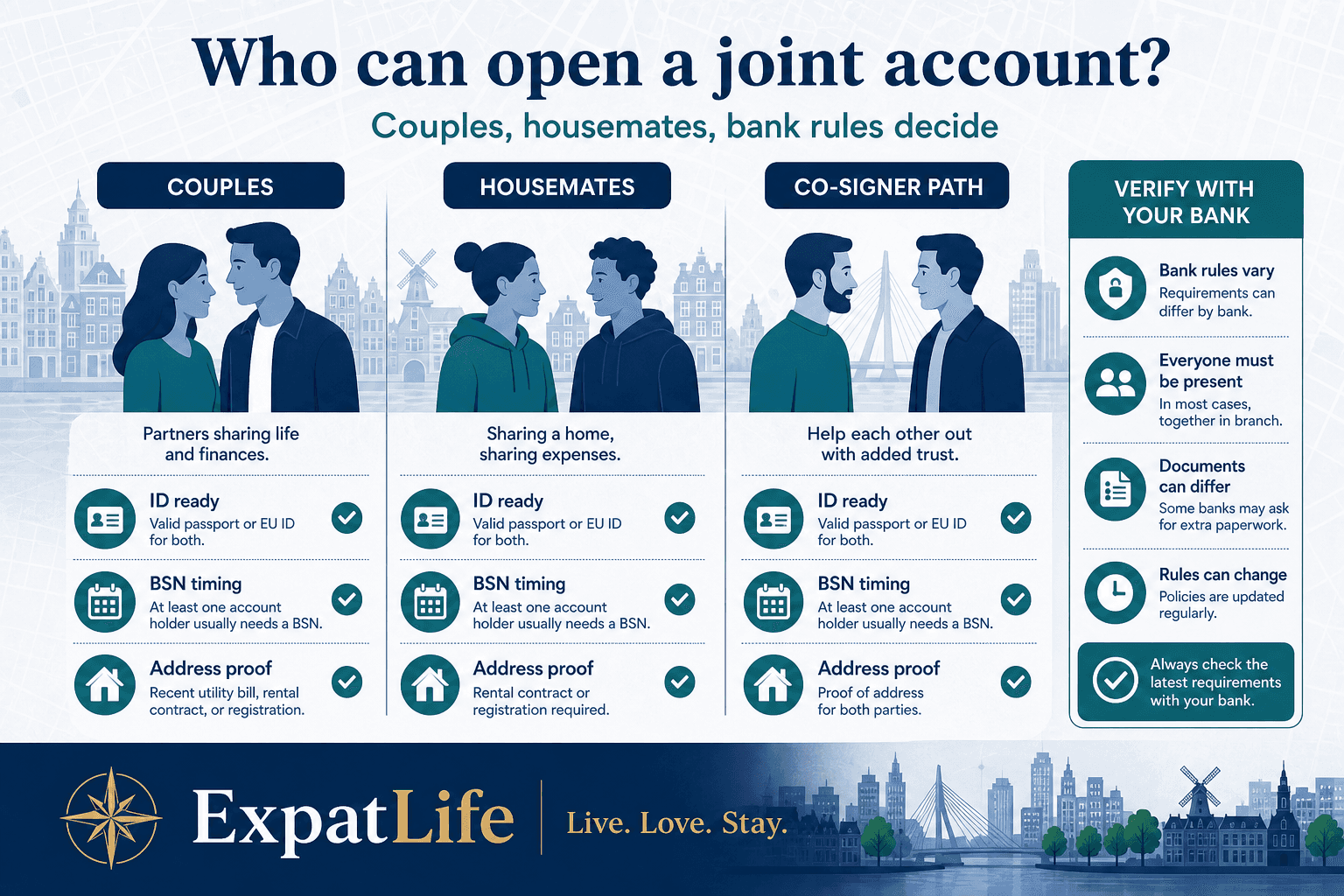
Who usually opens
Married, partners or cohabiting adults often open a joint IBAN for rent. Relationship status alone does not guarantee product eligibility — the bank’s KYC does.
Shared flats sometimes use a joint account for utilities. Write down who contributes what and how you will close if someone moves out.
If one adult already has a Dutch account, ask whether a co-holder can be added or whether a new joint product is cleaner.
Mixing household rent with ZZP invoicing is a different topic — see Best bank for ZZP and keep business money clearly separated unless a qualified adviser says otherwise.
| Setting | Common habit elsewhere | Dutch joint norm | Practical tip |
|---|---|---|---|
| Couple with Dutch addresses | One person opens everything alone | Both adults usually identify for a joint product | Book KYC slots together when you can |
| Housemate flat of three | Cash jar on the kitchen counter | Joint IBAN for bills or one person collects transfers | Agree exit rules before the first debit |
| Partner still abroad | Add them later casually | Bank may require in-person or video KYC first | Ask the bank which path they support |
| Account rejection risk | Retry the same incomplete file | Incomplete ID/address packs stall onboarding | See Account rejection orientation |
Access & cards
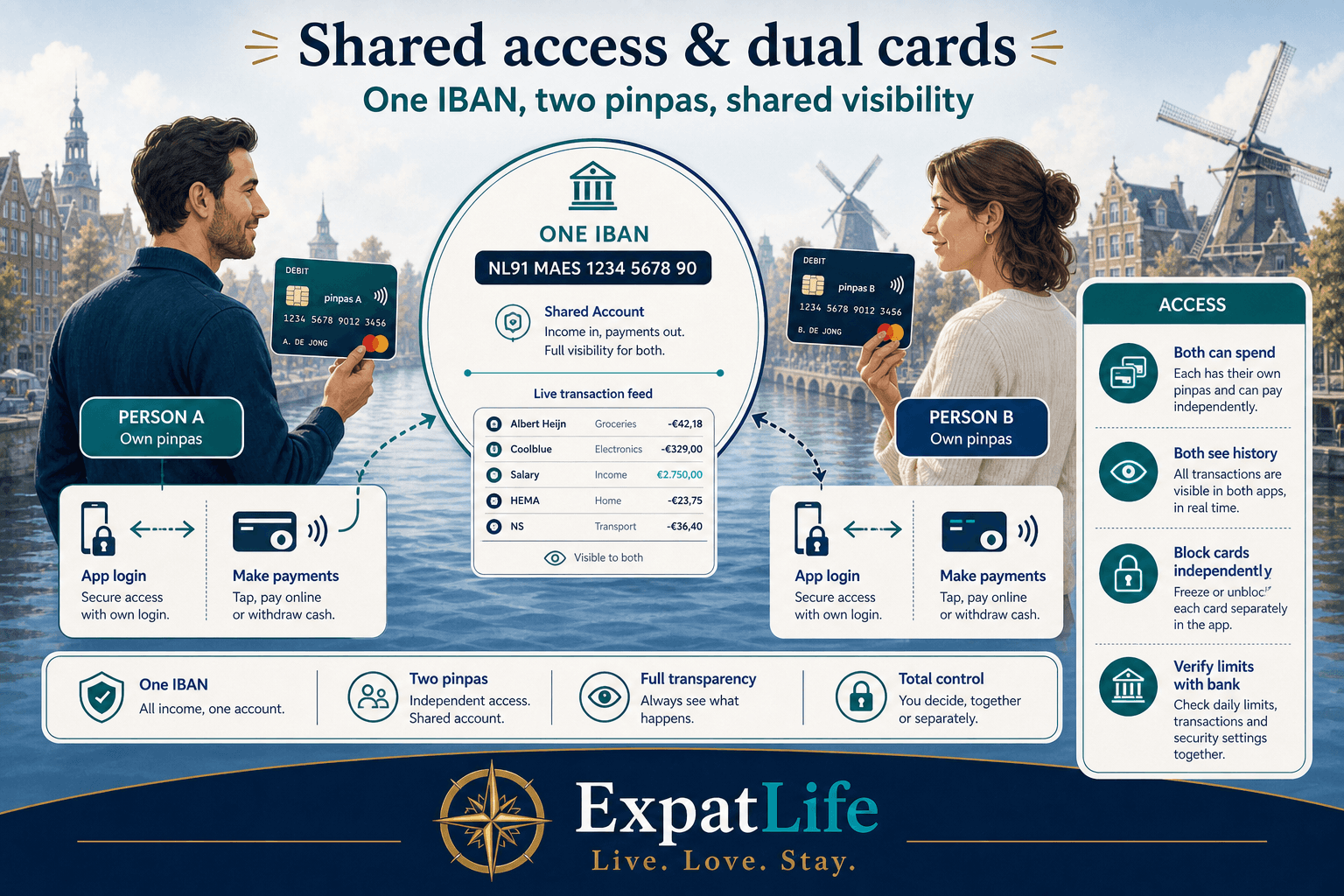
Most joint everyday packages are built so each adult can pay: dual debit cards (pinpas), personal PINs, and app access to the same IBAN. That convenience is the point — and the reason you should agree spending norms before rent day.
Shared access habits
Each adult typically receives a debit card linked to the joint IBAN. Activation, PIN and contactless limits follow Debit cards culture — see that sibling for till habits.
Shared history helps with rent and utilities. It also means surprise purchases are rarely secret — agree norms early.
Online Dutch checkouts often use iDEAL via a bank app. Decide who will approve household payments — rails detail lives on How payments work.
Phishing and card fraud still apply. Use Banking safety for calm checks if something looks wrong.
Household habits
The smoothest joint setups are boring: fixed bills on the joint IBAN, personal spending on solo accounts, and a short weekly sync for large transfers. Perfect spreadsheets are optional; clear rules are not.

Household money rules
Start with rent and utilities. Add groceries only if both adults want shared food money.
Many couples keep personal accounts for gifts, hobbies and travel — joint does not have to swallow everything.
Markets and tips culture sit on Cash vs card. Joint cards follow the same Dutch debit-first till habits.
Credit cards may help for deposits or travel holds — that product deep-dive lives on Credit cards.
| Setting | Common habit elsewhere | Dutch joint norm | Practical tip |
|---|---|---|---|
| Monthly rent | One person pays from a personal account | Landlord often prefers one recurring IBAN | Use the joint IBAN once both cards work |
| Groceries | Split every receipt in an app | Joint debit for shared food, or rotate weeks | Pick one rule and stick to it |
| Salary day | Everything lands in joint | Many keep salary on solo + standing transfer | Automate the household contribution |
| Surprise purchase | Hope the other person does not notice | Shared history makes surprises visible | Agree a euro threshold for a quick chat |
Costs
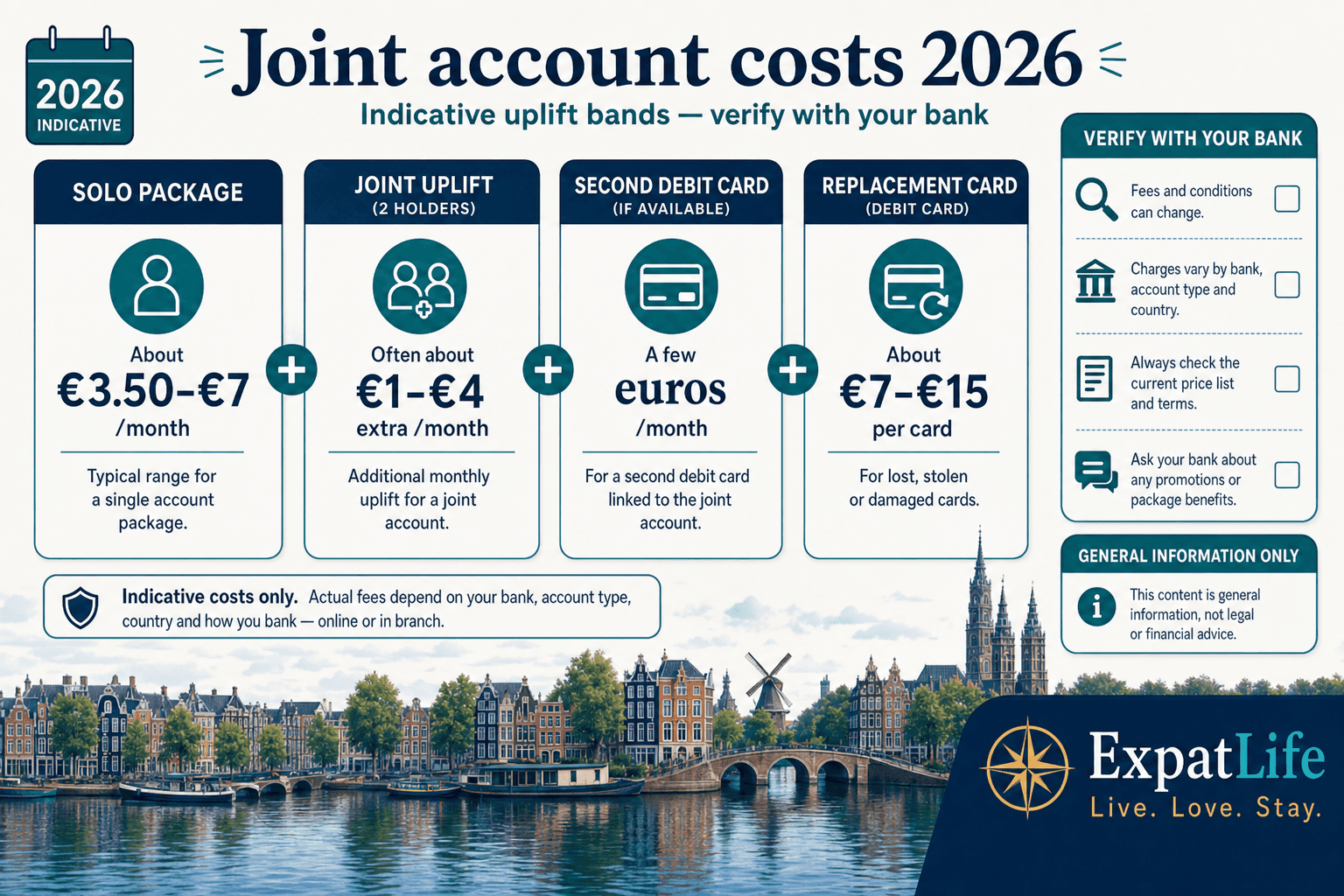
Joint everyday packages often cost a little more than a solo pinpas package because of dual cards and shared servicing. Euro figures below are indicative orientation for 2026 planning conversations — not live tariffs, not a ranking of banks, and not personal advice. Always verify current package prices on your bank’s official pages.
What to verify with banks
Mainstream retail packages commonly land around €3.50–€7 per month in 2026 (~€42–€84 per year) for a solo everyday account with a first debit card.
As orientation, many joint / partner packages sit roughly €1–€4 per month above the solo package for the same bank family — sometimes framed as an extra card fee instead of a named uplift.
Expect a few euros per month for an extra pinpas, or a shipping fee on digital banks. Confirm whether both cards are included in the joint package price.
Not a cheapest-bank ranking and not a live fee table. Use Banking fees, Cheapest accounts and Best banks for broader comparison — then verify PDFs.
| Cost line | Indicative 2026 band | Practical tip |
|---|---|---|
| Solo everyday package (big banks) | ~€3.50–€7 / month (~€42–€84 / year) | Baseline before joint uplift |
| Joint / partner uplift (indicative) | Often ~€1–€4 / month above solo | Sometimes billed as extra-card fee |
| Second / partner debit card | Often a few € / month or shipping fee | Confirm inclusion in package |
| Digital / neo joint options | Often €0–€10+ / month depending on tier | Watch physical card costs |
| Replacement debit card | Commonly ~€7–€15 one-off | Same order as debit-card guide |
| Own-bank ATM (NL) | Often free within package limits | Prefer your own network |
Opening
Treat joint onboarding as a shared project: pick a bank that actually offers the joint features you need, complete identification for every adult, activate dual cards, then move rent and utilities carefully.

Opening habits
Opening 1
Confirm the bank offers a gezamenlijke / partner account with dual cards if you need them.
Opening 2
Book identification together when possible. Incomplete packs stall applications — see Account rejection if you get stuck.
Opening 3
Set PINs, install apps, and make one small test purchase each.
Opening 4
Update rent and utilities carefully. Keep the old account open until the first successful debit lands.
Exit
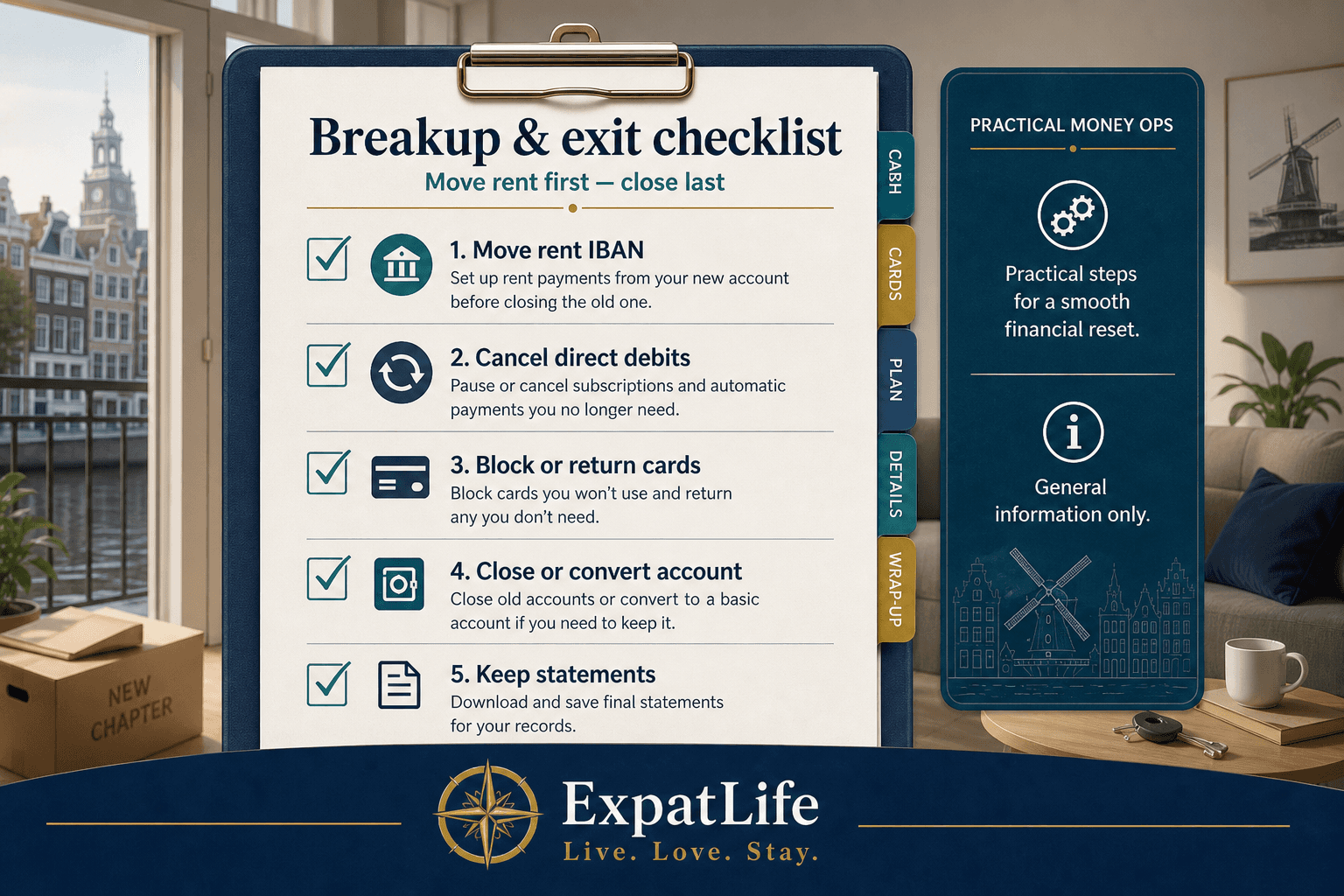
Living arrangements change. A calm exit is money operations: move rent, redirect direct debits, block cards, close or convert the account, and keep statements. This is not legal or relationship advice — banks, landlords and courts set their own rules.
Exit habits
Landlords care about a working IBAN. Change the rent rail before you shut the joint account.
Energy, internet, insurance and subscriptions can bounce if you close too early. List them from statements.
Block physical cards and remove them from Apple Pay / Google Wallet so neither adult is surprised.
Keep PDFs of statements covering the shared period — useful for deposits and admin, not a substitute for legal advice.
Breakup / exit checklist
Situations
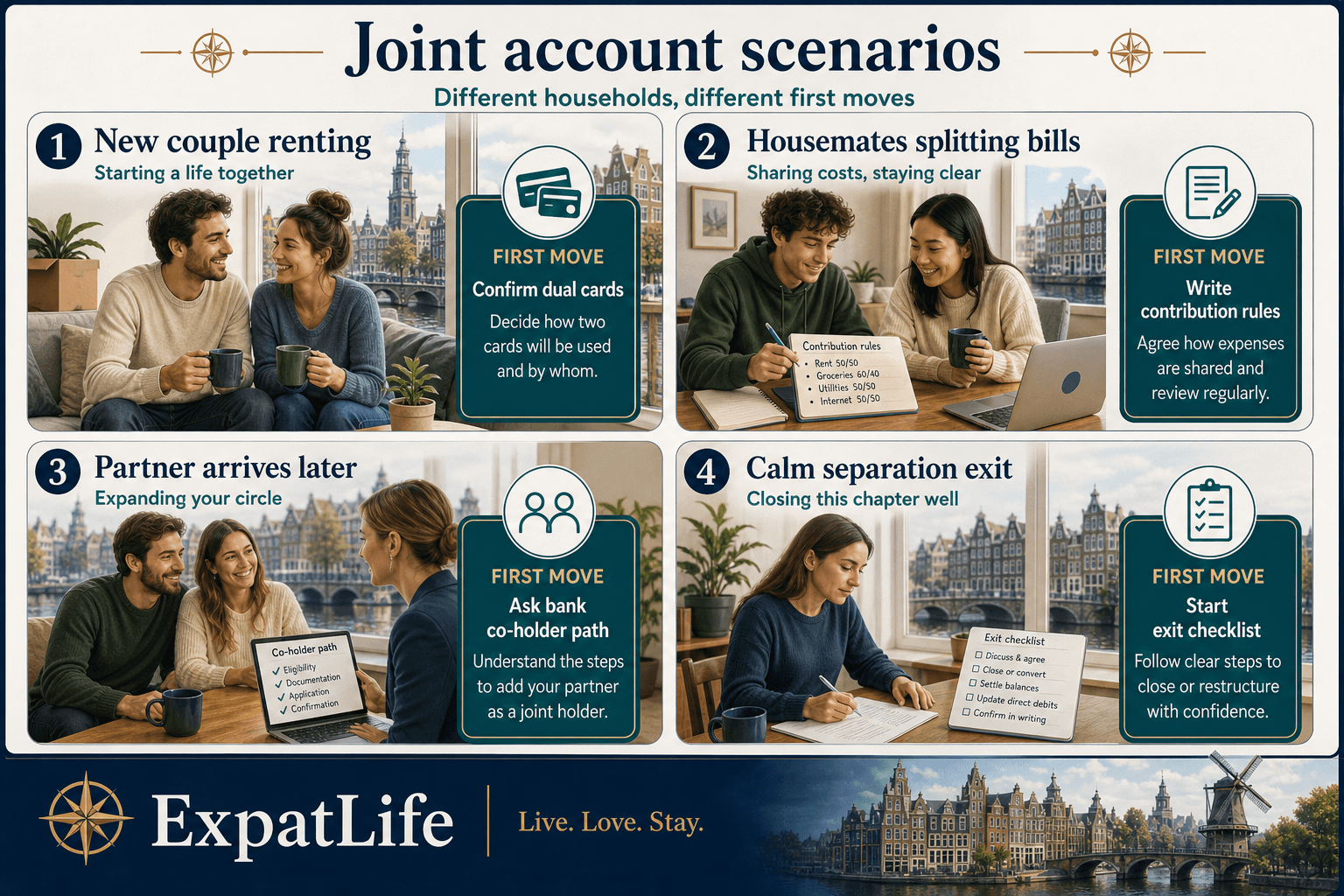
Same product family, different first moves depending on whether you are starting a lease, sharing a flat, waiting on a partner’s arrival, or exiting calmly.
Examples
| Situation | How it works here | First step |
|---|---|---|
| New couple signing a lease | Open joint for rent/utilities; keep solo accounts for personal spend | Confirm dual cards before the first rent debit |
| Housemates with three adults | Joint for fixed bills or one treasurer account with standing transfers | Write contribution and exit rules before anyone pays |
| Partner arrives months later | Bridge on one adult’s IBAN, then convert or open joint when KYC is possible | Ask the bank which co-holder path they support |
| Calm separation / move-out | Treat exit as money ops: rent rail, debits, cards, statements, then close | Start the exit checklist before emotions set the timeline |
Avoid
These patterns create avoidable joint-account friction — calm exit planning beats rushed closures.
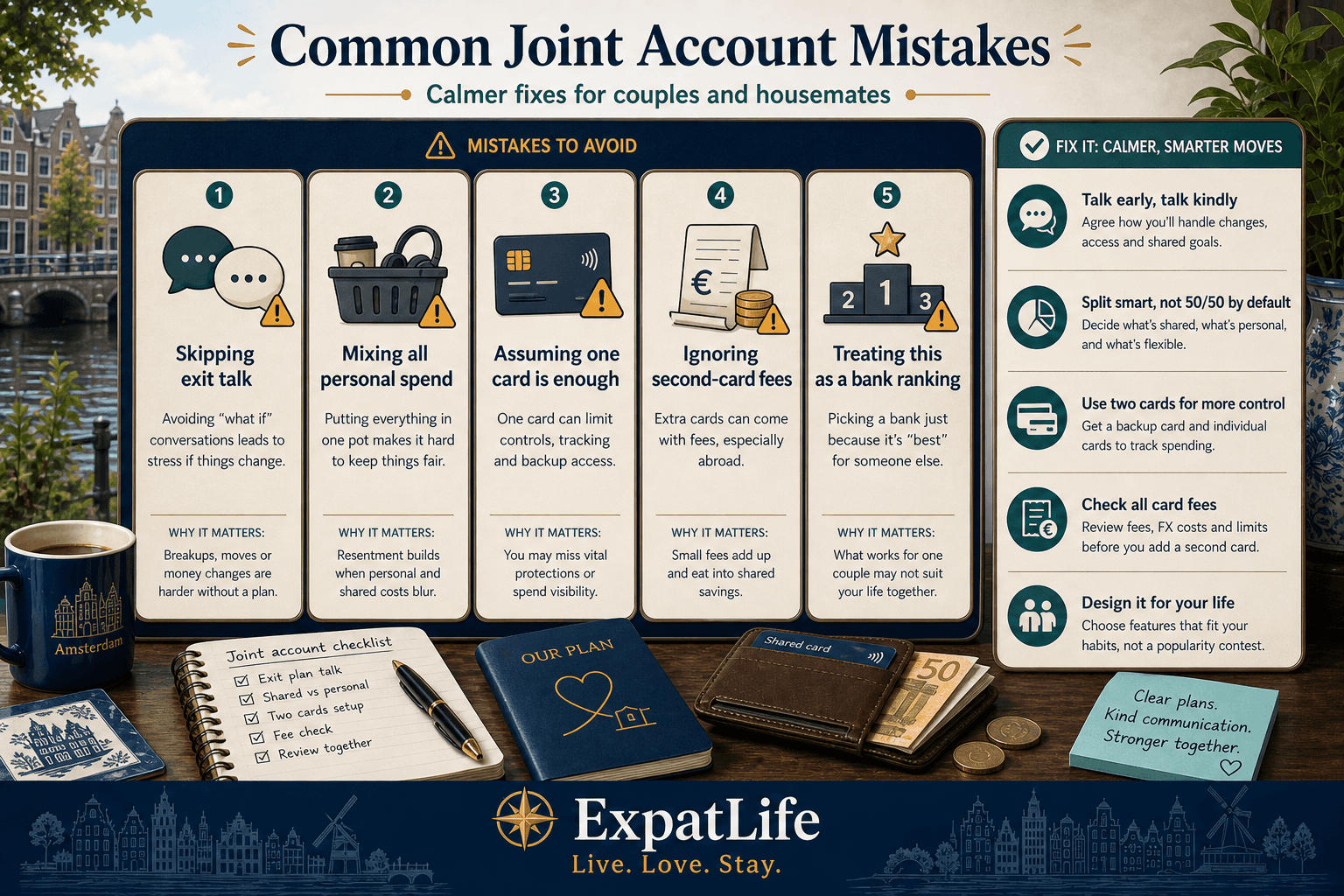
Joint IBANs are easy to open and awkward to unwind when rent is still attached.
Fix: Write a one-page exit note before the first debit.
Shared history plus unclear rules creates avoidable friction.
Fix: Park fixed bills on joint; keep personal spend separate if that helps.
Many households need dual pinpas cards for everyday Dutch debit culture.
Fix: Confirm second-card fees and activation timing with the bank.
A “cheap” solo package can look different once a partner card is added.
Fix: Read the joint tariff lines — then use Banking fees / Cheapest accounts for context.
Best-banks comparison tables belong on sibling guides.
Fix: Shortlist on Best banks for expats; verify joint products on official sites.
Landlords and utilities can bounce if the IBAN dies too early.
Fix: Follow the exit checklist: move rails first, close last.
Ready for joint
Work through this list before your first busy shared rent cycle.
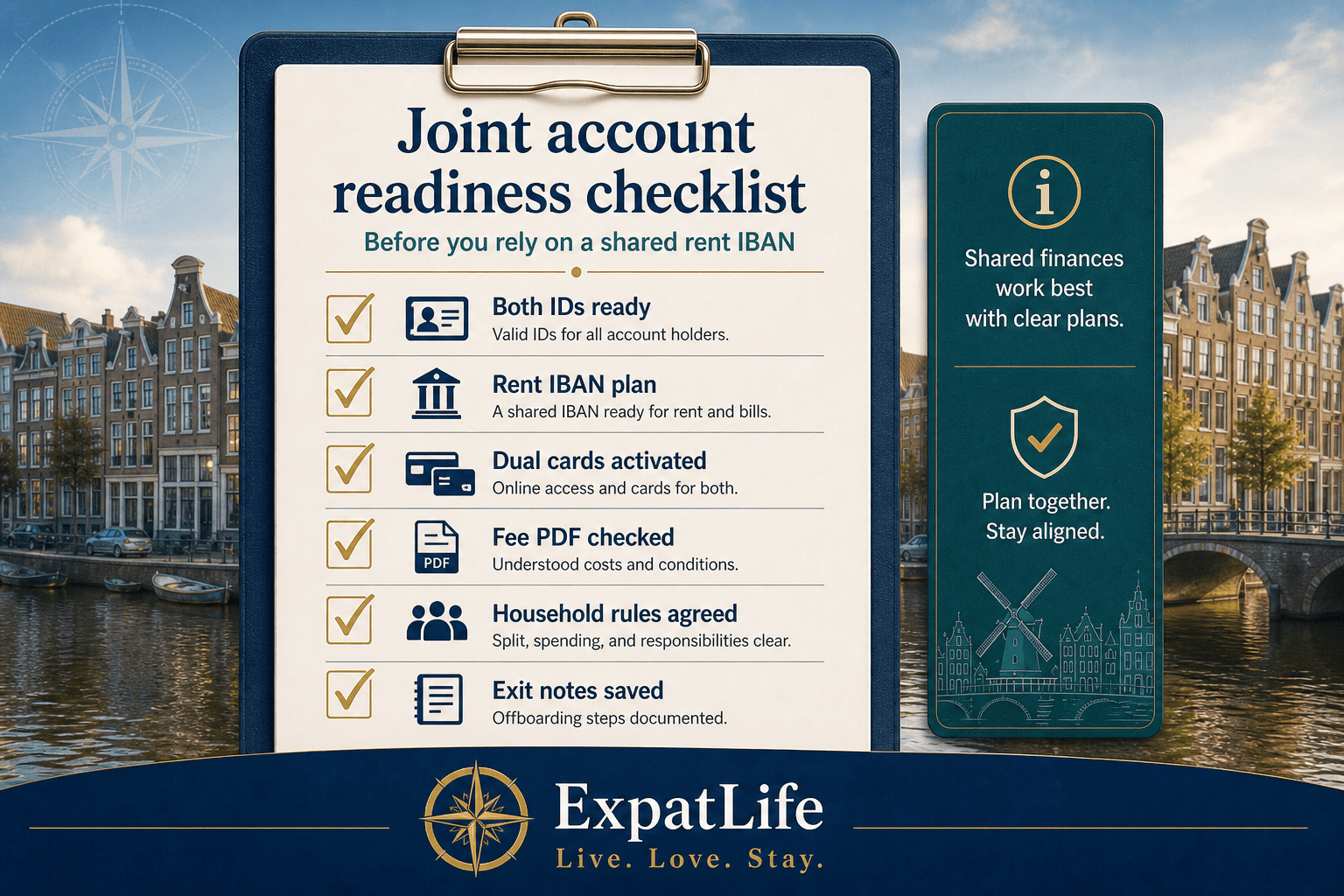
Joint readiness checklist
How-to
A calm sequence for your first shared rent cycle — banks remain authoritative for fees and eligibility.
Step 1
List rent, utilities and any shared groceries. Leave personal spend on solo accounts unless you both want full pooling.
Step 2
Use Best banks and Traditional vs digital for orientation, then open each bank’s joint / partner page. Do not rely on this guide as a ranking.
Step 3
Gather IDs, address proof and BSN timing. Book KYC together when the bank allows.
Step 4
Set PINs, install apps, and make one small test purchase each before rent day.
Step 5
Update landlord and billers carefully. Save who will move the rent IBAN if plans change.
Tools
Use tools for account and cost planning — then verify products and fees on each bank’s official pages.
Provider listings
Soft CTAs — we are not opening accounts for you. Use these cards to jump to official sites for joint / partner everyday account options, then validate dual-card fees and eligibility yourself.
FAQ
Short answers for the searches expats ask most often about Dutch gezamenlijke rekeningen and shared household banking.
A Dutch joint everyday bank account: one IBAN that more than one adult can use, commonly for rent, utilities and household shopping. Features and liability follow each bank’s product rules.
Often yes if every adult completes the bank’s identification and eligibility checks. Agree contribution and exit rules in writing before the first debit — banks do not manage housemate politics.
Many joint packages issue a pinpas for each adult. Confirm second-card fees, shipping and activation on the bank’s site. Everyday PIN culture is covered on Debit cards.
As 2026 orientation only: many joint / partner packages sit roughly €1–€4 per month above a solo everyday package, sometimes billed as an extra-card fee. Always verify live tariffs with your bank.
Some households do; many keep salary on solo accounts and automate a standing transfer for rent. Pick a rule you both understand. This is not financial advice.
Treat it as money ops: move rent and utilities, redirect direct debits, block cards, download statements, then ask the bank about closure or conversion. This page is not legal advice.
No. Types of accounts owns the taxonomy of everyday, savings, joint, student and business products. This page owns shared access, dual cards, household habits and exit orientation.
This guide does not rank banks. Use Best banks for expats and Open a bank account for shortlists, then confirm joint / partner features on official sites.
No. This is general orientation for newcomers. Banks set fees, eligibility and liability — verify with them and seek qualified advice when your situation is complex.
Related
Live cluster siblings stay linkable — Types of accounts, Open a bank account, Debit cards and Best banks.
Hub
Return to the Banking hub or jump to Types of accounts, Open a bank account, and live cluster peers.
Explore next
Learn account types, open an account, shortlist banks, understand dual debit cards, or model costs.
Trust
Confirm joint product rules and fees with banks — tariffs and eligibility change.
Some links on this page — including the Recommended options block — may be affiliate or referral links. If you use them, we may earn a commission at no extra cost to you. Affiliate status never changes bank eligibility, fees or liability rules.