
Default card
Debit pinpas
Linked to your everyday account balance
Netherlands · Money · Banking
How Dutch debit and PIN culture actually works for expats: what a pinpas is, Maestro and Debit Mastercard norms, shops, ATMs, online use, and what to expect if you come from a credit-first country.
General orientation only — not financial advice. Card networks, acceptance, limits and fees change by bank and merchant. Confirm details with your issuer and the shop before you rely on one card.
Quick answer
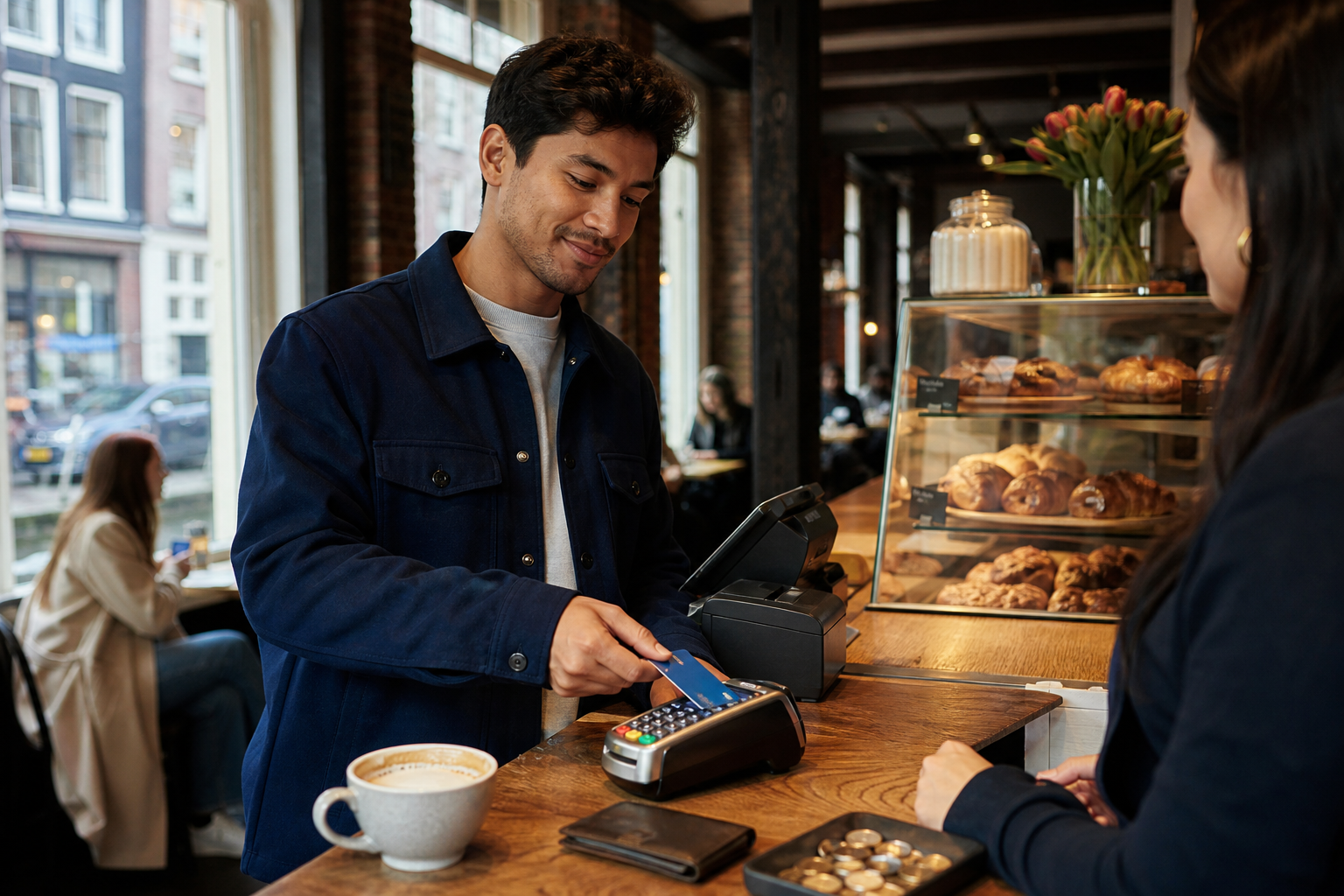
In the Netherlands, the everyday card in your wallet is usually a debit card — often called a pinpas — linked to your current account. You pay with chip, PIN, or contactless tap; money leaves available balance, not a revolving credit line.
This page is the debit-product and PIN-culture guide: what to expect from Maestro and Debit Mastercard branding, shops, ATMs and online use, and how that differs from credit-first habits abroad. Everyday cash-vs-card till culture lives on Cash vs card. iDEAL and SEPA rails live on How payments work. Credit availability and fees belong on Credit cards.
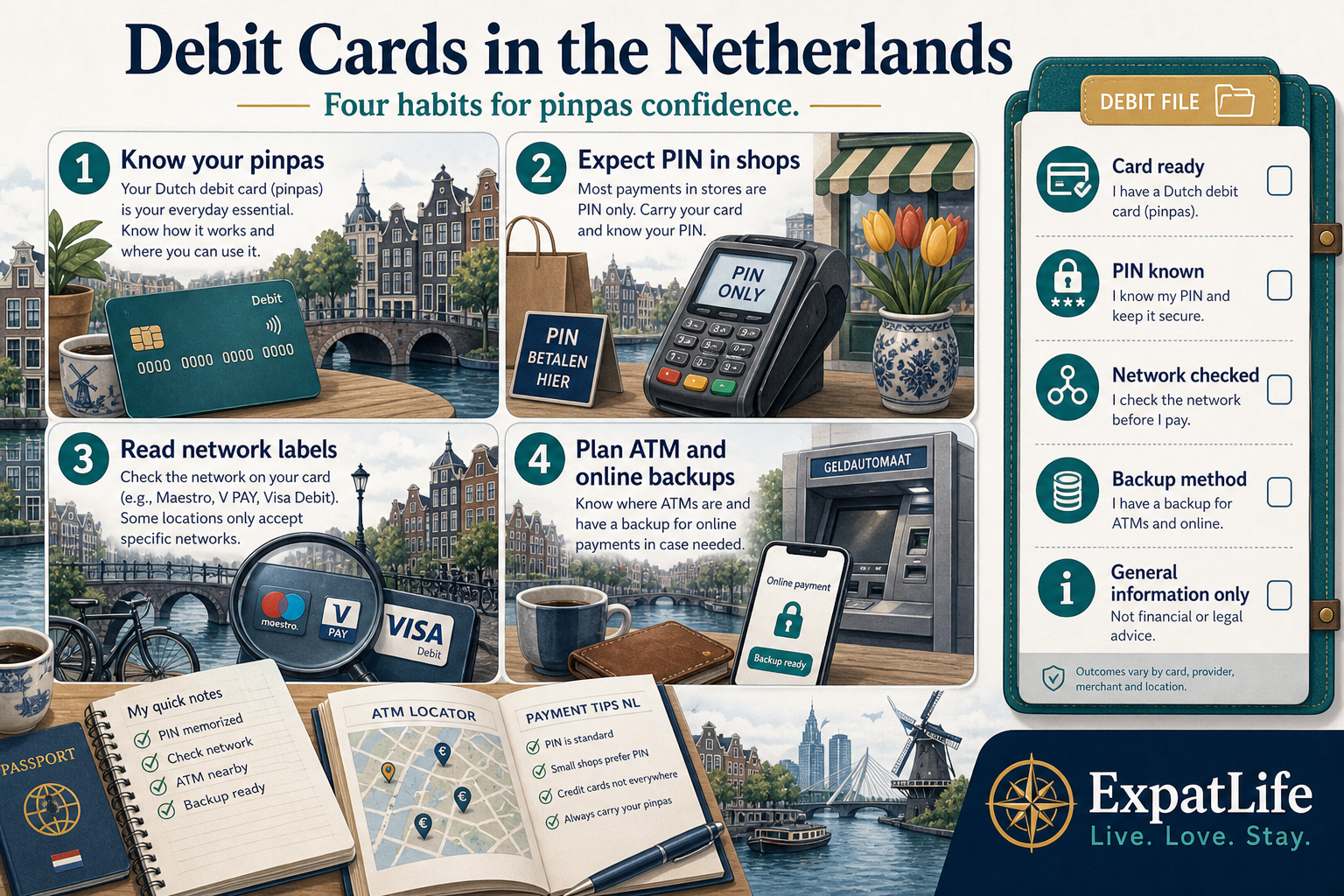
Debit readiness file — keep these together
Examples
| Situation | How it works here | First step |
|---|---|---|
| Weekly supermarket run | Dutch debit tap or chip + PIN is the local default | Confirm pinpas works once, then shop as locals do |
| First week after landing | Bridge with a working travel/debit card while Dutch pinpas onboarding finishes | Start Open a bank account, keep a modest cash float |
| Online Dutch webshop | Checkout often asks for iDEAL via your bank — not only card-not-present debit | Open How payments work for rails orientation |
Snapshot
Six cards cover Dutch debit and PIN culture. Deeper sections below expand each theme without ranking issuers.
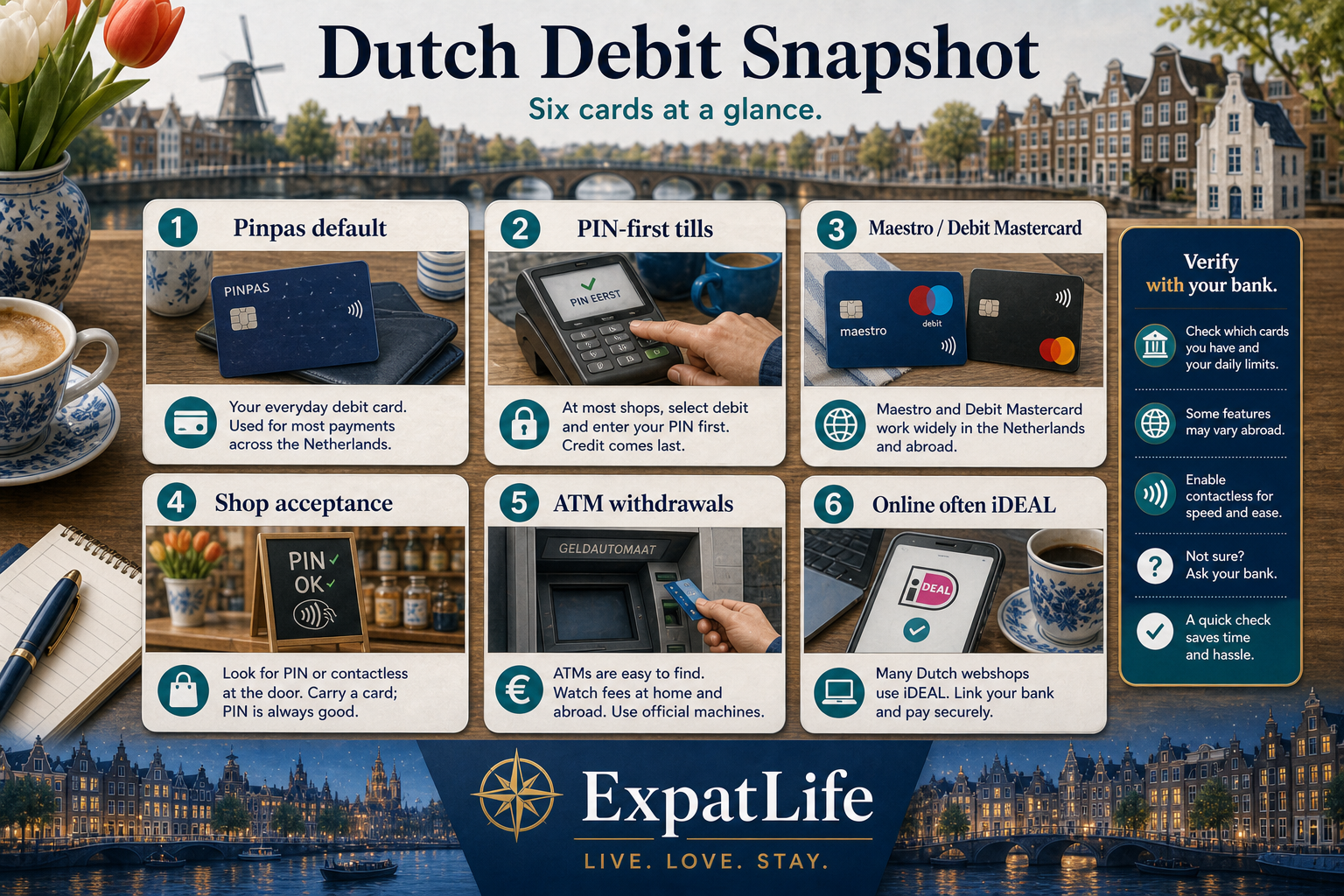
Default card
Debit pinpas
Linked to your everyday account balance
Till habit
PIN or tap
Credit is secondary in many shops
Networks
Maestro / Debit MC
Common branding paths — verify with your bank
Online
Often iDEAL
Covered on How payments work
Dutch debit and PIN culture: pinpas basics, network labels, shops, ATMs and online boundaries for expats.
A debit card that spends available funds — the everyday plastic locals use at the till.
Maestro and Debit Mastercard branding appear on many Dutch debit cards — logos change over time.
What to expect when you pin, tap, or withdraw a modest cash float.
Cash culture → Cash vs card. Rails → How payments work. Credit products → Credit cards sibling.
Need the account behind the card? Open a bank account — then return here for debit norms.
Pinpas
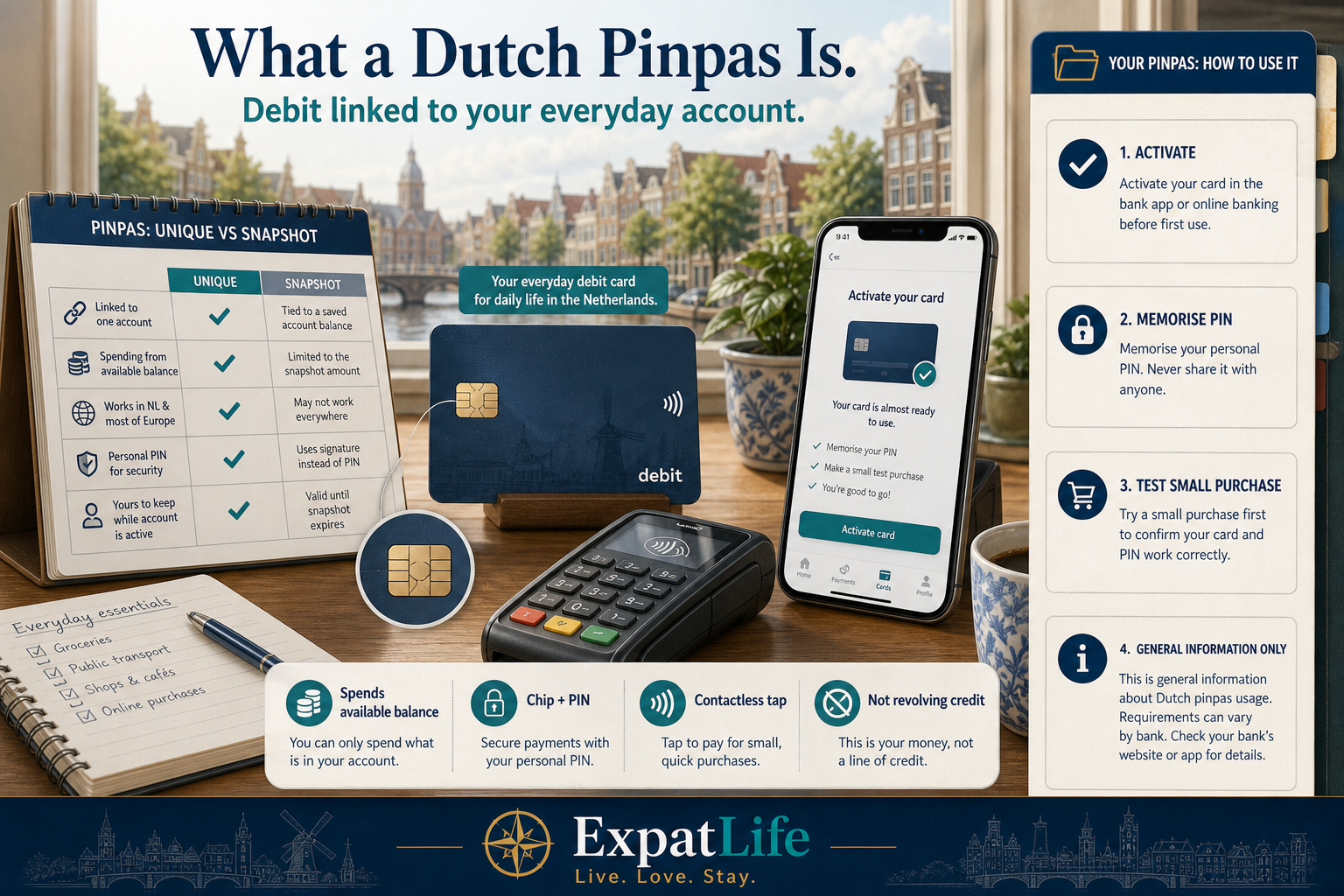
Pinpas is the everyday Dutch word for the debit card tied to your current account. It is how most people pay in shops: insert or tap, approve with PIN when asked, and the amount leaves available balance. It is not a credit line you pay off later — that distinction surprises many newcomers from credit-first countries.
Pinpas basics
A pinpas spends money you have (or an agreed overdraft if your bank offers one). It is not revolving credit — credit products are a separate topic.
New cards often need activation and a PIN you choose or receive securely. Follow your bank’s steps before a large grocery run.
Staff may say “pin” as a verb. “Pinpas” means the debit card. Cash is “contant”. Contactless is often just a tap gesture.
A foreign debit card can help early on, but fees, FX and occasional declines still happen — a Dutch pinpas is the long-term fit for residents.
Networks
Dutch debit cards carry network branding so terminals know how to route the payment. Historically many cards showed Maestro; Debit Mastercard branding is also common as products evolve. Treat logos as orientation — not a promise that every merchant or foreign ATM will behave the same way.
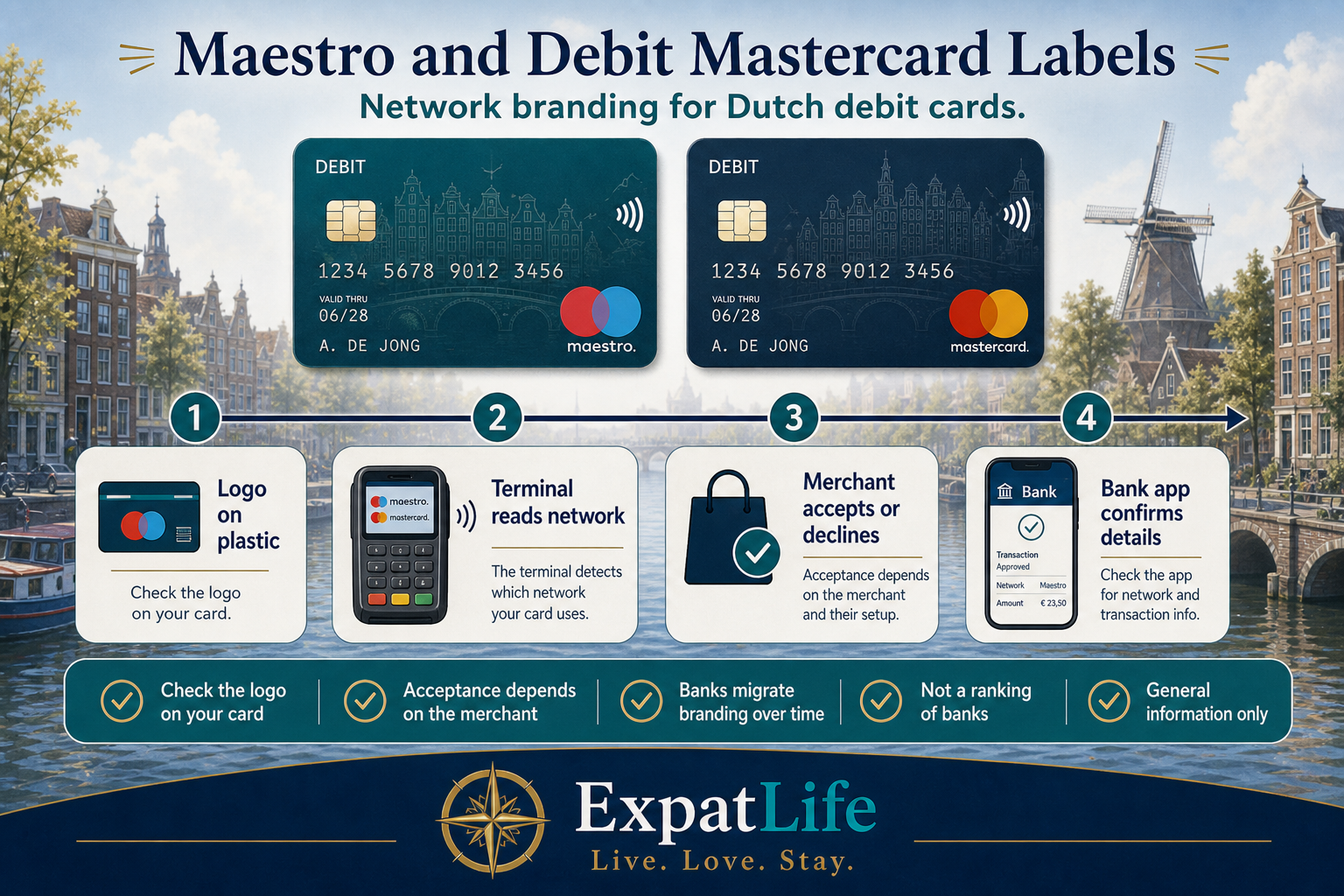
What network labels mean in practice
Maestro has been a familiar debit brand in Dutch wallets. If your card still shows it, use it as normal and verify any travel or online limits with your bank.
Some Dutch debit products use Debit Mastercard branding. That still means debit spending from your account — not automatic revolving credit.
This page does not rank which network or bank is “best”. Compare onboarding and fees on Best banks and official bank pages.
When plastic is replaced, branding or contactless settings can change. Re-test a small purchase after activation.
| Setting | Credit-first habit | Dutch debit norm | Practical tip |
|---|---|---|---|
| Dutch supermarket till | May expect credit or signature abroad | Debit + PIN / tap is the smooth default | Use your pinpas like locals |
| Hotel deposit hold | Often a credit card hold | Credit can still help; debit rules vary | Ask reception what they accept |
| Foreign ATM while travelling | Any card with a known logo | Network + issuer fees apply; check your app | Verify travel settings before you fly |
| Online Dutch webshop | Enter card numbers | Often iDEAL bank approval instead | See How payments work |
In shops
Everyday retail is built around debit. You present the card, tap or insert, enter a PIN when asked, and wait for confirmation. Contactless speeds small buys; banks periodically ask for PIN after tap limits. If a foreign card is declined, ask whether debit is preferred — then try your backup calmly.
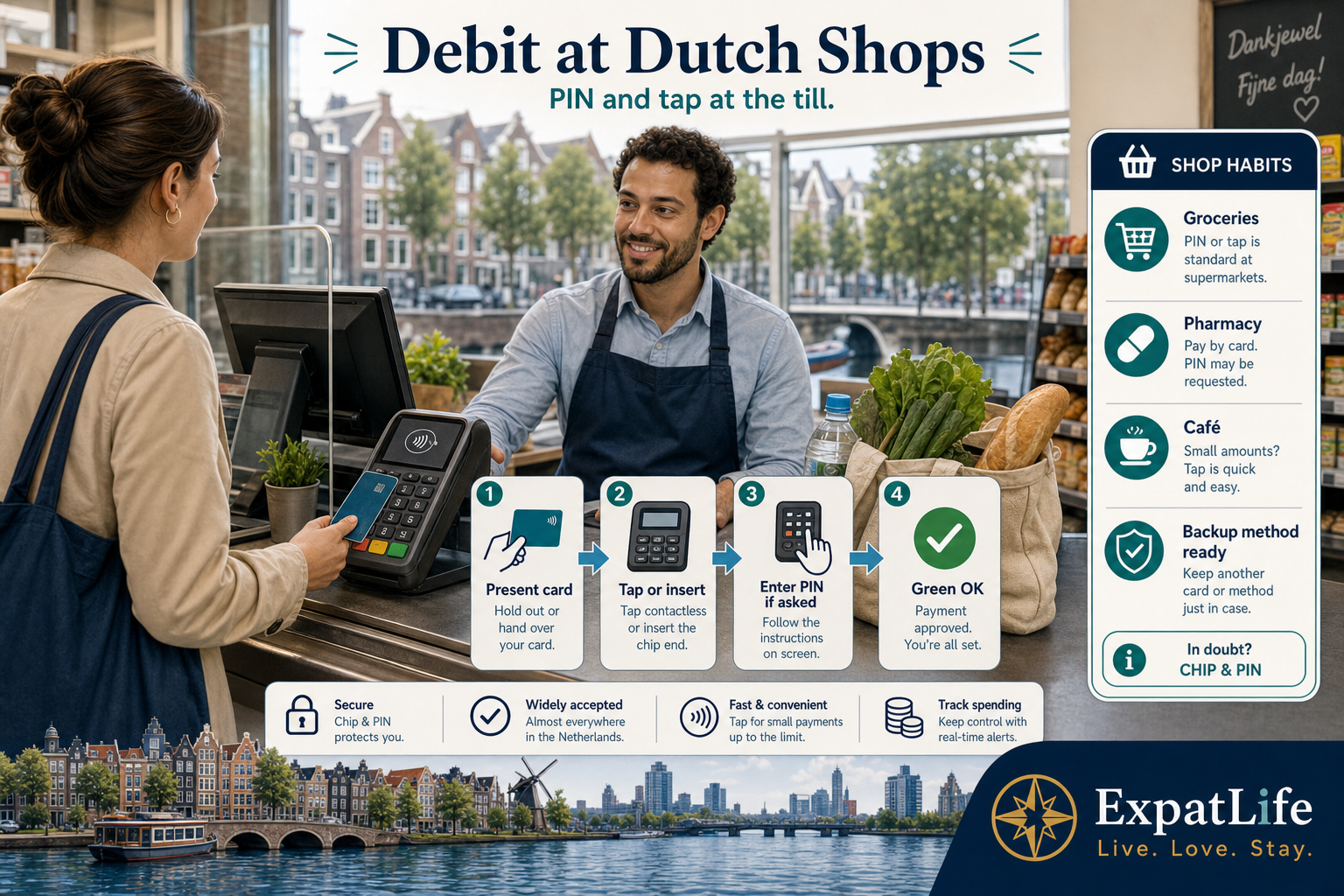
What to expect at the till
Paying at the terminal with your debit card — insert/tap and approve with PIN when required.
Your bank sets tap limits and re-check rules. Confirm in the app rather than assuming a universal euro ceiling.
Take a receipt when you need expense proof. Otherwise optional at many tills.
Markets and some stalls still lean on cash. That culture deep-dive lives on Cash vs card — not here.
ATMs
Your debit card is also how you withdraw cash. Prefer ATMs linked to your bank or a well-known network. Independent machines can add fees. Foreign debit cards may charge withdrawal and FX costs — check your issuer before making cash your main plan.
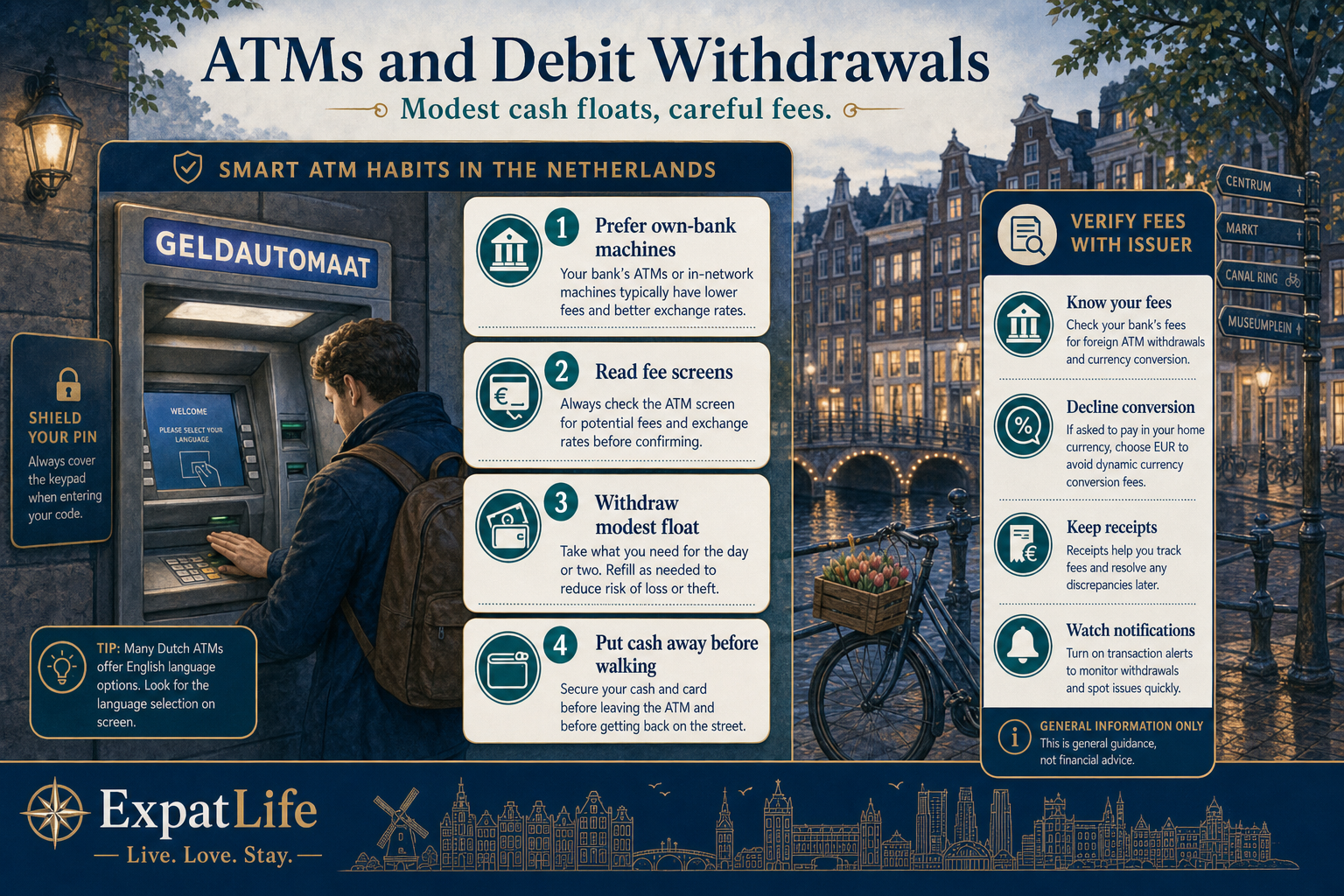
ATM habits
A modest float for markets and tips is usually enough — daily Dutch life is mostly card-first.
Often possible, but issuer fees and FX markups can add up. Compare with your bank’s fee page.
Enable travel notices if your bank asks, watch foreign ATM fees, and keep a backup card.
Use well-lit machines, put cash away before walking off, and treat unexpected “help” as a red flag — see Banking safety.
Online
Dutch online checkouts often prefer iDEAL: you approve the payment in your bank app rather than typing card numbers. Card-not-present debit can still appear on some sites, subscriptions and foreign merchants — rules differ by issuer. This page stays focused on debit culture; rails detail belongs on How payments work.
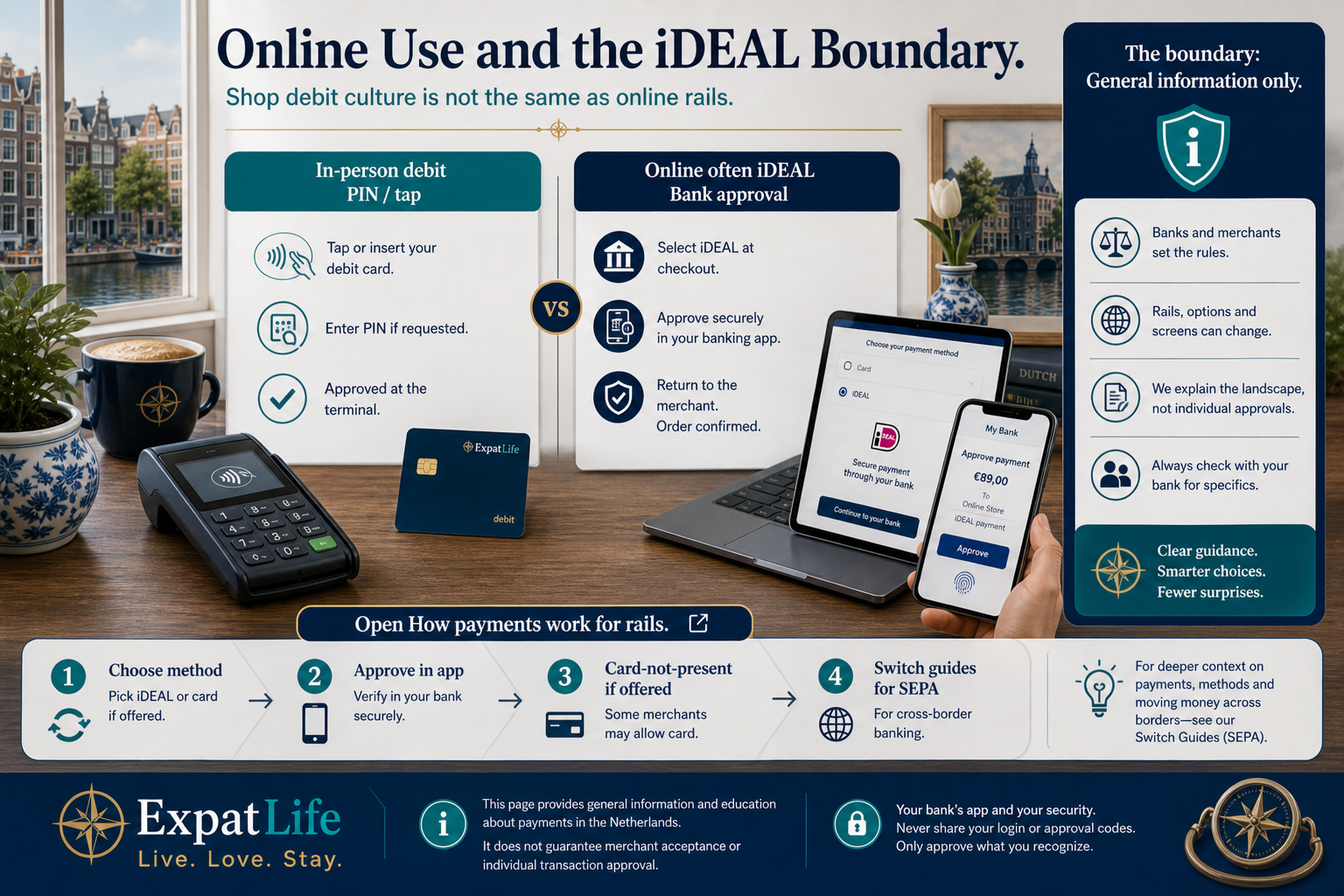
Online 1
On Dutch sites, iDEAL often appears alongside or instead of card fields.
Online 2
Confirm the amount and merchant name carefully before you approve.
Online 3
Enter debit details only on trusted sites; watch for 3-D Secure prompts.
Online 4
IBAN, SEPA and iDEAL deep-dives live on How payments work.
Habit shift
If you grew up swiping credit for groceries, Dutch tills can feel upside down. Here, debit carries weekly life. Credit still matters for some hotels, car rentals, deposits and travel — but it is not the universal shop language. Plan for debit first; keep credit as a specialist tool.
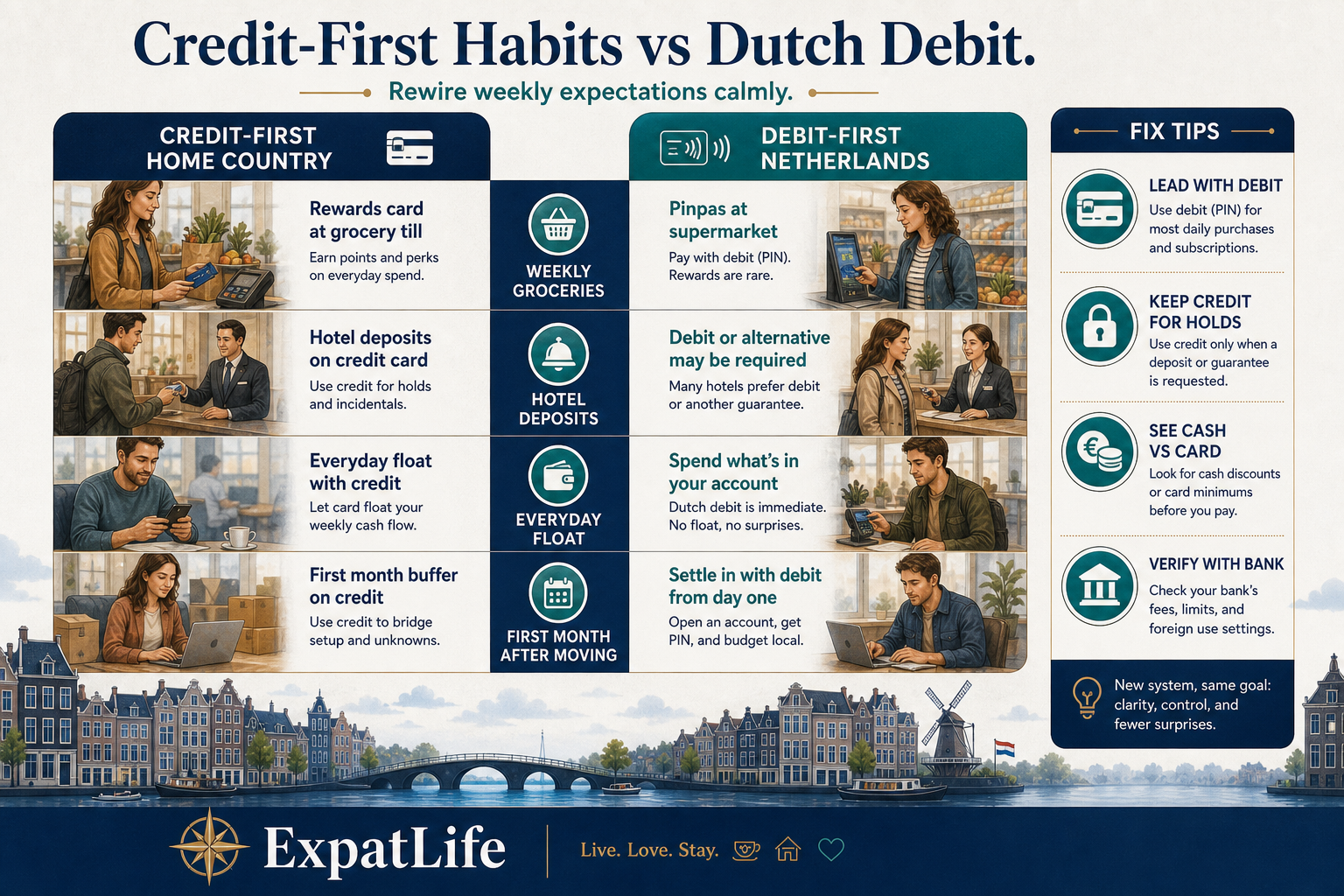
| Setting | Credit-first habit | Dutch debit norm | Practical tip |
|---|---|---|---|
| Weekly groceries | Often credit rewards / float | Debit pinpas is the smooth default | Build debit confidence early |
| Building “credit history” habits | Everyday credit use to build score | Different credit landscape — do not force credit at every till | Ask banks about products you actually need |
| Hotel / rental deposit | Credit card hold expected | Credit often preferred for holds; debit varies | Confirm with the provider before arrival |
| Splitting a café bill | One credit card + apps later | Each person may pin / tap, or use payment requests later | Ask how the table prefers to settle |
| First month after moving | Rely on foreign credit everywhere | Bridge carefully; prioritise Dutch debit setup | Pair with Open a bank account |
Situations
Same country, different first moves depending on how long you are staying and whether your pinpas is ready.

Examples
| Situation | How it works here | First step |
|---|---|---|
| Weekend tourist | Working foreign debit/credit + small cash float; test a purchase on day one | Do not rely on cash alone — see also Cash vs card |
| New arrival, no Dutch pinpas yet | Bridge with travel debit/credit and cash while account setup runs | Follow Open a bank account; keep PIN skills ready for the new card |
| Resident with Dutch debit | Live mostly debit-first; keep light cash for markets | Confirm contactless limits in your bank app |
| Student on a budget | Debit for campus and groceries; watch ATM fees | Avoid high third-party ATM costs — check your bank’s map |
Avoid
These patterns create avoidable debit friction — calm backups beat awkward declines.
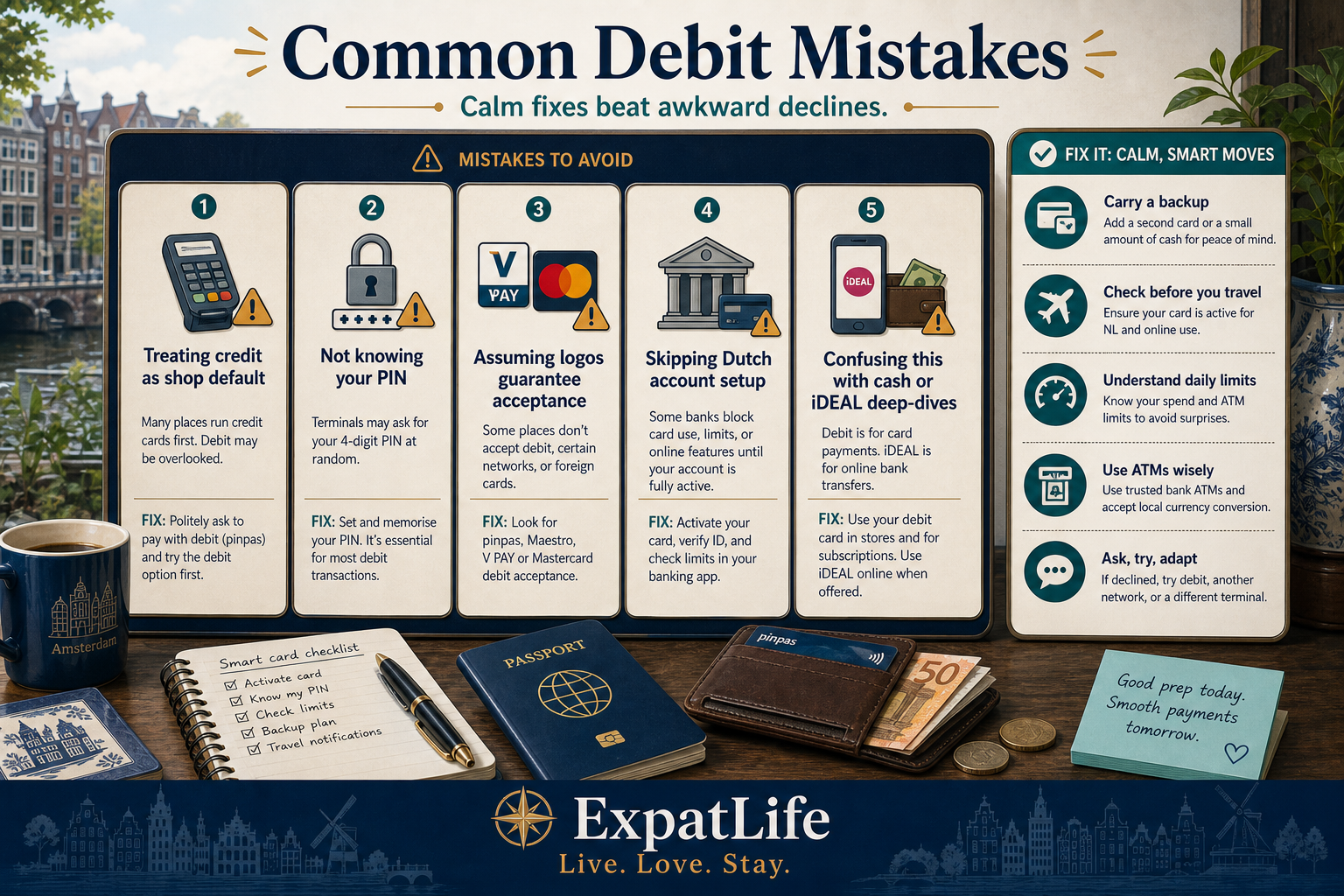
Many everyday shops are debit-led. Credit helps in some travel and hotel contexts, not as a universal till language.
Fix: Lead with debit capability plus a small cash float.
Contactless can fail or require a re-check. Without a PIN you are stuck.
Fix: Memorise the PIN before peak shopping hours.
Maestro or Debit Mastercard branding helps terminals route payments — merchants still decide.
Fix: Carry a backup method and ask calmly when declined.
Foreign cards can bridge weeks, but fees and declines add friction for residents.
Fix: Start Open a bank account early if you are staying.
When cash still helps is a sibling topic.
Fix: Use Cash vs card for markets, tips and till mix decisions.
iDEAL bank approval is common online.
Fix: Open How payments work for rails orientation.
Ready for debit
Work through this list before your first busy debit-heavy shopping week.
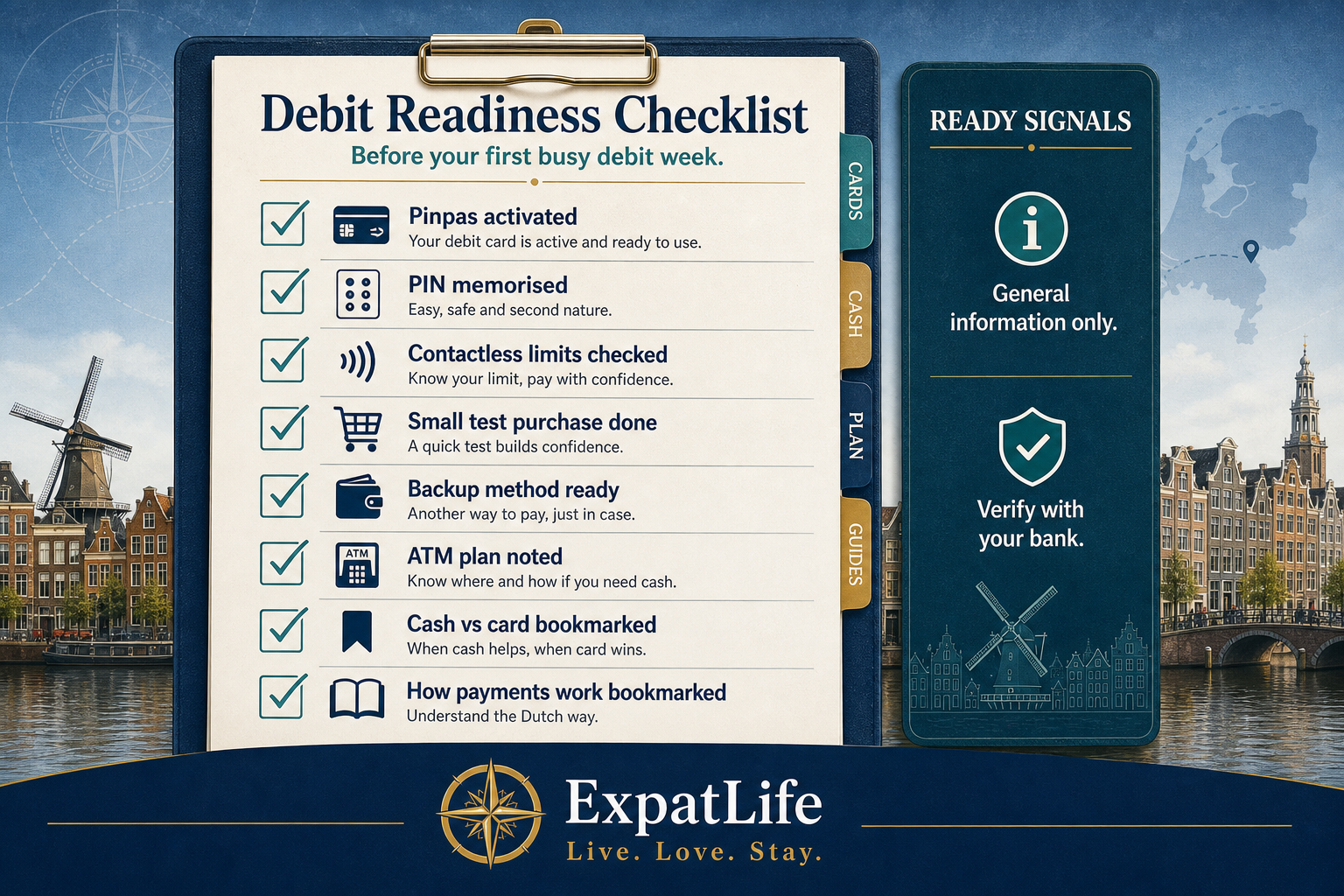
Debit readiness checklist
How-to
A calm sequence for your first debit-heavy weeks — banks and merchants remain authoritative.
Step 1
Residents: open an everyday account and activate the pinpas. Still onboarding? Keep a working foreign debit/credit and a cash float. Use Open a bank account for setup.
Step 2
Note contactless limits, travel notices and block/unblock controls before a large grocery run.
Step 3
Tap or chip + PIN at a low-stakes till so the first busy supermarket is not your first attempt.
Step 4
Withdraw a modest float when needed. Markets and tips culture are covered on Cash vs card.
Step 5
iDEAL and bank-app approvals are on How payments work. Credit holds and fees live on Credit cards.
Tools
Use tools for account and cost planning — then verify products and fees on each bank’s official pages.
FAQ
Short answers for the searches expats ask most often about Dutch debit cards and PIN culture.
The everyday Dutch debit card linked to your current account. You pay with PIN or contactless; money leaves available balance rather than a revolving credit line.
No. Debit spends from your account (or agreed overdraft if offered). Credit products are separate and are not the default at many everyday tills.
You need a working debit path your bank issues. Logos hint at networks; they are not a consumer ranking. Verify acceptance and fees with your bank and merchants.
Often yes for major networks, but fees, FX and occasional declines still happen. Residents usually set up a Dutch pinpas for smoother weekly life.
iDEAL is a common online bank-approval checkout rail. That topic is covered on How payments work — separate from in-person debit culture.
For markets, tips and some small stalls — see Cash vs card. Most weekly supermarket life is debit-first.
By opening a Dutch everyday account and activating the card the bank issues. Start with Open a bank account, then Best banks for expats when you shortlist.
No. This is general orientation for newcomers. Banks, shops and networks set their own rules — verify fees and acceptance with them.
Related
Live cluster siblings stay linkable — Cash vs card, Credit cards and Wise vs Revolut.
Hub
Return to the Banking hub or jump to Cash vs card, payments rails, and live cluster peers.
Explore next
Learn till culture, payment rails, open an account, shortlist banks, or model costs.
Trust
Confirm acceptance habits and fees with merchants and banks — rules change.
Some links on related banking pages may be affiliate links. If you use them, we may earn a commission at no extra cost to you. Affiliate status never changes merchant acceptance or bank decisions.