
Shop default
Debit + PIN / tap
Credit is secondary in many everyday places
Netherlands · Money · Banking
Everyday Dutch payment culture for expats: PIN-first shops, when cash is still useful, contactless taps, and what to expect as a tourist or newcomer — without ranking cards or promising acceptance.
General orientation only — not financial advice. Shops and terminals set their own rules. Card networks, limits and fees change; confirm with your bank and the merchant before you rely on one method.
Quick answer
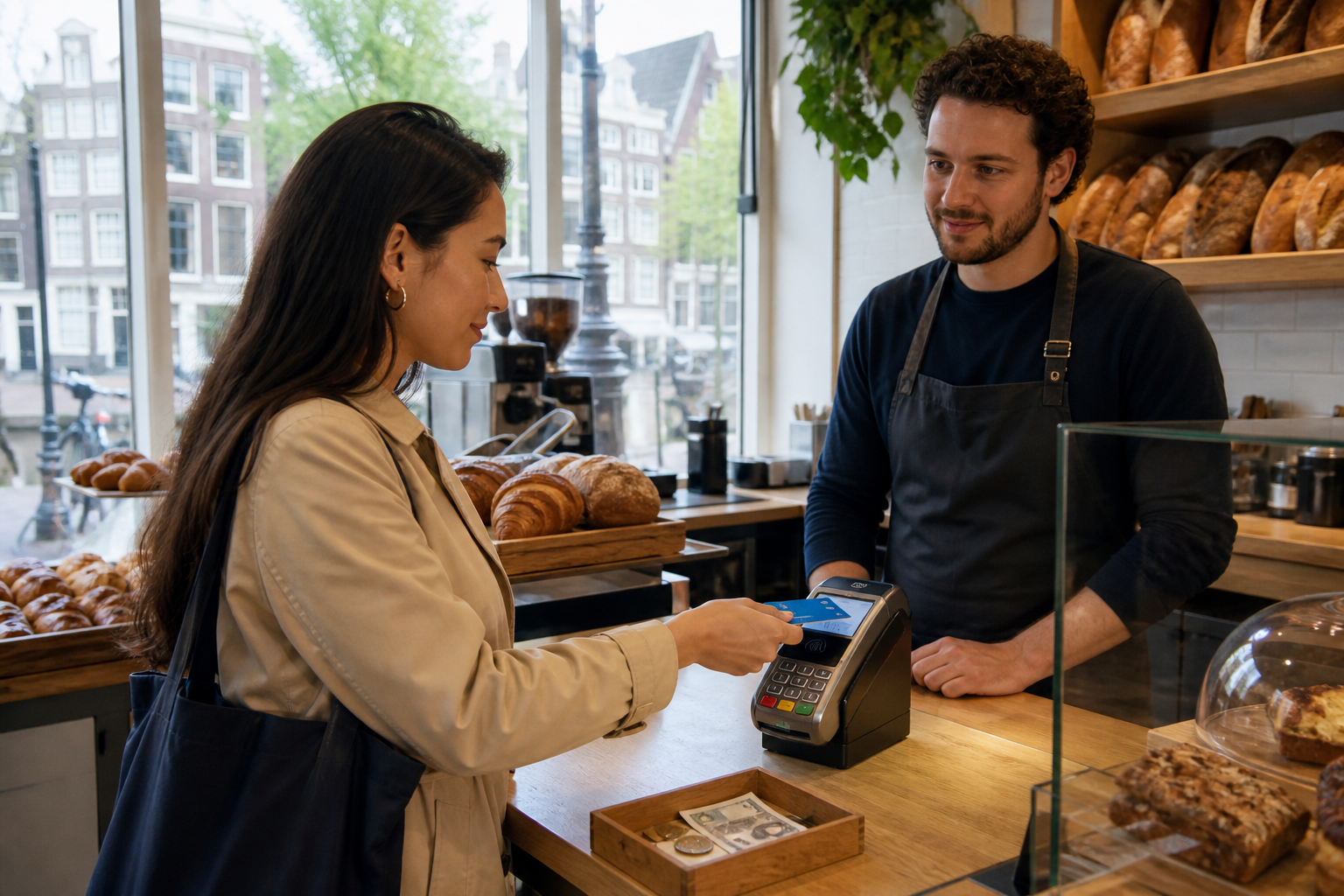
In the Netherlands, everyday shops are usually built around debit cards — chip, PIN, or contactless tap — more than around cash or foreign credit cards.
This page is the culture guide: what to expect at the till, when cash still helps, and how tourists and newcomers bridge the first weeks. For iDEAL, SEPA and online rails, use How payments work. For card product detail, use the Debit and Credit sibling pages when they publish.
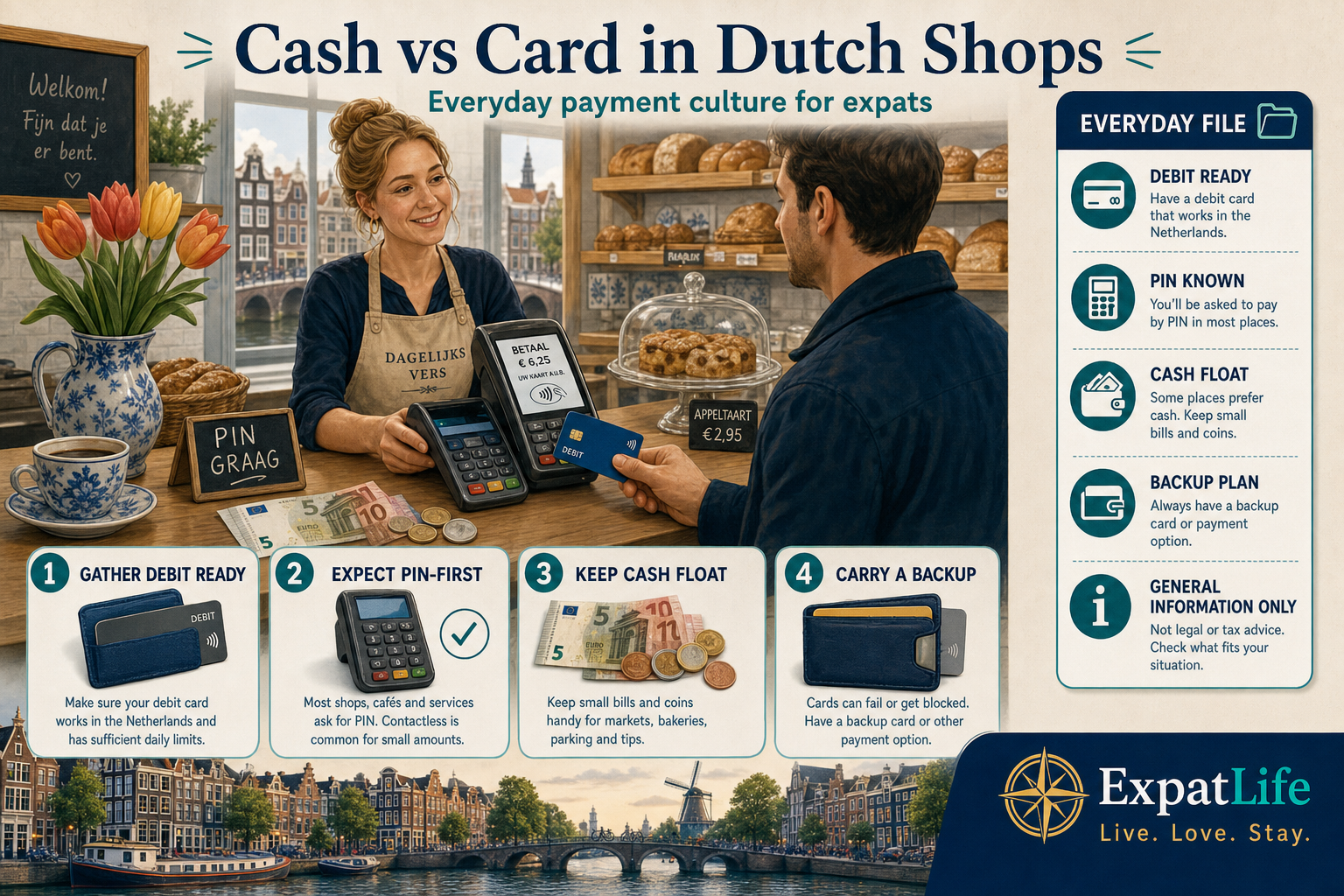
Everyday payments file — keep these together
Examples
| Situation | How it works here | First step |
|---|---|---|
| Weekly supermarket run | Debit tap or chip + PIN is the local default | Confirm card works once, then shop as locals do |
| Saturday market | More stalls still prefer cash or simpler card terminals | Withdraw a modest float the day before |
| First week after landing | Bridge with cash and a working travel card while Dutch debit setup finishes | See Open a bank account, then return here for till habits |
Snapshot
Six cards cover everyday Dutch till culture. Deeper sections below expand each theme without ranking products.
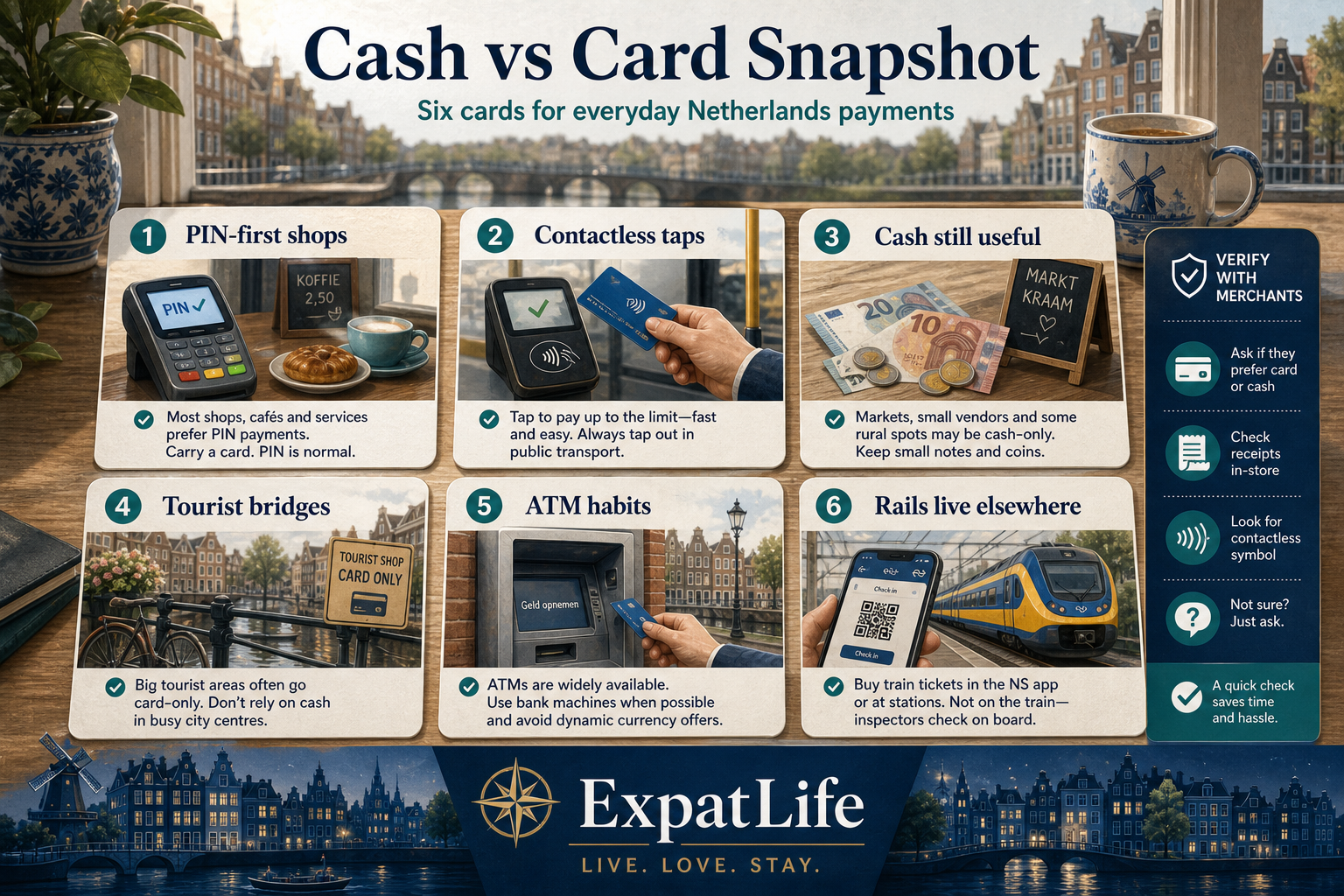
Shop default
Debit + PIN / tap
Credit is secondary in many everyday places
Cash role
Useful pockets
Markets, tips, some stalls — not the main system
Contactless
Common for small buys
Bank tap limits and PIN rechecks apply
Online
Often iDEAL
Covered on How payments work
Everyday cash vs card culture in Dutch shops, markets and early-arrival scenarios.
Why debit + PIN (or tap) is the normal till habit across much of daily life.
Markets, tips, small stalls and bridge periods before a Dutch debit card works.
Tap-to-pay expectations, limits and what to do when a tap fails.
iDEAL/SEPA rails → How payments work. Card products → Debit / Credit siblings.
Need a Dutch account first? Open a bank account — then return for till culture.
Shop culture
Dutch everyday retail is built around debit cards. You insert or tap, enter a PIN when asked, and the money leaves your current account. Many newcomers from credit-card cultures notice this first — credit can work in hotels, larger chains or travel contexts, but it is not the universal till language.
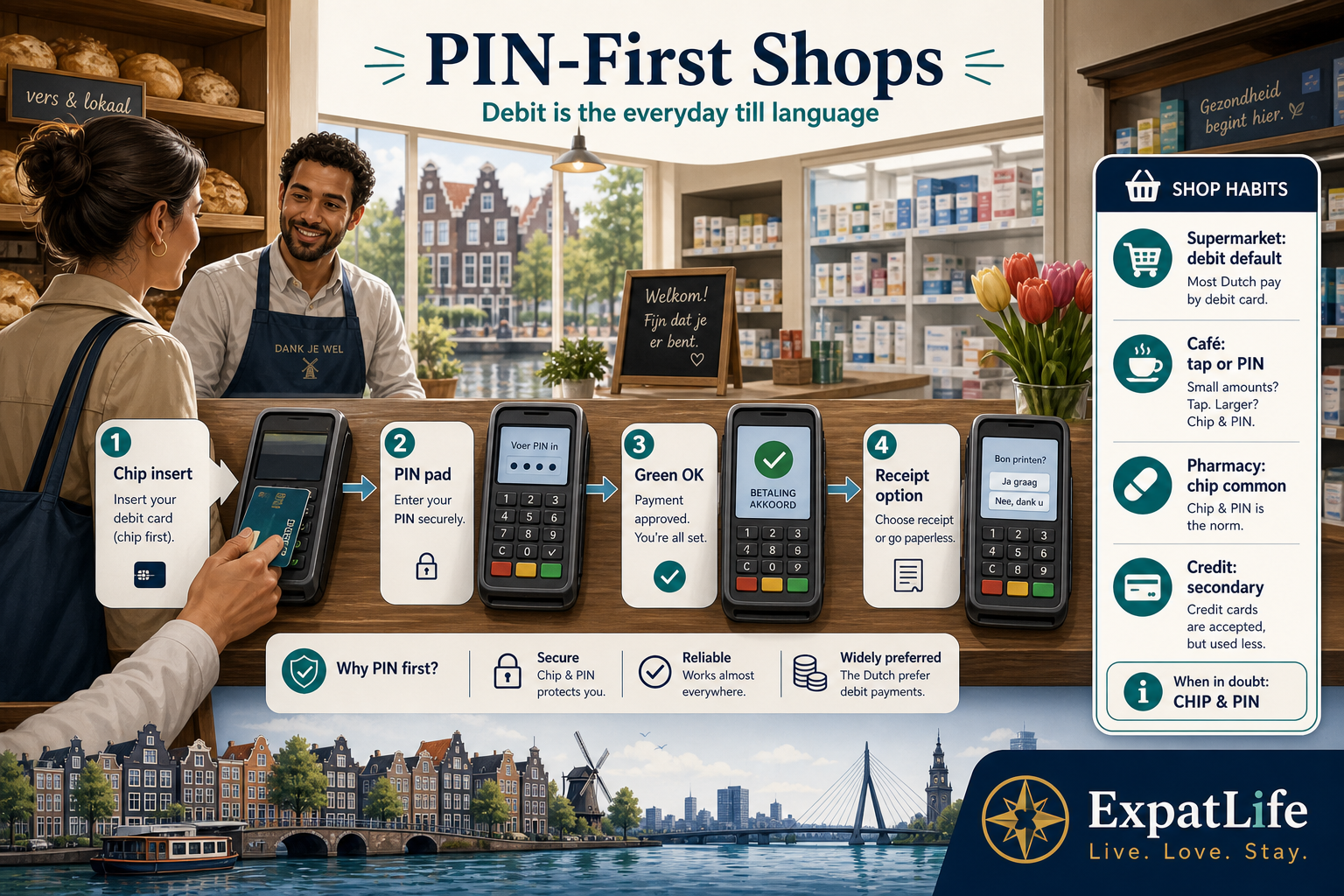
What to expect at the till
Using the shop terminal with your debit card — insert/tap and approve with PIN when required.
Local acceptance habits grew around debit. Credit still matters for some travel and deposits — product detail belongs on the Credit cards guide.
Many terminals accept major networks, but fees, FX and occasional declines still happen — carry a backup.
You may hear “pinpas” (debit card) or simply “pin”. Cash is “contant”. Contactless is often just a tap gesture.
Cash pockets
The Netherlands is often described as nearly cashless — and for weekly supermarket life that is close to true. Cash still unlocks street markets, tip jars, some food trucks, small events and the awkward window before your Dutch debit card is ready.
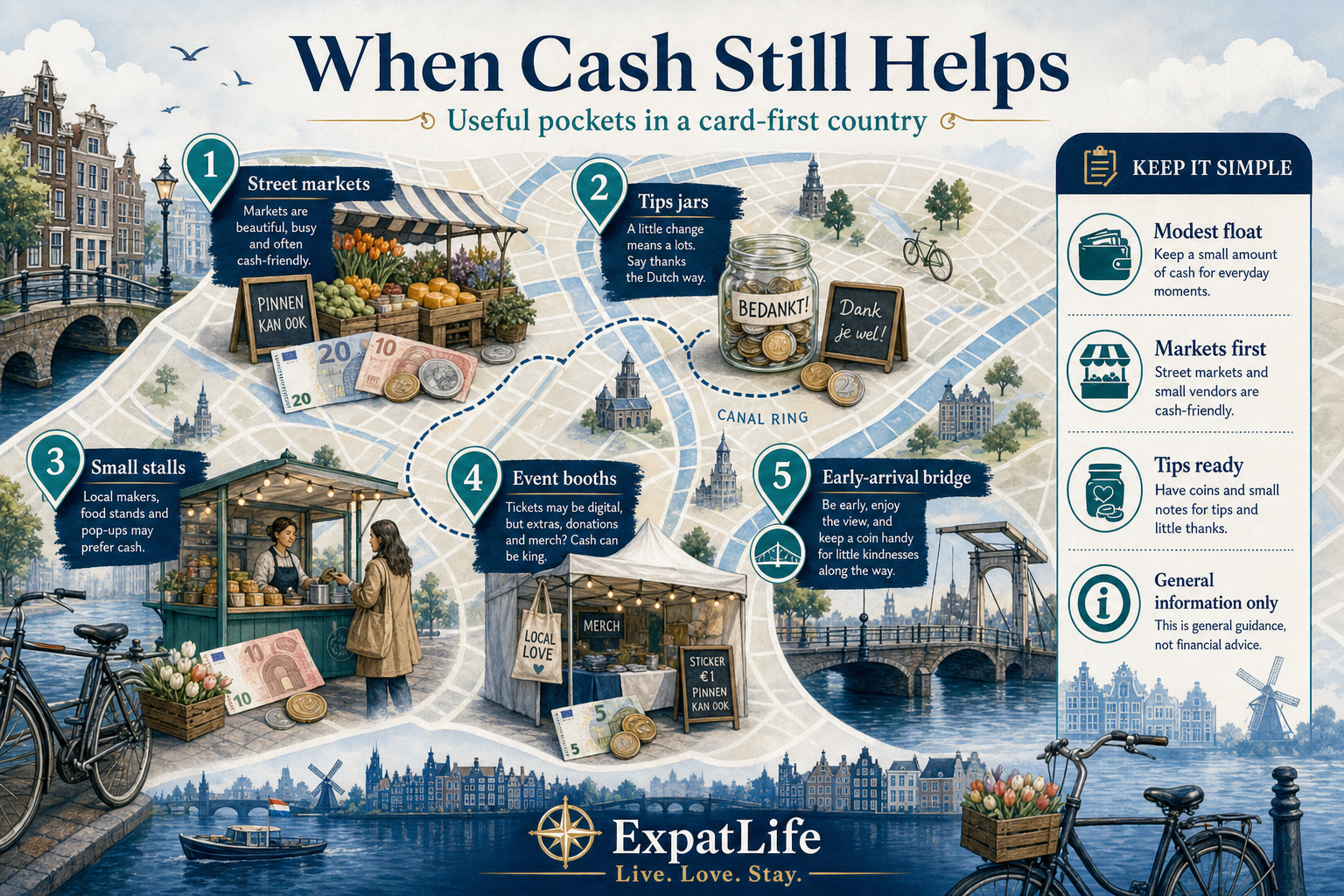
Where cash still helps
| Setting | Cash | Card | Practical tip |
|---|---|---|---|
| Albert Heijn / Jumbo / most pharmacies | Usually accepted, but not required | Debit + PIN / tap is the smooth default | Use debit like locals for speed |
| Saturday street market | Often the easiest path | Some stalls take card; many prefer cash | Bring a modest float |
| Café / lunch spot | Fine for small tabs | Debit tap common; credit varies | Ask before ordering if unsure |
| Hotel / larger chain | Possible but less common for deposits | Cards more routinely accepted — still verify | Credit may help for holds; confirm with reception |
| First week after landing | Helpful bridge | Travel card + later Dutch debit | Pair with Open a bank account checklist |
Tap to pay
Contactless (contactloos) is common for small everyday buys. You tap the card or phone, wait for confirmation, and sometimes enter a PIN after a bank-set limit or number of taps. Limits and wallet rules differ by bank — check your app rather than assuming a universal euro threshold.
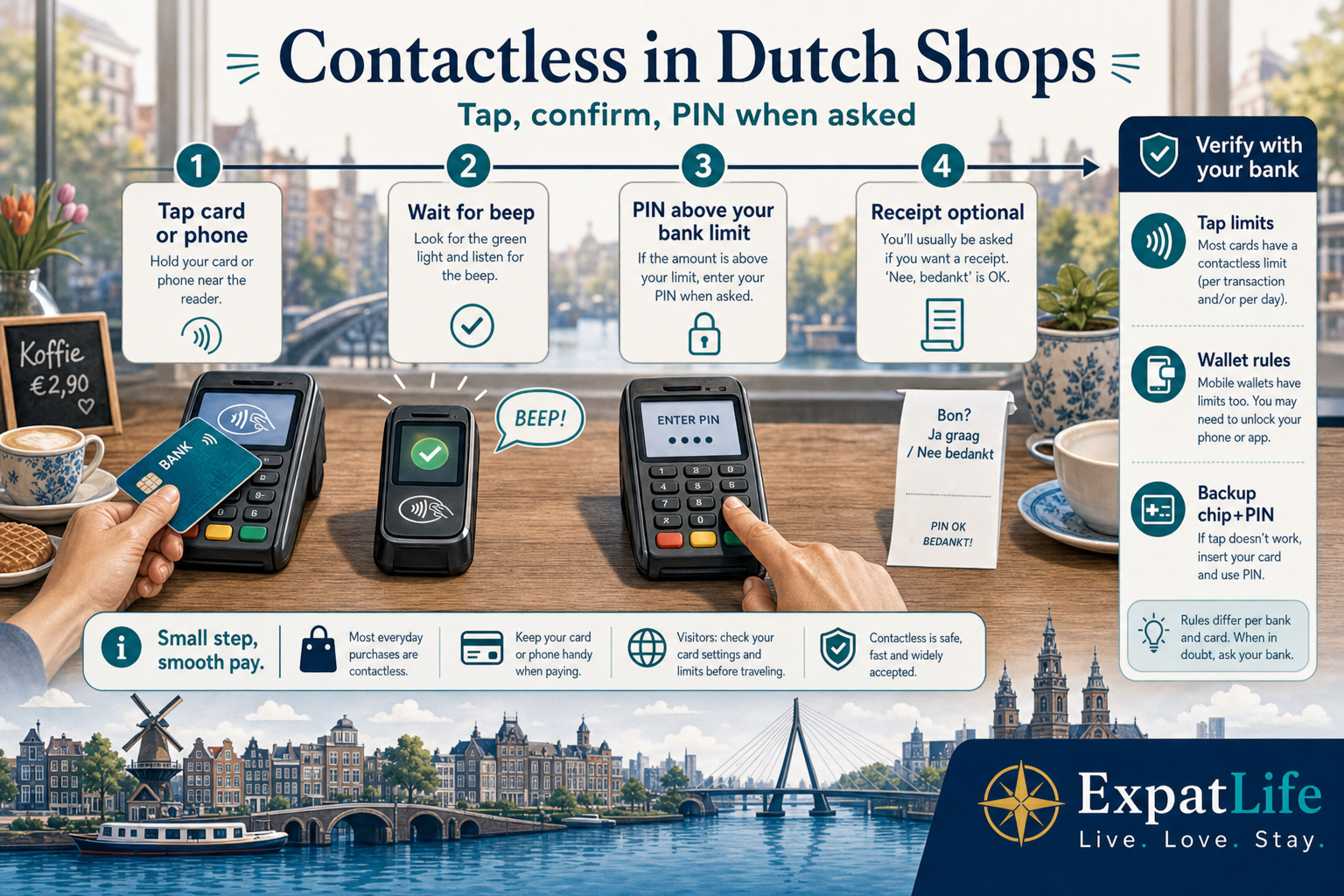
Tap 1
Hold near the contactless symbol on the terminal.
Tap 2
Listen for a beep or watch for a green OK on the display.
Tap 3
Banks periodically re-check with PIN after tap limits.
Tap 4
Take a receipt when you need expense proof; otherwise optional.
Side by side
Use this as a planning table — merchants still decide what they accept on the day.
| Setting | Cash | Card | Practical tip |
|---|---|---|---|
| Weekly groceries | Works, slower for large baskets | Best fit — debit tap or PIN | Default to debit |
| Market produce | Often easiest | Hit-or-miss by stall | Carry €20–€50 float |
| Restaurant bill | Fine for small groups | Debit common; splitting may use payment requests later | Ask how the table prefers to settle |
| Online Dutch webshop | Not used at checkout | Often iDEAL via your bank — not this page’s focus | Open How payments work |
| Tourist day trip | Helpful for tickets and stalls | Keep a working travel/debit card as primary | Two methods beat one |
Situations
Same country, different first moves depending on how long you are staying.
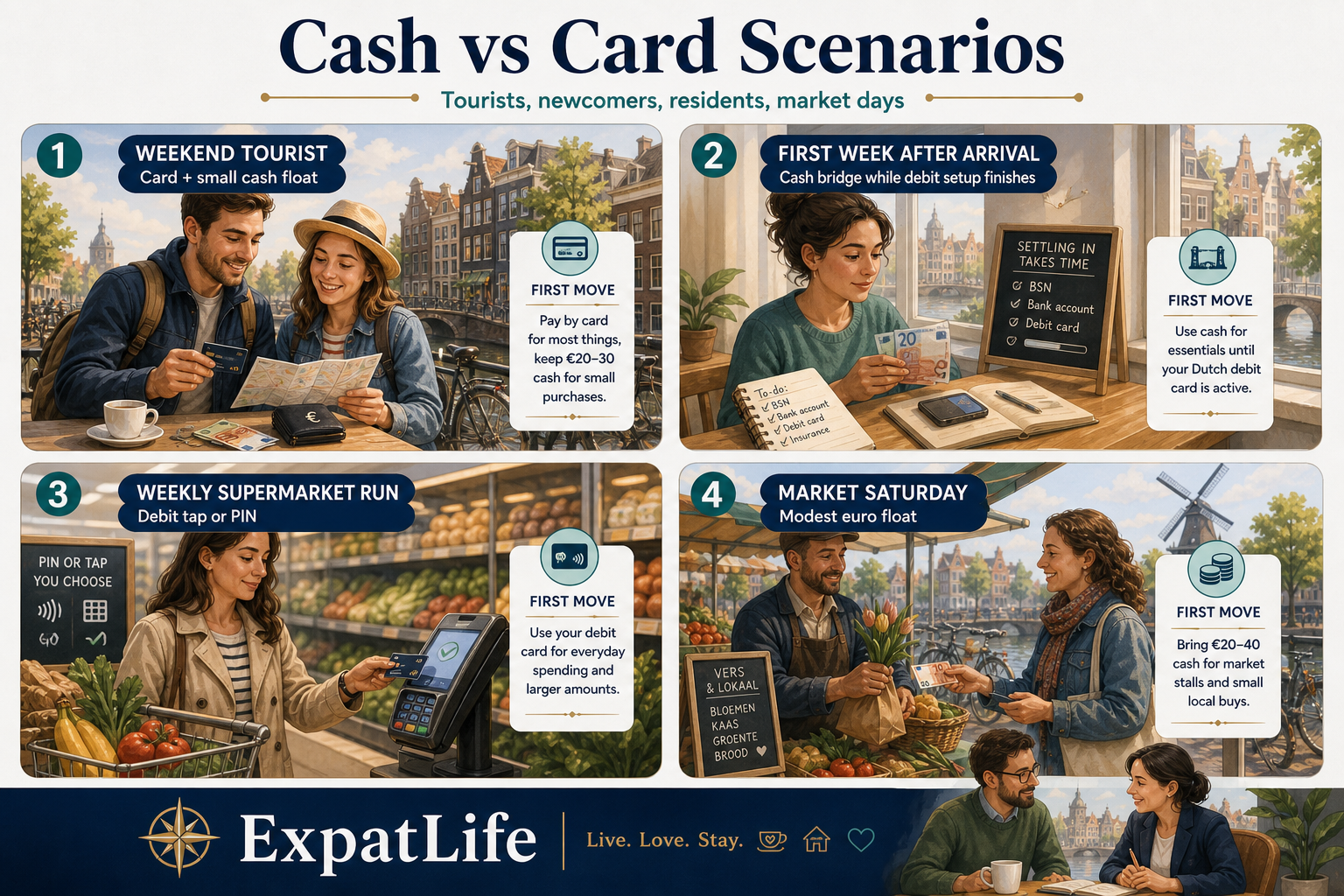
Examples
| Situation | How it works here | First step |
|---|---|---|
| Weekend tourist | Primary card + small cash float; do not rely on cash alone | Test a small tap or PIN purchase on day one |
| New arrival, no Dutch debit yet | Bridge with cash and a travel card while account setup runs | Follow Open a bank account, keep a float for markets |
| Resident with Dutch debit | Live mostly card-first; keep light cash for markets and tips | Confirm contactless limits in your bank app |
| Student on a budget | Debit for campus and groceries; cash for occasional markets | Avoid high third-party ATM fees — check your bank’s map |
Getting cash
When you need cash, prefer ATMs linked to your bank or a well-known network. Independent machines can add fees. Foreign cards may charge withdrawal and FX costs — check your issuer before relying on cash for a whole week.
ATM habits
A modest float (for example enough for a market morning) is usually enough — large cash piles are rarely needed for daily Dutch life.
Issuer fees and FX markups can outweigh convenience. Compare with your bank’s official fee page before making cash your main plan.
Try another nearby ATM or a supermarket cashback option if offered — do not assume every machine is stocked late at night.
Use well-lit machines, put cash away before walking off, and treat unexpected “help” from strangers as a red flag — see Banking safety.
Avoid
These patterns create avoidable till friction — calm backups beat awkward declines.
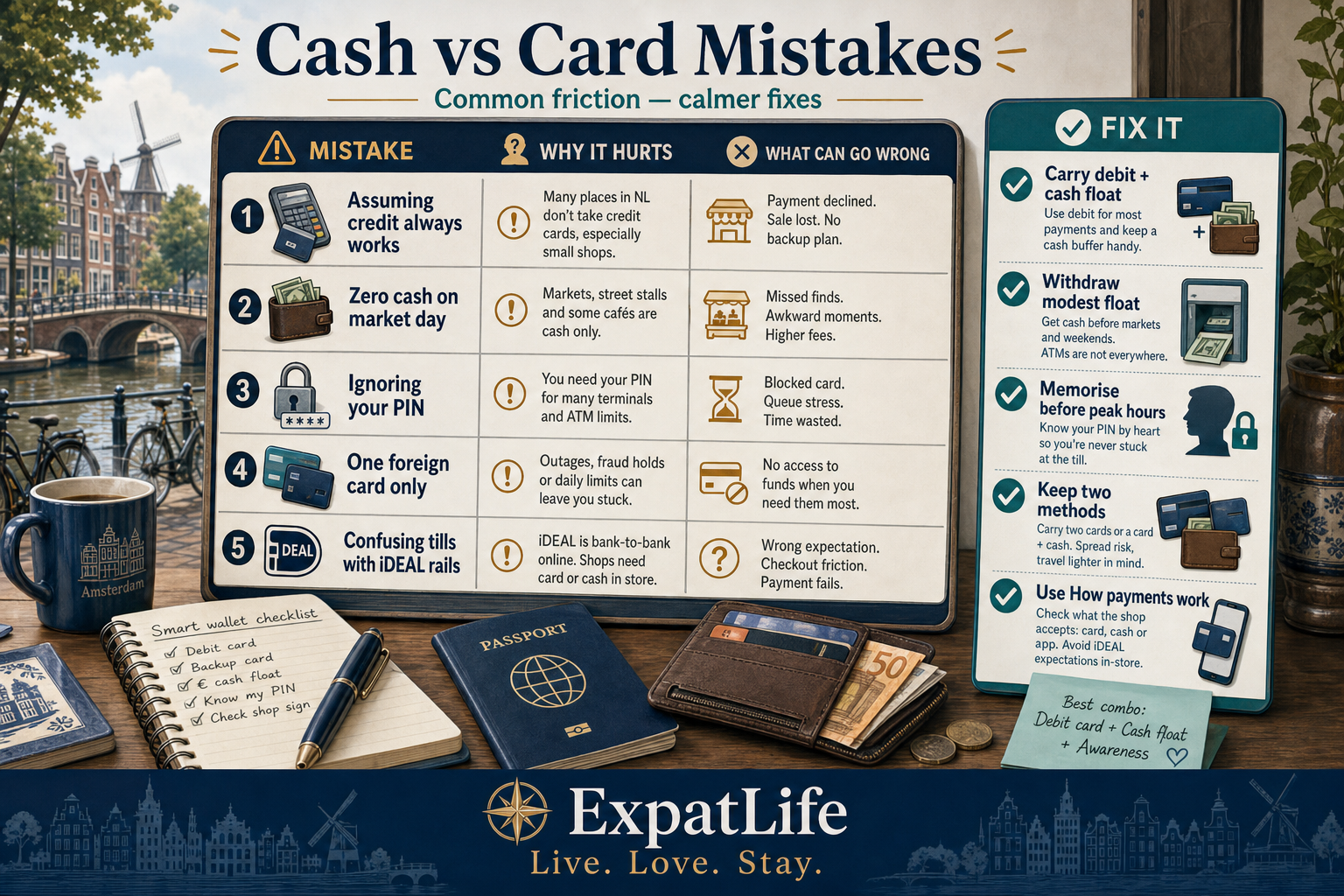
Many everyday shops are debit-led. Credit helps in some travel and hotel contexts, not as a universal default.
Fix: Carry debit capability plus a small cash float.
Stalls may take cards, but cash is still the smoother path at many markets.
Fix: Withdraw a modest float the day before.
Contactless can fail or require a re-check. Without a PIN you are stuck.
Fix: Memorise the PIN before peak shopping hours.
A single decline at a busy till creates stress.
Fix: Keep two methods: card + cash, or two cards.
iDEAL, SEPA and IBAN deep-dives belong on How payments work.
Fix: Use that guide for online and transfer mechanics.
Third-party machines can add costs quickly for visitors.
Fix: Prefer your bank’s network and read on-screen warnings.
Ready for shops
Work through this list before your first busy shopping or market day.
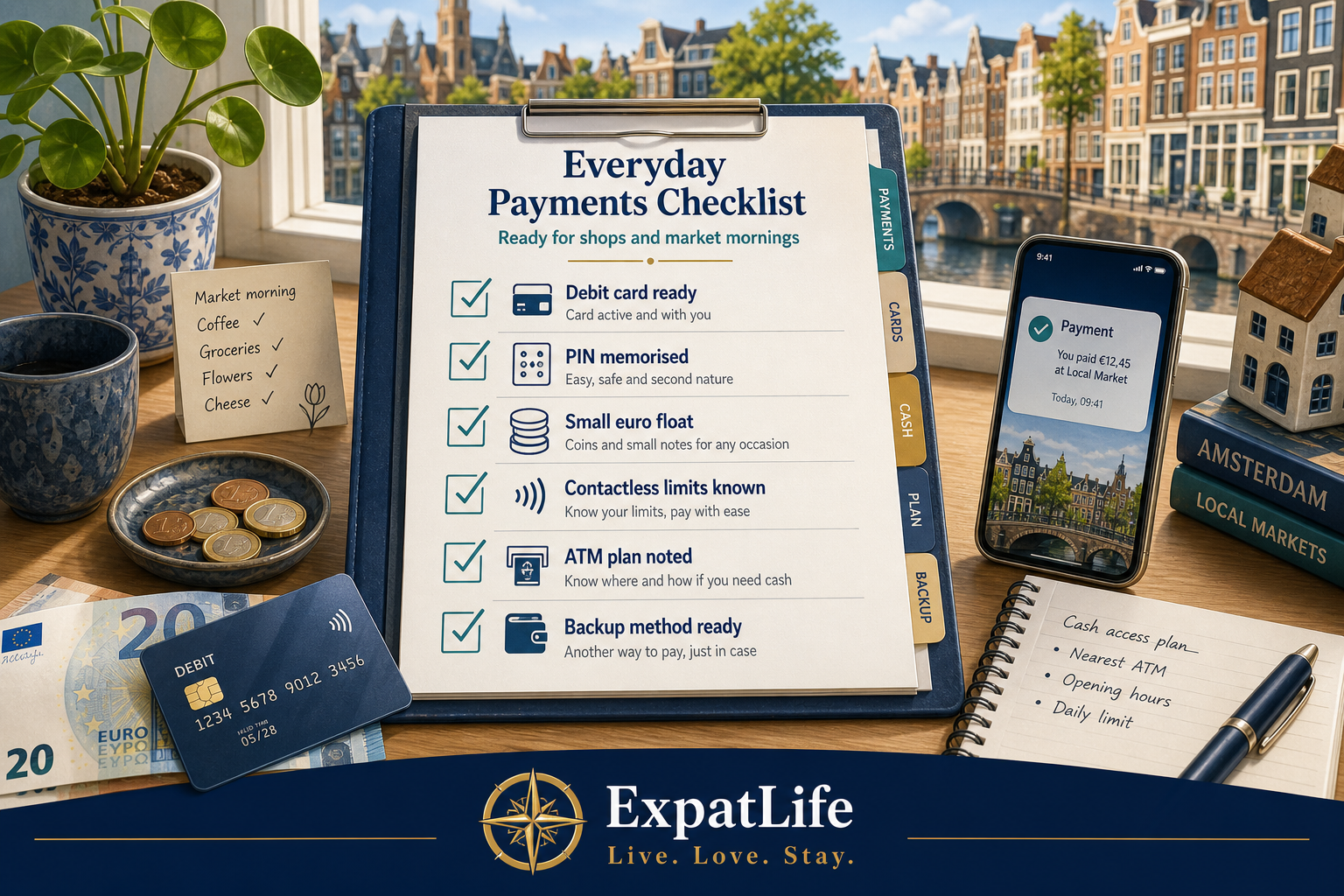
Everyday payments checklist
How-to
A calm sequence for your first busy shopping days — merchants and banks remain authoritative.
Step 1
Dutch debit is ideal long term. If you are still onboarding, keep a working travel card and a cash float. Use Open a bank account for setup.
Step 2
Open your bank app, note contactless limits, and practise one small purchase before a large grocery run.
Step 3
Enough for markets and tips — not a full month of expenses. Prefer your bank’s ATMs when possible.
Step 4
Tap when offered; insert and PIN when asked. If declined, ask whether debit is preferred, then try your backup.
Step 5
iDEAL and bank-app approvals are covered on How payments work — this page stays focused on in-person culture.
Tools
Use tools for account and cost planning — then verify products and fees on each bank’s official pages.
FAQ
Short answers for the searches expats ask most often about cash vs card in Dutch shops.
For weekly supermarket life, often not much. Keep a small float for markets, tips, some stalls and early-arrival gaps. Most everyday shops prefer debit.
Many places are card-first, but cash is still accepted in lots of settings. “Cashless” is a tendency, not a hard nationwide rule — always follow the merchant.
Paying at a terminal with your debit card — insert or tap, then enter your PIN when asked. Locals often say “pin” as the everyday word for this.
It is common for small everyday buys, but terminals and bank limits vary. If tap fails, use chip + PIN or another method.
Sometimes yes, especially in hotels and larger venues — but many everyday shops are debit-led. Carry a backup and do not assume universal acceptance.
On How payments work. iDEAL is an online bank-approval checkout rail, not the same topic as cash vs card at a physical till.
By opening a Dutch everyday account and activating the card the bank issues. Start with Open a bank account, then Best banks for expats when you shortlist.
No. This is general orientation for newcomers. Banks, shops and networks set their own rules — verify fees and acceptance with them.
Related
Live cluster siblings stay linkable — Debit cards, Credit cards and Wise vs Revolut.
Hub
Return to the Banking hub or jump to live cluster peers and the payments culture sibling.
Explore next
Learn payment rails, open an account, shortlist banks, or model costs.
Trust
Confirm acceptance habits and fees with merchants and banks — rules change.
Some links on related banking pages may be affiliate links. If you use them, we may earn a commission at no extra cost to you. Affiliate status never changes merchant acceptance or bank decisions.