
Who Issues Recepten
Your GP writes most everyday prescriptions. Specialists, hospital discharge and some other clinicians write others. Pharmacists dispense and counsel — they do not replace the clinician decision.
Netherlands · Health · Prescriptions
How prescriptions (recepten) work for expats — who issues them, electronic prescriptions, pharmacy pickup, herhaalrecept, medication lists, insurance orientation and bringing foreign prescriptions.
General orientation only — not medical advice, not dosing guidance, and not a recommendation of any medicine or pharmacy. For your own medicines, speak with your GP, pharmacist or treating clinician. Call 112 for life-threatening emergencies.

Quick answer
A Dutch recept is a clinician decision that a medicine should be dispensed under pharmacist oversight. Expats often meet the system when a huisarts sends a digital prescription to a local apotheek and a text or email says the medicine is ready. That simple loop hides several pieces newcomers need: who may write the recept, how electronic routing works, how herhaalrecept requests are made, and how insurance and eigen risico usually apply to prescribed medicines.
Two mix-ups create friction. First: assuming a foreign paper prescription will fill automatically at any Dutch counter. Second: assuming repeats never need a review or that the pharmacy invents ongoing authorisation without a practice process. In reality, clinical responsibility stays with the GP or specialist; the pharmacy checks, prepares, counsels and dispenses.
This guide is practical orientation for expats, students, families and newcomers: who issues prescriptions, how e-prescriptions travel, how pickup fits, how herhaalrecept works at a high level, how to keep a medication list, how costs usually connect to basic insurance, and what to do with foreign prescriptions. It is not dosing advice, not a ranking of medicines, and not a substitute for speaking with your own clinician or pharmacist.

Prescription file checklist
Examples
| Situation | How it works here | First step |
|---|---|---|
| Your GP just prescribed a new medicine | Confirm which pharmacy received the digital recept, wait for ready status if offered, bring ID and insurance details, and use first-dispense counseling before you leave. | Ask the practice which apotheek is on file for you. |
| You take a long-term medicine and supplies are low | Use your practice or pharmacy herhaalrecept process early — do not wait until the last tablet. Expect a review when clinically needed. | Check how your GP practice accepts repeat requests and how many days ahead they need. |
| You arrive with a foreign prescription | Plan a Dutch GP or specialist review. Bring original packaging, letters and a medication list. Do not assume automatic filling. | Book a huisarts appointment and prepare a bridge supply plan with your clinician. |
| A hospital discharge changed your medicines | Bring the discharge letter and updated list to your regular pharmacy and GP so records stay aligned. | Reconcile hospital medicines with your apotheek before the next herhaalrecept request. |
Snapshot
These six cards cover almost every prescription question expats ask first — who issues recepten, electronic prescriptions, pharmacy pickup, herhaalrecept, medication lists and foreign prescriptions.

Your GP writes most everyday prescriptions. Specialists, hospital discharge and some other clinicians write others. Pharmacists dispense and counsel — they do not replace the clinician decision.
Many recepten are sent digitally to the pharmacy your GP has on file. Confirm the destination before you travel, and keep paper routes for the exceptions you are given.
After preparation, you collect at the apotheek with ID and insurance details. First dispenses often include counseling. Finding and hours live on the Pharmacies guide.
Ongoing medicines usually need a repeat-prescription request through your GP practice or pharmacy process, with clinical review when appropriate.
Keep one accurate list of medicines, doses, allergies and supplements. Share it with GP, pharmacist and hospital teams whenever something changes.
Foreign recepts rarely fill automatically. Plan a Dutch clinician review, bring documentation, and arrange a safe bridge supply before your old pack runs out.
How it works
A prescription journey starts with a clinical decision, travels as a recept to a pharmacy, and ends with safe dispensing and counseling. Herhaalrecept extends that loop for stable ongoing medicines.
For many expats the flow feels digital: the huisarts assesses the problem, writes a recept, and sends it electronically to your nominated apotheek. The pharmacy screens interactions and allergies, prepares the medicine, and invites you to pick up. At first dispense, expect a short begeleidingsgesprek covering safe use and when to contact the GP.
Ongoing medicines usually do not refill forever without a process. Practices and pharmacies support herhaalrecept requests so stable therapies continue under clinical oversight. If your symptoms change, doses need review, or new interactions appear, you return to the clinician — not only to the counter.
Pharmacy operations — finding an apotheek, opening hours, OTC shelves and dienstapotheek — belong on the Pharmacies cornerstone. This page stays on recept mechanics: who writes, how electronic routing works, how repeats are requested, how lists and foreign prescriptions fit, and how costs usually connect to insurance.
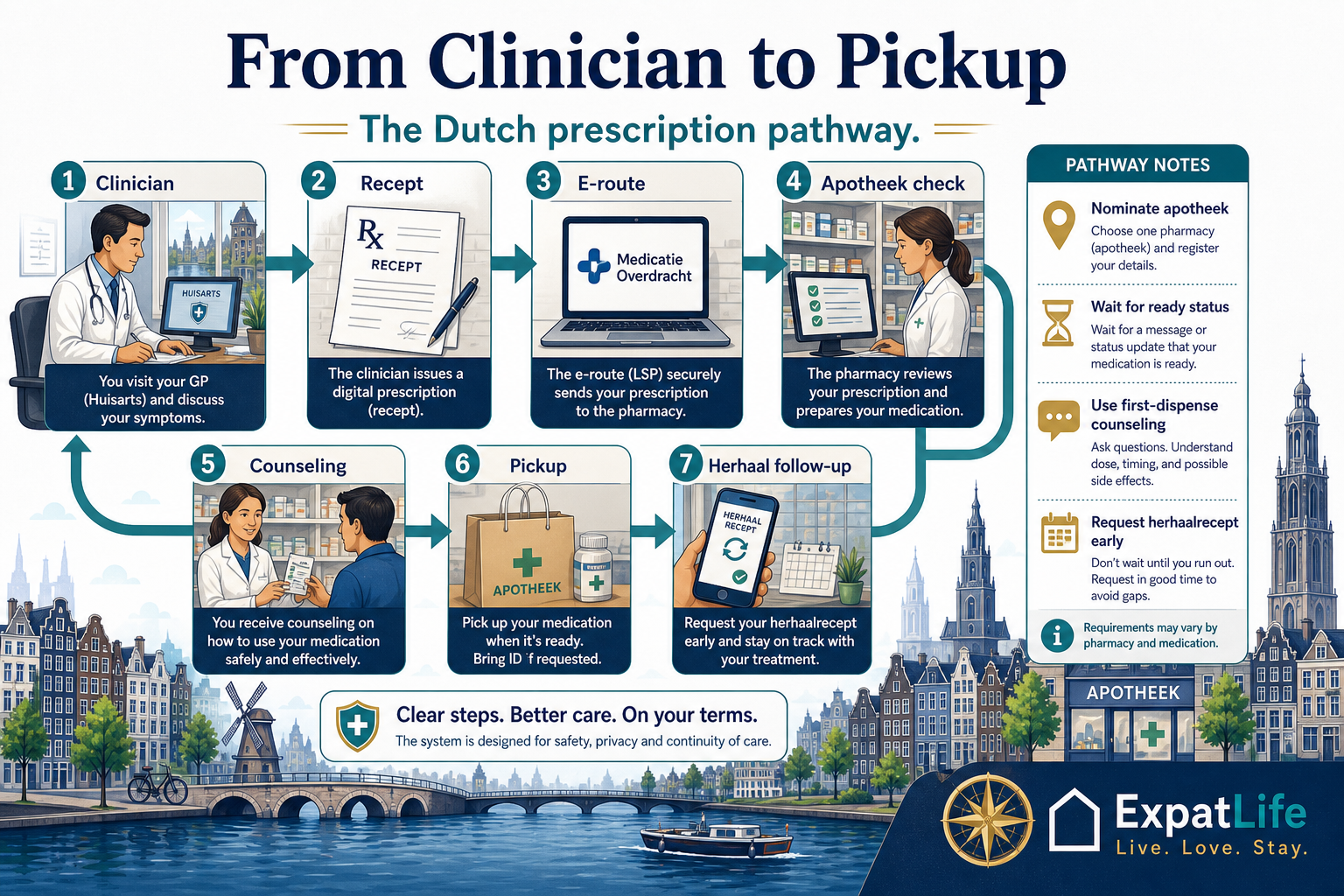
Prescription pathway
Stage 1
Your GP or specialist assesses the problem and, when appropriate, issues a prescription. Hospital discharge may also generate recepten to fill.
Stage 2
Many prescriptions travel digitally to your nominated apotheek. Paper or alternative routes still exist in some situations — follow the instructions you are given.
Stage 3
The pharmacy screens dose, interactions, allergies and supply. They may contact the clinician if something needs clarification.
Stage 4
A message, call or ready status tells you the medicine can be collected during opening hours. Bring ID and insurance details.
Stage 5
Especially for new medicines, the pharmacist explains safe use, timing and what to report. Ask questions before you leave.
Stage 6
Follow the agreed plan. Contact the pharmacy for practical medicine questions and your GP for clinical change or worsening symptoms.
Stage 7
For ongoing medicines, request a repeat through your practice or pharmacy process before you run out. Return to the clinician when review is needed.
How to
Step 1
Choose a huisarts practice and tell them which apotheek should receive your digital prescriptions.
Step 2
Store ID, BSN, insurance card photo, current medication list and allergies where you can reach them quickly.
Step 3
When a new recept is written, ask which pharmacy received it and whether a ready notification is expected.
Step 4
Ask how to take the medicine, what to avoid, and what symptoms mean you should contact the GP.
Step 5
Learn your practice's request channel and lead time so ongoing medicines never run out unexpectedly.
Step 6
After hospital, specialist or travel changes, refresh the shared medication and allergy list.
Step 7
Check how prescribed medicines interact with your remaining adult eigen risico for the current year.
Step 8
For finding an apotheek, opening hours and dienstapotheek patterns, follow the Pharmacies cornerstone.
Who issues
Most everyday recepten come from your registered huisarts. Specialists and hospital teams write prescriptions for their pathways. Pharmacists check and dispense — they do not replace the clinician who decides a medicine is appropriate.
Your GP is the default writer for common acute and chronic medicines once you are registered. Practice assistants often help with herhaalrecept logistics, but clinical decisions stay with the GP or treating clinician.
Hospital specialists write recepten for medicines started in outpatient or inpatient care. Discharge letters should list what changed so your GP and regular pharmacy can reconcile. Dentists and some other clinicians may prescribe within their scope — ask what to do next for pickup.
If you do not yet have a GP, solving registration usually unlocks everyday prescribing. Urgent situations without a registered GP may go through huisartsenpost pathways — see Emergency Healthcare for door choice, not for inventing a medicine plan.

Primary writer for most everyday and many chronic medicines once you are registered. Also coordinates referrals and often owns herhaalrecept review.
Writes recepten for medicines started or managed in specialist care. Keep the GP informed so your overall list stays coherent.
Discharge may include new or changed prescriptions. Bring papers to your regular apotheek and GP promptly.
Screens, prepares, counsels and dispenses. Contacts the clinician when clarification is needed. Does not diagnose or invent treatment plans.
| Route | When | How | Note |
|---|---|---|---|
| Huisarts recept | Most everyday and many chronic medicines | Consultation or agreed herhaalrecept process | Default for registered patients |
| Specialist recept | Medicines started or managed in specialist care | Outpatient or inpatient pathway | Reconcile with GP and apotheek |
| Discharge recept | After hospital stay or day treatment | Follow discharge instructions for filling | Update regular pharmacy history |
| Urgent pathway | True urgency without routine GP access | Huisartsenpost or emergency routes as appropriate | See Emergency Healthcare |
Who-issues checklist
Examples
| Situation | How it works here | First step |
|---|---|---|
| You need antibiotics after a GP consult | The GP assesses and, if appropriate, sends a recept to your pharmacy. Pick up during opening hours after ready status. | Confirm the destination apotheek before leaving the practice. |
| A specialist starts a new long-term medicine | Clarify who will manage repeats — specialist or GP — and update your medication list and pharmacy. | Ask who owns herhaalrecept for this medicine going forward. |
| You leave hospital with new tablets | Fill as instructed, then reconcile with your regular apotheek and GP so interaction checks stay accurate. | Keep the discharge letter with the medicine names and doses. |
| You are not yet registered with a GP | Prioritise huisarts registration for everyday prescribing. Use urgent pathways only for true urgency. | Open the GP guide and start registration while arranging temporary clinical review if needed. |
E-prescription
Many Dutch prescriptions are electronic. Your GP or specialist sends the recept to a nominated pharmacy; you collect when it is ready. Confirming the destination prevents wasted trips.
Ask your practice which apotheek is stored for you. If you move house or change pharmacies, update both the practice and the pharmacies involved so new recepten do not land in the wrong place.
Ready notifications vary: SMS, email, app or a call. A ready message does not extend opening hours. If you need medicine after closing, use the out-of-hours pattern described in Pharmacies and Emergency Healthcare — do not assume every counter is open.
Paper or alternative routes still appear in some situations. Follow the instructions on the day. The principle stays the same: a valid clinician recept, a pharmacist check, then dispensing.
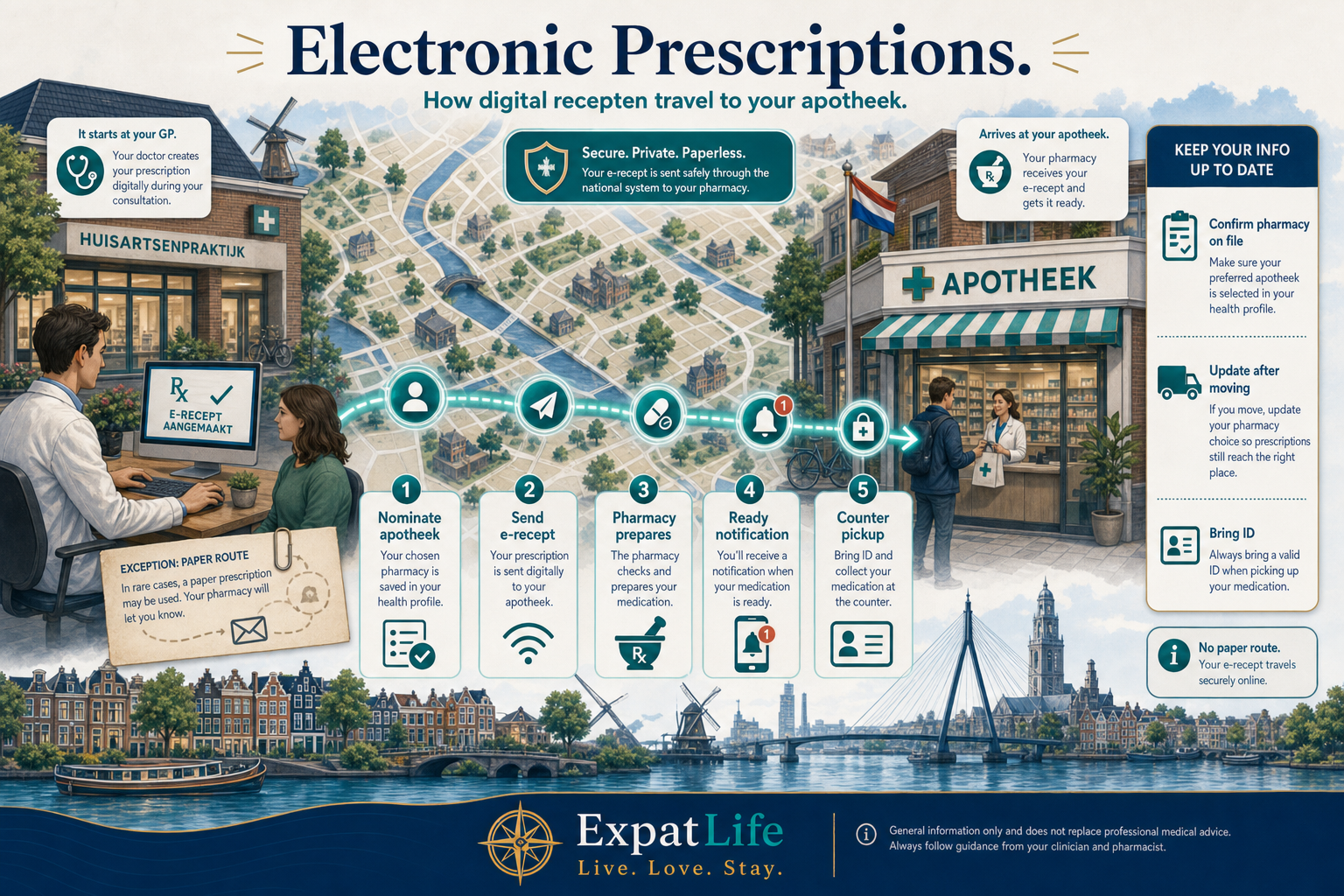
Tell your GP practice which pharmacy should receive digital prescriptions and verify it after any move.
Wait for preparation when possible. Arriving before the pharmacy has processed the recept often means a longer wait or a second trip.
Some pathways still use paper or special routing. Follow clinician and pharmacy instructions rather than inventing a transfer.
Bring ID to pickup. Ask the pharmacy what authorisation is needed if someone else collects for you.
E-prescription checklist
Examples
| Situation | How it works here | First step |
|---|---|---|
| The recept went to the wrong pharmacy | Call both pharmacies and the GP practice assistant to reroute. Do not travel until you know where it sits. | Confirm current destination before leaving home. |
| You never received a ready message | Call the nominated pharmacy and ask whether the recept arrived and whether preparation is complete. | Verify the pharmacy on file with the practice. |
| You need the medicine today near closing time | Call ahead, confirm readiness, and arrive with buffer for counseling and insurance processing. | Check opening hours on the Pharmacies guide pattern for your own apotheek. |
| You switched pharmacies last month | Update the GP practice and ask both pharmacies about any open recepten still pending. | Change the on-file apotheek before the next prescription is written. |
Pharmacy pickup
Pickup is the apotheek step: identity check, pharmacist screening, counseling when needed, and dispensing. This section orients the recept side of pickup — finding a pharmacy, hours and dienstapotheek depth live on the Pharmacies cornerstone.
Bring ID, insurance details, your medication list and any ready confirmation. At first dispense, budget time for counseling questions. If the medicine is for someone else, ask in advance what authorisation is required.
Stock issues, partial supplies and clinician clarifications can delay pickup. Do not change doses on your own while waiting. Ask the pharmacy what options exist and whether the GP needs to be contacted.
For opening hours, Saturday patterns, drugstore versus pharmacy differences and regional dienstapotheek routes, use the Pharmacies guide. For life-threatening emergencies, call 112.
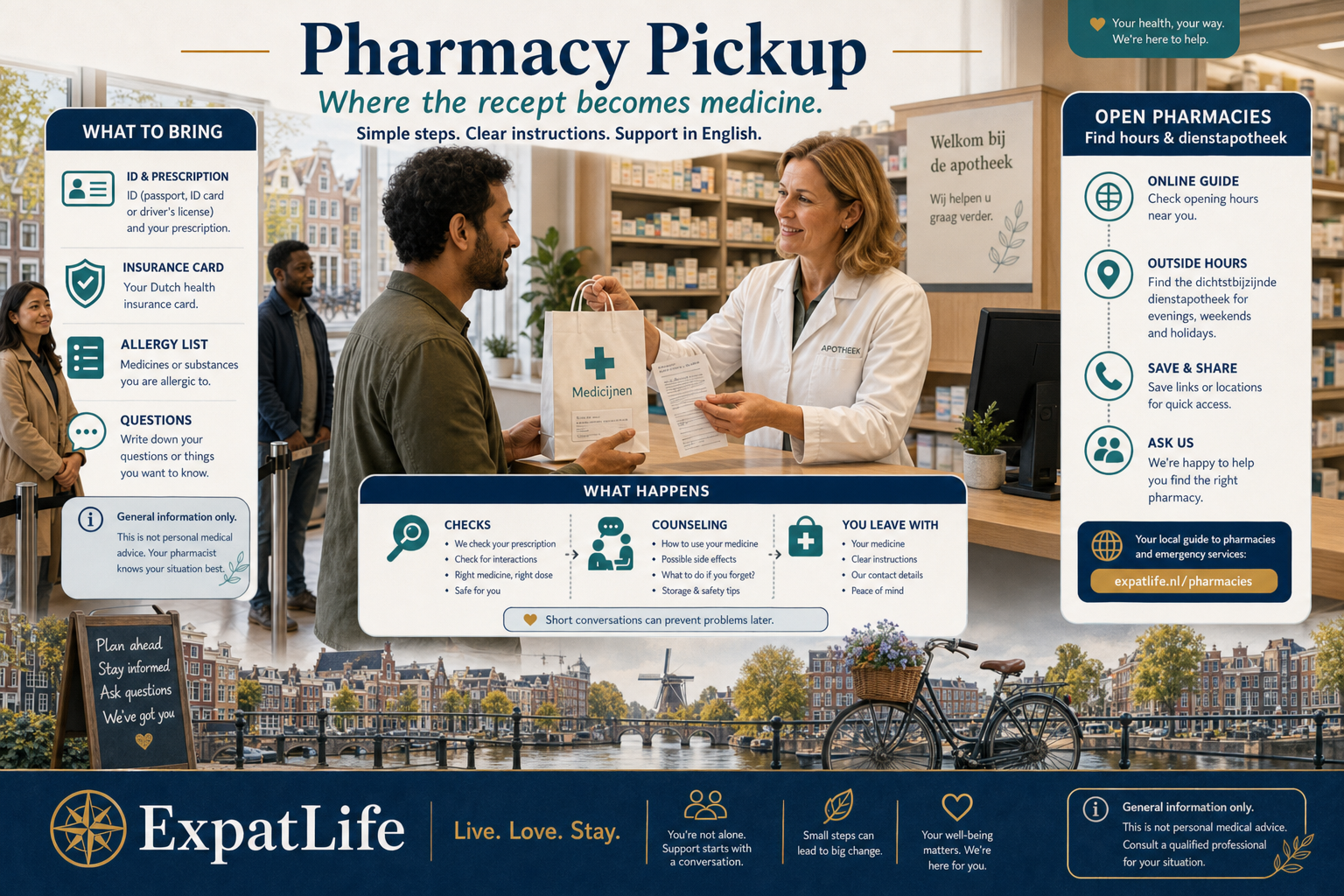
ID, insurance card or details, medication and allergy list, and questions for new medicines.
Checks, possible short wait, counseling especially at first dispense, medicine bag and leaflet.
Pharmacists clarify practical use and may contact the clinician. Clinical dose changes stay with the GP or specialist.
Finding an apotheek, hours and emergency pharmacy belong on the Pharmacies page — linked below.
Pharmacy pickup checklist
Examples
| Situation | How it works here | First step |
|---|---|---|
| First dispense of a new chronic medicine | Arrive with time for counseling. Confirm timing, what to report, and how herhaalrecept will work later. | Write three questions before you reach the counter. |
| Medicine is not in stock | Ask about ordering timelines, partial supply, or clinician-approved alternatives. Do not skip doses silently without advice. | Call the pharmacy early the same day you learn about the gap. |
| You need pickup after closing | Do not assume a random open shop. Follow triage and dienstapotheek guidance when urgency is real. | Open Pharmacies and Emergency Healthcare for the after-hours pattern. |
| A family member will collect for you | Ask the pharmacy what ID and permission they need before that person travels. | Call ahead the same morning. |
Herhaalrecept
Herhaalrecept is the Dutch repeat-prescription pathway for many stable ongoing medicines. It is a request-and-review process — not a promise that medicines refill forever without clinical oversight.
Practices differ in how you request repeats: online portal, phone, email, pharmacy-supported request, or another channel. Learn your practice's method and lead time. Requesting several days before you run out prevents stressful gaps.
Clinicians may want a review before extending some medicines — for example after dose changes, side effects, new diagnoses, pregnancy plans, or long intervals without contact. That review protects you; it is not bureaucratic harassment.
Pharmacy staff often help with logistics and may flag interaction or supply issues. They still need a valid recept from the responsible clinician. If ownership of a specialist-started medicine is unclear, ask who manages repeats going forward.
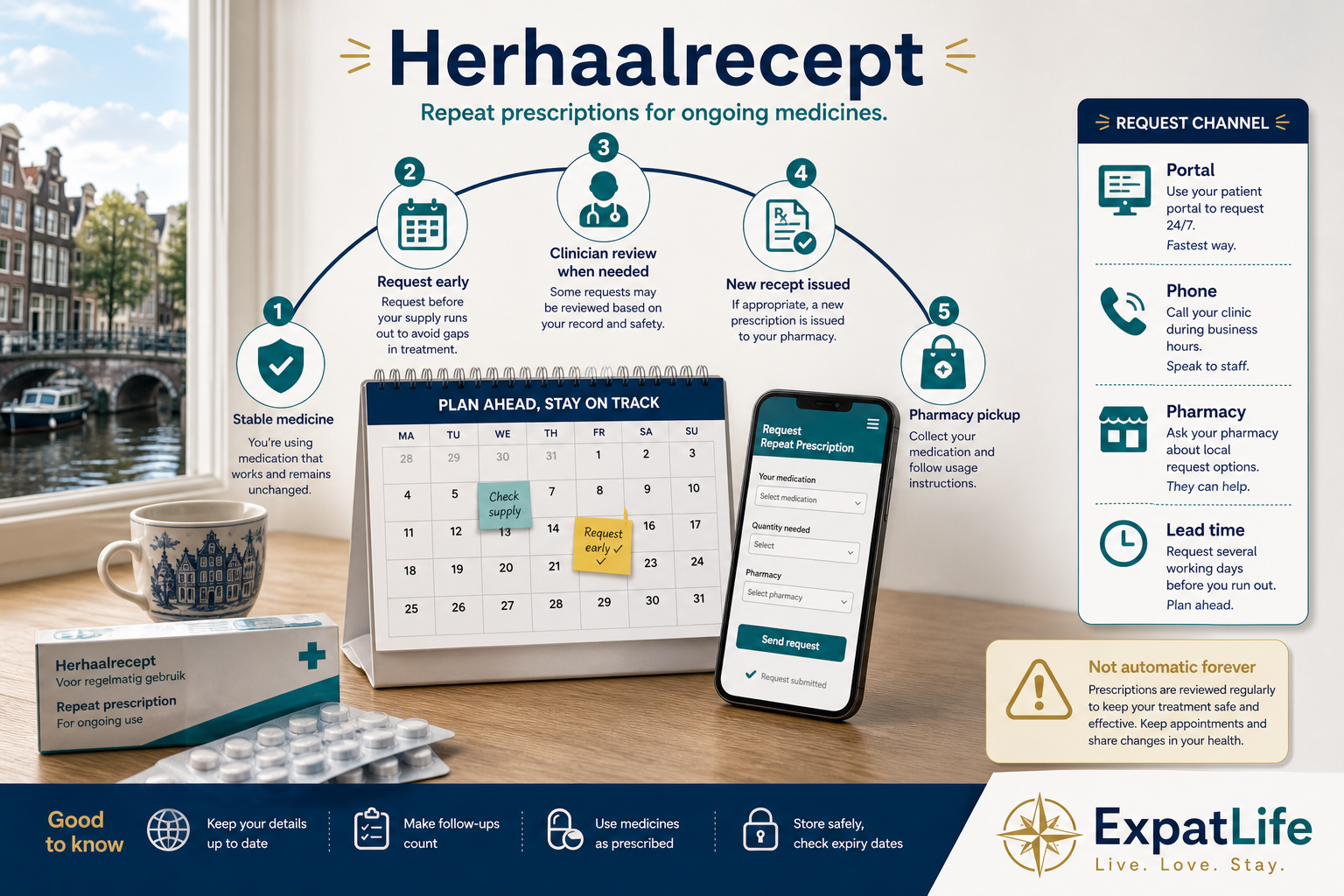
Herhaalrecept loop
Step 1
You and your clinician agree a long-term medicine is appropriate to continue under review.
Step 2
Use your practice or pharmacy-supported channel with enough lead time.
Step 3
Some requests are extended; others need an appointment, message or test first.
Step 4
The prescription is created and usually sent digitally to your nominated apotheek.
Step 5
Collect during opening hours after ready status, with ID and insurance details.
Build a habit of requesting before the pack is empty. Lead times vary by practice and medicine.
Portal, phone, pharmacy request or another route — save the correct path for your practice.
Some medicines need periodic GP or specialist review before the next recept is issued.
Update your medication list whenever a repeat set changes, stops or adds a new item.
Herhaalrecept checklist
Examples
| Situation | How it works here | First step |
|---|---|---|
| You have five days of tablets left | Submit the herhaalrecept request immediately and call if your practice's lead time is longer than five days. | Use the official request channel today — do not wait for the weekend. |
| The practice asks you to book a review first | Book promptly. Explain supply timing so they can plan any bridging steps if clinically appropriate. | Schedule the review and tell the pharmacy you are awaiting renewal. |
| A specialist started the medicine last year | Ask whether repeats now sit with the GP or remain with the specialist clinic. | Clarify ownership before the next request. |
| You are travelling for three weeks | Request early enough for pickup before departure. Ask clinician and pharmacist about travel supply rules that apply to you. | Start the request at least one practice lead-time before travel. |
Medication list
An accurate medication and allergy list makes prescribing, dispensing and hospital care safer. Expats who keep only brand names or forget supplements create avoidable friction.
Include prescription medicines, important zelfzorg products you use regularly, vitamins and supplements that matter for interactions, and known allergies or intolerances. Prefer generic names plus brand if you use both.
Share the list with your GP, pharmacist and hospital teams whenever medicines change. After discharge, reconcile hospital lists with your regular apotheek so interaction checks stay coherent.
A list is not medical advice and not a substitute for clinician review. It is the shared record that helps professionals protect you.
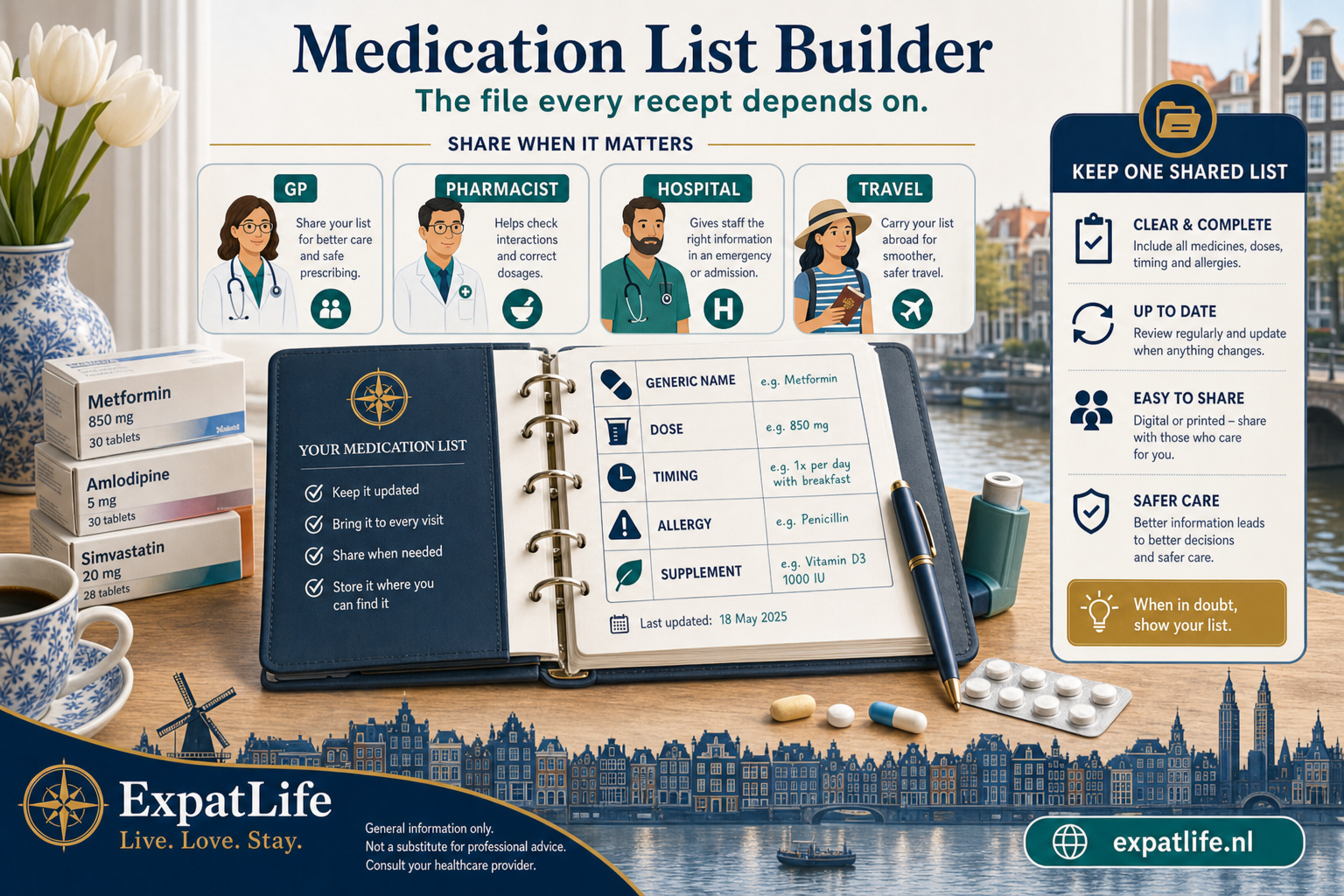
Generic name, brand if relevant, dose, timing, reason if known, and who prescribed it.
Medicine name, reaction type, and approximate date if known. Update after any new reaction.
Include products that may interact. Pharmacists often ask — honesty helps screening.
GP practice, regular apotheek, hospital admissions, and travel clinicians when relevant.
Medication-list checklist
Examples
| Situation | How it works here | First step |
|---|---|---|
| You take medicines from both a specialist and a GP | Merge into one list and confirm both writers know the full set. | Rewrite a single list this week and share it with GP and apotheek. |
| You only remember brand names from home | Ask the pharmacist or GP to help map generic names for your Dutch records. | Bring original packs or photos to the next appointment. |
| Hospital changed two medicines | Update the list the same day and visit or call your regular pharmacy for reconciliation. | Photograph the discharge medicine section before leaving. |
| You start a new supplement | Add it to the list and mention it at the next pharmacy or GP contact. | Write it down before you forget the product name. |
Costs
Many prescribed medicines are handled through basic health insurance (basisverzekering). Adults usually have an annual deductible (eigen risico) that can apply to insured care, including many medicines. Figures change by year — verify your own policy.
Indicative framing for orientation only (verify for the current policy year): adult mandatory eigen risico is commonly discussed around €385 per year in recent Dutch basic-insurance years, but your remaining balance, insurer rules, medicine reimbursement status and any voluntary higher deductible can change what you pay at the pharmacy.
Children typically do not have the same adult deductible pattern for basic insured care — confirm family rules with your insurer. OTC / zelfzorg products are usually self-pay. Pharmacies may apply service or dispensing fees depending on the situation — ask what you are paying today.
This is not a price quote and not insurance advice. Use your insurer portal, policy documents and pharmacist explanation for your case. Deeper package choice belongs on the Health Insurance guide.
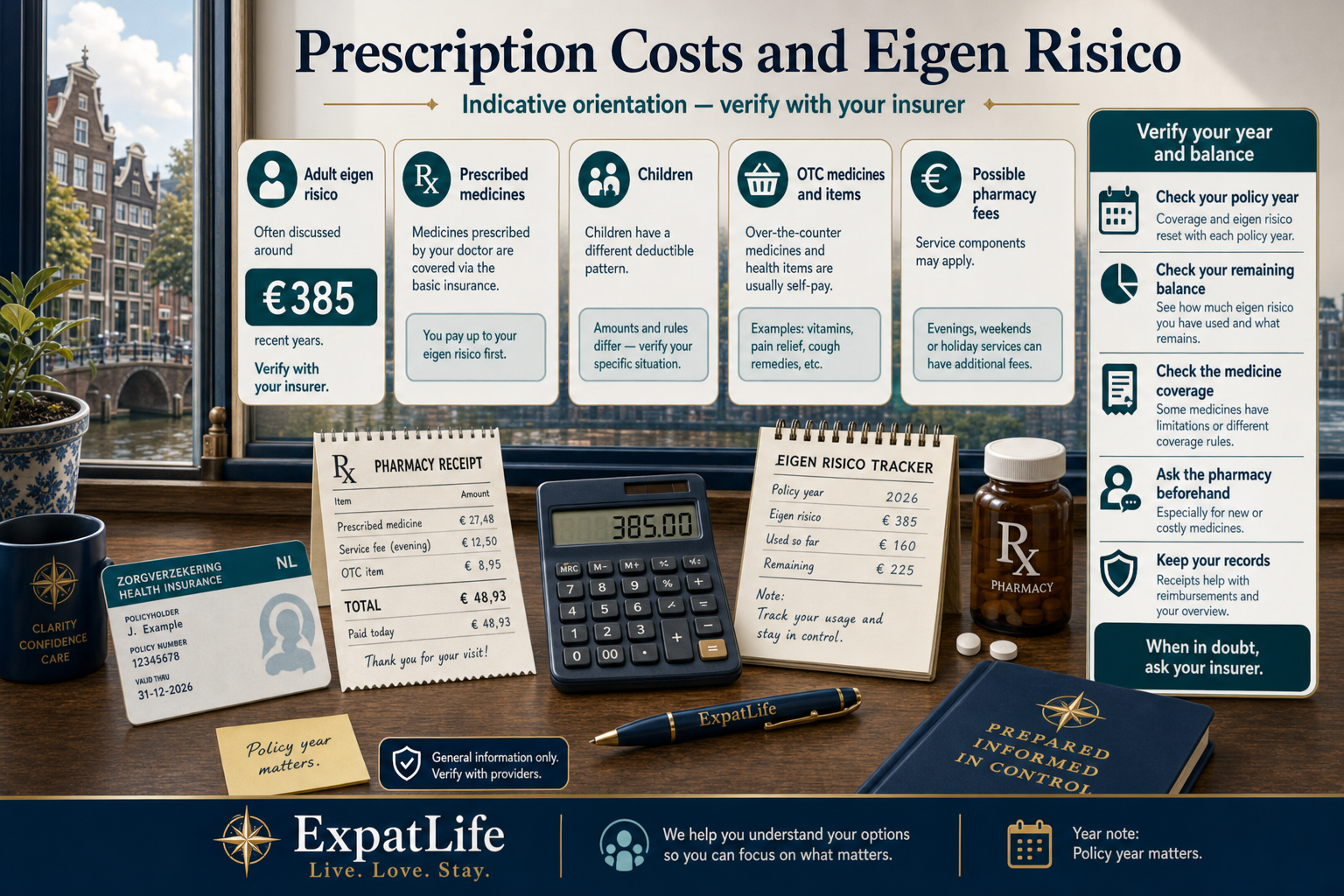
Indicative cost orientation only — figures and rules change by policy year. Verify remaining eigen risico, reimbursement status and any pharmacy fees with your insurer and pharmacist. Not a quote and not financial advice.
| Cost item | Indicative figure | What you usually pay | Note |
|---|---|---|---|
| Adult mandatory eigen risico (basic insurance) | Often cited around €385 / year in recent policy years | Remaining deductible may apply to many insured medicines until the annual amount is met | Verify your year and remaining balance in the insurer portal |
| Prescribed medicine via basic insurance | Often billed via insurer processes | May count toward remaining adult eigen risico; some items have different rules | Ask the pharmacy what applies to this recept today |
| Children on basic insurance | Different deductible pattern than adults | Confirm family rules — do not assume adult deductible logic | Verify with insurer for each child policy setup |
| OTC / zelfzorg products | Usually not via recept insurance billing | Typically self-pay at pharmacy or drugstore | Not the same as prescription reimbursement |
| Pharmacy service / dispensing fees | May apply depending on situation | Ask for a clear till explanation | Varies — verify at your apotheek |
Before expensive new medicines, look up remaining adult eigen risico for the current year.
If the amount surprises you, ask which part is medicine cost, deductible, or fees.
Not every product is reimbursed the same way. Your insurer and pharmacist can explain the category for your recept.
January policy switches can change networks and reimbursement details — re-check after renewals.
Costs checklist
Examples
| Situation | How it works here | First step |
|---|---|---|
| The pharmacy asks for a payment you did not expect | Ask calmly which component you are paying. Check remaining deductible in your portal afterward. | Request an itemised explanation at the counter. |
| It is January and you switched insurers | Update pharmacy records and re-check reimbursement and deductible settings for the new year. | Bring new insurance details on the next pickup. |
| Your child needs a prescribed medicine | Do not assume adult eigen risico logic. Confirm family rules with the insurer. | Check the child's coverage note in your insurer portal. |
| You also buy OTC products in the same visit | Expect OTC to be self-pay even if the prescribed item bills via insurance processes. | Separate the two categories mentally before you reach the till. |
Foreign Rx
A prescription from another country rarely fills automatically in the Netherlands. Plan a Dutch clinician review, bring documentation, and arrange a safe bridge supply before your old pack runs out.
Bring original packaging, clinic letters, a medication list with generic names, and allergy information. Book a huisarts appointment (or specialist pathway when appropriate) so a Dutch recept can be considered under local rules.
Do not stop critical medicines abruptly without clinical advice. If you are arriving soon and supplies are short, seek guidance early — urgent pathways exist for true urgency, while routine conversion belongs with GP registration and scheduled review.
Customs, controlled medicines and travel certificates are situation-specific. This page does not provide legal clearance advice. Ask clinicians and official sources what applies to your medicines before you travel.
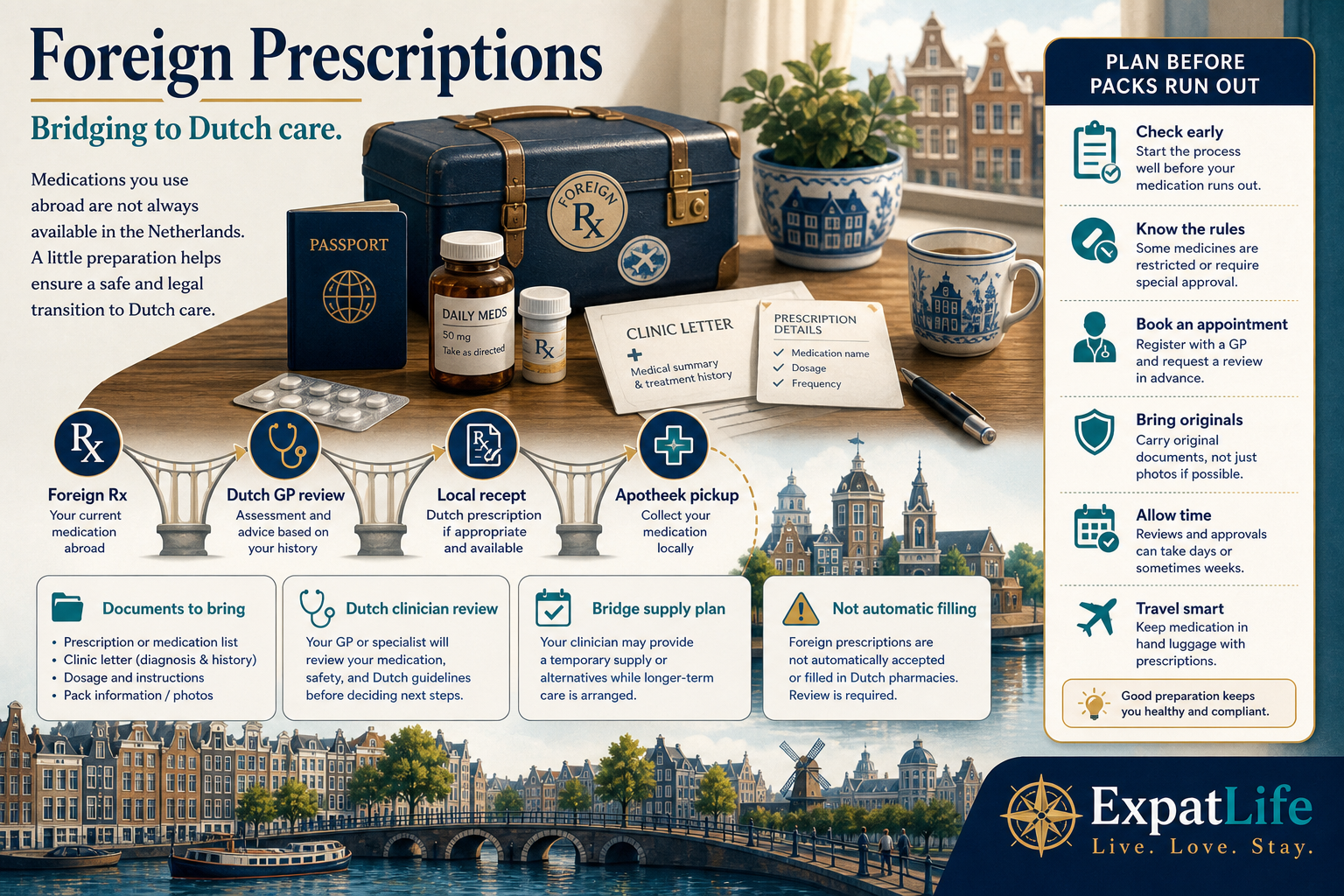
Original packs, letters, generic names, doses, allergies and treating clinician contact if available.
Expect a GP or specialist to assess whether and how to continue a medicine under Dutch prescribing rules.
Plan timing so you do not run out between arrival and the first Dutch recept.
Foreign paper recepts are not a guarantee of Dutch dispensing. Ask before you rely on them.
Call 112 now
Life-threatening allergic reaction or collapse
Call 112 immediately.
Same day / out of hours
Critical medicine nearly finished and no GP yet
Use huisartsenpost / urgent guidance as appropriate; bring documentation.
Planned route
Routine conversion of a stable foreign prescription
Book GP registration and a scheduled medicine review.
Foreign prescriptions checklist
Examples
| Situation | How it works here | First step |
|---|---|---|
| You arrive with two weeks of a chronic medicine left | Book a GP appointment promptly and bring full documentation. Do not wait until day thirteen. | Request a huisarts intake focused on medicine continuity. |
| A pharmacy declines a foreign paper prescription | Treat that as expected in many cases. Seek Dutch clinician review rather than arguing for automatic fill. | Contact a GP pathway with your medication file. |
| Your medicine has a different brand name here | Ask clinician and pharmacist to map the generic equivalent. Do not switch products on brand recognition alone. | Show the original pack and generic name at the appointment. |
| You need a temporary urgent supply | Use appropriate urgent care pathways for true urgency. Explain the shortage clearly and bring documentation. | Follow Emergency Healthcare door choice — call 112 only for life-threatening emergencies. |
Differences
Dutch prescription culture is GP-centred, often digital, and paired with pharmacist counseling. These differences are system design — once expected, they become predictable.
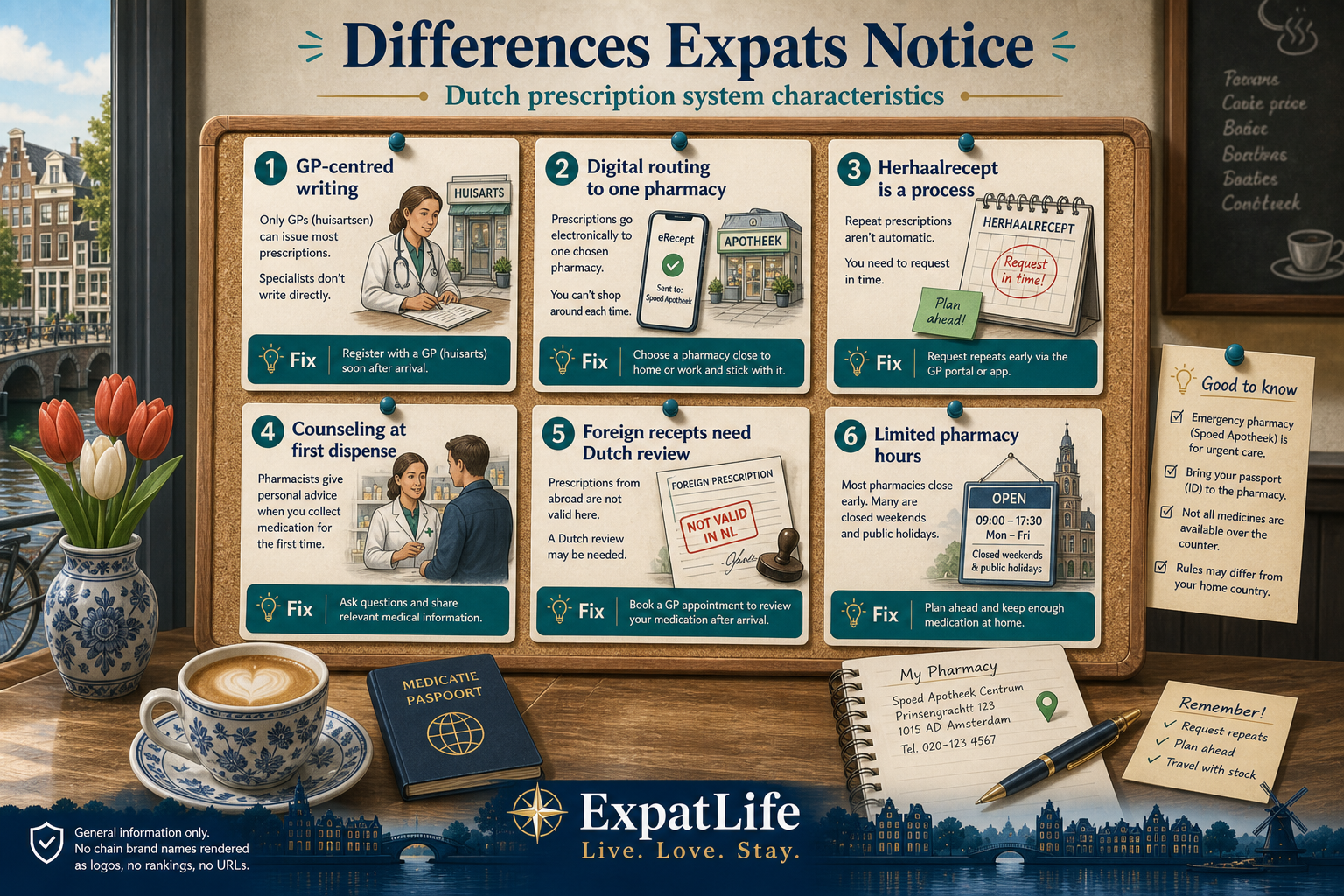
Example: expecting walk-in specialist prescriptions for everyday medicines.
Fix: Register with a huisarts for most recepten and herhaalrecept review.
Example: wandering between shops looking for a paper script.
Fix: Nominate an apotheek and confirm where each new recept was sent.
Example: assuming endless automatic refills without requests or reviews.
Fix: Learn the request channel and lead time; book reviews when asked.
Example: treating the counter as a silent checkout.
Fix: Use begeleidingsgesprek time for safety questions.
Example: handing a home-country script to any counter.
Fix: Plan a Dutch clinician review and bridge supply.
Example: arriving late evening for routine pickup.
Fix: Check hours; use Pharmacies / Emergency guides for after-hours urgency.
Checklist
Use this checklist when you register with a GP, start a new medicine, set up herhaalrecept, or convert foreign prescriptions into Dutch care.
Pair it with the Pharmacies checklist for finding an apotheek and saving opening hours.
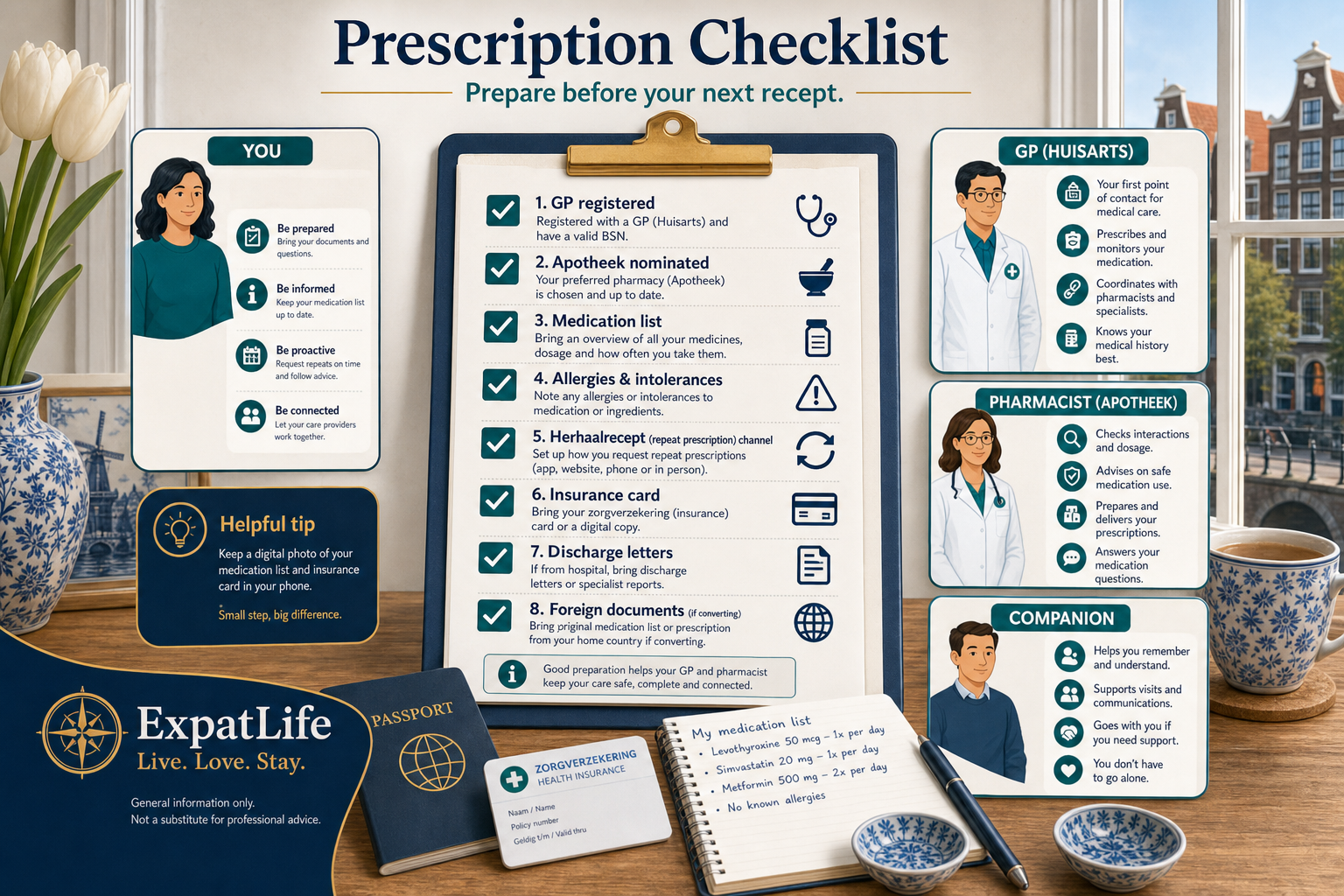
Preparation checklist
Keep lists current, request repeats early, and ask questions at first dispense.
Assess, prescribe, review ongoing medicines and clarify ownership of specialist therapies.
Screen, prepare, counsel and dispense — contact clinicians when clarification is needed.
Help with language, pickup authorisation and remembering counseling points when invited.
Avoid
These mistakes are common and fixable. Each one has a practical correction.
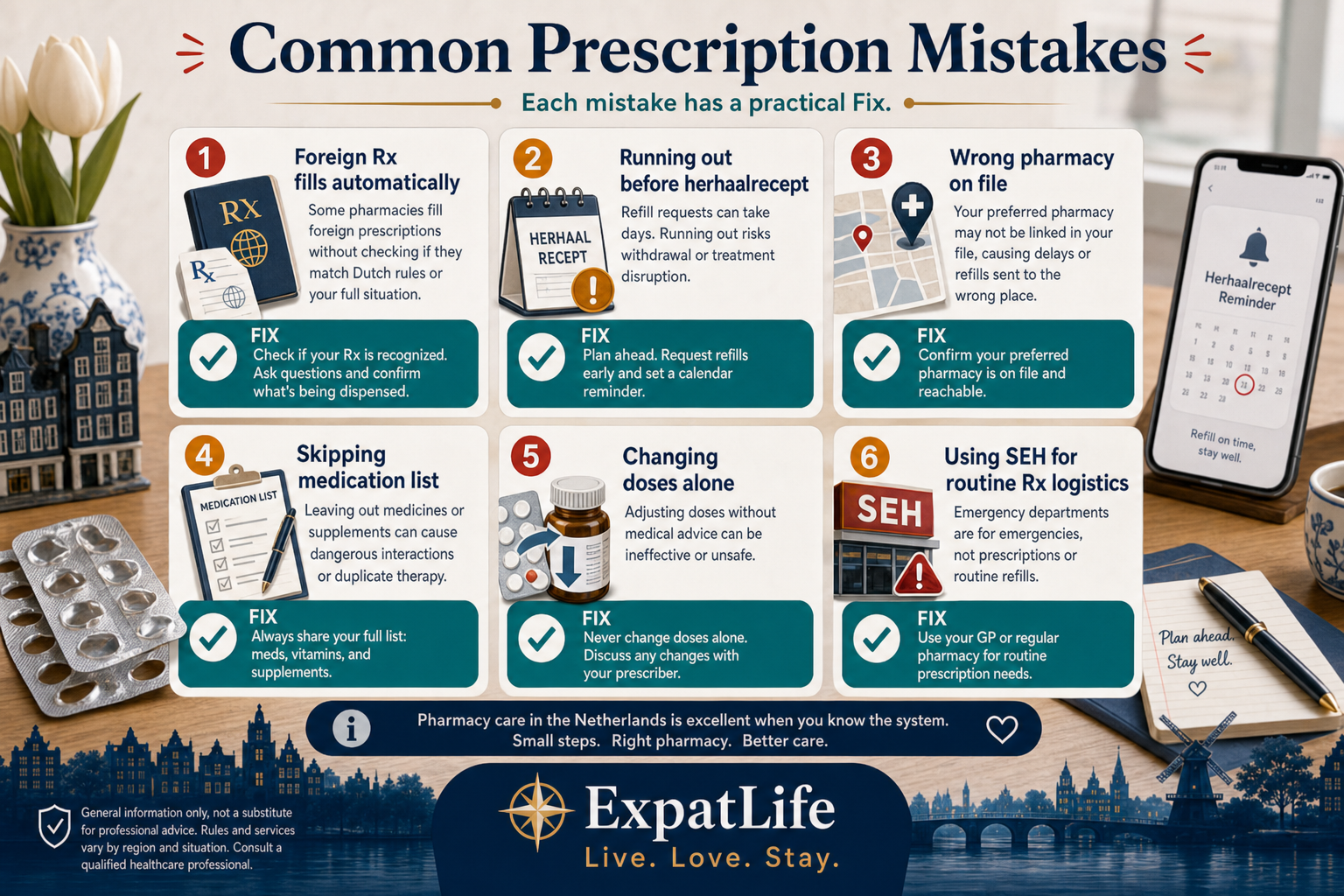
Example: handing a home-country script to a Dutch till and expecting immediate dispensing.
Fix: Book a Dutch clinician review and bring full documentation.
Example: noticing two tablets left on a Sunday night.
Fix: Request early using the practice channel; set calendar reminders.
Example: travelling to pharmacy A while the recept sits at pharmacy B.
Fix: Confirm the nominated apotheek whenever a new recept is written.
Example: forgetting supplements or specialist medicines during counseling.
Fix: Keep one shared list and update it after every change.
Example: doubling tablets after a missed day or stretching packs.
Fix: Ask the GP or pharmacist what to do — do not invent a new plan.
Example: going to hospital A&E because a daytime pharmacy was missed.
Fix: Use GP/pharmacy hours or urgent triage routes — SEH is for emergencies.
FAQ
Orientation answers only — confirm your own situation with your pharmacist, GP and insurer. Call 112 for life-threatening emergencies.
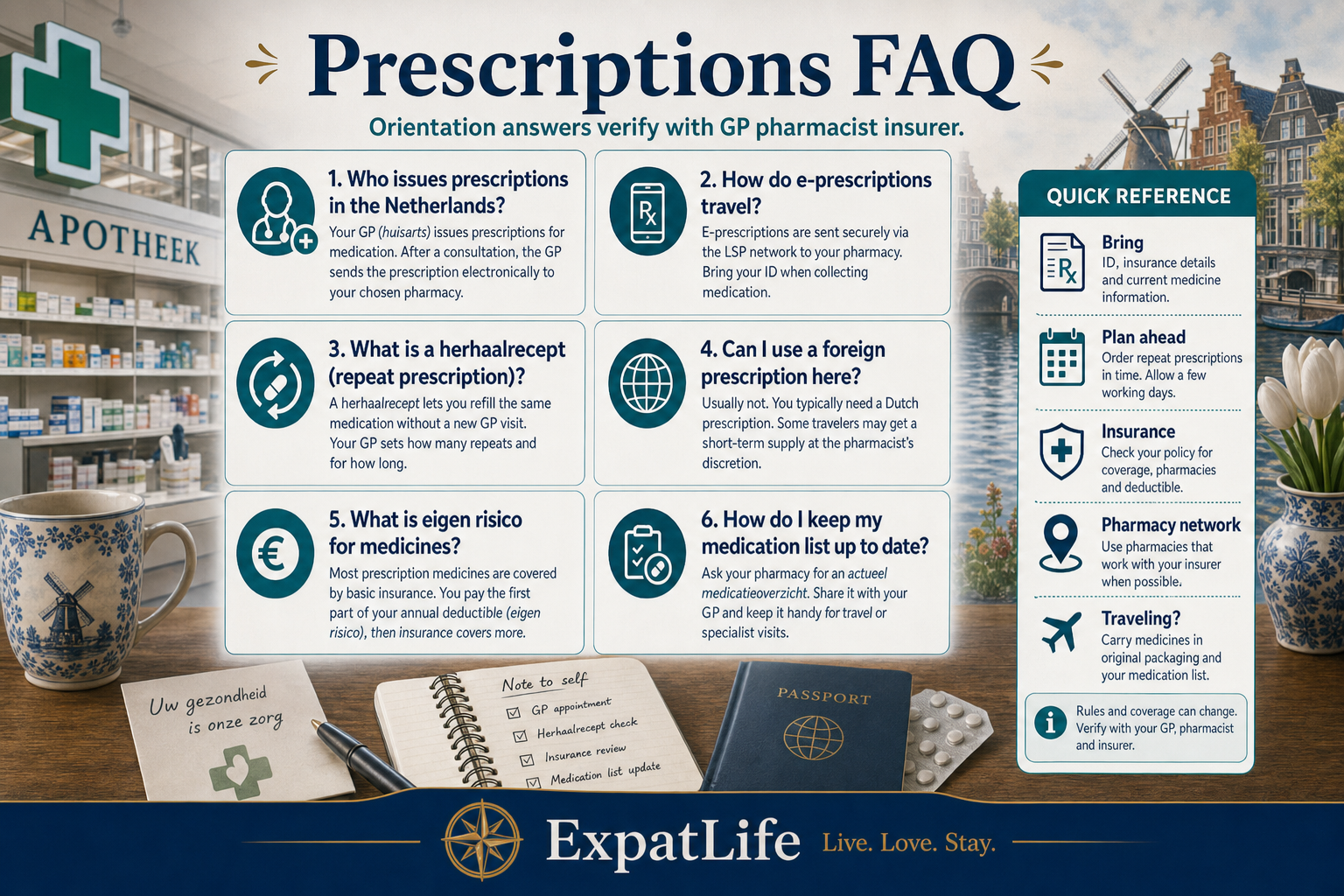
Most everyday recepten are issued by your GP (huisarts). Specialists, hospital discharge pathways and some other clinicians also prescribe within their roles. Pharmacists check and dispense but do not replace the clinician decision.
Many recepten are sent digitally to the pharmacy nominated with your GP practice. Confirm which apotheek is on file, wait for ready status when offered, then pick up with ID and insurance details.
A herhaalrecept is a repeat prescription for many ongoing medicines. You usually request it through your GP practice or a pharmacy-supported process, and clinicians may require a review before extending some medicines.
At an apotheek (pharmacy) after pharmacist screening. Finding a pharmacy, opening hours and dienstapotheek depth are covered in the Pharmacies guide.
Usually not as an automatic fill. Plan a Dutch GP or specialist review, bring documentation and packaging, and arrange a bridge supply. Ask before you rely on a foreign paper script.
Many prescribed medicines are handled through basic insurance and may count toward an adult's remaining annual eigen risico. OTC products are usually self-pay. Figures change by year — verify in your insurer portal.
Yes — keep current medicines, doses, allergies and relevant supplements in one list. Share it with your GP, pharmacist and hospital teams whenever something changes.
Pharmacists often provide a short counseling conversation (begeleidingsgesprek) covering safe use and what to watch for. It supports safety; clinical decisions stay with your GP or specialist.
Sometimes, depending on pharmacy policy and the medicine. Call ahead to ask what authorisation and ID are required.
Ask about ordering timelines, partial supply, or clinician-approved alternatives. Do not change doses on your own while waiting.
Ask explicitly. Some remain with the specialist clinic; others transfer to the GP. Clarify ownership before the next herhaalrecept request.
Keep the discharge medicine list, fill as instructed, and reconcile changes with your regular apotheek and GP so records stay aligned.
Many clinicians and pharmacists can work in English, especially in internationally oriented areas, but it is not guaranteed. Ask when you register and before complex counseling.
For severe symptoms such as breathing difficulty, facial or throat swelling, or collapse, call 112. For other concerning side effects, contact your pharmacist or GP according to urgency — do not silently invent a new dosing plan.
This page owns recept mechanics: who issues, e-prescriptions, herhaalrecept, medication lists, medicine cost orientation and foreign prescriptions. Pharmacies owns finding an apotheek, hours, OTC vs pickup operations, counseling context and dienstapotheek depth.
For most everyday recepten, yes — registration with a huisarts is the practical unlock. Urgent situations without a GP use triage pathways described in Emergency Healthcare.
Related
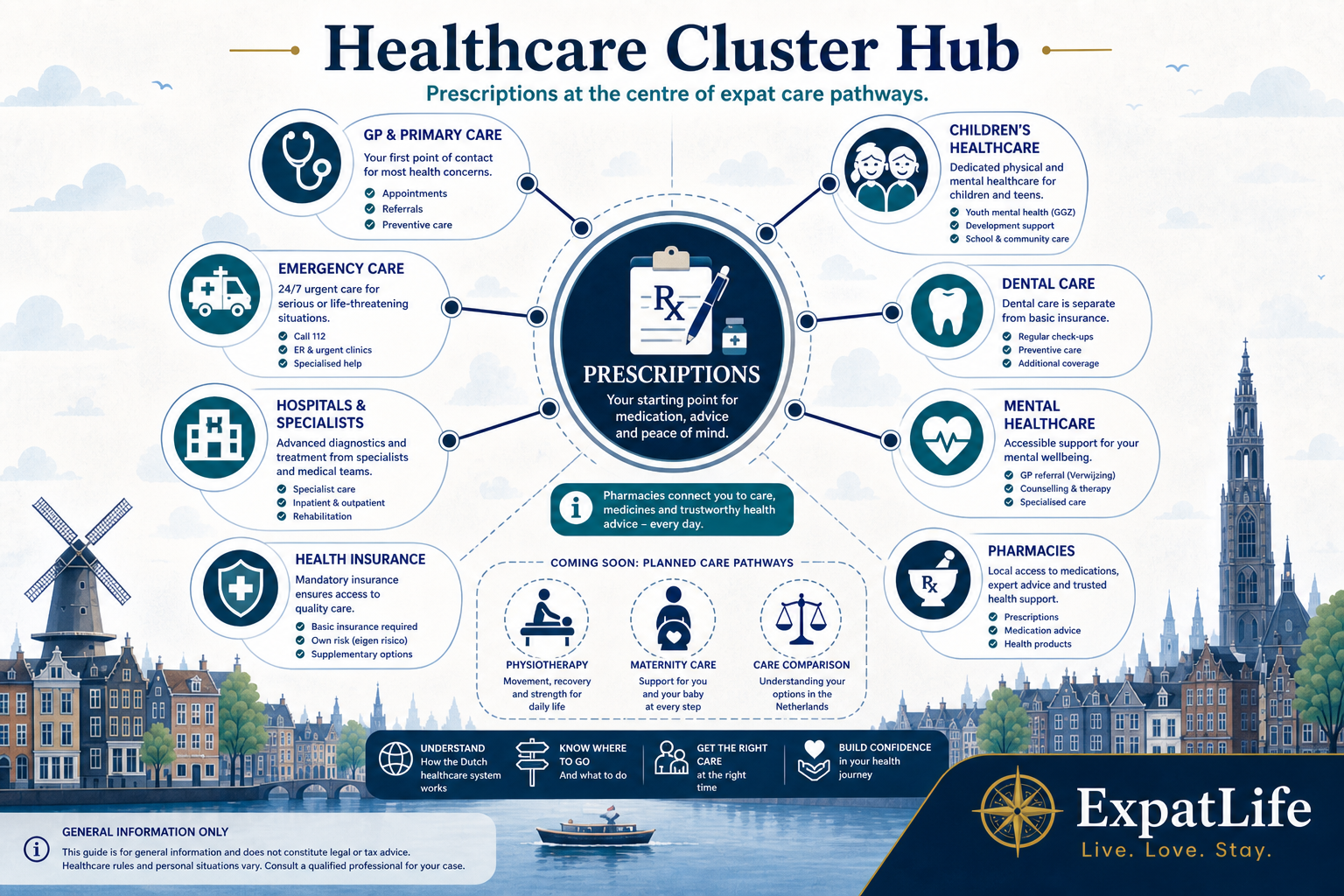
Prescriptions connect to pharmacies, GP care, emergency routes, insurance and family pathways — read them together.
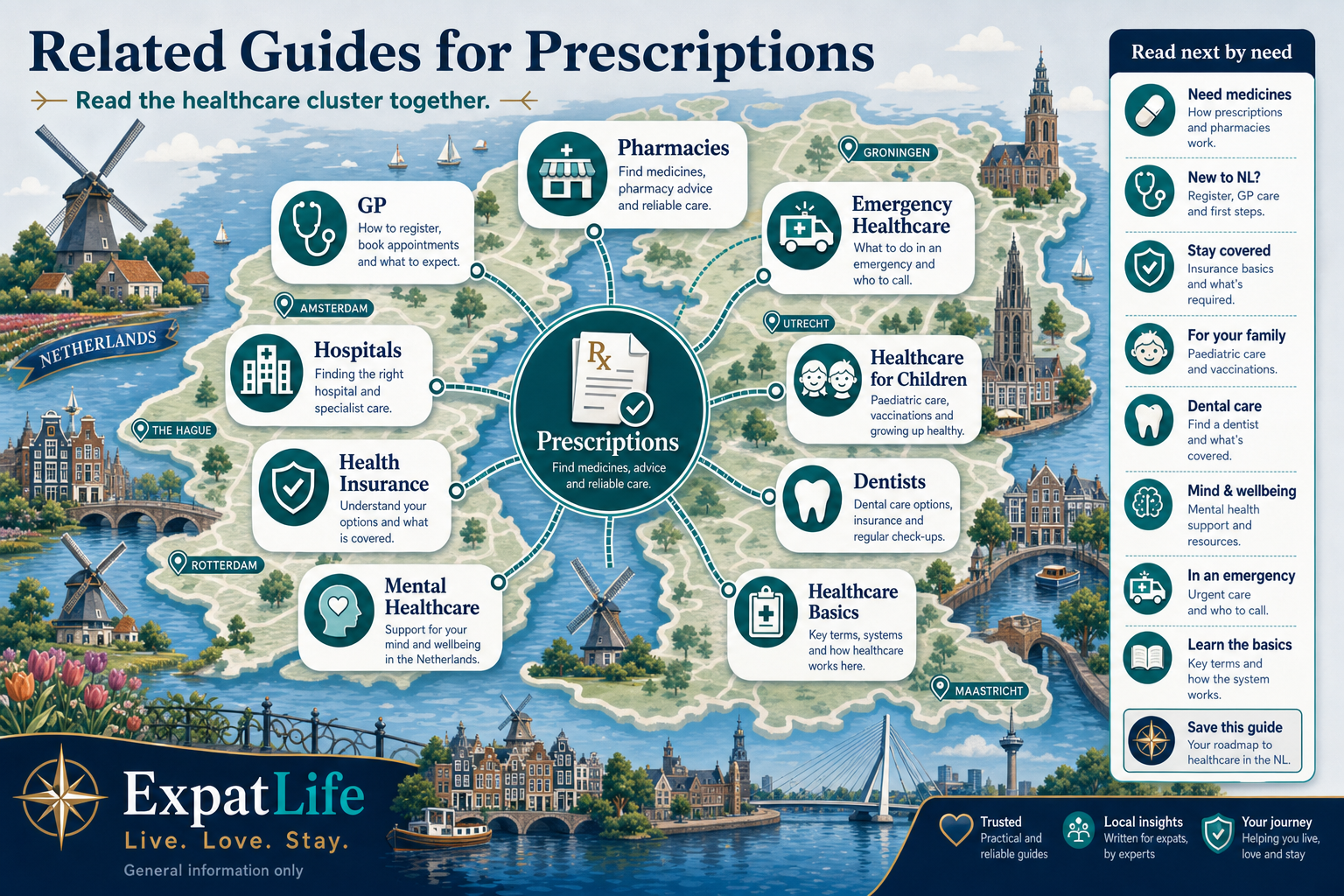
Health hub
This page is the prescriptions cornerstone — explore related health topics next.
Explore next
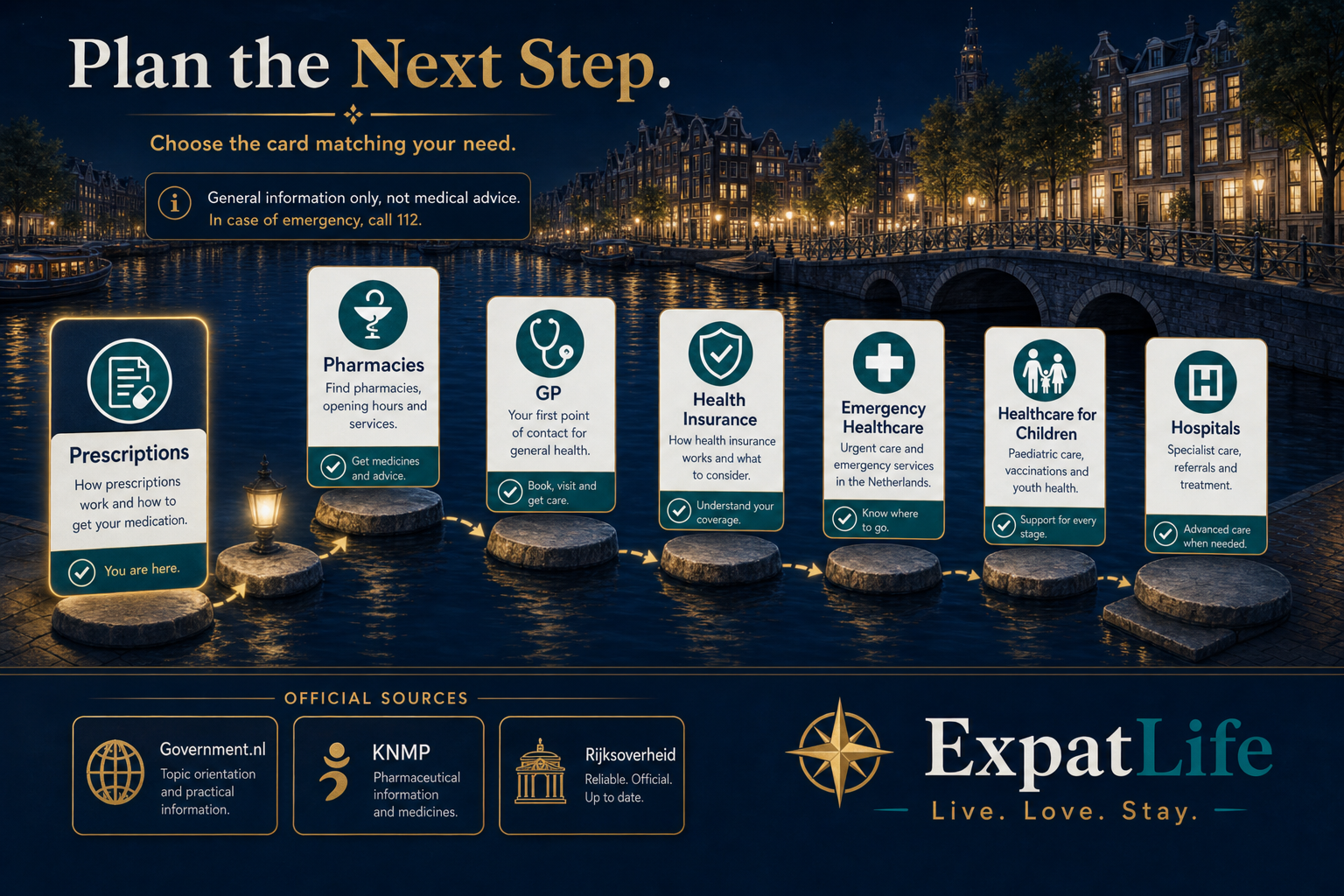
Pick the card that matches what is still open — pharmacy setup, GP registration, insurance, emergency routes or children's care — and verify specifics on the official sources below.
Trust
General information only — not medical advice. Prescription processes, insurer rules and medicine availability change, so verify your own situation with your GP, pharmacist and insurer. In an emergency, call 112.