
What Physio Covers
Movement assessment, recovery support after injury or surgery, exercise plans and many musculoskeletal complaints — with clear boundaries when a doctor or emergency route is needed first.
Netherlands · Health · Physiotherapy
How fysiotherapie works for expats — what it covers, direct access versus GP referral, finding a therapist, insurance limits, typical pathways and English-language realities.
General orientation only — not medical advice, not a treatment plan, and not a medical ranking of clinics. Partner referral listings (where shown) are disclosed discovery tools only. For your own symptoms, speak with a physiotherapist, GP or treating clinician. Call 112 for life-threatening emergencies.

Quick answer
In the Netherlands, fysiotherapie is a regulated allied-health profession. Physiotherapists assess how you move, screen for problems that need a doctor first, and design exercise and treatment plans aimed at recovery and function. Many practices sit in neighbourhoods near homes and workplaces rather than only inside hospitals.
Two systems surprise newcomers. First: you can often walk in or book directly without seeing a GP first (directe toegankelijkheid fysiotherapie). Second: what you can book clinically is not the same as what basic insurance will pay for. Adults recovering from everyday sports or desk-related complaints frequently discover that sessions come from supplementary insurance — or from their own pocket — until a defined annual limit is reached.
This guide is practical orientation for expats, students, families and newcomers: what physio covers, how direct access and GP referrals differ, how to find a therapist, how insurance usually works, what typical injury / chronic / post-op pathways look like at a high level, and what English-language support feels like in practice. It is not personal medical advice and not a ranking of clinics.
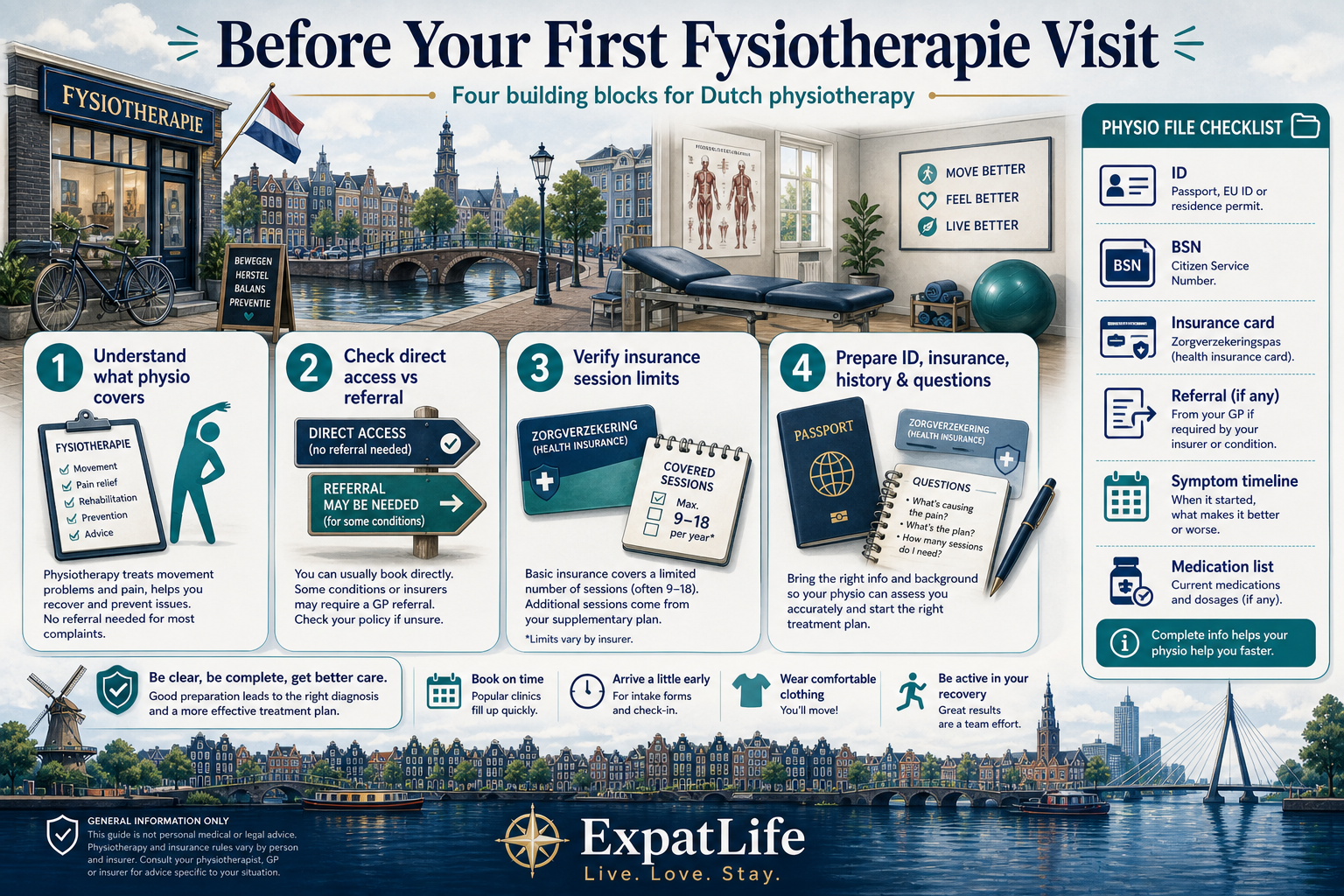
Physio file checklist
Examples
| Situation | How it works here | First step |
|---|---|---|
| You twisted your ankle or strained your back and want physio soon | For many non-emergency musculoskeletal complaints you can book a physiotherapist directly for screening. Still check insurance rules and escalate to a GP or urgent care if pain is severe, neurological, or followed significant trauma. | Rule out red flags, then call a nearby practice to book an intake and ask about reimbursement. |
| Your insurer says adult physio needs supplementary cover | That is a common Dutch pattern for everyday adult physiotherapy. Confirm your aanvullende session limit for the current policy year before committing to a long course. | Open your insurer portal, note remaining physio sessions, then share that number at intake. |
| You are recovering after planned surgery | Hospital teams often give post-op exercise instructions and may refer you to physiotherapy. Follow discharge guidance and confirm whether sessions route via basic or supplementary rules for your indication. | Bring the discharge letter and any referral to the practice your hospital recommended or one near home. |
| You need English-language support | Many practices in internationally oriented cities can work in English, but availability varies by therapist and day. Ask when you book rather than assuming. | When booking, ask specifically whether the intake can be in English. |
Snapshot
These six cards cover almost every physiotherapy question expats ask first — what fysiotherapie covers, direct access, GP referrals, finding a therapist, insurance limits and English-language realities.
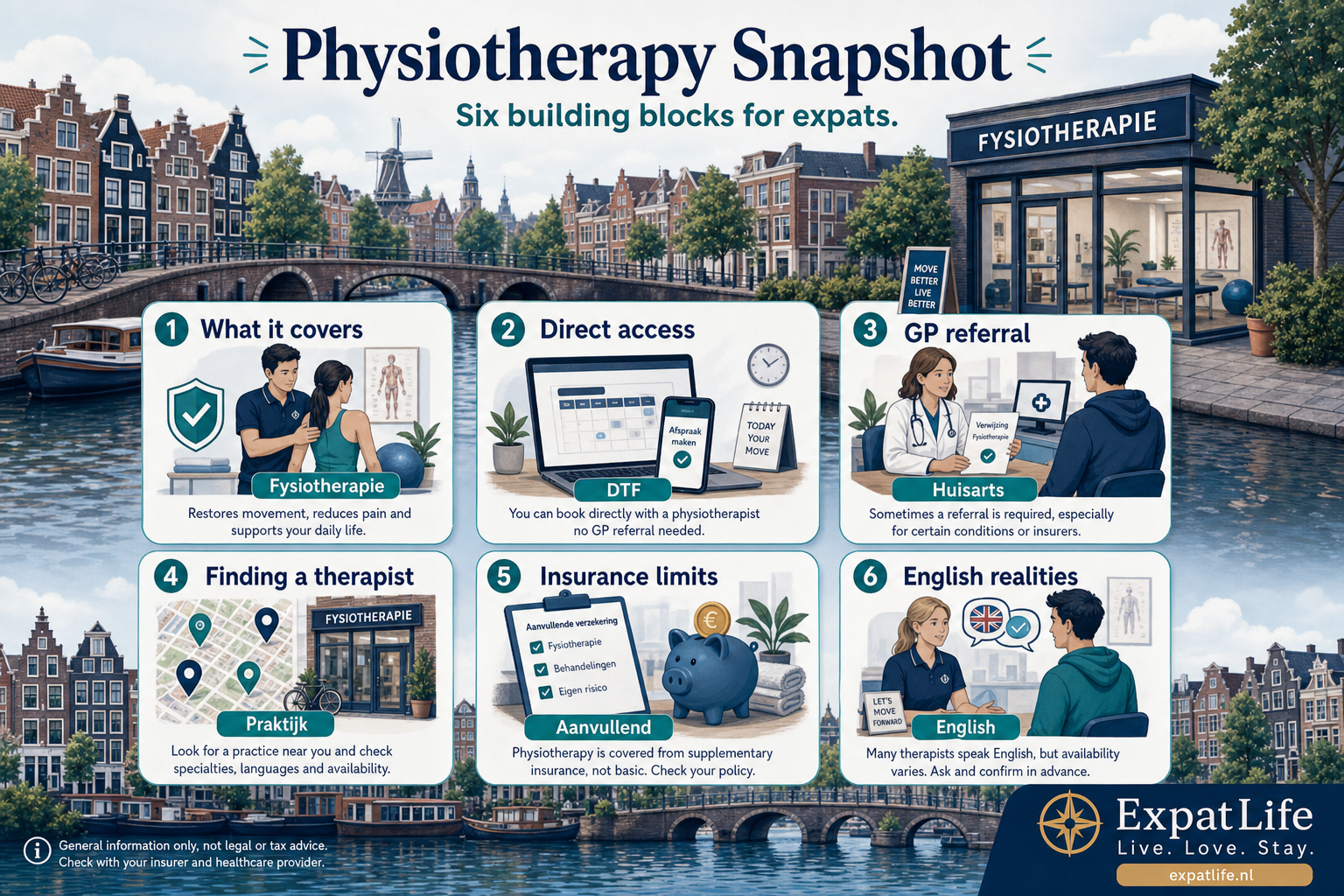
Movement assessment, recovery support after injury or surgery, exercise plans and many musculoskeletal complaints — with clear boundaries when a doctor or emergency route is needed first.
You can often start physiotherapy without a GP referral after a screening intake. Clinical access and insurance reimbursement are separate questions.
A huisarts or specialist referral still helps when symptoms are complex, when your insurer asks for it, or when another diagnosis needs ruling out first.
Search near home or work, check registration and specialties, ask about English and insurer contracts, then book an intake.
Basic insurance covers physio only in specific situations. Many adults rely on supplementary policies with annual session caps — verify every policy year.
International neighbourhoods often have English-capable therapists, but you should confirm language at booking and bring written history if needed.
How it works
A typical journey starts with screening and history-taking, then a shared plan that usually combines hands-on care with home exercises. Progress is reviewed; your GP stays in the loop when medical questions remain.
At the first visit the physiotherapist screens whether your complaint is appropriate for physio now, or whether you should see a GP or urgent pathway first. That screening is a safety step — not a promise that insurance will reimburse every session.
If treatment continues, expect a clear goal (for example walking further, returning to desk work, or rebuilding strength after surgery), a mix of supervised sessions and home exercises, and periodic review. Many plans are shorter and more exercise-focused than newcomers from other systems expect.
Coordination matters. If recovery stalls, red flags appear, or another specialty is needed, the physiotherapist may advise contact with your huisarts or the referring specialist. Hospital-linked rehab pathways can look more structured after surgery — follow the discharge instructions you were given.
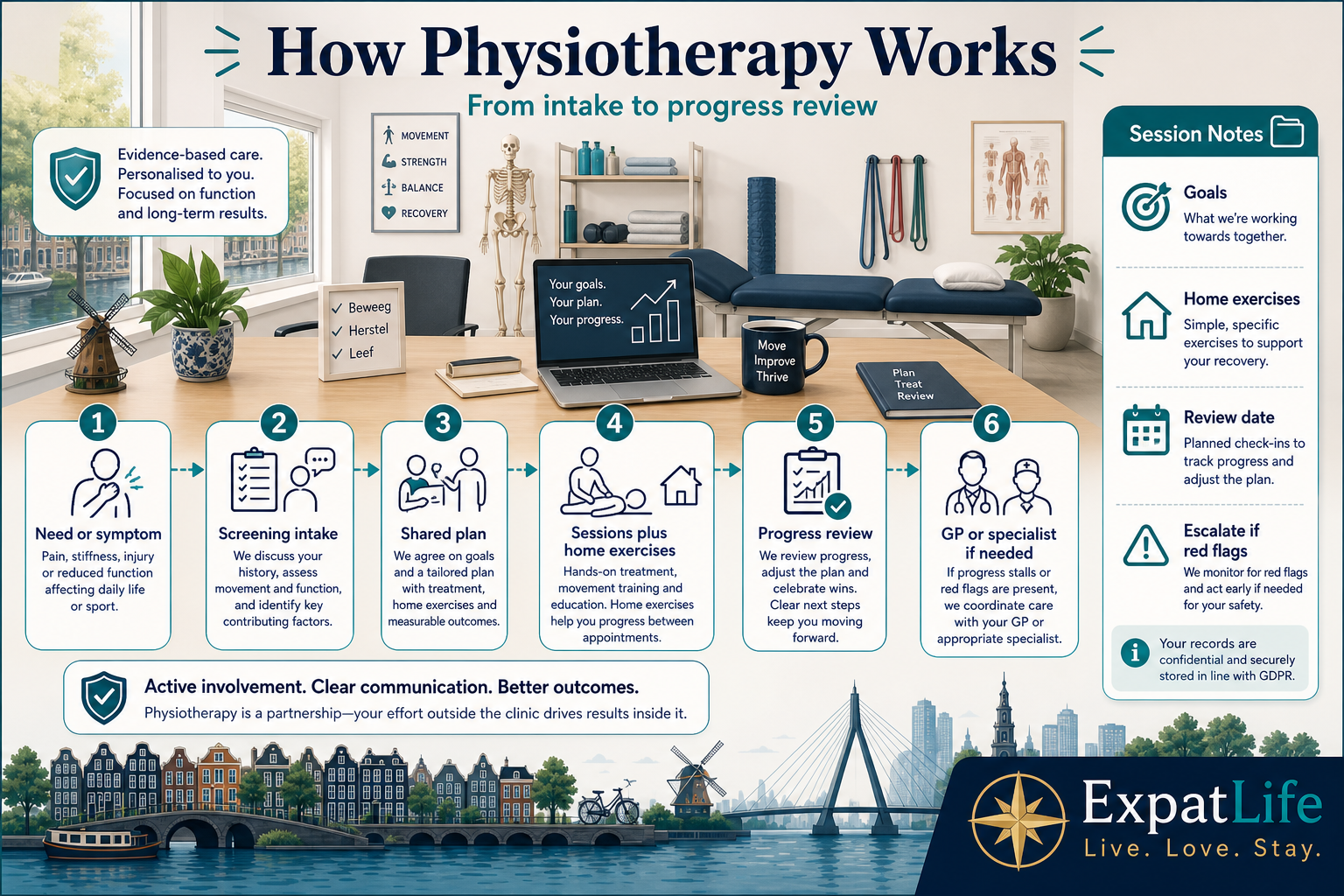
Physiotherapy pathway
Stage 1
Injury, post-op recovery, stiffness, or a longer-term musculoskeletal complaint brings you toward physiotherapy — after ruling out urgent medical routes when relevant.
Stage 2
Many practices accept direct bookings. A GP or specialist referral may still be useful for reimbursement or complex cases.
Stage 3
The physiotherapist checks safety, gathers your story, and assesses movement. You may be redirected to a doctor if needed.
Stage 4
Together you set practical goals and agree how often to attend, what to practise at home, and how progress will be judged.
Stage 5
Supervised sessions support technique and progression; home exercises usually carry much of the recovery work between visits.
Stage 6
Plans adapt as you improve, plateau, or need another clinical door. Insurance session limits should be tracked alongside clinical progress.
How to
Step 1
If symptoms are severe, sudden after major trauma, or include red flags, contact your GP, Huisartsenpost or 112 first. For many everyday musculoskeletal complaints, physiotherapy can be an appropriate next step.
Step 2
Look up whether your situation falls under basic-package physio rules or aanvullende session limits for the current policy year, and whether a referral is needed for reimbursement.
Step 3
Search by postcode, check registration and specialties, and ask about English support and insurer contracts.
Step 4
Bring ID, insurance details, referral if any, symptom timeline, medication list and your top questions.
Step 5
Use the first visit to confirm physio is appropriate, set practical goals, and understand the home-exercise expectation.
Step 6
Note remaining insured sessions, keep doing agreed exercises, and ask for a GP review if recovery stalls or new medical questions appear.
Step 7
New neurological symptoms, worsening trauma signs, chest pain or sudden severe illness are not 'push through physio' moments — use medical urgent routes.
Step 8
When goals are met, agree a maintenance approach. If more care is needed, confirm clinical and insurance next steps explicitly.
Scope
Fysiotherapie focuses on movement, function and recovery. It spans common injuries, post-operative orientation, and support for some longer-term conditions — with clear limits around diagnosis, medication and emergencies.
Typical reasons people see a physiotherapist include back or neck complaints, sports injuries, joint stiffness, post-fracture or post-surgery rehabilitation orientation, and guidance to rebuild strength and confidence in daily activities. Practices may also list specialties such as sports physio, pelvic physio, paediatric physio or manual therapy — availability varies.
Physiotherapists do not replace your GP. They do not prescribe most medicines, do not run the Dutch hospital referral system on their own, and are not the right door for chest pain, breathing emergencies, major trauma or unexplained systemic illness. Screening exists precisely to redirect those situations.
This page does not recommend specific techniques, products or clinics. Your own plan should come from the professional who assesses you.
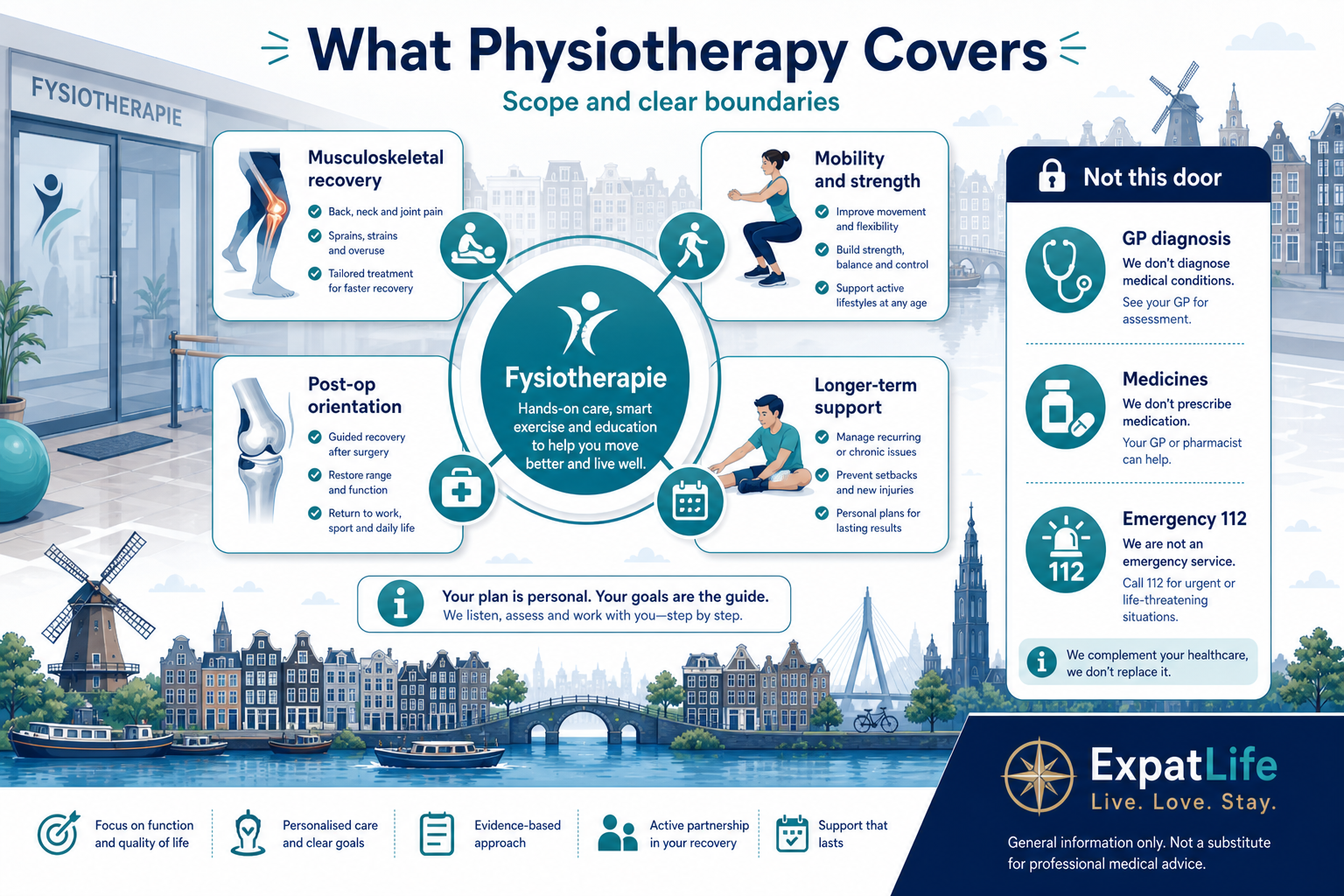
Sprains, strains, overuse complaints and many joint or soft-tissue problems are common physio reasons — after urgent medical issues are ruled out.
Exercise progression, movement coaching and return-to-work or return-to-sport orientation often sit at the centre of treatment.
After surgery, hospital teams may refer you for guided recovery. Follow discharge instructions and confirm insurance routing for your indication.
Some chronic conditions involve physiotherapy under specific insurance and clinical rules. Verify indication and session logic with clinician and insurer.
| Door | Focus | When it applies | Note |
|---|---|---|---|
| Physiotherapy | Movement, recovery, exercise plans | Many musculoskeletal and post-op recovery needs | Screening may redirect to a doctor |
| GP (huisarts) | Primary diagnosis, medicines, referrals | Unclear, systemic or complex medical pictures | Still central for coordination |
| Hospital / specialist | Surgery, complex diagnostics, specialty care | After GP referral or emergency pathways | May initiate post-op physio plans |
| Emergency routes | 112, Huisartsenpost, SEH | Life-threatening or urgent medical problems | Not replaced by a physio booking |
Scope checklist
Examples
| Situation | How it works here | First step |
|---|---|---|
| Desk-related neck and shoulder tension | Often suitable for physio assessment and exercise coaching. Still see a GP if symptoms are neurological, progressive or unexplained. | Book an intake and bring notes on work setup and symptom timing. |
| You want a massage clinic, not rehab | Physiotherapy is a clinical recovery service, not a spa substitute. Ask what the practice focuses on before booking. | Clarify goals on the phone: recovery plan versus wellness massage. |
| Child with a movement concern | Paediatric pathways and insurance rules can differ. Coordinate with JGZ / GP guidance when needed and verify basic-insurance child physio rules. | Read Healthcare for Children alongside this page, then ask a suitable practice about paediatric experience. |
| Pain after a car accident with possible concussion | Trauma with head injury signs needs medical assessment first. Physio may come later under clinical guidance. | Use GP / emergency pathways first; do not start with routine physio alone. |
Access
Directe toegankelijkheid fysiotherapie (DTF) means many people can book a physiotherapist without seeing the GP first. A referral remains useful — and sometimes necessary for reimbursement or complex care.
With direct access, the first appointment includes screening: is physiotherapy appropriate now, or should you see a doctor? If screening passes, treatment can start. If not, you are advised to contact your huisarts or another medical route.
A GP or specialist referral is still common after hospital care, for unclear diagnoses, or when your insurer's reimbursement rules expect one. Some adults discover they can attend without a referral clinically, yet their aanvullende or basic-cover rules still ask for paperwork — always verify for your policy year.
Think of it as two checklists: clinical access and payment rules. Passing one does not automatically satisfy the other.
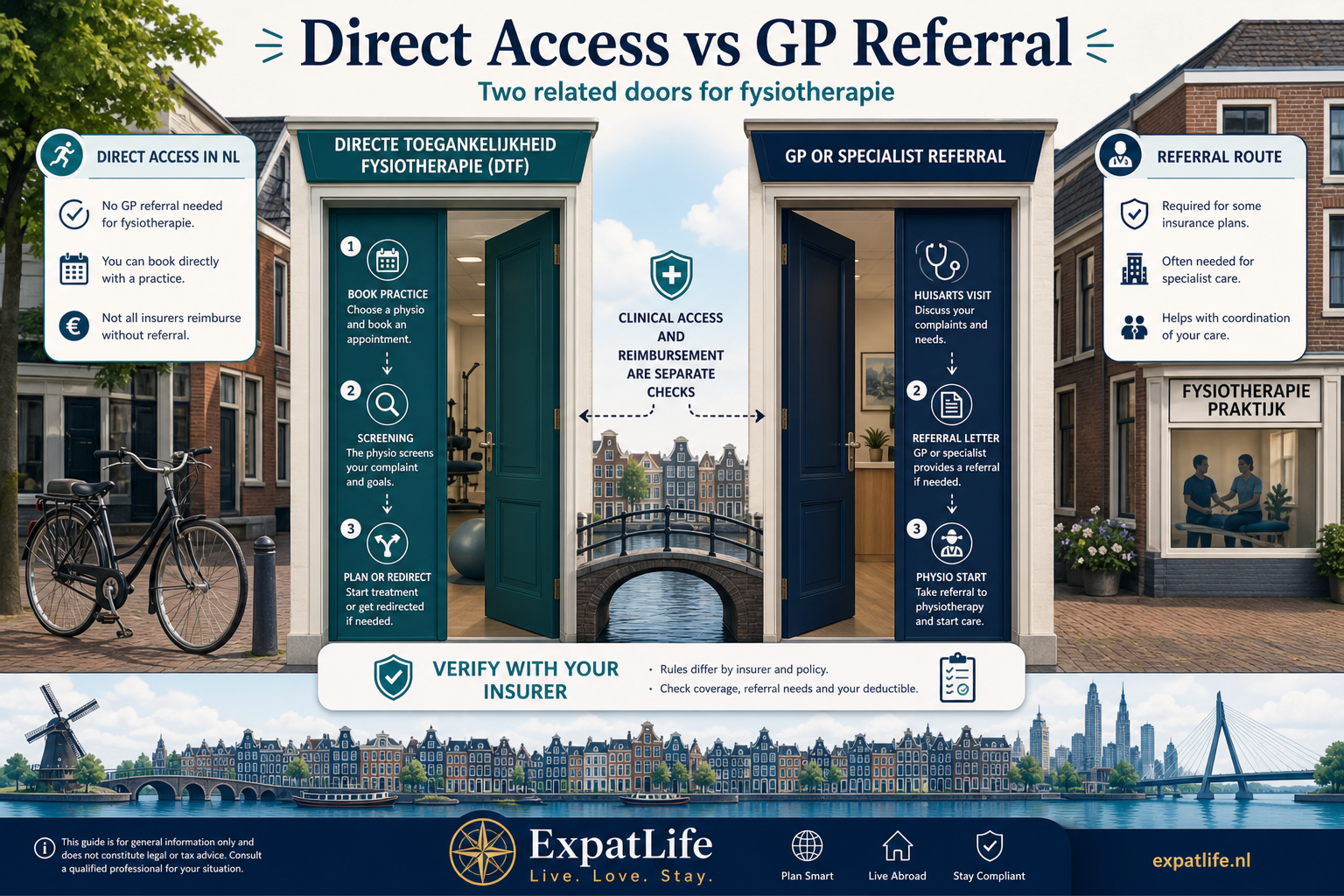
Book a physiotherapist directly. Expect screening. Useful for many straightforward musculoskeletal complaints when no red flags are present.
Your huisarts assesses first and may write a referral. Helpful for complex pictures, medical coordination and some insurer processes.
After surgery or specialty care, instructions and referrals often come from the treating team. Bring discharge papers to local physio.
Ask your insurer whether a referral is required for payment even when DTF allows clinical access.
| Route | When | How | Note |
|---|---|---|---|
| Direct access (DTF) | Many routine musculoskeletal starts | Book practice → screening intake → plan or redirect | Check reimbursement separately |
| GP referral | Complex, unclear, or insurer-required cases | Huisarts visit or message → referral → physio | Strong coordination route |
| Hospital / specialist referral | After surgery or specialty treatment | Follow discharge / clinic instructions | Bring documents to local physio |
| Urgent medical routes | Red flags, major trauma, emergencies | GP, Huisartsenpost or 112 as appropriate | Do not substitute with DTF alone |
Access checklist
Examples
| Situation | How it works here | First step |
|---|---|---|
| You want to start this week without waiting for a GP appointment | Many practices accept direct bookings. Confirm screening and insurance rules when you call. | Call two nearby practices and ask: 'Do you accept DTF, and what does my insurer usually need?' |
| Your insurer portal mentions a referral for physio claims | Get the referral even if you already started via DTF, if that is what reimbursement requires. | Message your GP practice assistant with the insurer requirement and your physio details. |
| Screening says see a doctor first | Treat that as useful triage, not a rejection. Book the GP and share the physio's concerns. | Ask the physiotherapist what specifically should be checked medically. |
| Post-op hospital letter names a physio pathway | Follow hospital timing and precautions. Local practices can continue care with the discharge plan. | Bring the full discharge pack to the first outpatient physio visit. |
Finding
Most people are best served by a practice they can reach reliably for repeated visits. Continuity beats hopping between trendy clinics.
Search for fysiotherapie near your postcode or workplace. Check whether the practice is easy to reach by bike or transit during your working hours. Ask about specialties if you need sports, pelvic or paediatric expertise.
Registration and quality signals help orientation — for example professional association context via KNGF — but this guide does not rank clinics. Ask practical questions: English support, waiting time for intake, insurer contracts, and how they handle DTF screening.
If you already have a hospital recommendation, you can still choose a neighbourhood practice for ongoing sessions when that fits your recovery plan and insurer rules.
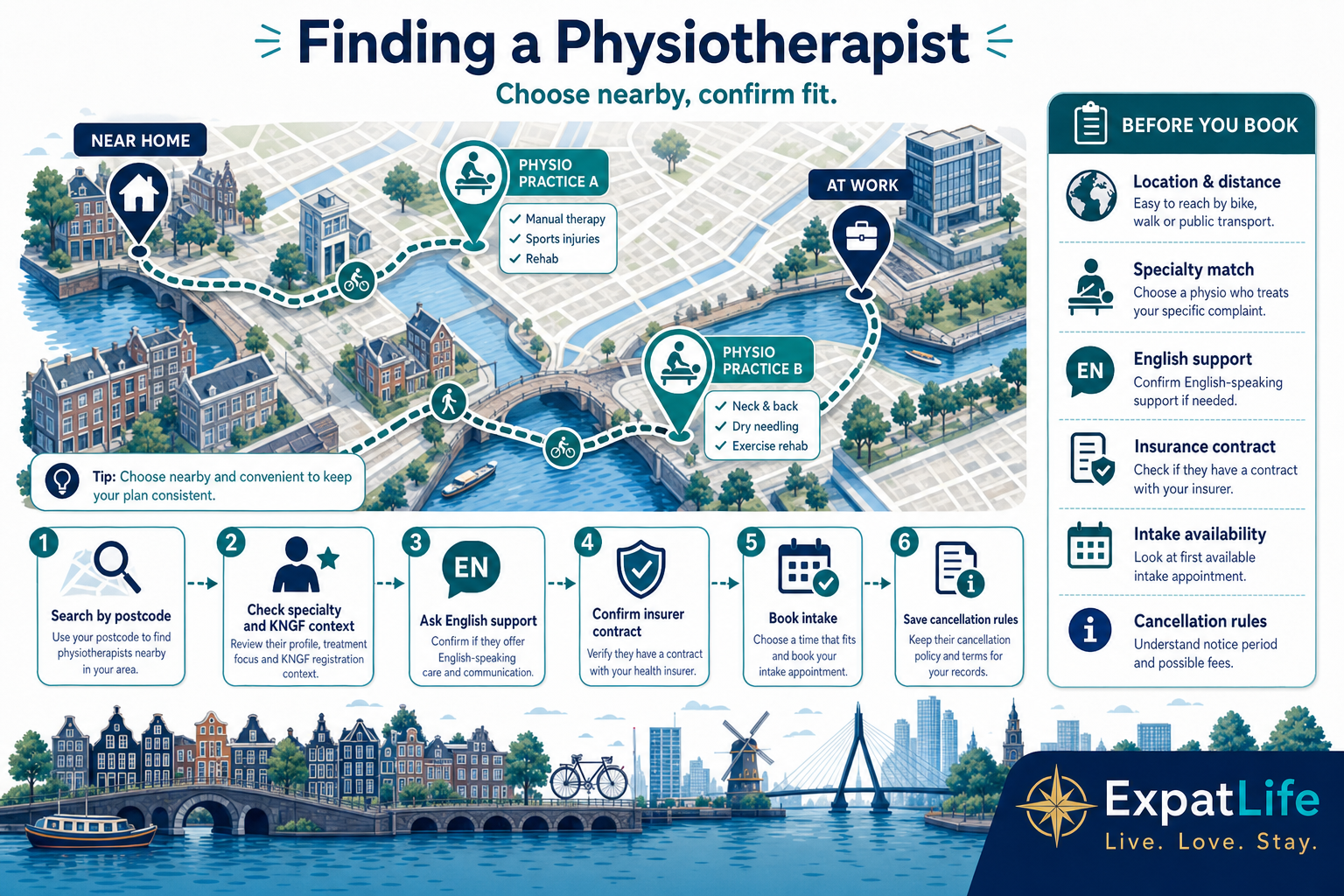
Pick a practice you can attend consistently. Ask about early, evening or Saturday options if your job is rigid.
Confirm English (or another language) for the actual therapist you will see, not only the front desk.
Ask whether they work with your insurer and how claims are submitted for aanvullende sessions.
Sports, pelvic, paediatric and other focus areas exist — match the practice to your need without chasing rankings.
| Route | When | How | Note |
|---|---|---|---|
| Neighbourhood practice | Most ongoing musculoskeletal and post-op follow-up | Book intake near home or work | Best default for continuity |
| Hospital-linked therapy | During admission or structured post-op pathways | Follow hospital scheduling | May transition to local physio later |
| Specialist physio focus | Pelvic, paediatric, sports or other named needs | Ask explicitly for that expertise | Availability varies by city |
| Insurer-contracted practice | When your policy steers reimbursement | Check insurer partner lists | Verify before a long course |
Finding checklist
Examples
| Situation | How it works here | First step |
|---|---|---|
| Every practice near you has a two-week wait | Widen the radius slightly, ask about cancellation lists, and use GP advice if symptoms worsen meanwhile. | Join a cancellation list at the closest suitable practice and book the next realistic intake. |
| You want English and sports physio | State both needs when booking. Availability may mean a specific therapist on certain days. | Ask: 'Which therapist can do an English sports-oriented intake this month?' |
| Your insurer uses preferred providers | Check whether reimbursement differs outside contracted practices before you commit. | Search your insurer's physio partner list, then call a listed nearby practice. |
| You moved cities mid-treatment | Ask the current practice for a summary letter and transfer goals to a new local physio. | Request a short transfer note before your final session in the old city. |
Insurance
For many adult expats, physiotherapy costs are shaped by session tariffs plus aanvullende verzekering session caps — not by the basic package alone. Use the indicative 2026 ranges below for planning, then verify with your practice and insurer.
Self-pay / practice tariffs (indicative 2026): a regular fysiotherapie session is often about €40–€55 (commonly around the mid-€40s). Manual therapy and some specialist sessions are often higher — roughly €55–€75. Practices set their own prices, so always ask for today’s list before you book a long course.
Dutch basic health insurance includes physiotherapy only in specific situations (for example certain chronic indications after a defined threshold such as the first 20 sessions self-funded then basic cover, some post-hospital pathways, and generally broader cover for children under 18). Everyday adult sports or desk injuries are frequently not fully covered by basic insurance alone.
Supplementary insurance (aanvullende verzekering) often reimburses a fixed number of physio sessions per year — commonly somewhere in a 6–52 session band depending on package and premium. Those aanvullende claims usually do not use eigen risico. When physio is billed under basic-insurance rules for adults, the mandatory eigen risico (about €385 in 2026, or higher with voluntary top-up) can apply. This is orientation only — not a quote and not advice to buy or drop a package.

Indicative cost orientation for 2026 planning conversations — not a fee schedule, quotation or reimbursement promise. Tariffs, session caps and deductible rules change by practice, insurer and policy year. Always verify remaining sessions, referral requirements, eigen risico impact and today’s practice tariff before you start.
| Cost item | Indicative figure | What you usually pay | Note |
|---|---|---|---|
| Regular physio session (self-pay tariff) | About €40–€55 / session (often ~€43–€50) | Full fee if uninsured for that visit or after your session cap | Ask the practice for today’s price list — tariffs are free-set. |
| Manual / specialist session | Often about €55–€75 / session | Higher than a regular session when self-paying | Manuele therapie and some specialty techniques sit above regular tariffs. |
| Adult everyday physio (many common injuries) | Usually aanvullende cover or self-pay | Insured sessions until your annual cap; then self-pay at practice tariff | Basic package alone often does not cover routine adult recovery. |
| Aanvullende physio package (orientation) | Commonly about 6–52 sessions / year | Package premium; claims usually outside eigen risico | Higher session budgets cost more premium — compare at renewal. |
| Basic-package physio (specific indications) | Only in defined situations (e.g. chronic list rules) | May hit adult eigen risico (~€385 in 2026) when basic-billed | Ask insurer whether your indication qualifies and from which session. |
| Chronic-list style pathway (orientation) | Often first ~20 sessions self-pay / aanvullend, then basic may continue | Depends on indication list + insurer confirmation | Do not assume — verify the exact threshold for your diagnosis. |
| Children under 18 | Often broader basic-insurance physio rules than adults | Confirm child-specific limits — do not copy adult assumptions | Verify in the family insurer portal. |
| Adult mandatory eigen risico (2026) | About €385 / year (up to ~€885 with voluntary top-up) | May apply when care is billed under basic insurance rules | Aanvullende physio claims usually do not consume eigen risico — verify. |
Ask for today’s tariff before intake. Regular sessions often land around €40–€55; specialist techniques can run higher.
Basic cover is selective for adult physio. Supplementary packages usually buy a session budget (often 6–52) — compare caps before renewal season.
Even with DTF clinical access, some reimbursement routes still want a GP referral. Check paperwork early.
Keep a running count of used and remaining sessions. Practices and portals can lag — ask before booking extras.
Insurance checklist
Examples
| Situation | How it works here | First step |
|---|---|---|
| Portal shows nine physio sessions left this year | Plan frequency with the therapist so clinical progress and the cap stay aligned. Ask what happens after session nine and what the self-pay tariff would be. | Share the remaining count at intake and agree a review before the last insured visits. |
| You have only basic insurance as an adult | Expect many everyday physio courses to be self-pay at roughly €40–€55 per regular session unless a specific basic indication applies. | Call insurer with your complaint category and ask whether basic cover applies; ask the practice for today’s tariff. |
| Child needs physiotherapy | Child rules are often more favourable under basic insurance, but still verify indication and any limits. | Check the child policy page, then book a practice with paediatric experience if needed. |
| Two insurers in one household | Each person's package and remaining sessions can differ. Do not assume partner benefits transfer. | Check each login separately before family bookings. |
Recommended
Use these referral options when you want English-friendly physiotherapy discovery or to compare supplementary insurance that covers physio sessions. Listings are for discovery — confirm language, specialty, availability and insurer contracts yourself.
Recommended physios
Start here when you want English-speaking discovery options. Confirm specialty, availability and whether the practice contracts with your insurer before you book. Indicative self-pay tariffs often land around €40–€55 per regular session (2026 orientation).
Evolution Fysiotherapie
AmsterdamEnglish-speaking physiotherapy for expats in Amsterdam — direct access, clear insurance claims support.
Ask practice for today’s tariff (regular sessions often ~€40–€55).
Visit provider →Alter Physio
Amsterdam ZuidEnglish physio near Amsterdam Zuidas / Zuid — convenient for desk-work and travel-related complaints.
Confirm session fees and insurer contracts when booking.
Visit provider →Art of Physio
Amsterdam ZuidInternational physiotherapy team in Amsterdam Zuid focused on expats and injury recovery.
Confirm language, specialty and today’s tariff before intake.
Visit provider →Insurance cover
Most adult everyday physio sits in aanvullende cover. Compare session budgets (often around 6–52) before renewal season.
Most adult everyday physiotherapy sits in aanvullende packages. Use a comparison tool when checking session budgets (often around 6–52), then confirm remaining sessions and referral rules in your insurer portal.
Some links may be affiliate or referral links. If you use them, we may earn a commission at no extra cost to you. Ordering reflects relevance for insurance comparison alongside English-friendly physio discovery, not pay-to-rank. This is not medical or insurance advice — confirm fit, language, credentials and insurer contracts with each provider. Learn more
Also useful for cover and providers: Health insurance guideHealth insurance comparisonHealth insurance providersBrowse all services
Some links are affiliate or referral links. If you use them, we may earn a commission at no extra cost to you. Ordering reflects editorial relevance for expats, not pay-to-rank. This is not medical advice and not a clinic ranking. Learn more
Pathways
Most expat journeys fall into a few patterns. The details of your exercises and hands-on care are clinical decisions — this section only orients the system steps.
Injury pathways often start with direct access or a GP visit, then screening, short-course physio and home exercises, with medical escalation if recovery stalls or red flags appear.
Chronic or longer-term pathways may involve clearer insurance indication rules, GP coordination and pacing that protects session budgets. Do not invent a diagnosis from an article; ask clinicians how your situation is categorised for care and cover.
Post-operative pathways usually begin with hospital instructions: precautions, early exercises and timing for outpatient physio. Bring discharge letters so the neighbourhood therapist continues the same plan rather than starting from zero.
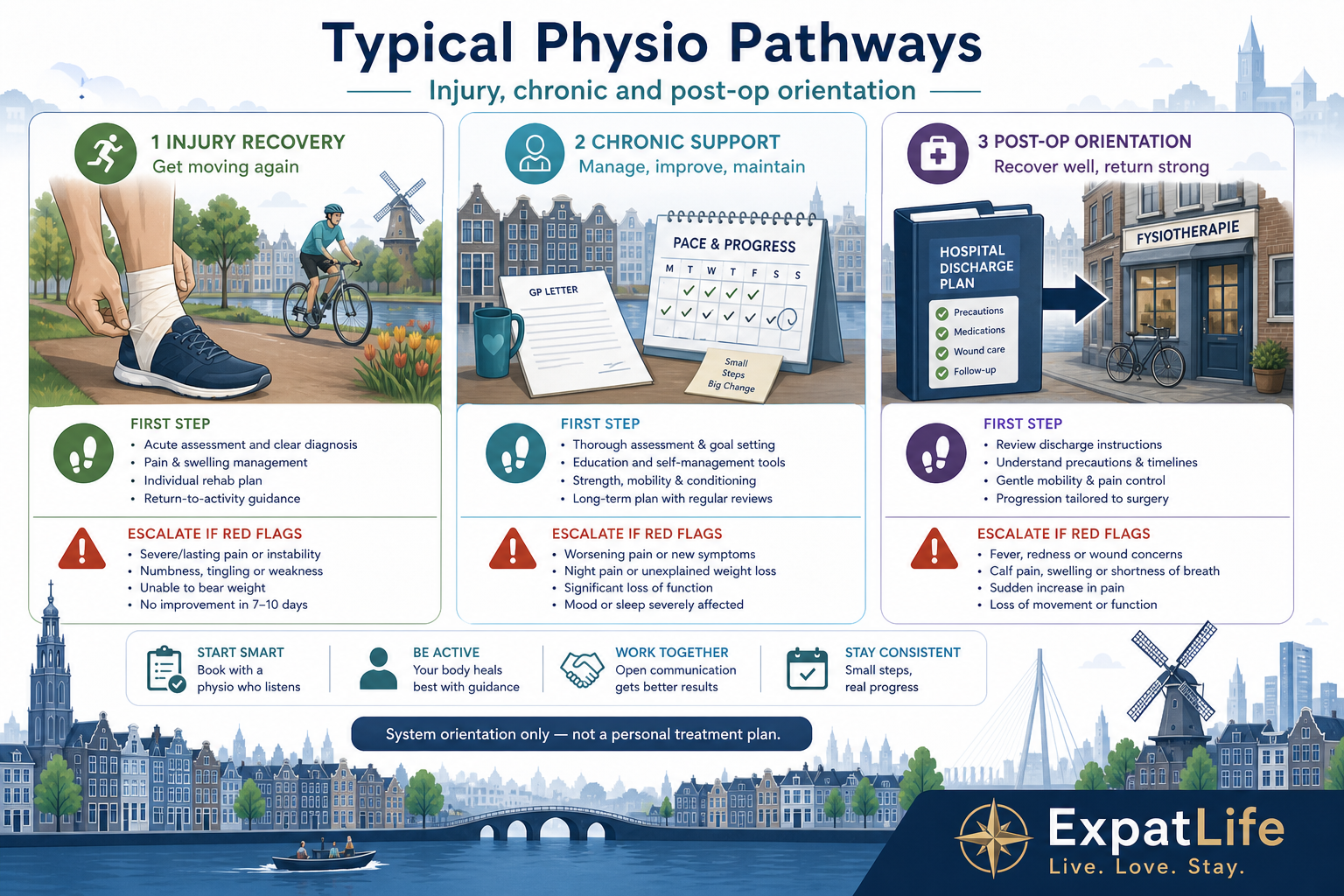
Screen → plan → progress with home exercises. Use GP/urgent routes for trauma or red flags. Track insurance sessions from day one.
Expect more coordination with your GP and clearer questions about whether basic or supplementary rules apply. Goals stay functional and realistic.
Follow hospital timing and restrictions. Transfer documents to local physio. Confirm billing route for your procedure year.
Worsening neurology, infection signs, chest symptoms or major new trauma mean medical review — not simply more of the same physio plan.
Pathway orientations
Path A
Safety check → DTF or GP → physio intake → short plan → review. Escalate if not improving as expected.
Path B
GP context + insurance indication questions → physio goals that fit session budgets → periodic medical review.
Path C
Hospital plan → precautions → outpatient physio with discharge papers → graded return to activity.
Call 112 now
Chest pain, severe breathlessness, collapse
Call 112 — not a physio booking.
Same day / out of hours
Major trauma, suspected fracture, inability to bear weight after injury
Use GP / Huisartsenpost / SEH guidance rather than routine DTF alone.
New saddle anaesthesia, bladder/bowel loss, progressive leg weakness
Seek urgent medical assessment; inform physio you are redirecting.
Planned route
Everyday sprain improving with advice
Physio intake and graded plan can be appropriate after safety checks.
Pathway checklist
Examples
| Situation | How it works here | First step |
|---|---|---|
| Ankle sprain after sport, walking possible | Often a physio-first candidate after ruling out inability to bear weight or severe deformity that needs urgent medical care. | If walking is possible and no red flags, book DTF intake and start RICE-style first aid guidance from trusted clinical advice you already have. |
| Long-running back pain with prior GP visits | Bring previous letters and imaging summaries. Align physio goals with what the GP already ruled in or out. | Ask the GP whether a physio course and any referral paperwork are appropriate now. |
| Two weeks after planned knee surgery | Follow the surgeon/hospital physio protocol. Do not copy a generic internet programme over discharge instructions. | Book outpatient physio with the discharge pack in hand. |
| Physio for three weeks, now new leg weakness | New neurological signs need medical review promptly — pause the assumption that more of the same plan is enough. | Contact GP or urgent pathways as advised; inform the physiotherapist. |
English
Many therapists in internationally oriented Dutch cities can work in English, but it is a local roster question — never a national guarantee.
Reception English does not always mean your treating physiotherapist is fluent that day. Ask for the specific clinician and appointment slot. In smaller towns, English availability can be thinner; written notes and translation support may help.
Bring a short written symptom timeline, medication list and goals in English (and Dutch keywords if you have them). Safety words matter: numbness, weakness, chest pain, fever, trauma. If communication still feels unsafe for clinical decisions, ask about another therapist, a GP visit with interpretation support, or postponing non-urgent care until language fit is clear.
This page does not maintain a directory of English-speaking clinics and does not rank anyone on language skills.
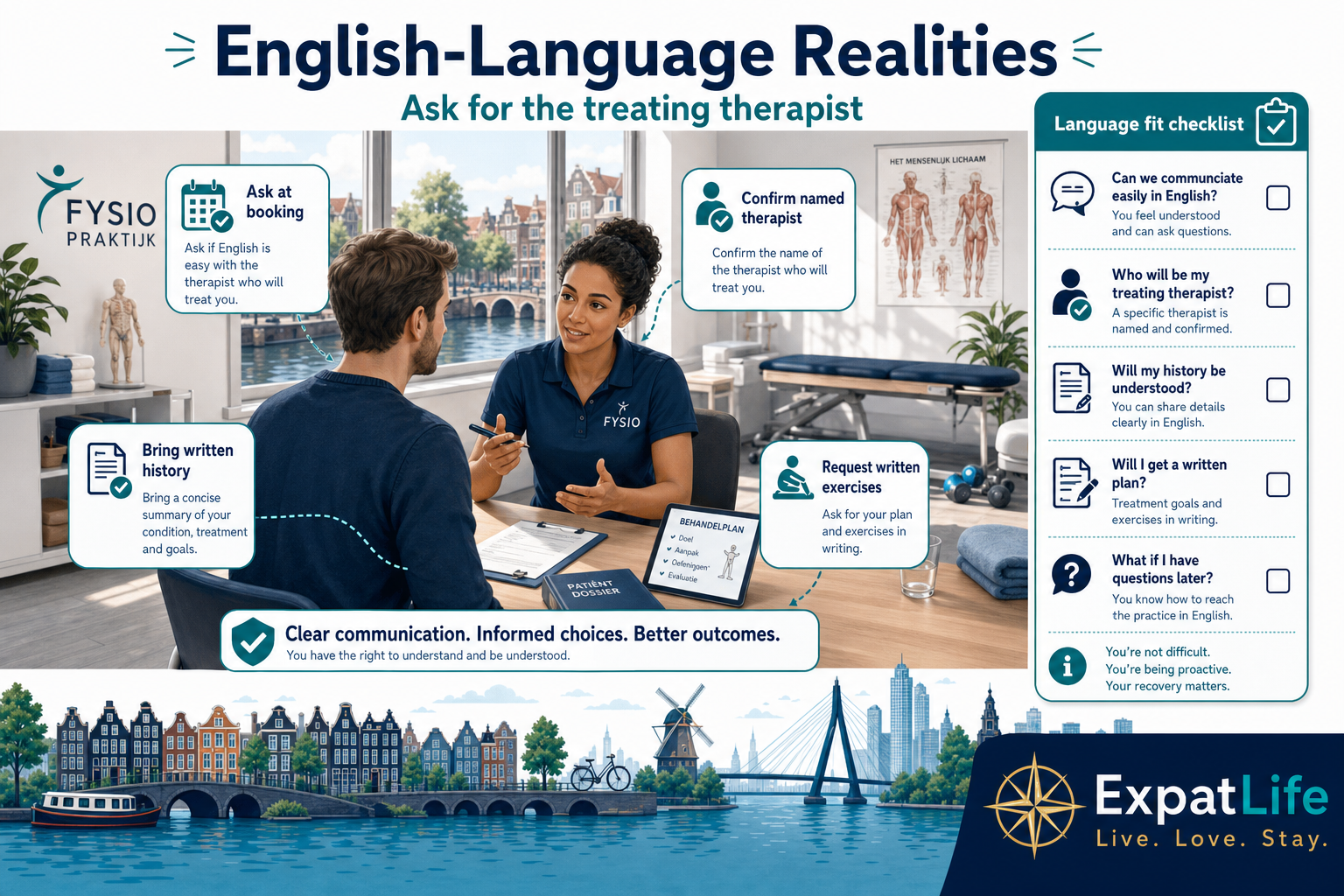
State that you need the intake and treatment explanations in English. Get a yes for the named therapist.
A one-page timeline reduces misunderstandings about onset, aggravating factors and prior treatment.
Ask for written or video home-exercise guidance you can replay — technique errors are costly.
If you cannot understand precautions after surgery or red-flag advice, pause and fix communication before continuing.
English checklist
Examples
| Situation | How it works here | First step |
|---|---|---|
| Website says 'English spoken' but therapist is unsure | Ask to reschedule with a colleague rather than guessing through post-op precautions. | Call reception and request an English-capable clinician explicitly. |
| You understand conversation but not exercise nuance | Request written cues, fewer exercises done well, and a follow-up check of technique. | Say: 'Please write the three most important home exercises for me.' |
| Partner translates for you | Helpful for logistics; still ensure the patient understands safety limits personally. | Repeat precautions back in your own words before leaving. |
| Small town with limited English | Combine a GP visit, written materials and the best available local physio — or travel to a city practice if clinically needed. | Ask the GP practice which nearby physios usually work with internationals. |
Differences
Dutch physiotherapy often feels more direct-access and exercise-heavy than systems built around long specialist waitlists — while insurance caps surprise many adults.

Example: booking physio this week without a GP letter.
Fix: Still complete screening and check reimbursement paperwork.
Example: discovering everyday physio is aanvullend with nine sessions.
Fix: Read the physio line in your package every policy year.
Example: shorter in-clinic time than expected.
Fix: Treat homework as the main treatment between visits.
Example: physio redirects you for medical review.
Fix: Keep huisarts registration active and share updates.
Example: looking for a 'top 10 physios' list on this site.
Fix: Choose nearby fit, language and insurer clarity instead.
Example: assuming adult self-pay logic for a child.
Fix: Verify basic-insurance child physio rules separately.
Checklist
A short preparation routine makes intakes faster and safer. You reuse the same file when switching practices or continuing after hospital care.
Update the file when medicines, insurers or goals change. Share only what clinicians need; keep copies of referrals and discharge letters.
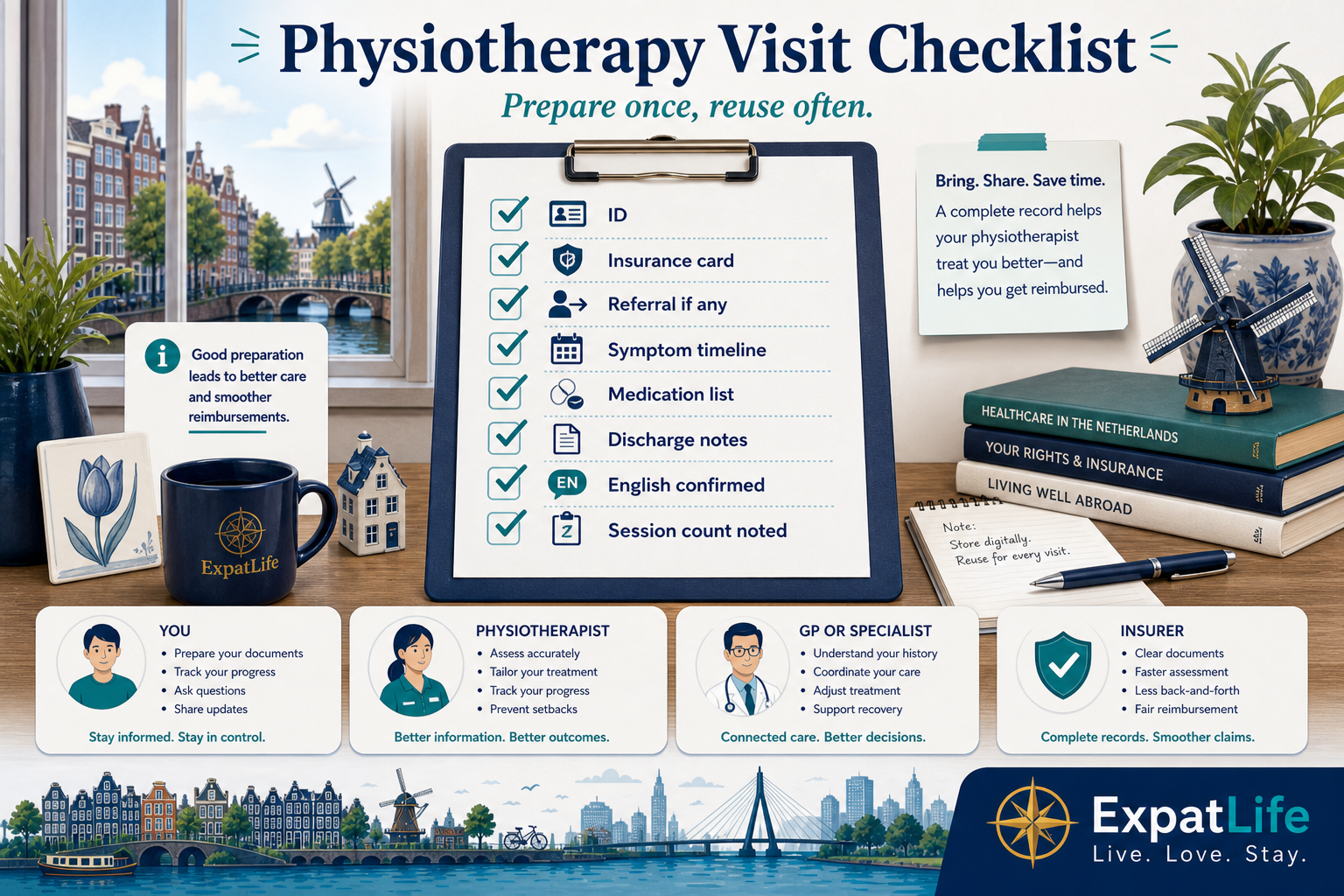
Preparation checklist
History, goals, home exercises, honest red-flag reporting.
Screening, plan, technique coaching, progress review.
Diagnosis, medicines, referrals, medical escalation.
Session caps, claim rules, referral-for-payment requirements.
Avoid
These mistakes are common and fixable. Each one has a practical correction.
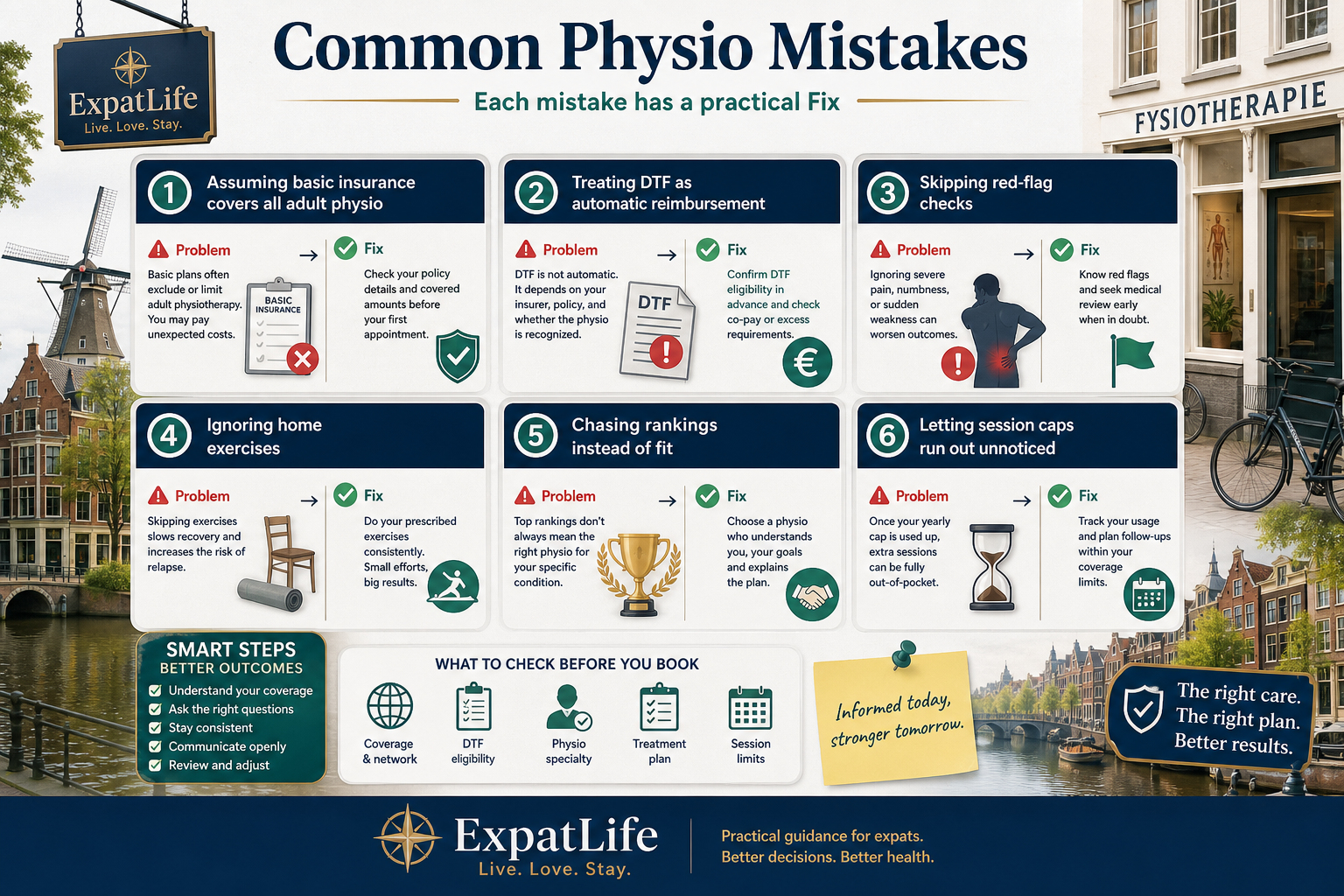
Example: surprise invoices after a sports injury course.
Fix: Check basic vs aanvullend rules for your indication before week two.
Example: starting without paperwork your insurer still requires.
Fix: Ask the payment question separately from the booking question.
Example: booking physio for post-trauma symptoms that need imaging or urgent care.
Fix: When in doubt, GP / urgent pathways first.
Example: attending sessions but changing nothing between visits.
Fix: Schedule homework like a recurring calendar event.
Example: delaying care to find a 'best clinic' list.
Fix: Choose nearby, language-capable, insurer-clear care now.
Example: discovering zero sessions left mid-plan.
Fix: Track remaining visits with the therapist each fortnight.
FAQ
Orientation answers only — confirm your own situation with your physiotherapist, GP and insurer. Call 112 for life-threatening emergencies.
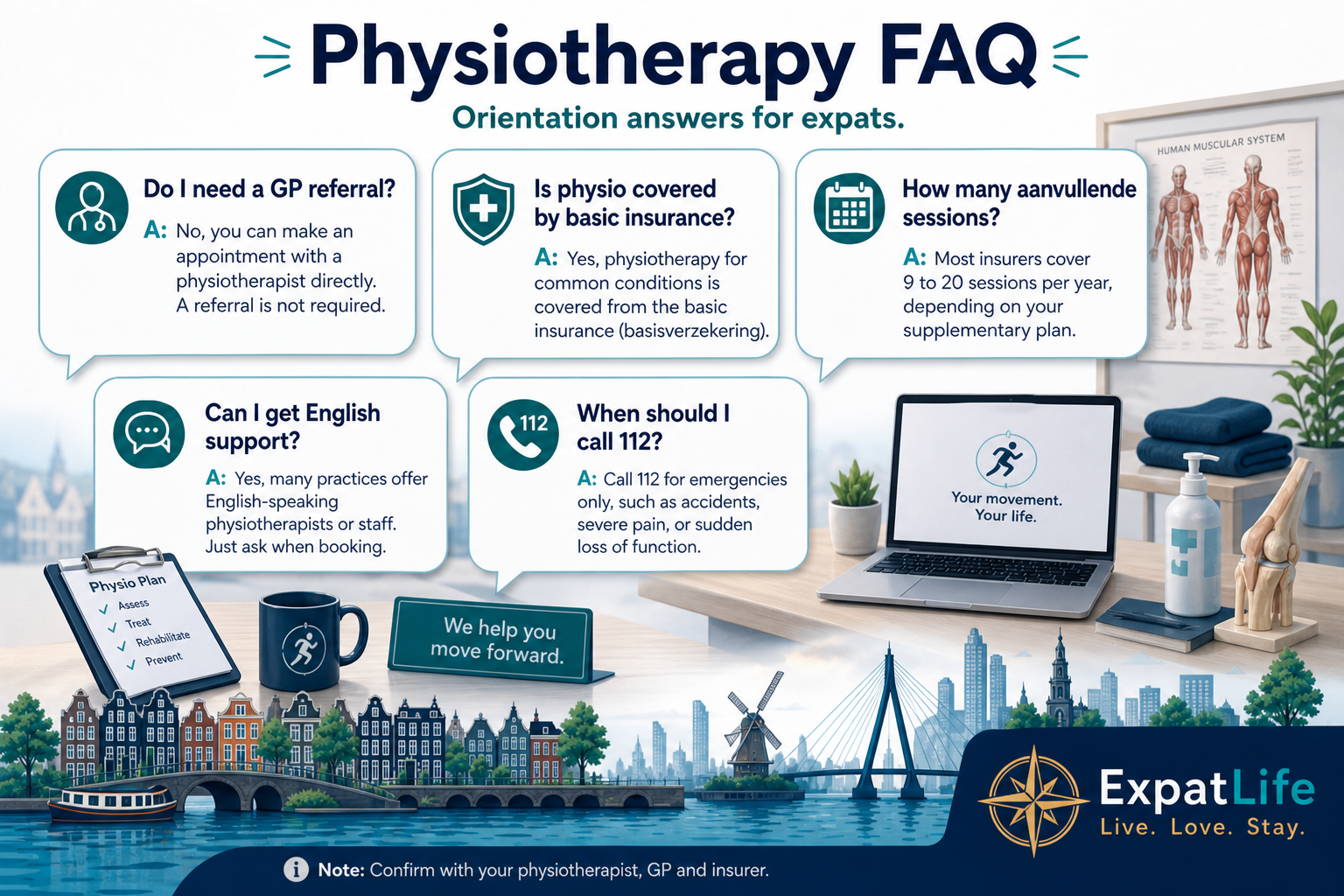
Often no for clinical access — directe toegankelijkheid (DTF) lets many people book after screening. Your insurer may still want a referral for reimbursement. Check both the clinical and payment rules.
Only in specific situations for many adults. Everyday injury recovery often relies on aanvullende verzekering or self-pay. Children frequently have broader basic-package physio rules — verify your own policy year.
Search near your postcode, ask about specialties, English support and insurer contracts, then book an intake — or use the recommended referral options on this page as a starting point. Confirm fit yourself; this is not a medical ranking.
Many practices in internationally oriented areas can, but it is not guaranteed. Confirm that the treating therapist — not only reception — can work in English.
Expect history-taking, screening for medical red flags, a movement assessment and a proposed plan with goals and home exercises. You may be referred to a GP instead if physio is not appropriate yet.
Directe Toegankelijkheid Fysiotherapie — the route that allows direct booking without a prior GP referral, with mandatory screening at the start.
Use GP, Huisartsenpost or 112 for red flags, major trauma, unclear systemic illness or emergencies. For many routine musculoskeletal complaints, DTF physio can be a reasonable first clinical door after a safety check.
Indicative 2026 practice tariffs for a regular session are often about €40–€55 (commonly around the mid-€40s). Manual therapy and some specialist sessions are often about €55–€75. Practices set their own prices — ask for today’s list. Not a quote.
When physio is billed under basic-insurance rules for adults, the mandatory eigen risico (about €385 in 2026, or higher with voluntary top-up) can apply. Aanvullende physio claims usually do not use eigen risico. Verify the billing route with your insurer.
Packages commonly sit somewhere in a 6–52 session band per year depending on insurer and premium. Check your remaining count in the portal before booking a long course.
Yes. Coverage rules for under-18s are often more favourable under basic insurance than for adults, but indication and practice fit still matter. See also Healthcare for Children.
Tell your physiotherapist, review goals and technique, and ask whether a GP or specialist review is needed. Do not silently escalate exercises beyond agreed plans.
This guide is system orientation first. Where we list partner or referral physio options, those links are disclosed discovery tools — not a medical ranking and not a guarantee of fit, availability or insurance contract status. Always confirm language, specialty and insurer rules yourself.
After surgery or specialty care, hospitals may start or refer physiotherapy. Bring discharge instructions to your local practice. See the Hospitals guide for secondary-care context.
For life-threatening symptoms such as severe chest pain, breathing difficulty, collapse, or major trauma emergencies. Physio bookings are for non-emergency recovery pathways.
Related
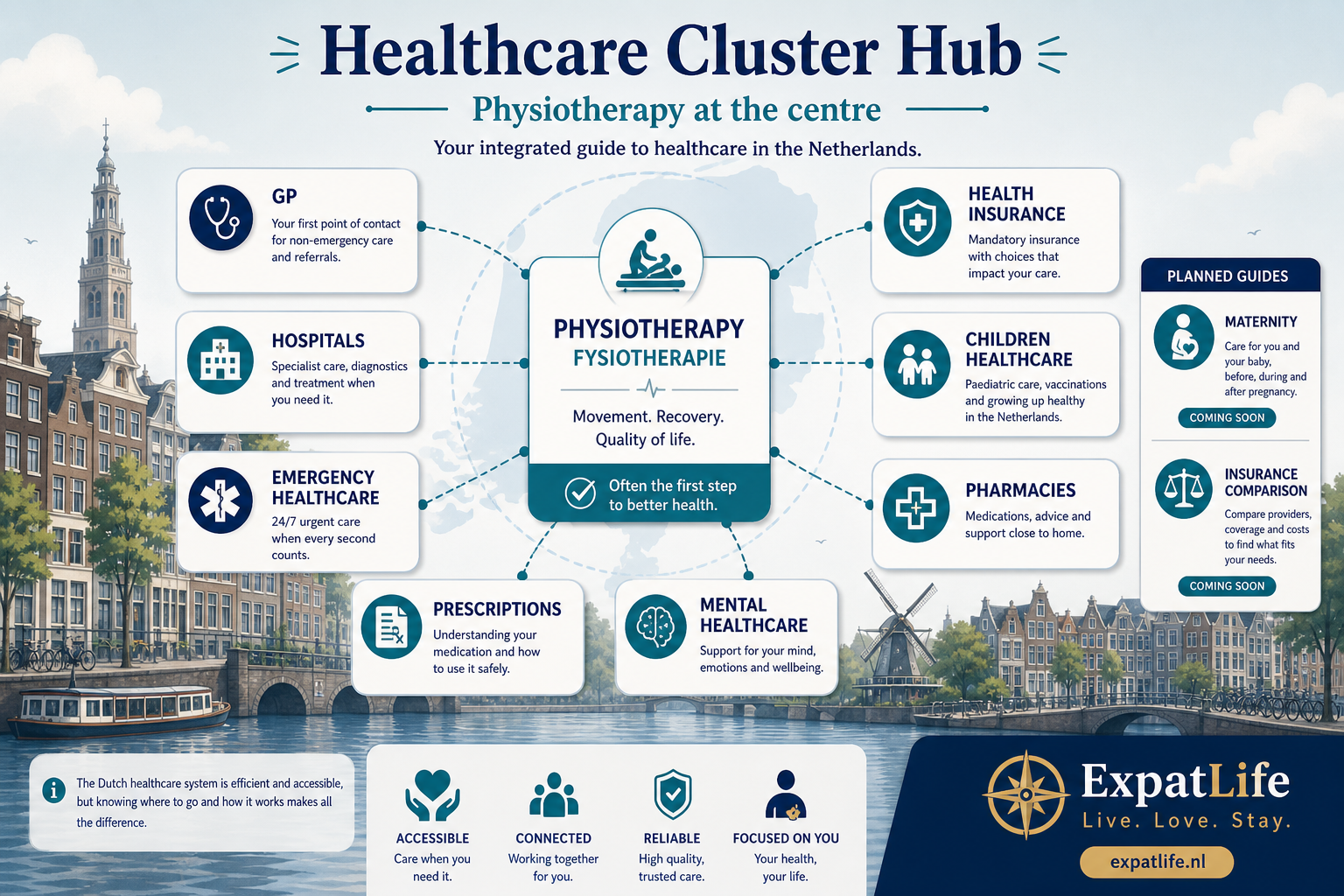
Physiotherapy connects to GP care, hospitals, emergency routes, insurance and family pathways — read them together.
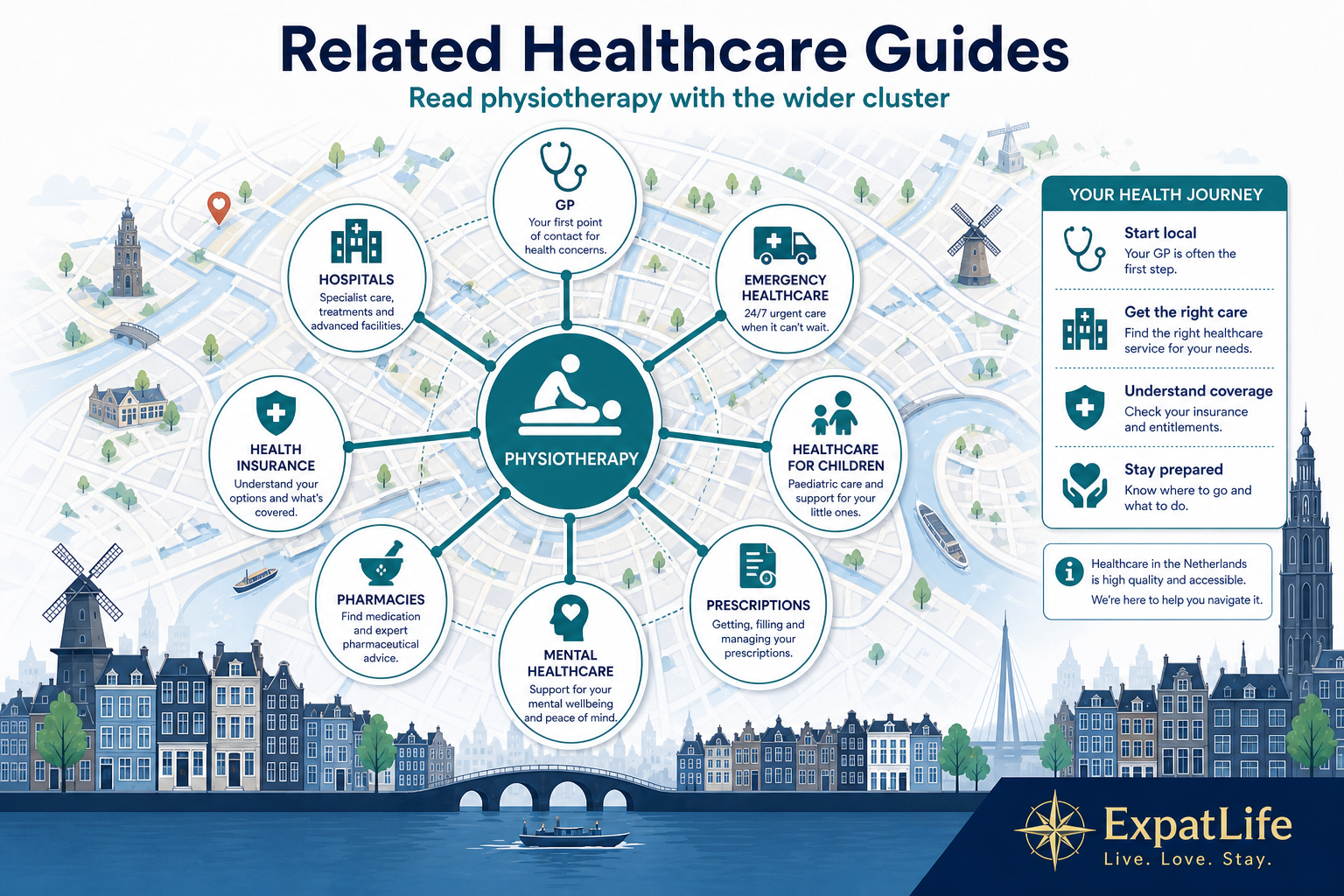
Health hub
This page is the physiotherapy cornerstone — explore related health topics next.
Explore next
Pick the card that matches what is still open — GP registration, insurance limits, hospital discharge, emergency routes or children's care — and verify specifics on the official sources below.

Trust
General information only — not medical advice. Physiotherapy processes, insurer rules and practice availability change, so verify your own situation with your physiotherapist, GP and insurer. In an emergency, call 112.