
Finding an Apotheek
Search near your postcode, prefer a pharmacy close to home or your GP, ask about English support, and tell your practice which pharmacy should receive digital prescriptions.
Netherlands · Health · Pharmacies
How Dutch pharmacies (apotheken) work for expats — finding one, opening hours, OTC vs prescription pickup, the service desk, medication counseling and emergency pharmacy orientation.
General orientation only — not medical advice, not a recommendation of any pharmacy or medicine, and not dosing guidance. For your own medicines, speak with your GP, pharmacist or treating clinician. Call 112 for life-threatening emergencies.
Quick answer
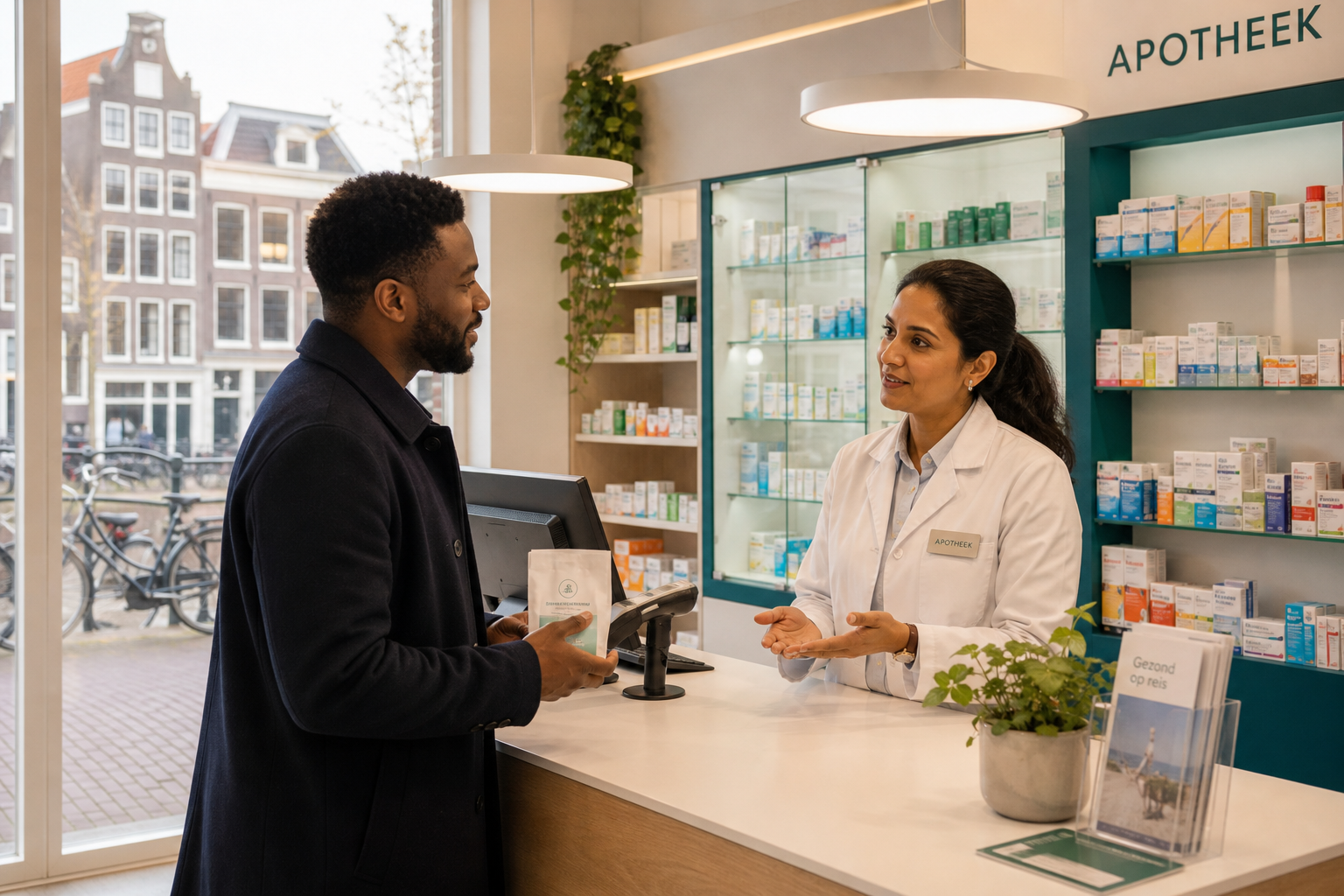
In the Netherlands, the apotheek is a regulated healthcare setting, not just a shop with medicines. Pharmacists check prescriptions, screen for interactions and allergies, prepare or order medicines, and counsel patients — especially at first dispense. Many expats first meet this system when a GP sends a digital prescription and the pharmacy texts or emails that the medicine is ready.
Two easy mix-ups create friction. First: drogisterijen (drugstores) sell many self-care products but do not replace a pharmacy for prescription dispensing. Second: opening hours are often weekday-focused; evenings, Sundays and holidays may require a regional dienstapotheek after triage, not a walk to the nearest lit storefront.
This guide is practical orientation for expats, students, families and newcomers: how to find a pharmacy, what opening hours feel like, how OTC and prescription pickup differ, what happens at the service desk, what counseling is for, how emergency pharmacy routes work at a high level, and how costs usually fit with basic insurance. It is not dosing advice, not a ranking of pharmacies, and not a substitute for speaking with your GP or pharmacist about your own medicines.

Pharmacy file checklist
Examples
| Situation | How it works here | First step |
|---|---|---|
| Your GP just prescribed a medicine | In many practices the prescription is sent digitally to your chosen pharmacy. Wait for a ready notification, bring ID and insurance details, and expect a short counseling conversation at first dispense. | Confirm which apotheek received the prescription and check opening hours before you travel. |
| You need painkillers or cold remedies tonight | Many zelfzorg products are available in drugstores during their hours. If you need a prescription medicine after pharmacy closing time, contact the huisartsenpost for urgency assessment rather than assuming a 24/7 counter nearby. | Decide whether you need OTC self-care or a prescription medicine — the route differs. |
| You are new in town and do not have a pharmacy yet | Search for an apotheek near home, ask whether they can register you as a regular patient, and share your medication and allergy list so counseling is safer. | Pick one daytime pharmacy, save the address and hours, then tell your GP which apotheek you use. |
| You need medicine after 20:00 or on Sunday | Most daytime pharmacies are closed. Urgent dispensing may go through a regional dienstapotheek after contact with the huisartsenpost or another clinician. | Call the huisartsenpost for triage guidance and ask which dienstapotheek applies — see also the Emergency Healthcare guide. |
Snapshot
These six cards cover almost every pharmacy question expats ask first — finding an apotheek, hours, OTC versus prescription pickup, the service desk, counseling and emergency pharmacy orientation.
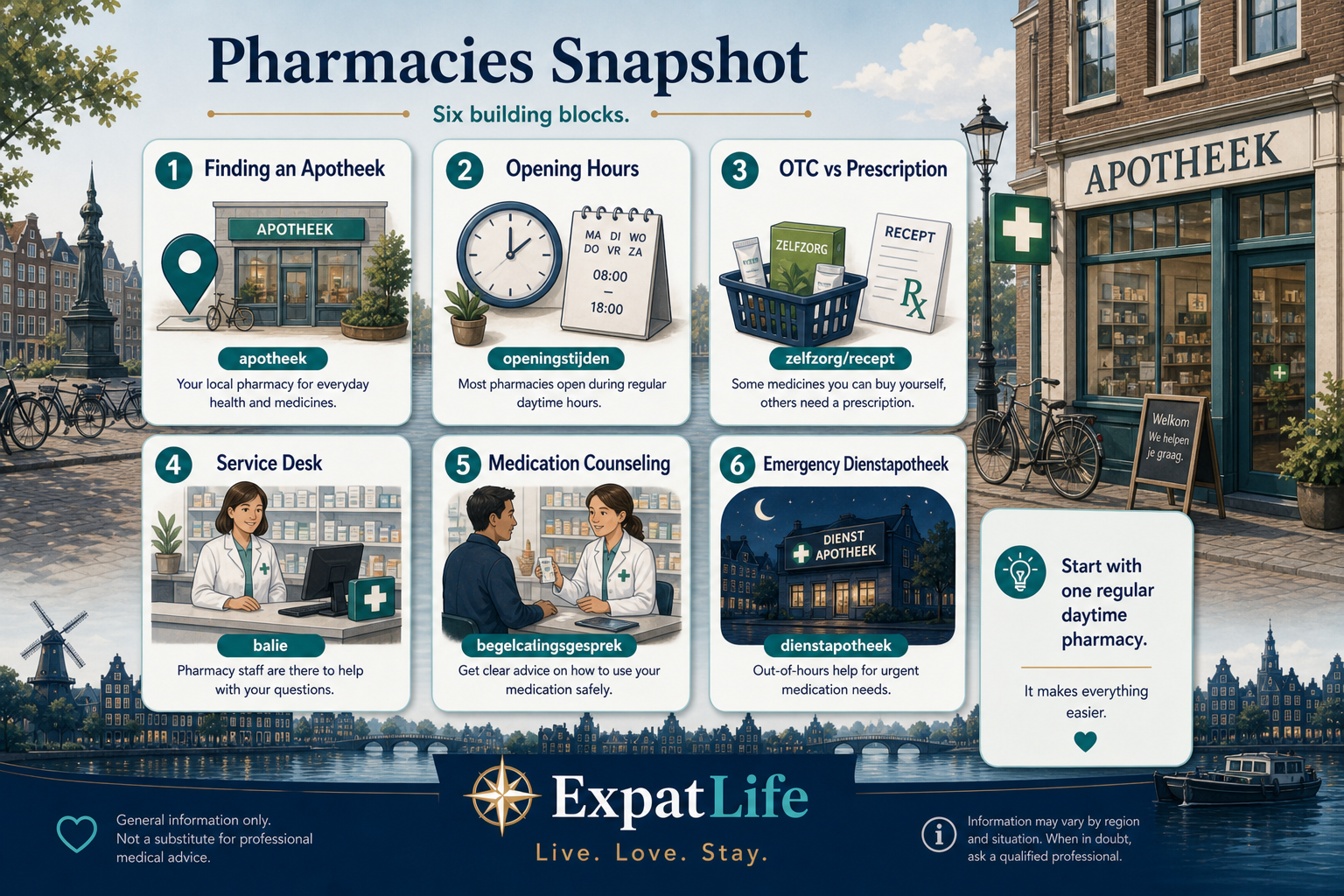
Search near your postcode, prefer a pharmacy close to home or your GP, ask about English support, and tell your practice which pharmacy should receive digital prescriptions.
Many pharmacies focus on weekday daytime hours, with limited Saturday mornings. Evenings, Sundays and holidays often require the regional out-of-hours route.
Zelfzorg products can often be bought without a recept. Prescription-only medicines require a valid prescription and pharmacist screening before pickup.
Pickup, short questions and first counseling happen at the counter. Bring ID, insurance details, your medication list and any pickup confirmation.
Pharmacists explain how to use a medicine safely, especially at first dispense. Clinical decisions and diagnoses stay with your GP or specialist.
Regional dienstapotheek covers urgent medicines outside normal hours, usually after Huisartsenpost or clinician guidance. Details live in the Emergency Healthcare guide too.
How it works
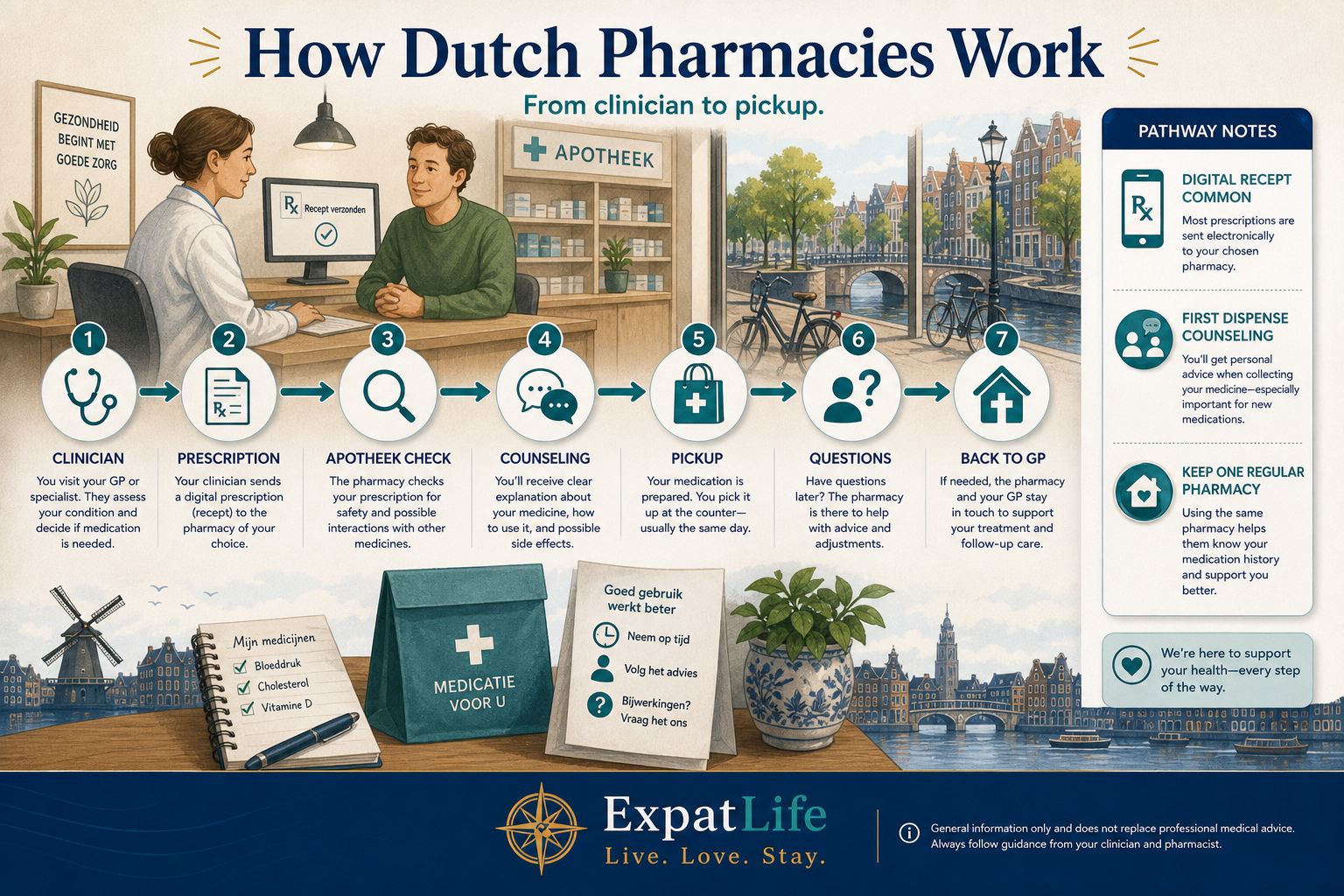
Dutch pharmacies sit between your clinician and safe medicine use. A GP or specialist decides what is prescribed; the apotheek checks, prepares and counsels; you leave with the medicine, the leaflet and a clearer plan for questions.
For many expats the flow feels digital: the huisarts sends a prescription electronically to your nominated pharmacy. The pharmacy prepares the medicine, may message you when it is ready, and asks you to the counter for pickup. At first dispense, expect a short begeleidingsgesprek covering how to take the medicine, what to watch for, and when to contact the GP.
Not everything is prescription-based. Pharmacies and drugstores sell zelfzorg products for common self-care needs. Staff can help you choose within that category, but they will redirect you to a GP when symptoms need clinical assessment or when a medicine is prescription-only.
Outside opening hours, the system switches to regional duty arrangements. Urgent medicines are not assumed to be available at every storefront. The huisartsenpost or another clinician often confirms urgency and points you to the correct dienstapotheek. Deep mechanics of herhaalrecept and e-prescription accounts belong on the Prescriptions cornerstone.
Pharmacy pathway
Stage 1
Your GP or specialist assesses the problem and, when appropriate, issues a prescription. Hospital discharge may also generate prescriptions to fill.
Stage 2
Many prescriptions travel digitally to your chosen apotheek. Paper routes still exist in some situations — follow the instructions you are given.
Stage 3
The pharmacy screens dose, interactions, allergies and practical supply. They may contact the clinician if something needs clarification.
Stage 4
A message, call or ready status tells you the medicine can be collected during opening hours. Bring ID and insurance details.
Stage 5
Especially at first dispense, the pharmacist explains safe use, timing and what to report. Ask questions before you leave.
Stage 6
Follow the agreed plan. Contact the pharmacy for practical medicine questions and your GP for clinical change or worsening symptoms.
Stage 7
Keep one regular pharmacy where possible so your medicine history stays coherent. Repeat-prescription workflows are covered in depth on the Prescriptions guide.
How to
Step 1
Search near your home postcode, confirm opening hours and language support, and tell your GP which pharmacy should receive digital prescriptions.
Step 2
Store ID, BSN, insurance card photo, current medication list and allergies where you can reach them quickly at the counter.
Step 3
Zelfzorg products may not need a recept. Prescription-only medicines do. If unsure, ask the pharmacist which category applies.
Step 4
When a prescription is sent digitally, confirm the pharmacy has prepared it and is open — especially on Saturdays.
Step 5
At first dispense, ask how to take the medicine, what to avoid, and what symptoms mean you should contact the GP.
Step 6
Know that urgent after-hours medicines usually need triage guidance to a regional dienstapotheek rather than a random open shop.
Step 7
Using the same apotheek helps interaction checks. Update them when medicines change after hospital or specialist visits.
Step 8
Ask pharmacists about supply, timing and interactions; ask your GP about diagnosis, dose changes and whether a medicine is still needed.
Finding a pharmacy
Most people are best served by one regular daytime pharmacy near home. Continuity helps interaction checks, counseling and prescription routing from your GP.
Search for 'apotheek' near your postcode. Prefer a location you can reach on foot, by bike or with a short tram ride during weekday hours. Ask whether they can register you as a regular patient and whether English counseling is available when needed.
Tell your huisarts practice which pharmacy should receive digital prescriptions. If you change pharmacies later, update both the old and new pharmacy and your GP practice so new recepten do not land in the wrong place.
Hospital or specialist prescriptions may still be filled at your regular pharmacy unless you are directed otherwise. Keep discharge letters and medicine lists so the pharmacist can reconcile what changed.
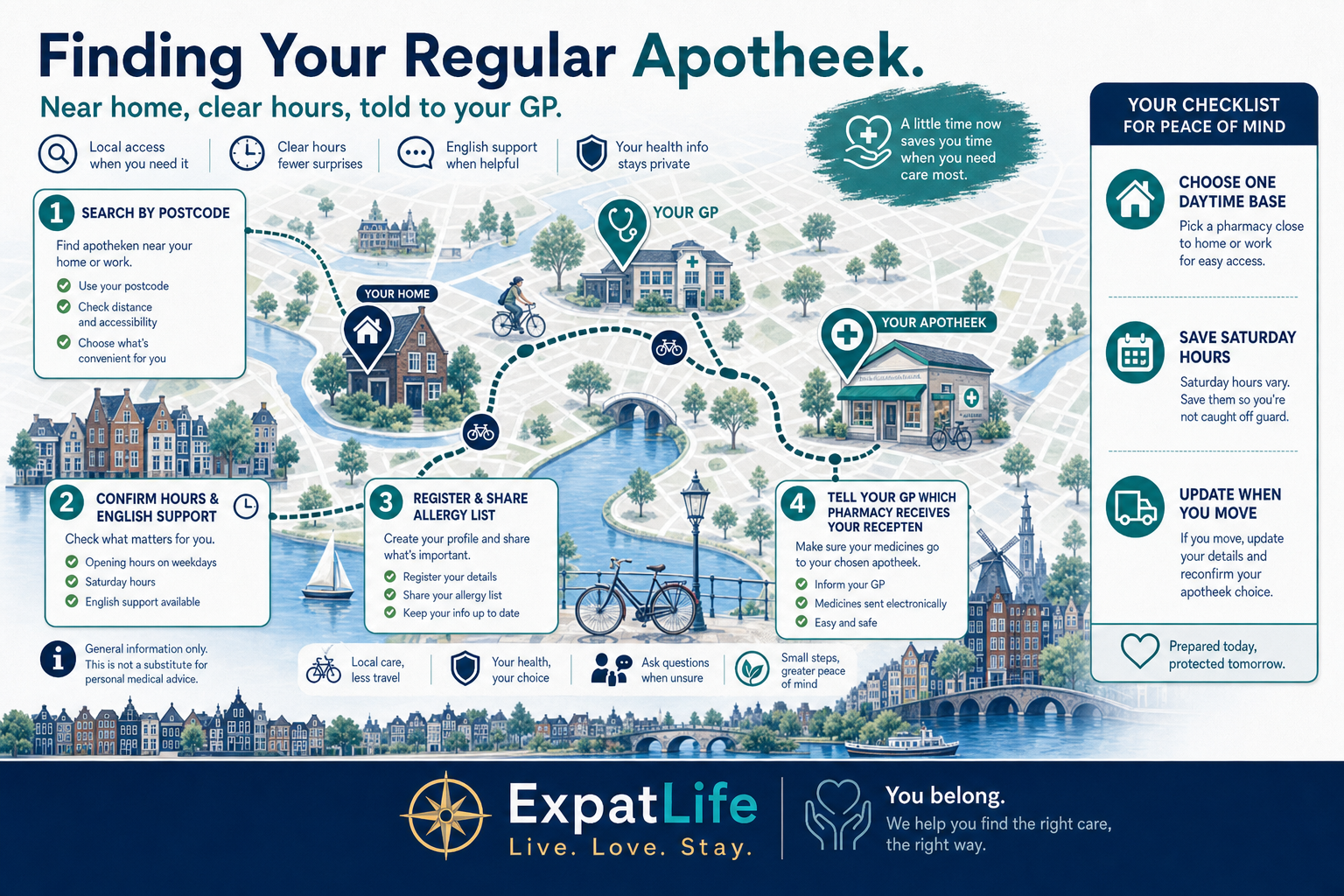
Daytime hours that match your schedule, clear pickup process, language support you can use safely, and a location you will actually visit.
Bring ID, BSN, insurance details, allergy list and current medicines. Ask how they prefer to notify you when a prescription is ready.
Ask the practice assistant which pharmacy is on file for you. Correct it before the next prescription is sent.
Choose a new local apotheek early, transfer relevant medicine history, and update your GP. Do not wait for the first urgent need.
| Route | When | How | Note |
|---|---|---|---|
| Regular daytime apotheek | Most prescription pickups and counseling | Visit during posted hours after ready status | Best default for continuity |
| Drugstore (drogisterij) | Many everyday zelfzorg products | Buy during drugstore opening hours | Not for prescription dispensing |
| Dienstapotheek | Urgent medicines outside normal pharmacy hours | Usually after huisartsenpost or clinician triage | Regional — confirm before travelling |
| Hospital pharmacy context | During admission or specialist pathways | Follow hospital instructions; reconcile with your regular apotheek afterward | Bring discharge medicine lists home |
Finding-a-pharmacy checklist
Examples
| Situation | How it works here | First step |
|---|---|---|
| Two pharmacies are equally close | Compare opening hours, Saturday availability and language support. Continuity matters more than branding. | Pick one as your regular pharmacy and tell your GP. |
| Your prescription went to the wrong pharmacy | Call both pharmacies and your GP practice assistant to reroute. Keep the prescription reference if you have one. | Confirm where the recept currently sits before travelling. |
| You only need occasional OTC products | Drugstores may be enough for many zelfzorg items, but still choose a pharmacy before you need a prescription. | Register a daytime apotheek even if your first need is months away. |
| You want English support | Ask when you call or visit. Availability varies by location and staff roster — never assume. | Ask specifically whether counseling for new medicines can be done in English. |
Opening hours
Dutch daytime pharmacies often keep weekday business hours with limited Saturday openings. Planning around those hours prevents last-minute stress.
Expect many apotheken to open in the morning, close in the early evening, and offer shorter Saturday hours if any. Sundays and public holidays are commonly closed for regular dispensing. Exact hours vary — always check your own pharmacy.
When a prescription is ready near closing time, arrive with margin. Counseling and insurance checks take a few minutes. If you miss closing time with an urgent need, do not invent a route: contact the huisartsenpost for triage and the correct dienstapotheek.
Tourists and newcomers sometimes assume 24/7 pharmacy counters on every high street. That is not the Dutch default. The emergency pharmacy system is regional and purpose-built for urgency after clinical guidance.
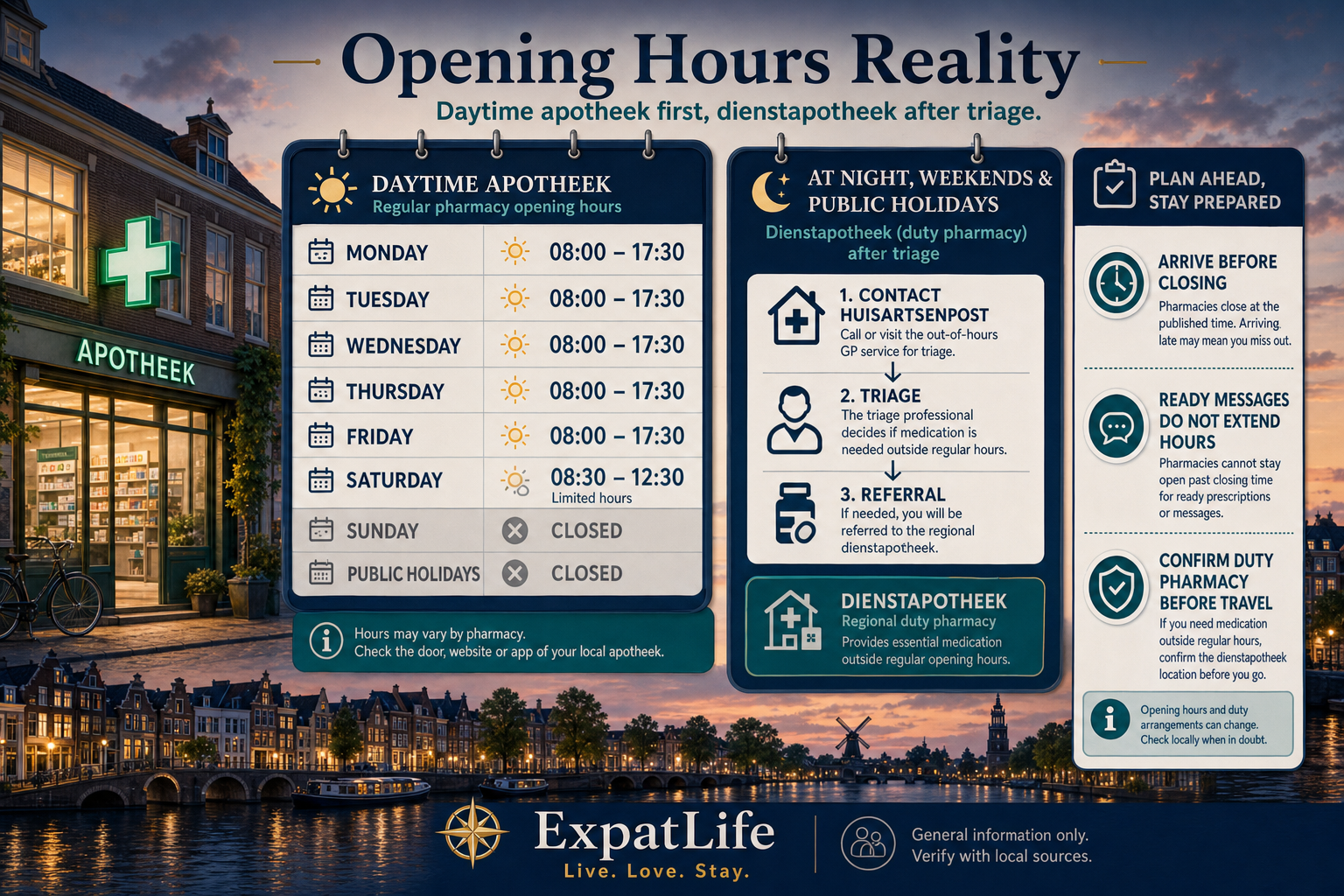
Most prescription pickups happen here. Save exact open and close times for your own apotheek.
Some pharmacies open shorter Saturday hours. Confirm before relying on weekend pickup.
Regular pharmacies are often closed. Urgent medicines may require the dienstapotheek pathway.
Public holidays can shift duty arrangements. Check local notices and triage guidance when urgency appears.
Opening-hours checklist
Examples
| Situation | How it works here | First step |
|---|---|---|
| Ready SMS arrives at 17:40 and the pharmacy closes at 18:00 | Travel only if you can arrive with time for counseling. Otherwise pick up next opening or ask whether anything must be urgent tonight. | Call the pharmacy before leaving if timing is tight. |
| You need a medicine on Sunday | If it cannot wait, contact the huisartsenpost for urgency assessment and the correct out-of-hours pharmacy. | Do not assume a random open drugstore can dispense prescription medicines. |
| Your pharmacy is closed for renovation | Ask which temporary pharmacy covers pickups and update your GP prescription routing. | Get the temporary address and hours in writing or via the practice. |
| You work late every weekday | Choose a pharmacy with later closing or reliable Saturday hours, or plan pickup during lunch. | Compare hours before registering as a regular patient. |
OTC vs Rx
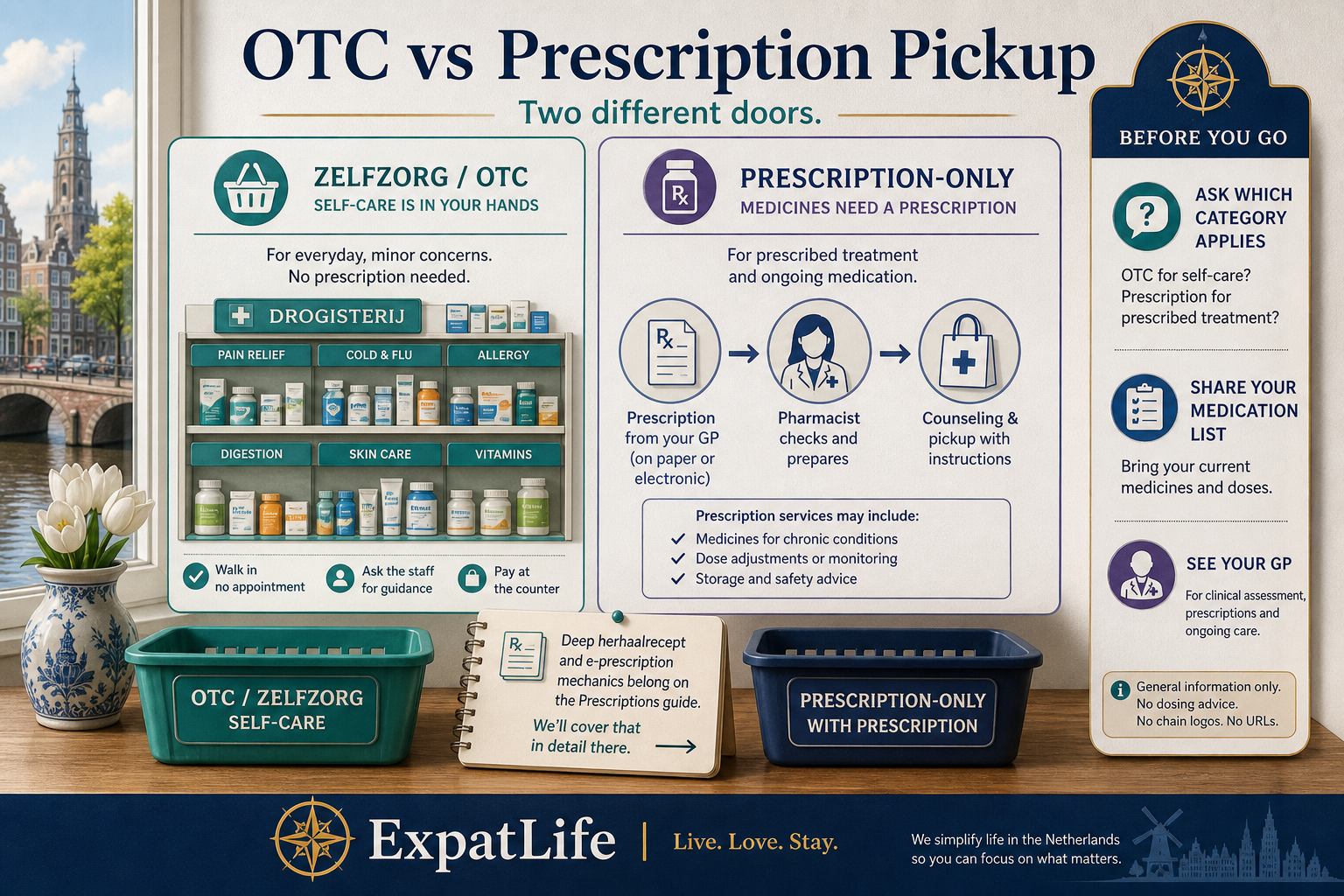
Zelfzorg (OTC) products and prescription-only medicines follow different rules. Mixing them up is one of the most common expat surprises.
Over-the-counter and pharmacy-advised zelfzorg products are for common self-care situations. You can often buy them without a recept in a pharmacy or drugstore. Staff may ask a few questions to steer you toward appropriate options and to spot when a GP visit is wiser.
Prescription-only medicines require a valid recept from a clinician. The pharmacy checks the prescription, prepares the medicine and counsels you. You generally cannot walk in and request a prescription-only antibiotic or similar medicine without the clinical step first.
This page stays at orientation level for pickup and counseling. Detailed herhaalrecept, e-prescription accounts and repeat workflows belong on the Prescriptions cornerstone.
| Type | Focus | When it applies | Note |
|---|---|---|---|
| OTC / zelfzorg | Everyday self-care products | Minor self-limiting needs when no prescription is required | Available in pharmacies and often in drugstores |
| Pharmacy counseling product | Guidance at the counter without a full prescription pathway | When you want help choosing within zelfzorg limits | Staff may redirect you to a GP if symptoms need assessment |
| Prescription-only medicine | Medicines that need a valid recept | After GP or specialist assessment | Dispensed at an apotheek after pharmacist checks |
| Repeat / e-prescription workflows | Ongoing supply for chronic medicines | When a clinician has authorised ongoing supply processes | Deep detail → Prescriptions guide |
Common self-care needs within product rules — not a substitute for diagnosis when symptoms are severe, persistent or unclear.
Prescription-only medicines after clinician assessment, with pharmacist screening and counseling at dispense.
Sell many zelfzorg items conveniently. They do not replace apotheek prescription dispensing.
Herhaalrecept portals, e-prescription account setup and advanced repeat logistics — see Prescriptions.
OTC vs Rx checklist
Examples
| Situation | How it works here | First step |
|---|---|---|
| You want antibiotics without seeing a doctor | Antibiotics are not an OTC self-serve category. You need clinical assessment and a valid prescription when appropriate. | Contact your GP or the appropriate urgent route — do not expect pharmacy counters to sell them freely. |
| You need allergy tablets before a flight tomorrow | Many zelfzorg options exist. Ask pharmacy or drugstore staff and mention other medicines you take. | Bring your medication list and ask which options fit self-care rules. |
| You have a hospital discharge prescription | Fill it at the directed pharmacy or your regular apotheek, then reconcile the new list with counseling questions. | Keep the discharge medicine list and ask what changed versus your old medicines. |
| You want to set up automatic repeats | That is a prescriptions-workflow topic. Use your pharmacy and GP processes, and watch for the Prescriptions cornerstone. | Ask your current pharmacy what repeat options they support at a high level, then follow clinician rules. |
Deep herhaalrecept and e-prescription mechanics belong on the Prescriptions guide. This section stays at overall pickup orientation.
Service desk
The service desk is where pickup, identity and insurance checks, short questions and counseling come together. A little preparation makes it faster and safer.
You may take a ticket, join a short queue, or respond to a ready notification. At the counter, staff confirm who the medicine is for, check details, and hand over the package with the patient leaflet. First dispenses usually include counseling time.
Bring ID and insurance details. If someone picks up for you, ask the pharmacy in advance what authorisation they need. Privacy matters — counseling conversations are normal and you can ask for a quieter moment if the desk is busy.
If a medicine is not in stock, the pharmacy will explain ordering timelines or alternatives after clinician agreement when needed. Do not swap doses on your own while waiting.
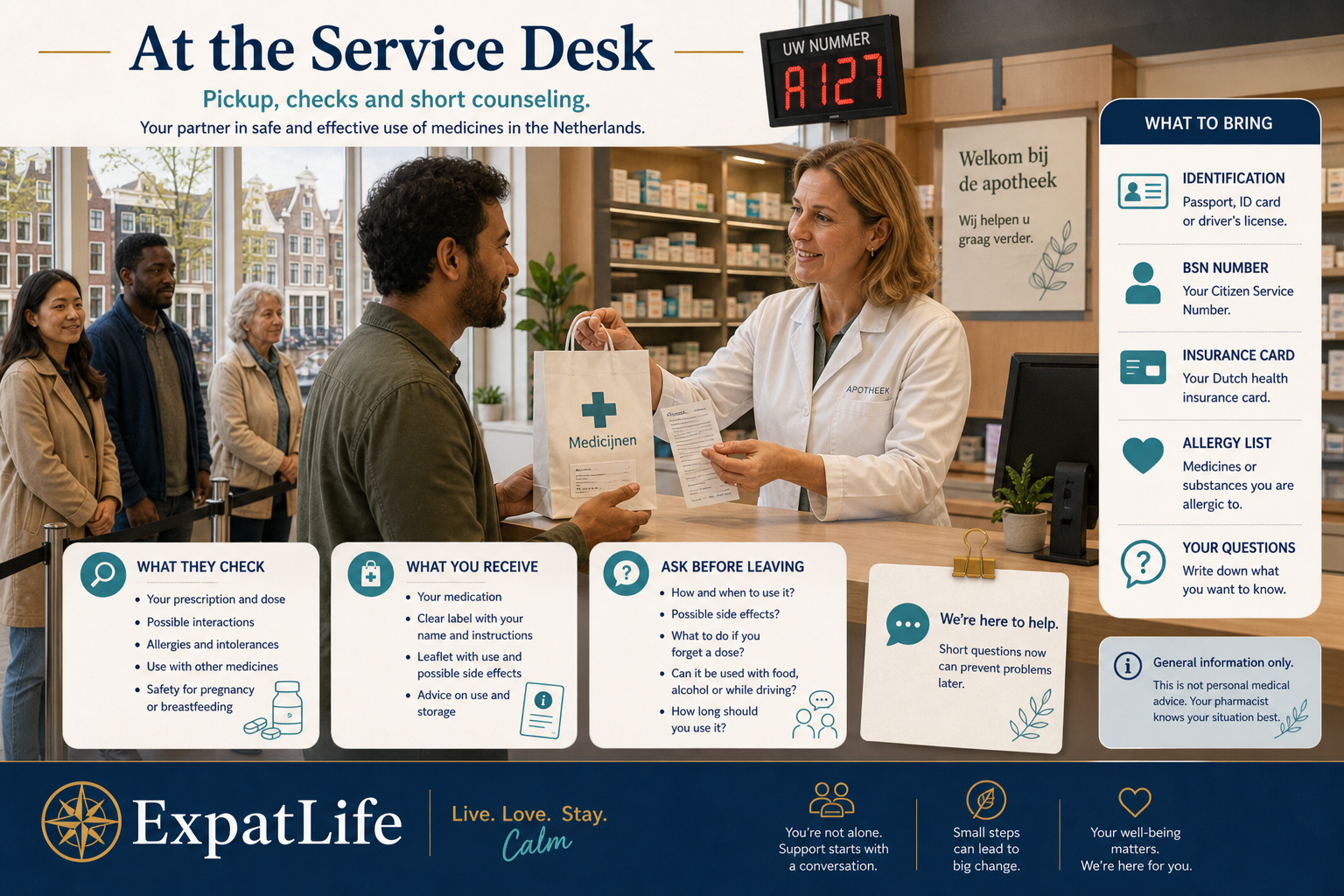
ID, BSN if asked, insurance card, allergy list, medication list, pickup confirmation and your questions.
Identity, prescription validity, interactions, allergies and practical supply details.
The medicine, usage instructions, leaflet and sometimes a summary of counseling points.
Timing with food, what to do if a dose is missed, which side effects need GP contact, and whether alcohol or other medicines are a concern — as orientation, not DIY dosing changes.
| Route | When | How | Note |
|---|---|---|---|
| Pickup only | Repeat of a known medicine with no new questions | Ready status → counter → confirm identity | Still report new allergies or problems |
| First dispense counseling | New medicine or major change | Counter conversation + leaflet | Budget extra time |
| Practical medicine question | Timing, interactions, supply issues | Ask pharmacist at desk or by phone during hours | Clinical diagnosis stays with GP |
| Out-of-hours urgent supply | Cannot wait until next opening | Huisartsenpost triage → dienstapotheek | See Emergency Healthcare guide |
Service desk checklist
Examples
| Situation | How it works here | First step |
|---|---|---|
| The queue is long and you are unsure what to say | Lead with your name, that you are picking up a prescription, and whether it is a first dispense. Hand over ID when asked. | Keep your ready message or reference visible. |
| You do not understand the Dutch instructions | Say so immediately and ask for English explanation or the key points in simple language. | Do not leave until timing and warnings are clear enough to use safely. |
| A friend will collect for you | Ask the pharmacy what they require — ID rules vary. Share only necessary details. | Call ahead before your friend travels. |
| Part of the prescription is delayed | Ask what is available now, when the rest arrives, and whether the clinician needs to be contacted. | Clarify whether you should start the available part as prescribed. |
Counseling
Medication counseling (often called a begeleidingsgesprek at first dispense) helps you use medicines safely. It is guidance and screening — not a replacement for your GP's clinical plan.
Pharmacists are trained to explain how to take a medicine, what to watch for, and how it may interact with other products you use. They also protect against obvious allergy and interaction risks in the pharmacy record.
Use counseling for practical safety questions. Use your GP for diagnosis, whether a medicine is still appropriate, and dose changes. If side effects worry you, contact the pharmacy or GP based on urgency — and call 112 for severe allergic reactions or other emergencies.
English-language counseling is often possible in internationally oriented areas, but it is not guaranteed. Ask early. For complex conversations, request clear language or interpreter support rather than relying on a child to translate.
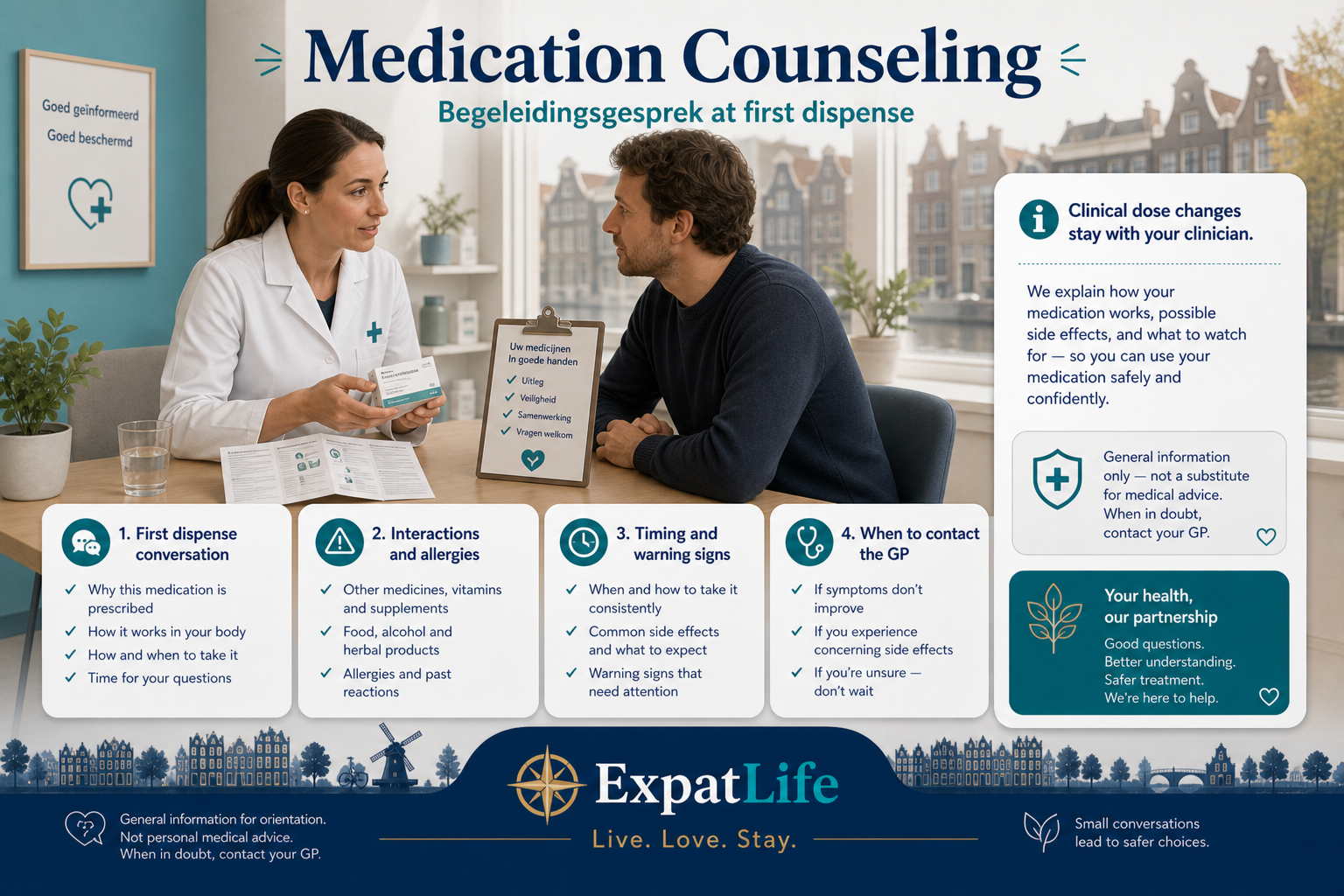
Expect a short structured conversation covering use, timing, key warnings and when to seek help.
Share your full list, including OTC products and supplements. Incomplete lists create avoidable risk.
Diagnosis, starting or stopping medicines, and clinical dose changes belong with your clinician.
Ask for English or simplified explanation. Do not guess critical timing instructions.
Counseling checklist
Examples
| Situation | How it works here | First step |
|---|---|---|
| You already take three other medicines | Hand the pharmacist a written list. Ask specifically about interactions and timing conflicts. | Update the pharmacy record before the new medicine is dispensed. |
| Side effects start two days later | Contact the pharmacy or GP depending on severity. For breathing difficulty, swelling or collapse, call 112. | Do not silently double or stop doses without clinical advice unless emergency guidance says otherwise. |
| Label text is dense and unfamiliar | Ask the pharmacist to highlight the three actions that matter today: when to take it, what to avoid, when to call. | Repeat those three points back in your own words. |
| Your child needs a liquid medicine | Confirm measuring device, timing and storage. Ask the pharmacist to demonstrate the measuring tool. | Write the schedule in a phone reminder after counseling. |
Emergency pharmacy
When your regular apotheek is closed and a medicine cannot wait, the Netherlands uses regional out-of-hours pharmacy arrangements — usually after triage guidance.
During daytime hours, use your regular pharmacy whenever possible. Outside those hours, contact the huisartsenpost (or follow clinician instructions) so urgency can be assessed. If urgent dispensing is appropriate, you will be directed to the regional dienstapotheek covering your area.
This section is orientation only. The Emergency Healthcare cornerstone covers 112, Huisartsenpost, SEH and ambulance pathways in full. Do not travel to a random late-open drugstore expecting prescription dispensing.
Call before you travel when possible. Confirm the pharmacy is open for your prescription and bring ID, insurance details and your medication list.
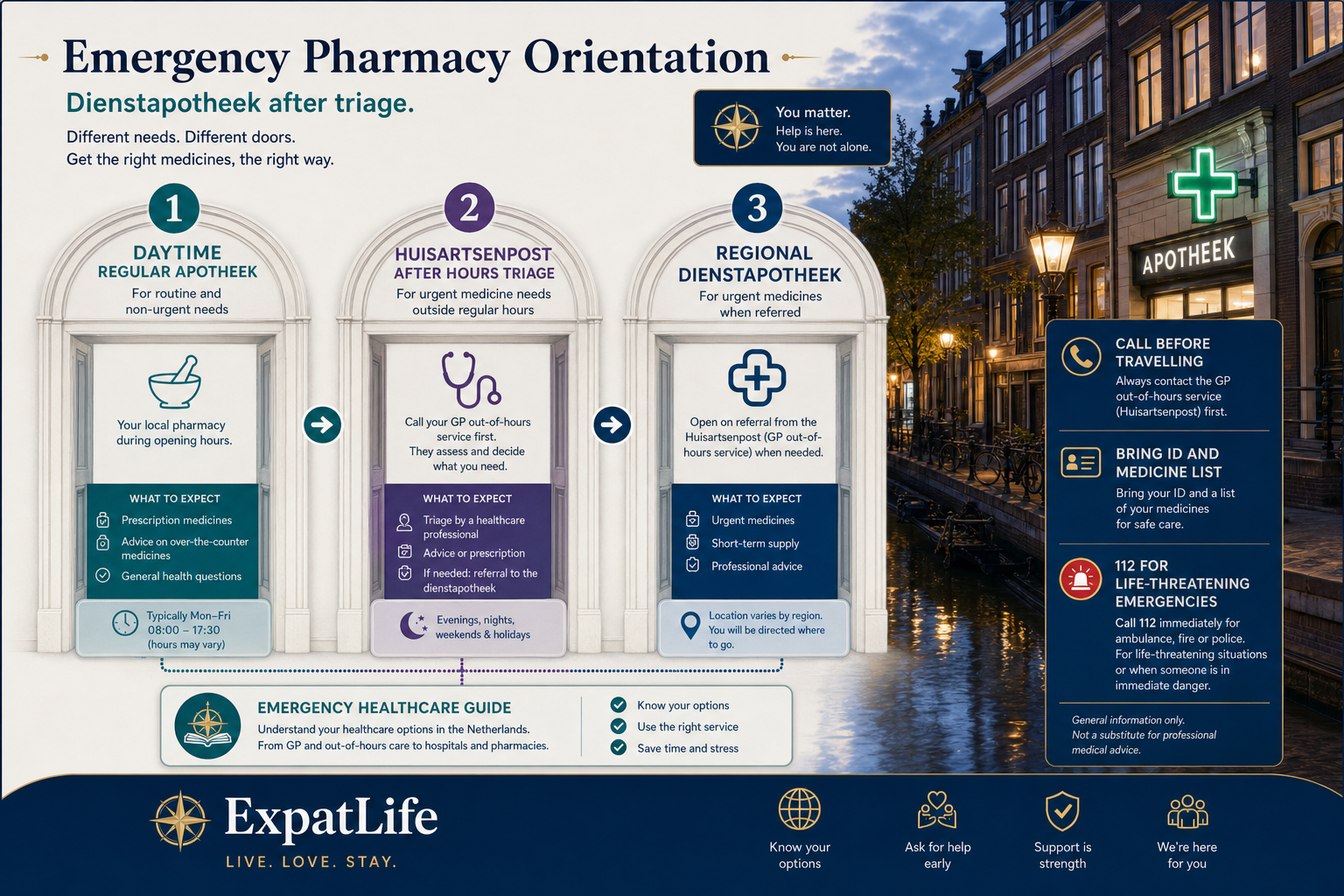
Call 112 now
Life-threatening allergic reaction, collapse or severe breathing problem
Call 112 immediately — this is not a routine pharmacy errand.
Same day / out of hours
Urgent medicine needed after pharmacy closing time
Contact the huisartsenpost for triage and the correct dienstapotheek route.
Planned route
Prescription ready during normal opening hours
Pick up at your regular apotheek with ID and insurance details.
OTC self-care need during drugstore hours
Use pharmacy or drugstore zelfzorg options; see a GP if symptoms worsen.
Emergency pharmacy checklist
Examples
| Situation | How it works here | First step |
|---|---|---|
| You run out of a critical chronic medicine on Saturday night | Contact the huisartsenpost to assess urgency and whether a dienstapotheek dispense is appropriate. | Have the medicine name, dose and your regular pharmacy details ready. |
| A child spikes a fever and you need advice plus possible medicine | Use GP by day or huisartsenpost after hours for clinical triage. Pharmacy routes follow that assessment when a prescription is needed. | Do not skip triage for prescription-only medicines. |
| You see a lit storefront and assume it can fill any Rx | Confirm it is an apotheek on duty for your prescription. Many late-open shops are not duty pharmacies. | Ask triage which dienstapotheek applies. |
| You need the full urgent-care map | Use the Emergency Healthcare cornerstone for 112, Huisartsenpost, SEH and pharmacy interplay. | Open that guide and save the decision points before the next evening urgency. |
Costs
Prescribed medicines are often handled through basic health insurance, while many OTC products are self-pay. Exact amounts depend on your policy year, remaining eigen risico and the medicine itself.
For insured prescription medicines, adults usually pay toward the annual deductible (eigen risico) until it is used up for that year. Children often follow different deductible rules — verify with your insurer. Pharmacies may also apply regulated dispensing or service components depending on the situation.
OTC / zelfzorg products are commonly paid directly at the counter or drugstore till. Supplementary insurance sometimes contributes to specific categories — never assume; check your policy.
This page does not hardcode prices as guarantees. Figures change by year, contract and medicine. Ask the pharmacy what you will pay before you leave, and confirm reimbursement rules in your insurer portal.
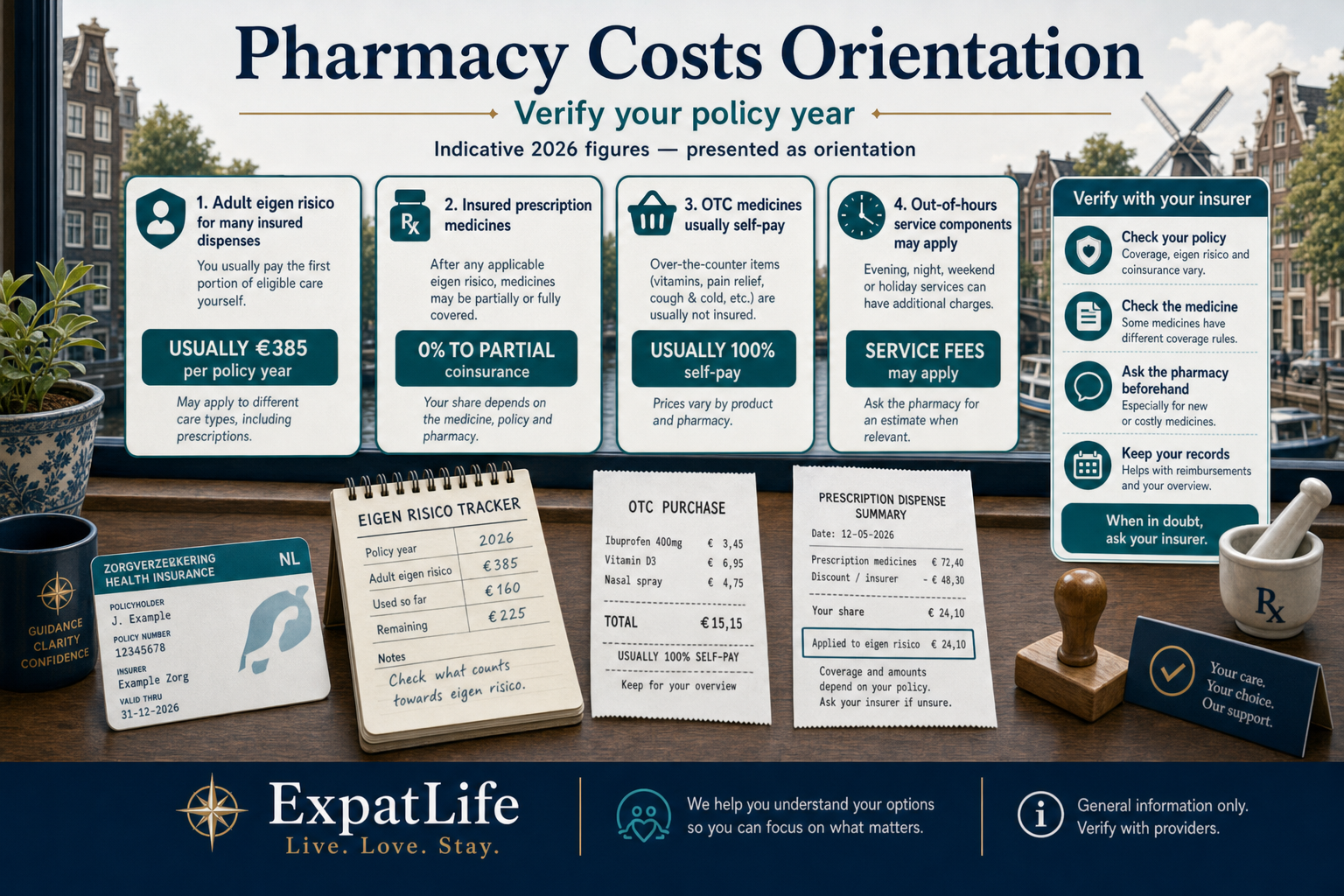
Indicative orientation only — verify current eigen risico, reimbursement and any pharmacy service fees with your insurer and pharmacy for your policy year.
| Cost item | Indicative figure | What you usually pay | Note |
|---|---|---|---|
| Adult annual deductible (eigen risico) | Mandatory amount set per policy year (verify current year) | Often applies to insured specialist and many pharmacy dispenses until depleted | GP care usually sits outside deductible — pharmacy medicines often do not |
| Insured prescription medicine | Varies by medicine and contract | May count toward remaining eigen risico; ask at pickup | Prefer contracted pathways your insurer recognises |
| OTC / zelfzorg product | Shelf price | Usually self-pay at till | Supplementary cover only if your policy says so |
| Out-of-hours dienstapotheek dispense | May include additional service components | Ask what is charged before travelling when possible | Urgency route first via triage |
Your remaining eigen risico, whether a medicine is preferred on your insurer's list, and any personal contribution rules.
What you pay today, whether the medicine is ordered specially, and whether a cheaper appropriate alternative exists after clinician agreement.
That OTC is reimbursed, that every brand is covered equally, or that last year's rules still apply.
The Health Insurance cornerstone explains basic cover, deductible and choosing an insurer.
Costs checklist
Examples
| Situation | How it works here | First step |
|---|---|---|
| The till asks for a payment you did not expect | Ask which component is eigen risico, product price or service-related. Check your insurer portal afterward. | Request a clear breakdown before you leave the desk. |
| You want a specific brand from home | Dutch pharmacies often dispense preferred or generic equivalents when clinically appropriate and contracted. Discuss concerns with pharmacist and GP. | Ask whether an equivalent is being dispensed and why. |
| You only need OTC pain relief | Expect self-pay pricing at pharmacy or drugstore. Insurance usually is not involved. | Compare options with staff using your medication list for safety. |
| You are comparing insurers next year | Use the Health Insurance guide and, when live, the comparison page — pharmacy habits alone should not drive the whole decision. | List chronic medicines and ask how preference policies affect them. |
Differences
Most pharmacy surprises are system design, not unfriendliness. Expecting them makes the first months easier.
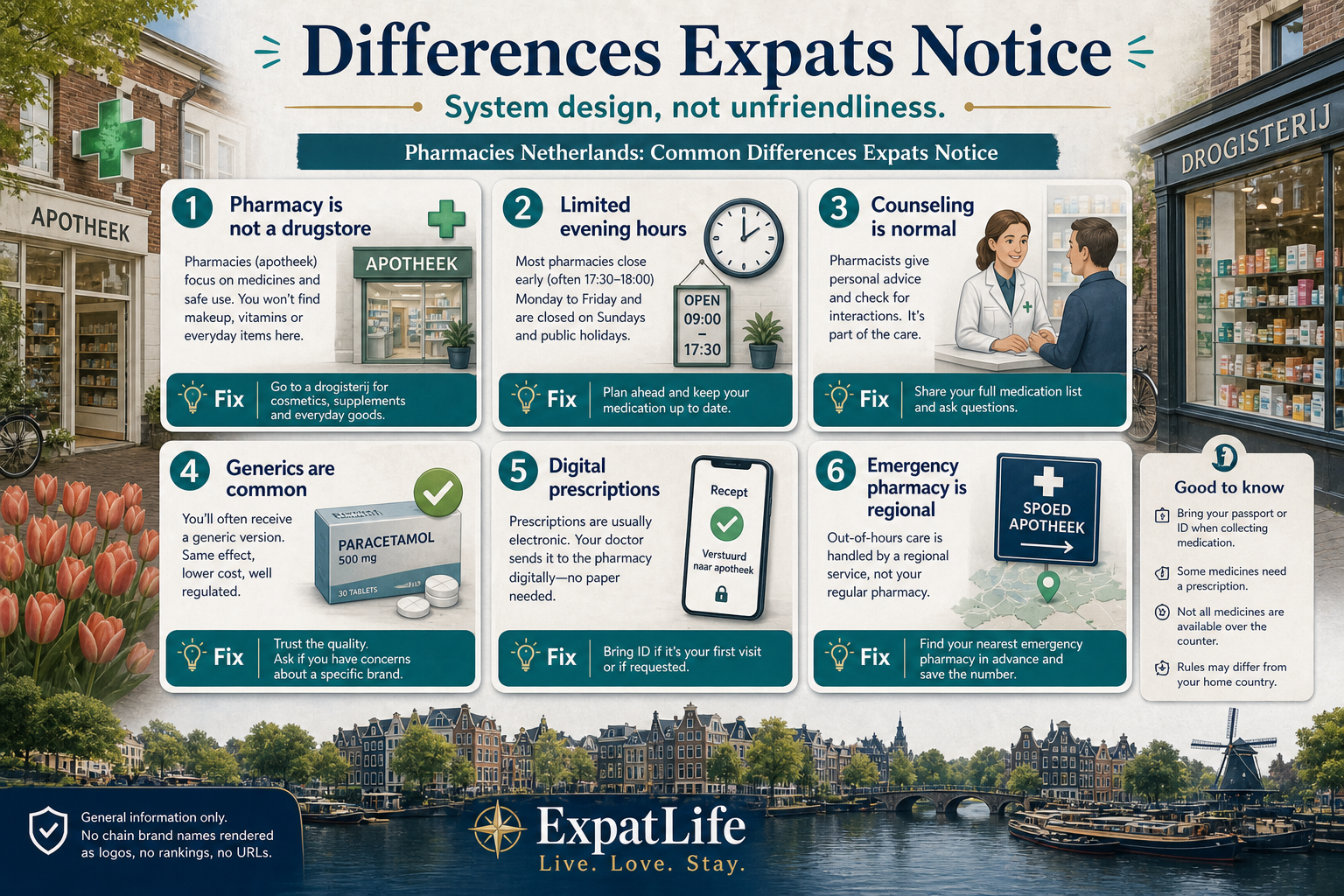
Example: expecting Etos or Kruidvat to fill a prescription.
Fix: Use an apotheek for prescription dispensing; use drugstores for many OTC items.
Example: arriving at 20:30 for a routine pickup.
Fix: Save daytime hours and use triage → dienstapotheek only when urgency justifies it.
Example: feeling surprised when staff ask detailed medicine questions.
Fix: Treat counseling as safety infrastructure — answer fully and ask your own questions.
Example: receiving a different box design than the brand you knew abroad.
Fix: Check the active ingredient with the pharmacist and ask if anything clinically changed.
Example: waiting for a paper script that never appears.
Fix: Ask which pharmacy received the digital recept and wait for ready status.
Example: searching for any 24/7 counter nearby.
Fix: Follow huisartsenpost guidance to the correct dienstapotheek.
Checklist
A short pharmacy file removes most counter friction. Build it when you arrive in the Netherlands, then update it when medicines change.
Share the same essentials with your GP practice so prescriptions, allergies and pharmacy routing stay aligned.
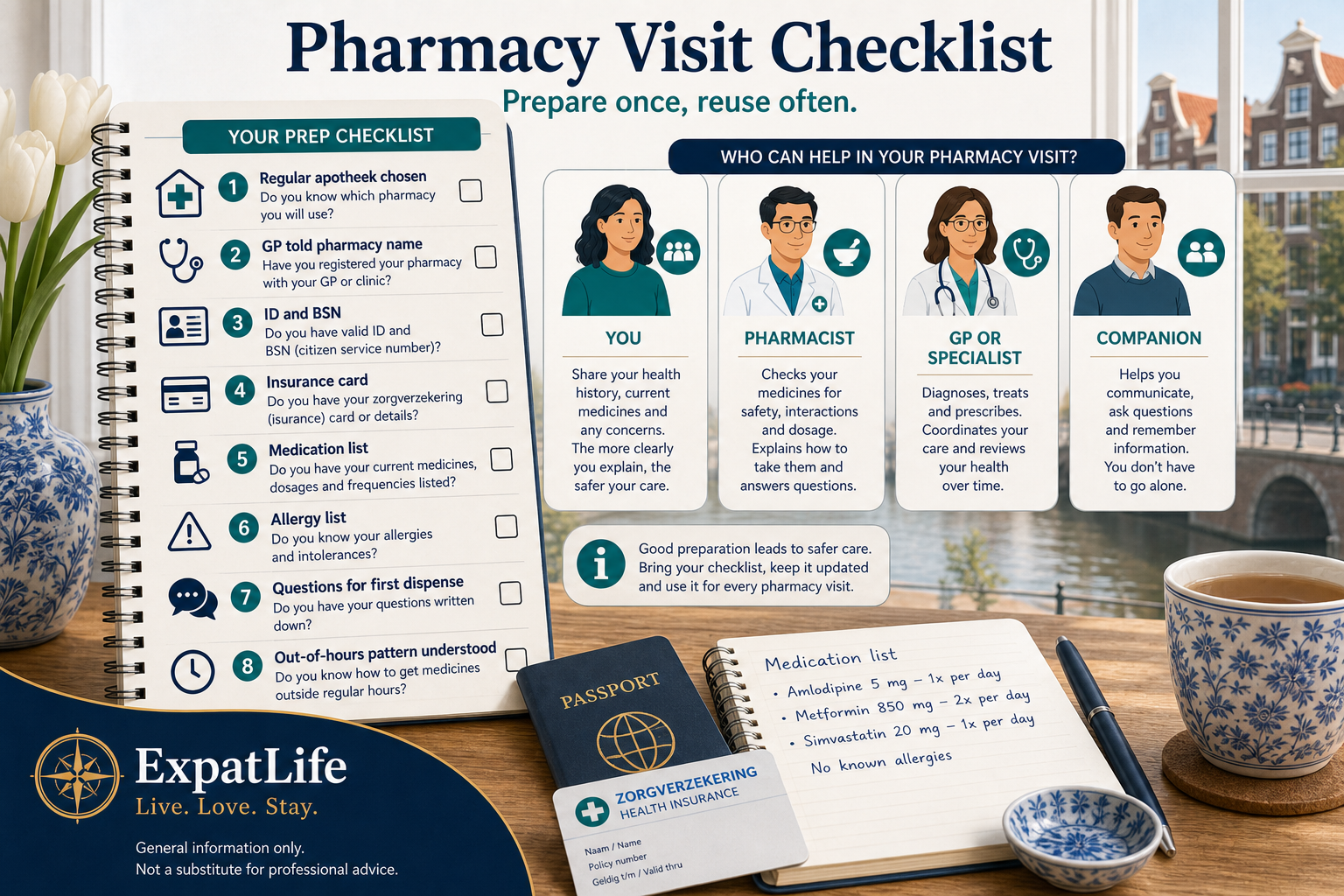
Preparation checklist
Keep lists current, ask questions, and confirm understanding before leaving.
Screen, prepare, counsel and flag interaction or supply issues.
Decide what is prescribed and adjust the clinical plan.
Help with language or pickup only when the pharmacy allows authorised collection.
Avoid
These mistakes are common and fixable. Each one has a practical correction.
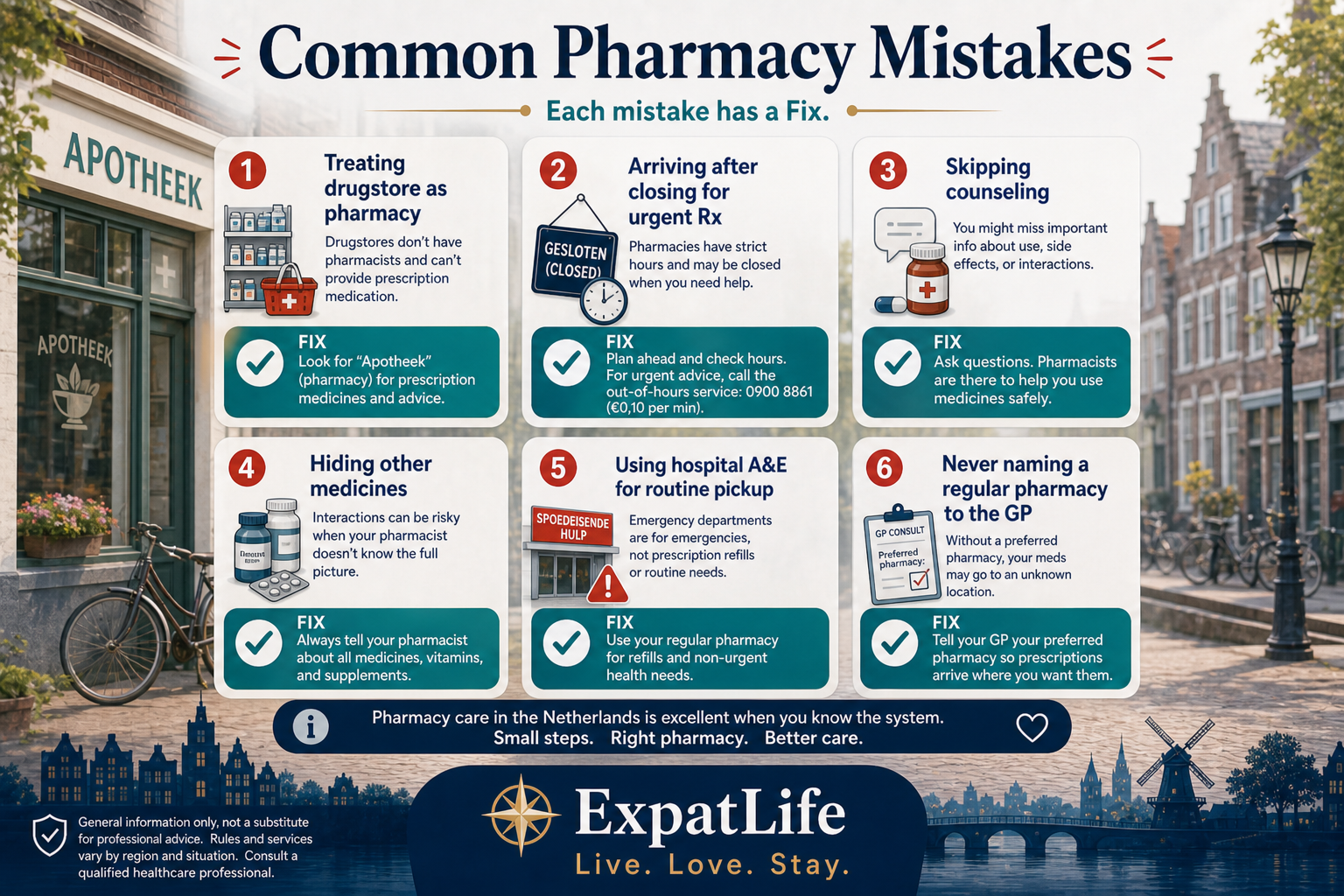
Example: showing a prescription at a drogisterij till.
Fix: Go to an apotheek for prescription dispensing.
Example: discovering at 19:30 that the pharmacy is closed.
Fix: Check hours first; for true urgency use huisartsenpost → dienstapotheek.
Example: rushing out without asking how to take a new medicine.
Fix: Budget five minutes for first-dispense questions.
Example: forgetting to mention blood thinners when buying OTC products.
Fix: Share the full list every time something new starts.
Example: going to SEH because a daytime pharmacy was missed.
Fix: SEH is for emergencies — use pharmacy hours or out-of-hours duty routes.
Example: digital prescriptions landing nowhere useful.
Fix: Tell the practice which apotheek should receive your recepten.
FAQ
Orientation answers only — confirm your own situation with your pharmacist, GP and insurer. Call 112 for life-threatening emergencies.
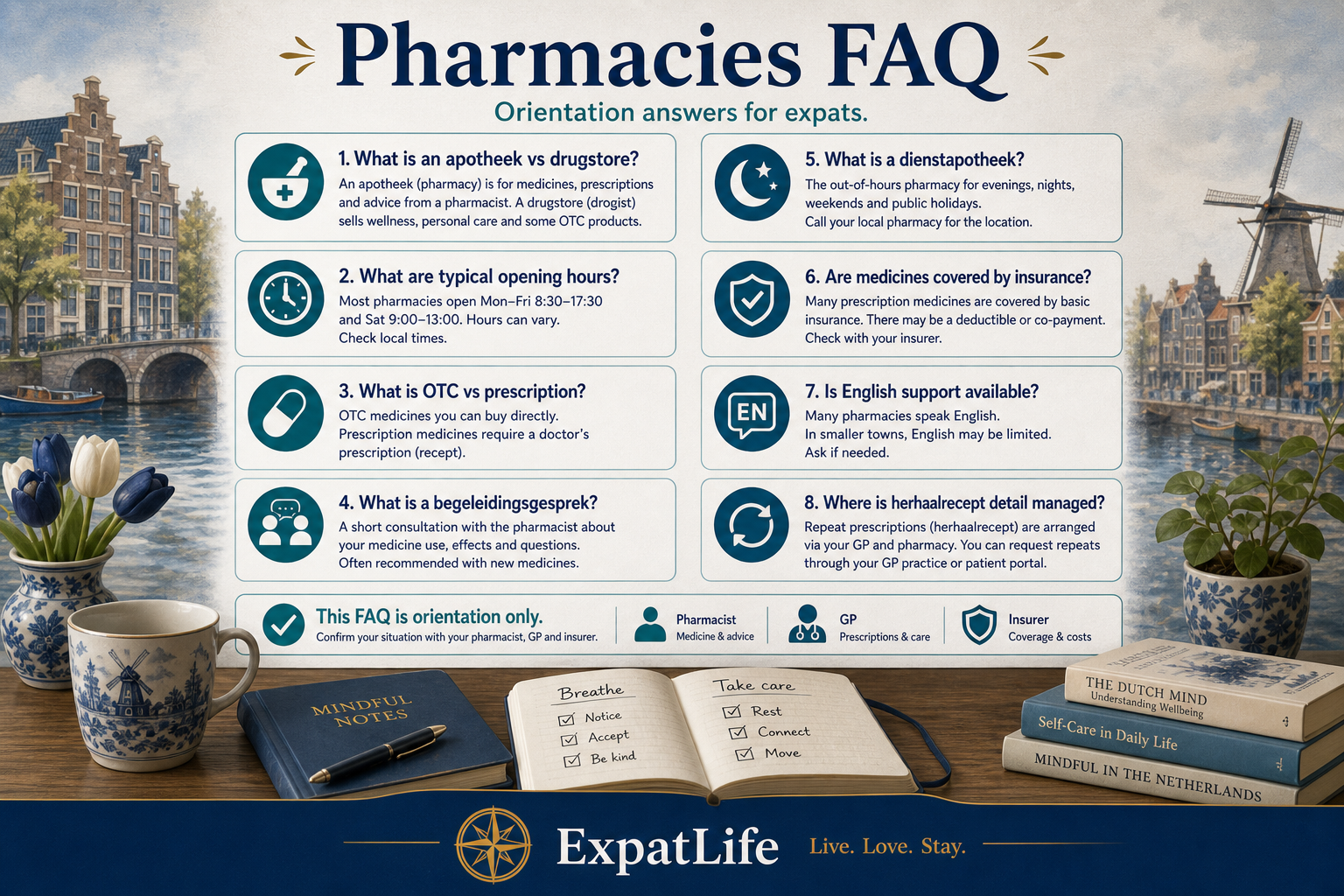
An apotheek (pharmacy) dispenses prescription medicines, performs pharmacist checks and offers medication counseling. A drogisterij (drugstore) sells many zelfzorg / OTC products but does not replace a pharmacy for prescription dispensing.
Search for apotheek near your postcode, compare opening hours and language support, register as a regular patient where possible, and tell your GP which pharmacy should receive digital prescriptions.
Many pharmacies focus on weekday daytime hours with limited Saturday openings. Evenings, Sundays and holidays often require a regional dienstapotheek after triage. Always check your own pharmacy's posted hours.
Many zelfzorg / OTC products can be bought without a recept in pharmacies and drugstores. Prescription-only medicines require a valid clinician prescription and pharmacist screening.
Your GP or specialist often sends a digital prescription to your nominated pharmacy. When it is ready, you pick it up at the counter with ID and insurance details, and you may receive counseling — especially at first dispense.
It is a medication counseling conversation, commonly at first dispense, covering how to use the medicine safely and what to watch for. It is guidance and screening, not a replacement for your GP's clinical decisions.
A regional out-of-hours pharmacy for urgent medicines when regular pharmacies are closed. You typically reach it after huisartsenpost or clinician triage confirms urgency and names the correct location.
It is strongly practical to choose a regular apotheek so your medicine history, allergies and prescription routing stay coherent. Ask how registration works at your chosen pharmacy.
Many prescribed medicines are handled through basic insurance and may count toward an adult's remaining eigen risico. OTC products are usually self-pay. Always verify your own policy year and remaining deductible.
Many can, especially in internationally oriented areas, but it is not guaranteed. Ask when you register or before counseling for a new medicine.
Sometimes, depending on pharmacy policy and the medicine. Call ahead to ask what authorisation and ID are required.
This pharmacies page stays at overall orientation. Deep herhaalrecept and e-prescription mechanics belong on the Prescriptions cornerstone.
For severe symptoms such as breathing difficulty, swelling of the face or throat, or collapse, call 112. For other concerning side effects, contact your pharmacist or GP according to urgency — do not silently invent a new dosing plan.
You can often fill at different pharmacies, but using one regular apotheek improves continuity and interaction checks. Keep your GP's routing updated if you switch.
Ask the pharmacy about ordering timelines, partial supply, or clinician-approved alternatives. Do not change doses on your own while waiting.
Daytime pharmacies handle routine dispensing. After hours, urgent medicines usually follow triage to a dienstapotheek. Life-threatening emergencies still go to 112. See the Emergency Healthcare guide for the full map.
Related
Pharmacies connect to GP care, emergency routes, insurance and family pathways — read them together.
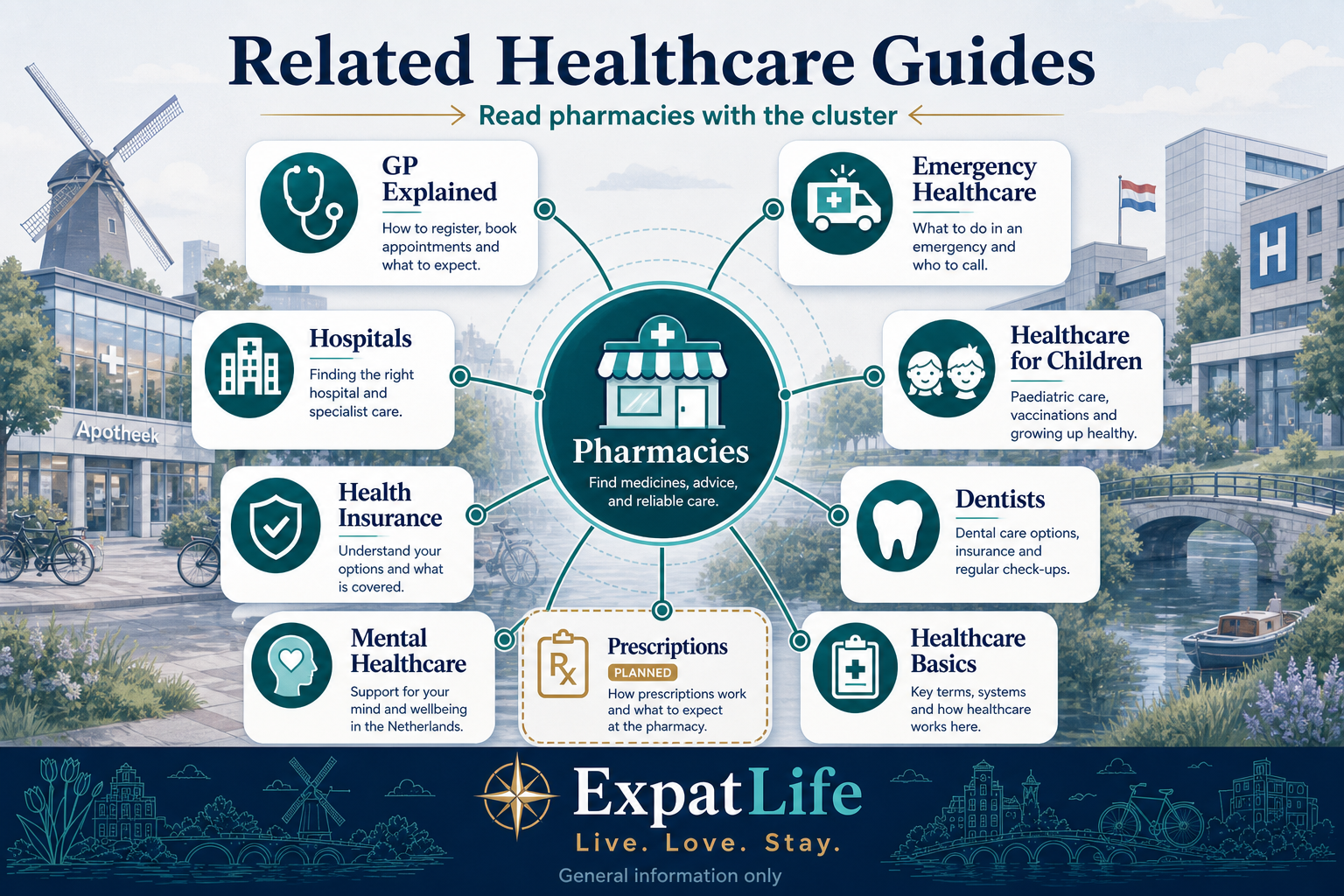
Health hub
This page is the pharmacies cornerstone — explore related health topics next.
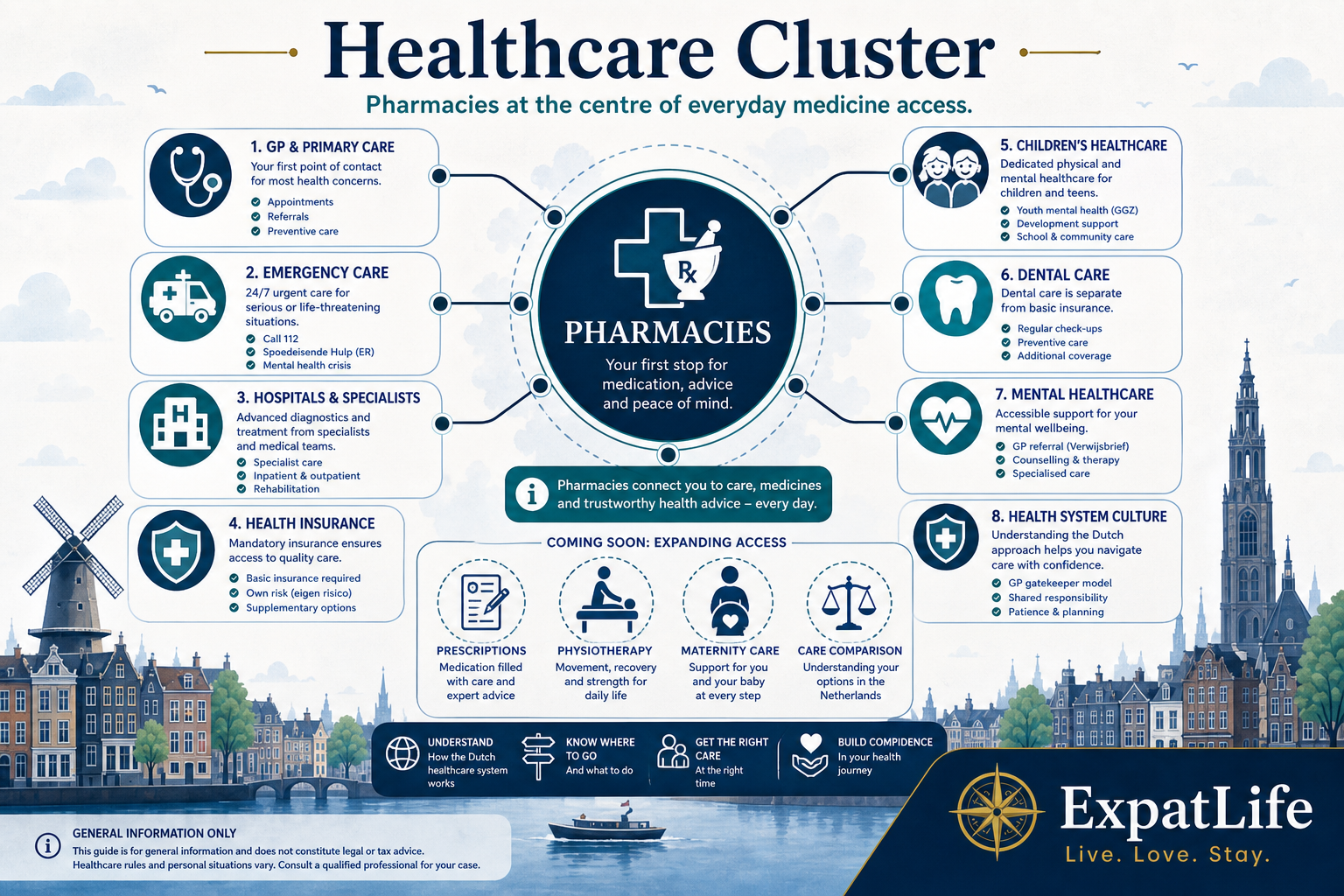
Explore next
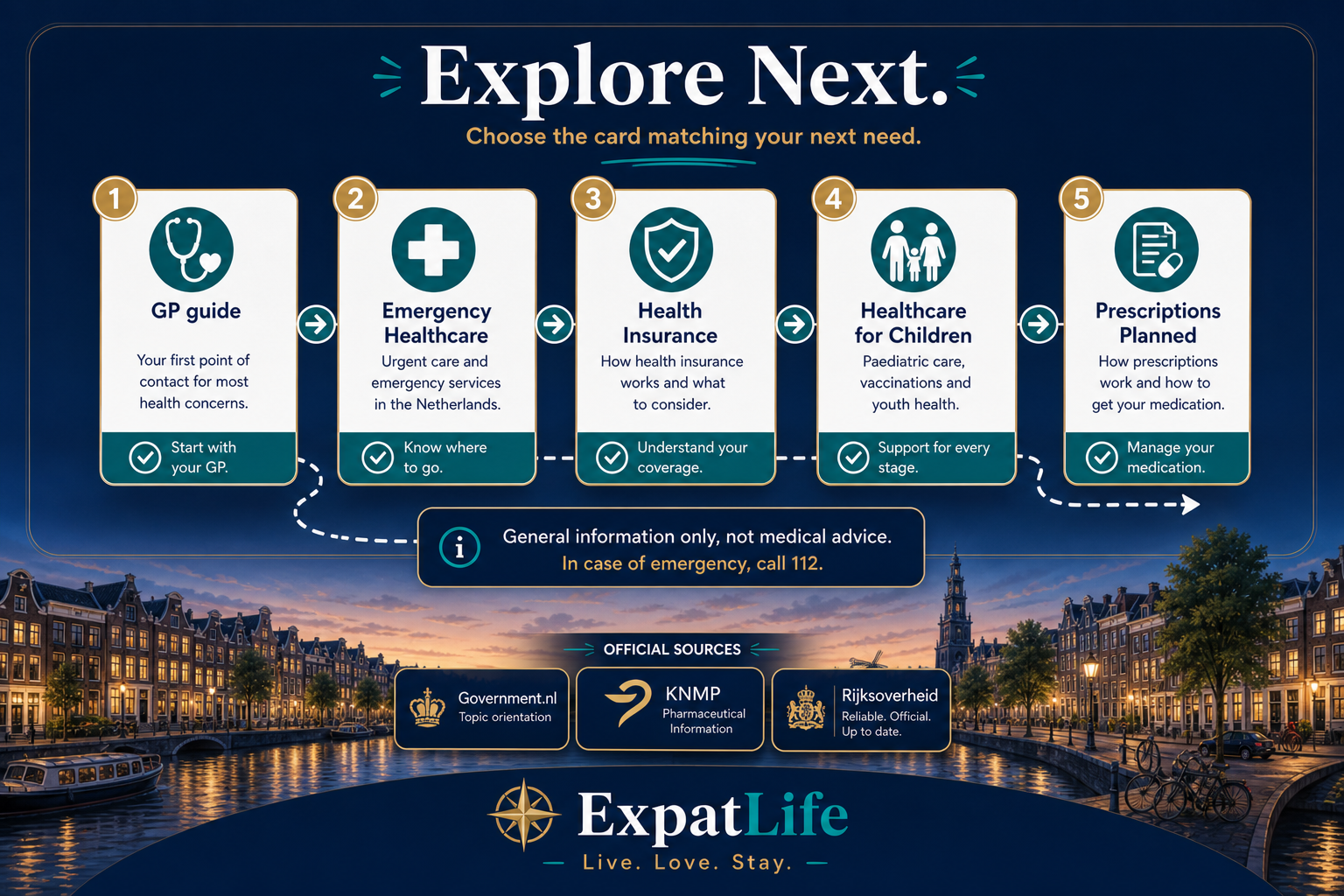
Pick the card that matches what is still open — GP registration, emergency routes, insurance, children's care or prescriptions depth — and verify specifics on the official sources below.
Trust
General information only — not medical advice. Pharmacy processes, insurer rules and medicine availability change, so verify your own situation with your pharmacist, GP and insurer. In an emergency, call 112.