
Entry point
GP first
A huisarts conversation opens most non-emergency adult mental health pathways.
Netherlands · Health · Mental Healthcare
How mental healthcare works for expats — GP first contact, POH-GGZ support, GGZ specialist care, stepped care, waiting times, insurance and what to do in a crisis.
General orientation only — not diagnosis, not treatment advice, and not a recommendation of any therapist, clinic or programme. For your own situation, speak with your GP or a mental health professional. If you or someone else is in immediate danger, call 112. If you are having suicidal thoughts, contact 113 Suicide Prevention (113.nl).

Quick answer
Dutch mental healthcare sits inside a referral-based, stepped-care system. Your GP handles a large share of first conversations about stress, sleep, anxiety, low mood, trauma responses and other concerns. Many practices also employ a POH-GGZ — a practice-based mental health professional who offers structured conversations and helps decide whether specialist GGZ support is appropriate. That primary-care step is not a barrier; it is how the system matches intensity of support to need.
When specialist care is indicated, the GP writes a referral into GGZ. That may mean a psychologist, a psychiatrist, a GGZ institution or a combination of assessment and treatment. Waiting times can be real, especially for some care types and regions, so asking early about interim support and insurer care mediation (zorgbemiddeling) is practical, not pushy. English-language care is often workable in larger cities and academic settings, but it is never guaranteed everywhere — ask when booking and request an interpreter when conversations are complex.
This guide is practical orientation for expats, students, families and newcomers: how the pathway works, what POH-GGZ and GGZ mean, how to prepare for a first conversation, what to expect around waiting and costs, how crisis routes fit in, and how youth pathways differ. It is not diagnosis, not treatment advice, and not a ranking or endorsement of any therapist, clinic or programme.
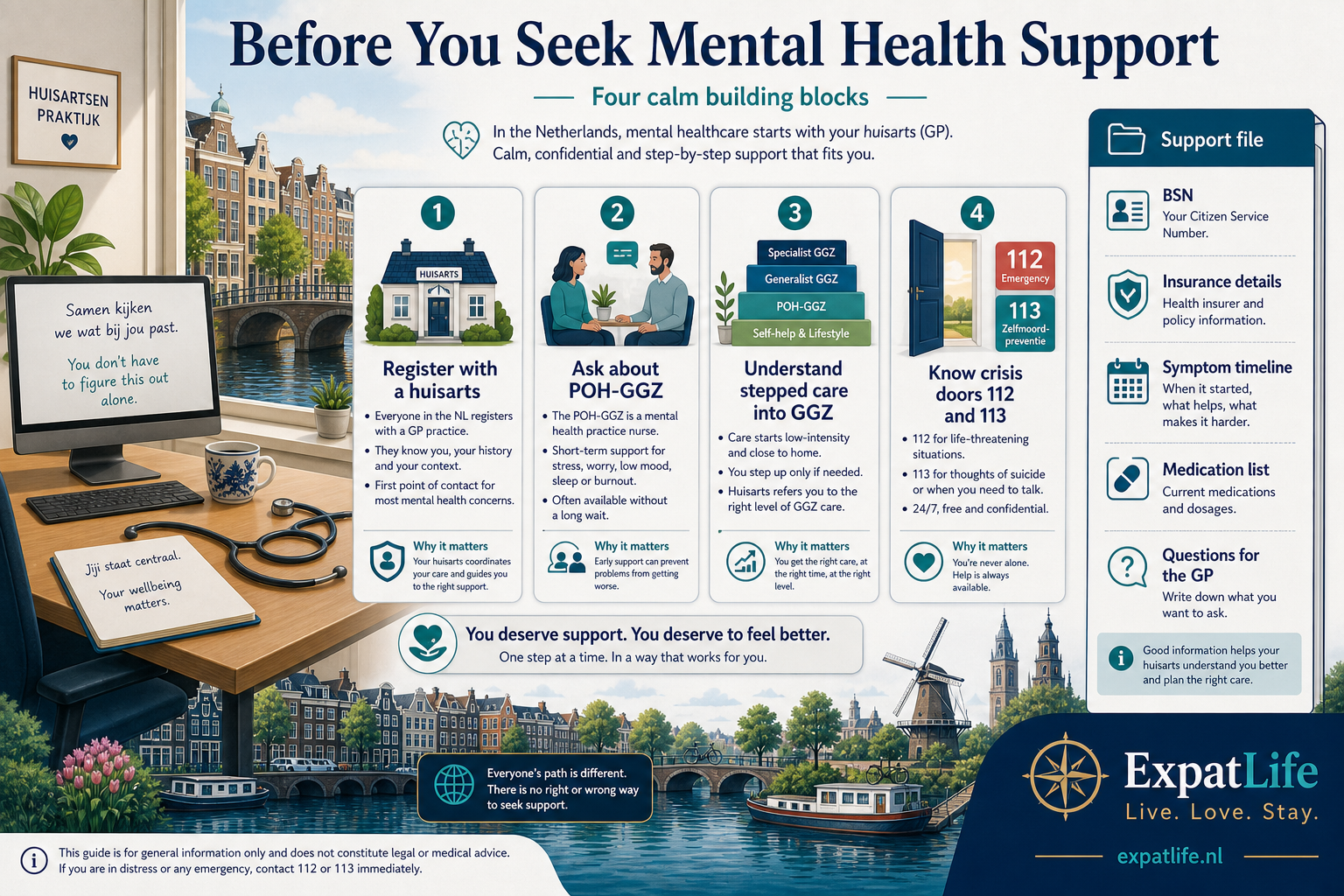
Support file — keep these together
Examples
| Situation | How it works here | First step |
|---|---|---|
| You feel overwhelmed after relocating and want support | Start with your huisarts for a first conversation. Ask whether the practice has a POH-GGZ and what the next step would look like. Loneliness and adjustment stress are common after a move; clinical pathways and community support can both matter. | Book a GP appointment and bring a short written timeline of what has changed since you arrived. |
| You already had therapy or psychiatry abroad | Continuity is usually arranged through the GP, who can discuss POH-GGZ or GGZ referral with your existing records. Bring translated summaries and medication lists so assessments are not started from zero. | Register with a huisarts, then share previous letters, diagnoses if documented, and current medication details. |
| You want to book a psychologist directly | Direct self-referral into insured specialist GGZ is generally not how Dutch access works. Insurers usually expect a valid referral for coverage of medically necessary specialist care. | Discuss the concern with your GP first and ask what would justify POH-GGZ support or a GGZ referral. |
| You are worried about safety tonight | Crisis care uses dedicated doors, not the routine appointment system. Immediate danger goes to 112; suicidal thoughts can be discussed with 113 Suicide Prevention. | Call 112 if there is immediate danger; contact 113 if you are having suicidal thoughts; otherwise call your GP during opening hours or the huisartsenpost after hours. |
Snapshot
Almost every adult mental health pathway expats meet is built from these six blocks. Read them once now, then use the detailed sections below when you need the specifics.
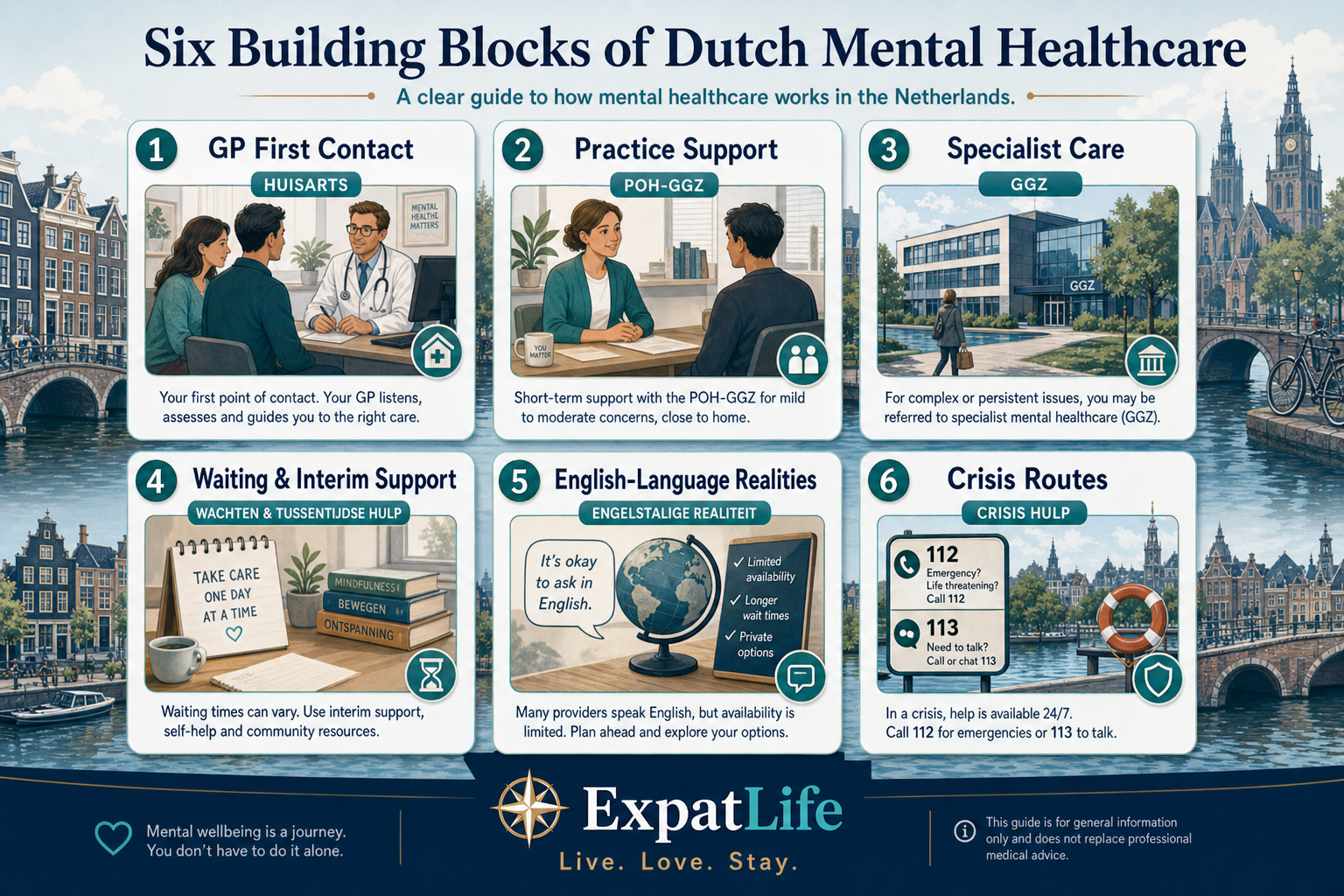
Entry point
GP first
A huisarts conversation opens most non-emergency adult mental health pathways.
Practice support
POH-GGZ
Many practices offer a mental health practice nurse for first-line conversations.
Specialist care
GGZ referral
Psychologists, psychiatrists and institutions usually need a referral.
Crisis doors
112 / 113
Immediate danger → 112; suicidal thoughts → 113; urgent care → GP or huisartsenpost.
Your huisarts assesses what is happening, offers first-line medical orientation and decides whether POH-GGZ support or a GGZ referral is appropriate. Keep the practice relationship active — they coordinate ongoing care.
A practice-based mental health practice nurse who offers structured conversations and stepped support inside primary care. Booking is often a separate appointment type arranged through the practice.
Geestelijke gezondheidszorg covers psychologists, psychiatrists and mental health institutions. Access for insured specialist care normally starts with a GP referral naming the reason and level of need.
Field target (Treeknorm) is 14 weeks total for GGZ; many specialised pathways take longer. Ask for current weeks, keep interim GP/POH support, and use insurer zorgbemiddeling.
English is often workable in larger cities and academic settings, but availability varies. Ask when booking and request an interpreter for complex or consent conversations.
Immediate danger → 112. Suicidal thoughts → 113 Suicide Prevention. Urgent but not life-threatening → GP by day or huisartsenpost after hours, with regional crisis services involved when professionals escalate.
How it works
Dutch mental healthcare is best understood as stepped care rather than a single destination. The lightest appropriate level comes first — often a GP conversation and POH-GGZ support — with specialist GGZ added when intensity, complexity or risk requires it, and responsibility returning to the GP for ongoing coordination.
The pathway usually starts when you notice that sleep, mood, anxiety, trauma responses, concentration or daily functioning have changed enough that you want professional support. You book a huisarts appointment, bring a short written timeline, and discuss what is happening. The GP may offer first-line advice, arrange blood tests or other medical checks if relevant, book POH-GGZ inside the practice, or start a GGZ referral.
POH-GGZ sits between everyday GP care and specialist GGZ. Conversations are structured and time-limited; the goal is practical support and a clearer view of whether specialist care is needed. If a referral is indicated, the GP issues a verwijzing naming the reason and often the level of care. You then wait for intake at a contracted GGZ provider, or sometimes the practice helps with the first booking step.
Specialist care can include assessment, talking therapies, medication management with a psychiatrist, group programmes or more intensive pathways. When an episode of specialist care ends or stabilises, follow-up often returns to the GP and, where useful, POH-GGZ. Referrals also have practical limits — if a long time passes without contact, your GP may need to issue a new one.
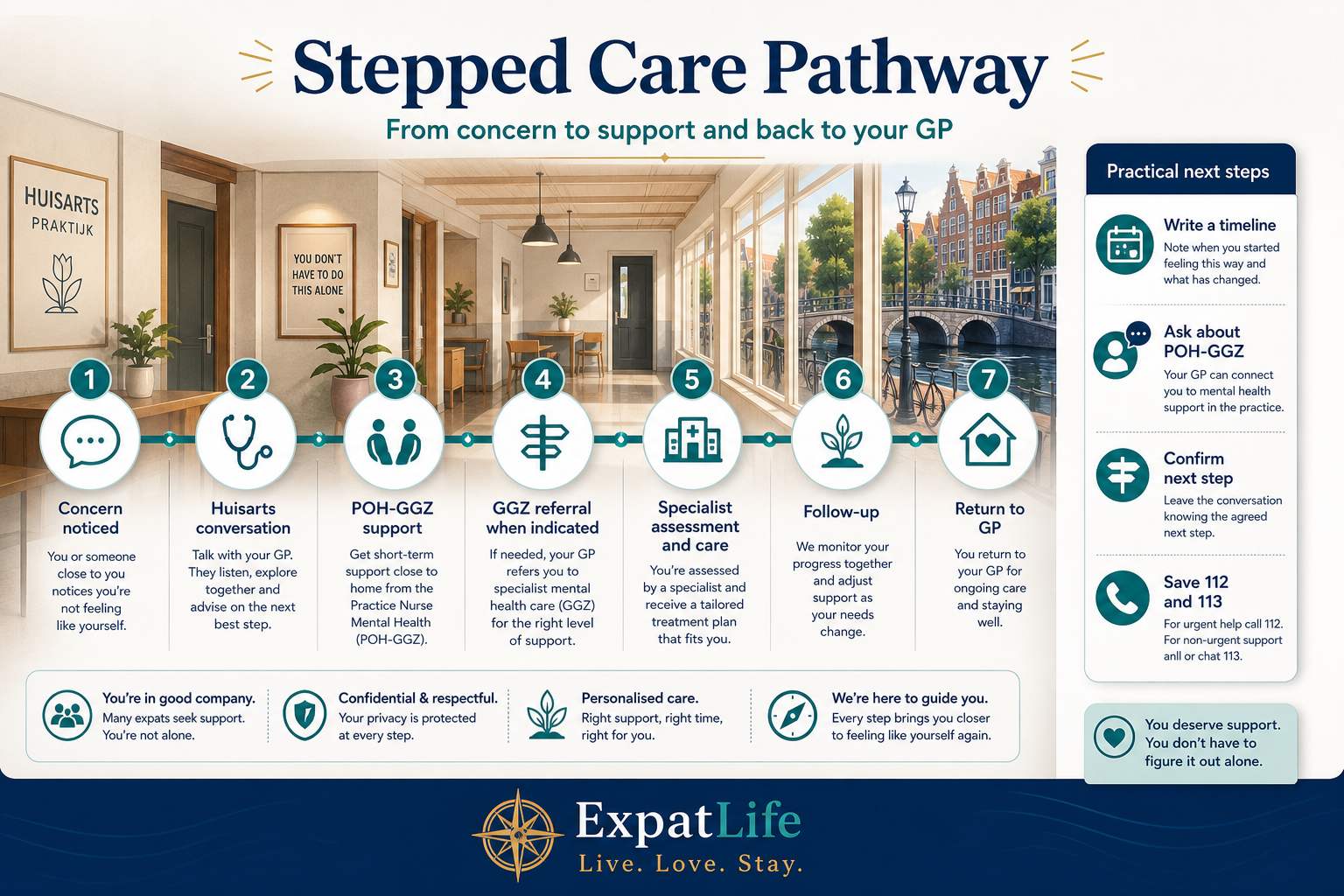
Care pathway
Step 1
Write down when symptoms or difficulties started, how they changed, what you have already tried and what worries you most. This one page shortens every later conversation.
Step 2
Your GP listens, may screen for medical contributors and decides whether practice-based support, watchful waiting with a clear review date, or specialist referral fits best.
Step 3
A mental health practice nurse offers structured conversations inside the practice and helps clarify next steps with the GP.
Step 4
If specialist care is indicated, the GP issues a referral. Keep the letter or digital confirmation for the provider and your insurer.
Step 5
Intake clarifies needs and intensity. Treatment may include therapy, psychiatric review, group programmes or coordinated multidisciplinary care.
Step 6
Progress is reviewed against agreed goals. Ask what would change the plan and who to contact between appointments if things worsen.
Step 7
When the specialist episode ends or stabilises, letters usually return to your huisarts, who resumes ongoing coordination, prescriptions where relevant and future referrals.
How to
Step 1
When you call or use the practice portal, say clearly that you want to discuss stress, mood, anxiety, sleep or another mental health concern. Ask whether a longer slot or a POH-GGZ route is available.
Step 2
Note when difficulties started, what changed, how sleep work relationships and daily functioning are affected, what you have already tried, and what you most want help with. Keep it to one page.
Step 3
Bring ID, your BSN, insurance details, a current medication and allergy list, and any relevant letters or summaries from previous care, including care abroad.
Step 4
Appointments are focused. Typical questions include what the next step could be, whether POH-GGZ is available, what a GGZ referral would mean, and what to do if things worsen before the next contact.
Step 5
Ask the practice in advance about English-language consultation or interpreter options. Avoid relying on a child to interpret sensitive conversations.
Step 6
Describe frequency, severity, triggers and impact rather than only labels. Mention safety concerns openly — clinicians need that information to route care correctly.
Step 7
Ask what happens next, who arranges it, when you should hear something, and what to do if risk increases. Repeat the plan back in your own words.
Step 8
Store the practice number, any POH-GGZ booking details, crisis numbers 112 and 113, and your insurer's care-mediation contact if a referral wait begins.
GP first contact
For most non-emergency adult mental health concerns, the huisarts is the first door. That conversation is assessment and routing, not a promise of a specific therapy — and it is the step that usually opens POH-GGZ or GGZ pathways.
Dutch GPs are trained to recognise and manage a wide range of first-line mental health presentations. They may explore sleep, mood, anxiety, substance use, physical contributors, medication and safety. They may also suggest short-term practical steps, arrange relevant medical checks, book POH-GGZ, or start a specialist referral.
Expats sometimes worry that starting with a GP means their concern will not be taken seriously. In practice, the opposite is usually true: a clear GP record and referral is what makes insured specialist care workable. Bring a written timeline, be specific about impact, and say if you are worried about safety.
If you are not yet registered with a huisarts, that is the first practical task. Without registration, planned mental health access is much harder to arrange. Our GP cornerstone guide covers registration, appointments and out-of-hours routes in depth.
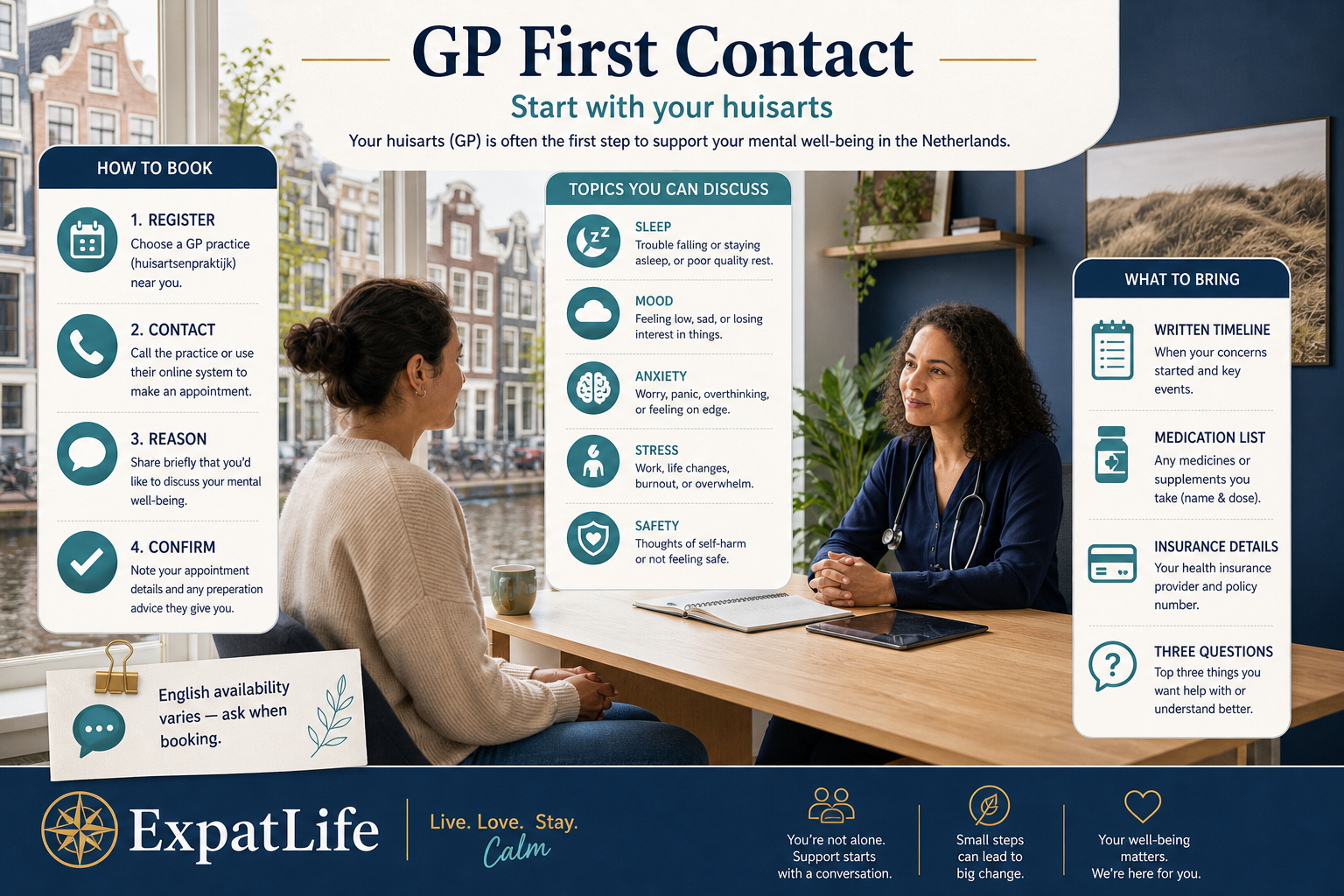
To understand what is happening, check for medical contributors, assess urgency and decide the lightest appropriate next step — advice, POH-GGZ, referral or urgent escalation.
A one-page timeline, medication list, insurance details and any previous mental health letters. Written notes beat trying to remember everything under stress.
Describe impact on sleep, work, study, relationships and safety. Mention suicidal thoughts or risk of harm if present — this routes care correctly and is taken seriously.
You should leave with a clear plan: watchful waiting with a review date, POH-GGZ booking, GGZ referral, or urgent crisis routing. Ask who does what and by when.
Before your huisarts conversation
Examples
| Situation | How it works here | First step |
|---|---|---|
| You are unsure whether your concern is 'serious enough' | You do not need to self-diagnose severity. GPs are used to early conversations, and stepped care exists precisely so support can start at a lighter level. | Book a GP appointment and describe impact on daily life rather than waiting for a crisis. |
| You want medication discussed | Medication decisions belong with a clinician after assessment. The GP can discuss options, monitoring and whether psychiatric input is needed — this page does not recommend treatments. | Raise the question at the GP appointment and ask what assessment would come first. |
| You feel dismissed after a short appointment | Dutch consultations can be short and direct. Ask for a follow-up, request POH-GGZ if available, or say clearly what still feels unresolved. | Write your remaining questions and book a review appointment or ask for POH-GGZ. |
| You have no GP yet | Registration comes first for planned pathways. In a crisis, use 112 or 113 regardless of registration status. | Start GP registration using the GP guide, and use crisis doors immediately if safety is at risk. |
POH-GGZ
POH-GGZ (praktijkondersteuner huisarts geestelijke gezondheidszorg) is a practice-based mental health professional working inside many huisarts practices. It is first-line support within stepped care — not a lesser service, and not the same as specialist GGZ.
The POH-GGZ offers structured conversations about stress, anxiety, low mood, sleep problems, adjustment difficulties and related concerns. Appointments are usually longer than a standard GP slot and may be offered as a short series. The POH-GGZ coordinates with your GP and helps decide whether specialist GGZ referral is appropriate.
Availability varies by practice. Some practices have strong POH-GGZ capacity; others have limited hours or none. Ask when you register or when you book: 'Does this practice have a POH-GGZ, and how do I get an appointment?' Booking is often arranged through the practice assistant after the GP agrees the route.
What to expect is practical and focused: clarifying what is happening, building coping strategies, monitoring progress and deciding next steps. It is orientation and support inside primary care — not a guarantee of a specific therapy model, and not a substitute for crisis services when risk is high.

A trained mental health practice nurse or equivalent professional working under the huisarts practice model, focused on first-line conversations and stepped support.
Often via the GP or practice assistant after an initial triage conversation. It is frequently a different appointment type from a standard doctor slot.
Structured conversations about current difficulties, goals and practical next steps. A short series is common; intensity stays within primary-care scope.
If needs appear more complex, persistent or specialised than practice-based support can cover, the POH-GGZ and GP discuss referral into specialist GGZ.
POH-GGZ checklist
Examples
| Situation | How it works here | First step |
|---|---|---|
| The practice says there is a waiting list for POH-GGZ | Ask what interim support exists, whether the GP can review sooner, and whether a GGZ referral should run in parallel if needs are significant. | Ask the practice assistant what the current wait looks like and what to do if risk increases while waiting. |
| You hoped for long-term therapy in the practice | POH-GGZ is usually short-series and stepped. Longer or more specialised therapy typically sits in GGZ after referral. | Ask the POH-GGZ and GP what level of care matches your goals and how referral would work if needed. |
| You are not sure the POH-GGZ route is enough | Say so clearly. Stepped care includes escalation when first-line support is not sufficient. | Request a joint review with the GP about whether specialist GGZ referral is appropriate. |
| Language is a barrier in sessions | Ask about English-language POH-GGZ capacity or interpreter support. Do not push through consent-level conversations you cannot follow. | Tell the practice before the next appointment that you need language support. |
GGZ care
GGZ (geestelijke gezondheidszorg) is specialist mental healthcare. It includes psychologists, psychiatrists and mental health institutions. This section explains care levels and referral logic — it does not rank providers or recommend specific clinics.
Specialist GGZ is usually reached through a GP referral when practice-based support is not enough, or when assessment suggests specialised treatment from the start. The referral describes the concern and often the indicated intensity. Insurers normally expect a valid referral for coverage of medically necessary specialist care.
Inside GGZ you may meet a psychologist for assessment and talking therapies, a psychiatrist when medical-psychiatric expertise is needed, or a multidisciplinary team in a GGZ institution for more complex or intensive pathways. Care can be outpatient, intensive outpatient or, when clinically necessary, inpatient — always based on professional assessment, not self-selection of intensity.
Expats often ask which provider is 'best'. Dutch insured care is organised around indication, contracts and availability rather than prestige rankings. Practical questions are: Is a referral in place? Is the provider contracted by my insurer? What is the indicative wait? Is English-language care available? Who coordinates with my GP?
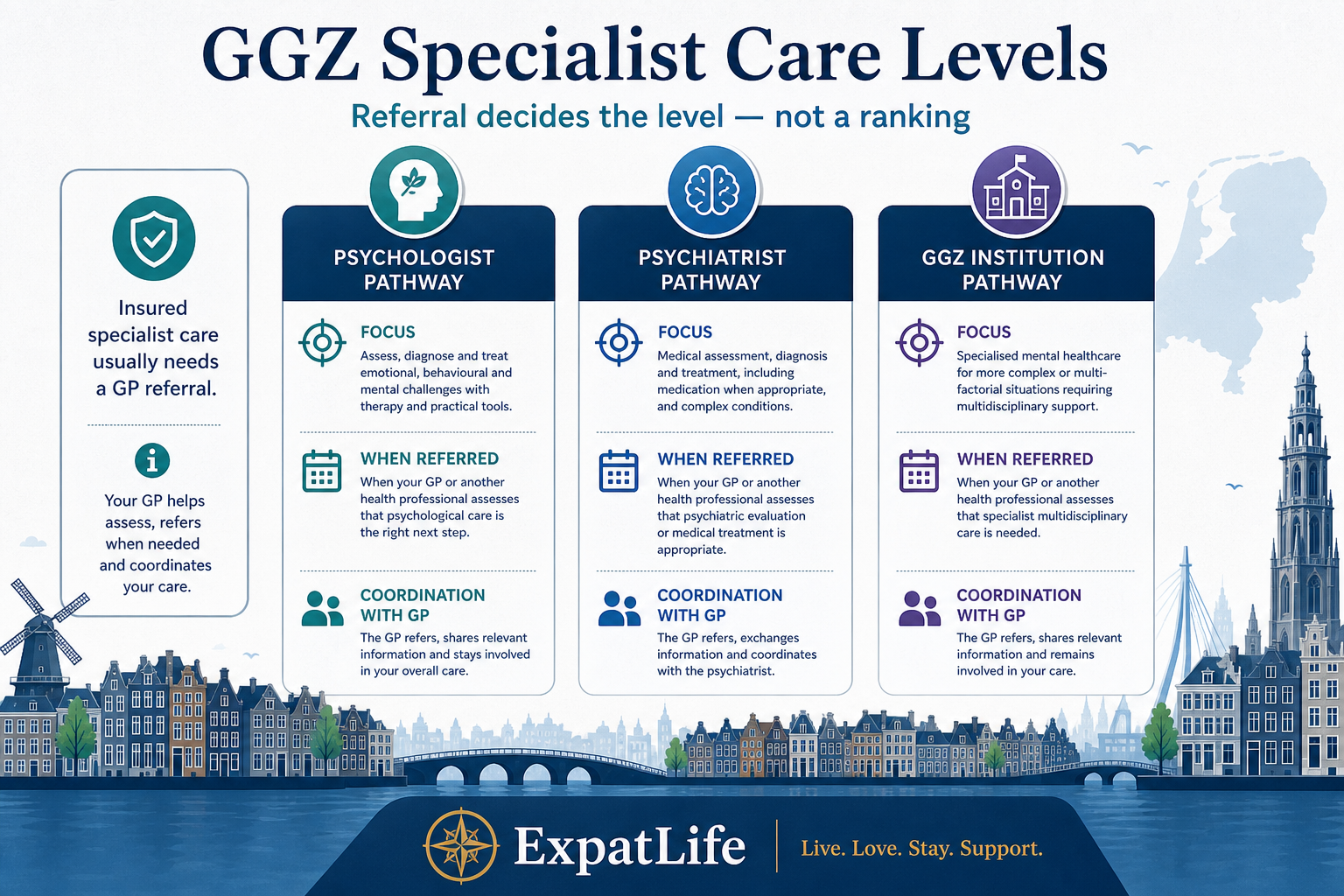
| Type | Focus | When you are referred | Note |
|---|---|---|---|
| GP / first-line medical care | First conversation, medical checks, safety orientation and routing into POH-GGZ or GGZ. | You start here for almost all non-emergency adult concerns. | Remains the coordinator even after specialist care begins. |
| POH-GGZ (practice support) | Structured first-line mental health conversations inside the huisarts practice. | When the GP judges practice-based support is appropriate. | Not specialist GGZ; escalation remains possible. |
| Psychologist (GGZ) | Specialist psychological assessment and talking therapies within GGZ pathways. | When needs exceed primary-care scope or specialised therapy is indicated. | Usually requires a GP referral for insured care. |
| Psychiatrist (GGZ) | Medical-psychiatric assessment, diagnosis within specialist care, and medication management when indicated. | When psychiatric expertise is needed alongside or instead of psychological care. | This page does not recommend medication — decisions belong with clinicians. |
| GGZ institution / multidisciplinary team | Coordinated specialist pathways for more complex, intensive or combined needs. | When multidisciplinary or higher-intensity care is indicated after assessment. | Intensity follows clinical indication, not preference for a brand of clinic. |
For planned insured specialist GGZ, a valid GP referral is normally required. Keep the letter or digital confirmation with your documents.
Intake clarifies needs. Starting at a lighter appropriate level is system design, not a refusal to help.
This guide describes care levels only. It never ranks therapists, clinics or institutions.
Specialist letters usually return to your huisarts. Ongoing prescriptions and future referrals often run through primary care.
Before specialist GGZ intake
Examples
| Situation | How it works here | First step |
|---|---|---|
| You are offered a different intensity than you expected | Ask what the indication is based on, what alternatives exist, and what would change the plan. Shared decision-making is normal. | Request a plain-language explanation of the recommended care level and why. |
| You want a specific therapy brand you read about online | Insured GGZ follows clinical indication and available programmes. Ask what evidence-based options are offered for your situation rather than insisting on a brand name. | Describe your goals to the referring GP or intake clinician and ask which approaches they consider appropriate. |
| Specialist care ends and you feel unfinished | Ask for a closing plan, GP handover and what would justify a new referral later. Ending an episode is not the same as abandoning support. | Request a discharge conversation covering warning signs, GP follow-up and re-entry routes. |
| You are unsure whether psychology or psychiatry is needed | You do not need to choose alone. The GP and intake assessment decide based on presentation — both can be involved over time. | Describe symptoms and history to your GP and ask which specialist route fits first. |
Finding care
Finding care in the Netherlands is usually coordinated rather than free-form shopping. Start with your GP, ask about POH-GGZ, and use a referral into contracted GGZ when specialist care is indicated. Your insurer's provider network and care-mediation service are practical tools, especially when waits are long.
Some people also encounter e-health or blended programmes — digital modules combined with professional contact. These can be useful interim or complementary options when clinically appropriate, but they are not a universal substitute for face-to-face care, and availability depends on indication and insurer arrangements. Ask your GP or insurer what is offered for your situation.
Private self-pay routes exist outside standard insured pathways, with different cost and quality-assurance implications. This guide does not recommend private providers. If you consider that route, still keep your GP informed and verify what happens if you later need insured GGZ or crisis care.
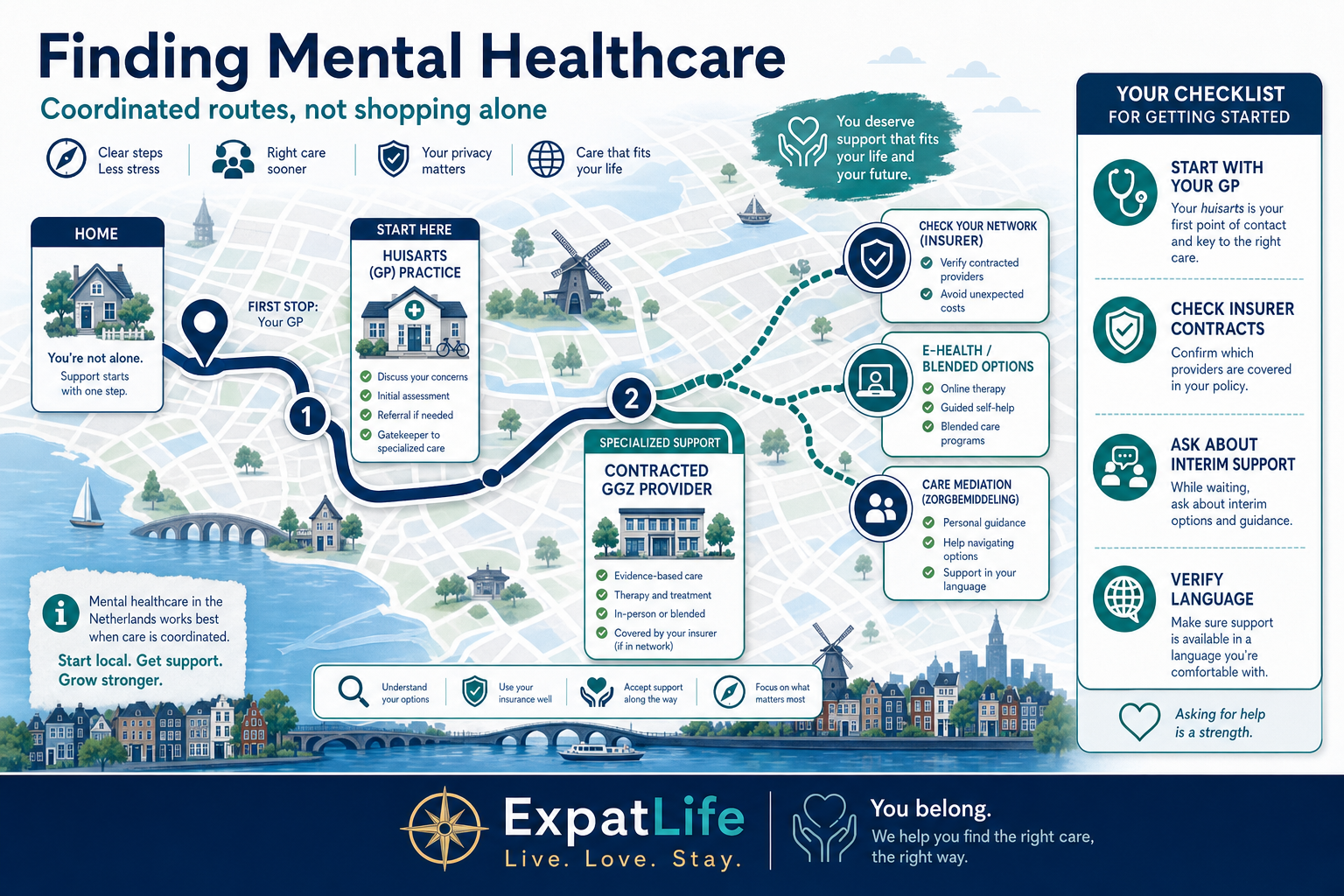
| Route | When | How | Note |
|---|---|---|---|
| Huisarts practice | First non-emergency conversation, medical checks, routing | Book a GP appointment; bring a timeline and questions | Standard entry point for most adults. |
| POH-GGZ | First-line mental health support inside primary care | Usually arranged via the GP or practice assistant | Availability varies by practice. |
| Contracted GGZ provider | Specialist care after referral | GP referral, then intake with a contracted psychologist, psychiatrist or institution | Check insurer network and indicative waits. |
| Insurer care mediation (zorgbemiddeling) | Waiting time feels too long | Contact your insurer's care-mediation service | They can look for earlier availability at contracted providers. |
| E-health / blended options | Clinically appropriate digital or mixed support | Ask GP or insurer what programmes exist for your indication | Orientation only — not suitable for every situation or for crisis care. |
| Crisis doors | Immediate danger, suicidal thoughts or urgent deterioration | 112, 113, GP or huisartsenpost depending on severity | Do not wait for a routine intake if safety is at risk. |
Finding-care checklist
Examples
| Situation | How it works here | First step |
|---|---|---|
| Online directories look confusing | Use your GP and insurer network as the primary route for insured care rather than choosing by advertising. | Book a GP appointment and ask which contracted options fit your referral. |
| A friend recommends a private therapist | Private care can be a personal choice but sits outside this page's insured-pathway orientation. Keep your GP informed and verify costs and continuity. | Ask your GP how private care would interact with insured GGZ or crisis routes if needed later. |
| You want something English-speaking and nearby | Say both preferences early. Availability varies; interpreter support may be the practical bridge. | Ask the practice and insurer about English-language contracted options and interpreter arrangements. |
| You relocated mid-treatment from abroad | Bring records to the GP and ask for continuity planning. A new Dutch referral is often still needed for insured GGZ. | Register with a huisarts and share translated summaries and medication lists. |
Waiting times
GGZ waiting times are often longer than people expect. The Dutch field standard (Treeknorm) is a useful benchmark — then ask for the current weeks for your specific pathway, because reality frequently runs longer, especially in specialised care.
Treeknorm — the agreed maximum acceptable wait for GGZ — is 4 weeks from registration to the first intake conversation, then 10 weeks from intake to the start of treatment (14 weeks total). NZa reporting has repeatedly shown that many people wait longer than those targets, particularly for the intake stage and for specialised pathways. A wait does not mean your referral was rejected.
Use the indicative ranges below as orientation only. They are not a promise for your case. Ask the referring GP, the provider’s intake team and your insurer for the current weeks for your care type and region — then decide whether to activate zorgbemiddeling (care mediation).
While you wait, ask what interim support is available: continued GP or POH-GGZ contact, practical coping plans, e-health options if appropriate, and clear instructions for what to do if risk increases. If your situation deteriorates, do not wait politely for an intake date — use urgent and crisis doors (GP, huisartsenpost, 113 or 112) and tell clinicians you are already on a waiting list.
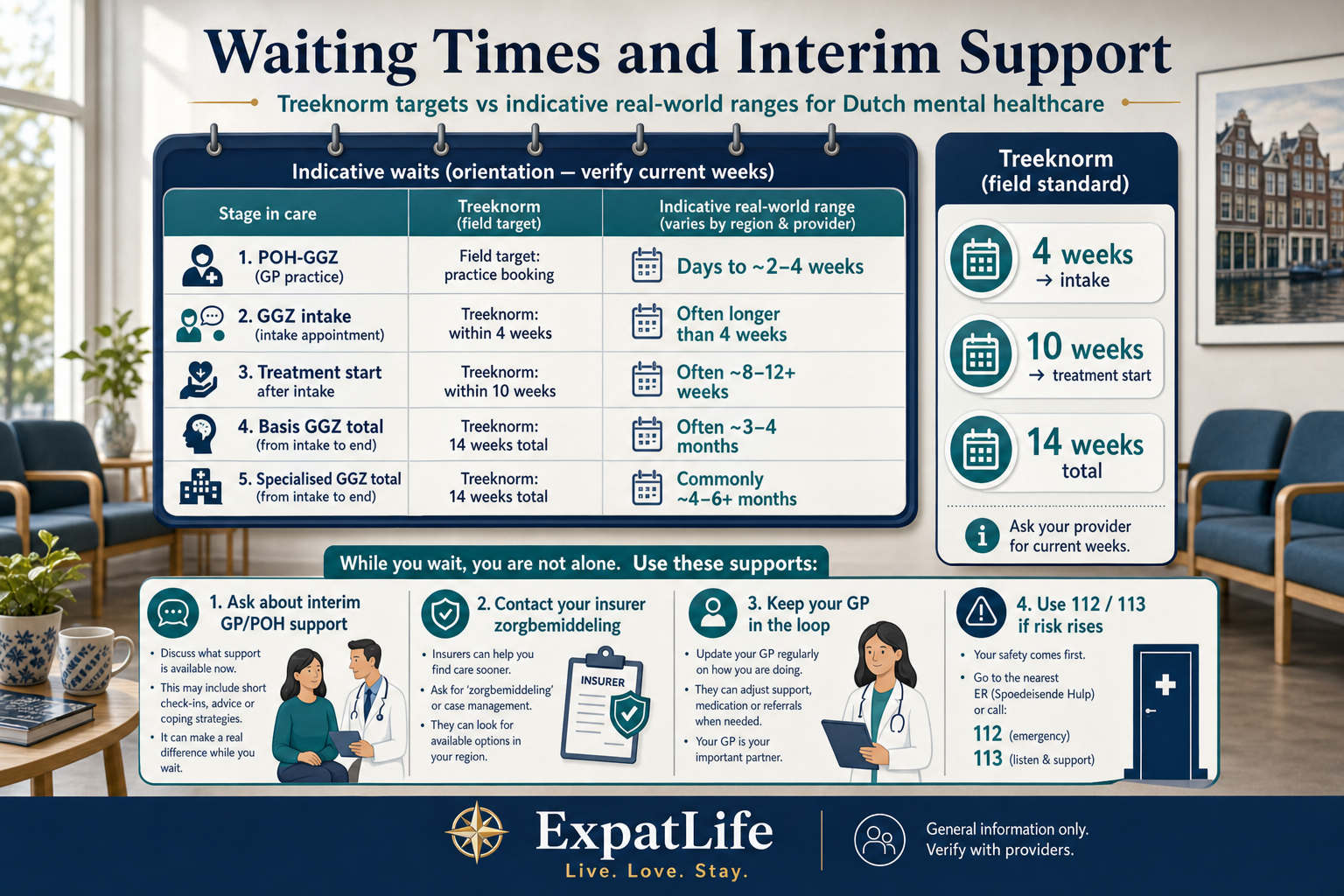
| Pathway | Treeknorm target | Indicative real-world range | What to do |
|---|---|---|---|
| POH-GGZ (inside GP practice) | Practice booking (not Treeknorm) | Often days to about 2–4 weeks for a first conversation | Shorter than specialist GGZ in most practices — ask the assistant for the current slot. |
| GGZ intake (aanmeld / first consultation) | Within 4 weeks | Often longer — many people wait beyond 4 weeks | Ask for the provider’s current intake wait in weeks when the referral is sent. |
| Start of GGZ treatment after intake | Within 10 weeks after intake | Often around 8–12+ weeks; can stretch further by diagnosis | Some pathways meet Treeknorm; specialised routes more often overshoot. |
| Basis GGZ — total to treatment start | Within 14 weeks total | Often about 3–4 months (around Treeknorm) | National averages for basis GGZ have sat near the 14-week target in recent NZa snapshots. |
| Specialised GGZ (SGGZ) — total to treatment start | Within 14 weeks total | Commonly about 4–6+ months; some pathways longer | Diagnosis group and region matter a lot — verify current weeks and ask about mediation early. |
| Youth / children’s pathways | Local targets apply; adult Treeknorm is a rough orientation only | Often several weeks to several months | Coordinate via GP/JGZ and ask for the youth pathway’s current wait — do not assume adult GGZ numbers. |
While you wait
Examples
| Situation | How it works here | First step |
|---|---|---|
| Intake is quoted at 8–12 weeks (past Treeknorm’s 4 weeks) | Treat that as a signal to activate interim support and insurer zorgbemiddeling, not to wait silently for the letter date. | Call the intake secretariat and your insurer’s care-mediation line in the same week with the referral details. |
| Specialised GGZ total wait is quoted around 5–6 months | Ask about earlier contracted alternatives, different intensity or modality, cancellation lists, and keep GP/POH-GGZ support active. | Contact your insurer with the referral and the quoted weeks; ask what faster contracted options exist. |
| You feel worse while waiting | Do not wait for the original date if risk or severity rises. Re-contact your GP and use urgent or crisis routes as needed. | Call your GP practice today, or the huisartsenpost outside hours, and describe the change clearly. |
| Your referral is getting old | Ask the GP whether it is still valid for the provider and insurer, and renew if needed before intake. | Check referral date with the practice and confirm requirements with the intended GGZ provider. |
English
Many clinicians in the Netherlands speak English, especially in larger cities and academic settings. That does not mean every practice, every POH-GGZ slot or every GGZ programme can offer high-quality English care on demand.
Ask early. When booking a GP, POH-GGZ or GGZ intake, say that you need the consultation in English or that you need an interpreter. For consent, diagnosis explanations and safety planning, accurate understanding matters more than politeness.
Interpreter support can be arranged in many care settings, though processes differ. Avoid relying on a child, partner or colleague to interpret sensitive mental health conversations unless there is no alternative in an emergency. Written information in plain language also helps — ask for key points after the appointment.
If English-language specialist capacity is limited in your region, options may include travelling further, using interpreter-supported local care, or interim primary-care support while mediation finds a better language match. None of these is a failure — they are practical adaptations inside a system that was not designed as an English-only service.

State your language need at the first phone call or portal message. Notes in the record help the whole team prepare.
Request an interpreter for complex or consent conversations. Confirm who arranges it and whether it will be in-person or remote.
Larger cities and academic centres often have more English-capable clinicians; smaller regions may rely more on interpreters.
English being 'often fine' is not a promise. Have a backup plan: interpreter request, written summary, companion who takes notes.
Language checklist
Examples
| Situation | How it works here | First step |
|---|---|---|
| The clinician's English is limited | Pause and request clearer language support rather than guessing. Safety and consent require understanding. | Say you need an interpreter or a slower plain-language explanation before decisions are made. |
| You understand everyday English but not clinical terms | Ask for plain language and written notes. Mental health vocabulary is hard even for fluent speakers. | Request a short written plan: next step, who contacts whom, what to do if things worsen. |
| No English-speaking GGZ slot is available nearby | Ask about interpreter-supported local care, wider contracted networks and insurer mediation. | Contact your insurer with language needs stated as a hard requirement. |
| Your partner usually translates | For mental health content, professional interpreting is usually safer and more private. | Ask the practice how to book an interpreter for the next appointment. |
Crisis
Crisis care uses dedicated doors. This section is orientation only — it does not replace professional judgement, and it never invents local phone numbers beyond the well-known national numbers 112 and 113.
If you or someone else is in immediate danger, call 112. That is the Dutch emergency number for ambulance and urgent emergency response. Do not wait for a routine GGZ intake if life may be at risk.
If you are having suicidal thoughts, contact 113 Suicide Prevention (113.nl). 113 provides specialised suicide-prevention support. You can also seek urgent clinical contact through your GP during opening hours or the huisartsenpost after hours. Regional crisis services exist and are typically accessed when professionals escalate urgent mental health crises — your GP, huisartsenpost or emergency pathway can involve them.
For the full picture of urgent physical and mental health doors — 112, huisartsenpost, SEH and related routes — use our Emergency Healthcare cornerstone. This mental healthcare page orients you; that guide goes deeper on emergency system mechanics.
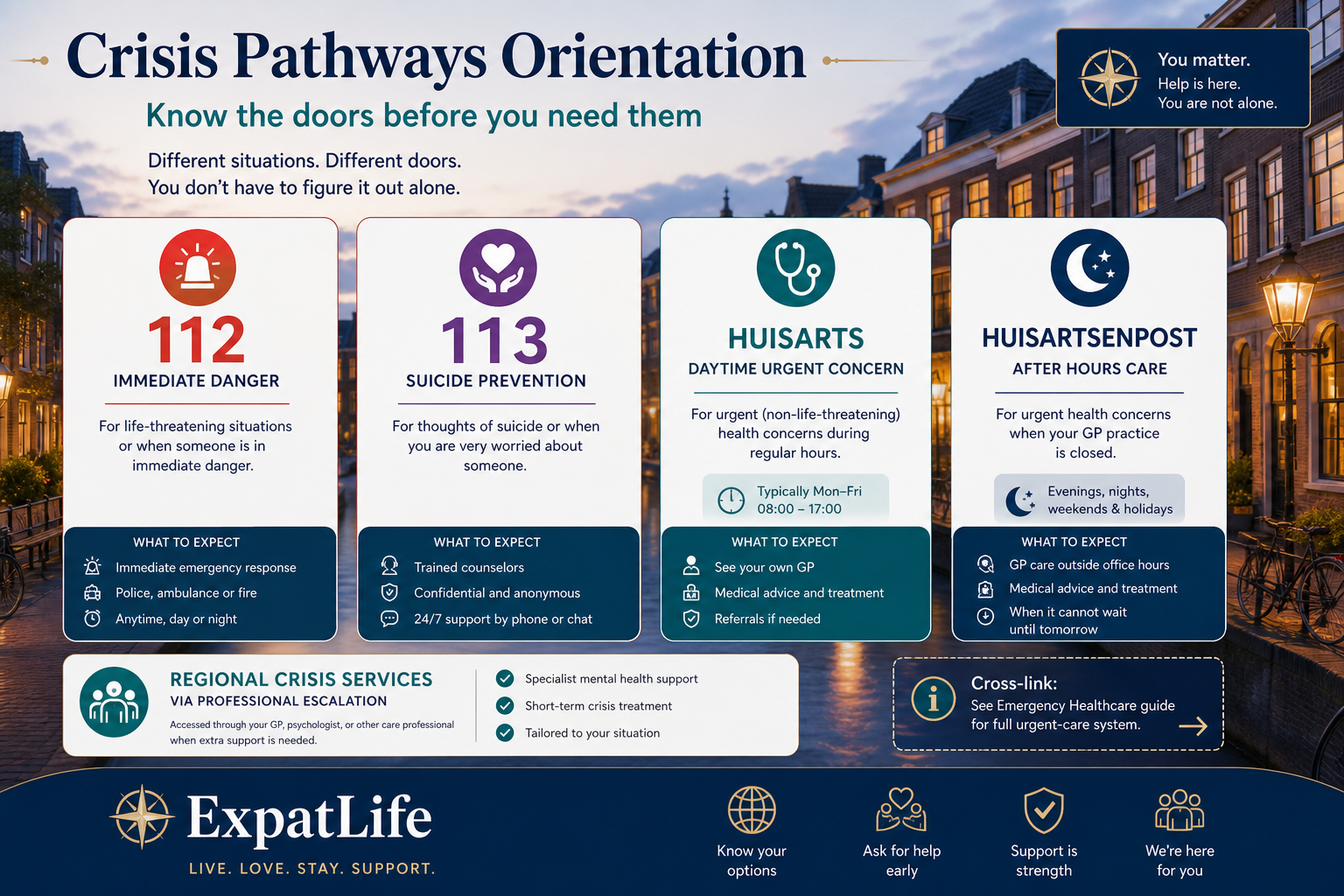
Call 112 now
Immediate danger to yourself or someone else
Call 112 now.
Suicidal thoughts, with or without a plan
Contact 113 Suicide Prevention and seek urgent clinical help; call 112 if danger is immediate.
Same day / out of hours
Rapid mental health deterioration tonight, not immediately life-threatening
Call your GP during opening hours or the huisartsenpost after hours.
Worsening symptoms while waiting for GGZ intake
Re-contact your GP, describe the change, and use huisartsenpost or crisis routes if risk rises.
Planned route
Ongoing stress or low mood without acute safety risk
Book a huisarts appointment and ask about POH-GGZ or referral as appropriate.
Admin questions about referral or waiting lists
Contact the practice assistant, GGZ intake secretariat or your insurer — not 112.
Examples
| Situation | How it works here | First step |
|---|---|---|
| A housemate is talking about suicide tonight | Take it seriously. If danger is immediate, call 112. Otherwise contact 113 for guidance and seek urgent clinical help via GP or huisartsenpost. | If anyone is in immediate danger call 112; otherwise contact 113 and stay with the person if it is safe to do so. |
| You are in crisis but worried about costs or paperwork | Safety comes first. Emergency and crisis routes are not something to delay for insurance admin. | Call 112 or 113 as appropriate; sort paperwork afterwards with your GP and insurer. |
| You called the wrong number and feel embarrassed | Services would rather you sought help. If you still need support, call the correct door now. | Use 112 for immediate danger, 113 for suicidal thoughts, or GP/huisartsenpost for urgent clinical contact. |
| You are abroad-minded and unsure Dutch crisis numbers | Memorise two numbers: 112 for emergencies and 113 for suicide prevention. Save them in your phone today. | Add 112 and 113 to favourites, and read the Emergency Healthcare guide for surrounding context. |
Children & youth
Children and adolescents use partly different doors from adult GGZ. This section is brief orientation only — family pathways are covered in depth in the Healthcare for Children guide.
Concerns about a child's mood, behaviour, anxiety, eating, sleep or school functioning usually start with the GP, the school support team, or youth health services (JGZ). The GP can assess and refer into youth mental healthcare (jeugd-GGZ) when specialist care is indicated.
Municipalities are responsible for a large part of youth support under the Youth Act (jeugdhulp). Local teams and family centres may offer support that sits alongside or instead of specialist GGZ, depending on need. Exact local organisation varies by municipality — ask your GP, JGZ team or municipality what applies where you live.
Waiting times for specialist youth mental health care can be long in some regions. Ask what interim support exists through school, JGZ, GP or municipal teams. In a crisis involving immediate danger, call 112. For suicidal thoughts in young people, seek urgent professional help and use 113 as appropriate.
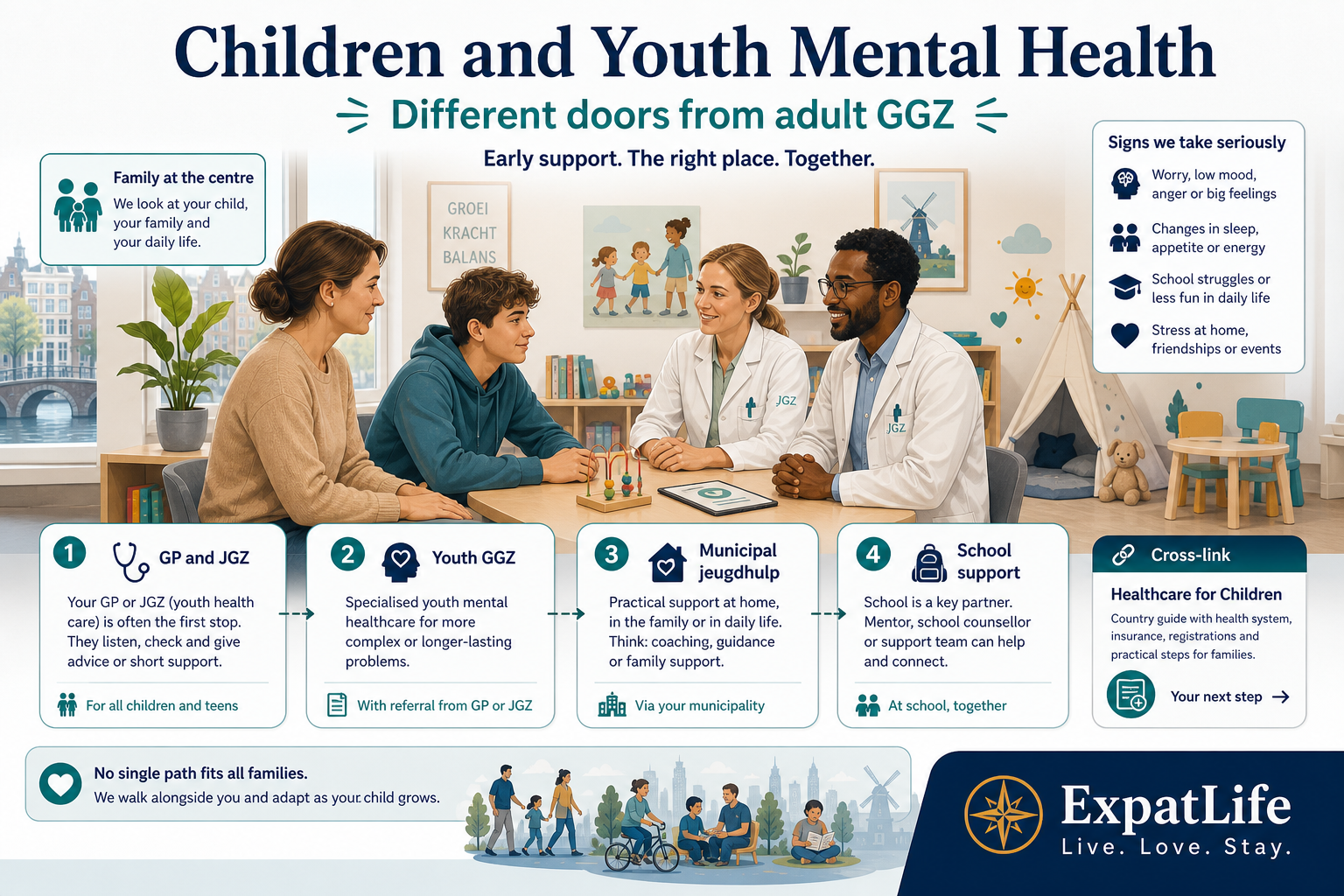
Common first doors for concerns about a child's mental wellbeing, development and school functioning.
Specialist youth mental healthcare usually reached via referral when indicated — orientation only, not a provider list.
Youth support organised via the municipality under the Youth Act; local teams and family centres vary by place.
Internal school support coordinators often work with JGZ and parents when wellbeing or learning is affected.
Examples
| Situation | How it works here | First step |
|---|---|---|
| A teacher raises wellbeing concerns | Take school observations seriously and coordinate with GP or JGZ rather than waiting for a crisis. | Book a GP appointment and ask the school what support is already in place. |
| You are told to contact the municipality | This can be a normal youth-support route under jeugdhulp. Ask what the local team offers and how it coordinates with GP care. | Request clear contact details from the GP, JGZ or school and note what to bring to the first conversation. |
| Your teenager refuses help | Ask professionals how to engage adolescents respectfully. Safety concerns still need urgent routes even if engagement is difficult. | Speak with the GP about options and escalate via crisis doors if danger is present. |
| You need the wider family healthcare map | Children's mental health sits inside a larger system of GP, JGZ, insurance and specialist care. | Open the Healthcare for Children guide and read the mental health section alongside this page. |
Costs
Most medically necessary adult GGZ is covered by basic health insurance once referral and indication rules are met. What you personally pay is usually driven by the annual deductible (eigen risico), whether the provider is contracted, and whether care sits in primary care (GP / POH-GGZ) or specialist GGZ.
For orientation in 2026, the mandatory eigen risico for adults is about €385 per calendar year (higher if you chose a voluntary top-up, up to about €885). Specialist GGZ for adults generally counts toward that deductible. GP consultations and POH-GGZ inside the huisarts practice are usually financed as primary care and typically do not consume eigen risico — confirm for your own policy year.
With a contracted GGZ provider and a valid referral, adults often pay only whatever remains of their eigen risico for that year; after the deductible is used up, basic insurance usually covers the rest of insured specialist GGZ. Non-contracted care can leave a much larger personal share (often a substantial percentage of the bill, depending on natura vs restitutie policy). Without a referral, insured reimbursement is commonly refused and you may pay the full private rate.
Trajectory values billed to insurers are much larger than typical out-of-pocket amounts: short basis-GGZ pathways are often in a rough €800–€1,200 range and specialised pathways often several thousand euros. Those are care-value ranges, not what most contracted insured adults pay beyond their remaining deductible. Children under 18 usually follow youth / municipal financing rules rather than adult GGZ billing — ask locally.
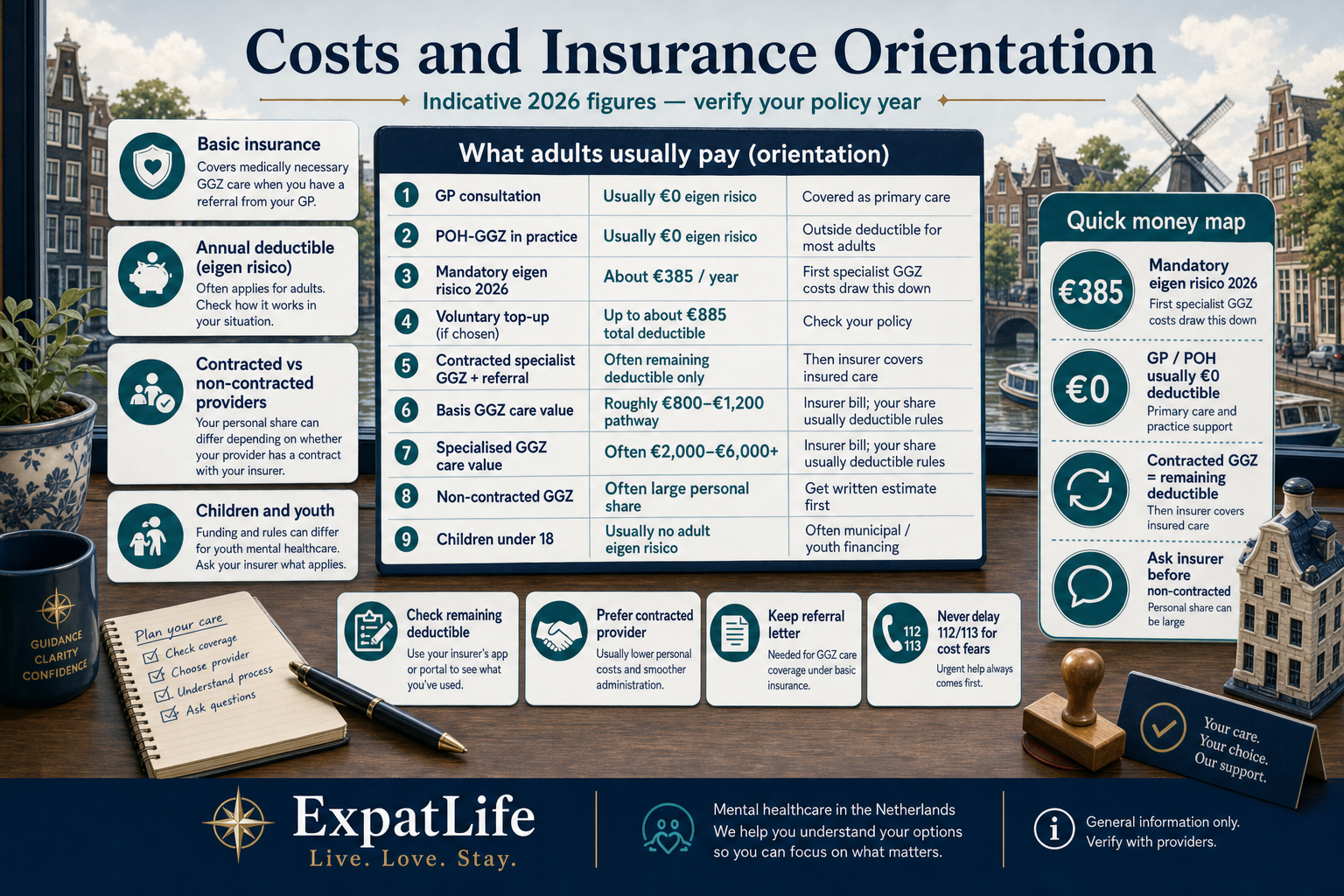
Indicative cost orientation for planning conversations — not a fee schedule, quotation, reimbursement promise or guarantee. Deductible amounts, tariff pathways and insurer contracts change by year and policy. Figures above use commonly published 2026 orientation (mandatory eigen risico about €385; care-value ranges for basis vs specialised GGZ). Always verify current terms with your own insurer, and never delay crisis care because of cost uncertainty.
| Cost item | Indicative figure | What you usually pay | Note |
|---|---|---|---|
| GP consultation | Usually €0 eigen risico | Typically covered under basic insurance without deductible | Primary-care visit — confirm medicines or diagnostics separately. |
| POH-GGZ (in GP practice) | Usually €0 eigen risico | Typically no deductible when booked via the huisarts practice | First-line stepped support inside primary care for most adults. |
| Mandatory eigen risico (adults, 2026) | About €385 / year | First specialist GGZ costs of the year usually draw this down | Voluntary top-up can raise the annual deductible to about €885 — check your policy. |
| Specialist GGZ (contracted + referral) | Usually remaining eigen risico only | Often €0–€385 depending on unused deductible | After deductible is used, basic insurance usually covers insured contracted care. |
| Basis GGZ care value (orientation) | Roughly €800–€1,200 per short pathway | Insurer bill value — your share is usually still the deductible rules above | Useful for understanding claim size; not a private self-pay quote. |
| Specialised GGZ care value (orientation) | Often about €2,000–€6,000+ per pathway | Insurer bill value — your share usually still follows deductible + contract rules | Longer or more intensive pathways sit higher; ask your insurer before assuming. |
| Non-contracted GGZ | Often large personal share | Can be a substantial % of the bill (policy-dependent) | Get a written reimbursement estimate before starting — especially for English-only private routes. |
| Children / youth under 18 | Usually no adult eigen risico | Often municipal / Jeugdwet financing rather than adult Zvw billing | Ask GP, JGZ or municipality which route applies — do not assume adult GGZ invoices. |
Medically necessary specialist GGZ is generally covered under basic insurance with a valid referral and indication — confirm details with your insurer.
Adults should expect specialist GGZ to count toward the mandatory deductible of about €385 (or higher with voluntary top-up). Ask how much remains unused this year.
Contracted providers usually give the most predictable bill: remaining deductible, then insurer covers insured care. Non-contracted care can increase your personal share sharply.
Huisarts and POH-GGZ support usually sit outside eigen risico, which is why starting there is both clinically and financially practical for many people.
Costs checklist
Examples
| Situation | How it works here | First step |
|---|---|---|
| You are afraid of the bill so you delay help | For contracted specialist GGZ, adults often face remaining eigen risico (up to about €385 in 2026) rather than the full multi-thousand-euro pathway value. Still: never delay crisis care. | If safety is at risk use 112 or 113; otherwise ask your insurer what remains of your deductible and whether the intended provider is contracted. |
| An invoice arrives for GGZ you thought was fully covered | Check whether unused eigen risico applied and whether the provider was contracted. Ask the insurer to explain the claim line by line. | Compare the invoice with your policy documents, then call your insurer with the claim reference. |
| You want a non-contracted English-speaking therapist | Reimbursement may be partial or limited depending on policy type — personal costs can jump from ‘remaining deductible’ to a large share of the full rate. | Ask your insurer what percentage or amount would be reimbursed for that specific non-contracted route before the first session. |
| Your child needs support and financing looks different | Youth pathways may involve municipal financing as well as healthcare insurance rules. Ask locally rather than assuming adult GGZ billing or adult eigen risico. | Ask the GP or municipality which financing route applies and read the children healthcare guide. |
Patient rights
Dutch healthcare law gives patients clear rights around information, consent, privacy and access to records. In mental healthcare these rights matter especially because conversations are sensitive and decisions can affect work, study and family life.
Shared decision-making is expected: clinicians explain options and listen to your preferences. Asking questions is not confrontation. You may request interpreter support, access your records, raise complaints through formal routes and involve a trusted person if you wish.
Privacy and confidentiality are core. Information is shared within the care team on a need-to-know basis. Ask who will receive letters, how your GP is informed, and what happens if you do not want certain details shared with family members.

You should receive understandable information about proposed care, alternatives and risks before agreeing. You may take time to decide and may withdraw consent.
Mental health information is confidential. Ask who has access, how GP letters work and how family requests are handled.
Request language support for consent and complex discussions. Accurate understanding is part of safe care.
You generally have the right to access your medical record and to see letters and plans through portals where available.
Ask three questions: what are my options, what are the benefits and risks, and what does that mean for my situation.
Practices and GGZ institutions have complaints officers, with independent escalation available if issues are not resolved.
You may bring someone to appointments. Ask how to record who may receive information about your care.
Requesting another specialist view can be appropriate in complex cases. Ask your GP how to arrange it and check coverage with your insurer.
Using your rights in practice
Examples
| Situation | How it works here | First step |
|---|---|---|
| You do not want your family to know details | Say so explicitly. Confidentiality rules exist for this reason, with limited exceptions around safety. | Tell the clinician who may and may not receive information, and ask how that is recorded. |
| You felt pressured to accept a plan | Consent should follow understanding. Ask for time, written information or a follow-up conversation. | Say you want to understand before deciding and request the plan in writing. |
| Something went wrong in communication | Start with the treating team, then the complaints officer, with independent escalation available afterwards. | Ask reception for the complaints officer contact details and keep a factual timeline. |
| You want someone with you but fear it affects privacy | You can bring a companion and still set boundaries about what is discussed. Ask how to structure the session. | Tell the clinician at the start what the companion may hear and when you want a private moment. |
Differences
None of these are problems once you expect them. Each card describes a system characteristic and how to work with it rather than against it.
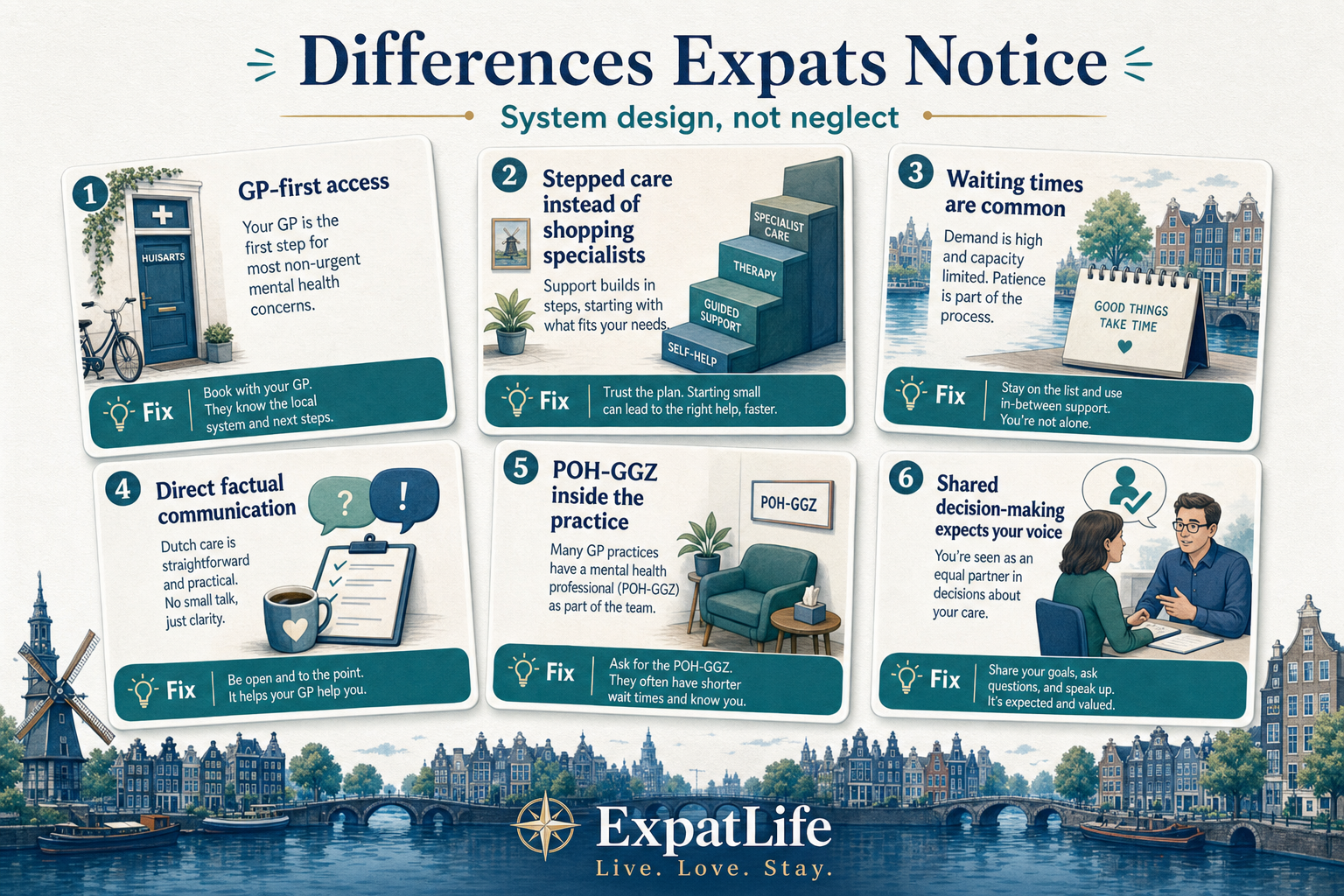
Example: contacting psychologists for weeks before learning a GP referral is required for coverage.
Fix: Start with your huisarts and ask about POH-GGZ or a GGZ referral — that conversation is the actual first step.
Example: being offered POH-GGZ before GGZ and interpreting it as dismissal.
Fix: Treat stepped care as matching intensity to need, and ask what would trigger escalation.
Example: a specialist intake months away with little explanation of interim options.
Fix: Ask immediately about interim GP/POH support, cancellation lists and insurer zorgbemiddeling.
Example: a clinician stating options and limits plainly without soft framing.
Fix: Read directness as clarity, and ask follow-up questions freely about alternatives and timelines.
Example: a focused GP slot ending before your third question.
Fix: Bring three prioritised questions in writing and state upfront what you most need covered.
Example: assuming every clinician can conduct a full mental health assessment in fluent English.
Fix: Ask when booking and arrange interpreter support for consent-level conversations.
Example: waiting for an intake while risk is rising because the 'official' pathway feels unfinished.
Fix: Use 112, 113, GP or huisartsenpost by severity — crisis care does not require completing a waitlist first.
Example: expecting a GGZ referral to solve isolation after a move without also rebuilding social structure.
Fix: Use clinical pathways when needed, and also explore community and loneliness resources alongside them.
Checklist
Good first conversations are mostly the result of ten minutes of preparation. A written timeline, an updated medication list and three clear questions change a rushed appointment into a productive one.
Preparation also means being clear about roles. You know your history and priorities; a companion can listen and take notes; your GP coordinates medical care and referrals; the POH-GGZ or GGZ clinician provides the indicated level of mental health support. When roles are clear, fewer things fall between the cracks.
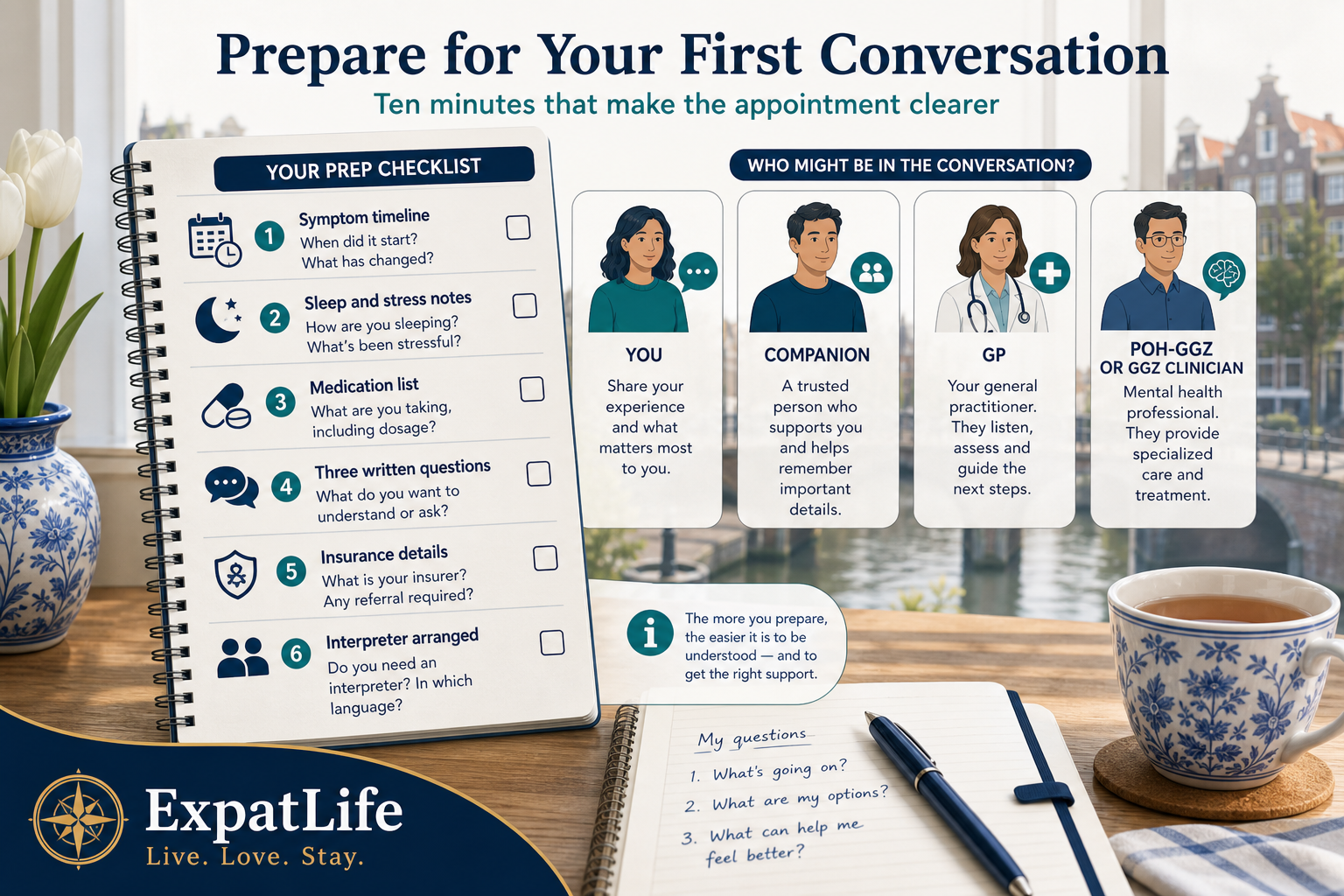
Preparation checklist
Bring history, priorities and questions; confirm you understand the next-step plan before leaving.
Listens, takes notes and helps remember what was said when the conversation is stressful.
First contact, medical coordination, POH-GGZ routing and GGZ referrals.
Practice-based first-line mental health conversations and stepped support.
Specialist assessment and treatment at the indicated intensity, then reporting back to the GP.
Answers coverage, deductible, contract and care-mediation questions about waiting times.
Avoid
These mistakes are common because mental health access models differ between countries. Each one has a straightforward fix that usually takes a single conversation.
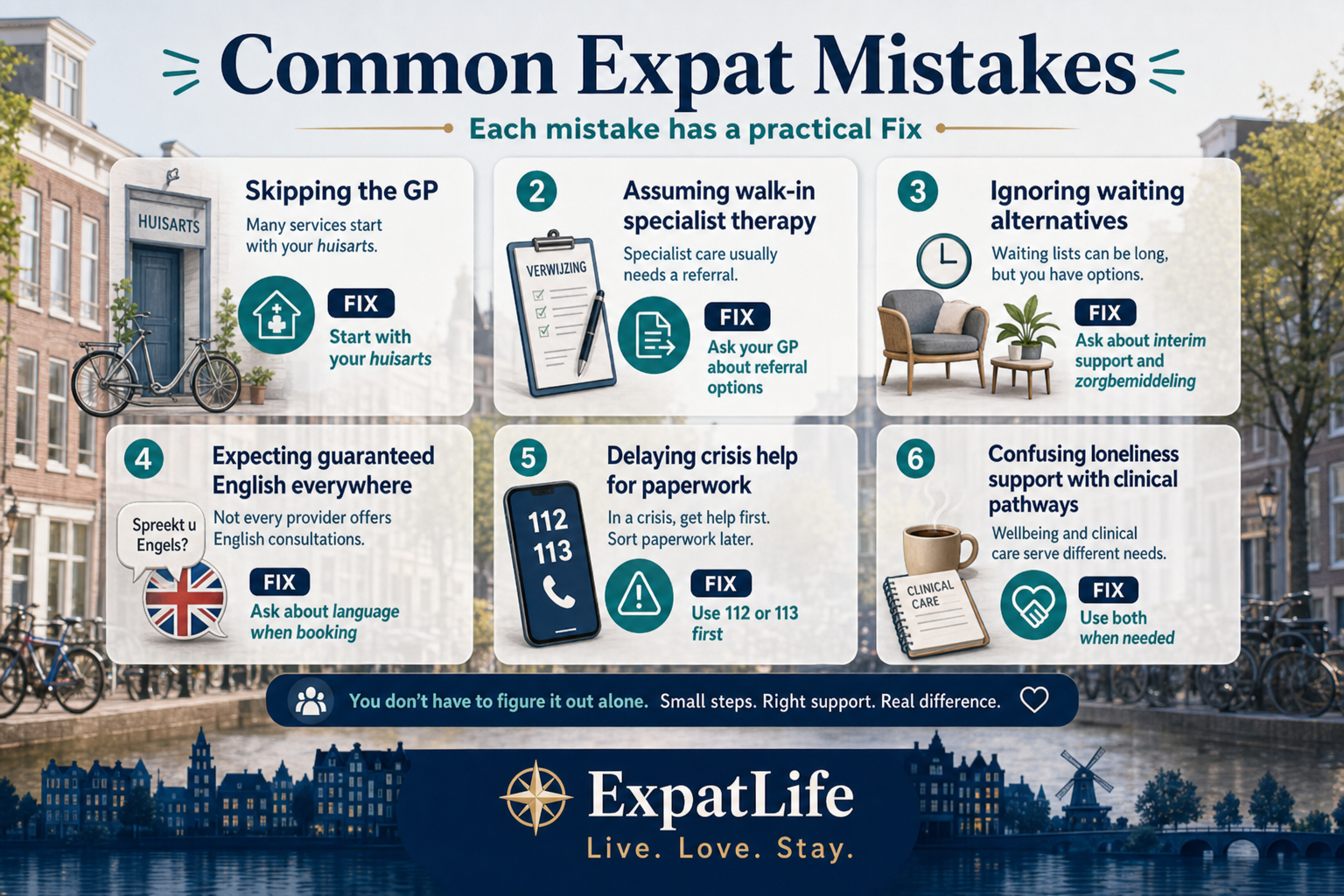
Example: emailing clinics for weeks before learning a referral is required for insured care.
Fix: Book a huisarts appointment first and ask specifically about POH-GGZ or a GGZ referral.
Example: declining practice-based support because you wanted a 'real' psychologist immediately.
Fix: Use POH-GGZ as stepped care when offered, and ask what would justify escalation to GGZ.
Example: enduring months without asking about interim support or care mediation.
Fix: Ask about interim GP/POH contact, cancellation lists and insurer zorgbemiddeling in the same week the wait is confirmed.
Example: arriving at intake and discovering language support was never arranged.
Fix: State language needs when booking and request an interpreter for complex conversations.
Example: not calling 112 or 113 while waiting for registration or a referral letter.
Fix: Use crisis doors immediately when safety is at risk — paperwork can follow.
Example: avoiding mention of suicidal thoughts so the clinician will not overreact.
Fix: Say safety concerns plainly — correct routing depends on accurate information.
Example: starting with a non-contracted provider and facing unexpected personal costs.
Fix: Check the insurer's provider list before planned specialist GGZ and ask what would be reimbursed.
Example: stopping all primary-care contact and having no coordinator for renewals or prescriptions.
Fix: Stay registered with a huisarts and make sure specialist letters reach them.
Example: waiting for therapy to invent a social life after relocation.
Fix: Use clinical pathways when needed and also rebuild community — see the expat loneliness guide.
Example: asking a teenager to translate a parent's trauma history.
Fix: Request professional interpreter support for sensitive mental health conversations.
FAQ
Orientation answers only — confirm your own situation with your GP, a mental health professional and your insurer. Call 112 for immediate danger; contact 113 for suicidal thoughts.
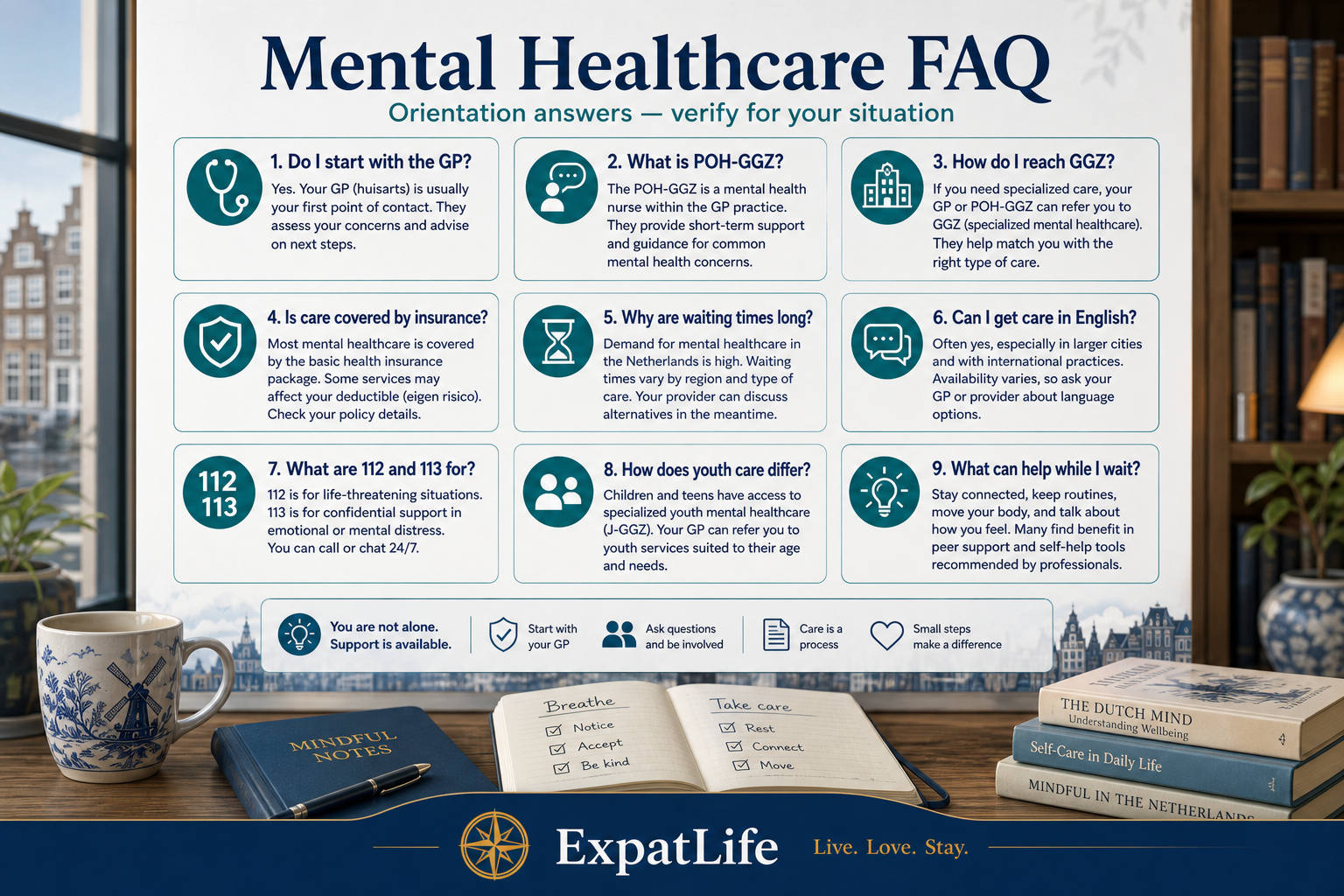
For non-emergency adult care, yes in practice — you normally start with your huisarts. Specialist GGZ usually requires a referral for insured care. POH-GGZ inside the practice is arranged through the GP practice. Crisis care is different: call 112 for immediate danger and contact 113 for suicidal thoughts.
POH-GGZ is a mental health practice nurse (or equivalent practice-based professional) working inside many GP practices. They offer structured first-line conversations and help decide whether specialist GGZ is needed. It is stepped primary-care support, not the same as specialist GGZ.
GGZ means geestelijke gezondheidszorg — specialist mental healthcare. It includes psychologists, psychiatrists and mental health institutions. Access for planned insured care normally runs through a GP referral, with insurer contracts and waiting times shaping practical options.
Medically necessary specialist GGZ is generally covered under basic insurance when indication and referral rules are met. For adults in 2026, expect the mandatory eigen risico of about €385 (or higher with voluntary top-up) to apply to specialist GGZ — so personal cost with a contracted provider is often only whatever deductible remains. GP and POH-GGZ usually sit outside that deductible. Non-contracted care can leave a much larger personal share. Children under 18 often follow municipal youth financing instead of adult billing. Always verify with your insurer.
The Dutch field standard (Treeknorm) for GGZ is 4 weeks to the first intake and 10 weeks from intake to treatment start (14 weeks total). In practice, POH-GGZ inside a GP practice is often days to about 2–4 weeks; basis GGZ totals often land around 3–4 months; specialised GGZ commonly runs longer — often about 4–6+ months depending on diagnosis and region. Always ask for the current weeks for your pathway, use interim GP/POH support while waiting, and contact insurer care mediation (zorgbemiddeling) if the wait stretches past Treeknorm or feels unsafe. Escalate via urgent or crisis doors if risk rises.
Often yes in larger cities and academic settings, but it is not guaranteed everywhere. Ask when booking whether the consultation can be in English or whether an interpreter can be arranged, especially for consent and complex decisions.
If there is immediate danger, call 112. If you are having suicidal thoughts, contact 113 Suicide Prevention (113.nl). For urgent but not immediately life-threatening situations, contact your GP during opening hours or the huisartsenpost after hours. Read the Emergency Healthcare guide for surrounding urgent-care context.
Usually not for insured planned care. Psychiatric assessment within GGZ is typically reached through GP referral and specialist intake. Your GP helps decide whether psychiatric expertise is indicated. This page does not recommend medication or specific clinicians.
Youth pathways often involve the GP, JGZ, school support and sometimes municipal jeugdhulp, with specialist youth GGZ when indicated. Organisation varies locally. Use the Healthcare for Children guide for family-system detail, and call 112 if there is immediate danger.
Relocation loneliness is common and can sit alongside clinical concerns without being the same thing. Start with your GP if mood, anxiety or functioning are affected, and also explore community rebuilding. Our Expat Loneliness guide covers the social side in depth.
Bring summaries and medication lists to your Dutch GP and ask how continuity can be arranged. A new Dutch referral is often still needed for insured GGZ. Online continuation with a foreign therapist may be a personal arrangement — check practical, legal and insurance implications yourself; this page does not endorse specific cross-border setups.
Usually your GP. Specialist letters return to primary care, which resumes ongoing coordination and can issue a new referral later if needed. Ask for a clear closing plan before specialist care ends.
Related
Mental healthcare connects to GP care, emergency routes, insurance and family pathways — read them together.
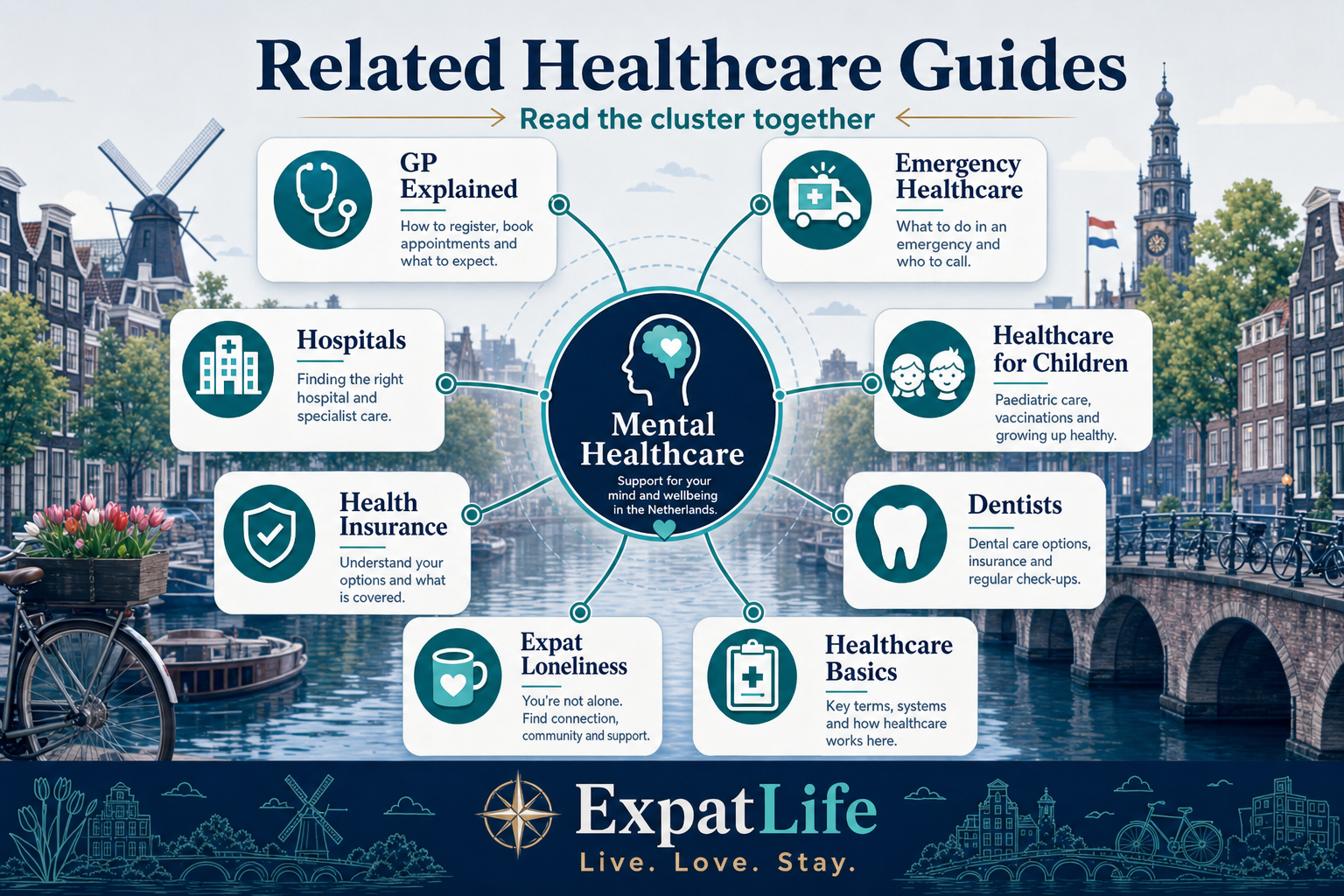
Health hub
This page is the mental healthcare cornerstone — explore related health topics next.
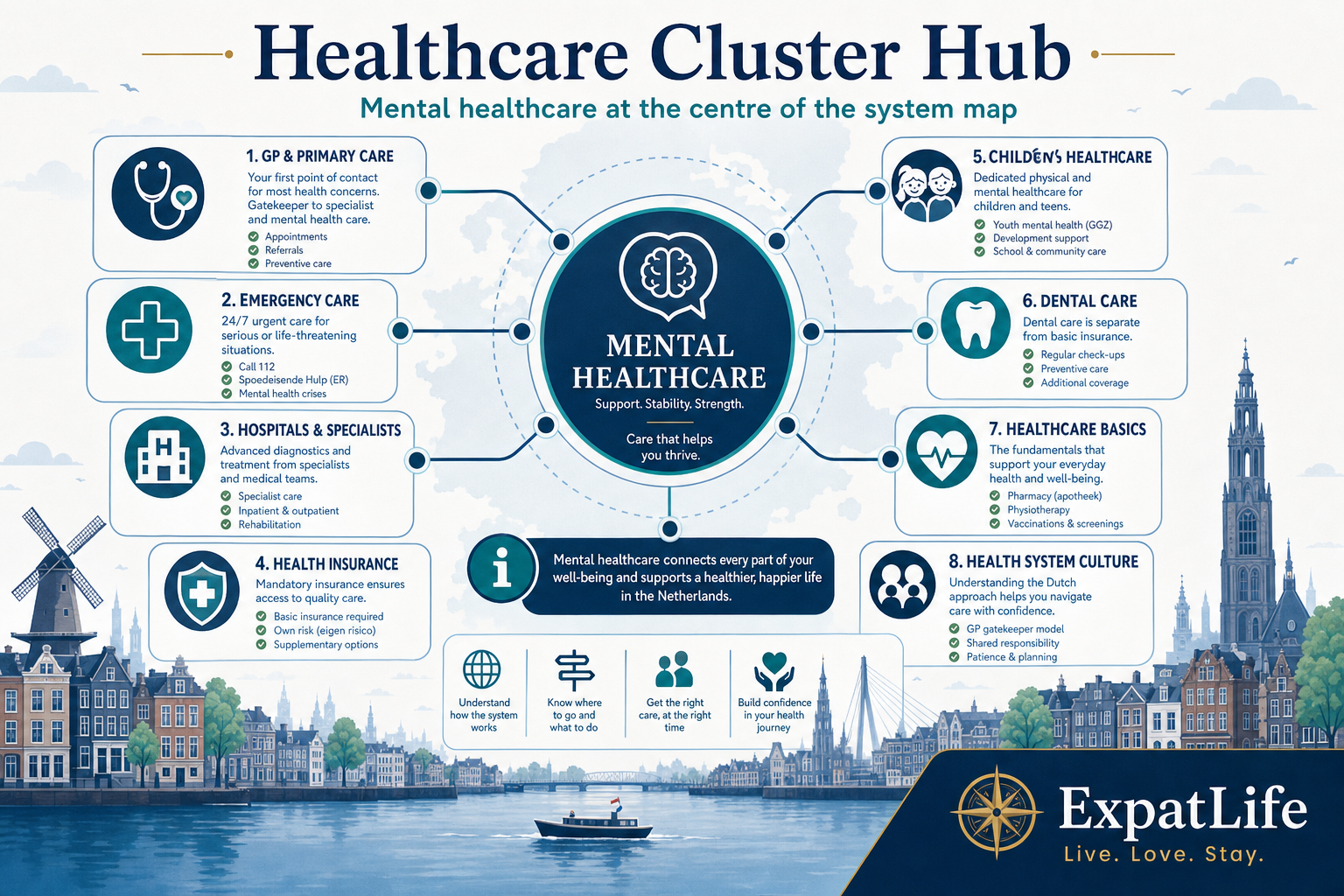
Explore next
Pick the card that matches what is still open — GP registration, emergency routes, insurance, children's care or loneliness support — and verify specifics on the official sources below.

Trust
General information only — not diagnosis, not treatment advice, and not a ranking, endorsement or quality assessment of any therapist, clinic or programme. Pathways, waiting times, insurer contracts and coverage rules change, so verify your own situation with your GP, treating clinician and insurer, alongside the official sources above. If you or someone else is in immediate danger, call 112. If you are having suicidal thoughts, contact 113 Suicide Prevention.