
Verloskundige First Line
Neighbourhood midwives often coordinate antenatal care, birth planning discussions and postpartum orientation for pregnancies remaining in midwife-led pathways.
Netherlands · Health · Maternity care
How Dutch maternity pathways work for expats — verloskundige first line, when hospital or obstetric care applies, registration timing, insurance orientation and kraamzorg awareness.
General orientation only — not medical advice, not a birth plan, and not a ranking or recommendation of any midwife practice, hospital or kraamzorg agency. For your own pregnancy, speak with your midwife, obstetric team or GP. Call 112 for life-threatening emergencies.

Quick answer
In the Netherlands, maternity care is organised around midwifery and obstetric pathways rather than an automatic obstetrician-first model. For many pregnancies, a neighbourhood verloskundige practice coordinates antenatal check-ups, discusses birth options, and stays involved around birth when midwife-led care remains appropriate.
Two ideas surprise newcomers. First: hospital birth is common and available, but it is not the only discussed option — home birth and birth centres can be part of the conversation when clinically suitable. Second: when higher-risk indications appear, transfer to obstetric or hospital pathways is a normal system feature, not a failure of the midwife model.
This guide stays inside a clear content boundary: midwife and obstetric pathway orientation, hospital birth orientation, registration timing, insurance orientation for maternity in the basic package, and a short kraamzorg awareness pointer. It is not a week-by-week pregnancy encyclopedia, not labour coaching, and not treatment advice.
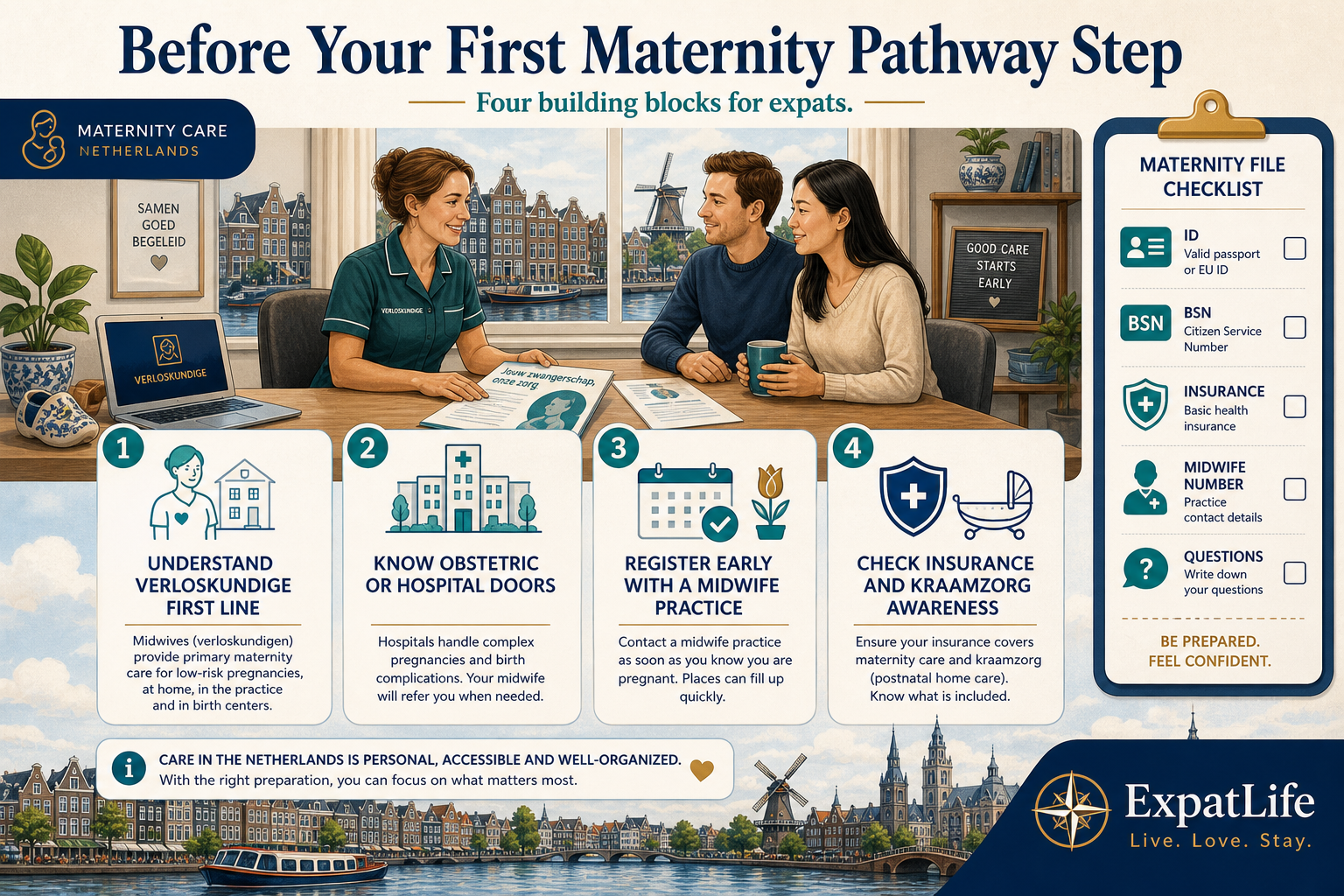
Maternity file checklist
Examples
| Situation | How it works here | First step |
|---|---|---|
| You just learned you are pregnant and feel unsure where to start | In the Dutch system, contacting a midwife practice (verloskundige) is often the practical first step for maternity pathway orientation. Your GP can also advise if you are unsure or have medical questions. | Search midwife practices near your postcode and ask about intake timing and English support. |
| You expected an obstetrician to manage the whole pregnancy from week one | Many low-risk pregnancies are midwife-led unless indications call for obstetric or hospital pathways. That difference is system design, not a lower standard of care by default. | Read the midwife and obstetric-pathway sections, then ask your midwife how your situation is classified over time. |
| You are moving to the Netherlands mid-pregnancy | Bring prior pregnancy records, medication lists and ultrasound reports. Register with a local midwife practice quickly and ask how previous care will be reviewed. | Contact practices immediately about capacity, then book GP registration if you do not have a huisarts yet. |
| You want English-language support | Many city practices can work in English, but availability varies. Ask when you enquire rather than assuming every appointment will be in English. | When calling practices, ask specifically whether antenatal visits and birth support can be in English. |
Snapshot
These six cards cover almost every maternity orientation question expats ask first — midwife first line, obstetric pathways, birth places, registration timing, insurance and kraamzorg awareness.
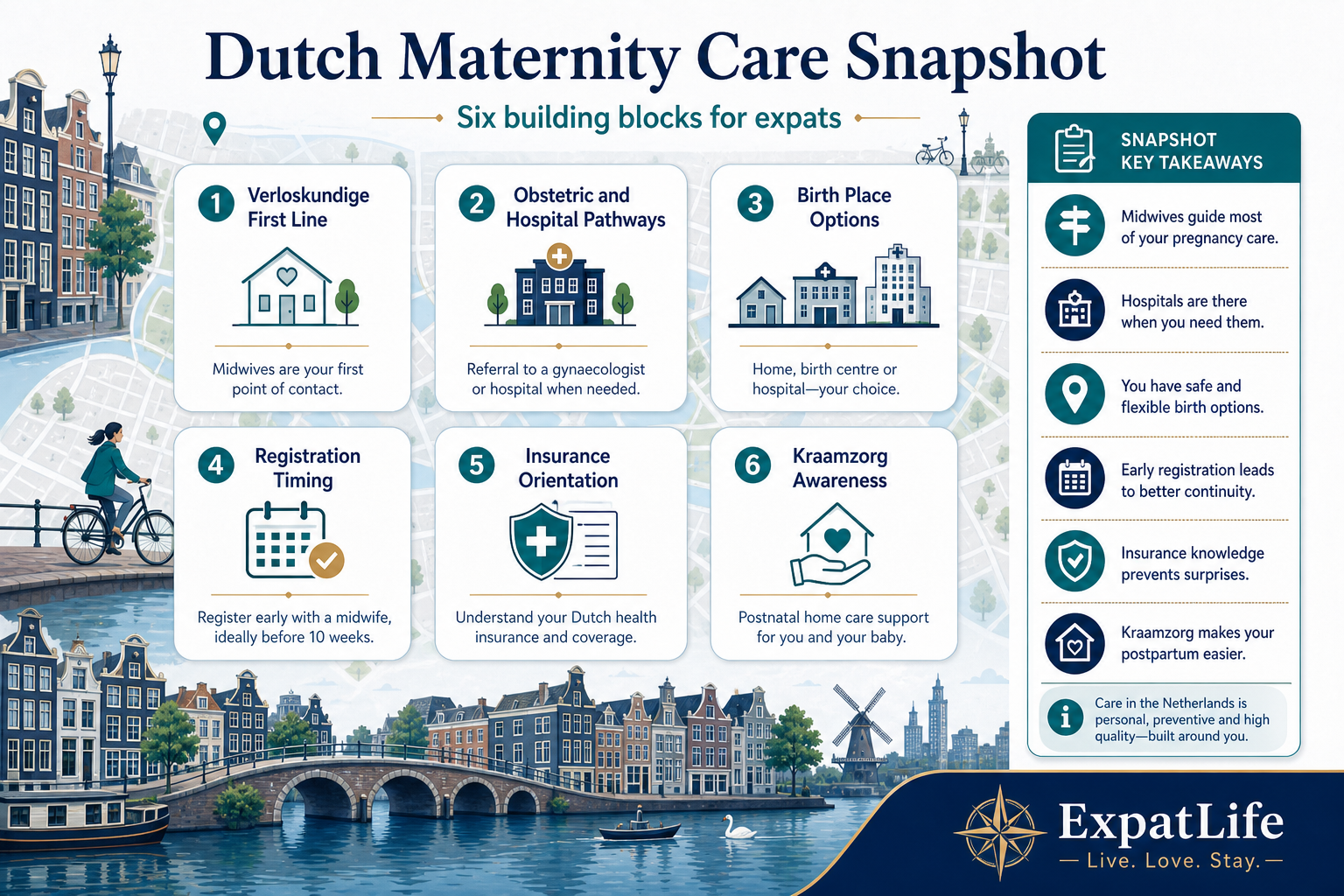
Neighbourhood midwives often coordinate antenatal care, birth planning discussions and postpartum orientation for pregnancies remaining in midwife-led pathways.
When medical indications apply, care can involve an obstetrician and/or hospital team. Transfers are a normal part of the system when needed.
Home, birth centre and hospital options may be discussed when clinically suitable. Suitability is decided with your care team — not from a generic ranking.
Contact a midwife practice early after pregnancy confirmation. Popular areas fill; intake paperwork and insurance details help the first visit.
Much maternity care is oriented within the basic health insurance package. Still verify your policy year and any own contributions, including kraamzorg.
Kraamzorg is postpartum maternity home care. This page gives a short pointer only — arrange awareness early via midwife or agency pathways.
How it works
A typical pathway starts with early registration at a midwife practice, continues with antenatal check-ups and birth-place discussions, and may stay midwife-led or move to obstetric/hospital care when indicated. Postpartum orientation includes kraamzorg awareness and children's healthcare routes for the baby.
After pregnancy confirmation, many people contact a verloskundige practice to register. Intake covers medical history, prior pregnancies, medicines and practical logistics. Your midwife explains how check-ups are scheduled and how to reach the practice outside office hours.
During pregnancy, antenatal visits monitor progress and create space to discuss birth preferences and place options. If indications appear that call for obstetric or hospital involvement, your team explains the pathway change. That coordination is a core design feature of Dutch maternity care.
Around birth and afterward, midwife involvement often continues for midwife-led pathways, while hospital teams lead when obstetric care is indicated. Kraamzorg can support the first days at home. Baby follow-up then connects strongly to JGZ / Healthcare for Children pathways.
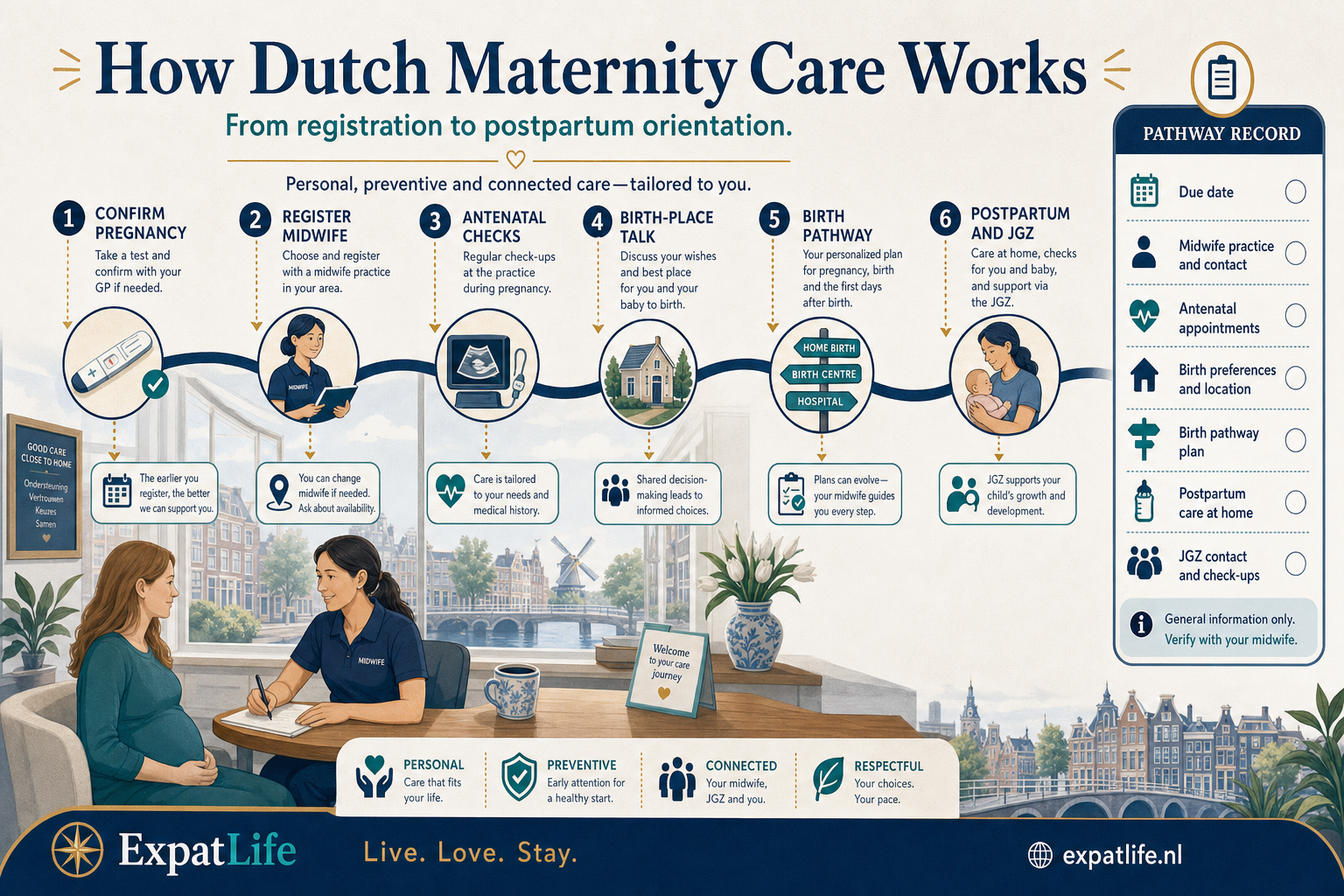
Maternity pathway
Stage 1
You confirm pregnancy (often via test and then practice contact). Gather ID, insurance and any prior medical notes.
Stage 2
Contact nearby verloskundige practices about capacity and intake. Ask about language and how they coordinate with local hospitals.
Stage 3
Attend scheduled visits, share symptoms early, and keep medication lists updated. Your team explains screening offers and next appointments.
Stage 4
Discuss home, birth centre or hospital options when relevant, and understand when obstetric pathways may apply.
Stage 5
Birth may remain midwife-led or take place in hospital with obstetric involvement when indicated. Follow the urgent-contact instructions you were given.
Stage 6
Arrange kraamzorg awareness in advance when possible. After birth, connect to JGZ / children's healthcare orientation for the baby.
How to
Step 1
Have ID, BSN, insurance details and a short medical history ready before you call practices.
Step 2
Ask about capacity, intake timing, English support and how the practice works with local hospitals.
Step 3
Share prior records, medicines and questions. Save the practice phone and out-of-hours instructions.
Step 4
Attend check-ups, raise concerns early, and keep a simple written list of questions for each visit.
Step 5
Use appointments to understand midwife-led versus obstetric/hospital pathways for your situation — clinical suitability comes first.
Step 6
Ask your midwife how kraamzorg registration works in your area and what own contribution to expect from your insurer information.
Step 7
Before late pregnancy, confirm whom to call day and night for urgent pregnancy concerns, and when 112 is appropriate.
Step 8
After birth, follow midwife/hospital discharge guidance and use Healthcare for Children for JGZ and baby healthcare orientation.
Midwife
For many pregnancies, a verloskundige (midwife) is the first and main professional coordinating maternity care. Understanding that door helps expats avoid waiting for an obstetrician-only model that is not how Dutch care is usually organised.
Midwife practices are often neighbourhood-based. They schedule antenatal visits, discuss screening offers at a high level, help you prepare practical birth questions, and explain how to reach them urgently. They also coordinate with GPs and hospitals when needed.
Midwife-led care does not mean 'no hospital ever'. It means the midwife remains the coordinating door while the pregnancy stays within the indications for that pathway. If indications change, obstetric or hospital teams become involved.
This page does not tell you which practice to choose and does not give clinical advice about your pregnancy. Those conversations belong with your midwife, obstetric team or GP.
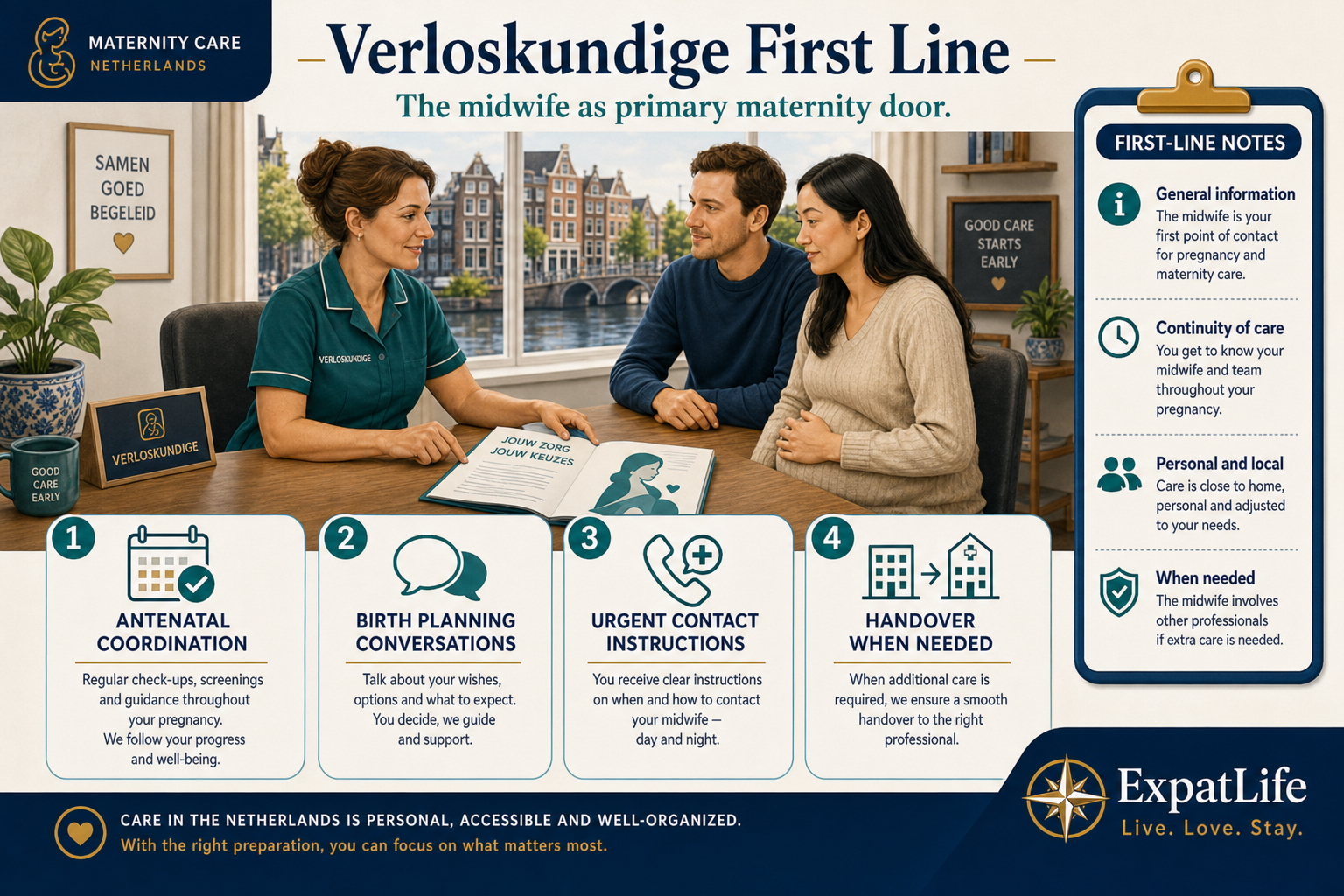
Check-ups, practical counselling and appointment rhythm usually sit with the midwife practice for midwife-led pathways.
Preferences and place options are discussed with clinical suitability in mind — not as a menu of guaranteed choices.
Once registered, you should know how to reach the practice or on-call midwife route outside office hours.
If indications call for obstetric or hospital care, midwife teams coordinate the pathway change with you.
| Door | Focus | When it applies | Note |
|---|---|---|---|
| Verloskundige (midwife) | First-line maternity coordination for many pathways | Common starting door after pregnancy confirmation | Coordinates with GP and hospital when needed |
| Obstetrician / hospital team | Specialist and hospital-based maternity care | When clinical indications apply | May be planned from intake or after transfer |
| GP (huisarts) | Primary care registration and general health | General questions, other illness, system entry | Not a substitute for maternity pathway registration |
| Emergency routes | 112 / urgent medical pathways | Life-threatening emergencies | Also know your midwife urgent instructions |
Midwife checklist
Examples
| Situation | How it works here | First step |
|---|---|---|
| You feel healthy and want a clear first phone call | Calling midwife practices is usually the right maternity starting move after pregnancy confirmation. | Ask: 'Do you have capacity for my due month, and can visits be in English?' |
| You have a complex medical history | Tell the practice at first contact. Intake may involve obstetric pathway discussion earlier. | Prepare a one-page history and medication list before the intake call. |
| Your GP already knows you are pregnant | The GP can advise and may point you to midwife registration; maternity pathway care still typically centres on midwifery/obstetrics. | Ask the GP practice assistant for local midwife registration tips, then call practices. |
| You cannot find capacity nearby | Widen the postcode search, ask practices about waitlists, and keep your GP informed. | Call three practices the same day and note reply timelines. |
Obstetric pathways
Obstetric and hospital maternity pathways are used when clinical indications call for specialist monitoring, hospital birth, or other hospital-based care. Understanding the 'why' helps expats interpret transfers calmly.
Some pregnancies begin in obstetric or hospital pathways because of medical history or known indications. Others start midwife-led and later transfer when new indications appear. Both patterns are normal in the Dutch system.
A transfer is not automatically a judgement about your birth preferences. It is a clinical pathway change. Your team should explain what is changing and who coordinates next appointments.
This guide does not list indications as medical advice. Only your midwife or obstetric team can interpret your situation. For hospital system context, see the Hospitals guide; for urgent symptoms, see Emergency Healthcare.
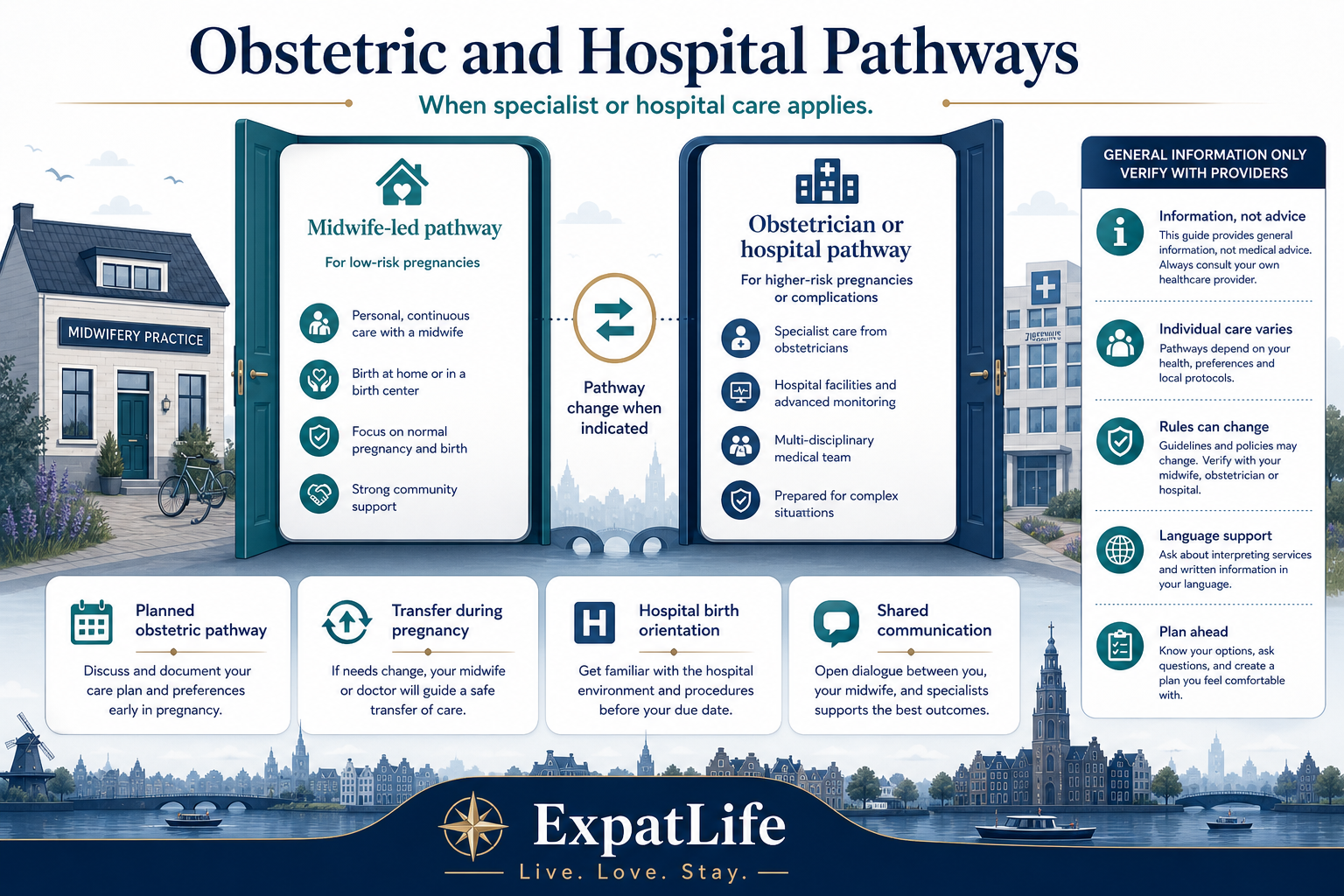
Known medical indications may mean obstetric or hospital-led care from early on, with midwife collaboration depending on local practice.
If new indications appear, care can move to obstetric/hospital pathways. Ask what changes for appointments and birth place.
Hospital birth may be planned or become appropriate during labour. Bring ID, insurance details and your care-team instructions.
You should leave pathway conversations knowing who to call and which team is now primary.
| Route | When | How | Note |
|---|---|---|---|
| Midwife-led pathway | Pregnancy remains within midwife-care indications | Antenatal visits at midwife practice; birth place per clinical discussion | Can transfer if indications change |
| Obstetric / hospital pathway | Clinical indications call for specialist or hospital-based care | Appointments and birth planning with obstetric/hospital team involvement | Local collaboration models vary |
| Urgent midwife / GP route | Urgent pregnancy concerns that are not life-threatening | Use the urgent instructions your practice gave you | Do not wait for a routine antenatal slot |
| 112 emergency | Life-threatening emergencies | Call 112 | See Emergency Healthcare for urgent system orientation |
Obstetric pathway checklist
Examples
| Situation | How it works here | First step |
|---|---|---|
| Your midwife mentions a hospital consultation | Treat it as a pathway conversation. Ask what question the hospital visit answers and who follows up afterward. | Write three questions: why, what changes, who is my main contact now? |
| You strongly prefer hospital birth from the start | Share preferences early. Suitability and local pathway rules still guide what is possible. | Ask at intake how hospital birth planning works in that practice's network. |
| You are anxious about 'transfer' language | Transfers are common when indications appear. Ask for plain-language explanations and interpreter support if needed. | Request a written summary of the next step after the consult. |
| You need secondary-care context | Use the Hospitals guide for referrals, admissions and hospital expectations — keep maternity clinical questions with your maternity team. | Open Hospitals for system orientation, then bring practical hospital questions to your midwife/obstetric appointment. |
Birth places
Dutch maternity conversations often include birth-place options. This is orientation about the map — not a promise that every option is suitable for every pregnancy.
Depending on clinical suitability and local organisation, discussions may include home birth with midwife support, birth in a birth centre (geboortecentrum), or hospital birth. Suitability can change during pregnancy or labour.
Expats sometimes hear 'home birth is common in the Netherlands' and over-interpret it. Home birth can be part of the system for some pathways; it is not a requirement, and it is not appropriate for every situation.
Your midwife or obstetric team explains what is realistic for you. This page does not recommend a place of birth.
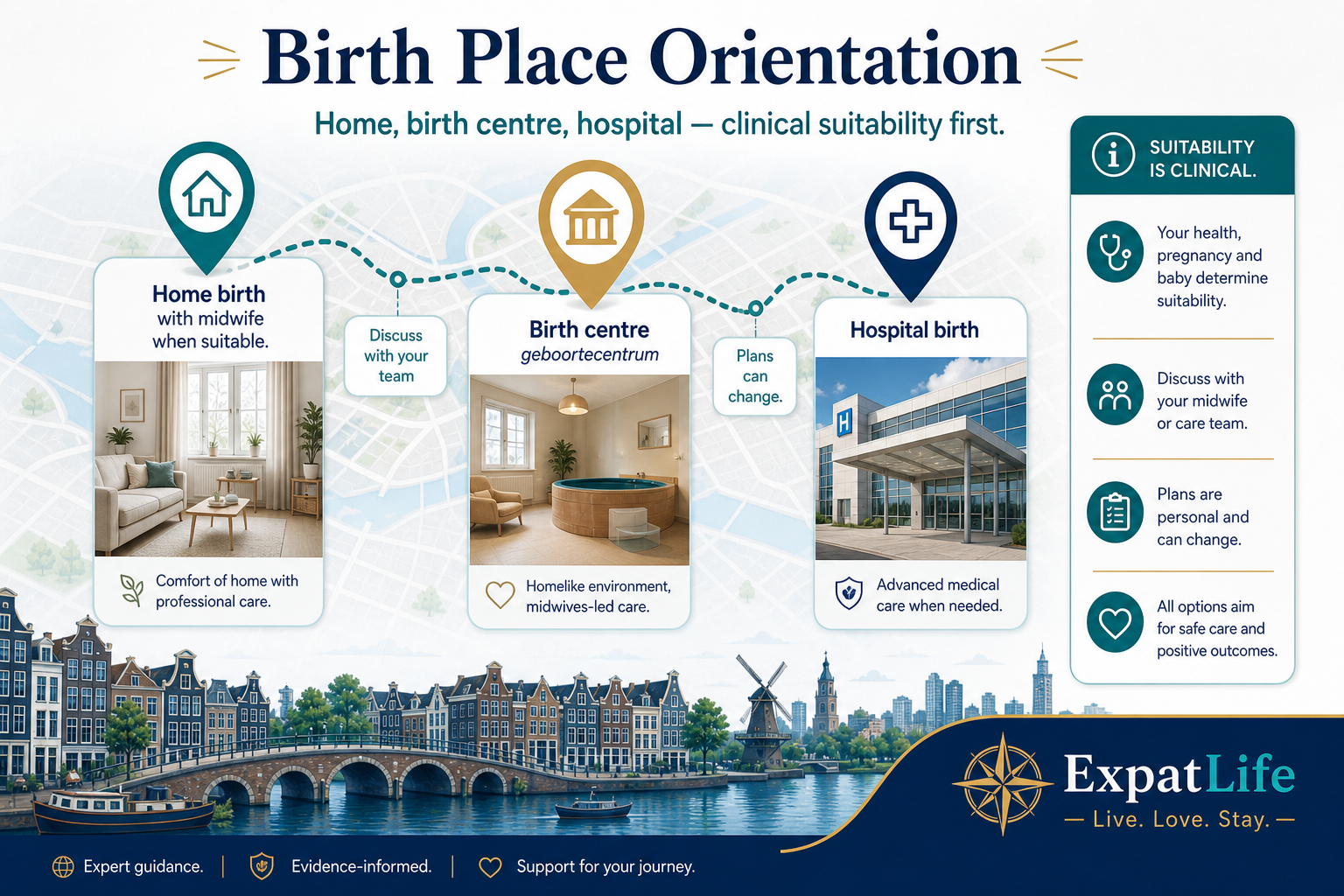
Discussed when clinically suitable and locally supported. Logistics and urgent transfer plans are part of the conversation with your team.
Some regions offer geboortecentrum options linked to midwifery and hospital networks. Availability is local.
Hospital birth may be preferred, planned for indications, or become appropriate during labour. Know parking, entrance and document needs in advance.
Plans can change. Ask how transfers work and which number to call if labour starts.
Birth-place conversation stages
Stage A
Share preferences without treating them as guarantees; ask what factors matter in Dutch pathways.
Stage B
Antenatal visits revisit whether midwife-led place options remain appropriate.
Stage C
Confirm numbers, routes, documents and what to do when labour starts.
Stage D
Follow your team's guidance if transfer or hospital care becomes appropriate.
Call 112 now
Life-threatening emergency in pregnancy or postpartum
Call 112. Do not wait for a routine antenatal slot.
Same day / out of hours
Urgent pregnancy concern (severe symptoms) outside life-threatening emergencies
Use the urgent midwife / practice instructions you were given, or GP / Huisartsenpost pathways when directed.
Planned route
Routine antenatal question or scheduling
Contact your midwife practice during listed hours or use their normal messaging route.
Birth-place checklist
Examples
| Situation | How it works here | First step |
|---|---|---|
| You assumed hospital birth was automatic | Ask how place-of-birth discussions work in your practice. Hospital birth remains available when appropriate. | Put 'birth place options' on your next appointment question list. |
| You want home birth because you read it is 'Dutch culture' | Culture notes are not clinical clearance. Suitability is individual and can change. | Ask your midwife what factors they review before home birth remains on the table. |
| You live far from the hospital | Travel time is a practical planning factor. Discuss it explicitly with your team. | Estimate night-time travel time and share it at a check-up. |
| Your preference and clinical advice differ | Ask for plain-language reasons and what monitoring or place change is recommended. | Request a written summary of the agreed plan after the consult. |
Registration
Early registration is one of the highest-value expat actions in Dutch maternity care. Practices plan capacity by due month; waiting can shrink your options.
After pregnancy confirmation, contact midwife practices promptly — especially in larger cities and popular neighbourhoods. Ask about intake timing, documents, language and how they work with nearby hospitals.
If you are new to the Netherlands, also progress GP registration and insurance paperwork in parallel. Maternity pathway care still centres on midwifery/obstetrics, but Dutch healthcare works better when your huisarts and insurer details are in order.
Moving mid-pregnancy requires extra speed: bring prior records and explain your due date clearly on first contact.
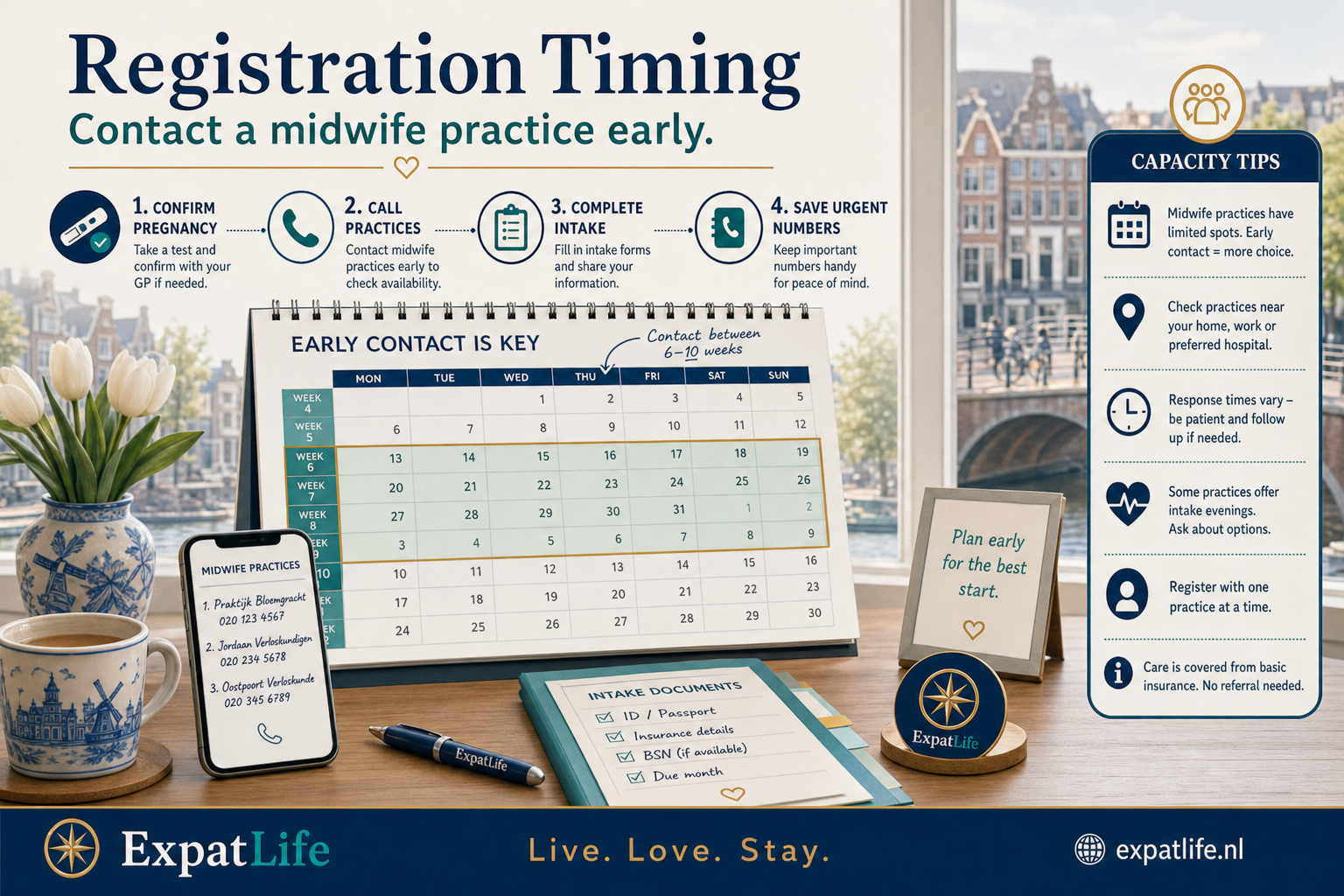
Do not wait until the second trimester to discover local capacity limits.
ID, BSN, insurance, medical history and prior pregnancy notes speed registration.
Confirm English (or interpreter needs) when you enquire, including for later birth support if relevant.
GP registration and insurer details support the wider healthcare system around maternity care.
| Route | When | How | Note |
|---|---|---|---|
| Midwife practice registration | As soon as pregnancy is confirmed (or on arrival if mid-pregnancy move) | Phone or online enquiry → intake → antenatal schedule | Primary maternity pathway door for many people |
| GP registration | If you do not yet have a huisarts | Register with a local GP practice | Supports coordination and non-maternity care |
| Insurer details check | Early pregnancy admin | Confirm policy active; ask maternity / kraamzorg contribution questions | Verify for your policy year |
| Kraamzorg awareness | Often during pregnancy, not after birth only | Ask midwife which registration route applies locally | Short pointer — not full encyclopedia here |
Registration checklist
Examples
| Situation | How it works here | First step |
|---|---|---|
| You confirmed pregnancy this week | Start midwife calls now, even if your first intake is weeks away. | Call two practices today and ask about capacity for your due month. |
| Practices say they are full | Ask for waitlists and neighbouring-area referrals; keep trying promptly. | Widen your postcode radius and call three more practices. |
| You arrive at week 28 | Treat registration as urgent admin. Bring foreign records translated if possible. | Email/call practices with due date, week number and record summary attached. |
| You only want a hospital registration desk | Hospital pathways still usually connect to maternity network rules. Ask hospital maternity information desks how local registration works, and still clarify midwife vs obstetric doors. | Ask: 'How do expats register for maternity care in this hospital network?' then follow the answer with midwife/obstetric intake as directed. |
Costs
Much maternity care sits in the basic health insurance package (basisverzekering). The money surprises for expats are usually kraamzorg own contribution, and a possible own contribution if you choose a polyclinic hospital birth without a medical indication. Use the indicative 2026 figures below for planning — then verify with your insurer.
Midwife care (verloskundige), medically indicated obstetric/hospital birth care, and standard maternity pathway elements are generally oriented in the basic package. Core midwifery and obstetric maternity care usually sits outside eigen risico — but some related diagnostics, transport or non-maternity services can still touch deductible rules. Always verify the billing route for your situation.
Kraamzorg (postpartum maternity home care) is covered from the basic package for indicated hours (commonly oriented between about 24–80 hours; many families land somewhere around the mid-40s). In 2026 the statutory own contribution (eigen bijdrage) for kraamzorg at home is about €5.70 per hour. At roughly 45–49 hours that often lands around €250–€280 out of pocket — unless your aanvullende verzekering reimburses (part of) that contribution.
If you choose a polyclinic hospital or birth-centre birth without a medical indication, a separate statutory own contribution commonly applies. Orientation figures for 2026 often put that household contribution toward roughly €450–€600+ depending on the facility tariff versus the basic-package contribution. Medically indicated hospital birth is typically covered without that same own-contribution logic — confirm with your midwife and insurer. This is orientation only — not a quote.
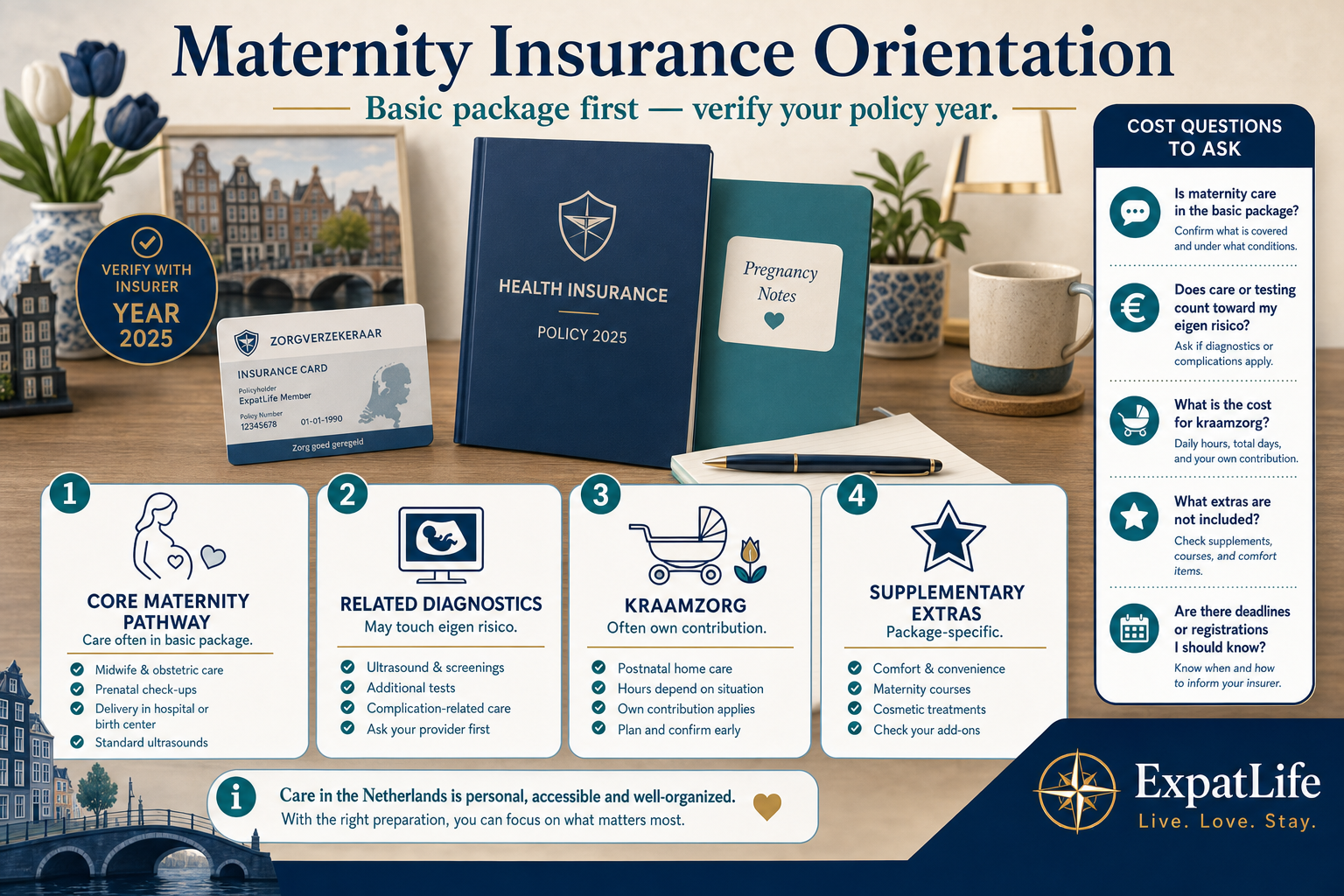
Indicative cost orientation for 2026 planning conversations — not a fee schedule, quotation or reimbursement promise. Hours, facility tariffs and package extras change by indication, insurer and policy year. Always verify remaining eigen risico relevance, kraamzorg hour indication, own-contribution amounts and any aanvullende reimbursement before you rely on a number.
| Cost item | Indicative figure | What you usually pay | Note |
|---|---|---|---|
| Midwife / obstetric maternity pathway care | Usually covered via basic package | Typically €0 for core maternity pathway care | Usually outside eigen risico — verify edge cases with insurer. |
| Kraamzorg own contribution (home, 2026) | About €5.70 / hour | Often roughly €250–€280 for ~45–49 indicated hours | Hours commonly oriented ~24–80; indication sets your total. |
| Kraamzorg hours (orientation) | Often about 24–80 indicated hours | Own contribution × indicated hours (unless aanvullend reimburses) | Ask midwife/agency for your expected indication band. |
| Polyclinic hospital birth (no medical indication) | Statutory own contribution — often toward ~€450–€600+ | Facility-dependent residual after basic contribution | Medically indicated hospital birth usually follows different cover rules. |
| Birth-centre / kraamhotel stay without medical indication | Often ~€45 / day own contribution (mother + child combined orientation) | Daily own contribution while you stay under those rules | Confirm 2026 day tariffs with insurer and facility. |
| Related diagnostics / non-maternity services | May interact with eigen risico (~€385 adult mandatory in 2026) | Depends on the service code and remaining deductible | Ask before optional extras; maternity core care is different. |
| Aanvullende package extras | Package-specific reimbursement for eigen bijdrage | Premium for packages that refund kraamzorg / birth own contribution | Compare before renewal if you expect pregnancy costs. |
| Adult mandatory eigen risico (2026 context) | About €385 / year (higher with voluntary top-up) | Usually not for core midwifery/kraamzorg — may apply to other care | Eigen bijdrage ≠ eigen risico — both can appear on maternity budgets. |
Essential maternity pathway care is oriented in basisverzekering — budget stress usually comes from own contributions, not from midwife visit fees.
Plan for about €5.70 per indicated kraamzorg hour at home. Roughly 45–49 hours often means about €250–€280 unless aanvullend helps.
Without a medical indication, a polyclinic hospital birth can add a statutory own contribution (often toward €450–€600+). Medically indicated stays follow different rules.
Some supplementary packages reimburse kraamzorg or birth own contributions — useful to check before January switching season.
Insurance checklist
Examples
| Situation | How it works here | First step |
|---|---|---|
| You worry maternity care will be fully self-pay | Core midwife and medically indicated obstetric pathway care is generally oriented in basic insurance. Budget instead for kraamzorg own contribution (~€5.70/hour in 2026) and any non-indicated hospital birth contribution. | Message insurer support: 'Please confirm maternity pathway cover, 2026 kraamzorg eigen bijdrage, and polyclinic birth own contribution for my package.' |
| You expect about 49 hours of kraamzorg | Multiply indicated hours by about €5.70 for a rough 2026 own-contribution estimate (often around €280), then check whether aanvullend reimburses any of it. | Ask your midwife/agency for the expected indication band and ask insurer what aanvullend refunds. |
| You want a hospital birth without a medical indication | Expect a statutory own contribution that can land toward roughly €450–€600+ depending on facility tariffs — verify exact 2026 figures before you decide. | Ask midwife and insurer for the polyclinic birth own-contribution estimate for your preferred hospital. |
| You change insurer in January while pregnant | Confirm continuity of maternity pathway billing, kraamzorg contribution rules and update your midwife practice with new policy details. | Send the new insurance card to the practice admin as soon as it is available. |
Recommended
Use these referral options when you want to compare insurance packages that can refund kraamzorg or birth own contributions, or when you are planning childcare after birth. This is not a ranking of midwives, hospitals or kraamzorg agencies — confirm clinical and local registration routes with your midwife.
Recommended support
Start here for package comparison and childcare discovery. Midwife and kraamzorg agency registration still happens via your local maternity pathway — we do not rank clinical providers. Indicative 2026 kraamzorg own contribution is about €5.70 per hour.
Independer
Netherlands-wideCompare Dutch basic and supplementary insurance — useful when checking packages that reimburse kraamzorg or polyclinic-birth own contributions.
Free comparison; premiums and eigen-bijdrage reimbursements vary by package.
Visit provider →Kinderdagverblijf.nl
Netherlands-wideSearch daycare centres by location while you plan the months after birth — waiting lists can be long in busy cities.
Directory for discovery; confirm fees and availability with each centre.
Visit provider →Sitters.nl
Netherlands-wideFlexible babysitting for evenings or gaps before a fixed daycare slot — useful after the kraamzorg weeks.
Confirm hourly rates and vetting on the platform.
Visit provider →Also useful: Health insurance guideHealth insurance comparisonHealth insurance providersHealthcare for ChildrenBrowse all services
Some links are affiliate or referral links. If you use them, we may earn a commission at no extra cost to you. Ordering reflects editorial relevance for expats, not pay-to-rank. This is not medical advice and not a clinic or agency ranking. Learn more
Kraamzorg
Kraamzorg is postpartum maternity home care in the Netherlands. This section is a short awareness pointer only — not a full kraamzorg encyclopedia.
Many families arrange kraamzorg during pregnancy so support can start after birth at home. Hours, scheduling and own contribution depend on indication, availability and insurer rules.
Your midwife is usually the practical person to ask which registration route applies locally. Agencies and availability vary by region and season — arrange awareness early rather than only after discharge.
For baby healthcare after the first days — consultatiebureau / JGZ orientation — use Healthcare for Children. That page is the stronger home for ongoing child health system questions.
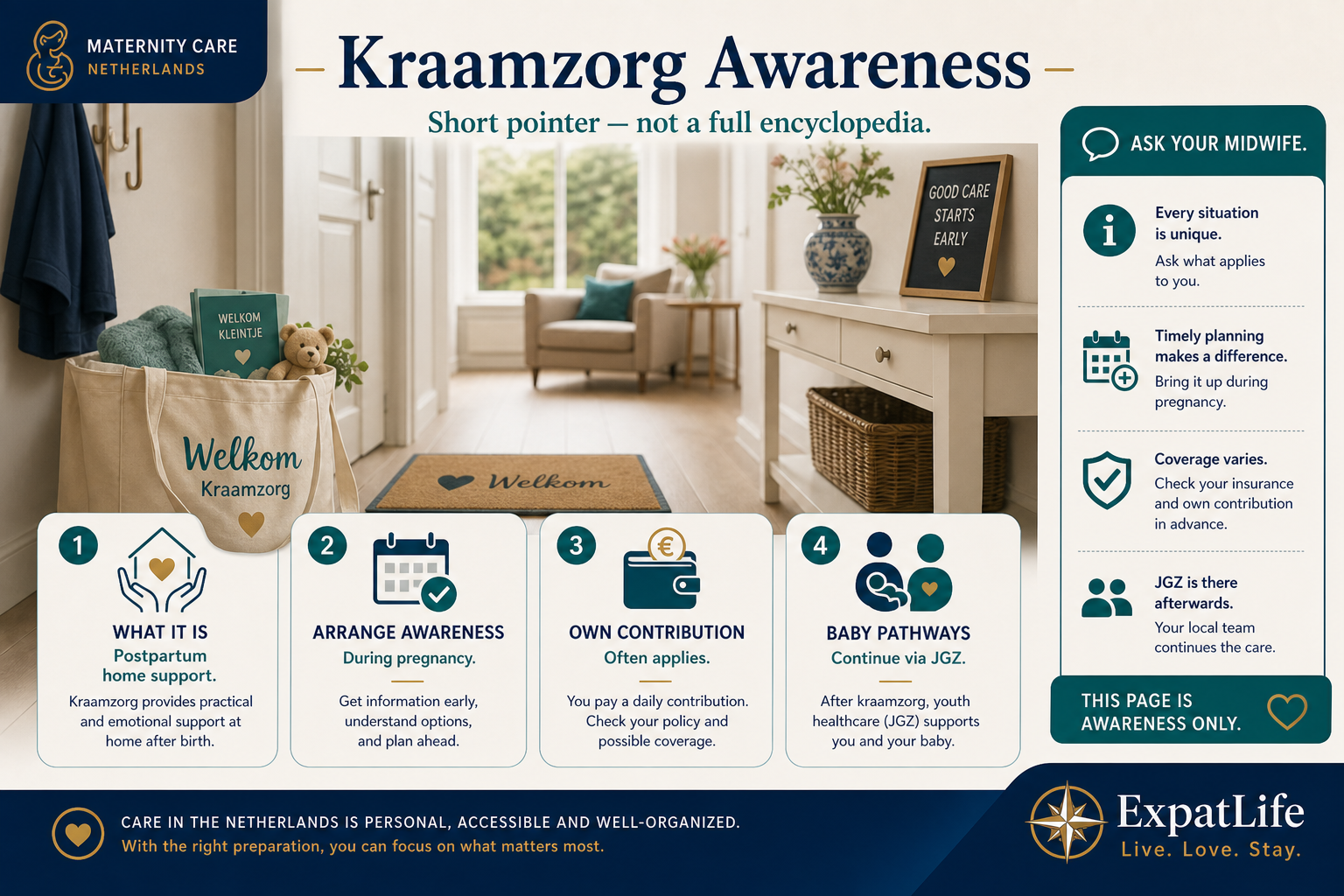
Postpartum maternity home support in the first days after birth — practical and care-support oriented under local rules.
During pregnancy, via midwife guidance and local registration routes — not only after you are home.
In 2026 the statutory own contribution for kraamzorg at home is about €5.70 per hour. Roughly 45–49 indicated hours often means about €250–€280 unless aanvullend reimburses part of it — verify with your insurer.
We do not expand into a full kraamzorg guide here. Ask your midwife for the local operational path.
Kraamzorg awareness checklist
Examples
| Situation | How it works here | First step |
|---|---|---|
| You have never heard of kraamzorg | Treat it as a standard Dutch postpartum support concept to ask about during pregnancy. | Add 'kraamzorg registration' to your next midwife appointment agenda. |
| You plan to have family flying in for help | Family help and kraamzorg can coexist, but registration timing still matters if you want agency support. | Ask what happens if you decline or reduce hours — then decide with full information. |
| You will stay with relatives in another city after birth | Location affects kraamzorg logistics. Tell your midwife the planned postpartum address early. | Confirm which address should be used for kraamzorg planning. |
| You want deep kraamzorg detail | Use your midwife and insurer for operational detail. This cornerstone stays at awareness level by design. | Ask the practice for their standard kraamzorg explanation sheet or trusted local link. |
Finding
Finding care usually means finding a midwife practice with capacity, confirming language and hospital-network fit, and knowing how obstetric pathways work if indications apply.
Search by postcode, ask neighbours or expats for process tips (not rankings), and call practices directly about capacity. Ask how the practice collaborates with local hospitals and what happens if transfer is needed.
If your history suggests obstetric pathways from the start, say so on first contact so the practice can explain the local route. Hospital information desks can also explain network registration habits — still clarify who your primary maternity team will be.
This site does not recommend or rank midwives, hospitals or kraamzorg agencies.
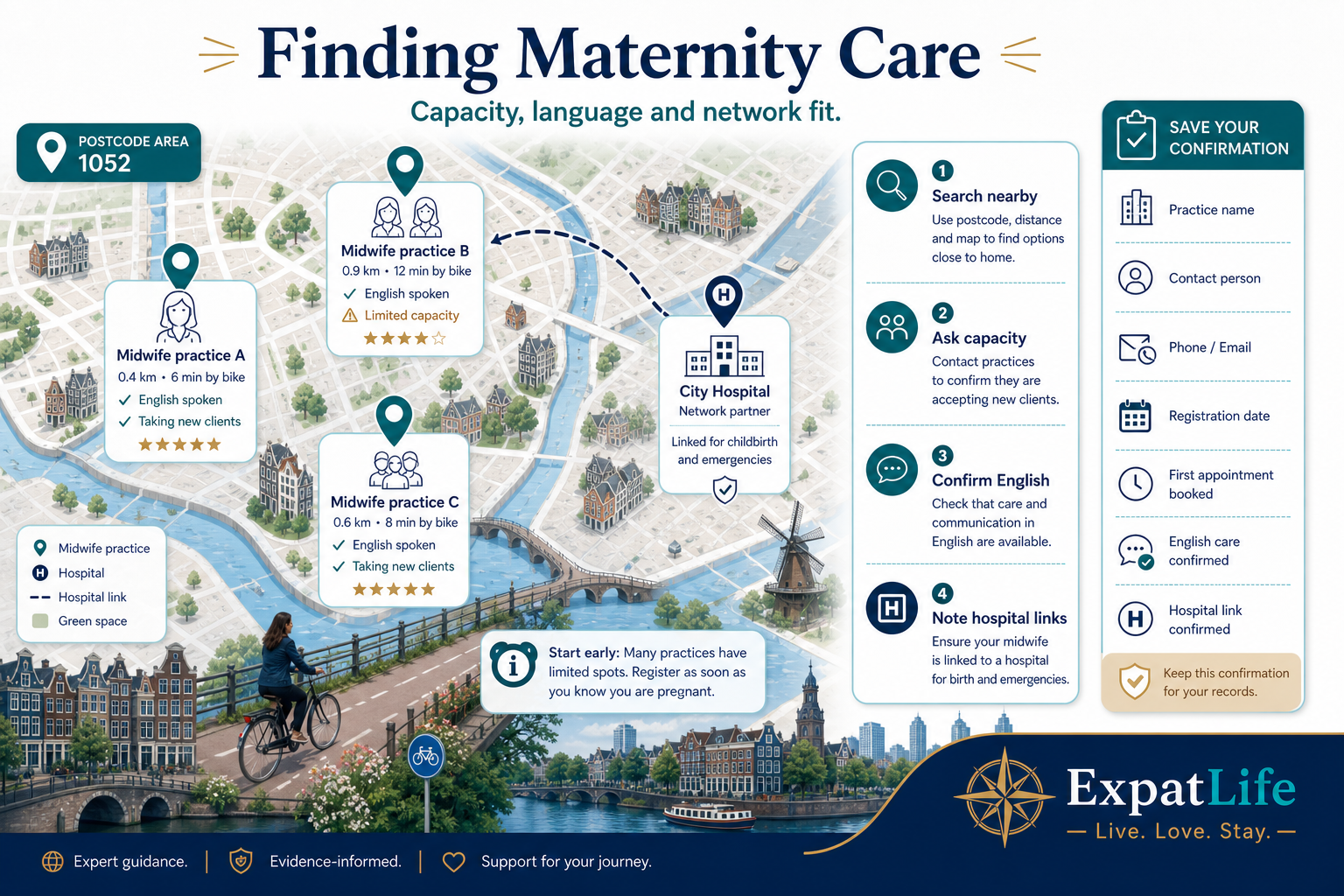
Start with practices close to home; night-time travel time matters later.
Due month, intake timing and whether the practice is accepting new clients.
Antenatal English support and labour-language realities can differ — ask both.
Understand linked hospitals and obstetric referral habits at a high level.
| Route | When | How | Note |
|---|---|---|---|
| Midwife practice search | Starting maternity pathway | Postcode search + phone/email enquiry | Most common expat starting move |
| Hospital maternity information | You need network/process clarity | Ask how registration works in that hospital's maternity network | Still clarify midwife vs obstetric primary door |
| GP practice assistant | You need local process tips | Ask how patients usually register for maternity care locally | Helpful pointer, not a substitute for midwife intake |
| Insurer support | Coverage and contribution questions | Portal message or phone | Does not replace clinical registration |
Finding checklist
Examples
| Situation | How it works here | First step |
|---|---|---|
| Two practices have capacity | Compare practical fit: language, distance, hospital links and how questions are answered — not online star ratings. | Ask each the same three questions and compare notes the same day. |
| You need obstetric-led care from the start | State indications/history clearly and ask which registration route the region uses. | Call and say you need guidance on obstetric pathway registration, then follow their intake instructions. |
| English is essential for you | Confirm the care team language, not only reception English. | Ask: 'Can antenatal visits and birth support be in English with the treating team?' |
| You found conflicting forum advice | Prefer your midwife/obstetric team and official sources over anonymous threads. | Bring the conflicting claim to your intake as a clarifying question. |
Differences
Dutch maternity care can feel unfamiliar if you expected obstetrician-first, hospital-only pathways. These differences are system characteristics — once expected, planning gets easier.
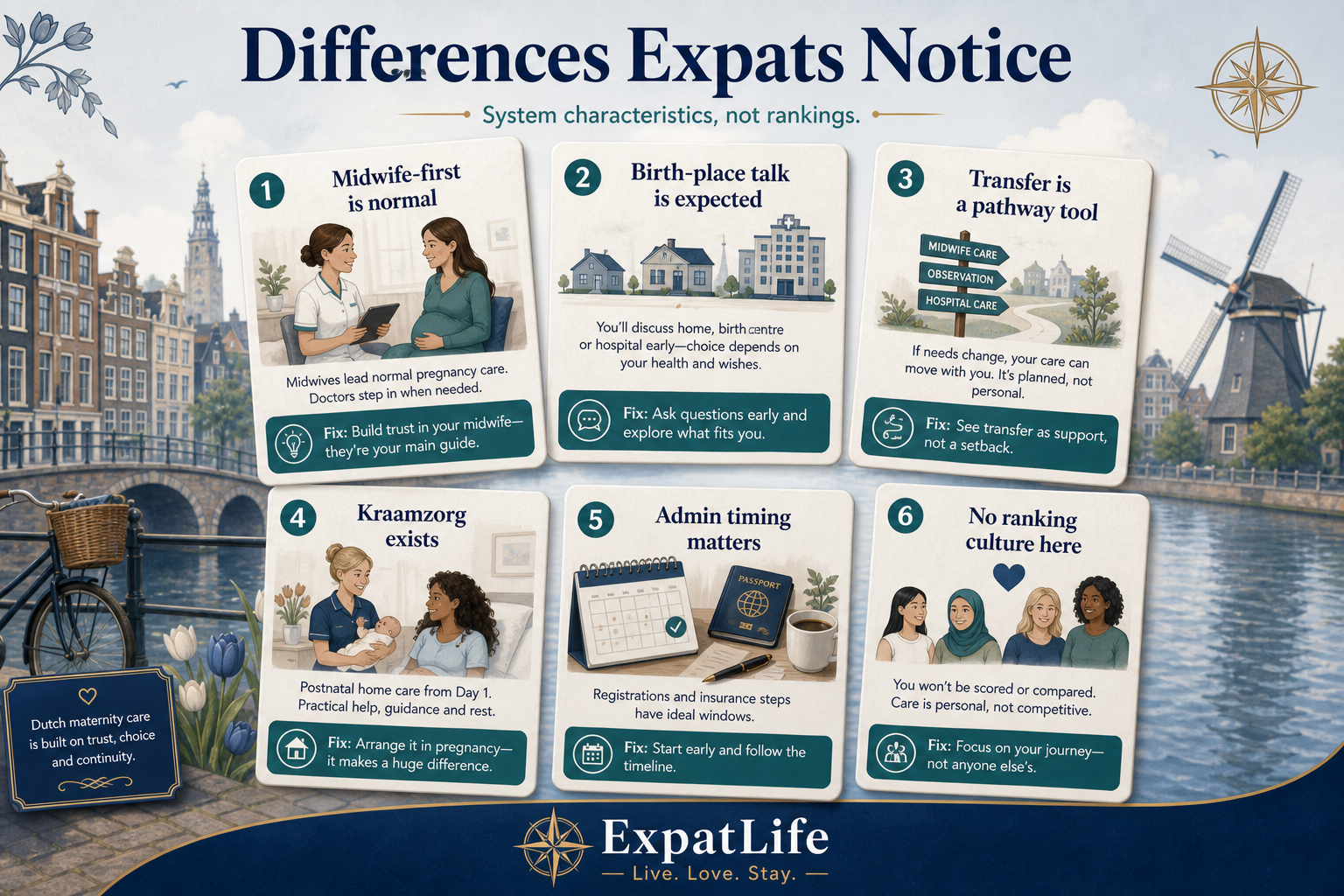
Many pregnancies are coordinated by a verloskundige unless indications call for obstetric pathways.
Fix: Start with midwife registration rather than waiting for an automatic obstetrician assignment.
Home, birth centre and hospital may all appear in conversations when clinically relevant.
Fix: Share preferences, then listen for suitability factors — plans can change.
Moving to hospital or obstetric care when indicated is normal system behaviour.
Fix: Ask for plain-language reasons and who coordinates next.
Postpartum home support is a known Dutch feature with registration and contribution rules.
Fix: Raise kraamzorg awareness during pregnancy, not only after birth.
Capacity constraints make early registration more important than in some other countries.
Fix: Call practices as soon as pregnancy is confirmed or on arrival if relocating.
This guide will not tell you the 'best hospital' or 'best midwife'.
Fix: Choose on capacity, communication, distance and clinical fit questions with professionals.
Checklist
A short file and a clear contact plan reduce stress more than collecting every possible product. Focus on registration, documents, urgent numbers, insurance clarity and kraamzorg awareness.
Clinical decisions stay with your midwife or obstetric team. This checklist is administrative and orientation support only.
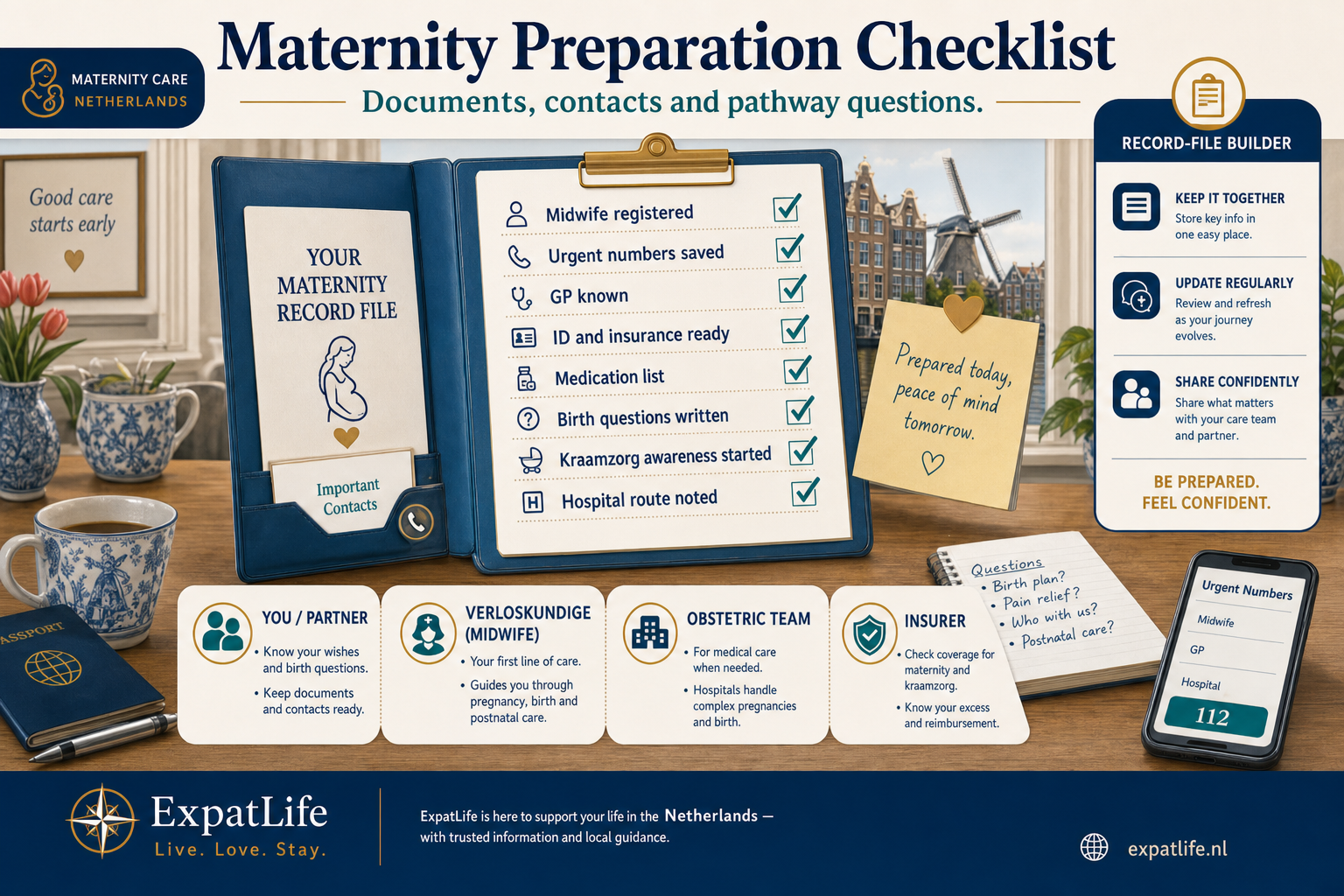
Preparation checklist
Register early, keep documents, ask language and pathway questions.
First-line maternity coordination for many pathways; urgent instructions.
Indication-led specialist and hospital maternity care when needed.
Coverage explanations, eigen risico questions and kraamzorg contribution rules.
Avoid
Most maternity-care mistakes are timing or assumption errors — waiting to register, expecting obstetrician-first care, or discovering kraamzorg too late.
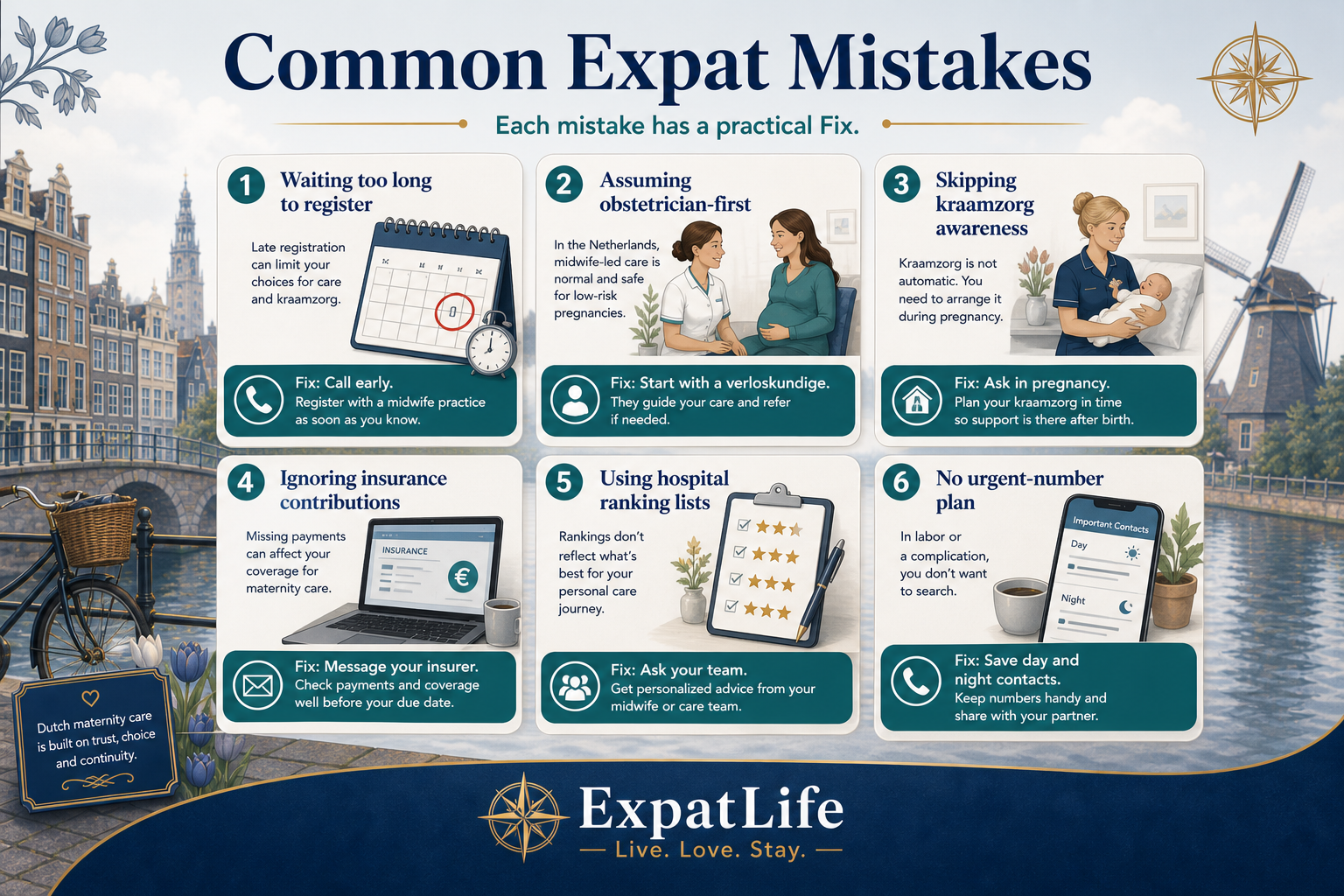
Delaying midwife contact until late pregnancy can shrink capacity options.
Fix: Call practices as soon as pregnancy is confirmed or immediately after relocating.
Expecting a hospital obstetrician to automatically own every pregnancy from week one leads to confusion.
Fix: Start with verloskundige registration and ask when obstetric pathways apply.
Leaving postpartum support questions until after birth creates avoidable stress.
Fix: Ask your midwife during pregnancy how local kraamzorg registration works.
Surprise bills often come from unverified eigen risico or kraamzorg own-contribution assumptions.
Fix: Message your insurer early and save the written answer.
Forum 'best hospital' threads are not clinical guidance.
Fix: Discuss network fit with your maternity team; this site does not rank hospitals.
Couples sometimes only save the daytime reception number.
Fix: After intake, save day and out-of-hours instructions, plus 112 for life-threatening emergencies.
FAQ
Orientation answers only — confirm your own situation with your midwife, obstetric team and insurer. Call 112 for life-threatening emergencies.
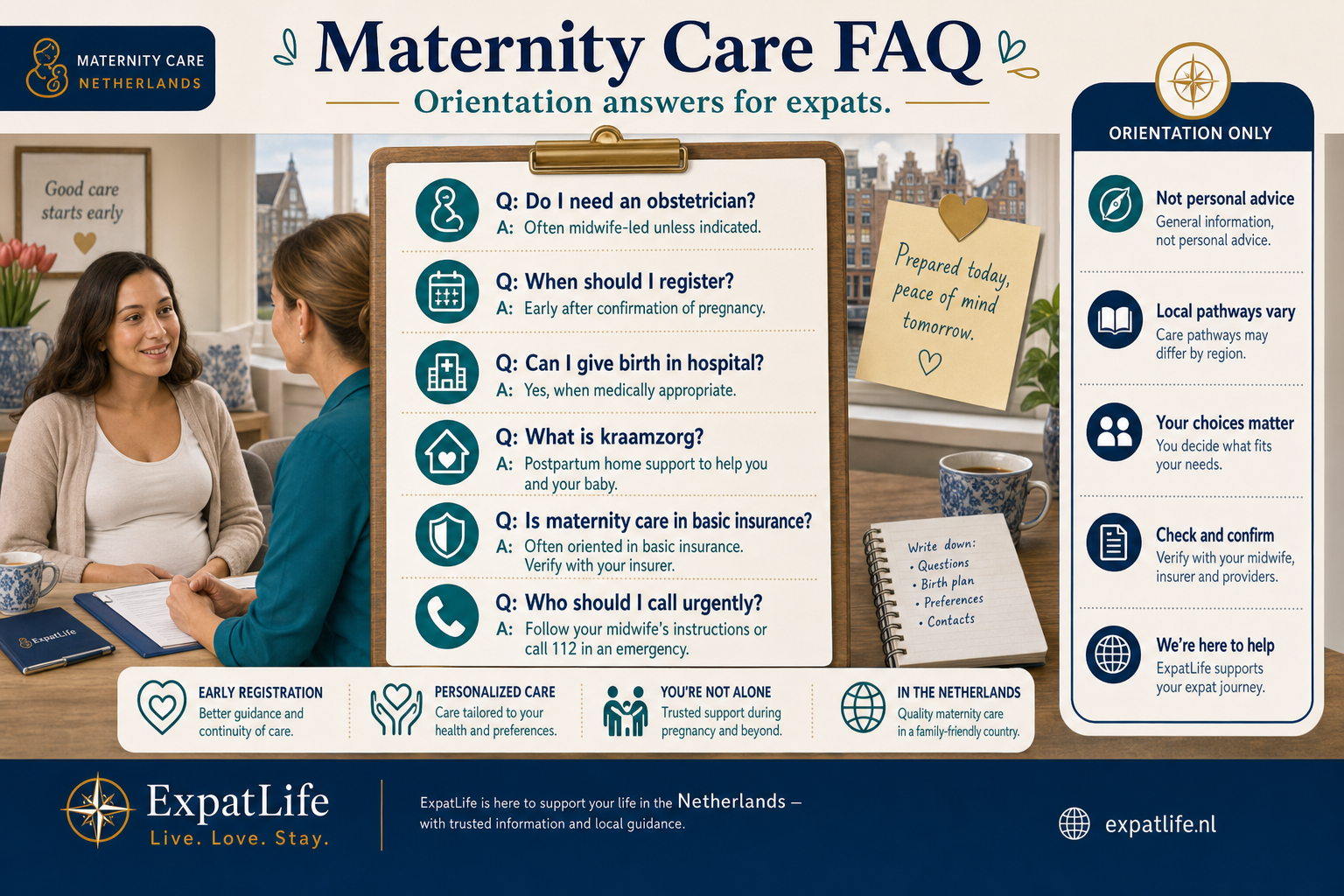
Not automatically. Many pregnancies are midwife-led (verloskundige) unless clinical indications call for obstetric or hospital pathways. Your team explains what applies to you.
Contact practices early after pregnancy confirmation — capacity can be limited, especially in busy areas. If you move mid-pregnancy, register as soon as you arrive.
Yes. Hospital birth is part of Dutch maternity pathways and may be planned or become appropriate based on indications and local organisation. Discuss options with your midwife or obstetric team.
No. Home birth can be discussed when clinically suitable and locally supported, but it is not required and is not appropriate for every situation.
A midwife — often the first-line maternity care professional coordinating antenatal care and birth planning conversations for midwife-led pathways.
Postpartum maternity home care. This guide only gives awareness — ask your midwife about local registration and your insurer about own contribution.
Essential midwife and medically indicated obstetric pathway care is generally oriented within the basic package and usually outside eigen risico. Budget separately for kraamzorg own contribution (about €5.70/hour in 2026) and any polyclinic hospital birth own contribution if you birth in hospital without a medical indication.
Indicated kraamzorg hours are covered from the basic package, but you pay a statutory own contribution — about €5.70 per hour in 2026. Many families land around the mid-40s hours, which often means roughly €250–€280 out of pocket unless aanvullende cover reimburses (part of) that contribution. Confirm your indication and package.
Medically indicated hospital birth is typically covered under maternity pathway rules. If you choose a polyclinic hospital or birth-centre birth without a medical indication, a statutory own contribution commonly applies — orientation figures for 2026 often land toward roughly €450–€600+ depending on the facility. Verify exact amounts with your insurer and midwife.
Many practices in internationally oriented areas can work in English, but it is not guaranteed. Confirm with the treating team when you enquire.
Care may transfer to obstetric and/or hospital pathways. Ask what changes, who coordinates next, and which numbers to use urgently.
After birth, baby follow-up often connects to JGZ / consultatiebureau pathways. See Healthcare for Children for that system orientation.
Use the urgent instructions from your midwife or obstetric team. For life-threatening emergencies, call 112. See also Emergency Healthcare.
No midwife or hospital ranking. Where we list partner or referral options (for example insurance comparison or childcare discovery), those links are disclosed discovery tools — not clinical recommendations. Always confirm language, capacity and fit yourself.
Yes, GP registration remains important for Dutch primary care and coordination. Maternity pathway care is still centred on midwifery/obstetrics.
ID, insurance details, medication list, prior pregnancy or medical records if available, and your top questions about language, pathways and kraamzorg.
Related
Maternity care connects to GP care, hospitals, insurance and children's healthcare — read them together.
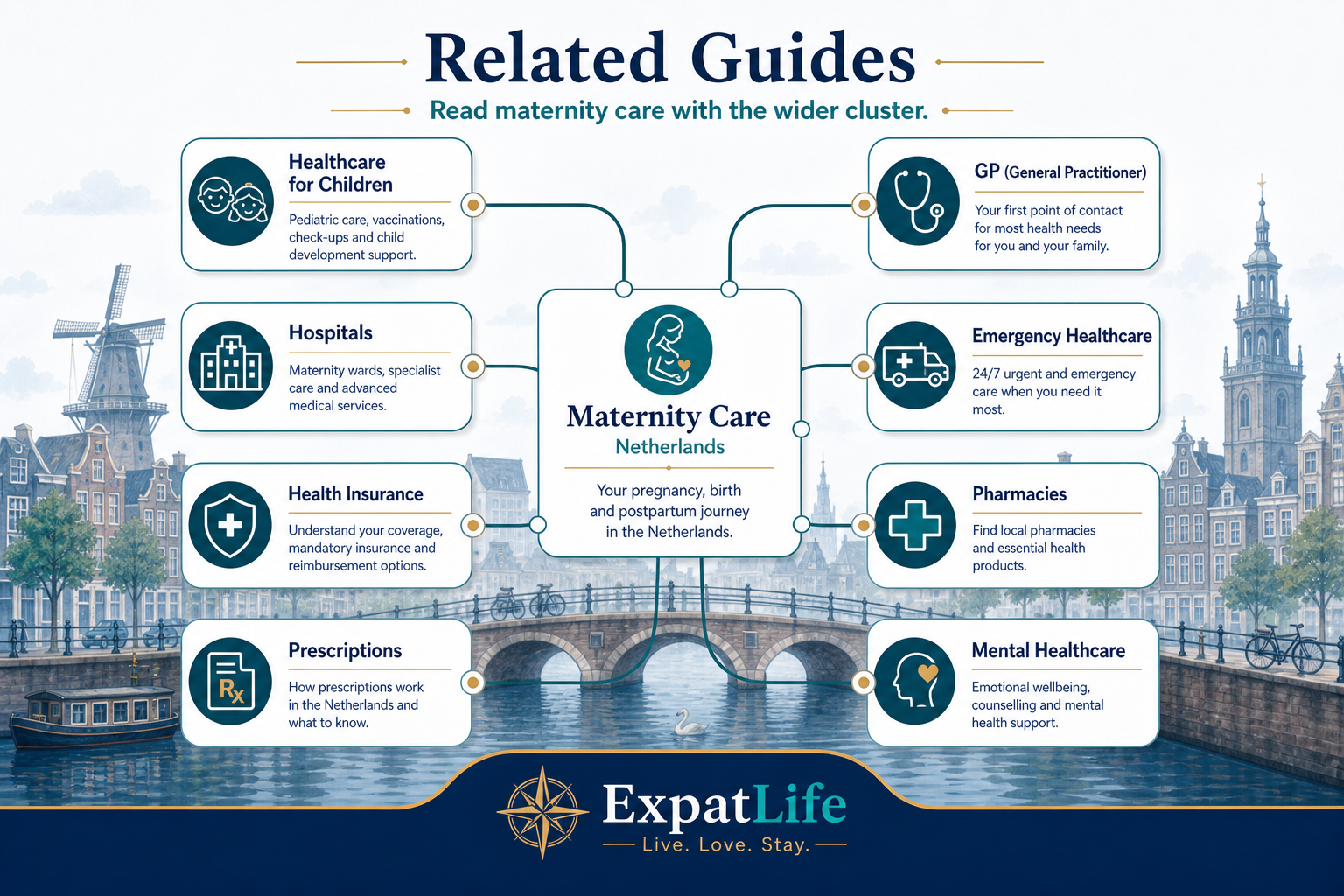
Health hub
This page is the maternity care cornerstone — explore related health topics next.
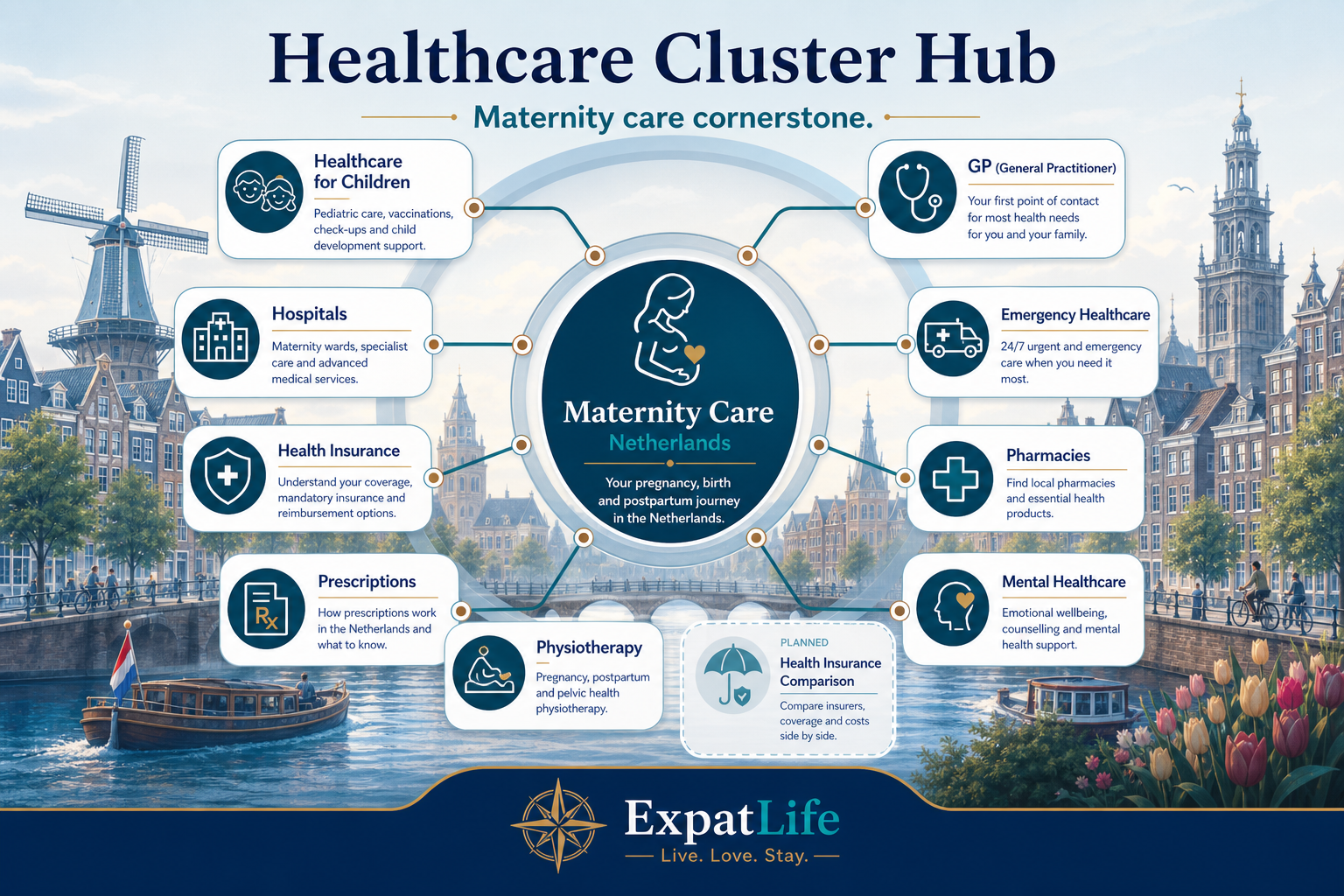
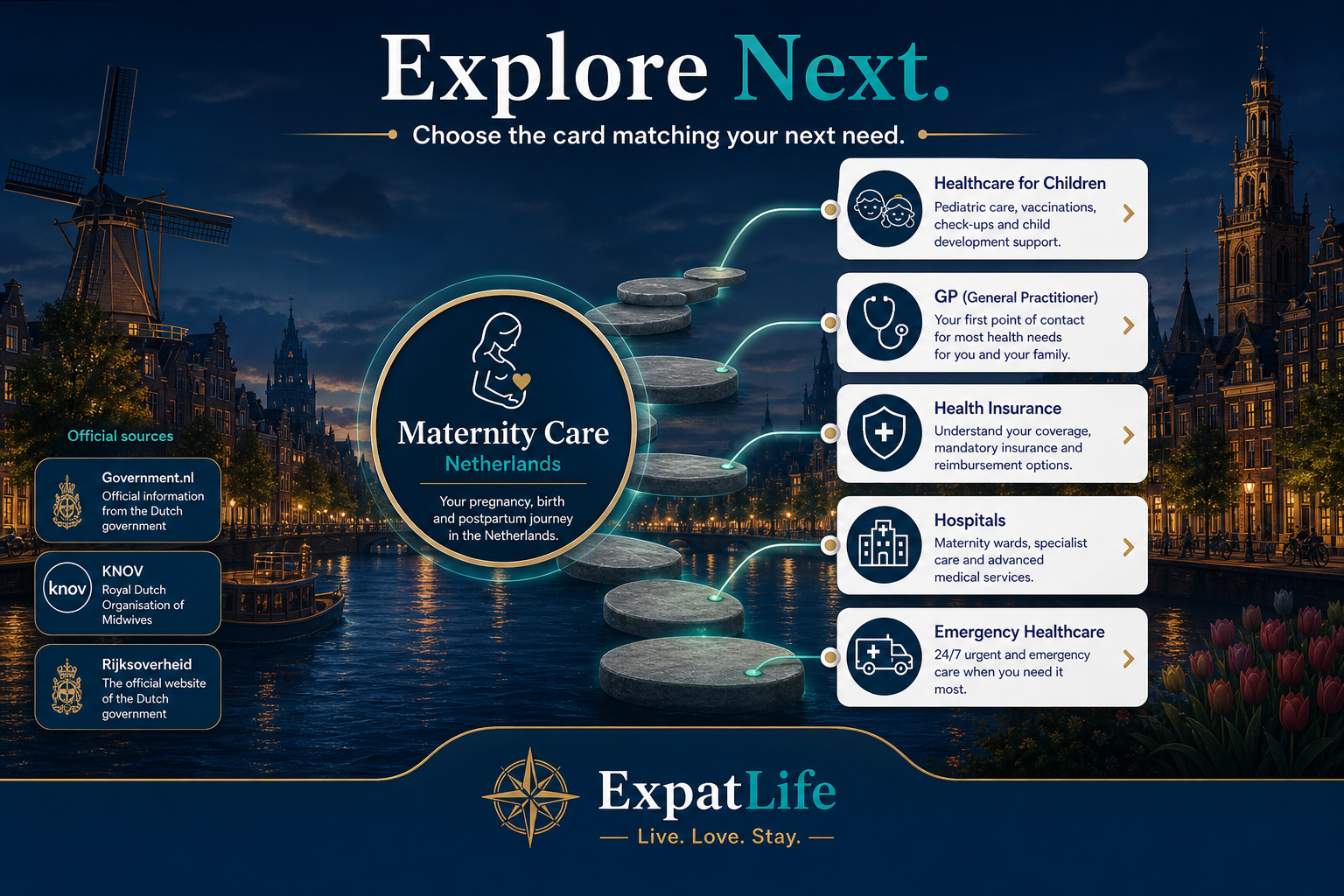
Explore next
Pick the card that matches what is still open — children's healthcare after birth, GP registration, insurance, hospital pathways or emergency routes — and verify specifics on the official sources below.
Trust
General information only — not medical advice. Maternity pathways, insurer rules and practice availability change, so verify your own situation with your midwife, obstetric team and insurer. In an emergency, call 112.