
Entry point
GP referral
A verwijzing from your huisarts opens specialist hospital care.
Netherlands · Health · Hospitals
Everything you need to know about hospital care in the Netherlands, including referrals, specialists, admissions, emergency departments and university medical centres.
General orientation only — not medical advice, diagnosis or treatment recommendations, and not a ranking or endorsement of any hospital. For your own situation, speak with your GP, your treating specialist or your insurer. Call 112 for life-threatening emergencies.

Quick answer
Dutch hospitals (ziekenhuizen) sit in the middle of a referral-based system. Your GP handles a large share of everyday medical problems, and when specialist assessment, imaging, surgery or intensive treatment is needed, the GP writes a referral into a hospital outpatient clinic. That is why arriving in the Netherlands and looking for a specialist directly usually leads back to the huisarts first.
Once you are inside the hospital system, most care is planned and appointment-based. You are given a clinic (polikliniek) and a time, you are assessed by a medical specialist or a specialist in training, diagnostics are arranged, and treatment follows if it is indicated. Overnight stays are kept as short as clinically sensible, and recovery frequently continues at home with GP or district nursing support.
This guide is practical orientation for expats, students, families and newcomers: how referrals work, what the different types of hospital do, how to choose one, what happens at an outpatient appointment and during an admission, which specialties exist, how emergency departments and university medical centres fit in, what to expect around costs and insurance, and what your rights as a patient look like. It is not medical advice and does not rank or recommend individual hospitals.
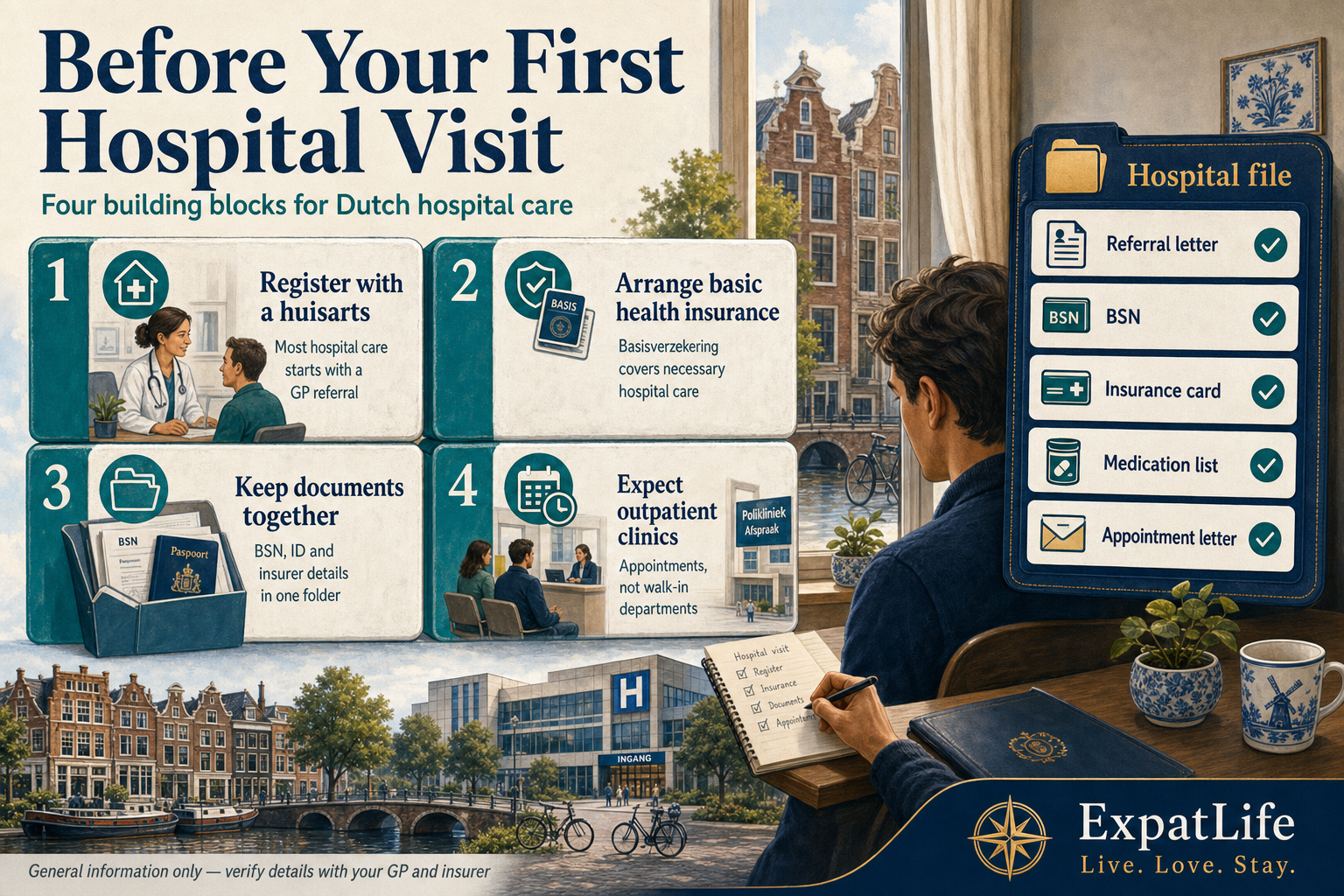
Hospital file — keep these together
Examples
| Situation | How it works here | First step |
|---|---|---|
| You have a persistent problem your GP cannot resolve | Ask the GP whether a hospital referral is appropriate, and to which specialty. The referral letter is what opens the outpatient clinic door. | Book a GP appointment and bring a written timeline of symptoms and what has already been tried. |
| You arrive with an ongoing condition treated abroad | Continuity is usually arranged through the GP, who can refer you to the right specialty with your existing records. | Register with a huisarts, then share translated summaries, medication lists and recent test results. |
| You want to see a specialist directly | Direct self-referral is generally not how Dutch hospital access works, and insurers usually expect a valid referral for coverage. | Discuss the concern with your GP first and ask what would justify a referral. |
| Something is urgent tonight | Urgent care runs through emergency doors, not the outpatient clinic. Life-threatening situations go to 112. | Call 112 if life may be at risk; otherwise call your GP during opening hours or the huisartsenpost after hours. |
Snapshot
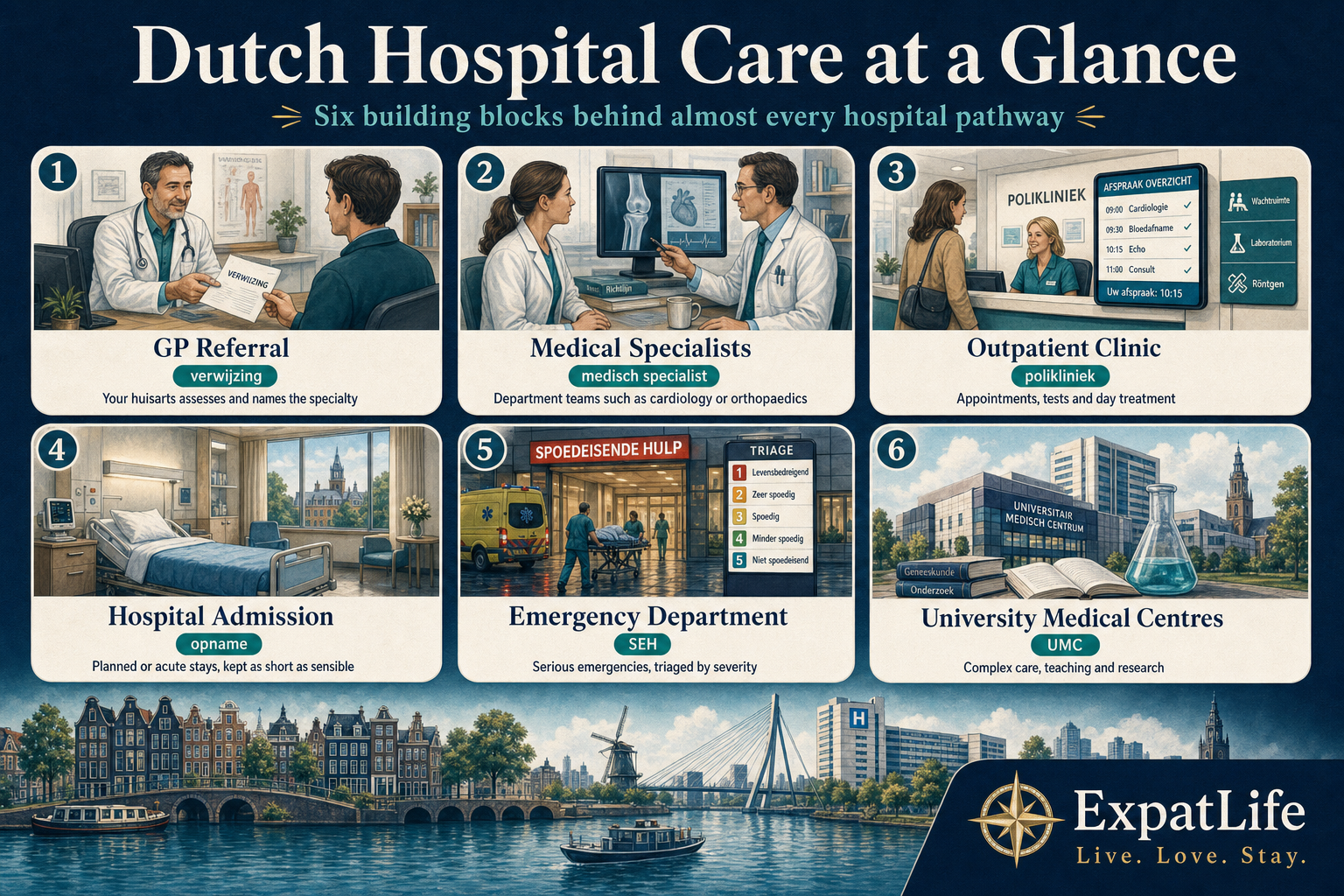
Almost every hospital pathway expats meet is built from these six blocks. Read them once now, then use the detailed sections below when you need the specifics.
Entry point
GP referral
A verwijzing from your huisarts opens specialist hospital care.
Usual setting
Outpatient clinic
Polikliniek appointments cover most consultations and diagnostics.
Overnight stay
Only if needed
Admission (opname) is reserved for clinical necessity.
Funding
Basic insurance
Medically necessary hospital care, usually with the annual deductible for adults.
Your huisarts assesses the problem and writes a referral naming the specialty. Insurers normally expect a valid referral for planned hospital care, so keep the letter or digital confirmation.
Hospital specialists (medisch specialisten) work within departments such as cardiology or orthopaedics. You may also be seen by a specialist in training or a specialised nurse as part of the team.
Appointment-based consultations, blood tests, imaging, minor procedures and day treatment. This is where most hospital care happens, and where follow-ups are arranged.
Planned or acute stays on a ward, with pre-admission screening for planned surgery. Stays are kept as short as clinically sensible, with recovery continuing at home.
Spoedeisende hulp handles serious emergencies and triages by severity. Many patients arrive by ambulance or with a GP or huisartsenpost referral rather than walking in.
UMCs combine complex patient care with medical education and research. Rare conditions and highly specialised treatment are often referred there from other hospitals.
How it works
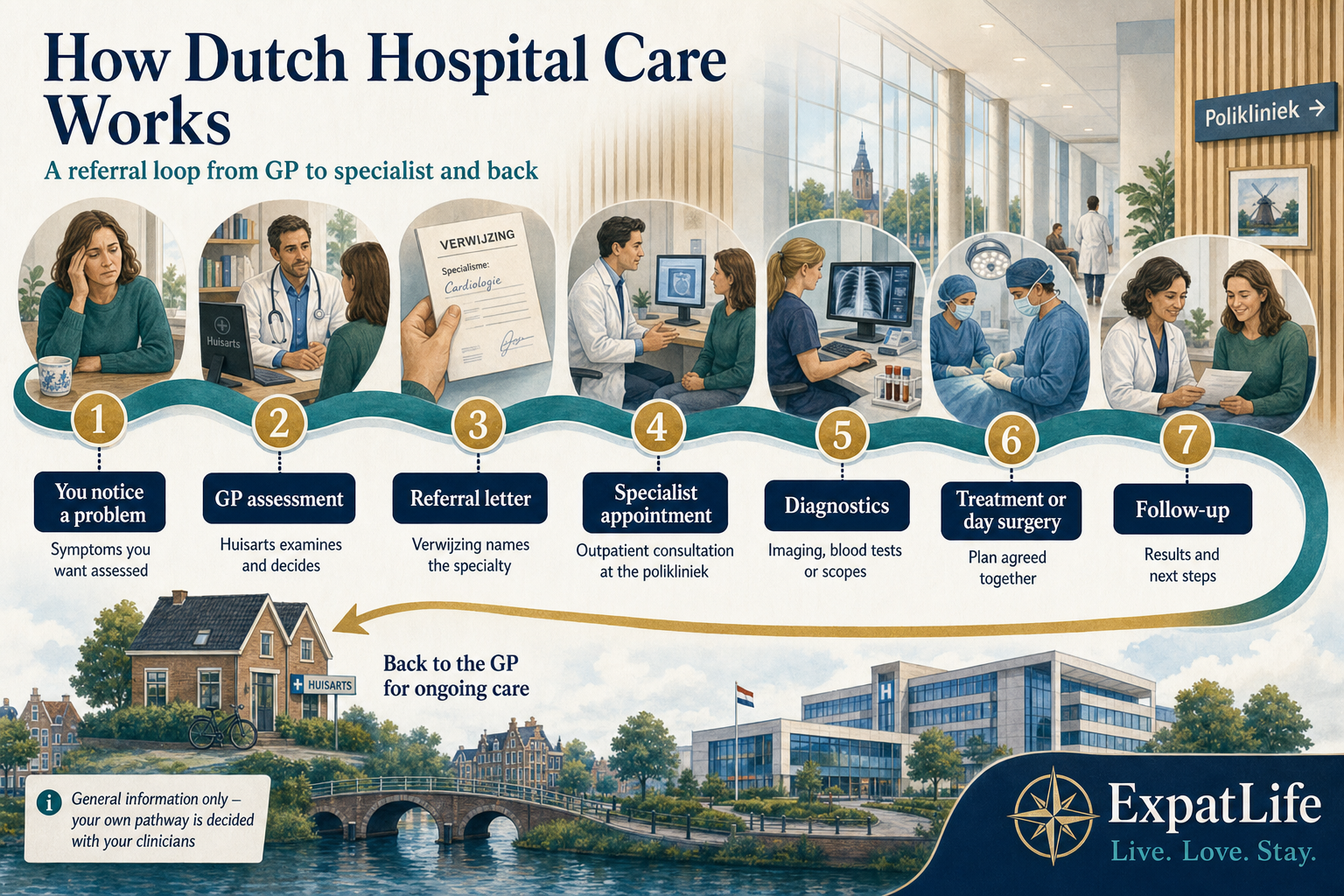
Dutch hospital care is best understood as a loop rather than a destination. The GP refers you in, the hospital assesses and treats, and responsibility returns to the GP for ongoing care once the specialist episode ends.
The loop starts with your huisarts. If specialist assessment is needed, the GP writes a referral (verwijsbrief or a digital referral) naming the specialty and the reason. You then make an appointment at a hospital outpatient clinic, often by phone or through the hospital's online portal, and sometimes the practice arranges the first appointment for you.
At the outpatient appointment, a specialist takes a history, examines you and decides which diagnostics are useful. Blood tests, imaging, function tests or scopes may be arranged the same day or scheduled separately. A follow-up appointment is then used to discuss results and agree a treatment plan with you.
Treatment can be medication, therapy, a day procedure or an operation requiring admission. When the specialist episode is complete, a discharge or closing letter goes to your GP so that ongoing monitoring, prescriptions and questions return to primary care. Referrals also have practical limits — if a long time passes, your GP may need to issue a new one.
Care pathway
Step 1
Write down when symptoms started, how they changed and what worries you most. This one page shortens every later conversation.
Step 2
Your GP examines, may run initial tests and decides whether specialist input is needed or whether primary care can manage it.
Step 3
The GP issues a referral naming the specialty and reason. Keep the letter or digital confirmation for the hospital and your insurer.
Step 4
You attend the polikliniek by appointment. Expect history taking, examination and a plan for what needs to be investigated.
Step 5
Blood tests, imaging, function tests or scopes are arranged. Some are same-day; others are separate appointments with preparation instructions.
Step 6
Results are discussed with you, options are explained, and a plan is agreed — from medication and monitoring to day treatment or surgery.
Step 7
Follow-up appointments check progress. Ask what result would change the plan and who to contact between appointments.
Step 8
When the specialist episode ends, the hospital sends a letter to your GP, who resumes ongoing care, repeat prescriptions and monitoring.
How to
Step 1
Check that your GP referral names the right specialty and that your appointment letter lists the hospital, clinic, building, floor and time. Confirm whether you must arrive earlier for registration or blood tests.
Step 2
Read the letter or portal message for fasting instructions, medication pauses, hydration requirements or forms to complete in advance. If anything is unclear, call the clinic secretariat before the appointment rather than guessing.
Step 3
Bring ID, your BSN, insurance details, the referral, a current medication and allergy list, and any relevant results or letters from previous care, including care abroad.
Step 4
Note when symptoms started, what makes them better or worse, what has already been tried, and the three questions you most want answered. Appointments are focused, so a written list keeps nothing behind.
Step 5
Ask the clinic in advance about English-language consultation or interpreter options, and bring someone who can listen and take notes if the topic is complex or stressful.
Step 6
Allow time for parking or public transport, finding the right building and registration. Arriving unhurried matters more than arriving early at the wrong entrance.
Step 7
Ask what the working diagnosis is, what the next investigation or treatment step is, what the alternatives are, and what would change the plan. Repeat the plan back in your own words to check you understood it.
Step 8
Confirm who arranges the next appointment, how and when you will receive results, who to contact with questions, and whether your GP will be informed.
Hospital types
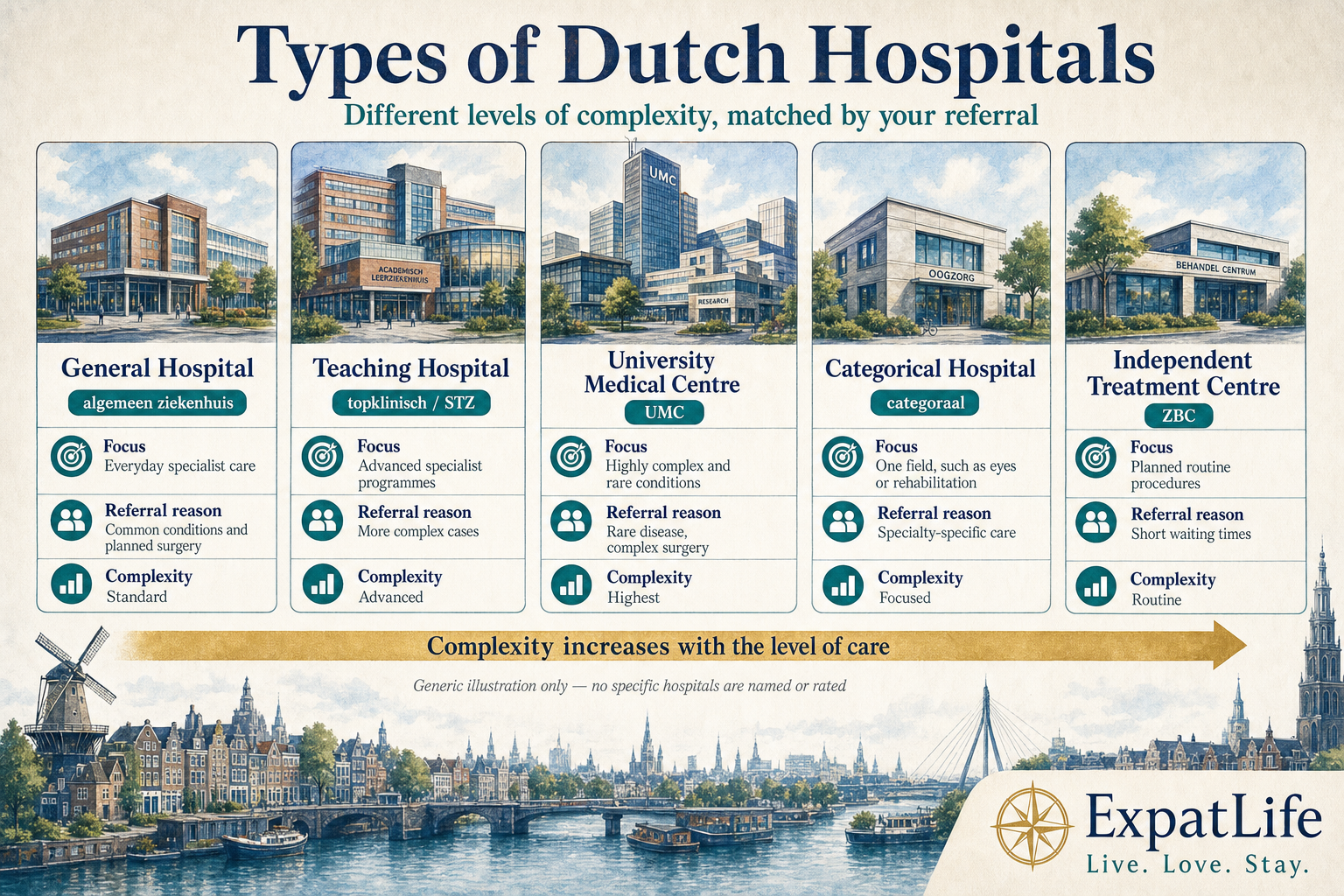
Not every hospital does everything. Dutch hospital care is layered by complexity, so a routine procedure and a rare condition may be handled in different places — sometimes deliberately far from home.
General hospitals (algemene ziekenhuizen) cover the majority of common specialist care: outpatient clinics, diagnostics, day treatment, planned surgery, maternity and an emergency department in many locations. For most people, most of the time, this is the hospital they will use.
Teaching hospitals — often described as top clinical or STZ hospitals — sit a step further, combining general care with more complex treatment and training of specialists. University medical centres (UMCs) are attached to medical faculties and concentrate the most complex care, research and education.
Alongside these are specialist categorical hospitals focused on one field, such as eye or cancer care, and independent treatment centres (zelfstandige behandelcentra, ZBCs) that handle planned, routine, lower-risk procedures. This page describes the categories and never ranks or recommends specific hospitals.
| Type | Focus | When you are referred | Note |
|---|---|---|---|
| General hospital (algemeen ziekenhuis) | Common specialist care: outpatient clinics, diagnostics, day treatment, planned surgery, often maternity and an emergency department. | Standard GP referral for the majority of specialist problems, and the default nearby option. | Usually the closest and most practical choice for routine specialist care and follow-up. |
| Teaching hospital (topklinisch / STZ) | General care plus more complex treatment, specialist training and applied research within several fields. | Referred for conditions needing more specialised teams, equipment or combined expertise. | You may be seen by specialists in training working under supervision as part of the team. |
| University medical centre (UMC) | Highly complex and rare conditions, transplant and specialised programmes, medical education and research. | Referred by a GP or, frequently, onward from another hospital when complexity increases. | Often involves multidisciplinary teams; clinical trial participation may be discussed with you. |
| Specialist categorical hospital | Concentrated expertise in one field, for example eye care, cancer care or rehabilitation. | Referred when a single-field concentration of expertise fits the diagnosis. | Care is deep rather than broad — other health needs stay with your GP or another hospital. |
| Independent treatment centre (ZBC) | Planned, routine, lower-risk procedures and consultations with a narrow scope and short pathways. | Referred for eligible planned care, sometimes with shorter waiting times than a hospital. | Check insurer contract status, referral requirements and how complications or aftercare are arranged. |
Routine cataract surgery and a rare metabolic disorder are handled at very different levels of the system. Referral decisions follow clinical complexity, not prestige.
Starting at a general hospital and being referred onward to a teaching hospital or UMC is a standard escalation, not a sign that something went wrong.
Some specialised treatments are concentrated in a limited number of centres to maintain expertise, which can mean travelling further for part of your care.
Complex treatment at one hospital with check-ups closer to home is a common arrangement — ask explicitly who does what and who coordinates.
Before you accept a referral destination
Choosing a hospital
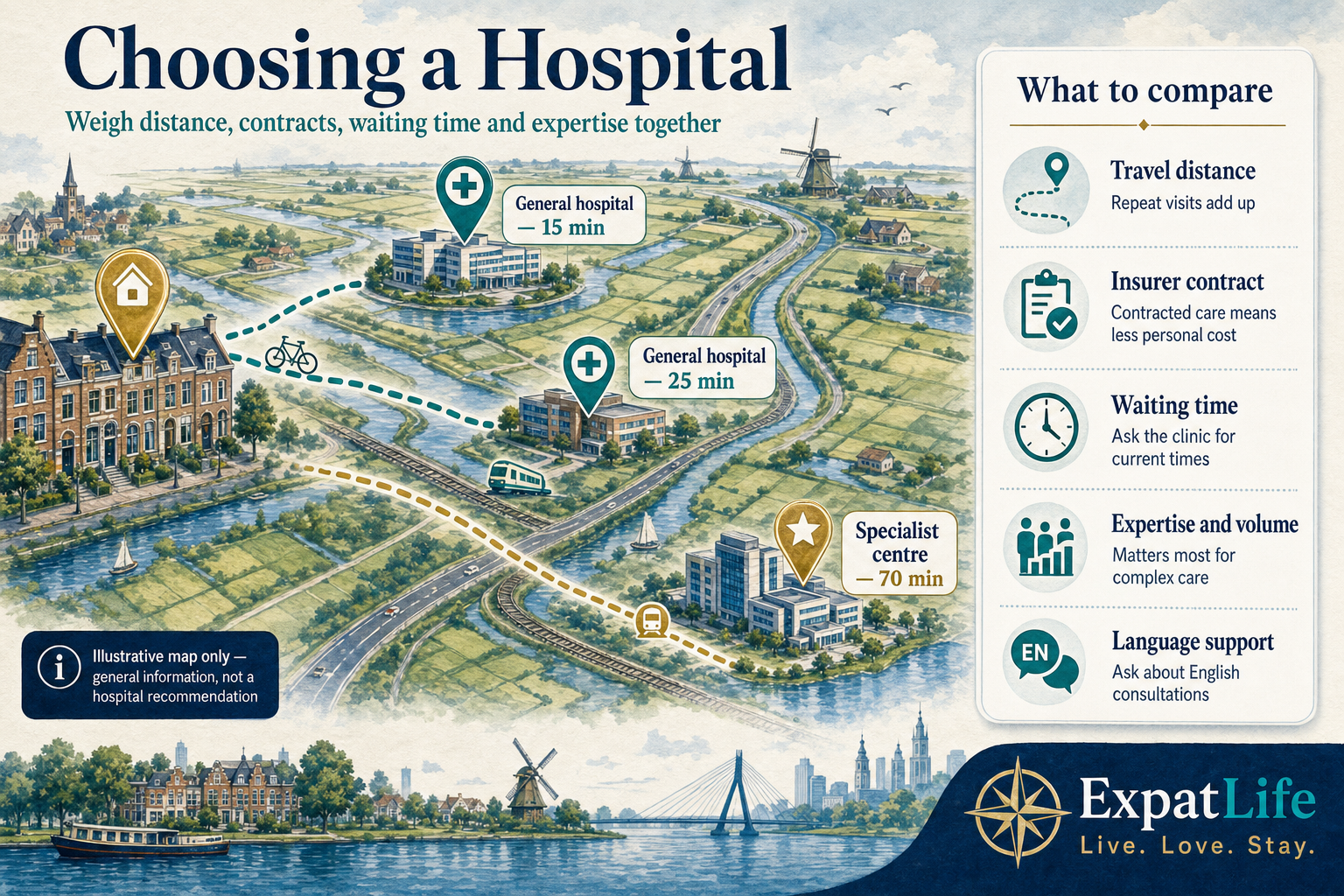
For planned care you generally have a choice of hospital, and your GP will usually suggest options rather than dictate one. The practical decision balances four things: how far you can realistically travel, whether your insurer has a contract with that hospital, how long the waiting time is for the specialty, and whether the condition needs concentrated expertise.
Waiting times differ by hospital and by specialty, and hospitals publish indicative waiting information. If a wait feels too long, ask the clinic or your insurer about alternatives — insurers operate care-mediation services (zorgbemiddeling) that help find an earlier slot at a contracted provider.
Language support also varies. In larger cities and academic centres, English is often workable, but it is not guaranteed everywhere. Ask when booking whether the consultation can be held in English or whether an interpreter can be arranged, especially for consent conversations and complex treatment decisions.
| Route | When | How | Note |
|---|---|---|---|
| Nearby general hospital | Routine specialist care, diagnostics and follow-up | GP referral, then book with the outpatient clinic | Usually the most practical option when travel frequency is high. |
| Teaching hospital or UMC | Complex, rare or multidisciplinary conditions | GP referral or onward referral from another hospital | Concentrated expertise can justify a longer journey. |
| Independent treatment centre (ZBC) | Eligible planned routine procedures | Referral to a contracted centre offering that treatment | Confirm contract status, referral rules and aftercare arrangements first. |
| Insurer care mediation (zorgbemiddeling) | Waiting time feels unacceptably long | Contact your insurer's care-mediation service | They can look for earlier availability at contracted providers. |
Choosing checklist
Examples
| Situation | How it works here | First step |
|---|---|---|
| Two hospitals are equally close | Compare insurer contract status, waiting time for that specialty and practical access before choosing. | Ask your GP or the clinic secretariats for indicative waiting times, then check your insurer's provider list. |
| The first appointment is months away | Ask the clinic whether cancellation slots exist and contact your insurer's care-mediation service about alternatives. | Call the outpatient secretariat and ask to be added to any earlier-availability list. |
| You are told to attend a hospital far from home | Ask whether the specialised part must happen there and whether follow-up can be shared with a hospital closer to home. | Raise the travel burden explicitly with the referring GP or specialist and ask about shared-care options. |
| You are worried about the language barrier | Ask when booking about English-language consultations or interpreter support, especially for consent discussions. | Call the clinic secretariat and note your language preference in the appointment record. |
Outpatient
The polikliniek is where most hospital care happens. Each specialty has its own clinic with its own secretariat, and appointments are scheduled and often quite short. That is not a lack of interest: the model assumes focused consultations supported by diagnostics and follow-up appointments rather than one long visit.
Expect a registration step on arrival — a check-in kiosk, a reception desk or a portal check-in — and expect that blood tests or imaging may be booked before or after the consultation. Preparation instructions in your appointment letter are important: fasting, medication pauses or hydration requirements exist for a reason and can lead to a rescheduled test if missed.
You may be seen by a medical specialist, a specialist in training, a physician assistant or a specialised nurse working within the team. Continuity is normal for chronic conditions, but a different team member can appear at follow-ups. If continuity matters to you, say so.
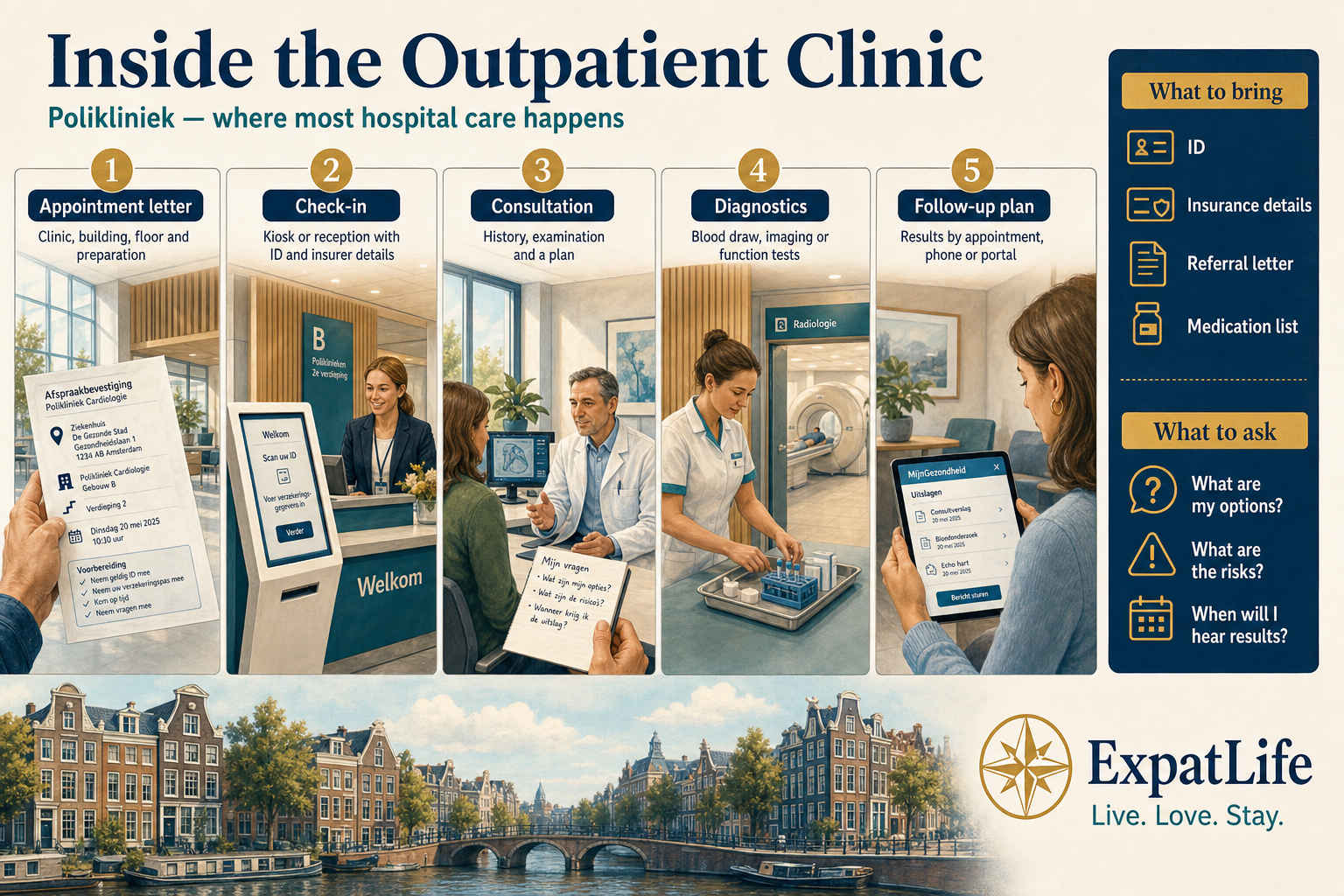
Names the clinic, building, floor, time and preparation instructions. Read it twice — hospital sites are large and clinics are not always where you expect.
Kiosk or reception check-in with ID and insurance details. Address changes and insurer changes should be updated here or in the portal.
History, examination and a plan. Focused and factual — a written question list ensures nothing important is left out.
Blood tests, imaging, function tests or scopes, sometimes same-day. Confirm where to go, what to prepare and how results will be shared.
Results are usually discussed at a follow-up appointment, by phone or through the patient portal. Ask which route applies and when.
Handles rescheduling, questions between appointments and paperwork. This is the number to save, not the emergency department.
Outpatient appointment checklist
Examples
| Situation | How it works here | First step |
|---|---|---|
| You forgot part of your medication list | Say so at the start — accurate medication information affects tests and prescriptions more than most patients expect. | Ask whether your pharmacy overview can be checked, or call your pharmacy for a current list. |
| The appointment felt too short | Focused consultations are normal, but you can ask for a follow-up or a longer appointment for complex discussions. | Say which question is still unanswered and ask how to get an answer — portal message, phone consult or new appointment. |
| You cannot attend the scheduled time | Reschedule through the clinic secretariat or the portal as early as you can, since slots are limited. | Call or message the secretariat with your appointment reference and preferred alternatives. |
| You have not heard about results | Do not assume silence means good news — follow up through the agreed route. | Contact the clinic secretariat and ask when results were expected and who reviews them. |
Admission
An admission means staying in hospital, either planned (for surgery or treatment) or acute (through the emergency department). Planned admissions usually begin with a pre-admission process: a screening appointment, an anaesthesia intake if you are having an operation, and clear instructions about fasting, medication and what to bring.
On the ward you will meet a mix of nurses, specialists in training and the responsible specialist, with ward rounds at set times. Dutch hospitals generally aim for the shortest clinically appropriate stay, so plans for discharge are often discussed early. This can feel abrupt if you are used to longer stays, but home recovery with GP or district nursing support is the standard model.
The discharge conversation matters. Ask what medication changes were made, which symptoms should prompt you to call, who to contact and when, what activity limits apply and what follow-up is arranged. Ask that your GP is informed, and keep any discharge letter or medication overview safe.
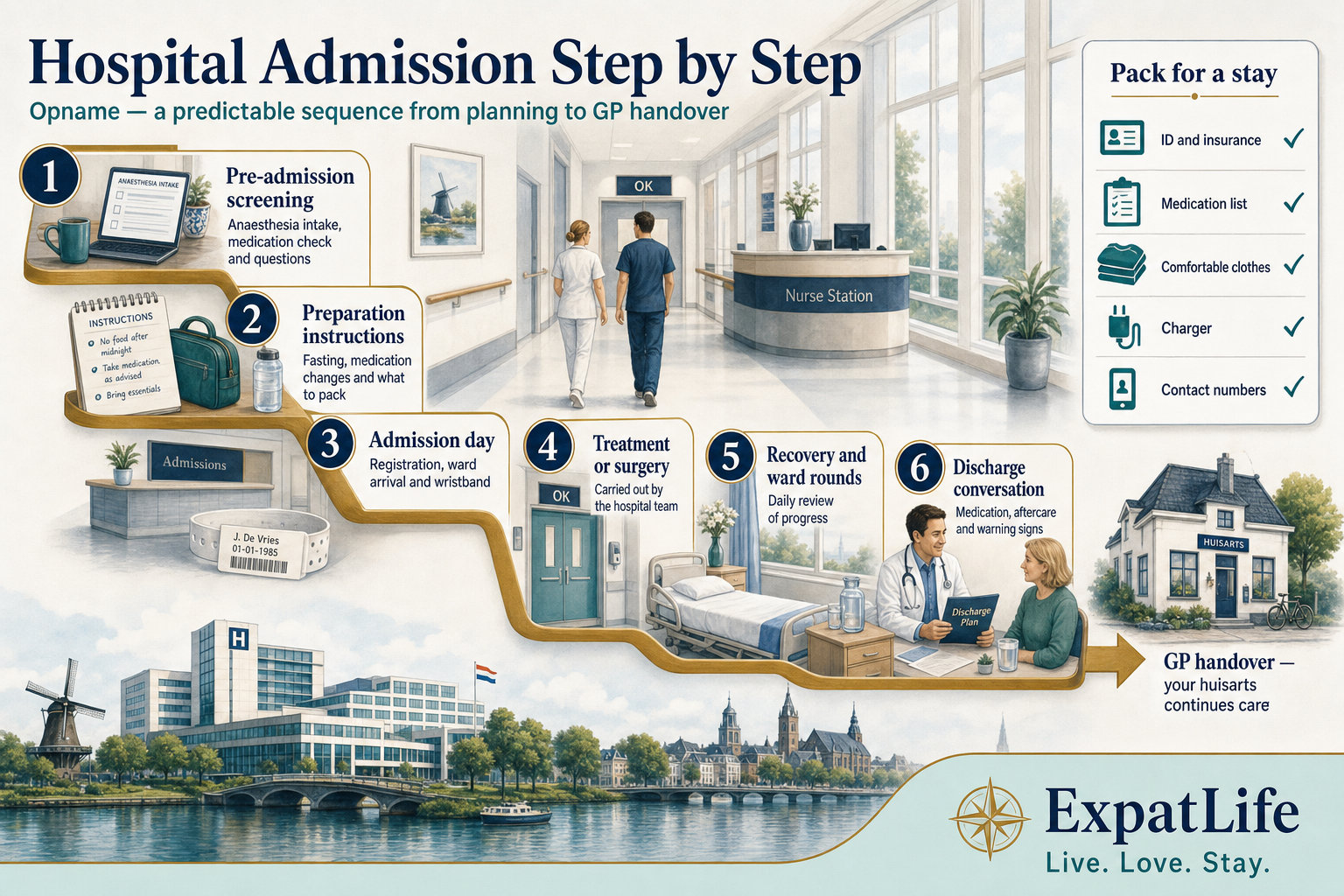
Stage 1
The specialist explains why admission is needed, what the alternatives are, and what the expected length of stay looks like.
Stage 2
Health checks, blood tests and an anaesthesia intake for surgery. Bring your full medication list — including blood thinners and supplements.
Stage 3
Fasting times, medication to pause or continue, hygiene instructions and arrival time. Follow these exactly to avoid cancellation.
Stage 4
Registration, ward arrival, consent confirmation and identification checks. Bring ID, insurance details and a small overnight bag.
Stage 5
The procedure or treatment takes place, with monitoring afterwards in recovery or on the ward.
Stage 6
Daily rounds review progress. Ask what milestones need to be reached before discharge is considered.
Stage 7
Medication changes, warning signs, activity limits, wound or aftercare instructions, and who to contact — ideally written down.
Stage 8
Follow-up appointments, home care or physiotherapy if needed, and a letter to your GP so primary care can continue monitoring.
Admission checklist
Examples
| Situation | How it works here | First step |
|---|---|---|
| You feel discharged too early | Say so directly and ask which criteria were used. Shared decision-making means your concerns belong in the conversation. | Ask what specific symptoms would mean you need to come back and who to call at any hour. |
| You are unsure whether to pause a medication | Never guess — pre-admission teams give explicit instructions for each medicine. | Call the pre-admission or anaesthesia department and read out the full medication name and dose. |
| Family wants to visit but lives abroad | Check ward-specific visiting rules and expected length of stay before flights are booked. | Ask the ward about visiting hours, numbers of visitors and any restrictions in place. |
| You will be alone at home after a procedure | Raise this before admission — aftercare planning can include home care or a longer observation period. | Tell the pre-admission team you live alone and ask what support can be arranged. |
Specialists
Hospital care is organised by specialty, and your referral names the department rather than an individual in most cases. Knowing what each specialty covers makes referral letters and appointment invitations far less confusing, especially when the Dutch name differs from what you are used to.
Specialists work in teams. For complex conditions, several specialties may discuss your case together in a multidisciplinary meeting before a plan is proposed to you — that is a strength of the system, though it can mean waiting for the next meeting date. A case manager or specialised nurse is often your practical point of contact.
Coordination is shared between the hospital and your GP. If more than one specialty is involved, ask who holds the overall plan and how information travels between them. When the hospital episode ends, coordination returns to the GP.
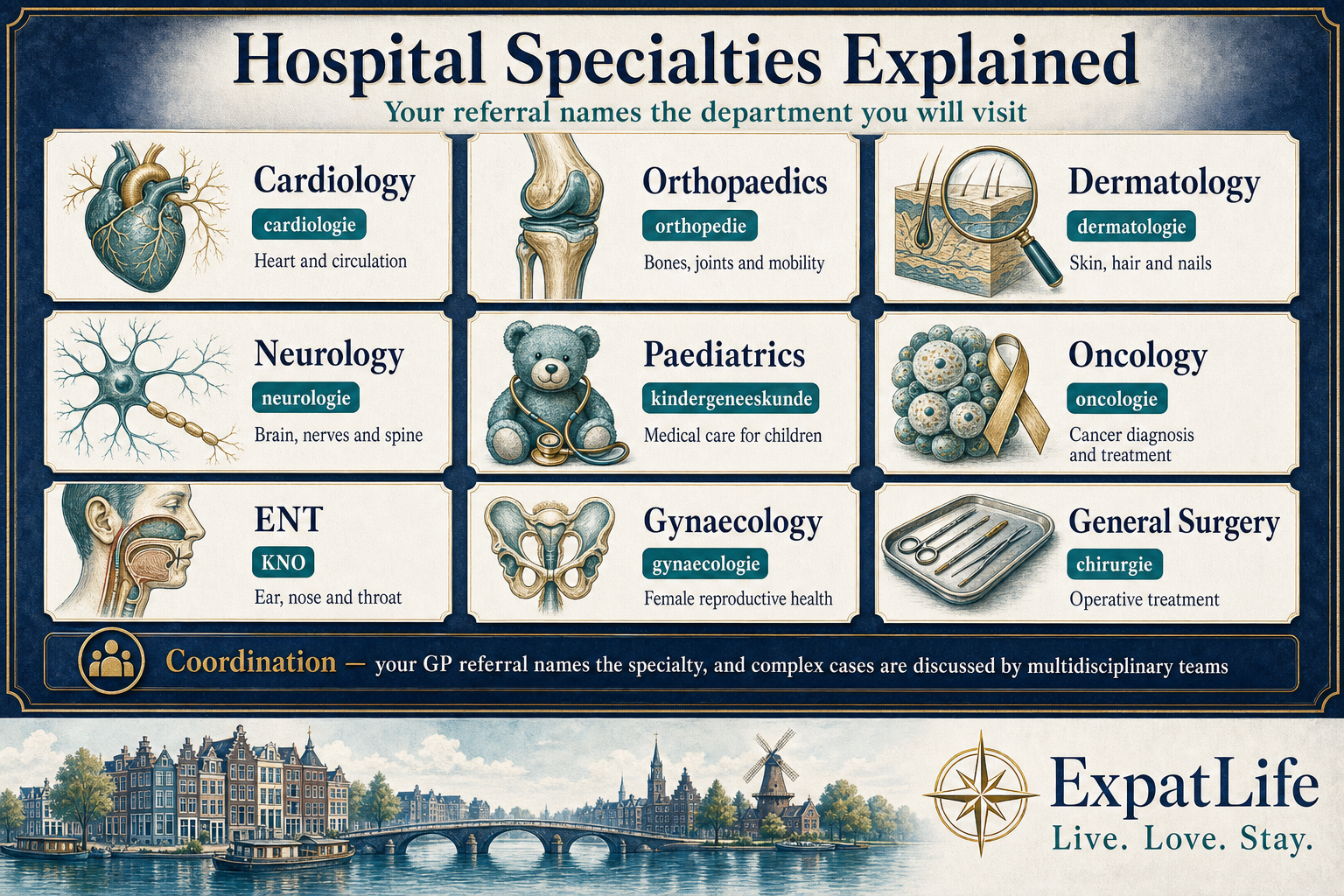
Heart and circulation — chest pain assessment, rhythm problems, heart failure, blood pressure complications and cardiac imaging.
Bones, joints, ligaments and musculoskeletal injuries — fractures, joint replacement, sports injuries and often combined with physiotherapy.
Skin, hair and nails — persistent rashes, eczema and psoriasis, skin lesion assessment and skin cancer pathways.
Brain, spinal cord and nerves — headaches and migraine, seizures, numbness or weakness, multiple sclerosis and stroke follow-up.
Children's medicine from newborns to adolescents, with child-friendly clinics and parents involved in decisions.
Cancer diagnosis and treatment, usually multidisciplinary, with case managers and specialised nurses supporting the pathway.
Ear, nose and throat — hearing problems, sinus and nasal conditions, tonsils, voice and swallowing issues.
Female reproductive health, menstrual and fertility concerns, and obstetric care when pregnancy needs medical involvement.
Abdominal and soft-tissue surgery — gallbladder, hernia, appendix, and coordination with acute surgical care.
Seeing a different team member at a follow-up is normal. Records are shared within the department, so context is not lost — but you can ask for continuity if it matters.
For cancer and other complex conditions, several specialties agree a proposal together. Ask when the meeting happens and when you will hear the outcome.
Ask for the name and number of a case manager, specialised nurse or clinic secretariat for questions between appointments.
An internal referral to another department inside the hospital is often possible without going back to the GP — ask whether that applies.
Examples
| Situation | How it works here | First step |
|---|---|---|
| You are not sure which specialty you were referred to | The referral letter and appointment invitation both name the department — check before travelling. | Read the appointment letter, or call the clinic secretariat with your appointment reference. |
| Two specialties give different impressions | Ask who coordinates the overall plan and request that they align — this is a reasonable request, not a complaint. | Raise it with the specialist you see next and ask for the coordinating clinician's name. |
| You want continuity with one specialist | Say so when booking follow-ups; continuity is often possible for chronic conditions, though not guaranteed. | Ask the secretariat to schedule with the same specialist where clinically possible. |
UMCs
University medical centres are hospitals attached to a medical faculty, combining patient care with education and research. They exist in a limited number of Dutch cities and concentrate expertise for complex, rare and highly specialised conditions alongside the everyday care they also deliver.
You can be referred to a UMC by your GP, but very often the route is an onward referral from another hospital when a condition proves more complex than a general or teaching hospital handles routinely. Concentrating rare procedures in fewer centres is a deliberate way to maintain expertise and quality.
Being treated in an academic setting brings some specific features: multidisciplinary teams, involvement of students and specialists in training, and the possibility that participation in research or a clinical trial is discussed with you. Participation is always your choice, and declining does not affect your right to standard care.
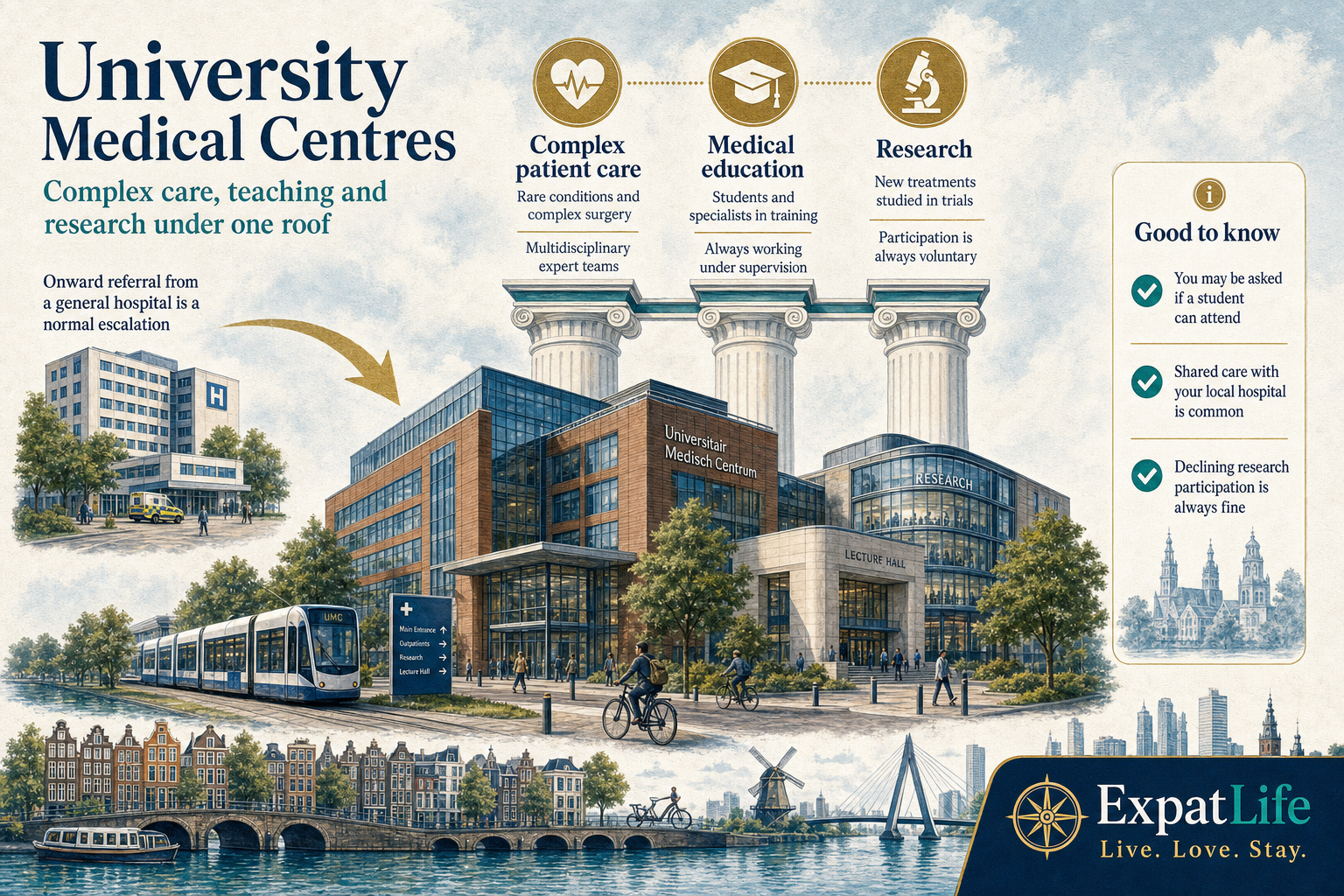
Multidisciplinary teams and specialised facilities for rare conditions, complex surgery and highly specialised programmes.
Medical students and specialists in training work under supervision. You may be asked whether a student can be present.
New treatments are studied in academic settings. Participation is voluntary, with an information and consent process, and declining is always acceptable.
Highly specialised treatment at the UMC combined with monitoring nearer home is common — ask who coordinates what.
Examples
| Situation | How it works here | First step |
|---|---|---|
| You are referred onward to a UMC | Treat it as an escalation for expertise, and ask what the UMC will do that the current hospital cannot. | Ask the referring specialist what question the UMC is expected to answer, and what happens afterwards. |
| You are invited to join a study | Participation is voluntary. Ask for written information, time to consider it and the option to decline without consequences for standard care. | Ask what the study involves practically, what the alternatives are, and who to contact with questions. |
| The UMC is a long journey away | Ask whether diagnostics or follow-ups can happen at a hospital closer to home under shared care. | Raise the travel burden explicitly and ask for a written division of responsibilities. |
Emergency
Hospital emergency departments (spoedeisende hulp, SEH) sit inside hospitals but work on a completely different access model from outpatient clinics. They handle serious emergencies, triage by severity rather than arrival order, and receive many patients by ambulance or on referral from a GP or huisartsenpost.
For life-threatening situations, call 112 — do not drive to a hospital reception and ask for help. For urgent problems that are not life-threatening, your GP during opening hours or the regional huisartsenpost outside them is usually both the correct and the faster route, and they refer you into the SEH when hospital assessment is needed.
This section is orientation only. The dedicated Emergency Healthcare guide covers 112, ambulances, out-of-hours GP care, emergency pharmacies and dental emergencies in full detail.
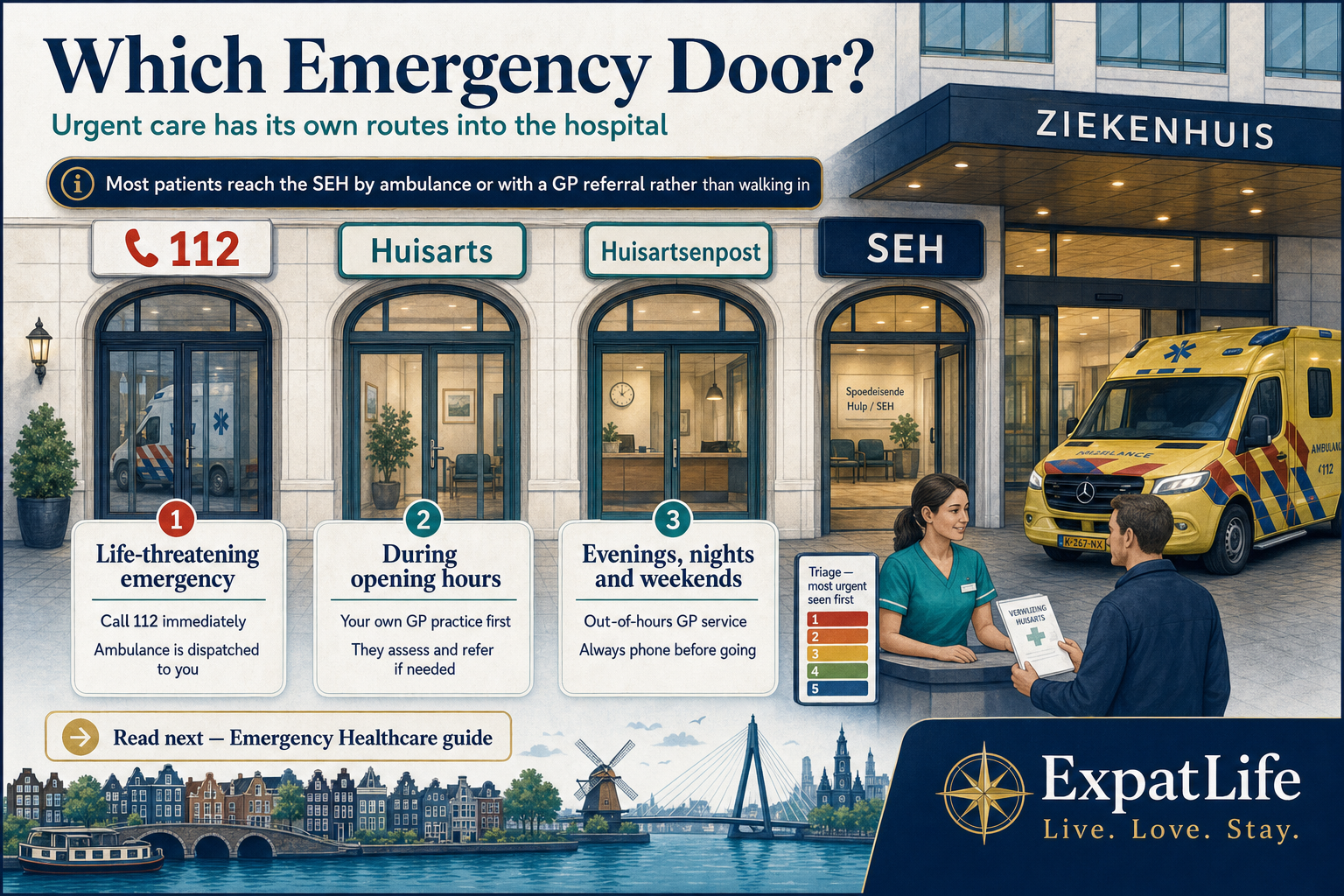
Call 112 now
Unresponsiveness, severe breathing difficulty or suspected stroke
Call 112 immediately — do not travel to a hospital yourself.
Heavy bleeding, severe allergic reaction or major trauma
Call 112 immediately.
Chest pain with worrying features
Call 112 — do not wait for an appointment.
Sudden severe deterioration while under hospital treatment
Call 112 if life may be at risk; otherwise use the emergency contact number your treatment team gave you.
Same day / out of hours
Urgent problem outside GP opening hours
Call the regional huisartsenpost for triage and referral if needed.
Post-operative wound concern or fever after discharge
Use the contact number from your discharge instructions; call the huisartsenpost or 112 if it escalates.
Planned route
Results question or appointment change
Contact the outpatient clinic secretariat or use the patient portal.
Ongoing symptom without new warning signs
Book a GP appointment and discuss whether a referral or follow-up is needed.
Children
Children are treated by paediatric teams, in clinics and wards designed with families in mind. Access follows the same referral logic: the family GP refers to paediatrics or another specialty, and appointments happen in outpatient clinics unless the situation is urgent.
Parents are expected to be involved. You are normally able to stay with your child, including during many procedures and often overnight, and decisions are explained to both the parents and — age-appropriately — the child. Older children and adolescents gradually gain more say in their own care.
Preparation is the single biggest lever for a calmer visit. Explaining honestly what will happen, bringing comfort items and knowing the practical routine reduces fear far more than reassurance alone. For vaccinations, growth monitoring and the wider children's healthcare system, use the Healthcare for Children guide.
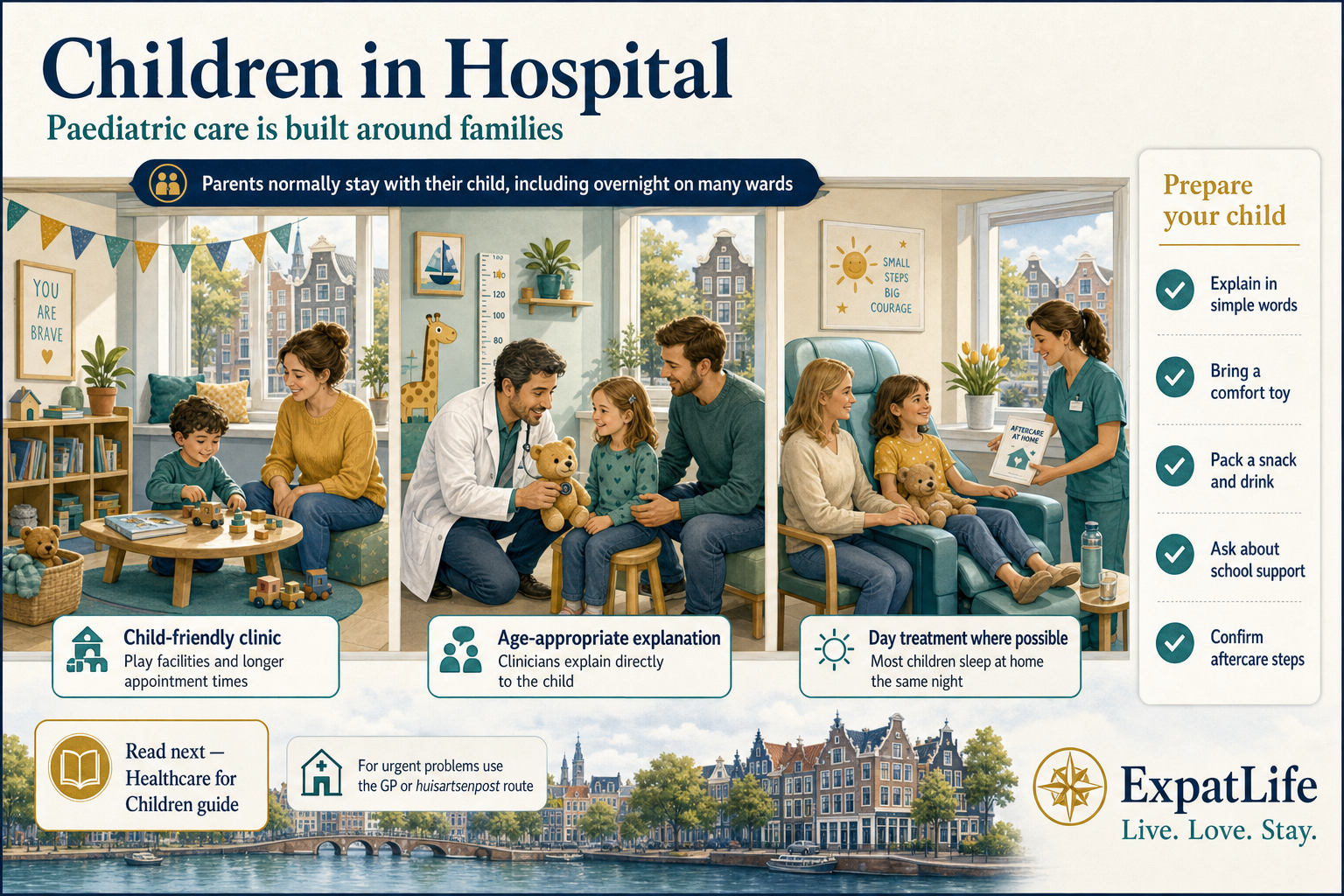
Child-friendly outpatient clinics with paediatricians, specialised nurses and play facilities, and appointment lengths adapted to children.
You can normally accompany your child, including during many procedures and often overnight. Ask the ward what the arrangements are.
Clinicians explain to children in a way they can understand, and involve adolescents progressively in decisions about their own care.
Many paediatric procedures are arranged as day treatment so the child sleeps at home, with clear aftercare instructions for parents.
Ask about school support, activity limits and how long recovery normally takes so you can plan realistically.
For urgent problems use the GP, huisartsenpost or 112 depending on severity — outpatient clinics are not the urgent-care door.
Prepare before a children's appointment
Examples
| Situation | How it works here | First step |
|---|---|---|
| First paediatric appointment after moving countries | Bring translated records so the team does not have to repeat investigations unnecessarily. | Ask your GP to include previous diagnoses and treatments in the referral, and bring the original documents. |
| Your child is anxious about a procedure | Ask the clinic what preparation support exists — explanation materials, play support or a pre-visit are often available. | Call the clinic and say your child is anxious; ask what they can arrange in advance. |
| Your child needs day surgery | Confirm fasting instructions, arrival time, who can stay and what recovery at home involves. | Read the pre-admission instructions carefully and call with any uncertainty rather than guessing. |
| Your teenager wants to be seen alone | Growing autonomy is part of Dutch paediatric care — discuss with the clinician what fits your child's age and situation. | Ask the clinic how consultations are usually arranged for that age group. |
Maternity
Dutch maternity care is midwife-led by default. A community midwife (verloskundige) provides routine antenatal care, and hospital involvement follows a medical indication rather than being automatic. If risks or complications appear, care shifts to an obstetrician-gynaecologist and the hospital takes a larger role.
Birth location is a real choice within that framework: at home, in a birth centre, or in hospital as an outpatient birth (poliklinische bevalling) or a medically indicated hospital birth. Which options are open to you depends on your clinical situation, and midwives explain the reasoning as the pregnancy progresses.
After birth, Dutch postnatal care includes kraamzorg — maternity home care that supports recovery, feeding and newborn checks in your own home. Hospitals provide neonatal care when a baby needs medical support. A dedicated Pregnancy & Birth guide covering the full pathway is coming soon.
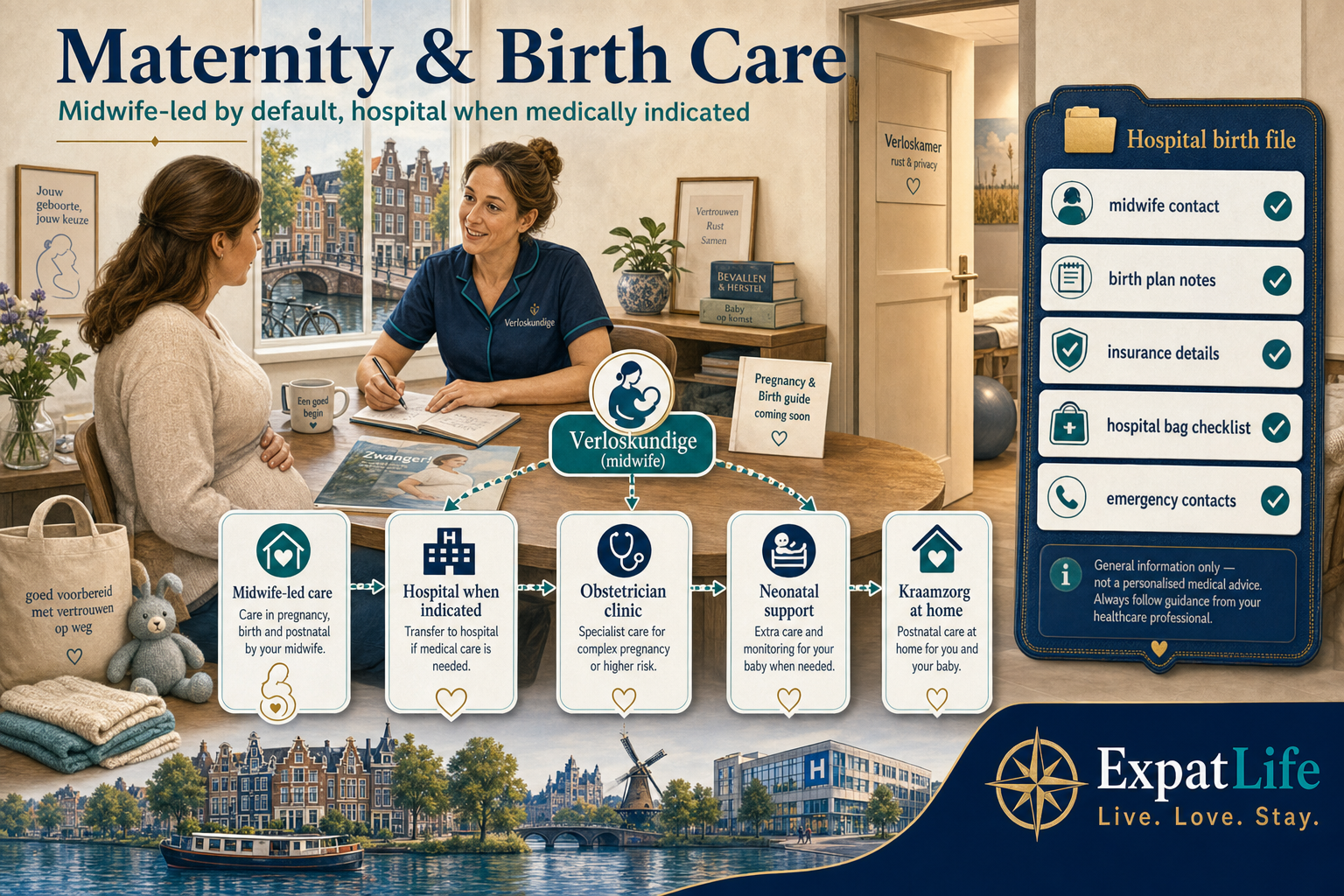
For full antenatal care, birth choices, kraamzorg, leave and registration depth, open the Maternity care cornerstone. This section is hospital-focused orientation only.
The verloskundige provides routine antenatal checks, monitors progress and refers to hospital care when a medical indication arises.
Hospital obstetric teams take over antenatal care and birth when there is a medical indication, working alongside midwives.
Home, birth centre or hospital, including outpatient birth. Options depend on your clinical situation and are discussed as the pregnancy progresses.
Hospitals provide newborn medical support when needed, with more specialised neonatal units in larger and academic centres.
Maternity home care supports recovery, feeding and newborn checks in the days after birth — arrange it early in pregnancy.
Check maternity-related coverage with your insurer, and arrange midwife and kraamzorg registration well before the due date.
Examples
| Situation | How it works here | First step |
|---|---|---|
| You want to give birth in hospital without a medical indication | Discuss an outpatient birth (poliklinische bevalling) with your midwife, including how it is arranged and what your insurer covers. | Raise your preference early in pregnancy so arrangements and coverage can be checked in time. |
| Your midwife refers you to the hospital | A medical indication has arisen; ask what it means, what changes practically and whether it may change back. | Ask for the reason in plain language and what it means for birth-location options. |
| You are new to the Netherlands and pregnant | Register with a community midwife promptly and with your GP, and share records from care abroad. | Contact a local midwifery practice as early as possible — capacity can be tight in busy areas. |
Private clinics
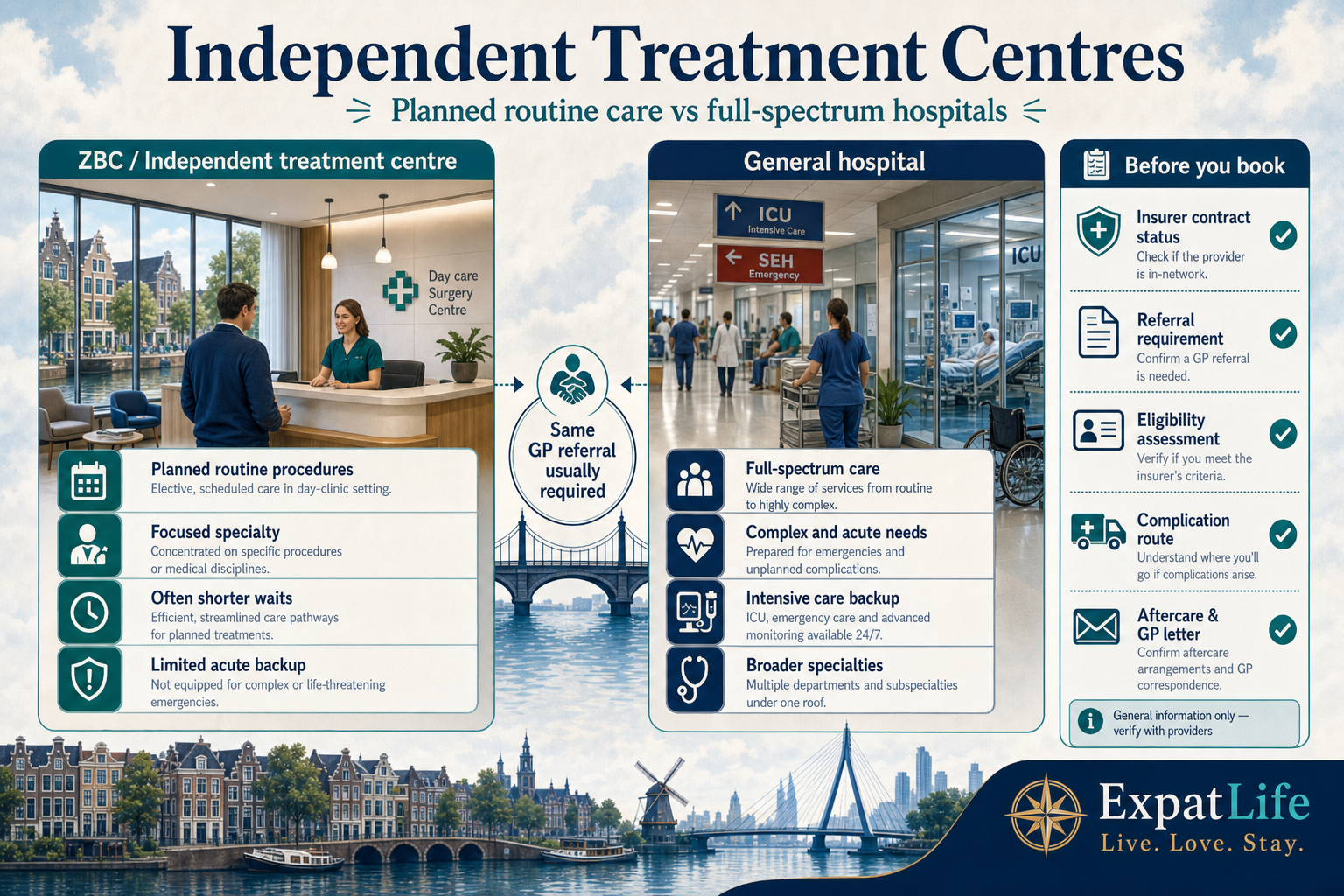
Alongside hospitals, the Netherlands has independent treatment centres (zelfstandige behandelcentra, ZBCs) that provide planned, routine, lower-risk specialist care such as certain eye, orthopaedic, dermatological or diagnostic procedures. Many work with insurer contracts and require the same GP referral as a hospital.
The trade-off is scope. A ZBC can offer a short, focused pathway and sometimes a shorter waiting time, but it does not carry the full breadth of a hospital, and it does not have the intensive care and acute backup that complex or higher-risk treatment may require. That is exactly why eligibility is assessed before treatment is offered.
There are also fully private services where you pay yourself. Before choosing any non-hospital option, check three things: whether your insurer has a contract, whether a referral is required for coverage, and how complications, aftercare and follow-up are arranged if something does not go to plan.
| Route | When | How | Note |
|---|---|---|---|
| Independent treatment centre (ZBC) | Planned, routine, lower-risk procedures you are assessed as eligible for | GP referral to a contracted centre offering that treatment | Focused pathways and sometimes shorter waits; limited scope and no acute backup. |
| General or teaching hospital | Broader specialist care, higher-risk procedures, or complications requiring escalation | GP referral or onward referral into the outpatient clinic | Full spectrum of specialties with intensive care and emergency support on site. |
| Fully private, self-paid service | You choose to pay yourself for speed, convenience or a service outside insured care | Direct booking, though a referral may still be advisable | Clarify costs, aftercare, complication routes and whether your GP will be informed. |
Before booking outside a hospital
Examples
| Situation | How it works here | First step |
|---|---|---|
| A treatment centre offers a much earlier date | Check contract status, referral requirements and complication arrangements before accepting the earlier slot. | Call your insurer to confirm coverage, then ask the centre how complications and aftercare are handled. |
| You are told you are not eligible for treatment at a ZBC | Eligibility reflects risk and complexity — hospital care exists precisely for these situations. | Ask which factor made you ineligible and what the hospital pathway looks like instead. |
| You want to pay privately to skip a wait | Weigh cost, aftercare and continuity, and keep your GP informed either way. | Ask for written cost information and check what your insurer would and would not reimburse. |
Costs
Hospital care in the Netherlands is funded through mandatory basic health insurance (basisverzekering), which covers medically necessary hospital care. For adults, the annual deductible (eigen risico) usually applies to hospital care, unlike GP consultations which are generally exempt. Children's coverage rules differ from adults'. Amounts and terms change over time, so this guide deliberately does not print fee figures.
Two things surprise newcomers most. First, insurers contract with providers, and using a non-contracted hospital can mean a larger personal share depending on your policy type. Second, hospital care is billed as treatment packages that can run across calendar years, so an invoice may arrive months later and may touch a different year's deductible than you expected.
Keep referral letters, appointment confirmations, discharge letters and invoices together. If a bill is unclear, ask the hospital's finance department what the invoice covers and ask your insurer how the deductible and any contract rules were applied to your specific treatment.

Cost orientation only — this is not a fee schedule, quotation, reimbursement promise or guarantee. Coverage rules, deductible amounts and insurer contracts change over time and differ per policy. Always verify current terms with your own insurer, and never delay emergency care because of cost uncertainty.
Residents are generally required to hold Dutch basic health insurance, which covers medically necessary hospital care. Verify your own policy details with your insurer.
Most adult hospital care counts towards the annual deductible, while GP care is generally exempt. Ask your insurer how it applies to your treatment.
Insurers contract with hospitals and treatment centres. Non-contracted care can leave a bigger personal share, depending on whether you hold an in-kind, restitution or combination policy.
Hospital care is billed as packages that can span calendar years, so invoices may arrive late and touch a different year's deductible than you expect.
Coverage and deductible rules for children differ from adult rules under basic insurance. Confirm family arrangements with your insurer.
Some extras such as certain physiotherapy or dental care sit outside basic insurance. Check whether supplementary cover is relevant to your treatment plan.
Costs checklist
Examples
| Situation | How it works here | First step |
|---|---|---|
| An invoice arrives months after treatment | Treatment-package billing is often delayed. Check what period and treatment it covers before assuming it is wrong. | Ask the hospital finance department to explain the invoice, then ask your insurer how the deductible was applied. |
| Your chosen hospital is not contracted | Reimbursement depends on your policy type; a larger personal share is possible. | Call your insurer before the appointment and ask what would be reimbursed for that specific hospital. |
| Treatment spans New Year | Package attribution can mean the deductible of one specific year applies — clarity beats assumption. | Ask your insurer which year the treatment package will be attributed to. |
| You are unsure whether a treatment is covered | Ask before treatment starts. The hospital can name the treatment; the insurer confirms coverage. | Request the treatment description from the clinic and check it with your insurer. |
Patient rights
Dutch healthcare law gives patients clear rights around information, consent, privacy and access to records. In practice, this shows up as an expectation that you take part in decisions: clinicians explain options and risks, and they expect questions rather than silent agreement.
That participatory style can be unfamiliar if you are used to a more directive model. Shared decision-making means it is entirely normal to ask what the alternatives are, what happens if you wait, and what the specialist would advise a family member in the same situation. Asking is not seen as distrust.
You also have practical routes when something is unclear or goes wrong: interpreter support, access to your own records through a patient portal, the option to request a second opinion, and a complaints officer (klachtenfunctionaris) at every hospital, with independent escalation available if a complaint is not resolved.
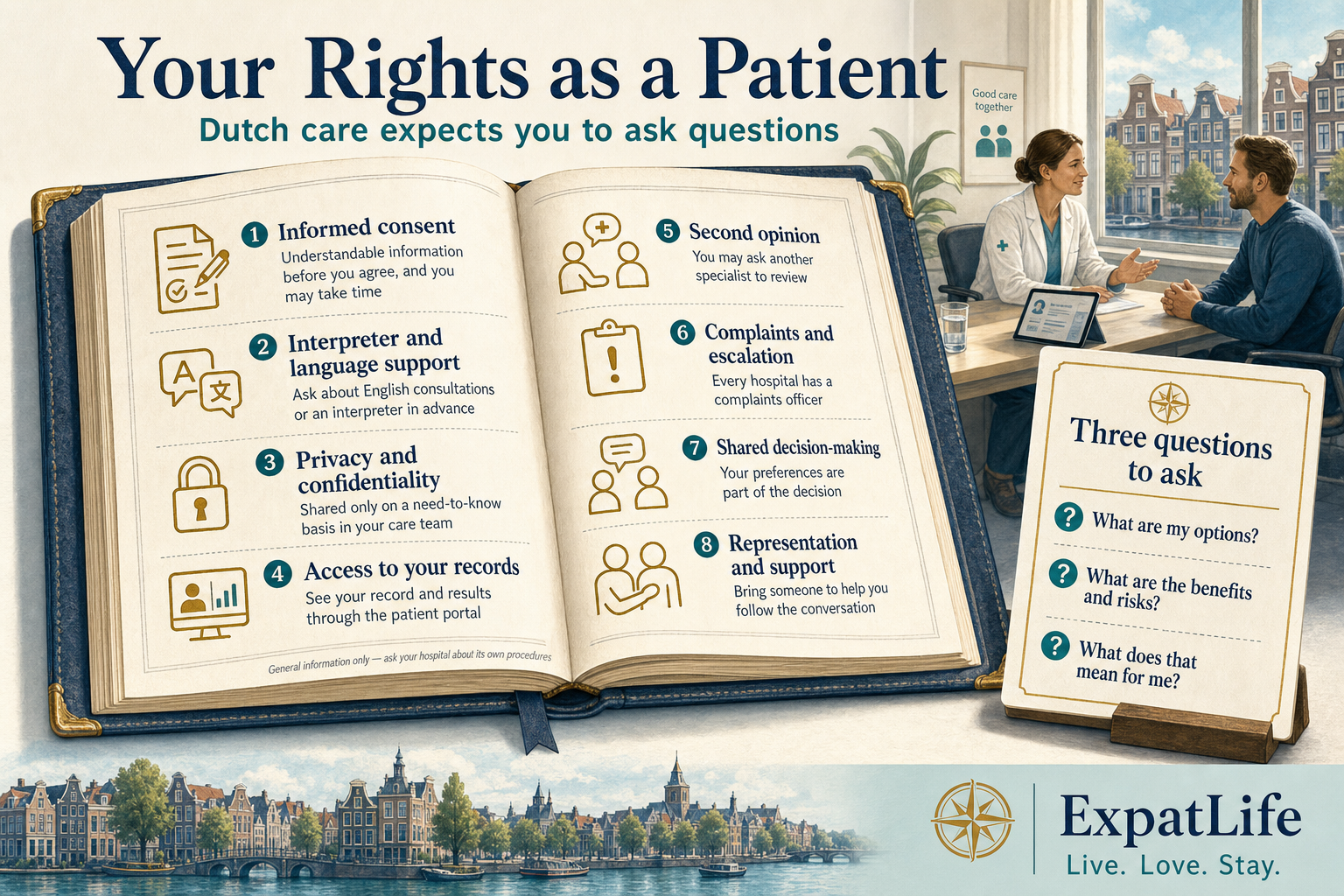
You should receive understandable information about the proposed treatment, alternatives and risks before agreeing. Consent can be withdrawn, and you may take time to decide.
Ask in advance about English-language consultation or interpreter arrangements, especially for consent conversations. Avoid relying on a child to interpret.
Medical information is confidential and shared on a need-to-know basis within your care team. You can ask who has access and how information is shared.
You have the right to see your medical record and usually to access letters, results and appointments through the hospital patient portal.
You may request a second opinion from another specialist. Ask your GP or specialist how to arrange it and check coverage with your insurer.
Every hospital has a complaints officer, and independent escalation routes exist if the issue is not resolved internally.
Ask three questions: what are my options, what are the benefits and risks, and what does that mean for my situation. This is expected, not confrontational.
You may bring someone to appointments, and arrangements exist for people who cannot make decisions themselves. Ask the clinic how to record who may be informed.
Using your rights in practice
Examples
| Situation | How it works here | First step |
|---|---|---|
| You do not fully understand a proposed treatment | Consent should follow understanding. Ask for a plainer explanation, written information or time to think. | Say clearly that you want to understand before deciding, and ask for the information in writing. |
| You want a second opinion | This is an accepted part of Dutch care. Arrange it through your GP or specialist and check coverage with your insurer. | Tell your specialist you would like a second opinion and ask what records should be shared. |
| You are unhappy with how you were treated | Start with the department, then the hospital complaints officer, with independent escalation available afterwards. | Ask reception or the clinic secretariat for the complaints officer's contact details. |
| The consultation was in Dutch and you missed details | Do not sign or agree to something you did not follow. Language support exists for this reason. | Ask for the explanation again in English or for an interpreter at the next appointment. |
Differences
None of these are problems once you expect them. Each card describes a system characteristic and how to work with it rather than against it.
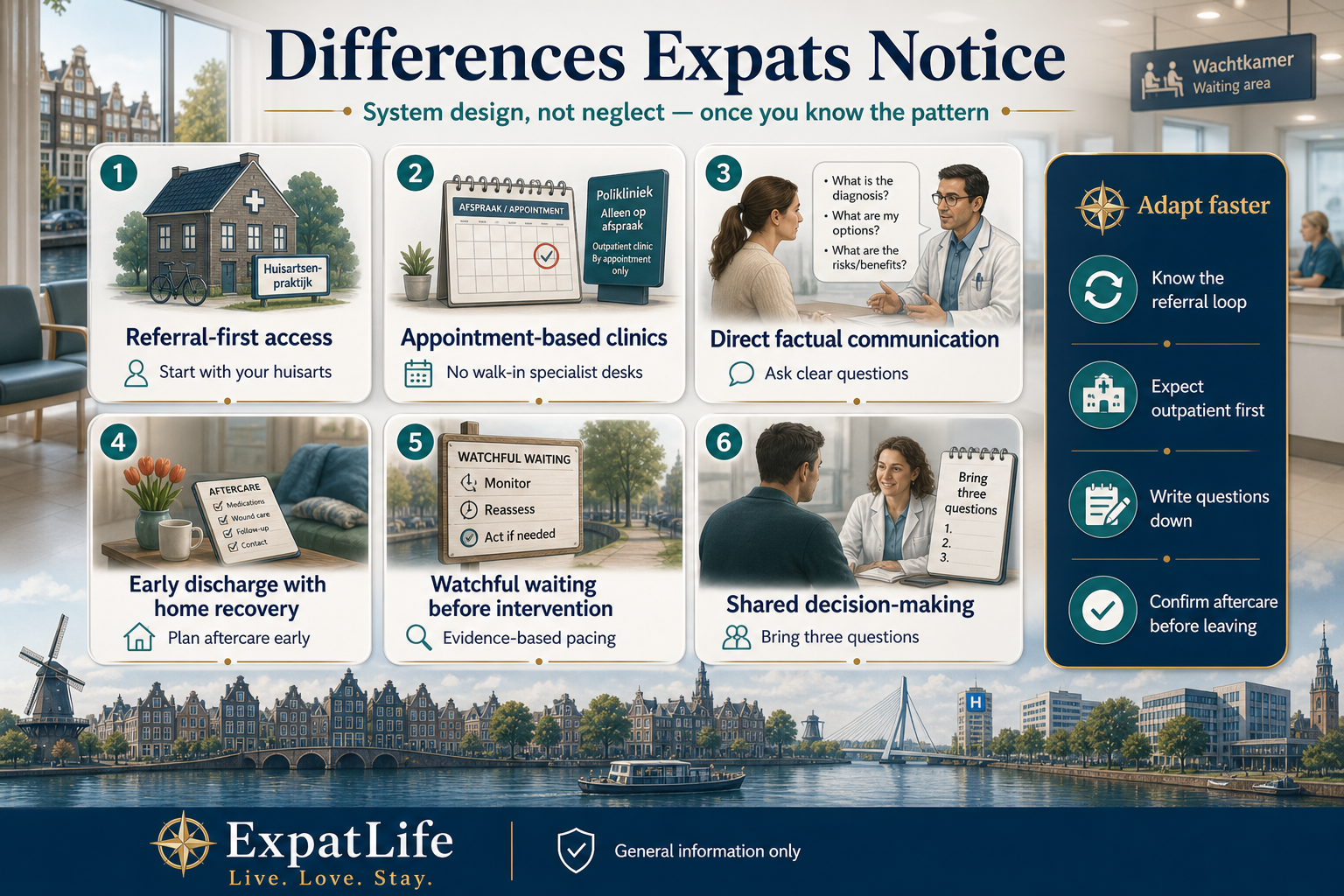
Example: arriving at a hospital outpatient clinic hoping to book a dermatologist directly and being sent back to the GP.
Fix: Start with your huisarts and ask what would justify a referral — that conversation is the actual first step.
Example: a fifteen-minute consultation ending before you asked your second question.
Fix: Bring three prioritised questions in writing and state upfront what you most want to cover.
Example: a specialist stating probabilities and options plainly without softening language.
Fix: Read directness as respect for your ability to decide, and ask follow-up questions freely.
Example: being advised to monitor a condition for several weeks before further investigation.
Fix: Ask what specifically would change the plan and when you should report back — then you have a plan, not a delay.
Example: going home the day after a procedure that would mean several nights elsewhere.
Fix: Prepare home recovery in advance and use the discharge conversation to confirm warning signs and contacts.
Example: being asked which option you prefer rather than being told what will happen.
Fix: Ask what the specialist would advise and why, then decide together — your preferences legitimately count.
Example: the specialist closing the episode and your GP handling ongoing prescriptions and monitoring.
Fix: Keep the GP relationship active; they hold your overall record and coordinate onward care.
Example: an invoice or letter appearing months after treatment ended.
Fix: Keep a folder for hospital documents and check invoices against treatment dates before worrying.
Checklist
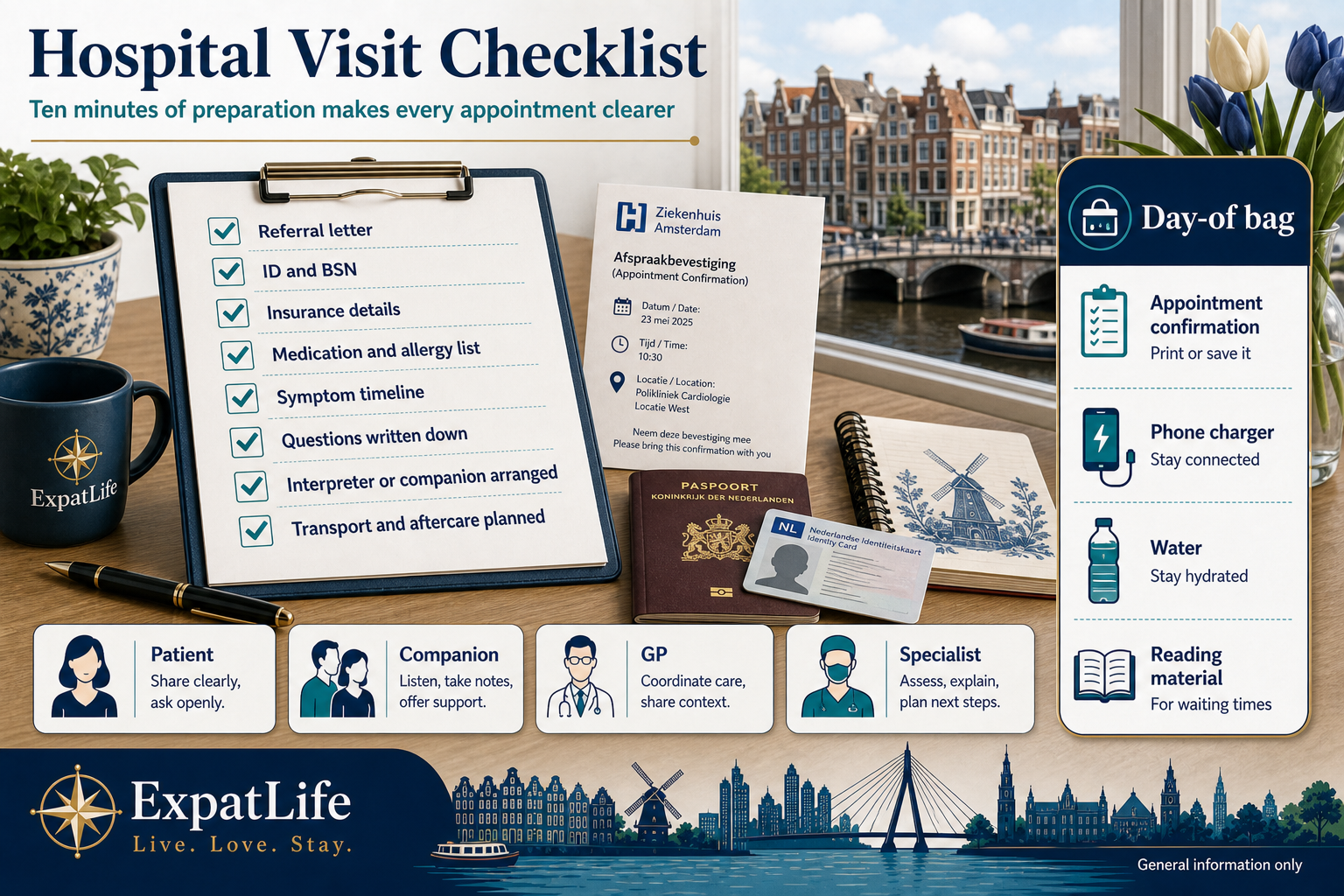
Good hospital visits are mostly the result of ten minutes of preparation. Having documents ready, a written symptom timeline and three clear questions changes a rushed appointment into a productive one, and it makes admissions far less stressful.
Preparation also means being clear about roles. You are the person who knows your history and priorities; a companion can listen and take notes; your GP holds the overall record and handles ongoing care; the hospital specialist and team run the episode of specialist care. When everyone's role is clear, fewer things fall between the cracks.
Preparation checklist
Bring history, priorities and questions; confirm you understand the plan before agreeing to it.
Listens, takes notes and remembers what was said when the conversation is stressful.
Refers you in, holds the overall record and resumes ongoing care after the specialist episode.
Assesses, investigates, treats and coordinates the specialist episode, then reports back to the GP.
Handles appointments, rescheduling, paperwork and routing your practical questions.
Answers coverage, deductible, contract and care-mediation questions about waiting times.
Avoid
These mistakes are common because hospital access models differ between countries. Each one has a straightforward fix that usually takes a single phone call.
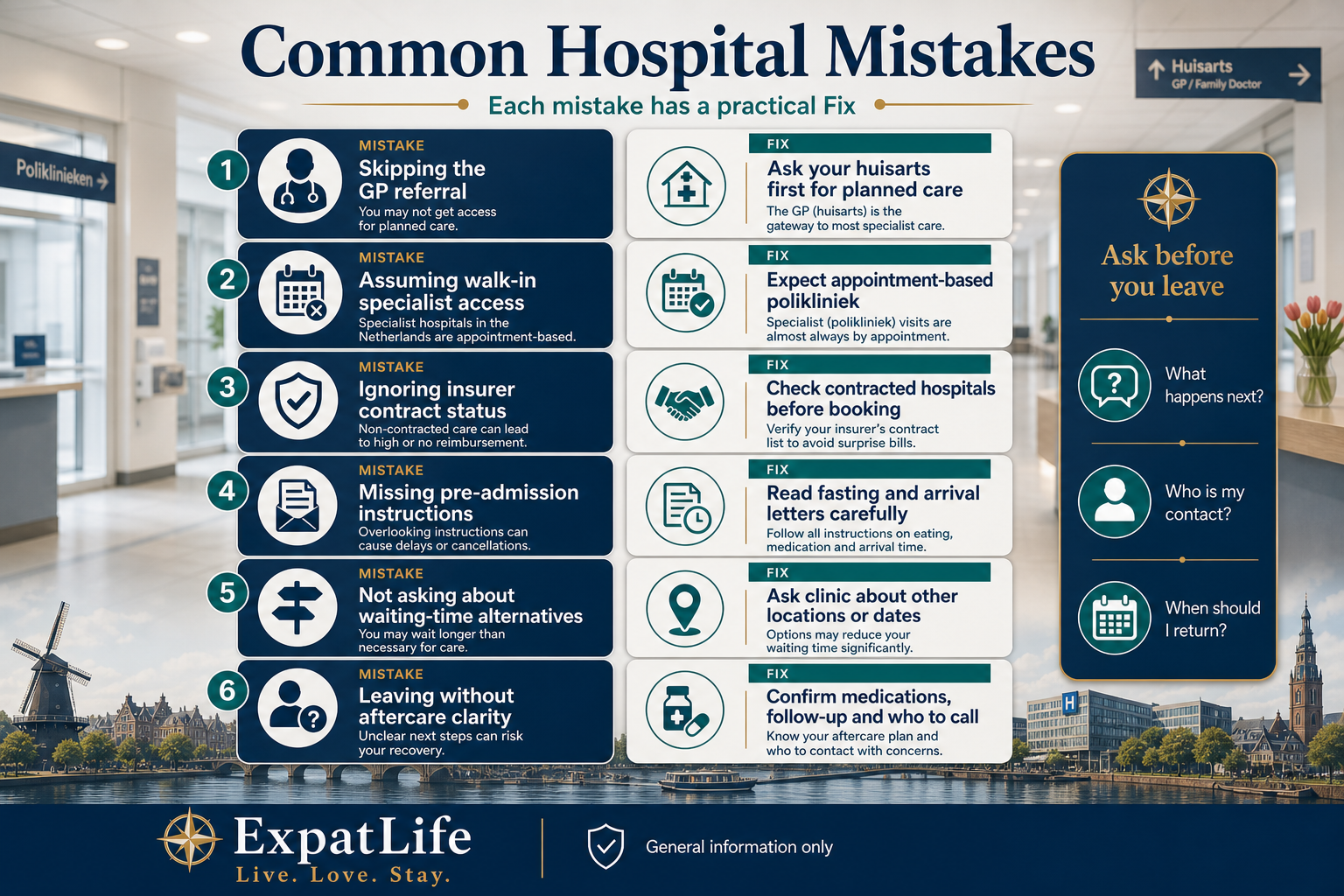
Example: calling outpatient clinics for weeks before learning that a GP referral is required.
Fix: Book a GP appointment first and ask specifically about a referral, the specialty and the reason.
Example: attending a specialist without a valid referral and facing reimbursement problems.
Fix: Keep the referral letter or digital confirmation and check referral requirements with your insurer.
Example: choosing a hospital or treatment centre that is not contracted and receiving a larger personal share.
Fix: Check the insurer's provider list before booking planned care, and ask what would be reimbursed.
Example: waiting months without knowing that care mediation and cancellation lists exist.
Fix: Ask the clinic about earlier slots and contact your insurer's care-mediation service.
Example: eating before a procedure requiring fasting, leading to a postponed appointment.
Fix: Read the appointment letter and portal messages twice, and call the clinic with any uncertainty.
Example: turning up without ID, insurance details or a medication list, slowing everything down.
Fix: Keep a single hospital folder on your phone and check it the evening before.
Example: going home unsure who arranges the next step or when results will arrive.
Fix: Before leaving, repeat the plan back and confirm who does what, by when, and who to contact.
Example: going to the SEH about a results question or an appointment change.
Fix: Use the clinic secretariat or patient portal for admin, and the GP, huisartsenpost or 112 for urgent needs by severity.
Example: repeating investigations because previous results were never shared.
Fix: Bring translated summaries and results, and ask that they be added to your record.
Example: relying only on specialists and having no coordinator for ongoing care or prescriptions.
Fix: Stay registered with a huisarts and make sure hospital letters reach them.
FAQ
Orientation answers only — confirm your own situation with your GP, your treating specialist and your insurer. Call 112 for life-threatening emergencies.
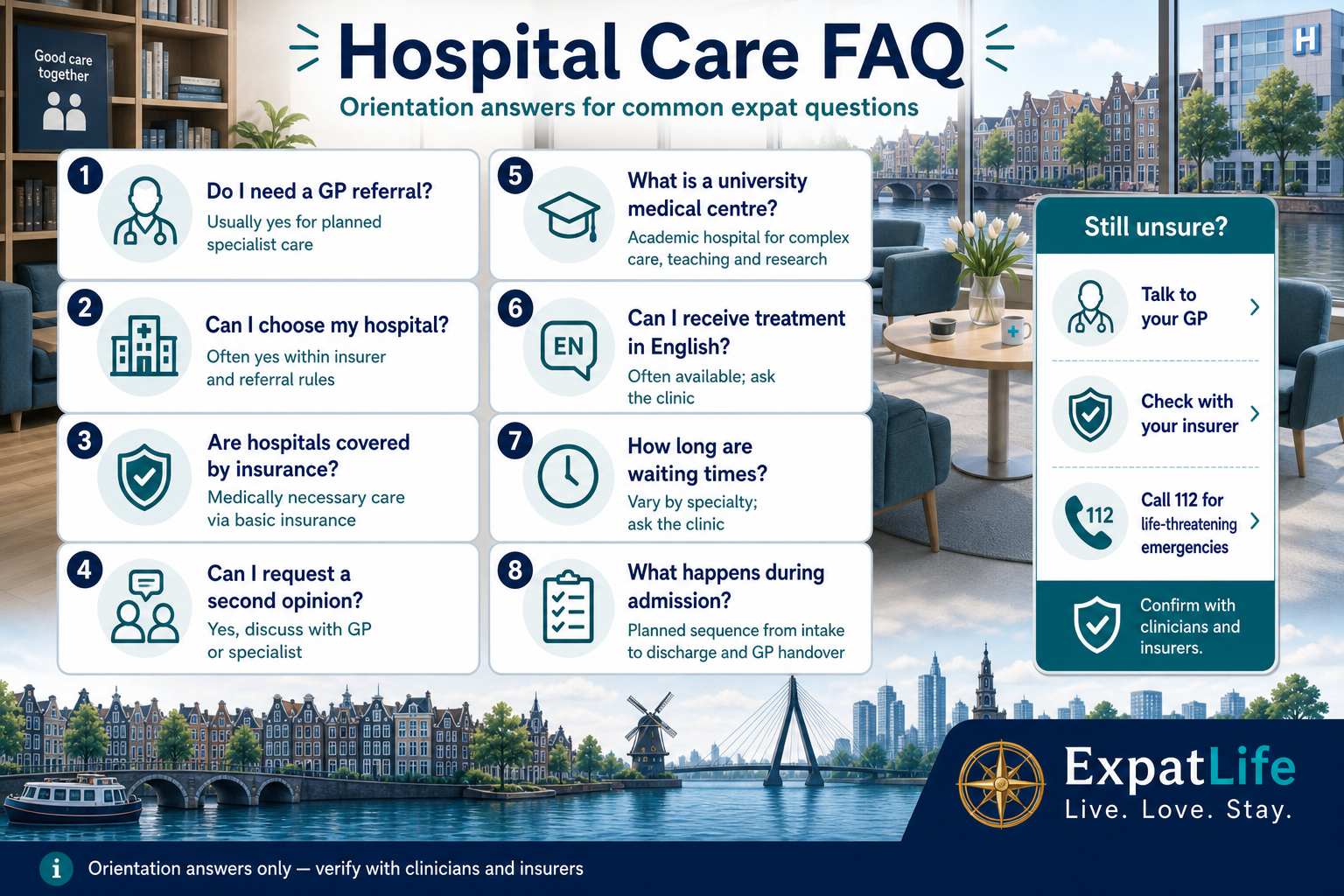
For planned specialist care, yes — you normally need a referral (verwijzing) from your GP, and insurers generally expect a valid referral for reimbursement. Emergency care is different: 112 and emergency departments do not require a referral. Keep the referral letter or digital confirmation with your appointment documents.
For planned care you usually have a choice, and your GP will often suggest options. Weigh travel distance, whether your insurer has a contract with the hospital, waiting time for that specialty and whether your condition needs concentrated expertise. For highly specialised treatment, the choice may be limited to a few centres.
Dutch basic health insurance covers medically necessary hospital care. For adults the annual deductible (eigen risico) usually applies to hospital care, unlike GP consultations. Using a non-contracted hospital can mean a larger personal share depending on your policy type. Verify your own policy and treatment with your insurer.
Yes. Requesting a second opinion from another specialist is an accepted part of Dutch care. Arrange it through your GP or your current specialist, ask which records should be shared, and check with your insurer how it is covered under your policy.
A university medical centre (UMC) is a hospital attached to a medical faculty that combines complex patient care with education and research. You may be referred there by your GP, but more often by another hospital when a condition is rare or highly complex. Expect multidisciplinary teams and the possible involvement of specialists in training and students.
In larger cities and academic centres, English is often workable, and many clinicians are comfortable in it — but it is not guaranteed everywhere. Ask when booking whether the consultation can be in English or whether an interpreter can be arranged, particularly for consent conversations and complex decisions.
Waiting times vary by specialty, hospital and season, and hospitals publish indicative waiting information. If a wait seems too long, ask the clinic about cancellation slots and contact your insurer's care-mediation service (zorgbemiddeling), which can look for earlier availability at contracted providers.
Planned admissions usually start with pre-admission screening and, for surgery, an anaesthesia intake, followed by clear preparation instructions. On the ward you meet nurses, specialists in training and the responsible specialist, with daily rounds. Stays are kept as short as clinically appropriate, ending with a discharge conversation about medication, warning signs, aftercare and follow-up, plus a letter to your GP.
The polikliniek is the outpatient clinic where planned, appointment-based specialist care happens. The SEH is the emergency department, which handles serious emergencies and triages by severity, receiving many patients by ambulance or on referral. Use the polikliniek for planned care and the appropriate emergency door — GP, huisartsenpost or 112 — for urgent situations.
No — that is not what emergency departments are for, and non-urgent patients are commonly redirected. For urgent problems, contact your GP during opening hours or the huisartsenpost outside them; they refer you to the SEH if hospital assessment is needed. Call 112 whenever life may be at risk.
Visiting arrangements vary by ward and hospital. For children, parents are normally able to stay with them, including during many procedures and often overnight. Ask the specific ward about visiting hours, numbers of visitors and any current restrictions before family travels.
Results are usually discussed at a follow-up appointment, by phone or through the hospital patient portal. You also have the right to access your own medical record. Ask how to activate portal access and confirm at each appointment how and when results will reach you — do not assume silence means everything is fine.
Register with a huisarts and arrange Dutch basic health insurance as early as you can, because both are needed for smooth planned hospital access. Bring translated records from care abroad so investigations are not repeated. In a life-threatening emergency, call 112 regardless of your registration status.
Your GP. When the specialist episode closes, the hospital sends a letter to your huisarts, who resumes ongoing monitoring, repeat prescriptions and follow-up questions. If new specialist input is needed later, the GP can issue a new referral.
Related
Hospital care connects to GP referrals, insurance, emergency routes and family pathways — read them together.
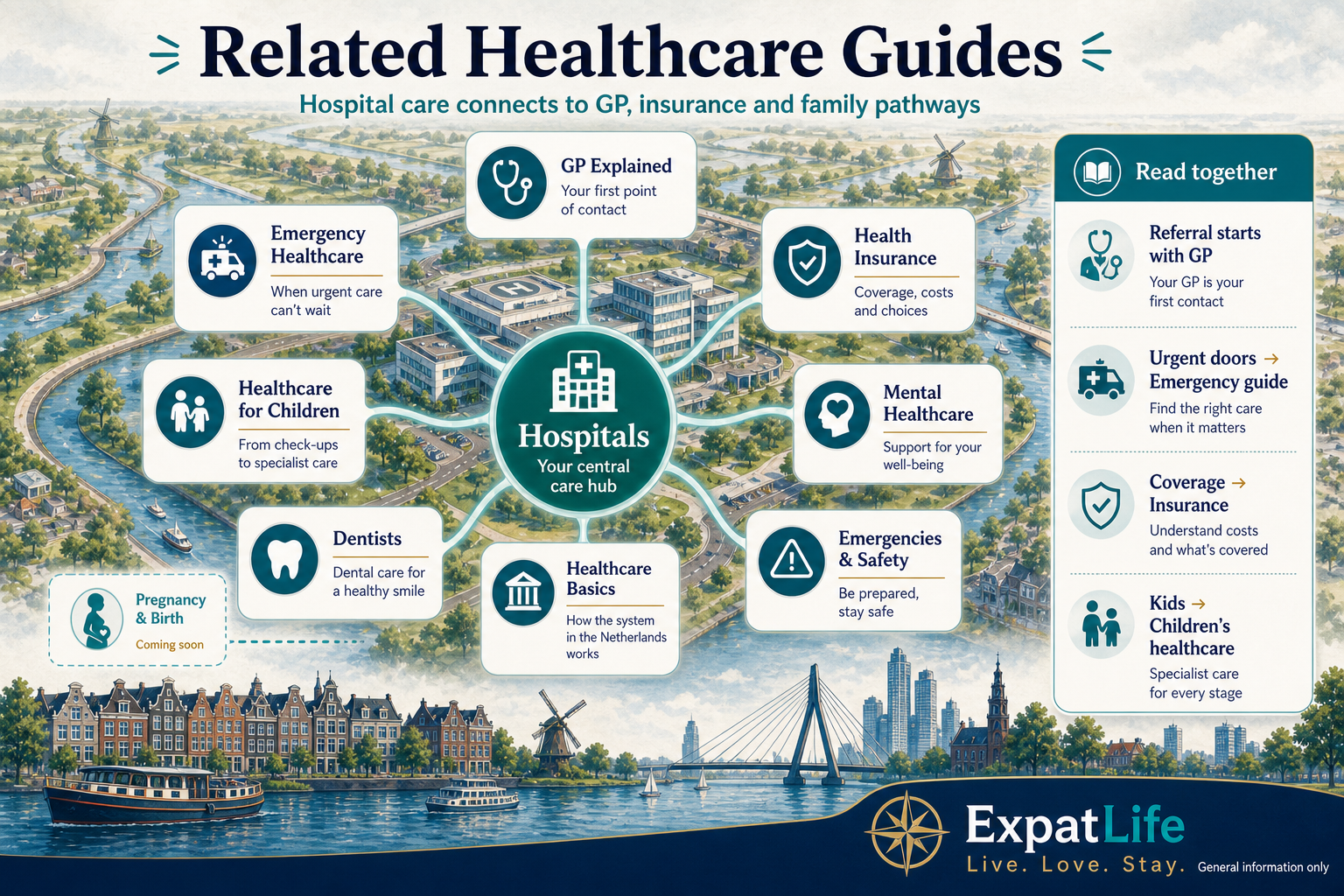
Health hub
This page is the hospitals cornerstone — explore related health topics next.
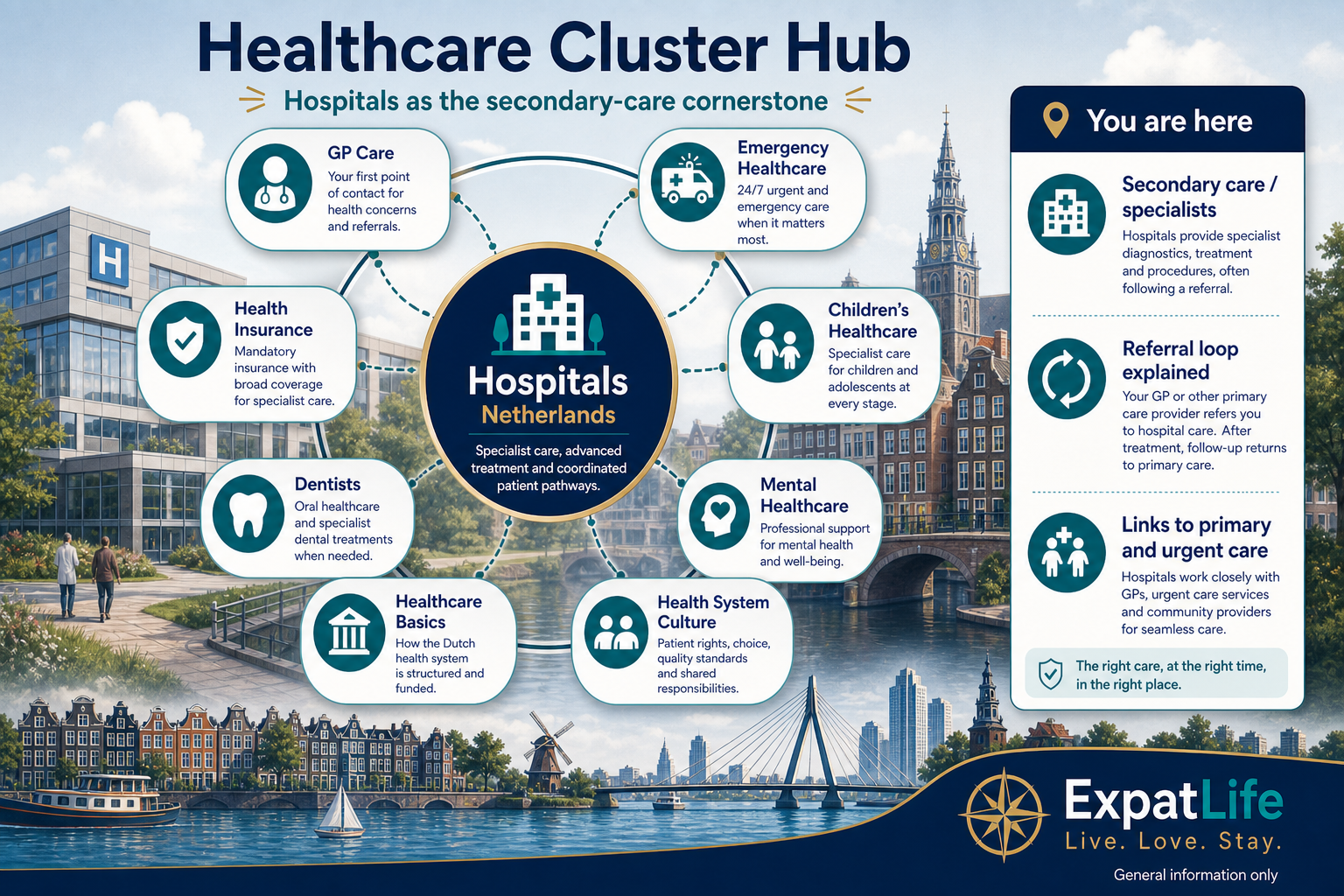
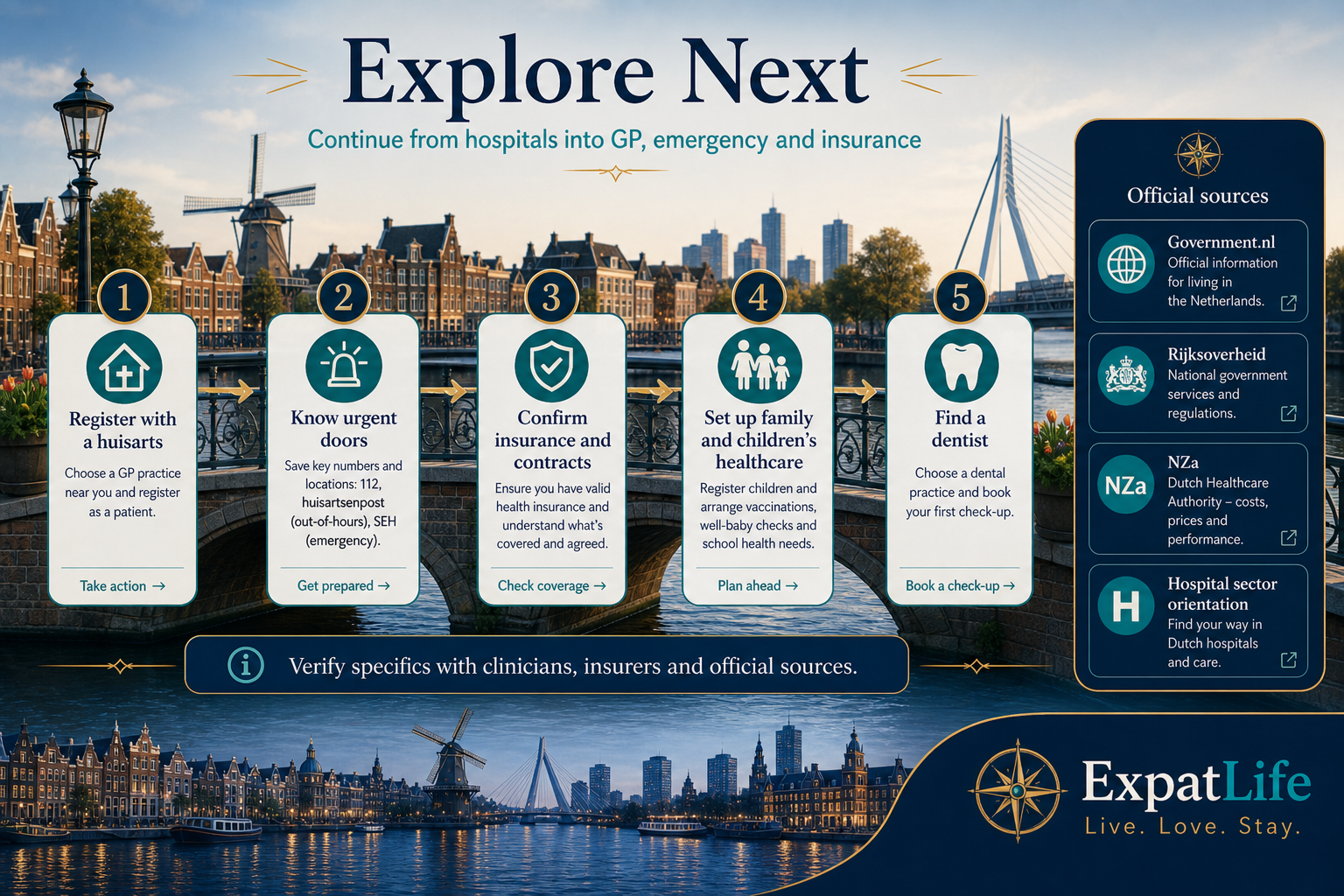
Explore next
Pick the card that matches what is still open — GP registration, insurance, children's care or dental routes — and verify specifics on the official sources below.
Trust
General information only — not medical advice, and not a ranking, endorsement or quality assessment of any hospital. Hospital procedures, waiting times, insurer contracts and coverage rules change, so verify your own situation with your GP, treating specialist, the hospital and your insurer, alongside the official sources above. In an emergency, call 112.