
Basic package
Mandatory core cover with largely standardised benefits — compare service and network, not imaginary coverage gaps.
Netherlands · Health · Insurance comparison
An expat-facing decision framework for comparing Dutch health insurance — basic vs supplementary factors, insurer choice levers, eigen risico tradeoffs and what to verify on comparison sites. Not a ranking of insurers.
General orientation only — not insurance, financial or medical advice, and not a ranking, award list or “best for expats” crowning of any insurer. Indicative figures (when shown) are year-labelled planning cues — always verify with your insurer and comparison tools such as Independer for the current policy year. For mandate, deadline and basic-package basics, use the Early Setup Health Insurance guide.

Quick answer
Dutch health insurance comparison for expats is less about crowning a “best insurer” and more about matching your likely care year to the right combination of basic policy type, optional supplementary cover, deductible level and service factors.
The Early Setup Health Insurance guide covers who must insure, the four-month rule and what the basic package broadly includes. This cornerstone owns the comparison framework: decision factors, tradeoffs and what to verify before you click switch.
Indicative euro figures on this page are labelled for 2026 planning conversations. They are not quotes. Always verify with your insurer and a current comparison tool for the policy year you are buying.
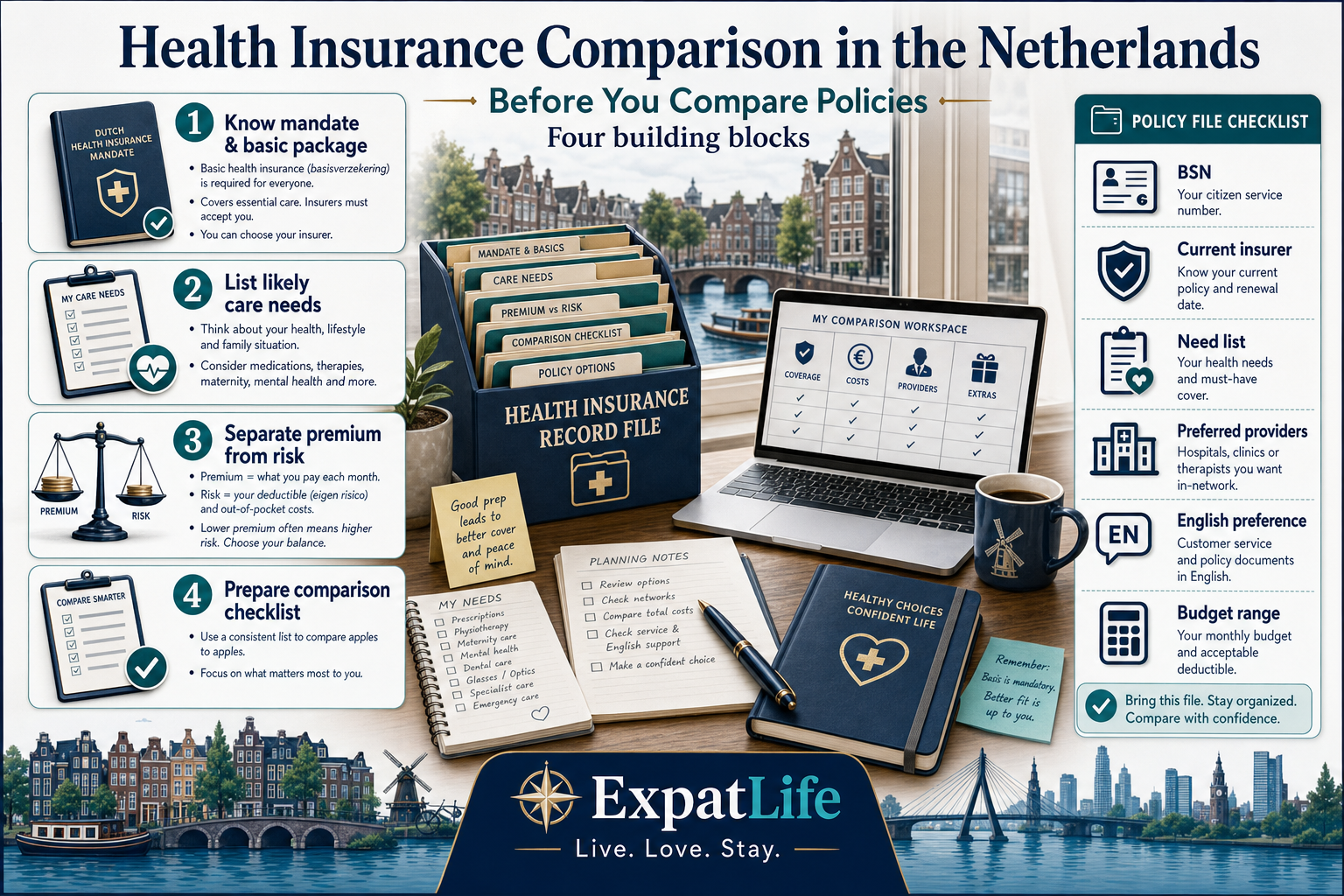
Policy file checklist
Examples
| Situation | How it works here | First step |
|---|---|---|
| First Dutch policy after arrival | Confirm mandate timing in the Early Setup guide, then use this framework to choose policy type and extras. | Open Health Insurance (early setup), then return here for compare factors. |
| Year-end switch consideration | Rebuild your need list, re-check network type and eigen risico, then verify filters on a comparison site. | Write three likely care needs for next year before sorting by premium. |
| Physio or dental year expected | Treat supplementary session or dental caps as first-class factors, not afterthoughts. | Open the Physiotherapy or Dentists guide for coverage context, then compare packages. |
Snapshot
These six cards cover almost every comparison question expats ask first — basic cover, supplementary extras, insurer factors, eigen risico, comparison-site checks and switching timing.

Mandatory core cover with largely standardised benefits — compare service and network, not imaginary coverage gaps.
Optional packages for dental, physio session caps, maternity extras and similar — only valuable if you will use them.
Network contracts, natura vs restitutie, English support, claims UX and customer service shape day-to-day fit.
Mandatory deductible plus optional voluntary excess — a premium vs out-of-pocket risk tradeoff for many adult pathways.
Tools for filtering packages by year — check filters carefully; they are not official rankings.
Most people compare toward year-end for a 1 January start — verify current deadlines before you assume.
How it works
A useful Dutch health insurance comparison starts with your likely care year, not with a sorted premium table. Premium matters, but fit factors decide whether a low price becomes an expensive surprise.
First separate what you must buy (basic) from what you might buy (supplementary). Then score how you want to access care: contracted networks, freedom to choose non-contracted providers, English support and claims friction.
Only after those factors are clear should you use a comparison site to filter current-year packages. Confirm the final policy wording with the insurer before you rely on a switch.
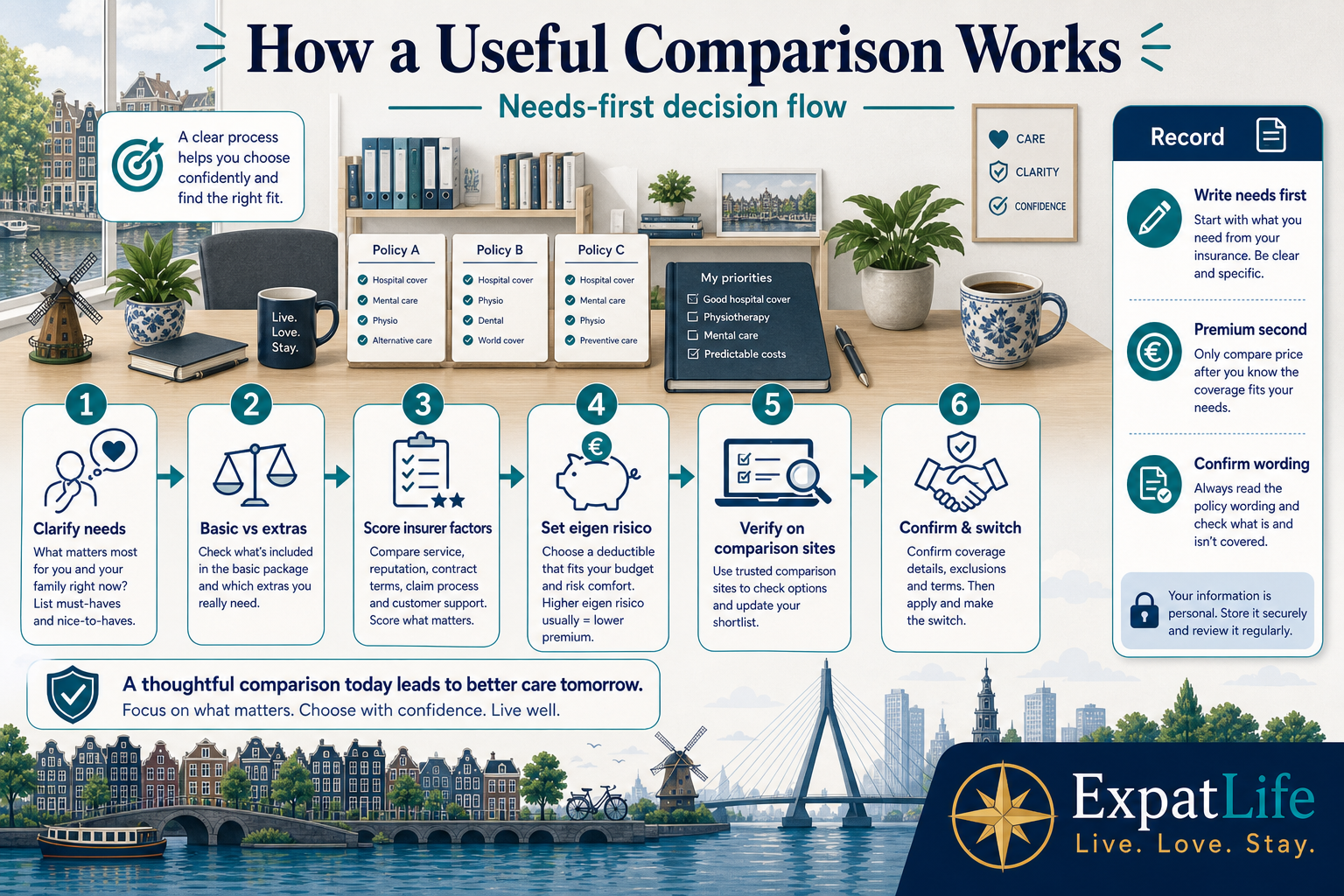
Comparison pathway
Stage 1
List likely dental, physio, maternity, medicines, specialist or family needs for the next calendar year.
Stage 2
Keep mandate basics in the Early Setup guide; decide whether any aanvullende package is worth the premium.
Stage 3
Network type, English support, claims and preferred providers matter more than brand familiarity.
Stage 4
Choose mandatory-only vs voluntary excess based on cash buffer and expected insured adult care.
Stage 5
Use a comparison site as a checklist, confirm policy year details, then complete the switch before the deadline.
How to
Step 1
Confirm who must insure, timing and what the basic package broadly includes before you compare.
Step 2
Note dental, physio, maternity extras, medicines, specialist care and language preferences for the next year.
Step 3
Decide natura vs restitutie preference and whether voluntary excess fits your cash buffer.
Step 4
Apply filters for extras and deductible, then open the shortlist policies — do not stop at the top row.
Step 5
Verify English support, network notes and claims process, then complete switching before the deadline.
Coverage layers
The basic package (basisverzekering) is mandatory and largely the same in benefit scope across insurers. Supplementary insurance (aanvullende verzekering) is optional and differs widely by package.
When people say “compare insurance,” they often mix two decisions: which basic policy type and insurer service factors to choose, and whether any supplementary package is worth the extra premium for their year.
Supplementary is not automatically “more complete care.” It is a budget tool for specific gaps — adult dental, many physio sessions, some maternity extras and similar. If those gaps are unlikely, a leaner setup can be rational.
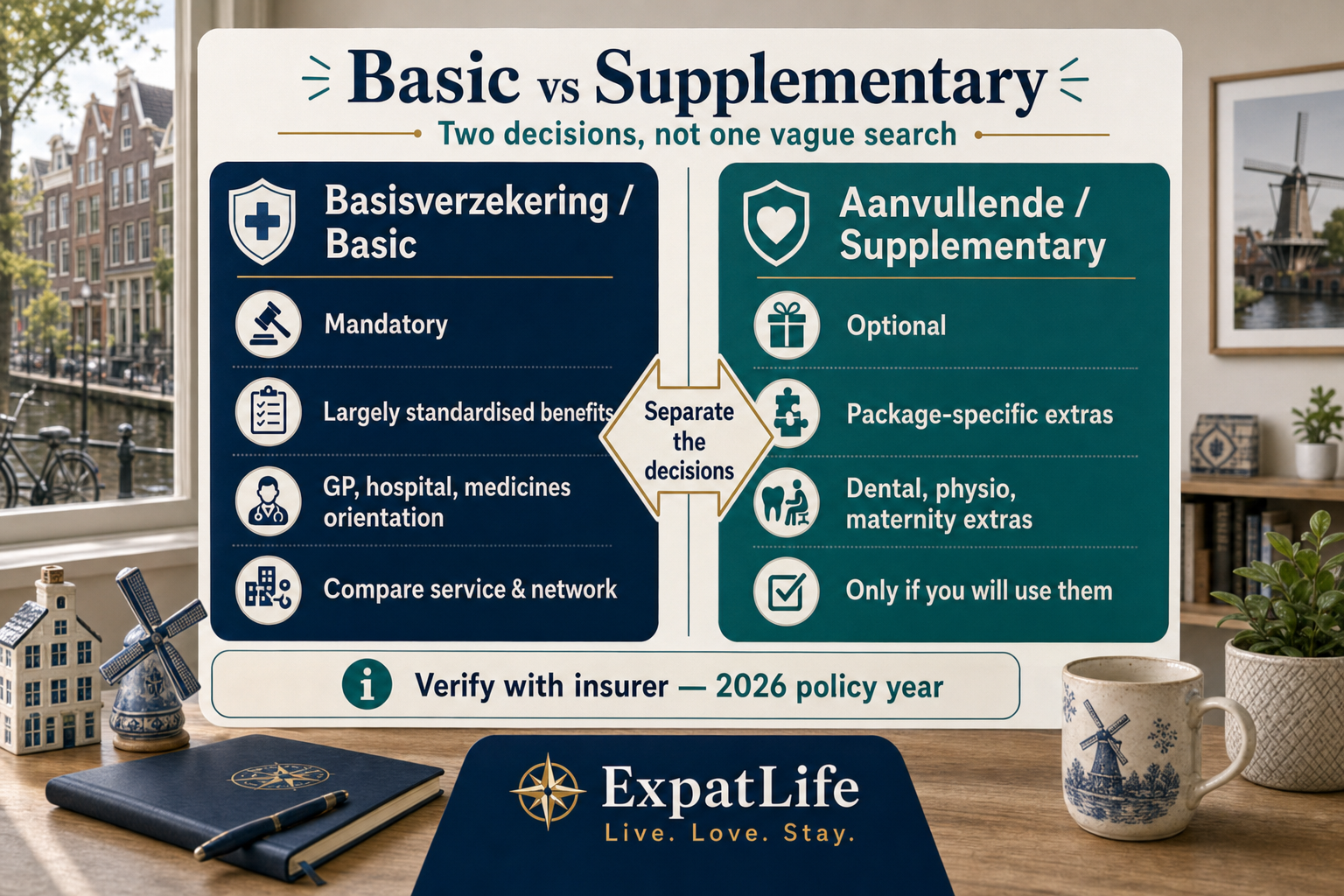
Mandatory. Covers medically necessary care such as GP, many hospital pathways and prescribed medicines under Dutch rules. Scope is largely standardised.
Optional. Packages add dental, physio session caps, glasses, maternity extras and more — terms differ by insurer and package tier.
An unused supplementary package is a pure cost. Estimate likely visits before buying higher tiers.
Children often follow different rules for deductibles and some care pathways — verify family composition on the policy, not by assumption.
| Layer | Focus | When it applies | Note |
|---|---|---|---|
| Basic package | Mandatory medically necessary care | Everyone who must insure under Dutch rules | Compare service/network factors — not mythical benefit gaps. |
| Supplementary dental | Adult dental budgets and orthodontics tiers | Likely check-ups, fillings or orthodontics next year | See Dentists guide for care context. |
| Supplementary physio | Session caps (often in a wide band by package) | Expected physiotherapy year | See Physiotherapy guide for access and limits. |
| Maternity-related extras | Own contributions / comfort add-ons | Pregnancy or birth planning year | See Maternity care guide — core midwife care is usually basic-oriented. |
Basic vs extras checklist
Examples
| Situation | How it works here | First step |
|---|---|---|
| Healthy year, no dental work planned | Basic-focused comparison may be enough; skip unused dental tiers. | Confirm you still want any minimal extras before filtering. |
| Physio every month is likely | Treat session caps and contracted physio networks as primary filters. | Open Physiotherapy guide, then filter aanvullende session bands. |
| Pregnancy expected next year | Learn basic maternity pathways first; then check which extras (if any) matter for your budget. | Open Maternity care guide, then return to compare factors. |
Insurer fit
Insurers differ less in what the basic package covers and more in how you access care and get help. Score factors — do not crown a “best for expats” winner from marketing pages.
Natura policies typically emphasise contracted providers; restitutie-style policies generally offer more freedom with different reimbursement mechanics for non-contracted care. Exact labels and percentages vary by policy — verify the wording for your year.
English support, mobile apps, claims speed and phone hours are real quality-of-life factors for newcomers. So is whether your preferred hospital, dentist or physiotherapist is contracted.

Contracted networks can mean smoother billing; more open policies can mean more choice with different personal-share rules. Verify labels for your policy year.
Check whether your GP-linked hospital, dentist, physio or midwife pathway sits inside contracted care for the policy you shortlist.
Ask about English for app, chat, phone and claims letters — marketing English is not the same as operational English.
App quality, reimbursement timelines and human support hours matter when something goes wrong mid-year.
| Route | When | How | Note |
|---|---|---|---|
| Natura-oriented | You are fine using contracted providers | Usually smoother in-network billing | Confirm your preferred clinics are contracted. |
| Restitutie-oriented | You want more provider freedom | Reimbursement rules differ for non-contracted care | Read personal-share percentages carefully. |
| English support check | You need operational English | Test chat/phone samples or FAQ language before switching | Do not rely on a translated homepage alone. |
| Claims UX | You expect frequent reimbursements | Review app ratings and claim steps on the insurer site | Still not a ranking — your workflow matters. |
Insurer-factor checklist
Examples
| Situation | How it works here | First step |
|---|---|---|
| You already love a non-contracted specialist clinic | Prioritise policy types that reimburse non-contracted care acceptably. | Ask the clinic which insurers they commonly work with, then verify policy wording. |
| You want the simplest in-network path | A contracted-network-oriented policy may reduce surprise personal shares. | Confirm your local hospital and GP referral destinations are contracted. |
| You need English claims help | Treat support language as a hard filter, not a nice-to-have. | Contact shortlisted insurers with one English claims question before switching. |
Deductible
For adults, Dutch basic insurance includes an annual deductible (eigen risico). You can often raise it with a voluntary excess (vrijwillig eigen risico) in exchange for a lower monthly premium.
For orientation in 2026, the mandatory adult eigen risico is about €385 per calendar year. Voluntary top-ups can raise the total deductible (commonly discussed up to about €885 combined) while lowering premium — exact steps and premium discounts vary by insurer and year.
GP care is generally outside eigen risico. Many hospital, specialist, ambulance and prescribed-medicine pathways for adults can count toward it. Children under 18 usually do not pay the adult deductible for basic-insured care — verify family rules for your policy.
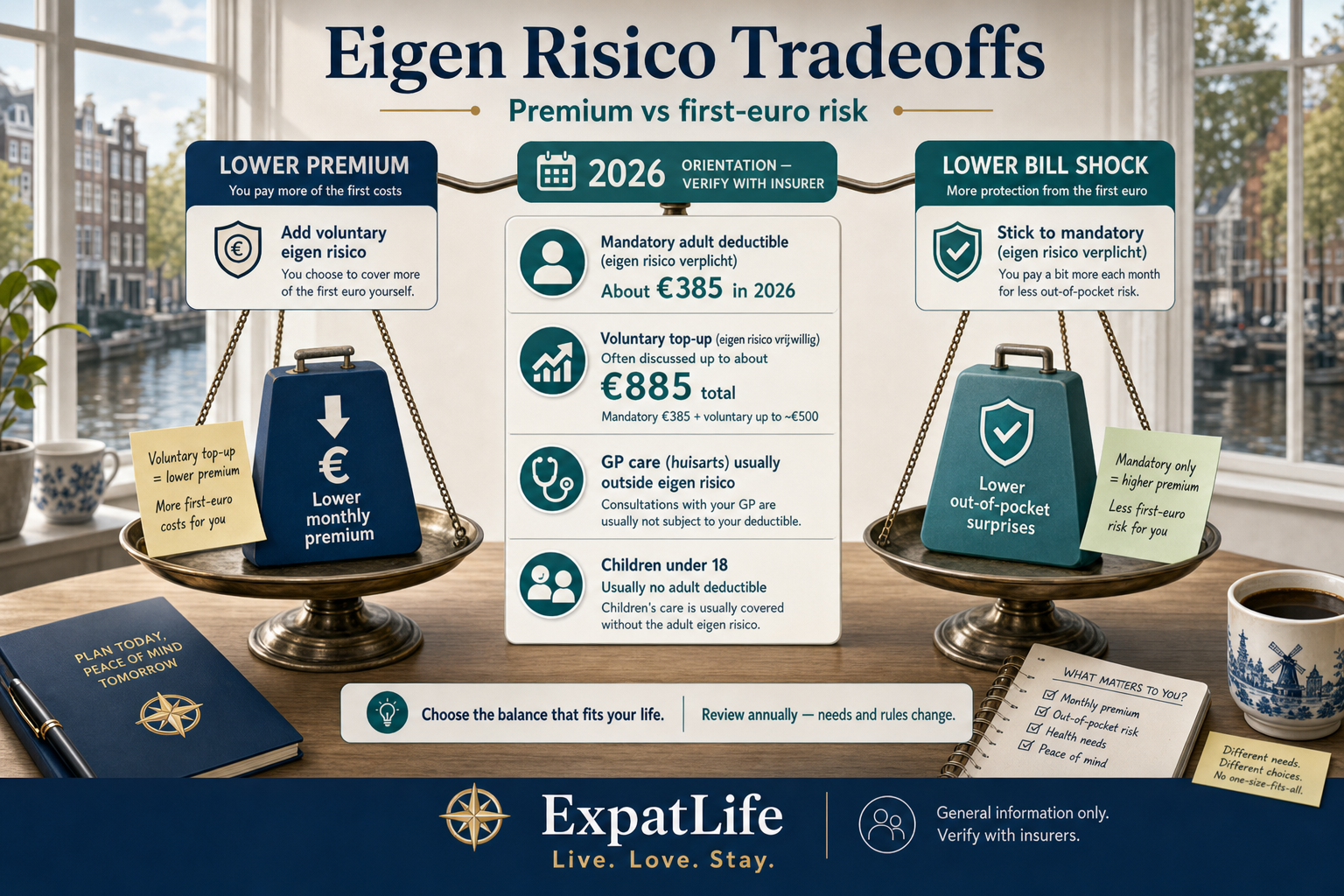
Indicative cost orientation for 2026 planning conversations — not a quote, premium promise or advice to raise or lower your deductible. Always verify current mandatory amounts, voluntary steps and premium effects with your insurer or a current comparison tool (for example Independer) for the policy year you are buying.
| Cost item | Indicative figure | What you usually pay | Note |
|---|---|---|---|
| Mandatory adult eigen risico (2026) | About €385 / year | First euros of many insured adult pathways | GP usually outside — verify edge cases. |
| With voluntary top-up (orientation) | Up to about €885 total discussed | Higher first-euro risk if care happens | Premium discount varies — not advice to top up. |
| Children under 18 (typical orientation) | Usually no adult deductible | Different financing rules may still apply | Confirm on the family policy. |
| Supplementary claims (typical orientation) | Often outside eigen risico | Package premium + any package limits | Dental/physio extras follow package terms. |
Voluntary excess can reduce monthly cost if you have a cash buffer and expect limited deductible-touching care.
Staying at the mandatory deductible limits first-euro shock when hospital, medicines or specialist care appear.
Raising eigen risico does not remove benefits from the basic package — it changes who pays first.
If deductible-touching care already happened, a high voluntary excess may not be the bargain it looked like in November.
Eigen risico checklist
Examples
| Situation | How it works here | First step |
|---|---|---|
| Strong cash buffer, low expected hospital year | Some people consider voluntary excess for premium savings — still a personal risk choice. | Price the exact discount vs extra risk for your shortlist policies. |
| Likely specialist or medicine year | Mandatory-only deductible often reduces bill shock. | Estimate whether you would hit €385 quickly anyway. |
| Most costs will be dental / physio extras | Focus on aanvullende caps; deductible may be a secondary lever. | Map which costs are basic-billed vs supplementary-billed. |
Tools
Comparison sites are useful filters — not award ceremonies. Treat the top row as a shortlist candidate, not a verdict. Independer is a commonly used Dutch comparison tool; other tools exist. None of them replace reading policy conditions.
Set the correct policy year before you sort. Apply filters for supplementary needs, eigen risico level and network type. Then open two or three policies and verify English support, contracted providers and exclusions yourself.
Be wary of any page that presents fake awards, guaranteed “best for expats” crowns or outdated year data. This ExpatLife guide intentionally does not rank insurers.
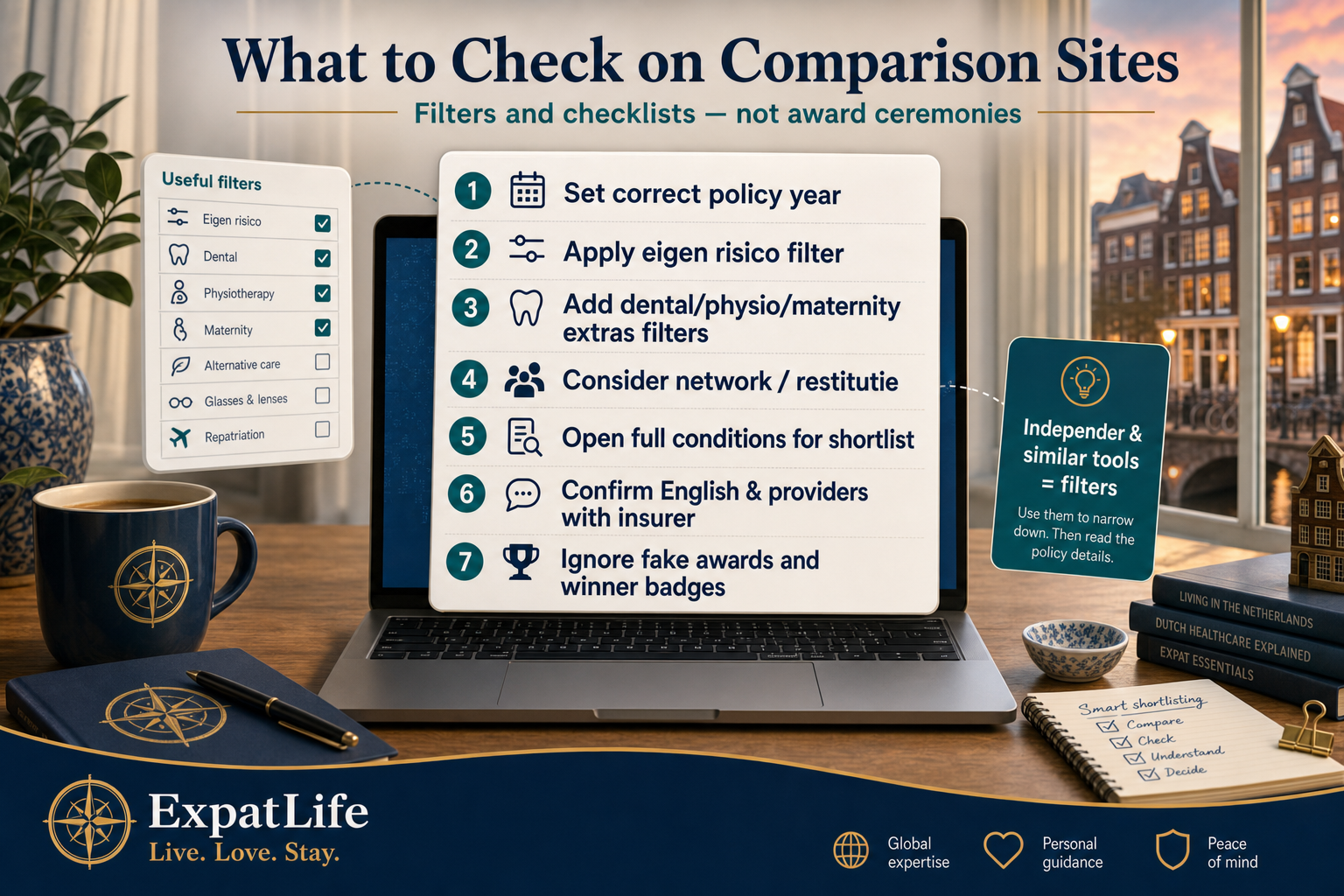
Wrong year or missing filters produce confident nonsense. Set year, deductible and extras before sorting by premium.
Session caps, waiting periods, network notes and exclusions live in details — not in the sort key.
Confirm critical claims with the insurer: English support, preferred providers and reimbursement examples.
Stars, badges and “winner” labels are marketing or editorial opinion — not official Dutch rankings for expats.
| Route | When | How | Note |
|---|---|---|---|
| Filter setup | Before sorting results | Set year, eigen risico, dental/physio/maternity extras | Garbage filters → garbage shortlists. |
| Shortlist review | After first sort | Open 2–3 policies end to end | Ignore trophy badges. |
| Insurer confirm | Before switching | Ask English + network + claims questions | Get answers in writing when possible. |
| Switch execution | Inside the window | Complete insurer switch / cancel correctly | Verify start date is 1 January when intended. |
Comparison-site checklist
Examples
| Situation | How it works here | First step |
|---|---|---|
| You only sorted by lowest premium | Restart with filters for network and extras — premium-only sorts hide fit risk. | Rebuild filters from your need list. |
| Site shows a “best” badge | Ignore the badge; score factors yourself. | Write your own scorecard with five fit criteria. |
| Details disagree with the summary row | Trust the policy conditions and insurer confirmation over the summary chip. | Screenshot both and ask the insurer which applies. |
Timing
Most residents compare and switch toward the end of the calendar year so a new policy starts on 1 January. Exact deadlines and auto-renewal mechanics can change — verify for the year you are in.
Newcomers also face arrival-related deadlines to take out basic insurance. That mandate clock is covered in the Early Setup Health Insurance guide. Do not confuse “I must insure after arrival” with “I can casually switch mid-year whenever I want.”
Mid-year changes are more limited. If you are unsure whether a life event allows a change, ask your current insurer and verify against official guidance rather than forum folklore.
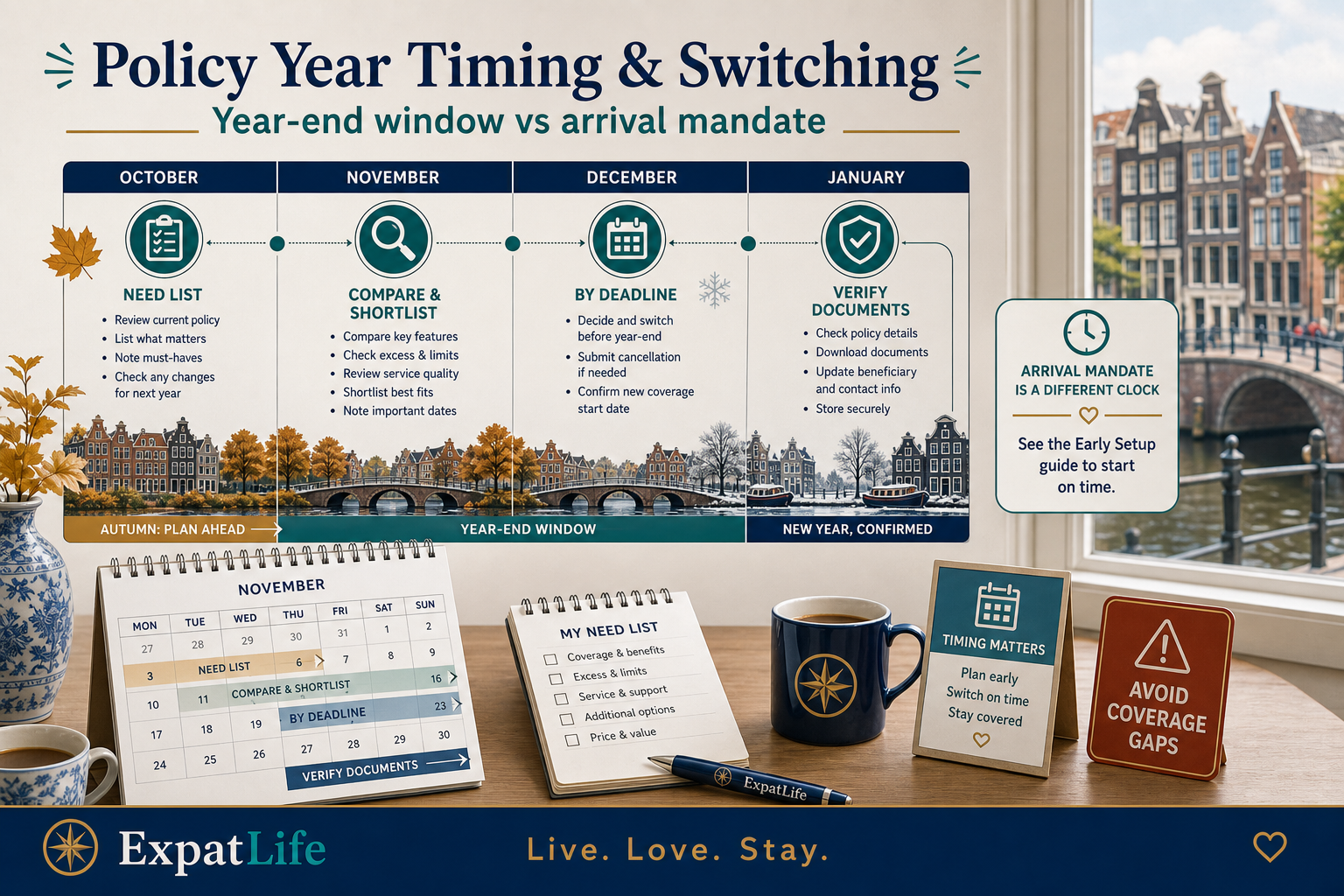
November–December is the practical research season for many households aiming at a 1 January start.
Many switches must be completed by 31 December for a New Year start — confirm the current rule before you wait.
New residents have their own timeline to arrange basic insurance — see the Early Setup guide.
If you do nothing, many policies continue — which is fine only if you still want the same fit.
Switch season
Window 1
Rebuild your care-need list and gather preferred-provider notes.
Window 2
Filter comparison sites, shortlist, and confirm English/network factors.
Window 3
Complete the switch with clear 1 January intent when that is your goal.
Window 4
Check policy documents, apps, cards and remaining deductible display.
Switching checklist
Examples
| Situation | How it works here | First step |
|---|---|---|
| Arrived in spring, still uninsured | Prioritise mandate compliance via Early Setup — comparison polish comes second. | Open Health Insurance (early setup) immediately. |
| Happy with insurer, unsure about extras | You can often adjust supplementary choices within insurer rules — still verify deadlines. | Ask your insurer what can change for 1 January. |
| Missed the year-end window | Assume you may be locked until next cycle unless a permitted life event applies. | Ask the insurer what options remain; avoid unverified mid-year myths. |
Extras context
Supplementary insurance is optional — but several expat-heavy care topics sit partly outside a lean basic-only budget. Use sibling guides for how those services work; use this page only for the insurance-factor lens.
Physiotherapy session caps, adult dental care, some maternity-related own contributions and day-to-day medicine logistics are common reasons expats reopen the extras conversation. None of those sibling pages are rebuilt here.
If your year is unlikely to touch those gaps, you may rationally skip heavy aanvullende tiers and revisit next November.
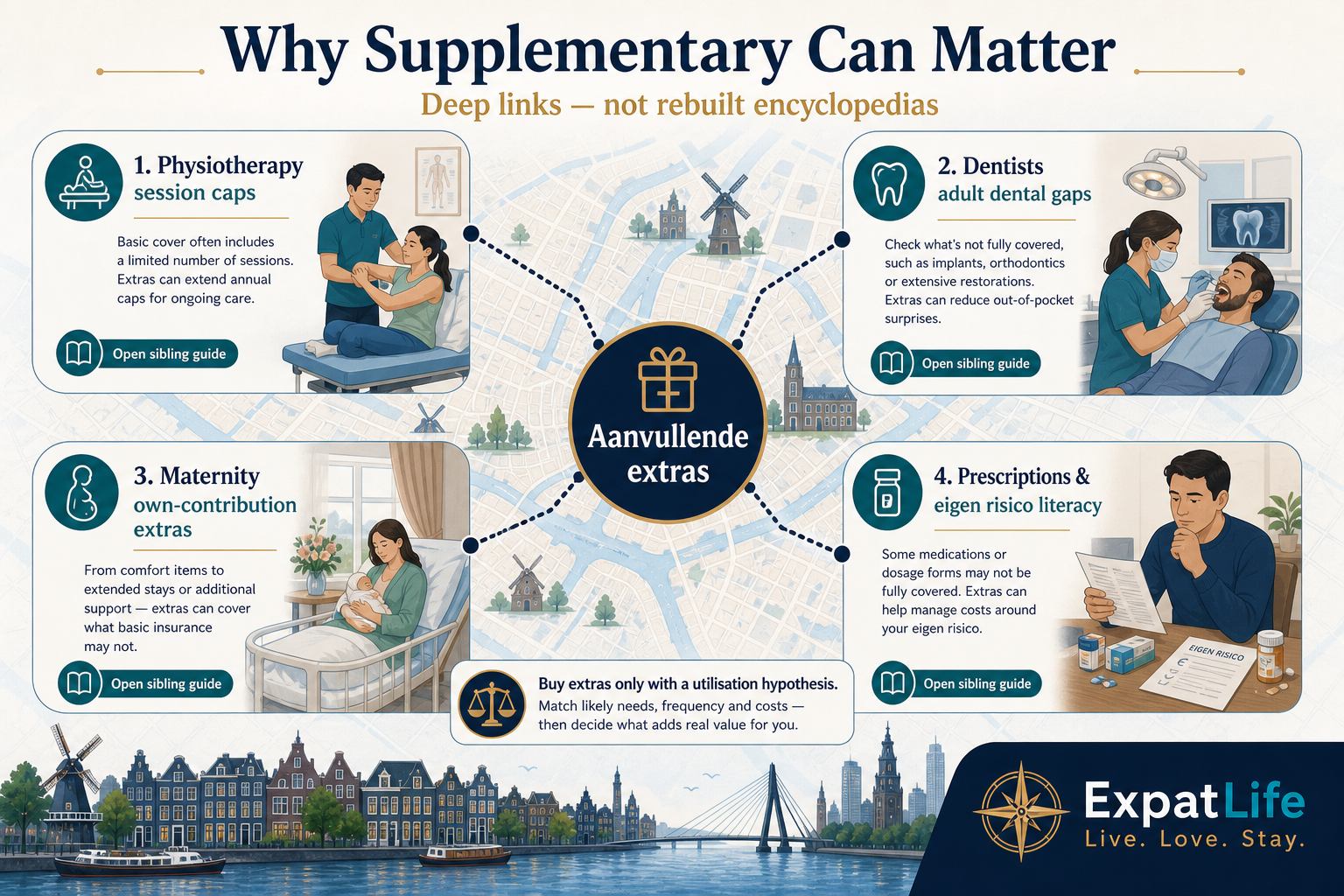
Many adult physio sessions rely on aanvullende caps. Direct access still does not equal unlimited reimbursement.
Adult routine dental care is a classic basic-package gap — supplementary dental tiers are a frequent comparison filter.
Core midwife/obstetric pathways are often basic-oriented; extras may still matter for certain contributions or comfort add-ons.
Prescribed medicines often route through basic insurance and may touch adult eigen risico — extras rarely replace deductible literacy.
Extras-context checklist
Examples
| Situation | How it works here | First step |
|---|---|---|
| Desk-job back pain every winter | Physio session caps become a primary filter. | Open Physiotherapy, estimate sessions, then compare packages. |
| Adult dental catch-up year | Dental supplementary tiers dominate the extras decision. | Open Dentists, then filter dental coverage bands. |
| Pregnancy + new medicines | Read Maternity and Prescriptions for care mechanics; compare only the insurance levers here. | Build a combined need list, then shortlist policies. |
Differences
Coming from systems with employer HMOs, private hospital networks or dental-in-basic norms, Dutch comparison culture can feel unfamiliar. These cards capture the usual surprises — without ranking insurers.

Benefit scope is largely standardised — newcomers sometimes over-search for coverage differences that barely exist.
Fix: Compare network, service, extras and deductible instead of hunting mythical basic gaps.
A cheap policy with the wrong network or unused extras can cost more in friction and waste.
Fix: Score fit factors before celebrating the lowest monthly price.
Adult routine dentistry frequently sits outside basic cover — a shock for many expats.
Fix: Use the Dentists guide + supplementary filters when dental work is likely.
Annual deductibles are a standard adult feature, not a scam.
Fix: Budget for it and decide consciously on voluntary top-ups.
Some processes are smooth in English; others expect Dutch for claims letters.
Fix: Test support channels before you switch.
Listicles and badges are not Dutch government rankings.
Fix: Use this framework and verify with official + insurer sources.
Checklist
Use this checklist when you compare or switch. It is a process aid — not a recommendation to buy any insurer or package.
Complete the need list and Early Setup basics before you touch premium sorting.
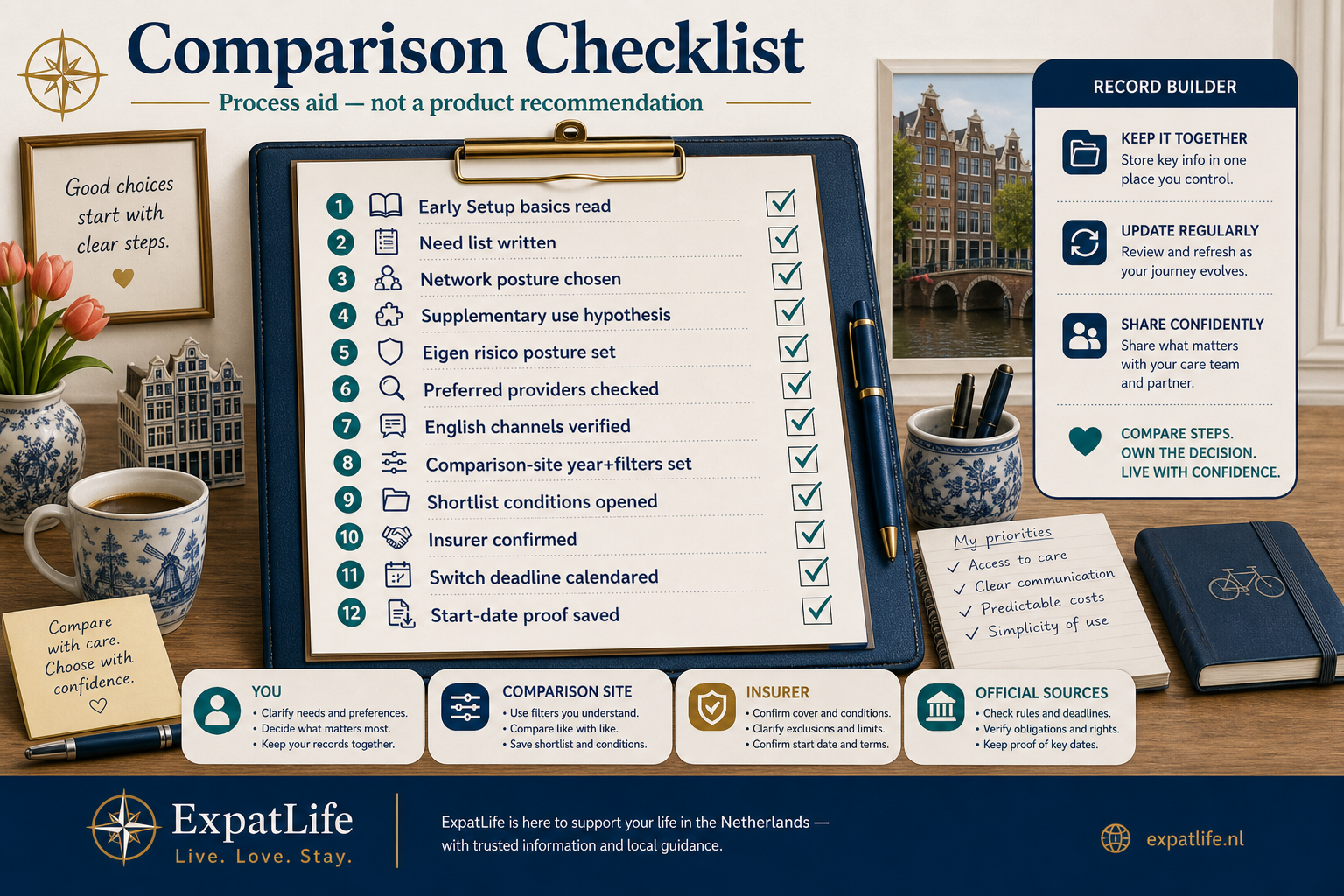
Comparison checklist
Need list, budget buffer and final switch decision.
Filtering and shortlisting for the correct policy year.
Policy wording, English support, network and claims confirmation.
Mandate, timing and basic-package literacy.
Whether dental, physio, maternity or medicines shape extras.
Government and regulator orientation — not product sales.
Avoid
These mistakes are expensive mainly because they skip fit factors or confuse mandate basics with optimisation. Fixes stay practical and non-alarmist.

Lowest monthly price can hide network friction or useless extras.
Fix: Score five fit factors before sorting by premium.
Provider freedom and personal-share rules differ by policy type.
Fix: Decide your freedom needs, then filter.
High dental or physio tiers with zero planned use waste premium.
Fix: Require a utilisation hypothesis for every extra.
People confuse deductible with “worse coverage.”
Fix: Treat it as a who-pays-first dial and budget accordingly.
Great research after the deadline does not help.
Fix: Calendar the deadline first.
“Best for expats” listicles are not official guidance.
Fix: Use this framework; verify with insurer and Government.nl.
FAQ
Orientation answers only — confirm your own situation with your insurer and official sources. This page does not rank insurers. Call 112 for life-threatening emergencies.

The basic package is largely standardised in what it covers. Insurers still differ in policy type (for example network-oriented versus more open reimbursement styles), service, apps, English support and contracted providers. Compare those factors rather than hunting for large mythical gaps in basic benefits.
Not automatically. Supplementary packages help when you expect gaps such as adult dental care or many physiotherapy sessions. If you cannot name a likely use, a leaner setup can be rational — revisit next year. See Physiotherapy, Dentists and Maternity care guides for care-context examples.
Broadly, natura-oriented policies emphasise contracted providers with smoother in-network billing, while restitutie-oriented policies generally allow more provider freedom with different reimbursement rules for non-contracted care. Labels and percentages vary — always read the policy for your year.
Eigen risico is the adult annual deductible for many basic-insured pathways. For orientation in 2026 the mandatory amount is about €385; voluntary top-ups can raise it while lowering premium. Whether to raise it depends on your cash buffer and expected care — this page does not advise either choice. Verify current steps with your insurer.
Use them as filtering tools for the correct policy year. They are not official rankings and not a substitute for reading conditions or confirming English support and networks with the insurer. This guide does not crown a winner from any comparison site.
Most voluntary switches aim for a 1 January start and must meet year-end deadlines. Newcomers also have arrival-related mandate timing covered in the Early Setup Health Insurance guide. Mid-year changes are more limited — ask your insurer rather than relying on forum advice.
There is no official “best for expats” insurer crown on ExpatLife. The useful question is which combination of network type, extras, deductible and English support fits your year. Score those factors; ignore fake awards.
Early Setup owns who must insure, the four-month rule and basic-package overview. This cornerstone owns comparison decision factors. Read Early Setup first if you are new, then use this framework to compare.
Related
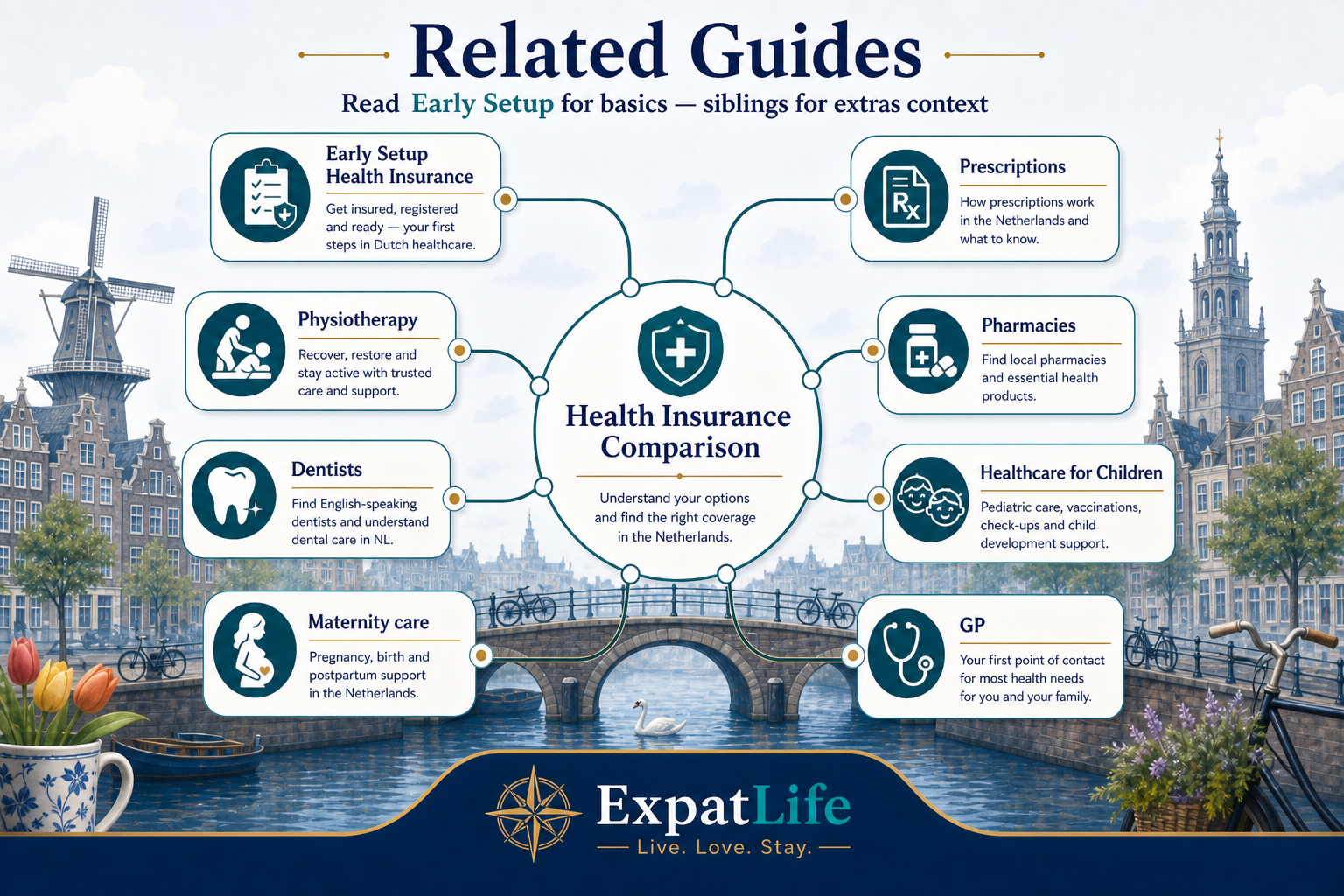
Comparison connects to Early Setup basics and to care guides that explain why extras may matter — read them together without duplicating their content here.
Health hub
This page is the health insurance comparison cornerstone — explore related health topics next.

Explore next
Pick the card that matches what is still open — mandate basics, physio extras, dental tiers, maternity planning or children's care — and verify specifics on the official sources below.

Trust
General information only — not insurance, financial or medical advice, and not an insurer ranking. Rules, premiums, deductible amounts and package terms change by year. Verify your own situation with official sources, your insurer and a current comparison tool. In a medical emergency, call 112.